
Showing 185 items matching "nursing equipment"
-
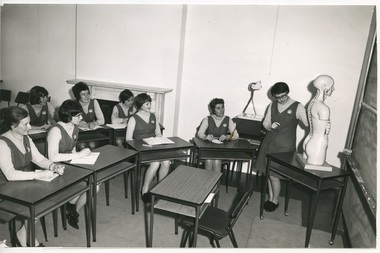 Royal District Nursing Service (now known as Bolton Clarke)
Photograph - Photograph, black and white, Barry Sutton, 14.09.1972
... Nursing Service, (RDNS). From 1885, only Trained nurses (Nurses) through the Hospital training system, were employed by the Society, and on visits to patients they taught the necessity of hygiene and cleanliness, as well as the need for a good diet, to bring about good health. Doctor’s lectures were later given at the MDNS home to instruct patients and their families on prevention of disease. Education to patients continued throughout the years regarding health care and the use of equipment ...This black and white photograph shows a group of RDNS Sisters who are part of the Post Basic Community Nursing Course. They are receiving education from Sr. Pat (Paddy) Rowley, RDNS Principal Nurse Educator. The session is being held in the Education Department at the Royal District Nursing Service Headquarters, 452 St. Kilda Rd, Melbourne.The RDNS winter uniform worn is a blue/grey skivvie under a blue/grey V neck tunic style herringbone winter material frock.Melbourne District Nursing Service ran its first Post-Basic Course for community nurses in 1962. Sisters attended the course for 12 weeks. The course ran annually until the mid 1990s. Education was an integral part of Melbourne District Nursing Society (MDNS), from its inception in 1885, later, in 1966, called Royal District Nursing Service, (RDNS). From 1885, only Trained nurses (Nurses) through the Hospital training system, were employed by the Society, and on visits to patients they taught the necessity of hygiene and cleanliness, as well as the need for a good diet, to bring about good health. Doctor’s lectures were later given at the MDNS home to instruct patients and their families on prevention of disease. Education to patients continued throughout the years regarding health care and the use of equipment in the home. In 1961, Education programs commenced at MDNS with their Trained nurses (Sisters) receiving In-service education. Sr. Pat (Paddy) Rowley was a leader in In-service Education and established the RDNS Department of Community Nursing Education in 1962. Staff could also apply for scholarships to further their education outside of RDNS. Many of their senior Sisters received Postgraduate diplomas from the College of Nursing in Community Health Nursing, Education, and Administration, and several travelled overseas visiting nursing organizations viewing their public health and District nursing systems. At RDNS many programs were run, including: a Post Basic Course, Cardiac Rehabilitation Nursing, Haematology/Oncology Nursing, Palliative Care program, Diabetic Stabilization Program, Leg Ulcer Management Program, Wound Care Specialist Program, HIV/AIDS Nursing Care, Cystic Fibrosis Home Support, Veterans Home Care Program, Breast Cancer Support Program, Continence Management Program, Stomal Therapy Program, In-Home Lactation Support Program and the Homeless Persons Program. RDNS staff attended several hospitals to observe and learn special care needed to some patients, e.g. to the Austin Hospital to learn the care required for paraplegic and quadriplegic patients at home, and to Mount Royal Hospital to observe the care of patients in the Rehabilitation ward. A Community Nursing Education Program was extended to student nurses from hospitals and to other nursing organizations. These Education programs kept the RDNS Sisters abreast of new techniques, such as changes in technology for e.g. new testing methods in detecting glucose levels in Diabetic patients. Sr. Nan Deakin obtained a Post Basic Certificate in Psychiatric Nursing and included this area in her Education lectures. Sr. Daphne Geldard specialized in the area of Alzheimer’s disease and Dementia. These Sisters visited patients in District areas with the regular RDNS Sister when required. Every member of staff, both professional and non professional staff, received regular education in the Education Department. In 1980, a Home Health Aide pilot study, funded by the Federal Government, the Brotherhood of St. Laurence and RDNS, with the program written and taught by Sr. Rowley, was evaluated as successful, and Home Health Aides were employed and worked in RDNS Centres under the supervision of RDNS Sisters. This black and white photograph is of a group of seven Royal District Nursing Service (RDNS) Sisters sitting in a semi-circle in two rows at single small two shelf tables. There are open white paged books or papers on each table and some of the Sisters have pens in their hands. The Sister sitting in the front far right is Sr. Affleck, who has dark short curly hair. The other Sisters have dark short hair in various styles. Further right in the photograph stands Sr. Rowley, who has dark short hair and is wearing glasses. She has her left hand supporting a torso of an anatomical model which is sitting on a table slightly to her left. She and the Sisters are looking at the vertebrae down the spine of the model. Another empty table is in front of the semi-circle and it sits in the centre foreground of the photograph. In the rear between Sr. Affleck and Sr. Rowley, a piece of equipment stands on a table. To the right of the photograph part of a large blackboard can be seen. The Sisters are wearing light grey skivvies under a darker V neck tunic style frock with the RDNS insignia on its upper left.Photographers stamp. Quote No. LD 8rdns education, rdns uniform, royal district nursing service, sister pat (paddy) rowley, sister margaret affleck -
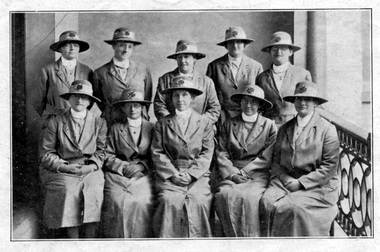 Royal District Nursing Service (now known as Bolton Clarke)
Photograph - Digital image, c.1922
... At that time they walked the streets and lane ways amid the slums of inner Melbourne carrying their nursing bag containing lotion, ointments, powders, liniment, bandages, dressings, a case of spirits, and the Nurse's own clean apron. The also supplied equipment ...The photograph appeared in the MDNS Annual Report of 1922 and is taken on the veranda of the Melbourne District Nursing Society (MDNS) Nurses Home at 39 Victoria Parade, Collingwood. The Sisters lived and worked out of the Nurses Home from June 1914 to 1953. They attended the disadvantaged in the inner suburbs of Melbourne. The Sisters and Matron are wearing the grey uniform and hat with a red Maltese cross is in the centre of the hatband which was introduced in 1921. These Sisters, plus two others visited 29.079 visits in the metropolitan area and in suburbs as far distant as Elwood, Glen Huntly, Deepdene, Essendon and Fairfield. Of the 1666 patients on the books 394 were midwifery patients nursed in their own homes. It is believed the Matron in the photograph is Matron Reynolds. In February 1885 it was recognized that nursing care was needed for the sick poor in inner Melbourne. The Melbourne District Nursing Society (MDNS) was founded on the 17th of February with one Trained nurse (Nurse) who qualified under the Hospital training system, commencing on the 1st of May, and a second employed six months later, both working in the now CBD, ie from Spencer Street to Spring Street and from Victoria Parade to Flinders Street. From its inception the Society was at the forefront of health care. They provided high quality nursing care; educated their patients in the curing and prevention of disease; teaching the importance of cleanliness and good nutrition, both by verbal instruction and demonstration, even supplying soup and milk when needed. At that time they walked the streets and lane ways amid the slums of inner Melbourne carrying their nursing bag containing lotion, ointments, powders, liniment, bandages, dressings, a case of spirits, and the Nurse's own clean apron. The also supplied equipment, such as earthenware hot water bottles, splints, urinals, bed pans, bed cradles, feeding mugs, and air-cushions as well as providing clean bed linen and nightdresses and clothes as necessary. In 1891 the first Nurses Home was rented for 1 year at £65 per annum at 66 Cardigan Street, Carlton; Nurses wages were now £60 per annum. A Doctor gave lectures from the Home to the public on the understanding and prevention of diseases. The Society decided to commence a Midwifery Service and Nurse Fowler, who had previously worked for the Society, was re-employed as their first trained Midwife. She began home births in August 1893 giving them Ante Natal care, taking midwifery bundles and providing clothes for the babe as needed. Following birth, she gave Post-natal care to the mother and babe twice a day for three days and then daily for a week, and longer if required. She resigned after twelve months and Nurse Wilkie was appointed to the position. As well as walking, the Nurses used Public transport in the limited areas it ran, though a taxi was used by the Nurses and Midwife in emergencies and at night. Late in 1891 the Society moved to larger rented premises at 49 Drummond Street and in 1902 moved to 188 Leicester Street, Carlton. The Nurses were becoming exhausted, particularly in the heat of summer. Permission to use bicycles was given to them in 1898 and the Society decided to purchase their own in 1903. A business man offered ‘new free wheel’ bicycles at £13 each, which included maintenance for one year. Bells and wooden frames were added at a cost of £5 per frame so the Nurses could carry extra equipment. Nurses bags were strapped to the handlebars. Soup was made for those in need 2-3 times a week, and if patients could not arrange to have it collected, the soup was delivered by the Nurses on their bicycles. Their use caused a change in uniform, with white pith helmets, and veils covering them and tied under their chins, now being used. In 1904 the Society relocated to rented premises at 5 Royal Terrace, Nicholson Street in Fitzroy. In 1913 a Nurse had her ‘board and residence, uniforms, bicycles and laundry expenses’ provided and was paid £50 a year for her first six months. At the end of a year her salary was increased by £5, and later she earned £60 a year. Over the years the Nurses complained their veils became wet in the rain and asked for a change of uniform, but this did not occur until 1921. In 1914 the Society was at last able to purchase their own premises, 'Floraston' 39 Victoria Parade in Collingwood. During the Spanish Influenza epidemic, in 1919, MDNS appealed for assistance to procure Motor vehicles so the Nurses could visit an influx of cases. Through trusts, grants and donations four 'Ford 'T Model' cars were procured which enabled the Nurses to triple their visits. It was recorded on the 21st of May, that the seven Nurses had visited 1,212 persons with influenza in the last three months, how many visits to each is not known. In the whole of 1918 the Nurses, including midwifery cases, visited 1,100 persons. It was also recorded on May 7th the Nurses were delivering 100 quarts of soup to the needy each morning. In winter they also carried wood in the cars to distribute to their destitute patients as needed. In 1921-22 many of the people nursed by the Trained nurses (Sisters) suffered from malignant and tubercular disease, often the Sister would visit to find the patient was desperately ill living in a room alone and no one there to even give them a drink. In these cases the Sister would send them to hospital, but if possible most cases were nursed in their home. During July 1921- 30 June 1922 the four Midwifery trained Sisters averaged 8 confinement cases a week and sometimes gave Post Natal care to 15 to 18 patients a day. At the time of confinement a Student from the Women's Hospital accompanied the MDNS Sister and if complications occurred the patient was transferred to the Women's Hospital. The Society often had to provide blankets, sheets, set of baby clothes and night gowns for the mother. In many instances the Society provided milk for many months. The midwifery Sisters often travelled long distances in the cars Through constant use the cars were in such a poor state they were sold in 1927 and the Sisters went back to using public transport, as well as their bicycles which continued to be used in inner areas until 1945.. The Midwives used taxis when a birth was imminent. Black and white photograph showing 9 Sisters, 5 standing at rear and Matron, in the centre, of 4 seated Sisters on a balcony wearing their Melbourne District Nursing Society (MDNS) uniforms of grey coats, with revered collars and belt, over their partly seen grey uniforms with white collars. Five of the Sisters are wearing glasses. All are wearing grey brimmed hats with a Maltese cross in the centre of the lighter colour hatband. Part of deep metal scroll work of the veranda rail can be seen. A concrete wall is behind the Sisters.mdns, mdns matron, miss reynolds, royal district nursing service, rdns, melbourne district nursing society, mdns uniforms -
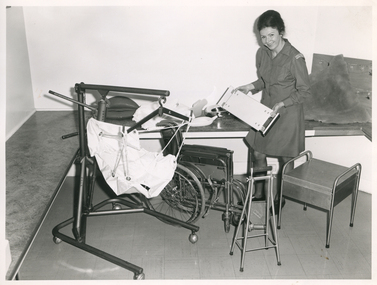 Royal District Nursing Service (now known as Bolton Clarke)
Photograph - Photograph, black and white:, Barry Sutton, 10.08.1971
... equipment...rdns uniform...royal district nursing...She is wearing the RDNS grey uniform dress which has the insignia "Royal District Nursing Service" written in white on a grey background attached to the upper sleeves. The photograph is showing some of the equipment which is available for temporary loan to RDNS patients....Headquarters also kept additional equipment which could be transported to Centres as required. rdns rdns equipment rdns uniform royal district nursing service sister scott Barry Sutton Photographer. ...Sr. Scott is in a room in the Royal District Nursing Service (RDNS) Melbourne Centre. She is wearing the RDNS grey uniform dress which has the insignia "Royal District Nursing Service" written in white on a grey background attached to the upper sleeves. The photograph is showing some of the equipment which is available for temporary loan to RDNS patients.From the founding of the Melbourne District Nursing Society (MDNS), in 1885, known as the Royal District Nursing Service (RDNS) from 1966, equipment was loaned and demonstrated to patients and their family members, to enable them to care for their loved ones in their home. In the 1970s RDNS employed a Physiotherapist who taught RDNS staff the correct transferring techniques, including the use of a hoist when this became available. RDNS staff taught and used these techniques in patient’s homes to undertake safe transfer of the patient and to reduce physical strain on RDNS nursing staff and family members. Each RDNS Centre had a room or shed where equipment for loan was kept. Headquarters also kept additional equipment which could be transported to Centres as required. Black and white digital image portraying Sister Scott, who is smiling and has her dark hair drawn up, checking equipment. She is holding a bath seat in her hands. Behind her on a table, left to right, is an air cushion, draw sheets, male urinal, female urinal, bed pan and a sheepskin which is in front of a wooden board with rows of cup hooks and names under each hook. In the left foreground is a hoist with a white sling hanging from either side of the front hanger. To its right is a closed wheelchair, a 4 pronged walking stick, and a commode to the right of Sr. Scott.Barry Sutton Photographer. Quote KL 49rdns, rdns equipment, rdns uniform, royal district nursing service, sister scott -
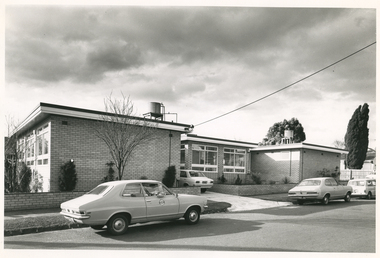 Royal District Nursing Service (now known as Bolton Clarke)
Photograph - Digital image, Barry Sutton, 12.07.1972
... Their Trained nurses (Sisters) left from these Centres each morning to carry out their nursing visits in a specific area (district), taking any sterilized equipment needed with them. ...The photograph is taken outside the new Royal District Nursing Service (RDNS) Caulfield Centre. RDNS Sisters left in RDNS Torana vehicles from this Centre each morning to give nursing care to patients in surrounding suburbs and returned to the Centre after their visits. Gradually over the years, Melbourne District Nursing Service (MDNS), later known as Royal District Nursing Service (RDNS) from 1966 when they received Royal patronage, opened Centres throughout the Melbourne Metropolitan area and outer suburbs. In 1972 The Melbourne Centre which was conducted from RDNS Headquarters, 452 St. Kilda Road, was relocated to Caulfield and it became the Caulfield Centre. Their Trained nurses (Sisters) left from these Centres each morning to carry out their nursing visits in a specific area (district), taking any sterilized equipment needed with them. They returned at the end of the day to write up their patients nursing histories, clean and reset any equipment used ready for re-sterilization, and contact other medical and community personal as necessary. Most of the RDNS cars were housed at each Centre, only a few being driven home by a Sister. This is a black and white photograph of two RDNS two door grey Torana cars parked on the road outside a flat roof, one storey, light coloured brick building. The building is in three sections with the centre section set back. Part of the back of a white car can be seen in the driveway to the left of the set back section. Three large white framed windows can be seen along the end view of the left hand section and even larger windows are seen in the centre section. A small water tank and piping sit on a platform on the roof of both the left and right hand sections of the building. White fascia with dark trim above it edges the roof on each sections of the building. Some pencil shape type shrubs and a bare tree is seen in front of the building and a low light coloured brick fence runs across the property and down either side of the drive, with the footpath and nature strip in front of this. The back of a white car is seen on the road in the far right of the photograph and part of a wooden fence and parts of two large trees with leaves can be seen.Barry Sutton Photographer's Stamp. Quote KY 5rdns, royal district nursing service, rdns transport, rdns centre -
 Royal District Nursing Service (now known as Bolton Clarke)
Photograph - Photograph, black and white, Barry Sutton, 19.07.1972
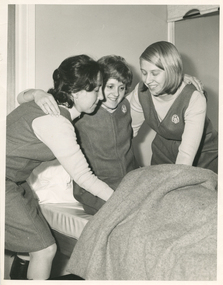
... From the founding of the Melbourne District Nursing Society (MDNS) in 1885, known as Royal District Nursing Service (RDNS) from 1966, the rehabilitation of patients to insure they were able to live independently in their own homes was at the forefront of care given by their Trained nurses. As well as teaching and supervising the use of equipment ...This photograph is taken in a room in the RDNS Heidelberg Centre. The Sisters are demonstrating a lifting technique to staff members. The Sisters are wearing their RDNS winter uniforms which are a blue/grey skivvie under a blue/grey V neck tunic style herringbone winter material dress with the RDNS insignia on the upper left. From the founding of the Melbourne District Nursing Society (MDNS) in 1885, known as Royal District Nursing Service (RDNS) from 1966, the rehabilitation of patients to insure they were able to live independently in their own homes was at the forefront of care given by their Trained nurses. As well as teaching and supervising the use of equipment, their Trained nurses taught them safe transfer techniques. These techniques were also taught to family members to enable them to care for their loved ones. RDNS at first held workshops given by a contracted private Physiotherapist, before employing their own Physiotherapist in 1975, who taught staff the correct transfer techniques, not only for safety of the patient, but to reduce physical strain on RDNS nursing staff and patient’s family members. When required the Physiotherapist accompanied the Sister on her visit to the patient in their home.Black and white photograph of three Royal District Nursing Service (RDNS) Sisters demonstrating a safe bed transfer. From Left to Right is the side on view of Sisters Daphne Geldard, who has short dark curled hair with her left arm around the back of Sister Elizabeth Francis, and her right arm under her legs. Sister Francis has short dark hair and is smiling. She has her right arm over the shoulders of Sr. Geldard, and her left arm is over the shoulder of Sr. Bev Armstrong. Her buttocks are slightly off the bed which has a white pillow and grey blanket. Sr. Armstrong is facing both Sisters. She has short straight blonde hair and has her eyes closed. She has her right arm around the back of Sr. Frances and her left arm is under her legs. The three Sisters are wearing light coloured skivvies under a darker V neck tunic style dress with the RDNS insignia on the upper left. Barry Sutton's Photographer's Stamp. Reprint Quote Number: KY22 Handwritten on back of photo are the names of the RDNS staff members and the location is Heidelberg Centrerdns, royal district nursing service, rdns uniform, rdns physiotherapist, rdns centre, sister daphne geldard, sister elizabeth francis, sister bev armstrong -
 Royal District Nursing Service (now known as Bolton Clarke)
Photograph - Photograph, black and white, Barry Sutton, 19.07.1972
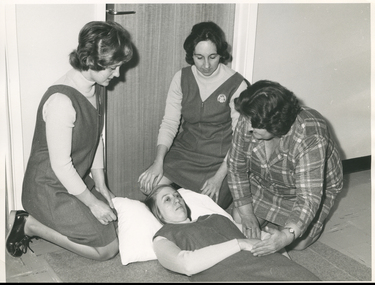
... The RDNS Sisters are wearing their winter uniforms of a blue/grey skivvie under a blue/grey V neck tunic style herringbone winter material dress, From the founding of the Melbourne District Nursing Society (MDNS) in 1885, known as Royal District Nursing Service (RDNS) from 1966, the rehabilitation of patients to insure they were able to live independently in their own homes was at the forefront of care given by their Trained nurses. As well as teaching and supervising the use of equipment ...Mrs P.. Cosh is a private Physiotherapist contracted by RDNS to educate RDNS nursing staff in safe transferring techniques. This photograph is taken in the Heidelberg Centre. The RDNS Sisters are wearing their winter uniforms of a blue/grey skivvie under a blue/grey V neck tunic style herringbone winter material dress,From the founding of the Melbourne District Nursing Society (MDNS) in 1885, known as Royal District Nursing Service (RDNS) from 1966, the rehabilitation of patients to insure they were able to live independently in their own homes was at the forefront of care given by their Trained nurses. As well as teaching and supervising the use of equipment, their Trained nurses taught them safe transfer techniques. These techniques were also taught to family members to enable them to care for their loved ones. RDNS at first held workshops given by a contracted private Physiotherapist before employing their own Physiotherapist in 1975 who taught staff the correct techniques, not only for safety of the patient, but to reduce physical strain on RDNS nursing staff and patient’s family members. When required the Physiotherapist accompanied the Sister on her visit to the patient in their home.On the left in the black and white photograph is Royal District Nursing Service (RDNS) Sister Elizabeth Francis, who has curled dark hair and is kneeling on a mat looking down at Sr. Bev. Armstrong, who has straight blonde hair and is lying on a mat on the floor with her head resting on a white pillow and her right arm resting across her body. Behind and slightly to the right of Sr. Armstrong is Sr. Daphne Geldard who has short dark curled hair. She is kneeling on the mat and looking down at Sr. Armstrong. To her right is Physiotherapist Mrs. P. Cosh, who has dark short curled hair and is wearing a check suite. She is looking at Sr. Armstrong and has her left hand resting on the out edge of Sr. Armstrong's right hand. The RDNS Sisters are wearing a light coloured skivvie under a darker V neck tunic style dress. A closed wooden door is behind the Sisters with pale walls either side. Lino tiles are on the floor either side the mat on which Sr. Armstrong lay.Barry Sutton Photographer's Stamp, Quote KY28, names of staff hand written on back of photographrdns, royal district nursing service, nurses uniforms, rdns physiotherapist, sister elizabeth francis, sister bev armstrong, sister daphne geldard, mrs p. cosh -
 Royal District Nursing Service (now known as Bolton Clarke)
Photograph - Photograph, black and white, Barry Sutton, 19.07.1972
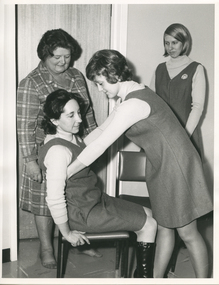
... From the founding of the Melbourne District Nursing Society (MDNS) in 1885, known as Royal District Nursing Service (RDNS) from 1966, the rehabilitation of patients to insure they were able to live independently in their own homes was at the forefront of care given by their Trained nurses. As well as teaching and supervising the use of equipment ...Miss Kosch is a private physiotherapist contracted by RDNS. She is at RDNS Heidelberg Centre teaching RDNS staff a safe method of lifting and transferring Sr. Geldard from a chair. From the founding of the Melbourne District Nursing Society (MDNS) in 1885, known as Royal District Nursing Service (RDNS) from 1966, the rehabilitation of patients to insure they were able to live independently in their own homes was at the forefront of care given by their Trained nurses. As well as teaching and supervising the use of equipment, their Trained nurses taught them safe transfer techniques. These techniques were also taught to family members to enable them to care for their loved ones. RDNS at first held workshops given by a contracted private Physiotherapist before employing their own Physiotherapist in 1975 who taught staff the correct techniques, not only for safety of the patient, but to reduce physical strain on RDNS nursing staff and patient’s family members. When required the Physiotherapist accompanied the Sister on her visit to the patient in their home.Standing in the rear left of the black and white photograph is Ms Kosch, who has short curled dark hair and is wearing a check suit. She is looking down at Royal District Nursing Service (RDNS). Sister (Sr) Daphne Geldard, who has collar length curled dark hair, and is seated in front of her on a padded kitchen type chair. To Sr. Geldard's right, standing, is Sr Elizabeth Francis who has short dark curled hair and is bending forward with her arms outstretched under Sr. Geldard's armpits. She has her right leg braced against Sr. Geldard's right knee Sr Bev. Armstrong, who has short blonde hair, is standing at the right rear observing the procedure. The three Sisters are wearing a grey skivvie under a darker V neck tunic style dress with the RDNS insignia on the upper left. A black below knee boot is seen on Sr. Geldard's right leg. A closed dark wooden door with a white surround is behind Ms Kosch and to its right another chair is seen against the wall. Photographers stamp , names of staff, date and location. Quote KY 35rdns, royal district nursing service, rdns uniform, rdns physiotherapy, sister elizabeth francis, sister daphne geldard, sister bev armstrong, ms kosch -
 Royal District Nursing Service (now known as Bolton Clarke)
Photograph - Digital image, Barry Sutton, c.1930
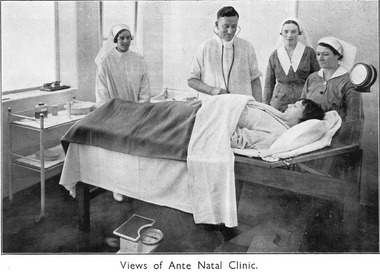
... In 1930 the Society were pioneers in opening an Ante-Natal Clinic at the Melbourne District Nursing Society (MDNS) After-Care Home, setting a high standard with equipment, keeping records and providing leaflets with instructions in how to keep healthy during pregnancy, what complications to look for, and what to do when labour commenced. ...In 1930 the Society were pioneers in opening an Ante-Natal Clinic at the Melbourne District Nursing Society (MDNS) After-Care Home, setting a high standard with equipment, keeping records and providing leaflets with instructions in how to keep healthy during pregnancy, what complications to look for, and what to do when labour commenced. ...In 1930 the Society were pioneers in opening an Ante-Natal Clinic at the Melbourne District Nursing Society (MDNS) After-Care Home, setting a high standard with equipment, keeping records and providing leaflets with instructions in how to keep healthy during pregnancy, what complications to look for, and what to do when labour commenced. This image was taken in the Ante-Natal Clinic and shows some of the equipment used at that time and the uniforms worn by Trained nurses (Sisters) in the 1930s. Melbourne District Nursing Society (MDNS) was founded in 1885 and only nurses who had trained in a Hospital Training School and were fully qualified were employed by the Society. It commenced with one Trained nurse (Nurse), and another employed six months later; both walking amid the slums of inner Melbourne administering nursing care to the sick poor. The Society decided to commence a Midwifery Service and Nurse Fowler, who had previously worked for the Society, was re-employed as their first Trained Midwife. She began home births in August 1893 giving some Ante Natal care, taking midwifery bundles and providing clothes for the babe and mother as needed. Following birth, she gave Post-natal care to the mother and babe twice a day for three days and then daily for a week, and longer if required. She resigned after twelve months and Nurse Wilkie was appointed to the position. As well as walking, the Nurses used Public transport in the limited areas it ran, though a taxi was used by the Nurses and Midwife in emergencies and at night. As the Society expanded it rented premises until it was able to purchase it's own Nurses Home at 39 Victoria Parade, Collingwood in 1914. The Society were pioneers in recognizing the need for premises where patients too ill to be in their own home, but not ill enough to go to hospital, was needed. Land was procured next to No. 39, and the Society built the After-Care Home at 45 Victoria Parade, for these patients, and for patients from Hospitals. It was opened in July 1926 and the name of the Society then became ‘Melbourne District Nursing Society and After-Care Home’ (‘Hospital’ from 1934) The Ante-Natal Clinic at the Melbourne District Nursing Society After-Care Home was opened on the 23rd of September 1930 and MDNS Midwifery patients were encouraged to attend. Prior to the opening of the clinic Ante-natal care was not considered important, but within a short time 100 percent of MDNS Midwifery patients were attending. During 1934 the Women’s Welfare Clinic, including at the time a very controversial Family Planning Clinic, the first of its kind in Australia, was opened to support women at risk following multiple and difficult pregnancies. The Clinic gave advice on birth-control and was attended by their own patients at first, but then accepted patients from Melbourne public hospitals until their own clinics were opened.Digital image showing a Doctor and three Melbourne District Nursing Society (MDNS) Sisters attending a patient in the Ante-Natal Clinic at the After Care Hospital. In the forefront is a set of scales standing on the floor, behind which is the lady lying on a wooden framed bed with the base slightly raised at the top end supporting a white pillow and the lady's head. The lady has short dark hair and her frock can be seen to her waist; the rest of her body is covered by a white sheet and dark coloured blanket. Behind her and to the right of the image, are two Sisters wearing dark coloured long sleeved uniforms which have a belt and white collar; they are both wearing white veils over their short dart hair. To their left is a Doctor who has short dart wavy hair and is looking down at the lady. He is wearing a long white gown and has a stethoscope in his ears with the other end held in his right hand. To his left is another Sister who is wearing a white veil over her dark curled hair, and is wearing a long white gown. In the rear between the Doctor and Sister a hand basin can be seen. On the far left of the picture a trolley with two cloth covered shelves can be seen; a basin and squat bottle sits on the top shelf and kidney dish on the lower one. Behind this, part of a window can be seen.after- care hospital, 45 victoria parade collingwood, melbourne district nursing society (1885-1957), ante-natal clinic, after-care home, mdns midwifery, rdns, royal district nursing service -
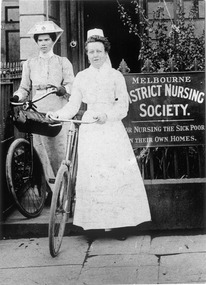 Royal District Nursing Service (now known as Bolton Clarke)
Photograph - Digital image, 1905
... At that time they walked the streets and lane ways amid the slums of inner Melbourne carrying their nursing bag containing lotion, ointments, powders, liniment, bandages, dressings, a case of spirits, and the Nurse's own clean apron, soap and small towel. They supplied equipment ...The Sister-in-Charge, Florence Lee-Archer, and a Trained nurse (Nurse) are about to leave the Melbourne District Nursing Society (MDNS) Nurses Home at No. 5 Royal Terrace, Nicholson Street, Fitzroy to visit patients. The MDNS moved into these larger premises at No. 5 Royal Terrace, Nicholson Street, Fitzroy in May 1904. This establishment was their Headquarters as well as the Nurses Home. Sister-in-Charge Florence Lee-Archer and five Trained nurses, known as 'Nurse' in those days, were employed by MDNS at that time to visit and give nursing care to the poor in their own homes. In 1885, 50 years after Melbourne was founded, it was recognized that nursing care was needed for the sick poor in inner Melbourne. The Melbourne District Nursing Society (MDNS) was founded in February 1885 with one Trained nurse, called 'Nurse' in those days, and a second employed six months later, working in the now CBD, ie from Spencer Street to Spring Street and from Victoria Parade to Flinders Street. From its inception the Society was at the forefront of health care and liaised with Doctors. They provided high quality nursing care; educated their patients in the curing and prevention of disease and teaching the importance of cleanliness, fresh air and good nutrition, both by verbal instruction and demonstration, even supplying soup and milk when needed. At that time they walked the streets and lane ways amid the slums of inner Melbourne carrying their nursing bag containing lotion, ointments, powders, liniment, bandages, dressings, a case of spirits, and the Nurse's own clean apron, soap and small towel. They supplied equipment on loan, such as earthenware hot water bottles, splints, urinals, bed pans, bed cradles, feeding mugs, and air-cushions as well as providing blankets and clean bed linen, and nightdresses as necessary. Trained midwives began home births in August 1893 taking midwifery bundles and providing clothes for the babe as needed. The Nurses provided nursing care to a range of people, often in destitute situations, some lying on rags on the floor as they had no bed, others with just a bed and maybe a thin blanket, a chair and nothing else. Their ages ranged from babes, children, adults to the elderly. The Nurses gave medications as ordered, dressed wounds e.g. to the injured, and surgical cases, and to those with leg ulcers; attended to patients with ‘surgical ailments’ such as ‘hip disease’; gave care to those with acute illnesses such as bronchitis, pleurisy, pneumonia, measles, and scarlet fever, as well as those with chronic illnesses such as consumption (tuberculosis), heart disease, arthritis, cancer, debility, neuritis and paralysis. The Nurses were becoming exhausted, particularly in the heat of summer. Permission to use bicycles was given to them in 1898 and the Society decided to purchase their own in 1903. A business man offered ‘new free wheel’ bicycles at £13 each, which included maintenance for one year. Bells and wooden frames were added at a cost of £5 per frame so the Nurses could carry extra equipment. Nurses bags were strapped to the handlebars. Soup was made for those in need 2-3 times a week, and if patients could not arrange to have it collected, the soup was delivered by the Nurses on their bicycles. Their use caused a change in uniform, with white pith helmets, and veils covering them and tied under their chins, now being used and straw hats in summer. In 1904 the Society relocated to rented premises at 5 Royal Terrace, Nicholson Street in Fitzroy. In 1913 a nurse had her ‘board and residence, uniforms, bicycles and laundry expenses’ provided and was paid £50 a year for her first six months. At the end of a year her salary was increased by £5, and later she earned £60 a year. Over the years the Nurses complained their veils became wet in the rain and asked for a change of uniform, but this did not occur until 1921.Digital Image showing, on the right, Melbourne District Nursing Society (MDNS) Sister-in-Charge Florence Lee-Archer wearing a long white uniform and white cap with long white tail (veil) seen hanging from its rear. On her left, is a MDNS Trained nurse (Nurse) wearing a long grey uniform with white collar and cuffs, and wearing a pale colour straw hat with Maltese cross in the centre of the white hatband. The hat is held on by a veil over the hat and tied under her chin. They are standing by their bicycles, the front wheels and handlebars seen; the Nurse has a nursing bag attached to the handlebars of her bicycle. Behind them and to their right, a black sign with the words 'Melbourne District Nursing Society - For Nursing the Sick Poor in their Own Homes' written in white capital letters can be seen attached to the metal spiked fence. Behind this are some shrubs and part of a building in the rear.Melbourne District Nursing Society - For Nursing The Sick Poor In Their Own Homes.melbourne district nursing society, mdns, mdns headquarters, mdns matron, rdns, royal district nursing service, sister florence lee-archer -
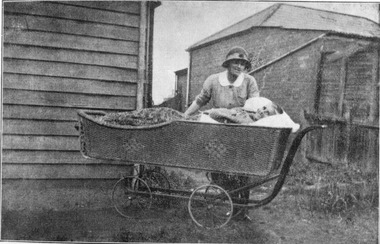 Royal District Nursing Service (now known as Bolton Clarke)
Photograph - Digital image, c.1920
... At that time they walked the streets and lane ways amid the slums of inner Melbourne carrying their nursing bags containing lotion, ointments, powders, liniment, bandages, dressings, a case of spirits, and the Nurse's own clean apron, soap and small towel. They supplied equipment ...This digital image is taken at the home of a Melbourne District Nursing Society (MDNS) patient, and depicts a MDNS Sister attending to a lady who is lying in a wicker bed pram in the rear garden of her home. The wicker bed pram enabled the lady to enjoy fresh air and to be moved about easily. The image shows the MDNS uniform of a grey cotton frock with white collar, and a grey brimmed hat with a red Maltese cross in the centre of the hatband. In 1885, 50 years after Melbourne was founded, it was recognized that nursing care was needed for the sick poor in inner Melbourne. The Melbourne District Nursing Society (MDNS) was founded in February 1885 with one Trained nurse, known as 'Nurse' in those days, and a second employed six months later,. The two Nurses worked in the now CBD, ie from Spencer Street to Spring Street and from Victoria Parade to Flinders Street. At that time they walked the streets and lane ways amid the slums of inner Melbourne carrying their nursing bags containing lotion, ointments, powders, liniment, bandages, dressings, a case of spirits, and the Nurse's own clean apron, soap and small towel. They supplied equipment on loan, such as earthenware hot water bottles, splints, urinals, bed pans, bed cradles, feeding mugs, and air-cushions as well as providing blankets and clean bed linen, and nightdresses as necessary. From its inception the Society was at the forefront of health care and liaised with Doctors. They provided high quality nursing care to a range of people, often in destitute situations, some lying on rags on the floor as they had no bed, others with just a bed and maybe a thin blanket, a chair and nothing else. Their ages ranged from babes, children, adults to the elderly. The Nurses gave medications as ordered, dressed wounds e.g. to the injured, and surgical cases, and to those with leg ulcers; attended to patients with ‘surgical ailments’ such as ‘hip disease’; gave care to those with acute illnesses such as bronchitis, pleurisy, pneumonia, measles, and scarlet fever, as well as those with chronic illnesses such as consumption (tuberculosis), heart disease, arthritis, cancer, debility, neuritis and paralysis. This image shows a Melbourne District Nursing Society (MDNS) Trained nurse (Sister) wearing a grey uniform with white collar, and a grey brimmed hat, which has a hatband with Maltese cross applied, standing behind and attending an elderly lady patient laying in a wicker bed pram outside her home. The Sister has her right hand resting on the pram and is looking down at the lady, and the lady, who has short grey hair, is smiling and looking toward the camera. Her body is covered with a floral cover. To the left, part of the horizontal weatherboards of a wooden house can be seen, and to the right and rear, a brick, tiled hip roof, building can be seen. The wicker bed pram has four spoked wheels and a metal frame that bends up to form a handle on its right hand side.melbourne district nursing society, mdns, mdns nurses, mdns patient care, mdns uniforms, rdns, royal district nursing service -
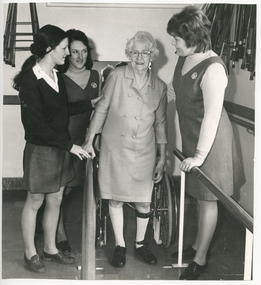 Royal District Nursing Service (now known as Bolton Clarke)
Photograph - Photograph, black and white, Barry Sutton, 20.07.1972
... Nursing Service, (RDNS). From 1885, only Trained Nurses (Nurses) who trained through the Hospital training system were employed by the Society, and on visits to patients they taught the necessity of hygiene and cleanliness, as well as the need for a good diet, to bring about good health. Doctor’s lectures were later given at the MDNS home to instruct patients and their families on prevention of disease. Education to patients continued throughout the years regarding health care and the use of equipment ...The photograph is taken in the Physiotherapy Department at Mount Royal Hospital. RDNS Sr. Sue Revill is from RDNS Moorabbin Centre and Sr. Helen Watt is from Footscray Centre, They are attending an Education session on Rehabilitation at Mount Royal. Hospital. They are wearing the RDNS winter uniform of a blue/grey skivvie under a V neck tunic style herringbone winter material dress with the RDNS insignia emblazoned on its upper left.Education was an integral part of Melbourne District Nursing Society (MDNS), from its inception in 1885, later, in 1966, called Royal District Nursing Service, (RDNS). From 1885, only Trained Nurses (Nurses) who trained through the Hospital training system were employed by the Society, and on visits to patients they taught the necessity of hygiene and cleanliness, as well as the need for a good diet, to bring about good health. Doctor’s lectures were later given at the MDNS home to instruct patients and their families on prevention of disease. Education to patients continued throughout the years regarding health care and the use of equipment in the home. In 1961, Education programs commenced at MDNS with their Trained nurses (Sisters) receiving In-service education. Sister Pat (Paddy) Rowley was a leader in this In-service Education and established the MDNS, later called RDNS, Department of Community Nursing Education in 1962. Staff could also apply for scholarships to further their education outside of RDNS. Many of their senior Sisters received Postgraduate diplomas from the College of Nursing in Community Health Nursing, Education, and Administration, and several travelled overseas visiting nursing organizations viewing their public health and district nursing systems. Many programs were run at RDNS, including: a Post Basic Course, Cardiac Rehabilitation Nursing, Haematology/Oncology Nursing, Palliative Care program, Diabetic Stabilization Program, Leg Ulcer Management Program, Wound Care Specialist Program, HIV/AIDS Nursing Care, Cystic Fibrosis Home Support, Veterans Home Care Program, Breast Cancer Support Program, Continence Management Program, Stomal Therapy Program, In-Home Lactation Support Program and the Homeless Persons Program. RDNS staff attended several hospitals to observe and learn special care needed to some clients, e.g. to the Austin Hospital to learn the care required for paraplegic and quadriplegic clients at home, and to Mount Royal Hospital to observe the care of clients in the Rehabilitation ward. A Community Nursing Education Program was extended to Student nurses from Hospitals and to other nursing organizations. These Education programs kept the RDNS Sisters abreast of new techniques, such as changes in technology for e.g. new testing methods in detecting glucose levels in Diabetic patients. Sr. Nan Deakin did a Post Basic Course in Psychiatric Nursing and included this area in her education lectures. Sr. Daphne Geldard specialized in the area of Alzheimer’s disease and Dementia. These Sisters visited patients in District areas with the regular RDNS Sister when required. Every member of staff, both professional and non professional staff, received regular education in the Education Department. In 1980, a Home Health Aide pilot study, funded by the Federal Government, the Brotherhood of St. Laurence and RDNS, with the program written and taught by Sr. Rowley, was evaluated as successful, and Home Health Aides were employed and worked in RDNS Centres under the supervision of the RDNS Registered Nurses. Black and white photograph depicting, on the left, a side-on view of a Hospital Physiotherapist with her long hair drawn back in a pony tail, and wearing a grey V neck dress over a white blouse and a dark cardigan who is facing right. She has her left hand on the arm of a standing lady and her right hand on the lady's hand which is on a walking rail. To the right rear of the Physiotherapist is Royal District Nursing Service (RDNS) Sister Sue Revill who has shoulder length dark hair and is looking at the lady. To her right the elderly lady who is wearing glasses; has wavy white hair and is wearing a light grey frock, is standing in front of a wheelchair with her right hand on the walking rail. Her left arm hangs loosely by her side. To her right is a walking rail and standing to its right is Sr. Helen Watt who is looking towards the lady. She has short dark wavy hair, and has her right arm around the back of the lady and her left hand is on the walking rail. In the background of the photograph, the lower section of several 4 prong walking stick are seen hanging on the wall. Barry Sutton photographer's stamp. Quote KY 78rdns, royal district nursing service, rdns uniform, rdns education, sister sue revill, sister helen watt -
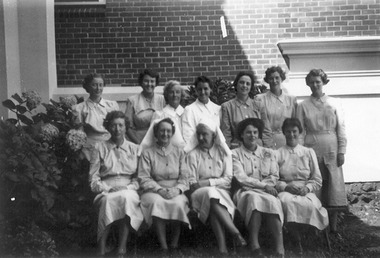 Royal District Nursing Service (now known as Bolton Clarke)
Photograph - Photograph, black and white, 09.1944
... At that time they walked the streets and lane ways amid the slums of inner Melbourne carrying their nursing bag containing lotion, ointments, powders, liniment, bandages, dressings, a case of spirits, and the Nurse's own clean apron, soap and small towel. They supplied equipment ...The group are photographed outside the Melbourne District Nursing Society After Care Hospital at 45 Victoria Parade, Collingwood. This photograph was taken three years after Miss Dorothy Tupper was appointed, in 1941, Matron of the District Nursing Division of 'Melbourne District Nursing Society and After Care Hospital'. She held this position until she retired at the end of 1962. In February 1885, 50 years after Melbourne was founded, it was recognized that nursing care was needed for the sick poor in inner Melbourne. The Melbourne District Nursing Society (MDNS) was founded, the first Society of its kind in Australia, with one Trained nurse, called 'Nurse' in those days, and a second employed six months later, working in the now CBD, ie from Spencer Street to Spring Street and from Victoria Parade to Flinders Street. From its inception the Society only employed qualified nurses (Nurses) trained under the Hospital training system and was at the forefront of health care. They provided high quality nursing care; educated their patients in the curing and prevention of disease; teaching the importance of cleanliness and good nutrition, both by verbal instruction and demonstration, even supplying soup and milk when needed. At that time they walked the streets and lane ways amid the slums of inner Melbourne carrying their nursing bag containing lotion, ointments, powders, liniment, bandages, dressings, a case of spirits, and the Nurse's own clean apron, soap and small towel. They supplied equipment on loan, such as earthenware hot water bottles, splints, urinals, bed pans, bed cradles, feeding mugs, and air-cushions as well as providing blankets and clean bed linen, and nightdresses as necessary. As the Society expanded bicycles and public transport were used to reach outer districts; before an appeal, during the influenza epidemic, provided four T Model Ford vehicles so the Nurses could visit more patients. Constant change of drivers and lack of time for maintenance caused cars to be disbanded. In addition to bicycles and public transport, a Motor Auxiliary was formed in 1929 and the public drove the District Trained nurses, 'Sisters', to visit patients in outer districts until District had its own fleet of vehicles. The After-Care and District division separated with the District Division moving premises and becoming Melbourne District Nursing Service, then in 1966 with royal patronage, Royal District Nursing Service (RDNS). Expansion followed with RDNS Centres built throughout the Melbourne suburbs and outer regions. By 2009 there were 598 cars in the fleet and the Sisters travelled 9 million 200,000 kilometres – this is equivalent to 12 trips to the moon and back. Sitting from left to right in the front row of this black and white Melbourne District Nursing Society (MDNS), photograph is a District nurse (Sister), next is Matron Tupper, (District Nursing Division) next, the Matron of the After-Care Hospital Section of the Society, and two District nurses, one wearing her uniform brimmed hat. Seven Sisters stand behind them, the centre two in white uniform dresses, one with short blonde hair, the other dark. The two Matrons are wearing white veils. The rest of the District nurses are wearing grey long sleeved uniform dresses, and have short dark curled hair. They are in front of a concrete veranda with the brick building behind. To the left of the Sisters a hydrangea bush can be seenGreen Number 948Fmelbourne district nursing society, m.d.n.s., nurses, mdns matron, mdns uniforms, after- care hospital, rdns, royal district nursing service, dorothy tupper -
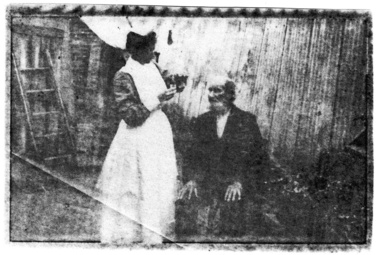 Royal District Nursing Service (now known as Bolton Clarke)
Photograph - Photograph, black and white, c.1890
... At that time they walked the streets and lane ways amid the slums of inner Melbourne carrying their nursing bags containing lotion, ointments, powders, liniment, bandages, dressings, a case of spirits, and the Nurse's own clean apron, soap and small towel. They supplied equipment ...This 1890s photograph shows the early uniform worn by Melbourne District Nursing Society (MDNS) Trained nurses, (known as 'Nurse', in those days), when visiting patients to administer nursing care.The Nurse is speaking with a patient who is sitting in his back garden. It shows the style of clothing and the rear of a weatherboard house of that era. In Melbourne in 1885 it was recognized that skilled nursing was needed in the inner city to care for the sick poor in their own homes. On the 17th of February a meeting was held with prominent Melbourne citizens, five gentlemen and fourteen ladies. ‘Dr. Caffyn and Rev. Charles Strong explained the objects and scope of District nursing Societies that had been formed in other towns’ in UK. On that day the Melbourne District Nursing Society (MDNS) was founded, the first District Nursing Society in Australia. Subsequent meetings were held to form a Committee and to draw up a Code of Rules of the Society. It was decided only nurses who had attended a Nurses Training School and were fully qualified would be employed by the Society, and that the nurses would keep a daily journal of their work. After interviewing several candidates, the first Trained Nurse (Nurse), Mrs. Ferguson, was employed with a salary of £100 per annum and commenced work on the 1st of May 1885. She was employed for three months initially, but this was soon extended, “on the understanding she will make arrangements to live in the more immediate vicinity of her district”. A Doctor was consulted before any person was seen. In rotation, a member of the Superintendence Sub-Committee supervised the Nurse’s visits and could assist to alleviate some of the poor social conditions they found. Though only Trained nurses were employed, the term ’Nurse’ was used in those days. Lady Janet Clarke, a philanthropist, was one of the first two Vice-presidents and President from 1888 until 1908 (except when overseas); she was a driving force in the Society. She held the first fund raiser for the Society at her home ‘Cliveden’ and went on to help organize many functions where she, along with Committee members, manned the stalls to raise funds. She also took her turn to accompany the Nurse, and was noted for her kindness and benevolence. Over the years the Committee, which was made up of 80% ladies, worked tirelessly for the Society; many Auxiliaries were formed. A second Trained nurse, Mrs. Joanna Cannon, was employed in late 1885, with a trial period of six months which was extended. She and Mrs Ferguson were the stalwarts of the Society in the early years, Nurse Cannon remaining with the Society for four years and Nurse Ferguson for five years, though both had a short break due to the heaviness of the work. Nurse’s salaries were reduced to account for the cost of uniforms, and again in later years when establishments were rented by the Society and the nurses could now live in the Nurses Home. The two Nurses worked in the now CBD, ie from Spencer Street to Spring Street and from Victoria Parade to Flinders Street. At that time they walked the streets and lane ways amid the slums of inner Melbourne carrying their nursing bags containing lotion, ointments, powders, liniment, bandages, dressings, a case of spirits, and the Nurse's own clean apron, soap and small towel. They supplied equipment on loan, such as earthenware hot water bottles, splints, urinals, bed pans, bed cradles, feeding mugs, and air-cushions as well as providing blankets and clean bed linen, and nightdresses and clothes as necessary. From its inception the Society was at the forefront of health care and liaised with Doctors. They provided high quality nursing care to a range of people, often in destitute situations, some lying on rags on the floor as they had no bed, others with just a bed and maybe a thin blanket, a chair and nothing else. Their ages ranged from babes, children, adults to the elderly. The Nurses gave medications as ordered, dressed wounds e.g. to the injured, and surgical cases, and to those with leg ulcers; attended to patients with ‘surgical ailments’ such as ‘hip disease’; gave care to those with acute illnesses such as bronchitis, pleurisy, pneumonia, measles, and scarlet fever, as well as those with chronic illnesses such as consumption (tuberculosis), heart disease, arthritis, cancer, debility, neuritis and paralysis. They educated their patients, and their Carers, in the curing and prevention of disease; teaching the importance of hygiene, cleanliness, ventilation and good nutrition. They taught them, by verbal instruction and demonstration, how to make poultices, to make and apply bandages, apply medical appliances such as splints; and the Nurses supplied milk, beef tea and cooked soup when needed. As the work increased a third Nurse was employed but this was arduous work, particularly in the heat of summer and many Nurses only remained with the Society for several months. Black and white photograph of a Melbourne District Nursing Society (MDNS) Trained nurse (Nurse) wearing a white apron over her grey full length uniform, and wearing a white cap. She is standing and looking down at a man dressed in a white shirt and dark jacket and pants. He is sitting outside the rear of a weatherboard house, the boards of the house are applied vertically. A wooden ladder leans against another wooden building.melbourne district nursing society, mdns uniforms, rdns, royal district nursing service, mdns -
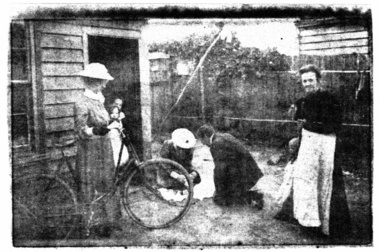 Royal District Nursing Service (now known as Bolton Clarke)
Photograph - Photograph, black and white, c.1905
... At that time they walked the streets and lane ways amid the slums of inner Melbourne carrying their nursing bag containing lotion, ointments, powders, liniment, bandages, dressings, a case of spirits, and the Nurse's own clean apron, soap and small towel. They supplied equipment ...This photograph shows Melbourne District Nursing Society (MDNS) Trained Nurses (known as 'Nurse' in those days) attending to a family in the early 1900s. It also shows their uniform which had a red Maltese cross in the centre of the pith helmet. The bicycle seen is the first mode of transport purchased by MDNS in 1903. The Nurse's bag is seen strapped to the handles of the bicycle. In February 1885, 50 years after Melbourne was founded, it was recognized that nursing care was needed for the sick poor in inner Melbourne. The Melbourne District Nursing Society (MDNS), the first District Nursing Society in Australia, was founded and the decision was made to only employ fully qualified nurses who had trained in a Hospital. In those days they were known as 'Nurse'. One Trained nurse, was employed in March, and a second employed six months later. They worked in the now CBD, ie from Spencer Street to Spring Street and from Victoria Parade to Flinders Street. From its inception the Society was at the forefront of health care and only attended patients seen by a Doctor. They provided high quality nursing care; educated their patients in the curing and prevention of disease; teaching the importance of cleanliness, ventilation and good nutrition, both by verbal instruction and demonstration, even supplying soup and milk when needed. At that time they walked the streets and lane ways amid the slums of inner Melbourne carrying their nursing bag containing lotion, ointments, powders, liniment, bandages, dressings, a case of spirits, and the Nurse's own clean apron, soap and small towel. They supplied equipment on loan, such as earthenware hot water bottles, splints, urinals, bed pans, bed cradles, feeding mugs, and air-cushions as well as providing blankets and clean bed linen, and nightdresses as necessary. Trained midwives began home births in late 1893 taking midwifery bundles and providing clothes for the babe and mother as needed. This was arduous work, particularly in the heat of summer. Permission to use bicycles was given to the Nurses in 1898 and the Society decided to purchase their own in 1903. A business man offered ‘new free wheel’ bicycles at £13 each which included maintenance for one year. Bells and wooden frames were added, at a cost of £5 per frame, so the Nurses could carry extra equipment. Nurses’ bags were strapped to the handlebars. Soup was made for those in need 2-3 times a week and if patients could not arrange to have it collected the soup was delivered by the Nurses on their bicycles. The use of bicycles caused a change in uniform, with white pith helmets, and veils covering them and tied under their chin, now being used. Over the years the Nurses complained their veils became wet in the rain and asked for a change of uniform but this did not occur until 1921. Bicycles continued to be used in inner areas until 1945. The Nurses provided high quality nursing care to a range of people often in destitute situations, some lying on rags on the floor as they had no bed, others with just a bed and maybe a thin blanket, a chair and nothing else. Their ages ranged from babes, children, adults to the elderly. The Nurses gave medications as ordered by a Doctor, dressed wounds e.g. to the injured, and surgical cases, and to those with leg ulcers; attended to patients with ‘surgical ailments’ such as ‘hip disease’; gave care to those with acute illnesses such as bronchitis, pleurisy, pneumonia, measles, and scarlet fever, as well as those with chronic illnesses such as consumption (tuberculosis), heart disease, arthritis, cancer, debility, neuritis and paralysis. The Nurses liaised with the person's Doctor. They educated their patients, and their Carers, in the curing and prevention of disease; teaching the importance of hygiene, cleanliness, ventilation and good nutrition. They taught them, by verbal instruction and demonstration, how to make poultices, to make and apply bandages, apply medical appliances such as splints; and the Nurses supplied milk, beef tea and cooked soup when needed. As the work increased a third Nurse was employed but this was arduous work, particularly in the heat of summer and many Nurses only remained with the Society for several months. Black and white photograph of two Melbourne District Nursing Society (MDNS) Trained nurses, 'Nurse', wearing their full length grey uniforms, with white collar, cuffs and belt, and white pith helmets with a Maltese cross applied. One Nurse is standing and holding her bicycle, while the other is kneeling and holding a small child. They are in the garden behind a horizontal weatherboard house. A man dressed in dark clothes is also kneeling beside the child. There is a child, dressed in white, in the doorway of the home, and a lady, dressed in a full length black dress and a white apron, is standing in front of the wooden fence in the garden. The bicycle has two large wire spoked wheels at either end of the black V shape bicycle frame; a rubber tyre runs around the outside of each wheel. The metal handlebars are a horizontal configuration and are attached with a central column into a black vertical column at the front of the V shape bicycle frame which has ‘fork shaped’ thin metal pierces running down either side of the wheel attaching the frame to the central hub of the wheel. The rear wheel is attached the same way to a central column at the rear of the frame which runs up to V shape solid seat. At the bottom of the V of the frame a pedal is attached with a rotating arm on either side of the bicycle and on the right side the rotating arm is attached to a sprocket which has a chain running around it back to a smaller sprocket on the hub of the back wheel. The chain has a thin metal guard over it. There are narrow thin metal mud guards running a short distance above the top of each wheel.melbourne district nursing society, mdns, mdns uniforms, mdns transport, rdns, royal district nursing service -
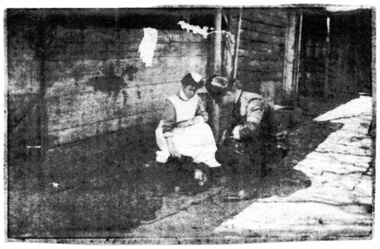 Royal District Nursing Service (now known as Bolton Clarke)
Photograph - Photograph, black and white, c.1890
... At that time they walked the streets and lane ways amid the slums of inner Melbourne carrying their nursing bag containing lotion, ointments, powders, liniment, bandages, dressings, a case of spirits, and the Nurse's own clean apron, soap and small towel. They supplied equipment ...This photograph shows a Melbourne District Nursing Society (MDNS) Trained nurse, 'Nurse' in the 1890s who is giving care to a patient who has collapsed in the street. It depicts the type of conditions the Nurses faced in that era and the uniform she wore It shows the help the Nurses received from the Police in that era and also the style of uniform worn by the police. In 1885 it was recognized that nursing care was needed for the sick poor in inner Melbourne. The Melbourne District Nursing Society (MDNS) was founded in February of that year, the first District Nursing Society in Australia, and it was decided only Nurses who had attended a Hospital Nurses Training School and were fully qualified would be employed by the Society. In those days even though they were trained they were called 'Nurse'. The Society began with one Nurse, and a second employed six months later, working in the now CBD, ie from Spencer Street to Spring Street and from Victoria Parade to Flinders Street. From its inception the Society was at the forefront of health care and liaised with Doctors. They provided high quality nursing care; educated their patients in the curing and prevention of disease; teaching the importance of cleanliness and good nutrition, both by verbal instruction and demonstration, even supplying soup and milk when needed. At that time they walked the streets and lane ways amid the slums of inner Melbourne carrying their nursing bag containing lotion, ointments, powders, liniment, bandages, dressings, a case of spirits, and the Nurse's own clean apron, soap and small towel. They supplied equipment on loan, such as earthenware hot water bottles, splints, urinals, bed pans, bed cradles, feeding mugs, and air-cushions as well as providing blankets and clean bed linen, and nightdresses as necessary. They provided nursing care to a range of people, often in destitute situations, some lying on rags on the floor as they had no bed, others with just a bed and maybe a thin blanket, a chair and nothing else. Their ages ranged from babes, children, adults to the elderly. The Nurses gave medications as ordered by a Doctor, dressed wounds e.g. to the injured, and surgical cases, and to those with leg ulcers; attended to patients with ‘surgical ailments’ such as ‘hip disease’; gave care to those with acute illnesses such as bronchitis, pleurisy, pneumonia, measles, and scarlet fever, as well as those with chronic illnesses such as consumption (tuberculosis), heart disease, arthritis, cancer, debility, neuritis and paralysis. They educated their patients, and their Carers, in the curing and prevention of disease; teaching the importance of hygiene, cleanliness, ventilation and good nutrition. They taught them, by verbal instruction and demonstration, how to make poultices, to make and apply bandages, apply medical appliances such as splints; and the Nurses supplied milk, beef tea and cooked soup when needed. As the work increased a third Nurse was employed but this was arduous work, particularly in the heat of summer and many Nurses only remained with the Society for several months. Black and white photograph of a Melbourne District Nursing Society (MDNS) Trained nurse, known as 'Nurse' in those days, wearing a white apron over her full length grey uniform with white collar seen; she is wearing a white cap. She is sitting on a step at the front of a weatherboard house attending to a man, who is dressed in dark clothing and is wearing a brimmed hat. He is lying on his side on the pavement with his head close to the Nurse and his face turned towards the road . A policeman, wearing his dark uniform and helmet, is kneeling beside the man. mdns, melbourne district nursing society, mdns uniforms, rdns, royal district nursing service, nursing care -
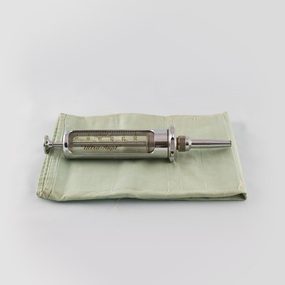 Royal District Nursing Service (now known as Bolton Clarke)
Equipment - Photograph, colour, c.1950
... nursing service...rdns...rdns equipment... Auric syringes were carried by the Melbourne District Nursing Society Trained nurses, (Sisters), in their equipment bags.Used for syringing ears this model was used during the 1950s . ...The Sisters of the Melbourne District Nursing Society used equipment to administer care, as directed by a Doctor, to patients in their own homes. royal district nursing service rdns rdns equipment mdns melbourne district nursing society The Auric Syringe has a glass graded barrel surrounded by a metal casing, and has a metal plunger and a metal cone shaped aural attachment narrowing at the end. ...Auric syringes were carried by the Melbourne District Nursing Society Trained nurses, (Sisters), in their equipment bags.Used for syringing ears this model was used during the 1950s . The Sisters of the Melbourne District Nursing Society used equipment to administer care, as directed by a Doctor, to patients in their own homes.The Auric Syringe has a glass graded barrel surrounded by a metal casing, and has a metal plunger and a metal cone shaped aural attachment narrowing at the end. The syringe is sitting on a cotton protective bag.royal district nursing service, rdns, rdns equipment, mdns, melbourne district nursing society -
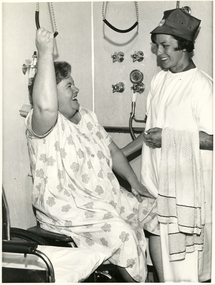 Royal District Nursing Service (now known as Bolton Clarke)
Photograph - Photograph, black and white, 1967
... nursing staff and patient’s family members. Sisters carried out General Care to those patients unable to care to their own hygiene safely, and, working towards independence where possible, the Sisters taught them safe transferring techniques using equipment such rails, shower seats, and hand showers. rdns royal district nursing service rdns uniform patient care moorabbin centre sister m. meissen mrs lata On the right of this black and white photograph is Royal District Nursing Service (RDNS) Sister Meissen standing and observing Mrs. ...This photograph shows Royal District Nursing Service (RDNS) Sister Meissen observing Mrs Lata as she transferred from her wheelchair onto a shower chair in the bathroom at her home. Sr. Meissen is based at the RDNS Moorabbin Centre. Patients were taught, and then supervised, by RDNS visiting Sisters in the use of safe transferring techniques. From the founding of the Melbourne District Nursing Society (MDNS) in 1885, known as the Royal District Nursing Service (RDNS), from 1966, their Trained nurses cared for patients in their own homes who required to be taught safe transferring techniques, e.g. from bed to wheelchair or from chair to walking frame etc. Their family members also needed to learn safe transferring techniques to enable them to care for their loved ones. RDNS employed a Physiotherapist who taught staff the correct techniques, not only for safety of the patient, but to reduce physical strain on RDNS nursing staff and patient’s family members. Sisters carried out General Care to those patients unable to care to their own hygiene safely, and, working towards independence where possible, the Sisters taught them safe transferring techniques using equipment such rails, shower seats, and hand showers.On the right of this black and white photograph is Royal District Nursing Service (RDNS) Sister Meissen standing and observing Mrs. Lata in the bathroom of her home. Sr. Meissen has short dark hair; is wearing a white gown over her uniform and wears a grey peaked uniform hat. She has a towel draped over her left arm, and is smiling at Mrs. Lata who is on her left and is sitting on a shower chair. Mrs. Lata, who is wearing a light coloured nightgown with flower motifs, is smiling up at Sr. Meissen and has her right arm raised with her hand gripping a rope pulley. Part of a wheelchair with the left arm removed is seen in the foreground; the seat of the chair is in line with the seat of the shower chair. A hand shower, taps and glass screen can be seen in the background of the photograph.rdns, royal district nursing service, rdns uniform, patient care, moorabbin centre, sister m. meissen, mrs lata -
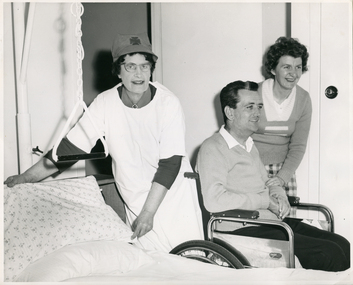 Royal District Nursing Service (now known as Bolton Clarke)
Photograph - Photograph, black and white, 30 06 1965
... nursing staff . Where possible the Sisters worked towards independence, using equipment such as shower seats, rails and hand showers. ...The MDNS Sister has given nursing care to the gentleman and has transferred him safely into the wheelchair. Whilst doing this the Sister demonstrated the transfer technique to the lady in the photograph who is probably his wife. The Sister is wearing the MDNS uniform of the day, a grey cotton dress and red cardigan, under her white gown. She has a red Maltese cross applied to the centre of her grey peaked hat.From its founding in 1885 the Hospital Trained nurses of the then named Melbourne District Nursing Society (MDNS), later named Royal District Nursing Service (RDNS) gave high quality nursing care to patients in their own homes. They nursed patients referred by Hospitals and General Practitioners giving treatments, such as injections, wound care and doing many other procedures, as well as assisting them with 'general care' when required. The Sisters needed to transfer the patients when required and also taught family members safe transferring techniques to enable them to care for their loved ones. RDNS employed a Physiotherapist who taught staff the correct techniques, not only for safety of the patient, but to reduce physical strain on patient’s family members and the RDNS nursing staff . Where possible the Sisters worked towards independence, using equipment such as shower seats, rails and hand showers. The Sisters liaised with the patient's Doctor and supported and advised the patient and Carer of any further help to assist them.On the left of the black and white photograph is a Melbourne District Nursing Service, (MDNS) Sister, who is wearing glasses and is looking at the camera. She is wearing a white gown over her uniform, with the grey collar and the dark sleeves of her cardigan in view and her grey peaked hat, with an emblazoned Maltese cross in the centre front, sits over her short dark curly hair. Both of her arms are extended and resting on either side of a pillow she is straightening. The Sister is standing next to wheelchair bound man who has short dark hair and is wearing dark trousers and a light coloured jumper. On the right hand side of the wheelchair a lady, wearing a light blouse, grey jumper and tartan skirt, is standing with her left hand resting on the left arm of the man.They are both smiling and looking slightly towards the right in the photograph A 'monkey bar hand grip' is attached to the bed by a pole and hangs on a white chair over the bed. A window covered by a blind is behind the Sister, with a light curtain to the left..Photographers stamp. Quote No. DW 84mdns, melbourne district nursing service, patient care, rdns, royal district nursing service -
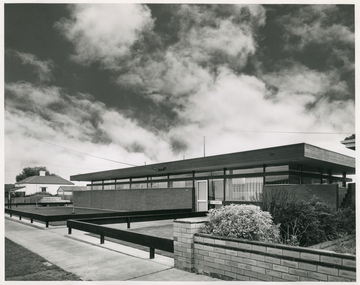 Royal District Nursing Service (now known as Bolton Clarke)
Photograph - Photograph, black and white, 30 06 1965
... Their Trained nurses (Sisters) left from these Centres each morning to carry out their nursing visits in a specific area, taking any sterilized equipment needed with them. ...This photograph is a record of the Melbourne District Nursing Service (MDNS) Moorabbin Centre, situated at 611 South Road, Moorabbin. It was opened in mid 1965 and was the fourth Centre MDNS had opened. Following Royal patronage in 1966, it became known as Royal District Nursing Service (RDNS) Moorabbin Centre.Gradually over the years, Melbourne District Nursing Service, MDNS, later known as Royal District Nursing Service, RDNS, from 1966 when they received Royal patronage, opened Centres throughout the Melbourne Metropolitan area. Their Trained nurses (Sisters) left from these Centres each morning to carry out their nursing visits in a specific area, taking any sterilized equipment needed with them. They returned at the end of the day to write up their patients nursing histories, clean and reset any equipment used ready for sterilization, and to contact other medical personal as necessary. Most of the RDNS cars were housed at each Centre, only a few being driven home by a Sister.Black and white photograph of RDNS Moorabbin Centre. The building is a single story brick building with a flat roof. A row of short glass windows are seen above the brick work to the left of the large glass doors which are on the right of the building. A low standing horizontal fence is seen along the front and along either side of the path leading up to the door. Some bushes are seen in the right hand side garden of the building. A footpath can be seen in front of the fence. On the left of the photograph can be seen a white house with a pitched roof. A dark sky with fluffy white 'cumulus' clouds are seen above the buildings.Photographers stamp. Quote No. DX 18mdns, melbourne district nursing service, mdns centres, royal district nursing service, rdns -
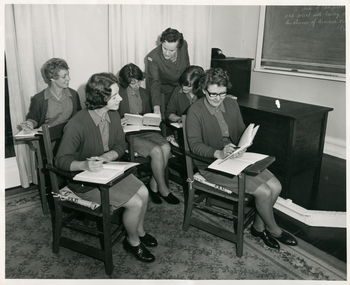 Royal District Nursing Service (now known as Bolton Clarke)
Photograph - Photograph, black and white, 07 06 1967
... Nursing Service, (RDNS). From 1885, only Trained Nurses, through the hospital training system, were employed by the Society, and on visits to patients they taught the necessity of hygiene and cleanliness, as well as the need for a good diet, to bring about good health. Doctor’s lectures were later given at the MDNS home to instruct patients and their families on prevention of disease. Education to patients continued throughout the years regarding health care and the use of equipment ...Miss Evans, Director of Nursing of Royal District Nursing Service, (RDNS), is holding an Education session with RDNS staff. Her uniform is a grey skirt and jacket with the RDNS badge emblazoned on her right shoulder. The badge has a white background and black writing. The RDNS Sisters are wearing their grey uniform frocks and red cardigans. Education was an integral part of Melbourne District Nursing Society (MDNS), from its inception in 1885, later, in 1966, called Royal District Nursing Service, (RDNS). From 1885, only Trained Nurses, through the hospital training system, were employed by the Society, and on visits to patients they taught the necessity of hygiene and cleanliness, as well as the need for a good diet, to bring about good health. Doctor’s lectures were later given at the MDNS home to instruct patients and their families on prevention of disease. Education to patients continued throughout the years regarding health care and the use of equipment in the home. In 1961, Education programs commenced at MDNS with Sisters receiving In-service education. Sr. Pat (Paddy) Rowley was a leader in In-service Education and established the RDNS Department of Community Nursing Education in 1962. Staff could also apply for scholarships to further their education outside of RDNS. Many of their senior trained nurses received Postgraduate diplomas from the College of Nursing in Community Health Nursing, Education, and Administration and several travelled overseas visiting nursing organizations viewing their public health and district nursing systems. At RDNS many programs were run, including: a Post Basic Course, Cardiac Rehabilitation Nursing, Haematology/Oncology Nursing, Palliative Care program, Diabetic Stabilization Program, Leg Ulcer Management Program, Wound Care Specialist Program, HIV/AIDS Nursing Care, Cystic Fibrosis Home Support, Veterans Home Care Program, Breast Cancer Support Program, Continence Management Program, Stomal Therapy Program, In-Home Lactation Support Program and the Homeless Persons Program. RDNS staff attended several hospitals to observe and learn special care needed to some clients, e.g. to the Austin Hospital to learn the care required for paraplegic and quadriplegic clients at home, and to Mount Royal Hospital to observe the care of clients in the Rehabilitation ward. A Community Nursing Education Program was extended to student nurses from hospitals and to other nursing organizations. These Education programs kept the RDNS Sisters abreast of new techniques, such as changes in technology for e.g. new testing methods in detecting glucose levels in Diabetic patients. Sr. Nan Deakin obtained a Post Basic Certificate in Psychiatric Nursing and included this area in her education lectures. Sr. Daphne Geldard specialized in the area of Alzheimer’s disease and Dementia. These Sisters visited patients in District areas with the regular RDNS Sister when required. Every member of staff, both professional and non professional staff, received regular education in the Education Department. In 1980, a Home Health Aide pilot study, funded by the Federal Government, the Brotherhood of St. Laurence and RDNS, with the program written and taught by Sr. Rowley, was evaluated as successful, and Home Health Aides were employed and worked in RDNS Centres under the supervision of the RDNS Registered Nurses. Black and white photograph showing Miss Mary Evan standing in the centre rear of the photograph. She is with five RDNS Sisters who have short hair, three with curly hair and two with straight hair, who are sitting on chairs with white paged books resting on 'over the lap' tables. Three Sisters are seated in front of Miss Evans, and another two Sisters are sitting in the foreground. Miss Evans, who has short dark curled hair, is wearing her grey uniform jacket which can be seen with the RDNS cloth badge visible at the top of her right sleeve. She is bending over one of the Sisters and has her right hand pointing to something on the Sister's book. Closed light curtains are seen in the rear of the photograph and a dark desk to the right. On the wall above this, part of a blackboard can be seen.Photographers stamp. Quote No. GF 28rdns, royal district nursing service, rdns education, miss mary evans, rdns d.o.n -
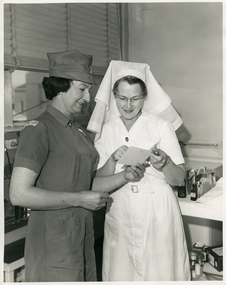 Royal District Nursing Service (now known as Bolton Clarke)
Photograph - Photograph, black and white, 26 07 1967
... Nursing Service, (RDNS), Liaison Sister who is standing side on in the left foreground of the photograph. She has dark short hair, and is wearing her grey short sleeved uniform with an RDNS cloth badge at the top of her right sleeve, and her grey peaked uniform hat. She is in a Hospital and is holding an open leaflet in her left hand which she is showing to an Occupational Health Sister who is on her right, and is wearing her white uniform and white veil. Part of a trolley, with equipment...Nursing Service, (RDNS), Liaison Sister who is standing side on in the left foreground of the photograph. She has dark short hair, and is wearing her grey short sleeved uniform with an RDNS cloth badge at the top of her right sleeve, and her grey peaked uniform hat. She is in a Hospital and is holding an open leaflet in her left hand which she is showing to an Occupational Health Sister who is on her right, and is wearing her white uniform and white veil. Part of a trolley, with equipment ...Sister Coates is working as a RDNS Liaison Officer in a Hospital and is sharing information with the Occupational Health Sister.Liaison had occurred between doctors and the Trained nurses of the Melbourne District Nursing Society (MDNS), from its inception in 1885. This increased when Midwifery was introduced in August 1893 with close liaising with the Women’s Hospital. As District nursing grew it was recognized that closer liaising between many Public Hospitals would be beneficial, for not only MDNS, later called Royal District Nursing Service (RDNS), Trained nursing staff, but also for the patients and the hospitals. In August 1964 a Liaison Officer commenced at the Alfred Hospital. This soon increased to Liaison Officers working full time at several Public Hospitals. At the time of a patient’s discharge, the Liaison Sister forwarded information on their diagnosis and instructions regarding the care required at home to the appropriate RDNS Centre, and in turn the attending District Sister wrote a report of progress and any queries to the Hospital doctor, via the Liaison sister, at the time the patient was attending outpatients. Any new instructions were then sent back to the District Sister. Liaising also occurred between District field staff and Doctors when patients were referred by General Practitioners and did not attend a hospital.Black and white photograph of Sister Moira Coates, Royal District Nursing Service, (RDNS), Liaison Sister who is standing side on in the left foreground of the photograph. She has dark short hair, and is wearing her grey short sleeved uniform with an RDNS cloth badge at the top of her right sleeve, and her grey peaked uniform hat. She is in a Hospital and is holding an open leaflet in her left hand which she is showing to an Occupational Health Sister who is on her right, and is wearing her white uniform and white veil. Part of a trolley, with equipment on the top and bottom shelf, can be seen in the background on the right hand side. Closed Venetian blinds are seen in the background on the left hand side of the photograph.Photographers stamp and 'Quote No. GH 8'rdns, royal district nursing service, rdns liaison, sister moira coates -
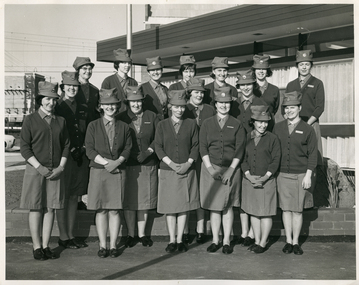 Royal District Nursing Service (now known as Bolton Clarke)
Photograph - Photograph, black and white, 30 08 1967
... Their Trained nurses left from these Centres each morning to carry out their nursing visits in a specific areas (districts) taking any sterilized equipment needed with them. ...This photograph is of RDNS staff taken outside the RDNS Essendon Centre on the day of its opening on the 30th of August 1967. The RDNS Sisters are wearing their uniforms of a red cardigans over their grey cotton frocks. The opening of the RDNS Essendon Centre enabled Sisters to leave from this building to give nursing care in the community. They returned to this building at the completion of their shift.Gradually over the years, Melbourne District Nursing Service (MDNS, later known as Royal District Nursing Service (RDNS) from 1966 when they received Royal patronage, opened Centres throughout the Melbourne Metropolitan area. Their Trained nurses left from these Centres each morning to carry out their nursing visits in a specific areas (districts) taking any sterilized equipment needed with them. They returned at the end of the day to write up their patients nursing histories, clean and reset any equipment used ready for sterilization, and contact other medical personal as necessary. Most of the RDNS cars were housed at each Centre, only a few being driven home by a Sister.Black and white photograph of sixteen Royal District Nursing Service, (RDNS) staff standing in two rows outside the Essendon Centre. The Sisters are wearing uniform dark cardigans over their grey uniforms; an RDNS badge can be seen attached on the upper left hand side front of some of the cardigans. They are wearing their grey peaked uniform hats, which have a round metal silver badge with the capital letter 'RDNS' written in blue across the centre section, attached to the centre front. They are standing in front of a building, which has a flat roof with a dark fascia and below this a large windows down to a short area of brickwork. Part of a light coloured building can be seen in the background on the left hand side of the photograph.Photographers stamp. Quote No. GJ 55rdns, royal district nursing service, rdns centre, rdns uniform -
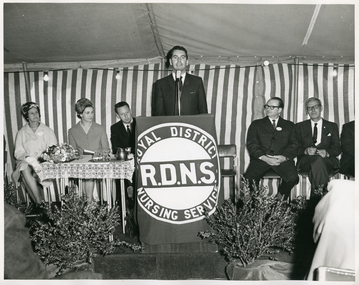 Royal District Nursing Service (now known as Bolton Clarke)
Photograph - Photograph, black and white, 30 08 1967
... Their Trained nurses (Sisters) left from these Centres each morning to carry out their nursing visits in a specific area, (district), taking any sterilized equipment needed with them. ...The dignitaries in this photograph are at the opening ceremony of the Royal District Nursing Service (RDNS) Essendon Centre on the 30th of August 1967Gradually over the years, Melbourne District Nursing Service, MDNS, later known as Royal District Nursing Service, RDNS, from 1966 when they received Royal patronage, opened Centres throughout the Melbourne Metropolitan area. Their Trained nurses (Sisters) left from these Centres each morning to carry out their nursing visits in a specific area, (district), taking any sterilized equipment needed with them. They returned at the end of the day to write up their patients nursing histories, clean and reset any equipment used ready for sterilization, and contact other medical personal as necessary. Most of the RDNS cars were housed at each Centre, only a few being driven home by a Sister.Black and white photograph of dignitaries participating in a ceremony. Hanging across the front of the rostrum is a large sign with the round RDNS logo emblazoned in white across the central dark strip, and white sections above and below the strip can be seen. A dark boarder is around the circumference of the logo, with the words 'Royal District Nursing Service' seen. Behind the rostrum a gentleman, who has short dark hair; is wearing a white shirt, dark tie and a dark suit, stands at the microphone. To his rear left sits two ladies, one wearing white, the other grey, and a gentleman in a dark suit. To his right rear sit two gentlemen in dark suits and another can partially be seen. The dignitaries are in a marque which shows a striped background and grey top behind them. There are flowers on either side of the rostrum.Photographers stamp and 'Quote No. GJ 70'rdns, royal district nursing service, essendon centre -
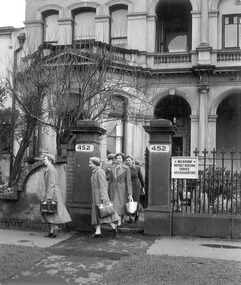 Royal District Nursing Service (now known as Bolton Clarke)
Photograph - Photograph, black and white:, c.1960
... At that time they walked the streets and lane ways amid the slums of inner Melbourne carrying their nursing bag containing lotion and dressings, and supplying equipment on loan, such as feeding mugs, bedpans, air-cushions, splints, bed cradles feeding mugs and providing clean bed linen and nightdresses as necessary. ...This photograph was taken just a few years after the District division of the 'Melbourne District Nursing Society and After Care Hospital' separated in 1957. The District Division then became known as 'Melbourne District Nursing Service'. They moved into their Headquarters at 452 St. Kilda Road, Melbourne which was used as the Nurses Home as well as for Administrative purposes. The Sisters left from there each day to do their rounds and returned to do their book work before retiring at the end of the day. This photograph depicts the winter uniform worn at this time; a grey felt beret which had a red Maltese cross attached in the centre; a grey cotton frock and red cardigan, and a grey woolen coat, some with a grey belt, worn over their uniform.In 1885, 50 years after Melbourne was founded, it was recognized that nursing care was needed for the sick poor in inner Melbourne. The Melbourne District Nursing Society (MDNS), the first Society of its kind in Australia, was founded in February 1885 with one Trained nurse (Nurse), and a second employed six months later, working in the now CBD ie. from Spencer Street to Spring Street and from Victoria Parade to Flinders Street. From its inception the Society was at the forefront of health care. They provided high quality trained nursing care; educated their patients in the curing and prevention of disease; teaching the importance of cleanliness and good nutrition, both by verbal instruction and demonstration, even supplying soup and milk when needed. At that time they walked the streets and lane ways amid the slums of inner Melbourne carrying their nursing bag containing lotion and dressings, and supplying equipment on loan, such as feeding mugs, bedpans, air-cushions, splints, bed cradles feeding mugs and providing clean bed linen and nightdresses as necessary. Trained midwives began home births in August 1893 taking midwifery bundles and providing clothes for the babe and mother as needed. The Society were pioneers in recognizing the need for premises where patients too ill to be in their own home, but not ill enough to go to hospital, was needed, and the Society built, then opened, the After-Care Home, (later called After-Care Hospital), in 1926, for their patients, and patients from Hospitals. Many children were nursed there, some long term during the Polio epidemic; the Society employed two School Teachers. The Society now ran two divisions, the After-Care with its own Trained nurses (Sisters) and nurses and the District division. The Society were the first in Melbourne, in early 1928, to recognize some patients leaving the After-Care, and many at home, needed further social care and they set up ‘Almoners’ from their Committee to visit these patients and be intermediaries in getting them social assistance. It was late the following year before the first training of Almoners took place in Melbourne. In 1930 the Society employed a full time kindergarten teacher to visit poor children in their homes. That year the Society were pioneers in opening an Ante-Natal Clinic at the After-Care, setting a high standard with equipment, keeping records and providing leaflets with instructions in how to keep healthy during pregnancy, what complications to look for and what to do when labour commenced. In 1934 the Society were pioneers again when they opened the first Women’s Welfare Clinic in Melbourne giving advice on birth-control, at first attended by their own patients, but then accepting patients from public hospitals until their own clinics were opened. A Social Service Officer was employed at the After-Care who successfully gained better housing from the Housing Commission for families living under unsuitable conditions. In 1957 the Hospital and Charities Commission decided to take over the After-Care Hospital, so the 'Melbourne District Nursing Society and After-Care Hospital' separated and the 'Melbourne District Nursing Service' was formed, setting up Headquarters at 452 St. Kilda Road. Royal patronage was granted in 1966, now becoming the Royal District Nursing Service, (RDNS). Liaison with public hospitals began with a District nurse attached to a hospital visiting patients before going home. Education continued to be at the forefront of District with research by RDNS Educators and programs being implemented. Initial visits not only assessed the specific nursing situation but the situation as a whole. Their patients ranged in age from babes, children, adults to the elderly and referrals were taken from Hospitals, General Practitioners and allied Health facilities. Some of the care the Sisters provided is as follows: – Post-Natal care given to mother and babe, Wound Care following various types of surgery, accidents, burns, cancer, leg ulcers etc. Supervising and teaching Diabetic Care, including teaching and supervising people with Diabetes to administer their own Insulin, and administering Insulin to those unable to give their own injections. Administering other injections and setting up weekly medication boxes. The Sisters performed Catheterizations on adults suffering from conditions such as Quadriplegia, Paraplegia, Multiple Sclerosis (MS), Motor Neurone Disease (MND) and Guillan-Barre Syndrome, and when required at school on children for e.g. those with Spina Bifida. The Sisters visited those requiring Cystic Fibrosis support and care; those requiring Haemo-Oncology care, including visiting children at school; those requiring Home Enteral Feeding care, and those requiring IV therapy at home and home Dialysis. Palliative Care was given including pain relief with the use of syringe drivers, personal care as needed, and advice and support to both patient and family. The Sisters provided Stoma management to those needing Urostomy, Ileostomy and Colostomy care and those requiring Continence care. HIV/AIDS nursing care was provided; visits to Homeless Persons were made. Personal care was given to patients ranging in age and with varying mobility problems, such as Amputees, those with MS, MND, Guillan-Barre Syndrome, Poliomyelitis, Quadriplegia, Paraplegia, Acquired Brain Injury, to those following a Cerebrovascular Accident (Stroke), those with severe Arthritis and those with a form of Dementia. When necessary the elderly were assisted with personal care and advice given on safety factors with the use of hand rails, bath or shower seats, and hand showers. Rehabilitation with an aim towards independence remained at the forefront of the Sister’s minds and when possible using aids and instruction on safe techniques enabled the person to become fully independent. All care included giving advice and support to the patient and their Carers. The Sisters liaised with the persons Doctor, Hospital and allied Health personal when necessary.Black and White photograph of seven (some partly hidden) Melbourne District Nursing Service (MDNS) Sisters wearing full winter uniform of grey berets and grey long coats, with lapels, over their uniform which is partly seen on one Sister. Some are on a path, and others walking to the open metal gate; one Sister is between two tall, square, dark grey concrete columns. Looking at the photograph, two Sisters have turned left onto the footpath. These two Sisters are carrying oblong leather type bags in their left hand and the Sister between the columns is carrying a white soft material type bag. The Sisters seen have short dark hair under their berets. White plaques with the black numbers '452' are attached to the top 1/3 of each column and an arched grey concrete fence with brick top runs to the left. Behind this are two medium size leafless trees. A metal spiked fence runs from the column to the right of the photograph. Attached to this, near the column, is a white plaque with 'Melbourne District Nursing Service Headquarters' written in black. In the rear is a light grey two story Italian style building with a polygon shaped bay window to the left on the ground floor. It has a long window in the front and another on the side. To the right of this is a veranda with two concrete arches, separated by a roman column. A door can be seen behind the first arch. Above the bay window on the second story are three long arched windows, and to the right of that an arched opening with a roman column separating the partially seen next window. A concrete balustrade is seen at the front of the second story.melbourne district nursing service, headquarters, mdns, nurses, nurses uniforms, royal district nursing service, rdns -
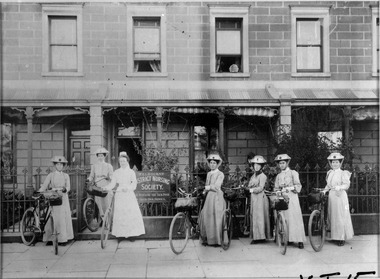 Royal District Nursing Service (now known as Bolton Clarke)
Photograph - Photograph, black and white, 1905
... At that time they walked the streets and lane ways amid the slums of inner Melbourne carrying their nursing bag containing lotion, ointments, powders, liniment, bandages, dressings, a case of spirits, and the Nurse's own clean apron, soap and small towel for her use. They loaned equipment ...This photograph is a record of Head Nurse, Sister Lee-Archer, and her staff of six Trained nurses, 'Nurses', of the Melbourne District Nursing Society (MDNS) outside their new Nurse’s Home and Headquarters rented at 5 Royal Terrace, Nicholson Street, Fitzroy. The bicycles seen were the first mode of transport purchased by MDNS and allowed these Nurses to extend the nursing visits they made into more Melbourne suburbs.The Melbourne District Nursing Society (MDNS) moved into larger premises at No. 5 Royal Terrace, Nicholson Street, Fitzroy in May 1904. Head trained Nurse, Lee-Archer and her staff of six Trained nurses pose outside the new ‘Nurse’s Home’ at 5 Royal Terrace, Nicholson Street, Fitzroy. The Nurses worked in the districts of North and West Melbourne, the City Proper, Carlton, Richmond, South Melbourne, Fitzroy and Collingwood making 17,954 visits during the year. The Society had a set of bye-laws which outlined the work conditions for the Nurses. Section 111.1 states ‘Each nurse shall be ready to go to her district at 9 am. She will be expected to visit urgent cases on Sundays, and will be required to work eight hours on each week day, to wear the special uniform, and live in the Home of the Society’. In February 1885, only 50 years after Melbourne was founded, it was recognized that nursing care was needed for the sick poor in inner Melbourne. The Melbourne District Nursing Society (MDNS), the first Society of its kind in Australia, was founded with one Trained nurse, known as 'Nurse' in those days, and a second employed six months later. They liaised with Doctors and worked in the now CBD, ie from Spencer Street to Spring Street and from Victoria Parade to Flinders Street. From its inception the Society was at the forefront of health care. They provided high quality nursing care; educated their patients in the curing and prevention of disease; teaching the importance of cleanliness, fresh air and good nutrition, both by verbal instruction and demonstration, even supplying soup and milk when needed. At that time they walked the streets and lane ways amid the slums of inner Melbourne carrying their nursing bag containing lotion, ointments, powders, liniment, bandages, dressings, a case of spirits, and the Nurse's own clean apron, soap and small towel for her use. They loaned equipment, such as earthenware hot water bottles, splints, urinals, bed pans, bed cradles, feeding mugs, and air-cushions as well as providing clean bed linen and nightdresses as necessary. Trained Midwives began home births in late 1893 taking midwifery bundles and providing clothes for the babe and mother as needed. This was arduous work, particularly in the heat of summer. As the work increased a third Nurse was employed but due to this arduous work many Nurses only remained with the Society for several months. Permission to use bicycles was given to the Nurses in 1898 and the Society decided to purchase their own in 1903. A business man offered ‘new free wheel’ bicycles at £13 each which included maintenance for one year. Bells and wooden frames were added, at a cost of £5 per frame, so the Nurses could carry extra equipment. Nurses’ bags were strapped to the handlebars. Soup was made for those in need 2-3 times a week and if patients could not arrange to have it collected the soup was delivered by the Nurses on their bicycles. The use of bicycles caused a change in uniform, with white pith helmets, and veils covering them and tied under their chin, now being used. They provided high quality nursing care to a range of people, often in destitute situations, some lying on rags on the floor as they had no bed, others with just a bed and maybe a thin blanket, a chair and nothing else. Their ages ranged from babes, children, adults to the elderly. The Nurses gave medications as ordered by a Doctor, dressed wounds e.g. to the injured, and surgical cases, and to those with leg ulcers; attended to patients with ‘surgical ailments’ such as ‘hip disease’; gave care to those with acute illnesses such as bronchitis, pleurisy, pneumonia, measles, and scarlet fever, as well as those with chronic illnesses such as consumption (tuberculosis), heart disease, arthritis, cancer, debility, neuritis and paralysis. In 1913 a Nurse had her Board and residence, uniforms, bicycle and laundry expenses provided and was paid £50 a year for her first six months. At the end of a year her salary was increased by £5, and later she earns £60 a year. Over the years the nurses complained that their veils became wet in the rain and asked for a change of uniform but this did not occur until 1921. Bicycles continued to be used in inner areas until 1945. Black and white photograph of six Trained nurses and their Matron, who has her hair swept up, and is wearing a long white uniform with belt, and white cap; part of her veil is seen hanging down her back, outside their Nurses Home The trained. nurses are holding their two wheeled bicycles, and are wearing long grey frocks, white collars and belts and straw hats with a Maltese cross in the centre of headband, this is held in place with scarves over the hat and tied under their chins. Their nursing bags are strapped to the handlebars of the bicycles. A black sign with the white capital letters 'Melbourne District Nursing Society. ....nursing the sick poor in their own homes' is on the metal spiked fence. The building is made of brick and five long sash windows are seen in the upper section. A metal roofed veranda, held up with four posts and two brick columns, divides the upper and lower section. A door and three long windows are seen which are partly obscured by several bushes behind the fence.melbourne district nursing society, 5 royal terrace, nicholson st carlton, nurses home, bicycles, mdns transport, royal district nursing service, rdns, mdns trained nurses, sister florence lee-archer -
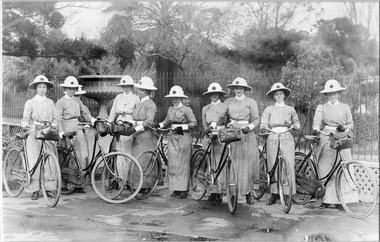 Royal District Nursing Service (now known as Bolton Clarke)
Photograph - Photograph, black and white, 1907
... nursing society...mdns...nurses...uniforms...mdns transport...mdns equipment...Bicycles continued to be used in inner areas until 1945. melbourne district nursing society mdns nurses uniforms mdns transport mdns equipment rdns royal district nursing service Black and white photo of a group of ten (one partially hidden at rear) Melbourne District Nursing Society (MDNS) trained nurses, with each standing with their bicycles in front of a spiked metal fence.The Nurses are wearing their MDNS uniform long grey frocks with white collar, cuffs and belt and white pith helmets with a central Maltese cross. ...This photograph was taken four years after bicycles were purchased by the Melbourne District Nursing Society (MDNS) and is a record of the first mode of transport used by their Trained nurses, and a record of the change of head ware needed now bicycles were in use. The uniforms were grey with white collar, belt and cuffs and a red Maltese cross was in the centre of the pith helmet. Prior to the use of bicycles the trained nurses walked to their patients and had become exhausted, particularly in summer. The bicycles were a solution to this problem, and now they could visit more patients and the Society's areas (districts) could be extended. In February 1885, 50 years after Melbourne was founded, it was recognized that nursing care was needed for the sick poor in inner Melbourne. The Melbourne District Nursing Society (MDNS), the first such Society in Australia, was founded with one Trained nurse, called 'Nurse' in those days, and a second employed six months later. They worked in the now CBD, ie from Spencer Street to Spring Street and from Victoria Parade to Flinders Street. From its inception the Society was at the forefront of health care. They provided high quality nursing care; educated their patients in the curing and prevention of disease; teaching the importance of cleanliness and good nutrition, both by verbal instruction and demonstration, even supplying soup and milk when needed. At that time they walked the streets and lane ways amid the slums of inner Melbourne carrying their nursing bag containing lotion, ointments, powders, liniment, bandages, dressings, a case of spirits, and the Nurse's own clean apron, soap and small towel. They supplied equipment on loan, such as earthenware hot water bottles, splints, urinals, bed pans, bed cradles, feeding mugs, and air-cushions as well as providing blankets, clean bed linen, and nightdresses as necessary. Trained Midwives began home births in late 1893 taking midwifery bundles and providing clothes for the babe and mother as needed. This was arduous work, particularly in the heat of summer. Permission to use bicycles was given to the Nurses in 1898 and the Society decided to purchase their own in 1903. A business man offered ‘new free wheel’ bicycles at £13 each which included maintenance for one year. Bells and wooden frames were added, at a cost of £5 per frame, so the Nurses could carry extra equipment. Nurses’ bags were strapped to the handlebars. Soup was made for those in need 2-3 times a week and if patients could not arrange to have it collected the soup was delivered by the Nurses on their bicycles. The use of bicycles caused a change in uniform, with white pith helmets, and veils covering them and tied under their chin, now being used. The Nurses provided high quality nursing care to a range of people, often in destitute situations, some lying on rags on the floor as they had no bed, others with just a bed and maybe a thin blanket, a chair and nothing else. Their ages ranged from babes, children, adults to the elderly. The Nurses gave medications as ordered by a Doctor, dressed wounds e.g. to the injured, and surgical cases, and to those with leg ulcers; attended to patients with ‘surgical ailments’ such as ‘hip disease’; gave care to those with acute illnesses such as bronchitis, pleurisy, pneumonia, measles, and scarlet fever, as well as those with chronic illnesses such as consumption (tuberculosis), heart disease, arthritis, cancer, debility, neuritis and paralysis. Over the years the Nurses complained that their veils became wet in the rain and asked for a change of uniform but this did not occur until 1921. Bicycles continued to be used in inner areas until 1945. Black and white photo of a group of ten (one partially hidden at rear) Melbourne District Nursing Society (MDNS) trained nurses, with each standing with their bicycles in front of a spiked metal fence.The Nurses are wearing their MDNS uniform long grey frocks with white collar, cuffs and belt and white pith helmets with a central Maltese cross. Nursing bags are strapped to five of the bicycles. A large pedestal urn is seen to the left behind the fence between the 3rd and 4th nurse. Bushes and trees are seen in the background. melbourne district nursing society, mdns, nurses, uniforms, mdns transport, mdns equipment, rdns, royal district nursing service -
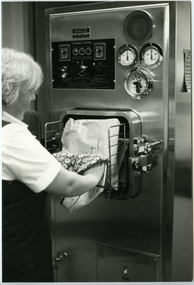 Royal District Nursing Service (now known as Bolton Clarke)
Photograph - Photograph, black and white, c.1975
... nursing service...rdns...rdns equipment...Following their day in the community the Sisters returned to the RDNS Centre and washed and set up the trays again ready for re-sterilization. royal district nursing service rdns rdns equipment sterilizing Black and white photograph showing a Royal District Nursing Service, (RDNS), Sister who has blonde short hair; is wearing a short sleeved white blouse and dark tunic style frock, standing in the Autoclave room in an RDNS centre. ...The Royal District Nursing Service (RDNS), Sister has sterilized an autoclave pack for use by the RDNS Sisters when attending their patients in their homes who are requiring specific treatments for e.g. catheterization. This photograph is taken in the sterilizing room at a RDNS Centre. The Sister is wearing the RDNS Summer uniform of a short sleeve white blouse under a royal blue V neck tunic style frock with the RDNS logo on its upper left.Royal District Nursing Service (RDNS) supplied sterilized equipment, such as ready set up catheter trays and dressing trays, as well as dressing packs for their Sisters to take to the home when attending to specific patient care. Patients bought their own future dressings, if these had not been given to them when discharged from Hospital. Following their day in the community the Sisters returned to the RDNS Centre and washed and set up the trays again ready for re-sterilization. Black and white photograph showing a Royal District Nursing Service, (RDNS), Sister who has blonde short hair; is wearing a short sleeved white blouse and dark tunic style frock, standing in the Autoclave room in an RDNS centre. She is emptying the Autoclave chamber after sterilizing a wrapped, 'gown and towel', which is written on the wrapping. Her right arm is extended with her hand on the metal wire basket which has a protective floral cloth covering the edge of the basket. The photograph shows a tall vertical Autoclave, which is made of metal. To the left above the chamber is a dark rectangular section with several switches, and to right of it are three white faced dials. royal district nursing service, rdns, rdns equipment, sterilizing -
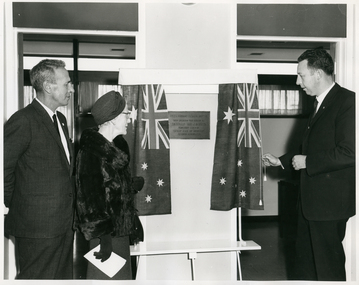 Royal District Nursing Service (now known as Bolton Clarke)
Photograph - Photograph, black and white, 30 08 1967
... Their Trained nurses (Sisters) left from these Centres each morning to carry out their nursing visits in a specific area, taking any sterilized equipment needed with them. ...This photograph records Mr. Ian Muir, President of the Essendon Rotary Club unveiling the plaque at the opening of the Royal District Nursing Service (RDNS) Essendon Centre on the 30th of August 1967. Mrs. E.G. Wilson is President of Royal District Nursing Service (RDNS). Mrs. Wilson was a Committee member, then Vice-president, of Melbourne District Nursing Service, later called Royal District Nursing Service (RDNS) from 1959 until 1964 and President 1965-1967 Gradually over the years, Melbourne District Nursing Service, MDNS, later known as Royal District Nursing Service, RDNS, from 1966 when they received Royal patronage, opened Centres throughout the Melbourne Metropolitan area. Their Trained nurses (Sisters) left from these Centres each morning to carry out their nursing visits in a specific area, taking any sterilized equipment needed with them. They returned at the end of the day to write up their patients nursing histories, clean and reset any equipment used ready for sterilization, and contact other medical personal as necessary. Most of the RDNS cars were housed at each Centre, only a few being driven home by a Sister.Black and white photograph showing Mr.Ian Muir unveiling a plaque. Mr. Muir, on the right hand side of the photograph, has dark short hair and is wearing a dark suit. His is standing side-on facing to the left of the photograph. His right hand is holding the cord of the right hand side Australian flag which was partly covering the plaque. A gentleman, with short grey hair and wearing a dark suit, is on the far left hand side of the photograph. Between him and another Australian flag, on the left hand side of the plaque, stands Mrs. E.G, Wilson, who is wearing glasses and is dressed in a dark suit and a dark hat. The dark plaque is attached to a light coloured section of wall and in the background are the windows above the light coloured far wall of the room.Photographers Stamp. 'Quote No. GJ 73royal district nursing service, rdns, essendon centre, mrs e.g. (hazel janet) wilson, mr ian muir, rdns centre -
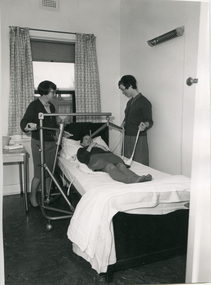 Royal District Nursing Service (now known as Bolton Clarke)
Photograph - Photograph, black and white, c.1967
... nursing service...rdns...rdns education...equipment...Royal District Nursing Service ran its own rehabilitation program requiring staff to be trained in techniques by RDNS Physiotherapists. royal district nursing service rdns rdns education equipment sister pat (paddy) rowley sister liz thomson sister joanne wilkinson Photographers stamp. ...The photograph is taken during an Education session at Royal District Nursing Service (RDNS). The Sisters are wearing their grey uniform cotton frocks and red cardigans of that era.Education was an integral part of Melbourne District Nursing Society (MDNS), later called Royal District Nursing Service, (RDNS), from its inception in 1885. Only Trained nurses (Nurses) were employed by the Society, and on visits to patients they taught the necessity of hygiene and cleanliness, as well as the need for a good diet, to bring about good health. Doctor’s lectures were later given at the MDNS home to instruct patients and their families on prevention of disease. Education to patients continued throughout the years regarding health care and the use of equipment in the home. RDNS Trained nurses (Sisters) received In-service education and by the end of the 1960s there was an increased focus on rehabilitation and independence. Patients were offered rehabilitation and new lifting techniques were introduced to reduce physical strain on staff and family members. Royal District Nursing Service ran its own rehabilitation program requiring staff to be trained in techniques by RDNS Physiotherapists.Black and white photograph of Royal District Nursing Service (RDNS), Sister Pat (Paddy) Rowley on left hand side, and Sister Joanne Wilkinson on right hand side, demonstrating the use of a hoist which has transferred Sister Liz Thomson onto a bed in the centre of the photograph. The bed is covered with white sheets and Sr. Thomson is lying on the bed with the sling of the hoist under her. The lowest metal bars and wheels of the hoist are under the bed and the top bars across the bed. Sr. Wilkinson's right hand is undoing the sling from the top bar of the hoist, and her left hand is holding the strap of the sling which is under Sr. Thomson. The Sisters are wearing their grey uniform frocks and dark cardigans. A window with two long floral opened curtains are behind the bed, and a strip heater is seen high on the adjoining wall.Photographers stamp. Quote No GW 90royal district nursing service, rdns, rdns education, equipment, sister pat (paddy) rowley, sister liz thomson, sister joanne wilkinson -
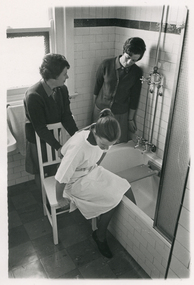 Royal District Nursing Service (now known as Bolton Clarke)
Photograph - Photograph, black and white, c.1967
... nursing service...rdns...rdns education...equipment...When required the Physiotherapist accompanied the Sister on her visit to the patient in their home.staff to be trained in techniques by RDNS Physiotherapists. royal district nursing service rdns rdns education equipment liz thomson betty mcdonald joanne wilkinson Photographers stamp and Quote No. ...The demonstration is being carried out in the bathroom at RDNS Headquarter, 452 St. Kilda Road, Melbourne. The Sisters are wearing their grey RDNS uniforms and red cardigans of that era. From the founding of the Melbourne District Nursing Society (MDNS) in 1885, known as Royal District Nursing Service (RDNS) from 1966, the rehabilitation of patients to insure they were able to live independently in their own homes was at the forefront of care given by their Trained nurses. As well as teaching and supervising the use of equipment, their Trained nurses taught them safe transfer techniques. These techniques were also taught to family members to enable them to care for their loved ones. RDNS at first held workshops given by a contracted private Physiotherapist before employing their own Physiotherapist in 1975 who taught staff the correct techniques, not only for safety of the patient, but to reduce physical strain on RDNS nursing staff and patient’s family members. When required the Physiotherapist accompanied the Sister on her visit to the patient in their home.staff to be trained in techniques by RDNS Physiotherapists.Black and white photograph showing a safety technique demonstration. Royal District Nursing Service (RDNS) Sister Liz Thomson, with her hair drawn back, is wearing a white gown over her uniform and is being transferred by Sister Betty McDonald, dark short curled hair. She has her arms extended supporting Sr. Thomson onto a bath seat. Sister Thomson has her left leg over the bath and the wooden bath seat can be seen positioned in the upper section of a white bath. Sister Joanne Wilkinson, who has short straight dark hair is on the right observing. Both Sr. McDonald and Sr. Wilkinson are wearing their RDNS uniforms of a dark cardigan over a grey frock. A white tiled wall with a strip of dark tiles is behind the bath.with metal piping attached to the right tiled wall and running to taps over the bath. A window is seen to the left of the tiled wall. Photographers stamp and Quote No. GW 8royal district nursing service, rdns, rdns education, equipment, liz thomson, betty mcdonald, joanne wilkinson
