
Showing 2905 items matching "1905"
-
 City of Ballarat
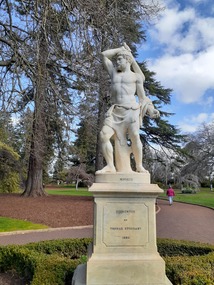
Artwork, other - Public Artwork, Angelo Bertozzi, Hercules by Angelo Bertozzi, circa 1880
... Thomas Stoddart (1828 - 1905) bought 12 white marble statues during a visit to Italy. ...Thomas Stoddart (1828 - 1905) bought 12 white marble statues during a visit to Italy. ...Thomas Stoddart (1828 - 1905) bought 12 white marble statues during a visit to Italy. Stoddart arranged for them to be shipped to Victoria and placed on pedestals of Sicilian marble and on bases of Victorian granite. These statues were unveiled in the gardens on Queen Victoria's birthday, 24th May, 1884. His intention was for the statues to adorn and add interest to the gardens. Stoddart's gift inspired the moves to make Ballarat a "City of Statues". Hercules was is one of the best-known heroes in Greek and Roman mythology. Hercules was renown for his great strength and courage, here he is depicted raising his mighty club and wearing a lion skin as a trophy.The artwork is of aesthetic and historic significance to the people of BallaratMarble figure of a man with raised club and wearing a lion skin around his loinsHerculeshercules, stoddart, botanic gardens -
 Surrey Hills Historical Society Collection
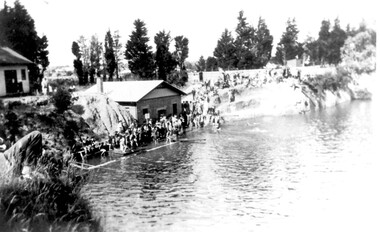
Photograph, The Surrey Dive, January 1931, 1931
... The Surrey Dive was formed on the site of a quarry from which clay had been extracted for brick-making. From 1905 Council was petitioned by the newly-formed Surrey Park Swimming Club to develop the site. ...The Surrey Dive was formed on the site of a quarry from which clay had been extracted for brick-making. From 1905 Council was petitioned by the newly-formed Surrey Park Swimming Club to develop the site. ...The Surrey Dive was formed on the site of a quarry from which clay had been extracted for brick-making. From 1905 Council was petitioned by the newly-formed Surrey Park Swimming Club to develop the site. Improvements including bathing sheds, spring boards and a 10-lane course but it remained a challenging site for inexperienced swimmers because of the sheer cliffs and the drop of 30m. The dive was the site of many swimming carnivals and attracted large spectator crowds. Frank Beaurepaire competed in the first carnival held in 1907 and won the one-mile race in record time. The dive was closed following the drought of 1967-1968 and redeveloped as an ornamental lake.The Surrey Dive was the first Olympic standard pool in Australia. Black and white photo of the Surrey Dive taken in January 1931, probably during a swimming carnival. The dive is in the foreground with 2 buildings on the LHS. One is brick with a chimney and at the water's edge; the other is of timber construction and is on the far LHS on the bank above the water. There is a large group of people in bathing costumes and a crowd which extends up the bank towards the right. There are mature conifer trees in the background. surrey dive, swimming, sports and recreations, ron falconer -
 Surrey Hills Historical Society Collection
Photograph, "Aberystwyth" 40 Wandsworth Road, Surrey Hills, 29 January 1998
... Built about 1905 in the Federation style with ‘Queen Anne’ influence. ...Built about 1905 in the Federation style with ‘Queen Anne’ influence. ...Built about 1905 in the Federation style with ‘Queen Anne’ influence. An early owner was Lionel Jones, a journalist and later Eustace Coghill of the Coghill family. After other owners the house was sold and in 1998 removed on two semi-trailers believed to be heading for the San Remo area. The name Aberystwyth possibly come from an association with Wales. Although a thriving sea-side town in the summer, the historic town of Aberystwyth is better known as a university town and the centre of learning for Wales, as it is also home to the National Library of Wales and boasts the largest Arts Centre in Wales. The town is huddled between three hills and two beaches.A coloured photograph of a close-up of the verandah fretwork, the roof without the tiles and a chimney.wandsworth road, surrey hills, federation style, queen anne style, mr lionel jones, journalists, mr eustace coghill, aberystwyth, house names -
 Melbourne Tram Museum
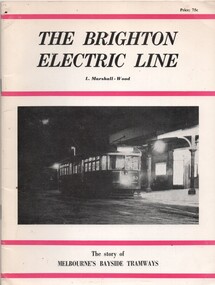
Book, Leon Marshall-Wood, "The Brighton Electric Line", 1966
... Kilda Station and the Brighton Beach railway station, that commenced operation in 1905. Also a short history of the Sandringham - Black Rock - Beaumaris - Cheltenham tram electric and horse tram lines. ...Kilda Station and the Brighton Beach railway station, that commenced operation in 1905. Also a short history of the Sandringham - Black Rock - Beaumaris - Cheltenham tram electric and horse tram lines. ...Book - - the history of the Brighton Electric Line by Leon Marshall-Wood, published 1966, 3rd edition revised and enlarged. Gives a brief history of the electric tramway operated by the Victorian Railways between St. Kilda Station and the Brighton Beach railway station, that commenced operation in 1905. Also a short history of the Sandringham - Black Rock - Beaumaris - Cheltenham tram electric and horse tram lines. Includes maps, rolling stock and ticket notes. Published by Traction Publications. Has details of the AETA on the back cover and listing of some publications. See Reg Item 2062 for the 1st edition and 3400 for the second edition.Yields information about the Victorian Railways Melbourne tramways or street railways.Book - 40 pages including card coverstrams, tramways, vr, melbourne, brighton, st kilda, sandringham, black rock, horse trams -
Eltham District Historical Society Inc
Document - Folder, Wingrove, Charles
... Contents Notes: Charles Symons Wingrove, J.P. (1812-1905). List of school age children of the Wingrove family, researched August/September 2001. ...Contents Notes: Charles Symons Wingrove, J.P. (1812-1905). List of school age children of the Wingrove family, researched August/September 2001. ...Charles Wingrove was an Eltham pioneer. Contents Notes: Charles Symons Wingrove, J.P. (1812-1905). List of school age children of the Wingrove family, researched August/September 2001. Extract from "Heidelberg (Victoria) The Land and its People 1838-1900", by Ronald Stuart Garden, coverying Charles Symons Wingrove. Newspaper article: "Wingrove ... man of Eltham", Leader Associated Newspapers Eltham Centenary Supplement, 30 March 1971. History of Charles Wingrove. Letter Brian Tucker to Eltham Shire Council, 5 November 1976. Enclosed 25 year Service Certificate presented to C S Wingrove in 1882. Newspaper clippings, A4 photocopies, etccharles wingrove, eltham roads board, andrew ross, wingrove park, b w plant, victorian agricultural society, evelyn arms eltham, fountain of friendship hotel eltham, charles symons wingrove, brian tucker, wingrove cottage eltham -
 Emerald Museum & Nobelius Heritage Park
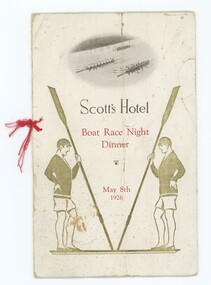
Programme - Menu for Boat Race Night at Scott's Hotel 1926, 1926
... This programme belonged to Dr Ian 'Spud' MacLeod Murphy (1905-1981). It is dated 8 May 1926 and relates to a celebration dinner for a rowing regatta - when Dr Murphy was a young man. ...This programme belonged to Dr Ian 'Spud' MacLeod Murphy (1905-1981). It is dated 8 May 1926 and relates to a celebration dinner for a rowing regatta - when Dr Murphy was a young man. ...This programme belonged to Dr Ian 'Spud' MacLeod Murphy (1905-1981). It is dated 8 May 1926 and relates to a celebration dinner for a rowing regatta - when Dr Murphy was a young man. He had been the cox of two Premier rowing teams in 1921 and 1922 and also later when he was at Melbourne University. Dr Murphy retired to Clematis in 1947 intending to breed turkeys but instead responded to the community need for a GP and worked for 34 years seven days a week without assistance providing medical services throughout the district. He was awarded the British Empire Medal in 1977 for his service to the health of the community.Dr Murphy was Emerald's first and much-loved GP. His work for the community over 34 years was of immense benefit to Emerald and surrounding districts. Programme for a Boat Race Dinner (1926) consisting of a folder with a red tie, an image of two oarsmen on the front and inside the menu for the occasion.On front below crossed oars is handwritten two lists of team members of winning teams of 1921 and 1922. On back handwritten 'Murphy'dr ian macleod murphy, spud murphy, doctor, emerald, boat race -
 Eltham District Historical Society Inc
Photograph, Phillip Shillinglaw's neice, May, c.1910
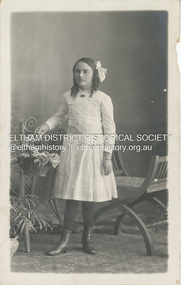
... - This could be Ethel May Bottle b. 1883, daughter of Edward Henry Bottle and step-daughter of Catherine Shillinglaw but this type of post-card photo only commenced in 1905 when she would have been 22. The girl looks more like 15. ...- This could be Ethel May Bottle b. 1883, daughter of Edward Henry Bottle and step-daughter of Catherine Shillinglaw but this type of post-card photo only commenced in 1905 when she would have been 22. The girl looks more like 15. ...Believed to be addressed to her cousin, Mary Ann Shillinglaw, from May ? - This could be Ethel May Bottle b. 1883, daughter of Edward Henry Bottle and step-daughter of Catherine Shillinglaw but this type of post-card photo only commenced in 1905 when she would have been 22. The girl looks more like 15. It is not known if Elizabeth Docherty (nee Shillinglaw) had any children. Born 1861 and married 1894 at 33 years of age, it is possible that she could have had a daughter who would have been 15 in 1910. "Dear Mary I hope this will find you all well. I hope Uncle Phillip is better. This is for the home it is among the lot. You must excuse me for sending one among the lot I haven’t enough to go all round. I will get more copied and send one to Carrie and Florrie. Well I think I have told you all this time I haven’t much room. So good bye from your loving cousin Mary 100 xxxxxxxxxxxxxx" Possibilities to investigate are the Kidd side families: Wilson Stewart Renolds Mills Mason Williams Post Card printed on back with photographer's details: W. Mason & Co., 144 Bridge Road, Richmond. W. Mason & Co. operated from this adress from 1903-c.1932 POSTCARD 1905-1940s Like the carte-de-visite, postcards enjoyed a collecting craze by large numbers of people, and were often kept in albums through which the interested visitor could browse. Postcards were posted or exchanged in huge numbers. Postal authorities in Australia only allowed the private printing of postcards from 1898. At this time the back of the card was reserved for the address and postage stamp, and the front was used for the message and a picture. In 1902 British authorities allowed a "divided back", so that the left side could be used for the message, the right side for the address and stamp, and the whole of the front was devoted to the picture. France followed suit in 1904, Germany and Australia in 1905, and the United States in 1907. - Frost, Lenore; Dating Family Photos 1850-1920; Valiant Press Pty. Ltd., Berwick, Victoria 1991marg ball collection, shillinglaw family photo album 3, postcard, 1903-1932, 1910, agnes mary shillinglaw 1881-1968, ethel may bottle, mary ann shillinglaw (1880-1963), w. mason & co. photographer 144 bridge rd melbourne -
 Phillip Island and District Historical Society Inc.
Photograph Album, Kodak, Phillip Island Cemetery, c 1990
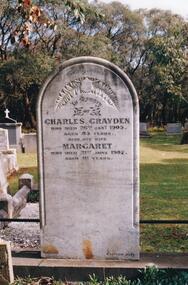
... He died 26th January 1905 aged 85. Margaret died 21st June 1907 aged 81. ...He died 26th January 1905 aged 85. Margaret died 21st June 1907 aged 81. ...The Album was compiled by Nancy McHaffie late 1990's, with the assistance of Edith Jeffery's, with her book "Garden of Memories" and extensive knowledge of Phillip Island. The Cemetery lies back from the road and is surrounded by Manna Gums, rare Peppermint Gums, Blackwoods and other native trees. In all 25 acres of land were set aside as Crown Land in the land settlement of 1868. There are 6.2 acres of wetlands near the cemetery entrance.466-27: Charles Grayden: Charles arrived from England on the "Robert Ben" about 1835. On arrival he went bush. He later married Margaret Larkie in St. James' old Cathedral, Melbourne on 15th September, 1842. They arrived at Hastings in 1860 then came to Phillip Island to live on Block 33, Newhaven in the year 1867. He died 26th January 1905 aged 85. Margaret died 21st June 1907 aged 81. She is also buried in this grave. 466-28: Joseph Bauer: Joseph was the son of our first owner of the Isle of Wight Hotel. His father came to the Island in 1870 and bought a small private house, then added to it in the style of a Swiss House. It became one of the most comfortable hotels in Victoria. Joseph died aged 19, in 1878.phillip island cemetery, nancy mchaffie, edith jeffery -
 Bendigo Historical Society Inc.
Document - COHN BROTHERS COLLECTION: SHARE SCRIP
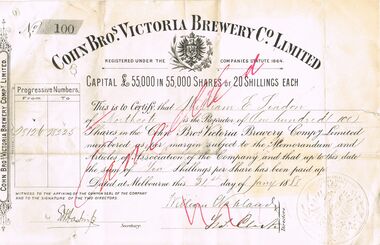
... Transferred after his death to William Charles Vahland 50 shares, and to Ralph William Brown 50 shares on the Seventh of December 1905. Executors of his will 'The Union Trustee Company of Australia Limited. ...Transferred after his death to William Charles Vahland 50 shares, and to Ralph William Brown 50 shares on the Seventh of December 1905. Executors of his will 'The Union Trustee Company of Australia Limited. ...Cohns bros Victoria Brewery Co 100 Share scrip numbers 28126-28225 in the name of William E Seadon dated 31 st January 1888. Capital £ 55,000 in 55,000 Shares or twenty shillings each. Cohns seal impressed upon document. Transferred after his death to William Charles Vahland 50 shares, and to Ralph William Brown 50 shares on the Seventh of December 1905. Executors of his will 'The Union Trustee Company of Australia Limited. Document impressed with executors wax seal. One penny victoria stamp duty affixed to reverse of share scrip document paid in addition at rate of five shillings per share £25 authorised by E I hastings Secretary with February 1888 date. One penny stamp duty also affixed to transfer document.bendigo, industry, cohn bros., 19th century cohns bros share scrip. the union trustees company of australia. mr w e seadon. -
 Bendigo Historical Society Inc.
Document - COHN BROTHERS COLLECTION: SHARE SCRIP
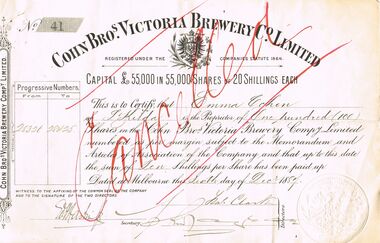
... Shares transferred to Esther M Landeshut of Redan Street St Kilda dated Nineteenth day June 1905. Signed in presence of John Burrit Box and Dianne Mackinson....Shares transferred to Esther M Landeshut of Redan Street St Kilda dated Nineteenth day June 1905. Signed in presence of John Burrit Box and Dianne Mackinson. ...a. Cohn Bros Victoria Brewery Co Limited share scrip No 41 Capital £55,000 in 55,000 shares consisting of numbers 28326- 28425 held by Emma Cohen of St Kilda dated 6th day December 1889. W Hastings secretary witnessed two directors signatures??. Reverse states Paid in addittion 5shillings per share dated 30th January 88 per P Maiton. .b Transfer Doc No 285 of shares numbered consecutively 28326-28425 from Emma Cohen deceased undertaken by 'The Equity Trustees Executors and agency Company Ltd' . Shares transferred to Esther M Landeshut of Redan Street St Kilda dated Nineteenth day June 1905. Signed in presence of John Burrit Box and Dianne Mackinson.bendigo, industry, cohn bros brewery, cohn bros brewery. emma cohen of st kilda. the equity trustees executors and agency company ltd -
 Bendigo Historical Society Inc.
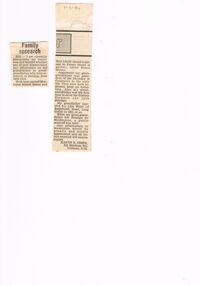
Newspaper - THREE UNRELATED ADVERTISER ARTICLES: SIMES (SYMES?) FAMILY: GOLDEN SQUARE RAILWAY STATION: ONE TREE HILL, 01/09/1984
... Simes family: Letter asking for help in assistance with information about the Simes family (1905-1924); Golden Square (railway) station buildings - some history of the building but article is about dilemma of old and 'not needed' buildings ''I wonder whether anybody want Golden Square/'' author - Andrew Ward, Bendigo Advertiser; article by John Hattam re the origin of the name ''One Tree Hill'' and history of the cutting down of The Tree (1879 - prosecution of a Jerry Ryan for vandalism); the road to the top being constructed (1892); lookout-tower constructions - the first being in 1894....Simes family: Letter asking for help in assistance with information about the Simes family (1905-1924); Golden Square (railway) station buildings - some history of the building but article is about dilemma of old and 'not needed' buildings ''I wonder whether anybody want Golden Square/'' author - Andrew Ward, Bendigo Advertiser; article by John Hattam re the origin of the name ''One Tree Hill'' and history of the cutting down of The Tree (1879 - prosecution of a Jerry Ryan for vandalism); the road to the top being constructed (1892); lookout-tower constructions - the first being in 1894. ...Three unrelated Advertiser articles all dated 1/9/1984 stapled together- Simes (Symes?)family; Golden Square railway station; One Tree Hill. Simes family: Letter asking for help in assistance with information about the Simes family (1905-1924); Golden Square (railway) station buildings - some history of the building but article is about dilemma of old and 'not needed' buildings ''I wonder whether anybody want Golden Square/'' author - Andrew Ward, Bendigo Advertiser; article by John Hattam re the origin of the name ''One Tree Hill'' and history of the cutting down of The Tree (1879 - prosecution of a Jerry Ryan for vandalism); the road to the top being constructed (1892); lookout-tower constructions - the first being in 1894.document, newspaper, old rail stations, golden square rail station -
 Bendigo Historical Society Inc.
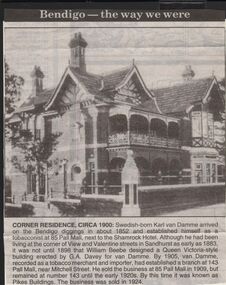
Newspaper - JENNY FOLEY COLLECTION: CORNER RESIDENCE CIRCA 1900
... Davey for Van Damme. By 1905, van Damme, recorded as a tobacco merchant and importer, had established a branch at 143 Pall Mall, near Mitchell street. ...Davey for Van Damme. By 1905, van Damme, recorded as a tobacco merchant and importer, had established a branch at 143 Pall Mall, near Mitchell street. ...Bendigo Advertiser "The way we were" from 1999. Corner residence circa 1900: Swedish born Karl Van Damme arrived on the Bendigo diggings in about 1852 and established himself as a tobacconist at 85 Pall Mall, next to the Shamrock Hotel. Although he had been living at the corner of View and Valentine streets in Sandhurst as early as 1883 it was not until 1898 that William Beebe designed a Queen Victoria style building erected by G.A. Davey for Van Damme. By 1905, van Damme, recorded as a tobacco merchant and importer, had established a branch at 143 Pall Mall, near Mitchell street. He sold the business at 85 Pall Mall in 1909, but remained at number 143 until the early 1920s. By this time it was known as Pikes Buildings. The business was sold in 1924newspaper, bendigo advertiser, the way we were -
 Bendigo Historical Society Inc.
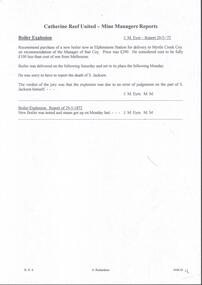
Document - MINING REPORTS - CATHERINE REEF UNITED MINE MANAGERS REPORTS
... Recommendations, re New Winding Engine and Poppet Legs by Rbt. Coakes 18th May, 1905. Truck road from the shaft to the battery. ...Recommendations, re New Winding Engine and Poppet Legs by Rbt. Coakes 18th May, 1905. Truck road from the shaft to the battery. ...Handwritten notes, with typed transcript of same, on Catherine Reef United Mine Manager, J. M. Eyre Report 20/5/'72. Recommends the purchase of a new boiler. S. Jackson killed in a boiler explosion which the jury said was due to an error of judgement on his part. Recommendations, re New Winding Engine and Poppet Legs by Rbt. Coakes 18th May, 1905. Truck road from the shaft to the battery. Recommendation to call for tenders for a new changing house and a blacksmith shop. Reports about boilers, ropes, cleaning of machinery, testing of brakes, slack coal from the Powlett North Woolamai Collieries, crushings, number of batteries, low wood supply and a visit to the New Moon & South New Moon which are burning the Powlett slack coal. Albert Richardson Collectiondocument, gold, mining reports, mining reports, catherine reef united mine managers reports, j m eyre, myrtle creek coy, s jackman, rbt coakes, great northern co, virginia co, mr roberts, mr harkness, mr mcgrath, ernest mueller, roberts & sons, mr bennett, mr abrahams, mr sluyterman, j langdon, electrical supply coy, smiths, powlett north woolamai collieries, m j gwatkins, new moon, south new moon -
 Ballarat Tramway Museum
Magazine, Australian Railway and Locomotive Historical Society, "ARLHS Bulletin", 1942
... June 1942 - page 82 & 83 - has an article "Electric Trams of Ballarat 1905 to 1942" written by Wal Jack. November 1942 - page 65 & 66, has an article "Flemington Bridge Tramways, The North Melbourne Electric Tramway and Lighting Company" written by Peter W Duckett....June 1942 - page 82 & 83 - has an article "Electric Trams of Ballarat 1905 to 1942" written by Wal Jack. November 1942 - page 65 & 66, has an article "Flemington Bridge Tramways, The North Melbourne Electric Tramway and Lighting Company" written by Peter W Duckett. ...Yields information about the tramways of Ballarat and the North Melbourne tramways and has a strong association with well known tramway enthusiasts of the era., Yields information about the tramways of Ballarat and the North Melbourne tramways and has a strong association with well known tramway enthusiasts of the era.Set of 8 Australian Railway and Locomotive Historical Society Bulletins for the period May 1942 to December 1942. Each page has been stencil duplicated. Index sheets for the journals at the front of the documents. The sheets have been placed in a heavy brown flysheet and then placed in "The Riven" spring back binder. May 1942 - page 57 to 59 - has a article, Horse Trams of Ballarat 1887 to 1913" written by Wal Jack, including a map prepared by C. C. Singleton. June 1942 - page 82 & 83 - has an article "Electric Trams of Ballarat 1905 to 1942" written by Wal Jack. November 1942 - page 65 & 66, has an article "Flemington Bridge Tramways, The North Melbourne Electric Tramway and Lighting Company" written by Peter W Duckett.ballarat, esco, nmetl, melbourne, horse trams, electrification -
Clunes Museum
Document (Collection) - MINUTE BOOKS, Clunes Free Lending Library et al, FREE LENDING LIBRARY - CLUNES, 1884-1912
... .1 United Friendly Societies of Clunes Minute Book containing Receipts and Disbursements 1877-1914 .2 Clunes Free Lending Library Letter Book 1912-1921 .3 Clunes Free Lending Library Minute Book 1905-1912 .4 Clunes Free Lending Library Minute Book 1894-1901 .5 Clunes Free Lending Library Minute Book 1884-1893 .6 Clunes Free Lending Library Loans Register .7 Letter to the Secretary, Medical Union, Clunes, with envelope addressed to Mr L Chambers, Medical Committee, Clunes .8 Letter Australian Women's Association , Clunes Branch 2536 dated 23 September 1914 advising that Mr Harden will represent the Branch at the meeting on Thursday September 24th, 1914 ...Administrative and financial records of the United Friendly Society of Clunes and the Clunes Free Lending Library in the late eighteenth and early nineteenth centuries clunes free lending library record keeping australian womens association medical union Nil .1 United Friendly Societies of Clunes Minute Book containing Receipts and Disbursements 1877-1914 .2 Clunes Free Lending Library Letter Book 1912-1921 .3 Clunes Free Lending Library Minute Book 1905-1912 .4 Clunes Free Lending Library Minute Book 1894-1901 .5 Clunes Free Lending Library Minute Book 1884-1893 .6 Clunes Free Lending Library Loans Register .7 Letter to the Secretary, Medical Union, Clunes, with envelope addressed to Mr L Chambers, Medical Committee, Clunes .8 Letter Australian Women's Association , Clunes Branch 2536 dated 23 September 1914 advising that Mr Harden will represent the Branch at the meeting on Thursday September 24th, 1914 FREE LENDING LIBRARY - CLUNES Document MINUTE BOOKS Clunes Free Lending Library United Friendly Society of Clunes ...clunes free lending library, record keeping, australian womens association, medical unionclunes free lending library, record keeping, australian womens association, medical union -
 Ballarat Tramway Museum
Newspaper, The Courier Ballarat, "In Retrospect", 20/09/1994 12:00:00 AM
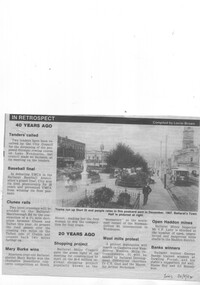
... The tram is fitted with a destination board on the front dash - the type used soon after opening in 1905. Caption of the photo says "Trams run up Sturt St and people relax in this postcard sent in December 1907. ...The tram is fitted with a destination board on the front dash - the type used soon after opening in 1905. Caption of the photo says "Trams run up Sturt St and people relax in this postcard sent in December 1907. ...Newspaper cutting from The Courier, Ballarat, Tuesday 20/9/1994 of the reproduction of a postcard photograph showing an ESCo tram soon after opening running west bound in Sturt St with the Town Hall in the background. Shows the development of the Gardens at the time and buildings on either side of Sturt St. and type of poles etc. The tram is fitted with a destination board on the front dash - the type used soon after opening in 1905. Caption of the photo says "Trams run up Sturt St and people relax in this postcard sent in December 1907. Ballarat's Town Hall is pictured at right." Also has an item in the "In Retrospect" section of the newspaper, about the construction of a new road to avoid two level crossings between Talbot and Clunes. Item compiled by Lorrie BrownIn bottom right hand corner, in blue ink "Tues 20/9/94".trams, tramways, sturt st, esco, town hall -
 Ballarat Tramway Museum
Document - Photocopy, Signalling Record Society of Victoria, "Safeworking Operations of the Ballarat Electric Tramway System", May. 1988
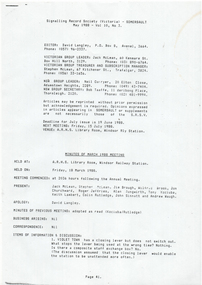
... Describes location of loops in horse drawn era compared to those of the ESCo area 1905 to 1934, with reference to changes made to ESCo Loops by SECV upon rehabilitation of the system, based upon changes on BTM's collection of staffs. ...Describes location of loops in horse drawn era compared to those of the ESCo area 1905 to 1934, with reference to changes made to ESCo Loops by SECV upon rehabilitation of the system, based upon changes on BTM's collection of staffs. ...Copy of an article by Neville Gower, published in "Somersault", the magazine of the Signalling Record Society of Victoria, May 1988. Describes location of loops in horse drawn era compared to those of the ESCo area 1905 to 1934, with reference to changes made to ESCo Loops by SECV upon rehabilitation of the system, based upon changes on BTM's collection of staffs. Published in p54, 55, 56 and 60 of Somersault, May 1988. Copy supplied by Graeme Reynolds, printed with a dot matrix printer. Page 56 and cover page supplied by Warren Doubleday (2/1999). Was a follow up article or item by Peter Barry in the July 1988 issue and an article on Bendigo during 1989. (Information provided by David Langley editor at the time - 1/1999). See also item 988.p1 - 54 has been enhanced in black ink.trams, tramways, signals, crossing loop, esco, tramway staffs -
 Mission to Seafarers Victoria
Flag - House flag, Messageries Maritimes
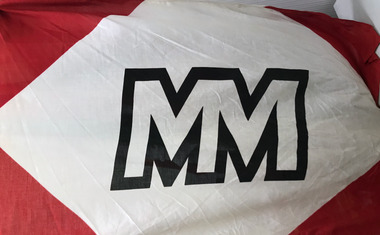
... The first Seafarers Service was held on 23 October 1905 in the St Paul's Cathedral in London to celebrate the Centenary of the Battle of Trafalgar and the death of Vice-Admiral Horatio Nelson on 21 October 1805. ...The first Seafarers Service was held on 23 October 1905 in the St Paul's Cathedral in London to celebrate the Centenary of the Battle of Trafalgar and the death of Vice-Admiral Horatio Nelson on 21 October 1805. ...The first Seafarers Service was held on 23 October 1905 in the St Paul's Cathedral in London to celebrate the Centenary of the Battle of Trafalgar and the death of Vice-Admiral Horatio Nelson on 21 October 1805. Reverend Alfred Gurney Goldsmith launched the first Seafarers Service two years later and the first service was held on Sunday 10 November 1907. National and house flags are used during the annual Seafarers Service. Messageries Maritimes was a French merchant shipping company. It was originally created in 1851. In 1977 it merged with Compagnie générale transatlantique to form Compagnie générale maritime. In 1996 CGM was privatized and sold to Compagnie Maritime d'Affrètement (CMA) to form CMA CGM.The service continue to reflect the full range of the maritime activities in Australia. Representatives come from the Royal and Merchant Navies, the commercial world, shipping companies, mission and philanthropic societies, veterans’ associations, labour unions, youth and leisure organisations, but anyone is welcome to attend.Large red rectangular flag with large M.M in black on a white diamond shape.Messageries Maritimes written in black penflag, seafarers service, messageries maritimes, m.m., shipping company, house flag -
 Mission to Seafarers Victoria
Flag - House flag, Eastern & Australian (E&A)
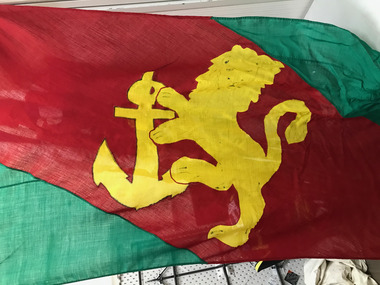
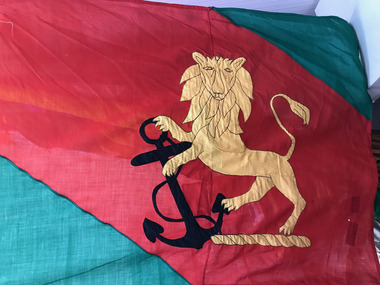
... The first Seafarers Service was held on 23 October 1905 in the St Paul's Cathedral in London to celebrate the Centenary of the Battle of Trafalgar and the death of Vice-Admiral Horatio Nelson on 21 October 1805. ...The first Seafarers Service was held on 23 October 1905 in the St Paul's Cathedral in London to celebrate the Centenary of the Battle of Trafalgar and the death of Vice-Admiral Horatio Nelson on 21 October 1805. ...The first Seafarers Service was held on 23 October 1905 in the St Paul's Cathedral in London to celebrate the Centenary of the Battle of Trafalgar and the death of Vice-Admiral Horatio Nelson on 21 October 1805. Reverend Alfred Gurney Goldsmith launched the first Seafarers Service two years later and the first service was held on Sunday 10 November 1907. National and house flags are used during the annual Seafarers Service. Eastern and Australian Steam Ship Company, a small line which played a strong part in Australian maritime history, providing links from Australia (in particular Queensland) and New Zealand to South-east Asia from 1873 to 1983.The service continue to reflect the full range of the maritime activities in Australia. Representatives come from the Royal and Merchant Navies, the commercial world, shipping companies, mission and philanthropic societies, veterans’ associations, labour unions, youth and leisure organisations, but anyone is welcome to attend.Large green flag with crest of a gold lion rampant holding a gold fouled anchor on a red stripe.E & A written in black penflag, seafarers service, shipping company, e&a, eastern and australian, house flag -
 Mission to Seafarers Victoria
Flag - House flag, Eastern & Australian (E&A)
... The first Seafarers Service was held on 23 October 1905 in the St Paul's Cathedral in London to celebrate the Centenary of the Battle of Trafalgar and the death of Vice-Admiral Horatio Nelson on 21 October 1805. ...The first Seafarers Service was held on 23 October 1905 in the St Paul's Cathedral in London to celebrate the Centenary of the Battle of Trafalgar and the death of Vice-Admiral Horatio Nelson on 21 October 1805. ...The first Seafarers Service was held on 23 October 1905 in the St Paul's Cathedral in London to celebrate the Centenary of the Battle of Trafalgar and the death of Vice-Admiral Horatio Nelson on 21 October 1805. Reverend Alfred Gurney Goldsmith launched the first Seafarers Service two years later and the first service was held on Sunday 10 November 1907. National and house flags are used during the annual Seafarers Service. Eastern and Australian Steam Ship Company, a small line which played a strong part in Australian maritime history, providing links from Australia (in particular Queensland) and New Zealand to South-east Asia from 1873 to 1983.The service continue to reflect the full range of the maritime activities in Australia. Representatives come from the Royal and Merchant Navies, the commercial world, shipping companies, mission and philanthropic societies, veterans’ associations, labour unions, youth and leisure organisations, but anyone is welcome to attend.Large green flag with crest of a gold lion rampant holding a black fouled anchor on a red stripe.E & A written in black penflag, seafarers service, shipping company, e&a, eastern and australian, house flag -
 Eltham District Historical Society Inc
Photograph, Early Residents' Reunion, Shire of Eltham Centenary Celebrations, 8 Aug 1971
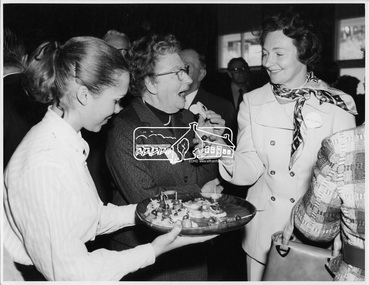
... Blanche Shallard (nee Everard) (1905-2002) was an active member of the Montmorency community from 1933 when she and her husband Jack Shallard settled there. ...Blanche Shallard (nee Everard) (1905-2002) was an active member of the Montmorency community from 1933 when she and her husband Jack Shallard settled there. ...Mrs Blanche Shallard and Mrs Jean Spence enjoying an horderves with unknown waitress at the early residents reunion as part of the centenary celebrations for the Shire of Eltham in August 1971. The event was held in the West Riding Hall, Henry Petrie Community Centre, Montmorency. Blanche Shallard (nee Everard) (1905-2002) was an active member of the Montmorency community from 1933 when she and her husband Jack Shallard settled there. She volunteered for many community groups including the Diamond Valley Community Hospital, Greensborough, local schools and churches and the Eltham District Historical Society. Jean Spence and her husband Geoffrey were also residents of Montmorency. This photo forms part of a collection of photographs gathered by the Shire of Eltham for their centenary project book, "Pioneers and Painters: 100 years of the Shire of Eltham" by Alan Marshall (1971). The collection of over 500 images is held in partnership between Eltham District Historical Society and Yarra Plenty Regional Library (Eltham Library) and is now formally known as 'The Shire of Eltham Pioneers Photograph Collection.' It is significant in being the first community sourced collection representing the places and people of the Shire's first one hundred years.Digital imagesepp, shire of eltham pioneers photograph collection, centenary celebrations, shire of eltham, shire of eltham centenary, early residents, early residents' reunion, mrs. j.v. shallard, jean spence, blanche shallard, henry petrie community centre montmorency, horderves, montmorency -
Glen Eira Historical Society
Book - St Peters Church of England, Murrumbeena
... Includes a forward on local history and church history from 1905 to 1997 by Father Tom Jewell, and chapters on the vicars from 1915. ...Includes a forward on local history and church history from 1905 to 1997 by Father Tom Jewell, and chapters on the vicars from 1915. ...This file contains two items for seventy-fifth anniversary celebrations. A ninety-five page book FEEDING CHRIST’S SHEEP – A HISTORY OF ST PETERS MURRUMBEENA WITH HOLY NATIVITY HUGHESDALE by Alex Reid, published in 1999 as part of the celebrations of the seventy-fifth anniversary of the laying of the Foundation Stone of the original church and the fortieth anniversary of the dedication of the new section of Church. Includes a forward on local history and church history from 1905 to 1997 by Father Tom Jewell, and chapters on the vicars from 1915. Also includes a supplement undated listing gifts to St Peters and Holy Nativity 75TH ANNIVERSARY bookmark Hand-written notes by John Callaghan on the detail of the foundation stones.clergy, anglican church, st peters murrumbeena, holy nativity hughesdale, reid fr. alex, ingham rev. a.e., green rev. w.g.a., meredith rev. c.w., potter rev. h.r., cotes rev. c.b., goodisson rev. k.p., laity rev. a.g., hassing rev. e.a., williams rev. r.t.p., jewell rev. t.s., christian religion, depression 1929-1939, world war 1939-1945, multiculturalism, catholicism, murrumbeena, hughesdale, history, world war 1914-1918 -
 Uniting Church Archives - Synod of Victoria
Photograph, Undated c.1900
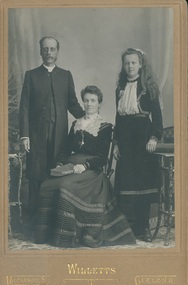
... Arnaud; 1904 Sale; 1905 Moonta; 1908 Crystal Brook; 1911 Koolunga; 1914 Woodville; 1916 Redruth; 1920 Gumeracha; 1924 Supernumerary Gumeracha; Chairman of District 1897 - 1899, 1904, 1913. ...Arnaud; 1904 Sale; 1905 Moonta; 1908 Crystal Brook; 1911 Koolunga; 1914 Woodville; 1916 Redruth; 1920 Gumeracha; 1924 Supernumerary Gumeracha; Chairman of District 1897 - 1899, 1904, 1913. ...David Buckley Bridgwood: born 1852 England. Commenced ministry in 1884. Married Adeline Williams, daughter of the Rev. Spencer Williams of Launceston on 22 March 1888. 1884 Warragul; 1885 Prahran; 1886 Murtoa; 1887 Flemington; 1888 Wangaratta; 1889 Sandhurst; 1892 Hobart; 1895 New Town; 1897 Westbury; 1900 Geelong West; 1902 Geelong; 1903 St. Arnaud; 1904 Sale; 1905 Moonta; 1908 Crystal Brook; 1911 Koolunga; 1914 Woodville; 1916 Redruth; 1920 Gumeracha; 1924 Supernumerary Gumeracha; Chairman of District 1897 - 1899, 1904, 1913. Died 1941, buried Mitcham S.A. B & W gloss, studio portrait of the Rev. D. Buckley Bridgwood with his wife Adeline and daughter Florence.methodist, minister, buckley bridgwood, adeline bridgwood, florence bridgwood -
 St Kilda Historical Society
Photograph
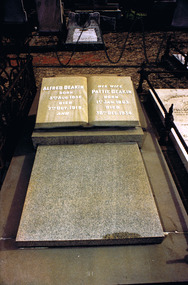
... He held the office of Prime Minister three times: 1903-4, 1905-8 and 1909-10. He was buried in St Kilda cemetery after a state funeral. ...He held the office of Prime Minister three times: 1903-4, 1905-8 and 1909-10. He was buried in St Kilda cemetery after a state funeral. ...Alfred Deakin was the second Prime Minister of Australia, after having served under Edmund Barton as Attorney-General. He held the office of Prime Minister three times: 1903-4, 1905-8 and 1909-10. He was buried in St Kilda cemetery after a state funeral. Elizabeth Martha Anne (Pattie) Browne married Alfred Deakin in 1882, when she was 19 years old. They had three children, Ivy, Stella and Vera. Pattie Deakin was awarded a CBE (Commander of the British Empire), for her contribution to public life. The award was announced in the 1935 New Years honours list, two days after her death.Colour photographBack of photograph: Deakin. 950821/501 Ric Clarke. The headstone reads: Alfred Deakin Born 3rd Aug 1856. Died 7th Oct. 1915. And His Wife Pattie Deakin Born 1st Jan. 1863. Died 30th Dec. 1934.st kilda cemetery, alfred deakin, pattie deakin -
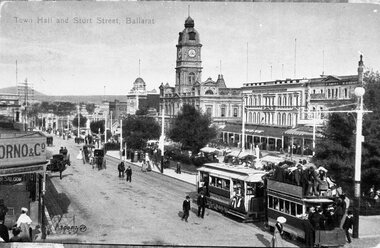 Ballarat Tramway Museum
Postcard, Sturt St. Ballarat, - horse tram trailer, c1905
... Photo appears to be taken soon after opening of the electric trams, as the tram does not have any destination box above the driver. Possibly summer 1905/1906. Numerous people in the street, some horse-drawn vehicles in the photograph. ...Photo appears to be taken soon after opening of the electric trams, as the tram does not have any destination box above the driver. Possibly summer 1905/1906. Numerous people in the street, some horse-drawn vehicles in the photograph. ...Image is of an ESCo tram just past the intersection of Doveton St. and Sturt St. travelling east along the north side of Sturt. Steet towing a heavily laden horse tram as a trailer. Photo appears to be taken soon after opening of the electric trams, as the tram does not have any destination box above the driver. Possibly summer 1905/1906. Numerous people in the street, some horse-drawn vehicles in the photograph. Shows buildings along the south side of Sturt St. and part of the verandah of the building at the NE corner of Doveton St. See Reg items 4275 & 10100 for other black and white prints of this photograph and 162 for the coloured postcard. Yields information about the use of horse tram trailers hauled by electric trams soon after opening of the electric tram system.B&W print and scanned images of a coloured postcard.See 835i3. In top of image are the words "Town Hall and Sturt Street, Ballarat"trams, tramways, esco, horse trams, postcards, doveton st, sturt st -
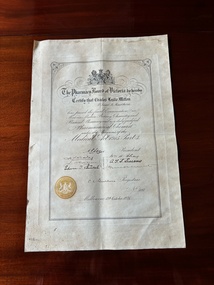 Surrey Hills Historical Society Collection
Document - Pharmacy Board of Victoria Certificate, Pharmacy College of Victoria, Charles Leslie Mitton Pharmacy Certificate, 13 October 1926
... Charles Leslie Mitton (1905-1968) was a pharmacist at 131 Union Road, Surrey Hills from 1933-1968. ...Charles Leslie Mitton (1905-1968) was a pharmacist at 131 Union Road, Surrey Hills from 1933-1968. ...Charles Leslie Mitton (1905-1968) was a pharmacist at 131 Union Road, Surrey Hills from 1933-1968. DOD 30/04/1968. Prior to coming to Surrey Hills, he was a pharmacist in Newmarket (Ref: 1931 electoral roll). He and his wife, Ethel Sylvia Elizabeth Mitton (nee Stevenson) lived at 65 Union Road. They were married in 1933 and had 2 sons and a daughter. He was followed in the business by his son John and daughter Rosalind. See also SHP0015 - Charles Mitton outside his pharmacy; SHP1100 - head and shoulders portrait of Charles Mitton; SHA2017/5/1 - Mitton's pharmacy ledger.A loose certificate printed with individual's name and address handwritten in appropriate blank spaces and signed by the President, Registrar and Examiners of the Pharmacy College of Victoria. The paper is yellowed and stained along the top edge. It is generally grubby. It appears to have been framed at some stage but not for some time. It has been folded in four. Embossed in yellow with the college's official stamp.Handwritten "Charles Leslie Mitton" / 32 Smart St., Hawthorn / (signature) A E Sayer (President) / .... Bailey / J W Cochran / Edwin T Church / Wm A .... / A T S Sissons / ................... (Examiners) / C L Butchers (Registrar)charles leslie mitton, mitton's pharmacy, 131 union road, pharmacies, certificates, pharmacy college of victoria -
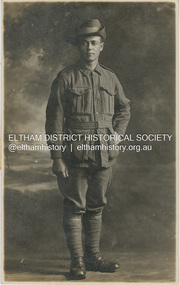 Eltham District Historical Society Inc
Photograph, Ernest Samuel Shillinglaw, 1916
... France followed suit in 1904, Germany and Australia in 1905, and the United States in 1907. - Frost, Lenore; Dating Family Photos 1850-1920; Valiant Press Pty. ...France followed suit in 1904, Germany and Australia in 1905, and the United States in 1907. - Frost, Lenore; Dating Family Photos 1850-1920; Valiant Press Pty. ...SHILLINGLAW Ernest Samuel : Service Number - 1689 : Place of Birth - Eltham VIC : Place of Enlistment - Melbourne VIC : Next of Kin - (Sister) SHILLINGLAW Mary Service Record https://recordsearch.naa.gov.au/SearchNRetrieve/Interface/DetailsReports/ItemDetail.aspx?Barcode=8082612&isAv=N Enlisted 25 Feb 1916 Embarked overseas 20 Jun 1916 Served with the 38th Battalion in France Wounded in action 29 May 1917 with a severe gunshot wound to the left eye. Promoted to Lance Corporal 3 Sep 1918 Awarded the Military Medal 17 Mar 1919 (Gazetted London 17 Jun) Diembarked Melbourne 30 Apr 1919 Discharged 25 Jun 1919 from AIF, medically unfit with influenza POSTCARD 1905-1940s Like the carte-de-visite, postcards enjoyed a collecting craze by large numbers of people, and were often kept in albums through which the interested visitor could browse. Postcards were posted or exchanged in huge numbers. Postal authorities in Australia only allowed the private printing of postcards from 1898. At this time the back of the card was reserved for the address and postage stamp, and the front was used for the message and a picture. In 1902 British authorities allowed a "divided back", so that the left side could be used for the message, the right side for the address and stamp, and the whole of the front was devoted to the picture. France followed suit in 1904, Germany and Australia in 1905, and the United States in 1907. - Frost, Lenore; Dating Family Photos 1850-1920; Valiant Press Pty. Ltd., Berwick, Victoria 1991marg ball collection, postcard, 1916, aif, ernest samuel shillinglaw (1888-1958), first world war, world war 1 -
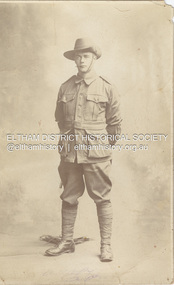 Eltham District Historical Society Inc
Photograph, Ernest Samuel Shillinglaw, 1916
... France followed suit in 1904, Germany and Australia in 1905, and the United States in 1907. - Frost, Lenore; Dating Family Photos 1850-1920; Valiant Press Pty. ...France followed suit in 1904, Germany and Australia in 1905, and the United States in 1907. - Frost, Lenore; Dating Family Photos 1850-1920; Valiant Press Pty. ...SHILLINGLAW Ernest Samuel : Service Number - 1689 : Place of Birth - Eltham VIC : Place of Enlistment - Melbourne VIC : Next of Kin - (Sister) SHILLINGLAW Mary Service Record https://recordsearch.naa.gov.au/SearchNRetrieve/Interface/DetailsReports/ItemDetail.aspx?Barcode=8082612&isAv=N Enlisted 25 Feb 1916 Embarked overseas 20 Jun 1916 Served with the 38th Battalion in France Wounded in action 29 May 1917 with a severe gunshot wound to the left eye. Promoted to Lance Corporal 3 Sep 1918 Awarded the Military Medal 17 Mar 1919 (Gazetted London 17 Jun) Diembarked Melbourne 30 Apr 1919 Discharged 25 Jun 1919 from AIF, medically unfit with influenza POSTCARD 1905-1940s Like the carte-de-visite, postcards enjoyed a collecting craze by large numbers of people, and were often kept in albums through which the interested visitor could browse. Postcards were posted or exchanged in huge numbers. Postal authorities in Australia only allowed the private printing of postcards from 1898. At this time the back of the card was reserved for the address and postage stamp, and the front was used for the message and a picture. In 1902 British authorities allowed a "divided back", so that the left side could be used for the message, the right side for the address and stamp, and the whole of the front was devoted to the picture. France followed suit in 1904, Germany and Australia in 1905, and the United States in 1907. - Frost, Lenore; Dating Family Photos 1850-1920; Valiant Press Pty. Ltd., Berwick, Victoria 1991marg ball collection, postcard, 1916, aif, ernest samuel shillinglaw (1888-1958), first world war, world war 1 -
 Surrey Hills Historical Society Collection
Photograph, Carnival Day at Surrey Dive, Possibly 1909
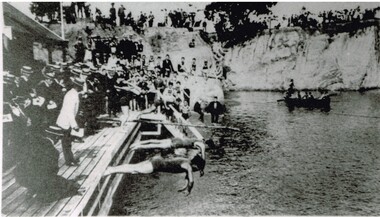
... In the era before purpose-built municipal swimming pools, Surrey Dive was a popular destination for swimming and people came to it from many Melbourne suburbs. It operated from 1905 to 1967. It was the newly formed Surrey Park Swimming Club (established in 1905) that petitioned the Box Hill Council to purchase the former quarry site associated with the Box Hill Brick Works. ...In the era before purpose-built municipal swimming pools, Surrey Dive was a popular destination for swimming and people came to it from many Melbourne suburbs. It operated from 1905 to 1967. It was the newly formed Surrey Park Swimming Club (established in 1905) that petitioned the Box Hill Council to purchase the former quarry site associated with the Box Hill Brick Works. ...This photo records one of the swimming carnivals held at the Surrey Dive, the first of which was organised in 1907. It was at the 1907 carnival that champion swimmer Frank Beaurepaire won the one-mile championship in record time. In the era before purpose-built municipal swimming pools, Surrey Dive was a popular destination for swimming and people came to it from many Melbourne suburbs. It operated from 1905 to 1967. It was the newly formed Surrey Park Swimming Club (established in 1905) that petitioned the Box Hill Council to purchase the former quarry site associated with the Box Hill Brick Works. A ramp, bathing sheds, springboards, and eventually a 10-lane course were developed, making the Dive the first Olympic standard pool in Australia. The carnivals attracted huge crowds. The original use as a quarry explains the notorious depth of the swimming hole and the sheer, steep cliffs surrounding it. These posed obvious safety issues, as did the water quality. Ivy Lavinia Weber, who was the second woman to be elected to the Victorian parliament (the first at a general election) and renowned for her commitment to health and physical fitness, campaigned for State government assistance to build new baths. These were built adjacent to the Dive and were opened in 1939. The Dive continued as a facility used by experienced swimmers until 1967 when it closed due to the drought causing the water to dry up. Today the site has been turned into an ornamental lake. This image was used as a mural in the refurbishment of the Box Hill Aqualink. The image has strong associations with early industry (brick making), recreation and particularly the early history of the sport of swimming.Black and white photo with a white border. Scan shows image only. It shows 3 men diving from a wooden platform into an area of water beneath higher banks. There is a boat in the background, a building to the LHS of the photo and many spectators in boater hats on the platform, some in bathing suits along a ledge and many around the top of the bank. Two men in the LH foreground may be officials.Printed long the bottom edge of the frame: "An image from history - Carnival Day at the Dive. / (photo: Box Hill Council)"surrey dive, box hill brick works, swimming, surrey park swimming club, (mr) frank beaurepaire, (mrs) ivy lavinia weber, swimming carnivals -
 Surrey Hills Historical Society Collection
Photograph, 3 Beatty Street, Mont Albert
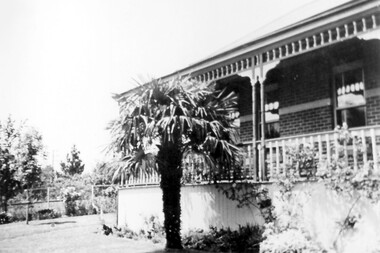
... The house was built c 1891 and from then until 1905 it was home to Leopold A Carter (dentist of Collins Street); followed by James J Hempill (broker) from 1905 -1907. he called it 'Manchling'. ...The house was built c 1891 and from then until 1905 it was home to Leopold A Carter (dentist of Collins Street); followed by James J Hempill (broker) from 1905 -1907. he called it 'Manchling'. ...Location is now 3 Beatty Street, Mont Albert although electoral entries for the Lodewyckx family in the 1930s give the address as 1 Beatty Street. This address is a more contemporary house and part of the original garden was subdivided off at some stage. The property's original address was 1 Victoria Street, renamed in 1917. The house was built c 1891 and from then until 1905 it was home to Leopold A Carter (dentist of Collins Street); followed by James J Hempill (broker) from 1905 -1907. he called it 'Manchling'. There were several other owners or tenants before the Lodewyckx family moved into it in 1920. They named the property 'Huize Eikenbosch' (Dutch meaning House of Oaks). It was set in 1/3 hectare with a formal garden, vegetable garden, orchard and chicken run. Augustin had a life-long interest in growing vegetables and planted many European trees, especially oaks. Augustin Lodewyckx was born and educated in Belgium, was appointed Professor of Modern Languages at Stellenbosch, South Africa and later joined the Belgium Colonial Service. In 1915 he commenced as lecturer in German at Melbourne, becoming Associate Professor in 1923. He had married Anna Sophia Hansen* in South Africa in 1910. They had 2 children Karel Axel, librarian of the University of Melbourne, and daughter Hilma Dymphna, translator, editor and wife of Manning Clark, historian. In 1942 Augustin introduced a university course in Dutch and also undertook research into German immigration to Australia. He retired in 1946 and died in 1964. (*Thought to be nick-named Mina.) A black and white photograph of a corner of a house with a large palm tree in front. There is decorative wooden balustrading on the verandah.beatty street, mont albert, mina lodewyckx (mrs), augustin lodewyckx (mr), karel axel lodewyckx (mr), axel lodewyckx (mr), anna sophia lodewyckx (mrs), hilma dymphna lodewyckx (miss), dymphna lodewyckx (miss), hilma dymphna clark (mrs), dymphna clark (mrs), architectural features
