Showing 2019 items matching "school hall"
-
Uniting Church Archives - Synod of VictoriaPhotographic print block
... This image is presumably of the Sunday School. glen iris presbyterian church "9" Interior of church hall with women and children sitting in rows of metal chairs. ...Glen Iris Presbyterian Church on the corner of High Street and Allison Avenue. This image is presumably of the Sunday School.Interior of church hall with women and children sitting in rows of metal chairs."9"glen iris presbyterian church -
Uniting Church Archives - Synod of VictoriaColour photo, Prior to 1977
... School which went to Year 10. She was the eldest of four children with three brothers, Jock, Norman and Rod. After Year 10, Frances took a job in Camperdown as a dental nurse. She tackled this successfully until deciding to study at Rolland House in Carlton to become a Deaconess. Jock, her brother, recalls asking Frances what made her decide to be a Deaconess. At a Presbyterian Fellowship camp at Warrnambool, Frances and the others were sleeping in the Church Hall...School which went to Year 10. She was the eldest of four children with three brothers, Jock, Norman and Rod. After Year 10, Frances took a job in Camperdown as a dental nurse. She tackled this successfully until deciding to study at Rolland House in Carlton to become a Deaconess. Jock, her brother, recalls asking Frances what made her decide to be a Deaconess. At a Presbyterian Fellowship camp at Warrnambool, Frances and the others were sleeping in the Church Hall ...Everyone seemed to know Frances – it was November 1985 – I met Frances at the Victorian Synod office as she lent me her office to interview staff for St Philip’s which I was taking over in 1986. The interviews completed, she took me to a nearby coffee shop where we had a delightful chat. I came away much the richer, more informed about St Philip’s and feeling I had known Frances forever. And so started our 23 year friendship, with me hearing the first of many stories – for Frances was a wonderfully gifted story teller with a capacity to turn the past into life, and its characters into real people. It seems fitting that a person destined to add to Australia’s history should be born down the beach from Mendonca’s Mahogany ship – Port Fairy on the 28 January 1924. There she went to school – first to primary school then to Camperdown’s Higher Elementary School which went to Year 10. She was the eldest of four children with three brothers, Jock, Norman and Rod. After Year 10, Frances took a job in Camperdown as a dental nurse. She tackled this successfully until deciding to study at Rolland House in Carlton to become a Deaconess. Jock, her brother, recalls asking Frances what made her decide to be a Deaconess. At a Presbyterian Fellowship camp at Warrnambool, Frances and the others were sleeping in the Church Hall on palliases. During the night she awoke and her eye was drawn to a stained glass window, unusually brightly lit. On the window were the words “Follow Me”. Without flinching Frances took the words to heart and decided to serve God as a Deaconess, and during her time with the Australian Inland Mission she became quite a legend. What a patriot Frances was! She loved the stories of pioneers and knew well the history of where she had come from – the Western District. A keen follower of cricket, she would be right up with the last test and the issues of the team. Originally a Melbourne football supporter, she became an avid Geelong supporter and would often score at the annual self destruct St Philip’s vs Flynn Church match. She loved the gladiatorial, albeit often suicidal display. And though an Aussie through and through she loved her Scottish roots. Through her stories, she could easily transport a person in the Centralian landscape onto the heather of the Highlands. In spite of her love for Scotland, the city which was her favourite was New York. Frances – truly a citizen of the world. As a citizen of the world Frances fought for Indigenous and migrant women’s rights and was active in the World Council of Churches, sponsoring local and overseas women to study in Australia and to return to their homes as trained teachers and theologians. Up until recently she was involved in the Spina Bifida and Hydro Cephalis Association of SA. By the time she had taken up with the AIM Frances had a well tuned desire for social justice. To her it was important that the poor and less fortunate were given a go. She felt that the Labor Party provided her best avenue to push her social justice desires. After joining the party in 1956, she quickly became a respected member of the party and worked tirelessly for it, being honoured in the end with life membership. In the party she knew everyone and everyone knew her. She introduced me to Bob Hawke and when I spoke to Gough Whitlam once on a plane, he affirmed to me his friendship with Frances. In her cottage was a picture of her with Kevin Rudd with his arm around her. She is remembered by her party colleagues as someone who had a real compassion for helping people. She believed in the traditional ethic of the Labor Party which is to help those who are less fortunate. Interestingly, she supported St Philip’s moving from solely being a residential college to a school because we had chosen a relatively low fee base to enable maximum access for people and our boarding house continued to, and still does, offer accommodation to any student wishing to attend schools in Alice. Having supported the outback for years from the engine rooms of the mission arm of the church in Victoria, Frances then decided to move to Alice for her retirement. Settling in the little cottage at the far south eastern corner of Old Timers, this became to me, my family and I’m sure to plenty of people, Frances’ Cottage. But moving to Alice was hardly moving into retirement. She quickly became Chaplain at St Philip’s where she clearly showed her love for the children and staff and a real belief in St Philip’s role – to provide access to education for isolated children. She became a stalwart of the Adelaide House Museum, a wonderful member of the congregation, a powerful contributor to the Presbytery and the Annual Synod. Frances was strong, never flinched on a point of principle and discussed things face to face so that you truly knew where you stood with her. She had a great feeling for the pastoralists and knew many of them well. As Chaplain of the College she related well to the children and in addition, knew many of their families. She also felt deeply for the Indigenous people and regularly tackled the issue of how conditions could be improved for them. As we developed the school at St Philip’s, Frances worked with me on so many things. She would visit the College each week for Chapel, run a Sunday school for little kids and the service for all the boarders. When the school was ready to start she wrote the College prayer, said now every week by all students. The prayer says so much about Frances. She pioneered the RE program, teaching RE and in addition to Sunday, visited staff and students every Wednesday. At Presentation Night she presented a homily and provided the blessing – always a strong presence in front of the College community. She was so much part of St Philip’s that when we built the new boarding house in 1990 it seemed so obvious to call it McKechnie House. As a faithful servant of Adelaide House for years and an enthusiastic member of the National Trust, Frances was the first chairperson of the committee, a driving force to redevelop Adelaide House and she worked tirelessly to present John Flynn’s Hospital in the best light. She helped to deliver the stories of Flynn and McKay and the Outback missionaries to so many people and was instrumental in producing meaningful displays. I enjoyed walking around the museum with her intensely, enjoying her detailed stories of the past missionary era and I know many others would have as well. As a loyal and loving member of the Flynn Church, and being such a comrade of Fred McKay’s, Frances understood intricately the symbols which lie within the architecture. Once again, as a story teller, each one had a yarn attached to it. Over her twenty-three years as a member of the Flynn Church she has made a wonderful contribution. As a charismatic personality people were naturally attracted to Frances and were touched and affected by her. Peter Robson, twenty-two years at St Philip’s, remembers her asking him why he had stayed so long at the College. He explained to her that it was her address one day in Chapel in the early times that inspired him to keep going. With great wisdom she had said, “You can’t conquer something, unless you allow it to conquer you.” St Philip’s had conquered him. Wherever she went, whomever she was with, she had a real and lasting impact. Frances brought the reality of the Outback to so many as she addressed congregations around Victoria. She started the Australian Church Women’s Fellowship in the Northern Territory in 1997. She was also involved in setting up the Institute for Aboriginal Development. I believe that Frances should have been recognised nationally for her work with an AM. However, she was the Northern Territory finalist in the Senior Australian of the Year Awards in 2003. In 2004 she was awarded an OBE – not from the Queen but at Old Timers. This is a coveted award which means “Over Bloody Eighty”. Frances was part of it all, in the river, at a bush dance, at a dinner, at a service, at a party, at a meeting, at a footy game, at a cricket game, at Synod, at Presbytery, at Labour meetings, I could go on. Frances McKechnie, what a wonderful Australian. (Eulogy by Chris Tudor) Frances McKechnie died mid-2008. Deaconess Frances McKechnie is seated in front of a map of Australia marked with Australian Inland Mission places identified.At the time the photo was taken, McKechnie was the Victorian Regional Officer for the Australian Inland Mission (Presbyterian). At one stage, she worked for National Mission Frontier Services from 1968 to 1986. See below for the eulogy at her funeral by Chris Tudor. (Frances died May or June 2008.)deaconess frances mckechnie; australian inland mission; presbyterian church -
Uniting Church Archives - Synod of VictoriaColour photo, 1986
... hall below. In 1953, with the help of Vernon Turner of the Christian Broadcasting Association, services were broadcast on radio. The broadcasts continued even when Gordon moved back to Melbourne, so for 30 years he maintained a successful weekly radio ministry. While at St Stephen's, he was also involved in the 1959 Billy Graham Crusade in Sydney, attended by 980,000 people over two weeks. Gordon was born in Warrnambool, Victoria, the son of a dentist, George Powell, and his wife, Louisa (nee Clarke). He went to school...hall below. In 1953, with the help of Vernon Turner of the Christian Broadcasting Association, services were broadcast on radio. The broadcasts continued even when Gordon moved back to Melbourne, so for 30 years he maintained a successful weekly radio ministry. While at St Stephen's, he was also involved in the 1959 Billy Graham Crusade in Sydney, attended by 980,000 people over two weeks. Gordon was born in Warrnambool, Victoria, the son of a dentist, George Powell, and his wife, Louisa (nee Clarke). He went to school ...1911–2005: Gordon George Powell, who has died at 94, was for many years the highly influential minister at St Stephen's Presbyterian Church in Sydney and a popular radio broadcaster and author. He began Wednesday services at St Stephen's in Macquarie Street soon after arriving in Sydney from Melbourne in 1952. They grew to become the biggest regular lunch-hour services in the world, with up to 1300 people crowding the church and the hall below. In 1953, with the help of Vernon Turner of the Christian Broadcasting Association, services were broadcast on radio. The broadcasts continued even when Gordon moved back to Melbourne, so for 30 years he maintained a successful weekly radio ministry. While at St Stephen's, he was also involved in the 1959 Billy Graham Crusade in Sydney, attended by 980,000 people over two weeks. Gordon was born in Warrnambool, Victoria, the son of a dentist, George Powell, and his wife, Louisa (nee Clarke). He went to school at Scotch College. He gave up plans to become an electrical engineer after hearing a call to the ministry and studied arts and then theology at the University of Melbourne, where he formed a close friendship with Edward (Weary) Dunlop. Gordon rowed in the Ormond crew, winning the university's inter-college trophy five times. He was a passionate sports lover all his life. He was awarded a scholarship to Trinity College, Glasgow University, in 1935, and for three months stayed with the great Scottish churchman George (later Lord) MacLeod. While on a cycling trip around Scotland, he stopped by the shores of Loch Ness and saw a long neck appear. The monster swam about 300 metres at great speed; Gordon counted three or four humps. Later, when he saw a skeleton of a plesiosaurus at the Victoria and Albert Museum, he recognised it as Nessie. For the rest of his life, he retained an avid interest in the Loch Ness Monster and its attendant scientific debate. While in Scotland, Gordon wrote a weekly article for The Messenger, the official journal of the Presbyterian Church of Victoria. This led to a life as an author of articles and books. He also wrote long letters home to his mother, a habit that later led to his weekly "Dad's Diaries", which were distributed to the wider family. Failing eyesight put an end to his reading and writing two years ago. On returning to Australia in late 1936, he became assistant minister at Toorak, the second-biggest Presbyterian church in Melbourne. There, at last, Gordon married Gwen Gilchrist, whom he had courted for nine years. They moved from the wealthiest church to one of the poorest, at Port Adelaide, which was still in the grip of the Depression. There, he was finally ordained, in May 1938, and the first two of their four children, Rosemary and David, were born. In 1941, Gordon became assistant minister to Scots Church in Melbourne and the following year, after the birth of his third child, Mardi, he reluctantly volunteered as an RAAF chaplain. He was a pacifist but felt bad at not being in uniform. For the following three years, he was stationed in New Guinea and Australia. His war reminiscences were published as Two Steps to Tokyo and sold 6000 copies in 1945 alone. At 34, by then the father of four children, he was invited to be minister of the Collins Street Independent Church in the heart of Melbourne, now St Michael's Uniting Church Before being inducted, he undertook a lecture tour of the US, speaking to Rotary clubs in 48 centres, from Michigan to Maryland. He met, and was impressed by, the liberal theologian Harry Emerson Fosdick, and the US religious leader and author Norman Vincent Peale, who became a close friend and mentor. Back in Australia, Gordon founded and fostered the first Alcoholics Anonymous group in Melbourne. In 1952, he took up what was to become his happiest ministry, at St Stephen's in Sydney. When Queen Elizabeth and Prince Philip toured two years later, Gordon and Gwen were not only invited to lunch with them, but sat beside them. This was a highlight for Gordon, an ardent monarchist. In 1960, Gordon and Gwen embarked on a world tour that included the US, where he was invited to give the opening prayer in the Senate, with vice-president Richard Nixon presiding. After another five years at St Stephen's, Gordon returned to Scots Church in Melbourne. It was a time of bitter debates over church union with the Methodists and Congregationalists. Gordon was in favour, but Scots ultimately voted to stay out and remain Presbyterian. By then in his mid-60s, he and Gwen moved to New York, where Peale was his neighbour. They had six happy years there before retiring to Melbourne. Gordon is survived by Gwen, and children David, Mardi and Jenny (daughter Rosemary died in 1992), 13 grandchildren and 10 great-grandchildren. [From the obituary in the Sydney Morning Herald, 2005, written by Jenny (Powell)] Gwen and Gordon Powell coming out of the Toorak Uniting Church 50 years after they were married there. Gwen and Gordon Powell coming out of the Toorak Uniting Church 50 years after they were married there.gordon powell; gwen powell; port adelaide; toorak presbyterian church; st stephen's presbyterian church sydney; presbyterian minister -
Uniting Church Archives - Synod of VictoriaBW photo, Undated, but post-1977
... Hall and UFT. He formally retired in 2008. He has been involved with, lectured in, studied at, worked for, chaired committees or directed at one or more times — La Trobe University, Christian Television Association, Australian Consultation on Liturgy, UCA Assembly committees, Lincoln College, England, Brugge Catholic Faculty, Oxford Institute for Methodist Theological Studies, Graduate School in Ecumenism at Bosse, the English Language Liturgical Consultation, World Methodist Council, World Council of Churches, Christian Unity Working Group, the Victorian Casino and Gambling Authority, Centre for Ecumenical Studies, Cambridge Society of Australia, Fellow of the School of Historical Studies Melbourne University, Queen’s College Council, Fellow of Queen’s College, Editor of the Australian Journal of Liturgy, Professorial Fellow of Charles Sturt University, President of the Cornish Association of Victoria, and member of the Council of the Genealogical Society of Victoria. ...Hall and UFT. He formally retired in 2008. He has been involved with, lectured in, studied at, worked for, chaired committees or directed at one or more times — La Trobe University, Christian Television Association, Australian Consultation on Liturgy, UCA Assembly committees, Lincoln College, England, Brugge Catholic Faculty, Oxford Institute for Methodist Theological Studies, Graduate School in Ecumenism at Bosse, the English Language Liturgical Consultation, World Methodist Council, World Council of Churches, Christian Unity Working Group, the Victorian Casino and Gambling Authority, Centre for Ecumenical Studies, Cambridge Society of Australia, Fellow of the School of Historical Studies Melbourne University, Queen’s College Council, Fellow of Queen’s College, Editor of the Australian Journal of Liturgy, Professorial Fellow of Charles Sturt University, President of the Cornish Association of Victoria, and member of the Council of the Genealogical Society of Victoria. ...The Rev. Dr Robert Gribben was born in 1943 in country Victoria where he was educated through primary and secondary state schools. He entered Queen’s College in 1961 in order to study degrees in law and arts, but after two years discontinued his legal studies and completed his Bachelor of Arts whilst beginning his candidature for the Methodist ministry. In 1965 he and his wife Susan became engaged, but before he could begin his theological studies he was offered the opportunity to undertake his theological studies in Cambridge University in Wesley House. After Susan completed her law degree with honours at Melbourne University, she followed Robert to England in June 1967, and they were married in June 1968 as Robert was completing his Cambridge B.A. He’d received notice that his first Methodist ministry appointment was to be in “Portland No. 2”, but as they had six months before he was to take that up, they moved to India where Robert worked for the Student Christian Movement and Susan for the Church of South India sorting out their legal records. Robert’s placements that followed in the Methodist Church were Portland and Heywood and Highbury Grove Kew, and in the Uniting Church as chaplain of Ormond College, Trinity Church North Balwyn, General Secretary of the Victorian Council of Churches, Wesley Church Melbourne, and Professor of Worship and Mission at the UCA Theological Hall and UFT. He formally retired in 2008. He has been involved with, lectured in, studied at, worked for, chaired committees or directed at one or more times — La Trobe University, Christian Television Association, Australian Consultation on Liturgy, UCA Assembly committees, Lincoln College, England, Brugge Catholic Faculty, Oxford Institute for Methodist Theological Studies, Graduate School in Ecumenism at Bosse, the English Language Liturgical Consultation, World Methodist Council, World Council of Churches, Christian Unity Working Group, the Victorian Casino and Gambling Authority, Centre for Ecumenical Studies, Cambridge Society of Australia, Fellow of the School of Historical Studies Melbourne University, Queen’s College Council, Fellow of Queen’s College, Editor of the Australian Journal of Liturgy, Professorial Fellow of Charles Sturt University, President of the Cornish Association of Victoria, and member of the Council of the Genealogical Society of Victoria. He has written some seven books and edited both editions of Uniting in Worship. On top of all that he has visited, worked in, or represented one body or another in — Colombo, Cairo, Rome, Geneva, Parish, the UK, Bangalore, Mysore, Madras, Kottoyam, Agra, Jaipur, Sri Lanka, Malaysia, Philippines, Japan, Hong Kong, the USA, Canada, Vienna, Israel, Netherlands, Poland, Bangkok, Singapore, Romania, Bucharest, Bulgaria, Greece, Syria, Lebanon, Cyprus, Turkey, Zimbabwe, Ethiopia, Jordan, Italy, Tonga, Finland, Germany, Norway, Denmark, Samoa, South Africa, Spain, Sicily, Chile, Indonesia, New Zealand, Ghana, Nigeria, Russia, Antigua and Jamaica. And on top of all that, he’s had two audiences with the Pope! Susan and Robert have two children and three grandchildren. Head and shoulders portrait of Rev. Dr Robert Gribben."Rev. Dr Robert Gribben", "Church & Nation"rev. dr robert gribben; liturgy; theological hall melbourne -
Uniting Church Archives - Synod of VictoriaPhotograph, Undated c.1913
... School. In 1894 John Barnaby entered the Theological Hall at Ormond college. ...School. In 1894 John Barnaby entered the Theological Hall at Ormond college. ...John Barnaby was born in 1867 near Rosebud, Victoria. In 1885 he came to Melbourne and started working as a teacher at Caulfield Grammar School. In 1894 John Barnaby entered the Theological Hall at Ormond college. He graduated B.A. in 1895 and finished his theological studies in 1896. He was ordained in 1898 and called to Kew Presbyterian Church. In 1903 he took his M.A. degree. In 1912 he left Kew and was appointed Neil Walter Black Lecturer at Ormond College Theological Hall. Graduated Bachelor of Divinity and also gained a Diploma of Education. Convenor Home Missions Committee until 1923. Superintendent of Group Mission from 1923. Died 12 September 1933B & W half length, seated studio portrait of Rev John Barnaby M.A. printed on buff card.Rev. John Barnaby, M.A. 1898 - 1912john barnaby, presbyterian minister, ormond college theological hall, kew, neil walter black lecturer, home missions committee -
Uniting Church Archives - Synod of VictoriaPhotograph, Undated c.1898
... School. In 1894 John Barnaby entered the Theological Hall at Ormond college. ...School. In 1894 John Barnaby entered the Theological Hall at Ormond college. ...John Barnaby was born in 1867 near Rosebud, Victoria. In 1885 he came to Melbourne and started working as a teacher at Caulfield Grammar School. In 1894 John Barnaby entered the Theological Hall at Ormond college. He graduated B.A. in 1895 and finished his theological studies in 1896. He was ordained in 1898 and called to Kew Presbyterian Church. In 1903 he took his M.A. degree. In 1912 he left Kew and was appointed Neil Walter Black Lecturer at Ormond College Theological Hall. Graduated Bachelor of Divinity and also gained a Diploma of Education. Convenor Home Missions Committee until 1923. Superintendent of Group Mission from 1923. Died 12 September 1933Oval, B & W head and shoulders studio portrait of Rev John Barnaby M.A. mounted on buff card.john barnaby, presbyterian minister, ormond college theological hall, kew, neil walter black lecturer, home missions committee -
Uniting Church Archives - Synod of VictoriaPhotograph, December 1918
... She started a Sunday morning children's church, a Sunday School, a Sunday evening service, a mothers' meeting, a girls' and boys' club and other activities. She helped raise funds for the Young St. Mission Hall...She started a Sunday morning children's church, a Sunday School, a Sunday evening service, a mothers' meeting, a girls' and boys' club and other activities. She helped raise funds for the Young St. Mission Hall ...Martha Downes was born at Codrington in 1880. She was grand-daughter of the first Presbyterian minister of Clunes. As a child she belonged to the Erskine congregation. She was trained at the Deaconess' Institute and was appointed to the Fitzroy Mission, where the Rev. A.I. Davidson was Superintendent. Miss Downes was placed in charge of the Gore St. branch of the Mission. She started a Sunday morning children's church, a Sunday School, a Sunday evening service, a mothers' meeting, a girls' and boys' club and other activities. She helped raise funds for the Young St. Mission Hall, which was built in 1912. In 1914 Sister Downes retired due to ill health, but returned in 1915 to take charge of the Erskine Mission. Her interest in girls led to the establishment of Erskine Hostel, in a delicensed hotel in Rathdown St. Carlton, where classes, guilds, club meetings and services were held. Martha Downes died on 24 February 1920.Oval, sepia toned three quarter length studio portrait of Sister Martha Downes, mounted on brown card. Sister Martha is dressed in the uniform of the Presbyterian Sisterhood."Aunt Marion, With all good wishes for Christmas and the New Year 1918-1919"martha downes, sisterhood, presbyterian, clunes, deaconess' institute, fitzroy mission, rev. a.i. davidson, erskine mission, erskine hostel, young street mission hall -
Uniting Church Archives - Synod of VictoriaPhotograph, Undated c.1900
... She started a Sunday morning children's church, a Sunday School, a Sunday evening service, a mothers' meeting, a girls' and boys' club and other activities. She helped raise funds for the Young St. Mission Hall...She started a Sunday morning children's church, a Sunday School, a Sunday evening service, a mothers' meeting, a girls' and boys' club and other activities. She helped raise funds for the Young St. Mission Hall ...Martha Downes was born at Codrington in 1880. She was grand-daughter of the first Presbyterian minister of Clunes. As a child she belonged to the Erskine congregation. She was trained at the Deaconess' Institute and was appointed to the Fitzroy Mission, where the Rev. A.I. Davidson was Superintendent. Miss Downes was placed in charge of the Gore St. branch of the Mission. She started a Sunday morning children's church, a Sunday School, a Sunday evening service, a mothers' meeting, a girls' and boys' club and other activities. She helped raise funds for the Young St. Mission Hall, which was built in 1912. In 1914 Sister Downes retired due to ill health, but returned in 1915 to take charge of the Erskine Mission. Her interest in girls led to the establishment of Erskine Hostel, in a delicensed hotel in Rathdown St. Carlton, where classes, guilds, club meetings and services were held. Martha Downes died on 24 February 1920.Sepia toned postcard format photograph of the Presbyterian Church, Clunes, Victoria. Two ladies and a gentleman stand on the steps of the Church. "Presbyterian Church" on front. Handwritten letter to Martha Downes on reverse.martha downes, sisterhood, presbyterian, clunes, deaconess' institute, fitzroy mission, rev. a.i. davidson, erskine mission, erskine hostel, young street mission hall -
Uniting Church Archives - Synod of VictoriaPhotograph, Undated c.1880s
... school was established. He believed that boys should be taught to appreciate orderly conduct rather than to fear punishment and that corporal punishment was degrading and to be used only in extreme circumstances. Under Fletcher Newington developed a high moral tone and a tradition of order and respect. After he retired in 1887 the old boys gave him an address of appreciation and a portrait in oils to be hung in the hall...school was established. He believed that boys should be taught to appreciate orderly conduct rather than to fear punishment and that corporal punishment was degrading and to be used only in extreme circumstances. Under Fletcher Newington developed a high moral tone and a tradition of order and respect. After he retired in 1887 the old boys gave him an address of appreciation and a portrait in oils to be hung in the hall ...Born 1823 West Indies, commenced ministry 1847, died 1890 in Rookwood, NSW. Joseph Horner Fletcher (1823-1890), Wesleyan minister, was born at St Vincent, Windward Islands, the eldest son of Rev. Joseph Fletcher, Wesleyan missionary, and his wife Mary, née Horner. In 1830-37 he attended a Methodist school in Kingswood, England, and then his uncle's school in Bath. He entered business but in July 1842 became a local preacher. He was accepted for the Wesleyan ministry in 1845 and after training at Richmond College, Surrey, he married Kate Green in December 1848. He was sent to Auckland, New Zealand, where he became the founding principal of Wesley College. In 1856 poor health obliged him to take up circuit work in Auckland and New Plymouth, where he witnessed the Maori war. He moved to Queensland and in 1861-64 was on circuit in Brisbane. In 1863 he became the first chairman of the Queensland Wesleyan District. In 1865 Fletcher was serving at Ipswich when invited to succeed Rev. John Manton as president of Newington College, Sydney. He acknowledged that the main business of the school was secular education in a Christian atmosphere and believed that education could help to overcome sectarianism. He invited distinguished academics to examine Newington students and strongly supported (Sir) Henry Parkes's education policies. He opposed the formation of a Methodist university college until a strong secondary school was established. He believed that boys should be taught to appreciate orderly conduct rather than to fear punishment and that corporal punishment was degrading and to be used only in extreme circumstances. Under Fletcher Newington developed a high moral tone and a tradition of order and respect. After he retired in 1887 the old boys gave him an address of appreciation and a portrait in oils to be hung in the hall. In addition to his normal duties from 1883 he had taught resident theological students. From 1887 he was an effective and progressive full-time theological tutor. As a preacher Fletcher had exceptional power: he expressed his thoughts in a fresh way with sparkling illustrations and characteristic humour. He combined humility with great spiritual power, prophetic vision and administrative ability. He encouraged the development of institutional church work which grew into the Central Methodist Mission in Sydney. Fletcher was elected as the first president of the New South Wales and Queensland Wesleyan Methodist Conference in 1874 and again in 1884, when he was also president of the General Conference of the Australasian Wesleyan Methodist Church. As conference editor in 1868, 1871 and 1873, Fletcher contributed more than fifty articles, numerous essays and reviews of books to the Weekly Advocate. He read widely, deeply and with discrimination. Never robust in health, he suffered months of illness before he died aged 66 at Stanmore, Sydney, on 30 June 1890. He was survived by three sons and two daughters, and buried in the Wesleyan section of Rookwood cemetery. In 1892 his eldest son, Joseph, edited a memorial edition of his Sermons, Addresses & Essays. Information from Australian Dictionary of Biography, Vol. 4, 1972. Sepia toned carte de visite. Seated studio portrait of the Rev. Joseph Fletcher.Rev Joseph Fletcherrev. joseph fletcher, joseph horner, wesleyan minister, newington college sydney, new zealand, queensland, president general conference, wesleyan methodist church, central methodist mission -
Ruyton Girls' SchoolProgramme, Ruyton Girls' School, Ruyton Speech Night Programme, 1952
... School choirs and ensembles. Historic publications note Speech Night would typically "open with the distribution of prizes, followed by 13 musical items, a play, French Dialogue and four tableaux." This particular record is associated with the Speech Night held on 11 December 1952 at the Recreation Hall...School choirs and ensembles. Historic publications note Speech Night would typically "open with the distribution of prizes, followed by 13 musical items, a play, French Dialogue and four tableaux." This particular record is associated with the Speech Night held on 11 December 1952 at the Recreation Hall ...Ruyton Girls' School has a long tradition of awarding prizes to students at annual "Speech Night" events. Speech Night commenced at Ruyton in 1878; the same year in which the School was founded by Mrs Charlotte Anderson. The Ruytonian December 1944, which recounts events from the last year to date, notes the 1943 Speech Night was the sixty-fifth iteration of the occasion. Previously, students were awarded customary books produced in England which were bound in navy blue leather, with the School's name and motto debossed in gold leaf. Speech Night at Ruyton is an extraordinary occasion. It is a time when the School gathers to celebrate both the year just lived and the contribution of Year 12 girls to the life of the School. It is a night of stirring student speeches, acknowledgement of student endeavour and excellence and awe-inspiring performances by School choirs and ensembles. Historic publications note Speech Night would typically "open with the distribution of prizes, followed by 13 musical items, a play, French Dialogue and four tableaux." This particular record is associated with the Speech Night held on 11 December 1952 at the Recreation Hall in Kew, Victoria.The record is historically significant due to the time period in which it was produced. This significance is strengthened in the way the record stands as a testament to the way Ruyton recognises, celebrates and engages its student through programming and events. The record's significance is further enhanced by its strong provenance, having been produced by Ruyton Girls' School and donated to the Archives by a familial connection to a former notable student.A5 size pamphlet printed on cream coloured paper with navy blue ink. Two pages, folded in half.Reverse: RGS008/2024/0016 /ruyton girls' school, students, school, ruyton, victoria, high school, senior school, day school, letter, old ruytonians association, kew, speech night, programme -
Ruyton Girls' SchoolProgramme, Ruyton Girls' School, Ruyton Speech Night Programme, 1953
... School choirs and ensembles. Historic publications note Speech Night would typically "open with the distribution of prizes, followed by 13 musical items, a play, French Dialogue and four tableaux." This particular record is associated with the Speech Night held on 14 December 1953 at the Recreation Hall...School choirs and ensembles. Historic publications note Speech Night would typically "open with the distribution of prizes, followed by 13 musical items, a play, French Dialogue and four tableaux." This particular record is associated with the Speech Night held on 14 December 1953 at the Recreation Hall ...Ruyton Girls' School has a long tradition of awarding prizes to students at annual "Speech Night" events. Speech Night commenced at Ruyton in 1878; the same year in which the School was founded by Mrs Charlotte Anderson. The Ruytonian December 1944, which recounts events from the last year to date, notes the 1943 Speech Night was the sixty-fifth iteration of the occasion. Previously, students were awarded customary books produced in England which were bound in navy blue leather, with the School's name and motto debossed in gold leaf. Speech Night at Ruyton is an extraordinary occasion. It is a time when the School gathers to celebrate both the year just lived and the contribution of Year 12 girls to the life of the School. It is a night of stirring student speeches, acknowledgement of student endeavour and excellence and awe-inspiring performances by School choirs and ensembles. Historic publications note Speech Night would typically "open with the distribution of prizes, followed by 13 musical items, a play, French Dialogue and four tableaux." This particular record is associated with the Speech Night held on 14 December 1953 at the Recreation Hall in Kew, Victoria.The record is historically significant due to the time period in which it was produced. This significance is strengthened in the way the record stands as a testament to the way Ruyton recognises, celebrates and engages its student through programming and events. The record's significance is further enhanced by its strong provenance, having been produced by Ruyton Girls' School and donated to the Archives by a familial connection to a former notable student.A5 size pamphlet printed on cream coloured paper with navy blue ink. Two pages, folded in half.Reverse: RGS008/2024/0017 /ruyton girls' school, students, school, ruyton, victoria, high school, senior school, day school, letter, old ruytonians association, kew, speech night, programme -
Ballarat Tramway MuseumNewspaper - The Sun News Pictorial Supplement, Herald Sun, "Ballarat", 30/9/1924
... Page 11 - photo from the Town Hall, Avenue of Honour Arch, rowing, Hospital including W J Hoare, R H Ramsey of the Ballarat Cricket Association, Mr Charlie Suffren, J R Jopling, R W Todd. Page 12 - Ballarat and district history, industry, statistics, School...Page 11 - photo from the Town Hall, Avenue of Honour Arch, rowing, Hospital including W J Hoare, R H Ramsey of the Ballarat Cricket Association, Mr Charlie Suffren, J R Jopling, R W Todd. Page 12 - Ballarat and district history, industry, statistics, School ...Newspaper supplement to The Sun News Pictorial, Tuesday 30/9/1924 - "Victoria Country Centres - No. 4". Has extensive notes on Ballarat, its history, civic history, and personalities. or figures. Page 11 - photo from the Town Hall, Avenue of Honour Arch, rowing, Hospital including W J Hoare, R H Ramsey of the Ballarat Cricket Association, Mr Charlie Suffren, J R Jopling, R W Todd. Page 12 - Ballarat and district history, industry, statistics, School of Mines. Has a photo of the Lydiard St Methodist church. Page 13 - Civic Identities - A E Kenny, Frederick Brawn MLC, W R Elsworth, Frank Herman, Alex Bell MLC, notes on Ballarat Power supply ESCo and SECV - Yallourn vs local generation, and an advertisement for Tyler's men's clothing and house furnishings. Page 14 - Ballarat sports, Cr Robert Cooke, South St, Craigs Hotel, photo of Ballarat Woollen Mills, the observatory, and an advert for A M Heath, Booksellers, stationer. Page 15 - Advert for Barlow Motors, Mining exchange building, Buick and Vauxhall motor cars Page 16 - South St competition adverts, schools, Mayor Levy, W J Coghlan, railway and wheat traffic, Myer's woollen mill, J T Walker furniture. Page 17 - advert to T M Burke - real estate - Forest St estate Page 18 - photos of the Executive's office, the Water Board - F Brown, A Farrer, W Brazenor, J C Fletcher, F W Saunders and G M Searle. Football league - A A O'Dea, W R Elsworth, J R Cooke, Cr F Besemeres. Brind's Diestillery of Dunnstown - Frank Brind and Harold Gill. W Ware boxing. Photos of St Andrew's Kirk and live livestock market with Graeme Dowling, Gold diggings. Page 19 - Council officers - G F Morton, A Levy, H Finch, J Pascoe, C J Liddiard, W McIntosh, W P Pryor and E R Marchani. South St Society W W Harris, W H Pearson, W S Sampson, A A King, F J Martell, F S Herman, A A O'Dea. Photos of Woollen mill, Sunshine biscuits, Ballarat Water pipe, Golf Club, Ballarat High School, Bridge St with tram and Golden Point monument. Page 20 - notes on racing, red cross - Mrs James Coghlan, fire brigade, sewerage scheme. Photo of Ballarat Freezing Co meat works with adverts for Craig's Hotel and the Ballarat Trustees Executors & Agency Co. Page 21 - General items re Tylers, city of statues, George Hotel, Barlow's cars, Eva Chemist, Dr W A Spring - racing, with an advert for Millers the Clothiers, Page 22 - Ballarat streets, Adam Lindsay Gordon cottage in grounds of Craig's Hotel, Miller's clothing store, with adverts for the Annual Spring agricultural show, and EVA's pharmacy. Page 23 - Photo of Sturt and Lydiard St with two trams, one possibly 13 in an accident with a motor car, photos of McDonald gates, Loreto Abbey with a racing people - Dave Barry, C L Fox, andHarry McGoldrick. Has adverts for Gribble suits and J T Walker furnishers. Page 24 - notes on real estate, stock agents, with photos of Miss McDonald of Red Cross, Mr and Mrs James Allan, Mr H H Osborne, and an advert for Sunshine Biscuits. Page 25 - Photos of the School of Mines, Orphanage, football crowd and Miss D Balten and Miss K Kennedy tennis with adverts for Macleod and Booth stock and station agents and The George Hotel. Page 26 - advert for Melbourne Sub-division company - Capitol House Melbourne.Yields information about Ballarat, its civic history, and personalities in 1924.Newspaper, 16 printed pages with photographs.ballarat, ballarat history, civic history, tramways, accidents -
Ballarat Tramway MuseumPhotograph - SECV Ballarat - last Friday of operations - set of 14, George Stevens, 17/9/1971
... Hall, Myer and Coles in the background. In the foreground is a ESCo/SEC switch pillar 3 - Trams 34 & ? IN Lydiard St North at the end of the double track 4 - Tram 34 IN Lydiard St North 5 - Tram 34 At the terminus with the cemetery gates open 6 - Tram 35 At the Sebastopol terminus with both poles up and the Royal Mail Hotel in the background 7 - Tram 35 Ready for departure 8 - Trams 17 & 35 at the Grey St Loop 9 - Tram 35 Northbound in Skipton St with Eclipse Ford in the background 10 - Trams 41 & 34 School special in Drummond St North 11 - Trams 41 & 34 Around Lake Wndouee 12 - Tram 39 Being worked on - hydraulic jacks? ...Hall, Myer and Coles in the background. In the foreground is a ESCo/SEC switch pillar 3 - Trams 34 & ? IN Lydiard St North at the end of the double track 4 - Tram 34 IN Lydiard St North 5 - Tram 34 At the terminus with the cemetery gates open 6 - Tram 35 At the Sebastopol terminus with both poles up and the Royal Mail Hotel in the background 7 - Tram 35 Ready for departure 8 - Trams 17 & 35 at the Grey St Loop 9 - Tram 35 Northbound in Skipton St with Eclipse Ford in the background 10 - Trams 41 & 34 School special in Drummond St North 11 - Trams 41 & 34 Around Lake Wndouee 12 - Tram 39 Being worked on - hydraulic jacks? ...Set of 14 Digital images, from negatives taken by George Stevens on 17/9/1971: 1 - Tram Standby Cars 41 and a single trucker in City Loop 2 - Tram 42 In Sturt St with Town Hall, Myer and Coles in the background. In the foreground is a ESCo/SEC switch pillar 3 - Trams 34 & ? IN Lydiard St North at the end of the double track 4 - Tram 34 IN Lydiard St North 5 - Tram 34 At the terminus with the cemetery gates open 6 - Tram 35 At the Sebastopol terminus with both poles up and the Royal Mail Hotel in the background 7 - Tram 35 Ready for departure 8 - Trams 17 & 35 at the Grey St Loop 9 - Tram 35 Northbound in Skipton St with Eclipse Ford in the background 10 - Trams 41 & 34 School special in Drummond St North 11 - Trams 41 & 34 Around Lake Wndouee 12 - Tram 39 Being worked on - hydraulic jacks? 13 - Tram 30 Sturt St on its way to Lydiard St North 14 - Tram 30 Reversing in Sturt St at Dawson StYields information about the tramcars used on 17/9/1971 and the various locations around the system. Set of 14 digital images scanned from black and white negatives.tramways, sturt st, albert st, wendouree parade, lydiard st nth, victoria st, depot, level crossing, tram 41, tram 42, tram 34, tram 17, tram 35, tram 39, tram 30 -
National Wool MuseumLetter, Melbourne School of Textiles, 20/3/1964
... MELBOURNE SCHOOL OF TEXTILES 35.1288 23-35 Cumberland Road, PASCOE VALE, W.8. 20TH March, 1964 Messrs. Robert Blake Pty. Ltd., 6 Hall...Business Business history Manufacturing Knitting Machine Fashion Textile Production Business Archives Manufacturing Documents Textile Education Melbourne School of Textiles Vocational Training Training Education School MELBOURNE SCHOOL OF TEXTILES 35.1288 23-35 Cumberland Road, PASCOE VALE, W.8. 20TH March, 1964 Messrs. Robert Blake Pty. Ltd., 6 Hall ...Kathryn Knitwear, founded by Robert Blake, manufactured high quality children’s knitwear in Melbourne from the 1940s – 1980s. Robert Blake began manufacturing children’s knitwear in his bedroom in Strathmore using a hand powered machine in the late 1940s. The operation moved to Ascot Vale and Essendon, before eventually establishing a factory in Moonee Ponds in the early 1950s. The business continued to expand, necessitating a move to a new factory in Broadmeadows. By 1962, the Broadmeadows factory was producing an average of 20,000 garments per month, which increased to 24,000 by 1964. Robert Blake’s Son, Brendan recalls that “The Kathryn brand was famous around Australia, anywhere children needed to keep warm and dress smartly. It also won a number of wool fashion awards”, including the 1969 Wool Awards, which was held by the Australian Wool Bureau and published in Women’s Weekly. The Kathryn range was designed for durability, comfort and care, without sacrificing style. They used patterning techniques that increase stretchiness, comfort and fit, as well as integrating decorative elements into the fabric to prevent them from being bulky, uncomfortable or tight. Making longevity of style a priority, Brendan Blake remembers that “there was one particular garment that was in the range for at least thirty years”. He also recalls “In the past, when women have found out that I was associated with Kathryn Knitwear, they would often relate to me the story of a garment they had purchased or received as a gift and, when their child had grown out of it, they would hand it on to another child. Several ladies have told me of purchasing garments for their daughters’ glory box, or saving a particular garment after their daughter had grown out of it. Brendan Blake: “At the peak of their operation they employed approximately two hundred people, mainly women and girls. A family would often seek to send their daughter to work in this company because they knew they would be looked after and safe. One lady wrote to me telling me that working at the Moonee Ponds Factory prior to getting married was the happiest time of her life.” In 1963, workers at the Kathryn factory earned £13 per week, which was 8 shillings and 8 pence higher than the minimum weekly wage for female workers in the textile manufacturing industry (£12 11s 4d). By 1970, the Kathryn Knitwear brand expanded from children’s knitwear into womenswear under the brand name ‘Lady Kathryn’, and for boys and men under ‘Robert Blake’. Continuing to diversify their distribution, they also began exporting ‘Kathryn’ garments to New Zealand, the Pacific Islands, and Japan. ‘Kathryn Knitwear’ was well-known for their early adoption of modern materials and techniques that had broad appeal to their customer base. This is shown in their early use of the acrylic fibre ‘Orlon’ in the 50s and 60s and ‘Superwash’ wool in the 1970s. Many of Kathryn Knitwear’s styles, particularly those that were long running staples of the brand, were available in both wool and Orlon to suit the consumer’s preference. Far from the humble origins of one man in his bedroom with a hand-cranked machine; at its closure in 1980, the Broadmeadows factory of ‘Kathryn’ housed more than 100 machines, including 53 sewing machines and 45 knitting machines. Robert Blake was “a passionate advocate for wool and Australian Made” throughout his whole life. A strong thread that ties through the lifespan of Robert Blake and Kathryn Knitwear is a balance between adopting new innovations without sacrificing the core values of durability, comfort, care and style that had made the brand so well known. Their legacy forms an integral part of both Australian social and manufacturing history.Typewritten letter in black ink on cream paper, with a hole punched in the upper left hand corner. Letter has initially been printed as a form with dotted lines, that have later been printed over.MELBOURNE SCHOOL OF TEXTILES 35.1288 23-35 Cumberland Road, PASCOE VALE, W.8. 20TH March, 1964 Messrs. Robert Blake Pty. Ltd., 6 Hall Street, MOONEE PONDS. Dear Sir Re: …. THOMSON N. …. The abovenames student, a member of your organization, has been absent from the following classes: Thursday / 19/3/64 / Certificate Course We are very keen for these classes to be a success, and would be obliged if you to see that he attends regularly in future. Yours faithfully, MELBOURNE SCHOOL OF TEXTILES. [SIGNATURE] O. C. RIEGULHUTH, ACTING PRINCIPAL.business, business history, manufacturing, knitting machine, fashion textile production, business archives, manufacturing documents, textile education, melbourne school of textiles, vocational training, training, education, school -
National Wool MuseumFunctional object - Floorboards, 1994
... The old brick stores, located on a formerly neglected section of the Corio Bay shoreline, now house the administration and chancellery, architecture and building schools, information technology services, the student union, a cafeteria and, as the focal facility, a Great Hall seating 1500 people and acoustically tuned for symphony orchestras. ...The old brick stores, located on a formerly neglected section of the Corio Bay shoreline, now house the administration and chancellery, architecture and building schools, information technology services, the student union, a cafeteria and, as the focal facility, a Great Hall seating 1500 people and acoustically tuned for symphony orchestras. ...Two short sections of flooring cut for distribution during Deakin Universities ‘Open Day’ in December 1994. This was during the conversion of Dalgety Wool Store to Deakin University’s Woolstore Campus. These small pieces of timber are part of Geelong’s history and were salvaged from the Dalgety Woolstores during the renovations. Hundred of meters of ironbark, red gum, pine and other timbers, some more than a century old, were reclaimed from the site and have been recycled as furniture and featured building materials for the woolstore campus. The old brick stores, located on a formerly neglected section of the Corio Bay shoreline, now house the administration and chancellery, architecture and building schools, information technology services, the student union, a cafeteria and, as the focal facility, a Great Hall seating 1500 people and acoustically tuned for symphony orchestras. The refit was developed from the existing grid of substantial timber columns and beams extending over 52,000 square metres. This framework was filled with lightweight panels to enclose workplaces and removed in some parts to establish courtyards, atriums and streets. The brick facades were redefined with new doors and double-glazed windows in proportion to original fenestration. Bright colours and industrial finishes identify the new insertions.Square sections of redgum lumber cut into floorboards. The sides of the lumber have a grove cut on one side and a matching section to fit within this groove on the other side. This has been done to ensure the floorboards have a tight and consistent fit with one another. The bottom of the lumber also has an additional grove running through the middle of the redgum. On top, one of the sections of lumber has three nail holes, which travel all the way through to the bottom of the wood.deakin university, dalgety wool store, red gum -
National Wool MuseumTool - Stencil, c.2018
... Beginning in 1966, Denis attended the same Gordon Technical School and walked the same halls as his father before him. ...Beginning in 1966, Denis attended the same Gordon Technical School and walked the same halls as his father before him. ...The story of 90 years of wool classing between father & son begins in 1936, when a young boy by the name of Stanley James Hucker walked through the doors of the Gordon Technical School in Geelong. Born in 1921, Stanley was 15 years of age when he began his 3-year course in Wool Classing. 30 years later, Stanley’s second son Denis completed the same 3-year wool classing course. Beginning in 1966, Denis attended the same Gordon Technical School and walked the same halls as his father before him. Stanley finished his course in 1938. He went back to the family farm in Lake Bolac for a brief period before enrolling in the Second World War. At the completion of the war, Stanley returned home and married before gaining a soldier settler allotment, north of Willaura. This enabled Stan to use his wool classing knowledge. He ran between 1,500 and 2,000 sheep for many years, while his wool classer stencil also allowed him to go out and class at various sheds around the area. He held his stencil from 1938 until he retired at the age of 60 in 1981. On retirement, his second son Denis was working in the district, managing a local property while also leasing land himself. Upon his father’s retirement, Denis had the opportunity to lease his father’s farm, an opportunity he could not refuse. Denis had finished his wool classing course at the Gordon Technical School in 1968, graduating dux of his class. He began working with a local contractor and started classing wool in his team. Denis gained a great deal of experience working as part of this team in big sheds of up to 8 stands servicing between 10 & 20,000 sheep. It was not all smooth sailing for Denis however, and he soon learnt an important lesson. Class wool the way you’re taught, don’t listen to the owner standing over your shoulder. At a clip of Corriedales near Casterton, Denis was pushing too many fleeces into the line of fine wool. This resulted in a notice from the Australian Wool Exchange (AWEX) “mixing counts too much, submit three clips for inspection”. Denis was able to submit 3 clips with no further complaints, however, this proved a valuable lesson he would never forget over his long career classing wool. In the early 1980s, when Denis was leasing two properties including his father’s, things were going well until drought struck. February 1983 was the date of the Ash Wednesday bushfires, and saw Melbourne have three days over 40 °C for only the second time on record. This period saw Denis give away farming, turning towards contracting work instead. After the difficult times of the early 1980s, the next two decades were a good time for the sheep industry. 15 micron wool was selling for prices between 4 to 5,000 cents per kilo, double what you’d expect for the same wool in 2022. In 1995 a single bale of wool sold for a million dollars. This was a good time for Denis too. His contracting work saw him employing local shearers and shed staff. His team was involved with the shearing and classing of more than 130,000 sheep. After 20 years of contracting, it was time for Denis to transition into the next phase of his life. He gave up independent contracting, preferring instead to return to being a member of someone else’s team. In 2018, having completed 50 years of wool classing, it was time to call it a day and retire completely. At the annual Gordon Wool School Old Students Association dinner held in 2018, Denis was presented with his 50 years as a registered wool classer stencil awarded by the Australian Wool Exchange (AWEX). This is a rare honour achieved by few. As of February 2020, a total of 430 wool classers had achieved this 50-year milestone. For Denis however, his proudest achievement is achieving 90 years of wool classing with his father. The National Wool Museum is proud to share the collection of objects gained from 90 years in the wool classing industry by Stanley and Denis. This ranges from Stanley’s first stencil and Wool Sample book, started when he first attended the Gordon in 1936. The collection concludes 90 years later with Denis’ 50 years of wool classing Stencil. The collection contains many more objects, all telling the story of these 90 years, and the hard work invested by this dedicated father and son duo. Thin sheet of orange plastic with letters and numbers moulded to produce a consistent pattern for the surface below through the application of ink. This wool classing stencil once belonged to Denis Hucker. The top number is Denis’ Wool Classing Stencil Number. On the next line is the emblem of the Australian Wool Exchange, followed by an image of Australia, and finally the letters AW. The final line reads 50 years, indicating Denis’ experience in the profession of wool classing. This stencil is reserved for wool classers who have held their stencil and been actively classing wool in Australia for more than 50 years. Wool classers sort, classify, and grade wool into various lines so that it can be sold at best market price. They also manage and supervise wool-handling teams. The stencil is used in the final step of preparing a bale of wool for sale. It is branded across the front of a wool bale to indicate the quality of the wool, with the classers number used as a seal of approval. Accompanying the stencil are two sheets of white A4 paper with printing in gold and black ink. The first sheet was presented by the Australian Council of Wool Exporters & Processors to Denis Hucker for achieving 50 years of wool classing. Surrounded by a thin gold boarder, the page is made up of black text with gold headings. In the top right corner, an image of a sheep with an outline of Australia is found. The second piece of paper was presented by the Australian Wool Exchange to Denis Hucker for achieving 50 years of wool classing. Two thirds of the page is made up of a gold stencil which reads “50 years”. Accompanying the stencil is black text. Moulded letters, numbers, emblem, and imagery. “950326 / (emblem AWEX) (Image Australia) AW / 50 Years” A4 Paper. Printed. See Multimedia A4 Paper. Printed See Multimedia wool classing, stencil, 90 years wool classing between father & son -
National Wool MuseumTool - Stencil, 1983
... Beginning in 1966, Denis attended the same Gordon Technical School and walked the same halls as his father before him. ...Beginning in 1966, Denis attended the same Gordon Technical School and walked the same halls as his father before him. ...The story of 90 years of wool classing between father & son begins in 1936, when a young boy by the name of Stanley James Hucker walked through the doors of the Gordon Technical School in Geelong. Born in 1921, Stanley was 15 years of age when he began his 3-year course in Wool Classing. 30 years later, Stanley’s second son Denis completed the same 3-year wool classing course. Beginning in 1966, Denis attended the same Gordon Technical School and walked the same halls as his father before him. Stanley finished his course in 1938. He went back to the family farm in Lake Bolac for a brief period before enrolling in the Second World War. At the completion of the war, Stanley returned home and married before gaining a soldier settler allotment, north of Willaura. This enabled Stan to use his wool classing knowledge. He ran between 1,500 and 2,000 sheep for many years, while his wool classer stencil also allowed him to go out and class at various sheds around the area. He held his stencil from 1938 until he retired at the age of 60 in 1981. On retirement, his second son Denis was working in the district, managing a local property while also leasing land himself. Upon his father’s retirement, Denis had the opportunity to lease his father’s farm, an opportunity he could not refuse. Denis had finished his wool classing course at the Gordon Technical School in 1968, graduating dux of his class. He began working with a local contractor and started classing wool in his team. Denis gained a great deal of experience working as part of this team in big sheds of up to 8 stands servicing between 10 & 20,000 sheep. It was not all smooth sailing for Denis however, and he soon learnt an important lesson. Class wool the way you’re taught, don’t listen to the owner standing over your shoulder. At a clip of Corriedales near Casterton, Denis was pushing too many fleeces into the line of fine wool. This resulted in a notice from the Australian Wool Exchange (AWEX) “mixing counts too much, submit three clips for inspection”. Denis was able to submit 3 clips with no further complaints, however, this proved a valuable lesson he would never forget over his long career classing wool. In the early 1980s, when Denis was leasing two properties including his father’s, things were going well until drought struck. February 1983 was the date of the Ash Wednesday bushfires, and saw Melbourne have three days over 40 °C for only the second time on record. This period saw Denis give away farming, turning towards contracting work instead. After the difficult times of the early 1980s, the next two decades were a good time for the sheep industry. 15 micron wool was selling for prices between 4 to 5,000 cents per kilo, double what you’d expect for the same wool in 2022. In 1995 a single bale of wool sold for a million dollars. This was a good time for Denis too. His contracting work saw him employing local shearers and shed staff. His team was involved with the shearing and classing of more than 130,000 sheep. After 20 years of contracting, it was time for Denis to transition into the next phase of his life. He gave up independent contracting, preferring instead to return to being a member of someone else’s team. In 2018, having completed 50 years of wool classing, it was time to call it a day and retire completely. At the annual Gordon Wool School Old Students Association dinner held in 2018, Denis was presented with his 50 years as a registered wool classer stencil awarded by the Australian Wool Exchange (AWEX). This is a rare honour achieved by few. As of February 2020, a total of 430 wool classers had achieved this 50-year milestone. For Denis however, his proudest achievement is achieving 90 years of wool classing with his father. The National Wool Museum is proud to share the collection of objects gained from 90 years in the wool classing industry by Stanley and Denis. This ranges from Stanley’s first stencil and Wool Sample book, started when he first attended the Gordon in 1936. The collection concludes 90 years later with Denis’ 50 years of wool classing Stencil. The collection contains many more objects, all telling the story of these 90 years, and the hard work invested by this dedicated father and son duo. Thin sheet of metal with letters and numbers cut to produce a consistent pattern for the surface below through the application of ink. In small text on the top edge of the stencil two separate phrases are engraved.” A.W.C. PROPERTY NOT TRANSFERABLE” and “PROFESSIONAL“. This wool classing stencil belonged to Stanley Hucker. It was his last Wool Classing Stencil. Dated to 1983, it is 45 years older than his first stencil. The role of a Wool Classer is to sort, classify, and grade wool into various ‘lines’ so that it can be sold for best market price. Wool Classers are typically also tasked with the managing and supervising of wool-handling teams. The stencil is used in the final step of preparing a bale of wool for sale. It is branded across the front of a wool bale to indicate the quality of the wool, with the classers number used as a seal of guarantee.Engraved letters. “A.W.C. PROPERTY / NOT TRANSFERABLE” Engraved letters. “PROFESSIONAL“. Cut imagery. Sheep’s head Cut letters, numbers, and imagery. “83 (Image Australia) P I / 50922”wool classing, stencil, 90 years wool classing between father & son -
National Wool MuseumBook - Wool Classing Exercise Book, 1936-38
... Beginning in 1966, Denis attended the same Gordon Technical School and walked the same halls as his father before him. ...Beginning in 1966, Denis attended the same Gordon Technical School and walked the same halls as his father before him. ...The story of 90 years of wool classing between father & son begins in 1936, when a young boy by the name of Stanley James Hucker walked through the doors of the Gordon Technical School in Geelong. Born in 1921, Stanley was 15 years of age when he began his 3-year course in Wool Classing. 30 years later, Stanley’s second son Denis completed the same 3-year wool classing course. Beginning in 1966, Denis attended the same Gordon Technical School and walked the same halls as his father before him. Stanley finished his course in 1938. He went back to the family farm in Lake Bolac for a brief period before enrolling in the Second World War. At the completion of the war, Stanley returned home and married before gaining a soldier settler allotment, north of Willaura. This enabled Stan to use his wool classing knowledge. He ran between 1,500 and 2,000 sheep for many years, while his wool classer stencil also allowed him to go out and class at various sheds around the area. He held his stencil from 1938 until he retired at the age of 60 in 1981. On retirement, his second son Denis was working in the district, managing a local property while also leasing land himself. Upon his father’s retirement, Denis had the opportunity to lease his father’s farm, an opportunity he could not refuse. Denis had finished his wool classing course at the Gordon Technical School in 1968, graduating dux of his class. He began working with a local contractor and started classing wool in his team. Denis gained a great deal of experience working as part of this team in big sheds of up to 8 stands servicing between 10 & 20,000 sheep. It was not all smooth sailing for Denis however, and he soon learnt an important lesson. Class wool the way you’re taught, don’t listen to the owner standing over your shoulder. At a clip of Corriedales near Casterton, Denis was pushing too many fleeces into the line of fine wool. This resulted in a notice from the Australian Wool Exchange (AWEX) “mixing counts too much, submit three clips for inspection”. Denis was able to submit 3 clips with no further complaints, however, this proved a valuable lesson he would never forget over his long career classing wool. In the early 1980s, when Denis was leasing two properties including his father’s, things were going well until drought struck. February 1983 was the date of the Ash Wednesday bushfires, and saw Melbourne have three days over 40 °C for only the second time on record. This period saw Denis give away farming, turning towards contracting work instead. After the difficult times of the early 1980s, the next two decades were a good time for the sheep industry. 15 micron wool was selling for prices between 4 to 5,000 cents per kilo, double what you’d expect for the same wool in 2022. In 1995 a single bale of wool sold for a million dollars. This was a good time for Denis too. His contracting work saw him employing local shearers and shed staff. His team was involved with the shearing and classing of more than 130,000 sheep. After 20 years of contracting, it was time for Denis to transition into the next phase of his life. He gave up independent contracting, preferring instead to return to being a member of someone else’s team. In 2018, having completed 50 years of wool classing, it was time to call it a day and retire completely. At the annual Gordon Wool School Old Students Association dinner held in 2018, Denis was presented with his 50 years as a registered wool classer stencil awarded by the Australian Wool Exchange (AWEX). This is a rare honour achieved by few. As of February 2020, a total of 430 wool classers had achieved this 50-year milestone. For Denis however, his proudest achievement is achieving 90 years of wool classing with his father. The National Wool Museum is proud to share the collection of objects gained from 90 years in the wool classing industry by Stanley and Denis. This ranges from Stanley’s first stencil and Wool Sample book, started when he first attended the Gordon in 1936. The collection concludes 90 years later with Denis’ 50 years of wool classing Stencil. The collection contains many more objects, all telling the story of these 90 years, and the hard work invested by this dedicated father and son duo. This is the first in a series of 5 wool classing exercise books. They were written by Stanley Hucker in his time at the Gordon Technical College from 1936-1938. This book begins in a cover of black vinyl with a strip of red tape on the spine to give added support. Some of the vinyl has been removed on the cover, revealing blue card beneath. A sticker label is also found on the front cover. It has been damaged. Part of the sticker has been removed, while blue ink can also be found obscuring the text below. Internally, the book is handwritten on yellowed pages with blue lines for the assistance in clarity of handwriting. The pages are also surrounded by a margin of red pen. The exercise book’s content is about veterinary studies relating to the diseases, injuries, and treatment of sheep. It is handwritten and accompanied by an occasional hand drawn diagram. A selection of pages have been photographed to give an impression of the information taught in classes, 90 years ago. This includes information about a sheep’s heart, hind limbs, and reproduction system in ewes. Front Cover. Wording, printed and handwritten “SERVICE / EXERCISE BOOK / NAME Stanley Hucker / GRADE wool classing / SCHOOL Gordon Technical / SUBJECT Veterinary”gordon institute geelong, wool classing, 1930s sheep farming, 90 years wool classing between father & son -
National Wool MuseumBook - Wool Classing Exercise Book, 1936-38
... Beginning in 1966, Denis attended the same Gordon Technical School and walked the same halls as his father before him. ...Beginning in 1966, Denis attended the same Gordon Technical School and walked the same halls as his father before him. ...The story of 90 years of wool classing between father & son begins in 1936, when a young boy by the name of Stanley James Hucker walked through the doors of the Gordon Technical School in Geelong. Born in 1921, Stanley was 15 years of age when he began his 3-year course in Wool Classing. 30 years later, Stanley’s second son Denis completed the same 3-year wool classing course. Beginning in 1966, Denis attended the same Gordon Technical School and walked the same halls as his father before him. Stanley finished his course in 1938. He went back to the family farm in Lake Bolac for a brief period before enrolling in the Second World War. At the completion of the war, Stanley returned home and married before gaining a soldier settler allotment, north of Willaura. This enabled Stan to use his wool classing knowledge. He ran between 1,500 and 2,000 sheep for many years, while his wool classer stencil also allowed him to go out and class at various sheds around the area. He held his stencil from 1938 until he retired at the age of 60 in 1981. On retirement, his second son Denis was working in the district, managing a local property while also leasing land himself. Upon his father’s retirement, Denis had the opportunity to lease his father’s farm, an opportunity he could not refuse. Denis had finished his wool classing course at the Gordon Technical School in 1968, graduating dux of his class. He began working with a local contractor and started classing wool in his team. Denis gained a great deal of experience working as part of this team in big sheds of up to 8 stands servicing between 10 & 20,000 sheep. It was not all smooth sailing for Denis however, and he soon learnt an important lesson. Class wool the way you’re taught, don’t listen to the owner standing over your shoulder. At a clip of Corriedales near Casterton, Denis was pushing too many fleeces into the line of fine wool. This resulted in a notice from the Australian Wool Exchange (AWEX) “mixing counts too much, submit three clips for inspection”. Denis was able to submit 3 clips with no further complaints, however, this proved a valuable lesson he would never forget over his long career classing wool. In the early 1980s, when Denis was leasing two properties including his father’s, things were going well until drought struck. February 1983 was the date of the Ash Wednesday bushfires, and saw Melbourne have three days over 40 °C for only the second time on record. This period saw Denis give away farming, turning towards contracting work instead. After the difficult times of the early 1980s, the next two decades were a good time for the sheep industry. 15 micron wool was selling for prices between 4 to 5,000 cents per kilo, double what you’d expect for the same wool in 2022. In 1995 a single bale of wool sold for a million dollars. This was a good time for Denis too. His contracting work saw him employing local shearers and shed staff. His team was involved with the shearing and classing of more than 130,000 sheep. After 20 years of contracting, it was time for Denis to transition into the next phase of his life. He gave up independent contracting, preferring instead to return to being a member of someone else’s team. In 2018, having completed 50 years of wool classing, it was time to call it a day and retire completely. At the annual Gordon Wool School Old Students Association dinner held in 2018, Denis was presented with his 50 years as a registered wool classer stencil awarded by the Australian Wool Exchange (AWEX). This is a rare honour achieved by few. As of February 2020, a total of 430 wool classers had achieved this 50-year milestone. For Denis however, his proudest achievement is achieving 90 years of wool classing with his father. The National Wool Museum is proud to share the collection of objects gained from 90 years in the wool classing industry by Stanley and Denis. This ranges from Stanley’s first stencil and Wool Sample book, started when he first attended the Gordon in 1936. The collection concludes 90 years later with Denis’ 50 years of wool classing Stencil. The collection contains many more objects, all telling the story of these 90 years, and the hard work invested by this dedicated father and son duo. This is the second in a series of 5 wool classing exercise books. They were written by Stanley Hucker in his time at the Gordon Technical College from 1936-1938. This book begins in a cover of black vinyl with a strip of red tape on the spine. A sticker label is also found on the front cover. It has been damaged with part of the sticker removed. Internally, the book is handwritten on yellowed pages with blue lines for the assistance in clarity of handwriting. The pages are also surrounded by a margin of red pen. The exercise book’s content is about the wool industry. It is handwritten and accompanied by an occasional hand drawn table. A selection of pages have been photographed to give an impression of the information taught in classes, 90 years ago. This includes information about: - Matching wool terminologies in different countries i.e. England, USA, France, and Germany - Charges deducted in the selling of wool i.e. insurance & commission - The duties of a Wool Classer - The history of Merino Sheep - Wool Selling figures from 1925-1932 - Statistics on the breed of sheep in Australia (as of 31st December 1929) - Australia’s portion of the global wool clip in 1934 gordon institute geelong, wool classing, 1930s sheep farming, 90 years wool classing between father & son -
National Wool MuseumBook - Wool Classing Exercise Book, 1936-38
... Beginning in 1966, Denis attended the same Gordon Technical School and walked the same halls as his father before him. ...Beginning in 1966, Denis attended the same Gordon Technical School and walked the same halls as his father before him. ...The story of 90 years of wool classing between father & son begins in 1936, when a young boy by the name of Stanley James Hucker walked through the doors of the Gordon Technical School in Geelong. Born in 1921, Stanley was 15 years of age when he began his 3-year course in Wool Classing. 30 years later, Stanley’s second son Denis completed the same 3-year wool classing course. Beginning in 1966, Denis attended the same Gordon Technical School and walked the same halls as his father before him. Stanley finished his course in 1938. He went back to the family farm in Lake Bolac for a brief period before enrolling in the Second World War. At the completion of the war, Stanley returned home and married before gaining a soldier settler allotment, north of Willaura. This enabled Stan to use his wool classing knowledge. He ran between 1,500 and 2,000 sheep for many years, while his wool classer stencil also allowed him to go out and class at various sheds around the area. He held his stencil from 1938 until he retired at the age of 60 in 1981. On retirement, his second son Denis was working in the district, managing a local property while also leasing land himself. Upon his father’s retirement, Denis had the opportunity to lease his father’s farm, an opportunity he could not refuse. Denis had finished his wool classing course at the Gordon Technical School in 1968, graduating dux of his class. He began working with a local contractor and started classing wool in his team. Denis gained a great deal of experience working as part of this team in big sheds of up to 8 stands servicing between 10 & 20,000 sheep. It was not all smooth sailing for Denis however, and he soon learnt an important lesson. Class wool the way you’re taught, don’t listen to the owner standing over your shoulder. At a clip of Corriedales near Casterton, Denis was pushing too many fleeces into the line of fine wool. This resulted in a notice from the Australian Wool Exchange (AWEX) “mixing counts too much, submit three clips for inspection”. Denis was able to submit 3 clips with no further complaints, however, this proved a valuable lesson he would never forget over his long career classing wool. In the early 1980s, when Denis was leasing two properties including his father’s, things were going well until drought struck. February 1983 was the date of the Ash Wednesday bushfires, and saw Melbourne have three days over 40 °C for only the second time on record. This period saw Denis give away farming, turning towards contracting work instead. After the difficult times of the early 1980s, the next two decades were a good time for the sheep industry. 15 micron wool was selling for prices between 4 to 5,000 cents per kilo, double what you’d expect for the same wool in 2022. In 1995 a single bale of wool sold for a million dollars. This was a good time for Denis too. His contracting work saw him employing local shearers and shed staff. His team was involved with the shearing and classing of more than 130,000 sheep. After 20 years of contracting, it was time for Denis to transition into the next phase of his life. He gave up independent contracting, preferring instead to return to being a member of someone else’s team. In 2018, having completed 50 years of wool classing, it was time to call it a day and retire completely. At the annual Gordon Wool School Old Students Association dinner held in 2018, Denis was presented with his 50 years as a registered wool classer stencil awarded by the Australian Wool Exchange (AWEX). This is a rare honour achieved by few. As of February 2020, a total of 430 wool classers had achieved this 50-year milestone. For Denis however, his proudest achievement is achieving 90 years of wool classing with his father. The National Wool Museum is proud to share the collection of objects gained from 90 years in the wool classing industry by Stanley and Denis. This ranges from Stanley’s first stencil and Wool Sample book, started when he first attended the Gordon in 1936. The collection concludes 90 years later with Denis’ 50 years of wool classing Stencil. The collection contains many more objects, all telling the story of these 90 years, and the hard work invested by this dedicated father and son duo. This is the third in a series of 5 wool classing exercise books. They were written by Stanley Hucker in his time at the Gordon Technical College from 1936-1938. This book begins in a white cover with black ink illustrations and writing. These illustrations have been added to with Pink ink. Internally, the book is handwritten on yellowed pages with blue lines for the assistance in clarity of handwriting. The pages are also surrounded by a margin of red pen. The exercise book’s content is about veterinary studies relating to the diseases, injuries, and treatment of sheep. It is handwritten. A selection of pages have been photographed to give an impression of the information taught in classes, 90 years ago. This includes information about blow fly and bacterial diseases.Front Cover. Wording, printed and handwritten “THE / AUSTRALIAN / EXERCISE / BOOK / Veterinary / NAME Stanley J Hucker / GRADE III / School “Gordon” Geelong” Front Cover. Illustrations, printed. Kangaroo, kookaburra / Map of Australia with state names / Emu, Koalagordon institute geelong, wool classing, 1930s sheep farming, 90 years wool classing between father & son -
National Wool MuseumBook - Wool Classing Exercise Book, 1937-38
... Beginning in 1966, Denis attended the same Gordon Technical School and walked the same halls as his father before him. ...Beginning in 1966, Denis attended the same Gordon Technical School and walked the same halls as his father before him. ...The story of 90 years of wool classing between father & son begins in 1936, when a young boy by the name of Stanley James Hucker walked through the doors of the Gordon Technical School in Geelong. Born in 1921, Stanley was 15 years of age when he began his 3-year course in Wool Classing. 30 years later, Stanley’s second son Denis completed the same 3-year wool classing course. Beginning in 1966, Denis attended the same Gordon Technical School and walked the same halls as his father before him. Stanley finished his course in 1938. He went back to the family farm in Lake Bolac for a brief period before enrolling in the Second World War. At the completion of the war, Stanley returned home and married before gaining a soldier settler allotment, north of Willaura. This enabled Stan to use his wool classing knowledge. He ran between 1,500 and 2,000 sheep for many years, while his wool classer stencil also allowed him to go out and class at various sheds around the area. He held his stencil from 1938 until he retired at the age of 60 in 1981. On retirement, his second son Denis was working in the district, managing a local property while also leasing land himself. Upon his father’s retirement, Denis had the opportunity to lease his father’s farm, an opportunity he could not refuse. Denis had finished his wool classing course at the Gordon Technical School in 1968, graduating dux of his class. He began working with a local contractor and started classing wool in his team. Denis gained a great deal of experience working as part of this team in big sheds of up to 8 stands servicing between 10 & 20,000 sheep. It was not all smooth sailing for Denis however, and he soon learnt an important lesson. Class wool the way you’re taught, don’t listen to the owner standing over your shoulder. At a clip of Corriedales near Casterton, Denis was pushing too many fleeces into the line of fine wool. This resulted in a notice from the Australian Wool Exchange (AWEX) “mixing counts too much, submit three clips for inspection”. Denis was able to submit 3 clips with no further complaints, however, this proved a valuable lesson he would never forget over his long career classing wool. In the early 1980s, when Denis was leasing two properties including his father’s, things were going well until drought struck. February 1983 was the date of the Ash Wednesday bushfires, and saw Melbourne have three days over 40 °C for only the second time on record. This period saw Denis give away farming, turning towards contracting work instead. After the difficult times of the early 1980s, the next two decades were a good time for the sheep industry. 15 micron wool was selling for prices between 4 to 5,000 cents per kilo, double what you’d expect for the same wool in 2022. In 1995 a single bale of wool sold for a million dollars. This was a good time for Denis too. His contracting work saw him employing local shearers and shed staff. His team was involved with the shearing and classing of more than 130,000 sheep. After 20 years of contracting, it was time for Denis to transition into the next phase of his life. He gave up independent contracting, preferring instead to return to being a member of someone else’s team. In 2018, having completed 50 years of wool classing, it was time to call it a day and retire completely. At the annual Gordon Wool School Old Students Association dinner held in 2018, Denis was presented with his 50 years as a registered wool classer stencil awarded by the Australian Wool Exchange (AWEX). This is a rare honour achieved by few. As of February 2020, a total of 430 wool classers had achieved this 50-year milestone. For Denis however, his proudest achievement is achieving 90 years of wool classing with his father. The National Wool Museum is proud to share the collection of objects gained from 90 years in the wool classing industry by Stanley and Denis. This ranges from Stanley’s first stencil and Wool Sample book, started when he first attended the Gordon in 1936. The collection concludes 90 years later with Denis’ 50 years of wool classing Stencil. The collection contains many more objects, all telling the story of these 90 years, and the hard work invested by this dedicated father and son duo. This is the fourth in a series of 5 wool classing exercise books. They were written by Stanley Hucker in his time at the Gordon Technical College from 1936-1938. This book begins in a white cover with blue ink illustrations and writing. It has a centrepiece-coloured emblem of King George VI & Queen Elizabeth with flags of the Union Jack & Australia in background. Internally, the book is handwritten on yellowed pages with blue lines for the assistance in clarity of handwriting. The pages are also surrounded by a margin of red pen. The exercise book’s content is about wool studies relating to the health and productivity of wool sheep. It is handwritten. A selection of pages have been photographed to give an impression of the information taught in classes, 90 years ago. This includes information about: - Wool scouring - Shearing - Lamb marking - Breeding - Fellmongering - Comparison between wool and artificial fibres - Characteristics of good wool - Wool selling methods - Established studs in Victoria - Award rates (1937-38)Front Cover. Wording, printed and handwritten. “CORONATION / EXERCISE BOOK / NAME Stanley Hucker / GRADE SUBJECT Wool / SCHOOL Gordon Front Cover. Illustration’s colour, printed. King George VI & Queen Elizabeth with flags of the Union Jack & Australia in background.gordon institute geelong, wool classing, 1930s sheep farming, 90 years wool classing between father & son -
National Wool MuseumBook - Wool Classing Exercise Book, 1936-38
... Beginning in 1966, Denis attended the same Gordon Technical School and walked the same halls as his father before him. ...Beginning in 1966, Denis attended the same Gordon Technical School and walked the same halls as his father before him. ...The story of 90 years of wool classing between father & son begins in 1936, when a young boy by the name of Stanley James Hucker walked through the doors of the Gordon Technical School in Geelong. Born in 1921, Stanley was 15 years of age when he began his 3-year course in Wool Classing. 30 years later, Stanley’s second son Denis completed the same 3-year wool classing course. Beginning in 1966, Denis attended the same Gordon Technical School and walked the same halls as his father before him. Stanley finished his course in 1938. He went back to the family farm in Lake Bolac for a brief period before enrolling in the Second World War. At the completion of the war, Stanley returned home and married before gaining a soldier settler allotment, north of Willaura. This enabled Stan to use his wool classing knowledge. He ran between 1,500 and 2,000 sheep for many years, while his wool classer stencil also allowed him to go out and class at various sheds around the area. He held his stencil from 1938 until he retired at the age of 60 in 1981. On retirement, his second son Denis was working in the district, managing a local property while also leasing land himself. Upon his father’s retirement, Denis had the opportunity to lease his father’s farm, an opportunity he could not refuse. Denis had finished his wool classing course at the Gordon Technical School in 1968, graduating dux of his class. He began working with a local contractor and started classing wool in his team. Denis gained a great deal of experience working as part of this team in big sheds of up to 8 stands servicing between 10 & 20,000 sheep. It was not all smooth sailing for Denis however, and he soon learnt an important lesson. Class wool the way you’re taught, don’t listen to the owner standing over your shoulder. At a clip of Corriedales near Casterton, Denis was pushing too many fleeces into the line of fine wool. This resulted in a notice from the Australian Wool Exchange (AWEX) “mixing counts too much, submit three clips for inspection”. Denis was able to submit 3 clips with no further complaints, however, this proved a valuable lesson he would never forget over his long career classing wool. In the early 1980s, when Denis was leasing two properties including his father’s, things were going well until drought struck. February 1983 was the date of the Ash Wednesday bushfires, and saw Melbourne have three days over 40 °C for only the second time on record. This period saw Denis give away farming, turning towards contracting work instead. After the difficult times of the early 1980s, the next two decades were a good time for the sheep industry. 15 micron wool was selling for prices between 4 to 5,000 cents per kilo, double what you’d expect for the same wool in 2022. In 1995 a single bale of wool sold for a million dollars. This was a good time for Denis too. His contracting work saw him employing local shearers and shed staff. His team was involved with the shearing and classing of more than 130,000 sheep. After 20 years of contracting, it was time for Denis to transition into the next phase of his life. He gave up independent contracting, preferring instead to return to being a member of someone else’s team. In 2018, having completed 50 years of wool classing, it was time to call it a day and retire completely. At the annual Gordon Wool School Old Students Association dinner held in 2018, Denis was presented with his 50 years as a registered wool classer stencil awarded by the Australian Wool Exchange (AWEX). This is a rare honour achieved by few. As of February 2020, a total of 430 wool classers had achieved this 50-year milestone. For Denis however, his proudest achievement is achieving 90 years of wool classing with his father. The National Wool Museum is proud to share the collection of objects gained from 90 years in the wool classing industry by Stanley and Denis. This ranges from Stanley’s first stencil and Wool Sample book, started when he first attended the Gordon in 1936. The collection concludes 90 years later with Denis’ 50 years of wool classing Stencil. The collection contains many more objects, all telling the story of these 90 years, and the hard work invested by this dedicated father and son duo. This is the fifth in a series of 5 wool classing exercise books. They were written by Stanley Hucker in his time at the Gordon Technical College from 1936-1938. This book begins in a white cover with blue ink swirls covering its entirety. It has a central sticker label. Internally, the book is handwritten on yellowed pages with blue lines for the assistance in clarity of handwriting. The pages are also surrounded by a margin of red pen. The exercise book’s content is about recording and tracking the financial transactions of Sheep Stations and Wool Classers. It is handwritten. A selection of pages have been photographed to give an impression of the information taught in classes, 90 years ago. This includes information about: - General bookkeeping terms and definitions - Practise invoices - Larger multiple page definition of bookkeeping - Assets liabilities - Practise bale bookFront Cover. Wording, printed and handwritten. “The “Gordon Geelong / CASH BOOK / Stanley Hucker / Station + Farm / Bookkeeping / Bookkeeping / Terms 1.2.3 for 1936. 1937. 1938”gordon institute geelong, wool classing, 1930s sheep farming, 90 years wool classing between father & son -
National Wool MuseumTool - Stencil, 1938
... Beginning in 1966, Denis attended the same Gordon Technical School and walked the same halls as his father before him. ...Beginning in 1966, Denis attended the same Gordon Technical School and walked the same halls as his father before him. ...The story of 90 years of wool classing between father & son begins in 1936, when a young boy by the name of Stanley James Hucker walked through the doors of the Gordon Technical School in Geelong. Born in 1921, Stanley was 15 years of age when he began his 3-year course in Wool Classing. 30 years later, Stanley’s second son Denis completed the same 3-year wool classing course. Beginning in 1966, Denis attended the same Gordon Technical School and walked the same halls as his father before him. Stanley finished his course in 1938. He went back to the family farm in Lake Bolac for a brief period before enrolling in the Second World War. At the completion of the war, Stanley returned home and married before gaining a soldier settler allotment, north of Willaura. This enabled Stan to use his wool classing knowledge. He ran between 1,500 and 2,000 sheep for many years, while his wool classer stencil also allowed him to go out and class at various sheds around the area. He held his stencil from 1938 until he retired at the age of 60 in 1981. On retirement, his second son Denis was working in the district, managing a local property while also leasing land himself. Upon his father’s retirement, Denis had the opportunity to lease his father’s farm, an opportunity he could not refuse. Denis had finished his wool classing course at the Gordon Technical School in 1968, graduating dux of his class. He began working with a local contractor and started classing wool in his team. Denis gained a great deal of experience working as part of this team in big sheds of up to 8 stands servicing between 10 & 20,000 sheep. It was not all smooth sailing for Denis however, and he soon learnt an important lesson. Class wool the way you’re taught, don’t listen to the owner standing over your shoulder. At a clip of Corriedales near Casterton, Denis was pushing too many fleeces into the line of fine wool. This resulted in a notice from the Australian Wool Exchange (AWEX) “mixing counts too much, submit three clips for inspection”. Denis was able to submit 3 clips with no further complaints, however, this proved a valuable lesson he would never forget over his long career classing wool. In the early 1980s, when Denis was leasing two properties including his father’s, things were going well until drought struck. February 1983 was the date of the Ash Wednesday bushfires, and saw Melbourne have three days over 40 °C for only the second time on record. This period saw Denis give away farming, turning towards contracting work instead. After the difficult times of the early 1980s, the next two decades were a good time for the sheep industry. 15 micron wool was selling for prices between 4 to 5,000 cents per kilo, double what you’d expect for the same wool in 2022. In 1995 a single bale of wool sold for a million dollars. This was a good time for Denis too. His contracting work saw him employing local shearers and shed staff. His team was involved with the shearing and classing of more than 130,000 sheep. After 20 years of contracting, it was time for Denis to transition into the next phase of his life. He gave up independent contracting, preferring instead to return to being a member of someone else’s team. In 2018, having completed 50 years of wool classing, it was time to call it a day and retire completely. At the annual Gordon Wool School Old Students Association dinner held in 2018, Denis was presented with his 50 years as a registered wool classer stencil awarded by the Australian Wool Exchange (AWEX). This is a rare honour achieved by few. As of February 2020, a total of 430 wool classers had achieved this 50-year milestone. For Denis however, his proudest achievement is achieving 90 years of wool classing with his father. The National Wool Museum is proud to share the collection of objects gained from 90 years in the wool classing industry by Stanley and Denis. This ranges from Stanley’s first stencil and Wool Sample book, started when he first attended the Gordon in 1936. The collection concludes 90 years later with Denis’ 50 years of wool classing Stencil. The collection contains many more objects, all telling the story of these 90 years, and the hard work invested by this dedicated father and son duo. Thin sheet of metal with letters cut to produce a consistent pattern for the surface below through the application of ink. This wool classing stencil belonged to Stanley Hucker. It was his first Wool Classing Stencil. It was used on Stanley’s property named “Yohhatnbu” in Willaura. Stanley gained the property as part of the Returned Soldiers Settlement Scheme for his service in World War 2. The role of a Wool Classer is to sort, classify, and grade wool into various ‘lines’ so that it can be sold for best market price. Wool Classers are typically also tasked with the managing and supervising of wool-handling teams. The stencil is used in the final step of preparing a bale of wool for sale. It is branded across the front of a wool bale to indicate the quality of the wool, with the classers number used as a seal of guarantee.Cut letters. “SJH / BOLAC ”wool classing, stencil, 90 years wool classing between father & son -
St Kilda Historical SocietyPhotograph, Harry Hawker plaque, St Kilda home - images collection
... In 1901, he left school at the age of 12 and became a trainee mechanic at the Melbourne branch of Hall & Warden bicycle depot. ...In 1901, he left school at the age of 12 and became a trainee mechanic at the Melbourne branch of Hall & Warden bicycle depot. ...Harry George Hawker was born on 22 January 1889 at South Brighton, Melbourne. He was the son of George Hawker, blacksmith, and Mary Ann Hawker, née Anderson, both Victorian-born. He attended schools at Moorabbin, East Malvern, St Kilda and Prahran. In 1901, he left school at the age of 12 and became a trainee mechanic at the Melbourne branch of Hall & Warden bicycle depot. In 1905 he joined the Tarrant Motor and Engineering Co. as a qualified mechanic and, in about 1907 he set up his own workshop at Caramut, western Victoria. In 1911 he left for England with the intention of becoming an aviator. In June 1912, he was employed by Sopwith Aviation Co. Ltd and worked on the Sopwith-Wright biplane. He enrolled in a flying school where he was personally taught by Sir Thomas Sopwith, and obtained his licence a few months later. He went on to become a test pilot, a renowned aviator who won many competitions, and a designer who improved aircraft safety and performance. He was killed while flying a French Goshawk on a trial run near Hendon, England, on 12 July 1921. Colour photograph unmountedOn the plaque: Harry Hawker 1889-1921 Aviator & Aircraft Designer lived here 1900-1911. Plaque unveiled for City of St Kilda by Weston Bate 12 February 1989st kilda, plaques, harry hawker, hg hawker, gourlay street -
St Kilda Historical SocietyPhotograph
... The adjacent former Sunday School is one of Melbourne's finest and the combination of fine church and hall side by side gives each added significance. https://vhd.heritagecouncil.vic.gov.au/places/1110 Churches Fitzroy Street St Kilda Crouch St Kilda Uniting Church St Kilda Wesleyan Methodist Church Princes Street Photograph ...The bluestone 1857-58 former Wesleyan Church, on the corner of Fitzroy Street and Princes Street St Kilda, was one of the first Wesleyan churches in Victoria designed in the gothic style. It had a square central entrance tower and early English stepped buttresses and pinnacles above. It was later the St Kilda Uniting Church and was closed on 25 June 1978. It has now been covered to flats.According to Heritage Victoria: The old St Kilda Methodist Church is a finely designed 1850's church building and centrepiece of a group of individually significant buildings in an urban conservation area. Towered churches from the 1850s are rare in Melbourne and this building is thus of special significance in this regard as well as for its design and detailing. This building is an important work of architects Crouch & Wilson. Thomas Crouch was prominent in St Kilda Methodist church affairs and lived locally. He served a term as mayor of St Kilda and also designed the chapel at Pentridge and Methodist churches at Fitzroy, Collingwood, Flemington, Daylesford and Maldon. St Kilda was the home of many of the better off Melbournians in the 1850s, '60s and '70s. The adjacent former Sunday School is one of Melbourne's finest and the combination of fine church and hall side by side gives each added significance. https://vhd.heritagecouncil.vic.gov.au/places/1110churches, fitzroy street, st kilda, crouch, st kilda uniting church, st kilda wesleyan methodist church, princes street -
St Kilda Historical SocietyEphemera - Ticket - concert, Christian Brothers' College St Kilda Annual Concert, 1918
... Since 2021, following the closure of its sister school for girls, Presentation College Windsor, it has operated as a co-educational school called St Mary's College. St Kilda Town Hall St Kilda schools Christian Brothers College Christian Brothers Training College 1918 20th century Dr Mannix Christian Brothers Printed on face: Christian Brothers' College, St. ...Christian Brothers College, St Kilda, was established in 1878 as a private secondary college for boys. Since 2021, following the closure of its sister school for girls, Presentation College Windsor, it has operated as a co-educational school called St Mary's College.Pale blue square card with black printing on one sidePrinted on face: Christian Brothers' College, St. Kilda, ANNUAL CONCERT, St Kilda Town Hall, Tuesday, Dec. 17, 1918. Proceeds in aid of Christian Brothers' Training College Jubilee Fund. His Grace the Most Rev. Dr. Mannix will Preside. Row J 81 ADMIT ONE This part to be given up at the Door.st kilda town hall, st kilda schools, christian brothers college, christian brothers training college, 1918, 20th century, dr mannix, christian brothers -
St Kilda Historical SocietyMemorabilia - Booklet, The Royal Visit Celebrations at the Opening of the First Parliament Commonwealth of Australia Melbourne May 1901, 1901
... Booklet contains photographs of: THH the Duke and Duchess of Cornwall and York; Earl of Hopetoun, Governor General, and Countess; Commonwealth Ministry; The Royal Party at Government House Melbourne; TRH the Duke and Duchess Landing at St Kilda Pier; The Mayor of Melbourne Welcoming His Royal Highness at the entrance to the City; Procession Passing down Bourke Street; Presentation of War Medals to Victorian Soldiers; The Duke of York and his Staff; St Kilda and Prahran Arch; City Arch; Procession passing Princes Bridge; Opening Ceremony at First Federal Parliament; Citizens' Arch; Queen Victoria Arch; Royal Yacht Ophir; Warships Gromoboi (Russian) and Brooklyn (USA); German Arch; Chinese Arch; State School Fete at Exhibition Building; The University Commencement; Group of Fijian Constabulary; Laying Foundation Stone, Soldiers' Memorial Ballarat; Visit to South Star Gold Mine, Ballarat; Illuminations at Princes Bridge and Flinders Street Station; Illuminations at Parliament House and Treasury; Illuminations at Town Hall and City Arch...Booklet contains photographs of: THH the Duke and Duchess of Cornwall and York; Earl of Hopetoun, Governor General, and Countess; Commonwealth Ministry; The Royal Party at Government House Melbourne; TRH the Duke and Duchess Landing at St Kilda Pier; The Mayor of Melbourne Welcoming His Royal Highness at the entrance to the City; Procession Passing down Bourke Street; Presentation of War Medals to Victorian Soldiers; The Duke of York and his Staff; St Kilda and Prahran Arch; City Arch; Procession passing Princes Bridge; Opening Ceremony at First Federal Parliament; Citizens' Arch; Queen Victoria Arch; Royal Yacht Ophir; Warships Gromoboi (Russian) and Brooklyn (USA); German Arch; Chinese Arch; State School Fete at Exhibition Building; The University Commencement; Group of Fijian Constabulary; Laying Foundation Stone, Soldiers' Memorial Ballarat; Visit to South Star Gold Mine, Ballarat; Illuminations at Princes Bridge and Flinders Street Station; Illuminations at Parliament House and Treasury; Illuminations at Town Hall and City Arch Duke and Duchess of Cornwall and York Royal visits 1901 Opening of Parliament Federation arch St Kilda and Prahran Arch City Arch German Arch Chinese Arch Handwritten inscription on title page: 'For the Boy from Grandfather in memory of a very happy time we spent together May 1901' Gold coloured paper cover embossed and tied with gold thread. ...Booklet contains photographs of: THH the Duke and Duchess of Cornwall and York; Earl of Hopetoun, Governor General, and Countess; Commonwealth Ministry; The Royal Party at Government House Melbourne; TRH the Duke and Duchess Landing at St Kilda Pier; The Mayor of Melbourne Welcoming His Royal Highness at the entrance to the City; Procession Passing down Bourke Street; Presentation of War Medals to Victorian Soldiers; The Duke of York and his Staff; St Kilda and Prahran Arch; City Arch; Procession passing Princes Bridge; Opening Ceremony at First Federal Parliament; Citizens' Arch; Queen Victoria Arch; Royal Yacht Ophir; Warships Gromoboi (Russian) and Brooklyn (USA); German Arch; Chinese Arch; State School Fete at Exhibition Building; The University Commencement; Group of Fijian Constabulary; Laying Foundation Stone, Soldiers' Memorial Ballarat; Visit to South Star Gold Mine, Ballarat; Illuminations at Princes Bridge and Flinders Street Station; Illuminations at Parliament House and Treasury; Illuminations at Town Hall and City ArchGold coloured paper cover embossed and tied with gold thread. Contains 16 pages of cream coloured paper printed in black, some with blue decorative margins.Handwritten inscription on title page: 'For the Boy from Grandfather in memory of a very happy time we spent together May 1901'duke and duchess of cornwall and york, royal visits, 1901, opening of parliament, federation arch, st kilda and prahran arch, city arch, german arch, chinese arch -
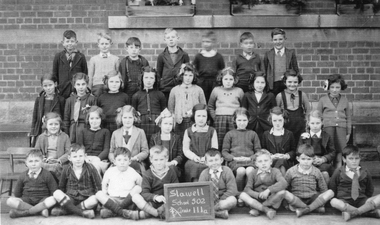
Stawell Historical Society IncPhotograph, Stawell Primary School Numbered 502 -- Grade 3A Class Photo c 1942
... Hall, Glenda Hurst, Lorraine Woodhart, ? Krause. 1st Row Seated - ? Allender, Noreen Byron, Margo Williams, Pam Knipe, Dorothy Christian, ?, ?, Judith Sweeney. Front Row - ? Johnston, E. Prydderch, ? Smart, Jim Martin, Hartley Newton, ? Oliver, (Whistle) Cooper, Selwyn (Keith) Darker, The Smart boys were twins. Judith Sweeney stayed with the Maddocks family 6-8 months - war evacuee, her father made runner shoes. Stawell Education Stawell Primary School ...502 Class 3a Photo (1942). Back row - Jack (Wossie) Hall, Ron Maddock, ? Smart, Gilbert Smith, Knowles Roberts , Ken Hull, Ron Richards. 2nd Back row - Hilary Waring, Lois Truscott, Margaret Taylor, Joan Hayward, Alison West, Patricia Hall, Glenda Hurst, Lorraine Woodhart, ? Krause. 1st Row Seated - ? Allender, Noreen Byron, Margo Williams, Pam Knipe, Dorothy Christian, ?, ?, Judith Sweeney. Front Row - ? Johnston, E. Prydderch, ? Smart, Jim Martin, Hartley Newton, ? Oliver, (Whistle) Cooper, Selwyn (Keith) Darker, The Smart boys were twins. Judith Sweeney stayed with the Maddocks family 6-8 months - war evacuee, her father made runner shoes. Stawell Primary School, 502 Grade 3a Class photo. The class black and white photo taken in 1942 consists of 32 students. Two middle rows of female students (17) and two rows of males students (15). The background of the photo is a brick school wall with 3 windows. stawell education -
Stawell Historical Society IncPhotograph, "Moke-Billy" Station in the Grampians owned by Mr. Rose -- Sketch 1844 at National Gallery of Victoria
... Hall's Gap is named after him. Phillip Davis Rose - Leased La Rose and Moke-Billy (Pille) 1842-43 Original In National Gallery of Victoria National Gallery of Victoria. Artist or School ...Copy of a sketch of Moke-Billy. Mr. Rose’s Station Grampians 1844 by R.H. Bunbury Previous to Mr. Rose, Charles Browning Hall early writing suggests Hall was a stock Herder this lead him to the Grampians district. Hall held two runs in the Wimmera district La Rose and Moke-Billy (Pille). 1841 - 42 - Hall's Gap is named after him. Phillip Davis Rose - Leased La Rose and Moke-Billy (Pille) 1842-43Original In National Gallery of VictoriaBlack & white photograph of a sketch of a log home and chimney. Lean-to on back, veranda on the front. Bark roof. Log fence. Building surrounded by tall trees with outline of mountains in the background. On the left is what looks like a back shelter. National Gallery of Victoria. Artist or School R. H. Bunbury 1814 - 1857 Title Moke-Billy, Mr. Rose's Station, Grampians. December, 1844. Medium drawing Dimensions 16.6 x 24.6 cm Accession No. Credit Line Presented 1954 To be reproduced only by written permission of National Gallery of Victoria 180 St. Kilda Road Melbourne Vic., Australia 3004. -
St Kilda Historical SocietyEphemera - Certificate, To FW Zercho esq, 1938
... School in 1913-1919). The certificate, dated 16 August 1938, is a birthday greeting addressed to F. W. Zercho that also acknowledges one year since the establishment of the Gregory Hall branch of the college. ...School in 1913-1919). The certificate, dated 16 August 1938, is a birthday greeting addressed to F. W. Zercho that also acknowledges one year since the establishment of the Gregory Hall branch of the college. ...The Gregory Hall was built on the grounds of All Saints Uniting Church, Chapel Street, East St Kilda in 1910-11. It was used for assemblies and classes at the All Saints' Grammar School which, after faltering fortunes, closed in1937. It was then leased to Zercho's Business College, founded in 1911 by Frederick William Zercho (the brother of Charles Henry Zercho, who was headmaster of the All Saints Grammar School in 1913-1919). The certificate, dated 16 August 1938, is a birthday greeting addressed to F. W. Zercho that also acknowledges one year since the establishment of the Gregory Hall branch of the college. It is signed by the headmistress, staff and students. Zercho's Business College became the largest business college in Australia. In 1968 it was sold to Stott's Business College.Two page certificate in leather bound folder: two sheets of white paper, handwritten and decorated with ink of multiple colours and each affixed to a board. The boards are covered with blue-dyed leather, decorated with gold ink, and were once joined together to form an outer cover for the pages. One sheet carries on one side a message to FW Zercho Esq that has been written in decorative calligraphy, and signatures. The second sheet carries decorative artwork and a list of signatures on each side as well as a sepia photograph.gregory hall, all saints church, all saints anglican church st kilda, frederick zercho, schools