
Showing 2580 items matching "https://11btn.wags.org.au/"
-
 Surrey Hills Historical Society Collection
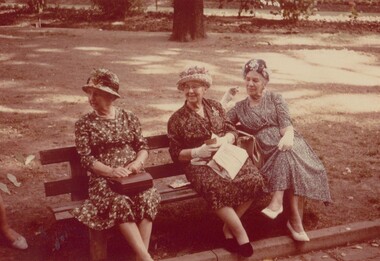
Photograph, Three Deakin sisters, 1964
... Born South Melbourne, she died in Elsternwick on 14 October, 1969, aged 87. (REF: http://www.ozsportshistory.com/wardeaths/women_a_e.html) There is a photo of her in uniform on this site and also on http://ww1nurses.gravesecrets.net/de.html LtoR: Alice, Minnie, Lily, Elsie. ...Born South Melbourne, she died in Elsternwick on 14 October, 1969, aged 87. (REF: http://www.ozsportshistory.com/wardeaths/women_a_e.html) There is a photo of her in uniform on this site and also on http://ww1nurses.gravesecrets.net/de.html LtoR: Alice, Minnie, Lily, Elsie. ...These are the 4 surviving daughters of Thomas Henry Deakin (1845-1915), born in Monmouthshire, Wales and his wife Janet (Jessie) Longmore (1851-1939), born in Morayshire, Scotland. The couple also had 2 sons: John Henry (1879-1962) and William Andrew (1883-1939). A fifth daughter Daisy Jessie was born in 1880 and died the same year at the age of 7 months. Elsie Longmore Deakin (1881-1969) was a nurse ans remained single; Minnie Winifred (1886-1966) married Charles Williamson in 1923; Lily Vipond (1890-1943) married David Mair in 1910 and Jessie Alice, known as Alice, married Hector Williamson in 1921. Hector and Charles were brothers. Elsie Longmore Deakin enlisted AANS aged 35 years in 10 May 1915; embarked on the Mooltan on 22 August 1916. Address : 114 Station Street, Fairfield, Next of kin : mother, Mrs Janet Deakin (nee Longmore), 114 Station Street, Fairfield, father, Thomas Henry Deakin Elsie Deakin enlisted at 35 years of age on 10 May, 1915 and served locally before volunteering for overseas duty on 9 August, 1916. Her three years of training were completed at the Melbourne General Hospital. She embarked with the rank of Sister for India and was appointed to the Victoria Hospital, Bombay. In January, 1917, when she was transferred to England and a Military Hospital at Bagthorpe later to the 1 Australian Auxiliary Hospital, and in January of the following years to 25 (British) GH in France but returned a few weeks later to England and the 1 AAH after suffering a seriously strained left ankle. She returned to France post-war and served another four months before being returned to Australia in May, 1919. Her appointment was terminated as medically unfit on 9 June, 1919. Born South Melbourne, she died in Elsternwick on 14 October, 1969, aged 87. (REF: http://www.ozsportshistory.com/wardeaths/women_a_e.html) There is a photo of her in uniform on this site and also on http://ww1nurses.gravesecrets.net/de.html LtoR: Alice, Minnie, Lily, Elsie. This is part of a large donation relating to the Deakin, Mair and Young families. The donor thought this was taken during the 1950s but the Kodak stamp identifies it as later.This is part of a large collection of material related to the Deakin, Mair and Young families with multiple connections to Surrey Hills and Mont Albert.A colour photo with a cream edge of 3 well-dressed women sitting on a public bench in what looks to be a park. All are wearing hats and carrying handbags. Two are wearing gloves. On rear in blue biro - "Aunties / Elsie Minnie & Alice / Mum's RIGHT TO LEFT In black biro) / Beryl / YOUNG / My Mothers Sisters / (Lily Vipond Deakin / MAIR." Some of the handwriting is thought to be that of the donor's mother, Beryl Mair. There may be another hand. It appears that not all the inscriptions were added at the same time. There is also a photographic processing stamp in red: " THIS IS A / KODACHROME PRINT / Made by / KODAK / FEBRUARY 1964 M" elsie longmore deakin, minnie winifred deakin, minnie winifred williamson, lily vipond deakin, lily vipond mair, jessie alice deakin, alice deakin, jessie alice williamson, alice williamson -
 Surrey Hills Historical Society Collection
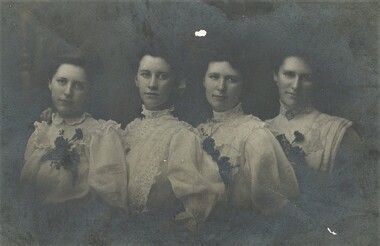
Photograph, The four Deakin sisters as young women, 1905
... Born South Melbourne, she died in Elsternwick on 14 October, 1969, aged 87. (REF: http://www.ozsportshistory.com/wardeaths/women_a_e.html) There is a photo of her in uniform on this site and also on http://ww1nurses.gravesecrets.net/de.html LtoR: Alice, Minnie, Lily, Elsie. ...Born South Melbourne, she died in Elsternwick on 14 October, 1969, aged 87. (REF: http://www.ozsportshistory.com/wardeaths/women_a_e.html) There is a photo of her in uniform on this site and also on http://ww1nurses.gravesecrets.net/de.html LtoR: Alice, Minnie, Lily, Elsie. ...These are the 4 surviving daughters of Thomas Henry Deakin (1845-1915), born in Monmouthshire, Wales and his wife Janet (Jessie) Longmore (1851-1939), born in Morayshire, Scotland. The couple also had 2 sons: John Henry (1879-1962) and William Andrew (1883-1939). A fifth daughter Daisy Jessie was born in 1880 and died the same year at the age of 7 months. Elsie Longmore Deakin (1881-1969) was a nurse ans remained single; Minnie Winifred (1886-1966) married Charles Williamson in 1923; Lily Vipond (1890-1943) married David Mair in 1910 and Jessie Alice, known as Alice, married Hector Williamson in 1921. Hector and Charles were brothers. Elsie Longmore Deakin enlisted AANS aged 35 years in 10 May 1915; embarked on the Mooltan on 22 August 1916. Address : 114 Station Street, Fairfield, Next of kin : mother, Mrs Janet Deakin (nee Longmore), 114 Station Street, Fairfield, father, Thomas Henry Deakin Elsie Deakin enlisted at 35 years of age on 10 May, 1915 and served locally before volunteering for overseas duty on 9 August, 1916. Her three years of training were completed at the Melbourne General Hospital. She embarked with the rank of Sister for India and was appointed to the Victoria Hospital, Bombay. In January, 1917, when she was transferred to England and a Military Hospital at Bagthorpe later to the 1 Australian Auxiliary Hospital, and in January of the following years to 25 (British) GH in France but returned a few weeks later to England and the 1 AAH after suffering a seriously strained left ankle. She returned to France post-war and served another four months before being returned to Australia in May, 1919. Her appointment was terminated as medically unfit on 9 June, 1919. Born South Melbourne, she died in Elsternwick on 14 October, 1969, aged 87. (REF: http://www.ozsportshistory.com/wardeaths/women_a_e.html) There is a photo of her in uniform on this site and also on http://ww1nurses.gravesecrets.net/de.html LtoR: Alice, Minnie, Lily, Elsie. This is part of a large donation relating to the Deakin, Mair and Young families.A black & white photo with a cream edge of 4 well-dressed young women in a head and shoulders formal pose. It is likely a studio photo. All wear white frilly or lacy blouses and 3 are carrying bunches of flowers.1. On rear: Top in blue biro - "Elsie Minnie Lily Alice DEAKIN / Mum's (crossing out) sisters On the basis of inscriptions in family autograph books, this writing belongs to Lily's daughter, Beryl Mair. 2. The rear has 4 remnant glued labels roughly torn from larger labels - the type once common for labelling jars and bottles. Partially beneath these is writing in another hand in black ink: " ..th love and be.. / ..shes ---------your /(crossing out) then name removed (superficial paper loss. 3, "YOUNG" in blue biro in lower LH corner. This may be the donor's handwriting. It may have been added in the course of sorting photos into Young antecedent photos; there are no members of the Young family in the photo itself. elsie longmore deakin, minnie winifred deakin, minnie winifred williamson, lily vipond deakin, lily vipond mair, jessie alice deakin, alice deakin, jessie alice williamson, alice williamson -
 Flagstaff Hill Maritime Museum and Village
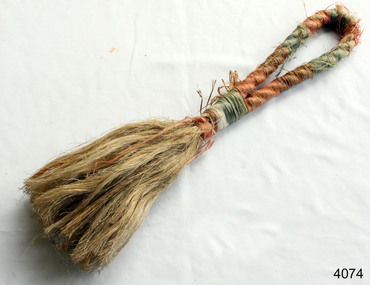
Domestic object - Brush, 20th Century
... The newest major change is the flat broom, invented by the Shakers in the 1800s, which has far more width for pushing dirt and nearly all brooms produced today are flat brooms. https://simple.wikipedia.org/wiki/Broom...The newest major change is the flat broom, invented by the Shakers in the 1800s, which has far more width for pushing dirt and nearly all brooms produced today are flat brooms. https://simple.wikipedia.org/wiki/Broom This object is an example of how a simple material can be turned into a useful item. flagstaff hill warrnambool shipwrecked-coast flagstaff-hill flagstaff-hill-maritime-museum maritime-museum shipwreck-coast flagstaff-hill-maritime-village Brush Broom Rope None. ...A broom is a cleaning tool. It consists of stiff fibres attached to, and roughly parallel to, a cylindrical handle, the broomstick. In the context of witchcraft, "broomstick" is likely to refer to the broom as a whole. A smaller whisk broom or brush is sometimes called a duster. History of broom design Brooms have changed very much in their construction, since they developed from ad-hoc use of branches and bundles of several natural fibres. Originally, all brooms were round, a shape that is easy to construct but inefficient for actually sweeping. Brooms could be attached to a handle, either short for a whisk broom, or long for a broom used to sweep the floor or fireplace. The word for the tool was originally besom, broom simply being the material of which it was normally made. The fibres used in modern brooms are from broom corn. They are long, straight, durable, and bound together in the plant. The newest major change is the flat broom, invented by the Shakers in the 1800s, which has far more width for pushing dirt and nearly all brooms produced today are flat brooms. https://simple.wikipedia.org/wiki/BroomThis object is an example of how a simple material can be turned into a useful item.Brush of plaited green & orange coloured rope like material. Brush section is like taffeta, blonde.None.flagstaff hill, warrnambool, shipwrecked-coast, flagstaff-hill, flagstaff-hill-maritime-museum, maritime-museum, shipwreck-coast, flagstaff-hill-maritime-village, brush, broom, rope -
 Federation University Historical Collection
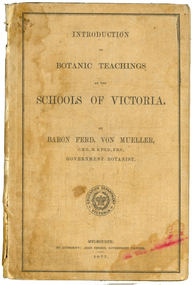
Book, Ferdinand Von Mueller, Introduction to Botanic Teachings at the Schools of Victoria, 1877
... Ferdinand von Mueller's entry on the University of Ballarat Honour Roll can be found at http://www.ballarat.edu.au/curator/honour-roll/honourroll_von_mueller.shtml Also See Cat. ...Ferdinand von Mueller's entry on the University of Ballarat Honour Roll can be found at http://www.ballarat.edu.au/curator/honour-roll/honourroll_von_mueller.shtml Also See Cat. ...Ferdinand von Mueller was an examiner of botany at the Ballarat School of Mines (SMB) between 1880 and 1888. During that era he was active in donating related items to the School. When the Ballarat School of Mines Council agreed to introduce pharmacy and botany classes in 1879, it was apparent students would require access to botanical specimens in order to further their studies. Council members, who were inspired by the work of Baron Ferdinand von Mueller, authorised development of an area along the School's northern boundary, fronting Lydiard Street South, and oversaw the establishment of the new Botanical Gardens. Baron von Mueller took a practical role the development of SMB's Botanical Gardens from the beginning. He became a generous benefactor who 'donated collections of seeds and leguminous fodder plants, including valued grasses of interest and use to agriculturalists and graziers generally' to SMB over many years. Ferdinand von Mueller's entry on the University of Ballarat Honour Roll can be found at http://www.ballarat.edu.au/curator/honour-roll/honourroll_von_mueller.shtml Also See Cat. No. 12062A light brown, hardcovered book of 152 pages. Chapters include Eucalyptus Trees; Wattles or Acacias; Casuarinas or Sheoaks; Cypress Pines or Sandarac trees; Exocarpos trees of Natice Cherry trees; Mistletoes; Native Honeysuckles or Banksias; Bellflower, Lobelia and Goodenia; Heaths; Correas; Mallow; Buttercups and Clematis; Cruciferous Plants; Mints; Orchids; grasses; ferns. The book has numerous botanical line drawings, and a comprehensive index.Inside front cover "Botanist, Teacher, researcher. My you make your mark like the baron. Best wishes for your birthday 1999 Martin"victorian, schools, botany, ferdinand von mueller, von mueller, botanic illustrations, flora, change number -
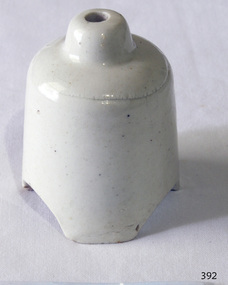 Flagstaff Hill Maritime Museum and Village
Ceramic - Pie Funnel, 20th Century
... Adapted from Wikipedia: https://en.wikipedia.org/wiki/Pie_bird...Adapted from Wikipedia: https://en.wikipedia.org/wiki/Pie_bird This item shows how a simple object can provide a significant improvement of the final product. ...Pies with top crusts need to be vented, to allow steam to escape. Funnel-style steam vents have been placed in the centre of fruit and meat pies during cooking since Victorian times. Pie funnels were used to prevent pie filling from boiling up and leaking through the crust by allowing steam to escape from inside the pie. They also supported the pastry crust in the centre of the pie, so that it did not sag in the middle, and are occasionally known as 'crust holders'. Older ovens had more problems with uniform heating, and the pie funnel prevented boil-over in pie cooking. The traditional inverted funnels, with arches on the bottom for steam to enter, were followed by ceramic birds; and from the 1940s they have been produced in a multitude of designs. Creigiau Pottery of South Wales produced a 'Welsh Pie Dragon' in copper lustreware. This trend has been particularly noticeable in recent times, due to their increasing popularity as gifts and collectors' items rather than simply utilitarian kitchen tools. Adapted from Wikipedia: https://en.wikipedia.org/wiki/Pie_birdThis item shows how a simple object can provide a significant improvement of the final product.Pie Funnel, ceramic white glaze with scalloped edges.Noneflagstaff hill, warrnambool, shipwrecked-coast, flagstaff-hill, flagstaff-hill-maritime-museum, maritime-museum, shipwreck-coast, flagstaff-hill-maritime-village, pie funnel, ceramics, cooking -
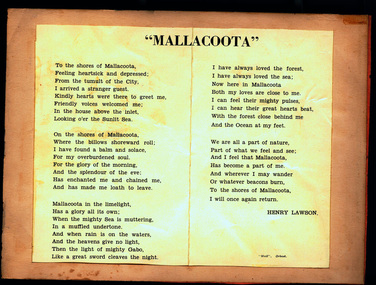 Orbost & District Historical Society
poem, Mallacoota
... He produced 5 collections of verse: Songs of War and Peace; Boundary Bend and Other Ballads; My Old Black Billy and other Songs of the Australian Outback; The Kerrigan Boys and other Australian Verses; and Swagless Swaggie and Other Ballads.His "Mallacoota" poem is printed in the Swagless Swaggie collection (1957). https://adb.anu.edu.au/biography/harrington-edward-philip-10431 ...He produced 5 collections of verse: Songs of War and Peace; Boundary Bend and Other Ballads; My Old Black Billy and other Songs of the Australian Outback; The Kerrigan Boys and other Australian Verses; and Swagless Swaggie and Other Ballads.His "Mallacoota" poem is printed in the Swagless Swaggie collection (1957). https://adb.anu.edu.au/biography/harrington-edward-philip-10431 Poetry associated with a place in East Gippsland. poem - Edward Harrington - bush balladist - Mallacoota A copy of a printed poem titled "Mallacoota" with unknown author. ...The poem, "Mallacoota", as in this copy, does not appear to be noted in any of the lists of poems attributed to Henry Lawson. NOTE: Information provided by David Williams on 13/12/2021 is that "this poem in your collection is by Edward Harrington (indeed not Lawson)". Edward P Harrington (1895-1966) was born in Shepparton, served in Palestine in W W I with the 4th Light Horse Regiment, tried farming, but his lifelong passion was for story-telling through poetry. He is described as the 'last bush balladist' in Australia, and was a close friend of E J Brady and John Shaw Neilson. It was likely that he came to Mallacoota as a guest of E J Brady who had a camp for writers and poets there. He produced 5 collections of verse: Songs of War and Peace; Boundary Bend and Other Ballads; My Old Black Billy and other Songs of the Australian Outback; The Kerrigan Boys and other Australian Verses; and Swagless Swaggie and Other Ballads.His "Mallacoota" poem is printed in the Swagless Swaggie collection (1957). https://adb.anu.edu.au/biography/harrington-edward-philip-10431 Poetry associated with a place in East Gippsland. A copy of a printed poem titled "Mallacoota" with unknown author. It is pasted onto a cardboard backing. Although attributed to Henry Lawson in this printed copy, information is that it is by Edward Harrington.poem - edward harrington - bush balladist - mallacoota -
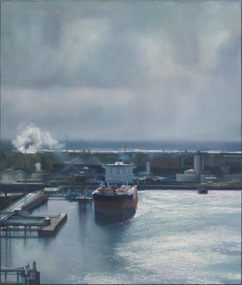 Mission to Seafarers Victoria
Painting, Robert Klein-Boonschate, Departure 7, 2003
... Finalist Robert Klein-Boonschate in the ANL Maritime Art Prize 2003 Biography: (https://www.artpartners.com.au/robert-kleinboonschate/) Born in The Netherlands, Robert migrated to Tallangatta, Australia with his family in 1971. ...Finalist Robert Klein-Boonschate in the ANL Maritime Art Prize 2003 Biography: (https://www.artpartners.com.au/robert-kleinboonschate/) Born in The Netherlands, Robert migrated to Tallangatta, Australia with his family in 1971. ...Finalist Robert Klein-Boonschate in the ANL Maritime Art Prize 2003 Biography: (https://www.artpartners.com.au/robert-kleinboonschate/) Born in The Netherlands, Robert migrated to Tallangatta, Australia with his family in 1971. Robert completed a degree in Graphic Art at Swinburne College and settled into Melbourne for the next seven years as a professional artist and art facilitator. Robert moved to Mparntwe (Alice Springs) in the 1980’s where he worked closely with Arrernte Peoples for the next 12 years. Robert’s beautiful landscapes reflect the influence of Arrernte artist Albert Namatjira and his love of the Australian landscape reflects his experiences with the Arrernte Peoples and their connection to ‘Country’. Robert opened the art studio located at his home in Alice Springs to Arrernte, Luritja, Warlpiri & Pintupi artists and worked alongside such artists as Johnny Warrangkula Tjupurrula. Robert helped to facilitate Johnny’s later body of work by constructing special brushes which could be used by Johnny after breaking his wrist. Robert has returned to NSW and now lives in Walla Walla surrounded by the rugged natural landscapes of Australia.Large scale Oil on Belgian Linen depicting dockside and ships.docks, waterside, maritime art, robert klein-boonschate, artwork-paintings, maritime art prize, anl -
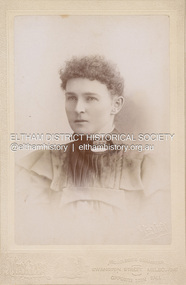 Eltham District Historical Society Inc
Photograph, Melba Studio, Caroline (Carrie) Shillinglaw, c.1898
... Retrieved December 2, 2022, from http://nla.gov.au/nla.news-article65696093 CABINET 1866-1905 The Cabinet photo was introduced in 1866 in answer to a demand for a larger format photograph which could be mounted for a cabinet or on the wall. ...Retrieved December 2, 2022, from http://nla.gov.au/nla.news-article65696093 CABINET 1866-1905 The Cabinet photo was introduced in 1866 in answer to a demand for a larger format photograph which could be mounted for a cabinet or on the wall. ...Caroline Shillinglaw married Christopher Watson 1907. Their daughter, Jean, was born 1906. Melba Studio Photographers operated from Nicholson's Chambers at 101 Swanston Street, Melbourne opposite the Town Hall from 1897-1929 A review of Melba Studio NEWS AND NOTES FOR LADIES. (1897, November 25). Fitzroy City Press (Vic. : 1881 - 1920), p. 3. Retrieved December 2, 2022, from http://nla.gov.au/nla.news-article65696093 CABINET 1866-1905 The Cabinet photo was introduced in 1866 in answer to a demand for a larger format photograph which could be mounted for a cabinet or on the wall. They were 4.5 inches by 6.5 inches (11.5 x 16.5 cm), more than twice the size of the cdv. They cost about twice as much as a cdv but eventually displaced them. They were not extensively produced until 1880 and had ceased by 1905. Coloured mounts, especially maroon or green, indicate a date between 1880 and 1890. - Frost, Lenore; Dating Family Photos 1850-1920; Valiant Press Pty. Ltd., Berwick, Victoria 1991marg ball collection, shillinglaw family photo album 2, cabinet photo, 1897-1929, 1898, caroline (carrie) watson (nee shillinglaw) 1876-1956, melba photographers swanston st melbourne -
 Eltham District Historical Society Inc
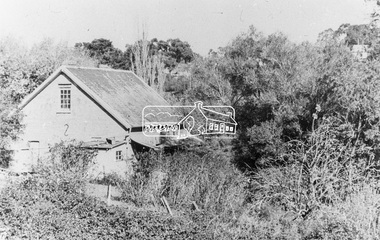
Photograph, Willis Vale on the north bank of the Plenty River, Church Street, Greensborough, c.1950
... Greensborough Historical Society has same image with more accurate information on the date/cause of fire damage https://victoriancollections.net.au/items/585b6c96d0ce2c1268f1c96b "House built by Edward Maygar, Robert Whatmough lived there mid 19th century and later sold to Partington family. ...Greensborough Historical Society has same image with more accurate information on the date/cause of fire damage https://victoriancollections.net.au/items/585b6c96d0ce2c1268f1c96b "House built by Edward Maygar, Robert Whatmough lived there mid 19th century and later sold to Partington family. ...Photo sourced from Heidelberg Historical Society reproduced on p63 of The Diamond Valley Story by Dianne H. Edwards, Shire of Diamond Valley 1979. "Willis Vale, Greensborough, situated on the north bank of the Plenty River at the end of Church Street. The home wasa built about 1840 by Jame Willis Mayger from bricks hand-made nearby. It was later passed to the Partington family and when this photo was taken the building was deserted. Vandals and finally a bushfire destroyed Willis Vale in the 1950s." Greensborough Historical Society has same image with more accurate information on the date/cause of fire damage https://victoriancollections.net.au/items/585b6c96d0ce2c1268f1c96b "House built by Edward Maygar, Robert Whatmough lived there mid 19th century and later sold to Partington family. It was located on the Plenty River at Partington's Flat Greensborough. The derelict Willis Vale house was destroyed in 1964 when a fire originating from North Plenty Gorge - Kurrak Road - was lit by two teenage boys and made its way several kilometres down to Partington's Flat Greensborough."Black and white copy of photo printed on glossy photographic paper 30.5 x 40.5 cm (12 x 16 inch); image size approx. 18.5 x 28 cmchurch street, diamond valley story, greensborough, james willis mayger, partington family, willis vale -
 Bendigo Historical Society Inc.
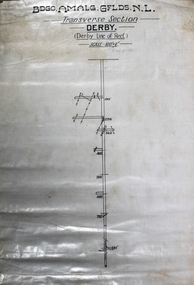
Map - Derby Line of Reef, Unknown
... A crosscut east from this shaft ata depth of 200 feet reaches the Derby Line in a distance of 700 feet. (https://search.informit.org/doi/10.3316/aesis.200104712) ...A crosscut east from this shaft ata depth of 200 feet reaches the Derby Line in a distance of 700 feet. (https://search.informit.org/doi/10.3316/aesis.200104712) gold mining gold Bendigo Derby Derby line of reef transverse section Printed in black text on top of plan: 'Bgo Amalg Gflds N.L." ...Informit: Lease application no.11038 contains a length of about 48 chains of the Paddy's Gully line of reefs. The Derby Anticline penetrates the area from its north boundary for a distance ofabout 30 chains at which point the fold disappears southwards. The outcrop of the Paddy's Gully Anticline is exposed in McClure Street. Along this section of the Paddys Gully line the top of what is regarded as 'favorable beds' occurs about 150 feet from the surface. It is estimated that the containing beds of Ladam's reef and the Garden Gully 300 feet reef, both of which proved to have been rich ore bodies on the Garden Gully line adjoining on the west, will be found at the approximate depth of 550 feet onthe Paddy's Gully line near the intersection of McClure and Bannerman Streets. A shorter vertical point of attack, though the position is less favorable geologically, is kocks Pioneer east shaft which is 420 feet deep. A crosscut east from this shaft ata depth of 200 feet reaches the Derby Line in a distance of 700 feet. (https://search.informit.org/doi/10.3316/aesis.200104712) Printed in black text on top of plan: 'Bgo Amalg Gflds N.L." (Bendigo Amalgamated Goldfields N.L.) Transverse Section, Derby, Derby Line of Reef. Scale 100' = 1". Plan forms part of the Margaret Roberts Collection.gold mining, gold, bendigo, derby, derby line of reef, transverse section -
 Bendigo Historical Society Inc.
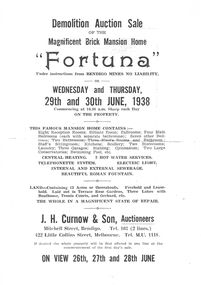
Flyer - Auction Sale
... The auction sale will be held within the next few weeks by J H Curnow and Son of Little Collins street and Bendigo. https://trove.nla.gov.au/newspaper/article/11158857?...The auction sale will be held within the next few weeks by J H Curnow and Son of Little Collins street and Bendigo. https://trove.nla.gov.au/newspaper/article/11158857? ...PROPERTY MARKET Fortuna, Bendigo The Bendigo mansion property, Fortuna, for many years the home of the late Mr George Lansell, will again be offered for sale by auction. Some few years ago the property was purchased by Gold Mines of Australia Ltd., and it was used for a time for the offices of Bendigo Mines N.L. The company now has no further use for the building. As a last effort to retain this historic 52-room mansion, it will be offered as it now stands, with the spacious grounds which contain three lakes, a terrace, a rose garden, a swimming-pool, and a Roman fountain. It is hoped that it may be purchased by some organisation for use as a school, hospital, or other institution. If a sale is not effected the building will be sold immediately for demolition. This should arouse much interest as it con-tains many cedar and mahogany fittings, parquetry floors, central heating and hot-water plants. The auction sale will be held within the next few weeks by J H Curnow and Son of Little Collins street and Bendigo. https://trove.nla.gov.au/newspaper/article/11158857?searchTerm=fortuna%20auction%20sale Demolition Auction Sale Flyer for Fortuna under instructions from Bendigo Mines. Dated 29th and 30th June 1930. Auctioneers J H Curnow and Son. Black ink on yellow paper.fortuna villa, auction, bendigo mines -
 Glen Eira Historical Society
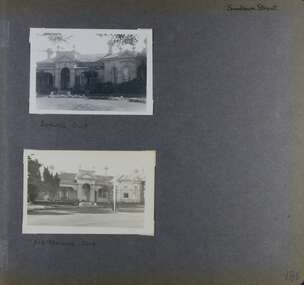
Album - Album page, Elsternwick Club, Sandham Street, Circa 1972
... From Victorian Heritage Database citation for HO60 Stanmere/Elsternwick Club, 19 Sandham Street Elsternwick https://vhd.heritagecouncil.vic.gov.au/places/35422 as at (1/11/2020) An imposing single storeyed stuccoed Boom period Italianate villa residence, distinguished by its bayed and pedimented projecting wing and central portico with surmounting pediment and urns. ...From Victorian Heritage Database citation for HO60 Stanmere/Elsternwick Club, 19 Sandham Street Elsternwick https://vhd.heritagecouncil.vic.gov.au/places/35422 as at (1/11/2020) An imposing single storeyed stuccoed Boom period Italianate villa residence, distinguished by its bayed and pedimented projecting wing and central portico with surmounting pediment and urns. ...This photograph is part of the Caulfield Historical Album 1972. This album was created as part of a project from approximately 1966-1972 by the Caulfield Historical Society to assist in identifying buildings worthy of preservation. This album is related to a Survey the Caulfield Historical Society developed in collaboration with the National Trust of Australia Victoria and Caulfield City Council to identify historic buildings within the City of Caulfield that warranted the protection of a National Trust Classification. Photographers Jenny O’Donnell and Trevor Hart, members of Caulfield Historical Society. Some photographs are older and from unknown sources. All photographs are black and white except where stated. From Victorian Heritage Database citation for HO60 Stanmere/Elsternwick Club, 19 Sandham Street Elsternwick https://vhd.heritagecouncil.vic.gov.au/places/35422 as at (1/11/2020) An imposing single storeyed stuccoed Boom period Italianate villa residence, distinguished by its bayed and pedimented projecting wing and central portico with surmounting pediment and urns. The cast iron verandahs, to two elevations, have tessellated floors and are partly built-in. From Victorian Heritage Database citation for HO60 Stanmere/Elsternwick Club, 19 Sandham Street Elsternwick https://vhd.heritagecouncil.vic.gov.au/places/35422 as at (1/11/2020) "Stanmere" is locally important as the home of the Short family whose decision to sub divide its holdings was linked closely with the profiteering ventures of the directors of the Premier Building Association, leading to the construction of low cost workers housing characteristic of the land boom speculators prior to the bank crash of the early 1890's.Handwritten: Page 186 of photo album with two photographs of the Elsternwick Club.Handwritten: Sandham Street [top right] / BOWLING CLUB [under top photo] / ELSTERNWICK CLUB [under bottom photo] / 186 [bottom right]trevor hart, victorian, chimneys, porch, cast iron lacework, verandah, sandham street, victorian villa residence, villa residence, cast iron frieze, cast iron columns, protruding bay, bay window, 1880's, late victorian, decorative brackets, rendered, arched windows, ornamented parapet, short family, premier building association, elsternwick club, boom years, elsternwick, pediment, stanmere, bowling club, club, bowling, land subdivision, cast iron work, tessallated floors -
 Bendigo Historical Society Inc.
Tool - OERTLING SCALES IN GLASS CASE, 1898
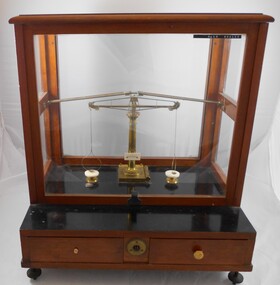
... Reference: Powerhouse Collection - https://collection.powerhouse.com.au/object/550913 ...Reference: Powerhouse Collection - https://collection.powerhouse.com.au/object/550913 MINING Equipment Scales Ludwig Oertling beam balance assay Bendigo School of Mines and Industry 21736, J.W. 28.2.98, E.C., 3/98 Brass beam balance made by Oertling, London in 1898. ...The Oertling beam balance scale was used in the Bendigo School of Mines assay laboratory. The manufacturer, Ludwig Oertling (1818-1893), was born near Hamburg and gained his apprenticeship in instrument-making with his brother Johann. He immigrated to London in 1840, where he joined instrument-maker and assayer George Makins (1815-1893). Oertling collaborated with Makins and built his first balance, which was "a twin-column assay type with a light lattice beam". By 1851, the year of the Great International Exhibition of the Works of All Nations, Oertling had established his own instrument-making business, employed five instrument-makers and by 1861, ten staff were engaged in designing and making instruments, principally analytical balances. Oertling's first twin-column beam balance was the prototype for all Oertling assay balances that were produced during the next century and exported to the British colonies: Australia, New Zealand, Canada, South Africa and India, to Europe and America." Reference: Powerhouse Collection - https://collection.powerhouse.com.au/object/550913 Brass beam balance made by Oertling, London in 1898. The scale is mounted on a wooden base board with a mahogany case, glass on four sides with two drawers underneath. On bottom of the left hand drawer, written in pencil, is the works number '21736'. A cursive 'L' on the same drawer bottom indicates 'left'. Also on bottom corner 'J.W. 28.2.98'. 'J.W' was John Wright, foreman and cabinet maker. He was Oertling’s longest working cabinet maker from1886-1928. In pencil underneath the right corner of the left drawer is '3/98'. Written in pencil inside the drawer cavity is 'E.C' in fancy script. This refers to 'Charlie Craig, employed as an instrument maker by the Oertling Company. The maker's name, "Oertling' is embossed on the base of the scale. There is a brass knob that fits in the front to make adjustments to the scales and also on either side of the exterior case to set the top of the scales. 21736, J.W. 28.2.98, E.C., 3/98mining, equipment, scales, ludwig oertling, beam balance, assay, bendigo school of mines and industry -
 National Vietnam Veterans Museum (NVVM)
Uniform - Cloth patch, US RAN
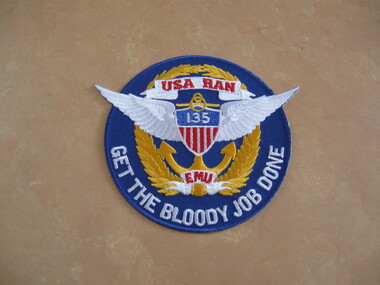
... A further reference was made to the badge in the 16 May 1969 Royal Australian Navy "Navy News", which ran a story on the emergence of this unique badge that has become synonymous with the unit and remains so to this day. Source: https://seapower.navy.gov.au/ran-helicopter-flight-vietnam-history ...A further reference was made to the badge in the 16 May 1969 Royal Australian Navy "Navy News", which ran a story on the emergence of this unique badge that has become synonymous with the unit and remains so to this day. Source: https://seapower.navy.gov.au/ran-helicopter-flight-vietnam-history Cloth badge Cerberus Collection 135th EMU Navy Helicopters US Army Assault helicopters Get The Bloody Job Done A blue cloth badge with white wings above a gold anchor with the number 135 is in the middle of the wings in white with red and white stripes underneath. ...This is the emblem of EMU (Experimental Miltary Unit) who were officially known as Royal Australian Navy Helicopter Flight Vietnam (RANHFV). The unit was formed in 1967 and integrated into the US ARmy 135th Assauly Helicopter Company until 1971. The February 1969 RANHFV Report of Proceedings contained the first reference to the unique unofficial badges worn by the men of the 135th AHC. It stated: "In an endeavour to boost the morale and unity of the Company, the Commanding Officer offered $25 and a 3-day pass to Vungtau for the designer of a new Company Crest and NAMAE Hughes’ entry won the competition. It is a very impressive combination of an anchor and US Army wings in a laurel wreath with USA-RAN inscribed in a scroll above the motto; GET THE B... JOB DONE written below". A further reference was made to the badge in the 16 May 1969 Royal Australian Navy "Navy News", which ran a story on the emergence of this unique badge that has become synonymous with the unit and remains so to this day. Source: https://seapower.navy.gov.au/ran-helicopter-flight-vietnam-history A blue cloth badge with white wings above a gold anchor with the number 135 is in the middle of the wings in white with red and white stripes underneath. On the anchor in red is the word EMU. Above the wings in red is USA RAN. At the bottom of the badge in white letters are the words Get The Bloody Job DoneGet The Bloody Job Donecloth badge, cerberus collection, 135th, emu, navy, helicopters, us army, assault helicopters -
![Manual, [Hattersley] Standard Loom Tuners Handbook: Setting instructions](/media/collectors/510b3f7f023fd725b4cd52cc/items/54065ed29821f50e3cc9ea4b/item-media/601344e16061d010347e22d5/item-fit-380x285.jpg?cb=6) National Wool Museum
National Wool MuseumManual, [Hattersley] Standard Loom Tuners Handbook: Setting instructions
... An example of this type of loom can be seen on Vic Collections here ( https://victoriancollections.net.au/items/54065d0f9821f50e3cc9c122 ) and is also on display within the National Wool Museum in Geelong, Victoria. ...An example of this type of loom can be seen on Vic Collections here ( https://victoriancollections.net.au/items/54065d0f9821f50e3cc9c122 ) and is also on display within the National Wool Museum in Geelong, Victoria. ...This handbook contains the setting instructions for a Standard Hattersley Loom developed by George Hattersley and Sons Ltd. The Hattersley loom was developed by George Hattersley and Sons of Keighley, West Yorkshire, England. The company had been started by Richard Hattersley after 1784, with his son, George Hattersley, later entering the business alongside him. The company developed several innovative looms, of which the Hattersley Standard Loom – developed in 1921 – was a great success. The Hattersley Standard Loom was designed and built in 1921. Thousands of models were expected to be sold, which would bring considerable financial success to the company. After the recapitalisation boom of 1919, cotton yarn production peaked in 1926 and further investment was sparse. Rayon, an artificial silk, was invented in the 1930s in nearby Silsden, and the Hattersley Silk Loom was adapted to weave this new fabric. An example of this type of loom can be seen on Vic Collections here ( https://victoriancollections.net.au/items/54065d0f9821f50e3cc9c122 ) and is also on display within the National Wool Museum in Geelong, Victoria. A copy of this manual may be available by contacting the National Wool Museum Collection Team. Book, 64pp. Red and black loose leaf, soft cover, printed black ink. "[Hattersley] Standard Loom Tuners Handbook: Setting instructions " - George Hattersley and Sons LtdTHE BRUCE WOOLLEN MANUFACTURING CO LTDtextile industry - history textile machinery weaving textile industry - education, george hattersley and sons ltd, weaving looms, weaving machinery, textile industry - history, textile machinery, weaving, textile industry - education -
 Ballarat and District Irish Association
Image, Round Tower at Monasterboice, c1864, c1864
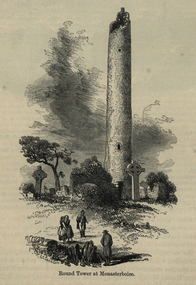
... The North and West crosses are also fine examples of this kind of structure, but these have suffered much more from the effects of the weather. (http://en.wikipedia.org/wiki/Monasterboice)...The North and West crosses are also fine examples of this kind of structure, but these have suffered much more from the effects of the weather. (http://en.wikipedia.org/wiki/Monasterboice) Ballarat Irish Monsasterboice Image of a round tower in a graveyard. ...The historic ruins of Monasterboice are of an early Christian settlement north of Drogheda in County Louth, Ireland. It was founded in the late 5th century by Saint Buithe who died around 521, and was an important centre of religion and learning until the founding of nearby Mellifont Abbey in 1142. The site houses two churches built in the 14th century or later and an earlier round tower, but it is most famous for its 10th century high crosses. The round tower is about 35-metres tall, and is in very good condition, although it is not possible to go inside. The passage of time has laid down layers of earth so now the doorway is almost at ground level. The monastery was burned in 1097. The 5.5-metre Muiredach's High Cross is regarded as the finest high cross in the whole of Ireland. It is named after an abbot, Muiredach mac Domhnaill, who died in 923 and features biblical carvings of both the Old and New Testaments of the Bible. The North and West crosses are also fine examples of this kind of structure, but these have suffered much more from the effects of the weather. (http://en.wikipedia.org/wiki/Monasterboice)Image of a round tower in a graveyard. It is the Round Tower at Monasterboiceballarat irish, monsasterboice -
 Ballarat and District Irish Association
Image, Lord Randolf Churchill, c1864, 1864
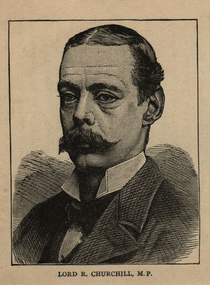
... It was said that the Liberals underwent a forced conversion to Home Rule to counteract that promise.(http://www.britannica.com/EBchecked/topic/117261/Lord-Randolph-Churchill, accessed 21 January 2014)...It was said that the Liberals underwent a forced conversion to Home Rule to counteract that promise.(http://www.britannica.com/EBchecked/topic/117261/Lord-Randolph-Churchill, accessed 21 January 2014) Ballarat Irish Churchill Randolf Churchill Image of a moustached man known as Lord R. ...Lord Randolph Henry Spencer-Churchill was a British statesman. He was the third son of the 7th Duke of Marlborough, and his wife, Lady Frances Vane. He was the father of Winston Churchill, the future wartime Prime Minister, who wrote his father's first major biography. (wikipedia) Having served as unofficial private secretary to his father, lord lieutenant (viceroy) of Ireland from 1876 to 1880, Churchill was especially interested in the Irish problem. Though opposed to national Home Rule for Ireland, he favoured self-government on the local level and blamed shortsighted British officials for the Irish crisis of the 1880s. The majority of the Conservative Party agreed with the Liberal government’s coercion policy toward Ireland, but Lord Randolph allowed the Irish nationalists, led by Charles Stewart Parnell, to understand that the Conservatives would oppose coercion in return for Irish votes in the general election of 1885. It was said that the Liberals underwent a forced conversion to Home Rule to counteract that promise.(http://www.britannica.com/EBchecked/topic/117261/Lord-Randolph-Churchill, accessed 21 January 2014)Image of a moustached man known as Lord R. Churchill, M.P.ballarat irish, churchill, randolf churchill -
 Uniting Church Archives - Synod of Victoria
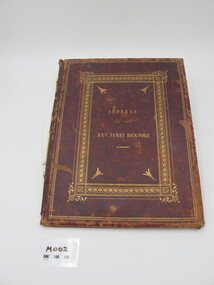
Illuminated Testimonial, Rev James Bickford, 1869
... Despite his previous advocacy of a 'mixed system' of education he supported the Victorian Education Act of 1872 as the only solution to sectarianism. [Source: https://adb.anu.edu.au/biography/bickford-james-2993]...Despite his previous advocacy of a 'mixed system' of education he supported the Victorian Education Act of 1872 as the only solution to sectarianism. [Source: https://adb.anu.edu.au/biography/bickford-james-2993] Rev James Bickford 1816-1895 Wesleyan Church Geelong Circuit Brown leather with gilt embossing and illuminated borders. ...James Bickford (1816-1895), Wesleyan clergyman, was born on 6 May 1816 in Modbury, Devon, England, fifth child of John Bickford, tenant farmer, and his wife Anne, née Whiteway. He received an elementary education and then worked for a commercial house at near-by Kingsbridge in 1830. Although raised in the Church of England, Bickford joined the Wesleyan society at Kingsbridge and was appointed a local preacher in 1835. He decided to become a missionary, and after a short informal training by the Wesleyan Missionary Society was ordained on 29 October 1838. Rev James Bickford became superintendent of the Yarra Street, Geelong, circuit in 1866. He was elected president of the Australasian Conference in 1868. Increased involvement in public affairs followed his appointment to Wesley Church, Melbourne, in 1870 and he was associated with the Society for Promoting Morality and the Sabbath Defence Association. Despite his previous advocacy of a 'mixed system' of education he supported the Victorian Education Act of 1872 as the only solution to sectarianism. [Source: https://adb.anu.edu.au/biography/bickford-james-2993]Brown leather with gilt embossing and illuminated borders. The Testimonial contains the signatures of the Circuit Stewards.rev james bickford 1816-1895, wesleyan church geelong circuit -
 Ballarat Tramway Museum
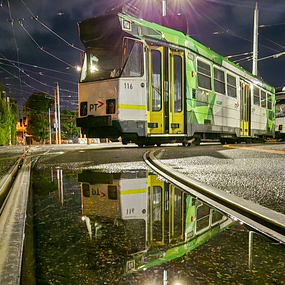
Photograph - Tram Z3 116 being transported and loaded for BTM - set of 12, Brenden Schonfelder, 2025
... For a Youtube video see item https://www.youtube.com/watch?v=hJsg48Gp7kk 1 - Last time at Essendon Depot - 6-1-2025 2 - Being towed by B2 2073 - Mount Alexander Road 3 - Last time through the city - William and Burke Streets 4 - 5 - Z3 116 driven from Preston Workshops to the loading ramp - 6/5/2025 6 - view from the driver's window of the loading ramp 7 - being pushed onto the low loader 8 - The team 9 - handing over the keys - Darren French of Yarra Trams and Alastair Reither of BTM 10 - loaded - Membrey's prime mover 11 - and at dusk 12 - pulling out of Preston Workshops on its way to the Museum's offsite store facility - 7/5/2025 - see item 10058 for the tram being unloaded....For a Youtube video see item https://www.youtube.com/watch?v=hJsg48Gp7kk 1 - Last time at Essendon Depot - 6-1-2025 2 - Being towed by B2 2073 - Mount Alexander Road 3 - Last time through the city - William and Burke Streets 4 - 5 - Z3 116 driven from Preston Workshops to the loading ramp - 6/5/2025 6 - view from the driver's window of the loading ramp 7 - being pushed onto the low loader 8 - The team 9 - handing over the keys - Darren French of Yarra Trams and Alastair Reither of BTM 10 - loaded - Membrey's prime mover 11 - and at dusk 12 - pulling out of Preston Workshops on its way to the Museum's offsite store facility - 7/5/2025 - see item 10058 for the tram being unloaded. ...Set of 12 images of Z3 116 being towed from Essendon Depot to Preston Depot and being loaded for transport to the Museum's offsite store. Photos by Brenden Schonfelder. For a Youtube video see item https://www.youtube.com/watch?v=hJsg48Gp7kk 1 - Last time at Essendon Depot - 6-1-2025 2 - Being towed by B2 2073 - Mount Alexander Road 3 - Last time through the city - William and Burke Streets 4 - 5 - Z3 116 driven from Preston Workshops to the loading ramp - 6/5/2025 6 - view from the driver's window of the loading ramp 7 - being pushed onto the low loader 8 - The team 9 - handing over the keys - Darren French of Yarra Trams and Alastair Reither of BTM 10 - loaded - Membrey's prime mover 11 - and at dusk 12 - pulling out of Preston Workshops on its way to the Museum's offsite store facility - 7/5/2025 - see item 10058 for the tram being unloaded.Yeilds information about the acquisition of Z3 class tram 116 by the BTM.Set of 12 digital images.btm, z3 class., tram 116, b2 class, tram 2073, essendon depot, preston workshops -
 National Wool Museum
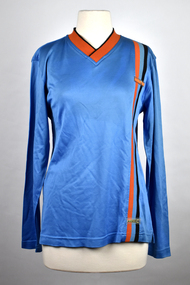
Textile - Australian Open Sportwool Top, CSIRO Division of Textile and Fibre Technology, c. 2000s
... The development of Sportwool® was funded by The Woolmark Company (now Australian Wool Innovation Limited). Source: https://csiropedia.csiro.au/sportwool/...The development of Sportwool® was funded by The Woolmark Company (now Australian Wool Innovation Limited). Source: https://csiropedia.csiro.au/sportwool/ Sportswool Australian Open Athletes Clothing The Woolmark Company CSIRO Division of Textile and Fibre Technology Uniforms 9095.1 Australian Open / Sportwool / Sportwool 9095.2 - front: [printed] Australian Open / OFFICIAL / LICENSED / PRODUCT 9095.3 - front: [printed] SPORTWOOL / Vapour Management Technology / www.sportwool.com 9095.1 - Long sleeve blue sports top with with orange and navy striped detail. 9095.2 - Clothing label tag featuring a black silhouette of a tennis player, with organe and white text and orange and blue graphics on a black background. 9095.3 - Four page fold out clothing label tag, front features printed text, silhouette sports graphics and a background of an orange and blue landscape. ...Sportwool® was developed to combine the physical performance attributes of synthetics with the comfort and breathability of a natural fibre. It is a lightweight, composite fabric consisting of a layer of machine-washable superfine Merino wool next to the skin and a layer of tough, easy-care polyester on the outside. As a result of this construction: - the wearer feels cooler more quickly and formation of liquid sweat is delayed - liquid sweat is carried away from the skin to the outside of the fabric, leaving - the inside dry and resulting in less ‘clammy’ garment cling - the wearer stays cooler when exercising - ‘post-exercise chill’ is reduced. In addition, Sportwool® is elastic, provides UV protection and does not retain odours. Sportwool® is constructed in weights ranging from ultra-light for jogging, to thicker, heavy-duty fabric for football jerseys. It is easily printed in bright colours and designs, including information about sponsors and players. Sportwool® can also be dyed in solid colours. The development of Sportwool® was funded by The Woolmark Company (now Australian Wool Innovation Limited). Source: https://csiropedia.csiro.au/sportwool/9095.1 - Long sleeve blue sports top with with orange and navy striped detail. 9095.2 - Clothing label tag featuring a black silhouette of a tennis player, with organe and white text and orange and blue graphics on a black background. 9095.3 - Four page fold out clothing label tag, front features printed text, silhouette sports graphics and a background of an orange and blue landscape.9095.1 Australian Open / Sportwool / Sportwool 9095.2 - front: [printed] Australian Open / OFFICIAL / LICENSED / PRODUCT 9095.3 - front: [printed] SPORTWOOL / Vapour Management Technology / www.sportwool.comsportswool, australian open, athletes, clothing, the woolmark company, csiro division of textile and fibre technology, uniforms -
 Federation University Art Collection
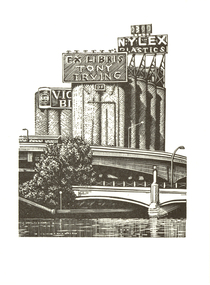
Work on paper - Artwork - Bookplate, Ex Libris for Rony Irving (Nylex Plastics) by David Frazer
... In 2002, David was awarded the Keith Wingrove Bookplate Design Award and in 2007, he was a major prizewinner at the International Print Biennial in Guanlan, China and a featured Australian artist on the ABC’s documentary series ‘Artist at Work’. (http://www.goldfieldsprintmakers.com/david-frazer.html) Art historian Robert C. ...In 2002, David was awarded the Keith Wingrove Bookplate Design Award and in 2007, he was a major prizewinner at the International Print Biennial in Guanlan, China and a featured Australian artist on the ABC’s documentary series ‘Artist at Work’. (http://www.goldfieldsprintmakers.com/david-frazer.html) Art historian Robert C. ...David Frazer (1966- ) David Frazer is an Australian artist who works in painting, wood engraving, etching, lithography and bronze. Born in Victoria, David Frazer graduated from the Phillip Institute of Technology, Melbourne with a Fine Art degree specialising in painting. In 1996 he achieved an Honours degree from Monash University specialising in Printmaking and in 2000, gained his Master of Arts. In 2002, David was awarded the Keith Wingrove Bookplate Design Award and in 2007, he was a major prizewinner at the International Print Biennial in Guanlan, China and a featured Australian artist on the ABC’s documentary series ‘Artist at Work’. (http://www.goldfieldsprintmakers.com/david-frazer.html) Art historian Robert C. Littlewood is a Private Press publisher who utilises his skills as a fine art photographer, a video producer, researcher and writer to document the lives and achievements of Australian artists who create (or created) original graphic prints. Littlewood is President of the Australian Bookplate Society and a Trustee of the Keith Wingrove Memorial Trust which administers the world's richest and Australia’s only Bookplate design award.Bookplate for Tony Irvinng featuring the Yarra River and silos at Richmond, Victoria. bookplate, tony irving, david frazer, nylex clock, yarra river, silos, richmond -
 Northern District School of Nursing. Managed by Bendigo Historical Society Inc.
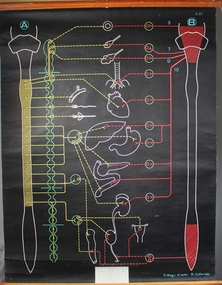
Poster - Sympathetic & Para-Sympathetic Nervous System, 1947
... See French artist Paul Sougy. https://www.themarginalian.org/2019/11/29/paul-sougy/ ...See French artist Paul Sougy. https://www.themarginalian.org/2019/11/29/paul-sougy/ Education Chart Nurse Training Lister House Northern District School of Nursing The sympathetic Nervous System Paul Sougy Coloured educational Schematic chart of the Sympathetic and Para-Sympathetic Nervous systems. ...Educational teaching chart used at the Northern District School of Nursing, Rowan Street, Bendigo. The Northern District School of Nursing opened in 1950 in to address the issues around nurse recruitment, training and education that had previously been hospital based. The residential school was to provide theoretical and in-house education and practical training over three years. The students would also receive practical hands-on training in the wards of associated hospitals. The Northern District School of Nursing operated from Lister House, Rowan Street, Bendigo. It was the first independent school of nursing in Victoria and continued until it closed in 1989 The sympathetic and parasympathetic nervous systems are the two main divisions of the autonomic nervous system, and they generally act in opposition to each other to maintain homeostasis. The sympathetic nervous system (SNS) is responsible for the "fight-or-flight" response, preparing the body for action, while the parasympathetic nervous system (PSNS) is responsible for the "rest-and-digest" response, promoting relaxation and recovery. See French artist Paul Sougy. https://www.themarginalian.org/2019/11/29/paul-sougy/ Coloured educational Schematic chart of the Sympathetic and Para-Sympathetic Nervous systems. Black paper with coloured lines and wooden header and footer. Written on lower Right - P. d'apre R. Collin.1947. Written on a white label in the lower middle - Supplied by Adam, Rouilly & Co LTD. Human Osteology Anatomy, Shropshire House, 179 Tottenham Court Road, London, W.1. Telephone Museum 2703. Written on the rear - PRINTED IN FRANCEeducation chart, nurse training, lister house, northern district school of nursing, the sympathetic nervous system, paul sougy -
 City of Greater Bendigo - Civic Collection
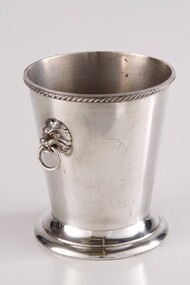
Functional object - Ice bucket, c 1960
... (Hunter, A. (2017) Saracen Plate Company - Lygon Street Carlton 1952-1974 in Museums Victoria Collections https://collections.museumsvictoria.com.au/articles/15804) The origins of this item is unknown although it was possibly either a gift or purchased by the City for use. ...(Hunter, A. (2017) Saracen Plate Company - Lygon Street Carlton 1952-1974 in Museums Victoria Collections https://collections.museumsvictoria.com.au/articles/15804) The origins of this item is unknown although it was possibly either a gift or purchased by the City for use. ...George Kyriakides migrated to Australia on the 1 January, 1948, leaving his home country of Cyprus for the promise of new opportunities in Australia. His silversmith skills were learned from a young age, working with his father to supplement the family income. The Saracen Plate Company was founded in 1952, from small beginnings in the garage of his family home in the Melbourne suburb of Malvern. The business grew quickly and facilitated the purchase of the property at 152 Lygon Street, Carlton. This original dwelling on the site was demolished and rebuilt as both a workshop and living space for the growing Kyriakides family. The business was primarily a wholesale manufacturer and supplied prominent Victorian department stores and Jewellers, such as Myer, Dunklings and Prouds. The Saracen Plate Company specialised in a style of silver plate known as 'Sheffield Reproduction', which featured in many homes as commemorative gifts or serving ware. (Hunter, A. (2017) Saracen Plate Company - Lygon Street Carlton 1952-1974 in Museums Victoria Collections https://collections.museumsvictoria.com.au/articles/15804) The origins of this item is unknown although it was possibly either a gift or purchased by the City for use. Silver plated ice bucket with lion head handles and braided trim. Missing insert.On base; Saracen reproduction. Silver plated. city of greater bendigo corporate gift, george kyriakides -
 City of Greater Bendigo - Civic Collection
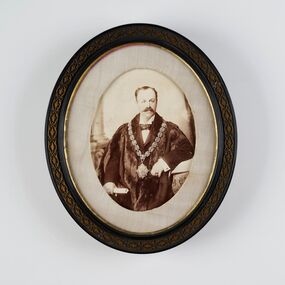
Photograph - Framed portrait of Councillor Harry Marks, Mayor City of Sandhurst 1896 - 97, Bartlett Bros, c 1896
... It was noted in the Bendigo Advertiser on July 3rd 1897 that Mayor Marks appeared in new robes .. made to council order by Messrs Henderson and Goodisson who dealt in highly fashionable goods in the Beehive. (fn https://trove.nla.gov.au/newspaper/page/9088966). ...It was noted in the Bendigo Advertiser on July 3rd 1897 that Mayor Marks appeared in new robes .. made to council order by Messrs Henderson and Goodisson who dealt in highly fashionable goods in the Beehive. (fn https://trove.nla.gov.au/newspaper/page/9088966). ...Harry Montague Marks was born at Pall Mall Bendigo on the 1st October 1855. At age 18 he worked for Goldsborough & Co in Melbourne learning land, wool and banking business. He returned to Bendigo aged 22 to open an auctioneers business which operated on the corner of Williamson and Hargraves Streets. Councillor Marks was elected to the seat of Darling in May 1893 and remained serving until 1902. He served as Mayor once only from 1896-97. It was noted in the Bendigo Advertiser on July 3rd 1897 that Mayor Marks appeared in new robes .. made to council order by Messrs Henderson and Goodisson who dealt in highly fashionable goods in the Beehive. (fn https://trove.nla.gov.au/newspaper/page/9088966). It is not know if these robes are still in existence. Harry Marks married Mary Leech in 1881and together they had four sons and one daughter. Harry Marks died in February 1916 aged 60. After his death Mary Marks became the senior partner in the firm HM Marks and Sons auctioneers. Mary died in 1919.Oval black and white silver gelatin print on board with fabric mount. Studio portrait of Mayor Marks. Front facing seated portrait wearing mayoral robes and chain, clutching a rolled document in right hand. Original rectangular shaped photograph has been trimmed to fit into oval frame.Bartlett Bros. lower left on photograph.councillor h m marks, mayor marks, mayoress marks -
 Sunshine and District Historical Society Incorporated
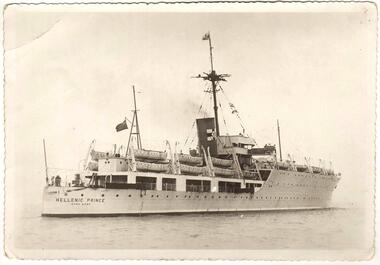
Photograph - Hellenic Prince Ship, Copy 27/01/2014 - (Original Post Card circa 1950)
... THE ABOVE INFORMATION WAS COMPILED FROM; (1) http://en.wikipedia.org/wiki/HMAS_Albatross_(1928) (accessed 11/2/2013), (2) An article by Graeme Andrews found at http://www.afloat.com.au/afloat-magazine/2011/july-2011/The_boat_people_of_the _forties_and_fifties#.UuYY6ou4apo (accessed 27/1/14), (3) http://museumvictoria.com.au/collections/items/273166/newsletter-kangaroo-hellenic-prince-5-jan-1951 (accessed 27/1/14), (4) National Archive search starting at; www.naa.gov.au/collection/search/index.aspx (accessed 27/1/14), (5) http://www.flickr.com/photos/41311545@N05/3864781978 (accessed 29/1/14). ...THE ABOVE INFORMATION WAS COMPILED FROM; (1) http://en.wikipedia.org/wiki/HMAS_Albatross_(1928) (accessed 11/2/2013), (2) An article by Graeme Andrews found at http://www.afloat.com.au/afloat-magazine/2011/july-2011/The_boat_people_of_the _forties_and_fifties#.UuYY6ou4apo (accessed 27/1/14), (3) http://museumvictoria.com.au/collections/items/273166/newsletter-kangaroo-hellenic-prince-5-jan-1951 (accessed 27/1/14), (4) National Archive search starting at; www.naa.gov.au/collection/search/index.aspx (accessed 27/1/14), (5) http://www.flickr.com/photos/41311545@N05/3864781978 (accessed 29/1/14). ...In 1949 the HELLENIC PRINCE with its 3 hospitals, 2 cinemas, and air conditioned accommodation was chartered by the International Refugee Organisation to transport displaced persons from Europe to Australia. Its first trip was to Sydney where it arrived with 1000 passengers on 5 December 1949. On the third trip it left Naples on 23 March 1950, and arrived in Fremantle on 20 April 1950, and in Melbourne on 25 April 1950. The men and women were separated for the voyage with my father sleeping on a hammock in a large room with other men, while my mother, my brother, and I had bunks in a shared cabin. On board were displaced persons ex Bagnoli Camp Italy, some of whom later built their bungalows on the grassy and rocky paddocks near Sunshine Victoria, and began to establish a new life in a new country. A few of the families that arrived on the third trip and purchased land in the Dunkeld Ave - Sandford Ave area of North Sunshine (Birmingham Estate) were Janczak, Kolanowicz, Mroz, Pawlak, Rasztabiga, Skrobalak, Szydlowski, Witkowski, and Zielinski. Some friends settled elsewhere in Sunshine. The family Tabaka went to West Sunshine just over the Derby Rd Bridge, while the family Wojcik went to Ardeer. The ship first started service in 1929 for the Royal Australian Navy as the HMAS ALBATROSS. It had a standard displacement of 4,800 tons and was 443 feet 7 inches (135.2 metres) long, and its top speed during trials reached 22 knots (41 km/hr). It was built at Cockatoo Island Dockyard as Australia's first Aircraft Carrier (seaplanes), but the aircraft that it was designed for were retired just before the ship went into service. A new plane specifically designed to work with the Albatross began operations after the ship was decommissioned in 1933, and placed into reserve in Sydney Harbour. Seaplanes continued to operate from the anchored ship. (Click on the Link 'HMAS Albatross (1)' situated above the Object Registration number to view pictures of the HMAS Albatross on the Navy web site). In 1938 the ship was recommissioned and transferred to the Royal Navy as part payment for the light cruiser Hobart. The ship then did military service for the Royal Navy during World War 2. It did patrol and escort duties in the southern Atlantic, and from mid 1942 in the Indian Ocean. By early 1944 the ship was converted so that it could repair landing craft and other support vessels off Sword and Juno beaches. The ship managed to return 132 craft into service and to save 79 others from total loss. On 11 August 1944 Albatross was torpedoed with the loss of either 50 or 66 personnel, but was able to be towed back to Portsmouth. After repairs she did a short service as a minesweeper depot ship, and following that was placed into reserve on 3 August 1945. In August 1946 the ship was sold for commercial use but the plans to convert it into a luxury liner or a floating cabaret fell through. The ship was again sold on 14 November 1948 to the British-Greek Yannoulatos Group, who renamed it HELLENIC PRINCE in recognition of the birth of Prince Charles and his Greek heritage. After conversion into a passenger ship the Hellenic Prince made several trips to Australia transporting displaced persons, however apparently not all trips were pleasant for the passengers. In the on board newsletter 'Kangaroo' dated 5 January 1951, the ship's master P. C. King expressed his indignation about the behaviour of passengers and made accusations of mutiny. According to some immigrants the conditions were appalling and overcrowded with 1200 passengers. Passengers were supposedly required to work and were paid with Woodbine cigarettes. The drinking water ran out, the freezer broke down, and fresh food that was brought on board went to the crew. Sea sickness was rife because the ship was rarely level due to malfunctioning pumps. (The newsletter 'Kangaroo' can be viewed at the Museum Victoria web site by clicking the Link 'Newsletter - Kangaroo'). In 1953 during the Mau Mau uprising the Hellenic Prince was used to transport troops to Kenya, and in 1954 the ship came to an end in a scrap yard at Hong Kong. THE ABOVE INFORMATION WAS COMPILED FROM; (1) http://en.wikipedia.org/wiki/HMAS_Albatross_(1928) (accessed 11/2/2013), (2) An article by Graeme Andrews found at http://www.afloat.com.au/afloat-magazine/2011/july-2011/The_boat_people_of_the _forties_and_fifties#.UuYY6ou4apo (accessed 27/1/14), (3) http://museumvictoria.com.au/collections/items/273166/newsletter-kangaroo-hellenic-prince-5-jan-1951 (accessed 27/1/14), (4) National Archive search starting at; www.naa.gov.au/collection/search/index.aspx (accessed 27/1/14), (5) http://www.flickr.com/photos/41311545@N05/3864781978 (accessed 29/1/14). Hellenic Prince has a significance to Sunshine Victoria because some of the displaced people from Europe, who arrived in Melbourne on Anzac Day 1950, were among the first people to settle in the grassy and rocky paddock areas of North Sunshine. These settlers established a residential suburban area out of the paddocks. In those early days there were no services and the planned roads were basically just drawings on a map. The ship is also significant because it was named in recognition of the birth of Prince Charles. In the ship's former life as the HMAS Albatross the significance is that it was built in Australia as our country's first Aircraft Carrier (seaplanes).New photograph made from a scanned copy of a circa 1950 Post Card featuring the ship on calm water.Hellenic Prince / Hong Konghellenic prince, migrant ship, displaced persons, refugees, international refugee organisation, bagnoli camp, hmas albatross, yannoulatos group -
 City of Melbourne Libraries
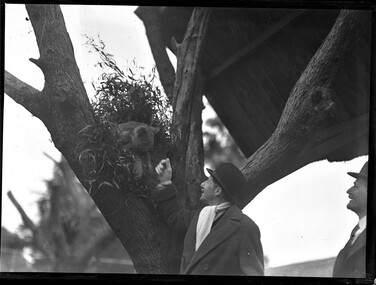
Photograph, Bull, Hugh Jones, 1897-1993, Vice-regal visit to zoo: Governor (Lord Huntingfield) and koala
... Retrieved September 28, 2024, from http://nla.gov.au/nla.news-article4833244 Koala Bears (1937), British Pathé, YouTube, https://www.youtube.com/watch?...Retrieved September 28, 2024, from http://nla.gov.au/nla.news-article4833244 Koala Bears (1937), British Pathé, YouTube, https://www.youtube.com/watch? ...Published: (1934, June 26). The Age (Melbourne, Vic. : 1854 - 1954), p. 11. Published title: VICE-ROYALTY GREETS THE KING OF THE BEASTS AT THE ZOO. Published caption: Lord Huntingfield experienced a pleasant “induction ceremony” as Patron of the Royal Zoological and Acclimatisation Society yesterday, when he made a tour of the Zoological Gardens. The picture shows the Governor, accompanied by Lady Huntingfield, inspecting the King of Beasts, who is submitting to a little playful treatment from the Director of the Gardens, Mr. Wilkie, while the Director whispers in his ear that a distinguished visitor has come to see him. (Inset), is a picture of Lord Huntingfield greeting one of the Koalas. Trove article identifier: http://nla.gov.au/nla.news-article204818472 Description: A man wearing a hat, scarf and overcoat reaches up to pat a koala in a tree watched by a man in a hat and suit. Research by project volunteer, Fiona Collyer: In 1932, the Zoo built an Australian native animal enclosure which visitors could enter and closely view koalas, wallabies, kookaburras and magpies all placed together. The branches of the trees in the enclosure were cut so that visitors could easily see and feed the koalas sitting in them. The cost to feed each koala fresh gum leaves was fifteen shillings per week. By 1924, Queensland was the last stronghold in Australia for the koala. They were functionally extinct in South Australia, only a few hundred in NSW, and an estimated population of 1000 animals remained in Victoria. There had been a six-month open season on koalas in Queensland in 1919 where over a million had been slaughtered, however with its vast, dense forests it was impossible to accurately know their numbers. Koala fur is tough, warm and waterproof and was in high demand from consumers in Canada, Britain and the US to make hats and gloves and for lining greatcoats. In 1927, with Queensland suffering a crippling drought and high unemployment, the cash-strapped McCormack Labor Government declared an “Open Season” on koalas and “opossums” for their skins, for the month of August. (Possums were often called “opossums” at this time but they are actually possums). There were widespread protests from many groups including the Nature Lovers League, Wild Life Preservation Society of Australia, Queensland Museum, C.W.A. Royal Australian Ornithologist Union, Boy Scouts, religious and women’s groups. There were letters to newspapers from ordinary people, editorials and pleas to women to refuse to wear or purchase koala fur. People questioned the masculinity of koala hunters as it was felt that no proper bushman or sportsman would kill such a defenceless creature. The Brisbane Courier newspaper led the campaign, devoting six columns a day to “Spare the Bear”. Author Vance Palmer sent an impassioned letter to the editor of the The Brisbane Courier, 19 July 1927: “Sir- It is be hoped that the disgust which all humane people have felt at the declaration of an open season for native bears in August will not be allowed to fade away until some protest... so overwhelming and effective that the question will never be raised again. For the shooting of our harmless and loveable native bear is nothing less than barbarous. His case is entirely different from that of other furred animals. No one has ever accused him of spoiling the farmers’ wheat, eating the squatters’ grass or even spreading the prickly pear. There is not a social vice that can be put down to his account. In addition, he is comparatively defenceless. He affords no sport to the gunman, and can be trusted to present a sitting target to the creature mean enough to aim at him. For this reason he has been almost blotted out already from some areas, in days when our fauna and flora were held in such little regard that the settlers’ first instinct was to shoot every strange animal and to sink his axe into every unfamiliar tree.” The Anglican Archbishop of Brisbane, Gerald Sharp, had his letter published in The Brisbane Courier on 16 July 1927: “Sir... The extermination of fauna so distinctive of our country, especially of such harmless and pretty creatures as our native bears, seems to me a shameful thing, and this is likely to mean their extermination.” But it was all to no avail. Known as “Black August”, the government was unmoved by the public’s outrage. 10,000 licences were issued to hunters and “the slaughter of the innocents” went ahead. The newspapers were full of stories of dreadful cruelty against the helpless, benign creatures by the heartless hunters who not only used guns and spotlights but wire snares and cyanide baits so that pelts wouldn’t be damaged. Infant koalas were left orphaned and unlikely to survive without their mothers. Top quality pelts were sold at an average price of 56 shillings and 9 pence per dozen, poor quality skins for as little as 2 1/2 pence each. In December 1927, the Minister for Agriculture and Stock, Mr W. Forgan Smith told the Parliament that during the August open season 597,985 koala pelts worth £139,595 had netted the state’s coffers £6000. 952,194 “opossum” pelts were sold and £9000 made for the State. The backlash that followed helped topple the Queensland Labor Government in 1929. The Wild Life Preservation Society of Australia lobbied the Prime Minister Mr Stanley Bruce to refuse to issue exportation permits for koala pelts and from 10 November 1927 the Commonwealth Government suspended the issuing of permits. In 1930, the Society made a direct appeal to USA President Herbert Hoover and he signed an order prohibiting the importation of koala and wombat fur to USA, eliminating a major market. Koala pelts were often deliberately mislabelled “wombat” to get around restrictions. The ban most likely saved the koala from probable extinction. Three years later the Australian Federal Government banned the export of koala products. This movement against koala killing was really the first conservation campaign in Australia. It raised awareness of the vulnerability of a beloved animal and eventually brought about national parks and national laws for their protection. By 1936, community opposition to possum open seasons was beginning. The koala was made a Protected Species in all states in 1937, meaning no one is allowed to harm a koala, however the laws protecting the gum trees they rely on for food and shelter are weak. The Australian Government estimates the wild koala population in Australia is between 225,000 and 500,000 in 2024. The Australian Koala Foundation estimates the national population at less than 60,000 in 2021 with a 30% decline in three years. Habitat loss from land clearing, dog attacks, road deaths, chlamydia, bushfires and drought exacerbated by climate change, continues to cause their decline. Over eight million koalas were killed for their pelts between 1888 and 1927. Any one of the annual harvests killed more koalas than are alive now. At this time, children were also being taught to appreciate Australian native animals. In 1933, “Blinky Bill: The Quaint Little Australian” book for children was published by Angus and Robertson. It was written and illustrated by New Zealand-born author Dorothy Wall and “Dedicated to my son Peter and all other Peters and Johns and Bobs and Toms and Marys and Bettys and Joans and Pats and all kind children.” The book tells the story of Blinky Bill - a mischievous, patched knickerbocker-wearing koala and his mother and father. The story has messages of conservation and instances of human unkindness and cruelty. Mr. and Mrs. Koala and young Blinky lead a mostly idyllic family life amongst a variety of other animals in the forest. However it all changes in chapter two, when Blinky Bill’s father is distressingly shot by a hunter. There is a harrowing description of Mr. Koala’s shooting and eventual death. “The Koala family lived so happily; never thinking of harm, or that anything could happen to disturb their little home, as all they asked for were plenty of fresh gum-leaves and the warm sun. They had no idea such things as guns were in the world or that a human being had a heart so cruel that he would take a pleasure in seeing a poor little body riddled with bullets hanging helplessly from the tree-top... That same being might just as well take his gun and shoot baby kookaburras, so helpless were they all and so trusting.” “Poor Mr. Koala one day was curled up asleep in his favourite corner, when the terrible thing happened. Bang! He opened his eyes in wonder. What was that? Did the limb of the tree snap where that young cub of his was skylarking? ... bang! again. This time he felt a stinging pain in his leg... Peering over the bough of the tree he saw a man on the ground with something long and black in his arms... Another bang and his ear began to hurt. Bang! again and now his little body was stinging all over. He grunted loudly and slowly climbed up the tree, calling Mrs. Koala and Blinky as he went. He managed to reach the topmost branch... Tears were pouring down his poor little face. He brushed them away with his front paws and cried just like a baby. Fortunately Mrs. Koala and Blinky Bill were hiding in the leaves quite motionless, and the shadows of the tree made them appear as part of it. The man with the gun stood and waited a long time, then walked away, whistling as he went - the only sound to be heard in the bush except the cries of the little bear far up in the tree.” Blinky and his mother quietly and fearfully wait for Mr. Koala to wake. In the morning, grunting and crying, they feel his lifeless body with their paws. Eventually Mrs. Koala realises that her husband is dead and that they need to move to a safe place. After travelling deeper into the forest, Mrs. Koala and Blinky meet koalas Mrs. Grunty and her son Snubby and she describes how she was captured as a baby by koala fur trappers to be a pet for a little girl. The trapper forgot to bring gum leaves for the koala so they try to feed her cake, milk and bananas, making her sick. The little girl’s father relays something he read in the paper: “During the year 1920 to 1921, two hundred and five thousand six hundred and seventy-nine koalas were killed and their skins sold to the fur market, under the name of wombat.” They place the koala in a box with a teddy bear for company. The baby koala’s health deteriorates and the alarmed trapper returns her to the bush. Mrs. Grunty tells Mrs. Koala that she and Blinky are the only bears that she has seen for ten years: “I remember well the little girl’s father telling her... that not so many years ago the bush was alive with us bears, from Queensland to the south of Victoria. Now, we are so rare that we have become a curiosity, something to put in zoos, for children to see; and actually in museums. I believe our grandparents sit there in glass cases, stuffed with something inside to make them appear alive, and, oh dear, glass eyes. In New South Wales, I think we could wander for miles from one corner to another and never meet a bear. I don’t know why we were all killed. As you know, we don’t eat the farmers’ crop or ruin their orchards. All we asked for were our own gum-trees.” At the end of the book, Dorothy tells her readers - “The kindest action of all would be to leave the koala baby in his own bushland, among his own playmates, with the sun, the sky, the birds, and the gum-trees, where he will grow to manhood and live for many years - happy as he should be.” In 1934, a “Wild Zoo”, the Sir Colin Mackenzie Sanctuary, opened on 32 hectares of land, formerly part of Coranderrk Aboriginal Reserve in the Yarra Valley, exclusively displaying Australian native animals, birds and reptiles. It was later renamed Healesville Sanctuary and is now managed by Melbourne Zoo and home to over 200 species of Australian native fauna. The Sanctuary is committed to rescuing, breeding, researching and raising awareness of the vulnerability of Australian animals. Andrew Arthur Wellesley Wilkie, 1853-1948, was Director of the Melbourne Zoo from 1923 to 1936 and was associated with the zoo for 70 years. He first worked as a horticultural assistant to Government botanist Baron Ferdinand von Mueller at the Botanical Gardens at the age of 13, along with his older brother David. One of Andrew’s jobs was to capture moths for the National Herbarium. In 1857, a group of prominent Melburnians assembled at St. Patrick’s Hall to form the Zoological Society of Victoria, with the aim of introducing animals and plants from overseas. It was conceived, “For the purposes of science and for that of affording the public the advantages of studying the habits of the animal creation in properly arranged zoological gardens.” The Victorian Government granted 32 acres (13 hectares) of land to the Zoological Society at the southern end of Richmond Paddock on the opposite bank to the Botanical Gardens. (This is where AAMI Stadium and Collingwood Football Club now stand.) In 1861, the Zoological Society of Victoria was renamed The Acclimatisation Society of Victoria. Unfortunately the Yarra River frontage was damp, swampy and subject to flooding, so the animals were briefly housed at the Botanical Gardens until in 1862, the City of Melbourne donated 55 acres (22 hectares) of land at Royal Park for the fledgling zoo. Baron von Mueller secured employment at Royal Park for Andrew and David and they helped to lay out the gardens, plant trees and take care of a collection of deer, pheasants, hares and partridges. Initially the zoo was used for the acclimatisation of animals recovering from the long voyage to Australia and for breeding them for sport. In 1872, the zoo bought two lions, a leopard and a cheetah that had been seized from circus showmen Keith and Phillips when they were unable to pay the bill of butcher Mr T K Bennet of Bourke Street. The first zoo director, Mr. Albert Le Souef, negotiated with captains of ships to buy animals at overseas ports they visited and soon a multitude of exotic species arrived, including a ten-year-old Indian elephant in 1878. In 1923, after being head keeper for some years, Andrew was appointed director of the zoo. By 1933, the zoo had 110 different species of animals, 200 species of birds and 72 species of reptiles under Andrew’s care. He had personally planted all but six trees and laid out the garden beds. As director he lobbied authorities for funds to build more humane enclosures for the animals. In June 1928, Table Talk magazine wrote of Andrew Wilkie: “Up at the Zoo there is a humble gentleman who is a lion among the lions, who knows the proper specific to employ when the boa constrictor has chilblains, and who is a friend and confidant of Queenie the elephant. His fount of zoological lore has never been plumbed. It is bottomless, like his good fellowship and geniality. Every day he may be seen somewhere in the grounds of that growing sanctuary for the strange and arresting fauna and creeping things of the world, and I assure you as one who is privy to his passion that that area and its inhabitants are rarely out of his thoughts.” Andrew retired from the zoo in 1936 at the age of 83 and in 1948 died at his home in Brunswick aged 94. He and his wife Josephine had six children. The Victorian Acclimatisation Society was founded in 1861 by Edward Wilson, 1813-1878, then owner and editor of The Argus newspaper. He said that Australian indigenous animals were practically useless, providing only “a little sport and an occasional meal”. The Society believed that Australia’s plants and animals were vastly inferior to those in Europe. They wanted to introduce and acclimatise to Victoria “all innoxious animals, birds, fishes, insects and vegetables, whether useful or ornamental” for sport and for the table, and to spread indigenous animals and plants from the colony around the world. Their motto was “if it lives, we want it”. The Society was primarily responsible for introducing sparrows, starlings, sambar and hog deer, ostriches, brown trout, blackberries, and carp to the Murray River. They released the European songbirds, thrush and blackbird to quell the homesickness of British settlers. The Society also sent Australian animals like platypus, echidnas, kangaroos and koalas to Europe for scientific and novelty purposes. Thomas Austin, a wealthy sheep farmer of Barwon Park, Winchelsea (property now owned by the National Trust) was a member and in 1859 he introduced hares, blackbirds, thrushes and partridges onto his property. He is probably best known for introducing 24 breeding rabbits onto his estate as game for shooting parties. Thomas quipped, “The introduction of a few rabbits could do little harm and might provide a touch of home, in addition to a spot of hunting." In 2022, genomic data confirmed that Australia’s feral rabbit population is entirely descended from these rabbits. Biological control has brought the rabbit population down from an estimated high of 10 billion rabbits in the 1920s to approximately 200 million today, inhabiting 70% of Australian landmass (5.3 million square kilometres). In 1872, the Acclimatisation Society was renamed The Zoological and Acclimatisation Society of Victoria and they focused on importing exotic animals for display purposes to the zoo. In 1937, the Royal Acclimatisation Society of Victoria was recreated as the Zoological Board of Victoria with a focus on research of native animals threatened with extinction. In an editorial for The Argus newspaper, 16 March 1856, Edward Wilson lamented: "...this country has been shamelessly stolen from the blacks. Had they been like the New Zealanders or the North American Indians, we should have bought their land, and supplied them with the means of living when we took it... In less than twenty years we have nearly swept them off the face of the earth. We have shot them down like dogs. In the guise of friendship we have issued corrosion sublimate in their damper, and consigned whole tribes to the agonies of an excruciating death. We have made them drunkards, and infected them with disease which has rotted the bones of their adults, and made such few children as are born amongst them a sorrow and a torture from the very instant of their birth. We have made them outcasts on their own land, and are rapidly consigning them to entire annihilation. There are but a few of them left, comparatively. This is what we would do for that few. We would feed and clothe every one of them.” [Note: this last sentence is italicized in the original newspaper article text]. Lord Huntingfield, (William Charles Arcedeckne Vanneck) 1883-1969, Governor of Victoria 1934-1939, was a British Conservative Party politician and the first ever Australian-born Governor of an Australian state (although he was always considered British). He was patron of the Royal Zoological and Acclimatisation Society of Victoria and was acting Governor-General for six months during the absence of Lord Gowie in 1938. Lady Huntingfield (née Margaret Eleanor Crosby) 1884-1943, his American-born wife showed great interest in social welfare and the advancement of women and children. She was president of the City Newsboys Society and Patroness of the Girls Friendly Society. In 1937, rose breeder Alister Clark named a yellow hybrid tea rose for her. In 1940, the City of Melbourne opened the Lady Huntingfield Free Kindergarten in North Melbourne, now the Lady Huntingfield Early Learning and Family Services Centre. Lady Huntingfield died in London in 1943 after her house was bombed during a German airstrike. The Lady Huntingfield Memorial Scholarship was established after the City of Melbourne raised £1000 in a public appeal conducted in her memory for students undertaking a Social Work degree at the University of Melbourne. It is awarded annually to this day. The Queen Victoria Hospital named a bed in her honour. References: VICE-ROYALTY GREETS THE KING OF BEASTS AT THE ZOO. (1934, June 26). The Age (Melbourne, Vic. : 1854 - 1954), p. 11. Retrieved August 23, 2024, from http://nla.gov.au/nla.news-article204818472 Prominent Personalities ANDREW WILKIE (1928, June 7). Table Talk (Melbourne, Vic. : 1885 - 1939), p. 15. Retrieved August 29, 2024, from http://nla.gov.au/nla.news-article146562949 'Edward Wilson (journalist)', Wikipedia, https://en.wikipedia.org/wiki/Edward_Wilson_(journalist) 'Thomas Austin (pastoralist)', Wikipedia, https://en.wikipedia.org/wiki/Thomas_Austin_(pastoralist) 'The Acclimatisation Society was driven by misguided ideals about 'fixing nature' in Australia', ABC News, https://www.abc.net.au/news/2022-11-04/acclimatisation-society-introduced-species-history-listen/101588262?utm_campaign=abc_news_web&utm_content=link&utm_medium=content_shared&utm_source=abc_news_web Blinky Bill: the quaint little Australian (eBook); by Dorothy Wall, 1933, 2023, Project Gutenberg Australia, https://gutenberg.net.au/ebooks04/0400571h.html "Black August": Queensland's Open Season on koalas in 1927 (thesis); Glenn Fowler, 1993, Australian National University, https://www.savethekoala.com/wp-content/uploads/2018/11/Black-August.pdf Unfair game: Queensland's Open Season on koalas in 1927; Jacqui Donegan, 2000, University of Queensland, https://mesto-ku.narod.ru/koalas.pdf OPEN SEASON CONDEMNED. (1927, July 19). The Brisbane Courier (Qld. : 1864 - 1933), p. 15. Retrieved September 5, 2024, from http://nla.gov.au/nla.news-article21863465 COUNTRY WOMEN'S ASSOCIATION. (1927, July 30). The Brisbane Courier (Qld. : 1864 - 1933), p. 25. Retrieved September 20, 2024, from http://nla.gov.au/nla.news-article21866965 AUSTRALIA: Barnardo's children at Melbourne Park Zoo (1929), British Pathé, YouTube, https://www.youtube.com/watch?v=_Wcrbo_cHpI 'Kodak Cinegraph Compilation No 8', ACMI Collection, https://www.youtube.com/watch?v=MCrBng5RwFI KOALA SKINS. EXPORT BAN SOUGHT. (1927, August 4). The Brisbane Courier (Qld. : 1864 - 1933), p. 10. Retrieved September 15, 2024, from http://nla.gov.au/nla.news-article21868746 THE ABORIGINES. (1856, March 16). The Argus (Melbourne, Vic. : 1848 - 1957), p. 5. Retrieved September 28, 2024, from http://nla.gov.au/nla.news-article4833244 Koala Bears (1937), British Pathé, YouTube, https://www.youtube.com/watch?v=XbqgMtyuzwE Australian Koala Bear (Earliest Archive Footage: 1929), Pond5, https://www.pond5.com/stock-footage/item/152767491-australian-koala-bear-earliest-archive-footage-1929Photographer notations on slide: "Vice Regal visit to zoo B42".1930-1939, zoos, governors, koalas, conservation, possums, botanic gardens -
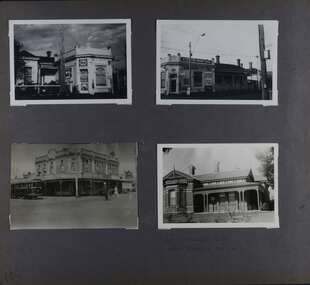 Glen Eira Historical Society
Album - Album page, Kambrook Road, Circa 1972
... The single storeyed shop incorporates the bracketed cornice and consoles characteristic of the main buildings and is in other respects a utilitarian structure. 4th image: https://vhd.heritagecouncil.vic.gov.au/places/42415 (on 24/01/2021) - 196 Kambrook Road An imposing late Victorian poly-chrome brick asymmetrical villa with corner verandah and projecting west facing wing with faceted window bay to the facade. ...The single storeyed shop incorporates the bracketed cornice and consoles characteristic of the main buildings and is in other respects a utilitarian structure. 4th image: https://vhd.heritagecouncil.vic.gov.au/places/42415 (on 24/01/2021) - 196 Kambrook Road An imposing late Victorian poly-chrome brick asymmetrical villa with corner verandah and projecting west facing wing with faceted window bay to the facade. ...This page of photographs is part of the Caulfield Historical Album 1972. This album was created in approximately 1972 as part of a project by the Caulfield Historical Society to assist in identifying buildings worthy of preservation. The album is related to a Survey the Caulfield Historical Society developed in collaboration with the National Trust of Australia (Victoria) and Caulfield City Council to identify historic buildings within the City of Caulfield that warranted the protection of a National Trust Classification. Principal photographer thought to be Trevor Hart, member of Caulfield Historical Society. Most photographs were taken between 1966-1972 with a small number of photographs being older and from unknown sources. All photographs are black and white except where stated, with 386 photographs over 198 pages. First 2 images: milkbar and residence corner Kambrook and Balaclava Roads ie south west corner - building named Airdrie 3rd image: https://vhd.heritagecouncil.vic.gov.au/places/43737 - re 26 Kambrook Road and 345 Balaclava Road corner building ie south east corner: A prominently situated two-storeyed complex of late Victorian buildings consisting of "Wybar's Buildings" occupying the Balaclava Road/ Kambrook Road corner and the "Caulfield Bakery" facing Kambrook Road, separated by a driveway from a single storeyed shop. The main building has a comer splay and balustraded parapet with curved pediments, the words "Wybar's Buildings 1887" having been obliterated but "Caulfield Bakery 1887" with the characteristic wheatsheaf surviving in raised cement work. The walls are stuccoed and richly ornamented with bracketed cornices and keystones with masks extending to the Bakery. The main building is further distinguished by the Masonic symbol of the mason's dividers in the pediment whilst the upper level of the bakery is in overpainted brickwork. The single storeyed shop incorporates the bracketed cornice and consoles characteristic of the main buildings and is in other respects a utilitarian structure. 4th image: https://vhd.heritagecouncil.vic.gov.au/places/42415 (on 24/01/2021) - 196 Kambrook Road An imposing late Victorian poly-chrome brick asymmetrical villa with corner verandah and projecting west facing wing with faceted window bay to the facade. Body bricks are red and relieved by cream and black brick banding and by cream bricks to the bracketed eaves. The fretted barge with king post treatment and timber posted verandah are unique in the Municipality and unusual in the metropolitan area and demonstrate an understated appreciation of the emerging Queen Anne mode.345 Balaclava and 26 Kambrook Roads HO91 - City of Glen Eira https://vhd.heritagecouncil.vic.gov.au/places/43737 (on 24/01/2021) "Wybar's Buildings" at the corner of Balaclava Road and Kambrook Road are important as a prominent late Victorian commercial development incorporating a variety of activities including a bakery and possibly a coffee palace, the latter understood to be unique within the municipality, but characteristic of the period. It is a rare complex of its type in Caulfield and is important also as evocative evidence of the late Victorian Land Boom and the creation of a small now defunct commercial centre at this location by the George Wybrow. 196 Kambrook Road HO122 - City of Glen Eira https://vhd.heritagecouncil.vic.gov.au/places/42415 "Glencoe" is situated at no. 196 Kambrook Road, Caulfield North and was built for the boot manufacturer, Robert Bruce Mair, in 1888. It is of historic and aesthetic significance. It is historically significant (Criterion A) as the home of an inner suburban industrialist, notable a boot manufacturer, demonstrating the attraction of Caulfield as a residential location for the manufacturers of the metropolis during the late Victorian Boom period. It is aesthetically significant (Criterion E) as a very early example of a Queen Anne influenced late Victorian villa, comparing at the State level with ''Woodlands'' (1888), North Essendon, generally acknowledged to be one of Australia's earliest houses to fully exploit this emerging style. The ornamental timberwork is especially expressive of the new architectural fashion and compares with the house at 33 Clarence Street, Elsternwick (1888-89).Page 105 of Photograph Album with two photographs of a milk bar and attached residence, one older photograph of Wybar's Building and another photograph of a house on Kambrook Road (all are landscape).Handwritten: 196 KAMBROOK ROAD / 1970 - GAFFNEY MRS S.M. [under bottom right photo] / 100 [bottom left]trevor hart, kambrook road, victorian style, caulfield north, parapets, wybar's buildings 1887, caulfield bakery 1887, architectural features, painted bricks, balaclava road, george wybrow, shops, milk bars, airdrie, polychrome bricks, verandahs, queen anne architectural style, houses, glencoe, robert mair -
 Ballarat Heritage Services
Photograph - Digital Photograph, Dorothy Wickham, Filming Fingal's Finest Day, Malahide Castle, 2016, 09/2016
... Set in 260 acres the castle is only 10 minutes from Dublin airport. https://www.malahidecastleandgardens.ie/ According to wikipedia See https://en.wikipedia.org/wiki/Easter_Rising#Fingal In Fingal (or north County Dublin), about 60 Volunteers mobilised near Swords. ...Set in 260 acres the castle is only 10 minutes from Dublin airport. https://www.malahidecastleandgardens.ie/ According to wikipedia See https://en.wikipedia.org/wiki/Easter_Rising#Fingal In Fingal (or north County Dublin), about 60 Volunteers mobilised near Swords. ...Generations of the Talbot family have called Malahide Castle home. They played significant roles in Irish political and social life. Set in 260 acres the castle is only 10 minutes from Dublin airport. https://www.malahidecastleandgardens.ie/ According to wikipedia See https://en.wikipedia.org/wiki/Easter_Rising#Fingal In Fingal (or north County Dublin), about 60 Volunteers mobilised near Swords. They belonged to the 5th Battalion of the Dublin Brigade (also known as the Fingal Battalion), and were led by Thomas Ashe and his second in command, Richard Mulcahy. Unlike the rebels elsewhere, the Fingal Battalion successfully employed guerrilla tactics. They set up camp and Ashe split the battalion into four sections: three would undertake operations while the fourth was kept in reserve, guarding camp and foraging for food. The Volunteers moved against the RIC barracks in Swords, Donabate and Garristown, forcing the RIC to surrender and seizing all the weapons. They also damaged railway lines and cut telegraph wires. The railway line at Blanchardstown was bombed to prevent a troop train reaching Dublin. This derailed a cattle train, which had been sent ahead of the troop train. The only large-scale engagement of the Rising, outside Dublin city, was at Ashbourne. On Friday, about 35 Fingal Volunteers surrounded the Ashbourne RIC barracks and called on it to surrender, but the RIC responded with a volley of gunfire. A firefight followed, and the RIC surrendered after the Volunteers attacked the building with a homemade grenade. Before the surrender could be taken, up to sixty RIC men arrived in a convoy, sparking a five-hour gun battle, in which eight RIC men were killed and 18 wounded. Two Volunteers were also killed and five wounded, and a civilian was fatally shot. The RIC surrendered and were disarmed. Ashe let them go after warning them not to fight against the Irish Republic again. Ashe's men camped at Kilsalaghan near Dublin until they received orders to surrender on Saturday. The Fingal Battalion's tactics during the Rising foreshadowed those of the IRA during the War of Independence that followed. Volunteer contingents also mobilised nearby in counties Meath and Louth, but proved unable to link up with the North Dublin unit until after it had surrendered. In County Louth, Volunteers shot dead an RIC man near the village of Castlebellingham on 24 April, in an incident in which 15 RIC men were also taken prisoner.filming, fingal's finest day, malahide castle, ireland -
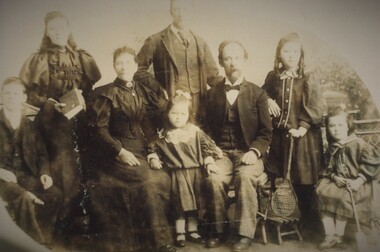 Surrey Hills Historical Society Collection
Photograph, Thomas Henry and Janet Longmore Deakin and family, 1895, Original: 1895
... Born South Melbourne, she died in Elsternwick on 14 October, 1969, aged 87. (REF: http://www.ozsportshistory.com/wardeaths/women_a_e.html) There is a photo of her in uniform on this site and also on http://ww1nurses.gravesecrets.net/de.html This is part of a large donation relating to the Deakin, Mair and Young families....Born South Melbourne, she died in Elsternwick on 14 October, 1969, aged 87. (REF: http://www.ozsportshistory.com/wardeaths/women_a_e.html) There is a photo of her in uniform on this site and also on http://ww1nurses.gravesecrets.net/de.html This is part of a large donation relating to the Deakin, Mair and Young families. ...Thomas Henry Deakin (1845-1915), born in Monmouthshire, Wales and his wife Janet (Jessie) Longmore (1851-1939), born in Morayshire, Scotland had 2 sons: John Henry (1879-1962) and William Andrew (1883-1939) and 4 surviving daughters. A fifth daughter Daisy Jessie was born in 1880 and died the same year at the age of 7 months. Elsie Longmore Deakin (1881-1969) was a nurse and remained single; Minnie Winifred (1886-1966) married Charles Williamson in 1923; Lily Vipond (1890-1943) married David Mair in 1910 and Jessie Alice, known as Alice, married Hector Williamson in 1921. Hector and Charles were brothers. LtoR: William Andrew (seated), Elsie Longmore (standing), Janet (Jessie) Mair nee Longmore (seated), Jessie Alice (standing beside her mother), John Henry (standing), Thomas Henry (seated), Minnie Winifred (standing), Lily Vipond (seated). Elsie Longmore Deakin enlisted AANS aged 35 years in 10 May 1915; embarked on the Mooltan on 22 August 1916. Address : 114 Station Street, Fairfield, Next of kin : mother, Mrs Janet Deakin (nee Longmore), 114 Station Street, Fairfield, father, Thomas Henry Deakin Elsie Deakin enlisted at 35 years of age on 10 May, 1915 and served locally before volunteering for overseas duty on 9 August, 1916. Her three years of training were completed at the Melbourne General Hospital. She embarked with the rank of Sister for India and was appointed to the Victoria Hospital, Bombay. In January, 1917, when she was transferred to England and a Military Hospital at Bagthorpe later to the 1 Australian Auxiliary Hospital, and in January of the following years to 25 (British) GH in France but returned a few weeks later to England and the 1 AAH after suffering a seriously strained left ankle. She returned to France post-war and served another four months before being returned to Australia in May, 1919. Her appointment was terminated as medically unfit on 9 June, 1919. Born South Melbourne, she died in Elsternwick on 14 October, 1969, aged 87. (REF: http://www.ozsportshistory.com/wardeaths/women_a_e.html) There is a photo of her in uniform on this site and also on http://ww1nurses.gravesecrets.net/de.html This is part of a large donation relating to the Deakin, Mair and Young families.The connection with Surrey Hills area is through Lily Vipond Deakin who married David Miller Mair and came to live in Mont Albert.A sepia copy photo of a family in a formal pose taken against a studio backdrop. The group comprises a mother and father with 2 boys and 4 girls. The 3 older girls are carrying - REAR: In blue biro - "Top HENRY ...............GRANDFATHER.....ALF / ANDREW .......Thomas Henry (crossed out) ..........MOTHER - JANET / DEAKIN" Middle: "ELSie minnie Lily" Below: "ALICE FRONT" Bottom: "LONGMORE"xelsie longmore deakin, minnie winifred deakin, minnie winifred williamson, lily vipond deakin, lily vipond mair, jessie alice deakin, alice deakin, jessie alice williamson, alice williamson, william andrew deakin, janet (jessie) longmore, janet (jessie) deakin, thomas henry deakin, john henry deakin -
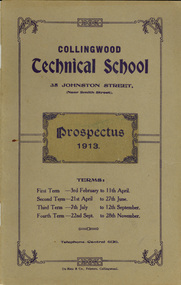 Federation University Historical Collection
Booklet, Collingwood Technical School Prospectus, 1913, 1913
... In 1988 Preston College of TAFE and Collingwood College of TAFE merged to become Northern Metropolitan Institute of TAFE (NMIT). (http://victoriancollections.net.au/organisations/northern-melbourne-institute-of-tafe)...In 1988 Preston College of TAFE and Collingwood College of TAFE merged to become Northern Metropolitan Institute of TAFE (NMIT). (http://victoriancollections.net.au/organisations/northern-melbourne-institute-of-tafe) collingwood technical school collingwood tafe nmit northern metropolitan institute of tafe Brown soft covered booklet of 40 pages. ...In the early years of the 20th century adequate technical education was lacking and became a focus in the Victorian Parliament. After much debate and discussion among politicians and educationalists, the 1910 Education Act No 2301 was passed, making possible the establishment of new technical schools to address the dearth of skilled trades people. In July 1912 Collingwood Technical School opened in the modified bluestone buildings at 35 Johnston St, originally built in 1853 as the Collingwood Town Hall and Court House. Within three weeks, there were 57 boys enrolled - studying preliminary carpentry and pattern-making, plumbing, engineering, sheet iron work and bricklaying. They attended two hours a night on three evenings a week. In 1913, the school opened its doors to juniors and took residence in new permanent buildings erected on the site. It was classified as a trades school by the State Education Department. Two years later courses in electrical wiring and electrical and mechanical engineering were introduced. In 1988 Preston College of TAFE and Collingwood College of TAFE merged to become Northern Metropolitan Institute of TAFE (NMIT). (http://victoriancollections.net.au/organisations/northern-melbourne-institute-of-tafe)Brown soft covered booklet of 40 pages. The contents include information relating to the Collingwood Technical School on 1913, including: Council members, constitution, standing orders, aim of the school, scholarships, advice to parents, Railway Fares, tram fares, General Rules to Students, Syllabus, English, Geography, Civics, Mathematics, Elementary Science, Woodwork, |Sheetmetalwork, evening course, carpentry, plumbing, joinery, and a list of students for 1912 Evening courses. collingwood technical school, collingwood, tafe, nmit, northern metropolitan institute of tafe
