
Showing 4443 items matching "melbourne history"
-
 Bendigo Military Museum
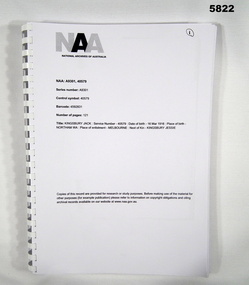
Administrative record - RECORDS, NAA WW2
... NAA Record of "KINGSBURY JACK": SERVICE NUMBER 40579: Date of Birth - 16 Mar 1916: Place of birth - /Northam WA: Place of Enlistment - Melbourne: Next of Kin - KINGSBURY JESSIE." See Cat 5820, 5821, 5823. NAA Records Military History WW2 Records - facsimile, with clear plastic front cover, black cardboard back cover and plastic binding comb. 117 pages - cut, plain, white paper. ...See Cat No. 5820. NAA Record of "KINGSBURY JACK": SERVICE NUMBER 40579: Date of Birth - 16 Mar 1916: Place of birth - /Northam WA: Place of Enlistment - Melbourne: Next of Kin - KINGSBURY JESSIE." See Cat 5820, 5821, 5823.Records - facsimile, with clear plastic front cover, black cardboard back cover and plastic binding comb. 117 pages - cut, plain, white paper. All with black print. NAA Record.naa records, military history, ww2 -
 Bendigo Military Museum
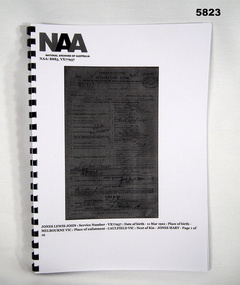
Administrative record - RECORDS, NAA WW2
... NAA Record of "John Lewis JOHN; Service number - VX77957: Date of Birth - 11 Mar 1921: Place of birth: Melbourne Vic: Place of enlistment - CAULFIELD VIC: Next of Kin - JONES Mary - Page 1 of 16. NAA Records Military History WW2 Records - facsimile, with clear plastic front cover, black cardboard back cover and plastic binding comb. 16 pages - cut, plain, white paper. ...See Cat 5820, 5821, 5822. NAA Record of "John Lewis JOHN; Service number - VX77957: Date of Birth - 11 Mar 1921: Place of birth: Melbourne Vic: Place of enlistment - CAULFIELD VIC: Next of Kin - JONES Mary - Page 1 of 16.Records - facsimile, with clear plastic front cover, black cardboard back cover and plastic binding comb. 16 pages - cut, plain, white paper. All with black print. NAA Record.naa records, military history, ww2 -
 Bendigo Military Museum
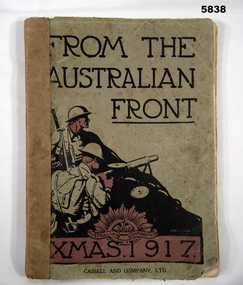
Book - BOOK, WW1, Cassell and Company Ltd/ London, New York, Toronto and Melbourne, "From The Australian Front Xmas 1917", 1917
... History WW1 Front end papers - owner's name, handwritten blue ink, Kevin Roberts/ 124 Fifth Ave/ Rosebud 3939/ 5986 6663". Next page handwritten - green pencil - child's drawing of 3 circles. Soft cover book. Cover - cardboard, black colour print on front and back. Front illustration 3 colour silhouette of two soldiers in a battle scene. Book illustration - Rising Sun Badge. 128 Badges - cut, plain, off white. Pictorial book containing black and white photographs and black and white illustrations and cartoons. "From The Australian Front Xmas 1917" Book BOOK, WW1 Cassell and Company Ltd/ London, New York, Toronto and Melbourne ...Item in the collection re Ron Bollard VX14150, refer Cat No 5919P for his service details. Soft cover book. Cover - cardboard, black colour print on front and back. Front illustration 3 colour silhouette of two soldiers in a battle scene. Book illustration - Rising Sun Badge. 128 Badges - cut, plain, off white. Pictorial book containing black and white photographs and black and white illustrations and cartoons.Front end papers - owner's name, handwritten blue ink, Kevin Roberts/ 124 Fifth Ave/ Rosebud 3939/ 5986 6663". Next page handwritten - green pencil - child's drawing of 3 circles.books, military history, ww1 -
 Bendigo Military Museum
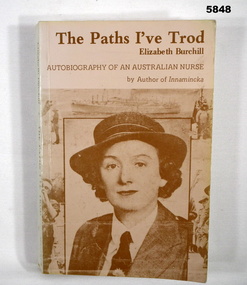
Book - BOOK, AUTOBIOGRAPHY, Elizabeth Burchill, "The Paths I've Trod", 1981/ 1984
... "The Paths I've Trod / Autobiography of an Australian Nurse" Books Military History WW2 Nurses Title page - handwritten, blue ink, author's signature "E. Burchill B.A., B Lits, R.N., R.M., I.W. (AUTHOR)/ Melbourne ...Owner and donor details - see Cat No. 5836.3. "The Paths I've Trod / Autobiography of an Australian Nurse"Soft cover book. Cover - cardboard, brown print on front, spine and back. Illustrated two sepia toned photographs - front 1/2 portrait of author (1940, back - author receiving her Bachelor of Arts. 249 pages - cut, plain, white paper. Illustrated black and white photographs. Title page and endpapers back - handwritten signature and notes.Title page - handwritten, blue ink, author's signature "E. Burchill B.A., B Lits, R.N., R.M., I.W. (AUTHOR)/ Melbourne/ 1987" End papers - back - handwritten, blue ink. ("David/ 855937") name and no's have been crossed out.books, military history, ww2, nurses -
 Bendigo Military Museum
Administrative record - CERTIFICATE OF DISCHARGE, 1914-1919
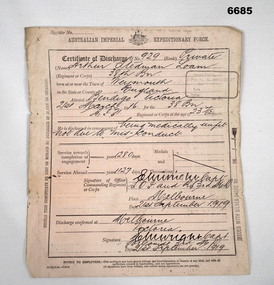
... history. Passchendaele Barracks Trust Certificate of Discharge A.S. Loam 38th Battalion Australian Imperial Expeditionary Force. CERTIFICATE OF DISCHARGE of No. 929 rank PRIVATE ARTHUR STEDMAN LOAM, Regimental Corps 38th Bn. 1280 days service. Service abroad 1127. Medially unfit, not due to mis-conduct. Signature of Officer Commanding Regiment or Corps. E. W. Wright Capt. SOI and RS 3rd MD Melbourne ...Refer Cat No 2698.2 for A.S.Loams service history.Certificate - cream coloured, heavy paper, black print handwriting.Australian Imperial Expeditionary Force. CERTIFICATE OF DISCHARGE of No. 929 rank PRIVATE ARTHUR STEDMAN LOAM, Regimental Corps 38th Bn. 1280 days service. Service abroad 1127. Medially unfit, not due to mis-conduct. Signature of Officer Commanding Regiment or Corps. E. W. Wright Capt. SOI and RS 3rd MD Melbourne. 21 September 1919 Discharge confirmed Melbourne, Victoria E.W. Wright Capt. 3MD 21 September 1919. passchendaele barracks trust, certificate of discharge, a.s. loam, 38th battalion -
 4th/19th Prince of Wales's Light Horse Regiment Unit History Room
Regimental Scrap Book: to 1959, 2009 (exact)
... photographs ceremonial 4 19 prince of wales s light horse regiment history training 4 19 pwlh band royal visit 1954 sir dallas brooks 4 19 pwlh badge social activities Archival quality A3 loose leaf slip case containing memorabilia documents, cuttings and photos about the Regiment for the period to 1959. Contents include: Training, social and ceremonial activities, Specification of Regimental badge, Honour Roll of members who have died on duty, Photos of Band 1948-49, Photos of Governor's Reception 1948, Royal Visit 1954, Royal Melbourne Show 1954, Wedding of Major and Mrs Clendinnen, Honorary Colonel Sir Dallas Brooks 1958, Documentation re transfer of Port Melbourne Municipal Band to the Regiment 19 Sep 1958, Exercise Fire Power. ...Archival quality A3 loose leaf slip case containing memorabilia documents, cuttings and photos about the Regiment for the period to 1959. Contents include: Training, social and ceremonial activities, Specification of Regimental badge, Honour Roll of members who have died on duty, Photos of Band 1948-49, Photos of Governor's Reception 1948, Royal Visit 1954, Royal Melbourne Show 1954, Wedding of Major and Mrs Clendinnen, Honorary Colonel Sir Dallas Brooks 1958, Documentation re transfer of Port Melbourne Municipal Band to the Regiment 19 Sep 1958, Exercise Fire Power.photographs, ceremonial, 4 19 prince of wales s light horse regiment history, training, 4 19 pwlh band, royal visit 1954, sir dallas brooks, 4 19 pwlh badge, social activities -
4th/19th Prince of Wales's Light Horse Regiment Unit History Room
Regimental Scrap Book: 1990-1999, 2009
... history 4 19 prince of wales s light horse...freedom of city melbourne...ceremonial training vietnam war history 4 19 prince of wales s light horse freedom of city melbourne freedom of city traralgon traralgon army depot commendations gippsland floods Archival quality A3 loose leaf slip case containing memorabilia documents, cuttings and photos about the Regiment for the period 1990-1999. ...Archival quality A3 loose leaf slip case containing memorabilia documents, cuttings and photos about the Regiment for the period 1990-1999. Contents include:Training, Ceremonial, social activities. Hansard 18 Oct 1990 re future of the Regiment. Threats to the Regiment. Chief of General Staff Commendation to A Squadron 4/19 PWLH for assistance with flood emergency in Gippsland April 1990. Meritorious Unit Commendation to Prince of Wales Light Horse Troop while attached to 173 US Airborne Brigade, South Vietnam 1965/66. Freedom of City of Melbourne May 1992. 50th Birthday of Regiment. Closure of Traralgon Depot 1998.ceremonial, training, vietnam war, history 4 19 prince of wales s light horse, freedom of city melbourne, freedom of city traralgon, traralgon army depot, commendations, gippsland floods -
4th/19th Prince of Wales's Light Horse Regiment Unit History Room
Card - Christmas Card, 1915 (exact)
... History including the Defence of ANZAC and the charge at Beersheba. The Regiment is based on a linkage of the two post-World War II Victorian Army Reserve RAAC units - 4th/19th Prince of Wales’ Light Horse and 8th/13th Victorian Mounted Rifles. From these units we derive our links with the six Light Horse Regiments of Victoria and Southern New South Wales (4th, 8th, 13th, 17th, 19th and 20th Light Horse Regiments.) The Regiment proudly bears the guidon of the 4th Light Horse, with the guidons of the remaining regiments being laid up in the crypt of the Melbourne ...Service of Frank Phillips Prior to the commencement of World War I, Frank Phillips served in the Minyip Troop of the Light Horse militia. His civilian occupation was that of clerk. On 22 August 1914 he enlisted in C Squadron 4th Light Horse Regiment. The 4th Light Horse Regiment embarked on the troop ship “Wiltshire “ for training at Mena Camp, in Egypt. During May 1915 the Regiment was deployed to the Gallipoli campaign in a dismounted role. After seven months, the Gallipoli campaigned was abandoned and the troops withdrawn. On return to Egypt the 4th Light Horse Regiment divided with one component deployed to Palestine and the other to the Western Front. Frank went on to serve in Palestine. He was promoted to Sergeant while at Gallipoli and, in Palestine, was promoted to Captain, serving as Adjutant of the Regiment. He was granted furlough to return to Australia from 14 October 1916 to 12 March 1917. On 16 January 1918 he was Mentioned in Despatches Citation: At Hill 750 near Bir El Esani on 30-4-17 he led an attack on Hill 750 under heavy rifle fire capturing the position and 7 armed Bedouins. On 23-5-17 during reconnaissance, he led and attack on 790 under very heavy rifle and machine gun fire and captured the position, inflicting losses on the Turks. He has, at all times, set a fine example of courage to his men. 22 October: 1918 he was awarded the Military Cross Recommendation of Commanding Officer – For exceptional gallantry and devotion to duty on the 28th September 1918, during the crossing of the JORDAN near EL MIN, this officer (adjutant of the Regiment) personally reconnoitred for crossings under heavy M.G. fire and led the Regiment to the only available crossing, rendering invaluable assistance during the crossing. On 3oth September when the Regiment was advanced guard on to KAUKAB, this officer’s personal reconnaissance to confirm patrol reports was of the highest order and utmost value to his C.O. culminating in the capture of KAUKAB with a mounted attack and the The 4th/19th Prince of Wales’s Light Horse Regiment has a long and distinguished history that pre-dates Federation to colonial Victoria’s mounted troops. Our history parallels that of the nation, including its active participation in some of the most inspiring events in Australian Military History including the Defence of ANZAC and the charge at Beersheba. The Regiment is based on a linkage of the two post-World War II Victorian Army Reserve RAAC units - 4th/19th Prince of Wales’ Light Horse and 8th/13th Victorian Mounted Rifles. From these units we derive our links with the six Light Horse Regiments of Victoria and Southern New South Wales (4th, 8th, 13th, 17th, 19th and 20th Light Horse Regiments.) The Regiment proudly bears the guidon of the 4th Light Horse, with the guidons of the remaining regiments being laid up in the crypt of the Melbourne Shrine of Remembrance. During World War I, the 4th Light Horse Regiment served with distinction on three fronts – Gallipoli, Palestine and the Western Front. Corporal, later Captain, Phillips was a member of the 4th Australian Light Horse Regiment. He created the post card while serving with the Regiment as a Corporal at Gallipoli. Post Card hand made and sent to familyFrom Cpl Frank Phillips, 4th Australian Light Horse Regiment. Entries in pencil Front: Addressed to Andrew Phillips (father) at Minyip, Victoria, Message: “A Merry Christmas and Happy New Year to all, Made while on my day out. Love Frank” Reverse Top Centre – 4 LH Badge Centre – cloth map of Australia stapled to card Bottom – Print of flag stapled to card, Irish green ensign, Union flag in canton, gold coloured Irish harp on fly. Notations: Broadmeadows, Wiltshire (Troop Ship), Shrapnel Gully, Suicide Gully, Courtney’s Post Mena, Mex, Heliopolis, Imbros, Gallipoli, Turkish soil underneath (flag), Australia on Turkey, Lone Pine, Leans Trench, Constantinople, All honour to our Irish comrades, To greet you 1915-16. From the shells, yells, and little Hells, of the Darda Dardenelles 0 – 0 May you enjoy your Xmas dinner as I hope to enjoy my Xmas billy in the trenches.ww1, gallipoli, 4th light horse, post card, frank phillips -
4th/19th Prince of Wales's Light Horse Regiment Unit History Room
DVD, Laying Up Guidons 7th August 2005
... Melbourne to present five Light Horse Regiment guidons to the Shrine Trustees for laying up. The guidons were those of thwe 8th, 13th, 17th, 19th and 20th Light Horse Regiments. This DVD of the cermony was compiled by Harry Austen (now deceased), a volunteer of the Regiment's Unit History Room ...Melbourne to present five Light Horse Regiment guidons to the Shrine Trustees for laying up. The guidons were those of thwe 8th, 13th, 17th, 19th and 20th Light Horse Regiments. This DVD of the cermony was compiled by Harry Austen (now deceased), a volunteer of the Regiment's Unit History Room DVD Laying up Guidons DVD Laying Up Guidons 7th August 2005 DVD Harry Austen (dec) ...On 7 August 2005, 4th/19th Prince of Wales's Light Horse Regiment conducted a ceremonial parade at the Shrine of Remembrance Melbourne to present five Light Horse Regiment guidons to the Shrine Trustees for laying up. The guidons were those of thwe 8th, 13th, 17th, 19th and 20th Light Horse Regiments. This DVD of the cermony was compiled by Harry Austen (now deceased), a volunteer of the Regiment's Unit History Room DVDdvd, laying up guidons -
4th/19th Prince of Wales's Light Horse Regiment Unit History Room
Manuscript, Captain Ernest Homewood James MVO, MC, VD, abt 1920
... Melbourne, 22 November 1879. Appointed Lieutenant in the AIF on 16 March 1916, Promoted Captain 1 January 1917. Terminated 29 October 1920 WW1 Capt Ernest James "1st Australian Armoured Car Section" History Palestine Armoured Cars A typed copy of Captain James's draft. ...Captain Ernest Homewood James, MVO, MC, VD, 1st Australian Armoured Car Section. Engineer of Hawthorn, Victoria. Born Melbourne, 22 November 1879. Appointed Lieutenant in the AIF on 16 March 1916, Promoted Captain 1 January 1917. Terminated 29 October 1920A typed copy of Captain James's draft.ww1, capt ernest james, "1st australian armoured car section", history, palestine, armoured cars -
 4th/19th Prince of Wales's Light Horse Regiment Unit History Room
Book, Wilke & Co Ltd, The Forgotten War, Australian Involvement in the South African Conflict of 1899-1902, 1979
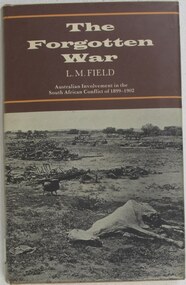
... book history boer war book history boer war Stamp of a previous owner, namely Brunswick Public Library Hard covered book of 236 pages, with photos and illustrations The Forgotten War, Australian Involvement in the South African Conflict of 1899-1902 Book Book Wilke & Co Ltd L M Field Melbourne University Press ...Hard covered book of 236 pages, with photos and illustrationsStamp of a previous owner, namely Brunswick Public Librarybook, history, boer war, book, history, boer war -
4th/19th Prince of Wales's Light Horse Regiment Unit History Room
Book, Laurie Field, The Forgotten War - Australia and the Boer War, 1995
... history Boer War Paperback book of 234 pages Green covered paperback book with coloured illustration of mounted riflemen. This book charts the course of the Australian troops in the Boer War in South Africa. The Forgotten War - Australia and the Boer War Book Book Laurie Field Melbourne ...Green covered paperback book with coloured illustration of mounted riflemen. This book charts the course of the Australian troops in the Boer War in South Africa.Paperback book of 234 pagesaustralian military history, boer war -
 Warrnambool and District Historical Society Inc.
Domestic object - Plate, side, C1920
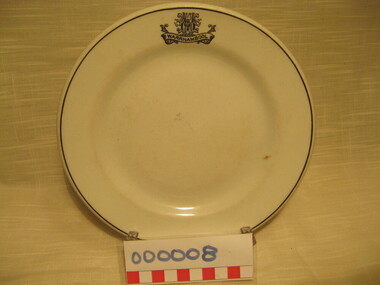
... history when the Hotel mansions was burnt to the ground. Evelyn O'Brien was granted a temporary licence and in September 1930 she was given permission to rebuild. The new hotel named Hotel Warrnambool was opened in March 1931. This item has local significance having come from one of Warrnambool's grandest buildings grand ozone coffee palace hotel mansions warrnambool ozone hotel warrnambool warrnambool Hotel Mansions crest on front of plate, with Warrnambool in banner underneath. Side Plate with Hotel Mansions crest in black, with Warrnambool in banner underneath and a black line around rim of plate. Loftus Moran Pty Ltd Melbourne ...The Ozone Hotel was formerly the Grand Ozone Coffee Palace which was erected in 1890 at a cost of around ten thousand pounds. Coffee Palaces were temperance hotels which were popular in the latter part of the 19th century which offered recreation and superior accommodation. The coffee palace operated until 1915 and was then closed before re-opening in 1920 as Hotels Mansions. It had major renovations including a large theatre area. February 23rd 1929 saw the most spectacular fire in Warrnambool's history when the Hotel mansions was burnt to the ground. Evelyn O'Brien was granted a temporary licence and in September 1930 she was given permission to rebuild. The new hotel named Hotel Warrnambool was opened in March 1931. This item has local significance having come from one of Warrnambool's grandest buildingsSide Plate with Hotel Mansions crest in black, with Warrnambool in banner underneath and a black line around rim of plate. Loftus Moran Pty Ltd Melbourne stamp on back (distributor?)Hotel Mansions crest on front of plate, with Warrnambool in banner underneath.grand ozone coffee palace, hotel mansions warrnambool, ozone hotel warrnambool, warrnambool -
 Warrnambool and District Historical Society Inc.
Textile - Woollen Blanket, Warrnambool Woollen Mill, Circa 1949
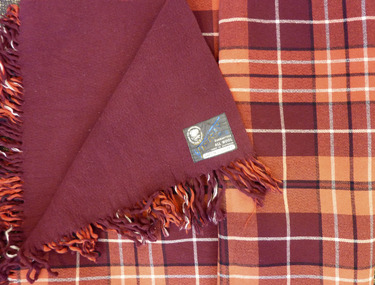
... Both the Warrnambool Woollen Mill and the Melbourne to Warrnambool Road Race are a significant part of local history. ...The first Warrnambool to Melbourne cycling race was held in October 1895. 24 riders started with only 7 finishing the race. W. Nicol was the winner of the inaugural race. Two months later on 14/12/1895 the race was run in reverse. For the ensuing 43 years it was mainly Melbourne to Warrnambool. Since 1939 it has been run mainly Melbourne to Warrnambool. The prize of this blanket was 2nd prize to E. Ion of Tasmania in October 1949. The prize itself, A Warrnambool Blankets Tartan rug was made at the Warrnambool Woollen Mill in Harris St Warrnambool Early efforts to establish a woollen Mill in Warrnambool commenced with an early mill on the Merri at Woodford in 1874 but the site proved unsuitable and was financially struggling. The decision was made to move plant and and machinery to the old meat preserving factory in South Warrnambool The plant and equipment was sold to Mr Robert Hood of Sherwood on the Hopkins River East Warrnambool who carried on the venture until fire destroyed the building in 1882, The site lay idle until a group of local businessmen raised 40000 pounds to establish the mill in 1910. It continued to trade well through the early and mid 20th century. Dunlop brought the mill in 1968 and there was a slow downturn with numerous owners until it closed in 2000. The site passed into private hands in 2003.Both the Warrnambool Woollen Mill and the Melbourne to Warrnambool Road Race are a significant part of local history. The Melbourne to Warrnambool Cycling road race remains one of the premier sporting events in Australia. It commenced in 1895 Maroon and red block check with black and white check lines on front with plain maroon back. Fringed on two sides. Grey cotton label with The Warrnambool Woollen Mill Co Limited in top Left hand side of label, Victory Rug diagonally in blue Guaranteed All WOOL Made in Australia in bottom RH corner of label. Owner M bottom of label. 1949 Mr. Ernie Ion” handwritten in black pen.warrnambool, warrnambool woollen mill, marcus saltau, w. nicol -
 Warrnambool and District Historical Society Inc.
Film - Book, Bailliere’s Victorian Directory 1868-1870, Original directories published as follows: Bailliere’s Victorian Directory 1868 Bailliere’s Victorian Directory 1869 Bailliere’s Victorian Directory 1870 Bailliere’s Victorian Directory 1871/72 Bailliere’s Victorian Directory 1875 Bailliere’s Victorian Directory 1880/81
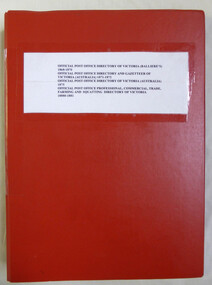
... Melbourne and suburbs, arranged locally and alphabetically, with cross references / compiled by authority. This directory is a useful resource in researching people and towns of the given area. Bailliere’s Victorian Directory 1868 Bailliere’s Victorian Directory 1869 Bailliere’s Victorian Directory 1870 Bailliere’s Victorian Directory 1871/72 warrnambool history : Ref 919.450025 written on index sheet alongside Victoria College Library stamp. ...The Official post office directory of Victoria (Bailliere's) : containing the names, residences and occupations of the inhabitants of the post towns of the colony, inclusive of Melbourne and suburbs, arranged locally and alphabetically, with cross references / compiled by authority. This directory is a useful resource in researching people and towns of the given area.Red plastic folder with white printed label attached to front cover. Contains printed index in plastic sleeve at front. Three plastic sleeves containing microfiche. Bailliere’s Victorian Directory 1868 Bailliere’s Victorian Directory 1869 Bailliere’s Victorian Directory 1870 Bailliere’s Victorian Directory 1871/72 Bailliere’s Victorian Directory 1875 Bailliere’s Victorian Directory 1880/81 : Ref 919.450025 written on index sheet alongside Victoria College Library stamp.bailliere’s victorian directory 1868, bailliere’s victorian directory 1869, bailliere’s victorian directory 1870, bailliere’s victorian directory 1871/72, warrnambool history -
 Warrnambool and District Historical Society Inc.
Programme, Modern Print, Warrnambool Musical and Elocutionary Competitions, 1938
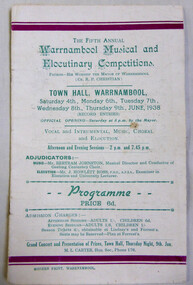
... Melbourne-born journalist and a noted elocutionist at that time. From 1924 to the early 1950s John Howlett Ross was a well-known A.B.C. radio broadcaster. Today the Warrnambool Eisteddfod conducts similar competitions annually. This program is of interest as an example of the popularity of music and elocution competitions in places such as Warrnambool in the first half of the 20th century. Also the local advertisements in the booklet are of considerable help to researchers today. Music and Elocution in Warrnambool John Howlett Ross, journalist and elocutionist History ...This booklet contains details of the programmes for the Warrnambool Musical and Elocutionary Competitions in 1938, the fifth annual competition of its kind. The competitions were held over five days and attracted a great number of participants with the prizewinners receiving monetary prizes donated by local businesses and businessmen. The competitions included a spelling bee and an operatic aria competition with the latter offering a prize of £10. The adjudicator for the elocution competitions was John Howlett Ross (1857-1953) a Melbourne-born journalist and a noted elocutionist at that time. From 1924 to the early 1950s John Howlett Ross was a well-known A.B.C. radio broadcaster. Today the Warrnambool Eisteddfod conducts similar competitions annually. This program is of interest as an example of the popularity of music and elocution competitions in places such as Warrnambool in the first half of the 20th century. Also the local advertisements in the booklet are of considerable help to researchers today. This is a booklet of 20 pages with a white cover with green and red printing and a black and white photograph on the back cover. The pages contain many advertisements and printed information. The booklet was stapled but the staples have been removed.music and elocution in warrnambool, john howlett ross, journalist and elocutionist, history of warrnambool -
 Warrnambool and District Historical Society Inc.
Work on paper - Letter, Henry Watts, Letter written 1859
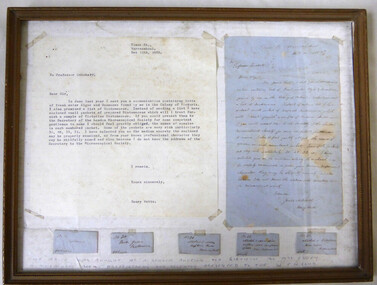
... History" (ib., iii., I33) (includes lists of fresh-water algae and Desmidieae ), First librarian (1881-2), also a vice-president of the Field Naturalists' Club of Victoria. He is further commemorated by Acacia wattsiana. F. v. M. www.anbg.gov.au/biography/watts-henry.html . Henry Watts worked as a bootmaker in Timor and Liebig streets Warrnambool in the 1860’s but it was as an amateur scientist that Watts gained public notice.For an exhibiton in Melbourne...History" (ib., iii., I33) (includes lists of fresh-water algae and Desmidieae ), First librarian (1881-2), also a vice-president of the Field Naturalists' Club of Victoria. He is further commemorated by Acacia wattsiana. F. v. M. www.anbg.gov.au/biography/watts-henry.html . Henry Watts worked as a bootmaker in Timor and Liebig streets Warrnambool in the 1860’s but it was as an amateur scientist that Watts gained public notice.For an exhibiton in Melbourne ...Henry Watts (1828_1889) Died at Melbourne, 16th December, 1889. He was a good microscopist. His botanical studies were chiefly devoted to algae, both fresh-water and marine, and while living for many years at Warrnambool he was a contributor of algae to Harvey, who figured Wrangelia wattsii, Harv., and Crouania wattsii, Harv., in his “Phycologia Australica " He was the author of "On the Fresh-water Algae of Victoria " (Trans. Roy. Soc. Vict., 1861-4, 67) ; .also a paper "On Fossil Polyzoa" (ib.. 82); "A Trip to Mt. Macedon in Search of Fresh-water Algae" (Wing's S. S. Record, iii., 252); "On a Species of fresh-water Algae from Victoria" (Vict. Nat., i., 21); "Some Recent Additions to our Knowledge of Microscopic Natural History" (ib., iii., I33) (includes lists of fresh-water algae and Desmidieae ), First librarian (1881-2), also a vice-president of the Field Naturalists' Club of Victoria. He is further commemorated by Acacia wattsiana. F. v. M. www.anbg.gov.au/biography/watts-henry.html . Henry Watts worked as a bootmaker in Timor and Liebig streets Warrnambool in the 1860’s but it was as an amateur scientist that Watts gained public notice.For an exhibiton in Melbourne in 1861 Henry Watts prepared a collection of over 100 different species of seaweed from the Warrnambool district. It is recorded in the Examiner in 1863 that he had been elected as an honorary member of the Bristol Microscopical Society of England He was a member of the Warrnambool Horticultural society and in 1865 he opted to become a flower distiller.At the 1866 MelbourneExhibition, Henry Watts exhibited 44 bottles of his perfumes. He had a keen interest in microscopes and microscopic organisms.He spent many hours combing the caves and examining the guano of local bats. This letter is written to Professor Quekett advising him that he has sent a collection of packets of samples of diatomaceae asking him to examine and name the same.. Professor Quekett was a famous microscopist of the Victorian era with the Quekett microscopist club one of the oldest in the world dedicated to the use of the microscope and its discoveries. Henry Watts was one of Warrnambool’s first botanists and marine scientists. He also established a flower distilling and perfume manufacturing business in Warrnambool. In 1861 he sent a collection of over 100 species of seaweed to the Melbourne Exhibition.Framed, handwritten letter, ink on blue paper. Transcript of letter is typed black on white paper. Five small numbered pieces of paper containing specimens of diatomaceae collected from marine and fresh water areas around Warrnambool.Names Henry Watts, Professor Quekett. Handwritten along the bottom of the frame, “The above was bought at a London Auction for $12-10-00 by Miss Eddey a Melbourne Book shop Proprietress and recently presented to the W.F.N. Club.: warrnambool, henry watts, watts henry, botanist,microscope, microscopic, quekett, john thomas quekett -
 Warrnambool and District Historical Society Inc.
Book, Helen Lawson Jones, Eighty One Years More than a Lifetime Thomas Lawson (1831-1907) And his descendants, 1994
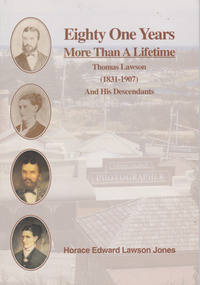
... Several of their children played a part in Warrnambool’s history – Horace was the Warrnambool Town Clerk from1893 to 1918, Richard established a private school, Warrnambool College in 1900 and was a teacher at Warrnambool High School from 1911 to 1913 when he left to become a distinguished educationalist at Melbourne University and the University of Otago at Dunedin, New Zealand, Archibald was a Presbyterian Minister at Koroit, his daughter was Shay Docking, a well-known artist and the author of the book, Horace Jones, a teacher at Warrnambool High School, was the son of Eliza Jane Lawson....Several of their children played a part in Warrnambool’s history – Horace was the Warrnambool Town Clerk from1893 to 1918, Richard established a private school, Warrnambool College in 1900 and was a teacher at Warrnambool High School from 1911 to 1913 when he left to become a distinguished educationalist at Melbourne University and the University of Otago at Dunedin, New Zealand, Archibald was a Presbyterian Minister at Koroit, his daughter was Shay Docking, a well-known artist and the author of the book, Horace Jones, a teacher at Warrnambool High School, was the son of Eliza Jane Lawson. ...Family history of Thomas Lawson (1831-1907) and his descendantsThis is a paper back book with a plasticized cove which has an image of Flagstaff Hill Maritime Village (reproduction of Daniel Clarke’s Studio) in the background in muted colours, photographs and paintings of Thomas and Susan Lawson in colour on the front cover and a photograph of and information on the author on the back. It has 37 pages, a Lawson family tree at the back and an introduction by Helen Jones. The book included printed material, black and white photographs and illustrative material.non-fictionFamily history of Thomas Lawson (1831-1907) and his descendants lawson family, warrnambool, cobden, camperdown -
 Warrnambool and District Historical Society Inc.
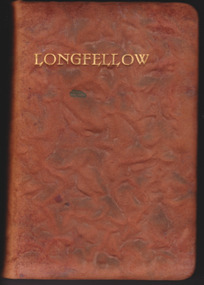
Book, The Poetical Works of Henry Wadsworth Longfellow, Late 19th century
... Melbourne in 1972. This beautiful book of Longfellow poems is worth keeping as an example of an antiquarian book. But it is most significant because of its inscription, telling us of its association with both the Lawson and Oakley Warrnambool College and Albert Lawson, a member of the Lawson family which had many members important in Warrnambool’s history. ...Henry Longfellow (1807-1882) was an American poet, the most popular one of his day. With poems such as ‘Paul Revere’s Ride’ he helped shape the American character. He was also popular in the British Empire countries and many people in places such as Warrnambool would have had a copy of his published works. The recipient of this volume, Albert Henry Lawson, was the son of Thomas and Susan Lawson, shopkeepers in Warrnambool in the 1870s and 80s. Albert Lawson became a pupil teacher in Cobden in 1903 and from 1904 to 1907 it appears that he was an assistant teacher at his brother’s school, Warrnambool College. This was a private school established by Richard Lawson and William Oakley in 1900. Albert Lawson was given the copy of Longfellow’s poems when he left Warrnambool College in 1907. He then embarked on a teaching career with the Victorian Education Department, married Susan Oakley, the daughter of William Oakley, and died in Melbourne in 1972.This beautiful book of Longfellow poems is worth keeping as an example of an antiquarian book. But it is most significant because of its inscription, telling us of its association with both the Lawson and Oakley Warrnambool College and Albert Lawson, a member of the Lawson family which had many members important in Warrnambool’s history. The inscription tells us that Albert Lawson worked as a teacher for some years at his brother’s school, a fact that was not fully documented until the acquisition of this book. This is a leather bound book of 698 pages. The cover is mottled brown in a raised pattern and the pages are edged with a red-gold tinge. The insides of the cover are edged with a red and gold border and have a blue, brown and cream mottled pattern. There is a sketch of Longfellow in the front with a tissue page covering the sketch. The pages of the book are of fine paper typical of a late Victorian publication. The book has a thin blue ribbon page marker which has become detached from the book. The book is edited by William Michael Rossetti.Front Cover: ‘Longfellow’ Spine: ‘Longfellow’ Inside on a blank page: ‘To Mr A.H. Lawson from his pupils at the W’bool College, with best wishes for his future welfare, April 15th 1907’. warrnambool college (lawson & oakley), albert lawson, poetry, longfellow poetry, henry wadsworth longfellow -
 Eltham District Historical Society Inc
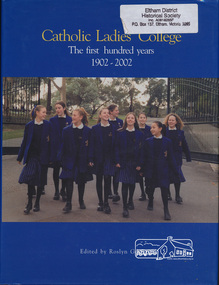
Book, Roslyn Guy, Catholic Ladies' College: The first hundred years 1902-2002 edited by Roslyn Guy, 2002
... History of Catholic Ladies College in Eltham 1902-2002 from its beginnings in East Melbourne. ...History of Catholic Ladies College in Eltham 1902-2002 from its beginnings in East Melbourne. ...History of Catholic Ladies College in Eltham 1902-2002 from its beginnings in East Melbourne. Includes photographs and lists of former principals, teachers and students.v, 231 p. : ill., plan, ports. ; 28 cm.ISBN 0958125805 Annotated: Donated to the EDHS Inc library for reference . Meera G. 10/9/02 [MeeraGovil, Eltham Bookshop]catholic ladies college eltham, clc, school -
 Eltham District Historical Society Inc
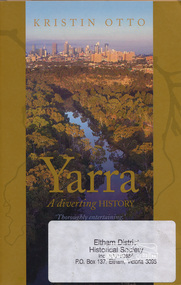
Book, Text Publishing, Yarra: a diverting history by Kristin Otto, 2009
... Exploration of the history and meaning of Melbourne's Yarra river and those who have lived and worked on it. ...Exploration of the history and meaning of Melbourne's Yarra river and those who have lived and worked on it. yarra river ISBN 9781921520006 Softcover, 245 p. : ill. maps, ports. ...Exploration of the history and meaning of Melbourne's Yarra river and those who have lived and worked on it. Softcover, 245 p. : ill. maps, ports. ISBN 9781921520006yarra river -
 Eltham District Historical Society Inc
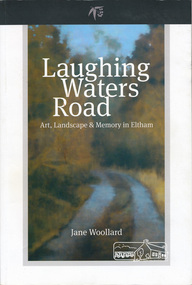
Book, Shire of Nillumbik, Laughing Waters Road: art, landscape & memory by Jane Woollard, 2016
... Melbourne art scene in the 1960s and '70s, especially the earth building movement known as the Eltham Style. Since 2001 more than eighty artists have been in residence at Laughing Waters in Birrarung House and Riverbend. Their experiences and art making are woven together with Wurundjeri, European and family histories...Melbourne art scene in the 1960s and '70s, especially the earth building movement known as the Eltham Style. Since 2001 more than eighty artists have been in residence at Laughing Waters in Birrarung House and Riverbend. Their experiences and art making are woven together with Wurundjeri, European and family histories ..."Laughing Waters has been a source of inspiration for many artists and designers, and was a natural extension of the dynamic art and lifestyle movement that began in the 1930s at Montsalvat. It was also an important site in the development of the Melbourne art scene in the 1960s and '70s, especially the earth building movement known as the Eltham Style. Since 2001 more than eighty artists have been in residence at Laughing Waters in Birrarung House and Riverbend. Their experiences and art making are woven together with Wurundjeri, European and family histories to create an evocative account of a special place in a bushy outer suburb of Melbourne." -- back cover. Eltham District Historical Society is acknowledged in the Acknowledgments section of this book.264 pages : illustrations, maps, portraits ISBN 9780994486707laughing waters, eltham, yarra river, artists, killeavey, mud bricks -
 Eltham District Historical Society Inc
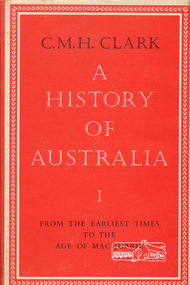
Book, Melbourne University Press, A History of Australia volume I by C.M.H. Clark, 1962
... A History of Australia volume I by C.M.H. Clark Book Melbourne University Press C M H Clark (Manning Clark) ...422 p. : ill., tables, maps, 17 plates ; 25 cm.ISBN 0522840086australia history -
 Eltham District Historical Society Inc
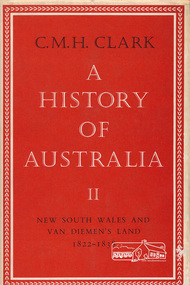
Book, Melbourne University Press, A History of Australia volume II by C.M.H. Clark, 1968
... A History of Australia volume II by C.M.H. Clark Book Melbourne University Press C M H Clark (Manning Clark) ...364 p., [10] p. of plates : ill., ports, 25 cm.australia history -
 Eltham District Historical Society Inc
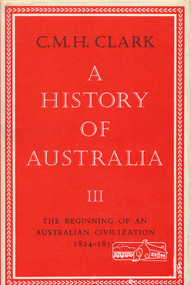
Book, Melbourne University Press, A History of Australia volume III by C.M.H. Clark
... australia history ISBN 052284054x 491 p., plates : ill., ports, 25 cm A History of Australia volume III by C.M.H. Clark Book Melbourne University Press C M H Clark (Manning Clark) ...491 p., plates : ill., ports, 25 cmISBN 052284054xaustralia history -
 Eltham District Historical Society Inc
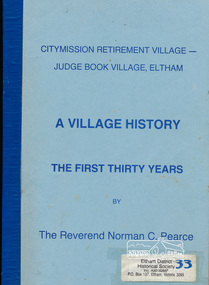
Book, Citymission Retirement Village - Judge Book Village, Eltham: A Village History; the first thirty years / The Reverend Norman C. Pearce, 1986
... This history documents the first thirty years through to 1986. Founded by the Melbourne City Mission, the significant early history of the "village for the aged" is documented including the various challenges faced including ongoing expansions and building develoment needs and impacts of flooding from the nearby Diamond Creek. ...This history documents the first thirty years through to 1986. Founded by the Melbourne City Mission, the significant early history of the "village for the aged" is documented including the various challenges faced including ongoing expansions and building develoment needs and impacts of flooding from the nearby Diamond Creek. ...CityMission Retirement Village, also known as Eltham Retirement Centre, also formerly known as Judge Book Memorial Village, was officially opened on Sunday 28 October 1956. This history documents the first thirty years through to 1986. Founded by the Melbourne City Mission, the significant early history of the "village for the aged" is documented including the various challenges faced including ongoing expansions and building develoment needs and impacts of flooding from the nearby Diamond Creek. It mentions some people associated with the organisation with reference to the Eltham Auxillary which was a group of Eltham residents formed to support the organisation and its residents through activity and fundraising efforts.Softcover; 60p.judge book village, retirement village, melbourne citymission, eltham, aged care, seniors, social service, older people, housing -
 Eltham District Historical Society Inc
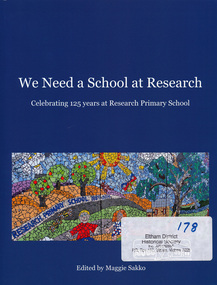
Book, Research Primary School, We Need a School at Research - celebrating 125 years at Research Primary School, edited by Maggie Sakko, 2014
... History of Research Primary School, north-eastern suburb of Melbourne. Begins with condensed version of the 1989 history of first 100 years, then covers 25 years 1989-2014: buildings and facilities, principals, teachers, students, uniform, School Council, Parents Group, out of school care, curriculum, and special events such as productions and camps. ...History of Research Primary School, north-eastern suburb of Melbourne. Begins with condensed version of the 1989 history of first 100 years, then covers 25 years 1989-2014: buildings and facilities, principals, teachers, students, uniform, School Council, Parents Group, out of school care, curriculum, and special events such as productions and camps. ...History of Research Primary School, north-eastern suburb of Melbourne. Begins with condensed version of the 1989 history of first 100 years, then covers 25 years 1989-2014: buildings and facilities, principals, teachers, students, uniform, School Council, Parents Group, out of school care, curriculum, and special events such as productions and camps. Registers of principals, staff and students are included. Numerous photographs are included.100 pages : illustrations, portraits ; 28 cm.ISBN 9780646925172research (vic.) -
 Eltham District Historical Society Inc
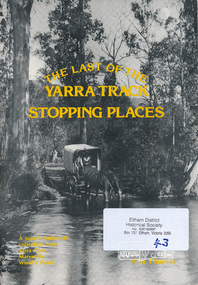
Book, The Last of the Yarra Track Stopping Places (third edition) by Ann Thomas, 1986
... History of Yarra Track from Melbourne to Wood's Point via Yarra Glen, Healesville and Marysville in gold mining era...History of Yarra Track from Melbourne to Wood's Point via Yarra Glen, Healesville and Marysville in gold mining era yarra glen ISBN 0959522417 [written on title page] With Best Wishes, Ann Thomas 12.11.86 64 p. : ill., map, ports. ; 30 cm. ...History of Yarra Track from Melbourne to Wood's Point via Yarra Glen, Healesville and Marysville in gold mining era64 p. : ill., map, ports. ; 30 cm.ISBN 0959522417 [written on title page] With Best Wishes, Ann Thomas 12.11.86yarra glen -
 Eltham District Historical Society Inc
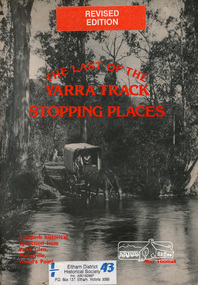
Book, The Last of the Yarra Track Stopping Places (revised edition) by Ann Thomas, 1983
... History of Yarra Track from Melbourne to Wood's Point via Yarra Glen, Healesville and Marysville in gold mining era...History of Yarra Track from Melbourne to Wood's Point via Yarra Glen, Healesville and Marysville in gold mining era yarra glen marysville ISBN 0959522417 56 p. : ill., ports. ; 30 cm. ...History of Yarra Track from Melbourne to Wood's Point via Yarra Glen, Healesville and Marysville in gold mining era56 p. : ill., ports. ; 30 cm. (revised edition)ISBN 0959522417yarra glen, marysville -
 Eltham District Historical Society Inc
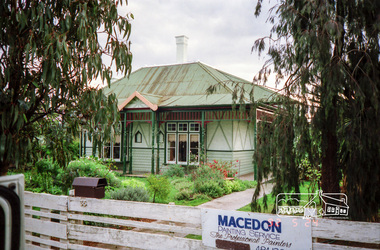
Photograph, 35 Ingrams Road, Research, Eltham Heritage Tour, 24 May 1992, 24/05/1992
... Melbourne's water supply was a communication line and a technological advance in 1891. It has been enlarged and re-faced and no longer used here but piped underground. Proclaimed a linear park it has reverted to crown land, controlled by local Council. Maroondah Dam was constructed in. 1920 to replace the original weir and at that time: the Aqueduct - as established into the landscape - with bridges and tunnels and pine trees were used to stop rubbish polluting the water." Record of the Society's history ...ELTHAM HERITAGE TOUR The Society excursion on 24th May 1992 was arranged by David Bick, leader of the team carrying out the Shire's heritage study. David selected a number of sites or buildings identified in the study, some of them lesser known components of the Shire's heritage. The tour commenced at the Eltham Shire Office at 10.00 am. Travel was by private car and mini-bus with stops at about twelve locations for commentary by David.It included a short walk in Hurstbridge and lunch at Kinglake. Highlights of the tour included: - 10 am Leave from Shire Offices - 3 Important Trees - A Physical Link to Eltham's First Settlers - Toorak Mansion Gates - A Surviving Farm House - An Intact Circa 1900 Main Street - First Settlers - Gold Miners, and Timber-getters - An Early Hotel - A Pioneering Homestead - Changing Eltham Shire - 20th Century - 4 pm Afternoon Tea and Finish Tour Extract from ELTHAM CULTURAL HERITAGE TOUR (Newsletter No. 85, July 1992, by Bettina Woodburn) "On a right-angle turning of the Eltham Road is Wellers Pub, a Cobb & Co. coaching stop on the way to distant gold-fields and places north of the Yarra River. The Hotel dates from the 1870's. Daily distances for a bullock team was eight miles, horses could do double that distance. We turned into Cassells Road and on the corner of Ingrams Road we admired an elaborate Edwardian villa, 1900 style. The Aqueduct conveying Melbourne's water supply was a communication line and a technological advance in 1891. It has been enlarged and re-faced and no longer used here but piped underground. Proclaimed a linear park it has reverted to crown land, controlled by local Council. Maroondah Dam was constructed in. 1920 to replace the original weir and at that time: the Aqueduct - as established into the landscape - with bridges and tunnels and pine trees were used to stop rubbish polluting the water."Record of the Society's history and activities and highlighting various aspects of the Heritage Study undertaken by David Bick used to create the future heritage overlay for the Shire of Eltham and later Nillumbik Shire.Roll of 35mm colour negative film, 4 stripsKodak Gold 100 5095shire of eltham historical society, activities, heritage tour, ingrams road, research (vic.)
