
Showing 223 items matching "girl's clothing"
-
 Surrey Hills Historical Society Collection
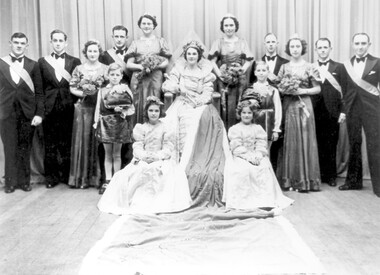
Photograph - Holy Trinity Surrey Hills Tennis Queen Carnival, Queen and court, 1940, 11 June 1940
... The carnivals were not always annual events, and were held in various locations throughout a year. sport tennis holy trinity anglican church 1940 clothing and dress miss connie eastwood miss hazel bodley miss leila hanslow miss olwyn powys miss barbara fair jeff holland derek manley queen carnival mrs mary clucas miss mary holborn mrs f eastwood REAR: "Holy Trinity Tennis Club Queen Carnival / June 11 / 1940 / M Clucas / 33 Jurang St / Balwyn" Black and white group photo of 6 men, 5 women, 2 girls and 2 boys in formal and / or mock-Elizabethan costume mounted on cardboard which has been roughly trimmed. ...Identification has been given as follows: LHS 'page': Jeff Holland (?); RHS 'page': Derek Manley; Queen: Leila Hanslow; young women L to R: Olwyn Powys, Hazel Bodley, Mary Clucas (nee Holborn), Connie Eastwood. Girls: L - Barbara Fair; R - Unknown. Gentlemen not identified. The Queen Carnival was a fundraiser for the Holy Trinity Tennis Club. The Queen Carnival Coronation was held in the Canterbury Memorial Hall on 11 June 1940. Mrs F Eastwood was the trainer and the Honorary Secretary of the tennis club. The donor Mary Holborn married Geoffrey Stroud Clucas in 1946 in Surrey Hills. The photo documents a social fundraising practice common in the early 20th century. Queen carnivals were also popular in New Zealand. In both countries they were particularly common during World War I and in the years after, when they were used to raise funds for returned soldiers. The first such carnival is believed to have been held in Napier, New Zealand, in 1913. The carnivals were not always annual events, and were held in various locations throughout a year.Black and white group photo of 6 men, 5 women, 2 girls and 2 boys in formal and / or mock-Elizabethan costume mounted on cardboard which has been roughly trimmed. The Queen is seated in the centre and the 2 young girls are seated either side and slightly in front of her. The 2 'pages' and the men and other women are standing evenly divided either side of her. The photo appears to have been taken in a hall. REAR: "Holy Trinity Tennis Club Queen Carnival / June 11 / 1940 / M Clucas / 33 Jurang St / Balwyn"sport, tennis, holy trinity anglican church, 1940, clothing and dress, miss connie eastwood, miss hazel bodley, miss leila hanslow, miss olwyn powys, miss barbara fair, jeff holland, derek manley, queen carnival, mrs mary clucas, miss mary holborn, mrs f eastwood -
 Surrey Hills Historical Society Collection
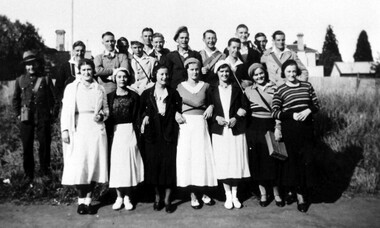
Work on paper - Photograph, Group of young people from Church of Christ, The Avenue, Surrey Hills
... He was the donor's uncle. church of christ churches the avenue surrey hills 1934 kirkland union road warrigal road clothing and address hats John Woodhead Jack Cornhill John Cornhill A black and white photograph of group of people. The girls ...This group of young people from the Church of Christ in The Avenue, Surrey Hills are on vacant land owned by John Woodhead. His home 'Kirkland' is in the background. He developed the shops on the SE corner of Canterbury Road and Union Road and donated the land for the Church of Christ and was an elder of the church. Jack Cornhill is identified as back row, 4th from the right. He was the donor's uncle.A black and white photograph of group of people. The girls are wearing skirts that just cover the knee, flat shoes and ankle length socks. Some ar wearing berets. One man on the left appears to be in uniform.church of christ, churches, the avenue, surrey hills, 1934, kirkland, union road, warrigal road, clothing and address, hats, john woodhead, jack cornhill, john cornhill -
 Surrey Hills Historical Society Collection
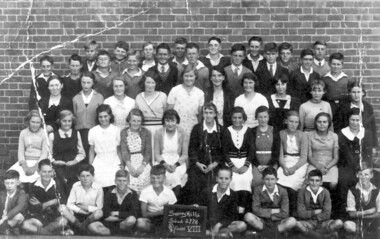
Photograph, Surrey Hills State School 1936 Grade 8, 1936
... Back row from left: V Bruce, R Rattan, O Turner, A Hiscox, W Richey, unknown, A Cocking, A fee 4th row: C Peters, C Thompson, K Brown, E Haye, D Frost, V Pugh, J Norman, W Orders, R Collins, R Smith 3rd row: S MacDonjald, G Dannock, B Scott, unknown, unknown, B Dryden, N Muir, D Nichols, N Green, L Lobb 2nd row: B Collins, A Timms, unknown, unknown, L Chenu, C Durling, S Spooner, unknown, unknown, J Bruce, N Armistead Front row: R Smith, B Wadsworth, C Colbert, J McNamara E Allen, D McMillan, A Campbell, L Wendorff, W Nicholson Mr V Bruce Mr R Rattan Mr O Turner Mr A Hiscox Mr W Richey Mr A Cocking Mr A Fee Mr C Peters Mr C Thompson Mr K Brown Mr E Haye Mr D Frost Mr V Pugh Mr J Norman Mr W Orders Mr R Collins Mr R Smith Miss S MacDonald Miss G Dannock Miss B Scott Miss B Dryden Miss N Muir Miss D Nichols Miss N Green Miss L Lobb Miss B Collins Miss A Timms Miss L Chenu Miss C Durling Miss S Spooner Miss J Bruce Miss N Armitstead Mr R Smith Mr B Wadsworth Mr C Colbert Mr J McNamara Mr E Allen Mr D McMillan Mr A Campbell Mr L Wendorf Mr W Nicholson Surrey Hills Primary School 1936 clothing and dress 1930-1940 A black and white photograph of a class of children in Grade 8 at Surrey Hills School No. 2778. There are 27 boys and 21 girls ...Back row from left: V Bruce, R Rattan, O Turner, A Hiscox, W Richey, unknown, A Cocking, A fee 4th row: C Peters, C Thompson, K Brown, E Haye, D Frost, V Pugh, J Norman, W Orders, R Collins, R Smith 3rd row: S MacDonjald, G Dannock, B Scott, unknown, unknown, B Dryden, N Muir, D Nichols, N Green, L Lobb 2nd row: B Collins, A Timms, unknown, unknown, L Chenu, C Durling, S Spooner, unknown, unknown, J Bruce, N Armistead Front row: R Smith, B Wadsworth, C Colbert, J McNamara E Allen, D McMillan, A Campbell, L Wendorff, W Nicholson A black and white photograph of a class of children in Grade 8 at Surrey Hills School No. 2778. There are 27 boys and 21 girls. They are wearing casual clothes not a uniform.mr v bruce, mr r rattan, mr o turner, mr a hiscox, mr w richey, mr a cocking, mr a fee, mr c peters, mr c thompson, mr k brown, mr e haye, mr d frost, mr v pugh, mr j norman, mr w orders, mr r collins, mr r smith, miss s macdonald, miss g dannock, miss b scott, miss b dryden, miss n muir, miss d nichols, miss n green, miss l lobb, miss b collins, miss a timms, miss l chenu, miss c durling, miss s spooner, miss j bruce, miss n armitstead, mr r smith, mr b wadsworth, mr c colbert, mr j mcnamara, mr e allen, mr d mcmillan, mr a campbell, mr l wendorf, mr w nicholson, surrey hills primary school, 1936, clothing and dress, 1930-1940 -
 Surrey Hills Historical Society Collection
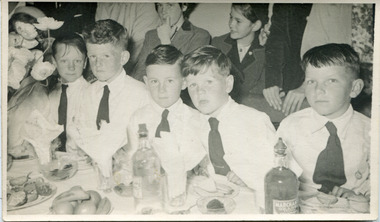
Digital photo, John Turnbull and John Garzoli, First Communion, 1951, 1951
... The clothing is often white to symbolize purity. It is more elaborate for girls but boys wear ‘Sunday best’; it could be a suit and tie or even a tuxedo. ...There was a Garzoli family living at 116/118 Windsor Crescent in the 1930s and still there in 1954; there was another Garzoli family also at 18 Windsor Crescent in 1954.This is one of a series of photos that document John Turnbull’s First Communion. They are representative of this important rite of passage in the Catholic Church in the 1950s. The sacrament of First Communion is an important tradition for Catholic families and individuals. Originally this was celebrated when a child was 10, 12 or even 14 years of age, however in 1910, Pope Pius X issued the decree Quam singulari, which changed the age at which First Communion is taken to 7 years old. Traditions of celebration surrounding First Communion usually include family gatherings and parties to celebrate the event. The first communicant wears special clothing. The clothing is often white to symbolize purity. It is more elaborate for girls but boys wear ‘Sunday best’; it could be a suit and tie or even a tuxedo. Many families have formal professional photographs taken in addition to candid snapshots in order to commemorate the event and some churches arrange for a professional photographer to attend after the ceremony. A black and white photo of 5 boys taken on the occasion of their First Communion. They are all wearing white shirts with ties. The boy on the RHS is also wearing a badge. They are seated at a table laiden with 'party food'. There are 2 girls in the background.On rear in black biro in John Turnbull's writing:"FIRST COMMUNION 1951 / ME - 2ND IN FROM LEFT / I THINK LAD ON FAR / RIGHT IS JOHN GARZOLI"catholic church, first communion, john turnbull, john gazoli, our holy redeemer church, surrey hills -
 Surrey Hills Historical Society Collection
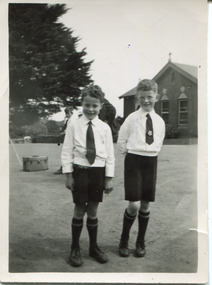
Digital photo, John Turnbull and Terry Ryan, First Communion, 1951, 1951
... The clothing is often white to symbolize purity. It is more elaborate for girls but boys wear ‘Sunday best’; it could be a suit and tie or even a tuxedo. ...This is one of a series of photos that document John Turnbull’s First Communion. They are representative of this important rite of passage in the Catholic Church in the 1950s. The sacrament of First Communion is an important tradition for Catholic families and individuals. Originally this was celebrated when a child was 10, 12 or even 14 years of age, however in 1910, Pope Pius X issued the decree Quam singulari, which changed the age at which First Communion is taken to 7 years old. Traditions of celebration surrounding First Communion usually include family gatherings and parties to celebrate the event. The first communicant wears special clothing. The clothing is often white to symbolize purity. It is more elaborate for girls but boys wear ‘Sunday best’; it could be a suit and tie or even a tuxedo. Many families have formal professional photographs taken in addition to candid snapshots in order to commemorate the event and some churches arrange for a professional photographer to attend after the ceremony. A black and white photo of 2 boys taken on the occasion of their First Communion. They are all wearing white shirts with ties. The boy on the RHS is also wearing a badge. A third boy is in the background and behind him is a large cypress tree and a brick building with a cross at the apex of the roof.On rear in black ink: "John (on right) with / his partner, first / Holy Communion / On / 28/10/51". Below this in John Turnbull's writing: "LAD ON LEFT IS TERRY RYAN" Photo processing stamp in purple ink within a border: "ALPHA / PHOTO SERVICE / BOX HILL" plus stamp "2107" -
 Surrey Hills Historical Society Collection
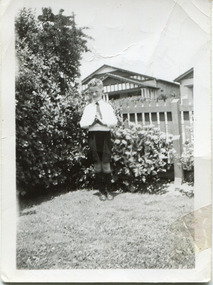
Digital photo, John Turnbull at home before his First Communion, 1951, 1951
... The clothing is often white to symbolize purity. It is more elaborate for girls but boys wear ‘Sunday best’; it could be a suit and tie or even a tuxedo. ...This is one of a series of photos that document John Turnbull’s First Communion. They are representative of this important rite of passage in the Catholic Church in the 1950s. The sacrament of First Communion is an important tradition for Catholic families and individuals. Originally this was celebrated when a child was 10, 12 or even 14 years of age, however in 1910, Pope Pius X issued the decree Quam singulari, which changed the age at which First Communion is taken to 7 years old. Traditions of celebration surrounding First Communion usually include family gatherings and parties to celebrate the event. The first communicant wears special clothing. The clothing is often white to symbolize purity. It is more elaborate for girls but boys wear ‘Sunday best’; it could be a suit and tie or even a tuxedo. Many families have formal professional photographs taken in addition to candid snapshots in order to commemorate the event and some churches arrange for a professional photographer to attend after the ceremony. A black and white photo of a boy taken in a garden in front of a picket fence. He is wearing a white shirt, shorts and long socks and his hands are in prayer position. In the background is a Californian bungalow house. On rear in black ink: "John on his / First Holy / Communion Day / 28/10/51". Below this in John Turnbull's writing: "MY PARENTS / HOUSE 30 PROSPECT / ST. BOX HILL" -
 Surrey Hills Historical Society Collection
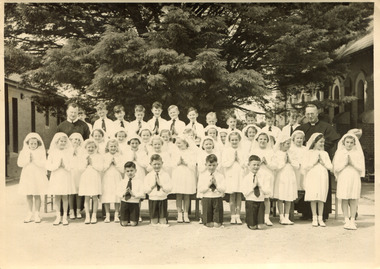
Digital photo, Our Holy Redeemer First Communion class, 1951, 1951
... The clothing is often white to symbolize purity. It is more elaborate for girls but boys wear ‘Sunday best’; it could be a suit and tie or even a tuxedo. ...According to the donor, Fr Fitzpatrick is the priest on the RHS of the Communion group.This is one of a series of photos that document John Turnbull’s First Communion. They are representative of this important rite of passage in the Catholic Church in the 1950s. The sacrament of First Communion is an important tradition for Catholic families and individuals. Originally this was celebrated when a child was 10, 12 or even 14 years of age, however in 1910, Pope Pius X issued the decree Quam singulari, which changed the age at which First Communion is taken to 7 years old. Traditions of celebration surrounding First Communion usually include family gatherings and parties to celebrate the event. The first communicant wears special clothing. The clothing is often white to symbolize purity. It is more elaborate for girls but boys wear ‘Sunday best’; it could be a suit and tie or even a tuxedo. Many families have formal professional photographs taken in addition to candid snapshots in order to commemorate the event and some churches arrange for a professional photographer to attend after the ceremony. A black and white photo of 16 visible boys (plus one additional boy almost completely obscured to the right of the group), 23 girls and 2 priests. The boys are wearing shorts and white shirts with ties. The girls are wearing white dresses and veils. The children are grouped with 12 boys in the back row and 4 kneeling in the front. The girls are in the front and centre rows and the priests are either side of the group. Behind the group is a large cypress tree and to either side the church and (?) school building. One of the boys is John Turnbull. On rear in black ink: "John's 1st COMMUNION / 1951 / JOHN IS BACK ROW / 2ND FROM LEFT". our holy redeemer church, our holy redeemer school, john turnbull, fr tim fitzpatrick, first communion, children -
 Surrey Hills Historical Society Collection
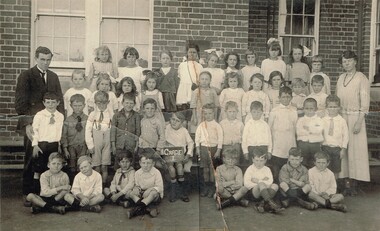
Photograph, Mont Albert Central School Grade 1, 1921, 1921
... The class of 18 girls and 22 boys is flanked by a male teacher of the LHS of the photo and a female teacher on the RHS. Children are wearing a variety of clothing indicating the absence of an official school uniform....The class of 18 girls and 22 boys is flanked by a male teacher of the LHS of the photo and a female teacher on the RHS. Children are wearing a variety of clothing indicating the absence of an official school uniform. ...Mont Albert State School was officially opened on 23rd April 1917. The school became Mont Albert Central School in 1918, taking in Forms 1 and 2. The school remained a Central School until 1964, when the secondary years formed the basis of a new High School, the Box Hill North High School, later to be named Koonung Secondary College. This is part of a large collection of material related to the Deakin, Mair and Young families, all with connections to Surrey Hills and Mont Albert. Ernest Lance Young was the son of Ernest Augustus Young (1891-1985) and Ruby Nichell Whitby (1892-1984). Lance was born 24 March 1915 in Surrey Hills. The family lived at 5 York Street, Surrey Hills. Electoral roll for 1937 gives the house name as 'Whitby Lodge'. He married Beryl Mair in 1939 and died on 5 October 1999 at Mont Albert. Electoral rolls list him as a manufacturer. His address after marriage was 11 York Street, Mont Albert. He is buried in Box Hill Cemetery (M-*-0867) along with his father. He served in WW2 (Service Number - VX104733 enlisting at St Kilda) and after returning took over his father's business. Young's Motor Products have manufactured products for the automotive and other related industries, including chemical trades, since 1920. Business history: Young's commenced trading in 1917 when Mr Ernest Augustus Young started selling paint brushes. At this time the company was known as E.A.Young & Co. with business premises in Queen Street Melbourne. Ernest soon expanded into paints and other products for the rapidly growing automotive trade and by 1920 was well recognised as a leading supplier. At this time canvas hoods were the norm and Ernest produced a "Canvas Hood Dressing" which gained acceptance as 'the one to buy'. This product was exported throughout the world. By 1930 Young's range had expanded and the product range included items like distilled water, gasket cement, vulcanising heat patches, rust prevention and many more diverse products. Young's name then, was so well known in Australia and the world, that a letter could be addressed just "Young's Melbourne" and it would reach the company. Young's survived the great depression, but in 1939 the Australian government commandeered the factory with all plant and equipment, thus closing Young's for the duration of the WW2. Ernest continued to make products at home for the war effort. When his son, Lance, returned home from overseas war service in Singapore, the Young's factory was re-established at 405 Canterbury Road, Canterbury near Chatham Station and worked to regain markets lost in the 1940s. By 1980 Lance Young wished to retire, his immediate family didn't want to continue the business and Lance believed Australia would lose a great asset if he just closed the company. He sought to find someone within the motor trade who would uphold the Young's principles of product and service and in 1981 Allan Kennedy & Sons bought the business.Lance Young was retained as an active consultant until his death in October 1999, aged 84. Products: Superseal for radiators, tyre dressing (tyre black), car shampoo, hood dressing, leather and vinyl cleaner. The factory was later elased to B&D Rollerdoors. REF: Personal communication (Laurie Newton, nee Young) and http://youngsmp.com.au/comprof.htm Black and white class photo taken outside the school building. The class of 18 girls and 22 boys is flanked by a male teacher of the LHS of the photo and a female teacher on the RHS. Children are wearing a variety of clothing indicating the absence of an official school uniform.REAR: Possibly 4 different hands as follows: 1. In black ink faded to brown: "January 1921 / Mont Albert State School" 2. "ERNEST" in black biro; looks to be a later insert to "Lance Young" in blue biro or ink. 3. "2nd on left / FRONT ROW legs crossed" in blue biro. -
 Whitehorse Historical Society Inc.
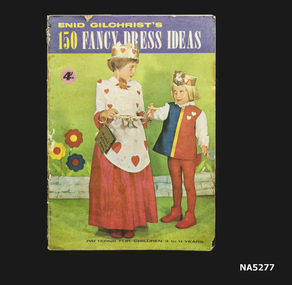
Booklet - Book, Enid Gilchrist's 150 Fancy Dress Ideas
... Fancy dress Enid Gilchrist clothing patterns children Enid Gilchrist's 150 Fancy Dress Ideas. Patterns for children 3-11 years. Green booklet with girl in Queen of Hearts outfit, child in tunic pattern. ...Enid Gilchrist's 150 Fancy Dress Ideas. Patterns for children 3-11 years. Green booklet with girl in Queen of Hearts outfit, child in tunic pattern. Patterns enclosed. Price 4/- (shilling)fancy dress, enid gilchrist, clothing, patterns, children -
 Whitehorse Historical Society Inc.
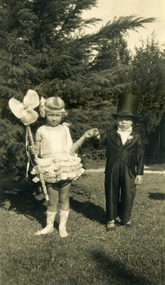
Photograph, Till, Alwyn
... till alwyn clothing and dress Black and white photograph of two children in fancy dress. Girl with wand; Boy, Alwyn, in a morning suit and top hat. ...Black and white photograph of two children in fancy dress. Girl with wand; Boy, Alwyn, in a morning suit and top hat.till, alwyn, clothing and dress -
 Whitehorse Historical Society Inc.
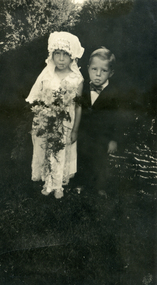
Photograph, Till
... till clothing and dress Two children Girl dressed in a white dress and hat, carrying a bouquet. ...Two children Girl dressed in a white dress and hat, carrying a bouquet. The boy wearing a suit and bow tie.till clothing and dress -
 Canterbury History Group
Ephemera - St John's Home for Boys and Girls, not known
... Girls. These bags were distributed to houses to be filled with clothing etc. and collected some days later....Girls. These bags were distributed to houses to be filled with clothing etc. and collected some days later. ...Heavy duty brown paper collection bag for the St John's Home for Boys and Girls. These bags were distributed to houses to be filled with clothing etc. and collected some days later.canterbury, balwyn road, shrublands, children's services, charitable organisations, st johns home for boys and girls -
 Surrey Hills Historical Society Collection
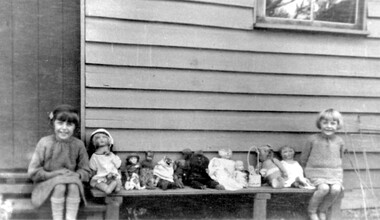
Photograph, Jocelyn and Lynette Cerini, 1930s
... girls are Jocelyn and Lynette Cerini. They are in front of their father's 'office' at the rear of the family home at 215 Union Road, Surrey Hills. jocelyn cerini (miss) lynette cerini (miss) dolls toys 1930-1939 clothing and dress 215 Union Road A black and white photograph of two young girls with their dolls lined up between them. ...The girls are Jocelyn and Lynette Cerini. They are in front of their father's 'office' at the rear of the family home at 215 Union Road, Surrey Hills.A black and white photograph of two young girls with their dolls lined up between them.jocelyn cerini (miss), lynette cerini (miss), dolls, toys, 1930-1939, clothing and dress, 215 union road -
 Surrey Hills Historical Society Collection
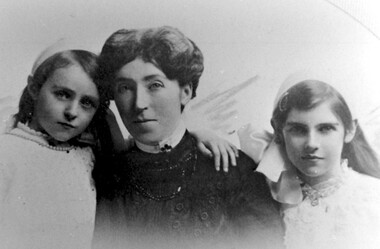
Photograph, Mrs Florence Grant and daughters
... He was a surveyor and they lived in Albany Crescent, Surrey Hills. florence grant (mrs) mollie grant (miss) mona grant (miss) jessie mona stuart grant (miss) jessie mona stuart webster (mrs) mona webster (mrs) clothing and dress A black and white photograph of a lady and two young girls dressed in Edwardian clothes. ...Florence Jane McDouall Stuart (1867 - 1936) married George Hudson Grant (1864 - 1910) in 1899. He was a surveyor and they lived in Albany Crescent, Surrey Hills.A black and white photograph of a lady and two young girls dressed in Edwardian clothes.florence grant (mrs), mollie grant (miss), mona grant (miss), jessie mona stuart grant (miss), jessie mona stuart webster (mrs), mona webster (mrs), clothing and dress -
 Surrey Hills Historical Society Collection
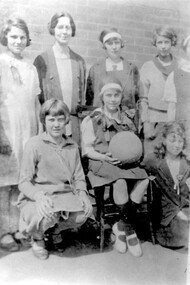
Photograph, Surrey Hills School - Basketball Team 1922
... Miss Macdonald was their coach. mary whitworth (mrs) mary hamilton (miss) macdonald, - (miss) surrey hills state school basketball 1922 clothing and dress A black and white photograph of a group of eight girls; one in the front is holding a basketball. ...Surrey Hills School Basketball Team 1922. Mary Hamilton, later Mrs Whitworth, identified is in front on left. Miss Macdonald was their coach.A black and white photograph of a group of eight girls; one in the front is holding a basketball. mary whitworth (mrs), mary hamilton (miss), macdonald, - (miss), surrey hills state school, basketball, 1922, clothing and dress -
 Surrey Hills Historical Society Collection
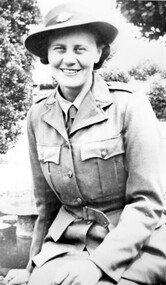
Photograph, Doris Wright, member of the Australian Women's Army Service
... girls only ‘giggle’ dresses – of a non-descript colour. They were not expected to appear in public in these and wore civilian dress. Japan had just entered the war and there were more urgent demands on restricted supplies. The formal uniforms eventually arrived. union road surrey hills uniforms clothing ...Doris Lilian Wright of 214 Union Road was a milliner but joined the Australian Women's Army Service (AWAS) in the early war years. The Women’s Australian National Service (WANS) was inaugurated in 1940. Training for members of the WANS included air raid drills, first aid, basic military drills, and even shooting, signalling, and mechanics. AWAS on formed on 13 August 1941 with the objective of releasing more men into forward areas. The Army was particular with its recruiting and four references were required; another stipulation was that teeth were in good condition. Doris was located at Elwood. Their training area was along the foreshore and one day to their great surprise there were crowds of American Marines – "the cream of the American Army". These were the first Americans to arrive in Australia to strengthen the defence of the country. The Americans soon went north and the AWAS went off to Balcombe on the Mornington Peninsula. At this time there were no uniforms for the girls only ‘giggle’ dresses – of a non-descript colour. They were not expected to appear in public in these and wore civilian dress. Japan had just entered the war and there were more urgent demands on restricted supplies. The formal uniforms eventually arrived.A black and white photograph of a lady in an army uniform and wearing a hat.union road, surrey hills, uniforms, clothing and dress, (miss) doris wright, australian women's army service -
 Surrey Hills Historical Society Collection
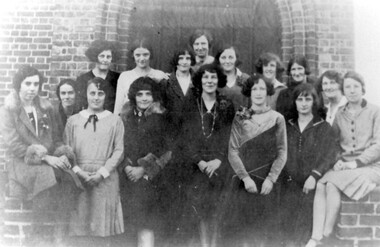
Photograph, Holy Trinity Kindergarten Sunday School teachers, 1920s
... (miss) patience cornell (miss) joy dicker (ms) doris wiles (ms) doris hearne (ms) beryl hearne (ms) mary chipperfield (ms) lal clark (ms) -, wilson (ms) jessie collins (ms) muriel chipperfield (ms) una blakie (ms) myra lock holy trinity church of england kindergarten teachers clothing and dress 1920-1929 (ms) marj andrews A black and white photograph of sixteen girls standing in the doorway of a church. ...Miss Patience Cornell, the leader of the group, is in the centre. Training classes were held for leaders at St Pauls Cathedral and St Johns, concluding with examinations. They then trained their assistants. Holy Trinity was known for implementing new ideas and programs for their 70 children. Far right is Miss Joy Dicker, who was leader from 1930 for 30 years. Identified as: Back LtoR: Doris Wiles, Doris Hearne, Beryl Hearne, …, Mary Chipperfield, Lal Clark, … Centre: Patience Cornell Front: … Wilson, Jessie Collins, Muriel Chipperfield, Una Blakie, Marj Andrews, Myra Lock, Joy Dicker Patience Cornell was the daughter of Frank and Blanche Cornell. Frank Cornell was first listed in Surrey Hills in 1906 at (6) Lorne Parade. In 1908 the listing gives his occupation as a clerk. He was born in 1869 in Richmond, Victoria and died 15 April 1917 in Surrey Hills from a stroke. His wife Blanche Annie Parsons Cornell (nee Bracher) was born in 1869 in Hokitika, New Zealand; she died on 21 January 1940. Children were: Gilbert Frank Cornell (b1894, Hawthorn; d1908, at Frankston beach, an accidental drowning) Ruth Amelia Cornell (b 1899, Kew; d 29 May 1977, Kew) Lorna Amy Cornell (b 1906, Surrey Hills; d unknown) Patience Blanche Cornell (b1907, Surrey Hills; d unknown). Ruth Amelia married David Ellis, c1922 in Surrey Hills. David was a dentist who practised in Surrey Hills for many years. Patience (Pat) Blanche married Norman Henry Brewer (1893–1975) in 1931 in Surrey Hills. A black and white photograph of sixteen girls standing in the doorway of a church.(miss) patience cornell, (miss) joy dicker, (ms) doris wiles, (ms) doris hearne, (ms) beryl hearne, (ms) mary chipperfield, (ms) lal clark, (ms) -, wilson, (ms) jessie collins, (ms) muriel chipperfield, (ms) una blakie, (ms) myra lock, holy trinity church of england, kindergarten teachers, clothing and dress, 1920-1929, (ms) marj andrews -
 Surrey Hills Historical Society Collection
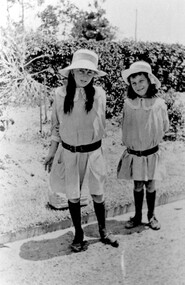
Photograph, Pat and Ruth Cornell, c1914
... His home was in St Johns Avenue and was bought by Ormiston Girls School. (miss) ruth cornell (miss) pat cornell 1914 clothing and dress uniforms (mr) felix lloyd buckley and nunn st. johns avenue surrey hills ormiston girls school (mr) frank cornell (miss) patience cornell (mrs) blanche annie parsons cornell A black and white photograph of two young girls dressed alike in long sleeved cotton dresses with large lace collars and a belt just below their waists. ...Patience (Pat) and Ruth Cornell, c1914 - 2 of the daughters of Frank Cornell and his wife Blanche Annie Parsons Cornell. Frank Cornell was first listed in Surrey Hills in 1906 at (6) Lorne Parade. In 1908 the listing gives his occupation as a clerk. He was born in 1869 in Richmond, Victoria and died 15 April 1917 in Surrey Hills. Blanche Annie Parsons Cornell (nee Bracher) was born in 1869 in Hokitika, New Zealand; she died on 21 January 1940. Children were: Gilbert Frank Cornell (b1894, Hawthorn; d1908, at Frankston beach, an accidental drowning) Ruth Amelia Cornell (b 1899, Kew; d 29 May 1977, Kew) Lorna Amy Cornell (b 1906, Surrey Hills; d unknown) Patience Blanche Cornell (b1907, Surrey Hills; d unknown. Frank and wife Blanche are buried in Box Hill Cemetery - CE-*-1058. Ruth Amelia married David Ellis, c1922 in Surrey Hills. David was a dentist who practised in Surrey Hills for many years; practice located in Windsor Crescent. Patience (Pat) Blanche married Norman Henry Brewer (1893–1975) in 1931 in Surrey Hills. Frank became a director of Buckleys & Nunn. The photo was taken in the garden of Felix Lloyd, Managing Director of Buckleys and Nunn. His home was in St Johns Avenue and was bought by Ormiston Girls School.A black and white photograph of two young girls dressed alike in long sleeved cotton dresses with large lace collars and a belt just below their waists. They are also wearing sun hats and knee-high dark coloured socks.(miss) ruth cornell, (miss) pat cornell, 1914, clothing and dress, uniforms, (mr) felix lloyd, buckley and nunn, st. johns avenue, surrey hills, ormiston girls school, (mr) frank cornell, (miss) patience cornell, (mrs) blanche annie parsons cornell -
 Surrey Hills Historical Society Collection
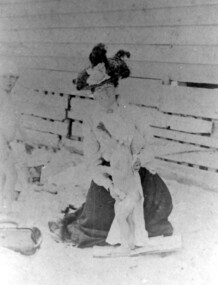
Photograph, Mrs Blanche Cornell
... Given the children's dates of birth, it is likely that it is Gilbert and Ruth in the photo. clothing and dress 1908 (mrs) blanche cornell beach (mrs) blanche annie parsons cornell (miss) blanche annie parsons bracher box hill cemetery A black and white photograph of a lady dressed in an ankle length skirt, long sleeved blouse and wearing a hat. She is sitting on the beach and drying off one small girl ...Mrs Blanche Cornell, wife of Frank Cornell, at the beach with 2 of her children, ? c1905 Frank Cornell was first listed in Surrey Hills in 1906 at (6) Lorne Parade. In 1908 the listing gives his occupation as a clerk. He was born in 1869 in Richmond, Victoria and died 15 April 1917 in Surrey Hills. Blanche Annie Parsons Cornell (nee Bracher) was born in 1869 in Hokitika, New Zealand; she died on 21 January 1940. Children were: Gilbert Frank Cornell (b1894, Hawthorn; d1908, at Frankston beach, an accidental drowning) Ruth Amelia Cornell (b 1899, Kew; d 29 May 1977, Kew) Lorna Amy Cornell (b 1906, Surrey Hills; d unknown) Patience Blanche Cornell (b1907, Surrey Hills; d unknown. Frank and wife Blanche are buried in Box Hill Cemetery - CE-*-1058. Ruth Amelia married David Ellis, c1922 in Surrey Hills. David was a dentist who practised in Surrey Hills for many years. Patience (Pat) Blanche married Norman Henry Brewer (1893–1975) in 1931 in Surrey Hills. Given the children's dates of birth, it is likely that it is Gilbert and Ruth in the photo. A black and white photograph of a lady dressed in an ankle length skirt, long sleeved blouse and wearing a hat. She is sitting on the beach and drying off one small girl. There is another small girl or boy to the left of the lady.clothing and dress, 1908, (mrs) blanche cornell, beach, (mrs) blanche annie parsons cornell, (miss) blanche annie parsons bracher, box hill cemetery -
 Surrey Hills Historical Society Collection
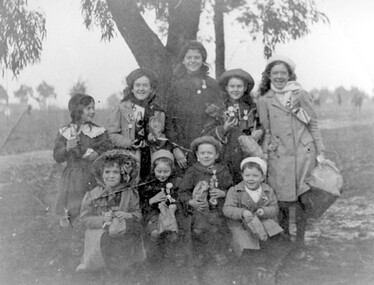
Photograph, Ruth Cornell and friends, 1902
... The donor was Ruth's sister. lorne parade surrey hills king's birthday edward vii festivals and celebrations 1902 clothing and dress (miss) ruth cornell (dr) david ellis (mrs) ruth ellis A black and white photograph of eight girls dressed up and proudly wearing medals and flags. ...Ruth Cornell is centre back surrounded by local school friends in 1902 after the presentation of medals in celebration of the birthday of Edward VII. Ruth was the daughter of Frank and Blanche Cornell. Frank Cornell was first listed in Surrey Hills in 1906 at (6) Lorne Parade. In 1908 the listing gives his occupation as a clerk. He was born in 1869 in Richmond, Victoria and died 15 April 1917 in Surrey Hills from a stroke. His wife Blanche Annie Parsons Cornell (nee Bracher) was born in 1869 in Hokitika, New Zealand; she died on 21 January 1940. Children were: Gilbert Frank Cornell (b1894, Hawthorn; d1908, at Frankston beach, an accidental drowning) Ruth Amelia Cornell (b 1899, Kew; d 29 May 1977, Kew) Lorna Amy Cornell (b 1906, Surrey Hills; d unknown) Patience Blanche Cornell (b1907, Surrey Hills; d unknown). Ruth Amelia married David Ellis, c1922 in Surrey Hills. David was a dentist who practised in Surrey Hills for many years. Patience (Pat) Blanche married Norman Henry Brewer (1893–1975) in 1931 in Surrey Hills. Dr David Ellis' surgery was in Whitehorse Road in 1930s and later at the corner of Windsor Crescent and Union Road. The donor was Ruth's sister. A black and white photograph of eight girls dressed up and proudly wearing medals and flags. Most are wearing hats and holding a bottle of drink.lorne parade, surrey hills, king's birthday, edward vii, festivals and celebrations, 1902, clothing and dress, (miss) ruth cornell, (dr) david ellis, (mrs) ruth ellis -
 Surrey Hills Historical Society Collection
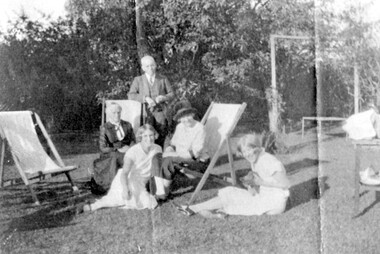
Photograph, Sunday afternoon at 'Dalriada' 77 Union Road, Surrey Hills
... (mr) charles steele dalriada house names surrey hills bona vista avenue (mrs) sarah steele clothing and dress union road (miss) harriette vevers steele (miss) hattie steele (miss) nancy steele (miss) margaret dillon steele (mrs) sarah ann vevers russell A black and white photograph of a group of people in their garden, enjoying the sun. The man is standing, two older ladies are sitting on deck chairs and the two younger girls ...‘Dalriada’” at 77 Union Road, on the corner Bona Vista Avenue has been demolished. It was the home of Mr Charles Henri Dillon Steele, a dentist of Collins Street, his wife Sarah (nee Russell) and daughters Harriette Vevers (Hattie) and Margaret Dillon (Nancy). They are pictured with grandmother Mrs Sarah Ann Vevers Russell (nee Lasslett), who with her husband Alexander lived at 'Clifton', Union Road, Surrey Hills from prior to 1903. He died in 1903 at Clifton. She was still living there in 1919. A black and white photograph of a group of people in their garden, enjoying the sun. The man is standing, two older ladies are sitting on deck chairs and the two younger girls are sitting on the grass playing with a kitten.(mr) charles steele, dalriada, house names, surrey hills, bona vista avenue, (mrs) sarah steele, clothing and dress, union road, (miss) harriette vevers steele, (miss) hattie steele, (miss) nancy steele, (miss) margaret dillon steele, (mrs) sarah ann vevers russell -
 Surrey Hills Historical Society Collection
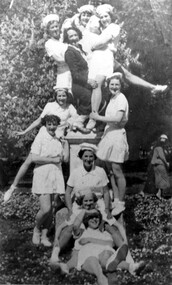
Photograph, Miss Lil Willaton and her calesthenics students, 1930s
... A black and white photograph of a group of girls posing for a photograph around a monument. They are all dressed in similar clothing of light coloured skirts / shorts and shirt, and wearing hats. ...(miss) lil willaton callisthenics (ms) nancy scott (ms) nancy hayes (ms) sylvia mcgill (ms) vera willaton (miss) lille louisa willaton (mrs) lille louisa stephenson (mrs) lil stephenson teacher gymnastics box hill cemetery lille street union road A black and white photograph of a group of girls posing for a photograph around a monument. They are all dressed in similar clothing of light coloured skirts / shorts and shirt, and wearing hats. ...Miss Lillie Louisa (Lil) Willaton, and her callisthenics students in 1930s celebrating during competitions in Ballarat in which they were successful. Lil held weekly classes in Surrey Hills, Box Hill and nearby suburbs for a number of decades. Students include Nancy Scott, Nancy Hayes, Sylvia McGill and Vera Willaton. Lil was born in Long Gully, Bendigo in 1904 daughter of Herbert Charles Leopold Willaton and Lillie Jenkins. She had 3 brothers and 3 sisters, one brother dying in infancy. The family lived in Lille Street, Surrey Hills. Both her parents and one sister died in Surrey Hills. In the 1920s Lil gained her A.L.C.M. (Australian London College of Music) in singing and made a career of teaching gymnastics with calisthenics, rhythmic movement etc. She arranged the music and lyrics for items and also designed the costumes, as well as conducting the physical training which culminated in annual concerts held in Box Hill and other town halls. Lil married Leslie Reginald Stephenson in 1934 and they lived at 36 Union Road, Surrey Hills. She died in July 1995 and is buried in Buried Box Hill Cemetery - CE-126-0001. A black and white photograph of a group of girls posing for a photograph around a monument. They are all dressed in similar clothing of light coloured skirts / shorts and shirt, and wearing hats. The lady in the centre is wearing a darker coloured suit.(miss) lil willaton, callisthenics, (ms) nancy scott, (ms) nancy hayes, (ms) sylvia mcgill, (ms) vera willaton, (miss) lille louisa willaton, (mrs) lille louisa stephenson, (mrs) lil stephenson, teacher, gymnastics, box hill cemetery, lille street, union road -
 Kew Historical Society Inc
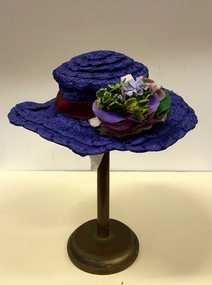
Headwear - Purple Raffia Sun Hat, Latiners, 1934-1945
... The headwear collection is particularly significant in that it includes the work of notable Australian and international milliners. latiners -- 310 flinders lane latiners - dawson street -- brunswick rupert vincent kirsch women's clothing -- hats Label: Latiners Deep purple coloured straw girls’ hat retailed by Latiners featuring a maroon ribbon at the base of the crown and a multicoloured fabric posy of flowers on the rim. ...Latiners was a Melbourne millinery company owned by Rupert Vincent Kirsch during the 1930s and 1940s. Originally located at 310 Flinders-lane, in 1934 the company shifted to 20 Dawson Street Brunswick. An article in the Melbourne Age newspaper recorded that the (illustrated) extensive factory was nearlng completion.(The Age, 10 July 1934). As well as producing hats in the factory, Latiners also imported hats into Australia. The Dawson Street factory is now listed on the Victorian Heritage Database as 'Of regional significance as one of the largest hat manufacturing businesses in Melbourne and architecturally important for its bold use of rendered forms.'The Kew Historical Society’s fashion and design collection is comprised of costumes, hats, shoes and personal accessories. Many of these items were purchased or handmade in Victoria; some locally in Kew. The extensive hat collection comprises items dating from the 1860s to the 1970s. While most of the hats in the collection were created by milliners for women, there are a number of early and important men’s hats in the collection. The headwear collection is particularly significant in that it includes the work of notable Australian and international milliners.Deep purple coloured straw girls’ hat retailed by Latiners featuring a maroon ribbon at the base of the crown and a multicoloured fabric posy of flowers on the rim. The straw hat is irregularly layered to give the impression of folds.Label: Latinerslatiners -- 310 flinders lane, latiners - dawson street -- brunswick, rupert vincent kirsch, women's clothing -- hats -
 Kew Historical Society Inc
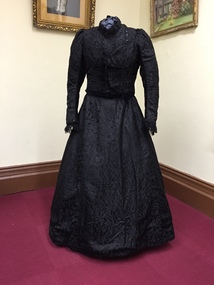
Clothing - Black Silk Damask Mourning Outfit, c.1898
... girl. The donor's father was the youngest who was born in 1911. The eldest son, Kenneth Morrison, was a Monsignor in the Catholic Church, and an Air Force Chaplain during the Second World War, while the daughter was a spinster who owned a few haberdashery and children’s clothing stores. ...girl. The donor's father was the youngest who was born in 1911. The eldest son, Kenneth Morrison, was a Monsignor in the Catholic Church, and an Air Force Chaplain during the Second World War, while the daughter was a spinster who owned a few haberdashery and children’s clothing stores. ...Elizabeth Morrison, was born in 1874 and died in 1963, aged 89 years. She was the schoolteacher at Warrigal until she married the donor's grandfather and moved to Melbourne to take up residence with him. Her husband Edward was a porter on the train from Melbourne to Adelaide. Together they had three children: two boys and a girl. The donor's father was the youngest who was born in 1911. The eldest son, Kenneth Morrison, was a Monsignor in the Catholic Church, and an Air Force Chaplain during the Second World War, while the daughter was a spinster who owned a few haberdashery and children’s clothing stores. The donor's father had a newsagency in Bridge Road, Richmond. He and his wife lived in Carson Street, Kew for about 50 years and had four children, two of whom were to become lawyers, another a surgeon and the final child social worker/family therapist. The donor's father lived until he was 100 years of age.The Fashion & Design collection of the Kew Historical Society includes examples of women’s, men’s, children’s and infants’ clothing from the 18th, 19th and 20th centuries. Items in the collection were largely produced for, or purchased by women in Melbourne, and includes examples of outerwear, protective wear, nightwear, underwear and costume accessories.The costume, which may have been used as a mourning dress is comprised of a matching heavy black silk skirt and top. The styling of the short bodice is accentuated by pleating and by the use of spirals of Parisian jet (black glass beads) on the bodice and cuffs. Chiffon lace is attached to the cuffs and is of the period. The dress is made of silk damask with a woven design of joined lines and circles. The rigidity of the fitted bodice is achieved by the use of baleen and by a heavy striped cotton fabric. The wide skirt, in contrast, has a stiffened brown cotton lining. There is a small insertion on the inside of the bodice that may have been used for a watch. The dress is in excellent condition. elizabeth morrison, australian fashion - 1890s, women's clothing -
 Kew Historical Society Inc
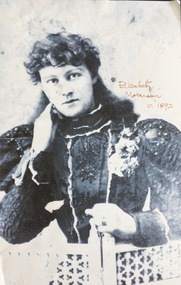
Print, Elizabeth Morrison, c.1892
... girl. The donor's father was the youngest who was born in 1911. The eldest son, Kenneth Morrison, was a Monsignor in the Catholic Church, and an Air Force Chaplain during the Second World War, while the daughter was a spinster who owned a few haberdashery and children’s clothing stores. ...girl. The donor's father was the youngest who was born in 1911. The eldest son, Kenneth Morrison, was a Monsignor in the Catholic Church, and an Air Force Chaplain during the Second World War, while the daughter was a spinster who owned a few haberdashery and children’s clothing stores. ...Elizabeth Morrison, was born in 1874 and died in 1963, aged 89 years. She was the schoolteacher at Warrigal until she married the donor's grandfather and moved to Melbourne to take up residence with him. Her husband Edward was a porter on the train from Melbourne to Adelaide. Together they had three children: two boys and a girl. The donor's father was the youngest who was born in 1911. The eldest son, Kenneth Morrison, was a Monsignor in the Catholic Church, and an Air Force Chaplain during the Second World War, while the daughter was a spinster who owned a few haberdashery and children’s clothing stores. The donor's father had a newsagency in Bridge Road, Richmond. He and his wife lived in Carson Street, Kew for about 50 years and had four children, two of whom were to become lawyers, another a surgeon and the final child social worker/family therapist.The donor's father lived until he was 100 years of age.Copy of a photograph of the owner of a 19th Century dress in the collectionPhotocopy of a photograph of Elizabeth Morrison (nee Fitzgerald) in c.1892. australian fashion - victorian era - 1890s, elizabeth morrison -
 Surrey Hills Historical Society Collection
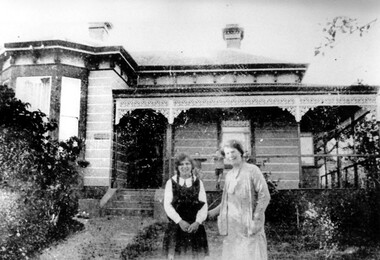
Photograph, "Warlingham", 85 Guildford Road, Surrey Hills, c1910
... See also SHP1927 and SHP1384. clothing and dress warlingham guildford road surrey hills house names mr william joseph trenerry mrs elsie trenerry miss elsie capon mr thomas coburn mr thomas kennedy vernon coburn mr arthur wheeler coburn mrs sara ethelwyn coburn mrs wynnie coburn miss sara ethelwyn cornell mr george lumsden miss emma louise sim mrs emma louise lumsden A black and white photograph of a Victorian style house with lacework around the verandah. There is a lady and young girl ...This photo was taken in c1910. ‘Warlingham’ has many typical Victorian features and has been restored and extended. The first owner was Thomas Kennedy Vernon Coburn, a solicitor. His wife was Sara Ethelwyn (Winnie) Cornell; they married on 26 March 1890. They had a large family and their eldest son (Arthur Wheeler Coburn) was born at 'Wannacul' Surrey Hills on 11 January 1891. The Coburns seem to have moved often and Thomas was declared insolvent in 1894, in part it would seem as a result of the land crash. The next owner was George Lumsden, grocer who is believed to have been there 1892-1896. He was married to Emma Louise Sim. During the years c1913-1919 Mr William Joseph Trenerry (manufacturer) and his wife Elsie (nee Capon) lived here. In the 1919 electoral roll the house name is given as 'Mosman', which may be a reference to Elsie Trenerry's origins; she came from Sydney. See also SHP1927 and SHP1384. A black and white photograph of a Victorian style house with lacework around the verandah. There is a lady and young girl with plaits wearing her school uniform standing in front of the house. Two young boys are watching and are standing on the verandah.clothing and dress, warlingham, guildford road, surrey hills, house names, mr william joseph trenerry, mrs elsie trenerry, miss elsie capon, mr thomas coburn, mr thomas kennedy vernon coburn, mr arthur wheeler coburn, mrs sara ethelwyn coburn, mrs wynnie coburn, miss sara ethelwyn cornell, mr george lumsden, miss emma louise sim, mrs emma louise lumsden -
 Surrey Hills Historical Society Collection
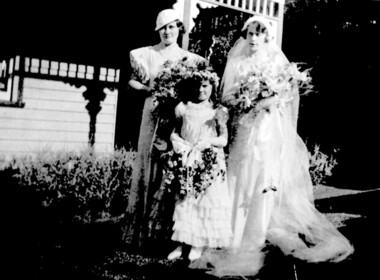
Photograph, Wedding of Lillian Murray and Charles Barrow
... Bridesmaid - Lilian Barrow, sister of Charles; flower girl Eva Rowden, cousin. 1934 house names barronscourt weddings clothing and dress essex road surrey hills mr charles barrow miss eva rowden miss lilian barrow miss lillian murray mrs lillian barrow A black and white photograph of two ladies and a young girl dressed in their wedding attire. ...Date: 3 January 1934. Photo taken at "Barronscourt", 3 Essex Road. Bridesmaid - Lilian Barrow, sister of Charles; flower girl Eva Rowden, cousin.A black and white photograph of two ladies and a young girl dressed in their wedding attire. All three are carrying floral bouquets. The bride is wearing a full length viel.1934, house names, barronscourt, weddings, clothing and dress, essex road, surrey hills, mr charles barrow, miss eva rowden, miss lilian barrow, miss lillian murray, mrs lillian barrow -
 Surrey Hills Historical Society Collection
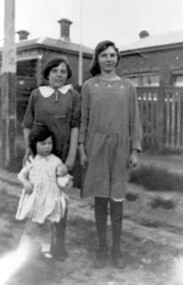
Photograph, Sylvia and Lena Jackson outside their home, 7-9 Russell Street, Surrey Hills
... Sylvia was born 20 July 1914 at Nurse Talbot's Hospital in Surrey Hills; d 2008. russell street surrey hills 1911 jewellers clothing and dress (miss) lena jackson (miss) sylvia jackson (miss) eleanor jackson (mr) george jackson (mrs) alice jackson nurse talbot's hospital mr walter dawson A black and white photograph of three young girls outside 7-9 Russell Street, Surrey Hills. ...Eleanor (Lena) and Sylvia were 2 of the 11 children of Alice Eleanor (1868-1924) and George James Jackson (1868-1950). Another was George Hall Jackson - AIF no 4660. The Jacksons were both jewellers and married in 1890, migrating from England. Lena was born 16 December 1911; d. 30 May 1984. She married Walter John Rea Dawson. Sylvia was born 20 July 1914 at Nurse Talbot's Hospital in Surrey Hills; d 2008.A black and white photograph of three young girls outside 7-9 Russell Street, Surrey Hills. The two taller girls are identified as Sylvia and Lena Jackson, whilst the small girl is unidentified.russell street, surrey hills, 1911, jewellers, clothing and dress, (miss) lena jackson, (miss) sylvia jackson, (miss) eleanor jackson, (mr) george jackson, (mrs) alice jackson, nurse talbot's hospital, mr walter dawson -
 Surrey Hills Historical Society Collection
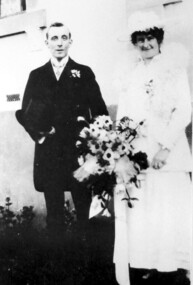
Photograph, Wedding Day of Amelia Amy Jacobs and James Dodgshun from Surrey Hills, 1916
... Girls' School in Mont Albert soon after its opening in 1900. Her mother was Eleanor Mills, youngest daughter of Robert Shortbridge Mills and Ann Lovelady. She died soon after the birth of Amy. Her father was Henry Atwood Jacobs. Following Eleanor's death Henry married Amy Lilian Scales. The donor Winifred Yarnold (nee Jacobs) was their youngest daughter and Amy's half-sister. wedding dresses house names surrey hills warrigal road clothing ...Amelia Allan (Amy) Jacobs on her marriage to James Dodgshun in 1916; photographed at the home of her grandfather, "Terreglea" in Boundary (Warrigal) Road, Surrey Hills. Amelia attended Ormiston Girls' School in Mont Albert soon after its opening in 1900. Her mother was Eleanor Mills, youngest daughter of Robert Shortbridge Mills and Ann Lovelady. She died soon after the birth of Amy. Her father was Henry Atwood Jacobs. Following Eleanor's death Henry married Amy Lilian Scales. The donor Winifred Yarnold (nee Jacobs) was their youngest daughter and Amy's half-sister.Lady dressed as bride wearing a white dress and possibly a lace jacket with a fluffy collar and matching hat, carrying a large bouquet of flowers. The man is wearing a dark suit and carrying a top hat.wedding dresses, house names, surrey hills, warrigal road, clothing and dress, hats, terreglea, the tower house, weddings, wedding parties, ormiston girls school, schools, mont albert, miss amelia allan jacobs, miss amy jacobs, mr james dodgshun -
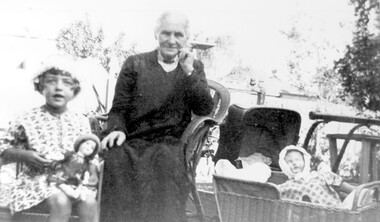 Surrey Hills Historical Society Collection
Photograph, Annie Barton and Jocelyn Cerini, 1928, c1928
... John and Ann Eliza Barton are buried in Box Hill Cemetery - C0044. clothing and dress 1928 miss jocelyn francesca cerini mrs jocelyn hall annie eliza duncan annie eliza barton box hill cemetery rev john barton jocelyn cerini dolls 215 union road A black & white photo of an elderly lady seated in a cane chair in an outdoor setting. To one side is a young girl ...The photo was taken in 1928 and the young child is definately Jocelyn Francesca Cerini, elder daughter of Natale Cerini and his wife Ethel (MS: Swan). The Cerini family lived at 215 Union Road. Most likely that the photo was taken in the back garden of 215 Union Road which backs onto 11 and 13 Barton Street. Thus the houses in the background are the two houses occupied by Barton family members - No 11 and 13 Barton Street, Surrey Hills. The photo card index compiled by Jocelyn Hall (nee Cerini) identifies the elderly lady as Miss Annie Barton, sister of Rev John Barton, second minister of Wyclif Congregational Church. She was a nurse. However the age of Jocelyn (born 1922) makes it more likely that this is Mrs Annie Eliza Barton (nee Duncan), wife of the Rev John Barton and mother of James Duncan Barton, John Saxon Barton, Ida Grace Barton, Albert Edward Barton, Annie Barton and Harold Arthur Barton. Annie Eliza (Duncan) Barton was born in 1845 and died on 16 Jan 1933, which is consistent with the age of the lady pictured. By the time this photo was taken her husband, the Rev John Barton (1844-1919) had died. He was minister of the Wyclif Church in 1896 and continued in that role until 1907. After a further appointment John Barton retired and continued to worship at Wyclif, residing at 13 Barton Street. On Federation in 1901 the street name changed - it was originally Kent Street. John Barton was born in 1845 in Ainsdale, Lancashire, son of James Barton and Ann Rimmer and grew up in Formby - the name later given to No 13 Barton Street. His family appear to have remained in the UK. He married Ann Eliza Duncan in 1872 in Queensland. Of the 2 daughters who were nurses: Ida Grace Barton (b 1877) did not marry. She trained at the Homeopathic Hospital (later Prince Henry's Hospital), graduating in 1909. Annie Barton (b 1883, Geelong) trained at the Melbourne Hospital. She was Matron AANS during WW1 in charge of the Base Hospital (Military) in St Kilda Road. She married Dr John Hodgson Nattrass. She died in 1965 at Caulfield. John and Ann Eliza Barton are buried in Box Hill Cemetery - C0044.A black & white photo of an elderly lady seated in a cane chair in an outdoor setting. To one side is a young girl also seated in a chair and holding a doll; to the other side is a doll's pram containing another doll. The background is indistinct but appear to be houses.clothing and dress, 1928, miss jocelyn francesca cerini, mrs jocelyn hall, annie eliza duncan, annie eliza barton, box hill cemetery, rev john barton, jocelyn cerini, dolls, 215 union road
