
Showing 3009 items matching "1871-1872"
-
 Bendigo Historical Society Inc.
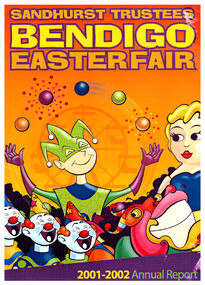
Administrative record - Sandhurst Trustees Bendigo Easter Festival Administration Documents - Annual Reports, 2003
... Gold, gold, gold. The year of 1871 was a great year for Bendigo. Parks were laid out, trees lined the streets. ...Gold, gold, gold. The year of 1871 was a great year for Bendigo. Parks were laid out, trees lined the streets. ...Sandhurst Trustees Bendigo Easter Festival. The aim of The Bendigo Easter Festival is to increase awareness of, and attendance at the Bendigo Easter Festival amongst regional, intrastate, and interstate audiences by 2006. Bendigo Easter Festival - Australia's oldest festival ... .... .. Gold, gold, gold. The year of 1871 was a great year for Bendigo. Parks were laid out, trees lined the streets. Although acknowledged as starting in 1869 the Easter Festival was considered an annual event by 1871. Under brilliant illumination the whole of the Camp Reserve (now Rosalind Park) was filled with a bewildering variety of groups, exhibits and individuals all eager to be involved in such a worthwhile cause. There were sports meetings, theatricals, bazaars and instrumental items as well as dancing and carnival rides. On Easter Monday, as it is today, there was a grand procession that included a variety of bands. 1871 also marked the first year that the Chinese joined in the festivities. Originally the Chinese participated in the procession by dressing in richly embroidered costumes, and carrying colourful banners in all shapes and sizes, which were specially made for them in China. In 1889, the Chinese were given their traditional place in the Parade, the end. They created a wonderful spectacle with their colourful costumes, banners and flags, and in 1892, Loong, the dragon appeared. The Bendigo Easter Festival had been fortunate in that it bad such a lively Chinese community in its midst. At the time of course, Bendigo was known as Sandhurst, and it was not until twenty years after the first Easter Festival that the town was known as Bendigo. These days with sponsorship from the Sandburst Trustees, the Festival is known as the Sandhurst Trustees Bendigo Easter Festival. 132 years later, the Sandburst Trustees Bendigo Easter Festival has had many changes. But loyal followers have never been disappointed. This year people saw the traditions upheld with family entertainments and not Loong, but Sun Loong, meaning new dragon, a 100m long Imperial Dragon who was created to take the place of the aging Loong. Sandhurst Trustees Bendigo Easter Festival Administration Documents - Annual Reports This Item includes the following Documents: 11213.5a1 2001-2003 Booklet Cover 11213.5a2 Annual Report Booklet 2001-2002 - 12 pages 11213.5b Annual Report 2003 - 16 pages 11213.5c Annual Report 2003-2004 - 16 pages 11213.5d Financial Management Report 2003-2004 - 8 pages 11213.5e Event Review 2003 11213.5f Parmalat Gala Parade Entrants and Commentary 15 pages 2003 11213.5g About the Bendigo Easter Fair Festival and Membership Drive for 2004-2005 11213.5h Marketing Plan November 2003 11213.5i The document outlines the planning for a Chinese Autumn Festival event at the Chinese Museum in Bendigo, designed to precede the Awakening of the Dragon ceremony during the Bendigo Easter Fair. Sunday 20th April 2003 11213.5j A summary of the relocation process, access logistics, and contact protocols for using the Bendigo Easter Festival storage at the Bendigo Advertiser Building in 2004 11213.5k Reports, feedback and requests for Sponsorships 2005 11213.5l This four page document outlines sponsorship opportunities for the Coliban Water Day at Lake during the Bendigo Easter Festival for 2005-2006. 11213.5m Bendigo Easter Fair 2003 Professional MC Plan - April bendigo easter festival, bendigo easter fair -
 Bendigo Historical Society Inc.
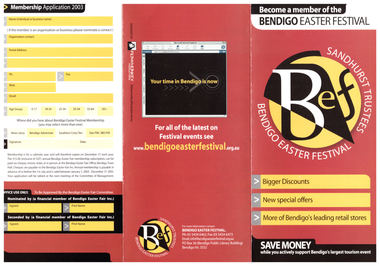
Administrative record - Sandhurst Trustees Bendigo Easter Festival Administration Documents - Membership, 2003
... Gold, gold, gold. The year of 1871 was a great year for Bendigo. Parks were laid out, trees lined the streets. ...Gold, gold, gold. The year of 1871 was a great year for Bendigo. Parks were laid out, trees lined the streets. ...Sandhurst Trustees Bendigo Easter Festival. The aim of The Bendigo Easter Festival is to increase awareness of, and attendance at the Bendigo Easter Festival amongst regional, intrastate, and interstate audiences by 2006. Bendigo Easter Festival - Australia's oldest festival ... .... .. Gold, gold, gold. The year of 1871 was a great year for Bendigo. Parks were laid out, trees lined the streets. Although acknowledged as starting in 1869 the Easter Festival was considered an annual event by 1871. Under brilliant illumination the whole of the Camp Reserve (now Rosalind Park) was filled with a bewildering variety of groups, exhibits and individuals all eager to be involved in such a worthwhile cause. There were sports meetings, theatricals, bazaars and instrumental items as well as dancing and carnival rides. On Easter Monday, as it is today, there was a grand procession that included a variety of bands. 1871 also marked the first year that the Chinese joined in the festivities. Originally the Chinese participated in the procession by dressing in richly embroidered costumes, and carrying colourful banners in all shapes and sizes, which were specially made for them in China. In 1889, the Chinese were given their traditional place in the Parade, the end. They created a wonderful spectacle with their colourful costumes, banners and flags, and in 1892, Loong, the dragon appeared. The Bendigo Easter Festival had been fortunate in that it bad such a lively Chinese community in its midst. At the time of course, Bendigo was known as Sandhurst, and it was not until twenty years after the first Easter Festival that the town was known as Bendigo. These days with sponsorship from the Sandburst Trustees, the Festival is known as the Sandhurst Trustees Bendigo Easter Festival. 132 years later, the Sandburst Trustees Bendigo Easter Festival has had many changes. But loyal followers have never been disappointed. This year people saw the traditions upheld with family entertainments and not Loong, but Sun Loong, meaning new dragon, a 100m long Imperial Dragon who was created to take the place of the aging Loong. Sandhurst Trustees Bendigo Easter Festival Administration Documents - Membership 2003 This Item includes the following Documents: 11213.6a1 Sandhurst Trustees Bendigo Easter Festival - Membership Form Front 11213.6a2 Sandhurst Trustees Bendigo Easter Festival - Membership Form Rear 11213.6b Bendigo Easter Festival Membership Application Form Layout and Membership Categories 11213.6c Bendigo Easter Festival Letters to members - Templates 11213.6d Bendigo Easter Festival Changes to Memberships and Guidleines for 2004 11213.6e Bendigo Easter Festival for 2004 - Two A3 Sheets showing events, and locations Feb 2005 11213.6f Bendigo Easter Festival New Members letters and contact details Aug 2003 - Contact BHS for Details 11213.6g Bendigo Easter Festival Member Tax Invoices and Remittances - Contact BHS for Details 11213.6h Bendigo Easter Festival Membership Expiry Flow Diagram 11213.6i Bendigo Easter Festival Newsletter Jan 2003 11213.6j Bendigo Easter Festival Membership Applications - Contact BHS for Details 11213.6k Handwritten letter from Diolee Myers Davey OAM nomination of Simon Mulqueen for life membership Jan 2003bendigo easter festival, bendigo easter fair -
 Bendigo Historical Society Inc.
Administrative record - Sandhurst Trustees Bendigo Easter Festival Administration Documents - Legal and Insurance, 2003
... Gold, gold, gold. The year of 1871 was a great year for Bendigo. Parks were laid out, trees lined the streets. ...Gold, gold, gold. The year of 1871 was a great year for Bendigo. Parks were laid out, trees lined the streets. ...Sandhurst Trustees Bendigo Easter Festival. The aim of The Bendigo Easter Festival is to increase awareness of, and attendance at the Bendigo Easter Festival amongst regional, intrastate, and interstate audiences by 2006. Bendigo Easter Festival - Australia's oldest festival ... .... .. Gold, gold, gold. The year of 1871 was a great year for Bendigo. Parks were laid out, trees lined the streets. Although acknowledged as starting in 1869 the Easter Festival was considered an annual event by 1871. Under brilliant illumination the whole of the Camp Reserve (now Rosalind Park) was filled with a bewildering variety of groups, exhibits and individuals all eager to be involved in such a worthwhile cause. There were sports meetings, theatricals, bazaars and instrumental items as well as dancing and carnival rides. On Easter Monday, as it is today, there was a grand procession that included a variety of bands. 1871 also marked the first year that the Chinese joined in the festivities. Originally the Chinese participated in the procession by dressing in richly embroidered costumes, and carrying colourful banners in all shapes and sizes, which were specially made for them in China. In 1889, the Chinese were given their traditional place in the Parade, the end. They created a wonderful spectacle with their colourful costumes, banners and flags, and in 1892, Loong, the dragon appeared. The Bendigo Easter Festival had been fortunate in that it bad such a lively Chinese community in its midst. At the time of course, Bendigo was known as Sandhurst, and it was not until twenty years after the first Easter Festival that the town was known as Bendigo. These days with sponsorship from the Sandburst Trustees, the Festival is known as the Sandhurst Trustees Bendigo Easter Festival. 132 years later, the Sandburst Trustees Bendigo Easter Festival has had many changes. But loyal followers have never been disappointed. This year people saw the traditions upheld with family entertainments and not Loong, but Sun Loong, meaning new dragon, a 100m long Imperial Dragon who was created to take the place of the aging Loong. Sandhurst Trustees Bendigo Easter Festival Administration Documents - Legal and Insurance This Item includes the following Documents: 11213.7a Sandhurst Trustees Bendigo Easter Festival - Logo 2003 11213.7b Sub Lease Agreement between the Bendigo Easter Fair Inc and The Rotary club of Bendigo - Town Hall 2005-2006 - Contact the BHS for Details 11213.7c Certificate of Currency Jan 2003 - McCormick Harris and Associates PTY LTD - Contact the BHS for Details 11213.7d Schedule of Insurances Feb 2003 - McCormick Harris and Associates PTY LTD - Contact the BHS for Details 11213.7e This document from Russell Kennedy Solicitors addresses the legal liability, insurance, and risk management considerations for the Bendigo Easter Fair Committee (BEF) and its members. Contact the BHS for details. 11213.7f This letter from McCormick Harris Associates to Bendigo Easter Fair Inc. outlines several key points regarding the organization's insurance arrangements. Recommendation to Transition Insurance coverage to the City of Greater Bendigo March 2003 - Contact the BHS for details 11213.7g This document is a confirmation of insurance coverage provided by the Victorian Managed Insurance Authority (VMIA) for the Crown in right of the State of Victoria and associated entities; 30 June 2002 - Contact the BHS for Details 11213.7h Assorted tax invoices and statements - Contact the BHS for Details 11213.7i Insurance Documents May and June 2003 - Contact the BHS for Detailsbendigo easter festival, bendigo easter fair -
 Bendigo Historical Society Inc.
Administrative record - Sandhurst Trustees Bendigo Easter Festival Administration Documents - Tax Invoices, 2003
... Gold, gold, gold. The year of 1871 was a great year for Bendigo. Parks were laid out, trees lined the streets. ...Gold, gold, gold. The year of 1871 was a great year for Bendigo. Parks were laid out, trees lined the streets. ...Sandhurst Trustees Bendigo Easter Festival. The aim of The Bendigo Easter Festival is to increase awareness of, and attendance at the Bendigo Easter Festival amongst regional, intrastate, and interstate audiences by 2006. Bendigo Easter Festival - Australia's oldest festival ... .... .. Gold, gold, gold. The year of 1871 was a great year for Bendigo. Parks were laid out, trees lined the streets. Although acknowledged as starting in 1869 the Easter Festival was considered an annual event by 1871. Under brilliant illumination the whole of the Camp Reserve (now Rosalind Park) was filled with a bewildering variety of groups, exhibits and individuals all eager to be involved in such a worthwhile cause. There were sports meetings, theatricals, bazaars and instrumental items as well as dancing and carnival rides. On Easter Monday, as it is today, there was a grand procession that included a variety of bands. 1871 also marked the first year that the Chinese joined in the festivities. Originally the Chinese participated in the procession by dressing in richly embroidered costumes, and carrying colourful banners in all shapes and sizes, which were specially made for them in China. In 1889, the Chinese were given their traditional place in the Parade, the end. They created a wonderful spectacle with their colourful costumes, banners and flags, and in 1892, Loong, the dragon appeared. The Bendigo Easter Festival had been fortunate in that it bad such a lively Chinese community in its midst. At the time of course, Bendigo was known as Sandhurst, and it was not until twenty years after the first Easter Festival that the town was known as Bendigo. These days with sponsorship from the Sandburst Trustees, the Festival is known as the Sandhurst Trustees Bendigo Easter Festival. 132 years later, the Sandburst Trustees Bendigo Easter Festival has had many changes. But loyal followers have never been disappointed. This year people saw the traditions upheld with family entertainments and not Loong, but Sun Loong, meaning new dragon, a 100m long Imperial Dragon who was created to take the place of the aging Loong. Sandhurst Trustees Bendigo Easter Festival Administration Documents - Tax Invoices 2003 This Item includes the following Documents: 11213.4a Tax Invoices and Remittance Advices for the year 2003 - Contact BHS for Detailsbendigo easter festival, bendigo easter fair -
 Bendigo Historical Society Inc.
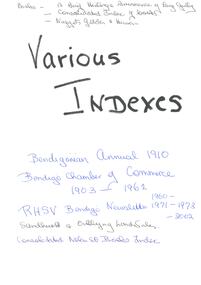
Article - Various Indexes
... Collection of indexes - Business advertisements St Patrick's Annual Sports 1934; White Hills Residents 1907-1908; Business Advertisements from Directories 1865, 1872, 1875, 1904, 1907, 1910; Bendigo Chamber of Commerce 1903, 1913, 1920, 1946; TC Watts 1920s photos of house sales; Back Creek Bendigo Cemetery - First Year Burials; Wills administered by Sandhurst Trustees; 1842-1866 277 Mining Deaths from Inquest records for Sandhurst; The Bendigonian Annual 1910. ...St Patrick's Annual Sports Bendigo businesses White Hills residents Bendigo Chamber of Commerce House sales T.C.Watts Back Creek Cemetery Sandhurst Trustees Mining deaths The Bendigonian Collection of indexes - Business advertisements St Patrick's Annual Sports 1934; White Hills Residents 1907-1908; Business Advertisements from Directories 1865, 1872, 1875, 1904, 1907, 1910; Bendigo Chamber of Commerce 1903, 1913, 1920, 1946; TC Watts 1920s photos of house sales; Back Creek Bendigo Cemetery - First Year Burials; Wills administered by Sandhurst Trustees; 1842-1866 277 Mining Deaths from Inquest records for Sandhurst; The Bendigonian Annual 1910. ...Collection of indexes - Business advertisements St Patrick's Annual Sports 1934; White Hills Residents 1907-1908; Business Advertisements from Directories 1865, 1872, 1875, 1904, 1907, 1910; Bendigo Chamber of Commerce 1903, 1913, 1920, 1946; TC Watts 1920s photos of house sales; Back Creek Bendigo Cemetery - First Year Burials; Wills administered by Sandhurst Trustees; 1842-1866 277 Mining Deaths from Inquest records for Sandhurst; The Bendigonian Annual 1910. Compiled by Carol Holsworth. Collection is in plastic pockets, contained in a white A4 three ring binder. Fourteen plastic pockets in total. st patrick's annual sports, bendigo businesses, white hills residents, bendigo chamber of commerce, house sales, t.c.watts, back creek cemetery, sandhurst trustees, mining deaths, the bendigonian -
 Ballarat Heritage Services
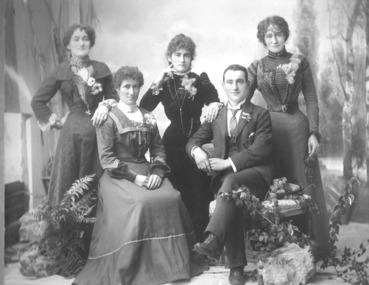
Photograph - Photograph - Black and White, Invernizzi Family of Yandoit Creek, c1900
... Ellen Honoria Invernizzi (b 1872) went to Western Australian, and then to Italy after the death of her parents. ...Ellen Honoria Invernizzi (b 1872) went to Western Australian, and then to Italy after the death of her parents. ...After the death of his parents Paul Invernizzi was brought up at Dunach, Victoria, by his uncle Giovanni Brusachi, and aunt ..... Brusachi nee OSullivanPhotograph of the Invernizzi family of Yandoit Creek, Victoria. Those depicted were the children of Margaret Frances O'Sullivan (b Ireland d 1882 at Yandoit Hill) and Ambrogio Invernizzi (b Italy d 1888 of Yandoit Hill). Ellen Honoria Invernizzi (b 1872) went to Western Australian, and then to Italy after the death of her parents. Her siblings were Onoria Elena Palma Invernizzi (b 1874 died 1961 WA), Frances Margaret Doney (nee Invernizzi) (b 1875 d 1941 WA), Glorinda Invernizzi (b 1877) went to Italy after the death of her parents. Paul Invernizzi (born 1879 d 1963 WA).yandoit creek, yandoit hills, invernizzi, paul invernizzi, glorinda invernizzi, onoria invernizzi, honoria invernizzi, swiss italian -
 Orbost & District Historical Society
albums, late 1980's
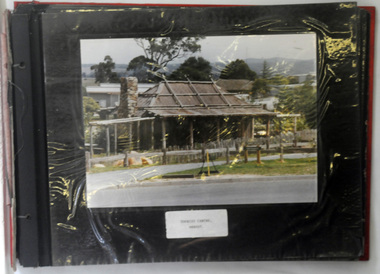
... The hut was an original family dwelling built in 1872, on a site approximately three kilometres upstream from the junction of the Buchan and Snowy Rivers. ...The hut was an original family dwelling built in 1872, on a site approximately three kilometres upstream from the junction of the Buchan and Snowy Rivers. ...These two albums were used at the Slab Hut - Orbost Visitor Information Centre. The Orbost Visitor Information Centre is situated in Forest Park on Nicholson Street. The centre is housed in the historic Slab Hut. The hut was an original family dwelling built in 1872, on a site approximately three kilometres upstream from the junction of the Buchan and Snowy Rivers. No nails were used in the construction; it was all wired together. After a period in storage the slab hut was opened in its present location in Orbost as the Information Centre in 1987.These albums are contemporary records of the construction and relocation of an iconic Orbost building, the Slab Hut.Two large photo albums. 2280.1 has no front cover. The back cover and spine are red. The pages are black and most photos are labelled. They are photographs of the Orbost area. 2280.2 has brown covers. It contains photographs of the construction of the gardens and buildings around the Slab Hut (Orbost Visitor Information Centre). On the cover in gold print is "PHOTOS".slab-hut-orbost album-photographs-orbost -
 Eltham District Historical Society Inc
Folder, Schools no 209 Eltham and no 371 Little Eltham, 1970
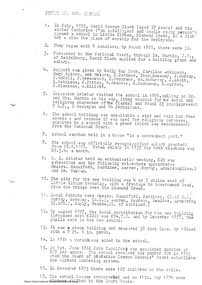
... Copy of handwritten letter from the PROV file dated April 20 1872 advocating the need and preservation of the two schools in the township. ...Copy of handwritten letter from the PROV file dated April 20 1872 advocating the need and preservation of the two schools in the township. harry gilham collection church of england school eltham primary school eltham state school HG Booklet 40 12 pages. ...Information collated about the early history of Eltham Primary School (n 209) from the Education Department Victoria, 1970 (some duplicated) and School no. 371 "Little Eltham" operated by the Church of England. Includes hand written extracts from correspondence registers of the denominational school board from Public Records Office Victoria (marked pages 77-83 from Chappel file). Copy of handwritten letter from the PROV file dated April 20 1872 advocating the need and preservation of the two schools in the township. 12 pages. PhotocopiesHG Booklet 40harry gilham collection, church of england school, eltham primary school, eltham state school -
 Warrnambool and District Historical Society Inc.
Work on paper - Document, Victorian Saddle & Harness Warehouse, C 1900
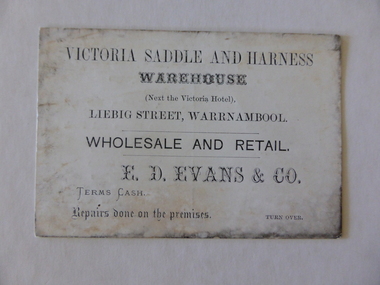
... This business operated in Liebig Street from 1872 to the last known date of 1911. Edward David Evan's saddlery business was prominent in Warrnambool but he also had a similar business in Lonsdale Street, Melbourne. ...This business operated in Liebig Street from 1872 to the last known date of 1911. Edward David Evan's saddlery business was prominent in Warrnambool but he also had a similar business in Lonsdale Street, Melbourne. ...This is an advertising card for the business of E.D.Evans & Co., the Victoria Saddle and Harness Warehouse situated in Liebig Street Warrnambool next to the Victoria Hotel. This business operated in Liebig Street from 1872 to the last known date of 1911. Edward David Evan's saddlery business was prominent in Warrnambool but he also had a similar business in Lonsdale Street, Melbourne. He was a Warrnambool Councillor from 1875 to 1878 and from 1884 to 1888. He was also heavily involved with the Warrnambool Racing Club being President for some time. This is an interesting card because it comes from the saddlery business of E.D. Evans and Co., a prominent business in Warrnambool in the 19th and early 20th Centuries . A white card with black printing on both sides.The card is stained particularly around the edges.VICTORIA SADDLE AND HARNESS WAREHOUSE E.D. EVANS & CO.e.d.evans, saddler of warrnambool, saddlery in warrnambool, edward david evans -
 Bendigo Historical Society Inc.
Administrative record - Deborah Gold Mines N.L. Mine Manager's Report Book, 1930 to 1943
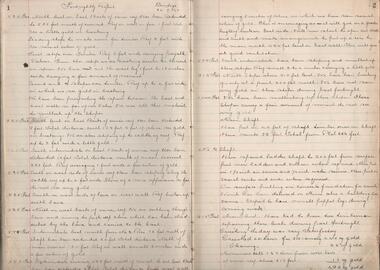
... He was born in Guildford in 1872, died in Bendigo in 1943. He spent his working life working in gold mines, mainly in Bendigo, in various roles, starting his work life as a blacksmith. ...He was born in Guildford in 1872, died in Bendigo in 1943. He spent his working life working in gold mines, mainly in Bendigo, in various roles, starting his work life as a blacksmith. ...Deborah Gold Mines included the South Deborah, North Deborah and Deborah Extended. Deborah Gold Mines N.L. was wound up in 1950, when the shareholders, at an extraordinary meeting confirmed a proposal for voluntary liquidation. (Advertiser., Adelaide, 24 May, 1950) . George Kingsley, who wrote the reports, was the Mine Manager. He was born in Guildford in 1872, died in Bendigo in 1943. He spent his working life working in gold mines, mainly in Bendigo, in various roles, starting his work life as a blacksmith. One hundred and eighty page Mine Manager's fortnightly report book, dark blue cover, white label affixed on front with 'Deborah ....(.illegible) Minute Book' Dates from 18th July 1940 to 23rd July 1943. Entries signed by Geo Kingsley. Mine Manager's report book is part of the Margaret Roberts Collection. bendigo, gold mining, deborah gold mines, north deborah, south deborah, deborah extended, margaret roberts collection -
 Bendigo Historical Society Inc.
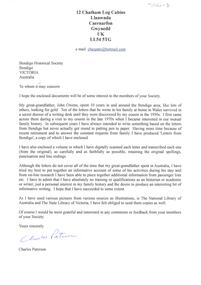
Document - LETTER
... He returned to Wales in 1863 and in 1864 he married his uncles widow, Jane Davis. Jane died in 1872 and John then married Mary Ellen Jackson....He returned to Wales in 1863 and in 1864 he married his uncles widow, Jane Davis. Jane died in 1872 and John then married Mary Ellen Jackson. ...John Owens (1831-1892) was a Welshman who spent 1853-1863 in Australia, predominantly on the Bendigo goldfields.He was a miner who also initially set up a horse drawn puddling machine, although he sold this in 1857. He gave first hand insight into life on the goldfields through letters he wrote home to his parents. He returned to Wales in 1863 and in 1864 he married his uncles widow, Jane Davis. Jane died in 1872 and John then married Mary Ellen Jackson.Letter fromCharles Patersonaccompanying donation of two books 5316.1 Letters from Bendigo 5316.2 Letters from the Bendigo Diggings Both books spiral bound and contain coloured prints & maps. Books enclosed in plastic sleeve.John Owensperson, family, john owens, history-bendigo-goldfields-family-owens -
 Bendigo Historical Society Inc.
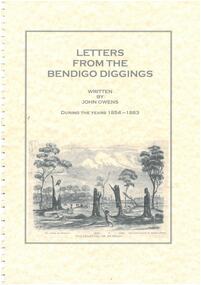
Book - LETTERS FROM THE BENDIGO DIGGINGS
... He returned to Wales in 1863 and in 1864 he married his uncles widow, Jane Davis. Jane died in 1872 and John then married Mary Ellen Jackson....He returned to Wales in 1863 and in 1864 he married his uncles widow, Jane Davis. Jane died in 1872 and John then married Mary Ellen Jackson. ...John Owens (1831-1892) was a Welshman who spent 1853-1863 in Australia, predominantly on the Bendigo goldfields.He was a miner who also initially set up a horse drawn puddling machine, although he sold this in 1857. He gave first hand insight into life on the goldfields through letters he wrote home to his parents. He returned to Wales in 1863 and in 1864 he married his uncles widow, Jane Davis. Jane died in 1872 and John then married Mary Ellen Jackson.Letters from the Bendigo diggings comprising copies of letters written by John Owens to his family in Wales during the years 1854 - 1863 & Letters from Bendigo written by John Owens, Great Grandfather of Charles Paterson. John Owens was in the goldfields of Victoria during the years 1853 - 1863. . One of two books donated by Charles Paterson. Both books spiral bound and contain coloured prints & maps. Books enclosed in plastic sleeve.John Owensperson, family, john owens, history-bendigo-goldfields-family-owens -
 Warrnambool and District Historical Society Inc.
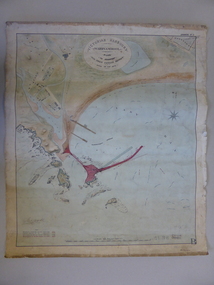
Document - Map, Warrnambool Harbour 1879, 1879
... Coode first visited Australia in 1872 when he commenced work with the Melbourne Harbour Trust to report on ways to improve Melbourne Port. ...Coode first visited Australia in 1872 when he commenced work with the Melbourne Harbour Trust to report on ways to improve Melbourne Port. ...This map shows the plans by eminent harbour engineer, Sir John Coode in 1879. Construction of the breakwater commenced in 1884 and was completed in 1890. Coode first visited Australia in 1872 when he commenced work with the Melbourne Harbour Trust to report on ways to improve Melbourne Port. He is considered one of the most eminent harbour engineers of the 19th century. His original plans for Warrnambool were revised because of cost but then subsequently found to be inadequate and later extended. This was not successful either and the harbour continues to have silting problems to this day. The Warrnambool Breakwater is of historical importance to Victoria and as this map depicts the original plans, it too has great historical significance. It is also significant with its association with Sir John Coode, who was one of the most important port engineers of the 19th century. He worked to improve ports along the Victorian coast including Portland, Geelong, Port Fairy and Lakes Entrance. While this map demonstrates the engineering skills of the era, it also reflects the limitations when natural elements are involved. Its Historical importance also lies in the depiction of items on the map which relate to Warrnambool’s early history. Paper on linen map coloured, and depicting the harbour area of Warrnambool with the proposed breakwater plan in red. It has Victorian Harbours information in oval at top of map. It shows depths of some areas.In oval at top, “Victorian Harbours Warrnambool plan to accompany Sir John Coode report dated 28th Feb 1879. Drawing No 2. Scale 500 feet to 1 inch at bottom centre. Sir John Coode signature in bottom left corner. A 33 A on bottom left reversesir john goode, warrnambool harbour map, warrnambool harbour map 1879, port of warrnambool map 1879 -
 Bendigo Historical Society Inc.
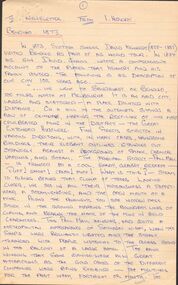
Document - BENDIGO 1873
... HE had a large family many of whom were also singers and toured throughout the world. 1872-1876 the group toured Canada, New Zealand and Australia. ...HE had a large family many of whom were also singers and toured throughout the world. 1872-1876 the group toured Canada, New Zealand and Australia. ...David Kennedy(1825-1886) was a Scottish singer. Initially a church musician. HE had a large family many of whom were also singers and toured throughout the world. 1872-1876 the group toured Canada, New Zealand and Australia. In 1879 and 1880 they toured India and South Africa. In 1881 three of his children died in a fire at a Nice theatre. David died in South Africa but is buried in Scotland. David junior(1849-1885) began as a singer with his father but later moved into writing.Hand written account of Scottish singer David Kennedy and his family's World Tour, of which Bendigo was a part, written by David Kennedy Jnr. He tells of the mine in Pall Mall, the gold cakes from the different companies displayed in the bank windows, meeting some Chinese sifting tailings, buying a Chinese book and then finding it was an old almanac. Meeting two Irishmen and an account of a large public school. Some of the ink has run.document, bendigo 1873, david kennedy, david kennedy jnr, great extended hustlers, messrs smith and jones, david kennedy the scottish singer, marjory kennedy, alexander gardener -
Bendigo Historical Society Inc.
Document - ADDRESS TO MRS C HEINZ, May 1896
... He established the Happy Valley Butchers shop in 1872 with his two brothers. This continued to expand and eventually moved to Korong Road. ...He established the Happy Valley Butchers shop in 1872 with his two brothers. This continued to expand and eventually moved to Korong Road. ...Conrad Heinz (1846-13/2/1896) was born in Germany and came to Australia aged 15. He married Franziska Ingelfinger in 1866. He established the Happy Valley Butchers shop in 1872 with his two brothers. This continued to expand and eventually moved to Korong Road. He was patron of the Bendigo Athletics Club and was elected unopposed to the Barkly Ward of the Bendigo council in 1892 and served as Mayor and Chief Magistrate in 1894. He died of cancer of the knee after preferring Chinese traditional medicines rather than the advised amputation.Address to Mrs. C. Heinz. Dear Madam. We are directed by the members of the Bendigo Athletic Club to express to you their deepest sympathy in the great loss you have sustained by the death of your late beloved husband the late Mayor. Councillor Heinz. Signed by President. Treasurer. Secretary. Bendigo May 1896. Sketch of Cricket Gear. Rugby Player. 2 Runners. Pennyfarthing bike. Weeping Willow tree. Gilt frame. By curtesy of Mr & Mrs.A.Hufer. DP 553. F.Fearn.F.Fearn ?person, individual, certificate -
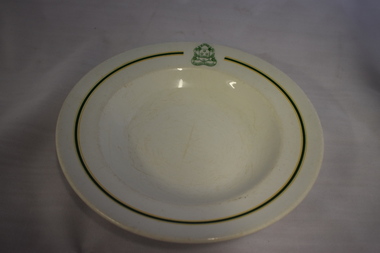 Warrnambool and District Historical Society Inc.
Plate, St Anns Warrnambool, Early to mid 20th century
... St Ann’s School opened in 1872 as St Mary’s Convent of Mercy School, Wyton, with the latter name being the name of the ex-John Ardlie house in which the school was initially established. ...St Ann’s School opened in 1872 as St Mary’s Convent of Mercy School, Wyton, with the latter name being the name of the ex-John Ardlie house in which the school was initially established. ...This plate came from St Ann’s School, Warrnambool. It was probably used in the boarding house section and may have been used for either soup or cereal. St Ann’s School opened in 1872 as St Mary’s Convent of Mercy School, Wyton, with the latter name being the name of the ex-John Ardlie house in which the school was initially established. There were eight foundation Sisters of Mercy. The name changed to St Ann’s Convent School in 1888 and in 1991 it amalgamated with the Warrnambool Christian Brothers College to form Emmanuel College.This plate is an interesting memento of St. Ann’s School in Warrnambool in the mid 20th century.This is a round china plate with a green and yellow band around the inner edge of the plate. There is also the emblem of the school with the name and motto. The plate has a dip or recess in the middle. The china is slightly crazed. ‘St. Anns Warrnambool Omnia Vincit Labor’ st ann’s school, warrnambool, emmanuel college, warrnambool -
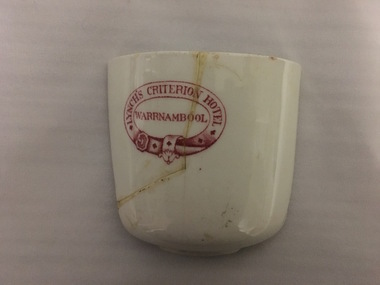 Warrnambool and District Historical Society Inc.
Household, Cup Fragment
... This hotel, on the western side of Kepler Street near Lava Street, Warrnambool, was opened in 1872 with John Tate as the first licensee. ...This hotel, on the western side of Kepler Street near Lava Street, Warrnambool, was opened in 1872 with John Tate as the first licensee. ...This fragment is a piece of a cup that came from the Criterion Hotel in Warrnambool. This hotel, on the western side of Kepler Street near Lava Street, Warrnambool, was opened in 1872 with John Tate as the first licensee. Two notable families associated with the Criterion Hotel were the Humm family, (late 19th and early 20th centuries) and the McGennan family ( from the late 1920s on) The name on the fragment is that of Theresa Lynch who was the licensee of the hotel from 1919 to 1926 and the owner for most of that time. The hotel was closed in 2008 and, following a fire, the building was demolished in 2013.This fragment is of interest as it is one of the few items we have that date from the time of Theresa Lynch and the Criterion Hotel.This is a curved piece, one half of a white china cup. The fragment has been broken and mended. The fragment has imprinted on it in a red circle the name of a Warrnambool hotel and its proprietor. ‘Lynch’s Criterion Hotel Warrnambool’ theresa lynch, warrnambool -
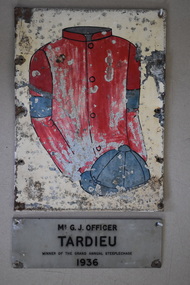 Warrnambool and District Historical Society Inc.
Plaque, Tardieu, C 1990
... The Warrnambool Grand Annual Steeplechase was first held in June 1872. Today it is part of the Warrnambool May Racing Carnival and is run over 5,500 metres with 32 fences. ...The Warrnambool Grand Annual Steeplechase was first held in June 1872. Today it is part of the Warrnambool May Racing Carnival and is run over 5,500 metres with 32 fences. ...These plaques were once on display at the Warrnambool racecourse with the smaller one originally affixed to a seat. These plaques commemorate the winner of the Grand Annual Steeplechase in Warrnambool in 1931. The Warrnambool Grand Annual Steeplechase was first held in June 1872. Today it is part of the Warrnambool May Racing Carnival and is run over 5,500 metres with 32 fences. Tardieu won the race in 1936 and was one of only two horses with riders to finish the course the other being Montargis. The owner of the the horse Mr Officer was chairman of the Warrnambool Racing club at the time.These plaques are of interest as mementoes of the Warrnambool Grand Annual Steeplechase one of Australia's most significant hurdle races..1 Silver coloured metal plaque in a rectangular shape with four holes in each corner for attachment to a surface. There is black printing on the plaque. .2 A rectangular shaped metal plaque with ten perforations along the longer sides. The plaque has a sketch of a jockey's cap and silks in blue and pink. Mr G J Officer TARDIEU Winner of the Grand Annual Steeplechase 1936.warrnambool, racing club, warrnambool grand annual steeplechase -
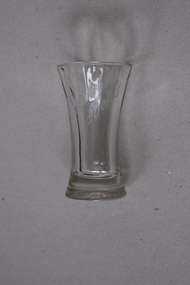 Warrnambool and District Historical Society Inc.
Criterion Hotel Glass, Glass, Mid 20th century
... The Criterion Hotel opened in Kepler Street, Warrnambool in April 1872. The first licensee was John Tate and the Humm family members of Woodford and the McGennan family of Warrnambool were prominent licensees and owners in the late 19th and 20th centuries. ...The Criterion Hotel opened in Kepler Street, Warrnambool in April 1872. The first licensee was John Tate and the Humm family members of Woodford and the McGennan family of Warrnambool were prominent licensees and owners in the late 19th and 20th centuries. ...This small glass has been kept as a souvenir of the Warrnambool Criterion Hotel by a local resident, James Godfrey. The Criterion Hotel opened in Kepler Street, Warrnambool in April 1872. The first licensee was John Tate and the Humm family members of Woodford and the McGennan family of Warrnambool were prominent licensees and owners in the late 19th and 20th centuries. In the second half of the 20th century the hotel was an important centre in Warrnambool for live pop music. The hotel closed in 2008. The building was partially destroyed by fire in 2010 and the remaining structure was demolished in 2013. This glass is significant because it has local provenance as a memento of a hotel in Warrnambool prominent in the local business world for 136 years and as an example of the souvenirs kept of this hotel by Warrnambool residents.This is a small clear glass tumbler with a heavy base and a slightly tapered neck and a circular open top. The name ‘Criterion Hotel’ has been etched on to the side of the glass.Criterion Hotelcriterion hotel warrnambool, history of warrnambool, glass -
Warrnambool and District Historical Society Inc.
Administrative record - Note book
... The dates are from 1859 to 1872. The names of the workers and their wages and transactions have been recorded by either William Cassady or a foreman. ...The dates are from 1859 to 1872. The names of the workers and their wages and transactions have been recorded by either William Cassady or a foreman. ...This note book contains details of the men who worked, mainly as casual labourers, at the farm Boughton at Cassady's Bridge near Warrnambool. The dates are from 1859 to 1872. The names of the workers and their wages and transactions have been recorded by either William Cassady or a foreman. The entries are notable for the original creative spelling and the lack of information on the names of the workers, often referred to by their first name or a nick name. William Cassady (1824-1885) purchased Boughton in 1846 and he and his wife, Elizabeth had fourteen children.This note book is of considerable significance because it is an early record of the property Boughton and its workersThis is a note book with a metal fastener, and a cloth cover with a green mottled pattern inside. The pages have printed red lines and black hand writing. The cover is stained and partly detached from the binding.william cassady, boughton, cassady's bridge -
 Warrnambool and District Historical Society Inc.
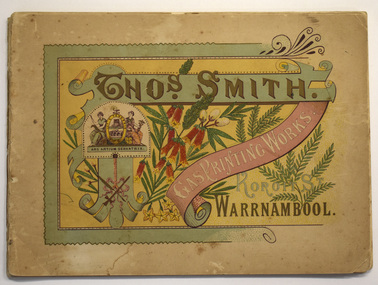
Booklet - Printer's Advertising Booklets, Thomas Smith, Printer, Koroit St. Warrnambool, Thos. Smith Gas Printing Works Koroit St. Warrnambool, c. 1900
... He was later involved with the Port Fairy newspaper, the Belfast Gazette before establishing a gas printing business in Kepler Street, Warrnambool in 1872. He later moved to Koroit Street. The booklets show specimens of his work which were engraved, lithographed or printed - letterheads, business cards etc. ...He was later involved with the Port Fairy newspaper, the Belfast Gazette before establishing a gas printing business in Kepler Street, Warrnambool in 1872. He later moved to Koroit Street. The booklets show specimens of his work which were engraved, lithographed or printed - letterheads, business cards etc. ...A booklet advertising the work of Warrnambool printer Thomas SmithThese are two copies of a advertising booklet.The cover is multi-coloured and includes an ornamental border, a crest, scroll work, images of flowers and fronds and printed headings. One copy is missing its cover and the cover of the other copy is detached The booklets contain black and white photographs and drawings, reproductions of the printer's work and a sketch map of the Warrnambool C.B.D. The booklets are bound with cotton thread.non-fictionA booklet advertising the work of Warrnambool printer Thomas Smith 19th century warrnambool businesses, thomas smith printer, lithographer warrnambool -
 National Wool Museum
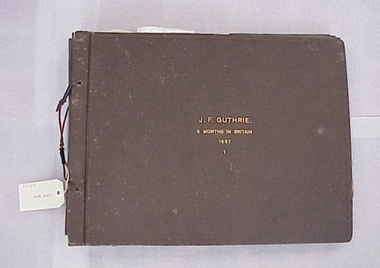
Scrapbook, J.F Guthrie. 3 Months in Britain 1937 1
... Senator James Francis Guthrie (1872-1958) was the founder and first president of the Australian Corriedale Sheepbreeders' Association in 1914 and was involved in the wool industry all his life. ...Senator James Francis Guthrie (1872-1958) was the founder and first president of the Australian Corriedale Sheepbreeders' Association in 1914 and was involved in the wool industry all his life. ...Part of collection of items related to the late Senator J.F. Guthrie, breeder of Corriedales. Senator James Francis Guthrie (1872-1958) was the founder and first president of the Australian Corriedale Sheepbreeders' Association in 1914 and was involved in the wool industry all his life. He worked for Dalgety's and was managing director of the Guthrie Corriedale Stud. He was a Senator for Victoria between 1920-38 and wrote a number of books about the Australian wool industry.Part of collection of items related to the late Senator J.F. Guthrie, breeder of Corriedales.Part of collection of items related to the late Senator J.F. Guthrie, breeder of Corriedales. Part of collection of items related to the late Senator J.F. Guthrie, breeder of Corriedales.J.F Guthrie. 3 Months in Britain 1937 1anzac day, guthrie, senator james francis c.b.e. gilligan, mrs marguerite, london, england -
 National Wool Museum
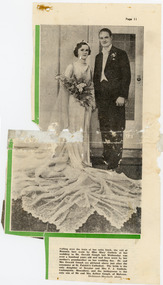
Magazine clipping
... Senator James Francis Guthrie (1872-1958) was the founder and first president of the Australian Corriedale Sheepbreeders' Association in 1914 and was involved in the wool industry all his life. ...Senator James Francis Guthrie (1872-1958) was the founder and first president of the Australian Corriedale Sheepbreeders' Association in 1914 and was involved in the wool industry all his life. ...Part of collection of items related to the late Senator J.F. Guthrie, breeder of Corriedales. Senator James Francis Guthrie (1872-1958) was the founder and first president of the Australian Corriedale Sheepbreeders' Association in 1914 and was involved in the wool industry all his life. He worked for Dalgety's and was managing director of the Guthrie Corriedale Stud. He was a Senator for Victoria between 1920-38 and wrote a number of books about the Australian wool industry.Part of collection of items related to the late Senator J.F. Guthrie, breeder of Corriedales.Magazine cutting of wedding photograph of Mary Guthrie and Dr Oswald Gough.guthrie, senator james francis c.b.e. gilligan, mrs marguerite, melbourne, victoria -
 National Wool Museum
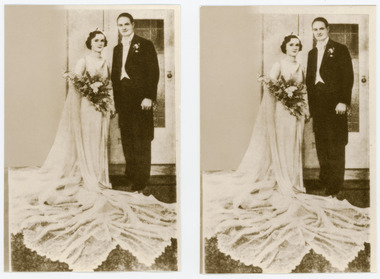
Photograph
... Senator James Francis Guthrie (1872-1958) was the founder and first president of the Australian Corriedale Sheepbreeders' Association in 1914 and was involved in the wool industry all his life. ...Senator James Francis Guthrie (1872-1958) was the founder and first president of the Australian Corriedale Sheepbreeders' Association in 1914 and was involved in the wool industry all his life. ...Part of collection of items related to the late Senator J.F. Guthrie, breeder of Corriedales. Senator James Francis Guthrie (1872-1958) was the founder and first president of the Australian Corriedale Sheepbreeders' Association in 1914 and was involved in the wool industry all his life. He worked for Dalgety's and was managing director of the Guthrie Corriedale Stud. He was a Senator for Victoria between 1920-38 and wrote a number of books about the Australian wool industry.Part of collection of items related to the late Senator J.F. Guthrie, breeder of Corriedales.Two sepia photographs of Mary Guthrie and Dr Oswald Gough on their wedding day.guthrie, senator james francis c.b.e. gilligan, mrs marguerite, melbourne, victoria -
 National Wool Museum
Photograph
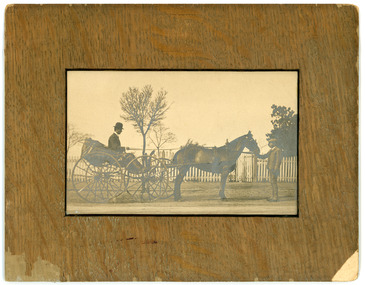
... Senator James Francis Guthrie (1872-1958) was the founder and first president of the Australian Corriedale Sheepbreeders' Association in 1914 and was involved in the wool industry all his life. ...Senator James Francis Guthrie (1872-1958) was the founder and first president of the Australian Corriedale Sheepbreeders' Association in 1914 and was involved in the wool industry all his life. ...Part of collection of items related to the late Senator J.F. Guthrie, breeder of Corriedales. Senator James Francis Guthrie (1872-1958) was the founder and first president of the Australian Corriedale Sheepbreeders' Association in 1914 and was involved in the wool industry all his life. He worked for Dalgety's and was managing director of the Guthrie Corriedale Stud. He was a Senator for Victoria between 1920-38 and wrote a number of books about the Australian wool industry.Part of collection of items related to the late Senator J.F. Guthrie, breeder of Corriedales.Sepia photograph of horse and buggy and two gentlemen, framed in thin wooden frame.guthrie, senator james francis c.b.e. gilligan, mrs marguerite -
 Whitehorse Historical Society Inc.
Photograph, Vermont Primary School No 3133, 1980's
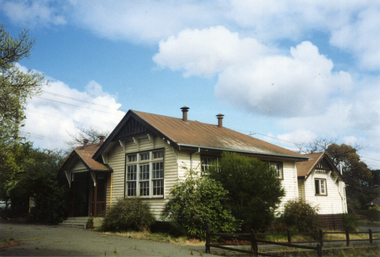
... The first of the Vermont Primary School buildings was erected on 1872. In 1907 a room was built onto the west side of the building and a new classroom and cloakroom were erected in 1922. ...The first of the Vermont Primary School buildings was erected on 1872. In 1907 a room was built onto the west side of the building and a new classroom and cloakroom were erected in 1922. ...The first of the Vermont Primary School buildings was erected on 1872. In 1907 a room was built onto the west side of the building and a new classroom and cloakroom were erected in 1922. Due to rising numbers and traffic volume, Vermont Progress Association urged the government to relocate the school buildings to a less prominent site, and new school buildings were erected in Nurlendi Street in the 1950's. The original timber building remained on the site until its removal to the Nurlendi Street site in the 1990's, and is on the city of Whitehorse Heritage Review.Coloured photograph of the Vermont Primary School while it was standing vacant from the 1950's until 1989 when it was moved to the main school in Nurlendi Road, Vermont. The school was on the North West corner of Canterbury and Mitcham roads facing Mitcham Road. Canterbury Road can be seen through the trees at the left of the photograph.vermont primary school no 3133, primary schools -
 City of Greater Bendigo - Civic Collection
Photograph - Portrait, Vincent Kelly, Mrs A.J. Anderson Mayoress 1941 - 1942, 1942
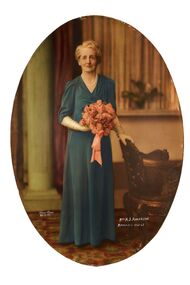
... Mayoress Anderson was born Mary Gittins at Sandhurst in 1872 and was the daughter of William Bromley Gittins and Susan Horwood. ...Mayoress Anderson was born Mary Gittins at Sandhurst in 1872 and was the daughter of William Bromley Gittins and Susan Horwood. ...Prior to the election of female Councillors and Mayors from the 1960’s onwards the Mayoress role was one of the few ways women could be active in civic life. Mayoresses made important contributions to their local communities through their charity work and as ambassadors for their region on a state and at times, international level. They also undertook some Mayoral duties on occasions when the Mayor was unavailable. Mayoress Anderson was born Mary Gittins at Sandhurst in 1872 and was the daughter of William Bromley Gittins and Susan Horwood. She was Mayoress from 1941 - 42.Framed, oval photographic studio portrait of Mrs A.J Anderson. Hand coloured detail.Mrs. A.J. Anderson / Mayoress 1941 - 42 / Vincent Kelly / Bendigomary gittins, mayor a.j. anderson, vincent kelly photographer, mayoress mary anderson, city of greater bendigo portraits, city of bendigo, framed copy -
 Eltham District Historical Society Inc
Photograph - Digital Photograph, Alan King, Wellers Restaurant, 150 Eltham-Yarra Glen Road, Kangaroo Ground, 23 January 2008
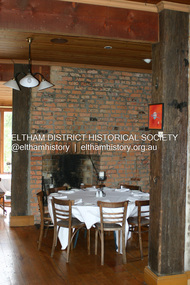
... Originally Wellers Hotel, it was constructed by Edward Weller in 1872. Following his death in 1883 it was taken over by his widow, Mary Weller. ...Originally Wellers Hotel, it was constructed by Edward Weller in 1872. Following his death in 1883 it was taken over by his widow, Mary Weller. ...Originally Wellers Hotel, it was constructed by Edward Weller in 1872. Following his death in 1883 it was taken over by his widow, Mary Weller. The hotel was delicensed in 1909 and converted to a private residence. Around 1920 William Pitman bought the property, succeeded by his son Vernon who coined the term Pittman's Corner. Vernon and Isabel Pitman owned the house form 1945-1973. Following Vernon's death, Isabel remained there till her death in 1983. The property was converted to a restaurant in 1984 by owners Robert and Kath Hendry who undertook extensive renovations in 1988. Shawn and Stephanie Wolfe purchased the property from the Hendrys in 2003 and introduced live entertainment with many famous bands and entertainers from the 1960s, 1970s and 1980s performing there, including James Reyne, Daryl Barithwaite, Brian Cadd and Billy Thorpe. In 2014 the Wolfe's sold the property and the entire contents were sold at auction. New (local ) owners Gregory Anderson, Craig Jones and Steve Gist refurbished the property and relaunched it as Fondata 1872 in 2017. Covered under Heritage Overlay, Nillumbik Planning Scheme. Published: Nillumbik Now and Then / Marguerite Marshall 2008; photographs Alan King with Marguerite Marshall.; p87This collection of almost 130 photos about places and people within the Shire of Nillumbik, an urban and rural municipality in Melbourne's north, contributes to an understanding of the history of the Shire. Published in 2008 immediately prior to the Black Saturday bushfires of February 7, 2009, it documents sites that were impacted, and in some cases destroyed by the fires. It includes photographs taken especially for the publication, creating a unique time capsule representing the Shire in the early 21st century. It remains the most recent comprehenesive publication devoted to the Shire's history connecting local residents to the past. nillumbik now and then (marshall-king) collection, eltham-yarra glen road, fondata 1872, kangaroo ground, wellers restaurant, billy thorpe, brian cadd, craig jones, daryl barithwaite, edward weller, gregory anderson, hotels, james reyne, kath hendry, mary weller, restaurants, robert hendry, shawn wolfe, stephanie wolfe, steve gist -
 Flagstaff Hill Maritime Museum and Village
Journal, May 1868 - June 1877
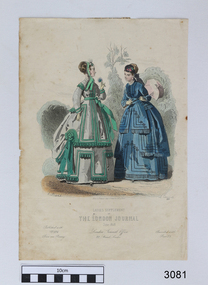
... Preval”, a mid to late 19th century watercolour artist. Covers from 1871 have no signatures but have the word “COPYRIGHT” included in the printing. ...Preval”, a mid to late 19th century watercolour artist. Covers from 1871 have no signatures but have the word “COPYRIGHT” included in the printing. ...This Journal contains a wide variety of lifestyle subjects, showing an interest in in collection of ladies’ fashion covers, newspaper clippings and personal notes appear to have been gathered by a person with interests in fashion, poetry and the home. The covers dating up to 1870 have signatures such as “E. Preval”, a mid to late 19th century watercolour artist. Covers from 1871 have no signatures but have the word “COPYRIGHT” included in the printing. The name below the illustrations “Moine et Falconer” is a French fashion printer and publisher. The loose newspaper cuttings are dated from 1878 to 1927. Journal, comprising a collection of sixty (60) medium weight cartridge paper covers of the “Ladies’ Supplement of the London Journal” with a selection of newspaper clippings pasted to the back of all but two of the covers. The journal covers are dated between years 1868 – 1877. They each have a hand coloured engraving. Below some of the illustrations is a name and address (in French). Some of the covers have a portrait orientation and others are landscape. Some of the covers have a length of additional paper on the left/top with small print, as though there has been a magazine spine attached. The covers have printed dates and numbers, and some of the illustrations are numbered and have one or two signatures. On the reverse of the covers is a selection of newspaper cuttings, including poetry, Household Receipts (recipes, helpful hints on household matters, quotes, fashion, etc.) and personal notes, carefully cut to fit onto the pages. Hand written dates on some of these articles show that they are not all from the same date, and don’t necessarily correspond to the date of the cover. Some of these pages have been assembled upside down to the front cover. Also included are additional notes and loose newspaper cuttings from 1878 – 1927. Under some of the hand coloured engravings are the printed words “Moine et Falconer, imp. r. St Victor, go Paris” (or similar). There are also one or two signatures on the earlier engravings including “E. Preval”. Printed onto the Journal pages “Price one Penny”. Several of the pages have hand drawn lines and pencil script notes. Many of the newspaper cuttings have a date written in pencil on them. For example, “Stuffing Birds”.. The Ladies’ Supplements have been printed with number for “Published with No. –“, and a number for “Presented with Part -”. Some of the reverse pages have pencil notes beside them. flagstaff hill, warrnambool, shipwrecked coast, flagstaff hill maritime museum, maritime museum, shipwreck coast, flagstaff hill maritime village, great ocean road, ladies’ supplement of the london journal, the london journal, journal, 19th century, london journal office, moine et falconer, fashion print, ladies’ clothes, fashion plates, 19th century lifestyle, 19th century fashion, e proval -
 Bendigo Historical Society Inc.
Document - The Mechanics Institute and Its Successors - Technical Education in Bendigo, 2/11/2023
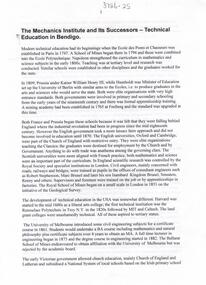
... The MI supported the establishment of a School of Design in 1871. A separate School of Mines began classes in 1873 initially using the MI building. ...The MI supported the establishment of a School of Design in 1871. A separate School of Mines began classes in 1873 initially using the MI building. ...The Mechanics Institute movement began in Scotland in the early 1800's with the goal of providing classes for the working classes. In 1854 a group was formed in Bendigo to establish a Mechanics Institute. By 1856 the first permanent building was established in McCrae Street and included a free library. Initially it provided classes in drawing, arithmetic and book-keeping. The MI supported the establishment of a School of Design in 1871. A separate School of Mines began classes in 1873 initially using the MI building. In 1904 the School of Mines took over the MI including the library and developed further into what is now Bendigo TAFE.A 5 page document on the history of modern technical education and the Bendigo Mechanics Institutebendigo mechanical insitute, history, bendigo tafe
