
Showing 1000 items matching "district nursing"
-
 Royal District Nursing Service (now known as Bolton Clarke)
Photograph - Photograph, black and white, Barry Sutton, 24.04.1974
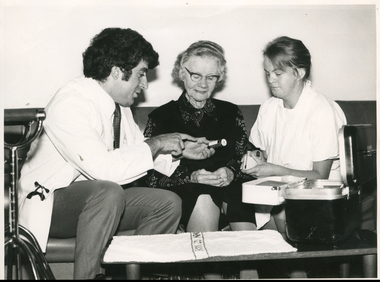
... royal district nursing service...A Medical Student is explaining the use of a bottle of testing tablets to a lady who is a patient of RDNS. The Royal District Nursing Service (RDNS) Sister is holding testing equipment; i.e. the eye dropper and test tube in the receptacle, in her hands, and is observing the Medical Student giving instructions to the lady. ...Sitting to her right, and facing the lady, is a Royal District Nursing Service (RDNS) Sister who has her long dark hair drawn back. ...Education was an integral part of Melbourne District Nursing Society (MDNS) from its inception in 1885, later called Royal District Nursing Service, (RDNS). ...A Medical Student is explaining the use of a bottle of testing tablets to a lady who is a patient of RDNS. The Royal District Nursing Service (RDNS) Sister is holding testing equipment; i.e. the eye dropper and test tube in the receptacle, in her hands, and is observing the Medical Student giving instructions to the lady. The photograph is taken in the lady's home.Education was an integral part of Melbourne District Nursing Society (MDNS) from its inception in 1885, later called Royal District Nursing Service, (RDNS). Only Trained nurses (Nurses) were employed by the Society, and on visits to patients they taught the necessity of hygiene and cleanliness, as well as the need for a good diet, to bring about good health. Doctor’s lectures were later given at the MDNS home to instruct patients and their families on prevention of disease. Education to patients continued throughout the years regarding health care and the use of equipment in the home. In 1961 Education programs commenced at MDNS with Trained nurses (Sisters) receiving In-service education. Sr. Pat (Paddy) Rowley was a leader in In-service Education and established the RDNS Department of Community Nursing Education in 1962. Staff could also apply for scholarships to further their education outside of RDNS. At RDNS many programs were run, including: a Post Basic Course, Cardiac Rehabilitation Nursing, Haematology/Oncology Nursing, Palliative Care program, Diabetic Stabilization Program, Leg Ulcer Management Program, Wound Care Specialist Program, HIV/AIDS Nursing Care, Cystic Fibrosis Home Support, Veterans Home Care Program, Breast Cancer Support Program, Continence Management Program, Stomal Therapy Program, In-Home Lactation Support Program. RDNS Sisters attended several hospitals to observe and learn special care needed to some patients, e.g. to the Austin Hospital to learn the care required for paraplegic and quadriplegic patients at home and to Mount Royal Hospital to observe the care of patients in the rehabilitation ward. RDNS moved its Education Department from 452 St. Kilda Road to 448 St. Kilda Road in 1974. A Community Nursing Education Program was extended to student nurses from hospitals and to other nursing organizations. These Education programs kept the RDNS Sisters abreast of new techniques, such as changes in technology for e.g. new testing methods for detecting glucose levels in Diabetic patients. Sr. Nan Deakin obtained a Post Basic Certificate in Psychiatric Nursing and included this area in her Education lectures. Sr. Daphne Geldard specialized in the area of Alzheimer’s disease and Dementia. These Sisters visited patients in District areas with the regular RDNS Sister when required. Every member of staff, both professional and non professional staff, received regular education in the Education Department. In 1980, a Home Health Aide pilot study, funded by the Federal Government, the Brotherhood of St. Laurence and RDNS, with the program written and taught by Sr. Rowley, was evaluated as successful, and Home Health Aides were employed and worked in RDNS Centres under the supervision of the RDNS Sisters.In the left foreground of this black and white photograph is the partial view of two metal 4 prong sticks.To their right, seated on a long dark vinyl type couch, is a Medical Student who has short curly black hair; is wearing a white hospital coat over grey trousers, a white shirt, and a tie with small black and white squares. A stethoscope is folded in the pocket of his coat. He is turned toward the right of the photograph and is holding, on its side, a small bottle in his left hand and is pointing his right index finger to writing on its label. An elderly lady who is wearing glasses and has wavy grey hair is sitting to his right and is looking at the label on the bottle. She is wearing a black skirt and black sleeveless jacket over a black and white patterned blouse. Her hands are clasped in her lap. Sitting to her right, and facing the lady, is a Royal District Nursing Service (RDNS) Sister who has her long dark hair drawn back. She is wearing a white short sleeve gown over her uniform, and is holding a white oblong receptacle which holds a test tube, which has dark fluid in the bottom, and an eye dropper. In front of her, is a white 'inner tray' which is clipped onto the front edge of an open oblong black RDNS nursing case which is in the right foreground of the photograph sitting on a long, narrow, low table. On the table and to the left of the case a small white hospital drape runs along the table.Barry Sutton MA 24royal district nursing service, rdns, rdns patient care, rdns education -
 Royal District Nursing Service (now known as Bolton Clarke)
Photograph - Photograph, black and white, Barry Sutton, c.1970
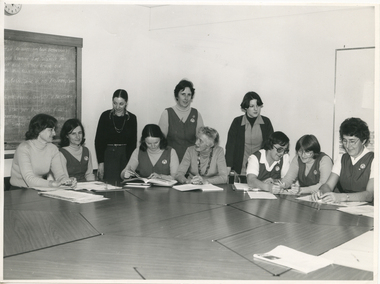
... royal district nursing service...Miss Wright is the Education Director of Royal District Nursing Service (RDNS) and is giving a lecture to the RDNS staff. ...Black and white photograph showing Royal District Nursing Service (RDNS), Miss Ora Wright seated at a table in discussion amid a group of nine RDNS Educators, Physiotherapists and Clerical staff. ...Miss Wright is the Education Director of Royal District Nursing Service (RDNS) and is giving a lecture to the RDNS staff. ...Miss Wright is the Education Director of Royal District Nursing Service (RDNS) and is giving a lecture to the RDNS staff. Two of the RDNS Sisters are wearing their summer uniform which was a royal blue V necked tunic style frock, with the RDNS badge emblazoned on the upper left hand side, over a short sleeved white blouse. Three of the Sisters are wearing their winter uniform of a blue/grey skivvy under a blue/grey herringbone V neck tunic style winter material dress.Education was an integral part of Melbourne District Nursing Society (MDNS), from its inception in 1885, later, in 1966, called Royal District Nursing Service, (RDNS). From 1885, only Trained nurses (Nurses), through the Hospital training system, were employed by the Society, and on visits to patients they taught the necessity of hygiene and cleanliness, as well as the need for a good diet, to bring about good health. Doctor’s lectures were later given at the MDNS home to instruct patients and their families on prevention of disease. Education to patients continued throughout the years regarding health care and the use of equipment in the home. In 1961, Education programs commenced at MDNS with their Trained nurses (Sisters) receiving In-service education. Sister Pat (Paddy) Rowley was a leader in In-service Education and established the RDNS Department of Community Nursing Education in 1962. Staff could also apply for scholarships to further their education outside of RDNS. Many of their senior Sisters graduated from the College of Nursing in Community Health, Education and Administration and several travelled overseas visiting nursing organizations viewing their public health and district nursing systems. At RDNS many programs were run, including: a Post Basic Course, Cardiac Rehabilitation Nursing, Haematology/Oncology Nursing, Palliative Care program, Diabetic Stabilization Program, Leg Ulcer Management Program, Wound Care Specialist Program, HIV/AIDS Nursing Care, Cystic Fibrosis Home Support, Veterans Home Care Program, Breast Cancer Support Program, Continence Management Program, Stomal Therapy Program, In-Home Lactation Support Program and the Homeless Persons Program. RDNS staff attended several hospitals to observe and learn special care needed to some clients, e.g. to the Austin Hospital to learn the care required for paraplegic and quadriplegic clients at home, and to Mount Royal Hospital to observe the care of clients in the Rehabilitation ward. A Community Nursing Education Program was extended to student nurses from hospitals and to other nursing organizations. These Education programs kept the RDNS Sisters abreast of new techniques, such as changes in technology for e.g. new testing methods in detecting glucose levels in Diabetic patients. Sr. Nan Deakin did a Post Basic Course in Psychiatric Nursing and included this area in her education lectures. Sr. Daphne Geldard specialized in the area of Alzheimer’s disease and Dementia. These Sisters visited patients in District areas with the regular RDNS Sister when required. Every member of staff, both professional and non professional staff, received regular education in the Education Department. In 1980, a Home Health Aide pilot study, funded by the Federal Government, the Brotherhood of St. Laurence and RDNS, with the program written and taught by Sr. Rowley, was evaluated as successful, and Home Health Aides were employed and worked in RDNS Centres under the supervision of the RDNS SistersBlack and white photograph showing Royal District Nursing Service (RDNS), Miss Ora Wright seated at a table in discussion amid a group of nine RDNS Educators, Physiotherapists and Clerical staff. Miss Wright has short light coloured hair and has her head turned to her right. She is wearing a long necklace of mixed coloured beads over a light coloured top. Three of the staff are standing behind the seated group. Three staff are seated either side of Miss Wright. Two of the RDNS Educators are wearing white short sleeve blouses under a V neck tunic style dress and the other three are wearing a light coloured skivvy under a V neck grey tunic style dress. The RDNS insignia on a white background can be seen on the upper left of each RDNS uniforms. A blackboard full of white writing can be seen in the left rear of the photograph and several tables joined together are in the foreground. Two books and several sheets of white paper are in front of the seated staff.Photographer stamp. Quote No. DR 12royal district nursing service, rdns, rdns education, rdns clerical staff, rdns physiotherapist, miss ora wright -
 Returned Nurses RSL Sub-branch
Book - Photocopy of pages from a publication, Newman Rosenthal, People - not cases, 1974
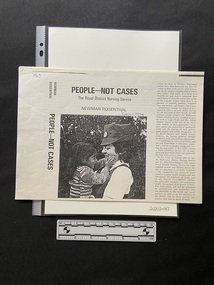
... Royal District Nursing Service...Information taken from the book "People - not cases" about the history of the Royal District Nursing Service. The pages are taken from the chapters on 'Depression and the ante-natal clinic' and the 'First birth-control clinic'....Royal District Nursing Service Melbourne District Nursing Service Community health nursing Home care services 'H63' [Handwritten in blue ink in the top left corner] Black print on white paper, landscape orientation. ...Information taken from the book "People - not cases" about the history of the Royal District Nursing Service. The pages are taken from the chapters on 'Depression and the ante-natal clinic' and the 'First birth-control clinic'.Black print on white paper, landscape orientation. There is a large square black and white image of a nurse holding a child and they are both smiling, the young girl is touching the nurses face. To the left of the image the title and author are printed sideways, Above the image is the titla and author in bold type. On the right side of the page is a column of text containing five paragraphs.'H63' [Handwritten in blue ink in the top left corner]royal district nursing service, melbourne district nursing service, community health nursing, home care services -
 Royal District Nursing Service (now known as Bolton Clarke)
Photograph - Photograph, sepia, 1907
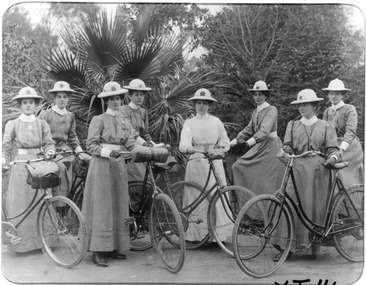
... melbourne district nursing society (1885-1957)...This photograph depicts the Sister-in-charge with a group of Melbourne District Nursing Society (MDNS,) Trained nurses, 'Nurses", with their bicycles, which were the first mode of transport purchased by MDNS in 1903. ...Sepia photograph of eight Melbourne District Nursing Society Trained nurses posing with their bicycles in a park; some are partly hidden. ...This photograph depicts the Sister-in-charge with a group of Melbourne District Nursing Society (MDNS,) Trained nurses, 'Nurses", with their bicycles, which were the first mode of transport purchased by MDNS in 1903. ...This photograph depicts the Sister-in-charge with a group of Melbourne District Nursing Society (MDNS,) Trained nurses, 'Nurses", with their bicycles, which were the first mode of transport purchased by MDNS in 1903. The bicycles enabled their Nurses to visit more patients over a wider area. They are identified as: L-R back row: Trained Nurses Taylor, Steele, Francis, Young. L-R front row: Isobel Curnow, Annie Roberts, Isabel Hawkes (Sister in Charge), Becker. Their uniforms were a grey cotton dress with white collar, cuffs and belt and their was a red Maltese cross on their pith helmets. They gave nursing care to the poor in the inner Melbourne and close surrounding areas (districts). On the 17th of February 1885, just 50 years after Melbourne was founded, a preliminary meeting of ladies and gentlemen who were anxious to form a society to provide "skilled nursing" for the sick poor in their own homes was held in Mrs William McCulloch’s home at Spring Street, Melbourne. At this meeting it was decided “that the association would be called the Melbourne District Nursing Society”, the first Society of its kind in Australia, and “that the special object of the Society shall be to secure skilled nursing for the sick poor in their own homes”. On the 16th of March a Committee was formed to “arrange for engaging one "duly qualified nurse”. On the 1st of May 1885 a Nurse, Mrs. Ferguson, was employed at £100 per annum, and a second Nurse, Mrs. Joanne Cannon, commenced six months later. In that era the term ‘Nurse’ was used even though they were ‘qualified’ i.e. ‘trained’ nurses. They worked in the now CBD, ie from Spencer Street to Spring Street and from Victoria Parade to Flinders Street. From its inception the Society was at the forefront of health care. They provided high quality Trained nursing care; educated their patients in the curing and prevention of disease; teaching the importance of cleanliness, fresh air and good nutrition, both by verbal instruction and demonstration, even supplying soup and milk when needed, as well as providing wood and coal in the winter. At that time they walked the streets and lane ways amid the slums of inner Melbourne carrying their nursing bag containing lotion, ointments, powders, liniment, bandages, dressings, a case of spirits, and the Nurse's own clean apron, soap and small towel. They supplied equipment on loan, such as earthenware hot water bottles, splints, urinals, bed pans, bed cradles, feeding mugs, and air-cushions as well as providing blankets and clean bed linen, and nightdresses as necessary. Trained midwives began home births in late 1893 taking midwifery bundles and providing clothes for the babe and mother as needed. As the work increased a third Trained nurse was employed but this was arduous work, particularly in the heat of summer and many Nurses only remained with the Society for several months. Permission to use bicycles was given to the Nurses in 1898 and the Society decided to purchase their own in 1903. A business man offered ‘new free wheel’ bicycles at £13 each which included maintenance for one year. Bells and wooden frames were added, at a cost of £5 per frame, so the Nurses could carry extra equipment. Nurses’ bags were strapped to the handlebars. Soup was made for those in need 2-3 times a week and if patients could not arrange to have it collected the soup was delivered by the Nurses on their bicycles. The use of bicycles caused a change in uniform, with white pith helmets, and veils covering them and tied under their chin, now being used. They provided high quality nursing care to a range of people, often in destitute situations, some lying on rags on the floor as they had no bed, others with just a bed and maybe a thin blanket, a chair and nothing else. Their ages ranged from babes, children, adults to the elderly. The Nurses gave medications as ordered by a Doctor, dressed wounds e.g. to the injured, and surgical cases, and to those with leg ulcers; attended to patients with ‘surgical ailments’ such as ‘hip disease’; gave care to those with acute illnesses such as bronchitis, pleurisy, pneumonia, measles, and scarlet fever, as well as those with chronic illnesses such as consumption (tuberculosis), heart disease, arthritis, cancer, debility, neuritis and paralysis. In 1913 a Nurse had her Board and residence, uniforms, bicycles and laundry expensive provided and was paid £50 a year for her first six months. At the end of a year her salary is increased by £5, and later she earns £60 a year. Over the years the nurses complained that their veils became wet in the rain and asked for a change of uniform but this did not occur until 1921. Bicycles continued to be used in inner areas until 1945. Sepia photograph of eight Melbourne District Nursing Society Trained nurses posing with their bicycles in a park; some are partly hidden. Nurse's uniforms consist of long grey dresses with white belts, cuffs and collars and white pith helmets with a Maltese cross in the centre. Oblong leather nursing bags of varying sizes are strapped to five of the bicycles. In the centre is Sister-in-charge – Mrs Hawkes (in white); to her left are 4 Nurses and to her right 3. L-R – Front row – Trained Nurses Curnow, Roberts, (Hawkes) and Becker. Back row – Nurses Taylor, Steele, Francis and Young. Trees and a palm are in the background. The bicycles have two large wire spoked wheels at either end of the black V shape bicycle frame; a rubber tyre runs around the outside of each wheel. The metal handlebars are a horizontal configuration and are attached with a central column into a black vertical column at the front of the V shape bicycle frame which has ‘fork shaped’ thin metal pierces running down either side of the wheel attaching the frame to the central hub of the wheel. The rear wheel is attached the same way to a central column at the rear of the frame which runs up to V shape solid seat. At the bottom of the V of the frame a pedal is attached with a rotating arm on either side of the bicycle and on the right side the rotating arm is attached to a sprocket which has a chain running around it back to a smaller sprocket on the hub of the back wheel. The chain has a thin metal guard over it. There are narrow thin metal mud guards running a short distance above the top of each wheel. melbourne district nursing society (1885-1957), bicycles, nurses, uniforms, mdns, mdns transport, rdns, royal district nursing service, trained nurse annie roberts, sister-in-charge isabel hawkes, trained nurse taylor, trained nurse steele, trained nurse francis, trained nurse young, trained nurse becker, trained nurse isobel curnow -
 Royal District Nursing Service (now known as Bolton Clarke)
Photograph - Photograph, Portrait black and white, c.1950
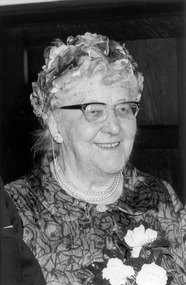
... melbourne district nursing society...Lady Clara R Lowe was elected Honorary Treasurer in 1938, a role she held until being made President of the Melbourne District Nursing Society (MDNS) in February 1950 until late 1951....Lady Clara R Lowe became a Committee member of the Melbourne District Nursing Society (MDNS) and After-Care Hospital in 1937. ...Lady Clara R Lowe was elected Honorary Treasurer in 1938, a role she held until being made President of the Melbourne District Nursing Society (MDNS) in February 1950 until late 1951.Lady Clara R Lowe became a Committee member of the Melbourne District Nursing Society (MDNS) and After-Care Hospital in 1937. She became the Honorary Treasurer in 1938, a role she held until being elected as President in February 1950. She led the Committee of the Society in a time when the Victorian Hospital and Charities Commission wished to set up a separate District nursing service throughout Victoria, with the Society involved. The Commission, under the power of the Hospitals and Charities Act, planned to restructure MDNS and the After-Care Hospital. Lady Lowe was involved with these discussions and in the forming, in October 1951, of separate Boards of Directors for the Nursing division, and for the After-Care division Though the Boards would function independently they would be under the same Committee of Management. Now separate buildings were required for the housing of the District nurses and the headquarters of the Nursing division. The Commission became autocratic in this regard and Lady Lowe resigned as President in late 1951 as she felt she could no longer lead her committee without their interference. Black and white photograph showing the head and shoulder view of Lady Clara R. Lowe who is smiling and is slightly turned to her left. She is wearing glasses, and is wearing a close fitting patterned hat over her wavy grey hair. She has a double row string of pearls around her neck and is wearing a patterned grey frock. The petals of held white flowers are seen in front of her frock. melbourne district nursing society, mdns, after- care hospital, lady clara r. lowe, royal district nursing service, rdns -
 Northern District School of Nursing. Managed by Bendigo Historical Society Inc.
Administrative record - Northern District School of Nursing Graduates Association - Examination Papers, Mar 1976
... Northern District School of Nursing Graduates Association - Examination Papers...The Northern District School of Nursing in Victoria, Australia Graduates Association: History of the School Managed by a committee including hospital administrators, medical professionals, and nursing leaders from several regional hospitals. ...Northern District School of Nursing Graduates Association - Examination Papers March 1976 This item contains the following documents: 3794.6a This document is a set of surgical nursing examination questions designed to assess knowledge and practical skills in patient care, treatment, and management across various clinical scenarios 3794.6b This nursing examination paper covers essential topics in medical nursing, focusing on assessment, diagnosis, and management of key conditions....Administrative record Northern District School of Nursing Graduates Association - Examination Papers ...The Northern District School of Nursing in Victoria, Australia Graduates Association: History of the School Managed by a committee including hospital administrators, medical professionals, and nursing leaders from several regional hospitals. Associated with major hospitals in the Northern District, including Bendigo Base, Mildura Base, Castlemaine, Echuca, Swan Hill, St. Arnaud, and Kyneton District Hospitals. Provide high-quality theoretical and practical nursing training. Raise the standard of nursing education in the region. Maintain the highest principles of nursing practice. Applicants must be at least 17 years old and hold a Proficiency Certificate or higher educational qualification. Application involves submitting forms, certificates, an interview, an aptitude test, and a medical examination. A three-month probationary period follows initial acceptance. Preliminary Training School: Four-week introductory course covering basic nursing, anatomy, hygiene, and practical skills. Practical experience in various hospital departments, guided by senior staff. Study Block Plan: Includes several blocks of theoretical and practical instruction throughout the three-year program. Regular school exams and two state exams (First Professional and Final State) are required for progression and graduation. Nurses work a 40-hour week with at least one or two days off per week and three weeks of annual leave. Accommodation is provided in comfortable hostels with good facilities. Uniforms are supplied free; nurses provide their own shoes and stockings. Salaries and allowances are regulated, with deductions for board and free medical care. Additional Information Post-Graduate Opportunities. Senior positions require further experience and additional certificates (e.g., Midwifery, Infant Welfare).Diploma courses available in administration, teaching, and specialized nursing fields. Bursaries are available for advanced study.Career Prospects: Graduates can pursue roles in administration, teaching, ward and departmental leadership, district and visiting nursing, industrial and school nursing, and more. Opportunities existed both within hospitals and in community or specialized settings.FAQs and Practical Details. Minimal training costs (mainly exam fees and personal items).Living out allowances and travel expenses are covered. Four training intakes per year; waiting periods are short if qualifications are met.Northern District School of Nursing Graduates Association - Examination Papers March 1976 This item contains the following documents: 3794.6a This document is a set of surgical nursing examination questions designed to assess knowledge and practical skills in patient care, treatment, and management across various clinical scenarios 3794.6b This nursing examination paper covers essential topics in medical nursing, focusing on assessment, diagnosis, and management of key conditions.nurse training, lister house, examinations -
Northern District School of Nursing. Managed by Bendigo Historical Society Inc.
Administrative record - Northern District School of Nursing Graduates Association - Examinations and Instruction Guides, June 1977
... Northern District School of Nursing Graduates Association - Examinations and Instruction Guides...The Northern District School of Nursing in Victoria, Australia Graduates Association: History of the School Managed by a committee including hospital administrators, medical professionals, and nursing leaders from several regional hospitals. ...Northern District School of Nursing Graduates Association - Examinations and Instruction Guides June 1977 This item contains the following documents: 3794.13a This document is a surgical nursing examination paper covering essential topics in patient care, surgical procedures, and nursing responsibilities. 3794.13b Copy of Above 3794.13c This examiner's report provides feedback on nurses' performance in their final surgical nursing examination, highlighting strengths and areas needing improvement...The Northern District School of Nursing in Victoria, Australia Graduates Association: History of the School Managed by a committee including hospital administrators, medical professionals, and nursing leaders from several regional hospitals. ...The Northern District School of Nursing in Victoria, Australia Graduates Association: History of the School Managed by a committee including hospital administrators, medical professionals, and nursing leaders from several regional hospitals. Associated with major hospitals in the Northern District, including Bendigo Base, Mildura Base, Castlemaine, Echuca, Swan Hill, St. Arnaud, and Kyneton District Hospitals. Provide high-quality theoretical and practical nursing training. Raise the standard of nursing education in the region. Maintain the highest principles of nursing practice. Applicants must be at least 17 years old and hold a Proficiency Certificate or higher educational qualification. Application involves submitting forms, certificates, an interview, an aptitude test, and a medical examination. A three-month probationary period follows initial acceptance. Preliminary Training School: Four-week introductory course covering basic nursing, anatomy, hygiene, and practical skills. Practical experience in various hospital departments, guided by senior staff. Study Block Plan: Includes several blocks of theoretical and practical instruction throughout the three-year program. Regular school exams and two state exams (First Professional and Final State) are required for progression and graduation. Nurses work a 40-hour week with at least one or two days off per week and three weeks of annual leave. Accommodation is provided in comfortable hostels with good facilities. Uniforms are supplied free; nurses provide their own shoes and stockings. Salaries and allowances are regulated, with deductions for board and free medical care. Additional Information Post-Graduate Opportunities. Senior positions require further experience and additional certificates (e.g., Midwifery, Infant Welfare).Diploma courses available in administration, teaching, and specialized nursing fields. Bursaries are available for advanced study.Career Prospects: Graduates can pursue roles in administration, teaching, ward and departmental leadership, district and visiting nursing, industrial and school nursing, and more. Opportunities existed both within hospitals and in community or specialized settings.FAQs and Practical Details. Minimal training costs (mainly exam fees and personal items).Living out allowances and travel expenses are covered. Four training intakes per year; waiting periods are short if qualifications are met.Northern District School of Nursing Graduates Association - Examinations and Instruction Guides June 1977 This item contains the following documents: 3794.13a This document is a surgical nursing examination paper covering essential topics in patient care, surgical procedures, and nursing responsibilities. 3794.13b Copy of Above 3794.13c This examiner's report provides feedback on nurses' performance in their final surgical nursing examination, highlighting strengths and areas needing improvementnurse training, lister house, examinations -
 Bendigo Historical Society Inc.
Document - NORTHERN DISTRICT SCHOOL OF NURSING: TRIBUTE, 8/6/1989
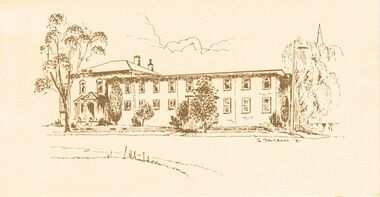
... NORTHERN DISTRICT SCHOOL OF NURSING: TRIBUTE...Document, Northern District School of Nursing, farewell to Lister House. ...DOCUMENT lister house Ron Webb and Jenny Reid Document, Northern District School of Nursing, farewell to Lister House. ...Document, Northern District School of Nursing, farewell to Lister House. It is with Pride and sadness that we say farewell to LISTER HOUSE.This will end 39 years of Nurse Training unique in Australia. The final farewell to student nurses in the present Certificate Course at the Northern District School of Nursing will take place on June 8th,1989 when School 108 completes Examinations.The old mansion, LISTER HOUSE, belonged to Bendigo's golden years of the 19th Century. By courtesy of Ron Webb and Jenny Reid. The front cover depicts a drawing of Lister House by G.Samson '81.Ron Webb and Jenny Reiddocument, lister house -
 Royal District Nursing Service (now known as Bolton Clarke)
Document, black and white, c.1957
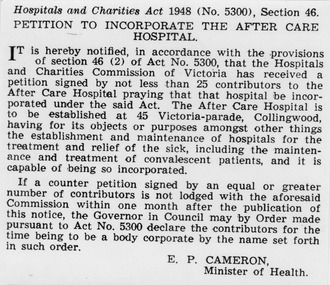
... melbourne district nursing society...The name Melbourne District Nursing Society and After-Care Hospital came into being in 1935. ...The name Melbourne District Nursing Society and After-Care Hospital came into being in 1935. ...The name Melbourne District Nursing Society and After-Care Hospital came into being in 1935. In 1957 the two bodies separated and the Hospital and Charities Commission of Victoria received the document a 'Petition to Incorporate the After Care Hospital'The Melbourne District Nursing Society was founded in 1885 and in 1926 opened the After-Care Home. The Society then became the 'Melbourne District Nursing Society and After-Care Home' until 1935 when the word 'Home' was replaced b the word 'Hospital'. In 1957 the two bodies separated and the Hospital and Charities Commission of Victoria received a 'Petition to Incorporate the After Care Hospital'Black and white document 'Petition to Incorporate the After Care Hospital' The document is bold black printing on a white background. It commences; 'Hospital and Charities Act 1948 (No. 5300), Section 46. The body of the document contains nineteen lines and finishes with ‘'E. P. Cameron, Minister of Health’.melbourne district nursing society, after- care hospital, rdns, royal district nursing service -
 Royal District Nursing Service (now known as Bolton Clarke)
Photograph - Digital image, Barry Sutton, 10.08.1971
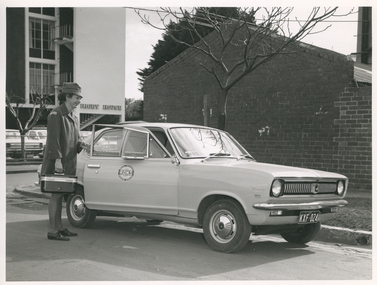
... ...royal district nursing service...The RDNS insignia on the door of the car is a round badge with a royal blue circle around the edge with the words "Royal District Nursing Service" in white, and the centre section is in three parts ,with the upper and lower sections white, and a royal blue centre strip with the large white capital letters "RDNS"....Black and White Photograph of a Royal District Nursing Service (RDNS) Sister about to enter one of the new light grey 2 door Holden Torana RDNS cars. ...Royal District Nursing Service (RDNS) has had various modes of transport over the last 130 plus years. ...The RDNS Sister is about to leave to visit patients in their homes in the community to administer nursing care as advised by a Doctor. The RDNS insignia on the door of the car is a round badge with a royal blue circle around the edge with the words "Royal District Nursing Service" in white, and the centre section is in three parts ,with the upper and lower sections white, and a royal blue centre strip with the large white capital letters "RDNS".Royal District Nursing Service (RDNS) has had various modes of transport over the last 130 plus years. At first, from 1885 as Melbourne District Nursing Society (MDNS), their Trained nurses (Nurses) walked the streets and lane ways amid the slums of central Melbourne. As the Society expanded public transport was used, and bicycles were bought by the Society in 1903 and used in inner areas until 1945. During the Spanish flu epidemic, in 1919, MDNS appealed for assistance to procure Motor vehicles so the Nurses could visit an influx of cases. Through trusts, grants and donations four 'Ford T Model' cars were procured which enabled the Nurses to triple their visits. Through constant use the cars were in such a poor state two were sold in 1922 and the others later. In 1922-23 three Peugeot cars were purchased and a woman Chauffeur, 'Miss Sword', was employed who lived in the Home and was also in charge of the garage. MDNS was expanding and a Motor Auxiliary was formed in 1929 to take the Trained nurses (Sisters) to patients, and some Sisters used their own cars; even a motorcycle was used by one Sister in 1933. All these forms of transport were intermingled and in the early 1950s, and now as Melbourne District Nursing Service, seven Ford Prefect cars were bought followed by twelve Ford Anglia cars 1955. Having received Royal patronage; the now Royal District Nursing Service (RDNS) had its own fleet of Holden vehicles by the mid 1960s and the Motor Auxiliary ceased operating in 1971 as by then all staff employed were required to have a driving licence. Seat-belts had been introduced to Victoria in 1959 and District fitted them to their cars from 1962, even though they did not become compulsory until 1970. The Holden vehicles were replaced with grey Holden Torana vehicles. After several years the fleet was changed to white Toyota Corolla vehicles. The Melways Directory of maps was introduced in 1966, which was a boon to the Sisters, though it was a few years before it went beyond Seville, so a large paper map was used by the Sisters visiting patients in the areas passed Seville. By 2009 there were 598 cars in the fleet and the Sisters travelled 9 million 200,000 kilometres – this is equivalent to 12 trips to the moon and back. Black and White Photograph of a Royal District Nursing Service (RDNS) Sister about to enter one of the new light grey 2 door Holden Torana RDNS cars. The Sister, who is smiling, is wearing her uniform grey peaked hat over her long dark hair which is drawn back. She is wearing her long grey coat with the RDNS insignia on the upper sleeve and is holding the partly opened driver side door of the car with her left hand. She is holding the handle on the top of her rectangular black nursing case with her right hand. To the right, the grill and black number plate, with the white writing displaying "KXF 024", can be seen. The round RDNS insignia is on the upper centre of the car door. The car is the same width all over, has a flat bonnet which joins a sloping windscreen adjoining a flat roof which runs along and joins a short back window running down to a boot. A black tyred wheel can be seen under wheel arches at the front and near the rear of the vehicle. In the background to the left is a mid size bare tree; behind this portions of several parked cars and behind them a multi storey building with the Written words "Rioby House". To its right and directly behind the car is a mid size bare tree and behind that the end view of a brick building with a hip roof. Barry Sutton Photographer. Quote KL 52rdns transport, rdns uniform, royal district nursing service, rdns -
 Royal District Nursing Service (now known as Bolton Clarke)
Photograph - Photograph, black and white, Barry Sutton, 14.09.1972
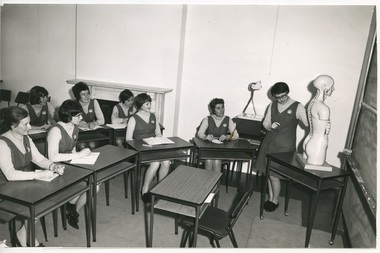
... ...royal district nursing service...The session is being held in the Education Department at the Royal District Nursing Service Headquarters, 452 St. Kilda Rd, Melbourne.The RDNS winter uniform worn is a blue/grey skivvie under a blue/grey V neck tunic style herringbone winter material frock....This black and white photograph is of a group of seven Royal District Nursing Service (RDNS) Sisters sitting in a semi-circle in two rows at single small two shelf tables. ...Education was an integral part of Melbourne District Nursing Society (MDNS), from its inception in 1885, later, in 1966, called Royal District Nursing Service, (RDNS). ...This black and white photograph shows a group of RDNS Sisters who are part of the Post Basic Community Nursing Course. They are receiving education from Sr. Pat (Paddy) Rowley, RDNS Principal Nurse Educator. The session is being held in the Education Department at the Royal District Nursing Service Headquarters, 452 St. Kilda Rd, Melbourne.The RDNS winter uniform worn is a blue/grey skivvie under a blue/grey V neck tunic style herringbone winter material frock.Melbourne District Nursing Service ran its first Post-Basic Course for community nurses in 1962. Sisters attended the course for 12 weeks. The course ran annually until the mid 1990s. Education was an integral part of Melbourne District Nursing Society (MDNS), from its inception in 1885, later, in 1966, called Royal District Nursing Service, (RDNS). From 1885, only Trained nurses (Nurses) through the Hospital training system, were employed by the Society, and on visits to patients they taught the necessity of hygiene and cleanliness, as well as the need for a good diet, to bring about good health. Doctor’s lectures were later given at the MDNS home to instruct patients and their families on prevention of disease. Education to patients continued throughout the years regarding health care and the use of equipment in the home. In 1961, Education programs commenced at MDNS with their Trained nurses (Sisters) receiving In-service education. Sr. Pat (Paddy) Rowley was a leader in In-service Education and established the RDNS Department of Community Nursing Education in 1962. Staff could also apply for scholarships to further their education outside of RDNS. Many of their senior Sisters received Postgraduate diplomas from the College of Nursing in Community Health Nursing, Education, and Administration, and several travelled overseas visiting nursing organizations viewing their public health and District nursing systems. At RDNS many programs were run, including: a Post Basic Course, Cardiac Rehabilitation Nursing, Haematology/Oncology Nursing, Palliative Care program, Diabetic Stabilization Program, Leg Ulcer Management Program, Wound Care Specialist Program, HIV/AIDS Nursing Care, Cystic Fibrosis Home Support, Veterans Home Care Program, Breast Cancer Support Program, Continence Management Program, Stomal Therapy Program, In-Home Lactation Support Program and the Homeless Persons Program. RDNS staff attended several hospitals to observe and learn special care needed to some patients, e.g. to the Austin Hospital to learn the care required for paraplegic and quadriplegic patients at home, and to Mount Royal Hospital to observe the care of patients in the Rehabilitation ward. A Community Nursing Education Program was extended to student nurses from hospitals and to other nursing organizations. These Education programs kept the RDNS Sisters abreast of new techniques, such as changes in technology for e.g. new testing methods in detecting glucose levels in Diabetic patients. Sr. Nan Deakin obtained a Post Basic Certificate in Psychiatric Nursing and included this area in her Education lectures. Sr. Daphne Geldard specialized in the area of Alzheimer’s disease and Dementia. These Sisters visited patients in District areas with the regular RDNS Sister when required. Every member of staff, both professional and non professional staff, received regular education in the Education Department. In 1980, a Home Health Aide pilot study, funded by the Federal Government, the Brotherhood of St. Laurence and RDNS, with the program written and taught by Sr. Rowley, was evaluated as successful, and Home Health Aides were employed and worked in RDNS Centres under the supervision of RDNS Sisters. This black and white photograph is of a group of seven Royal District Nursing Service (RDNS) Sisters sitting in a semi-circle in two rows at single small two shelf tables. There are open white paged books or papers on each table and some of the Sisters have pens in their hands. The Sister sitting in the front far right is Sr. Affleck, who has dark short curly hair. The other Sisters have dark short hair in various styles. Further right in the photograph stands Sr. Rowley, who has dark short hair and is wearing glasses. She has her left hand supporting a torso of an anatomical model which is sitting on a table slightly to her left. She and the Sisters are looking at the vertebrae down the spine of the model. Another empty table is in front of the semi-circle and it sits in the centre foreground of the photograph. In the rear between Sr. Affleck and Sr. Rowley, a piece of equipment stands on a table. To the right of the photograph part of a large blackboard can be seen. The Sisters are wearing light grey skivvies under a darker V neck tunic style frock with the RDNS insignia on its upper left.Photographers stamp. Quote No. LD 8rdns education, rdns uniform, royal district nursing service, sister pat (paddy) rowley, sister margaret affleck -
Northern District School of Nursing. Managed by Bendigo Historical Society Inc.
Administrative record - Northern District School of Nursing List of Graduates (School 61-78), 1960s
... Northern District School of Nursing List of Graduates (School 61-78)...nursing fields. Bursaries are available for advanced study.Career Prospects: Graduates can pursue roles in administration, teaching, ward and departmental leadership, district and visiting nursing, industrial and school nursing, and more. ...Northern District School of Nursing List of Graduates (School 61-78), 15 pages This item contains the following documents: 3791.8a This document provides a list of graduates along with their allocated hospital for Schools 61 to 78 3791.8b This document provides a list of graduates (with married names and details) for school 77 (Contact the BHS for details)...nursing fields. Bursaries are available for advanced study.Career Prospects: Graduates can pursue roles in administration, teaching, ward and departmental leadership, district and visiting nursing, industrial and school nursing, and more. ...Managed by a committee including hospital administrators, medical professionals, and nursing leaders from several regional hospitals. Associated with major hospitals in the Northern District, including Bendigo Base, Mildura Base, Castlemaine, Echuca, Swan Hill, St. Arnaud, and Kyneton District Hospitals. Provide high-quality theoretical and practical nursing training. Raise the standard of nursing education in the region. Maintain the highest principles of nursing practice. Applicants must be at least 17 years old and hold a Proficiency Certificate or higher educational qualification. Application involves submitting forms, certificates, an interview, an aptitude test, and a medical examination. A three-month probationary period follows initial acceptance. Preliminary Training School: Four-week introductory course covering basic nursing, anatomy, hygiene, and practical skills. Practical experience in various hospital departments, guided by senior staff. Study Block Plan: Includes several blocks of theoretical and practical instruction throughout the three-year program. Regular school exams and two state exams (First Professional and Final State) are required for progression and graduation. Nurses work a 40-hour week with at least one or two days off per week and three weeks of annual leave. Accommodation is provided in comfortable hostels with good facilities. Uniforms are supplied free; nurses provide their own shoes and stockings. Salaries and allowances are regulated, with deductions for board and free medical care. Additional Information Post-Graduate Opportunities. Senior positions require further experience and additional certificates (e.g., Midwifery, Infant Welfare).Diploma courses available in administration, teaching, and specialized nursing fields. Bursaries are available for advanced study.Career Prospects: Graduates can pursue roles in administration, teaching, ward and departmental leadership, district and visiting nursing, industrial and school nursing, and more. Opportunities exist both within hospitals and in community or specialized settings.FAQs and Practical Details. Minimal training costs (mainly exam fees and personal items).Living out allowances and travel expenses are covered. Four training intakes per year; waiting periods are short if qualifications are met.Northern District School of Nursing List of Graduates (School 61-78), 15 pages This item contains the following documents: 3791.8a This document provides a list of graduates along with their allocated hospital for Schools 61 to 78 3791.8b This document provides a list of graduates (with married names and details) for school 77 (Contact the BHS for details)nurse training, lister house, list of graduates -
 Royal District Nursing Service (now known as Bolton Clarke)
Photograph - Photograph, black and white, c.1960
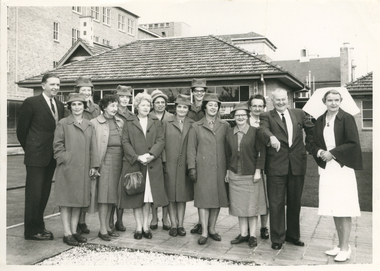
... melbourne district nursing society...The occasion of the photograph is unknown, but it depicts a group of Melbourne District Nursing Service (MDNS) Sisters with Matron Tupper. ...Black and white photograph of a group of seven Melbourne District Nursing Service (MDNS) Sisters and Matron Tupper with two men and four ladies standing in two rows in front of a brick house which has a tiled roof. ...The occasion of the photograph is unknown, but it depicts a group of Melbourne District Nursing Service (MDNS) Sisters with Matron Tupper. ...The occasion of the photograph is unknown, but it depicts a group of Melbourne District Nursing Service (MDNS) Sisters with Matron Tupper. She is wearing the Matron uniform of a white frock and veil and a red cape. The Sisters are wearing their grey MDNS uniforms and one is wearing a uniform red cardigan. The Sisters peaked hats have a red Maltese cross applied in the centre front.From its foundation in 1885 the Melbourne District Nursing Society (MDNS), were instrumental in giving nursing care to patients in their own homes, and to assist them if they had financial problems or resided in poor living conditions. Miss Dorothy Tupper who, as a Trained nurse, had undertaken a course in hospital housekeeping at London Prince of Wales Hospital, was contacted by MDNS in 1939 and, possessing both business and humanitarian qualities, was asked to organize their newly established Social Service Department. As the MDNS Social Service Sister, she assessed the living conditions in patient's homes. She continued in this role until being appointed Matron of the Society's District Nursing division in 1941; a role she continued in until her retirement at the end of 1962.Black and white photograph of a group of seven Melbourne District Nursing Service (MDNS) Sisters and Matron Tupper with two men and four ladies standing in two rows in front of a brick house which has a tiled roof. To the left in the back row is a gentlemen with dark hair, who is wearing a dark suit, then two MDNS Sisters, next is a lady who is wearing glasses and is dressed in a light colour coat and hat. To her right is a tall MDNS Sister wearing dark rimmed glasses, then a lady with dark curly hair looking over the shoulder of a man with grey hair who is wearing a dark suit; on his right is Matron Tupper, who is wearing her white nursing uniform, her dark cape, and white veil over her short dark curled hair. In the left front is a Sister; to her right is a lady with dark curly hair and wearing a light coloured coat over a dark skirt and jumper; then a lady with blonde curly hair who is wearing a dark coat over her light dress and is carrying a handbag. Three Sisters are to her right - the end one is wearing glasses and a dark cardigan over her grey uniform frock The other MDNS Sisters in the group are wearing their grey uniform coats over their partly seen grey uniforms. All the MDNS Sisters are wearing grey uniform peaked hats. A three storey building is to the left rear of the photograph and and parts of three other buildings behind and to the right of the house.melbourne district nursing society, mdns, mdns social service department, mdns matron, matron dorothy tupper -
 Royal District Nursing Service (now known as Bolton Clarke)
Photograph - Photograph, black and white, 30 08 1967
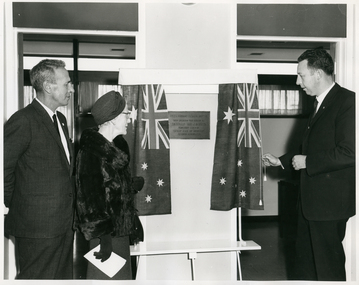
... royal district nursing service...Wilson is President of Royal District Nursing Service (RDNS). ...Wilson is President of Royal District Nursing Service (RDNS). Mrs. Wilson was a Committee member, then Vice-president, of Melbourne District Nursing Service, later called Royal District Nursing Service (RDNS) from 1959 until 1964 and President 1965-1967 Gradually over the years, Melbourne District Nursing Service, MDNS, later known as Royal District Nursing Service, RDNS, from 1966 when they received Royal patronage, opened Centres throughout the Melbourne Metropolitan area. ...This photograph records Mr. Ian Muir, President of the Essendon Rotary Club unveiling the plaque at the opening of the Royal District Nursing Service (RDNS) Essendon Centre on the 30th of August 1967. Mrs. E.G. Wilson is President of Royal District Nursing Service (RDNS). Mrs. Wilson was a Committee member, then Vice-president, of Melbourne District Nursing Service, later called Royal District Nursing Service (RDNS) from 1959 until 1964 and President 1965-1967 Gradually over the years, Melbourne District Nursing Service, MDNS, later known as Royal District Nursing Service, RDNS, from 1966 when they received Royal patronage, opened Centres throughout the Melbourne Metropolitan area. Their Trained nurses (Sisters) left from these Centres each morning to carry out their nursing visits in a specific area, taking any sterilized equipment needed with them. They returned at the end of the day to write up their patients nursing histories, clean and reset any equipment used ready for sterilization, and contact other medical personal as necessary. Most of the RDNS cars were housed at each Centre, only a few being driven home by a Sister.Black and white photograph showing Mr.Ian Muir unveiling a plaque. Mr. Muir, on the right hand side of the photograph, has dark short hair and is wearing a dark suit. His is standing side-on facing to the left of the photograph. His right hand is holding the cord of the right hand side Australian flag which was partly covering the plaque. A gentleman, with short grey hair and wearing a dark suit, is on the far left hand side of the photograph. Between him and another Australian flag, on the left hand side of the plaque, stands Mrs. E.G, Wilson, who is wearing glasses and is dressed in a dark suit and a dark hat. The dark plaque is attached to a light coloured section of wall and in the background are the windows above the light coloured far wall of the room.Photographers Stamp. 'Quote No. GJ 73royal district nursing service, rdns, essendon centre, mrs e.g. (hazel janet) wilson, mr ian muir, rdns centre -
Northern District School of Nursing. Managed by Bendigo Historical Society Inc.
Administrative record - Northern District School of Nursing Graduates Association - Examinations and Guides, 1979
... Northern District School of Nursing Graduates Association - Examinations and Guides...The Northern District School of Nursing in Victoria, Australia Graduates Association: History of the School Managed by a committee including hospital administrators, medical professionals, and nursing leaders from several regional hospitals. ...Northern District School of Nursing Graduates Association - Examinations and Guides 1979 This item contains the following documents: 3795.5a This document is a surgical nursing examination paper focusing on key aspects of postoperative care and management. 3795.5b This document is a surgical nursing examination paper for general nurses, covering a range of key topics and scenarios relevant to surgical patient care. 3795.5c This document is an assessment report on nursing students' performance in a surgical nursing examination...The Northern District School of Nursing in Victoria, Australia Graduates Association: History of the School Managed by a committee including hospital administrators, medical professionals, and nursing leaders from several regional hospitals. ...The Northern District School of Nursing in Victoria, Australia Graduates Association: History of the School Managed by a committee including hospital administrators, medical professionals, and nursing leaders from several regional hospitals. Associated with major hospitals in the Northern District, including Bendigo Base, Mildura Base, Castlemaine, Echuca, Swan Hill, St. Arnaud, and Kyneton District Hospitals. Provide high-quality theoretical and practical nursing training. Raise the standard of nursing education in the region. Maintain the highest principles of nursing practice. Applicants must be at least 17 years old and hold a Proficiency Certificate or higher educational qualification. Application involves submitting forms, certificates, an interview, an aptitude test, and a medical examination. A three-month probationary period follows initial acceptance. Preliminary Training School: Four-week introductory course covering basic nursing, anatomy, hygiene, and practical skills. Practical experience in various hospital departments, guided by senior staff. Study Block Plan: Includes several blocks of theoretical and practical instruction throughout the three-year program. Regular school exams and two state exams (First Professional and Final State) are required for progression and graduation. Nurses work a 40-hour week with at least one or two days off per week and three weeks of annual leave. Accommodation is provided in comfortable hostels with good facilities. Uniforms are supplied free; nurses provide their own shoes and stockings. Salaries and allowances are regulated, with deductions for board and free medical care. Additional Information Post-Graduate Opportunities. Senior positions require further experience and additional certificates (e.g., Midwifery, Infant Welfare).Diploma courses available in administration, teaching, and specialized nursing fields. Bursaries are available for advanced study.Career Prospects: Graduates can pursue roles in administration, teaching, ward and departmental leadership, district and visiting nursing, industrial and school nursing, and more. Opportunities existed both within hospitals and in community or specialized settings.FAQs and Practical Details. Minimal training costs (mainly exam fees and personal items).Living out allowances and travel expenses are covered. Four training intakes per year; waiting periods are short if qualifications are met.Northern District School of Nursing Graduates Association - Examinations and Guides 1979 This item contains the following documents: 3795.5a This document is a surgical nursing examination paper focusing on key aspects of postoperative care and management. 3795.5b This document is a surgical nursing examination paper for general nurses, covering a range of key topics and scenarios relevant to surgical patient care. 3795.5c This document is an assessment report on nursing students' performance in a surgical nursing examinationnurse training, lister house, examinations -
Northern District School of Nursing. Managed by Bendigo Historical Society Inc.
Administrative record - Northern District School of Nursing Graduates Association - Examination Instructions to Candidate, Abt 1976
... Northern District School of Nursing Graduates Association - Examination Instructions to Candidate...The Northern District School of Nursing in Victoria, Australia Graduates Association: History of the School Managed by a committee including hospital administrators, medical professionals, and nursing leaders from several regional hospitals. ...Northern District School of Nursing Graduates Association - Examination Instructions to Candidate, about 1976 This item contains the following documents: 3794.10a Nursing examination instructions for H. ...The Northern District School of Nursing in Victoria, Australia Graduates Association: History of the School Managed by a committee including hospital administrators, medical professionals, and nursing leaders from several regional hospitals. ...The Northern District School of Nursing in Victoria, Australia Graduates Association: History of the School Managed by a committee including hospital administrators, medical professionals, and nursing leaders from several regional hospitals. Associated with major hospitals in the Northern District, including Bendigo Base, Mildura Base, Castlemaine, Echuca, Swan Hill, St. Arnaud, and Kyneton District Hospitals. Provide high-quality theoretical and practical nursing training. Raise the standard of nursing education in the region. Maintain the highest principles of nursing practice. Applicants must be at least 17 years old and hold a Proficiency Certificate or higher educational qualification. Application involves submitting forms, certificates, an interview, an aptitude test, and a medical examination. A three-month probationary period follows initial acceptance. Preliminary Training School: Four-week introductory course covering basic nursing, anatomy, hygiene, and practical skills. Practical experience in various hospital departments, guided by senior staff. Study Block Plan: Includes several blocks of theoretical and practical instruction throughout the three-year program. Regular school exams and two state exams (First Professional and Final State) are required for progression and graduation. Nurses work a 40-hour week with at least one or two days off per week and three weeks of annual leave. Accommodation is provided in comfortable hostels with good facilities. Uniforms are supplied free; nurses provide their own shoes and stockings. Salaries and allowances are regulated, with deductions for board and free medical care. Additional Information Post-Graduate Opportunities. Senior positions require further experience and additional certificates (e.g., Midwifery, Infant Welfare).Diploma courses available in administration, teaching, and specialized nursing fields. Bursaries are available for advanced study.Career Prospects: Graduates can pursue roles in administration, teaching, ward and departmental leadership, district and visiting nursing, industrial and school nursing, and more. Opportunities existed both within hospitals and in community or specialized settings.FAQs and Practical Details. Minimal training costs (mainly exam fees and personal items).Living out allowances and travel expenses are covered. Four training intakes per year; waiting periods are short if qualifications are met.Northern District School of Nursing Graduates Association - Examination Instructions to Candidate, about 1976 This item contains the following documents: 3794.10a Nursing examination instructions for H. G. Campbell School 15 Examination Schedule and LocationsExams are held at the Northern District School of Nursing at 9:30 a.m. (candidates assemble at 9:15 a.m.) on a specified Wednesday in late September. Additional exams are held at the candidate's own hospital on Thursday, 3rd September at 10:00 a.m. Exam ProceduresExamination papers are distributed in a sealed envelope, opened in the presence of candidates. Candidates receive their paper in the examination room.Exam RulesTwo hours are allotted to complete each paper. Write answers on one side of the sheet only.Stop writing immediately when time is called. Only the candidate's number (in words and figures) and the subject should appear on the outside; names must not be written. Copying or assisting others leads to disqualification. There is a one-hour interval between papers. The instructions are issued by the Nurses Board, with contact details provided for the Registrar in Melbourne.nurse training, lister house, examinations -
 Royal District Nursing Service (now known as Bolton Clarke)
Photograph - Photograph, black and white, Barry Sutton, 01.05.1974
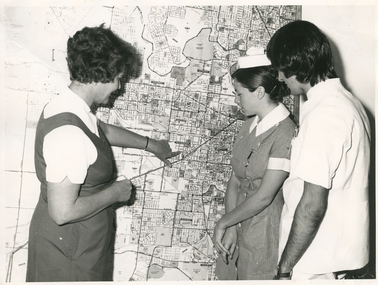
... royal district nursing service...Sister Ellen Anderson is the Supervisor of the Royal District Nursing Service, (RDNS) Footscray Centre. ...On the left of this black and white photograph is Royal District Nursing Service (RDNS), Sister Ellen Anderson, who has short dark curly hair and is wearing her RDNS uniform of a short sleeve white blouse under a dark V neck tunic style frock. ...Sister Ellen Anderson is the Supervisor of the Royal District Nursing Service, (RDNS) Footscray Centre. ...Sister Ellen Anderson is the Supervisor of the Royal District Nursing Service, (RDNS) Footscray Centre. She is wearing her RDNS uniform of a short sleeve white blouse under a royal blue V neck tunic style dress. Sr. Anderson is showing two Student nurses from Western General Hospital the map with the areas covered by Footscray Centre. The map had different colour pins to identify streets where patients lived who were currently receiving nursing care from RDNS Sisters working in these areas (districts).During their training, Student nurses from several hospitals either attended the Royal District Nursing Service (RDNS), Education Department, or, a RDNS Nurse Educator travelled to the appropriate hospital’s Education Department to educate the Trainees on District nursing through the RDNS Community Nursing Program. Following the lectures Students went to a RDNS Centre and each Student accompanied a Trained nurse (Sister) for a week observing and gaining knowledge of all facets of nursing care in the home. This gave them an insight into the home conditions and situations patients faced after discharge from hospital. During 1971 there were 584 Student nurses who received field experience with RDNS. From its inception as Melbourne District Nursing Society (MDNS), in 1885, their Trained nurses (Nurses) worked in specific areas, 'districts'. The first Nurse worked east and west, between Victoria Parade and Flinders Street and, north and south, between Spencer Street and Spring Street. When a second Nurse was employed they divided this area at Elizabeth Street so each Nurse could attend to patients in the same area giving continuity of care. As the Society expanded, becoming Melbourne District Nursing Service, then, with Royal patronage, Royal District Nursing Service (RDNS) many Centres were opened throughout the Melbourne Metropolitan area and outer suburbs. The District nurse's areas (districts) grew and were divided within Shire boundaries for e.g. Knox 1, Knox 2, Knox 3, Knox 4, within the area of the Shire of Knox. A map covering the Centre’s Districts was attached to a wall, and its different colour pins identified streets where patients lived who were currently receiving nursing care from the RDNS Trained nurses (Sisters) working in these areas (districts).On the left of this black and white photograph is Royal District Nursing Service (RDNS), Sister Ellen Anderson, who has short dark curly hair and is wearing her RDNS uniform of a short sleeve white blouse under a dark V neck tunic style frock. She is standing side-on, towards the right of the photograph, and with her left hand is pointing to an area on a large map attached to the wall in the background. To her right, is a Student nurse who is facing Sr. Anderson, and looking at the area on the map. Under her white nurses cap, she has her long dark hair drawn back, and is wearing her hospital uniform of a short sleeve checked dress with white collar and cuffs; a nursing watch is attached to its upper left; her hands are clasped in front of her. To her right, is a male Student nurse who has collar length straight dark hair, and is wearing white trousers and a short sleeve white top with pens in the left upper pocket. He is looking at the areas on the map.. Barry Sutton MA 77 informationroyal district nursing service, rdns, rdns education, rdns centre, rdns district map, sister ellen anderson -
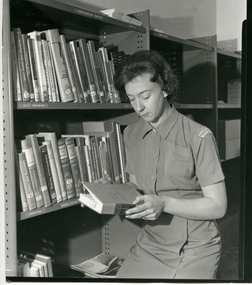 Royal District Nursing Service (now known as Bolton Clarke)
Photograph - Photograph, black and white, c.1967
... melbourne district nursing society...Black and white photograph showing Royal District Nursing Service (RDNS), Sister J. Rignall using the Library facilities at RDNS. ...Education was an integral part of Melbourne District Nursing Society (MDNS), from its inception in 1885, later, in 1966, called Royal District Nursing Service, (RDNS). ...Sister Rignall is undergoing In-service education at RDNS and is wearing the grey RDNS uniform of that era.Education was an integral part of Melbourne District Nursing Society (MDNS), from its inception in 1885, later, in 1966, called Royal District Nursing Service, (RDNS). From 1885, only Trained Nurses who trained through the Hospital training system were employed by the Society, and on visits to patients they taught the necessity of hygiene and cleanliness, as well as the need for a good diet, to bring about good health. Doctor’s lectures were later given at the MDNS home to instruct patients and their families on prevention of disease. Education to patients continued throughout the years regarding health care and the use of equipment in the home. In 1961, Education programs commenced at MDNS with nurses receiving In-service education. Sr. Pat (Paddy) Rowley was a leader in this In-service Education and established the MDNS, later called RDNS, Department of Community Nursing Education in 1962. Staff could also apply for scholarships to further their education outside of RDNS. Many of their senior trained nurses received Postgraduate diplomas from the College of Nursing in Community Health Nursing, Education, and Administration, and several travelled overseas visiting nursing organizations viewing their public health and district nursing systems. Many programs were run at RDNS, including: a Post Basic Course, Cardiac Rehabilitation Nursing, Haematology/Oncology Nursing, Palliative Care program, Diabetic Stabilization Program, Leg Ulcer Management Program, Wound Care Specialist Program, HIV/AIDS Nursing Care, Cystic Fibrosis Home Support, Veterans Home Care Program, Breast Cancer Support Program, Continence Management Program, Stomal Therapy Program, In-Home Lactation Support Program and the Homeless Persons Program. RDNS staff attended several hospitals to observe and learn special care needed to some clients, e.g. to the Austin Hospital to learn the care required for paraplegic and quadriplegic clients at home, and to Mount Royal Hospital to observe the care of clients in the Rehabilitation ward. A Community Nursing Education Program was extended to student nurses from hospitals and to other nursing organizations. These Education programs kept the RDNS Sisters abreast of new techniques, such as changes in technology for e.g. new testing methods in detecting glucose levels in Diabetic patients. Sr. Nan Deakin did a Post Basic Course in Psychiatric Nursing and included this area in her education lectures. Sr. Daphne Geldard specialized in the area of Alzheimer’s disease and Dementia. These Sisters visited patients in District areas with the regular RDNS Sister when required. Every member of staff, both professional and non professional staff, received regular education in the Education Department. Black and white photograph showing Royal District Nursing Service (RDNS), Sister J. Rignall using the Library facilities at RDNS. Sister Rignall has short curly hair and is wearing her short sleeve grey uniform frock; the RDNS insignia is seen at the top of her left sleeve. She is standing and looking down at a book she is holding. Shelves of library books are seen running behind her on her left hand side.Photographers Stamp and Quote No. GW 94melbourne district nursing society, mdns, royal district nursing service, rdns, rdns education, rdns library, sister j. rignall -
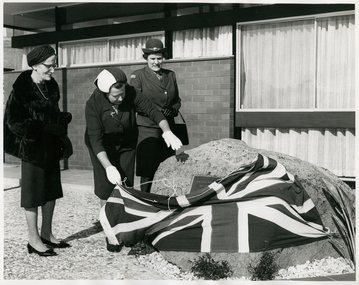 Royal District Nursing Service (now known as Bolton Clarke)
Photograph - Photograph, black and white, 30 08 1967
... ...royal district nursing service...Wilson is President of the Royal District Nursing Service. Miss Mary Evans is the Director of Nursing of the Royal District Nursing Service and is wearing her dark grey Director's uniform....Wilson is President of the Royal District Nursing Service. Miss Mary Evans is the Director of Nursing of the Royal District Nursing Service and is wearing her dark grey Director's uniform. ...Mrs. R. Gordon is the President of the Victorian branch of the National Council of Women and is unveiling the Memorial plaque to Caroline Chisholm. The plaque stands on a rock in front of the Royal District Nursing Service (RDNS) Essendon Centre, and was unveiled on the same day the Centre opened on the 30th of August 1967. Mrs. E.G. Wilson is President of the Royal District Nursing Service. Miss Mary Evans is the Director of Nursing of the Royal District Nursing Service and is wearing her dark grey Director's uniform.Caroline Chisholm visited the goldfields of Victoria in 1854 and was horrified by the conditions en-route. The Memorial plaque to Caroline Chisholm, in front of the RDNS Essendon Centre, is in recognition for her work in establishing, with Government assistance, shelter sheds about a days walk apart, to enable the prospectors and their families shelter whilst heading for the goldfields. Caroline Chisholm, a Philanthropist, began her work in Madras in 1834 founding a Female School of Industry for the daughters of European soldiers. They were taught to read, write, cook, keep house and were given instructions in nursing. After coming to Sydney in 1838, she set up accommodation for poor young unemployed migrant women and families. This work was extended when she arranged employment in the countryside for assisted immigrant women and families, many times travelling with groups of young women to check their employment conditions. In seven years she placed 11,000 people in homes and employment. On her return to England she fought for, and won, free passage to Australia for wives and children of former convicts, and for children left behind in England by circumstances, when the family migrated. She established the Family Colonisation Loan Society in 1849, which set up a saving scheme for emigrants, and later loaned them half of their passage to Australia. The Society's Agents found them employment on arrival, and the loan was paid back within two years by a humane payment scheme. At first they used emigrant ships for passage, but then the Society provided ships with much improved conditions, and this led to the upgrading of the passenger Act.. The Chisholm's lived in Kyneton for several years, returning to Sydney for health reasons, before going back to England where Caroline died, aged 68 years, on the 25th of March 1877.Black and white photograph showing Mrs. R. Gordon, wearing a black coat and black and white beret style hat, with her left hand on a rock and her right hand on the British Flag, whilst unveiling the Memorial plaque to Caroline Chisholm. Mrs. R. Gordon stands between Mrs. E.G. Wilson, who is to her left, and is wearing glasses and a black coat, hat and shoes. Miss Mary Evans, who is wearing her RDNS uniform of a dark grey skirt and jacket and brimmed hat, and with a handbag looped over her left arm, is to the right.. Part of a building is seen in the background; short glass windows can be seen above the brickwork to the left and a large glass window to the right.Photographers stamp and 'Quote No. GJ 60'rdns, royal district nursing service, essendon centre, caroline chisholm, memorial plaque, mrs r. gordon, miss mary evans, mrs e.g. (hazel janet) wilson -
Northern District School of Nursing. Managed by Bendigo Historical Society Inc.
Administrative record - Northern District School of Nursing Graduates Association - Apology Letter for Invitation to unveil Lister House Plaque, 23 April 1995
... Northern District School of Nursing Graduates Association - Apology Letter for Invitation to unveil Lister House Plaque...The Northern District School of Nursing in Victoria, Australia Graduates Association: History of the School Managed by a committee including hospital administrators, medical professionals, and nursing leaders from several regional hospitals. ...Northern District School of Nursing Graduates Association - Apology Letter for Invitation to unveil Lister House Plaque; from Margot Scott to the Association President Joan O'Shea, 23 April 1995 This item contains the following documents: 3792.16a The hand written letter three page is an apology after being asked to unveil the Lister House plaque; and is critical of the recorded history of the school (Contact BHS for details) 3792.16b Sample of a plaque to be installed at Lister House...The Northern District School of Nursing in Victoria, Australia Graduates Association: History of the School Managed by a committee including hospital administrators, medical professionals, and nursing leaders from several regional hospitals. ...The Northern District School of Nursing in Victoria, Australia Graduates Association: History of the School Managed by a committee including hospital administrators, medical professionals, and nursing leaders from several regional hospitals. Associated with major hospitals in the Northern District, including Bendigo Base, Mildura Base, Castlemaine, Echuca, Swan Hill, St. Arnaud, and Kyneton District Hospitals. Provide high-quality theoretical and practical nursing training. Raise the standard of nursing education in the region. Maintain the highest principles of nursing practice. Applicants must be at least 17 years old and hold a Proficiency Certificate or higher educational qualification. Application involves submitting forms, certificates, an interview, an aptitude test, and a medical examination. A three-month probationary period follows initial acceptance. Preliminary Training School: Four-week introductory course covering basic nursing, anatomy, hygiene, and practical skills. Practical experience in various hospital departments, guided by senior staff. Study Block Plan: Includes several blocks of theoretical and practical instruction throughout the three-year program. Regular school exams and two state exams (First Professional and Final State) are required for progression and graduation. Nurses work a 40-hour week with at least one or two days off per week and three weeks of annual leave. Accommodation is provided in comfortable hostels with good facilities. Uniforms are supplied free; nurses provide their own shoes and stockings. Salaries and allowances are regulated, with deductions for board and free medical care. Additional Information Post-Graduate Opportunities. Senior positions require further experience and additional certificates (e.g., Midwifery, Infant Welfare).Diploma courses available in administration, teaching, and specialized nursing fields. Bursaries are available for advanced study.Career Prospects: Graduates can pursue roles in administration, teaching, ward and departmental leadership, district and visiting nursing, industrial and school nursing, and more. Opportunities existed both within hospitals and in community or specialized settings.FAQs and Practical Details. Minimal training costs (mainly exam fees and personal items).Living out allowances and travel expenses are covered. Four training intakes per year; waiting periods are short if qualifications are met.Northern District School of Nursing Graduates Association - Apology Letter for Invitation to unveil Lister House Plaque; from Margot Scott to the Association President Joan O'Shea, 23 April 1995 This item contains the following documents: 3792.16a The hand written letter three page is an apology after being asked to unveil the Lister House plaque; and is critical of the recorded history of the school (Contact BHS for details) 3792.16b Sample of a plaque to be installed at Lister Housenurse training, lister house, lister house plaque, marot scott, joan o'shea -
Northern District School of Nursing. Managed by Bendigo Historical Society Inc.
Administrative record - Northern District School of Nursing Graduates Association - First Year General Nursing Notes, 1950s
... Northern District School of Nursing Graduates Association - First Year General Nursing Notes...The Northern District School of Nursing in Victoria, Australia Graduates Association: History of the School Managed by a committee including hospital administrators, medical professionals, and nursing leaders from several regional hospitals. ...Northern District School of Nursing Graduates Association - First Year General Nursing Notes, Workbook which belonged to Heather Gamble This item contains the following documents: 3793.4a First Year General Nursing Notes, Workbook which belonged to Heather Gamble - Contains Typed and written Notes, 37 pages. ...The Northern District School of Nursing in Victoria, Australia Graduates Association: History of the School Managed by a committee including hospital administrators, medical professionals, and nursing leaders from several regional hospitals. ...The Northern District School of Nursing in Victoria, Australia Graduates Association: History of the School Managed by a committee including hospital administrators, medical professionals, and nursing leaders from several regional hospitals. Associated with major hospitals in the Northern District, including Bendigo Base, Mildura Base, Castlemaine, Echuca, Swan Hill, St. Arnaud, and Kyneton District Hospitals. Provide high-quality theoretical and practical nursing training. Raise the standard of nursing education in the region. Maintain the highest principles of nursing practice. Applicants must be at least 17 years old and hold a Proficiency Certificate or higher educational qualification. Application involves submitting forms, certificates, an interview, an aptitude test, and a medical examination. A three-month probationary period follows initial acceptance. Preliminary Training School: Four-week introductory course covering basic nursing, anatomy, hygiene, and practical skills. Practical experience in various hospital departments, guided by senior staff. Study Block Plan: Includes several blocks of theoretical and practical instruction throughout the three-year program. Regular school exams and two state exams (First Professional and Final State) are required for progression and graduation. Nurses work a 40-hour week with at least one or two days off per week and three weeks of annual leave. Accommodation is provided in comfortable hostels with good facilities. Uniforms are supplied free; nurses provide their own shoes and stockings. Salaries and allowances are regulated, with deductions for board and free medical care. Additional Information Post-Graduate Opportunities. Senior positions require further experience and additional certificates (e.g., Midwifery, Infant Welfare).Diploma courses available in administration, teaching, and specialized nursing fields. Bursaries are available for advanced study.Career Prospects: Graduates can pursue roles in administration, teaching, ward and departmental leadership, district and visiting nursing, industrial and school nursing, and more. Opportunities existed both within hospitals and in community or specialized settings.FAQs and Practical Details. Minimal training costs (mainly exam fees and personal items).Living out allowances and travel expenses are covered. Four training intakes per year; waiting periods are short if qualifications are met.Northern District School of Nursing Graduates Association - First Year General Nursing Notes, Workbook which belonged to Heather Gamble This item contains the following documents: 3793.4a First Year General Nursing Notes, Workbook which belonged to Heather Gamble - Contains Typed and written Notes, 37 pages. This nursing training manual provides comprehensive guidance on essential hospital nursing procedures, focusing on bed management, patient care, and clinical practices.nurse training, lister house, heather gamble -
Northern District School of Nursing. Managed by Bendigo Historical Society Inc.
Administrative record - Northern District School of Nursing Graduates Association - Medical Poetry, 1960s
... Northern District School of Nursing Graduates Association - Medical Poetry...The Northern District School of Nursing in Victoria, Australia Graduates Association: History of the School Managed by a committee including hospital administrators, medical professionals, and nursing leaders from several regional hospitals. ...Northern District School of Nursing Graduates Association - Medical Poetry 1960s This item contains the following documents: 3801.2a A satirical, medical-themed parody of a wedding announcement, creatively blending medical terminology and humor throughout 3801.2b A humorous poem that candidly describes a patient's struggles with using a bedpan after surgery. 3801.2c This document is an email correspondence between Jan Ellis and Jenny Pata discussing the sharing of personal anecdotes for a newsletter. ...Contact BHS for Details Administrative record Northern District School of Nursing Graduates Association - Medical Poetry ...The Northern District School of Nursing in Victoria, Australia Graduates Association: History of the School Managed by a committee including hospital administrators, medical professionals, and nursing leaders from several regional hospitals. Associated with major hospitals in the Northern District, including Bendigo Base, Mildura Base, Castlemaine, Echuca, Swan Hill, St. Arnaud, and Kyneton District Hospitals. Provide high-quality theoretical and practical nursing training. Raise the standard of nursing education in the region. Maintain the highest principles of nursing practice. Applicants must be at least 17 years old and hold a Proficiency Certificate or higher educational qualification. Application involves submitting forms, certificates, an interview, an aptitude test, and a medical examination. A three-month probationary period follows initial acceptance. Preliminary Training School: Four-week introductory course covering basic nursing, anatomy, hygiene, and practical skills. Practical experience in various hospital departments, guided by senior staff. Study Block Plan: Includes several blocks of theoretical and practical instruction throughout the three-year program. Regular school exams and two state exams (First Professional and Final State) are required for progression and graduation. Nurses work a 40-hour week with at least one or two days off per week and three weeks of annual leave. Accommodation is provided in comfortable hostels with good facilities. Uniforms are supplied free; nurses provide their own shoes and stockings. Salaries and allowances are regulated, with deductions for board and free medical care. Additional Information Post-Graduate Opportunities. Senior positions require further experience and additional certificates (e.g., Midwifery, Infant Welfare).Diploma courses available in administration, teaching, and specialized nursing fields. Bursaries are available for advanced study.Career Prospects: Graduates can pursue roles in administration, teaching, ward and departmental leadership, district and visiting nursing, industrial and school nursing, and more. Opportunities existed both within hospitals and in community or specialized settings.FAQs and Practical Details. Minimal training costs (mainly exam fees and personal items).Living out allowances and travel expenses are covered. Four training intakes per year; waiting periods are short if qualifications are met.Northern District School of Nursing Graduates Association - Medical Poetry 1960s This item contains the following documents: 3801.2a A satirical, medical-themed parody of a wedding announcement, creatively blending medical terminology and humor throughout 3801.2b A humorous poem that candidly describes a patient's struggles with using a bedpan after surgery. 3801.2c This document is an email correspondence between Jan Ellis and Jenny Pata discussing the sharing of personal anecdotes for a newsletter. Contact BHS for Detailsnurse training, lister house, medical poetry -
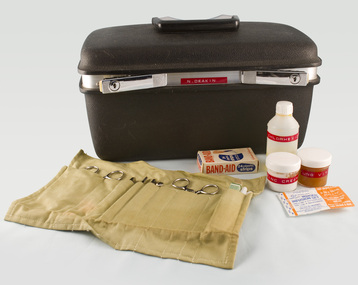 Royal District Nursing Service (now known as Bolton Clarke)
Equipment - Photograph, colour, c.1970
... ...royal district nursing service...This is style of nursing case and type of equipment used by the Sisters of the Royal District Nursing Service (RDNS) in the 1970s. The Sisters worked throughout the Melbourne inner and outer suburbs visiting patients to administer nursing care in their homes and other arranged venues. ...The Trained nurses of the Melbourne District Nursing Society (MDNS), later known as Royal District Nursing Service (RDNS), visited patients in their home and gave best practice care in many fields of nursing, and to people of many cultures, throughout its 130 years of expansion. ...This is style of nursing case and type of equipment used by the Sisters of the Royal District Nursing Service (RDNS) in the 1970s. The Sisters worked throughout the Melbourne inner and outer suburbs visiting patients to administer nursing care in their homes and other arranged venues. The Trained nurses of the Melbourne District Nursing Society (MDNS), later known as Royal District Nursing Service (RDNS), visited patients in their home and gave best practice care in many fields of nursing, and to people of many cultures, throughout its 130 years of expansion. Initial visits not only assessed the specific nursing situation but the situation as a whole. Their patients ranged in age from babes, children, adults to the elderly and referrals were taken from Hospitals, General Practitioners and allied Health facilities. Some of the care the Sisters provided is as follows: – Post-Natal care given to mother and babe, Wound Care following various types of surgery, accidents, burns, cancer, leg ulcers etc. Supervising and teaching Diabetic Care, including teaching and supervising people with Diabetes to administer their own Insulin, and administering Insulin to those unable to give their own injections. Administering other injections and setting up weekly medication boxes. The Sisters performed Catheterizations on adults suffering from conditions such as Quadriplegia, Paraplegia, Multiple Sclerosis (MS), Motor Neurone Disease (MND) and Guillan-Barre Syndrome, and when required at school on children for e.g. those with Spina Bifida. The Sisters visited those requiring Cystic Fibrosis support and care; those requiring Haemo-Oncology care, including visiting children at school; those requiring Home Enteral Feeding care, and those requiring IV therapy at home and home Dialysis. Palliative Care was given including pain relief with the use of syringe drivers, personal care as needed, and advice and support to both patient and family. The Sisters provided Stoma management to those needing Urostomy, Ileostomy and Colostomy care and those requiring Continence care. HIV/AIDS nursing care was provided; visits to Homeless Persons were made. Personal care was given to patients ranging in age and with varying mobility problems, such as those with MS, MND, Guillan-Barre Syndrome, Quadriplegia, Paraplegia, Acquired Brain Injury, to those following a Cerebrovascular Accident (Stroke), those with severe Arthritis and those with a form of Dementia. When necessary the elderly were assisted with personal care and advice given on safety factors with the use of hand rails, bath or shower seats, and hand showers. Rehabilitation with an aim towards independence remained at the forefront of the Sister’s minds and when possible using aids and instruction on safe techniques enabled the person to become fully independent. All care included giving advice and support to the patient and their Carers. The Sisters liaised with the persons Doctor, Hospital and allied Health personal as necessary.Black deep case made of man made material. it has a raised lid with attached handle. The metal section between the lid and body of the case has metal clasps attached to it which open and close within this section. The deep section contains a cotton bag sewn in sections which contain artery forceps, dissecting forceps, scissors, thermometer, wooden spatula. Shown are a packet of Band-Aids, plastic bottle containing chlorhexidine, jar containing soft-soap and jar containing Saf-sol which were carried within the body of the case.rdns, royal district nursing service, rdns equipment, melbourne district nursing society -
 Northern District School of Nursing. Managed by Bendigo Historical Society Inc.
Ephemera - Northern District School of Nursing Graduates Association - Memorabilia, 1960s
... Northern District School of Nursing Graduates Association - Memorabilia...The Northern District School of Nursing in Victoria, Australia Graduates Association: History of the School Managed by a committee including hospital administrators, medical professionals, and nursing leaders from several regional hospitals. ...Northern District School of Nursing Graduates Association - Memorabilia from Faye Lynetter Carter 1960s This item contains the following documents: 3801.3a A handwritten note to the Association 3801.3b A copy of Faye's Lynette Carter's Certificate 1961 from the Echuca, Bendigo and Northern Base Hospital 3801.3c Photocopy of Faye and the other nurses of her year 3801.3d Photocopy of Faye and three other graduates 3801.3e Photocopy of the Graduate's dinner 3801.3f Examination paper July 1961 for Surgical Nursing...The Northern District School of Nursing in Victoria, Australia Graduates Association: History of the School Managed by a committee including hospital administrators, medical professionals, and nursing leaders from several regional hospitals. ...The Northern District School of Nursing in Victoria, Australia Graduates Association: History of the School Managed by a committee including hospital administrators, medical professionals, and nursing leaders from several regional hospitals. Associated with major hospitals in the Northern District, including Bendigo Base, Mildura Base, Castlemaine, Echuca, Swan Hill, St. Arnaud, and Kyneton District Hospitals. Provide high-quality theoretical and practical nursing training. Raise the standard of nursing education in the region. Maintain the highest principles of nursing practice. Applicants must be at least 17 years old and hold a Proficiency Certificate or higher educational qualification. Application involves submitting forms, certificates, an interview, an aptitude test, and a medical examination. A three-month probationary period follows initial acceptance. Preliminary Training School: Four-week introductory course covering basic nursing, anatomy, hygiene, and practical skills. Practical experience in various hospital departments, guided by senior staff. Study Block Plan: Includes several blocks of theoretical and practical instruction throughout the three-year program. Regular school exams and two state exams (First Professional and Final State) are required for progression and graduation. Nurses work a 40-hour week with at least one or two days off per week and three weeks of annual leave. Accommodation is provided in comfortable hostels with good facilities. Uniforms are supplied free; nurses provide their own shoes and stockings. Salaries and allowances are regulated, with deductions for board and free medical care. Additional Information Post-Graduate Opportunities. Senior positions require further experience and additional certificates (e.g., Midwifery, Infant Welfare).Diploma courses available in administration, teaching, and specialized nursing fields. Bursaries are available for advanced study.Career Prospects: Graduates can pursue roles in administration, teaching, ward and departmental leadership, district and visiting nursing, industrial and school nursing, and more. Opportunities existed both within hospitals and in community or specialized settings.FAQs and Practical Details. Minimal training costs (mainly exam fees and personal items).Living out allowances and travel expenses are covered. Four training intakes per year; waiting periods are short if qualifications are met.Northern District School of Nursing Graduates Association - Memorabilia from Faye Lynetter Carter 1960s This item contains the following documents: 3801.3a A handwritten note to the Association 3801.3b A copy of Faye's Lynette Carter's Certificate 1961 from the Echuca, Bendigo and Northern Base Hospital 3801.3c Photocopy of Faye and the other nurses of her year 3801.3d Photocopy of Faye and three other graduates 3801.3e Photocopy of the Graduate's dinner 3801.3f Examination paper July 1961 for Surgical Nursingnurse training, lister house, faye carter -
Northern District School of Nursing. Managed by Bendigo Historical Society Inc.
Administrative record - Northern District School of Nursing Graduates Association - Latrobe University School of Health Sciences Students Award Ceremony, 3rd May 1995
... Northern District School of Nursing Graduates Association - Latrobe University School of Health Sciences Students Award Ceremony...The Northern District School of Nursing in Victoria, Australia Graduates Association: History of the School Managed by a committee including hospital administrators, medical professionals, and nursing leaders from several regional hospitals. ...Northern District School of Nursing Graduates Association - Latrobe University School of Health Sciences Students Award Ceremony, 3rd May 1995 This item contains the following documents: 3792.17a Northern District School of Nursing Graduates Association - Latrobe University School of Health Sciences Students Award Ceremony program, includes the recipient of the Nursing Graduates Association Award. ...The Northern District School of Nursing in Victoria, Australia Graduates Association: History of the School Managed by a committee including hospital administrators, medical professionals, and nursing leaders from several regional hospitals. ...The Northern District School of Nursing in Victoria, Australia Graduates Association: History of the School Managed by a committee including hospital administrators, medical professionals, and nursing leaders from several regional hospitals. Associated with major hospitals in the Northern District, including Bendigo Base, Mildura Base, Castlemaine, Echuca, Swan Hill, St. Arnaud, and Kyneton District Hospitals. Provide high-quality theoretical and practical nursing training. Raise the standard of nursing education in the region. Maintain the highest principles of nursing practice. Applicants must be at least 17 years old and hold a Proficiency Certificate or higher educational qualification. Application involves submitting forms, certificates, an interview, an aptitude test, and a medical examination. A three-month probationary period follows initial acceptance. Preliminary Training School: Four-week introductory course covering basic nursing, anatomy, hygiene, and practical skills. Practical experience in various hospital departments, guided by senior staff. Study Block Plan: Includes several blocks of theoretical and practical instruction throughout the three-year program. Regular school exams and two state exams (First Professional and Final State) are required for progression and graduation. Nurses work a 40-hour week with at least one or two days off per week and three weeks of annual leave. Accommodation is provided in comfortable hostels with good facilities. Uniforms are supplied free; nurses provide their own shoes and stockings. Salaries and allowances are regulated, with deductions for board and free medical care. Additional Information Post-Graduate Opportunities. Senior positions require further experience and additional certificates (e.g., Midwifery, Infant Welfare).Diploma courses available in administration, teaching, and specialized nursing fields. Bursaries are available for advanced study.Career Prospects: Graduates can pursue roles in administration, teaching, ward and departmental leadership, district and visiting nursing, industrial and school nursing, and more. Opportunities existed both within hospitals and in community or specialized settings.FAQs and Practical Details. Minimal training costs (mainly exam fees and personal items).Living out allowances and travel expenses are covered. Four training intakes per year; waiting periods are short if qualifications are met.Northern District School of Nursing Graduates Association - Latrobe University School of Health Sciences Students Award Ceremony, 3rd May 1995 This item contains the following documents: 3792.17a Northern District School of Nursing Graduates Association - Latrobe University School of Health Sciences Students Award Ceremony program, includes the recipient of the Nursing Graduates Association Award. This document outlines the program for a student awards ceremony recognizing exceptional academic and clinical achievements among nursing students. The ceremony is organized by the School of Health Sciences and held on May 3, 1995.Attendees include award recipients, their families, sponsors, university staff, and special guests. Welcome and introductions by Ms Sue Ronaldson (Head, School of Health Sciences) and Dr Ian MacBean (Acting Dean, La Trobe University, Bendigo). Zonta Club: Heather Winderlich Award ($200): For outstanding academic achievement over three years (Recipient: Belinda Haw). Northern District School of Nursing Graduates Association Award ($100): For outstanding academic achievement in the third year (Recipient: Meagan Tharratt).Australian Medical Association – Bendigo Branch Book Prize ($80): For achievement in clinical nursing and theory (Recipient: Matthew Wall).Royal College of Nursing, Australia One year’s associate membership for outstanding academic and clinical performance (Recipient: Jocelyn Barklem). Mildura Private Hospital Scholarship ($1,000): For outstanding academic and clinical performance in the first and second years (Recipient: Katia Forbes).Bendigo and Region Psychiatric Services ($100 x 2 prizes): For academic performance in psychiatric nursing subjects in the third year (Recipients: Jacoba Hall, Kelly McEncroe).nurse training, lister house, lister house plaque, scholarsips, latrobe university -
 Northern District School of Nursing. Managed by Bendigo Historical Society Inc.
Document - Northern District School of Nursing Seventh Annual Report, 1957
... Northern District School of Nursing Seventh Annual Report...The Northern District School of Nursing operated from Lister House, Rowan Street, Bendigo. ...The Northern District School of Nursing operated from Lister House, Rowan Street, Bendigo. ...The Northern District School of Nursing opened in 1950 to address the issues around nurse recruitment, training and education that had previously been hospital based. The residential school was to provide theoretical and in-house education and practical training over three years. The students would also receive practical hands-on training in the wards of associated hospitals. The Northern District School of Nursing operated from Lister House, Rowan Street, Bendigo. It was the first independent school of nursing in Victoria and continued until it closed in 1989.A twelve page booklet being The Seventh Annual Report of the Committee of Management for the twelve monts’ period 1st July 1956 - 30th June, 1957 of the Northern School of Management. Print in blue and gold on front blue cardboard cover. The report covers Office Bearers, Lecturers, exam results, wastage and causes thereof, training details and expenditure. There are four copies.“N.W. Long’ is written in ink on top right hand corner of cover of one copy.nurse education, ndsn hospitals -
 Northern District School of Nursing. Managed by Bendigo Historical Society Inc.
Document - Northern District School of Nursing Eighth Annual Report, 1958
... Northern District School of Nursing Eighth Annual Report...The Northern District School of Nursing operated from Lister House, Rowan Street, Bendigo. ...The Northern District School of Nursing operated from Lister House, Rowan Street, Bendigo. ...The Northern District School of Nursing opened in 1950 to address the issues around nurse recruitment, training and education that had previously been hospital based. The residential school was to provide theoretical and in-house education and practical training over three years. The students would also receive practical hands-on training in the wards of associated hospitals. The Northern District School of Nursing operated from Lister House, Rowan Street, Bendigo. It was the first independent school of nursing in Victoria and continued until it closed in 1989.A sixteen page booklet being The Eighth Annual Report of the Committee of Management for the twelve monts’ period 1st July 1957 - 30th June, 1958 of the Northern School of Nursing Committee of Management. Print in blue and silver on front blue cardboard cover. The report covers Office Bearers, Lecturers, exam results, wastage and causes thereof, training details and expenditure. There are four copies. “N.W. Long’ is written in ink on top right hand corner of cover of one copy.nurse education, ndsn hospitals -
 Northern District School of Nursing. Managed by Bendigo Historical Society Inc.
Document - Northern District School of Nursing Ninth Annual Report, 1959
... Northern District School of Nursing Ninth Annual Report...The Northern District School of Nursing operated from Lister House, Rowan Street, Bendigo. ...The Northern District School of Nursing operated from Lister House, Rowan Street, Bendigo. ...The Northern District School of Nursing opened in 1950 to address the issues around nurse recruitment, training and education that had previously been hospital based. The residential school was to provide theoretical and in-house education and practical training over three years. The students would also receive practical hands-on training in the wards of associated hospitals. The Northern District School of Nursing operated from Lister House, Rowan Street, Bendigo. It was the first independent school of nursing in Victoria and continued until it closed in 1989.A twelve page booklet being The Ninth Annual Report of the Committee of Management for the twelve months’ period 1st July 1958 - 30th June, 1959 of the Northern School of Nursing Committee of Management. Print in blue and silver on front blue cardboard cover. The report covers Office Bearers, Lecturers, exam results, wastage and causes thereof, training details and expenditure. There are four copies.“N.W. Long’ is written in ink on top right hand corner of cover of one copy.nurse education, ndsn hospitals -
 Northern District School of Nursing. Managed by Bendigo Historical Society Inc.
Document - Northern District School of Nursing Tenth Annual Report, 1960
... Northern District School of Nursing Tenth Annual Report...The Northern District School of Nursing operated from Lister House, Rowan Street, Bendigo. ...The Northern District School of Nursing operated from Lister House, Rowan Street, Bendigo. ...The Northern District School of Nursing opened in 1950 to address the issues around nurse recruitment, training and education that had previously been hospital based. The residential school was to provide theoretical and in-house education and practical training over three years. The students would also receive practical hands-on training in the wards of associated hospitals. The Northern District School of Nursing operated from Lister House, Rowan Street, Bendigo. It was the first independent school of nursing in Victoria and continued until it closed in 1989.A ten page booklet being The Tenth Annual Report of the Committee of Management for the twelve months’ period 1st July 1959 - 30th June, 1960 of the Northern School of Nursing Committee of Management. Print in black on mustard background on cream cardboard cover. The report covers Office Bearers, Lecturers, exam results, wastage and causes thereof, training details and expenditure. There are four copies. “N.W. Long’ is written in ink on top right hand corner of cover of one copy. There are pencilled corrections to items under headings "Examinations" and "Students in training as at 30th June, 1960"nurse education, ndsn hospitals -
Northern District School of Nursing. Managed by Bendigo Historical Society Inc.
Administrative record - Northern District School of Nursing Graduates Association - Assignment on Otosclerosis and Stapedectomy, 1980s
... Northern District School of Nursing Graduates Association - Assignment on Otosclerosis and Stapedectomy...The Northern District School of Nursing in Victoria, Australia Graduates Association: History of the School Managed by a committee including hospital administrators, medical professionals, and nursing leaders from several regional hospitals. ...Northern District School of Nursing Graduates Association - Assignment on Otosclerosis and Stapedectomy by Leanne Pyke School 91 - 15 pages Phase two block three. ...The Northern District School of Nursing in Victoria, Australia Graduates Association: History of the School Managed by a committee including hospital administrators, medical professionals, and nursing leaders from several regional hospitals. ...The Northern District School of Nursing in Victoria, Australia Graduates Association: History of the School Managed by a committee including hospital administrators, medical professionals, and nursing leaders from several regional hospitals. Associated with major hospitals in the Northern District, including Bendigo Base, Mildura Base, Castlemaine, Echuca, Swan Hill, St. Arnaud, and Kyneton District Hospitals. Provide high-quality theoretical and practical nursing training. Raise the standard of nursing education in the region. Maintain the highest principles of nursing practice. Applicants must be at least 17 years old and hold a Proficiency Certificate or higher educational qualification. Application involves submitting forms, certificates, an interview, an aptitude test, and a medical examination. A three-month probationary period follows initial acceptance. Preliminary Training School: Four-week introductory course covering basic nursing, anatomy, hygiene, and practical skills. Practical experience in various hospital departments, guided by senior staff. Study Block Plan: Includes several blocks of theoretical and practical instruction throughout the three-year program. Regular school exams and two state exams (First Professional and Final State) are required for progression and graduation. Nurses work a 40-hour week with at least one or two days off per week and three weeks of annual leave. Accommodation is provided in comfortable hostels with good facilities. Uniforms are supplied free; nurses provide their own shoes and stockings. Salaries and allowances are regulated, with deductions for board and free medical care. Additional Information Post-Graduate Opportunities. Senior positions require further experience and additional certificates (e.g., Midwifery, Infant Welfare).Diploma courses available in administration, teaching, and specialized nursing fields. Bursaries are available for advanced study.Career Prospects: Graduates can pursue roles in administration, teaching, ward and departmental leadership, district and visiting nursing, industrial and school nursing, and more. Opportunities existed both within hospitals and in community or specialized settings.FAQs and Practical Details. Minimal training costs (mainly exam fees and personal items).Living out allowances and travel expenses are covered. Four training intakes per year; waiting periods are short if qualifications are met.Northern District School of Nursing Graduates Association - Assignment on Otosclerosis and Stapedectomy by Leanne Pyke School 91 - 15 pages Phase two block three. This item contains the following documents: 3793.3a Assignment on Otosclerosis and Stapedectomy by Leanne Pyke School 91 - 15 pages This document provides a comprehensive overview of otosclerosis and its surgical management via stapedectomy, Illustrated through a detailed patient case. Otosclerosis is a disease of unknown cause affecting the middle ear, leading to progressive conductive hearing loss.nurse training, lister house, leanne pyke
