
Showing 4257 items matching " 2000.522..01"
-
 Federation University Art Collection
Work on paper - Printmaking - Linocut, Griffin, Murray, 'Heron' by Murray Griffin, 1950
... Murray GRIFFIN (11/11/1903– 29/01/1992) Born Malvern, Victoria Vaughan Murray (Murray) Griffin trained at the National Gallery of Victoria Art School from 1919 to 1923. ...Murray GRIFFIN (11/11/1903– 29/01/1992) Born Malvern, Victoria Vaughan Murray (Murray) Griffin trained at the National Gallery of Victoria Art School from 1919 to 1923. ...Murray GRIFFIN (11/11/1903– 29/01/1992) Born Malvern, Victoria Vaughan Murray (Murray) Griffin trained at the National Gallery of Victoria Art School from 1919 to 1923. He taught art at Scotch College (1936 to 1937), drawing and teaching at RMIT (1937 to 1940) and teacher of drawing at the National Gallery of Victoria Art School 1946 to 1953. In 1941 he was appointed an official war artist working with the 8th Australian Division in Malaya for three months. The completed works were prepared for transport to Australia but did not arrive and are lost. He was captured by the Japanese in February 1942 after the fall of Singapore and incarcerated for three and a half years as a Prisonor of war at Changi Prison, Singapore. This item is part of the Federation University Art Collection. The Art Collection features over 2000 works and was listed as a 'Ballarat Treasure' in 2007.Framed colour linocut by Murray Griffen.signed lls 'Murray Griffin '50'art, artwork, murray griffin, griffin, linocut, printmaking -
 Kew Historical Society Inc
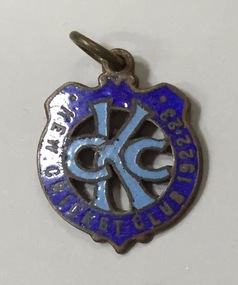
Unknown - Membership Medallion, Kew Cricket Club KCC 1922-1923, 1922
... After Francis Rigg’s death, the collection of buttons and medallions was inherited by his son, Ken Rigg (14/11/1922-19/01/2014). The collection was subsequently donated to the Kew Historical Society in 2015 by his grandson Adrian Rigg at the time of the Gallipoli & Beyond Commemoration.The collection covers a period of almost 40 years. ...After Francis Rigg’s death, the collection of buttons and medallions was inherited by his son, Ken Rigg (14/11/1922-19/01/2014). The collection was subsequently donated to the Kew Historical Society in 2015 by his grandson Adrian Rigg at the time of the Gallipoli & Beyond Commemoration.The collection covers a period of almost 40 years. ...Frances Rigg was a local business identity in Kew, ultimately managing the local branch of the English, Scottish and Australian (ES&A) Bank at 175 High Street, Kew from c. 1920 until the 1940s. After Francis Rigg’s death, the collection of buttons and medallions was inherited by his son, Ken Rigg (14/11/1922-19/01/2014). The collection was subsequently donated to the Kew Historical Society in 2015 by his grandson Adrian Rigg at the time of the Gallipoli & Beyond Commemoration.The collection covers a period of almost 40 years. The majority of the buttons are patriotic buttons, issued and sold during and immediately after the First World World War (1914-1918) to raise funds for national and overseas causes. The collection also includes a number of locally significant sporting event buttons and sporting club medallions, issued in the 1920s and 1930s.Blue enamel on metal membership medallion produced by the Kew Cricket Club for the year 1922-23 and which belonged to Francis Horace Rigg (1882-1946). The medallion in shield shape is enameled in shades of blue with the initials of the Club, KCC surrounded by the full name of the club and the period for which the member would gain access to games.Kew Cricket Club KCC 1922-1923kew cricket club, membership medallions -
 Kew Historical Society Inc
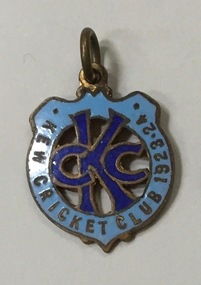
Unknown - Membership Medallion, Kew Cricket Club KCC 1923-1924, 1923
... After Francis Rigg’s death, the collection of buttons and medallions was inherited by his son, Ken Rigg (14/11/1922-19/01/2014). The collection was subsequently donated to the Kew Historical Society in 2015 by his grandson Adrian Rigg at the time of the Gallipoli & Beyond Commemoration.The collection covers a period of almost 40 years. ...After Francis Rigg’s death, the collection of buttons and medallions was inherited by his son, Ken Rigg (14/11/1922-19/01/2014). The collection was subsequently donated to the Kew Historical Society in 2015 by his grandson Adrian Rigg at the time of the Gallipoli & Beyond Commemoration.The collection covers a period of almost 40 years. ...Frances Rigg was a local business identity in Kew, ultimately managing the local branch of the English, Scottish and Australian (ES&A) Bank at 175 High Street, Kew from c. 1920 until the 1940s. After Francis Rigg’s death, the collection of buttons and medallions was inherited by his son, Ken Rigg (14/11/1922-19/01/2014). The collection was subsequently donated to the Kew Historical Society in 2015 by his grandson Adrian Rigg at the time of the Gallipoli & Beyond Commemoration.The collection covers a period of almost 40 years. The majority of the buttons are patriotic buttons, issued and sold during and immediately after the First World World War (1914-1918) to raise funds for national and overseas causes. The collection also includes a number of locally significant sporting event buttons and sporting club medallions, issued in the 1920s and 1930s.Blue enamel on metal membership medallion produced by the Kew Cricket Club for the year 1923-24 and which belonged to Francis Horace Rigg (1882-1946). The medallion in shield shape is enameled in shades of blue with the initials of the Club, KCC surrounded by the full name of the club and the period for which the member would gain access to games.Kew Cricket Club KCC 1923-1924kew cricket club, membership medallions -
 Kew Historical Society Inc
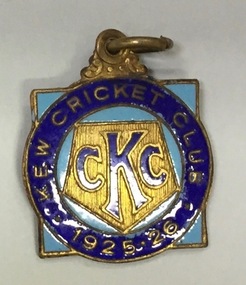
Unknown - Membership Medallion, Kew Cricket Club KCC 1925-26, 1925
... After Francis Rigg’s death, the collection of buttons and medallions was inherited by his son, Ken Rigg (14/11/1922-19/01/2014). The collection was subsequently donated to the Kew Historical Society in 2015 by his grandson Adrian Rigg at the time of the Gallipoli & Beyond Commemoration.The collection covers a period of almost 40 years. ...After Francis Rigg’s death, the collection of buttons and medallions was inherited by his son, Ken Rigg (14/11/1922-19/01/2014). The collection was subsequently donated to the Kew Historical Society in 2015 by his grandson Adrian Rigg at the time of the Gallipoli & Beyond Commemoration.The collection covers a period of almost 40 years. ...Frances Rigg was a local business identity in Kew, ultimately managing the local branch of the English, Scottish and Australian (ES&A) Bank at 175 High Street, Kew from c. 1920 until the 1940s. After Francis Rigg’s death, the collection of buttons and medallions was inherited by his son, Ken Rigg (14/11/1922-19/01/2014). The collection was subsequently donated to the Kew Historical Society in 2015 by his grandson Adrian Rigg at the time of the Gallipoli & Beyond Commemoration.The collection covers a period of almost 40 years. The majority of the buttons are patriotic buttons, issued and sold during and immediately after the First World World War (1914-1918) to raise funds for national and overseas causes. The collection also includes a number of locally significant sporting event buttons and sporting club medallions, issued in the 1920s and 1930s.Blue and gilt enamel on metal membership medallion produced by the Kew Cricket Club for the year 1925-26 and which belonged to Francis Horace Rigg (1882-1946). The circular medallion on a square base is enameled in shades of blue and gold with the initials of the Club, KCC surrounded by the full name of the club and the period for which the member would gain access to games.Kew Cricket Club KCC 1925-26kew cricket club, membership medallions -
 Kew Historical Society Inc
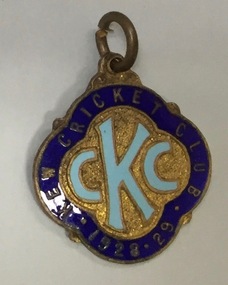
Unknown - Membership Medallion, Kew Cricket Club KCC 1928-29, 1928
... After Francis Rigg’s death, the collection of buttons and medallions was inherited by his son, Ken Rigg (14/11/1922-19/01/2014). The collection was subsequently donated to the Kew Historical Society in 2015 by his grandson Adrian Rigg at the time of the Gallipoli & Beyond Commemoration.The collection covers a period of almost 40 years. ...After Francis Rigg’s death, the collection of buttons and medallions was inherited by his son, Ken Rigg (14/11/1922-19/01/2014). The collection was subsequently donated to the Kew Historical Society in 2015 by his grandson Adrian Rigg at the time of the Gallipoli & Beyond Commemoration.The collection covers a period of almost 40 years. ...Frances Rigg was a local business identity in Kew, ultimately managing the local branch of the English, Scottish and Australian (ES&A) Bank at 175 High Street, Kew from c. 1920 until the 1940s. After Francis Rigg’s death, the collection of buttons and medallions was inherited by his son, Ken Rigg (14/11/1922-19/01/2014). The collection was subsequently donated to the Kew Historical Society in 2015 by his grandson Adrian Rigg at the time of the Gallipoli & Beyond Commemoration.The collection covers a period of almost 40 years. The majority of the buttons are patriotic buttons, issued and sold during and immediately after the First World World War (1914-1918) to raise funds for national and overseas causes. The collection also includes a number of locally significant sporting event buttons and sporting club medallions, issued in the 1920s and 1930s.Blue and gilt enamel on metal membership medallion produced by the Kew Cricket Club for the year 1928-29 and which belonged to Francis Horace Rigg (1882-1946). The medallion is enameled in shades of blue and gold with the initials of the Club, KCC surrounded by the full name of the club and the period for which the member would gain access to games.Kew Cricket Club KCC 1928-29kew cricket club -
 Kew Historical Society Inc
Unknown - Membership Medallion, Kew Cricket Club KCC 1929-1930, 1929
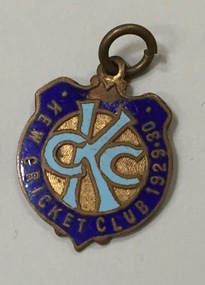
... After Francis Rigg’s death, the collection of buttons and medallions was inherited by his son, Ken Rigg (14/11/1922-19/01/2014). The collection was subsequently donated to the Kew Historical Society in 2015 by his grandson Adrian Rigg at the time of the Gallipoli & Beyond Commemoration.The collection covers a period of almost 40 years. ...After Francis Rigg’s death, the collection of buttons and medallions was inherited by his son, Ken Rigg (14/11/1922-19/01/2014). The collection was subsequently donated to the Kew Historical Society in 2015 by his grandson Adrian Rigg at the time of the Gallipoli & Beyond Commemoration.The collection covers a period of almost 40 years. ...Frances Rigg was a local business identity in Kew, ultimately managing the local branch of the English, Scottish and Australian (ES&A) Bank at 175 High Street, Kew from c. 1920 until the 1940s. After Francis Rigg’s death, the collection of buttons and medallions was inherited by his son, Ken Rigg (14/11/1922-19/01/2014). The collection was subsequently donated to the Kew Historical Society in 2015 by his grandson Adrian Rigg at the time of the Gallipoli & Beyond Commemoration.The collection covers a period of almost 40 years. The majority of the buttons are patriotic buttons, issued and sold during and immediately after the First World World War (1914-1918) to raise funds for national and overseas causes. The collection also includes a number of locally significant sporting event buttons and sporting club medallions, issued in the 1920s and 1930s.Blue and gilt enamel on metal membership medallion produced by the Kew Cricket Club for the year 1929-30 and which belonged to Francis Horace Rigg (1882-1946). The medallion is enameled in shades of blue and gold with the initials of the Club, KCC surrounded by the full name of the club and the period for which the member would gain access to games.Kew Cricket Club KCC 1929-1930kew cricket club, membership medallions -
 Kew Historical Society Inc
Unknown - Membership Medallion, Kew Cricket Club KCC 1931-1932, 1931
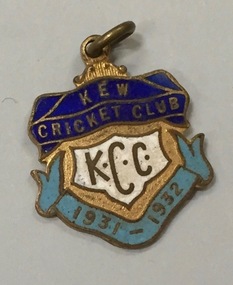
... After Francis Rigg’s death, the collection of buttons and medallions was inherited by his son, Ken Rigg (14/11/1922-19/01/2014). The collection was subsequently donated to the Kew Historical Society in 2015 by his grandson Adrian Rigg at the time of the Gallipoli & Beyond Commemoration.The collection covers a period of almost 40 years. ...After Francis Rigg’s death, the collection of buttons and medallions was inherited by his son, Ken Rigg (14/11/1922-19/01/2014). The collection was subsequently donated to the Kew Historical Society in 2015 by his grandson Adrian Rigg at the time of the Gallipoli & Beyond Commemoration.The collection covers a period of almost 40 years. ...Frances Rigg was a local business identity in Kew, ultimately managing the local branch of the English, Scottish and Australian (ES&A) Bank at 175 High Street, Kew from c. 1920 until the 1940s. After Francis Rigg’s death, the collection of buttons and medallions was inherited by his son, Ken Rigg (14/11/1922-19/01/2014). The collection was subsequently donated to the Kew Historical Society in 2015 by his grandson Adrian Rigg at the time of the Gallipoli & Beyond Commemoration.The collection covers a period of almost 40 years. The majority of the buttons are patriotic buttons, issued and sold during and immediately after the First World World War (1914-1918) to raise funds for national and overseas causes. The collection also includes a number of locally significant sporting event buttons and sporting club medallions, issued in the 1920s and 1930s.One of three blue and gilt enamel on metal membership medallions produced by the Kew Cricket Club for the year 1931-32 and which belonged to Francis Horace Rigg (1882-1946). The medallion is enameled in shades of blue and gold with the initials of the Club at centre, the full name of the Club at top and the period for which the member would gain access to games at the base.Kew Cricket Club KCC 1931-1932kew cricket club, francis horace rigg, numismatics, medallions, sport -
 Kew Historical Society Inc
Unknown - Membership Medallion, Kew Cricket Club KCC 1931-1932, 1931
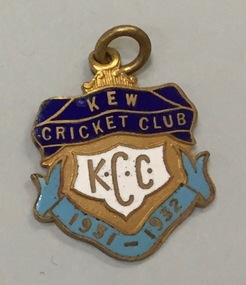
... After Francis Rigg’s death, the collection of buttons and medallions was inherited by his son, Ken Rigg (14/11/1922-19/01/2014). The collection was subsequently donated to the Kew Historical Society in 2015 by his grandson Adrian Rigg at the time of the Gallipoli & Beyond Commemoration.The collection covers a period of almost 40 years. ...After Francis Rigg’s death, the collection of buttons and medallions was inherited by his son, Ken Rigg (14/11/1922-19/01/2014). The collection was subsequently donated to the Kew Historical Society in 2015 by his grandson Adrian Rigg at the time of the Gallipoli & Beyond Commemoration.The collection covers a period of almost 40 years. ...Frances Rigg was a local business identity in Kew, ultimately managing the local branch of the English, Scottish and Australian (ES&A) Bank at 175 High Street, Kew from c. 1920 until the 1940s. After Francis Rigg’s death, the collection of buttons and medallions was inherited by his son, Ken Rigg (14/11/1922-19/01/2014). The collection was subsequently donated to the Kew Historical Society in 2015 by his grandson Adrian Rigg at the time of the Gallipoli & Beyond Commemoration.The collection covers a period of almost 40 years. The majority of the buttons are patriotic buttons, issued and sold during and immediately after the First World World War (1914-1918) to raise funds for national and overseas causes. The collection also includes a number of locally significant sporting event buttons and sporting club medallions, issued in the 1920s and 1930s.One of three blue and gilt enamel on metal membership medallions produced by the Kew Cricket Club for the year 1931-32 and which belonged to Francis Horace Rigg (1882-1946). The medallion is enameled in shades of blue and gold with the initials of the Club at centre, the full name of the Club at top and the period for which the member would gain access to games at the base.Kew Cricket Club KCC 1931-1932kew cricket club, membership medallions -
 Kew Historical Society Inc
Unknown - Membership Medallion, Kew Cricket Club KCC 1931-1932, 1931
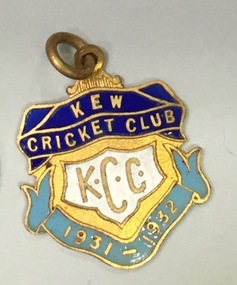
... After Francis Rigg’s death, the collection of buttons and medallions was inherited by his son, Ken Rigg (14/11/1922-19/01/2014). The collection was subsequently donated to the Kew Historical Society in 2015 by his grandson Adrian Rigg at the time of the Gallipoli & Beyond Commemoration.The collection covers a period of almost 40 years. ...After Francis Rigg’s death, the collection of buttons and medallions was inherited by his son, Ken Rigg (14/11/1922-19/01/2014). The collection was subsequently donated to the Kew Historical Society in 2015 by his grandson Adrian Rigg at the time of the Gallipoli & Beyond Commemoration.The collection covers a period of almost 40 years. ...Frances Rigg was a local business identity in Kew, ultimately managing the local branch of the English, Scottish and Australian (ES&A) Bank at 175 High Street, Kew from c. 1920 until the 1940s. After Francis Rigg’s death, the collection of buttons and medallions was inherited by his son, Ken Rigg (14/11/1922-19/01/2014). The collection was subsequently donated to the Kew Historical Society in 2015 by his grandson Adrian Rigg at the time of the Gallipoli & Beyond Commemoration.The collection covers a period of almost 40 years. The majority of the buttons are patriotic buttons, issued and sold during and immediately after the First World World War (1914-1918) to raise funds for national and overseas causes. The collection also includes a number of locally significant sporting event buttons and sporting club medallions, issued in the 1920s and 1930s.One of three blue and gilt enamel on metal membership medallions produced by the Kew Cricket Club for the year 1931-32 and which belonged to Francis Horace Rigg (1882-1946). The medallion is enameled in shades of blue and gold with the initials of the Club at centre, the full name of the Club at top and the period for which the member would gain access to games at the base.Kew Cricket Club KCC 1931-1932kew cricket club -
 Kew Historical Society Inc
Unknown - Membership Medallion, Kew Cricket Club KCC 1934-1935, 1934
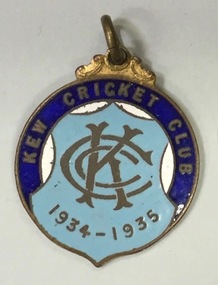
... After Francis Rigg’s death, the collection of buttons and medallions was inherited by his son, Ken Rigg (14/11/1922-19/01/2014). The collection was subsequently donated to the Kew Historical Society in 2015 by his grandson Adrian Rigg at the time of the Gallipoli & Beyond Commemoration.The collection covers a period of almost 40 years. ...After Francis Rigg’s death, the collection of buttons and medallions was inherited by his son, Ken Rigg (14/11/1922-19/01/2014). The collection was subsequently donated to the Kew Historical Society in 2015 by his grandson Adrian Rigg at the time of the Gallipoli & Beyond Commemoration.The collection covers a period of almost 40 years. ...Frances Rigg was a local business identity in Kew, ultimately managing the local branch of the English, Scottish and Australian (ES&A) Bank at 175 High Street, Kew from c. 1920 until the 1940s. After Francis Rigg’s death, the collection of buttons and medallions was inherited by his son, Ken Rigg (14/11/1922-19/01/2014). The collection was subsequently donated to the Kew Historical Society in 2015 by his grandson Adrian Rigg at the time of the Gallipoli & Beyond Commemoration.The collection covers a period of almost 40 years. The majority of the buttons are patriotic buttons, issued and sold during and immediately after the First World World War (1914-1918) to raise funds for national and overseas causes. The collection also includes a number of locally significant sporting event buttons and sporting club medallions, issued in the 1920s and 1930s.Circular blue and gilt enamel on metal membership medallion produced by the Kew Cricket Club for the year 1934-35 that belonged to Francis Horace Rigg (1882-1946). The medallion is enameled in shades of blue and gold with inscriptions in gilt. The medallion includes the logo of the Club at centre, the full name of the Club at top and the period for which the member would gain access to games at the base.Kew Cricket Club KCC 1934-1935kew cricket club -
 Kew Historical Society Inc
Unknown - Membership Medallion, Kew Cricket Club KCC 1935-1936, 1935
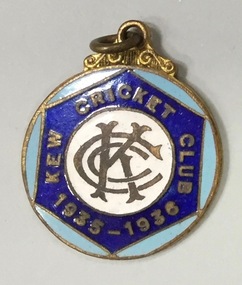
... After Francis Rigg’s death, the collection of buttons and medallions was inherited by his son, Ken Rigg (14/11/1922-19/01/2014). The collection was subsequently donated to the Kew Historical Society in 2015 by his grandson Adrian Rigg at the time of the Gallipoli & Beyond Commemoration.The collection covers a period of almost 40 years. ...After Francis Rigg’s death, the collection of buttons and medallions was inherited by his son, Ken Rigg (14/11/1922-19/01/2014). The collection was subsequently donated to the Kew Historical Society in 2015 by his grandson Adrian Rigg at the time of the Gallipoli & Beyond Commemoration.The collection covers a period of almost 40 years. ...Frances Rigg was a local business identity in Kew, ultimately managing the local branch of the English, Scottish and Australian (ES&A) Bank at 175 High Street, Kew from c. 1920 until the 1940s. After Francis Rigg’s death, the collection of buttons and medallions was inherited by his son, Ken Rigg (14/11/1922-19/01/2014). The collection was subsequently donated to the Kew Historical Society in 2015 by his grandson Adrian Rigg at the time of the Gallipoli & Beyond Commemoration.The collection covers a period of almost 40 years. The majority of the buttons are patriotic buttons, issued and sold during and immediately after the First World World War (1914-1918) to raise funds for national and overseas causes. The collection also includes a number of locally significant sporting event buttons and sporting club medallions, issued in the 1920s and 1930s.Circular blue, white and gilt enamel on metal membership medallion produced by the Kew Cricket Club for the year 1935-36 that belonged to Francis Horace Rigg (1882-1946). The medallion is enameled in shades of blue with the Club’s logo on circular white enameled section in the centre. The full name of the Club and the period for which the member would gain access to games is enclosed in a surrounding section of navy blue enamel with a hexagonal outer edge.Kew Cricket Club KCC 1935-1936kew cricket club, membership medallions -
 Flagstaff Hill Maritime Museum and Village
Document - Invitation, Government of New South Wales, Commonwealth of Australia Inaugural Celebrations, Bef. 01-01-1901
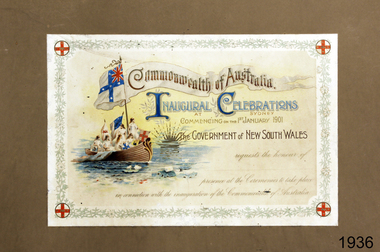
... Bef. 01-01-1901...Flagstaff Hill Flagstaff Hill Maritime Museum and Village Warrnambool Maritime Museum Maritime Village Great Ocean Road Shipwreck Coast invitation Commonwealth of Australia Inaugural Celebrations Sydney 1st January 1901 01-01-1901 Federation of Australia Australian States Government of New South Wales symbols flags Australian Colony certificate G.U. ...This is an Invitation to attend the Inaugural Celebrations of the Commonwealth of Australia, to celebrate the Federation of Australia's united Colonies. It was created on behalf of the Government of New South Wales. January 1st, 1901, is the official date of Australia's Federation. There is no recipient's name on the invitation. The illustrations on the invitation represent the Federation of Australian States, with their historic symbols carried on the sailing ship, representing the colonisation of Australia. The 'rising sun' possibly represents the rising of the young Australia. The Sough Australian symbol appears to be the historic seal of South Australia, depicting Britania meeting an Australian Aboriginal seated on the beach. The symbol was replaced in 1904. The Victorian symbol of a crown above the Southern Cross appears on the flag at the back of the ship, with a crown and the Southern Cross beside each other. The invitation was originally framed by G.U. Petterd, a picture framer and plush worker in Warrnambool, Victoria.The invitation holds great significance, representing a point in Australia's history when the British Colony became an independent nation, with the states uniting under a Federal government. The symbols on the invitation represent those used by each state at the time, many of which have evolved and changed since that time. The decorative and careful creation of the certificate represents the importance placed on the celebrations.Invitation; rectangular page printed in colour with text and illustrations, and attached to cardboard. The document has a floral border with a symbol in each corner. The illustration includes a wooden sailing ship with six figures with long fair hair wearing white robes, and holding six flags or symbols. The mast holds a swallow-tailed banner showing a flag and text. The invitation is from the Government of New South Wales, for the recipient to attend the inaugural celebrations in Sydney on 1st January 1901, for the official date of the Federation of Australia. There is a purple oval stamp on the revers with inscriptions. The picture was originally framed by G.U. Petterd, WarrnamboolSTAMP: "G.U. PETTERD, WARRNAMBOOL / PICTURE FRAMER & PLUSH / WORKER" TEST: - "Commonwealth of Australia. / INAUGURAL CELEBRATIONS / AT SYDNEY / COMMENCING on the 1st JANUARY 1901" "The GOVERNMENT of NEW SOUTH WALES / requests the honour of / (blank line) / presence at the Celebrations to take place / in connection with the inauguration of the Commonwealth of Australia" Symbols: - [white flag, blue cross, Union Jack] (Australian Federation Flag) [blue Maltese cross with crown in centre] (Queensland symbol) [red St George cross with a lion in the centre] (New South Wales symbol) [white with a symbol on one side (crown?) with a blue flag with Southern Cross on the other] (Victoria's symbols of Crown above Southern Cross) [red lion on white] (Tasmanian symbol) [black swan on yellow] (Western Australia badge) [two figures, one standing and one seated] (South Australian seal) and image of (rising sun on the horizon)flagstaff hill, flagstaff hill maritime museum and village, warrnambool, maritime museum, maritime village, great ocean road, shipwreck coast, invitation, commonwealth of australia, inaugural celebrations, sydney, 1st january 1901, 01-01-1901, federation of australia, australian states, government of new south wales, symbols, flags, australian colony, certificate, g.u. petturd, picture framer and plush worker, picture framer, plush worker, 1901 -
 The Beechworth Burke Museum
Decorative object - Clock, Seth Thomas Clock Company, 01/01/1881
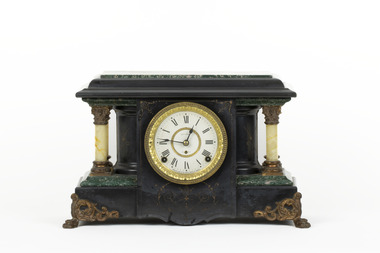
... 01/01/1881 ...The Seth Thomas Clock Company was founded in 1813 by renowned American clockmaker Seth Thomas (1785-1859) of Connecticut, USA, and pioneered the mass production of clocks. After Seth Thomas's death, his son, also Seth Thomas (1816-1888), continued operating the business. Their 'Adamantine' model was released in many variations. This particular model features two pillars on either side of the clockface, however other Adamantine variants could have none or up to three or four half-pillars on either side. This style of black mantle clock appears to be inspired by French clocks of the 1860s, which had gained popularity in the United States. While those clocks were often made with onyx, slate, or marble, Seth Thomas uses a durable celluloid veneer named Adamantine over a wood case to replicate the appearance of the original materials. This object is representative of the innovative manufacturing processes of pioneering clockmaker Seth Thomas and his company. Decorative black mantle clock with black and green veneer and a white face marked with black roman numeralsInscriptions: 7337 2685 6618 10508 Label on reverse [one section is illegible due to damage to label]: ADAMANTINE Label No. 295 E. / ST Trade Mark ... the / smaller end of key. To make run faster, turn to the right, slower to the left. One full turn of the key will make a difference of two / minutes in twenty-four hours. To get correct strike turn minute hand to 12 and then back to figure 9; continue doing so until proper / hour is struck. Key and Pendulum ball will be found tied or tacked to each clock. Adamantine Clock. Patented September 7, 1880. This finish is very durable, will not chip, and cannot be scratched or dented by any ordinary usage. Can be / washed or otherwise cleaned without detriment or injury to polish. Genuine Seth Thomas Clocks have Trade Mark on Movement. WHEN ORDERING MATERIAL FOR THIS CLOCK BE SURE AND GIVE LABEL NUMBER 295E. SETH THOMAS CLOCK CO. / MAKERS OF CLOCKS AND WATCHES.seth thomas clock company, adamantine, black mantle clock, horology, manufacturing -
 Federation University Historical Collection
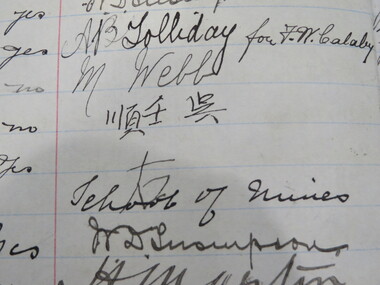
Book - Register, Berry Anderson & Co, Ballarat School of Mines Gold Entry Book. 1908-1976, 01/06/1908-01/12/1976
... 01/06/1908-01/12/1976 ...The Ballarat School of Mines had a model mine used by students, and to conduct assays for a fee. The Register of Gold Entry Book had to be kept by the Licensed Gold Buyer or Assayer under the Gold Buyers Act.Brown half leather bound register registering receipt of gold. Columns include date, nature of transaction (eg assaying/purchase), age, where employed, business (eg mining, fossicking, assayer, etc), Abode, Signature, Witness, Claim, Mining Division, District, Where Obtained, Character of Gold (eg alluvial, smelted, quartz, etc), Weight, Value, How Gold Treated, To whom delivered after assay or smelting, Date of Assayer's Certificate. ballarat school of mines, model mine, battery, assay, smelting, gold, robinson, frederick martell, r. callister, a. garrard, peter tong, lee sue, ah lung, chinese, f.w. calaby, ah kit, charlie ah lung, ah sung, ah chee, dep choon, charlie ah hing, frederick greaves, peter fong, george ah ki, ah hing, william mong, thomas bell and party, brown hill, dentist, amalgam, albert sydney sergeant, plumber, plumbing, george spence, plumber, commonwealth bank, j. hutton-jones, golden duke mining syndicate, blackwood, d.e.j. grant, eganstown, linton gold mining company, mining, d. bernard, g. peron, john page, david bernard, harry webb, ah fou, w.d. thompson, a.b. tolliday, m. webb -
 Federation University Historical Collection
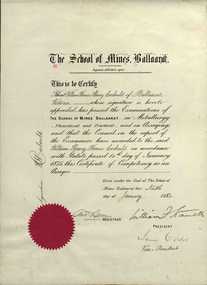
Ceramic - Certificate, William Corbould's School of Mines Certificates, signed by James Oddie, 09/01/1884, 07/01/1885
... 09/01/1884, 07/01/1885 ...Three Ballarat School of Mines certificate made out to William Corbould. All have the seal of the Ballarat School of Mines is attached, and are signed by Andrew Berry, James Oddie, and William Thomas Henry Corbould. .1) Theoretical and Practical Assaying. Also signed by William Stawell (President) .2) Certificate of Competency in Organic Chemistry Practical Tests .3) Chemistry, first stage, 1884 james oddie, andrew berry, william corbould, ballarat school of mines, chemistry, certificate -
Federation University Historical Collection
Book, 01/01/1906
... 01/01/1906 ...Green softcovered book -
Federation University Historical Collection
Magazine, The Independent Monthly: The Good Universities Guide, July 1991 and August 1993, 01/07/1991 - 01/08/1993
... 01/07/1991 - 01/08/1993 ...2 copies of The Independent Monthly: The Good Universities Guide, July 1991 and August 1993good universities guide, universities -
 Federation University Historical Collection
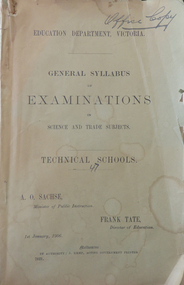
Book, General Syllabus of Examinations in Science and trade Subjects: Technical Schools, 1906, 01/01/1906
... 01/01/1906 ...Green soft covered book of 114 pages.examinations, science subjects, trade subjects, frank tate, a.o. sachse, photography, metalworking, blacksmithing, metal founding, carpentry and joinery, graining and marbling, bootmaking, dressmaking and needlework -
 Greensborough Historical Society
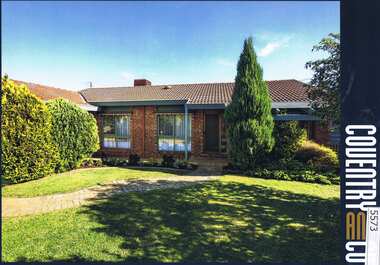
Advertising Leaflet, 3 Lumleah Court Greensborough, 01/01/2013
... 01/01/2013 ...3 Lumleah Court Greensborough, 4 bedroom brick veneer home, for auction 1 December 2012, sold January 2013 for $525,000Real estate advertising leaflet, 4 p., printed in colourlumleah court greensborough -
 Greensborough Historical Society
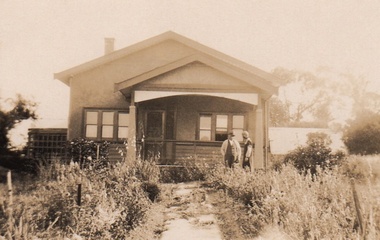
Photograph - Digital Image, Cherel Sartori, Kell's Cottage, 01/01/1956
... 01/01/1956 ...Photograph of Kell's Cottage. The house was built 1917, at 112 Henry Street Greensborough by William Mitchell on the 60 acre dairy farm owned by Ethel and Walter Kell. This collection of photographs was copied by Cherel Sartori (who owned the house from 1990-2000), following a visit by Claude Amiet who lived in the house as a child in the early 20th century.Digital copy of black and white photographkell's cottage, claude amiet, cherel sartori -
 Greensborough Historical Society
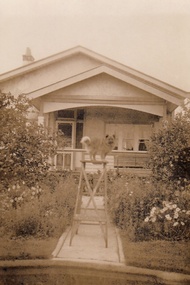
Photograph - Digital Image, Cherel Sartori, Kell's Cottage 1940s, 01/01/1956
... 01/01/1956 ...Photograph of Kell's Cottage in the 1940s. The house was built 1917, at 112 Henry Street Greensborough by William Mitchell on the 60 acre dairy farm owned by Ethel and Walter Kell. This collection of photographs was copied by Cherel Sartori (who owned the house from 1990-2000), following a visit by Claude Amiet who lived in the house as a child in the early 20th century.Digital copy of black and white photographkell's cottage, claude amiet, cherel sartori -
 Greensborough Historical Society
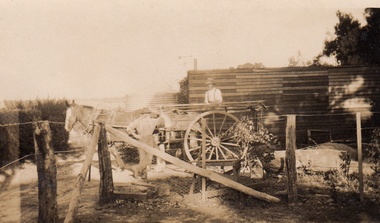
Photograph - Digital Image, Cherel Sartori, Kell's Cottage, 01/01/1956
... 01/01/1956 ...Photographs of Kell's Cottage in the 1940s. The house was built 1917, at 112 Henry Street Greensborough by William Mitchell on the 60 acre dairy farm owned by Ethel and Walter Kell. This collection of photographs was copied by Cherel Sartori (who owned the house from 1990-2000), following a visit by Claude Amiet who lived in the house as a child in the early 20th century.Digital copy of 3 black and white photographkell's cottage, claude amiet, cherel sartori -
 Greensborough Historical Society
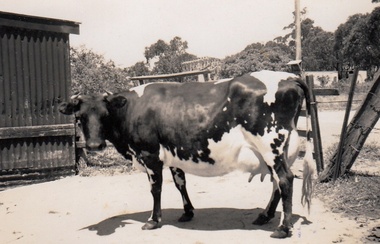
Photograph - Digital Image, Cherel Sartori, Cows at Kell's Cottage 1956, 01/01/1956
... 01/01/1956 ...Photograph of a cow at Kell's Cottage in the 1940s. The house was built 1917, at 112 Henry Street Greensborough by William Mitchell on the 60 acre dairy farm owned by Ethel and Walter Kell. This collection of photographs was copied by Cherel Sartori (who owned the house from 1990-2000), following a visit by Claude Amiet who lived in the house as a child in the early 20th century.An indication of the rural aspect of this area in the mid-20th century.Digital copy of black and white photographkell's cottage, claude amiet, cherel sartori -
 Greensborough Historical Society
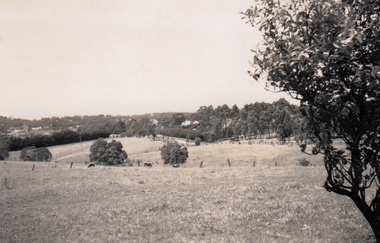
Photograph - Digital Image, Cherel Sartori, Looking east from Henry Street to the river 1956, 01/01/1956
... 01/01/1956 ...Looking from Henry Street east to the Plenty River, 1956. The house was built 1917, at 112 Henry Street Greensborough by William Mitchell on the 60 acre dairy farm owned by Ethel and Walter Kell. This collection of photographs was copied by Cherel Sartori (who owned the house from 1990-2000), following a visit by Claude Amiet who lived in the house as a child in the early 20th century.An indication of the rural aspect of this area in the mid-20th century.Digital copy of black and white photographkell's cottage, claude amiet, cherel sartori -
Glenelg Shire Council Cultural Collection
Administrative record - Police Report - Criminal Offence Larceny Heywood, Victoria, 01/01/1914
... 01/01/1914 ...Hand written supplementary Police Report of Criminal Offence - larceny of a bicycle. Heywood police station, 1st Jan 1914 -
 The Beechworth Burke Museum
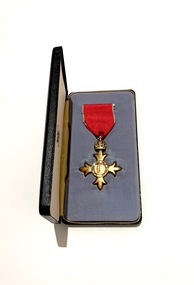
Medal - Order of the British Empire Medal, 01/01/1976
... 01/01/1976 ...David Aloysius Patrick McKenzie-McHarg, L.I.B, O.B.E was born on 20th June 1918 in Albury, NSW to Hugh Patrick McKenzie-McHarg and Laura May (Dunne) McKenzie-McHarg. McKenzie-McHarg served on the Council of the United Shire of Beechworth for more than a decade during the 1960s-70s, including seven years as president. He was renowned as a public speaker and played a significant role in the community. In recognition for his outstanding achievements and services rendered to the Beechworth community he was awarded an Order of the British Empire (OBE) in 1976. David McKenzie-McHarg died on 6th June 1992 and is buried in Beechworth Cemetery. David McKenzie-McHarg’s wife, Marjorie Jean McKenzie McHarg, was well known to the Beechworth community as a brilliant pianist and played at all the balls and house parties. Apparently, she could play without sheet-music and would only have to hear a tune once to play it to near perfection. Together, they were a formidable asset to the Beechworth community over many years The British honours system has various orders, usually relating to the monarchy, military and colonial officials. An OBE (or order of the British Empire) is given for an outstanding achievement or service to the community. This will have had a long-term, significant impact and stand out as an example to others. This Order was established by George V in 1917 in response to recognising the thousands of men and women who served in a variety of non-combatant roles during the First world war who didn’t otherwise receive any formal recognition but were certainly worthy of acknowledgement. Recommendations for appointments to this Order were originally made on the nomination of the United Kingdom, however this soon became available to Commonwealth countries as well. However, Australia officially ceased to recommend the Order of the British Empire in 1989 with the establishment of the Order of Australia. Silver badge suspended from red ribbon with pearl-grey edges. The badge is in the form of a cross patonce (having the arms growing broader and floriated toward the end), the obverse of which bears the same field as the star pictures George V and Queen Mary. The reverse bears George V's Royal and Imperial Cypher. Both are within a ring bearing the motto of the Order: FOR GOD AND THE EMPIRE. The presentation case in which the medal is housed is of a black outer boarder edge leatherette finishing, block letters in gold OBE. The inside has a cream velvet base with a silk padded liner to the roof with the full set of Royal Mint Crest Mark. Obverse: FOR GOD AND THE EMPIRE / burke museum, obe, obe medal, beechworth, david mckenzie-mcharg, british honours system, george v, beechworth community, order of australia., order of the british empire, marjorie jean mckenzie mcharg -
 Ballarat Fire Brigade
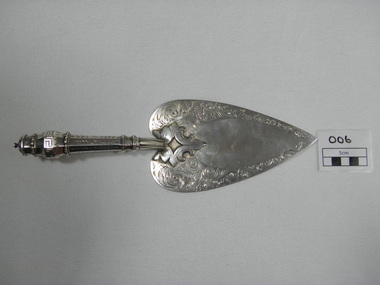
Trowel, just prior to 01/01/1864
... just prior to 01/01/1864 ...Trowel was presented to Captain Spark by honourable secretary Mr Charles Dyte on 1/1/1864 to lay the foundation stone of the watchtower and belfrey of the Ballarat fire station. Trowel was made by Mr. Bennett of Bridge street and fashioned on the trowel used by Mr. Fraser M.L.C. when laying the foundation stone of the St. Kilda town hallhand engraved sterling silver ceremonial trowel. engraving is floral design on blade. handle is hollow, octaganol with leaf pattern and greek meander patternHallmarked on underside - emu, "WE" (letters), kangarooballarat fire brigade, captain, foundation stone, trowel, colonial silversmith, silver trowel, captain spark, honourable secretary, mr bennet, sterling silver, charles dyte, dyte, spark, 1864, watchtower and belfrey, tower, watchtower, belfrey -
 Phillip Island and District Historical Society Inc.
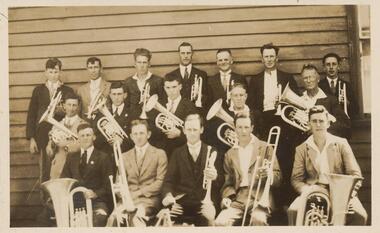
Photograph, 01/01/1936
... 01/01/1936 ...Donated by Stan McFee from Keith McIlwraith Collection.Black & White photograph of 17 members of the Phillip Island Band 1/1/1936.On back: Top L to R: - J. McLean, Bob Dixon, Frank Towns, C. Williams [Band master], Percy Double, Andy Morrison, Roy Richardson Middle Row L to R: - Keith McIwraith, Rue De La Haye, harry De La Haye, N. Cleeland, David Robb,. Bottom Row L to R:- Cess Leeson, Bryant West, Bill Bowers, Bill McLardy, Herb Watchorn . Names provided by Murray De La Haye November 2022the phillip island band, brass bands, stan mcfee, keith mcilwraith collection, phillip island -
 Greensborough Historical Society
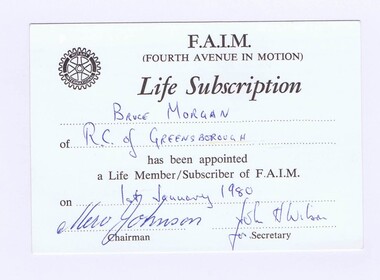
Memorabilia - Card, Rotary International, Rotary International F.A.I.M. (Fourth Avenue In Motion) Life Subscription, 01/01/1980
... 01/01/1980 ...Membership Card confirming that Bruce Morgan was appointed a Life Member Subscriber of F.A.I.M. on 1st January 1980. F.A.I.M. (or Fourth Avenue in Motion) ia now known as RAWCS Rotary Australia World Community Service.Bruce Morgan was the first Shire Secretary (1964-1983) of the Shire of Diamond Valley. This collection was compiled by his wife, Mavis Morgan, detailing the events they attended in their official capacityCream card with black text, black & white logo and hand written details in blue biro.bruce morgan, mavis morgan, rotary international, f.a.i.m., fourth avenue in motion -
 Australian National Surfing Museum
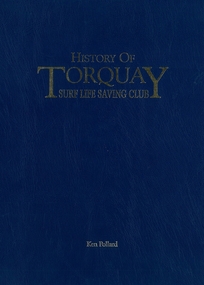
Book, Torquay Surf Life Saving Club Inc, History of Torquay Surf Life Saving Club, 01/01/1996
... 01/01/1996 ...History of the Torquay Surf Life Saving Club celebrates the first fifty years (1945-1995) of the largest surf life saving club in Victoria. The book features historic photographs of the surf club and the famed Torquay Surf Beach on Victoria rugged Surf Coast. The book also features chapters on the historic, cultural, social and competitive areas within the club.This bok is significant because it represents the first official history of one of the largest and most influential surf life saving clubs in Australia.Blue leather hardback book with gold lettering on blue representing the colours of the Torquay Surf Life Saving Club. Authors name - Ken Pollardbells beach, torquay surf life saving club, d s club, peter troy, vic tantau, terry wall, ken pollard, torquay surf beach, pioneer surfers, jim wall, dick garrard, sprint walker, owen yateman, alan coulson, ron hussey, joe sweeney, sharon heathcote, ray brewin, frances murphy, bryan hayden
