
Showing 4438 items matching " american."
-
 Trafalgar Holden Museum
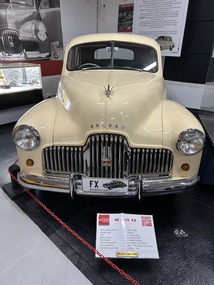
Vehicle - Holden 48 - 215 sedan, 48-215 Holden Sedan, November 1948
... This involved compromise with GM as Holden managing director, Lawrence Harnett, favoured development of a local design, while GM preferred to see an American design as the basis for "Australia's Own Car". ...This involved compromise with GM as Holden managing director, Lawrence Harnett, favoured development of a local design, while GM preferred to see an American design as the basis for "Australia's Own Car". ...The 48 - 215 was the first vehicle produced by GMH specifically for the local Australian market. This vehicle later became better known as the FX. This vehicle was manufactured from 1948 to 1953. From here Holden continued to pursue the goal of producing an Australian car. This involved compromise with GM as Holden managing director, Lawrence Harnett, favoured development of a local design, while GM preferred to see an American design as the basis for "Australia's Own Car". In the end the design was based on a previously rejected post war Chevrolet proposal. The Holden was launched in 1948, creating long waiting lists extending through 1949 and beyond. The name ":Holden" was chosen in honour of Sir Edward Holden, the company's first chairman and grandson of J.A.Holden. Other names considered were "GeM", "Austral", "Melba", Woomrah", " Boomerang", "Emu", and "Canbra", a phonetic spelling of Canberra. Although officially designated " 48-215" the car was marketed simply as "Holden" The unofficial usage of the name "FX" originated within Holden referring to the updated suspension on the 48-48 215 of 1953.This was the first vehicle manufactured solely for the Australian market.4 Door sedan, two pane split screen windscreen, lifting boot and bonnet. Powered by an 132.5 Cubic inch motor.Holden Specialautomobile, holden, 1948, vintage, car -
 Mont De Lancey
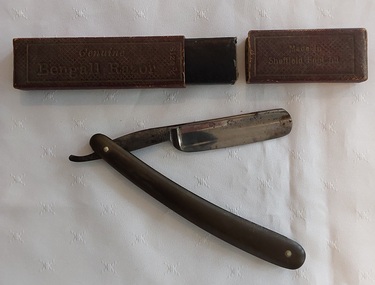
Domestic object - Razors, Klein, Early 20th Century
... Boker & Co. is a historic German-American company, established in 1837 by Hermann Boker, known for its high-quality cutlery, especially vintage straight razors, pocket knives, and other tools, marked by the iconic "Tree Brand" symbol originating from a chestnut tree near their Remscheid forge...Boker & Co. is a historic German-American company, established in 1837 by Hermann Boker, known for its high-quality cutlery, especially vintage straight razors, pocket knives, and other tools, marked by the iconic "Tree Brand" symbol originating from a chestnut tree near their Remscheid forge Cut throat razors Shaving equipment Shavers Barbers 1. ...Bengall razors, made by T.R. Cadman & Sons in Sheffield, England, were produced for a long period, with the trademark granted in 1748 and the company trading until 1965, meaning they were made throughout the 18th, 19th, and 20th centuries, with many popular models from the early to mid-20th century (1900s-1940s/50s) being common finds. They were a classic type of straight razor, popular for daily use before safety razors took over. Klein cut-throat razors marked "Ground in Hamburg" are vintage straight razors, often collectible, indicating they were manufactured by or for J. Klein & Co. (or similar) and had their blades ground for sharpness in Hamburg, Germany, a traditional centre for steel and razor making, reflecting a quality indicator for these classic wet-shaving tools. H. Boker & Co. is a historic German-American company, established in 1837 by Hermann Boker, known for its high-quality cutlery, especially vintage straight razors, pocket knives, and other tools, marked by the iconic "Tree Brand" symbol originating from a chestnut tree near their Remscheid forgeTwo cut throat razors: 1. A vintage Bengall Cut Throat Shaving Razor with a brown bakelite handle made by T.R. Cadman & Sons, in Sheffield, England.The blade folds back into the handle to protect it. It has a floral decoration around the end of the blade near the handle. It is stored in a burgundy leather case with 'Genuine Bengall Razor' stamped onto it. 2. A vintage Klein Cut Throat Shaving Razor ground in Hamburg Germany with a brown bakelite handle.The blade folds back into the handle to protect it. There is a blue sticker on the end of the inside of the case with SHOP written on both sides. 3. An empty H Boker and Co razor case with the name in ornate lettering printed in black lettering on the front with Trade Mark written each side of an outline of marked by the iconic "Tree Brand" symbol originating from a chestnut tree near their Remscheid forge tree on the short section of the case. There is a white sticker with E.A. Pettit printed on it in purple and the name Kennedy in black ink handwriting below.1. The blade has 'Bengall' engraved one side and on the back it has 'T.R. Cadman & Sons Sheffield England'. 2.The blade has 'Klein' engraved on one side and on the back has 'Ground in Hamburg Germany'. There is a blue sticker on the end of the inside of the case with 'SHOP' written on both sides.3. On the empty worn black case 'H Boker and Co' 'Trade Mark' is written each side of an outline of tree on the short section of the case. There is a white sticker with 'E.A. Pettit Puts Your razor Inters Class Order' or 1/6' printed on it in purple and the name 'Kennedy' in black ink handwriting below.cut throat razors, shaving equipment, shavers, barbers -
 Wodonga & District Historical Society Inc
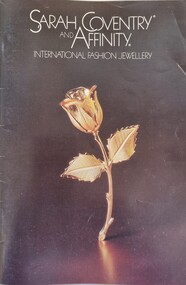
Booklet - Sarah Coventry Affinity Range Catalogue 1982
... Ltd. was a North American jewellery company that was established in 1949 by the Stuart family as part of Emmons Jewelry, Inc. ...Ltd. was a North American jewellery company that was established in 1949 by the Stuart family as part of Emmons Jewelry, Inc. ...Historical information Sarah Coventry Pty. Ltd. was a North American jewellery company that was established in 1949 by the Stuart family as part of Emmons Jewelry, Inc. It began operations in England and Australia in 1968, and in Australia it moved from Carlton in Melbourne to Wodonga in 1969. The premises were originally on High Street in Wodonga, but a new warehouse was built in Melbourne Road later in 1969. It was a direct selling jewellery business using a party-plan model similar to Tupperware and Avon. The sales reps or 'Hostesses' were provided with jewellery samples in demonstration kits, which they displayed at jewellery parties in their homes. The designs for jewellery such as brooches, necklaces, earrings, chokers and bracelets were purchased from freelance designers and jewellery manufacturers rather than in-house designers. In 1979 Sarah Coventry Pty. Ltd. in Wodonga was bought by three Australian businessmen, including Wodonga local Jim Sawyer, and continued to sell jewellery under the name "Sar*gem Pty. Ltd”, for several more years in the 1980s, along with a new range of fashion jewellery, Affinity. This catalogue was produced by Sar*gem Pty Ltd in 1982As part of the Sarah Coventry collection, the catalogue has local significance connected to the decentralised commercial development of regional centres such as Wodonga in NE Victoria, as well as national and international significance from the perspective of social and economic developments for women after World War II. The direct selling party-plan business model Sarah Coventry was based on is also considered the first of its kind for jewellery. A coloured catalogue promoting the Affinity Jewellery line released in 1982. The back cover features a fundraising campaign for the Guide Dog Association. Business contact details on the back cover use the company name "Sar*Gem Pty Ltd", Hume Highway Wodonga.sarah coventry, sarah coventry wodonga, sarah coventry affinity -
 City of Greater Bendigo - Civic Collection
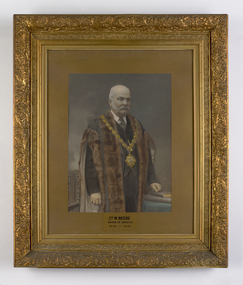
Photograph - Mayor Portrait Cr William Beebe (Jnr), Bartlett Bros, Cr W. Beebe, 1917
... Beebe employed a variation of the Arts and Crafts style popular in England and America from the 1870s and manifested in various forms including the Queen Anne revival style. ...Beebe employed a variation of the Arts and Crafts style popular in England and America from the 1870s and manifested in various forms including the Queen Anne revival style. ...William Beebe junior (1857-1920) was born in Bull Street Sandhurst. His father owned a stone and monument business in Mitchell Street and William commenced work with his father as a small boy. At age 19 William Snr took his into partnership and he continued to study architectural drawing at the School of Mines during this time. Beebe and Son designed and built several buildings during the 1880's to complement their main business which was stonemasonry. In 1892 Beebe decided to concentrate on his profession as an architect and was responsible for a large number of buildings and homes around Bendigo including the A.N.A Hall (now demolished), Fire Station on View Street (1898) and the Former Royal Bank at View Point (1908). Beebe employed a variation of the Arts and Crafts style popular in England and America from the 1870s and manifested in various forms including the Queen Anne revival style. William Beebe served was elected to the Bendigo City Council in 1913, becoming Mayor twice. He died of a heart attack while in office in 1920. Three quarter standing portrait of Cr William Beebe in mayoral robes. Framed and mounted photograph with separate hand-inscribed title panel. Ornamental frame with a gold window mount. Photograph has been hand coloured.Cr W Beebe / Mayor of Bendigo / 1915 - 16 -- 1916 - 17councilor beebe, mayor beebe -
 Ballarat Tramway Museum
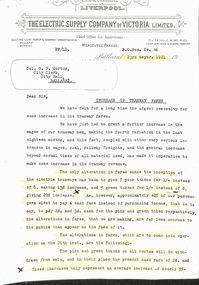
Document - Photocopies, Alan Bradley, "Increase of Tramway Fares", "One Man Cars", 18/07/2001 12:00:00 AM
... Gives details of fare structures, costs, tramway wages, section changes, American and English tramway fares and increase in the cost of coal. ...Gives details of fare structures, costs, tramway wages, section changes, American and English tramway fares and increase in the cost of coal. ...Photocopies of letters made by Alan Bradley in relation to the use of Fare Tokens by the Electric Supply Co. of Victoria - See Reg. Item 1794. Photocopies made 18.07.2001. Photocopies of letters copied by Alan from the City of Ballarat's files. 1801.1 - Photocopy of letter dated 23/9/1921, signed by Mr. Pringle of ESCo to Col. G.F. Morton, City Clerk of the City of Ballaarat concerning the increase of tramway fares and the withdrawal of tokens due to the increase in costs. Gives details of fare structures, costs, tramway wages, section changes, American and English tramway fares and increase in the cost of coal. Three sheets stapled together in top left hand corner. 1801.2 - Photocopy of letter dated 23/7/1913 concerning the introduction of one man tramcars, signed by Mr. Pringle of ESCo, to Col. Williams, City Clerk of the City of Ballarat, and the introduction of celluloid tokens which would replace slip tickets and work better in the Fare Boxes. Also notes the introduction of "screens", windscreens, to all cars. Two sheets stapled together in top left hand corner. See Reg. Item 2514 for H.P. James notes on the token system.Parts of letter have been highlighted by Alan re tokens and other interesting points.trams, tramways, tokens, fares, tickets, esco, windscreens, costs -
 Hepburn Shire Council Art and Heritage Collection
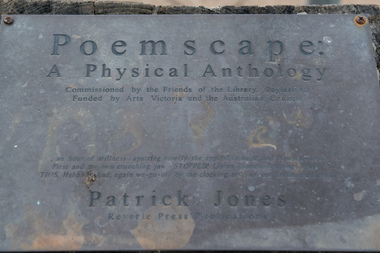
Public Art Work, Patrick Jones, 'Poemscape: a physical anthology' - Patrick Jones. 1999, 1999
... The text of each plate is by 19 poets including the artist and Daylesford resident Patrick Jones, local poets Peter O'Mara, Toby Sime and Robert Campbell, Australian poets Geoff Page, Kath Walker, D T Sime, Judith Wright, Ramona Barry, Jack Davis, Robert Campbell, Christopher Brennan and International Poets Dylan Thomas - Welsh, Sylvia Plath - American, Choku Kanai - Japanese, William Blake - English, Duo Duo - Chinese (translated from the Chinese by John Rosenwald), Yannis Ritsos- Greek (translated from the Greek by Kimon Friar & Kostas Myrsiades), Michel Deguy - French (translated from the French by Clayton Eshleman), Seamus Heaney - Irish and Rainer Maria Rilke - German. ...The text of each plate is by 19 poets including the artist and Daylesford resident Patrick Jones, local poets Peter O'Mara, Toby Sime and Robert Campbell, Australian poets Geoff Page, Kath Walker, D T Sime, Judith Wright, Ramona Barry, Jack Davis, Robert Campbell, Christopher Brennan and International Poets Dylan Thomas - Welsh, Sylvia Plath - American, Choku Kanai - Japanese, William Blake - English, Duo Duo - Chinese (translated from the Chinese by John Rosenwald), Yannis Ritsos- Greek (translated from the Greek by Kimon Friar & Kostas Myrsiades), Michel Deguy - French (translated from the French by Clayton Eshleman), Seamus Heaney - Irish and Rainer Maria Rilke - German. ...The work was installed at the cnr of Bridgport St and the Midland Hwy, adjacent to the Daylesford Library, in 1999. The work was commissioned by the Friends of the Library, Daylesford and funded by Arts Victoria and the Australia Council. Poemscape: a physical anthology is a much loved site specific installation work commissioned by the Friends of the Library, funded by Arts Victoria and the Australia Council, made by Daylesford resident Patrick Jones in response to his interests in the provision of public food, the development of locavore sensibilities and the rethinking of economies of material accountability and regard. Patrick Jones is a poet and non-fiction writer, a visual artist and ecological thinker. In 2013 Patrick Jones was awarded the degree of Doctor in Creative Arts from the University of Western Sydney for his thesis, 'Walking for food. Regaining permapoesis.'Public Art Environmental installation work installed near the Daylesford Library. Poemscape: a physical anthology comprises of 19 apple trees (18 Fuji apple trees and 1 Granny Smith apple tree) planted on the corner of Bridgport St and the Midland Hwy, adjacent to the library. Adjacent to each tree is a hardwood plinth at topped with a laser engraved brass plate that has been screwed in place. The text of each plate is by 19 poets including the artist and Daylesford resident Patrick Jones, local poets Peter O'Mara, Toby Sime and Robert Campbell, Australian poets Geoff Page, Kath Walker, D T Sime, Judith Wright, Ramona Barry, Jack Davis, Robert Campbell, Christopher Brennan and International Poets Dylan Thomas - Welsh, Sylvia Plath - American, Choku Kanai - Japanese, William Blake - English, Duo Duo - Chinese (translated from the Chinese by John Rosenwald), Yannis Ritsos- Greek (translated from the Greek by Kimon Friar & Kostas Myrsiades), Michel Deguy - French (translated from the French by Clayton Eshleman), Seamus Heaney - Irish and Rainer Maria Rilke - German. The title plate adjacent to the Granny Smith apple tree is by the artist/poet - Patrick Jones. See photographs with images of each of the laser engraved brass plates. permapoesis, artist as family, patrick jones, william blake, kath walker, chaku kanai, peter o'mara, sylvia plath, dylan thomas, geoff page, duo duo, d.t. sime, judith wright, yannis ritsos, michel deguy, ramona barry, seamus heaney, jack davis, rainer maria rilke, robert campbell, christopher brennan, hepburn shire, daylesford library, public art, installation art, environmental art, hepburn shire public art collection -
 Melbourne Tram Museum
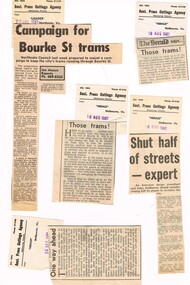
Newspaper, Leader Northcote, Melbourne Herald, " Campaign for Bourke St trams", " Those Trams" and "One way ahead", 1980 - 1981
... Noted the "MMTB juggernauts". .5 - Melbourne Herald - 8/11/1980" - titled "Shut half of streets - expert" reporting that an American design consultant - Desmond Muirhead - about shutting streets to traffic, keeping trams as in the Bourke St Mall - uses Munich as an example....Noted the "MMTB juggernauts". .5 - Melbourne Herald - 8/11/1980" - titled "Shut half of streets - expert" reporting that an American design consultant - Desmond Muirhead - about shutting streets to traffic, keeping trams as in the Bourke St Mall - uses Munich as an example. " Campaign for Bourke St trams", " Those Trams" and "One way ahead" Newspaper Leader Northcote, Melbourne Herald ...Series of five news paper cuttings regarding tram operation in the CBD and in particular along Bourke St. Each cutting has the Aust. Press Cuttings Agency source sheet pasted to the top left hand corner along with the paper name and date stamp. .1 - Leader Northcote - 22/7/1981 - " Campaign for Bourke St trams", written by Ian Munro, regarding a proposal by the City Commissioners to remove trams from Bourke St and run via Lonsdale St. .2 - Melbourne Herald - 18/8/1981 - "Those Trams", editorial regarding the possibility of removing trams from Bourke St. .3 - as for .2, but a short piece - just the last paragraph of .2 .4 - Melbourne Herald - 10/9/1981 - editorial titled "One way ahead" about the possibility of a converting some city streets to one way, a ring road and traffic flows. Noted the "MMTB juggernauts". .5 - Melbourne Herald - 8/11/1980" - titled "Shut half of streets - expert" reporting that an American design consultant - Desmond Muirhead - about shutting streets to traffic, keeping trams as in the Bourke St Mall - uses Munich as an example.Some have In pencil "Ballarat Trams" in top left hand corner.trams, tramways, bourke st, lonsdale st, city of melbourne, mmtb, traffic control -
 Melbourne Tram Museum
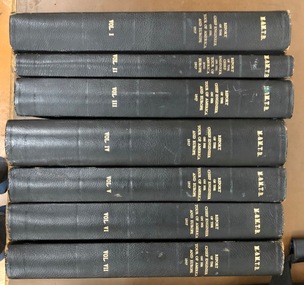
Document - Report, D. H. Eakins, Melbourne and Metropolitan Tramways Board, "Report of the Chief Engineer on his tour of America and Europe 1957", 1957 - 1958
... "Report of the Chief Engineer on his tour of America and Europe 1957"...Report - set of seven bound volumes titled "Report of the Chief Engineer on his tour of America and Europe 1957". Each volume, contains foolscap stencil duplicated sheets with some folded drawings and many pages of photographs. ..."Report of the Chief Engineer on his tour of America and Europe 1957" Document Report D. ...Report - set of seven bound volumes titled "Report of the Chief Engineer on his tour of America and Europe 1957". Each volume, contains foolscap stencil duplicated sheets with some folded drawings and many pages of photographs. Each volume has a printed title sheet, table of contents bound with glue end sheets into a green and black leather hard cover. Each set of sheets have been sewn into the volume with cut sheets to allow for folded drawings and photographs. Each volume has the MMTB name, logo and report title in gold block on the front and on the spine. The spine has the volume number as well. 1 - Report Vol 1 - Introduction, Architectural and Civil Subjects 2 - Baltimore, Birmingham, Blackpool, Boston, Brussels, Cleveland, Copenhagen, \Detroit 4 - Glasgow, Gothenburg, Hamburg-Berlin, Liverpool, London 5 - Los Angeles, Manchester, Milan, Montreal, New York, Philadelphia 6 - Rome, St Louis, San Antonio and San Francisco 7 - Stockholm and Toronto. Dated report 30 June 1958. Photographs generally taken by Ken Hall who accompanied Mr Eakins on the tour. See Reg Item 4522 for additional prints of the Scandinavian Section of the trip.trams, tramways, tours, overseas tours, chief engineer -
 Bendigo Historical Society Inc.
Ephemera - LYDIA CHANCELLOR COLLECTION: EPHEMERA
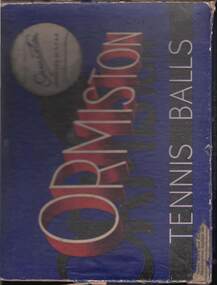
... Written in connection with the visit of the American fleet August 1908 (VIII) A small cream sympathy card for a lost soldier Bendigo, Oct., 1918. ...Written in connection with the visit of the American fleet August 1908 (VIII) A small cream sympathy card for a lost soldier Bendigo, Oct., 1918. ...A wide variety of items all in a damaged and incorrectly labelled tennis ball box. It is labelled 'Authors Book Reviews.' Some items are ephemeral others are of historical importance. (I) A black exercise book titled 'Correspondence Golden Square Patriotic League.' Lydia Pethard Hon. Sec. This book has pages labelled 'inwards' and 'outwards' and details correspondence between Aug. 2nd 1918 and C1921. (II) A Secondary Infantry Bendigo Brigade Comforts Fund cash book. 1919. (III) A black exercise book titled 'Golden Square Patriotic League.' Contains the minutes of meetings held between November 26th, 1917 and August 5th, 1918. Also includes the 'Annual Report p resented at Public Meeting held August 15th, 1918 and presented by President Lydia Pethard, Hon. Sec. (IV) A black exercise book labelled 'Wilsons' Reed Branch 2nd Infantry Comforts Fund. Mrs. Geo Goulden. It contains information relevant to the members and is dated 26/7/17 to 28/12/18 and 3/8/17 to 13/12/18. In the centre of the book is a list of donations. (V) A black exercise book titled 'Red Cross Golden Square.' Contains meetings held from June 30th, 1915 to October 29th., 1917. (VI) A small black notebook titled 'Carnival Returns July 21st 1917.' Appears to pertain to raffle tickets. (VII) 20 booklets titled 'Austral-American Souvenir. The Glorious Fourth.' Reprinted in connection with Bendigo-Eaglehawk Australian Comforts Fund Effort, 4th July, 1918. Written in connection with the visit of the American fleet August 1908 (VIII) A small cream sympathy card for a lost soldier Bendigo, Oct., 1918. (VX) A small blue and white election advertisement urging 'yes' for Reinforcements on Dec. 20th. (X) 2 copies of the Australian Comforts Fund Bendigo Appeal June-July 1916 Receipts. (XI) 2 copies of an application for authority to make an appeal, or to collect. Pertaining to Patriotic Funds. (XII) 2 copies of parcel slips 'for our Australian Troops From the Lady Mayoress's Patriotic League.' (ix) small card circ 1917 -A christmas flash from the boys in the trenches -on Dec 20th for Reinforcements Hold up the light -the front of the card shows a picture of three soldiers in a trench shining a searchlight on a map of Australia .The back shows a searchlight with the words -vote yes - Authorised by the Reinforcements Referendum Councilorganization, club / society, australian comforts fund, lydia chancellor, collection, ephemera, golden square patriotic league, bendigo brigade comforts fund, wilsons' reed branch 2nd infantry comforts fund, red cross golden square, bendigo-eaglehawk australian comforts fund, war, world war i, clubs, clubs and societies, organizations, finance, history, australian history, australian comforts fund -
 Eltham District Historical Society Inc
Photograph - Digital Photograph, Marguerite Marshall, Smith Dam, Karingal Drive, Eltham, 19 September 2006
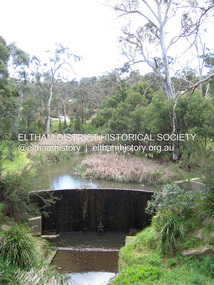
... Smith was awarded the American Society of Civil Engineers J. James R. ...Smith was awarded the American Society of Civil Engineers J. James R. ...The dam at the entrance to the Nerreman Gateway in Eltham was built according to an internationally acclaimed theory developed by the builder's father. In 1920, Victorian engineer B.A. Smith was awarded the American Society of Civil Engineers J. James R. Cross Gold Medal for his Technical Paper titled 'Arched Dams'. It was the first time this medal had been awarded outside the United States. The concrete arched dam across the Eltham West Drain was built in 1940 by B.A. Smith's son and engineer, D. B. (Bernie) Smith to water the 24 acre (9.75 ha) hobby farm owned by himself and new wife, Isa Smith. Upon completion of the dam a pump-house was constructed beside the creek but before the water could be pumped up the hill they had to dig a trench and lay 500m of 100mm water main to an elevated holding tank. The Smiths made the pump-house their home for several years until they constructed their home at the top of the hill overlooking Eltham and views extending to Kinglake. Following Bernie's death in 1983, Nerreman Park was subdivided between 1993 and 1995. Gordon Ford designed the landscaping and the pump-house was demolished. Covered under Heritage Overlay, Nillumbik Planning Scheme. Published: Nillumbik Now and Then / Marguerite Marshall 2008; photographs Alan King with Marguerite Marshall.; p137 The dam at the entrance to the Nerreman Gateway in Eltham, was built according to an internationally acclaimed theory developed by the builder’s father. In 1920, Victorian engineer B A Smith was awarded the American Society of Civil Engineers J. James R. Croes Gold Medal, for his Technical Paper titled Arched Dams. It was the first time this medal had been awarded outside America. An international example of the application of Smith’s work can be found in the design of the Hoover Dam on the Colorado River, Nevada, USA. Built between 1930 and 1936, it is recognised by the ASCE as one of ‘America’s Seven Modern Civil Engineering Wonders’.1 The concrete arched dam across the Eltham West Drain was built by B A Smith’s son and engineer, D B (Bernie) Smith. Bernie’s dam followed his father’s theory, having a curvature that takes maximum advantage of concrete’s great strength in compression. The water load is carried into the abutments because of this curvature, which permits a wall thickness of only 225 millimetres thick at its crest, despite the dam’s capacity of more than 4.5 megalitres. The Eltham dam was designed to water the 24 acre (9.75 ha) hobby farm belonging to newly married couple Bernie and Isa Smith. Bernie, from Armadale, and Isa, from a farm at Tyntynder near Swan Hill, were attracted to the hilly topography and the creek running through the property. It extended from Ryans Road, Eltham, to Karingal Drive, Montmorency and was adjacent to Meruka Park. The Smiths named it Nerreman Park using the Aboriginal word Nerreman meaning ‘River Bend’ as their creek had a pronounced bend.2 In 1940 the first thing Bernie did was to build a dam, and with Isa’s help, a pump-house, to secure a water supply for their cattle, pigs, chickens, orchard and vegetable gardens. It was also available for the fire-plugs, which they placed all over the property in case of bushfire. The couple built the pump-house beside the creek and installed a Tange three-plunger pump, which had originally supplied the City of Wodonga with water. But before the Smiths could pump water up the hill from the dam they had to dig a trench and lay about 550 yards (500m) of a four-inch (100mm) water main up to an elevated holding tank. The trench was dug with a single furrow plough drawn by an old draught horse. Living in rough conditions did not deter the Smiths, who made the pump-house their home, where they still lived when their first child was born in 1944. They later built their home at the top of their property overlooking Eltham, with magnificent views to Kinglake, the Dandenong Ranges and Melbourne. From 1946 it took them almost 20 years to complete the 36-square house with its 12-foot (3.6m) high ceilings. Material for the concrete roof and walls faced with sandstone, was ripped out of the ground on their property by plough pulled by tandem Clydesdale horses. Isa was a strong woman – two days before their second child was born – she set three huge sandstone boulders in place in the bottom wall of the garage. She also mixed all the cement for the house. A collapsed kitchen wall did not discourage her from rebuilding it in a week, while her husband was away working in the country. She later recalled: ‘We stood back to admire this beautiful wall we’d built and while we were looking at it, it came tumbling down’.3 Following Bernie’s death in 1983, Nerreman Park was subdivided, between 1993 and 1995. Local Gordon Ford designed the landscaping and the pump-house was pulled down. But the dam remains as a reminder of exceptional engineering4 – and of a remarkable couple.This collection of almost 130 photos about places and people within the Shire of Nillumbik, an urban and rural municipality in Melbourne's north, contributes to an understanding of the history of the Shire. Published in 2008 immediately prior to the Black Saturday bushfires of February 7, 2009, it documents sites that were impacted, and in some cases destroyed by the fires. It includes photographs taken especially for the publication, creating a unique time capsule representing the Shire in the early 21st century. It remains the most recent comprehenesive publication devoted to the Shire's history connecting local residents to the past. nillumbik now and then (marshall-king) collection, eltham, karingal drive, smiths dam, bernie smith, gordon ford, isa smith, nerreman gateway, nerreman park estate, dams -
 Upper Yarra Museum
Lamp, Tilley Lamp Company
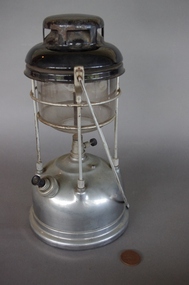
... This type of lamp is commonly known in the UK as a "Tilley lamp", after a manufacturer of the same name, and in North America as a "Coleman lantern" for similar reasons. ...This type of lamp is commonly known in the UK as a "Tilley lamp", after a manufacturer of the same name, and in North America as a "Coleman lantern" for similar reasons. ...http://en.wikipedia.org/wiki/File:Tilley-storm-lantern-X246-May- Tilley storm lantern, this model has been in production since 1964 The Tilley Lamp derives from John Tilley’s invention of the hydro-pneumatic blowpipe in 1813 in England. http://en.wikipedia.org/wiki/Kerosene_lamp#Pressure_lamp Pressure lamps are far more sophisticated than wick lamps and produce a much brighter light, although they can be quite complicated and fiddly to use. This type of lamp is commonly known in the UK as a "Tilley lamp", after a manufacturer of the same name, and in North America as a "Coleman lantern" for similar reasons. A kerosene blowtorch displaying the various aspects of the kerosene burnerA pressure lamp has a fuel tank at the bottom with a small pump to pressurise the kerosene. There is a narrow gap up to the top of the lamp, called a flue, and at the top of the lamp there is a burner (gas outlet). Directly underneath the burner is the mantle, a fabric bag coated with chemicals that incandesce when heated by the gas flame. The burner lamp is known for its brightness. It is so bright because of the amount of pressure that is placed onto the wick. This pressure allows a steady flow of the gasoline and a constant light Tilley Storm Pressure Lantern, model no x246 has a stainless steel base which is filled with kerosene, with a pump used to pressurize the kerosene vapor. Under the base is a sticker.On top is a black hood with vents which sits on the glass heat resistant shade. The glass shade has an etched label. It has a white and pink mantle on the central rod with a long shaped stainless steel handle, this folds down when not in use.Base - Sticker Tilley Lamp Model X246 Etched on glass shade Tilley, Durosil, ITI, Heat Resistant. Made in Englandlantern tilley pump pressure mantle kerosene methylated spirits stainless steel lamp kerosene lamp round glass cylinder -
 Flagstaff Hill Maritime Museum and Village
Container - Tin, W T Rawleigh, Circa 1930s
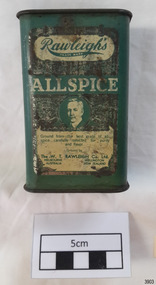
... Rawleigh & Co. was established by William Rawleigh in America in 1889 and later expanded into Australia. ...Rawleigh & Co. was established by William Rawleigh in America in 1889 and later expanded into Australia. ...This tin once contained Rawleigh's Allspice, a cooking ingredient. It was donated with other similar tins that were used by the donor’s mother who was married in 1932. It those times in Australia all manner of household items, including food and drink, were sold by hawkers (salesmen) who travelled from door to door in both suburban and rural areas. The donor remembered the tin on her mother’s pantry shelf. The Rawleigh Nutmegs label stated “Selected whole nutmegs not ground but granulated to preserve full strength and flavour.” The company had operated in Melbourne, Australia, and Wellington, New Zealand. W.T. Rawleigh & Co. was established by William Rawleigh in America in 1889 and later expanded into Australia. The company made a variety of household products in a factory in Collins Place, Melbourne, between 1930 and 1935. It specialised in medicines and remedies, food additives, cleaning products and toiletries. The company in Melbourne expanded into their factory in Dawson Street, Brunswick, in the mid-1930s. Independent salesmen, often referred to as ‘The Rawleigh’s man’, sold Rawleigh products door-to-door between the wars and after the Second World War in the Melbourne suburbs. Rayleigh’s products are still produced today. The tin is significant for its association with W.T Rawleigh, one of Melbourne’s strong growing manufacturers in period particularly between the World Wars. Rawleigh’s was, and still is, well known for its household and cleaning products, medicines, food additives and toiletries. The tin increases in significance for its use as a recognised object found in many Australian kitchens since early days. It gives a snapshot into domestic life and social norms of the pre and post war period in Melbourne The tin is significant for its association with a local family in the 1930s for the preparation of family meals. Rawleigh's rectangular Allspice spice tin, green, with directions for use on back and sides of container.Text “Rawleigh’s ALLSPICE” “The W.T. RAWLEIGH Co. Ltd.” “MELGOURNE / AUSTRALIA” “WELLINGTON / NEW ZEALAND” Motif: Man’s portrait in a circle. Other text includes information about spices.flagstaff hill museum, container, spice container, rawleigh company, tin container, kitchen item, tin, cooking ingredient, food container, grocery, allspice, rawleigh co. -
 Flagstaff Hill Maritime Museum and Village
Container - Tin, W T Rawleigh, Circa 1930s
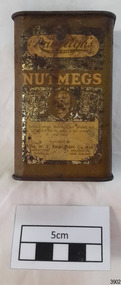
... Rawleigh & Co. was established by William Rawleigh in America in 1889 and later expanded into Australia. ...Rawleigh & Co. was established by William Rawleigh in America in 1889 and later expanded into Australia. ...This tin once contained Rayleigh's Nutmegs, a cooking ingredient. It was donated with other similar tins that were used by the donor’s mother who was married in 1932. It those times in Australia all manner of household items, including food and drink, were sold by hawkers (salesmen) who travelled from door to door in both suburban and rural areas. The donor remembered the tin on her mother’s pantry shelf. The Rawleigh Nutmegs label stated “Selected whole nutmegs not ground but granulated to preserve full strength and flavour.” The company had operated in Melbourne, Australia, and Wellington, New Zealand. W.T. Rawleigh & Co. was established by William Rawleigh in America in 1889 and later expanded into Australia. The company made a variety of household products in a factory in Collins Place, Melbourne, between 1930 and 1935. It specialised in medicines and remedies, food additives, cleaning products and toiletries. The company in Melbourne expanded into their factory in Dawson Street, Brunswick, in the mid-1930s. Independent salesmen, often referred to as ‘The Rawleigh’s man’, sold Rawleigh products door-to-door between the wars and after the Second World War in the Melbourne suburbs. Rayleigh’s products are still produced today. The tin is significant for its association with W.T Rawleigh, one of Melbourne’s strong growing manufacturers in period particularly between the World Wars. Rawleigh’s was, and still is, well known for its household and cleaning products, medicines, food additives and toiletries. The tin increases in significance for its use as a recognised object found in many Australian kitchens since early days. It gives a snapshot into domestic life and social norms of the pre and post war period in Melbourne The tin is significant for its association with a local family in the 1930s for the preparation of family meals. Rawleigh spice tin, rectangular, tall, used for storing Rawleigh's nutmeg. Tin has a flip-top lid, is coloured gold and comes with directions for use on front, back and sides of container.Text includes “W.T. RAWLEIGH Co. Ltd.”, “MELBOURNE / AUSTRALIA”, WELLINGTON / NEW ZEALAND” “Rawleigh’s / NUTMEGS” Motif: man’s portrait in a circle. Other text includes information about spices.tin container, flagstaff hill, warrnambool, shipwrecked coast, flagstaff hill maritime museum, maritime museum, shipwreck coast, flagstaff hill maritime village, great ocean road, food container, tin, kitchen item, container, cooking ingredient, grocery, spice container, nutmeg, rawleigh co. -
 Glenelg Shire Council Cultural Collection
Souvenir - Souvenir Wooden Bowl, c. 1958
... After return to her owners Edina traded around the UK and Mediterranean before being purchased and used as a blockade runner during the American Civil War carrying cotton from the Confederate states in 1861. ...After return to her owners Edina traded around the UK and Mediterranean before being purchased and used as a blockade runner during the American Civil War carrying cotton from the Confederate states in 1861. ...The Edina was one of the longest serving steam vessels anywhere in the world. Built on the Clyde by Barclay, Curle & Co. she was an iron hull single screw steamer of 322 tons with three masts. In 1855 Edina was requisitioned by the Admiralty from her owners the Leith, Hull & Hamburg Steam Packet Co. to carry stores and horses to the Black Sea during the Crimean War. After return to her owners Edina traded around the UK and Mediterranean before being purchased and used as a blockade runner during the American Civil War carrying cotton from the Confederate states in 1861. Edina arrived in Melbourne under sail in March 1863 and was purchased by Stephen Henty for use from ports in western Victoria and later carried gold prospectors across the Tasman to New Zealand. After a refit in 1870 she was used in the coastal trade along the Queensland coast for Howard Smith until returning to Victoria and the Melbourne-Geelong trade as a cargo-passenger vessel. She was taken out of service in 1938 but was later renamed Dinah and used as a lighter until 1958 when she was broken up and her remains used as land-fill.Small round shallow wooden bowl, 9 cm diameter with small brass plate attached wit two small brass tacks to the inner rim. Inscription 'MADE FROM THE WOOD OF S.S. EDINA''MADE FROM THE WOOD OF S.S. EDINA'souvenir, ss edina, shipwreck -
 Orbost & District Historical Society
black and white photograph, late 19th century - early 20th century
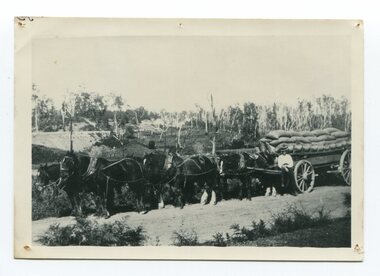
... Maize, or corn as it is called in America and New South Wales, has been grown on the Orbost flats for at least 70 years. ...Maize, or corn as it is called in America and New South Wales, has been grown on the Orbost flats for at least 70 years. ...Maize, or corn as it is called in America and New South Wales, has been grown on the Orbost flats for at least 70 years. When early settlers began to arrive on the Snowy River somewhere in the 1880s, the land was mostly swamps and heavily timbered jungle on the river frontages. The swamps were drained, bit by bit, by stout hearted men with short handled shovels and working in mud and water. The frontages were cleared by axe and shovel and fire. Several kinds of crops were experimented with such as hops, hemp and maize, the latter grew particularly well and became the main crop of district. The problem then was to thresh and deliver the product to the market. A small single cob machine was brought here and one man turned the handle, while the boy or Mum fed the cobs singly into the machine. A good day’s work would thresh about 50 bushels or about 12 bags (4 bushels). The task then was to cart the maize to market. For a few years this was done by horses and dray carrying about 60 bushels to Mossiface, where it was loaded onto river boats to Lakes Entrance, and then by ocean boats to Melbourne. ( from NEWSLETTER OCTOBER, 2006) This is a pictorial record of farming practices in Orbost in the early 20th century.A black / white photograph of a horse team hauling a wagon loaded with bags of maize.A man is sitting on the edge of the wagon.farming-orbost agriculture maize corn transport -
 The Beechworth Burke Museum
Animal specimen - Broad-shelled turtle, Trustees of the Australian Museum, 1860-1880
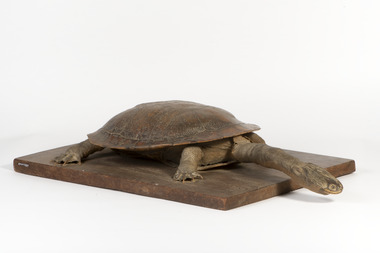
... The family Chelidae is endemic to Australia, New Guinea, and South America and consists of some 40 species of freshwater turtle. ...The family Chelidae is endemic to Australia, New Guinea, and South America and consists of some 40 species of freshwater turtle. ...The family Chelidae is endemic to Australia, New Guinea, and South America and consists of some 40 species of freshwater turtle. Twenty-four described species are found in Australia and three of these occur in the Murray Darling Basin. Turtles of the genus Chelodina are distinguished by their exceptionally long necks. These turles are also referred to as side-necked turtles, so named because the neck and head, when not extended, fold under the leading edge of the carapace. They are further characterised by their relatively flattened shells and their clawed webbed feet. This specimen is part of a collection of almost 200 animal specimens that were originally acquired as skins from various institutions across Australia, including the Australian Museum in Sydney and the National Museum of Victoria (known as Museums Victoria since 1983), as well as individuals such as amateur anthropologist Reynell Eveleigh Johns between 1860-1880. These skins were then mounted by members of the Burke Museum Committee and put-on display in the formal space of the Museum’s original exhibition hall where they continue to be on display. This display of taxidermy mounts initially served to instruct visitors to the Burke Museum of the natural world around them, today it serves as an insight into the collecting habits of the 19th century.This specimen is part of a significant and rare taxidermy mount collection in the Burke Museum. This collection is scientifically and culturally important for reminding us of how science continues to shape our understanding of the modern world. They demonstrate a capacity to hold evidence of how Australia’s fauna history existed in the past and are potentially important for future environmental research. This collection continues to be on display in the Museum and has become a key part to interpreting the collecting habits of the 19th century.This specimen is stylised standing on a wooden platform. It has a long, narrow neck and a large and relatively flat shell. The head, neck and limbs are all dark grey or brown in colour and the underside is a pale brown. The feet are webbed and have long claws. The eyes are made from pale glass and the specimen has a short tale.BMM5891taxidermy mount, taxidermy, animalia, burke museum, beechworth, australian museum, skin, reynell eveleigh johns, turtle, australian turtle, australian animal, snake-necked turtle, chelidae, broad-shelled turtle -
 The Beechworth Burke Museum
Animal specimen - Californian Quail, Trustees of the Australian Museum, 1860-1880
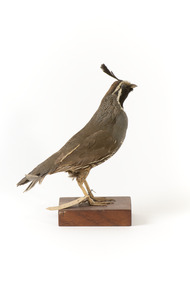
... They are native to western America but have been introduced to areas outside this location including King Island. ...They are native to western America but have been introduced to areas outside this location including King Island. ...About the specimen: The Californian Quail is a highly sociable bird commonly seen in small flocks. They have a distinctive appearance with the black plume on top of their head and white markings on the head and torso. This species reside in open woodland, bushy grassland, roadsides and fringes of urban areas. They are native to western America but have been introduced to areas outside this location including King Island. This species was established as the state bird of California in 1932. Explain how it should look: Copy and paste: This specimen is part of a collection of almost 200 animal specimens that were originally acquired as skins from various institutions across Australia, including the Australian Museum in Sydney and the National Museum of Victoria (known as Museums Victoria since 1983), as well as individuals such as amateur anthropologist Reynell Eveleigh Johns between 1860-1880. These skins were then mounted by members of the Burke Museum Committee and put-on display in the formal space of the Museum’s original exhibition hall where they continue to be on display. This display of taxidermy mounts initially served to instruct visitors to the Burke Museum of the natural world around them, today it serves as an insight into the collecting habits of the 19th century.Copy and paste this section: This specimen is part of a significant and rare taxidermy mount collection in the Burke Museum. This collection is scientifically and culturally important for reminding us of how science continues to shape our understanding of the modern world. They demonstrate a capacity to hold evidence of how Australia’s fauna history existed in the past and are potentially important for future environmental research. This collection continues to be on display in the Museum and has become a key part to interpreting the collecting habits of the 19th century.This male Californian Quail has a black forward drooping plume on the top of its head. It has a dark brown/black coloured cap on its head and a black face with distinct white markings on the sides of its face and neck. The back of the bird is brown.The belly is a lighter brown colour and the chest and back of the neck is a blue-grey. This specimen stands upon a wooden platform and has an identification tag tied around its leg.Swing-tag: 46 / (b)? Californian Scrub Quail / Catalogue Page, 30. / Metal tag: 4341 / taxidermy mount, taxidermy, animalia, burke museum, beechworth, australian museum, skin, reynell eveleigh johns, bird, californian quail, california, american birds, quail, californain sub wren, wren -
 The Beechworth Burke Museum
Animal specimen - Squirrel, Trustees of the Australian Museum, 1860-1880
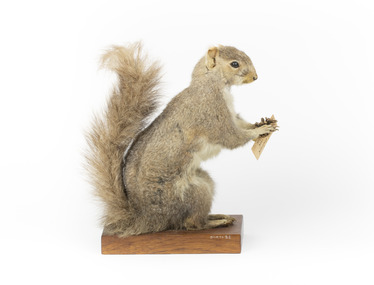
... They are commonly located in America, Eurasia and Africa. The Squirrel was introduced to Australia by humans. ...They are commonly located in America, Eurasia and Africa. The Squirrel was introduced to Australia by humans. ...The Squirrel is a small to medium sized member of the rodent family Sciuridae. They are commonly located in America, Eurasia and Africa. The Squirrel was introduced to Australia by humans. Interestingly, the tail of the Squirrel serves the purpose of keeping the rain, wind or cold off the body of the animal, to help it cool off in hot weather, to counterbalance when moving and can be utilized as a parachute when jumping from one location to the next. Squirrels consume foods that are rich in protein, carbohydrates and fats. They eat nuts, seeds. fruits and vegetation. This specimen is part of a collection of almost 200 animal specimens that were originally acquired as skins from various institutions across Australia, including the Australian Museum and the National Museum of Victoria, as well as individuals such amateur anthropologist Reynell Eveleigh Johns between 1860-1880. These skins were then mounted by members of the Burke Museum Committee and put-on display in the formal space of the Museum’s original exhibition hall where they continue to be on display. This display of taxidermy mounts initially served to instruct visitors to the Burke Museum of the natural world around them, today it serves as an insight into the collecting habits of the 19th century.This specimen is part of a significant and rare taxidermy mount collection in the Burke Museum. This collection is scientifically and culturally important for reminding us of how science continues to shape our understanding of the modern world. They demonstrate a capacity to hold evidence of how Australia’s fauna history existed in the past and are potentially important for future environmental research. This collection continues to be on display in the Museum and has become a key part to interpreting the collecting habits of the 19th century.Grey Squirrel standing on a wooden platform. The small sized specimen holds a pinecone between its hands and has a paper identification tag tied to one of its arms. It has grey/ash coloured fur with a pale belly and dark coloured glass eyes. It has a long and bushy tail that stands along its back in an arched shape. It has tiny hands and feet.40. ash-coloured / Squirrel / Catalogue, Page, 49. / A.4484 / BMM 75 32 /taxidermy mount, taxidermy, animalia, burke museum, beechworth, australian museum, skin, reynell eveleigh johns, squirrel -
 The Beechworth Burke Museum
Animal specimen - Common Squirrel, Trustees of the Australian Museum, 1860-1880
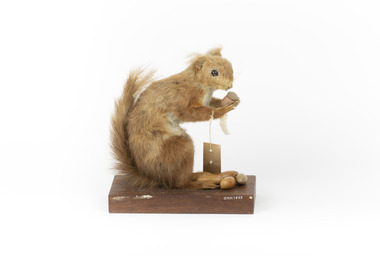
... They are commonly located in America, Eurasia and Africa. The Squirrel was introduced to Australia by humans. ...They are commonly located in America, Eurasia and Africa. The Squirrel was introduced to Australia by humans. ...The Squirrel is a small to medium sized member of the rodent family Sciuridae. They are commonly located in America, Eurasia and Africa. The Squirrel was introduced to Australia by humans. Interestingly, the tail of the Squirrel serves the purpose of keeping the rain, wind or cold off the body of the animal, to help it cool off in hot weather, to counterbalance when moving and can be utilized as a parachute when jumping from one location to the next. Squirrels consume foods that are rich in protein, carbohydrates and fats. They eat nuts, seeds. fruits and vegetation. This specimen is part of a collection of almost 200 animal specimens that were originally acquired as skins from various institutions across Australia, including the Australian Museum and the National Museum of Victoria, as well as individuals such amateur anthropologist Reynell Eveleigh Johns between 1860-1880. These skins were then mounted by members of the Burke Museum Committee and put-on display in the formal space of the Museum’s original exhibition hall where they continue to be on display. This display of taxidermy mounts initially served to instruct visitors to the Burke Museum of the natural world around them, today it serves as an insight into the collecting habits of the 19th century.This specimen is part of a significant and rare taxidermy mount collection in the Burke Museum. This collection is scientifically and culturally important for reminding us of how science continues to shape our understanding of the modern world. They demonstrate a capacity to hold evidence of how Australia’s fauna history existed in the past and are potentially important for future environmental research. This collection continues to be on display in the Museum and has become a key part to interpreting the collecting habits of the 19th century.Grey Squirrel standing on a wooden platform. The small sized specimen holds an acorn between its hands and has a paper identification tag tied to one of its arms. Small acorns are arranged around the specimen's feet. It has orange coloured fur with a pale belly and dark coloured glass eyes. It has a long and bushy tail that stands along its back in an arched shape. It has tiny hands and feet.42. Common Squirrel / Catalogue, page, 50 / A.4487 /taxidermy mount, taxidermy, animalia, burke museum, beechworth, australian museum, skin, reynell eveleigh johns, squirrel -
 The Beechworth Burke Museum
Animal specimen - Carolina Squirrel, Trustees of the Australian Museum, 1860-1880
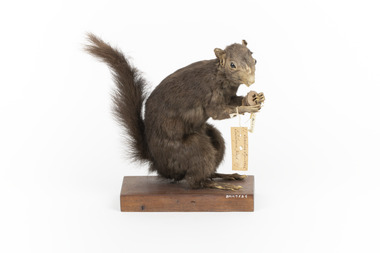
... They are commonly located in America, Eurasia and Africa. The Squirrel was introduced to Australia by humans. ...They are commonly located in America, Eurasia and Africa. The Squirrel was introduced to Australia by humans. ...The Squirrel is a small to medium sized member of the rodent family Sciuridae. They are commonly located in America, Eurasia and Africa. The Squirrel was introduced to Australia by humans. Interestingly, the tail of the Squirrel serves the purpose of keeping the rain, wind or cold off the body of the animal, to help it cool off in hot weather, to counterbalance when moving and can be utilized as a parachute when jumping from one location to the next. Squirrels consume foods that are rich in protein, carbohydrates and fats. They eat nuts, seeds. fruits and vegetation. This specimen is part of a collection of almost 200 animal specimens that were originally acquired as skins from various institutions across Australia, including the Australian Museum and the National Museum of Victoria, as well as individuals such amateur anthropologist Reynell Eveleigh Johns between 1860-1880. These skins were then mounted by members of the Burke Museum Committee and put-on display in the formal space of the Museum’s original exhibition hall where they continue to be on display. This display of taxidermy mounts initially served to instruct visitors to the Burke Museum of the natural world around them, today it serves as an insight into the collecting habits of the 19th century.This specimen is part of a significant and rare taxidermy mount collection in the Burke Museum. This collection is scientifically and culturally important for reminding us of how science continues to shape our understanding of the modern world. They demonstrate a capacity to hold evidence of how Australia’s fauna history existed in the past and are potentially important for future environmental research. This collection continues to be on display in the Museum and has become a key part to interpreting the collecting habits of the 19th century.The Carolina Squirrel specimen has dark coloured fur with paler colouring on the face and hands. It grasps a nut between its hands and stands on a wooden platform. A paper tag hangs from the right arm with a smaller tag attached to the left. The squirrel has dark black glass eyes and sharp claws on the hands and feet. A.4481 BMM7535 35. Carolina Squirrel / Catalogue, Page, 49 /taxidermy mount, taxidermy, animalia, burke museum, beechworth, australian museum, skin, reynell eveleigh johns, squirrel -
 The Beechworth Burke Museum
Animal specimen - Carolina Squirrel, Trustees of the Australian Museum, 1860-1880
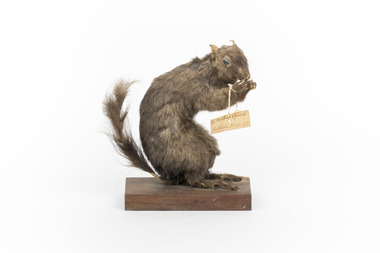
... They are commonly located in America, Eurasia and Africa. The Squirrel was introduced to Australia by humans. ...They are commonly located in America, Eurasia and Africa. The Squirrel was introduced to Australia by humans. ...The Squirrel is a small to medium sized member of the rodent family Sciuridae. They are commonly located in America, Eurasia and Africa. The Squirrel was introduced to Australia by humans. Interestingly, the tail of the Squirrel serves the purpose of keeping the rain, wind or cold off the body of the animal, to help it cool off in hot weather, to counterbalance when moving and can be utilized as a parachute when jumping from one location to the next. Squirrels consume foods that are rich in protein, carbohydrates and fats. They eat nuts, seeds. fruits and vegetation. This specimen is part of a collection of almost 200 animal specimens that were originally acquired as skins from various institutions across Australia, including the Australian Museum and the National Museum of Victoria, as well as individuals such amateur anthropologist Reynell Eveleigh Johns between 1860-1880. These skins were then mounted by members of the Burke Museum Committee and put-on display in the formal space of the Museum’s original exhibition hall where they continue to be on display. This display of taxidermy mounts initially served to instruct visitors to the Burke Museum of the natural world around them, today it serves as an insight into the collecting habits of the 19th century.This specimen is part of a significant and rare taxidermy mount collection in the Burke Museum. This collection is scientifically and culturally important for reminding us of how science continues to shape our understanding of the modern world. They demonstrate a capacity to hold evidence of how Australia’s fauna history existed in the past and are potentially important for future environmental research. This collection continues to be on display in the Museum and has become a key part to interpreting the collecting habits of the 19th century.The Carolina Squirrel specimen has dark grey coloured fur. This specimen stands on a wooden platform and its arms are stylized in a raised position next to its face. A paper tag hangs from the right arm with a smaller tag attached to the left. The squirrel has dark black glass eyes and sharp claws on the hands and feet.A.4480 36. Carolina Squirrel / Catalogue, page, 49 /taxidermy mount, taxidermy, animalia, burke museum, beechworth, australian museum, skin, reynell eveleigh johns, squirrel -
 Kiewa Valley Historical Society
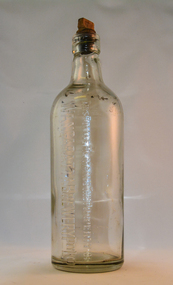
Bottle - Ginger Beer, mid to late 1900's
... Up to the end of the second World War Australian "soft drink" demand was for local produce. The American invasion of other flavours of "soft drink" came in the 1950's. ...Up to the end of the second World War Australian "soft drink" demand was for local produce. The American invasion of other flavours of "soft drink" came in the 1950's. ...This bottle was used in a period when "soft" drink ginger beer was "brewed" not only in homes but also in specific breweries. Most rural areas had families which produced their own ginger beer. Medium to large towns and cities had ginger beer "factories". These factories had large "on bottle" advertising who the producer was. This producer advertising was firmly infused into the bottle and not on removable labels (late 1900's on wards). Regional breweries had a strong following, similar to State beer producing breweries. The competition between breweries of ginger beer was regional and not state or international. Return of bottles was not a sign of saving the environment or becoming eco- friendly but a requirement to keep production costs low. This is highlighted by "This bottle Remains the Property", in other words return when empty. Up to the end of the second World War Australian "soft drink" demand was for local produce. The American invasion of other flavours of "soft drink" came in the 1950's. Multi -Corporations producing non alcoholic beverages at lower production costs reduced local manufacturers considerably. This however had little effect on semi isolated rural areas where home brews flourished.This bottle shows the impact that small regional towns had and still have on semi isolated rural communities(Kiewsa Valley). With better communications (radio/television/newspapers) and a better transport connections specialised breweries such as the Wangaratta Brewery had an extensive customer "hinterland" to serve. The "canny" rural population would be able to reuse this bottle for their own specific purpose. Because of the long distances between Kiewa Valley residences and the major towns available to them, the issue of adaptability of any purchases made was always closely linked to their long term usefulness.This bottle is made from thick clear glass and has a capacity of one and a half pints. It has a flat top with a wooden screw stopper (internal thread). On one side "THIS BOTTLE REMAINS THE PROPERTY OF WANGARATTA BREWERY PTY LTD" On the top rim of bottle on both sides "17". On the bottom of the base are "AGM" AND "346"ginger beer bottle, soft drink bottles, cordial bottles, wangaratta drinks -
 Bendigo Historical Society Inc.
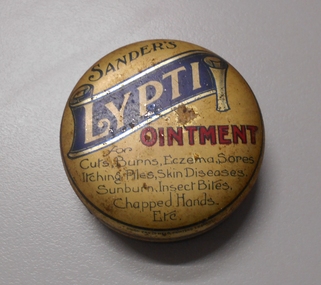
Accessory - Lypti Ointment - Cosmetic
... At its peak, Sandner and Sons had agents up and down the east coast of Australia as well as in New Zealand and the United States of America. https://www.bendigoadvertiser.com.au/story/3854951/sandner-and-sons-to-be-preserved-in-national-library/ ...At its peak, Sandner and Sons had agents up and down the east coast of Australia as well as in New Zealand and the United States of America. https://www.bendigoadvertiser.com.au/story/3854951/sandner-and-sons-to-be-preserved-in-national-library/ Sandner Cosmetics Eucalyptus Distillery A small tin of Sander's LYPTI OINTMENT. ...When Carl Sandner began Sandner and Sons Eucalyptus Distillery in 1875, he probably had no idea his archives would end up in the National Library. The distillery operated until 1967 and the Uley Street site was the subject of archaeological monitoring in 2011 prior to Bendigo’s new ambulance station being built there. But his great great grandson Alec Sandner handed over some mint-condition documents that he has held on to for many years. “I had this tin and the more I opened it, the more interested in it I became,” Mr Sandner said. “There was a letter from the Kaiser in 1888 because the business had written to them asking them to endorse. They had politely refused. “There was also a letter from the Italian consulate saying the King of Italy was satisfied with the product he received. From then the advertising said the products had been approved by the King of Italy.” At its peak, Sandner and Sons had agents up and down the east coast of Australia as well as in New Zealand and the United States of America. https://www.bendigoadvertiser.com.au/story/3854951/sandner-and-sons-to-be-preserved-in-national-library/ A small tin of Sander's LYPTI OINTMENT. The lidded tin contains a waxy brown substance with an aroma of eucalyptus. There are no ingredients listed. Gold coloured tin with red, blue and white printing. "For Cuts, Burns, Eczema, Sores, Itching, Piles, Skin Diseases, Sunburn, Insect Bites, Chapped Hands Etc.sandner, cosmetics, eucalyptus distillery -
 Bendigo Historical Society Inc.
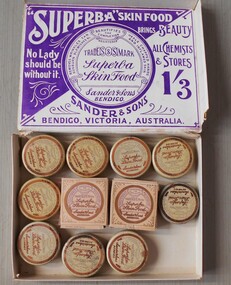
Accessory - Superba Skin Food - Cosmetic
... At its peak, Sandner and Sons had agents up and down the east coast of Australia as well as in New Zealand and the United States of America. https://www.bendigoadvertiser.com.au/story/3854951/sandner-and-sons-to-be-preserved-in-national-library/ ...At its peak, Sandner and Sons had agents up and down the east coast of Australia as well as in New Zealand and the United States of America. https://www.bendigoadvertiser.com.au/story/3854951/sandner-and-sons-to-be-preserved-in-national-library/ Sandner Cosmetics Eucalyptus Distillery Rectangular cream coloured box with attached fold back lid. ...When Carl Sandner began Sandner and Sons Eucalyptus Distillery in 1875, he probably had no idea his archives would end up in the National Library. The distillery operated until 1967 and the Uley Street site was the subject of archaeological monitoring in 2011 prior to Bendigo’s new ambulance station being built there. But his great great grandson Alec Sandner handed over some mint-condition documents that he has held on to for many years. “I had this tin and the more I opened it, the more interested in it I became,” Mr Sandner said. “There was a letter from the Kaiser in 1888 because the business had written to them asking them to endorse. They had politely refused. “There was also a letter from the Italian consulate saying the King of Italy was satisfied with the product he received. From then the advertising said the products had been approved by the King of Italy.” At its peak, Sandner and Sons had agents up and down the east coast of Australia as well as in New Zealand and the United States of America. https://www.bendigoadvertiser.com.au/story/3854951/sandner-and-sons-to-be-preserved-in-national-library/ Rectangular cream coloured box with attached fold back lid. Printed in purple on the lid and also inside the lid "SUPERBA" SKIN FOOD Brings Beauty. All Chemists & Stores.1/3. No Lady should be without it. SANDER & Sons. BENDIGO, Victoria, Australia. A centred circle frame includes the following Removes wrinkles, tan, sunburn blemishes &c. Beautifies the complexion. Heals chapped hands and inflemed skin. Inside the box is a loose advertising card for the product. The box contains eleven small tins of the skin cream. Each tin has a small red wax seal on one side. Seven appear to be intact and unopened and four have been opened. Some of the printing on the tins is gold coloured in places but all tins show various stages of wear Two of them are inside original smaller boxes. The tins contain a waxy substance covered with a piece of waxed paper. Folded information sheet inside one of the boxes. There are no ingredients listed. sandner, cosmetics, eucalyptus distillery -
 Royal Australian and New Zealand College of Obstetricians & Gynaecologists (RANZCOG)
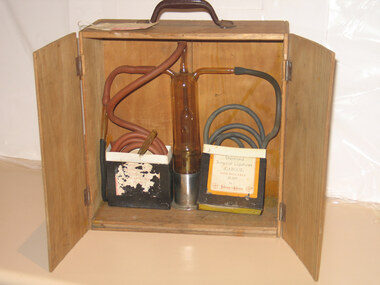
Rubin's tubal insufflator apparatus associated with St Vincent's Hospital, c1919
... It was developed by American gynaecologist Isidor Clinton Rubin (1883-1958). ...It was developed by American gynaecologist Isidor Clinton Rubin (1883-1958). ..."Potential blockage in the Fallopian tubes was assessed using this apparatus. It was developed by American gynaecologist Isidor Clinton Rubin (1883-1958). It blows carbon dioxide, via a cannula, into the uterus. The ease with which gas escaped through the Fallopian tubes was reflected by pressure changes on an instrument called a manometer. Blockage of the tubes is often due to previous infection or surgery. It is a common cause of infertility. Rubin’s test formed a standard part of infertility investigations for many years. It was gradually replaced by an X-ray technique involving radio-opaque ‘dye’ injected into the uterus." Source: Science Museum Group. Rubin’s apparatus for uterotubal insufflation, New York, United States, 1928. A639503Science Museum Group Collection Online. Accessed 12 June 2024. https://collection.sciencemuseumgroup.org.uk/objects/co96774/rubins-apparatus-for-uterotubal-insufflation-new-york-united-states-1928-tubal-insufflator. There is no manometer to monitor gas pressure on this model so it is either incomplete or a manometer was not available in this possibly early model. This device may be dated c1919, 1920s, or 1930s. 1919 was the year Isidor Clinton Rubin (1883-1958) introduced this apparatus. Rubin's tubal insufflator apparatus. Consists of a large cylindrical glass canister, with three glass nozzles at top with long rubber tubing attached to each. The device is inside a portable plywood box with two door. One surgical steel introducer, and one glass introducer, are also attached to the device. -
 Royal Australian and New Zealand College of Obstetricians & Gynaecologists (RANZCOG)
Tubal insufflator associated with Dr Lorna Lloyd-Green, c1919
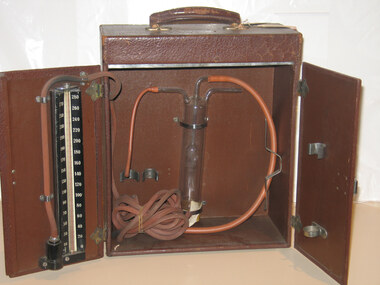
... It was developed by American gynaecologist Isidor Clinton Rubin (1883-1958). ...It was developed by American gynaecologist Isidor Clinton Rubin (1883-1958). ..."Potential blockage in the Fallopian tubes was assessed using this apparatus. It was developed by American gynaecologist Isidor Clinton Rubin (1883-1958). It blows carbon dioxide, via a cannula, into the uterus. The ease with which gas escaped through the Fallopian tubes was reflected by pressure changes on an instrument called a manometer. Blockage of the tubes is often due to previous infection or surgery. It is a common cause of infertility. Rubin’s test formed a standard part of infertility investigations for many years. It was gradually replaced by an X-ray technique involving radio-opaque ‘dye’ injected into the uterus." Source: Science Museum Group. Rubin’s apparatus for uterotubal insufflation, New York, United States, 1928. A639503Science Museum Group Collection Online. Accessed 12 June 2024. https://collection.sciencemuseumgroup.org.uk/objects/co96774/rubins-apparatus-for-uterotubal-insufflation-new-york-united-states-1928-tubal-insufflator. Model may be dated c1919 or 1920s or 1930s. 1919 was the year Isidor Clinton Rubin (1883-1958) introduced the apparatus. Instrumant has a label with Cyrus Jones monogram " Donated by Dr Lorna Lloyd Green, 1986/ Rubin's Insufflator/ NB "sparklet holder separate" missing?Rubin's tubal insufflator apparatus, large cylidrical glass canister inside a portable carry box with two doors with three glass nozzels at top with long rubber tubing attached on each. One surigical steel introducer, one glass introducer attached. A blood pressure manometer is fixed on the inside door. infertility -
 National Vietnam Veterans Museum (NVVM)
Film - Film, DVD, Roadshow Entertainment, The Odd Angry Shot, 1979
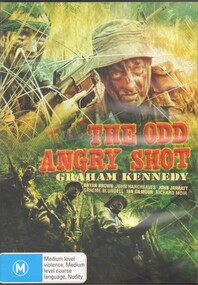
... The film focuses on the soldiers in their cantonments away from the battlefield, where they spend the bulk of their time playing cards, smoking, drinking beer, nursing their tinea, making jokes and messing about with American forces. The film also contains some small scale battle scenes. ...The film focuses on the soldiers in their cantonments away from the battlefield, where they spend the bulk of their time playing cards, smoking, drinking beer, nursing their tinea, making jokes and messing about with American forces. The film also contains some small scale battle scenes. ...The Odd Angry Shot is a 1979 Australian war film written, directed and produced by Tom Jeffrey (with Sue Millikin).] It is based on the book of the same title by William Nagle, and follows the experiences of Australian soldiers during the Vietnam War. The movie, which was shot on location in New South Wales and Canungra, Queensland, traces the tour of duty of an Australian Special Air Service Regiment reconnaissance team from their departure to their return home to Australia. It avoids much of the political comment on Australia’s involvement in Vietnam, unlike Hollywood films which tend to explore the rights and wrongs of the Vietnam War. The film focuses on the soldiers in their cantonments away from the battlefield, where they spend the bulk of their time playing cards, smoking, drinking beer, nursing their tinea, making jokes and messing about with American forces. The film also contains some small scale battle scenes. When the men return to Australia, they reflect on how both they and the general Australian society have changed. (In particular, they find it unwise to disclose that they fought in Vietnam: to do so invited abuse in a society divided about whether Australians should have been sent to fight there.) Sourced from WikipediaThe cover of the DVD depicts several soldiers. There is one with a gun behind his head. Inside there is the DVD of the movie titled The Odd Angry Shot starring Graham Kennedydvd, australian special air service (sas), australian actors, graham kennedy (actor) -
 National Vietnam Veterans Museum (NVVM)
Photograph, First President of Republic of Vietnam
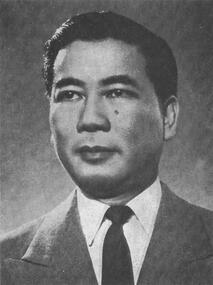
... While the United States publicly denied playing any part in the 1963 coup that overthrew Diệm, it was revealed that American officials had met with and encouraged the generals who planned the coup. ...While the United States publicly denied playing any part in the 1963 coup that overthrew Diệm, it was revealed that American officials had met with and encouraged the generals who planned the coup. ...In 1954, as the defeated French forces left the State of Vietnam, Ngô Đình Diệm, a devout Roman Catholic, became the first prime minister. In 1956, a government-controlled referendum determined that South Vietnam should become a republic rather than stay under the control of Emperor Bảo Đại (who was living in Cannes, on the French Riviera). Ngô Đình Diệm appointed himself the first President of the Republic of Vietnam (South Vietnam). He then appointed his younger brother, Ngô Đình Nhu, to be his chief advisor and head of both South Vietnam’s secret police and its largest intelligence agency. During 1963, a campaign of civil resistance led by Buddhist monks protested religious discrimination. The government’s brutal treatment of Buddhists convinced many that Ngô Đình Diệm should go. While the United States publicly denied playing any part in the 1963 coup that overthrew Diệm, it was revealed that American officials had met with and encouraged the generals who planned the coup. Both Ngô Đình Diệm and his brother, Ngô Đình Nhu, were executed on 2 November 1963. 1st elected president of South Vietnam, Ngo Dinh Diem. 1st president vietnam, ngo dinh diem, republic of vietnam, south vietnam, assassination, execution, diem, president -
 National Vietnam Veterans Museum (NVVM)
Film - Film, DVD, Roadshow Entertainment, The Odd Angry Shot, 1979
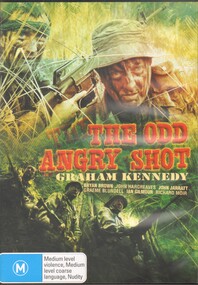
... The film focuses on the soldiers in their cantonments away from the battlefield, where they spend the bulk of their time playing cards, smoking, drinking beer, nursing their tinea, making jokes and messing about with American forces. The film also contains some small scale battle scenes. ...The film focuses on the soldiers in their cantonments away from the battlefield, where they spend the bulk of their time playing cards, smoking, drinking beer, nursing their tinea, making jokes and messing about with American forces. The film also contains some small scale battle scenes. ...The Odd Angry Shot is a 1979 Australian war film written, directed and produced by Tom Jeffrey (with Sue Millikin).] It is based on the book of the same title by William Nagle, and follows the experiences of Australian soldiers during the Vietnam War. The movie, which was shot on location in New South Wales and Canungra, Queensland, traces the tour of duty of an Australian Special Air Service Regiment reconnaissance team from their departure to their return home to Australia. It avoids much of the political comment on Australia’s involvement in Vietnam, unlike Hollywood films which tend to explore the rights and wrongs of the Vietnam War. The film focuses on the soldiers in their cantonments away from the battlefield, where they spend the bulk of their time playing cards, smoking, drinking beer, nursing their tinea, making jokes and messing about with American forces. The film also contains some small scale battle scenes. When the men return to Australia, they reflect on how both they and the general Australian society have changed. (In particular, they find it unwise to disclose that they fought in Vietnam: to do so invited abuse in a society divided about whether Australians should have been sent to fight there.) Sourced from WikipediaThe cover of the DVD depicts several soldiers. There is one with a gun behind his head. Inside there is the DVD of the movie titled The Odd Angry Shot starring Graham Kennedydvd, australian special air service (sas), australian actors, graham kennedy (actor) -
 Federation University Art Collection
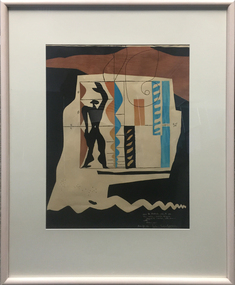
Work on paper - Printmaking - Lithograph (Limited Edition), Le Corbusier, 'Modulor' by Le Corbusier, 1956, 1956
... His career spanned five decades, with his buildings constructed throughout Europe, India, and the Americas. (Wikipedia) The Modulor is an anthropometric scale of proportions devised by the Swiss-born French architect Le Corbusier (1887–1965). ...His career spanned five decades, with his buildings constructed throughout Europe, India, and the Americas. (Wikipedia) The Modulor is an anthropometric scale of proportions devised by the Swiss-born French architect Le Corbusier (1887–1965). ...Le Corbusier (or Charles-Édouard Jeanneret-Gris) (6 October 6, 1887 – August 27, 1965) Born Chaux-de-Fonds, Switzerland Studied at the local art school Began to study architecture in 1905 With Amedee Ozenfant founded the journal “L’Esprit Nouveau” in 1920 Became a French citizen in 1930 La Corbusier was a Swiss-French architect, designer, painter, urban planner, writer, and one of the pioneers of what is now called modern architecture. He was born in Switzerland and became a French citizen in 1930. His career spanned five decades, with his buildings constructed throughout Europe, India, and the Americas. (Wikipedia) The Modulor is an anthropometric scale of proportions devised by the Swiss-born French architect Le Corbusier (1887–1965). It was developed as a visual bridge between two incompatible scales, the imperial and the metric system. It is based on the height of a man with his arm raised. It was used as a system to set out a number of Le Corbusier's buildings and was later codified into two books. (wikipedia) This item is part of the Federation University Art Collection. The Art Collection features over 1000 works and was listed as a 'Ballarat Treasure' in 2007.Limited edition lithograph after an original collage by Le Corbusier, probably executed in Mourlot Workshop. art, artwork, le corbusier, modular, mourlot workshop, lithograph, colour lithograph, printmaking, aavailable
