
Showing 2930 items matching " military - history."
-
 Bendigo Military Museum
Photograph - PHOTOGRAPH WW1, C.WW1
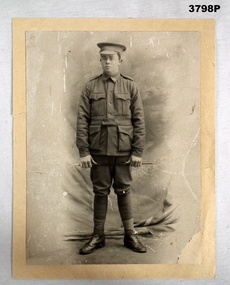
... Refer Cat No 1334 for his service history and award of the Military Medal....Refer Cat No 1334 for his service history and award of the Military Medal. Photographs 22nd Photo B & W of a soldier in peak hat standing holding a pace stick. ...The photo is John Thomas O’Bree MM, No 6865, 22nd Batt AIF. Refer Cat No 1334 for his service history and award of the Military Medal.Photo B & W of a soldier in peak hat standing holding a pace stick. Photo is pasted to a light fawn coloured piece of cardboard.photographs, 22nd -
 Bendigo Military Museum
Film - PHOTOGRAPHS
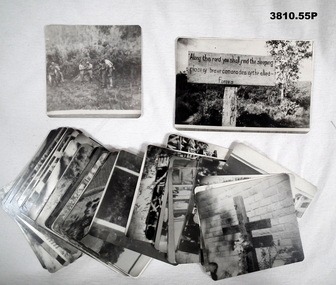
... Refer Reg No 2485 for Alf MASKELL's service history. pow’s military burma railway Photos, black / white, copies of originals. ...The photos belonged to Alf MASHELL VX25221 POW. They were given to Alf by a mate in Alf's unit, Sergeant D T MOORE who was also a POW & worked on the railway. Refer Reg No 2485 for Alf MASKELL's service history.Photos, black / white, copies of originals. The photos are a mixture taken during the building of the Burma Railway, DR's at work on the railway, the surrender in Singapore & the search after the War.pow’s, military, burma railway -
 Bendigo Military Museum
Equipment - TRUNK PERSONAL ARMY WW1, C.WW1
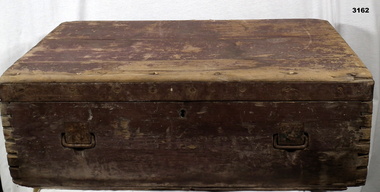
... Refer Cat No 1906 for his full service history also 1905P, 1903.2. personal effects - travel goods military equipment - containers Trunk officers Painted in white on each end of box: “Lt H SOUTHBY 39TH BATT”. ...Box relates to Capt Henry SOUTHBY, 39th Batt. KIA 12.10.1917. Refer Cat No 1906 for his full service history also 1905P, 1903.2.Wooden trunk with hinged top lid, both box & lid metal lined. Carry handles each end & two strap hooks front & back. Key lock in front. Lid has a lock down clip on each side. Lid has metal strip screwed on front & sides. Painted in white on each end of box: “Lt H SOUTHBY 39TH BATT”.personal effects - travel goods, military equipment - containers, trunk, officers -
 Bendigo Military Museum
Equipment - KIT BAG RAAF WW2, c.1939 - 1945
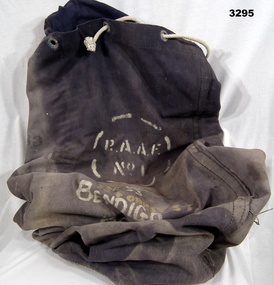
... Refer Cat No 3291 for his Service History. military equipment containers -personal Kit bag RAAF F/O NEVILLE 438263 53 Forest Street Bendigo Vic K36/Q. ...Item issued to Flying Officer Geoffrey Wilkin NEVILLE No 438263 RAAF. Refer Cat No 3291 for his Service History.RAAF Kit Bag, blue canvas, white rope attached through brass eyelets. Identification details stenciled on. A white circle has RAAF No 1. F/O NEVILLE 438263 53 Forest Street Bendigo Vic K36/Q.military equipment, containers -personal, kit bag raaf -
 Bendigo Military Museum
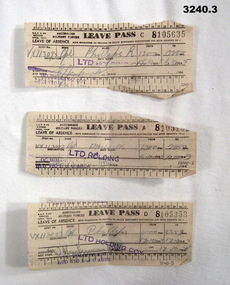
Administrative record - LEAVE PASSES WW2, Australian Army, c.1943
... PHILLIPS VX113093, refer Cat No 3239P for his service history. documents - military leave .1) "Unit: Ltd Holding Coy. ...Items relate to R. T. PHILLIPS VX113093, refer Cat No 3239P for his service history.THree Leave Passes from Australian Military Forces for VX113093 Cpl PHILLIPS. Plain paper Army form AAF 96 revised April 1943..1) "Unit: Ltd Holding Coy. Leave from 15.10.1945 to 16.10.1945" .2) "Unit: Ltd Holding Coy. Leave from 16.10.1945 to 16.10.1945" .3) "Unit: Ltd Holding Coy. Leave from 17.10.1945 to 17.10.1945 2359 hrs"documents - military, leave -
 Bendigo Military Museum
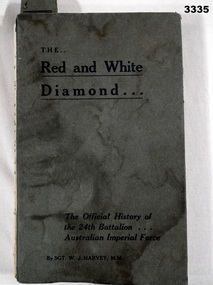
Book - BOOK, 24TH BN, Sergeant W J Harvey M.M. et al, The ..... Red & White Diamond, Post 1920
... The official history of the 24th Battalion Australian Imperial Force. Books military 24th Bn Front fly leaf handwritten in black ink: “July 1-7-1921, J A Rodway, Worker's Club, Mildura” Hard cover paper glued to cardboard, dark grey colour. ...The ..... Red & White Diamond ...... The official history of the 24th Battalion Australian Imperial Force.Hard cover paper glued to cardboard, dark grey colour. Dark blue print on front & spine (broken off). 340 pages, cut, plain, beige coloured. Illustrated, black & white photos & sketch maps. Front fly leaf handwritten in black ink: “July 1-7-1921, J A Rodway, Worker's Club, Mildura” books, military, 24th bn -
 Bendigo Military Museum
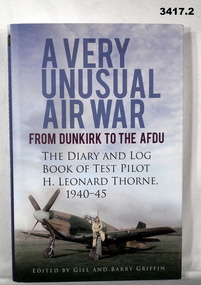
Book - BOOK, AIR FORCE, A Very Unusual Air War, From Dunkirk to the AFDU, 2013
... Military Museum. Thank you for keeping the memory of our war heroes alive” .1) Hard cardboard cover, blue coloured paper, gold print on spine. .2) Dust cover is blue, brown, white, black print on front, spine, back. Colour photo of an aircraft & pilot on front, back cover has colour photo of a Log Book. Pages - 254, cut, plain, white. Illustrated black & white photos & documents. A Very Unusual Air War, From Dunkirk to the AFDU. Book BOOK, AIR FORCE Gill & Barry Griffin The History ...From front cover: The Diary and Log Book of Test Pilot H Leonard Thorne 1940-45..1) Hard cardboard cover, blue coloured paper, gold print on spine. .2) Dust cover is blue, brown, white, black print on front, spine, back. Colour photo of an aircraft & pilot on front, back cover has colour photo of a Log Book. Pages - 254, cut, plain, white. Illustrated black & white photos & documents. Inscription front fly leaf handwritten in blue ink: “To a good friend & brother, Kevin Hogan Gill & Barry” To the Bendigo District RSL & Passchendaele Barracks Memorial Military Museum. Thank you for keeping the memory of our war heroes alive”book, test pilot, dunkirk -
 Bendigo Military Museum
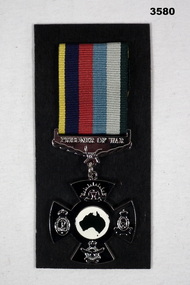
Award - MEDAL
... Refer 3144 for his service history. Medals military Prisoners of war PRISONER OF WAR Medal, Australian Prisoner of War, set on a black cardboard backing. ...Item with the collection of Cyril John JOHNSON VX 36298 died as a POW of the Japanese. Refer 3144 for his service history.Medal, Australian Prisoner of War, set on a black cardboard backing.PRISONER OF WARmedals, military, prisoners of war -
 Bendigo Military Museum
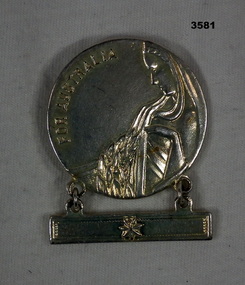
Badge - MOTHERS AND WIDOWS BADGE WW2, post WWII
... Refer 3144 for his service history. Badges military sacrifice On front: FOR AUSTRALIA On rear: A17189 AMOR SYDNEY Badge, circular, Mothers & Widows, depicting a woman with wreath. ...Item with the collection of Cyril John JOHNSON VX 36298 died as a POW of the Japanese. Refer 3144 for his service history.Badge, circular, Mothers & Widows, depicting a woman with wreath. Under via 2 small links is a clasp with 1 star depicting 1 son lost in the war.On front: FOR AUSTRALIA On rear: A17189 AMOR SYDNEYbadges, military, sacrifice -
 Bendigo Military Museum
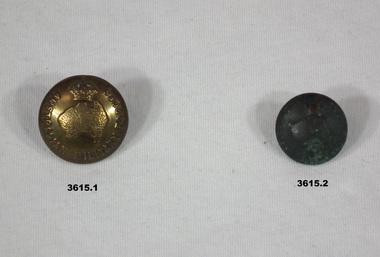
Uniform - BUTTONS, ARMY
... history. Uniform buttons army AMF .1) Printed on back: “K C LUKE PTY LTD MELBOURNE” .2) Printed on back: “EMPIRE - TOOL SYD” .1) & .2) Embossed print around edge: “AUSTRALIAN MILITARY FORCES” .1) & .2) Round, metal, button with imprint of Australia & crown on front. ...Items in collection re Sgt James C WATT No 533, 24th BN, refer Cat No 3554.2 for his service history..1) & .2) Round, metal, button with imprint of Australia & crown on front. Attached ring on back. .1) Printed on back: “K C LUKE PTY LTD MELBOURNE” .2) Printed on back: “EMPIRE - TOOL SYD” .1) & .2) Embossed print around edge: “AUSTRALIAN MILITARY FORCES” uniform, buttons, army, amf -
 Bendigo Military Museum
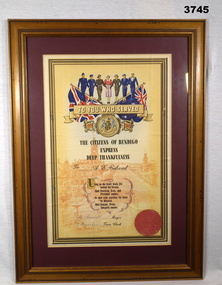
Memorabilia - CITIZENS OF BENDIGO, FRAMED
... Refer Reg No 2473 for his service history. service recognition military Printed at top: TO YOU WHO SERVED Stamp on back: Bethany Gallery Coloured certificate with 7 service members with Union Jack & Australian flags at atop with a cream background of a view of Pall Mall Bendigo. ...Alfred Edward BOLAND VX120107 2nd AIF. Refer Reg No 2473 for his service history.Coloured certificate with 7 service members with Union Jack & Australian flags at atop with a cream background of a view of Pall Mall Bendigo. Presented to A E BOLAND by the citizens of Bendigo & signed by Mayor & Town Clerk. Sketch is mounted with maroon border & tan wooden frame with glass front & white cardboard backing.Printed at top: TO YOU WHO SERVED Stamp on back: Bethany Galleryservice, recognition, military -
 Bendigo Military Museum
Uniform - UNIFORM, NURSES WW2, 1939 - 1946
... History. Items were all numbered 215.01 from a previous institution. See also Reg No 1899 & 1900.2P. uniforms costumes - female uniform essential services - hospital Nurses .2) Self coloured label: V109 MADE IN AUSTRALIA 1942 Inside back neck in ink: G? HOLLOW .5) On label in black: V558 Made in 1943 Australia Size 6-3/4" WRANC .1) Jacket. Grey, fine wool tailored jacket & skirt. Jacket has full belt fastened with press studs. Front fastened with military ...The uniform belonged to CAPT GLADYS MOLE VFX17199 AAMC 2nd AIF. Refer 1901.4 for Service History. Items were all numbered 215.01 from a previous institution. See also Reg No 1899 & 1900.2P.WRANC .1) Jacket. Grey, fine wool tailored jacket & skirt. Jacket has full belt fastened with press studs. Front fastened with military buttons, also pocket flaps & 2 buttons on each sleeve. Shoulder epaulettes of dark brown felt with a button 'Australia' badge & 3 captain's pips. Colour patch on each sleeve - brown square on light grey square with central angled blue bar. Service ribbons on right breast. Upper back section & fronts lined with rayon. Hanging tab centre back neck. .2) Shirt. Long sleeved cream cotton shirt with tail, epaulette tabs on shoulders fastened with a button. Front button fastening semi stiff collar. .3) Skirt. Fastens at side with hooks & eyes & 1 button on waist band. .4) Tie. Made of dark brown crepe with silver Rising Sun badge pinned to it. .5) Hat. Grey/green felt velour with band of brown edged both sides with narrow stripes of pale grey & red. Unlined with petersham sweat band & black hat elastic double chin strap. Signs of wear at inner front. .6) & .7) Gloves. Pair, dark brown leather with stitching detail in 3 decorative lines on backs. Previous number 215.01 has been inked inside. .8) & .9) Shoes. Pair, brown leather lace up with stitched soles by Duncan. .2) Self coloured label: V109 MADE IN AUSTRALIA 1942 Inside back neck in ink: G? HOLLOW .5) On label in black: V558 Made in 1943 Australia Size 6-3/4"uniforms, costumes - female uniform, essential services - hospital, nurses -
 Bendigo Military Museum
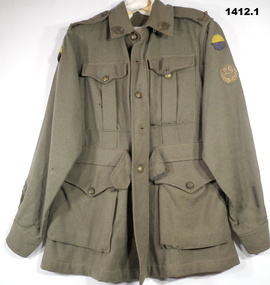
Uniform - JACKET AND SLOUCH HAT - WW1, Dalter Lucas & Sons (1910) Ltd, 1918
... history. The hat was manufactured in 1918 by Dalter Lucas & Sons Bury, UK. It appears to be of a similar style to those issued to Gurkha troops due to the thickness of the felt, the three rows of stitching around the brim and the use of a press stud to pin up the left hand side of the brim. uniforms military clothing costume accessories - male .2) Pressed into the hat band appears to be; “Dalter Lucas & sons (1910) Ltd, BURY 1918” .1) Coat, Battle Dress, Kahki, includes 2 x “Australia” shoulder badges, 2 x “Rising Sun” epaulette badges, 2 x “yellow over purple” colour patches, 3 x “service chevrons”, 1 x “Empire Wounded stripe”, 1 x “Lewis Gun” cloth badge, all metal buttons intact as well as waist belt. .2) Hat, Slouch, kahki fur felt, cotton pugaree, leather head band, Rising sun badge, no chin strap. ...Slouch hat and Uniform jacket belonging to Edwin James JONES No 3511 AIF. Refer 1367.5 for his service history. The hat was manufactured in 1918 by Dalter Lucas & Sons Bury, UK. It appears to be of a similar style to those issued to Gurkha troops due to the thickness of the felt, the three rows of stitching around the brim and the use of a press stud to pin up the left hand side of the brim..1) Coat, Battle Dress, Kahki, includes 2 x “Australia” shoulder badges, 2 x “Rising Sun” epaulette badges, 2 x “yellow over purple” colour patches, 3 x “service chevrons”, 1 x “Empire Wounded stripe”, 1 x “Lewis Gun” cloth badge, all metal buttons intact as well as waist belt. .2) Hat, Slouch, kahki fur felt, cotton pugaree, leather head band, Rising sun badge, no chin strap..2) Pressed into the hat band appears to be; “Dalter Lucas & sons (1910) Ltd, BURY 1918”uniforms, military clothing, costume accessories - male -
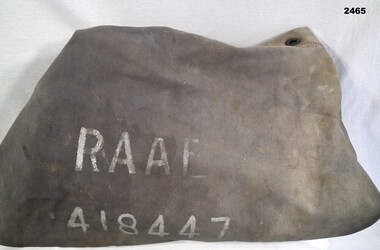 Bendigo Military Museum
Equipment - KIT BAG RAAF WW2, c.1940-41
... MAXWELL LENNOX MATHESON 418447 Flight Lieutenant RAAF 1942 - 1948, refer Cat No 1959 for service history. containers - military military - equipment - air force “RAAF 418447” RAAF Kit Bag, blue canvas, sausage shape. ...MAXWELL LENNOX MATHESON 418447 Flight Lieutenant RAAF 1942 - 1948, refer Cat No 1959 for service history.RAAF Kit Bag, blue canvas, sausage shape. The top has 12 brass eyelets for a card strap. White stencil writing on side.“RAAF 418447”containers - military, military - equipment - air force -
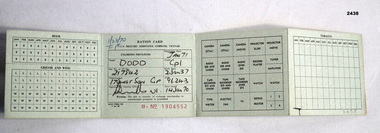 Bendigo Military Museum
Card - CARD, RATION, 1971
... history. Cards ration U.S DODD, CPL, 217842m 17 Const Sqd GP Jan 71 expiry Card, folds in 4, light blue colour. 1 side shows a shield with a sword 4 times. The card is a Ration Card put out by US Military ...Card used by Peter James Dodd No 217842 while serving in South Vietnam. Refer 2436.2P for his service history.Card, folds in 4, light blue colour. 1 side shows a shield with a sword 4 times. The card is a Ration Card put out by US Military Assistance Command, Vietnam. The card is for items re beer, liquor, wine, tobacco & electrical. Persons details are in ink. Also signed by the issuing Officer.DODD, CPL, 217842m 17 Const Sqd GP Jan 71 expirycards, ration u.s -
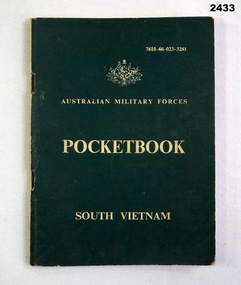 Bendigo Military Museum
Book - POCKET BOOK, June 1967
... Pocket book, green cover, Australian Military Forces South Vietnam. This book contains the history, the War, Government, language, the people re South Vietnam, 74 pages with drawings & sketches....history also 2586. Part of an extensive collection including his fathers. Pocket book South Vietnam “7610-66-023-3281” Pocket book, green cover, Australian Military Forces South Vietnam. ...Item issued to Wayne William Forbes No 3176337 RAE. Refer Cat No 754 for service history also 2586. Part of an extensive collection including his fathers.Pocket book, green cover, Australian Military Forces South Vietnam. This book contains the history, the War, Government, language, the people re South Vietnam, 74 pages with drawings & sketches.“7610-66-023-3281”pocket book, south vietnam -
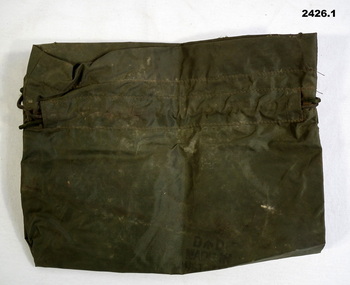 Bendigo Military Museum
Equipment - TOILETRY, LAUNDRY BAGS, 1) 1965; .2) 1969
... history also 2586. Part of an extensive collection including his fathers. military equipment - containers Toiletry laundry .1) D (up arrow) D Made in Australia (up arrow) CGCF 1965 .2) CGCF (up arrow)1969 .1) Toiletry bag, green water proof with green pull tight cord on 1 end. .2) Laundry bag, khaki cotton with white pull tight cord on 1 end. ...Items belonged to Wayne Forbes No 3176337 RAE. Refer Cat No 754 for service history also 2586. Part of an extensive collection including his fathers..1) Toiletry bag, green water proof with green pull tight cord on 1 end. .2) Laundry bag, khaki cotton with white pull tight cord on 1 end..1) D (up arrow) D Made in Australia (up arrow) CGCF 1965 .2) CGCF (up arrow)1969military equipment - containers, toiletry, laundry -
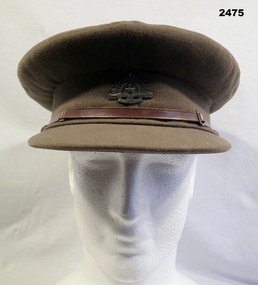 Bendigo Military Museum
Headwear - HAT, PEAKED, Est 1940
... Refer 2473 for service history. Hats uniform military Officers Peak hat, brown colour, front has leather adjustable band, above is a "Rising Sun badge". ...Belonged to Alfred Edward Boland, V59811, VX120107. Refer 2473 for service history.Officers Peak hat, brown colour, front has leather adjustable band, above is a "Rising Sun badge". The inside is lined with a leather band and cotton.hats, uniform, military -
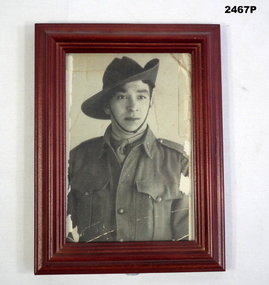 Bendigo Military Museum
Photograph - PHOTOGRAPH, FRAMED, Post 1941
... Refer 2468 for service history. photographs military framed Photo, B & W, portrait of a Soldier H.C.Rosewall, Frame is wood maroon stained. ...Hamlet Cyril Rosewall No V31545 2nd AIF. Refer 2468 for service history.Photo, B & W, portrait of a Soldier H.C.Rosewall, Frame is wood maroon stained.photographs, military, framed -
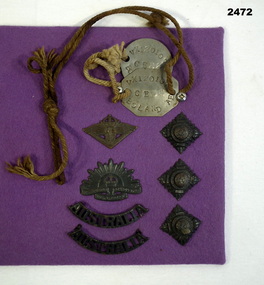 Bendigo Military Museum
Accessory - IDENTITY DISCS, ACTIVE SERVICE, RANK INSIGNIA BADGES, Est 1939 - 45
... Refer 2473 for service history. Badges Identity Military "VX120107 CE BOLAND AE" (On the ID discs) Cardboard with purple felt covering with the following mounted on for display re A.E Boland. 1. ...Items belonged to Alfred Edward Boland, V59811, VX120170. Refer 2473 for service history.Cardboard with purple felt covering with the following mounted on for display re A.E Boland. 1. Set of Identity Discs, one round, one eight sided with cord attached. 2. Returned from Active Service Badge. 3. Rising Sun lapel badge, blackened brass. 4. Two x "Australia" shoulder badges, blackened brass. 5. Three x Officer shoulder rank Insignia, blackened brass."VX120107 CE BOLAND AE" (On the ID discs)badges, identity, military -
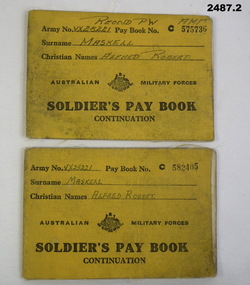 Bendigo Military Museum
Financial record - PAY BOOK ARMY WW2, Soldiers pay, 22.6.40 - 12.12.45
... Refer 2485 medals and service history also 1076, 1100.2, 2484P. Records pay military .1) "RECOVD PW AMF" (Recovered Prisoner of War) .1) Pay book, yellow covers, No C575736 re VX25221 Maskell Alfred Robert, 24 pages. .2) Pay book, yellow covers, No C582405 re VX25221 Maskell Alfred Robert, 24 pages. ...Alfred Robert Maskell VX25221 4th Anti Tank Regt 2nd AIF. Refer 2485 medals and service history also 1076, 1100.2, 2484P..1) Pay book, yellow covers, No C575736 re VX25221 Maskell Alfred Robert, 24 pages. .2) Pay book, yellow covers, No C582405 re VX25221 Maskell Alfred Robert, 24 pages..1) "RECOVD PW AMF" (Recovered Prisoner of War)records, pay, military -
 Bendigo Military Museum
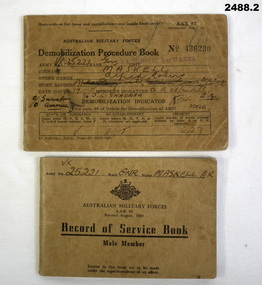
Administrative record - DEMOBILIZATION PROCEDURE, RECORD OF SERVICE BOOKS, 1) 7.12.45, .2) 22.6.40 - 12.12.45
... Refer 2485 for medals and service history also 1076, 1100.2, 2489P. Records military .1) "V.T.227" .1) Demobilization Procedure book, "AAB87" No 436230 re VX25221 Maskell Alfred Robert, brown covers, 29 pages. .2) Record of Service book, "AAB83" Re VX25221 GNR Maskell A.R, brown covers, 40 pages. ...Alfred Robert Maskell VX25221, 4th Anti Tank Regt 2nd AIF. Refer 2485 for medals and service history also 1076, 1100.2, 2489P..1) Demobilization Procedure book, "AAB87" No 436230 re VX25221 Maskell Alfred Robert, brown covers, 29 pages. .2) Record of Service book, "AAB83" Re VX25221 GNR Maskell A.R, brown covers, 40 pages..1) "V.T.227"records, military -
 Bendigo Military Museum
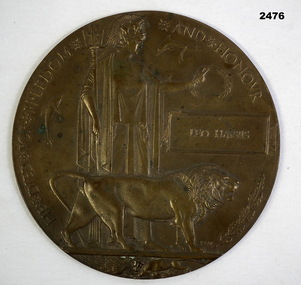
Memorabilia - MEMORIAL PLAQUE, Post WW1
... Refer 2478 for service history also 2477P, 2479.3. Plaques commemorative military "He Died for Freedom and Honour" "Leo Harris" Commemorative Plaque, bronze, with figures of Britanica, Lion and Dolphins, a rectangular space provided for individual names. ...Re Leo Harris No 3132, 58th Batt, KIA. Refer 2478 for service history also 2477P, 2479.3.Commemorative Plaque, bronze, with figures of Britanica, Lion and Dolphins, a rectangular space provided for individual names."He Died for Freedom and Honour" "Leo Harris"plaques, commemorative, military -
 Bendigo Military Museum
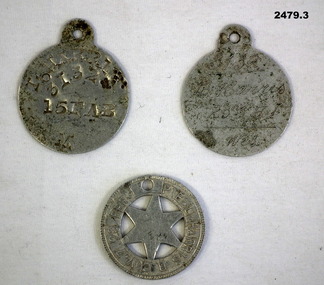
Accessory - IDENTITY DISCS, Est 1915-16
... Refer 2478 for service history also 2476, 2477P. Identity military .1) "L Harris-3132-15 FAB" .2) "3132-L Harris-23rd A.I. ...Leo Harris 3132 KIA. Refer 2478 for service history also 2476, 2477P.Identity Discs re L Harris. .1) Disc, round, aluminium with hole at top for tie cord, lettering has been stamped on. .2) Disc, round, aluminium with hole at top for tie cord, lettering engraved on. .3) Disc, round, aluminium, coin shaped with 6 point star central, hole at top for tie cord..1) "L Harris-3132-15 FAB" .2) "3132-L Harris-23rd A.I. Wes" .3) "Pte L Harris B Coy . 7 23 Ref"identity, military -
 Bendigo Military Museum
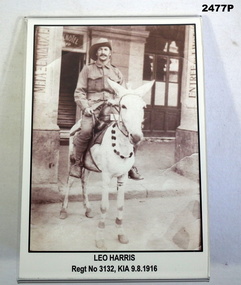
Memorabilia - PHOTOGRAPH, Est 1916
... Refer 2478 for service history also 2476, 2479.3. Photography military KIA "Leo Harris Regt No 3132 KIA 9.8.1916" Photograph in sepia tone showing a soldier in slouch hat mounted on a donkey, in the background is a hotel. ...Leo Harris No 3132. Refer 2478 for service history also 2476, 2479.3.Photograph in sepia tone showing a soldier in slouch hat mounted on a donkey, in the background is a hotel. Photo is in a plastic stand."Leo Harris Regt No 3132 KIA 9.8.1916"photography, military, kia -
 Bendigo Military Museum
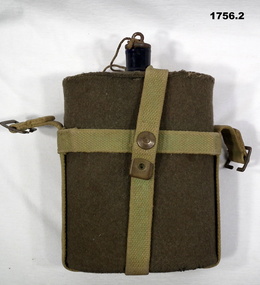
Equipment - WATER BOTTLE, c.1939
... Refer Cat No 432.2 for his service history and 937P. military equipment - army containers Water bottle with khaki felt cover & khaki cotton webbing straps & brass buckle. ...Item issued to Frederick Ernest ADDLEM VX142253. Refer Cat No 432.2 for his service history and 937P.Water bottle with khaki felt cover & khaki cotton webbing straps & brass buckle. Dark blue enamel metal bottle with metal stopper attached with cord.military equipment - army, containers -
 Bendigo Military Museum
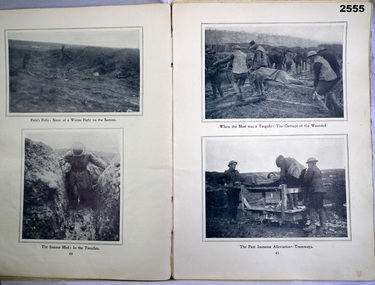
Book - BOOK WW1, From The Front, 1917
... Refer Cat No 1516P for service history. books military the front "T R HILSON 5 Millroy St Bendigo" Covers missing, contains photos & drawings black & white images from the front. ...Item souvenired by T R HILSON No 2088 3rd Reinforcements 38th Batt AIF. Refer Cat No 1516P for service history.Covers missing, contains photos & drawings black & white images from the front."T R HILSON 5 Millroy St Bendigo"books, military, the front -
 Bendigo Military Museum
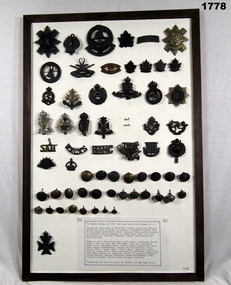
Souvenir - BADGE & BUTTON DISPLAY, MOUNTED, c.1914 - 1918
... Refer Cat No 1786P for his Service History also 1777 & 1787.4. numismatics- badges - military- international uniform accessories Mounted on a RX frame with wire attachments, 63 affixed items of various badges & buttons from other countries Armed Forces. ...The items were souvenired by Robert Allen No 7925, 6th FAB AIF. Refer Cat No 1786P for his Service History also 1777 & 1787.4.Mounted on a RX frame with wire attachments, 63 affixed items of various badges & buttons from other countries Armed Forces.numismatics- badges - military- international, uniform accessories -
 Bendigo Military Museum
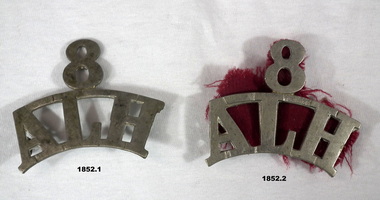
Badge - BADGES LH, 1914-1919
... Refer Cat No 1848P for his service history. numismatics-badges-military Light horse .1) 8th Light Horse Regt badge, silver, metal. .2) 8th Light Horse badge, silver, metal with piece of burgundy material attached. ...Items in the collection re Patrick Joseph Morgan, pre WW1 service, No 3415 AIF, KIA. Refer Cat No 1848P for his service history..1) 8th Light Horse Regt badge, silver, metal. .2) 8th Light Horse badge, silver, metal with piece of burgundy material attached.numismatics-badges-military, light horse -
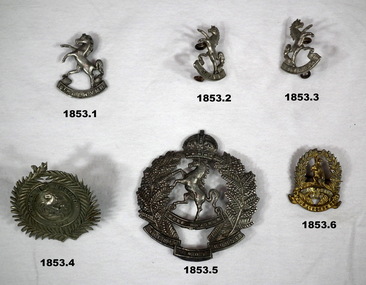 Bendigo Military Museum
Badge - BADGES VARIOUS, Pre WW1
... Items in the collection re Patrick Joseph Morgan, pre WW1 service, No 3415 AIF, KIA. refer 1848P for his service history. numismatics-badges-military Light Horse .1) 8th Light Horse Regiment CMF Militia collar badge. ...Items in the collection re Patrick Joseph Morgan, pre WW1 service, No 3415 AIF, KIA. refer 1848P for his service history..1) 8th Light Horse Regiment CMF Militia collar badge. Silver metal rearing horse facing left, underneath is banner with text "8th ALH VMR". .2) 8th Light Horse Regiment collar badge. Silver metal rearing horse facing left, underneath is banner with text "8th ALH". .3) 8th Light Horse Regiment collar badge. Silver metal rearing horse facing right, underneath is banner with text "8th ALH". .4) 8th Light Horse Regiment hat badge, silver metal. Rearing horse facing left inside circle with text "Timeo Nec Sperno". Circle is surrounded by wreath. Below in a banner with text "8th Aust Light Horse VMR'. .5) 8th Light Horse Regiment hat badge, silver metal. Rearing horse facing left with leaves on either side and crown above. Underneath is number "8" and banners with text "More Majorum" and Indi Light Horse". .6) 9th Light Horse Regiment badge, gold metal. Centre has a sitting kangaroo facing left, looking over to the right, with wattle leaves on either side. Underneath are banners with text "Pro Gloria VMR" and "9th Aus Lt Horse Regt".numismatics-badges-military, light horse
