
Showing 3915 items matching " union"
-
 Ballarat Tramway Museum
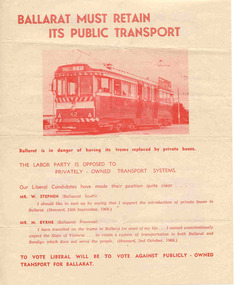
Pamphlet, Australian Labor Party, "Ballarat Must Retain its Public Transport", May. 1970
... See Alan Bradley, Trams of the Golden City - from the draft - "During the campaign for the State election of May 30, 1970 the Labor Party and tramways union campaigned for the retention of “public transport” by voting labor. ...See Alan Bradley, Trams of the Golden City - from the draft - "During the campaign for the State election of May 30, 1970 the Labor Party and tramways union campaigned for the retention of “public transport” by voting labor. ...Political pamphlet, published by the Australian Labor Party for the Saturday May 30, 1970 state election titled "Ballarat Must Retain its Public Transport". Printed in red ink on off white art paper, features Ballarat 42 crossing Albert St Sebastopol. Gives quotes from Liberal members supportive of private transport in Ballarat. On rear gives five points of the Labor party why private transport should be kept, and photos of the candidates for Ballarat South (Ted Cullen), Ballarat Province (The Hon Jack Jones) and Ballarat North (Kevin Flynn). See Alan Bradley, Trams of the Golden City - from the draft - "During the campaign for the State election of May 30, 1970 the Labor Party and tramways union campaigned for the retention of “public transport” by voting labor. But the Bolte Government was returned, all four Ballarat Liberal members held their seats, and most importantly the Government won a majority in the Upper House." trams, tramways, ballarat, public transport, elections, alp, labor party -
 Ballarat Tramway Museum
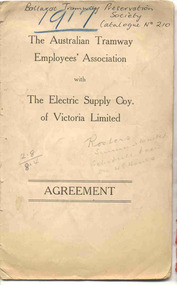
Book, Electric Supply Co. of Vic (ESCo), "The Australian Tramway Employees' Association with the Electric Supply Coy. of Victoria Limited / Agreement", 1917
... Jewell General Secretary for the Union....Trams tramways Bendigo Ballarat ATEA Unions Agreements ESCo "Ballarat Tramway Preservation Society Catalogue No. 210" in ink on top of outside cover. ...Sixteen page booklet, off white paper, saddle stapled, titled "The Australian Tramway Employees' Association with the Electric Supply Coy. of Victoria Limited / Agreement". Has 1917 in indelible pencil on top of cover, with numerous red and pencil notes inside on the various clauses of the agreement. Date of Agreement from 1/1/1917 to continue to the 31/12/1918. Applies to both Ballarat and Bendigo. Details hours of work, rates, Sunday runs, casual rates, holidays, free passes, uniforms, window shields (windscreens) on Bendigo trams, eyesight tests, dismissals, meals, Board of Reference. First schedule gives rates of pays for all types of tramway workers and Rosters for Bendigo Eaglehawk and Cemetery line, Golden Square and Lake Weeroona line and Ballarat Rosters for Summer and winter - gives Run Nos. Signed by William Home for P. J. Pringle for ESCo and Lionel Hill, President and T. Jewell General Secretary for the Union."Ballarat Tramway Preservation Society Catalogue No. 210" in ink on top of outside cover. Numerous notes in red ink or pencil against the various rules. trams, tramways, bendigo, ballarat, atea, unions, agreements, esco -
 Ballarat Tramway Museum
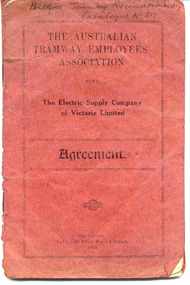
Book, Electric Supply Co. of Vic (ESCo), "The Australian Tramway Employees' Association with the Electric Supply Coy. of Victoria Limited / Agreement", 1919
... Jewell General Secretary for the Union. Two copies held. On Copy two "1919" written in indelible ink on front cover....Trams tramways Bendigo Ballarat ATEA Unions Agreements ESCo "Ballarat Tramway Preservation Society Catalogue No. 211" in ink on top of outside cover. ...Twenty page booklet, off white paper, saddle stapled, with additional red paper cover titled "The Australian Tramway Employees' Association with the Electric Supply Coy. of Victoria Limited / Agreement". Dated on cover 1919. Agreement dated 4/9/1919 Applies to both Ballarat and Bendigo. Details hours of work, rates, Sunday runs, casual rates, holidays, free passes, uniforms, window shields (windscreens) on Bendigo trams, eyesight tests, dismissals, meals, Board of Reference. First schedule gives rates of pays for all types of tramway workers and Rosters for Bendigo Eaglehawk and Cemetery line, Golden Square and Lake Weeroona line and Ballarat Rosters for Summer and winter - gives Run Nos. Signed by P. J. Pringle for ESCo and John L Abfalter Vice President and T. Jewell General Secretary for the Union. Two copies held. On Copy two "1919" written in indelible ink on front cover."Ballarat Tramway Preservation Society Catalogue No. 211" in ink on top of outside cover. Numerous notes in red ink or pencil against the various rules. "1919" on copy two. copy 2 - has schedules varied 1/2/20 and revised amounts. trams, tramways, bendigo, ballarat, atea, unions, agreements, esco -
 Melbourne Legacy
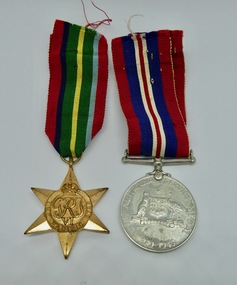
Medal, Australian Service Medal and Pacific Star Medal, 1949
... The normal ribbon is missing and it is on the ribbon meant for the UK War Medal which is of red, white and blue to represent the colours of the Union Flag. 01700.2 The six–pointed star is yellow copper zinc alloy. ...The normal ribbon is missing and it is on the ribbon meant for the UK War Medal which is of red, white and blue to represent the colours of the Union Flag. 01700.2 The six–pointed star is yellow copper zinc alloy. ...The Australian Service Medal and Pacific Star Medal that were awarded to Private Arthur Norman Comben VX26251 for his war service in World War Two. From the AWM website Private Arthur N Comden of the 2/21st Australian Infantry Battalion, who died on Hainan Island, China, on 27 June 1945. The DVA records show he was born 6 April 1907 in Yarraville and enlisted on 17 June 1940 whilst residing in Coopers Creek Victoria. His next of kin was shown as H Dilks. Also that he had been a prisoner of war. His connection with Legacy is not known, he may have been a junior legatee though there's no record of his father Arthur John Louis Comben serving for Australia in WW1. More research is needed to check, it is possible the medals were donated to Legacy as no family members wanted them. Additional information provided by a distant relative - Arthur's mother (Mary Eleanor Norman) remarried twice after his fathers death in 1911. His stepfather Horace Dilks served in World War 1 with the 2nd Pioneer Battalion.These are examples of World War 2 medals awarded to a serviceman who participated in the conflict in the Pacific region. Many returned servicemen joined Legacy after World War 2 and would have had similar medals.Silver circular medal and bronze star shaped medal from World War 2 mounted on ribbons initially together by a safety pin. 01700.1 The medal is nickel silver with the crowned effigy of King George VI on the obverse. The reverse has the Australian coat of arms, placed centrally, surrounded by the words ‘THE AUSTRALIA SERVICE MEDAL 1939-1945’. The normal ribbon is missing and it is on the ribbon meant for the UK War Medal which is of red, white and blue to represent the colours of the Union Flag. 01700.2 The six–pointed star is yellow copper zinc alloy. The obverse has a central design of the Royal and Imperial cypher, surmounted by a crown. The cypher is surrounded by a circlet containing the words ‘The Pacific Star’. The ribbon has central yellow and green stripes that represent the forests and the beaches of the Pacific, flanked dark blue, light blue and red stripes that represent the service of the Naval Forces and Merchant Navy, the Air Forces and the Armies.Both engraved with 'VX26251 A. N. Comben'.medals, world war two, arthur comden -
 Melbourne Tram Museum
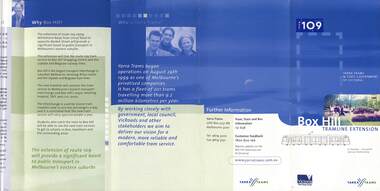
Pamphlet, VicRoads, "Have your say on improving tram 109", Sep. 2005
... Gives information and consultative meetings - looks at the relocation and reconstruction of tram stops, centre platform stops, kerb access stops, maps and alternative stop locations from Kew Junction to Union Road - stops within the City of Boroondara. ...Gives information and consultative meetings - looks at the relocation and reconstruction of tram stops, centre platform stops, kerb access stops, maps and alternative stop locations from Kew Junction to Union Road - stops within the City of Boroondara. ...Pamphlet or book - 12 pages, A4 landscape printed on gloss white paper, centre stapled, titled "Have your say on improving tram 109", consultative or consultation document for the Box Hill tram route. Gives information and consultative meetings - looks at the relocation and reconstruction of tram stops, centre platform stops, kerb access stops, maps and alternative stop locations from Kew Junction to Union Road - stops within the City of Boroondara. Contains a form that could be posted back to VicRoads. Published 9/2005c, has dates for October 2005 meetings. Has the logos of Victorian Government, VicRoads, Yarra Trams and the City of Boroondara. Two copies held .1 - five fold pamphlet - DL - titled "Box Hill Tram line extension", promoting the construction of the route 109 to Box Hill. Message from the Minister, Peter Batchelor, who is Yarra Trams, project details, benefits and why.trams, tramways, yarra trams, route 109, box hill, mont albert, kew junction, superstops, tram stops, city of boroondara, vicroads, new tramway, construction -
 Melbourne Tram Museum
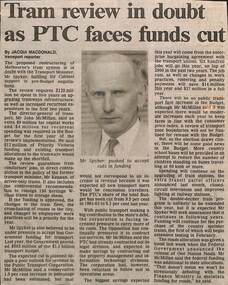
Newspaper, The Age, "Tram review in doubt as PTC faces funds cut", "Tramway plan offers reform at a price", "Report criticises run-down trams", 1992
... Quotes Mr John McMillan, DG of Transport, re issues of getting cabinet support for planned upgrades, storage of W class trams, unions, conductors, work practices, cross linking of tram routes, rail and buses. .2 - Editorial, The Age, 2/7/1992 - titled "Tramway plan offers reform at a price" - about the proposed plan to restructure the public transport system, W class trams, operations and the revolt against scratch tickets. .3 - Newspaper clipping - The Age - 3/4/1992 titled "Report criticises run-down trams" abort the report by Workshops director John Barry, the condition of W class trams, stored B class trams, sub-stations and maintenance....Trams tramways Budgets PTC Unions W Class B class Public Transport Funding Operations Scratch Tickets .1 - Newspaper clipping, The Age 3/8/1992, titled "Tram review in doubt as PTC faces funds cut", written by Jacqui Macdonald Transport Reporter, with a photo of Mr Spyker, Transport Minister. ....1 - Newspaper clipping, The Age 3/8/1992, titled "Tram review in doubt as PTC faces funds cut", written by Jacqui Macdonald Transport Reporter, with a photo of Mr Spyker, Transport Minister. Quotes Mr John McMillan, DG of Transport, re issues of getting cabinet support for planned upgrades, storage of W class trams, unions, conductors, work practices, cross linking of tram routes, rail and buses. .2 - Editorial, The Age, 2/7/1992 - titled "Tramway plan offers reform at a price" - about the proposed plan to restructure the public transport system, W class trams, operations and the revolt against scratch tickets. .3 - Newspaper clipping - The Age - 3/4/1992 titled "Report criticises run-down trams" abort the report by Workshops director John Barry, the condition of W class trams, stored B class trams, sub-stations and maintenance.trams, tramways, budgets, ptc, unions, w class, b class, public transport, funding, operations, scratch tickets -
 Surrey Hills Historical Society Collection
Work on paper - Vertical File, Surrey Hills Medical Centre
... SHNCHC project: Documenting 100 years of medical practice at 174 Union Road, including letter from Sue Barnett to Dr. ...SHNCHC project: Documenting 100 years of medical practice at 174 Union Road, including letter from Sue Barnett to Dr. ...SURREY HILLS MEDICAL CENTRE 1. Letter of commendation from Dr. J. Blakie re Dr. Mitchell H. O’Sullivan, 4.10.1917 (1 page). 2. Biography of Dr. James Blakie, undated, (1 page). 3. Surrey Hills Medical Centre patient information, undated, (1 page). 4. As above. 5. ‘More medical genes’ about the Bennett family, from Chiron 1989 (2 pages). 6. Note from Sue Barnett to Jocelyn Hall, 11.7.1998 (1 page). 7. SHNCHC project: Documenting 100 years of medical practice at 174 Union Road, including letter from Sue Barnett to Dr. D.J. Traum, May 2013 (5 pages). 8. Obituary of James Geoffrey Hindhaugh St Mark’s Anglican Church service 9. The Two of Us: Andrew & Esther: Father and Daughter magnificent medicos. SHNN No. 243 April/May 2023 surrey hills medical centre -
 Melbourne Tram Museum
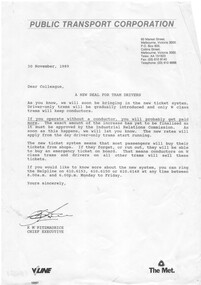
Administrative record - Correspondence, Public Transport Corporation (PTC), "A New Deal for Tram Drivers", 1989 - 1990
... Gives the proposals placed before the unions about Conductors and Met Tickets. .7 - Instruction to crews at Camberwell Depot dated 26/1/1990, 5 sheets stapled in top left hand corner, about the pending introduction of one person trams and the relevant instructions. ...Trams tramways Strike PTC Met Tram Tram Blockade Unions Employees Conductors Drivers One Man Trams Wages Set of 10 documents about the industrial action of early 1990, that resulted in the tram blockade. .1 - Letter from K. ...Set of 10 documents about the industrial action of early 1990, that resulted in the tram blockade. .1 - Letter from K. Fitzmaurice dated 30-11-1989 - titled "A New Deal for Tram Drivers", one page, regarding the phasing out of the tram conductors and increase in wages. .2 - ditto, dated 2/1/1990, two pages regarding the unauthorised use of a Met vehicle - occurred the previous day. .3 - Letter from Jim Kennan (Minister for Transport) and Neil Pope (Minister for Labour) - dated 4/1/1990, on Victoria Transport Letterhead, giving a guarantee to conductors. .4 - Letter from K. Fitzmaurice dated 9-1-1990 - one page regarding their future jobs and the impacts of Met Ticket and improved rates of pay. .5 - Advert in The Age, Full page 11/1/1990 - to all tram and bus crews - regarding Job Guarantee. .6 - Letter from K. Fitzmaurice dated 17-1-1990 - seven pages regarding - headed Government return to work proposal. Gives the proposals placed before the unions about Conductors and Met Tickets. .7 - Instruction to crews at Camberwell Depot dated 26/1/1990, 5 sheets stapled in top left hand corner, about the pending introduction of one person trams and the relevant instructions. Headed "Notice to One-person tram operations" .8 - Letter from K. Fitzmaurice dated 1/2/1990 - one page - "Return to Work Proposal" on PTC letterhead giving a summary of the agreement with the union. .9 - Letter from Ian Stoney Chief Executive of the PTC dated 29/5/1990 address to Carolyn Dean, regarding a review of one-person operation. .10 - One sheet - titled "pay structure - tram and bus" - gives the existing and proposed rates - not dated. May not be a 1990 document.trams, tramways, strike, ptc, met tram, tram blockade, unions, employees, conductors, drivers, one man trams, wages -
 Flagstaff Hill Maritime Museum and Village
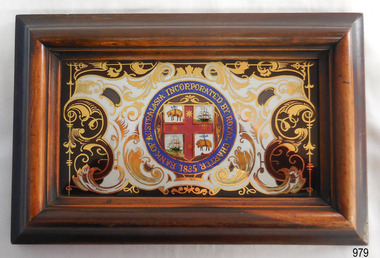
Plaque - Insignia, Bank of Australasia, 19th Century
... In 1951 the Bank of Australasia amalgamated with the Union Bank to form the Australia and New Zealand Bank, now known as the ANZ. ...In 1951 the Bank of Australasia amalgamated with the Union Bank to form the Australia and New Zealand Bank, now known as the ANZ. ...This decorative plaque displays the insignia of the Bank of Australasia, which was incorporated by the Royal Charter of England in March 1834. The bank began in Australia on 14th December 1835, opening in Sydney. The Acting Superintendent of the bank at that time was David Charters McArthur. He was Superintendent from 1867-to 1876. The Melbourne branch opened on 28th August 1838 in a two-roomed brick cottage on the north side of Little Collins Street, where two huge mastiff dogs were used at night to guard the bank. The government also provided an armed military sentinel. Due to the bank's rapid growth, a new building for the Melbourne branch was opened in 1840 at 75 Collins Street West. By 1879 the bank had been upgraded to a magnificent two-storey building on the corners of Collins and Queens Streets, with the entry on Collins Street. In 1951 the Bank of Australasia amalgamated with the Union Bank to form the Australia and New Zealand Bank, now known as the ANZ. Then in 1970, the ANZ merged with both the ES&A and the London Bank of Australia to form the ANZ Banking Group Limited. The ANZ Banking Group Ltd kindly donated a variety of historic items from the Bank of Australasia. BANK of AUSTRALASIA, WARRNAMBOOL – In 1854 Warrnambool had two banks, the Union Bank and the Bank of Australasia. Later, completely different bank businesses opened; in 1867 the National Bank of Australasia, then in 1875 the Colonial Bank of Australasia. The original Warrnambool branch of the Bank of Australasia was established in July 1854, and operated from a leased cottage on Merri Street, close to Liebig Street. The bank later bought a stone building previously erected by drapers Cramond & Dickson on the corner of Timor and Gibson Streets. Samuel Hannaford was a teller and then Manager at the Warrnambool branch from 1855 to 1856 and the Warrnambool Council chose that bank for its dealings during 1856-57. In 1859 Roberts & Co. was awarded the contract to build the new Bank of Australasia branch for the sum of £3,000. The land was on a sand hill on the northeast corner of Timor and Kepler Streets and had been bought in 1855 from investor James Cust. The new building opened on May 21, 1860. The bank continued to operate there until 1951 when it merged with the Union Bank to form the ANZ Bank, which continued operating from its Liebig Street building. Warrnambool City Council purchased the former Bank of Australasia building in 1971 and renovated it, then on 3rd December 1973 it was officially opened as the Art Gallery by Cr. Harold Stephenson and Gallery Director John Welsh. The Gallery transferred to the purpose-built building in Liebig Street in 1986 and the old bank building is now the Gallery club. Staff at the Bank of Australasia in Warrnambool included the following men but others were also involved: Samuel Hannaford, Teller then Manager from 1855-1856; W H Palmer, Manager from January 1857 until November 1869 when the Teller Basil Spence was promoted to Manager; H B Chomley, Manager from April 1873 and still there in 1886; A Butt, Manager in 1895-1904; J R McCleary Accountant and Acting Manager for 12 months, until 1900; A Kirk, Manager 1904; J Moore, staff until his transfer to Bendigo in December 1908; J S Bath was Manager until 1915; C C Cox, Manager until April 1923; Richard C Stanley, Manager 1923 to April 1928. The plaque has historical significance as it belonged to the Bank of Australasia which was established in Australia in 1835 by Royal Charter. The plaque is significant for its association with the Bank of Australasia in Warrnambool, the first bank in Warrnambool, established in 1854. The bank continued to operate until its merger in 1951 when it became the ANZ Bank, which is still in operation today. The Bank was an integral part of the establishment and growth of commerce in Colonial Warrnambool and throughout Australia.Plaque with insignia on glass in a rectangular varnished wooden frame. Insignia of the Bank of Australasia has been painted onto the glass in a mirror-like fashion. Insignia depicts a heraldic shield with sheep hung up by their waists and ships in full sail. Inscription on insignia. Stamp and handwritten inscription on the rectangular label with a blue border on the reverse.Insignia: "BANK OF AUSTRALASIA INCORPORATED BY ROYAL CHARTER 1835" Label's red oval stamp with "AUSTRALIA AND NEW ZEALAND BANK UNITED ARCHIVES" Label's handwritten black letters "AM1" flagstaff hill, warrnambool, shipwrecked coast, flagstaff hill maritime museum, maritime museum, shipwreck coast, flagstaff hill maritime village, great ocean road, commerce, banking, plaque, insignia, bank of australasia, insignia on glass, union bank, australia & new zealand bank, anz bank, david charters mcarthur, d c mcarthur, sydney, new south wales, currency, banknote, legal tender -
 Flagstaff Hill Maritime Museum and Village
Document - Bank notice, List of Offices, ca Nov. 1877
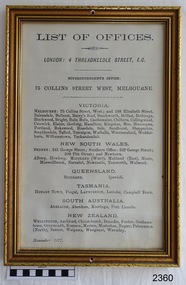
... In 1951 the Bank of Australasia amalgamated with the Union Bank to form the Australia and New Zealand Bank, now known as the ANZ. ...In 1951 the Bank of Australasia amalgamated with the Union Bank to form the Australia and New Zealand Bank, now known as the ANZ. ...The addresses given on the List for the London and Melbourne offices have connected the document to the Bank of Australasia. The List is dated November 1877 and shows the number and the location of all of the branches of the Bank at that point in time., a total of 77. - Victoria 35, New South Wales 14, Queensland 2, Tasmania 5, South Australia 5, New Zealand 16 Copies of the notice would have been displayed in all branches of the bank in both Australia and New Zealand to inform customers and perhaps impress them too with a large number of locations and the reference to the bank's connection with London. This document gives information on all bank offices throughout Australia and New Zealand. It refers to the Superintendent's Office address at 75 Collins Street West, Melbourne and is dated November 1877. This places the document at the time just before the new Melbourne office opened on the corner of Collins Street and Queen's Street in 1879. The Bank of Australasia was incorporated by Royal Charter of England in March 1834. It came to Australia on 14th December 1835, opening in Sydney. The Acting Superintendent of the Bank of Australasia in Sydney at that time was David Charters McArthur. He was Superintendent from 1867-to 1876. The Melbourne branch of the Bank of Australasia opened on 28th August 1838 in a two-roomed brick cottage on the north side of Little Collins Street. Two huge mastiff dogs were kept in the backyard and let loose at night to guard the bank. The government also provided an armed military sentinel. Due to the bank's rapid growth, a new building for the Melbourne branch was opened in 1840 at 75 Collins Street West. By 1879 the bank had been upgraded to a magnificent two-storey building on the corners of Collins and Queens Streets, with the entry on Collins Street. In 1951 the Bank of Australasia amalgamated with the Union Bank to form the Australia and New Zealand Bank, now known as the ANZ. Then in 1970, the ANZ merged with both the ES&A and the London Bank of Australia to form the ANZ Banking Group Limited. The ANZ Banking Group Ltd kindly donated a variety of historic items from the Bank of Australasia. BANK of AUSTRALASIA, WARRNAMBOOL – In 1854 Warrnambool had two banks, the Union Back and the Bank of Australasia. Later, completely different bank businesses opened; in 1867 the National Bank of Australasia, then in 1875 the Colonial Bank of Australasia. The original Bank of Australasia was established in Warrnambool in July 1854, and operated from a leased cottage on Merri Street, close to Liebig Street. The bank bought a stone building previously erected by drapers Cramond & Dickson on the corner of Timor and Gibson Streets. Samuel Hannaford was a teller and then Manager at the Warrnambool branch from 1855 to 1856. Warrnambool’s Council chose the Bank of Australasia as its bank 1856-57. In 1859 Roberts & Co. was awarded the contract to build the new Bank of Australasia branch for the sum of £3,000. The land was on a sand hill on the northeast corner of Timor and Kepler Streets and had been bought in 1855 from investor James Cust. The new building opened on May 21, 1860. The bank continued to operate there until 1951 when it merged with the Union Bank to form the ANZ Bank, which continued operating from its Liebig Street building. Warrnambool City Council purchased the former Bank of Australasia building in 1971 and renovated it, then on 3rd December 1973 it was officially opened as the Art Gallery by Cr. Harold Stephenson and Gallery Director John Welsh. The Gallery transferred to the purpose-built building in Liebig Street in 1986 and the old bank building is now the Gallery club. The List of Offices of the Bank of Australasia has early Australian historical significance through its association with the Bank, which was established in 1834 by Royal Charter and opened in Sydney, Australia, in Sydney in 1835. The List is significant for showing the number and location of all of the Offices of the Bank of Australia in November 1877. This shows that Victoria had 45 percent of all Offices. The framed document is locally significant for its association with the Bank of Australasia, Warrnambool's first bank, established in 1854. The bank continued to operate until the organisation's merger in 1951. It became the ANZ Bank, which is still in operation today. The Bank was an integral part of the establishment and growth of commerce in Colonial Warrnambool and throughout Australia.Document in a decorative gilt frame. Titled List of Bank Offices and dated November 1877, facsimile. Offices include London, and a variety of offices in Victoria, New South Wales, Queensland, Tasmania, South Australia and New Zealand. Round holes in the centre top and bottom of the frame. Text includes: "LONDON: 4 THREADNEEDLE STREET, E.C." "SUPERINTENDENT'S OFFICE: / 75 COLLINS STREET WEST, MELBOURNE" "Warrnambool" " November 1877" flagstaff hill, warrnambool, bank of australasia 1877, branches of bank of australasia 1877, banks in australia 1877, commerce 1877, shipwreck-coast, document, bank document, flagstaff hill maritime museum & village, bank of australasia, 1877, branches in australia, bank of london, offices in australia, offices in new zealand, commerce, banking, finance, shipwrecked coast, flagstaff hill maritime museum, maritime museum, shipwreck coast, flagstaff hill maritime village, great ocean road, boa, union bank, australia & new zealand bank, anz bank, david charters mcarthur, d c mcarthur, sydney, new south wales, currency, banknote, legal tender, list of bank offices -
 Flagstaff Hill Maritime Museum and Village
Book - Financial Reports, Bank of Australasia, Bank of Australasia Reports 1835-1857, 1857
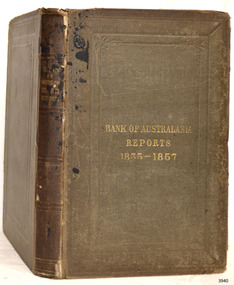
... In 1951 the Bank of Australasia amalgamated with the Union Bank to form the Australia and New Zealand Bank, now known as the ANZ. ...In 1951 the Bank of Australasia amalgamated with the Union Bank to form the Australia and New Zealand Bank, now known as the ANZ. ...This book contains the Reports of the Bank of Australasia from 1835-1857 and was published in the Bank's head office in London in the year of the last report within the book. The Reports date from the incorporation of the Bank. The Bank of Australasia was incorporated by the Royal Charter of England in March 1834. The bank began in Australia on 14th December 1835, opening in Sydney. The Acting Superintendent of the bank at that time was David Charters McArthur. He was Superintendent from 1867-to 1876. The Melbourne branch opened on 28th August 1838 in a two-roomed brick cottage on the north side of Little Collins Street, where two huge mastiff dogs were used at night to guard the bank. The government also provided an armed military sentinel. Due to the bank's rapid growth, a new building for the Melbourne branch was opened in 1840 at 75 Collins Street West. By 1879 the bank had been upgraded to a magnificent two-storey building on the corners of Collins and Queens Streets, with the entry on Collins Street. In 1951 the Bank of Australasia amalgamated with the Union Bank to form the Australia and New Zealand Bank, now known as the ANZ. Then in 1970, the ANZ merged with both the ES&A and the London Bank of Australia to form the ANZ Banking Group Limited. The ANZ Banking Group Ltd kindly donated a variety of historic items from the Bank of Australasia. BANK of AUSTRALASIA, WARRNAMBOOL – In 1854 Warrnambool had two banks, the Union Bank and the Bank of Australasia. Later, completely different bank businesses opened; in 1867 the National Bank of Australasia, then in 1875 the Colonial Bank of Australasia. The original Warrnambool branch of the Bank of Australasia was established in July 1854, and operated from a leased cottage on Merri Street, close to Liebig Street. The bank later bought a stone building previously erected by drapers Cramond & Dickson on the corner of Timor and Gibson Streets. Samuel Hannaford was a teller and then Manager at the Warrnambool branch from 1855 to 1856 and the Warrnambool Council chose that bank for its dealings during 1856-57. In 1859 Roberts & Co. was awarded the contract to build the new Bank of Australasia branch for the sum of £3,000. The land was on a sand hill on the northeast corner of Timor and Kepler Streets and had been bought in 1855 from investor James Cust. The new building opened on May 21, 1860. The bank continued to operate there until 1951 when it merged with the Union Bank to form the ANZ Bank, which continued operating from its Liebig Street building. Warrnambool City Council purchased the former Bank of Australasia building in 1971 and renovated it, then on 3rd December 1973 it was officially opened as the Art Gallery by Cr. Harold Stephenson and Gallery Director John Welsh. The Gallery transferred to the purpose-built building in Liebig Street in 1986 and the old bank building is now the Gallery club. Staff at the Bank of Australasia in Warrnambool included the following men but others were also involved: Samuel Hannaford, Teller then Manager from 1855-1856; W H Palmer, Manager from January 1857 until November 1869 when the Teller Basil Spence was promoted to Manager; H B Chomley, Manager from April 1873 and still there in 1886; A Butt, Manager in 1895-1904; J R McCleary Accountant and Acting Manager for 12 months, until 1900; A Kirk, Manager 1904; J Moore, staff until his transfer to Bendigo in December 1908; J S Bath was Manager until 1915; C C Cox, Manager until April 1923; Richard C Stanley, Manager 1923 to April 1928. The book has historical significance as it is connected to the Bank of Australasia which was established in Australia in 1835 by Royal Charter during the early Colonial period of Australia's history. The reports within the book begin from the time the bank was established and include the time that the Warrnambool branch was in operation. The book is significant for its association with the Bank of Australasia in Warrnambool, the first bank in Warrnambool, established in 1854. The bank continued to operate until its merger in 1951 when it became the ANZ Bank, which is still in operation today. The Bank was an integral part of the establishment and growth of commerce in Colonial Warrnambool and throughout Australia.Book, brown fabric covered board covers with embossed borders front and back. The titles on the front and spine are embossed and gilt. The fly page includes the insignia of the Bank of Australasia. The book contains reports of the Bank of Australasia from 1835-1857. It was published by the Bank at its London address in 1857. Inscription in pencil. Date: 1857 Published by the Bank of Australasia."BANK OF AUSTRALASIA / REPORTS / 1835-1857" "NO. 4, THREADNEEDLE STREET, LONDON. / 1857." Pencil, handwritten "L32"flagstaff hill, warrnambool, shipwrecked coast, flagstaff hill maritime museum, maritime museum, shipwreck coast, flagstaff hill maritime village, great ocean road, commerce, banking, bank of australasia, anz bank, david charters mcarthur, d c mcarthur, australia, bank reports, 1835-1857, financial reports, financial record -
 Flagstaff Hill Maritime Museum and Village
Book - Legal reference, Sweet & Maxwell Limited, Law Publishers, Bills of Exchange, Promissory Notes, Bank-Notes and Cheques, 1899
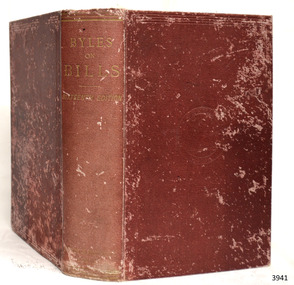
... In 1951 the Bank of Australasia amalgamated with the Union Bank to form the Australia and New Zealand Bank, now known as the ANZ. ...In 1951 the Bank of Australasia amalgamated with the Union Bank to form the Australia and New Zealand Bank, now known as the ANZ. ...This book is a legal reference book used by the Bank of Australasia after 1899. The Bank of Australasia was incorporated by the Royal Charter of England in March 1834. The bank began in Australia on 14th December 1835, opening in Sydney. The Acting Superintendent of the bank at that time was David Charters McArthur. He was Superintendent from 1867-to 1876. The Melbourne branch opened on 28th August 1838 in a two-roomed brick cottage on the north side of Little Collins Street, where two huge mastiff dogs were used at night to guard the bank. The government also provided an armed military sentinel. Due to the bank's rapid growth, a new building for the Melbourne branch was opened in 1840 at 75 Collins Street West. By 1879 the bank had been upgraded to a magnificent two-storey building on the corners of Collins and Queens Streets, with the entry on Collins Street. In 1951 the Bank of Australasia amalgamated with the Union Bank to form the Australia and New Zealand Bank, now known as the ANZ. Then in 1970, the ANZ merged with both the ES&A and the London Bank of Australia to form the ANZ Banking Group Limited. The ANZ Banking Group Ltd kindly donated a variety of historic items from the Bank of Australasia. BANK of AUSTRALASIA, WARRNAMBOOL – In 1854 Warrnambool had two banks, the Union Bank and the Bank of Australasia. Later, completely different bank businesses opened; in 1867 the National Bank of Australasia, then in 1875 the Colonial Bank of Australasia. The original Warrnambool branch of the Bank of Australasia was established in July 1854, and operated from a leased cottage on Merri Street, close to Liebig Street. The bank later bought a stone building previously erected by drapers Cramond & Dickson on the corner of Timor and Gibson Streets. Samuel Hannaford was a teller and then Manager at the Warrnambool branch from 1855 to 1856 and the Warrnambool Council chose that bank for its dealings during 1856-57. In 1859 Roberts & Co. was awarded the contract to build the new Bank of Australasia branch for the sum of £3,000. The land was on a sand hill on the northeast corner of Timor and Kepler Streets and had been bought in 1855 from investor James Cust. The new building opened on May 21, 1860. The bank continued to operate there until 1951 when it merged with the Union Bank to form the ANZ Bank, which continued operating from its Liebig Street building. Warrnambool City Council purchased the former Bank of Australasia building in 1971 and renovated it, then on 3rd December 1973 it was officially opened as the Art Gallery by Cr. Harold Stephenson and Gallery Director John Welsh. The Gallery transferred to the purpose-built building in Liebig Street in 1986 and the old bank building is now the Gallery club. Staff at the Bank of Australasia in Warrnambool included the following men but others were also involved: Samuel Hannaford, Teller then Manager from 1855-1856; W H Palmer, Manager from January 1857 until November 1869 when the Teller Basil Spence was promoted to Manager; H B Chomley, Manager from April 1873 and still there in 1886; A Butt, Manager in 1895-1904; J R McCleary Accountant and Acting Manager for 12 months, until 1900; A Kirk, Manager 1904; J Moore, staff until his transfer to Bendigo in December 1908; J S Bath was Manager until 1915; C C Cox, Manager until April 1923; Richard C Stanley, Manager 1923 to April 1928. The book has historical significance as it is connected to the Bank of Australasia which was established in Australia in 1835 by Royal Charter during the early Colonial period of Australia's history. The book was used as a reference to financial law by the Bank. The book is significant for its association with the Bank of Australasia in Warrnambool, the first bank in Warrnambool, established in 1854. The bank continued to operate until its merger in 1951 when it became the ANZ Bank, which is still in operation today. The Bank was an integral part of the establishment and growth of commerce in Colonial Warrnambool and throughout Australia.Book, red board covers with embossed borders on front and back and embossed insignia on front cover. The title on the spine is embossed and gilt. Title: A Treatise of the Law of Bills of Exchange, Promissory Notes, Bank-Notes and Cheques. Author: The Right Honourable Sir John Barnard Byles, late One of the Judges of Her Majesty's Court of Common Pleas, Edition: Sixteenth Edition by Maurice Barnard Byles, Esq., and Walter John Barnard Byles, Esq., of the Inner Temple, Barristers-at-Law. Publisher: Sweet & Maxwell, Limited, 3, Chancery Lane, London, Law Publishers, 1899 Inscription in pencil.Pencil, handwritten "L34"flagstaff hill, warrnambool, shipwrecked coast, flagstaff hill maritime museum, maritime museum, shipwreck coast, flagstaff hill maritime village, great ocean road, commerce, banking, bank of australasia, australia, financial law, legal reference, banking law, bank law, bills of exchange, promisory notes, bank notes, cheques, currency, legal tender, financial trading, sir john barnard byles, maurice barnard byles, walter john barnard byles, sweet & maxwell, banknote -
 Flagstaff Hill Maritime Museum and Village
Book - Legal reference, Charles E Maxwell (G Partridge & Co.), Low booksellers and publishers, The Law and Practice of Banking in Australia and New Zealand, 1900
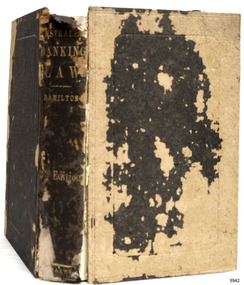
... In 1951 the Bank of Australasia amalgamated with the Union Bank to form the Australia and New Zealand Bank, now known as the ANZ. ...In 1951 the Bank of Australasia amalgamated with the Union Bank to form the Australia and New Zealand Bank, now known as the ANZ. ...This book is a legal reference book used by the Bank of Australasia after 1900. The Bank of Australasia was incorporated by the Royal Charter of England in March 1834. The bank began in Australia on 14th December 1835, opening in Sydney. The Acting Superintendent of the bank at that time was David Charters McArthur. He was Superintendent from 1867-to 1876. The Melbourne branch opened on 28th August 1838 in a two-roomed brick cottage on the north side of Little Collins Street, where two huge mastiff dogs were used at night to guard the bank. The government also provided an armed military sentinel. Due to the bank's rapid growth, a new building for the Melbourne branch was opened in 1840 at 75 Collins Street West. By 1879 the bank had been upgraded to a magnificent two-storey building on the corners of Collins and Queens Streets, with the entry on Collins Street. In 1951 the Bank of Australasia amalgamated with the Union Bank to form the Australia and New Zealand Bank, now known as the ANZ. Then in 1970, the ANZ merged with both the ES&A and the London Bank of Australia to form the ANZ Banking Group Limited. The ANZ Banking Group Ltd kindly donated a variety of historic items from the Bank of Australasia. BANK of AUSTRALASIA, WARRNAMBOOL – In 1854 Warrnambool had two banks, the Union Bank and the Bank of Australasia. Later, completely different bank businesses opened; in 1867 the National Bank of Australasia, then in 1875 the Colonial Bank of Australasia. The original Warrnambool branch of the Bank of Australasia was established in July 1854, and operated from a leased cottage on Merri Street, close to Liebig Street. The bank later bought a stone building previously erected by drapers Cramond & Dickson on the corner of Timor and Gibson Streets. Samuel Hannaford was a teller and then Manager at the Warrnambool branch from 1855 to 1856 and the Warrnambool Council chose that bank for its dealings during 1856-57. In 1859 Roberts & Co. was awarded the contract to build the new Bank of Australasia branch for the sum of £3,000. The land was on a sand hill on the northeast corner of Timor and Kepler Streets and had been bought in 1855 from investor James Cust. The new building opened on May 21, 1860. The bank continued to operate there until 1951 when it merged with the Union Bank to form the ANZ Bank, which continued operating from its Liebig Street building. Warrnambool City Council purchased the former Bank of Australasia building in 1971 and renovated it, then on 3rd December 1973 it was officially opened as the Art Gallery by Cr. Harold Stephenson and Gallery Director John Welsh. The Gallery transferred to the purpose-built building in Liebig Street in 1986 and the old bank building is now the Gallery club. Staff at the Bank of Australasia in Warrnambool included the following men but others were also involved: Samuel Hannaford, Teller then Manager from 1855-1856; W H Palmer, Manager from January 1857 until November 1869 when the Teller Basil Spence was promoted to Manager; H B Chomley, Manager from April 1873 and still there in 1886; A Butt, Manager in 1895-1904; J R McCleary Accountant and Acting Manager for 12 months, until 1900; A Kirk, Manager 1904; J Moore, staff until his transfer to Bendigo in December 1908; J S Bath was Manager until 1915; C C Cox, Manager until April 1923; Richard C Stanley, Manager 1923 to April 1928. The book has historical significance as it is connected to the Bank of Australasia which was established in Australia in 1835 by Royal Charter during the early Colonial period of Australia's history. The book was used as a reference to financial law by the Bank. The book is significant for its association with the Bank of Australasia in Warrnambool, the first bank in Warrnambool, established in 1854. The bank continued to operate until its merger in 1951 when it became the ANZ Bank, which is still in operation today. The Bank was an integral part of the establishment and growth of commerce in Colonial Warrnambool and throughout Australia.Book, dark brown, hard-covers with embossed borders front and back. The title on the spine is embossed and gilt. Title: The Law and Practice of Banking in Australia and New Zealand Author: Edward B. Hamilton, B.A., Judge of County Courts, Victoria, assisted by J.G. Eagleson, B.A., LL.B, Barrister-at-Law Edition: Second Edition Publisher: Charles E. Maxwell, (G. Partridge & Co.), 458, Chancery Lane, London, Law Booksellers and Publishers, 1900. Published in Melbourne. Marked with purple oval stamp and pencil inscription.Text within oval stamp "THE BANK OF AUSTRALASIA LIMITED" Pencil, handwritten "L35"flagstaff hill, warrnambool, shipwrecked coast, flagstaff hill maritime museum, maritime museum, shipwreck coast, flagstaff hill maritime village, great ocean road, commerce, banking, bank of australasia, australia, financial law, legal reference, banking law, bank law, legal practice, edward b. hamilton, charles e. maxwell, banking practice, g. partridge & co -
 Flagstaff Hill Maritime Museum and Village
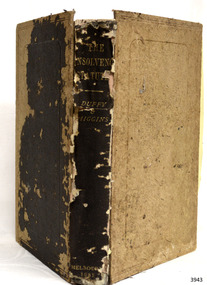
Book - Legal reference, McCarron, Bird & Co, The Insolvency Statute 1871, after 1882
... In 1951 the Bank of Australasia amalgamated with the Union Bank to form the Australia and New Zealand Bank, now known as the ANZ. ...In 1951 the Bank of Australasia amalgamated with the Union Bank to form the Australia and New Zealand Bank, now known as the ANZ. ...This book is a legal reference book used by the Bank of Australasia after 1882. The Bank of Australasia was incorporated by the Royal Charter of England in March 1834. The bank began in Australia on 14th December 1835, opening in Sydney. The Acting Superintendent of the bank at that time was David Charters McArthur. He was Superintendent from 1867-to 1876. The Melbourne branch opened on 28th August 1838 in a two-roomed brick cottage on the north side of Little Collins Street, where two huge mastiff dogs were used at night to guard the bank. The government also provided an armed military sentinel. Due to the bank's rapid growth, a new building for the Melbourne branch was opened in 1840 at 75 Collins Street West. By 1879 the bank had been upgraded to a magnificent two-storey building on the corners of Collins and Queens Streets, with the entry on Collins Street. In 1951 the Bank of Australasia amalgamated with the Union Bank to form the Australia and New Zealand Bank, now known as the ANZ. Then in 1970, the ANZ merged with both the ES&A and the London Bank of Australia to form the ANZ Banking Group Limited. The ANZ Banking Group Ltd kindly donated a variety of historic items from the Bank of Australasia. BANK of AUSTRALASIA, WARRNAMBOOL – In 1854 Warrnambool had two banks, the Union Bank and the Bank of Australasia. Later, completely different bank businesses opened; in 1867 the National Bank of Australasia, then in 1875 the Colonial Bank of Australasia. The original Warrnambool branch of the Bank of Australasia was established in July 1854, and operated from a leased cottage on Merri Street, close to Liebig Street. The bank later bought a stone building previously erected by drapers Cramond & Dickson on the corner of Timor and Gibson Streets. Samuel Hannaford was a teller and then Manager at the Warrnambool branch from 1855 to 1856 and the Warrnambool Council chose that bank for its dealings during 1856-57. In 1859 Roberts & Co. was awarded the contract to build the new Bank of Australasia branch for the sum of £3,000. The land was on a sand hill on the northeast corner of Timor and Kepler Streets and had been bought in 1855 from investor James Cust. The new building opened on May 21, 1860. The bank continued to operate there until 1951 when it merged with the Union Bank to form the ANZ Bank, which continued operating from its Liebig Street building. Warrnambool City Council purchased the former Bank of Australasia building in 1971 and renovated it, then on 3rd December 1973 it was officially opened as the Art Gallery by Cr. Harold Stephenson and Gallery Director John Welsh. The Gallery transferred to the purpose-built building in Liebig Street in 1986 and the old bank building is now the Gallery club. Staff at the Bank of Australasia in Warrnambool included the following men but others were also involved: Samuel Hannaford, Teller then Manager from 1855-1856; W H Palmer, Manager from January 1857 until November 1869 when the Teller Basil Spence was promoted to Manager; H B Chomley, Manager from April 1873 and still there in 1886; A Butt, Manager in 1895-1904; J R McCleary Accountant and Acting Manager for 12 months, until 1900; A Kirk, Manager 1904; J Moore, staff until his transfer to Bendigo in December 1908; J S Bath was Manager until 1915; C C Cox, Manager until April 1923; Richard C Stanley, Manager 1923 to April 1928. The book has historical significance as it is connected to the Bank of Australasia which was established in Australia in 1835 by Royal Charter during the early Colonial period of Australia's history. The book was used as a reference to financial law by the Bank. The book is significant for its association with the Bank of Australasia in Warrnambool, the first bank in Warrnambool, established in 1854. The bank continued to operate until its merger in 1951 when it became the ANZ Bank, which is still in operation today. The Bank was an integral part of the establishment and growth of commerce in Colonial Warrnambool and throughout Australia.Book, dark brown, hard-covers with embossed borders front and back. The title on the spine is embossed and gilt. Title: The Insolvency Statute 1871 and the Amending Statute (No. 411), with rules, notes and index Author: Frank Gaven Duffy, M.A., LL.B. and Henrey Bournes Higgins, M.A., LL.B., Barristers-in-Law Edition: 1882 Publisher: McCarron, Bird & Co., 37 Flinders Lane West, Melbourne Pencil inscription.Pencil, handwritten "L36"flagstaff hill, warrnambool, shipwrecked coast, flagstaff hill maritime museum, maritime museum, shipwreck coast, flagstaff hill maritime village, great ocean road, commerce, banking, bank of australasia, australia, financial law, legal reference, banking law, bank law, insolvency statute, insolvency law, 1871, amending statute (no. 411), insolvency, frank gaven duffy, henrey bournes higgins, mccarron bird & co -
 Flagstaff Hill Maritime Museum and Village
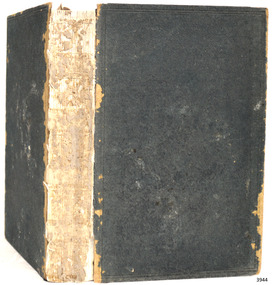
Book - Legal reference, The Law Book Co. of Australasia Ltd, The Law relating to Banker and Customer in Australia, 1907
... In 1951 the Bank of Australasia amalgamated with the Union Bank to form the Australia and New Zealand Bank, now known as the ANZ. ...In 1951 the Bank of Australasia amalgamated with the Union Bank to form the Australia and New Zealand Bank, now known as the ANZ. ...This book is a legal reference book used by the Bank of Australasia after 1907. The Bank of Australasia was incorporated by the Royal Charter of England in March 1834. The bank began in Australia on 14th December 1835, opening in Sydney. The Acting Superintendent of the bank at that time was David Charters McArthur. He was Superintendent from 1867-to 1876. The Melbourne branch opened on 28th August 1838 in a two-roomed brick cottage on the north side of Little Collins Street, where two huge mastiff dogs were used at night to guard the bank. The government also provided an armed military sentinel. Due to the bank's rapid growth, a new building for the Melbourne branch was opened in 1840 at 75 Collins Street West. By 1879 the bank had been upgraded to a magnificent two-storey building on the corners of Collins and Queens Streets, with the entry on Collins Street. In 1951 the Bank of Australasia amalgamated with the Union Bank to form the Australia and New Zealand Bank, now known as the ANZ. Then in 1970, the ANZ merged with both the ES&A and the London Bank of Australia to form the ANZ Banking Group Limited. The ANZ Banking Group Ltd kindly donated a variety of historic items from the Bank of Australasia. BANK of AUSTRALASIA, WARRNAMBOOL – In 1854 Warrnambool had two banks, the Union Bank and the Bank of Australasia. Later, completely different bank businesses opened; in 1867 the National Bank of Australasia, then in 1875 the Colonial Bank of Australasia. The original Warrnambool branch of the Bank of Australasia was established in July 1854, and operated from a leased cottage on Merri Street, close to Liebig Street. The bank later bought a stone building previously erected by drapers Cramond & Dickson on the corner of Timor and Gibson Streets. Samuel Hannaford was a teller and then Manager at the Warrnambool branch from 1855 to 1856 and the Warrnambool Council chose that bank for its dealings during 1856-57. In 1859 Roberts & Co. was awarded the contract to build the new Bank of Australasia branch for the sum of £3,000. The land was on a sand hill on the northeast corner of Timor and Kepler Streets and had been bought in 1855 from investor James Cust. The new building opened on May 21, 1860. The bank continued to operate there until 1951 when it merged with the Union Bank to form the ANZ Bank, which continued operating from its Liebig Street building. Warrnambool City Council purchased the former Bank of Australasia building in 1971 and renovated it, then on 3rd December 1973 it was officially opened as the Art Gallery by Cr. Harold Stephenson and Gallery Director John Welsh. The Gallery transferred to the purpose-built building in Liebig Street in 1986 and the old bank building is now the Gallery club. Staff at the Bank of Australasia in Warrnambool included the following men but others were also involved: Samuel Hannaford, Teller then Manager from 1855-1856; W H Palmer, Manager from January 1857 until November 1869 when the Teller Basil Spence was promoted to Manager; H B Chomley, Manager from April 1873 and still there in 1886; A Butt, Manager in 1895-1904; J R McCleary Accountant and Acting Manager for 12 months, until 1900; A Kirk, Manager 1904; J Moore, staff until his transfer to Bendigo in December 1908; J S Bath was Manager until 1915; C C Cox, Manager until April 1923; Richard C Stanley, Manager 1923 to April 1928. The book has historical significance as it is connected to the Bank of Australasia which was established in Australia in 1835 by Royal Charter during the early Colonial period of Australia's history. The book was used as a reference to financial law by the Bank. The book is significant for its association with the Bank of Australasia in Warrnambool, the first bank in Warrnambool, established in 1854. The bank continued to operate until its merger in 1951 when it became the ANZ Bank, which is still in operation today. The Bank was an integral part of the establishment and growth of commerce in Colonial Warrnambool and throughout Australia.Book, with black, hardcovers and embossed borders front and back. Title: The Law relating to Banker and Customer in Australia Author: F. A A Russell, M.A., Sydney, Barrister-in-law Edition: 1907 Publisher: The Law Book Co. of Australasia Ltd., 72 Castlereagh Street, Sydney Printer: Websdale, Shoosmith & Co., Sydney Pencil inscription.Pencil, handwritten "L37"flagstaff hill, warrnambool, shipwrecked coast, flagstaff hill maritime museum, maritime museum, shipwreck coast, flagstaff hill maritime village, great ocean road, commerce, banking, bank of australasia, australia, financial law, legal reference, banking law, bank law, legal practice, f. a a russell, 1907, the law book co. of australasia ltd, websdale, shoosmith & co. -
 Flagstaff Hill Maritime Museum and Village
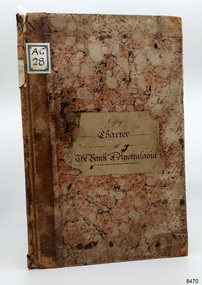
Legal record - Charter, Copy of Charter of Bank of Australasia, 01-10-1867
... In 1951 the Bank of Australasia amalgamated with the Union Bank to form the Australia and New Zealand Bank, now known as the ANZ. ...In 1951 the Bank of Australasia amalgamated with the Union Bank to form the Australia and New Zealand Bank, now known as the ANZ. ...This Copy of the Charter of the Bank of Australasia originated from the Bank of Australasia. The bank of Australasia was incorporated by Royal Charter of England in March 1834. It had its Australian beginning on 14th December 1835, opening in Sydney. The Acting Superintendent of the bank at that time was David Charters McArthur. He was Superintendent from 1867-to 1876. The Melbourne branch opened on 28th August 1838 in a two-roomed brick cottage on the north side of Little Collins Street, where two huge mastiff dogs were used at night to guard the bank. The government also provided an armed military sentinel. Due to the bank's rapid growth, a new building for the Melbourne branch was opened in 1840 at 75 Collins Street West. By 1879 the bank had been upgraded to a magnificent two-storey building on the corners of Collins and Queens Streets, with the entry on Collins Street. In 1951 the Bank of Australasia amalgamated with the Union Bank to form the Australia and New Zealand Bank, now known as the ANZ. Then in 1970, the ANZ merged with both the ES&A and the London Bank of Australia to form the ANZ Banking Group Limited. The ANZ Banking Group Ltd kindly donated a variety of historic items from the Bank of Australasia. BANK of AUSTRALASIA, WARRNAMBOOL – In 1854 Warrnambool had two banks, the Union Bank and the Bank of Australasia. Later, completely different bank businesses opened; in 1867 the National Bank of Australasia, then in 1875 the Colonial Bank of Australasia. The original Warrnambool branch of the Bank of Australasia was established in July 1854, and operated from a leased cottage on Merri Street, close to Liebig Street. The bank next bought a stone building previously erected by drapers Cramond & Dickson on the corner of Timor and Gibson Streets. Samuel Hannaford was a teller and then Manager at the Warrnambool branch from 1855 to 1856 and the Warrnambool Council chose that bank for its dealings during 1856-57. In 1859 Roberts & Co. was awarded the contract to build the new Bank of Australasia branch for the sum of £3,000; the firm built the Warrnambool Post Office in 1856 and purchased land in Timor Street in 1858. The land was on a sand hill on the northeast corner of Timor and Kepler Streets and had been bought in 1855 from investor James Cust. The new building opened on May 21, 1860. The bank continued to operate there until 1951 when it merged with the Union Bank to form the ANZ Bank, which continued operating from its Liebig Street building. Warrnambool City Council purchased the former Bank of Australasia building in 1971 and renovated it, then on 3rd December 1973 it was officially opened as the Art Gallery by Cr. Harold Stephenson and Gallery Director John Welsh. The Gallery transferred to the purpose-built building in Liebig Street in 1986 and the old bank building is now the Gallery club. Staff at the Bank of Australasia in Warrnambool included the following men but others were also involved: Samuel Hannaford, Teller then Manager from 1855-1856; Hawkins, Manager in 1856, W H Palmer, Manager from January 1857 until November 1869 when the Teller Basil Spence was promoted to Manager; H B Chomley, Manager from April 1873 and still there in 1886; A Butt, Manager in 1895-1904; J R McCleary Accountant and Acting Manager for 12 months, until 1900; A Kirk, Manager 1904; J Moore, staff until his transfer to Bendigo in December 1908; J S Bath was Manager until 1915; C C Cox, Manager until April 1923; Richard C Stanley, Manager 1923 to April 1928. The Copy of the Charter of the Bank of Australasia has significance through its association with the Bank of Australasia. The early Australian bank was established in 1834 by Royal Charter and opened in Sydney, Australia, in Sydney in 1835. The bank had many Australian offices in November 1877, particularly on the east and south coasts. Victoria had 45 per cent of all Offices. The Charter is locally significant for its association with the Warrnambool Bank of Australasia, which was established in 1854. It was Warrnambool Council’s first bank. The bank continued to operate until the organisation's merger in 1951 when it became the ANZ Bank Group today. The Bank was an integral part of the growth of local commerce and the community. Record book, hard cover, tan black and beige pebble-pattern on front and back, and tan reinforced strip on spine with decorative embossing. Handwritten title on cream paper is attached in centre of front cover. Cream paper pages are lined and have watermarks on each one. Pages are numbered up to the last written page, number 35. The last page is sealed in red with an official stamp and dated 1st October 1867. Inscriptions are on three labels. and on front end page, and red oval stamp inside front cover. It is an official copy of the Charter of the Bank of Australasia.Label with title, handwritten in pen "Copy / Charter / of / The Bank of Australasia" Label on spine, typewritten "COPY / CHARTER" Label on front cover, handwritten in pen "A G / 28" Front inside cover, red oval stamp "AUSTRALIA AND NEW ZEALAND BANK LIMITED - ARCHIVES - " and in the oval, in pen "A G / 28" Front end page, handwritten in pencil "Normal Copy 5 Dec No. 74" Front end page, in pencil "L 28"flagstaff hill, warrnambool, shipwrecked coast, flagstaff hill maritime museum, maritime museum, shipwreck coast, flagstaff hill maritime village, great ocean road, bank of australasia, boa, union bank, australia & new zealand bank, anz bank, david charters mcarthur, d c mcarthur, sydney, new south wales, currency, banknote, legal tender, commerce, banking, roberts & co., james cust, heraldic shield, insignia, samuel hannaford, w h palmer, basil spence, h b chomley, a butt, j r mccleary, a kirk, j moore, j s bath, c c cox, richard c stanley, charter of the bank of australasia -
 Surrey Hills Historical Society Collection
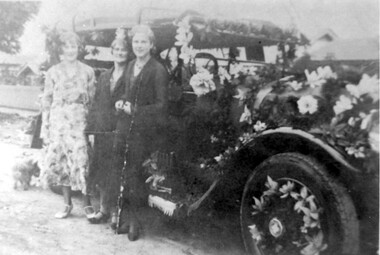
Photograph, Fred Lyons' taxi decorated for celebrations for Empire Day in 1930s, 1933-1938
... Lyons family history: From 1907 a cab service operated from near the railway gates in Union Road. It was established and maintained by Mr C Fraser until c1916. ...Lyons family history: From 1907 a cab service operated from near the railway gates in Union Road. It was established and maintained by Mr C Fraser until c1916. ...Lyons family history: From 1907 a cab service operated from near the railway gates in Union Road. It was established and maintained by Mr C Fraser until c1916. George Rea either took over then or set up in opposition. Fred Lyons initially worked for George until he set up his own business. In time he changed over to a motor vehicle and continued his service until 1960. Frederick Adolphus Lyons (1891-1980) was born in Surrey Hills, son of Thomas and Catherine Lyons. He married Elizabeth Ruby Hall in 1918. They lived just around the corner at 55 Sunbury Crescent. The Lyons’ home in Sunbury Crescent was called ‘Knopshambury’ - this was probably a misspelling of Knockshanbally in Co Kilkenny, the birth place of Fred’s father, Thomas Edmund Josias Lyons (1846-1915). Arthur Lyons was born in Surrey Hills on 12 Jun 1920. He became a motor mechanic / welder and lived at 55 Sunbury Crescent. Empire Day celebrations were held in Surrey Hills from 1906-1911 and revitalised from 1933-1938 by the Surrey Hills Progress Association. Street parades featuring decorated business vehicles and bonfires were a feature. This is one of a series of photos donated by Arthur Lyons.The donation was made while he was in hospital. He died shortly afterwards (23 Sep 1990). Donation was finalised by a neighbour, Mrs Florence Ann Armitstead, wife of Glen Victor Armitstead. Glen was a local hairdresser. They moved to 11 Sunbury Crescent after their marriage in 1939. Arthur had no relatives to distribute the material to. Empire Day celebrations were held in Surrey Hills from 1906-1911 and revitalised by the Surrey Hills Progress Association from 1933-1938. The evening parade of floats, and vehicles both horse-drawn and motorised, proceeded along Union Road to the Surrey Gardens beneath festoons of candlelit lanterns, bunting and flags. The paper flowers used extensively on trade and business vehicles were the result of hours of work by families and friends. The Empire Day Celebrations were a great community event, in some years augmented by bonfires, including the ones in Beckett Park.Black and white photo of Fred Lyons' taxi decorated for Empire Day. The cab is parked in the street and is festooned with flowers and ribbons on the hood, bonnet radiator, running board and in the tyre spokes. Three women stand beside the cab. There are houses in the background. motor vehicles, festivals and celebrations, taxis, empire day, fred lyons, frederick adolphus lyons -
 Warrnambool and District Historical Society Inc.
Desk, Writing desk, Mid 19th century
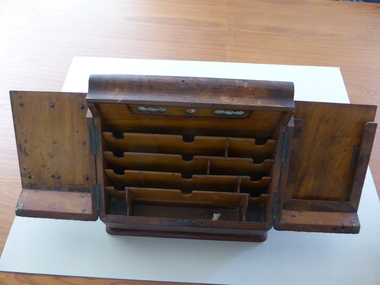
... In 1951 the Bank of Australasia merged with the Union Bank to form the A.N.Z. Bank Limited. ...In 1951 the Bank of Australasia merged with the Union Bank to form the A.N.Z. Bank Limited. ...This writing desk was used by the Warrnambool Bank of Australasia personnel and the date associated with it (through unproven Historical Society records) is 1859. The Bank of Australasia was established in Sydney in 1835. The Warrnambool branch of the Bank of Australasia was established in 1854 in a stone cottage in Merri Street leased for two years. The bank was next located in a leased building in Timor Street with new purpose-built premises at the corner of Timor and Kepler Streets opening in 1860. In 1951 the Bank of Australasia merged with the Union Bank to form the A.N.Z. Bank Limited. In 1970 the E. S. & A. Bank and the London Bank of Australia merged with the A.N.Z. Bank forming the A.N.Z. Banking Group Limited with the business transferring to Liebig Street. The old Bank of Australasia building was purchased by the Warrnambool City Council and later sold to a private buyer. It is now a nightclub. The writing desk may have been used in both the Timor Street leased building and the bank building at the corner of Kepler and Timor Streets. William Palmer was the Bank Manager when the desk would have been first used. This is a most significant item as it comes from the Warrnambool Bank of Australasia, the first bank to be established in Warrnambool and a major banking business in Warrnambool for nearly 100 years. The desk was handed over to the Warrnambool and District Historical Society by Clarrie Kempton, the A.N.Z. Bank Manager in Warrnambool from 1964 to 1971.This is a wooden writing desk, possibly made of walnut wood. The base is rectangular with a drawer with a brass handle at the base. From the base the desk slopes up to a triangular shape with a slightly curved top. The middle of the desk has a front opening with two doors with four brass hinges with a brass lock. There are six bolts, one with a slot missing. Inside the doors are inset 10 wooden slots of different sizes to hold papers, letters, ink, dockets etc. Also inside the doors, behind a transparent material, are spaces for the day, date and month. These numbers and letters were once able to be changed according to the date. The writing desk is in good condition but a little stained. ‘Tuesday’ ‘8’ ‘November’ bank of australasia, history of warrnambool, history of warrnambool -
4th/19th Prince of Wales's Light Horse Regiment Unit History Room
Medal, France and Germany Star, abt 1945
... The Ribbon The France and Germany Star ribbon has stripes of red, white and blue that represent the colours of the Union Flag, France and the Netherlands. Clasps One clasp was issued for the France and Germany Star: Atlantic Regulations only allow one clasp to be worn with the Star. ...The Ribbon The France and Germany Star ribbon has stripes of red, white and blue that represent the colours of the Union Flag, France and the Netherlands. Clasps One clasp was issued for the France and Germany Star: Atlantic Regulations only allow one clasp to be worn with the Star. ...The France and Germany Star was granted for operational service on land in France, Belgium, Holland or Germany after the D-Day landings on 6 June 1944 until 8 May 1945, the date of the end of active hostilities in Europe. Eligibility This medal is awarded for operational service on land in France , Belgium , Holland or Germany between 6 June 1944 and 8 May 1945. The Medal The France and Germany Star is a six–pointed star of yellow copper zinc alloy. The obverse has a central design of the Royal and Imperial cypher, surmounted by a crown. The cypher is surrounded by a circlet containing the words ‘The France and Germany Star'. Stars issued to Australian personnel have recipient names engraved on the plain reverse. The Ribbon The France and Germany Star ribbon has stripes of red, white and blue that represent the colours of the Union Flag, France and the Netherlands. Clasps One clasp was issued for the France and Germany Star: Atlantic Regulations only allow one clasp to be worn with the Star. When the ribbon is worn alone a silver rosette ribbon emblem is worn to denote the award of a clasp to the medal.Full size medal. Ribbon not attachedNo recipient engraved -
 Bendigo Historical Society Inc.
Photograph - BASIL MILLER COLLECTION: PORTRAIT OF BASIL MILLER
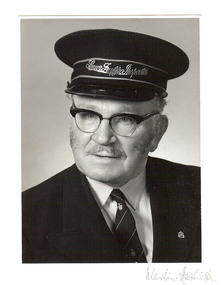
... He was involved in Tramway Union affaird for many years and his staunch views on inductrial matters were well known. ...He was involved in Tramway Union affaird for many years and his staunch views on inductrial matters were well known. ...Basil William Bates Miller was born in Castlemaine on 27th June, 1908, the eldest child of Ferdinand and Lavina. The family moved to Bendigo and subsequently to a house in King Street, where Basil lived for over 70 years. All the family were musical and Basil became accomplished at Piano, organ and violin. He was honorary organist at his church and many Masonic Lodges for up to 40 years. He served in the Bendigo Regiment and as a warrant Officer in the Royal Australian Engineers in World War II. In the 1920's Basil obtained employment with the Electric Supply Company of Victoria as an 'oiler boy' and later Junior Conductor. He rose through Conductor, Motorman and Inspector to retire as Senior Inspector when the State Electricity Commission of Victoria closed the Bendigo Tramways in April 1972. He was involved in Tramway Union affaird for many years and his staunch views on inductrial matters were well known. He remained active during almost 30 years of retirement and died in the Bendigo Hospitral on 14th August, 2001 at the age of 93. Black and white photograph of Basil Miller, Senior Traffic Inspector of Bendigo Tramways, in uniform, looking to the right. Martin Washington written in pencil, bottom right corner. Mounted on cream card. Basil left his tramways collection of photographs and documents to the Bendigo Historical Society. Mr. Arthur Penna, 78 emmett Street, Golden Square, was the executor of Basil's will.person, individual, basil miller -
 Warrnambool and District Historical Society Inc.
Bottle, J Fletcher Warrnambool, Early 20th century
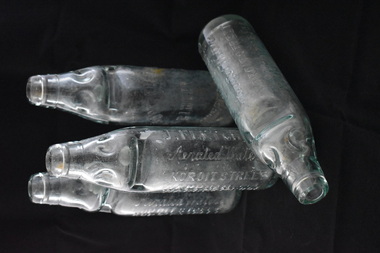
... As a young boy John Fletcher worked at the cordial factory of John Rowley in Banyan Street, Warrnambool and then worked for a number of years for John Davis at his Union Cordial Factory. In 1885 John Fletcher succeeded John Davis and continued in this business until 1930.. ...As a young boy John Fletcher worked at the cordial factory of John Rowley in Banyan Street, Warrnambool and then worked for a number of years for John Davis at his Union Cordial Factory. In 1885 John Fletcher succeeded John Davis and continued in this business until 1930.. ...These bottles are known as marble stopper bottles. This type of bottle was filled upside down so that as soon as the filling stopped the stopper was forced down to seal the bottle against the rubber ring. Pressure inside the bottle would keep the marble pressed against the top of the bottle. To open the bottle the marble was pressed down where it would fall into the neck chamber below. The marble would stay inside the chamber when the bottle was tilted up for drinking. These bottles have come from the aerated waters factory of John Fletcher of Warrnambool. This factory in Koroit Street was established in the mid 19th century by John Davis. As a young boy John Fletcher worked at the cordial factory of John Rowley in Banyan Street, Warrnambool and then worked for a number of years for John Davis at his Union Cordial Factory. In 1885 John Fletcher succeeded John Davis and continued in this business until 1930.. The business was then taken over by Ralph Reeves. John Fletcher manufactured aerated waters, soda, tonic waters, lemonade, ginger ale, hop beer, hop bitters, sarsaparilla and cordials. These bottles are of interest firstly because they are good examples of marble stopper bottles, no longer in use today. They are also important because they are John Fletcher bottles and he was a prominent soft drinks manufacturer in Warrnambool for over 40 years. These four bottles are made of green coloured glass. They have a round body with deep indentations at the top, narrowing the entrance to the neck which is short and thick. The top opening is made of thick moulded glass. A glass marble is loose in the neck section. The rubber ring inside the neck is missing. The manufacturer’s details are embedded into the glass on both sides of the bottle.‘Lemonade’ ‘J.Fletcher’s Aerated Waters Koroit Street Warrnambool’ ‘This bottle is the property of John Fletcher Warrnambool and cannot be legally used by others’ fletcher's cordial, marble stopper bottle, warrnambool cordial -
 Warrnambool and District Historical Society Inc.
Bottle, John Fletcher Warrnambool, Early 20th century
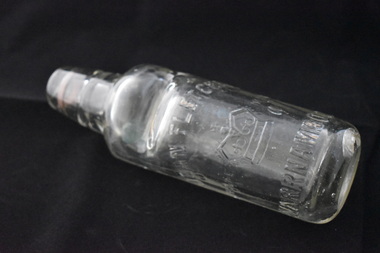
... He then worked for John Davis at his Union Cordial Factory in Koroit Street for many years. ...He then worked for John Davis at his Union Cordial Factory in Koroit Street for many years. ...This is a marble stopper bottle. It was filled upside down so that as soon as the filling stopped the marble was forced down to seal the bottle against the rubber ring. Pressure inside the bottle kept the marble pressed against the top of the bottle. To open the bottle the marble has been pressed down and has fallen into the neck chamber below. The marble stayed inside the chamber when the bottle was tilted up for drinking. This bottle came from the Warrnambool aerated waters factory of John Fletcher. This factory was commenced in the mid 19th century by John Davis. As a young boy John Fletcher worked at the cordial factory of John Rowley in Banyan Street, Warrnambool. He then worked for John Davis at his Union Cordial Factory in Koroit Street for many years. In 1885 he succeeded John Davis in this business. Fletcher’s business continued until 1930 when it was sold to the soft drinks manufacturer, Ralph Reeves. John Fletcher made aerated waters, soda water, tonic water, lemonade, ginger ale, hop beer, hop bitters, sarsaparilla and cordials. This bottle is of interest as a good example of a marble stopper bottle and as a memento of the soft drinks made by John Fletcher, a prominent Warrnambool businessman for over 40 years. This is a glass bottle with a heavy round base and a rounded body which is markedly indented at the top, causing the aperture inside to be narrowed. The neck is rounded and tapers to the moulded glass opening at the top. There is a round piece of red rubber inside the top of the bottle. A green glass marble is loose in the neck section. The lettering giving details of the manufacturer is embedded into the glass. There is a small chip on the base.‘John Fletcher Trade Mark (crown symbol)Warrnambool’ ‘Soda Water’ ‘M’ john fletcher, warrnambool, cordial manufacturers, warrnambool -
 Warrnambool and District Historical Society Inc.
Bottle, John Fletcher, Early 20th century
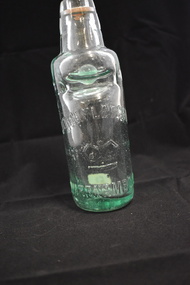
... As a young boy John Fletcher worked at the cordial factory of John Rowley in Banyan Street, Warrnambool and then worked for John Davis at his Union Cordial Factory for many years. In 1885 he succeeded John Davis in this business. ...As a young boy John Fletcher worked at the cordial factory of John Rowley in Banyan Street, Warrnambool and then worked for John Davis at his Union Cordial Factory for many years. In 1885 he succeeded John Davis in this business. ...This bottle is known as a marble stopper bottle. The bottle was filled upside down so that as soon as the filling stopped the stopper was forced down to seal the bottle against the rubber ring. Pressure inside the bottle would keep the marble pressed against the top of the bottle. To open the bottle the marble was pressed down where it would fall into the neck chamber below. The marble would stay inside the chamber when the bottle was tilted up for drinking. This bottle came from the aerated waters factory of John Fletcher. This factory was commenced in the mid 19th century by John Davis. As a young boy John Fletcher worked at the cordial factory of John Rowley in Banyan Street, Warrnambool and then worked for John Davis at his Union Cordial Factory for many years. In 1885 he succeeded John Davis in this business. Fletcher’s business continued until 1930 and it later was bought by Ralph Reeves. John Fletcher manufactured aerated waters, soda, tonic waters, lemonade, ginger ale, hop beer, hop bitters, sarsaparilla and cordials. This bottle is of interest, firstly because it is a good example of the marble stopper type of bottle, no longer in use. It is also important because it is a John Fletcher bottle and he was a prominent soft drinks manufacturer in Warrnambool for over 40 years. This is a green-coloured glass bottle with a round base. The top of the body of the bottle has two heavy indentations either side, narrowing the entry to the body of the bottle. The neck is short and thick and the opening at the top of the bottle is moulded with a rubber ring around the inside. A glass marble is loose inside the bottle neck. The name of the manufacturer is moulded into the glass on the side and includes a crown symbol used as a trade mark.‘John Fletcher Trade Mark Warrnambool’ john fletcher, warrnambool, cordial manufacturers in warrnambool -
 Uniting Church Archives - Synod of Victoria
Photograph, 1981
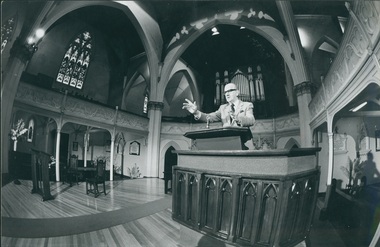
... From 1968 until his retirement at the end of 1981, Arthur Preston was the Superintendent of what is now Wesley Central Parish Mission (Central Methodist Mission prior to Church Union in 1977. In 1982 he was awarded the Order of Australia. ...From 1968 until his retirement at the end of 1981, Arthur Preston was the Superintendent of what is now Wesley Central Parish Mission (Central Methodist Mission prior to Church Union in 1977. In 1982 he was awarded the Order of Australia. ...Arthur William Preston was born in 1912. Following his ordination into the Methodist Church he was stationed in Mareeba and Townsville in North Queensland. From 1944 to 1948 he was Field Secretary for the Queensland Methodist Centenary Celebrations, conducting evangelistic missions throughout Queensland and assisting in raising the sum of 100,000 pounds for development work within the Queensland Methodist Church. From 1948 to 1963 he was superintendent of the West End Methodist Mission in Brisbane. In 1963 he was awarded the O.B.E. From 1963 - 1966 he was Associated Minister at the Adelaide Central Mission. During his ministry in Adelaide he established and directed the Life Line Telephone Counselling Service. During 1966 and 1968 he was Associate Minister in the Glen Iris Circuit, Victoria. From 1968 until his retirement at the end of 1981, Arthur Preston was the Superintendent of what is now Wesley Central Parish Mission (Central Methodist Mission prior to Church Union in 1977. In 1982 he was awarded the Order of Australia. Arthur Preston died on 19 March 1985.B & W gloss fish eye photograph of the Rev Arthur Preston preaching from the pulpit in Wesley Church, Lonsdale St. Melbourne. arthur preston, methodist, minister, wesley church, life line -
 Uniting Church Archives - Synod of Victoria
Photograph, 1956
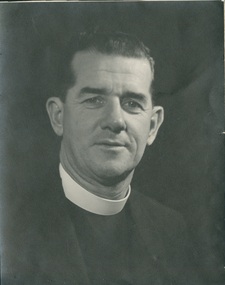
... From 1968 until his retirement at the end of 1981, Arthur Preston was the Superintendent of what is now Wesley Central Parish Mission (Central Methodist Mission prior to Church Union in 1977. In 1982 he was awarded the Order of Australia. ...From 1968 until his retirement at the end of 1981, Arthur Preston was the Superintendent of what is now Wesley Central Parish Mission (Central Methodist Mission prior to Church Union in 1977. In 1982 he was awarded the Order of Australia. ...Arthur William Preston was born in 1912. Following his ordination into the Methodist Church he was stationed in Mareeba and Townsville in North Queensland. From 1944 to 1948 he was Field Secretary for the Queensland Methodist Centenary Celebrations, conducting evangelistic missions throughout Queensland and assisting in raising the sum of 100,000 pounds for development work within the Queensland Methodist Church. From 1948 to 1963 he was superintendent of the West End Methodist Mission in Brisbane. In 1963 he was awarded the O.B.E. From 1963 - 1966 he was Associated Minister at the Adelaide Central Mission. During his ministry in Adelaide he established and directed the Life Line Telephone Counselling Service. During 1966 and 1968 he was Associate Minister in the Glen Iris Circuit, Victoria. From 1968 until his retirement at the end of 1981, Arthur Preston was the Superintendent of what is now Wesley Central Parish Mission (Central Methodist Mission prior to Church Union in 1977. In 1982 he was awarded the Order of Australia. Arthur Preston died on 19 March 1985.B & W matte head and shoulders studio portrait of the Rev. Arthur Preston."To my dearest Claire - happy birthday wishes and love from Arthur"arthur preston, methodist, minister, wesley church, life line -
 Uniting Church Archives - Synod of Victoria
Photograph, 1982
... From 1968 until his retirement at the end of 1981, Arthur Preston was the Superintendent of what is now Wesley Central Parish Mission (Central Methodist Mission prior to Church Union in 1977. In 1982 he was awarded the Order of Australia. ...From 1968 until his retirement at the end of 1981, Arthur Preston was the Superintendent of what is now Wesley Central Parish Mission (Central Methodist Mission prior to Church Union in 1977. In 1982 he was awarded the Order of Australia. ...Arthur William Preston was born in 1912. Following his ordination into the Methodist Church he was stationed in Mareeba and Townsville in North Queensland. From 1944 to 1948 he was Field Secretary for the Queensland Methodist Centenary Celebrations, conducting evangelistic missions throughout Queensland and assisting in raising the sum of 100,000 pounds for development work within the Queensland Methodist Church. From 1948 to 1963 he was superintendent of the West End Methodist Mission in Brisbane. In 1963 he was awarded the O.B.E. From 1963 - 1966 he was Associated Minister at the Adelaide Central Mission. During his ministry in Adelaide he established and directed the Life Line Telephone Counselling Service. During 1966 and 1968 he was Associate Minister in the Glen Iris Circuit, Victoria. From 1968 until his retirement at the end of 1981, Arthur Preston was the Superintendent of what is now Wesley Central Parish Mission (Central Methodist Mission prior to Church Union in 1977. In 1982 he was awarded the Order of Australia. Arthur Preston died on 19 March 1985.Informal gloss coloured photograph of the Rev Arthur Preston standing in the grounds of Government House, Melbourne. He is wearing his Order of Australia Award medallionarthur preston, methodist, minister, wesley church, life line, order of australia -
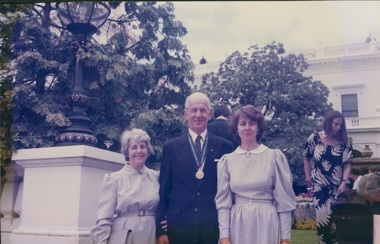 Uniting Church Archives - Synod of Victoria
Photograph, 1982
... From 1968 until his retirement at the end of 1981, Arthur Preston was the Superintendent of what is now Wesley Central Parish Mission (Central Methodist Mission prior to Church Union in 1977. In 1982 he was awarded the Order of Australia. ...From 1968 until his retirement at the end of 1981, Arthur Preston was the Superintendent of what is now Wesley Central Parish Mission (Central Methodist Mission prior to Church Union in 1977. In 1982 he was awarded the Order of Australia. ...Arthur William Preston was born in 1912. Following his ordination into the Methodist Church he was stationed in Mareeba and Townsville in North Queensland. From 1944 to 1948 he was Field Secretary for the Queensland Methodist Centenary Celebrations, conducting evangelistic missions throughout Queensland and assisting in raising the sum of 100,000 pounds for development work within the Queensland Methodist Church. From 1948 to 1963 he was superintendent of the West End Methodist Mission in Brisbane. In 1963 he was awarded the O.B.E. From 1963 - 1966 he was Associated Minister at the Adelaide Central Mission. During his ministry in Adelaide he established and directed the Life Line Telephone Counselling Service. During 1966 and 1968 he was Associate Minister in the Glen Iris Circuit, Victoria. From 1968 until his retirement at the end of 1981, Arthur Preston was the Superintendent of what is now Wesley Central Parish Mission (Central Methodist Mission prior to Church Union in 1977. In 1982 he was awarded the Order of Australia. Arthur Preston died on 19 March 1985.Informal gloss coloured photograph of the Rev Arthur Preston standing in the grounds of Government House, Melbourne with his wife Mrs Claire Preston and his daughter Miss Adel Preston. He is wearing his Order of Australia Award medallion.arthur preston, methodist, minister, wesley church, life line, order of australia, claire preston, adele preston -
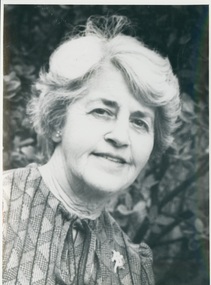 Uniting Church Archives - Synod of Victoria
Photograph, Undated c.1980s
... From 1968 until his retirement at the end of 1981, Arthur Preston was the Superintendent of what is now Wesley Central Parish Mission (Central Methodist Mission prior to Church Union in 1977. In 1982 he was awarded the Order of Australia. ...From 1968 until his retirement at the end of 1981, Arthur Preston was the Superintendent of what is now Wesley Central Parish Mission (Central Methodist Mission prior to Church Union in 1977. In 1982 he was awarded the Order of Australia. ...Arthur William Preston was born in 1912. Following his ordination into the Methodist Church he was stationed in Mareeba and Townsville in North Queensland. From 1944 to 1948 he was Field Secretary for the Queensland Methodist Centenary Celebrations, conducting evangelistic missions throughout Queensland and assisting in raising the sum of 100,000 pounds for development work within the Queensland Methodist Church. From 1948 to 1963 he was superintendent of the West End Methodist Mission in Brisbane. In 1963 he was awarded the O.B.E. From 1963 - 1966 he was Associated Minister at the Adelaide Central Mission. During his ministry in Adelaide he established and directed the Life Line Telephone Counselling Service. During 1966 and 1968 he was Associate Minister in the Glen Iris Circuit, Victoria. From 1968 until his retirement at the end of 1981, Arthur Preston was the Superintendent of what is now Wesley Central Parish Mission (Central Methodist Mission prior to Church Union in 1977. In 1982 he was awarded the Order of Australia. Arthur Preston died on 19 March 1985.B & W gloss head and shoulders photograph of Mrs Claire Preston, wife of the Rev. Arthur Preston.arthur preston, methodist, minister, wesley church, life line, order of australia, claire preston, adele preston -
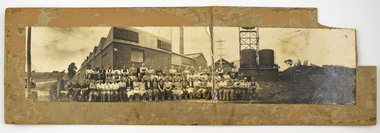 National Wool Museum
Photograph - Staff Group Portrait, Collins Bros Mill Pty Ltd, 1930s-1940s
... The Collins No. 2 Woollen Mill building dates from around the 1930s, however related buildings at that site were first constructed from around 1918, that was the Marnock Vale Wool Scouring Works. The Union Woollen Mill founded in the 1870s by William Henry Collins, a major Geelong industrial enterprise, was among the local firms which flourished during the First World War period. ...The Collins No. 2 Woollen Mill building dates from around the 1930s, however related buildings at that site were first constructed from around 1918, that was the Marnock Vale Wool Scouring Works. The Union Woollen Mill founded in the 1870s by William Henry Collins, a major Geelong industrial enterprise, was among the local firms which flourished during the First World War period. ...The Collins No. 2 Woollen Mill building dates from around the 1930s, however related buildings at that site were first constructed from around 1918, that was the Marnock Vale Wool Scouring Works. The Union Woollen Mill founded in the 1870s by William Henry Collins, a major Geelong industrial enterprise, was among the local firms which flourished during the First World War period. From 1914-1918 Collins Bros. concentrated on equipment for the A. I. F. However, afterwards Collins Bros. Pty. Ltd. specialised in the manufacture of flannels and blankets. From 1920 to 1938 the output was increased by fifty percent, and the number of employees rose to 200. The Collins Bros. No. 2 Mill was established in Bridge Street, Newtown. The proprietary brand 'Physician' became well and favourably known throughout Australia source: Heritage Victoria The Collins Bros Mills No. 1 and No. 2 hired over 250 people, and produced between 40,000 and 60,000 blankets for both the Australian market and for overseas export. Collins Bros closed both mills in 1974.Landscape photograph mounted on board showing a group portrait of staff seated and standing together in front of the Collins No. 2 Woollen Mill, Bridge Street, Newtown. Buildings, a chimney, towers, tanks, farmland, a car, powerlines and dirt roads are shown in the background. -
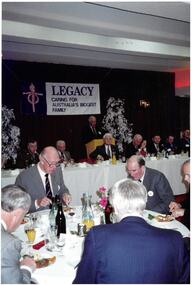 Melbourne Legacy
Photograph - Photo, Legatee function, 1991
... Sir Zelman spoke movingly on the work of Legacy and on the dramatic world events: the Gulf War; the reunification of Germany; the changes within the Soviet Union and his speech was warmly received by all who attended. ...Sir Zelman spoke movingly on the work of Legacy and on the dramatic world events: the Gulf War; the reunification of Germany; the changes within the Soviet Union and his speech was warmly received by all who attended. ...Photos of the launch of Legacy Week in 1991. The guest speaker was Sir Zelman Cowan, a former Governor General of Australia. The launch was in the Crest International Hotel in St Kilda on 3 September 1991. Sir Zelman spoke movingly on the work of Legacy and on the dramatic world events: the Gulf War; the reunification of Germany; the changes within the Soviet Union and his speech was warmly received by all who attended. The speaker and head table are under the Legacy Banner - which says "Legacy Caring for Australia's Biggest Family". The same banner is used at an event in Melbourne City Square - see 000491 (from the same roll of film). President John Sullivan is on the head table and is also in a photo at the Eternal Flame (000493 from the same roll of film). Part of a Legacy Appeal or Badge week launch in 1991. Seems to have fallen of a scrapbook of photos compiled by Legacy of major events in the 1980s and 1990s and deposited in the archive cabinets along with many other items and photos prior to the start of the cataloguing. See other photos at 01581.A record of a Legatee event to launch Legacy Week in 1991.Colour photo of the launch of Legacy Week 1991 at the Crest International.legacy appeal, legatee event, badge appeal
