
Showing 552 items matching " side table"
-
 Ballarat Tramway Museum
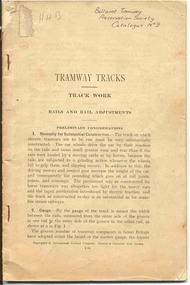
Book, International Textbook Company, "Tramway Track - Track Work", 1900's?
... side stapled with two staples. Evidence of it being bound with a glued cover. Used as a training book for building tramway tracks, including electrical considerations. Has two pages of Exam questions at the back. Published by the International Textbook Company, early 1900's. Many illustrations and tables...side stapled with two staples. Evidence of it being bound with a glued cover. Used as a training book for building tramway tracks, including electrical considerations. Has two pages of Exam questions at the back. Published by the International Textbook Company, early 1900's. Many illustrations and tables ...Seventy Six page booklet, titled "Tramway Track - Track Work", printed in off white of light brown paper, three sections and side stapled with two staples. Evidence of it being bound with a glued cover. Used as a training book for building tramway tracks, including electrical considerations. Has two pages of Exam questions at the back. Published by the International Textbook Company, early 1900's. Many illustrations and tables.On page 1 "Ballarat Tramway Preservation Society Catalogue No. 9" in black ink.trams, tramways, tramways, trackwork, electrical engineering -
 Ballarat Tramway Museum
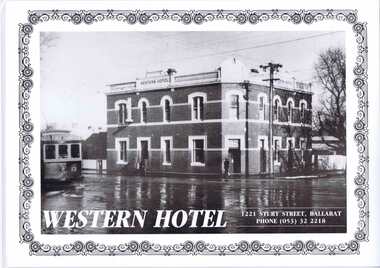
Photograph - Black & White Photograph/s, mid 1940s
... table mat. Trams Tramways Ballarat Trams SECV Sturt St Plastic placement with a reproduction of a Post War II(?1946 colour scheme),of tram No.13 turning into Ripon Street North travelling to View Point. Street scene highlights Western Hotel on a wet afternoon, by clothing on street walkers & bare branched trees, late Autumn to early spring. Reverse of side ...Yields information and history of the Western Hotel through photographs, in the form of a laminated table mat.Plastic placement with a reproduction of a Post War II(?1946 colour scheme),of tram No.13 turning into Ripon Street North travelling to View Point. Street scene highlights Western Hotel on a wet afternoon, by clothing on street walkers & bare branched trees, late Autumn to early spring. Reverse of side of plastic placemat portrays Western Hotel in Victorian Centenary year of 1938. Images rescanned 29/10/2013.trams, tramways, ballarat trams, secv, sturt st -
 Ballarat Tramway Museum
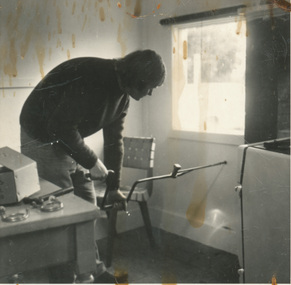
Photograph - Black & White Photograph/s, Sep. 1977
... Stove on right side of photo and parts on the kitchen table....Stove on right side of photo and parts on the kitchen table. Photograph Black & White Photograph/s ...Photo of Richard Gilbert drilling a hole through the kitchen wall of the BTPS's first Bungaree house as part of the installation of the gas stove. Note the use of a track auger drill to do the work. Stove on right side of photo and parts on the kitchen table.On rear in ink "Bungaree" & "9/77".tramways, trams, bungaree, btps -
 Box Hill Historical Society
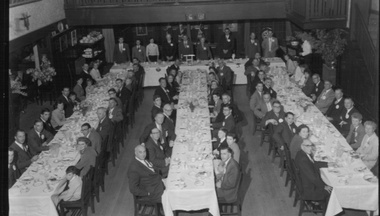
Photograph - Rotary
... table all persons are standing. All men are dressed in suits and there are a few women and children. There are stairs on the right hand side of the picture leading to a balcony....table all persons are standing. All men are dressed in suits and there are a few women and children. There are stairs on the right hand side of the picture leading to a balcony. ...Box Hill Rotary Migrants Group possibly at Wattle Park Chalet. Three long tables have guests seated at them, whilst at the head table all persons are standing. All men are dressed in suits and there are a few women and children. There are stairs on the right hand side of the picture leading to a balcony.B&w photoclothing and dress, box hill rotary migrants group, service clubs, wattle park chalet, box hill, wattle park, migrants -
 Stawell Historical Society Inc
Photograph, Stawell Town Hall Renovations 1995-1996 -- 38 Photos -- Coloured
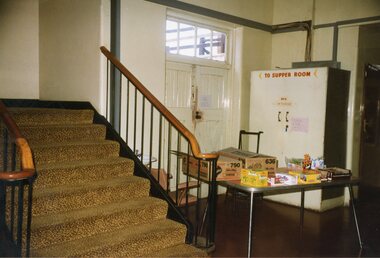
... Series of colour photographs of Town Hall Renovations 1995/96 TOWN HALL RENOVATIONS 1491: STAIRS TO THE UPSTAIRS SUPPER ROOM & A TABLE WITH SWEETS. 1491A: UPSTAIRS HALLWAY. 1491B: MAIN HALLWAY LOOKING TOWARD MAIN ENTRANCE. 1491C: UPSTAIRS WAITING AREA WITH ENTRANCE TO CINEMA. 1491D ANOTHER ANGLE OF PREVIOUS PHOTO. 1491E: LOOKING INTO THE HALL FROM THE BALCONY. 1491F: STAIRWELL TO THE GROUND FLOOR FROM 1491C. 1491G: STAIRS INTO THE CINEMA OTHER SIDE OF 1491C. 1491H: STAIRS TO UPSTAIRS CINEMA ENTRANCE. 1491I: GROUND FLOOR CINEMA ENTRANCE....Series of colour photographs of Town Hall Renovations 1995/96 TOWN HALL RENOVATIONS 1491: STAIRS TO THE UPSTAIRS SUPPER ROOM & A TABLE WITH SWEETS. 1491A: UPSTAIRS HALLWAY. 1491B: MAIN HALLWAY LOOKING TOWARD MAIN ENTRANCE. 1491C: UPSTAIRS WAITING AREA WITH ENTRANCE TO CINEMA. 1491D ANOTHER ANGLE OF PREVIOUS PHOTO. 1491E: LOOKING INTO THE HALL FROM THE BALCONY. 1491F: STAIRWELL TO THE GROUND FLOOR FROM 1491C. 1491G: STAIRS INTO THE CINEMA OTHER SIDE OF 1491C. 1491H: STAIRS TO UPSTAIRS CINEMA ENTRANCE. 1491I: GROUND FLOOR CINEMA ENTRANCE. ...Series of colour photographs of Town Hall Renovations 1995/96 TOWN HALL RENOVATIONS 1491: STAIRS TO THE UPSTAIRS SUPPER ROOM & A TABLE WITH SWEETS. 1491A: UPSTAIRS HALLWAY. 1491B: MAIN HALLWAY LOOKING TOWARD MAIN ENTRANCE. 1491C: UPSTAIRS WAITING AREA WITH ENTRANCE TO CINEMA. 1491D ANOTHER ANGLE OF PREVIOUS PHOTO. 1491E: LOOKING INTO THE HALL FROM THE BALCONY. 1491F: STAIRWELL TO THE GROUND FLOOR FROM 1491C. 1491G: STAIRS INTO THE CINEMA OTHER SIDE OF 1491C. 1491H: STAIRS TO UPSTAIRS CINEMA ENTRANCE. 1491I: GROUND FLOOR CINEMA ENTRANCE.stawell, town hall renovations -
 Sunshine and District Historical Society Incorporated
Archive - McKay Massey Ferguson social function, n.d
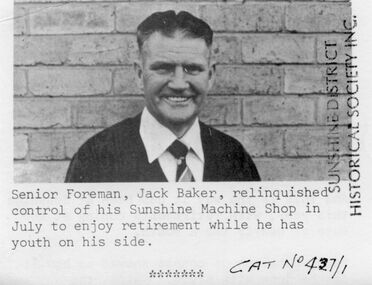
... side Photograph 2 Several people at a social function held by HV McKay Massey Ferguson. Congratulations to Jim McNair for his organisation of the night At the Last Laugh L2R Jeanett and Bruno Quality Control Grils Silvano Machine Shop and Alma Grils Helen McNair Margaret and Dick Machine Shop Smith Jim McNair Quality Control Also Social Club Treasurer Alan Stephens Quality Control Only 7 carafes on the table...side Photograph 2 Several people at a social function held by HV McKay Massey Ferguson. Congratulations to Jim McNair for his organisation of the night At the Last Laugh L2R Jeanett and Bruno Quality Control Grils Silvano Machine Shop and Alma Grils Helen McNair Margaret and Dick Machine Shop Smith Jim McNair Quality Control Also Social Club Treasurer Alan Stephens Quality Control Only 7 carafes on the table McKay Massey Ferguson social function Archive McKay Massey Ferguson social function ...Photograph 1 Senior Foreman Jack Baker Senior Foreman relinquished control of his Sunshine Machine Shop in July to enjoy retirement while he has youth on his side Photograph 2 Several people at a social function held by HV McKay Massey Ferguson. Congratulations to Jim McNair for his organisation of the night At the Last Laugh L2R Jeanett and Bruno Quality Control Grils Silvano Machine Shop and Alma Grils Helen McNair Margaret and Dick Machine Shop Smith Jim McNair Quality Control Also Social Club Treasurer Alan Stephens Quality Control Only 7 carafes on the tableh.v. mckay massey harris, massey ferguson, sunshine harvester works, employee -
 Yarrawonga and Mulwala Pioneer Museum
Baby weighing scales, Seca
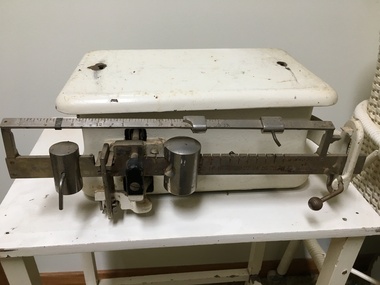
... table sits a woven cane basket with a wooden base. The top edge of the basket is is plaited cane and painted gold. The other cane is painted white. It is lined with a piece of white towelling on which the baby would lie. Attached on the side...table sits a woven cane basket with a wooden base. The top edge of the basket is is plaited cane and painted gold. The other cane is painted white. It is lined with a piece of white towelling on which the baby would lie. Attached on the side ...Cream painted stand with a moving sprung table top attached. On top of the table sits a woven cane basket with a wooden base. The top edge of the basket is is plaited cane and painted gold. The other cane is painted white. It is lined with a piece of white towelling on which the baby would lie. Attached on the side of the base is a notched metal bar which has a sliding metal weight so the bar will balance. It is marked with 2, 4, 6, 8 etc up to 30 lb and a smaller upper bar measures ounces. There is a framed pamphlet hanging above the scales with instructions for using the scales.Ounce measures 0, 4, 8, 12, 1 (pound) Made in Germany 24767. Triangle shape with the word Seca inside -
 Sunshine and District Historical Society Incorporated
Booklet - The Sunshine Presbyterian Ladies Guild Cookery book
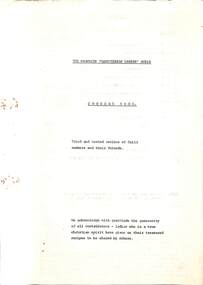
... 74 loose double sided pages from a two ringed binder containing recipes including conversion tables from imperial to metric - undated...Sunshine Presbyterian Ladies Guild Cooking savoury and snacks|fish, meat and poultry dishes|desserts|baked goods|sauces 74 loose double sided pages from a two ringed binder containing recipes including conversion tables from imperial to metric - undated Booklet The Sunshine Presbyterian Ladies Guild Cookery book ...savoury and snacks|fish, meat and poultry dishes|desserts|baked goods|saucessunshine presbyterian ladies guild, cooking -
 Williamstown Historical Society Inc
Photograph - Nelson Place, Bayview Hotel
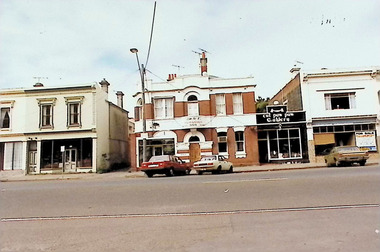
... Upstairs was used as a clubroom for 100 people and billiard tables were installed downstairs. The laneway at the side led to the Artillery Brewery building, which has since been replaced by Nelson Heights Towers. ...Upstairs was used as a clubroom for 100 people and billiard tables were installed downstairs. The laneway at the side led to the Artillery Brewery building, which has since been replaced by Nelson Heights Towers. ...The Bay View Hotel located at 175 Nelson Place was designed by Gordon McCrae and built by Mr. Ingham in 1910 as a 13 room hotel. Upstairs was used as a clubroom for 100 people and billiard tables were installed downstairs. The laneway at the side led to the Artillery Brewery building, which has since been replaced by Nelson Heights Towers. The original hotel was a wooden building built pre-1869. Andrew Rider, hairdresser and photographer, whose name is linked with the hotel from 1875, was the owner of the new 13 room brick Bay View hotel and shop constructed in 1910 whilst George W. Magor was both the new and old publican. A year later, JJ Jeffries purchased the hotel, and by 1920 Hannah Starr was the licensee.bayview hotel, nelson place, 175 nelson place, andrew rider -
 Tatura Irrigation & Wartime Camps Museum
Textile - Table Banner, CWA Table Banner
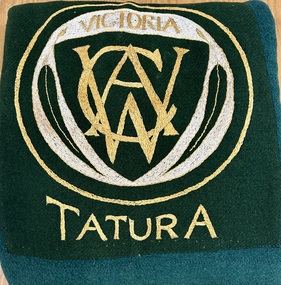
... This table banner was used on the official table at Tatura CWA monthly meetings CWA Tatura CWA VICTORIA TATURA Bottle Green Wool hemmed on each side. ...This table banner was used on the official table at Tatura CWA monthly meetingsBottle Green Wool hemmed on each side. A CWA logo has been embroidered with gold and pale yellow thread onto a darker green woollen square which has been attached to the blanket.CWA VICTORIA TATURAcwa, tatura -
 Tatura Irrigation & Wartime Camps Museum
Photograph - Garrison Beer Garden
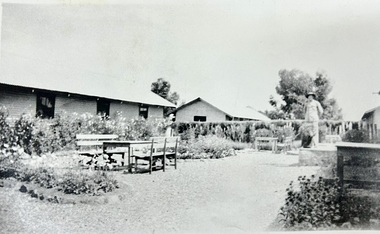
... In the centre of the garden is a table with two bench seats on either side. A man is standing off to the right of photo. ...In the centre of the garden is a table with two bench seats on either side. A man is standing off to the right of photo. ...No 1 Camp Garrison beer garden. The sergeant is from the Canteen Sgt's MessBlack and white photograph of the No 1 Camp Garrison Beer garden. Two hunts on the left of picture and and a partial glimpse of huts on the right. The huts are surrounded by gardens. In the centre of the garden is a table with two bench seats on either side. A man is standing off to the right of photo. A large tree behind him.camp 1, garrison, beer garden, sergeant, sergeants mess, canteen, tatura, danson -
 Tatura Irrigation & Wartime Camps Museum
Table, Dr Sigmund Lehnert, 1941-1942
... Larger wooden dove tailed table with picture of army huts, guard tower and hay 1941 carved on one side. Picture of army huts and barbed wire fence, plants and Tatura 1942 carved on the opposite side. ...Dunera Boys Dr Sigmund Lehnert Hay internment camp wood work Tatura group internment camp wood work Hay 1941 Tatura 1942 Larger wooden dove tailed table with picture of army huts, guard tower and hay 1941 carved on one side. Picture of army huts and barbed wire fence, plants and Tatura 1942 carved on the opposite side. ...Dunera internee made this table whilst in camps at Hay and Tatura groups. Part of a nest of 2 tables, smaller table registered no C7687.Larger wooden dove tailed table with picture of army huts, guard tower and hay 1941 carved on one side. Picture of army huts and barbed wire fence, plants and Tatura 1942 carved on the opposite side. The top has been covered with contact adhesive.Hay 1941 Tatura 1942dunera boys, dr sigmund lehnert, hay internment camp wood work, tatura group internment camp wood work -
Tatura Irrigation & Wartime Camps Museum
Table, Dr Sigmund Lehnert, 1941-1942
... Small wooden dove tailed table with picture of army huts, guard tower and hay 1941 carved on one side. Picture of army huts and barbed wire fence, plants and Tatura 1942 carved on the opposite side. ...Part of a nest of 2 tables, smaller table registered no C7686. dunera boys dr sigmund lehnert hay internment camp wood work tatura group internment camp wood work Hay 1941 Tatura 1942 Small wooden dove tailed table with picture of army huts, guard tower and hay 1941 carved on one side. Picture of army huts and barbed wire fence, plants and Tatura 1942 carved on the opposite side. ...Dunera internee made this table whilst in camps at Hay and Tatura groups. Part of a nest of 2 tables, smaller table registered no C7686.Small wooden dove tailed table with picture of army huts, guard tower and hay 1941 carved on one side. Picture of army huts and barbed wire fence, plants and Tatura 1942 carved on the opposite side. The top has been covered with contact adhesive.Hay 1941 Tatura 1942dunera boys, dr sigmund lehnert, hay internment camp wood work, tatura group internment camp wood work -
 Tatura Irrigation & Wartime Camps Museum
Photograph, Camp 3 Classmates Reunion
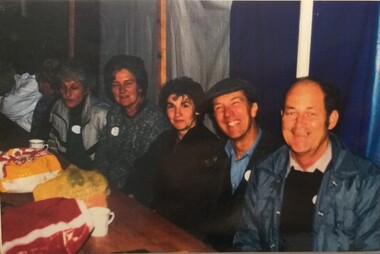
... Colour photograph of 5 people seated at a table, on the right hand side a royal blue cloth with a white line. ...Class mates reunion Peter Drescher Camp 3 reunion Colour photograph of 5 people seated at a table, on the right hand side a royal blue cloth with a white line. ...Camp 3 class mates from 1938 at a reunion in 1988. Colour photograph of 5 people seated at a table, on the right hand side a royal blue cloth with a white line. Behind head of man on right with adjacent back drop grey with yellow stripe. Informal get together. Photograph is on coreflue class mates reunion, peter drescher, camp 3 reunion -
 Ballarat Tramway Museum
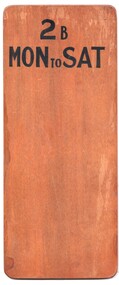
Document - Tramcar run table or table card - 2b - used for 2/3/1958 - the day of the Queen Mother's visit to Ballarat
... side and a sheet of paper giving the tram crew timetable for 12 Run (Ballarat) for 2 March 1958. Has another sheet of paper underneath and the original times for the board can be seen under that again. Details the sign-on times, trips, locations, times, and sign-off times. Document Tramcar run table ...Used on the day of the Queen Mother's visit to Ballarat. Shows how the tram crew worked between Mt Pleasant - Grenville St or the Gardens their working hours and meal breaksDemonstrates how tram crews were advised on their work schedules or tram times for the event of the Royal Visit by the Queen Mother to Ballarat.A plywood sheet, with rounded corner, varnished with "2B Mon to Sat" on one side and a sheet of paper giving the tram crew timetable for 12 Run (Ballarat) for 2 March 1958. Has another sheet of paper underneath and the original times for the board can be seen under that again. Details the sign-on times, trips, locations, times, and sign-off times.timetable, tram crews, queen mother, royal visit, rosters -
 Ballarat Tramway Museum
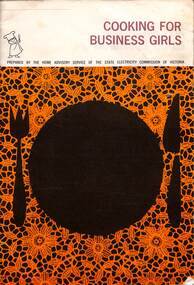
Booklet - Set of 3 SECV Cookbook / Recipe Book, State Electricity Commission of Victoria (SECV), Cooking for Business Girls, 1960's
... Set of three books or booklets - all featuring an image of a plate on a table cloth with a knife and fork on either side. 1 - Cooking for Business Girls - 24 pages 2 - Cold start oven cooking - 14 pages 3 - Electric Frypan cooking - 20 pages...Set of three books or booklets - all featuring an image of a plate on a table cloth with a knife and fork on either side. 1 - Cooking for Business Girls - 24 pages 2 - Cold start oven cooking - 14 pages 3 - Electric Frypan cooking - 20 pages Cooking for Business Girls Booklet Set of 3 SECV Cookbook / Recipe Book State Electricity Commission of Victoria (SECV) ...Provides a series of recipe and potential dinner menus. Prepared by the home advisory service of the SECV. The SEC promoted electric cooking on Ballarat tramcars using large roof advertisements.Set of three books or booklets - all featuring an image of a plate on a table cloth with a knife and fork on either side. 1 - Cooking for Business Girls - 24 pages 2 - Cold start oven cooking - 14 pages 3 - Electric Frypan cooking - 20 pagesnon-fictionProvides a series of recipe and potential dinner menus. Prepared by the home advisory service of the SECV. The SEC promoted electric cooking on Ballarat tramcars using large roof advertisements.secv, power supply, tramcars, cookbooks, recipe books, home advisory -
 Ballarat Tramway Museum
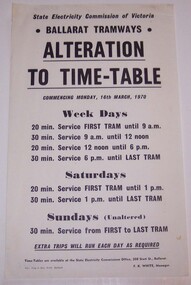
Poster, State Electricity Commission of Victoria (SECV), "Alteration to Time-Table", Mar. 1970
... side only, titled "Alteration to Fares", under the SEC and "Ballarat Tramways" heading. Gives details of timetable changes for Ballarat, commencing 16-3-1970. Gives details of service frequencies. Printed by Alex King & Sons Print, Ballarat and signed by F. K. White Manager. 21 copies held. See Reg Item 2474 for a mounted version of this poster. "Alteration to Time-Table ...Significant in being a poster distributed by the SEC in Ballarat to advise passengers of the new timetable to apply from March 1970, reduction in services prior to closure, due to reducing crew numbers and to save money.Foolscap Sheet, glossy one side only, titled "Alteration to Fares", under the SEC and "Ballarat Tramways" heading. Gives details of timetable changes for Ballarat, commencing 16-3-1970. Gives details of service frequencies. Printed by Alex King & Sons Print, Ballarat and signed by F. K. White Manager. 21 copies held. See Reg Item 2474 for a mounted version of this poster.On rear in black ink 'BTPS 617"trams, tramways, timetables, sec, ballarat -
 Ballarat Tramway Museum
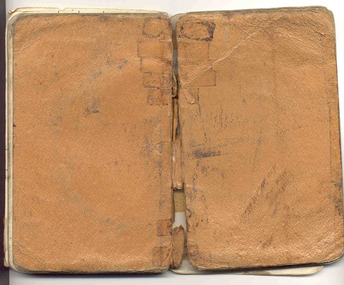
Ephemera, Ray Hall, Ballarat tram timetables, c1970
... side of the page. On a scrap paper, formally summary time sheets of crews, additional tables have been written in for Sat and Sun runs....side of the page. On a scrap paper, formally summary time sheets of crews, additional tables have been written in for Sat and Sun runs. ...Has a strong association with tram crews and the rosters crew workings, Ray Hall. Prepared by crews from sheets to enable them to know what service times to run, meal times, details of crew changes etc, based on their allocated shift or run from the roster.Sixty (60) page notebook with brown card board covers. Each sheet faint ruled, both sides, with some additional pages fixed in. Right hand side only has the hand written details of each SEC Ballarat runs - giving sign on times, notes, timetables, which run taken or taken by, meal times, notes with regard to special instructions, finish times notes with corrections and changes. Includes weekday and Saturday runs. Sunday timetables not included in the notebook pages. Image 1 shows covers and image 2, one of the sheets with the runs printed on both side of the page. On a scrap paper, formally summary time sheets of crews, additional tables have been written in for Sat and Sun runs.trams, tramways, ballarat, rosters, employees, shifts, timetables -
Ballarat Tramway Museum
Document - Photocopy, Kym Westwood, "Tram Feasibility Study for the Ballarat Tourism Board", Jul. 2000
... sides of an A4 sheet. Stored as a 48 pages with a metal fold back clip to hold sheets together. Front cover featured a photograph of ESCo No. 1. Contains information on research design, data analysis, results, conclusions and recommendations, list of references, exhibits, tables, data summaries, copies of newspaper items and background material. ...sides of an A4 sheet. Stored as a 48 pages with a metal fold back clip to hold sheets together. Front cover featured a photograph of ESCo No. 1. Contains information on research design, data analysis, results, conclusions and recommendations, list of references, exhibits, tables, data summaries, copies of newspaper items and background material. ...Photocopy of a bound (comb binding) report titled, "Tram Feasibility Study for the Ballarat Tourism Board". Was originally 96pages, has been photocopied using both sides of an A4 sheet. Stored as a 48 pages with a metal fold back clip to hold sheets together. Front cover featured a photograph of ESCo No. 1. Contains information on research design, data analysis, results, conclusions and recommendations, list of references, exhibits, tables, data summaries, copies of newspaper items and background material. Compiled by Kym Westwood of the University of Ballarat - 1997. Copy of report made 7/2000 for BTM files.trams, tramways, city tramway, ballarat tramways, tramway revival, university of ballarat -
 Ballarat Tramway Museum
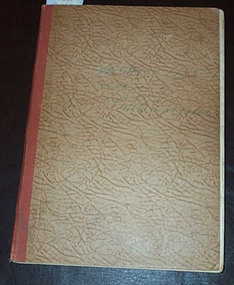
Book, H.P. James, "In Other Days", late 1930's
... side note records Mr. James elected as Vice President in 1939. Receipt signed by Edward Crimmins (See Reg. Item 2486) Has a table...side note records Mr. James elected as Vice President in 1939. Receipt signed by Edward Crimmins (See Reg. Item 2486) Has a table ...ESCo Employee Hours Work Record book that has been used by an ESCo/SEC inspector, H. P. James as a record / note book for his personal collection or papers or journal titled "In Other Days". Book sewn with string in 36 page sections, blank end papers, board covers with stipple paper out sides and Rexene cloth binding. Comprising plain paper end papers and 104 printed pages (52 leaves), with each sheet printed in black on feint ruled paper for recording the hours worked and other details of drivers and conductors employed by ESCo. Printed for daily use, with Day and date page headings - made out for the 1930's. Text generically printed feint ruled paper. Images: Book - i1 Inside front cover - i2 Members Certificate - i3 Photo of H.P. James and index page - i4 Has been used to gather mementos such as photos, articles, newspaper clippings, letters and other miscellaneous documents on Ballarat local history. Newspaper cuttings etc often have side notes written by Mr. James. Inside front cover has certificate recording Mr. James membership to the Ballarat Historical Society (on Australasian Historical Record Society paper) for 1937 - 1938. A side note records Mr. James elected as Vice President in 1939. Receipt signed by Edward Crimmins (See Reg. Item 2486) Has a table of contents for pages 1 to 65. Opposite is a photograph of Mr. James dressed for the Ballarat Tramways Social Club function - See Reg. Item No. 506 Primary items are: 1 - Newspaper cutting "A stroll along Bridge St. 50 years ago" - Nathan F. Speilvogel. 3 - Newspaper cutting "What I Remember of Early Ballarat" - James Sainsberry. 4 - Newspaper cutting "Magnet that Made Ballarat - New Monument Marks Gold Discovery" 7 - Newspaper cutting "Romance of a Ballarat Street Block" - Speilvogel 9 - Newspaper cutting "Sixty years of Dana St. School"- Speilvogel 11 - Newspaper cutting "The White Flat - its Transitions of Service - Historical Review" - J. Hargreaves 15 - Newspaper cutting "Memories of Russell Square - Fireman's Carnivals" - James 16 - Notes on the Alfred Hall 17 - Newspaper cutting - "Alfred Hall" - James 21 - Letter re Russell Square dated 24/2/38, J. McLeish 23 - Newspaper cutting "The First Train to Ballarat" 25 - Newspaper cutting "Story of Ballarat's Horse Trams 1887 to 1913", James - see Reg. Item 2489. 27 - Photos and Newspaper cutting of items re horse trams, and photo of ESCo No. 18 - See Reg. Items 2490, 2491 and 2492. 28 - ESCo opening ticket (See other Reg. Items 608 for examples of this) ticket No. 1595. 29 - Newspaper cutting "Story of Ballarat's Electric Trams", James, See Reg. Item 2493. 30 - Poster - SEC - Ballarat "The New System of Fares and Sections" - 3/10/1997 - See Reg. Item 2494. SEC - Tourist Ticket - See Reg. Item 2495 ESCo - 3d check ticket - See Reg. Item 2496 31 - Tickets and handwritten notes - with reference to page 51 ESCo 1d - See Reg. Item 2497 (2 No.) ESCo/SEC? - lunch hour weekly ticket - See Reg. Item 2498 ESCo/SEC? - Morning and evening weekly ticket - See Reg. Item 2499 ESCo/SEC? - 3d Adult Transfer - See Reg. Item 2500 ESCo/SEC? - 2d child Transfer - See Reg. Item 2501 ESCo - 1.1/2 child ticket - See Reg. Item 2502 ESCo - 3d Adult ticket - See Reg. Item 2503 Extract of an item titled "History of Ballarat Tramways", SEC Magazine, Feb. 1939 - See Reg. Item 2504 2d ESCo token (See other reg items 1794 and 1943 for details of this object) - sewn into page. 33 - Handwritten notes "Alfred Hall" 35 - Handwritten notes "Russell Square" 36, 37 - miscellaneous cuttings from the Courier for 1939 and 1940 39 - Newspaper cutting "South Street Band Contests" - cutting dated 27/10/1932. (See images - i5 to 41, 43, - ditto - contest results 44 - Photo of the Tramway Shelter in Sturt Street being removed - Courier dated 18/12/1923 - see Reg Item 2523. 45 - Extract of April 1938 from SEC Magazine, photos of the launch of the illuminated Ballarat Centenary tram - see Reg Item 2524. 47 - Newspaper cutting "Peeps into the Past" 48 - Listing of "Members of Returned Soldiers Band", Ballarat, dated 18/11/1919. 49 - Newspaper cutting "Ballarat, The Home of the Band Contests", dated 27/10/1932. 51 - Handwritten notes - "Tram Fares methods of collection" - See Reg. Item 2505. 53 - Newspaper cutting "100 years ago", Port Phillip Herald for 1840. 54 - Black and white photo of a gathering of people (tramway?) at the Showgrounds - See Reg. Item 2506 55 - Six black and white photos with handwritten notes ESCo 19 or 20 - See Reg. Item 2507 Group of ESCo employees by ESCo tram - See Reg. Item 2508 Photo of ESCo employee, Si Barker - See Reg. Item 2509 Photo of ESCo company bus - See Reg. Item 2510 (See also Reg Item 3813) Photo of No. 25 - Barkly St - See Reg. Item 2511 Photo of two ESCo employees - See Reg. Item 2512 56 - Loose newspaper cutting "San Francisco Struggle Buggies" - cable trams - The Age 15/3/1947 57 - Letter from Mr. Pringle of ESCo to Inspector James and Handwritten notes on ESCo management - See Reg. Item 2513 Handwritten notes on the token systems - See Reg. Item 2514 59 - Page titled "Bundy clocks and meters" but no notes 61 - Hand drawn map of Ballarat tramways with notes on tracks - horse, SEC and ESCo and loops - See Reg. Item 2515. 63 - Miscellaneous newspaper cuttings and photo of the Arch of Victory 64 - Photo of W. J.K. Dunstan ??? (has notes written on back, but difficult to read)* - Notes on rear of photo p64. "49 years in service W.J.K. Dunstan Office Manager Ballarat Branch Retired 18/3/46" 65 - Newspaper cutting "Old Victorian Schooldays, letters and reminiscences by past scholars". 67 - Newspaper cuttings - photo of Ballarat Choral Union and Urquhart St. school 69 - Newspaper cutting "Saint with a top hat" 71, 73 - Newspaper cutting "District Mining Disasters of By-Gone Days" - John Hargreaves 75 - Newspaper cutting "The Ballarat Courier" banners for 2/9/1939 - outbreak of World War Two - normal and a special edition. 77, 79 - Newspaper cutting "My Youth in Ballarat" - T.P. Long. 81 - Two photos and handwritten notes showing trams in Sturt St and the line up of horse trams - See Reg Item 2516. 83 - Newspaper cutting "Theatrical History - The Charlie Napier" - Speilvogel 85, 87 - Newspaper cutting "Story of the Eureka Stockade Monument" - Speilvogel 89 - Newspaper cutting "The Beginning of Buninyong" - Speilvogel 91 - Newspaper cutting "St. David's Day" 93, 95 - Newspaper cutting "From 1856 to 1894, Ballarat's Foremost Citizen Major (William Collard) Smith Recalled - J. Hargreaves. 97 - Newspaper cutting "All Electrical Exhibition / Ballarat's Electric Supply, its development" - 1936, See Reg. Item 2517. 98 - Loose photo of the ESCo Power station chimney and steeplejacks - See Reg. Item 2518. 98 - Loose sheet of paper about the origin of the ESCo trams - See Reg. Item 2525. 99 - Newspaper cutting - about Electricity in Ballarat and tramway services, and handwritten notes on ESCo Inspectors - See Reg. Item 2519 100, 101 - Newspaper cuttings - "Mr. Melbourne Day by Day" cartoon series and the artist's death notice dated 22/8/1939. 102 - Poster - Dana Street School Jubilee Re-union, has N. Speilvogel and H. James as joint secretaries. 103 - Newspaper cutting of various photos and a scene of a gold train at Bendigo 104 - Newspaper cuttings - Bob Menzies and Adolph Hitler and backs of Melbourne tram tickets - "School Boy Howlers". 105 - Letter in an envelope to H.P. James dated 11/10/1937, by a person about the building of the tram sheds at Wendouree - See Reg. Item 2520. Newspaper cutting of the opening of the tramway to Lydiard St. North from Gregory St. - See Reg. Item 2521 Loose item - 1/- SEC Tourist Ticket No. A2676 - See Reg. Item 2522.Many in pencil and inktrams, tramways, h.p. james, esco, horse trams, ballarat, civic history -
 Brighton Historical Society
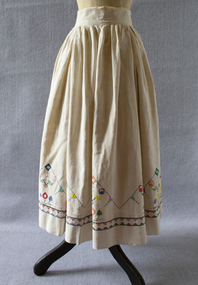
Skirt, late-nineteenth century & 1950s
... table where her mother worked. Toula would involve Olga by allowing her to help choose the colour combinations. Toula lived with Olga in Brighton until her death in 1976. Olga inherited her mother's sewing skills. She re-invented some of Toula’s trousseau nightdresses and skilfully altered other clothing, making dresses which she wore around Brighton for many years. skirt linen hand woven embroidery ithaca migration greek diaspora olga black Ankle-length full cream linen skirt with multi-coloured cross stitch embroidery featuring mountains, birds and trees. Fullness is pleated into wide waist band. Left side ...This skirt belonged to Olga Black, a long-time Brighton resident. The linen used for the skirt were woven by Olga's great-grandmother Efstathia in the late-nineteenth century with flax grown on the island of Ithaca. In the 1950s, Olga made the fabric into a skirt, embellishing it with hand embroidery. Olga Maria Black was born in Melbourne in 1930, the daughter of Ithacan migrants Constantine and Toula Mavrokefalos. Constantine first emigrated to Australia in 1902, returning to Greece circa 1912-13 to serve his home country in the Balkan Wars. Toula's family had left Ithaca for Romania when she was only six months old, but she happened to be visiting the island at the very time that Constantine arrived, fresh from the war. Within three weeks they were married, and when Constantine returned to Melbourne in 1914 his new bride came with him. Constantine had trained as an accountant, but his qualifications were not recognised in Australia. Changing his surname to the Anglicised "Black", he started off working in his older brother Dionysios's cafés before going into business on his own. In 1917 he opened the Paris Residential Café at 54-56 Swanston Street, which offered both dining and accommodation. The business saw some years of success, but did not survive the Great Depression. Constantine died in 1944. Olga's mother Toula learned to sew as a child, while growing up in the Romanian village of Brila. She developed her skills making lace and embroidering items for her trousseau. Some of the linen she embroidered had been woven from flax on Ithaca by her own grandmother, Efstathia. During the Depression, when money was scarce, Toula embroidered at home, doing work for a factory in Flinders Lane. Using a cotton reel, a threepence and a sixpence she created and embroidered designs on hundreds of blouses. Olga spent her preschool days sitting at the table where her mother worked. Toula would involve Olga by allowing her to help choose the colour combinations. Toula lived with Olga in Brighton until her death in 1976. Olga inherited her mother's sewing skills. She re-invented some of Toula’s trousseau nightdresses and skilfully altered other clothing, making dresses which she wore around Brighton for many years.Ankle-length full cream linen skirt with multi-coloured cross stitch embroidery featuring mountains, birds and trees. Fullness is pleated into wide waist band. Left side opening. The fabric widths have been whipped together by hand probably at the time the cloth was woven in the late-nineteenth century. The skirt is machine stitched.skirt, linen, hand woven, embroidery, ithaca, migration, greek diaspora, olga black -
 Brighton Historical Society
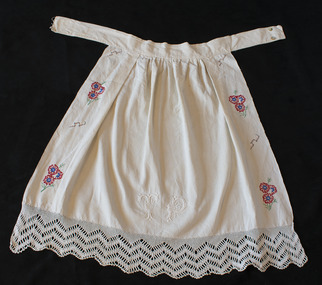
Apron, circa late 1800s, 1908 and 1950
... table where her mother worked. Toula would involve Olga by allowing her to help choose the colour combinations. Toula lived with Olga in Brighton until her death in 1976. Olga inherited her mother's sewing skills. She re-invented some of Toula’s trousseau nightdresses and skilfully altered other clothing, making dresses which she wore around Brighton for many years. olga black toula raftopoulos migration embroidery Cream linen embroidered half apron. White lace along hem, along with white embroidered initials, "T.P." Coloured floral and abstract embroidery along sides ...Three generations of women are represented in this apron. The linen used was woven by Olga's great-grandmother Efstathia in the late nineteenth century with flax grown on the island of Ithaca. Olga's mother Toula Raftopoulos added the whitework around 1908 at age 16 - the first piece of lacework she made on her own - and embroidered her initials on the front. Olga embellished the apron with coloured embroidery around 1950 at age 20. Olga Maria Black was born in Melbourne in 1930, the daughter of Ithacan migrants Constantine and Toula Mavrokefalos. Constantine first emigrated to Australia in 1902, returning to Greece circa 1912-13 to serve his home country in the Balkan Wars. Toula's family had left Ithaca for Romania when she was only six months old, but she happened to be visiting the island at the very time that Constantine arrived, fresh from the war. Within three weeks they were married, and when Constantine returned to Melbourne in 1914 his new bride came with him. Constantine had trained as an accountant, but his qualifications were not recognised in Australia. Changing his surname to the Anglicised "Black", he started off working in his older brother Dionysios's cafés before going into business on his own. In 1917 he opened the Paris Residential Café at 54-56 Swanston Street, which offered both dining and accommodation. The business saw some years of success, but did not survive the Great Depression. Constantine died in 1944. Olga's mother Toula learned to sew as a child, while growing up in the Romanian village of Brila. She developed her skills making lace and embroidering items for her trousseau. Some of the linen she embroidered had been woven from flax on Ithaca by her own grandmother, Efstathia. During the Depression, when money was scarce, Toula embroidered at home, doing work for a factory in Flinders Lane. Using a cotton reel, a threepence and a sixpence she created and embroidered designs on hundreds of blouses. Olga spent her preschool days sitting at the table where her mother worked. Toula would involve Olga by allowing her to help choose the colour combinations. Toula lived with Olga in Brighton until her death in 1976. Olga inherited her mother's sewing skills. She re-invented some of Toula’s trousseau nightdresses and skilfully altered other clothing, making dresses which she wore around Brighton for many years.Cream linen embroidered half apron. White lace along hem, along with white embroidered initials, "T.P." Coloured floral and abstract embroidery along sides in red, black, blue and green.olga black, toula raftopoulos, migration, embroidery -
 Brighton Historical Society
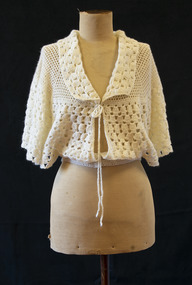
Bed jacket, circa 1955
... He loved being in Australia and enjoyed life to the last, insisting on having bread and wine on the table at every meal. bed jacket migration 1950s carmela auditore carmela materia giuseppa auditore Cream crocheted wool bed jacket. Loose around bust with wide sleeves and open sides ...This bed jacket was crocheted for Carmela Materia (1931-2018) by her mother, Giuseppa Auditore, around the time they emigrated from Italy to Melbourne. Both women were longtime Brighton locals, residing in the area from the 1950s until their deaths. Carmela Auditore was the first woman from her home village of Scaletta, Italy to emigrate to Australia. Setting sail alone in 1950 at the age of 19, she joined her brother John and uncle Frank in McCallum St, Brighton. Frank had arrived some years earlier and had spent the duration of the First World War in an internment camp. John worked at the Brighton Case Company, a box manufacturer on Nepean Highway, and paid for her passage. Carmela found a job sewing children's clothing at Drummonds, a small factory in Church St. Working eight hours a day, five days per week, netted her a weekly wage of three pounds. To earn a little extra, she washed dishes at a St Kilda Road restaurant for ten shillings a shift. Her parents, Salvatore and Giuseppa Auditore, joined her in Brighton in 1952. They rented a house behind an antique shop in Bay Street. Salvatore had been a fisherman in Scaletta, but quickly adapted to the job he found helping around the Garage at Brighton Motors in Male Street. On 14 February 1953, Carmela married her sweetheart, Salvatore Materia, at St James Catholic Church in Gardenvale. Salvatore had been living with his aunt in Well Street and worked on the wharves. Both Carmela and Salvatore were hard workers. They owned a fruit shop in Church Street where Woolworths now stands, and years later Carmela recalled the familiar 6am tap on her window each morning when her husband returned from the market. On dark winter mornings, she felt as if her hands would freeze as she helped Salvatore unload cold cabbages and cauliflowers from his truck. They later owned a shop in Ludstone Street in Hampton. After Salvatore died suddenly at the age of 48, Carmela returned to sewing, working at the Willow Fashions knitting mill in Gardenvale. She later went into partnership with her sister and brother-in-law, this time in the delicatessen business. Her parents, Giuseppa and Salvatore, spent the rest of their days with Brighton. Carmela recalled her father cheerfully walking the streets, greeting people by name. He knew everybody. He loved being in Australia and enjoyed life to the last, insisting on having bread and wine on the table at every meal.Cream crocheted wool bed jacket. Loose around bust with wide sleeves and open sides. Fastens at collar with thin braided ties, and at waist with two pearlescent plastic buttons.bed jacket, migration, 1950s, carmela auditore, carmela materia, giuseppa auditore -
 Brighton Historical Society
Purse, Coin purse, circa 1966
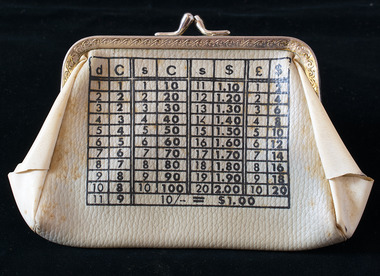
... Cream vinyl coin purse with conversion table for pre-decimal and decimal currency printed in black on each side. Hinged silver metal opening and kiss clasp. ...This coin purse is printed with a simple conversion table to help the user navigate the switch from pounds, shillings and pence to the new dollars and cents. coin purse decimal currency 1960s Cream vinyl coin purse with conversion table for pre-decimal and decimal currency printed in black on each side. Hinged silver metal opening and kiss clasp. ...Australia converted to decimal currency on 14 February 1966. This coin purse is printed with a simple conversion table to help the user navigate the switch from pounds, shillings and pence to the new dollars and cents.Cream vinyl coin purse with conversion table for pre-decimal and decimal currency printed in black on each side. Hinged silver metal opening and kiss clasp. Unlined.coin purse, decimal currency, 1960s -
 Jewish Museum of Australia
Diary of Alfred Broch, 10/7/1940 - 17/12/1940
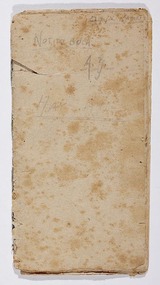
... tables etc. Intended accommodation taken up by luggage cases. (barbed wire). Food good but only spoons. Next day: robbery from the cases. Own people steal. Purloined objects even include toothbrushes and toothpaste. Much to eat. Small convoy with one cruiser. In the same convoy a women’s transport which soon leaves us as it is bound for Canada and we are quite surprised. The English soldiers and officers have another side...tables etc. Intended accommodation taken up by luggage cases. (barbed wire). Food good but only spoons. Next day: robbery from the cases. Own people steal. Purloined objects even include toothbrushes and toothpaste. Much to eat. Small convoy with one cruiser. In the same convoy a women’s transport which soon leaves us as it is bound for Canada and we are quite surprised. The English soldiers and officers have another side ...This diary was handwritten by Alfred Broch over the course of four months in 1940. It was kept while Alfred Broch was travelling on the HMT Dunera and then during his detainment in the Hay internment camp.Bound with cotton and handwritten in pencil. Bound with cotton and handwritten in pencil.[selected passage translation from German, further translation available] : “Dunera” 10.VII – 6.IX.1940 First impression very depressing. Fears. Confusion with prisoners of war. Never mind. Corrected. Continuing further bad treatment. Boarding the ship assisted by rifle butts. Robbed as soon as we reached the deck. Impression of a death ship. Complete helplessness. No sleeping facilities. All sleep on the floor, on tables etc. Intended accommodation taken up by luggage cases. (barbed wire). Food good but only spoons. Next day: robbery from the cases. Own people steal. Purloined objects even include toothbrushes and toothpaste. Much to eat. Small convoy with one cruiser. In the same convoy a women’s transport which soon leaves us as it is bound for Canada and we are quite surprised. The English soldiers and officers have another side. While in the danger zone they only had a webbing belt and slippers. In case of torpedoes – expecting certain death. Bad air as all vents are closed. Other Inscriptions: Front page, upper right, underlined: "Alfred Broch" Front page, upper, underlined: "Notitz Buch" Front page, centre, underlined: "Hay 1941" Page 1, upper right: "Mittwoch 10. VII." Page 3, upper right: "10. VII. - 6. IX. 1940 Page 4, centre: "[...] ARANDORA STAR" Page 11, upper, underlined: "Von Liverpool Nach Hay / Mittwoch 10 VII" dunera, wwii, internment, jewish history & people -
 Ballarat Tramway Museum
Ephemera, The Commercial Notebook, Ballarat tram timetables, 1913
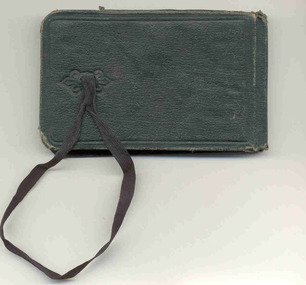
... On side of notebook, in the same cloth, a holder for a short pencil has been provided. On inside end paper, has a sticker of the "The Commercial Notebook", discount table. ...On side of notebook, in the same cloth, a holder for a short pencil has been provided. On inside end paper, has a sticker of the "The Commercial Notebook", discount table. ...Notebook, green cloth covered, with end papers, five sections ruled sheets sewn fitted with a black cotton tape strap. On side of notebook, in the same cloth, a holder for a short pencil has been provided. On inside end paper, has a sticker of the "The Commercial Notebook", discount table. In pencil is "J.H. Prisk / 516 Drummond / Ballarat" On first pages inside are details of change float, tickets sold, type , returns commencing "Monday 15/12" (1913) through to March 10 (1914), then many pages with monetary calculations, then sketches of tramcar lighting circuits, noes on cabling, roses, switches, current densities, and conduits lengths etc. Last page in notebook has notes re times of cards ex Sheds and Sebastopol and working hours on various runs. See worksheets in Reg. Item 3140 for details about Jack and his SEC driving career.On back of photograph in black ink "Jack Prisk Sec. Driver & Daughter Marg."trams, tramways, sec, drivers, esco, crews -
Lakes Entrance Historical Society
Postcard - Rev. Bulmer Lake Tyers Mission Station, Lake Tyers Victoria, Bulmer, H D, 1910c
... table. Reference: Page 46 ' You are what you make yourself to be ' by Phillip Pepper. On Reverse: Postcard, Halfpenny stamp for inland - one penny foreign. The address only to be written on this side...table. Reference: Page 46 ' You are what you make yourself to be ' by Phillip Pepper. On Reverse: Postcard, Halfpenny stamp for inland - one penny foreign. The address only to be written on this side ...Christmas at Lake Tyers, Kitty Johnson on left of table, Rev. John Bulmer on right of table. Reference: Page 46 ' You are what you make yourself to be ' by Phillip Pepper. On Reverse: Postcard, Halfpenny stamp for inland - one penny foreign. The address only to be written on this side.Black and white postcard of Rev. Bulmer distributing fruit cake to Aboriginal women and children, who are wearing European dress, at Lake Tyers Mission Station, Lake Tyers Victoria.aboriginals, religion -
 Lakes Entrance Historical Society
Photograph - Bamboo Motel, Tween Lakes Motel, Lakes Entrance c1960, 1959
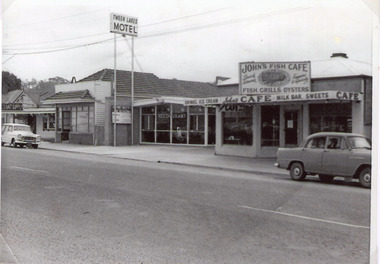
... tables 12 x 6 and the main games played were snooker and billiards. On the corner of Cairstairs Ave opposite Robin Hood Inn. The cafe Duckin, Mr and Mrs Kostantinidis bought it and on the side of that cafe down a verandah was the Billiard Room. ...tables 12 x 6 and the main games played were snooker and billiards. On the corner of Cairstairs Ave opposite Robin Hood Inn. The cafe Duckin, Mr and Mrs Kostantinidis bought it and on the side of that cafe down a verandah was the Billiard Room. ...There was Billiard parlour down that end of town in the early 50’s. in Carstairs Ave. Rosmary Kavadis father (John Kostantinidis) owned it and it held 2 big tables 12 x 6 and the main games played were snooker and billiards. On the corner of Cairstairs Ave opposite Robin Hood Inn. The cafe Duckin, Mr and Mrs Kostantinidis bought it and on the side of that cafe down a verandah was the Billiard Room. It was very popular and a lot of the locals would play there. Rosemary was about 5 - 7 years old and had to stand on a fish box to play. It was very popular and next door was the Bamboo Coffee Shop run by Mr and Mrs Varney The'Duckin' became Peels bait shop Dot and Con Coucoulas took over the Bamboo and turned it into a motel not sure of the year and then bought the Duckin and demolished it. It was after Tween Lakes was built in 1959, as that was the first motel on the Esplanade Lakes Entrance. The first 20 units and restaurant were built in 1959 with firsts guests on Dec. 22nd.1959. The units 21-27 plus the front residence and office were built in 1962.Black and white photographic copy of a short section of the Esplanade with Bamboo Cafe, Tween Lakes Motel and John's Fish Shop. A c1950 Holden sedan parked in front of Fish Cafe, and Holden wagon in front of Bamboo Motel. Lakes Entrance Victoriatownship, motels, restaurant, business, accommodation -
 National Wool Museum
Sheet, Instruction
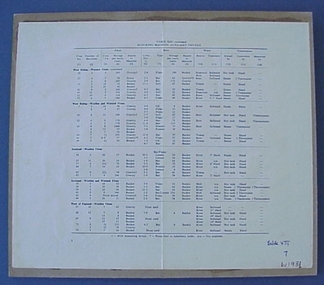
... Instruction sheet for mill floor operator, Table XIII Scouring Machine Auxiliary Details - continued. Textile Mills Collins Bros Mill Pty Ltd Other side of sheet. ...Instruction sheet for mill floor operator, Table XIII Scouring Machine Auxiliary Details - continued.Other side of sheet.textile mills, collins bros mill pty ltd -
 Stawell Historical Society Inc
Photograph, Salvation Army Home League Stawell
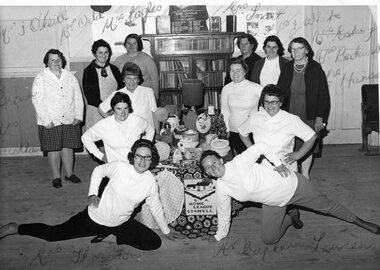
... Exercise Group Back Row: L to R: Betty Ackroyd, Eva Odd, Coral Eagles Marj Brown Margret Randle Front Olga Collins Right Side: Vi White, Lucy Eskin, Daphne Beckworth, Cynthia Perry Front Mrs Valma Laurens Religion Group of Ladies around a Table Some Posing on Floor. ...H.L. Exercise Group Back Row: L to R: Betty Ackroyd, Eva Odd, Coral Eagles Marj Brown Margret Randle Front Olga Collins Right Side: Vi White, Lucy Eskin, Daphne Beckworth, Cynthia Perry Front Mrs Valma LaurensGroup of Ladies around a Table Some Posing on Floor.religion
