
Showing 304 items matching "jammer"
-
 Eltham District Historical Society Inc
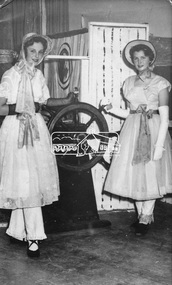
Photograph, Joy Chapman (left) with Dianne Bell in HMS Pinafore, 1960, 1960
... Being an only child growing up was a little lonely however rambling along the creek with my Mum, picking mushrooms and picking cherry plums for jam and the dogs catching rabbits which we ate if we could get them away from the dogs. ...Being an only child growing up was a little lonely however rambling along the creek with my Mum, picking mushrooms and picking cherry plums for jam and the dogs catching rabbits which we ate if we could get them away from the dogs. ...My Recollections of Eltham Past by Margaret Joy Harding (nee Joy Chapman.) My family of Elizabeth and Alec Chapman moved to Eltham in 1946 into a cottage on the opposite side of the Diamond Creek from where the little train now operates in the Lower Park. At that time Eltham truly was a country town and the Pub was the main meeting place for most inhabitants on a Saturday afternoon in the beer garden. I attended Eltham Primary School where I started as a 4-year-old (my birthday being slightly after the mid-year intake) that happened then. My mother spent a lot of days taking me back to school when I had dismissed myself and walked the one kilomtre home alone. Bremner's Common (now Wingrove Park) was a big attraction with its dam and tad poling which I found much more entertaining than school. (Mrs Bremner ran a Service Station on the site of the current one). Another attraction at this site was the circus that came a couple of times a year. Watching them put up the circus tent was very interesting and even more of an attraction was the feeding of the Lions in cages and the monkeys and elephants among the other animals that are not found in a circus these days. At school then we were provided with hot chocolate at morning recess where the mothers would prepare it in the shelter shed. The only form of classroom heating was an open fire. Worse was the warm milk given in the summer months. By the time I was near finishing at Primary school we used to be able to walk along the Main Road at lunchtime to Mrs. Mitchell's shop to a delicious hot pie. As I recall there was no supervision for this departure from the school grounds. It is interesting that some of the other children I started school with I still have contact with, in fact one is a very good friend although now living in Perth. That is the other thing about Eltham; many who grew up here continue to live in the area. Following primary school, the natural progression was to Eltham High School. There was only the main building at that time and I can remember our first assembly at the front entrance. During the time I was at High School several new class rooms were added and the school hall. I remember the musical plays such as HMS Pinafore and other classical musicals being performed. I also remember countless hours doing marching practice. The main street shops when I was young consisted of the Blue Gum milk bar at the far end, a Grocery store and a shoe maker where Coles currently stands. Opposite there was Lyon's Garage. They also provided a bus service and when we got off the train this little bus would tour the back streets taking each individual to their home, sometimes this could take quite considerable time. There was also a Black Smith next to the Chiropractic Practice opposite Alistair Knox Park, another Milk Bar/General Store on the comer of Bridge Street/Main Road where a shop currently still operates. There was also a Butcher's shop down from the pub opposite Franklin Street. The only doctor was next to the courthouse on the other side of Brougham Street. On Saturday afternoon I was occasionally allowed to go the movies in the Town Hall which also stood on the site of the Coles centre. Often the Fire Alarm would sound and everyone would run outside to watch the fire truck leave with the volunteers clutching on the back. The other attraction during summer of course was the swimming pool which was a small concrete pool filled with water pumped from the Diamond Creek, sometimes it was like a mud puddle so for me the nearer to home Yarra/Diamond Creek junction was a much better option. We swam in the water hole which was quite deep and with fallen trees and sometimes carcasses of cows and kangaroos floating past. As recreation, the churches were another attraction for the Sunday school picnics to Mordialloc in the back of the moving van with benches tied into the back for us to "sit" on. Too bad when we went around a corner! In the early days we had an Ice Man deliver the ice once a week for "refrigeration". The green grocer came around in a horse and cart as did the milkman and the bread was delivered but I constantly got into trouble for eating the middle out on the way from the box it was delivered to in Mt Pleasant road across the paddock. The milkman finally would not come down our street after his horse bolted one morning and took off across the paddock. We also had the "Pan Man" come weekly and whose visit I would avoid. Our nearest shop was where the flower stall is located opposite the Lower Park. It consisted of a Tea Room and Milk Bar. There was a Public Telephone there which was the only contact to anyone else. We were a one car family so my mother’s movements were very limited as the Eltham Station was a couple of kilometres away and a trip to the city was an event. Being an only child growing up was a little lonely however rambling along the creek with my Mum, picking mushrooms and picking cherry plums for jam and the dogs catching rabbits which we ate if we could get them away from the dogs. We also liked to go into the Lower Park during school holidays when the Greek people came to camp and they would sing and dance around the camp fire and it all seemed so different to us as this was early days of immigration. Childhood was relatively simple and carefree and I wish the kids of today had the freedom of my youth and the healthy outdoor lifestyle of the "olden days". SHOW GIRL COMPETITION In 1965 Eltham was more like a country town than the suburb it has become today. People knew each other, if not personally then certainly of the family name. The big event for the year was a Gymkhana or show at Lower Eltham Park. I can remember marching as a teenager from the town centre to the park in the marching girls with the decorated floats. In 1965, just on a whim on the day, I decided to enter the Miss Eltham Show Girl which was a part of the festivities at the park. I seem to remember that the show mainly consisted of horse events, cattle judging and dog show. As I had not given any serious thought to entering the competition, I wore a suit that I had for work which was brown wool, with a coffee coloured shirt under, black shoes, bag, and gloves but no hat. I duly paraded for the judges and much to my surprise I was announced the winner. I eventually went on to compete at the Miss Victoria Show Girl competition which was held at the Royal Melbourne Show. There I met many country girls who were representing their rural Victoria home. I made it into a final round of judging but I think justice prevailed when someone from a country background was crowned. It was fun to go into the show as I had not really been before and to see the displays of handcraft, cooking and wood chopping events was great as well as the judging of farm animals interesting. It is hard to remember the Eltham I grew up in. The Lyons Garage company bus that actually drove you home (or close to it) when we got off the train at night. The Eltham Hotel on a Saturday afternoon a usual social meeting place where people just sat and chatted. The pictures held in the Town Hall and when the fire alarm sounded all the men just jumped up and ran to help. Suburbia has now swallowed most of that life but thankfully we at least do have the trestle bridge and parkland. Digital file only - Black and white photo print on loan for scanning by EDHSalec chapman, annie bremner, blacksmith, bremner's flat, brougham steet, bus services, circus, diamond creek, dianne bell, doctor bradbury, easter gymkhana, elizabeth chapman, eltham high school, eltham hotel, eltham lower park, eltham public hall, eltham state school, eltham trestle bridge, general store, grace mitchell, ice man, joy chapman, lyons garage, margaret harding, milk bar, miss eltham 1965, miss victoria show girl, mount pleasant road, pan man, rodda parade, shops, show girl competition, swimming pool, water hole, yarra river -
 Eltham District Historical Society Inc
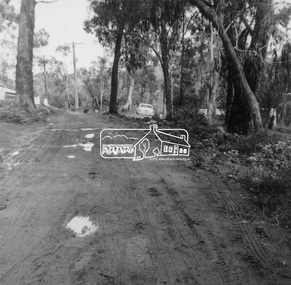
Photograph, Rodda Parade looking towards the creek, 1960. Chapman home to the right, 1960
... Being an only child growing up was a little lonely however rambling along the creek with my Mum, picking mushrooms and picking cherry plums for jam and the dogs catching rabbits which we ate if we could get them away from the dogs. ...Being an only child growing up was a little lonely however rambling along the creek with my Mum, picking mushrooms and picking cherry plums for jam and the dogs catching rabbits which we ate if we could get them away from the dogs. ...My Recollections of Eltham Past by Margaret Joy Harding (nee Joy Chapman.) My family of Elizabeth and Alec Chapman moved to Eltham in 1946 into a cottage on the opposite side of the Diamond Creek from where the little train now operates in the Lower Park. At that time Eltham truly was a country town and the Pub was the main meeting place for most inhabitants on a Saturday afternoon in the beer garden. I attended Eltham Primary School where I started as a 4-year-old (my birthday being slightly after the mid-year intake) that happened then. My mother spent a lot of days taking me back to school when I had dismissed myself and walked the one kilomtre home alone. Bremner's Common (now Wingrove Park) was a big attraction with its dam and tad poling which I found much more entertaining than school. (Mrs Bremner ran a Service Station on the site of the current one). Another attraction at this site was the circus that came a couple of times a year. Watching them put up the circus tent was very interesting and even more of an attraction was the feeding of the Lions in cages and the monkeys and elephants among the other animals that are not found in a circus these days. At school then we were provided with hot chocolate at morning recess where the mothers would prepare it in the shelter shed. The only form of classroom heating was an open fire. Worse was the warm milk given in the summer months. By the time I was near finishing at Primary school we used to be able to walk along the Main Road at lunchtime to Mrs. Mitchell's shop to a delicious hot pie. As I recall there was no supervision for this departure from the school grounds. It is interesting that some of the other children I started school with I still have contact with, in fact one is a very good friend although now living in Perth. That is the other thing about Eltham; many who grew up here continue to live in the area. Following primary school, the natural progression was to Eltham High School. There was only the main building at that time and I can remember our first assembly at the front entrance. During the time I was at High School several new class rooms were added and the school hall. I remember the musical plays such as HMS Pinafore and other classical musicals being performed. I also remember countless hours doing marching practice. The main street shops when I was young consisted of the Blue Gum milk bar at the far end, a Grocery store and a shoe maker where Coles currently stands. Opposite there was Lyon's Garage. They also provided a bus service and when we got off the train this little bus would tour the back streets taking each individual to their home, sometimes this could take quite considerable time. There was also a Black Smith next to the Chiropractic Practice opposite Alistair Knox Park, another Milk Bar/General Store on the comer of Bridge Street/Main Road where a shop currently still operates. There was also a Butcher's shop down from the pub opposite Franklin Street. The only doctor was next to the courthouse on the other side of Brougham Street. On Saturday afternoon I was occasionally allowed to go the movies in the Town Hall which also stood on the site of the Coles centre. Often the Fire Alarm would sound and everyone would run outside to watch the fire truck leave with the volunteers clutching on the back. The other attraction during summer of course was the swimming pool which was a small concrete pool filled with water pumped from the Diamond Creek, sometimes it was like a mud puddle so for me the nearer to home Yarra/Diamond Creek junction was a much better option. We swam in the water hole which was quite deep and with fallen trees and sometimes carcasses of cows and kangaroos floating past. As recreation, the churches were another attraction for the Sunday school picnics to Mordialloc in the back of the moving van with benches tied into the back for us to "sit" on. Too bad when we went around a corner! In the early days we had an Ice Man deliver the ice once a week for "refrigeration". The green grocer came around in a horse and cart as did the milkman and the bread was delivered but I constantly got into trouble for eating the middle out on the way from the box it was delivered to in Mt Pleasant road across the paddock. The milkman finally would not come down our street after his horse bolted one morning and took off across the paddock. We also had the "Pan Man" come weekly and whose visit I would avoid. Our nearest shop was where the flower stall is located opposite the Lower Park. It consisted of a Tea Room and Milk Bar. There was a Public Telephone there which was the only contact to anyone else. We were a one car family so my mother’s movements were very limited as the Eltham Station was a couple of kilometres away and a trip to the city was an event. Being an only child growing up was a little lonely however rambling along the creek with my Mum, picking mushrooms and picking cherry plums for jam and the dogs catching rabbits which we ate if we could get them away from the dogs. We also liked to go into the Lower Park during school holidays when the Greek people came to camp and they would sing and dance around the camp fire and it all seemed so different to us as this was early days of immigration. Childhood was relatively simple and carefree and I wish the kids of today had the freedom of my youth and the healthy outdoor lifestyle of the "olden days". SHOW GIRL COMPETITION In 1965 Eltham was more like a country town than the suburb it has become today. People knew each other, if not personally then certainly of the family name. The big event for the year was a Gymkhana or show at Lower Eltham Park. I can remember marching as a teenager from the town centre to the park in the marching girls with the decorated floats. In 1965, just on a whim on the day, I decided to enter the Miss Eltham Show Girl which was a part of the festivities at the park. I seem to remember that the show mainly consisted of horse events, cattle judging and dog show. As I had not given any serious thought to entering the competition, I wore a suit that I had for work which was brown wool, with a coffee coloured shirt under, black shoes, bag, and gloves but no hat. I duly paraded for the judges and much to my surprise I was announced the winner. I eventually went on to compete at the Miss Victoria Show Girl competition which was held at the Royal Melbourne Show. There I met many country girls who were representing their rural Victoria home. I made it into a final round of judging but I think justice prevailed when someone from a country background was crowned. It was fun to go into the show as I had not really been before and to see the displays of handcraft, cooking and wood chopping events was great as well as the judging of farm animals interesting. It is hard to remember the Eltham I grew up in. The Lyons Garage company bus that actually drove you home (or close to it) when we got off the train at night. The Eltham Hotel on a Saturday afternoon a usual social meeting place where people just sat and chatted. The pictures held in the Town Hall and when the fire alarm sounded all the men just jumped up and ran to help. Suburbia has now swallowed most of that life but thankfully we at least do have the trestle bridge and parkland. Digital file only - Black and white photo print on loan for scanning by EDHSalec chapman, annie bremner, blacksmith, bremner's flat, brougham steet, bus services, circus, diamond creek, dianne bell, doctor bradbury, easter gymkhana, elizabeth chapman, eltham high school, eltham hotel, eltham lower park, eltham public hall, eltham state school, eltham trestle bridge, general store, grace mitchell, ice man, joy chapman, lyons garage, margaret harding, milk bar, miss eltham 1965, miss victoria show girl, mount pleasant road, pan man, rodda parade, shops, show girl competition, swimming pool, water hole, yarra river -
 Eltham District Historical Society Inc
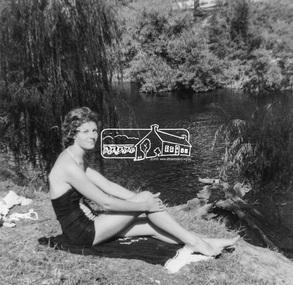
Photograph, Joy Chapman at the river junction, February 1962, Feb 1962
... Being an only child growing up was a little lonely however rambling along the creek with my Mum, picking mushrooms and picking cherry plums for jam and the dogs catching rabbits which we ate if we could get them away from the dogs. ...Being an only child growing up was a little lonely however rambling along the creek with my Mum, picking mushrooms and picking cherry plums for jam and the dogs catching rabbits which we ate if we could get them away from the dogs. ...My Recollections of Eltham Past by Margaret Joy Harding (nee Joy Chapman.) My family of Elizabeth and Alec Chapman moved to Eltham in 1946 into a cottage on the opposite side of the Diamond Creek from where the little train now operates in the Lower Park. At that time Eltham truly was a country town and the Pub was the main meeting place for most inhabitants on a Saturday afternoon in the beer garden. I attended Eltham Primary School where I started as a 4-year-old (my birthday being slightly after the mid-year intake) that happened then. My mother spent a lot of days taking me back to school when I had dismissed myself and walked the one kilomtre home alone. Bremner's Common (now Wingrove Park) was a big attraction with its dam and tad poling which I found much more entertaining than school. (Mrs Bremner ran a Service Station on the site of the current one). Another attraction at this site was the circus that came a couple of times a year. Watching them put up the circus tent was very interesting and even more of an attraction was the feeding of the Lions in cages and the monkeys and elephants among the other animals that are not found in a circus these days. At school then we were provided with hot chocolate at morning recess where the mothers would prepare it in the shelter shed. The only form of classroom heating was an open fire. Worse was the warm milk given in the summer months. By the time I was near finishing at Primary school we used to be able to walk along the Main Road at lunchtime to Mrs. Mitchell's shop to a delicious hot pie. As I recall there was no supervision for this departure from the school grounds. It is interesting that some of the other children I started school with I still have contact with, in fact one is a very good friend although now living in Perth. That is the other thing about Eltham; many who grew up here continue to live in the area. Following primary school, the natural progression was to Eltham High School. There was only the main building at that time and I can remember our first assembly at the front entrance. During the time I was at High School several new class rooms were added and the school hall. I remember the musical plays such as HMS Pinafore and other classical musicals being performed. I also remember countless hours doing marching practice. The main street shops when I was young consisted of the Blue Gum milk bar at the far end, a Grocery store and a shoe maker where Coles currently stands. Opposite there was Lyon's Garage. They also provided a bus service and when we got off the train this little bus would tour the back streets taking each individual to their home, sometimes this could take quite considerable time. There was also a Black Smith next to the Chiropractic Practice opposite Alistair Knox Park, another Milk Bar/General Store on the comer of Bridge Street/Main Road where a shop currently still operates. There was also a Butcher's shop down from the pub opposite Franklin Street. The only doctor was next to the courthouse on the other side of Brougham Street. On Saturday afternoon I was occasionally allowed to go the movies in the Town Hall which also stood on the site of the Coles centre. Often the Fire Alarm would sound and everyone would run outside to watch the fire truck leave with the volunteers clutching on the back. The other attraction during summer of course was the swimming pool which was a small concrete pool filled with water pumped from the Diamond Creek, sometimes it was like a mud puddle so for me the nearer to home Yarra/Diamond Creek junction was a much better option. We swam in the water hole which was quite deep and with fallen trees and sometimes carcasses of cows and kangaroos floating past. As recreation, the churches were another attraction for the Sunday school picnics to Mordialloc in the back of the moving van with benches tied into the back for us to "sit" on. Too bad when we went around a corner! In the early days we had an Ice Man deliver the ice once a week for "refrigeration". The green grocer came around in a horse and cart as did the milkman and the bread was delivered but I constantly got into trouble for eating the middle out on the way from the box it was delivered to in Mt Pleasant road across the paddock. The milkman finally would not come down our street after his horse bolted one morning and took off across the paddock. We also had the "Pan Man" come weekly and whose visit I would avoid. Our nearest shop was where the flower stall is located opposite the Lower Park. It consisted of a Tea Room and Milk Bar. There was a Public Telephone there which was the only contact to anyone else. We were a one car family so my mother’s movements were very limited as the Eltham Station was a couple of kilometres away and a trip to the city was an event. Being an only child growing up was a little lonely however rambling along the creek with my Mum, picking mushrooms and picking cherry plums for jam and the dogs catching rabbits which we ate if we could get them away from the dogs. We also liked to go into the Lower Park during school holidays when the Greek people came to camp and they would sing and dance around the camp fire and it all seemed so different to us as this was early days of immigration. Childhood was relatively simple and carefree and I wish the kids of today had the freedom of my youth and the healthy outdoor lifestyle of the "olden days". SHOW GIRL COMPETITION In 1965 Eltham was more like a country town than the suburb it has become today. People knew each other, if not personally then certainly of the family name. The big event for the year was a Gymkhana or show at Lower Eltham Park. I can remember marching as a teenager from the town centre to the park in the marching girls with the decorated floats. In 1965, just on a whim on the day, I decided to enter the Miss Eltham Show Girl which was a part of the festivities at the park. I seem to remember that the show mainly consisted of horse events, cattle judging and dog show. As I had not given any serious thought to entering the competition, I wore a suit that I had for work which was brown wool, with a coffee coloured shirt under, black shoes, bag, and gloves but no hat. I duly paraded for the judges and much to my surprise I was announced the winner. I eventually went on to compete at the Miss Victoria Show Girl competition which was held at the Royal Melbourne Show. There I met many country girls who were representing their rural Victoria home. I made it into a final round of judging but I think justice prevailed when someone from a country background was crowned. It was fun to go into the show as I had not really been before and to see the displays of handcraft, cooking and wood chopping events was great as well as the judging of farm animals interesting. It is hard to remember the Eltham I grew up in. The Lyons Garage company bus that actually drove you home (or close to it) when we got off the train at night. The Eltham Hotel on a Saturday afternoon a usual social meeting place where people just sat and chatted. The pictures held in the Town Hall and when the fire alarm sounded all the men just jumped up and ran to help. Suburbia has now swallowed most of that life but thankfully we at least do have the trestle bridge and parkland. Digital file only - Black and white photo print on loan for scanning by EDHSalec chapman, annie bremner, blacksmith, bremner's flat, brougham steet, bus services, circus, diamond creek, dianne bell, doctor bradbury, easter gymkhana, elizabeth chapman, eltham high school, eltham hotel, eltham lower park, eltham public hall, eltham state school, eltham trestle bridge, general store, grace mitchell, ice man, joy chapman, lyons garage, margaret harding, milk bar, miss eltham 1965, miss victoria show girl, mount pleasant road, pan man, rodda parade, shops, show girl competition, swimming pool, water hole, yarra river -
 Flagstaff Hill Maritime Museum and Village
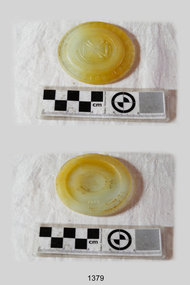
Cap Liner, Between 1870 and 1908
... The Falls of Halladale had been at sail for 102 days when, at 3 am on the night of 14th November 1908, under full sail in calm seas with a six knots breeze behind and misleading fog along the coast, the great vessel rose upon an ocean swell and settled on top of a submerged reef near Peterborough on south-west Victoria’s coast. The ship was jammed on the rocks and began filling with water. ...The Falls of Halladale had been at sail for 102 days when, at 3 am on the night of 14th November 1908, under full sail in calm seas with a six knots breeze behind and misleading fog along the coast, the great vessel rose upon an ocean swell and settled on top of a submerged reef near Peterborough on south-west Victoria’s coast. The ship was jammed on the rocks and began filling with water. ...This Zinc Cap Porcelain Liner was recovered from the (1908) shipwreck site of the FALLS OF HALLADALE. The purpose of cap liners was to assist with the safe preserving and storage of perishable foodstuffs in an age when refrigeration was generally unavailable. These round, coarse-glass inserts formed part of the screw lids used with the Ball Mason style of canning fruit jars. The liner was placed inside the zinc cap to stop the contents of the jar reacting with the zinc. It prevented the metallic tainting of food as well as the corrosion of the metallic lid. On March 30, 1869, Lewis R Boyd was issued with patent # 88439 for an “Improved Mode of Preventing Corrosion in Metallic Caps”. From the 1870s to the 1950s, large quantities of these liners were produced by a number of glass manufacturing companies. They are consequently difficult to date or identify. “It is assumed that most of the earlier versions of these liners have the name ‘BOYD’S’ or ‘BOYD’ embossed on them. Later versions may or may not have the name included in the lettering”. (http://www.glassbottlemarks.com). Only a few were made of porcelain, the great majority being made first of transparent and later of translucent or opaque glass. The different emblems of triangles, circles, and crosses embossed on the front face of the liners are assumed to signify mould or model types rather than the company that produced them. This particular artefact is one of 14 cap liners that were retrieved from the shipwreck site and are now part of the Flagstaff Hill Maritime Village collection. The Maltese Cross and “BOYD’S GENUINE PORCELAIN LINED” lettering are unique to this piece. However, it is evident from the markings and materials of the other cap liners, that they originally formed sets or series. Six are larger (8 mm depth x 85mm diameter), of greenish hue with ground glass texture, and support the raised emblem of a compass needle. Two are medium-sized (75mm diameter) with two raised dots in a central circle and the lettering “Patd. APR 25.82”. This particular cap liner is likely to have also been one of a mass-produced line being imported from America. The iron-hulled sailing ship FALLS OF HALLADALE was a bulk carrier of general cargo en route from New York to Melbourne and Sydney. In her hold, along with 56,763 tiles of unusual beautiful green American slates (roofing tiles), 5,673 coils of barbed wire, 600 stoves, 500 sewing machines, 6500 gallons of oil, 14400 gallons of benzene, and many other manufactured items, were 117 cases of crockery and glassware. The FALLS OF HALLADALE came aground on a reef off the Peterborough headland at 3 am on the morning of the 15th of November, 1908. The captain and 29 crew members all survived, but her valuable cargo was largely lost, despite two salvage attempts in1908-09 and 1910. The iron-hulled, four-masted barque, the Falls of Halladale, was a bulk carrier of general cargo. She left New York in August 1908 on her way to Melbourne and Sydney. In her hold, along with 56,763 tiles of unusual beautiful green American slates (roofing tiles), 5,673 coils of barbed wire, 600 stoves, 500 sewing machines, 6500 gallons of oil, 14400 gallons of benzene, and many other manufactured items, were 117 cases of crockery and glassware. Three months later and close to her destination, a navigational error caused the Falls of Halladale to be wrecked on a reef off the Peterborough headland at 3 am on the morning of the 15th of November, 1908. The captain and 29 crew members all survived, but her valuable cargo was largely lost, despite two salvage attempts in 1908-09 and 1910. ABOUT THE ‘FALLS OF HALLADALE’ (1886 - 1908) Built: in1886 by Russell & Co., Greenock shipyards, River Clyde, Scotland, UK. The company was founded in 1870 (or 1873) as a partnership between Joseph Russell (1834-1917), Anderson Rodger and William Todd Lithgow. During the period 1882-92 Russell & Co., they standardised designs, which sped up their building process so much that they were able to build 271 ships over that time. In 1886 they introduced a 3000 ton class of sailing vessel with auxiliary engines and brace halyard winches. In 1890 they broke the world output record. Owner: Falls Line, Wright, Breakenridge & Co, 111 Union Street, Glasgow, Scotland. Configuration: Four masted sailing ship; iron-hulled barque; iron masts, wire rigging, fore & aft lifting bridges. Size: Length 83.87m x Breadth 12.6m x Depth 7.23m, Gross tonnage 2085 ton Wrecked: the night of 14th November 1908, Curdies Inlet, Peterborough south west Victoria Crew: 29 The Falls of Halladale was a four-masted sailing ship built-in 1886 in Glasgow, Scotland, for the long-distance cargo trade and was mostly used for Pacific grain trade. She was owned by Wright, Breakenridge & Co of Glasgow and was one of several Falls Line ships, all of which were named after waterfalls in Scotland. The lines flag was of red, blue and white vertical stripes. The Falls of Halladale had a sturdy construction built to carry maximum cargo and able to maintain full sail in heavy gales, one of the last of the ‘windjammers’ that sailed the Trade Route. She and her sister ship, the Falls of Garry, were the first ships in the world to include fore and aft lifting bridges. Previous to this, heavily loaded vessels could have heavy seas break along the full length of the deck, causing serious injury or even death to those on deck. The new, raised catwalk-type decking allowed the crew to move above the deck stormy conditions. This idea is still used today on the most modern tankers and cargo vessels and has proved to be an important step forward in the safety of men at sea. On 4th August 1908, with new sails, 29 crew, and 2800 tons of cargo, the Falls of Halladale left New York, bound for Melbourne and Sydney via the Cape of Good Hope. The cargo on board was valued at £35,000 and included 56,763 tiles of American slate roofing tiles (roof slates), 5,673 coils of barbed wire, 600 stoves, 500 sewing machines, 6,500 gallons of oil, 14,400 gallons of benzene, plumbing iron, 117 cases of crockery and glassware and many other manufactured items. The Falls of Halladale had been at sail for 102 days when, at 3 am on the night of 14th November 1908, under full sail in calm seas with a six knots breeze behind and misleading fog along the coast, the great vessel rose upon an ocean swell and settled on top of a submerged reef near Peterborough on south-west Victoria’s coast. The ship was jammed on the rocks and began filling with water. The crew launched the two lifeboats and all 29 crew landed safely on the beach over 4 miles away at the Bay of Islands. The postmistress at Peterborough, who kept a watch for vessels in distress, saw the stranding and sent out an alert to the local people. A rescue party went to the aid of the sailors and the Port Campbell rocket crew was dispatched, but the crew had all managed to reach shore safely by the time help arrived. The ship stayed in full sail on the rocky shelf for nearly two months, attracting hundreds of sightseers who watched her slowly disintegrate until the pounding seas and dynamiting by salvagers finally broke her back, and her remains disappeared back into deeper water. The valuable cargo was largely lost, despite two salvage attempts in 1908-09 and 1910. Further salvage operations were made from 1974-1986, during which time 22,000 slate tiles were recovered with the help of 14 oil drums to float them, plus personal artefacts, ship fittings, reams of paper and other items. The Court of Marine Inquiry in Melbourne ruled that the foundering of the ship was entirely due to Captain David Wood Thomson’s navigational error, not too technical failure of the Clyde-built ship. The shipwreck is a popular site for divers, about 300m offshore and in 3 – 15m of water. Some of the original cargo can be seen at the site, including pieces of roof slate and coils of barbed wire. The Falls of Halladale shipwreck is listed on the Victorian Heritage Register (No. S255). She was one of the last ships to sail the Trade Routes. She is one of the first vessels to have fore and aft lifting bridges. She is an example of the remains of an International Cargo Ship and also represents aspects of Victoria’s shipping industry. The wreck is protected as a Historic Shipwreck under the Commonwealth Historic Shipwrecks Act (1976). A circular translucent glass disc in good condition with raised upper case lettering around 8mm rim – “BOYD’S GENUINE PORCELAIN LINED” - and a raised central emblem of a Maltese Cross. On the reverse face in the centre of the disc, there is a raised numeral “3”. falls of halladale, wright, breakenridge & co of glasgow, unusual beautiful green american slates (roofing tiles), warrnambool, shipwrecked-coast, flagstaff-hill, flagstaff-hill-maritime-museum, maritime-museum, shipwreck-coast, flagstaff-hill-maritime-village, shipwrecked-artefact, zinc cap porcelain liner, boyd’s genuine porcelain lined, glass lid, opaque disc, food preserving, fruit bottling, cap liner, shipwrecked coast, flagstaff hill maritime museum, shipwreck artefact, 1908 shipwreck -
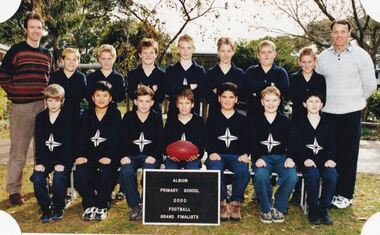 Sunshine and District Historical Society Incorporated
Photograph - Albion State School 2000 Class Photographs
... 5153.01 - Albion State School 2000 Football Grand Finalists 5153.02 - Albion State School 2000 Grade 1 2E 5153.02 - Albion State School 2000 Grade 1 2E Names Back Row L2R Alisi Faingaanuku Ashley Skew Michael Nardella Julie Rand Tyson Stone Mary Guglielmi Robert Depietro Second Row L2R Jennifer Truong Jayde Stanley Corine Markovic Malgorzata Wasilewska Robert Reynolds Jessica Nedelkovska Annie Lam Carl Schwencke Front L2R Kasey Davis Danielle Williams Joshua Folino Laura Demicoli Cavan Chen Jenny Le Jake Raye Jennifer Williams Tully Tran 5153.03 - Albion State School 2000 Grade 2 3H 5153.03 - Albion State School 2000 Grade 2 3H Names Back Row L2R Cody Mayne Timothy McGrath David Kennedy Simon Kinder Peter Horak Dion Johnson Second Row L2R Aiden Wileman Tiani Megens Monique Zerni Rachel Elliott Stephanie Stronell Kelly Kennedy Tony Tongpoon Front Row L2R Luke Cleland Meyer Teagan Maguire Christopher Dymott Callan Tishlet Helen Ha Michael Dipietro Jame schwencke Emily Folino Roger Cini Absent William Burrows Tiffany Smith 5153.04 - Albion State School 2000 Grade 3 4D 5153.04 - Albion State School 2000 Grade 3 4D Names Back Row L2R Benjamin Milicevic William Raye Jack Wightman Mathew Grima Mitchell Pollard Steven Cameron Shane Quinsee Rafael Protacio Second Row L2R Nikki Durham Miranda Hall Thuy Vu Melissa Kennedy Megan Montague Zayne Duggan Jacquilyn TeRay Dusan Zarkovic Front Row L2R Nichalos Davie Shannan Weeks Minh Le Cassandra Williams Olivia Moore Jade Formosa Shannan Salmon Lynda Ferrara Daniel Kindred 5153.05 - Albion State School 2000 Grade 4 5T 5153.05 - Albion State School 2000 Grade 4 5T Names Back Row L2R Cong Le Adis Husejnovic Troy Maguire Chantelle Noack Kamil Bulinski Dylan Markovic Steven Pucek Second Row L2R Blake Cain Mathew Smith Mathew Tiemes Jilliah Johnson Priya Shah Justin Wemyss Gul Resuloglu Garratt Stone Front Row L2R Samantha Williams Caitlin Tippet Steve Bernacki Adam Stanley Meg MKinnon Helen Milsom Nicholas Rosener Courtney Te Ray Jared DAlfonso Teachers Mrs Jann Turner Mrs Teresa Woods Mrs Betty Batty Mr Gareth Dainton Principal Mr Joe Vella 5153.06 - Albion State School 2000 Grade 5 6H 5153.06 - Albion State School 2000 Grade 5 6H Names Back Row L2R Alison Testa Jarrod Montague Heidi McKinnon Matthew Baker Brody Woodbury Doreen Roberts Second Row L2R Katherine ONeill Bradley Rolfo Benjamin Huynh Sarah Kennedy Lisa Broadwood Ricky Liddy Nicholas Miller Front Row L2R Sara Kindred Gavin Stone Terence Sinclair Mary Nguyen Farisha Zammit Katie Hamilton Damian Stanley Anh Vu Matthew Gauci 5153.07 - Albion State School 2000 Grade 5 6P 5153.07 - Albion State School 2000 Grade 5 6P Names Back Row Troy Strinovic Miki ORegan Kellie Davis Dwayne Brown Binh Nguyen Second Row L2R Samantha Skew Ricky Lyon Jessica James Charly Attard Garry Gath Caterina Viterale Rory Markovic Front Row L2R Sean Ung Matthew Archer Patrick Geoghegan Jimmy Phan Catherine Protacio Brendon Stephens Jennifer Pucek Rebecca Trinh Robert Anderson Teacher Mrs Patricia Porigneaux Mrs Lynn Mahoney Principal Mr Joe Vella 5153.08 - Albion State School 2000 Grade Prep 1X 5153.08 - Albion State School 2000 Grade Prep 1X Names Back Row Jarrod Doherty Ebony Wemyss Nicolle Reynolds Jade Burling Ethan Morgan Jim Murphy Second Row L2R Jack Schofield Julie Ung Jessica Heeps Reece Mayne Anthony Buttiegieg Casey James Amanda Mustafa Kieran Azzopardi Front Row L2R Luke DAlfonso Naomi Truong Jesse Culhane Saamu Melissa Hall Natalie Coburn Nicole Williams Imran Clancy Nasim Jamal David Tran 5153.09 - Albion State School 2000 Whole School Hands Up 5153.10 - Albion State School 2000 House Captains 5153.11 - Albion State School 2000 JSC 5153.12 - Albion State School 2000 Netball Squad Grand Finalists 5153.13 - Albion State School 2000 Newcombe 5153.14 - Albion State School 2000 Whole School 5153.15 - Albion State School 2000 Staff 5153.15 - Albion State School 2000 Staff Names Back Row L2R Valentina Risteska Donna El Daief Ann Fabbro Lorraine Farrugia Second Row L2R Sandra Spurr Jann Turner Adrieene Erwood Gareth Dainton Wayne Haren Anna Xasteroulis Julie Hrovatin Betty Batty Front Row L2R Kathryn Ceballos Lynn Mahoney Susan Carpenter Joe Vella Teresa Woods Angela Paschalidis Sandy Dennis Absent Pat Porigneaux Chris Sortino 5153.16 - Albion State School 2000 T Ball...Albion State School Albion Primary School Adelaide Street Albion 5153.01 - Albion State School 2000 Football Grand Finalists 5153.02 - Albion State School 2000 Grade 1 2E 5153.02 - Albion State School 2000 Grade 1 2E Names Back Row L2R Alisi Faingaanuku Ashley Skew Michael Nardella Julie Rand Tyson Stone Mary Guglielmi Robert Depietro Second Row L2R Jennifer Truong Jayde Stanley Corine Markovic Malgorzata Wasilewska Robert Reynolds Jessica Nedelkovska Annie Lam Carl Schwencke Front L2R Kasey Davis Danielle Williams Joshua Folino Laura Demicoli Cavan Chen Jenny Le Jake Raye Jennifer Williams Tully Tran 5153.03 - Albion State School 2000 Grade 2 3H 5153.03 - Albion State School 2000 Grade 2 3H Names Back Row L2R Cody Mayne Timothy McGrath David Kennedy Simon Kinder Peter Horak Dion Johnson Second Row L2R Aiden Wileman Tiani Megens Monique Zerni Rachel Elliott Stephanie Stronell Kelly Kennedy Tony Tongpoon Front Row L2R Luke Cleland Meyer Teagan Maguire Christopher Dymott Callan Tishlet Helen Ha Michael Dipietro Jame schwencke Emily Folino Roger Cini Absent William Burrows Tiffany Smith 5153.04 - Albion State School 2000 Grade 3 4D 5153.04 - Albion State School 2000 Grade 3 4D Names Back Row L2R Benjamin Milicevic William Raye Jack Wightman Mathew Grima Mitchell Pollard Steven Cameron Shane Quinsee Rafael Protacio Second Row L2R Nikki Durham Miranda Hall Thuy Vu Melissa Kennedy Megan Montague Zayne Duggan Jacquilyn TeRay Dusan Zarkovic Front Row L2R Nichalos Davie Shannan Weeks Minh Le Cassandra Williams Olivia Moore Jade Formosa Shannan Salmon Lynda Ferrara Daniel Kindred 5153.05 - Albion State School 2000 Grade 4 5T 5153.05 - Albion State School 2000 Grade 4 5T Names Back Row L2R Cong Le Adis Husejnovic Troy Maguire Chantelle Noack Kamil Bulinski Dylan Markovic Steven Pucek Second Row L2R Blake Cain Mathew Smith Mathew Tiemes Jilliah Johnson Priya Shah Justin Wemyss Gul Resuloglu Garratt Stone Front Row L2R Samantha Williams Caitlin Tippet Steve Bernacki Adam Stanley Meg MKinnon Helen Milsom Nicholas Rosener Courtney Te Ray Jared DAlfonso Teachers Mrs Jann Turner Mrs Teresa Woods Mrs Betty Batty Mr Gareth Dainton Principal Mr Joe Vella 5153.06 - Albion State School 2000 Grade 5 6H 5153.06 - Albion State School 2000 Grade 5 6H Names Back Row L2R Alison Testa Jarrod Montague Heidi McKinnon Matthew Baker Brody Woodbury Doreen Roberts Second Row L2R Katherine ONeill Bradley Rolfo Benjamin Huynh Sarah Kennedy Lisa Broadwood Ricky Liddy Nicholas Miller Front Row L2R Sara Kindred Gavin Stone Terence Sinclair Mary Nguyen Farisha Zammit Katie Hamilton Damian Stanley Anh Vu Matthew Gauci 5153.07 - Albion State School 2000 Grade 5 6P 5153.07 - Albion State School 2000 Grade 5 6P Names Back Row Troy Strinovic Miki ORegan Kellie Davis Dwayne Brown Binh Nguyen Second Row L2R Samantha Skew Ricky Lyon Jessica James Charly Attard Garry Gath Caterina Viterale Rory Markovic Front Row L2R Sean Ung Matthew Archer Patrick Geoghegan Jimmy Phan Catherine Protacio Brendon Stephens Jennifer Pucek Rebecca Trinh Robert Anderson Teacher Mrs Patricia Porigneaux Mrs Lynn Mahoney Principal Mr Joe Vella 5153.08 - Albion State School 2000 Grade Prep 1X 5153.08 - Albion State School 2000 Grade Prep 1X Names Back Row Jarrod Doherty Ebony Wemyss Nicolle Reynolds Jade Burling Ethan Morgan Jim Murphy Second Row L2R Jack Schofield Julie Ung Jessica Heeps Reece Mayne Anthony Buttiegieg Casey James Amanda Mustafa Kieran Azzopardi Front Row L2R Luke DAlfonso Naomi Truong Jesse Culhane Saamu Melissa Hall Natalie Coburn Nicole Williams Imran Clancy Nasim Jamal David Tran 5153.09 - Albion State School 2000 Whole School Hands Up 5153.10 - Albion State School 2000 House Captains 5153.11 - Albion State School 2000 JSC 5153.12 - Albion State School 2000 Netball Squad Grand Finalists 5153.13 - Albion State School 2000 Newcombe 5153.14 - Albion State School 2000 Whole School 5153.15 - Albion State School 2000 Staff 5153.15 - Albion State School 2000 Staff Names Back Row L2R Valentina Risteska Donna El Daief Ann Fabbro Lorraine Farrugia Second Row L2R Sandra Spurr Jann Turner Adrieene Erwood Gareth Dainton Wayne Haren Anna Xasteroulis Julie Hrovatin Betty Batty Front Row L2R Kathryn Ceballos Lynn Mahoney Susan Carpenter Joe Vella Teresa Woods Angela Paschalidis Sandy Dennis Absent Pat Porigneaux Chris Sortino 5153.16 - Albion State School 2000 T Ball Collection of Digital Photographs Photograph Albion State School 2000 Class Photographs ...The current school, Albion Primary School, No 4265 opened in 1926. It was built on a site once owned by John Fitzgerald (1850s). The land was later acquired by H. V. McKay who had transferred his Sunshine Harvester Works to the area in 1905 - 7. In 1920, the Albion railway station was moved nearer Ballarat Road at the request of Mr McKay. More people came to live in the area including soldier settlers.Albion Primary School's mission is to 'Aim High' in all we do so that our students grow to be socially capable, reach their full academic potential and become caring, respectful community minded people. Albion Primary School is located in a residential area in Albion, a small pocket of the local government area of Brimbank, approximately 10 kilometres west of Melbourne and was established in 1926. Our current enrolment is 199 students. We have a rich cultural diversity amongst our school community. The school is set around a courtyard with spacious playing areas including a grassed oval, running track, games courts, an adventure playground, sand pit, jumping pits, shady courtyard and garden areas, a vegetable garden and fruit tree orchard. As well as classroom groups, we have our learning teams, student house groups (siblings are allocated to the same house) and a Junior School Council. The school has four main buildings. All classrooms have air conditioning and interactive screens. Block A houses classrooms, staff areas and the administration offices. Our newest building has classrooms and some small group/office spaces. Block B includes our library, canteen and a multi-purpose room used for indoor physical education, Perceptual Motor Program, drama, visiting performers, and community activities. Block C houses classrooms and specialist rooms. We expect and receive the best from our students in terms of their learning and behaviour. The school’s dedicated and effective staff is strongly committed to helping students achieve personal, behavioural, social and academic success. In terms of learning, the highest priority is placed on the work in English and Mathematics. We also have a range of specialist and extra-curricular programs that we provide. Our specialist teacher-librarian is involved in reading extension programs that support development in literacy. All children are able to develop their artistic abilities through visual arts and music program. Our music program is supported by the Australian Children's Music Foundation. A specialist Physical Education teacher provides lessons for all children as well as the opportunity for students to participate in organised lunch time sporting competitions between the house groups. Auslan is the additional language all students learn at Albion. All children participate in a student wellbeing program that focuses on developing strong connections and a sense of belonging within the school. Our school student leaders participate in programs that help develop their leadership skills. 5153.01 - Albion State School 2000 Football Grand Finalists 5153.02 - Albion State School 2000 Grade 1 2E 5153.02 - Albion State School 2000 Grade 1 2E Names Back Row L2R Alisi Faingaanuku Ashley Skew Michael Nardella Julie Rand Tyson Stone Mary Guglielmi Robert Depietro Second Row L2R Jennifer Truong Jayde Stanley Corine Markovic Malgorzata Wasilewska Robert Reynolds Jessica Nedelkovska Annie Lam Carl Schwencke Front L2R Kasey Davis Danielle Williams Joshua Folino Laura Demicoli Cavan Chen Jenny Le Jake Raye Jennifer Williams Tully Tran 5153.03 - Albion State School 2000 Grade 2 3H 5153.03 - Albion State School 2000 Grade 2 3H Names Back Row L2R Cody Mayne Timothy McGrath David Kennedy Simon Kinder Peter Horak Dion Johnson Second Row L2R Aiden Wileman Tiani Megens Monique Zerni Rachel Elliott Stephanie Stronell Kelly Kennedy Tony Tongpoon Front Row L2R Luke Cleland Meyer Teagan Maguire Christopher Dymott Callan Tishlet Helen Ha Michael Dipietro Jame schwencke Emily Folino Roger Cini Absent William Burrows Tiffany Smith 5153.04 - Albion State School 2000 Grade 3 4D 5153.04 - Albion State School 2000 Grade 3 4D Names Back Row L2R Benjamin Milicevic William Raye Jack Wightman Mathew Grima Mitchell Pollard Steven Cameron Shane Quinsee Rafael Protacio Second Row L2R Nikki Durham Miranda Hall Thuy Vu Melissa Kennedy Megan Montague Zayne Duggan Jacquilyn TeRay Dusan Zarkovic Front Row L2R Nichalos Davie Shannan Weeks Minh Le Cassandra Williams Olivia Moore Jade Formosa Shannan Salmon Lynda Ferrara Daniel Kindred 5153.05 - Albion State School 2000 Grade 4 5T 5153.05 - Albion State School 2000 Grade 4 5T Names Back Row L2R Cong Le Adis Husejnovic Troy Maguire Chantelle Noack Kamil Bulinski Dylan Markovic Steven Pucek Second Row L2R Blake Cain Mathew Smith Mathew Tiemes Jilliah Johnson Priya Shah Justin Wemyss Gul Resuloglu Garratt Stone Front Row L2R Samantha Williams Caitlin Tippet Steve Bernacki Adam Stanley Meg MKinnon Helen Milsom Nicholas Rosener Courtney Te Ray Jared DAlfonso Teachers Mrs Jann Turner Mrs Teresa Woods Mrs Betty Batty Mr Gareth Dainton Principal Mr Joe Vella 5153.06 - Albion State School 2000 Grade 5 6H 5153.06 - Albion State School 2000 Grade 5 6H Names Back Row L2R Alison Testa Jarrod Montague Heidi McKinnon Matthew Baker Brody Woodbury Doreen Roberts Second Row L2R Katherine ONeill Bradley Rolfo Benjamin Huynh Sarah Kennedy Lisa Broadwood Ricky Liddy Nicholas Miller Front Row L2R Sara Kindred Gavin Stone Terence Sinclair Mary Nguyen Farisha Zammit Katie Hamilton Damian Stanley Anh Vu Matthew Gauci 5153.07 - Albion State School 2000 Grade 5 6P 5153.07 - Albion State School 2000 Grade 5 6P Names Back Row Troy Strinovic Miki ORegan Kellie Davis Dwayne Brown Binh Nguyen Second Row L2R Samantha Skew Ricky Lyon Jessica James Charly Attard Garry Gath Caterina Viterale Rory Markovic Front Row L2R Sean Ung Matthew Archer Patrick Geoghegan Jimmy Phan Catherine Protacio Brendon Stephens Jennifer Pucek Rebecca Trinh Robert Anderson Teacher Mrs Patricia Porigneaux Mrs Lynn Mahoney Principal Mr Joe Vella 5153.08 - Albion State School 2000 Grade Prep 1X 5153.08 - Albion State School 2000 Grade Prep 1X Names Back Row Jarrod Doherty Ebony Wemyss Nicolle Reynolds Jade Burling Ethan Morgan Jim Murphy Second Row L2R Jack Schofield Julie Ung Jessica Heeps Reece Mayne Anthony Buttiegieg Casey James Amanda Mustafa Kieran Azzopardi Front Row L2R Luke DAlfonso Naomi Truong Jesse Culhane Saamu Melissa Hall Natalie Coburn Nicole Williams Imran Clancy Nasim Jamal David Tran 5153.09 - Albion State School 2000 Whole School Hands Up 5153.10 - Albion State School 2000 House Captains 5153.11 - Albion State School 2000 JSC 5153.12 - Albion State School 2000 Netball Squad Grand Finalists 5153.13 - Albion State School 2000 Newcombe 5153.14 - Albion State School 2000 Whole School 5153.15 - Albion State School 2000 Staff 5153.15 - Albion State School 2000 Staff Names Back Row L2R Valentina Risteska Donna El Daief Ann Fabbro Lorraine Farrugia Second Row L2R Sandra Spurr Jann Turner Adrieene Erwood Gareth Dainton Wayne Haren Anna Xasteroulis Julie Hrovatin Betty Batty Front Row L2R Kathryn Ceballos Lynn Mahoney Susan Carpenter Joe Vella Teresa Woods Angela Paschalidis Sandy Dennis Absent Pat Porigneaux Chris Sortino 5153.16 - Albion State School 2000 T Ballalbion state school, albion primary school, adelaide street, albion -
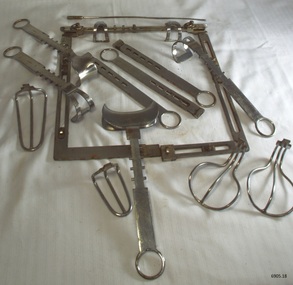 Flagstaff Hill Maritime Museum and Village
Surgical Kit, c. 1920's
... The accompanying text reads “Devine’s retractor is so designed that there are no screws, yet the retractors and “mechanical hands” by a jamming action remain firmly on the frame in whatever position they are placed. ...The accompanying text reads “Devine’s retractor is so designed that there are no screws, yet the retractors and “mechanical hands” by a jamming action remain firmly on the frame in whatever position they are placed. ...This H.B Devin’s operating frame and abdominal retractor kit is named after its designer, Sir Hugh Berchmans Devine, 1878-1959, son of a Werribee district grazier in Victoria, Australia, surgeon at the Royal Melbourne Hospital. A text book diagram of H.B. Devine’s Abdominal Retractor shows the frame and retractors set up for a pelvic operation. The accompanying text reads “Devine’s retractor is so designed that there are no screws, yet the retractors and “mechanical hands” by a jamming action remain firmly on the frame in whatever position they are placed. This is accomplished by a system of inclined planes incorporated in the frame and in the single and double hooks, retractor blades and handles of the “mechanical hands”. Set comprises 3 “mechanical hands” 5 retractor blades. (Pg 72, The 1948 Catalogue of Surgical Instruments, published by Felton, Grimwade & Duerdins Pty Ltd of Melbourne). Devine became a general surgeon who later gained an international reputation for his for his contribution in the advancement of abdominal surgery. Devine was educated in Ballarat and later became an Honourable Fellow of the Royal College of Surgeons. During his career he became Senior Surgeon and Dean of the Medical School at St Vincent’s Hospital in Melbourne. He served in the Australian Army Medical Corps in WWI and developed techniques in gastro-intestinal surgery. He was instrumental in the foundation of the Australasian College of Surgeons in 1927, retiring from the council in 1948. A survey on needs for operating room equipment notes that “In the past some surgeons associated themselves with particular instrument makers… The Melbourne surgeon [Hugh Devine] had his special abdominal retractor made by a small firm in South Yarra…” Hugh Devine writes instructions for inserting the Operating Frame in his book “The Surgery of the Alimentary Tract”. He says “ … the author’s operating frame is inserted into the wound … for exposure of the stomach … and exploration of the abdomen” and adds a note that the frame is “obtainable from J. Ludbrooke & Son, Melbourne, Victoria, Australia”. He accompanies his text with a diagram of the frame set into the wound. This surgical kit was donated to Flagstaff Hill Maritime Village by the family of Doctor William Roy Angus, Surgeon and Oculist. It is part of the “W.R. Angus Collection” that includes historical medical equipment, surgical instruments and material once belonging to Dr Edward Ryan and Dr Thomas Francis Ryan, (both of Nhill, Victoria) as well as Dr Angus’ own belongings. The Collection’s history spans the medical practices of the two Doctors Ryan, from 1885-1926 plus that of Dr Angus, up until 1969. ABOUT THE “W.R.ANGUS COLLECTION” Doctor William Roy Angus M.B., B.S., Adel., 1923, F.R.C.S. Edin.,1928 (also known as Dr Roy Angus) was born in Murrumbeena, Victoria in 1901 and lived until 1970. He qualified as a doctor in 1923 at University of Adelaide, was Resident Medical Officer at the Royal Adelaide Hospital in 1924 and for a period was house surgeon to Sir (then Mr.) Henry Simpson Newland. Dr Angus was briefly an Assistant to Dr Riddell of Kapunda, then commenced private practice at Curramulka, Yorke Peninsula, SA, where he was physician, surgeon and chemist. In 1926, he was appointed as new Medical Assistant to Dr Thomas Francis Ryan (T.F. Ryan, or Tom), in Nhill, Victoria, where his experiences included radiology and pharmacy. In 1927 he was Acting House Surgeon in Dr Tom Ryan’s absence. Dr Angus had become engaged to Gladys Forsyth and they decided he further his studies overseas in the UK in 1927. He studied at London University College Hospital and at Edinburgh Royal Infirmary and in 1928, was awarded FRCS (Fellow from the Royal College of Surgeons), Edinburgh. He worked his passage back to Australia as a Ship’s Surgeon on the on the Australian Commonwealth Line’s T.S.S. Largs Bay. Dr Angus married Gladys in 1929, in Ballarat. (They went on to have one son (Graham 1932, born in SA) and two daughters (Helen (died 12/07/1996) and Berenice (Berry), both born at Mira, Nhill ) According to Berry, her mother Gladys made a lot of their clothes. She was very talented and did some lovely embroidery including lingerie for her trousseau and beautifully handmade baby clothes. Dr Angus was a ‘flying doctor’ for the A.I.M. (Australian Inland Ministry) Aerial Medical Service in 1928 . Its first station was in the remote town of Oodnadatta, where Dr Angus was stationed. He was locum tenens there on North-South Railway at 21 Mile Camp. He took up this ‘flying doctor’ position in response to a call from Dr John Flynn; the organisation was later known as the Flying Doctor Service, then the Royal Flying Doctor Service. A lot of his work during this time involved dental surgery also. Between 1928-1932 he was surgeon at the Curramulka Hospital, Yorke Peninsula, South Australia. In 1933 Dr Angus returned to Nhill and purchased a share of the Nelson Street practice and Mira hospital (a 2 bed ward at the Nelson Street Practice) from Dr Les Middleton one of the Middleton Brothers, the current owners of what previously once Dr Tom Ryan’s practice. Dr Tom and his brother had worked as surgeons included eye surgery. Dr Tom Ryan performed many of his operations in the Mira private hospital on his premises. He had been House Surgeon at the Nhill Hospital 1902-1926. Dr Tom Ryan had one of the only two pieces of radiology equipment in Victoria during his practicing years – The Royal Melbourne Hospital had the other one. Over the years Dr Tom Ryan had gradually set up what was effectively a training school for country general-practitioner-surgeons. Each patient was carefully examined, including using the X-ray machine, and any surgery was discussed and planned with Dr Ryan’s assistants several days in advance. Dr Angus gained experience in using the X-ray machine there during his time as assistant to Dr Ryan. When Dr Angus bought into the Nelson Street premises in Nhill he was also appointed as the Nhill Hospital’s Honorary House Surgeon 1933-1938. His practitioner’s plate from his Nhill surgery is now mounted on the doorway to the Port Medical Office at Flagstaff Hill Maritime Village, Warrnambool. When Dr Angus took up practice in the Dr Edward and Dr Tom Ryan’s old premises he obtained their extensive collection of historical medical equipment and materials spanning 1884-1926. A large part of this collection is now on display at the Port Medical Office at Flagstaff Hill Maritime Village in Warrnambool. In 1939 Dr Angus and his family moved to Warrnambool where he purchased “Birchwood,” the 1852 home and medical practice of Dr John Hunter Henderson, at 214 Koroit Street. (This property was sold in1965 to the State Government and is now the site of the Warrnambool Police Station. and an ALDI sore is on the land that was once their tennis court). The Angus family was able to afford gardeners, cooks and maids; their home was a popular place for visiting dignitaries to stay whilst visiting Warrnambool. Dr Angus had his own silk worm farm at home in a Mulberry tree. His young daughter used his centrifuge for spinning the silk. Dr Angus was appointed on a part-time basis as Port Medical Officer (Health Officer) in Warrnambool and held this position until the 1940’s when the government no longer required the service of a Port Medical Officer in Warrnambool; he was thus Warrnambool’s last serving Port Medical Officer. (Masters of immigrant ships arriving in port reported incidents of diseases, illness and death and the Port Medical Officer made a decision on whether the ship required Quarantine and for how long, in this way preventing contagious illness from spreading from new immigrants to the residents already in the colony.) Dr Angus was a member of the Australian Medical Association, for 35 years and surgeon at the Warrnambool Base Hospital 1939-1942, He served with the Australian Department of Defence as a Surgeon Captain during WWII 1942-45, in Ballarat, Victoria, and in Bonegilla, N.S.W., completing his service just before the end of the war due to suffering from a heart attack. During his convalescence he carved an intricate and ‘most artistic’ chess set from the material that dentures were made from. He then studied ophthalmology at the Royal Melbourne Eye and Ear Hospital and created cosmetically superior artificial eyes by pioneering using the intrascleral cartilage. Angus received accolades from the Ophthalmological Society of Australasia for this work. He returned to Warrnambool to commence practice as an ophthalmologist, pioneering in artificial eye improvements. He was Honorary Consultant Ophthalmologist to Warrnambool Base Hospital for 31 years. He made monthly visits to Portland as a visiting surgeon, to perform eye surgery. He represented the Victorian South-West subdivision of the Australian Medical Association as its secretary between 1949 and 1956 and as chairman from 1956 to 1958. In 1968 Dr Angus was elected member of Spain’s Barraquer Institute of Barcelona after his research work in Intrasclearal cartilage grafting, becoming one of the few Australian ophthalmologists to receive this honour, and in the following year presented his final paper on Living Intrasclearal Cartilage Implants at the Inaugural Meeting of the Australian College of Ophthalmologists in Melbourne In his personal life Dr Angus was a Presbyterian and treated Sunday as a Sabbath, a day of rest. He would visit 3 or 4 country patients on a Sunday, taking his children along ‘for the ride’ and to visit with him. Sunday evenings he would play the pianola and sing Scottish songs to his family. One of Dr Angus’ patients was Margaret MacKenzie, author of a book on local shipwrecks that she’d seen as an eye witness from the late 1880’s in Peterborough, Victoria. In the early 1950’s Dr Angus, painted a picture of a shipwreck for the cover jacket of Margaret’s book, Shipwrecks and More Shipwrecks. She was blind in later life and her daughter wrote the actual book for her. Dr Angus and his wife Gladys were very involved in Warrnambool’s society with a strong interest in civic affairs. He had an interest in people and the community They were both involved in the creation of Flagstaff Hill, including the layout of the gardens. After his death (28th March 1970) his family requested his practitioner’s plate, medical instruments and some personal belongings be displayed in the Port Medical Office surgery at Flagstaff Hill Maritime Village, and be called the “W. R. Angus Collection”. [References: The 1948 Catalogue of Surgical Instruments; hospital supplies and guide to instruments for operatons, published by Felton, Grimwade & Duerdins Pty Ltd, 21 Alfred Place, Melbourne; Sir Hugh Berchmans Devine, Royal College of Surgeons, http://livesonline.rcseng.ac.uk/biogs/E004999b.htm; Equipment, What Surgeons Want in Operating Rooms, https://mpatkin.org/op_room_planning/what_surgeons_want.htm ]The W.R. Angus Collection is significant for still being located at the site it is connected with, Doctor Angus being the last Port Medical Officer in Warrnambool. The collection of medical instruments and other equipment is culturally significant, being an historical example of medicine, administration, household equipment and clothing from late 19th to mid-20th century. Dr Angus assisted Dr Tom Ryan, a pioneer in the use of X-rays and in ocular surgery. Surgical Kit containing operating frame and abdominal retractors, part of the W.R. Angus Collection. Kit cover is brown kid leather lined with navy cotton, 6 leather pockets inside and cotton flaps to close. Contains Sir Hugh Devine operating frame and abdominal retractors, stainless steel, made by J. Ludbrooke and Sons, Melbourne. Note with instruments "Sir Hugh Devine, surgeon at Royal Melbourne Hospital” c. 1920’sImpressed into instruments “J. LUDBROOKE AND SONS”, “PATENT 12990/28”, “83”, flagstaff hill, warrnambool, shipwrecked coast, flagstaff hill maritime museum, maritime museum, shipwreck coast, flagstaff hill maritime village, great ocean road, dr w r angus, dr ryan, surgical instrument, t.s.s. largs bay, warrnambool base hospital, nhill base hospital, mira hospital, flying doctor, medical treatment, medical history, surgical kit, j. ludbrooke and sons, operating frame, abdominal retractor set, abdominal surgery, alimentary surgery -
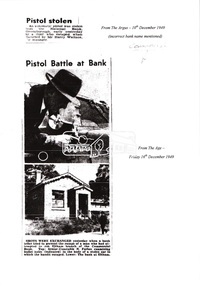 Eltham District Historical Society Inc
Folder, Commercial Bank of Australia Eltham Branch Hold-Up, 15 December 1949
... Spears lets off eight shots and Wallace, seven before his gun jams. The getaway car initially heads slowly down Main Road towards Bridge Street. ...Spears lets off eight shots and Wallace, seven before his gun jams. The getaway car initially heads slowly down Main Road towards Bridge Street. ...Thursday, December 15, 1949, the quiet little bank was embroiled in an infamous wild shoot-out between a daring thief and two bank officers. Today, the building still carries the scars ; a bullet hole remains visible in a cedar bench testifying to the events that played out that day. 3.30 a.m., Friday, December 9. The manager of the Commercial Bank branch at Greensborough, Mr Harry Wallace and his wife are asleep in their bedroom of the little house behind the branch. Harry is awakened by a noise and sees an intruder in a corner of the bedroom. He calls out but the intruder who has switched off the power in anticipation flees through a side door and scarpers down Main Street. Harry summons the police but a search by First Constable Thomas of the Greensborough Police assisted by a wireless patrol car is unsuccessful. A report is filed noting the theft of a .25 calibre pistol from the wardrobe. Thursday, December 15th. It is 1pm and the Commercial Bank has just opened. The branch is only open Mondays and Thursdays from 1-3pm. The morning started off a little cool with some scattered showers but it has fined up and the temperature is now around 61 degrees (16 C). A new grey Singer sports car with soft-top pulls up on the opposite side of the road and a young man, neatly dressed in a dark blue suit, wearing a grey hat and carrying a brief case exits the vehicle. He looks around then crosses the road and walks up the steps and through the door into the bank. There are three people inside; Mr. Jack Burgoyne whose grocery store is situated just 50 yards up the road, Mr. Lindsay A. Spears, the Eltham Agency Receiving Officer and by chance, Mr Harry Wallace, manager of the Greensborough branch. Jack Burgoyne takes note of the young stranger; thinking to himself he appears nervous. The man approaches the counter and introduces himself as John Henderson of Greensborough and explains that he wishes to open a new account. He places his hat and £3 on the counter. Mr Spears attends to the paperwork. He asks the young man to sign two forms, which he does but then he withdraws from the counter and starts walking towards the door. Suddenly he spins around pulling an automatic pistol from his right-hand pocket. He exclaims forcefully; “The game’s on! I’ll take the lot!” Spears appears to comply by pretending to open a drawer. The man shouts loudly, “Keep your hand away from that drawer.” Spears instead reaches for a pistol in his pocket and challenges the man, “Here it is. Come and get it!” At the same time, Harry Wallace pulls a pistol from his pocket as well. The bandit fires a shot but misses, the bullet striking the counter. Both Spears and Wallace open fire and Jack Burgoyne ducks for cover. As the bandit turns and runs for the door leaving his £3 behind, he fires another shot, which strikes the ceiling. Spears fires back, and thinks he may have hit him in the foot. The bandit flees the bank and heads for the grey Singer car, registration NO-106, parked opposite. Wallace and Spears pursue him to the door and open fire again, striking the car three times around the driver’s door. Spears lets off eight shots and Wallace, seven before his gun jams. The getaway car initially heads slowly down Main Road towards Bridge Street. About 100 yards down the road, Dave Adams, a PMG employee, who has heard the shots, throws a steel manhole step at the driver. It hits the roof of the car nine inches above the driver’s head and tears the hood. Another witness claims to have seen the door blow open and the driver raise his hand. The car gathers speed and swings left into Bridge Street racing along at about 60 miles an hour careering recklessly past council employee, Mr. Percy Williams, who is driving a dray along Smarts Road [believed to be Bridge Street]. At the end of the road the Singer fails to get round the sharp turn and crashes into an embankment skidding to a stop outside the home of Mr John Clifford. One side of the car is wrecked. Mr Clifford, an aircraft engineer hears the fast travelling car bump heavily into the road bank at about 1.25 p.m. Hearing the whine of an engine he goes outside to find the grey Singer parked at the side of the road. Jack George also lives at the corner and hears the car crash. “The bandit opened the car door, ran 50 yards, and suddenly turned back,” exclaims Jack. “He took something from the car. It might have been a gun.” In his haste, the bandit drops his grey felt hat, size 6 7/8, on the road and dashes up Sherbourne Road for about 200 yards then disappears into the scrub carrying a brief case and a bundle in which a sailor’s cap can be seen. About 3 p.m., Mr H.D. Pettie of Mountain View Road, Montmorency is looking through his field glasses and notices a young man walking through thick scrub on private property some distance from his house. The man is wearing a sailor’s cap and disappears along the railway track toward Montmorency. As the day progresses, ten police cars, one motor cycle, and about 40 police led by Det. Sgt. McMennemin of Malvern CIB are searching for him. They believe he is hiding in thick scrub along the bank of the creek about half-a-mile outside Eltham township. Wireless patrol cars, four mobile traffic cars and the CIB area cars from Malvern and Kew are taking part. Police check the thief’s car and discover it was stolen from Helen Baxter, of Doncaster Road, North Balwyn from outside Victoria Barracks. Harry Wallace informs the police that he believes he recognised the bandit as the man who took his pistol from his bedroom the previous Friday morning. As night falls, armed police are posted at strategic points in the Eltham-Greensborough district. Police in cars are watching the roads. Others are searching the bush and checking passengers on trains. Little do they realise the young man has already slipped out of the net. SEQUEL YOUTH OF 19 CHARGED WITH ATTEMPTED ARMED ROBBERY OF BANK AT ELTHAM Weekly Times, Wednesday 15 February 1950, page 6 Detectives who raided a house in Bell St., Coburg, Melbourne, charged a 19-year-old youth, of South Yarra, with attempted armed robbery at the Commercial Bank’s Eltham (Vic.) receiving depot on Dec. 15. Police say they recovered a loaded automatic pistol, diamond and signet rings worth more than £200, a complete set of house-breaking instruments, a sailor’s uniform, and chloroform gauze in the raid. The youth was charged that while armed with an offensive weapon, he attempted to rob Lindsay George Spears of a sum of money. He was further charged on six counts of breaking, entering and stealing. Police allege that the person who tried to hold up Mr Spears in the Commercial Bank receiving depot at Eltham on December 15. escaped in a stolen car, after Mr Spears and Mr Henry Wallace, manager of the bank’s Greensborough branch, had fired at him. After the car crashed, he escaped into thick scrub and is alleged to have changed into a sailor’s uniform. On December 9 an automatic pistol was stolen from Mr Wallace’s bedroom at the Greensborough bank. The chloroform pad recovered is alleged to have been stolen from the Dental Supply Company, Plenty Road, Preston. The rings are alleged to have been taken in a £513 burglary from the shop of James Paton. Sydney Road, Coburg. Det. Sgt. H. McMennemin conducted the investigations with Senior Dets. R. Newton and M Downie, Detectives l. Dent, R. Rayner, P. Pedersen and M. Handley and First Constable A. Thomas. The youth will appear at Eltham Court on February 22. Manager’s Gun Used in Holdup at Bank The Age, Thursday 23 February 1950, page 4 It was stated in Eltham court yesterday that a youth who robbed a bank manager of his pistol, later used it in an attempt to hold-up the bank. Kay Arthur Morgan, 19, draftsman, of Castle-street, South Yarra, was committed for trial on charges of breaking and entering, and stealing a pistol and attempted robbery while armed with an offensive weapon. He pleaded guilty. The manager of Eltham branch of the Commercial Bank of Australia Ltd., Henry Clifton Cabot Wallace, said he disturbed someone in the bedroom, in which he and his wife were sleeping, at 3 a.m. on December. 9, 1949. Later he found that his automatic- pistol was missing. On December 15 a youth, who said his name was John Henderson, entered the bank and opened a new account. As the youth was leaving the bank he turned round with a pistol in his hand and said: — “I want the lot.” Spear indicated a drawer under the counter; and said.— “Here it is. Come and get it.” The youth said:— “Keep your hand away from that drawer.” Witness said Spear then drew his pistol from his hip pocket. The youth fired at them, and Spear returned the fire. “I pulled my pistol and fired, too” said witness. The youth fired again, ran out to a car and drove off. Witness and Spear fired several shots at the car. The youth was the accused Morgan, sitting in court, witness said. Evidence was given that one bullet was found in the celling and the other in the bank. Morgan was allowed £100 bail on each charge. Morgan ended up serving three years for the failed armed robbery and became a notorious criminal. He had twin sons, Peter and Doug and even though only ten years old, Morgan would get his sons to act as lookouts whilst he committed burglaries. The lads became building contractors but when the industry suffered a downturn in 1977 and they were short on cash, they returned to the family business. Over the following 23 months they undertook 24 raids on country and outer-suburban TABs and banks. Whilst robbing one country bank for the third time, just like their father, it all went wrong ending up with a police officer shot. They were nick-named the “After-dark” bandits and are considered to be Australia’s last bushrangers. They were convicted and served 17 years in prison.5 x A4 photocopied pagesbank hold-up, cba bank, det sgt mcmennemin, eltham, h.d. pettie, harry wallace, jack burgoyne, kay arthur morgan, lindsay a. spears, main road -
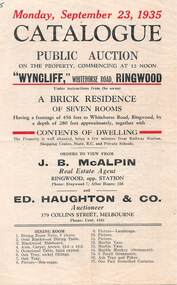 Ringwood and District Historical Society
Flyer - Catalogue, Public Auction - Brick Residence and Contents of Dwelling, "Wyncliff", Whitehorse Road, Ringwood. 1935
... Two Large Vases, 1 with floral design; Salad Bowl and Servers; One Dozen Dessert Knives; Nine Stainless Teaspoons (new); Plated Vases; Plated Jam Dishes; Plated Cream Bowl; Silver Plated Cake Dish; One Pair Plated Shell Butter Dishes; Lino Border. ...Two Large Vases, 1 with floral design; Salad Bowl and Servers; One Dozen Dessert Knives; Nine Stainless Teaspoons (new); Plated Vases; Plated Jam Dishes; Plated Cream Bowl; Silver Plated Cake Dish; One Pair Plated Shell Butter Dishes; Lino Border. ...Double-sided A5 size advertisement for public auction under instructions from the owner on Monday, September 23, 1935 on the property - seven room brick residence with frontage 456 feet by approximately 280 feet and contentents of dwelling fully listed over 4 pages. Agent - J.B. McAlpin, Ringwood, opp. station. Phone Ringwood 7; after houres 236. Auctioneer - ED. Haughton & Co., 379 Collins Street, Melbourne. Phone Central 4101.Contents of Dwelling List - includes: DINING ROOM - Dining Room Suite - 6 pieces; Oval Blackwood Dining Table; Blackwood Sideboard; Axminster Carpet, Occasional Table hand carved; Oak Trays; Seascape, Landscape and other Pictures; 2 Marble Vases; Marble Monkey and 3 other Small Ornaments; Ash Tray and Poker; One Pair Stencilled Curtains. Two Large Vases, 1 with floral design; Salad Bowl and Servers; One Dozen Dessert Knives; Nine Stainless Teaspoons (new); Plated Vases; Plated Jam Dishes; Plated Cream Bowl; Silver Plated Cake Dish; One Pair Plated Shell Butter Dishes; Lino Border. LOUNGE ROOM - 2 Pictures and 1 pair with Circular Frames; Floral Jardinere and Pot Plant; Cabinet Gramophone "Singola"; Records; Player Piano "Cable"; Piano Stool; 31 Rolls; Roll Cabinet; Quantity of Music; Music Case, Leather; Portable Gramophone "Decca"; Floral Design Jardinere; Wicker Occasional Table; 2 Wicker Chairs; Cane Lounge Settee; Blackwood Bookcase; 9 Volumes Universal Encyclopedia; 10 Vols Children's Encyclopedia; Floral Vase; Black and Gold Vase; One pair Plated Vases; Ash Pan; Lino Border (Lounge Room); One Carpet, green 13.6 x 10.6; One Cushion; Hall Stand; Pedestal; Floral Design Jardinere; Painting on Canvas (Landscape); Hall Runner Carpet 25 feet; Hall Lino 29ft 5 in.; Five Door Mats (small). FIRST BEDROOM - Arm Chair (Leather); English Oak Dressing Table; English Oak Wash Stand Marble Top; Toilet Set (Four pieces); Silk Fire Screen; Blackwood Occasional Table; Black and Gold Vase; Pair China Vases; Pair Glass Vases; Single Glass Vase; One Kewpie Lavender Bag; Bedroom Lino 15.6 x 13.6. SECOND BEDROOM - Arm Chair (Leather); Dressing Table; Wash Stand; 3 Piece Toilet Set; One Vase (Pink Cameo Design); Two Ornaments (one round); Bedroom Lino 13.5 x 12.10; 3 Pictures; 2 Pairs Curtains (applique, stenc'ld); Pair Curtain Poles. THIRD BEDROOM - Lino approx 14ft x 10ft; Two Green Mohair Mats; Pair Pictures (White frames); One Picture ("The Mourners"); Picture ("The Wanderer Found"); Small Picture; Wicker Chair. FOURTH BEDROOM - Duchess Chest 5 drawers; Corner Wardrobe and Curtains; One Single Bed & Wire Mattress; Single Bedding; Lino on floor 14ft x 6ft 6in.; Occasional Table; 3 Pictures; Two Door Mats; Hall Runner (Carpet) 21ft. BREAKFAST ROOM - Two Wicker Chairs; Cushion; Brown Cushion; Four Vienna Chairs; Jardinere; Kerb (Wooden). 3 Pictures; Oil Painting (Canvas); 2 Pictures; Lino 14ft x 14ft; Brown Table Cover; Fruit Set; Robur Tea Pot; Plaque; China Biscuit Barrel; Glass Fruit Bowl; Pair Pickle Jars and Stand; Wooden Inkstand; Pair Ash Trays; Two Marble Vases; Glass Vase; Electric Jug and Electric Toaster (practically new); Picture; Cushion; Pair Lace Curtains; Curtain Rod; Three Lace Curtains; Brass Curtain Rods (3); Lino in Vestibule 10ft x 8 ft; Lino in Kitchen 12.6 x8.6; Coal Scuttle; Two Small Tables (1 Baize Cover). STORE ROOM - Briquette Grate; Three Coir Mats (one new); Three Small Door Mats (new); Glass Fire Screen; 2 Alm Pot Stands; Steel Pot Stand; Lady's Bicycle; 2 Electric Radiators (one large); White Cabinet; Stretcher Bed; Large Cot with Wire Mattress; Kerb; Fender and Irons; Lino on floor 12ft x 12ft; Lino in Storeroom 6ft x 6ft; Three Large Window Blinds; Clothes Horse; Dressmaker's Fitting Stand; Dressmaker's Bust; Window Display Bust; Blouse Stand; Small Display Stand; Meat Cover (Metal); Leather Portmantau; Leather Kit Bag; Four Large Wooden Drawers; Picnic Basket; Mattress, Bolster and Pillow; Cot Quilt; One Long-handled Feather Duster; Feather Duster; Wicker Lounge; Cane Soiled Linen Basket; One New Washing Tub; Copper Preserving Pan; Lino in Laundry 8 x 6 approx; Carpet Sweeper; Small Jardinere; 2 Shopping Baskets; Kitchen Safe; Kitchen Table; Three Buckets; 1 Horse Rub patent (prac new); Wooden Pot Plant Stand; Bird Cage and Stand; Pair Steps; Pair Small Steps; Metal Meat Safe; Wooden Safe; Hand worked Table Cover; Pair Poplin Silk Curtains (new); Leather Table Centre. VERANDAH - 12ft Shelving with doors; 35ft Shelving; Wooden Stand; Axe Stand (wooden); Nine feet Wooden Shop Fittings; Small Filing Cabinet; Three Window Frames & Glass; 38 Pot Plants Fernery; 9 Hanging Baskets Fernery; Electric Shop Sgn Storeroom; 2 Small Electric Shop Signs Storeroom; 2 Garden Sprays; Doll's Pram and Doll; Two Boxes Paint and Slate; Crystal Radio Set; New Canvas Blind & Roller 6ft.; Electric Light Reflectors (two); Two pieces of Painted Baize; Small Vice; Sprinkler; One Gallon Tin of Spray Oil; 2 Packets of "Aresto"; Two Hurricane Lamps; One Pair Spring Balance Scales; Small Pair Spring Balance Scales. WASH HOUSE - Pair Heavy Tracers (2); Pair Reins; Back Band; One Tug; Pair Hames; One Pair Neck Bands (2); Four Manger Balls; Pair Knee Pads; Kicking Strap complete; Leather Head Stall; Collar Pad; Knife Board and Tin Polish; Fork Cleaner; Foot Spray Pump. TOOL SHED - One Stewart Horse Clipper; Approx 120ft Ribbed Hose; 100ft ½in Hose; Child's Scooter; Tin Box; Ferret Box; One Tool Box; Tomato Hoe; Sprinkler; Two Large Augers; Large Watering Can; Medium Watering Can; Small Watering Can; Wooden Tool Chest; Rope, Tackle and two Pulleys; Six pieces of Lino; Three Small Canvas Blinds; Lawn Mower 14in.; Lawn Mower 12in.; Grass Catcher; 8 Pieces Garden Tools; Barrow; Quantity of Timber; Quantity of Flower Pots; Quantity of Wire; 4 Egg & 1 Fowl Crates Feed Room; 1 Gallon Demijohn Feed Room; Quantity of Shelving Feed Room; Quantity of Cement, Lime; Six Small Doors; Roll of Perforated Cardboard; Boot Rack; Coat Rack; 3 Automatic Sanitary Disinfectant; Pair Neck Straps and Rope; One Chimney Top & 3 Vent Bks.; Desk; Large Pump; Large Safe; Pair Sliding Door Rollers & Fittings; Two Wooden Doors; Box Sundries; Wooden Frame and Glass; 2 Vienna Chairs; Delivery Cart; Five Boxes Tiles; Quantity Agricultural Pipes; Wooden Bench; Wood Horse; Earthenware Drain Pipe; Wooden Tool Box; New Brass Spray "Rego"; Two Wood Planes. YARD - Pair Hedge Clippers; Box Containing 2 prs Secateurs & Punch; Box Tools seven pieces; Box Sundries; Lawn Weeder and Seed Sower; Box Tools 6 pieces; Two Saws; Bundle Files; Three Braces; Box of 13 pieces Gimlets etc.; Five Spanners; Box Tools 4 pieces; Four Coal Chisels; Box 7 pieces of Tools; Box of 5 pieces of Tools; Box of Docket Books; One Printing set; Large Figure Printing Set; Small Figure Printing set; Price Ticket Box; Air Brush Writing Set Complete; Six Shelves & Brackets, one Hat Rack, in store room; Box of Three Hammers; Two Boot Lasts; Tin of Polishing Oil; Box of Gardening Sundries; 2 Bicycle Pumps Saddle & Clips; One Covered Baking Dish; 200 c.p. Globe (Vestibule); Two "Dimolite" Fittings; Set of Five Canisters; Earthernware Jar; Two shopping Cases; Dinner Set 11 pieces; Box of Sundry Tins; Alm Fish Pan and Drainer; Two Ventilators; Knife Board & 3 Bread Saws; Soap Box and Jewel Case; Three Glass Articles. OFFICE FURNITURE - Steel Safe (Office Safe); Office Table five drawers; Cabinet 8 drawers; Cupboard three shelves; Selves 2ft3in x 1ft6in; Cheque Protector; Remington Typewriter; Typewriter Adjustable Table; Burroughs Bookkeeping Machine and Stand Complete; Small Office Table; Glass Show Case3ft9 x 2ft.; Four Sheets M. Glass; Five Sheets P. Glass; Gent's Overcoat new; Boy's Pullover New; Small Show Case; Duplicator (complete); Webster's Dictionary; Family doctor's Book. Two Dictionaries; Bundle of Three Books; Art Decorating Book; Bundle of Three Books; Bundle of Three Books; Two Books (Children's); (Multiple) Bundles each containing Three Books; Leather Riding Whip; Tort-shell Inkstand & Calendar; Tort-shell Folding Letter Rack; Water Filter; Thermos Flask and Case; Two Waste Paper Baskets. -
 Moorabbin Air Museum
Document (series) - Nomad Development Material - Collection of Vilem Gottlieb
... Fincher 1979 10 Bound book Nomad ASTA Nomad model N22S - Certification Report N22S2-21022 - Flight Test Certification Report - AF36 Documentation 1988 11 Bound book Nomad GAF GAF Project Report RN2/4 - Nomad N22 - Detail Specification - Part 1 Basic Aircraft 1973 12 Bound book Nomad GAF Nomad Aircraft - Model N22-B - With icing spray system fitted - Development flight test schedule 1978 13 Stapled book Nomad GAF N22B - Nomad Performance Summary for Air Taxi and Commercial Operations 14 Manila Folder Nomad Civil Aviation Authority (Commonwealth of Australia) Copy of Certificate of Approval for aeroplanes type known as GAF models N2, N22, N22B, N22C, N22S, N24 and N24A 1992 15 Nomad Photograph of a Nomad with what looks like smoke underneath 16 Nomad GAF Brochure - STRETCHED Nomad N24 17 Suspension folder General Motors - Allison Gas Turbine Operations Engineering Department Report No.11910A - Instructions for the use of a program, in the form of a source deck of digital computer cards, tape, or floppy diskette to calculate steady state performance of the Allison Gas Turbine Model 250-B17E Turboprop Engine 1987 18 General Motors - Allison Gas Turbine Operations Supplement 1 to the above 19 Fax - very feint - From: Woodward Governor Company Small Aircraft Controls - To: Hawker Pacific - About: propellor synchrophasing systems availability 1992 20 Various pages, some handwritten or faxed about engines, propellor synchronising, and installation charts 1987 21 Manila Folder Nomad Newspaper article: Another Nomad Scare 22 Bulldog Newspaper article: Undercarriage Jams on Test Flight - The Daily Telegraph 1976 23 Jetstream Photograph of a Jetstream 24 Nomad GAF/Department of Productivity Memo re Nomad Ground Training Certificate awarded to Vilem K Gottlieb 25 Avalon Memo congratulating V K Gottlieb on successfully passing the Avalon B17B Engine Course 1978 26 Nomad ASTA Aircraft Weighing Summary - N22B - VH-AUN 1992 27 ASTA/Litton Systems Canada Ltd Fax - very feint - USCS Radar Trials 1990 28 Gippsland Aeronautics Email trail GA18 Bill of Material 2011 29 ASTA Instrument of Appointment - delegate Patrick Larcey 2002 30 Certificate of Competency in Winching Operations for Endorsement in a Helicopter Winch Operator’s/Aircrewman’s Log Book 1986 31 CASA Email: Mod 953 SB 2008 32 Gippsland Aeronautics Email trail: Nomad Technical Publications - Flight manuals for the Mod N953 2011 33 Gippsland Aeronautics Publication “What’s News at GippsAero” Issue 13 October 2012 2011 34 A page from an illustrated parts catalogue - Figure 8 Flap Control, Actuation, Post-Mod N953 35 Nomad A page from a Nomad - Series N24 Maintenance Manual 36 Gippsland Aeronautics Email trail re BOM creation for GA18 2011 37 Nomad Nomad N24A - Draft list of composite parts and accompanying handwritten notes 38 Nomad Gippsland Aeronautics Nomad product support - Service bulletins 2009 39 Nomad Gippsland Aeronautics Email asking for document listing the major modifications and customer options 40 Nomad Gippsland Aeronautics Handwritten notes about spare parts 41 Jetstream Jetstream CEntral Jetstream 31 Commuter Performance Information 42 Nomad Avalon Aircraft Weighing Summary - N24A-60 - ZK-NMD 43 Photograph of a Learjet cockpit 44 Photograph of a cabin of an unknown aircraft - could be the Learjet in the previous photo 45 Manila Folder ASTA Newspaper article: ASTA bids for $500m Orion deal 46 Newspaper article: re Hornet fighter jet rescue helicopter 47 Newspaper article: ASTA returns profit despite poor times 48 Newspaper article: Government to sell ASTA 49 Newspaper employment ad: ASTA Defence - Integrated Logistics Support Personnel 50 Newspaper article: ASTA to cut staff 51 Newspaper employment ad: Test Pilot at the Flying Operations Airworthiness Division (DoT) 52 GAF Job application: Flight Test Observer (No.138) 1976 53 Australian High Commission Letter re recruitment for GAF position 1977 54 Australian High Commission Letter re interview for GAF position 1977 55 Australian High Commission Letter advising of successful application for GAF position 1977 56 Australian High Commission Letter re successful medical examination 1977 57 Australian High Commission Memos regarding start date in Australia 1977 58 Memos confirming appointment as Deputy Chief Flight Test Engineer 1969 59 Australian Department of Foreign Affairs International Message Form: Nomad Icing UK 1978 60 Australian Consolate Advice re interview for application to migrate to Australia 1977 61 GAF Copy of a job ad for Flight Development Engineer 1984 62 GAF Memo: expressing interest in the Flight Development Engineer position 1984 63 GAF Memo: acknowledgement of above memo expressing interest in the Flight Development Engineer position 1984 64 Menu: 94th Aero Squadron - 1st Pursuit Group - unsure of the specific event 65 Avalon Memo: GAF Helicopter Crew - Compensation/Insurance and Additional Payments 1986 66 Aeronautical Development Associates Ltd Letter and list of installation projects 1983 67 Certificate of Competency in Winching Operations for Endorsement in a Helicopter Winch Operator’s/Aircrewman’s Log Book - DoT Air Navigation Orders on Air Service Operations - Helicopter winching and rappelling operations 1986 68 ASTA Memo: appointment of George Stuart to the position of CEO 1987 69 ASTA Various letters and memos re termination of employment and retrenchment 70 GAF Duty Statement - Senior Technical Officer (Engineering) Grade 2 1973 71 Nomad ASTA Letter to Field Aviation Company Limited requesting support services as required for Nomad N22S-164 1988 72 GAF Letter to Avalon Workforce: re GAF ceasing operations on 30/6, recommencing operations as ASTA on 1/7 1987 73 GAF Attached to #72 a copy of a newspaper obituary - GAF passing away! ...Fincher 1979 10 Bound book Nomad ASTA Nomad model N22S - Certification Report N22S2-21022 - Flight Test Certification Report - AF36 Documentation 1988 11 Bound book Nomad GAF GAF Project Report RN2/4 - Nomad N22 - Detail Specification - Part 1 Basic Aircraft 1973 12 Bound book Nomad GAF Nomad Aircraft - Model N22-B - With icing spray system fitted - Development flight test schedule 1978 13 Stapled book Nomad GAF N22B - Nomad Performance Summary for Air Taxi and Commercial Operations 14 Manila Folder Nomad Civil Aviation Authority (Commonwealth of Australia) Copy of Certificate of Approval for aeroplanes type known as GAF models N2, N22, N22B, N22C, N22S, N24 and N24A 1992 15 Nomad Photograph of a Nomad with what looks like smoke underneath 16 Nomad GAF Brochure - STRETCHED Nomad N24 17 Suspension folder General Motors - Allison Gas Turbine Operations Engineering Department Report No.11910A - Instructions for the use of a program, in the form of a source deck of digital computer cards, tape, or floppy diskette to calculate steady state performance of the Allison Gas Turbine Model 250-B17E Turboprop Engine 1987 18 General Motors - Allison Gas Turbine Operations Supplement 1 to the above 19 Fax - very feint - From: Woodward Governor Company Small Aircraft Controls - To: Hawker Pacific - About: propellor synchrophasing systems availability 1992 20 Various pages, some handwritten or faxed about engines, propellor synchronising, and installation charts 1987 21 Manila Folder Nomad Newspaper article: Another Nomad Scare 22 Bulldog Newspaper article: Undercarriage Jams on Test Flight - The Daily Telegraph 1976 23 Jetstream Photograph of a Jetstream 24 Nomad GAF/Department of Productivity Memo re Nomad Ground Training Certificate awarded to Vilem K Gottlieb 25 Avalon Memo congratulating V K Gottlieb on successfully passing the Avalon B17B Engine Course 1978 26 Nomad ASTA Aircraft Weighing Summary - N22B - VH-AUN 1992 27 ASTA/Litton Systems Canada Ltd Fax - very feint - USCS Radar Trials 1990 28 Gippsland Aeronautics Email trail GA18 Bill of Material 2011 29 ASTA Instrument of Appointment - delegate Patrick Larcey 2002 30 Certificate of Competency in Winching Operations for Endorsement in a Helicopter Winch Operator’s/Aircrewman’s Log Book 1986 31 CASA Email: Mod 953 SB 2008 32 Gippsland Aeronautics Email trail: Nomad Technical Publications - Flight manuals for the Mod N953 2011 33 Gippsland Aeronautics Publication “What’s News at GippsAero” Issue 13 October 2012 2011 34 A page from an illustrated parts catalogue - Figure 8 Flap Control, Actuation, Post-Mod N953 35 Nomad A page from a Nomad - Series N24 Maintenance Manual 36 Gippsland Aeronautics Email trail re BOM creation for GA18 2011 37 Nomad Nomad N24A - Draft list of composite parts and accompanying handwritten notes 38 Nomad Gippsland Aeronautics Nomad product support - Service bulletins 2009 39 Nomad Gippsland Aeronautics Email asking for document listing the major modifications and customer options 40 Nomad Gippsland Aeronautics Handwritten notes about spare parts 41 Jetstream Jetstream CEntral Jetstream 31 Commuter Performance Information 42 Nomad Avalon Aircraft Weighing Summary - N24A-60 - ZK-NMD 43 Photograph of a Learjet cockpit 44 Photograph of a cabin of an unknown aircraft - could be the Learjet in the previous photo 45 Manila Folder ASTA Newspaper article: ASTA bids for $500m Orion deal 46 Newspaper article: re Hornet fighter jet rescue helicopter 47 Newspaper article: ASTA returns profit despite poor times 48 Newspaper article: Government to sell ASTA 49 Newspaper employment ad: ASTA Defence - Integrated Logistics Support Personnel 50 Newspaper article: ASTA to cut staff 51 Newspaper employment ad: Test Pilot at the Flying Operations Airworthiness Division (DoT) 52 GAF Job application: Flight Test Observer (No.138) 1976 53 Australian High Commission Letter re recruitment for GAF position 1977 54 Australian High Commission Letter re interview for GAF position 1977 55 Australian High Commission Letter advising of successful application for GAF position 1977 56 Australian High Commission Letter re successful medical examination 1977 57 Australian High Commission Memos regarding start date in Australia 1977 58 Memos confirming appointment as Deputy Chief Flight Test Engineer 1969 59 Australian Department of Foreign Affairs International Message Form: Nomad Icing UK 1978 60 Australian Consolate Advice re interview for application to migrate to Australia 1977 61 GAF Copy of a job ad for Flight Development Engineer 1984 62 GAF Memo: expressing interest in the Flight Development Engineer position 1984 63 GAF Memo: acknowledgement of above memo expressing interest in the Flight Development Engineer position 1984 64 Menu: 94th Aero Squadron - 1st Pursuit Group - unsure of the specific event 65 Avalon Memo: GAF Helicopter Crew - Compensation/Insurance and Additional Payments 1986 66 Aeronautical Development Associates Ltd Letter and list of installation projects 1983 67 Certificate of Competency in Winching Operations for Endorsement in a Helicopter Winch Operator’s/Aircrewman’s Log Book - DoT Air Navigation Orders on Air Service Operations - Helicopter winching and rappelling operations 1986 68 ASTA Memo: appointment of George Stuart to the position of CEO 1987 69 ASTA Various letters and memos re termination of employment and retrenchment 70 GAF Duty Statement - Senior Technical Officer (Engineering) Grade 2 1973 71 Nomad ASTA Letter to Field Aviation Company Limited requesting support services as required for Nomad N22S-164 1988 72 GAF Letter to Avalon Workforce: re GAF ceasing operations on 30/6, recommencing operations as ASTA on 1/7 1987 73 GAF Attached to #72 a copy of a newspaper obituary - GAF passing away! ...Donation from Anna Gottlieb -
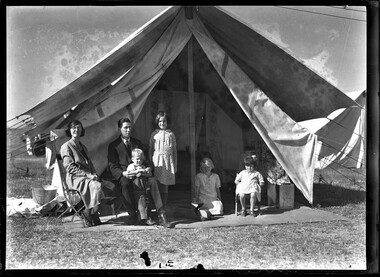 City of Melbourne Libraries
Photograph, Bull, Hugh Jones, 1897-1993, Seventh Day Adventists Camp at Hampton: E. Gane + family
... Cold nut foods, granose, nuttose, and jam protose, bromose, with jelly and various "ose" sandwiches, impossible for the unbeliever to diagnose, are put before you. ...Cold nut foods, granose, nuttose, and jam protose, bromose, with jelly and various "ose" sandwiches, impossible for the unbeliever to diagnose, are put before you. ...Photographer notations on slide: Seventh Day Adventists Camp. E Gane + family Published: 28 December 1933 Published title: SEVENTH DAY ADVENTISTS. Published caption: “I. — The Annual Camp of the Seventh Day Adventists in Highett-road, Hampton, comprising more than 250 tents and accommodating over a thousand persons. II. —W. J. Westerman (vice-president of Australasian) and Pastor G. G. Stewart (president of Victoria), conversing with Pastor C. H. Watson (world president of the Seventh Day Adventists).- III.— Evangelist E. R. Gane and family.” SEVENTH DAY ADVENTISTS. (1933, December 28). The Age (Melbourne, Vic. : 1854 - 1954), p. 9. Retrieved August 1, 2025, from http://nla.gov.au/nla.news-article203356427 Research by project volunteer, Fiona Collyer: In December 1933, evangelist Mr E.R. Gane and his family gather outside their tent during the ten day Seventh Day Adventist Conference held in Highett Road, Hampton. Description: A woman, man and four small children sit and stand in front of a tent. One child plays with a toy train. In December 1933, delegates from all over Victoria and beyond travelled to Melbourne for the annual Seventh Day Adventists Conference of Victoria, held over ten days on a vacant allotment at Highett Road Hampton. A canvas town of 250 tents for over 1000 campers was created along with large marquees for lectures, devotional services and kitchens. Many daily visitors also attended the lectures and services. The principal speaker was Victorian born world president of the Seventh Day Adventists, Pastor Charles H. Watson (1877-1962), who travelled from Washington DC for the event. The Highett Street campers attended a busy schedule of bible readings, devotional services and health lectures during the ten days of the camp. Lecture subjects included- “Among the Head Hunters of the Solomon Islands”, “ Looking Through the Prophetic Telescope into 1934”, “Soul Surgery”, “Viewing the Celestial Land Through the Prophetic Telescope”and “The Four Horsemen of the Apocalypse”. The Seventh Day Adventist religion was established in the USA in 1863. One of its co-founders was American Ellen G. White whose writings are regarded as divinely inspired and are still adhered to today. Ellen preached on the “Eight Laws of Health”- Nutrition, exercise, water, sunshine, temperance, air, rest and trust in God. Adventists regard their bodies as holy temples and avoid food deemed by the Bible as unclean. They eat a mainly plant based diet with no caffeinated beverages and abstain from alcohol and tobacco. They believe in the observance of Saturday, the seventh day of the week in the Christian (Gregorian) and Hebrew calendars as the sabbath and the literal and imminent second coming of Jesus Christ. New converts are baptised by immersion in water. The Adventists opened the Warburton Sanitarium in 1910 as a health retreat, integrating their holistic health philosophy of physical, mental and spiritual well being. It was a resort in the hills “among picturesque mountain scenery…surrounded by tall forests and deep fern gullies…” where highly strung Melburians could alleviate their digestive maladies, stress and jaded nerves as “…worn down nervous systems mend quickly in this peaceful environment…invigorating air and an abundance of home-grown fruit, vegetables, fresh eggs, milk, and cream help to build healthy bodies”. The resort also offered hydrotherapy, massage and electrical treatments. An advertisement in The Argus- 1 December 1947 assured readers- “EVERYTHING SUNNY AGAIN." “That's how you'll feel when you say farewell to Warburton Sanitarium and Hospital after spending a holiday here. Victoria's Hydro is famous far and wide for wonders worked with sufferers from nervous and digestive disorders. Wholesome food, perfectly cooked; splendid air, regulated exercise, sweet natural sleep; these quickly correct faulty digestion, restore vitality, bring back that sunny optimism natural to healthy people. Massage and curative baths under medical supervision…” Later, after further building work, it became the Warburton Hospital with medical, casualty and obstetrics wards as well as offering strategies to stop smoking, lose weight and for stress management. The hospital ceased operation in 2001. Ellen G. White wrote “God sent me to Australia” and in 1891, accompanied by her son William C. White she arrived in Australia to start a Bible school, spread her health philosophy and for missionary work. At first health food products were imported from America, but it soon became apparent that due to the expense and the food becoming stale over the long journey, that local manufacturing was necessary. In 1898 William secured the services of American Adventist baker Edward C. Halsey, who had worked at Dr Kellogg’s Battle Creek (“Cereal City”), Sanitarium, Michigan, USA. They rented the St George’s bakery in Northcote, Melbourne, producing the first ready to eat breakfast cereal Granola, Caramel Cereal, and peanut butter. The fledgling company relocated to larger premises in Cooranbong, NSW soon after. The Sanitarium Health Food Company opened a factory in Warburton in 1925, manufacturing Granose Biscuits, Cerix Puffed Wheat, San-Bran, Bixies malted wheat flakes, Betta peanut butter, Marmite, “Kwic-Bru - A delicious health “coffee” made from choicest cereals and free from drugs that affect the heart and nerves” In 1928, Sanitarium bought out Grain Products Limited who were manufacturing a sweet cereal biscuit called Weet-Bix which soon became Australia’s favourite breakfast cereal. The Warburton factory closed in 1997, with manufacturing shifting interstate. Sanitarium breakfast cereal boxes offered free collectable cards inside and children could buy albums from grocers for sixpence and mount the cards. Subjects of the albums included- “Aboriginal Tribes, Legends, Customs”, “Australia- Yesterday and Today”, “Marvels of the Great Barrier Reef”, “Advance Australia- a Pageant of the Years”. In 1902 the Adventist’s opened the “Pure Food Vegetarian Cafe” in Sydney (In 1907 the name was changed to “Sanitarium Health Food Cafe”), Eating vegetarian food was definitely a curiosity. “Cristina” reviewed the cafe for The Australasian-27 October 1906. Topics For The Block. “Feeling somewhat like a criminal, and hoping to escape detection, I stealthily made my way into a vegetarian restaurant the other day... If my friends happened to catch me walking in there, I should henceforth be considered a crank, a faddist, and little short of a lunatic! Whom did I find within, seated with the air of habitués at the small tables, but heaps of my friends. They had all this while been pursuing their vegetarian way, layin' low and sayin' nuffin'. Flesh-eaters, now that the Sydney summer has set in apparently in good earnest, are beginning to wonder if the vegetarians are not wiser in their day and generation. Roast beef, hot cornea beef, ragouts, and meat curries, the very thought of them makes one feel hot. Frosted lemon pudding, stewed fruits, wheatmeal rolls, and tomatoes sound nice when you look at their names on the vegetarian menu. Such weird messes are served, square, unintelligible blocks of some brown substance, a few bites of which form a full and satisfying meal. Cold nut foods, granose, nuttose, and jam protose, bromose, with jelly and various "ose" sandwiches, impossible for the unbeliever to diagnose, are put before you. You drink malted nut broth, you eat gluten sticks, stewed beans, lentil patties, with vegetable sauce, any or all of which are distinctly nourishing and filling at the price. A mock (decidedly mock) veal cutlet or a red lentil roast is sufficient lunch, it appears, for anyone. Thus, "you obtain the best working results from your machinery with the least possible expenditure..." In December 1906 the Adventists branched out to Melbourne, opening the Sanitarium Health Food Cafe at 289 Collins Street next to the Royal Bank building. (corner Collins and Elizabeth Streets, demolished in 1939). Their motto was “Quality and Purity”. “Cynthia” of The Leader “Social Circle” column reviewed the cafe in 9 March 1907- “Hundreds of people have a feeling of positive affection for a diet that will be satisfying, appetising and nourishing, without having meat for its backbone. It will come as news that we have in Melbourne a cafe where you can really enjoy yourself without eating anything in the way of meat. Cream, custard, cheese and the like are not cold shouldered out of the menu, and the housewife in search of new dishes will find here ever so much in the way of suggestions. Nuts figure conspicuously in the menu, and lentil and walnut cutlets may be instanced among the delicacies. Beans are cooked in quite alluring fashion, while creamed parsnips are excellent. For sandwiches you could hardly desire anything more appetising than granosi biscuits, and nut cheese. The combination is suggestive of school lunches, and nut meat might well be employed as a variant. A visit to the cafe itself — it is next the Royal Bank in Collins-street — will surprise anyone used to the average vegetarian restaurant. Every thing is fresh, fragrant, and thoroughly modern… It is run, in connection with that curious people the Seventh Day Adventists.” However, “Adele” writing for the Evelyn Observer and Bourke East Record -13 December 1907 had a different experience- CITY RESTAURANTS. “There is no glamour from the outside. We enter the dining room at six and secure a seat at a small table, for this night we are going to dine on vegetables. Some people pride themselves on being vegetarians, and devote a great deal of their spare cash and energy to disseminating vegetarian principles. I shall not in a hurry forget the dinner we tried to get through at this vegetarian restaurant. There was put before us plate after plate of vegetables not soaked, but sodden with water, not an atom of flavouring or dressing; no attempt was made to give the slightest piquancy to potato, cabbage, turnip or carrot. I beg pardon, I am unjust, there were two caterpillars in the cabbage. It is astonishing how persistently ordinary cooks spoil vegetables in the process of cooking and how little they understand the value of vegetables on a menu.” From the extensive menu of 1924, you could order cream of green pea soup, followed by nut meat with Yorkshire pudding, egg timbales, stewed brown lentils, savoury rissoles with piquant sauce. Among the dessert offerings were creamed sago, steamed figs and walnut drops. Washed down with fermented wine and to finish, “Frucerea”, a coffee substitute essence made from fruit and cereal. A four course meal of soup, entree, vegetables and sweets cost 1/6 in 1924. Proving that plant-based food was not just a novelty, 67,000 meals were served at the cafe in 1918, rising to 73,000 in 1921. Later the Sanitarium Cafe moved to 293 Little Collins Street, (opposite Royal Arcade) sharing the building with The Lilliput Golf Course, a miniature golf course of 18 holes. The course was a replica of the fashionable Lido Course in France and was open daily from 10am to midnight with a green fee of one shilling. It featured goldfish, waterfalls and dance music. Lilliput boasted that they were “Melbourne’s coolest indoor course” Miniature golf (mini, minnie, midget, miget, Tom Thumb, Wee golf, putt-putt, pigmy, peewee, crazy golf, obstacle golf) swept the globe in the 1930s, starting in the USA, then Europe. The courses provided affordable recreation during uncertainty at the start of the Great Depression. The craze arrived in Sydney September 1930 with the first mini golf course opening in the basement of the State Theatre. It featured a replica Sydney Harbour Bridge and attracted over 1000 players a day at one shilling per game. The miniature golf bug hit Melbourne hard in 1930-31 with nearly 200 courses springing up in the CBD and suburbs within a few months. The first miniature golf course to open in Melbourne was on 4 October 1930 in the basement of recently built art deco style Wentworth House at 203 Collins Street, designed by architect Cedric Heise Ballantyne, (also designed Regent Theatre, Plaza Ballroom, Athenaeum Club, National Theatre, St Kilda, built in 1930, demolished in 1974 for the City Square) It was managed by J. C. Williamson who advertised for a “Girl Spruiker” who “Must be Young, Attractive Personality, and Able to Talk to the Public” to work at the course. The Age 26 September 1930 reported - “The Wentworth House management have spared no expense in preparing the links. Water hazards, sand bunkers, running streams, ancestral castles, moats and a cunning drawbridge have each been devised to test the skill of players, while the walls and ceiling have been "atmospherically" treated to convey an exterior effect”. Even Melbourne City Council jumped on the bandwagon, leasing the lower hall of Melbourne Town Hall to colourful car dealer and racehorse owner Mr A. G. Barlow for £43 per week for the “Kit Kat Tiny Golf Course”, opening on 11 December 1930. (Turf identity, Mr Alexander George Barlow, (1880-1937) who raced under the nom de course “A. G. Vauxhall”, owned filly Frances Tressady, who in 1923 won the Victoria Derby and Oaks Stakes double and came fifth in the Melbourne Cup. The “Frances Tressady Stakes” is held each March at Flemington Racecourse in honour of the horse, the last filly to win the Derby. Barlow was the proprietor of Barlow Brothers Pty Ltd car dealership at 442 Elizabeth Street, Melbourne. He played 14 games for Carlton Football Club (VFL) on the half-forward line from 1901-1903). Patrons could vie for The Herald Miniature Golf Championship Cup, a gold cup worth £7/7, in an eight week long competition. Sports newspaper The Sporting Globe also offered a Cup and prize money. Many courses offered prizes of theatre tickets, cash and cigarettes. Myer’s department store, hoping to cash in on the fad, advertised in Melbourne’s newspapers that their Sports Department could design and equip complete miniature golf courses using “Fairway” imitation turf at 4/6 a yard. Newspaper cartoonists loved to lampoon the fad. Both Percy Leason, cartoonist for society magazine Table Talk and Syd Miller of Smith’s Weekly depicted “real” golfers causing havoc on a mini golf course, showing that being a “real” golf player was no advantage to playing miniature golf. But bust often follows boom. With such rapid market saturation, expensive novel hazards, waning interest, long opening hours, often to midnight, and price cutting of game fees from one shilling to sixpence and then to threepence amongst some courses, the bubble was bound to burst. The Sporting Globe columnist J.M.Dillon on 20 May 1931 lamented- £100,000 LOST Failure of ‘Minnie’ Golf. “Miniature golf might have provided fun and jokes for thousands of people in Australia, but there were many for whom it panned out a tragedy. It is likely that the dead losses of those who attempted to make money out of the game in Australia were in the vicinity of £100,000. …For a while there was hardly a spare block of land, or a possible “site” in the shape of a hall, or a showroom, in Sydney and Melbourne, that some one was not after to set upon it a “minnie links.” Big amusement firms and private individuals anxious to make money began to run courses. Practically every individual who touched the game had his finger’s financially burnt. …From the approximately £60,000 invested in Melbourne alone, there must have been £25,000 lost. …There are now dozens of courses going to ruin, and many more that the owners would be happy to give away if the takers would remove from them obligations of leases, &c…” The lease on the “Kit Kat Tiny Golf Club” at the Melbourne Town Hall expired on 30 April 1931, with Mr Barlow losing £798 on the venture. The hazards and fittings, which cost £400 and included a large replica of the Town Hall, now worthless. Due to declining patronage, the Little Collins Street cafe closed in 1938, although the adjacent shop continued to sell Sanitarium products. In New Zealand, the first Sanitarium factory opened in Christchurch in 1900, with the company later opening factories in Palmerston North and Auckland. The Adventists opened vegetarian cafes, firstly at 37 Taranaki Street Wellington in 1906, followed by cafes in Auckland, Christchurch and Dunedin. Weet-Bix is also New Zealand’s favourite cereal- there the jingle is “Kiwi kids are Weet-Bix kids.” In 1955, the Australian Women’s Weekly ran an illustrated, full colour advertisement featuring New Zealand born Edmund Hillary (later Sir) 1919-2008, who, along with Sherpa Tenzing Norgay, was the first climber to reach the summit of Mount Everest on 29 March 1953. The Australian Women’s Weekly, 30 March, 1955- “WEET-BIX carried by Hillary on Himalayan adventure! c/- N.Z. Alpine Club Inc., Dunedin, New Zealand. The Manager, Sanitarium Health Food Company, Christchurch, N.Z. Dear Sir. …Weet-Bix was chosen at my special request as I had always felt that some easily prepared form of breakfast was essential to the primitive conditions of high camps. Weet-Bix fulfilled its task very well indeed. We usually had them with hot milk (powdered) and sugar, and even when we were unable to eat anything else, we usually managed to have a little Weet-Bix . . . I regard them as a great success and expect they will be more widely used in the Himalayas in future. Yours faithfully, (Signed) E.P. Hillary. Sanitarium Marmite - motto- “Too much spoils the flavour”- is as beloved with Kiwis as Vegemite is with Australians. In 1966, a fire gutted the Christchurch Marmite factory causing a nation wide shortage. Once the factory was rebuilt, Sanitarium relaunched the yeasty extract in reusable glass tumblers with printed designs such as yachts, New Zealand birds and vintage cars. These popular collectibles can still be found in the kitchen cupboards of many New Zealand baches (holiday homes). After the devastating 2011 earthquake in Christchurch damaged the Marmite factory causing shortages and panic buying, a “Marmageddon” was declared with jars of the “black gold” advertised online for up to NZ$800. Consumers were advised to spread their Marmite sparingly until production resumed. (The Christchurch plant reportedly produces around 640,000kg of Marmite per year). Sanitarium Health and Wellbeing Company is exempt from paying company income tax on their profits due to their ownership by a religious organisation. Although not a compulsory rule for salvation, Adventists are encouraged to pay a tithe of 10% of their income to the church to support the ministry in God’s work. Nowadays, there are over 25 million members of the Seventh Day Adventists Church in 200 countries. ITEMS OF INTEREST (1933, December 22). The Argus (Melbourne, Vic. : 1848 - 1957), p. 8. Retrieved July 21, 2025, from http://nla.gov.au/nla.news-article11723188 SEVENTH DAY ADVENTISTS. (1933, December 28). The Age (Melbourne, Vic. : 1854 - 1954), p. 9. Retrieved July 1, 2025, from http://nla.gov.au/nla.news-article203356427 EVANGELISTS' CAMP (1933, December 20). The Herald (Melbourne, Vic. : 1861 - 1954), p. 30. Retrieved July 1, 2025, from http://nla.gov.au/nla.news-article243213209 Master Butchers Have A Time Pilots FOR School Air Race Charity Golf At Riversdale (1931, May 1). The Sun News-Pictorial (Melbourne, Vic. : 1922 - 1954; 1956), p. 14-15. Retrieved September 4, 2025, from http://nla.gov.au/nla.news-article276159136 2000 ADVENTISTS UNDER CANVAS (1933, December 27). The Herald (Melbourne, Vic. : 1861 - 1954), p. 17. Retrieved July 1, 2025, from http://nla.gov.au/nla.news-article243223698 TOPICS FOR THE BLOCK. (1906, October 27). The Australasian (Melbourne, Vic. : 1864 - 1946), p. 45. Retrieved August 30, 2025, from http://nla.gov.au/nla.news-article139178204 https://en.wikipedia.org/wiki/Seventh-day_Adventist_Church https://www.sanitarium.com/au/about/sanitarium-story/profits-for- ENTERTAINMENT AT MENZIES'. (1906, December 6). Punch (Melbourne, Vic. : 1900 - 1918; 1925), p. 26. Retrieved August 3, 2025, from http://nla.gov.au/nla.news-article175380296 https://encyclopedia.adventist.org/article?id=9HN0&highlight=Conference SOCIAL CIRCLE (1907, March 9). Leader (Melbourne, Vic. : 1862 - 1918, 1935), p. 41. Retrieved August 3, 2025, from http://nla.gov.au/nla.news-article196649677 CITY RESTAURANTS. (1907, December 13). Evelyn Observer and Bourke East Record (Vic. : 1902 - 1917), p. 1 (MORNING.). Retrieved August 3, 2025, from http://nla.gov.au/nla.news-article61133109 Advertising (1924, May 6). The Sun News-Pictorial (Melbourne, Vic. : 1922 - 1954; 1956), p. 9. Retrieved August 3, 2025, from http://nla.gov.au/nla.news-article274271406 1930, December 5). The Herald (Melbourne, Vic. : 1861 - 1954), p. 14. Retrieved August 5, 2025, from http://nla.gov.au/nla.news-page26374135 Thousands Are Still Playing Miniature Golf (1931, January 2). The Herald (Melbourne, Vic. : 1861 - 1954), p. 11. Retrieved August 8, 2025, from http://nla.gov.au/nla.news-article242880087 MINIATURE GOLF. (1930, October 16). The Argus (Melbourne, Vic. : 1848 - 1957), p. 10. Retrieved August 8, 2025, from http://nla.gov.au/nla.news-article4209280 THE REAL GOLFER WHO FORGOT HIMSELF ON THE MINIATURE GOLF COURSE (1930, November 13). Table Talk (Melbourne, Vic. : 1885 - 1939), p. 13. Retrieved August 8, 2025, from http://nla.gov.au/nla.news-article146706596 Advertising (1930, December 5). The Herald (Melbourne, Vic. : 1861 - 1954), p. 14. Retrieved August 8, 2025, from http://nla.gov.au/nla.news-article242761991 Advertising (1931, January 9). The Herald (Melbourne, Vic. : 1861 - 1954), p. 12. Retrieved August 8, 2025, from http://nla.gov.au/nla.news-article242887972 1955, March 30). The Australian Women's Weekly (1933 - 1982), p. 38. Retrieved August 9, 2025, from http://nla.gov.au/nla.news-page4812489 £100,000 LOST (1931, May 20). Sporting Globe (Melbourne, Vic. : 1922 - 1954), p. 1 (Edition1). Retrieved August 14, 2025, from http://nla.gov.au/nla.news-article183023946 1930, December 5). The Herald (Melbourne, Vic. : 1861 - 1954), p. 14. Retrieved August 15, 2025, from http://nla.gov.au/nla.news-page26374135 Advertising (1931, January 23). The Herald (Melbourne, Vic. : 1861 - 1954), p. 14. Retrieved August 15, 2025, from http://nla.gov.au/nla.news-article242887795 MINIATURE GOLF. (1931, February 5). The Dandenong Journal (Vic. : 1927 - 1954), p. 6. Retrieved August 16, 2025, from http://nla.gov.au/nla.news-article201082526 Still Time To Enter Midge (1931, January 16). The Herald (Melbourne, Vic. : 1861 - 1954), p. 12. Retrieved August 16, 2025, from http://nla.gov.au/nla.news-article242888830 WIT OF THE WEEK (1930, October 23). Table Talk (Melbourne, Vic. : 1885 - 1939), p. 23. Retrieved August 29, 2025, from http://nla.gov.au/nla.news-article146455050 Advertising (1930, October 2). Table Talk (Melbourne, Vic. : 1885 - 1939), p. 16. Retrieved August 18, 2025, from http://nla.gov.au/nla.news-article146454620 MIDGET GOLF LINKS. (1930, September 26). The Age (Melbourne, Vic. : 1854 - 1954), p. 6. Retrieved August 18, 2025, from http://nla.gov.au/nla.news-article202235074 https://www.smh.com.au/national/fairfax-archive-mini-golf-20131125-2y608.html TURF NOTES (1923, November 6). The Ballarat Star (Vic. : 1865 - 1924), p. 6. Retrieved September 3, 2025, from http://nla.gov.au/nla.news-article213855201 Advertising (1930, October 4). The Herald (Melbourne, Vic. : 1861 - 1954), p. 10. Retrieved October 14, 2025, from http://nla.gov.au/nla.news-article242937272 LAUGHTER AND TEARS. (1930, November 15). Smith's Weekly (Sydney, NSW : 1919 - 1950), p. 21. Retrieved September 9, 2025, from http://nla.gov.au/nla.news-article234426874 Advertising (1947, December 1). The Argus (Melbourne, Vic. : 1848 - 1957), p. 5. Retrieved September 15, 2025, from http://nla.gov.au/nla.news-article22523355Photographer notations on slide: "Seventh Day Adventists Camp. E Gane + family".religion, health food, mini golf, 1930-1939, tents, churches, camps -
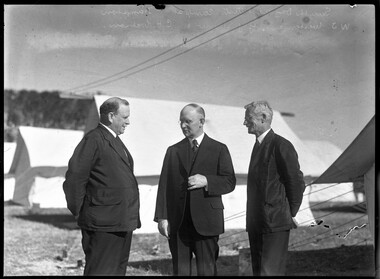 City of Melbourne Libraries
Photograph, Bull, Hugh Jones, 1897-1993, Seventh Day Adventists Camp at Hampton: W.J. Westerman, G.G. Stewart & C.H. Watson
... Cold nut foods, granose, nuttose, and jam protose, bromose, with jelly and various "ose" sandwiches, impossible for the unbeliever to diagnose, are put before you. ...Cold nut foods, granose, nuttose, and jam protose, bromose, with jelly and various "ose" sandwiches, impossible for the unbeliever to diagnose, are put before you. ...Photographer notations on slide: Seventh Day Adventists Camp at Hampton W.J. Westerman, G.G. Stewart & C.H. Watson Published: 28 December 1933 Published title: SEVENTH DAY ADVENTISTS. Published caption: “I. — The Annual Camp of the Seventh Day Adventists in Highett-road, Hampton, comprising more than 250 tents and accommodating over a thousand persons. II. —W. J. Westerman (vice-president of Australasian) and Pastor G. G. Stewart (president of Victoria), conversing with Pastor C. H. Watson (world president of the Seventh Day Adventists).- III.— Evangelist E. R. Gane and family.” SEVENTH DAY ADVENTISTS. (1933, December 28). The Age (Melbourne, Vic. : 1854 - 1954), p. 9. Retrieved August 1, 2025, from http://nla.gov.au/nla.news-article203356427 Research by project volunteer, Fiona Collyer: In December 1933, the annual Seventh Day Adventists Conference of Victoria was held, with over a 1000 participants camping for ten days at Highett Road Hampton. Pastor Charles H. Watson, world president of the Seventh Day Adventists, Walter J. Westerman, vice-president of Australasian and Pastor George G. Stewart, president of Victoria attended. Interestingly, The Age newspaper modified the original photo in their publication, placing the three men close to each other. Description: Three middle aged men dressed in suits converse in front of tents. In December 1933, delegates from all over Victoria and beyond travelled to Melbourne for the annual Seventh Day Adventists Conference of Victoria, held over ten days on a vacant allotment at Highett Road Hampton. A canvas town of 250 tents for over 1000 campers was created along with large marquees for lectures, devotional services and kitchens. Many daily visitors also attended the lectures and services. The principal speaker was Victorian born world president of the Seventh Day Adventists, Pastor Charles H. Watson (1877-1962), who travelled from Washington DC for the event. The Highett Street campers attended a busy schedule of bible readings, devotional services and health lectures during the ten days of the camp. Lecture subjects included- “Among the Head Hunters of the Solomon Islands”, “ Looking Through the Prophetic Telescope into 1934”, “Soul Surgery”, “Viewing the Celestial Land Through the Prophetic Telescope”and “The Four Horsemen of the Apocalypse”. The Seventh Day Adventist religion was established in the USA in 1863. One of its co-founders was American Ellen G. White whose writings are regarded as divinely inspired and are still adhered to today. Ellen preached on the “Eight Laws of Health”- Nutrition, exercise, water, sunshine, temperance, air, rest and trust in God. Adventists regard their bodies as holy temples and avoid food deemed by the Bible as unclean. They eat a mainly plant based diet with no caffeinated beverages and abstain from alcohol and tobacco. They believe in the observance of Saturday, the seventh day of the week in the Christian (Gregorian) and Hebrew calendars as the sabbath and the literal and imminent second coming of Jesus Christ. New converts are baptised by immersion in water. The Adventists opened the Warburton Sanitarium in 1910 as a health retreat, integrating their holistic health philosophy of physical, mental and spiritual well being. It was a resort in the hills “among picturesque mountain scenery…surrounded by tall forests and deep fern gullies…” where highly strung Melburians could alleviate their digestive maladies, stress and jaded nerves as “…worn down nervous systems mend quickly in this peaceful environment…invigorating air and an abundance of home-grown fruit, vegetables, fresh eggs, milk, and cream help to build healthy bodies”. The resort also offered hydrotherapy, massage and electrical treatments. An advertisement in The Argus- 1 December 1947 assured readers- “EVERYTHING SUNNY AGAIN." “That's how you'll feel when you say farewell to Warburton Sanitarium and Hospital after spending a holiday here. Victoria's Hydro is famous far and wide for wonders worked with sufferers from nervous and digestive disorders. Wholesome food, perfectly cooked; splendid air, regulated exercise, sweet natural sleep; these quickly correct faulty digestion, restore vitality, bring back that sunny optimism natural to healthy people. Massage and curative baths under medical supervision…” Later, after further building work, it became the Warburton Hospital with medical, casualty and obstetrics wards as well as offering strategies to stop smoking, lose weight and for stress management. The hospital ceased operation in 2001. Ellen G. White wrote “God sent me to Australia” and in 1891, accompanied by her son William C. White she arrived in Australia to start a Bible school, spread her health philosophy and for missionary work. At first health food products were imported from America, but it soon became apparent that due to the expense and the food becoming stale over the long journey, that local manufacturing was necessary. In 1898 William secured the services of American Adventist baker Edward C. Halsey, who had worked at Dr Kellogg’s Battle Creek (“Cereal City”), Sanitarium, Michigan, USA. They rented the St George’s bakery in Northcote, Melbourne, producing the first ready to eat breakfast cereal Granola, Caramel Cereal, and peanut butter. The fledgling company relocated to larger premises in Cooranbong, NSW soon after. The Sanitarium Health Food Company opened a factory in Warburton in 1925, manufacturing Granose Biscuits, Cerix Puffed Wheat, San-Bran, Bixies malted wheat flakes, Betta peanut butter, Marmite, “Kwic-Bru - A delicious health “coffee” made from choicest cereals and free from drugs that affect the heart and nerves” In 1928, Sanitarium bought out Grain Products Limited who were manufacturing a sweet cereal biscuit called Weet-Bix which soon became Australia’s favourite breakfast cereal. The Warburton factory closed in 1997, with manufacturing shifting interstate. Sanitarium breakfast cereal boxes offered free collectable cards inside and children could buy albums from grocers for sixpence and mount the cards. Subjects of the albums included- “Aboriginal Tribes, Legends, Customs”, “Australia- Yesterday and Today”, “Marvels of the Great Barrier Reef”, “Advance Australia- a Pageant of the Years”. In 1902 the Adventist’s opened the “Pure Food Vegetarian Cafe” in Sydney (In 1907 the name was changed to “Sanitarium Health Food Cafe”), Eating vegetarian food was definitely a curiosity. “Cristina” reviewed the cafe for The Australasian-27 October 1906. Topics For The Block. “Feeling somewhat like a criminal, and hoping to escape detection, I stealthily made my way into a vegetarian restaurant the other day... If my friends happened to catch me walking in there, I should henceforth be considered a crank, a faddist, and little short of a lunatic! Whom did I find within, seated with the air of habitués at the small tables, but heaps of my friends. They had all this while been pursuing their vegetarian way, layin' low and sayin' nuffin'. Flesh-eaters, now that the Sydney summer has set in apparently in good earnest, are beginning to wonder if the vegetarians are not wiser in their day and generation. Roast beef, hot cornea beef, ragouts, and meat curries, the very thought of them makes one feel hot. Frosted lemon pudding, stewed fruits, wheatmeal rolls, and tomatoes sound nice when you look at their names on the vegetarian menu. Such weird messes are served, square, unintelligible blocks of some brown substance, a few bites of which form a full and satisfying meal. Cold nut foods, granose, nuttose, and jam protose, bromose, with jelly and various "ose" sandwiches, impossible for the unbeliever to diagnose, are put before you. You drink malted nut broth, you eat gluten sticks, stewed beans, lentil patties, with vegetable sauce, any or all of which are distinctly nourishing and filling at the price. A mock (decidedly mock) veal cutlet or a red lentil roast is sufficient lunch, it appears, for anyone. Thus, "you obtain the best working results from your machinery with the least possible expenditure..." In December 1906 the Adventists branched out to Melbourne, opening the Sanitarium Health Food Cafe at 289 Collins Street next to the Royal Bank building. (corner Collins and Elizabeth Streets, demolished in 1939). Their motto was “Quality and Purity”. “Cynthia” of The Leader “Social Circle” column reviewed the cafe in 9 March 1907- “Hundreds of people have a feeling of positive affection for a diet that will be satisfying, appetising and nourishing, without having meat for its backbone. It will come as news that we have in Melbourne a cafe where you can really enjoy yourself without eating anything in the way of meat. Cream, custard, cheese and the like are not cold shouldered out of the menu, and the housewife in search of new dishes will find here ever so much in the way of suggestions. Nuts figure conspicuously in the menu, and lentil and walnut cutlets may be instanced among the delicacies. Beans are cooked in quite alluring fashion, while creamed parsnips are excellent. For sandwiches you could hardly desire anything more appetising than granosi biscuits, and nut cheese. The combination is suggestive of school lunches, and nut meat might well be employed as a variant. A visit to the cafe itself — it is next the Royal Bank in Collins-street — will surprise anyone used to the average vegetarian restaurant. Every thing is fresh, fragrant, and thoroughly modern… It is run, in connection with that curious people the Seventh Day Adventists.” However, “Adele” writing for the Evelyn Observer and Bourke East Record -13 December 1907 had a different experience- CITY RESTAURANTS. “There is no glamour from the outside. We enter the dining room at six and secure a seat at a small table, for this night we are going to dine on vegetables. Some people pride themselves on being vegetarians, and devote a great deal of their spare cash and energy to disseminating vegetarian principles. I shall not in a hurry forget the dinner we tried to get through at this vegetarian restaurant. There was put before us plate after plate of vegetables not soaked, but sodden with water, not an atom of flavouring or dressing; no attempt was made to give the slightest piquancy to potato, cabbage, turnip or carrot. I beg pardon, I am unjust, there were two caterpillars in the cabbage. It is astonishing how persistently ordinary cooks spoil vegetables in the process of cooking and how little they understand the value of vegetables on a menu.” From the extensive menu of 1924, you could order cream of green pea soup, followed by nut meat with Yorkshire pudding, egg timbales, stewed brown lentils, savoury rissoles with piquant sauce. Among the dessert offerings were creamed sago, steamed figs and walnut drops. Washed down with fermented wine and to finish, “Frucerea”, a coffee substitute essence made from fruit and cereal. A four course meal of soup, entree, vegetables and sweets cost 1/6 in 1924. Proving that plant-based food was not just a novelty, 67,000 meals were served at the cafe in 1918, rising to 73,000 in 1921. Later the Sanitarium Cafe moved to 293 Little Collins Street, (opposite Royal Arcade) sharing the building with The Lilliput Golf Course, a miniature golf course of 18 holes. The course was a replica of the fashionable Lido Course in France and was open daily from 10am to midnight with a green fee of one shilling. It featured goldfish, waterfalls and dance music. Lilliput boasted that they were “Melbourne’s coolest indoor course” Miniature golf (mini, minnie, midget, miget, Tom Thumb, Wee golf, putt-putt, pigmy, peewee, crazy golf, obstacle golf) swept the globe in the 1930s, starting in the USA, then Europe. The courses provided affordable recreation during uncertainty at the start of the Great Depression. The craze arrived in Sydney September 1930 with the first mini golf course opening in the basement of the State Theatre. It featured a replica Sydney Harbour Bridge and attracted over 1000 players a day at one shilling per game. The miniature golf bug hit Melbourne hard in 1930-31 with nearly 200 courses springing up in the CBD and suburbs within a few months. The first miniature golf course to open in Melbourne was on 4 October 1930 in the basement of recently built art deco style Wentworth House at 203 Collins Street, designed by architect Cedric Heise Ballantyne, (also designed Regent Theatre, Plaza Ballroom, Athenaeum Club, National Theatre, St Kilda, built in 1930, demolished in 1974 for the City Square) It was managed by J. C. Williamson who advertised for a “Girl Spruiker” who “Must be Young, Attractive Personality, and Able to Talk to the Public” to work at the course. The Age 26 September 1930 reported - “The Wentworth House management have spared no expense in preparing the links. Water hazards, sand bunkers, running streams, ancestral castles, moats and a cunning drawbridge have each been devised to test the skill of players, while the walls and ceiling have been "atmospherically" treated to convey an exterior effect”. Even Melbourne City Council jumped on the bandwagon, leasing the lower hall of Melbourne Town Hall to colourful car dealer and racehorse owner Mr A. G. Barlow for £43 per week for the “Kit Kat Tiny Golf Course”, opening on 11 December 1930. (Turf identity, Mr Alexander George Barlow, (1880-1937) who raced under the nom de course “A. G. Vauxhall”, owned filly Frances Tressady, who in 1923 won the Victoria Derby and Oaks Stakes double and came fifth in the Melbourne Cup. The “Frances Tressady Stakes” is held each March at Flemington Racecourse in honour of the horse, the last filly to win the Derby. Barlow was the proprietor of Barlow Brothers Pty Ltd car dealership at 442 Elizabeth Street, Melbourne. He played 14 games for Carlton Football Club (VFL) on the half-forward line from 1901-1903). Patrons could vie for The Herald Miniature Golf Championship Cup, a gold cup worth £7/7, in an eight week long competition. Sports newspaper The Sporting Globe also offered a Cup and prize money. Many courses offered prizes of theatre tickets, cash and cigarettes. Myer’s department store, hoping to cash in on the fad, advertised in Melbourne’s newspapers that their Sports Department could design and equip complete miniature golf courses using “Fairway” imitation turf at 4/6 a yard. Newspaper cartoonists loved to lampoon the fad. Both Percy Leason, cartoonist for society magazine Table Talk and Syd Miller of Smith’s Weekly depicted “real” golfers causing havoc on a mini golf course, showing that being a “real” golf player was no advantage to playing miniature golf. But bust often follows boom. With such rapid market saturation, expensive novel hazards, waning interest, long opening hours, often to midnight, and price cutting of game fees from one shilling to sixpence and then to threepence amongst some courses, the bubble was bound to burst. The Sporting Globe columnist J.M.Dillon on 20 May 1931 lamented- £100,000 LOST Failure of ‘Minnie’ Golf. “Miniature golf might have provided fun and jokes for thousands of people in Australia, but there were many for whom it panned out a tragedy. It is likely that the dead losses of those who attempted to make money out of the game in Australia were in the vicinity of £100,000. …For a while there was hardly a spare block of land, or a possible “site” in the shape of a hall, or a showroom, in Sydney and Melbourne, that some one was not after to set upon it a “minnie links.” Big amusement firms and private individuals anxious to make money began to run courses. Practically every individual who touched the game had his finger’s financially burnt. …From the approximately £60,000 invested in Melbourne alone, there must have been £25,000 lost. …There are now dozens of courses going to ruin, and many more that the owners would be happy to give away if the takers would remove from them obligations of leases, &c…” The lease on the “Kit Kat Tiny Golf Club” at the Melbourne Town Hall expired on 30 April 1931, with Mr Barlow losing £798 on the venture. The hazards and fittings, which cost £400 and included a large replica of the Town Hall, now worthless. Due to declining patronage, the Little Collins Street cafe closed in 1938, although the adjacent shop continued to sell Sanitarium products. In New Zealand, the first Sanitarium factory opened in Christchurch in 1900, with the company later opening factories in Palmerston North and Auckland. The Adventists opened vegetarian cafes, firstly at 37 Taranaki Street Wellington in 1906, followed by cafes in Auckland, Christchurch and Dunedin. Weet-Bix is also New Zealand’s favourite cereal- there the jingle is “Kiwi kids are Weet-Bix kids.” In 1955, the Australian Women’s Weekly ran an illustrated, full colour advertisement featuring New Zealand born Edmund Hillary (later Sir) 1919-2008, who, along with Sherpa Tenzing Norgay, was the first climber to reach the summit of Mount Everest on 29 March 1953. The Australian Women’s Weekly, 30 March, 1955- “WEET-BIX carried by Hillary on Himalayan adventure! c/- N.Z. Alpine Club Inc., Dunedin, New Zealand. The Manager, Sanitarium Health Food Company, Christchurch, N.Z. Dear Sir. …Weet-Bix was chosen at my special request as I had always felt that some easily prepared form of breakfast was essential to the primitive conditions of high camps. Weet-Bix fulfilled its task very well indeed. We usually had them with hot milk (powdered) and sugar, and even when we were unable to eat anything else, we usually managed to have a little Weet-Bix . . . I regard them as a great success and expect they will be more widely used in the Himalayas in future. Yours faithfully, (Signed) E.P. Hillary. Sanitarium Marmite - motto- “Too much spoils the flavour”- is as beloved with Kiwis as Vegemite is with Australians. In 1966, a fire gutted the Christchurch Marmite factory causing a nation wide shortage. Once the factory was rebuilt, Sanitarium relaunched the yeasty extract in reusable glass tumblers with printed designs such as yachts, New Zealand birds and vintage cars. These popular collectibles can still be found in the kitchen cupboards of many New Zealand baches (holiday homes). After the devastating 2011 earthquake in Christchurch damaged the Marmite factory causing shortages and panic buying, a “Marmageddon” was declared with jars of the “black gold” advertised online for up to NZ$800. Consumers were advised to spread their Marmite sparingly until production resumed. (The Christchurch plant reportedly produces around 640,000kg of Marmite per year). Sanitarium Health and Wellbeing Company is exempt from paying company income tax on their profits due to their ownership by a religious organisation. Although not a compulsory rule for salvation, Adventists are encouraged to pay a tithe of 10% of their income to the church to support the ministry in God’s work. Nowadays, there are over 25 million members of the Seventh Day Adventists Church in 200 countries. ITEMS OF INTEREST (1933, December 22). The Argus (Melbourne, Vic. : 1848 - 1957), p. 8. Retrieved July 21, 2025, from http://nla.gov.au/nla.news-article11723188 SEVENTH DAY ADVENTISTS. (1933, December 28). The Age (Melbourne, Vic. : 1854 - 1954), p. 9. Retrieved July 1, 2025, from http://nla.gov.au/nla.news-article203356427 EVANGELISTS' CAMP (1933, December 20). The Herald (Melbourne, Vic. : 1861 - 1954), p. 30. Retrieved July 1, 2025, from http://nla.gov.au/nla.news-article243213209 Master Butchers Have A Time Pilots FOR School Air Race Charity Golf At Riversdale (1931, May 1). The Sun News-Pictorial (Melbourne, Vic. : 1922 - 1954; 1956), p. 14-15. Retrieved September 4, 2025, from http://nla.gov.au/nla.news-article276159136 2000 ADVENTISTS UNDER CANVAS (1933, December 27). The Herald (Melbourne, Vic. : 1861 - 1954), p. 17. Retrieved July 1, 2025, from http://nla.gov.au/nla.news-article243223698 TOPICS FOR THE BLOCK. (1906, October 27). The Australasian (Melbourne, Vic. : 1864 - 1946), p. 45. Retrieved August 30, 2025, from http://nla.gov.au/nla.news-article139178204 https://en.wikipedia.org/wiki/Seventh-day_Adventist_Church https://www.sanitarium.com/au/about/sanitarium-story/profits-for- ENTERTAINMENT AT MENZIES'. (1906, December 6). Punch (Melbourne, Vic. : 1900 - 1918; 1925), p. 26. Retrieved August 3, 2025, from http://nla.gov.au/nla.news-article175380296 https://encyclopedia.adventist.org/article?id=9HN0&highlight=Conference SOCIAL CIRCLE (1907, March 9). Leader (Melbourne, Vic. : 1862 - 1918, 1935), p. 41. Retrieved August 3, 2025, from http://nla.gov.au/nla.news-article196649677 CITY RESTAURANTS. (1907, December 13). Evelyn Observer and Bourke East Record (Vic. : 1902 - 1917), p. 1 (MORNING.). Retrieved August 3, 2025, from http://nla.gov.au/nla.news-article61133109 Advertising (1924, May 6). The Sun News-Pictorial (Melbourne, Vic. : 1922 - 1954; 1956), p. 9. Retrieved August 3, 2025, from http://nla.gov.au/nla.news-article274271406 1930, December 5). The Herald (Melbourne, Vic. : 1861 - 1954), p. 14. Retrieved August 5, 2025, from http://nla.gov.au/nla.news-page26374135 Thousands Are Still Playing Miniature Golf (1931, January 2). The Herald (Melbourne, Vic. : 1861 - 1954), p. 11. Retrieved August 8, 2025, from http://nla.gov.au/nla.news-article242880087 MINIATURE GOLF. (1930, October 16). The Argus (Melbourne, Vic. : 1848 - 1957), p. 10. Retrieved August 8, 2025, from http://nla.gov.au/nla.news-article4209280 THE REAL GOLFER WHO FORGOT HIMSELF ON THE MINIATURE GOLF COURSE (1930, November 13). Table Talk (Melbourne, Vic. : 1885 - 1939), p. 13. Retrieved August 8, 2025, from http://nla.gov.au/nla.news-article146706596 Advertising (1930, December 5). The Herald (Melbourne, Vic. : 1861 - 1954), p. 14. Retrieved August 8, 2025, from http://nla.gov.au/nla.news-article242761991 Advertising (1931, January 9). The Herald (Melbourne, Vic. : 1861 - 1954), p. 12. Retrieved August 8, 2025, from http://nla.gov.au/nla.news-article242887972 1955, March 30). The Australian Women's Weekly (1933 - 1982), p. 38. Retrieved August 9, 2025, from http://nla.gov.au/nla.news-page4812489 £100,000 LOST (1931, May 20). Sporting Globe (Melbourne, Vic. : 1922 - 1954), p. 1 (Edition1). Retrieved August 14, 2025, from http://nla.gov.au/nla.news-article183023946 1930, December 5). The Herald (Melbourne, Vic. : 1861 - 1954), p. 14. Retrieved August 15, 2025, from http://nla.gov.au/nla.news-page26374135 Advertising (1931, January 23). The Herald (Melbourne, Vic. : 1861 - 1954), p. 14. Retrieved August 15, 2025, from http://nla.gov.au/nla.news-article242887795 MINIATURE GOLF. (1931, February 5). The Dandenong Journal (Vic. : 1927 - 1954), p. 6. Retrieved August 16, 2025, from http://nla.gov.au/nla.news-article201082526 Still Time To Enter Midge (1931, January 16). The Herald (Melbourne, Vic. : 1861 - 1954), p. 12. Retrieved August 16, 2025, from http://nla.gov.au/nla.news-article242888830 WIT OF THE WEEK (1930, October 23). Table Talk (Melbourne, Vic. : 1885 - 1939), p. 23. Retrieved August 29, 2025, from http://nla.gov.au/nla.news-article146455050 Advertising (1930, October 2). Table Talk (Melbourne, Vic. : 1885 - 1939), p. 16. Retrieved August 18, 2025, from http://nla.gov.au/nla.news-article146454620 MIDGET GOLF LINKS. (1930, September 26). The Age (Melbourne, Vic. : 1854 - 1954), p. 6. Retrieved August 18, 2025, from http://nla.gov.au/nla.news-article202235074 https://www.smh.com.au/national/fairfax-archive-mini-golf-20131125-2y608.html TURF NOTES (1923, November 6). The Ballarat Star (Vic. : 1865 - 1924), p. 6. Retrieved September 3, 2025, from http://nla.gov.au/nla.news-article213855201 Advertising (1930, October 4). The Herald (Melbourne, Vic. : 1861 - 1954), p. 10. Retrieved October 14, 2025, from http://nla.gov.au/nla.news-article242937272 LAUGHTER AND TEARS. (1930, November 15). Smith's Weekly (Sydney, NSW : 1919 - 1950), p. 21. Retrieved September 9, 2025, from http://nla.gov.au/nla.news-article234426874 Advertising (1947, December 1). The Argus (Melbourne, Vic. : 1848 - 1957), p. 5. Retrieved September 15, 2025, from http://nla.gov.au/nla.news-article22523355Photographer notations on slide: "Seventh Day Adventists Camp at Hampton W.J. Westerman, G.G. Stewart & C.H. Watson".religion, health food, mini golf, 1930-1939, tents, churches, camps -
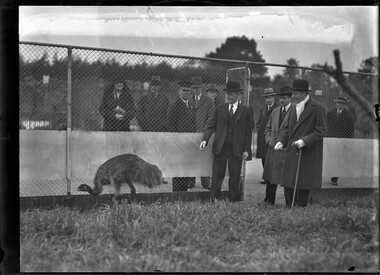 City of Melbourne Libraries
Photograph, Bull, Hugh Jones, 1897-1993, Vice-regal visit to zoo: Lord Huntingfield meets an emu
... After reloading, the gun jammed and the emus dispersed in all directions, and were not sighted again that day. ...After reloading, the gun jammed and the emus dispersed in all directions, and were not sighted again that day. ...Photographer notations on slide: "Vice Regal visit to Zoo B42" Not published. Description: A group of men and one woman all dressed in hats and overcoats stand by a wire fence while watching an emu. Research by project volunteer, Fiona Collyer: On 25 June 1934, new Victorian Governor, His Excellency Lord Huntingfield and his wife Lady Huntingfield made an official visit to the Melbourne Zoological Gardens in order to grant his patronage to the Royal Zoological and Acclimatisation Society. During the visit, zoo director Mr. Andrew Wilkie introduced them to some of the zoo’s inhabitants, including an emu. After the First World War, many returned soldiers took up the Government’s offer of land in the Soldier Settlement Scheme. Most of the veterans had little or no farming experience and much of the land offered was of poor quality, with blocks often too small to be viable. Many of the settlers had ongoing physical and mental injuries from the war. The Western Australian government allocated land to 5000 former soldiers but by 1929, one quarter of the men had already abandoned their land, unable to make a living. Not only was the world economy struggling with the Great Depression, but the settlers also had to contend with plummeting wheat and wool prices, crippling drought and rabbit infestation. The Scullin Government (Oct 1929-Jan 1932) had promised subsidies to the Western Australian farmers if they increased their wheat crops but were unable to pass the legislation in the Senate. The new Lyons Government (Jan 1932-April 1939) abandoned the legislation and the subsidies were never paid, bringing calls from Western Australia of secession from Australia. In October 1932, a deputation of soldier settlers from the Campion wheatbelt region in Western Australia, petitioned Commonwealth Minister for Defence, Western Australian Senator Sir George Pearce, for assistance. A mob of 20,000 emus were migrating to the coast after breeding and were gathering along the eastern side of the Number 1 Rabbit Proof Fence, attracted to the ripening crops and the dams the farmers had built. They were heading towards Campion, 303 kilometres east of Perth, eating and trampling the wheat, destroying the fences and letting the rabbits in. Having witnessed firsthand the effectiveness of machine guns in killing people in war, the former soldiers thought the guns would be ideal for killing emus. Sir George, wanting to demonstrate that his government was sympathetic to the settlers and hoping to quell Western Australian succession talk, agreed. However, he stipulated that no expense would be incurred by the Commonwealth Government and only active military personnel could use the machine guns. The farmers had to pay for the ammunition, food and accommodation for the military for the length of the operation. The cost for the ammunition was £50 for 10,000 rounds. Sir George also felt the operation would provide excellent target practice for the soldiers! The operation was headed by Major Gwynydd Purves Wynn-Aubrey Meredith, 1887-1975, of the Seventh Heavy Battery of the Royal Australian Artillery, and assisted by Sergeant S. McMurray and Gunner J. O'Halloran. They were equipped with two American-designed Lewis light machine guns and 10,000 rounds. Each magazine held 47 rounds of ammunition and the gun was capable of firing 500 to 600 rounds per minute with effective firing range of 800 metres. A cinematographer from British Movietone News accompanied the soldiers in order to record what was expected to be not only an easy victory but also useful propaganda for both the military and the Lyons Government. Emu (Dromaius novaehollandiae, meaning New Holland Racer) is a species of long-necked flightless bird endemic to Australia. The Tasmanian and the dwarf King and Kangaroo Island subspecies were hunted to extinction after the European settlement of Australia. It is the second largest bird in the world after the ostrich, standing up to 1.9 metres tall and weighing up to 50 kilograms. The Emu has long, powerful legs with three forward facing toes and is the only bird with calf muscles. It is able to jump 2.1 metres into the air and run 50 kilometres per hour. It communicates by drumming and booming through an inflatable neck sac which can be heard up to two kilometres away. Along with its tough hide and a body more feathers than flesh, the emu can be a tricky target. Emus had been a protected native species until 1922, when the government changed their status to “vermin” in response to the emus breaking down fences and destroying crops. Major Meredith told the press that Colonel Oswald V. Hoad of the 1st Cavalry Division NSW had especially requested he send 100 emu skins to replenish the plumage on his Light Horsemen’s hat tops. On the first day of the Emu War, 2 November 1932, Major Meredith spotted a mob of emus out of range of the guns, so he asked the farmers to use their vehicles to drive the emus towards the fence and the guns. The panicked birds split into small groups, kicking up the dust and scattering every which way. Only six were killed, though some were wounded. After that, the emus became very wary of humans. On 4 November, Major Meredith staged a dawn ambush at a dam. As 1000 emus approached to drink, the soldiers opened fire, killing 12 emus. After reloading, the gun jammed and the emus dispersed in all directions, and were not sighted again that day. The West Australian newspaper reported on 4 November 1932 that, “The emus have proved that they are not so stupid as they are usually considered to be. Each mob has its leader, always an enormous black-plumed bird standing fully six-feet high, who keeps watch while his fellows busy themselves with the wheat. At the first suspicious sign, he gives the signal, and dozens of heads stretch up out of the crop. A few birds will take fright, starting a headlong stampede for the scrub, the leader always remaining until his followers have reached safety.” In a later attempt, they mounted a gun onto the bed of a truck in order to chase and mow down the birds. However the truck couldn’t drive fast enough over the rough terrain and it was too bumpy to fire the gun accurately. The birds easily outran the truck except for one hapless emu who faltered while being chased and fell under the truck, its body wedging in the steering gear, causing the driver to crash the truck, and bringing down half a chain of the rabbit proof fence. RSPCA inspector Mr. Arthur Austin arrived with a rifle and knife in order to finish the work of the Lewis guns and dispatch injured emus. He said that while his society was sympathetic to the stricken settlers, he was anxious that wounded birds should not be left to suffer. Major Meredith told the inspector, “What speed can you run? You have to be better than Peter Pan if you want to catch wounded emus that make for the scrub.” (Racehorse “Peter Pan” had won the 1932 Melbourne Cup a few weeks earlier.) The commentator of the British Movietime newsreel uses a jocular tone to optimistically proclaim, “The scouts [emus] of the advancing army have keen eyesight, and in order to get close to the main body, our lads have to do some real stalking, with the enemy watching events through their periscopes raised up over the heads of corn... Instead of the birds ruining the farmers, tables are turned, there will be no more damage down here for many a day to come once the enemy is eliminated.” Emus proved tougher adversaries than expected, barely breaking stride even when badly injured from machine gun bullets, and the suspicious emus soon learnt to stay out of range of the men and their guns. Meanwhile, in the eastern states concern was being expressed about the cruelty of machine-gunning the native birds. Senator James Guthrie UAP of Victoria suggested that there must be “more humane, if less spectacular methods” of coping with the pests. People wrote letters to the newspapers to express their dismay at the inhumane methods used. R.F. Bellchambers from Humbug Scrub, 25 November 1932, lamented that, “At the present rate of extinctions, it will shortly be necessary to go to the Museum to see the remains of our fauna.” The Murchison Times published a letter on 16 November 1932 from “Clay Pan Joe”: “War on Emus. Slaughter of innocent birds would be more appropriate... The birds may be a nuisance and it may be necessary to destroy them, but why cause so much suffering amongst these innocent birds.” E.S. Playford of Norton’s Summit wrote to The Advertiser, 22 November 1932, that “...habitation on the earth would be impossible without bird life. Therefore, it is unwise to say that any bird is useless. Is sentiment dying? Are we so keen on personal gain that our lovely and unique birds have to be ruthlessly slaughtered in thousands and their bodies left rotting in the sun?” In Sydney, picture palace patrons expressed “considerable concern” after viewing the Movietone News newsreel of emus fleeing from the barrage of machine-guns, and wounded emus in the fields in Campion. The press had a field day, dubbing it the “The Emu War” and joking that the “Chicago method” was being used against the feathered foe. The Daily News newspaper published a cartoon depicting the emus outrunning and outsmarting the soldiers. In Parliament NSW Senator James Dunn called Sir George the “Minister for the Emu War”. Labor member Mr. Rosevear, midst great laughter, asked if the minister would consider declaring an armistice and withdrawing his troops from the Western Front. Prime Minister Joe Lyons was asked if medals would be struck for those taking part in the war. Labor parliamentarian Mr. A.E. Green declared any medals should go to the emus who had “won every round so far”. With the embarrassing press coverage and poor results, Sir George ordered a stop to the project on 9 November, and Major Meredith and the soldiers departed for Perth. The WA Premier Sir James Mitchell and the Campion farmers demanded they return, citing the continued destruction of crops and fences by the emus. Major Meredith and his two gunners were allowed to return on 13 November and seemingly having learnt from their previous experiences, had slightly more success this time killing emus. The operation finally finished on 10 December with Major Meredith reporting “definite kills” of 986 emus for 9860 rounds of ammunition, coincidentally and conveniently exactly 10% of the number of rounds used. A further 2500 birds were said to have died from their injuries and although this is a disputed figure, even if accurate, the ratio of rounds expended to emu casualties was thought too high to justify continuing. The operation barely caused a dint in the marauding mob of 20,000 emus. “There’s only one way to kill an emu”, one of the party bitterly remarked: “Shoot him through the back of the head when his mouth is closed or through the front of his mouth when his mouth is open. That’s how hard it is.” Australian ornithologist Dominic L. Serventy noted that “The machine-gunners’ dreams of point blank fire into serried masses of Emus were soon dissipated. The Emu command had evidently ordered guerrilla tactics, and its unwieldy army soon split up into innumerable small units that made use of the military equipment uneconomic. A crestfallen field force therefore withdrew from the combat area after about a month.” Major Meredith expressed the greatest of respect for the enemy. He said, “If we had a military division with the bullet-carrying capacity of these birds, it would face any army in the world. They could face machine guns with the invulnerability of tanks. They are like Zulus, whom even dum dum bullets would not stop." The Major’s official report stated that there were no human casualties in “The Emu War.” Emus are considered the victors of “The Great Emu War.” Western Australian farmers requested military assistance in 1934, 1943 and 1948, including using bombs, but the government refused. The bounty system instigated in 1923 continued, with farmers using rifles against their fleet-footed foe, with 57,034 bounties for dead emus claimed in six months in 1934 in Western Australia alone. 284,704 emus were killed in Western Australia between 1945 and 1960. The other most effective defence against the emus was the construction of a robust, vermin proof fence spanning over a long distance. Emus were formally protected in 1999 by the Environment Protection and Biodiversity Conservation Act. It’s estimated there are between 625,000 to 725,000 wild emus in Australia in 2024. An emu and a kangaroo feature on Australia’s coat of arms, holding up a shield illustrated with symbols of the six states. The animals symbolise the nation moving forward as neither animal can walk backwards. Campion is now a ghost town. A book about the operation, “Letters from the Emu War” by J.A. Bryden was published in 2023 by Playtime Books. In 2024, an Australian film called “The Emu War” was released, starring Damian Callinan and Luke McGregor. Andrew Arthur Wellesley Wilkie, 1853-1948, was Director of the Melbourne Zoo from 1923 to 1936 and was associated with the zoo for 70 years. He first worked as a horticultural assistant to Government botanist Baron Ferdinand von Mueller at the Botanical Gardens at the age of 13, along with his older brother David. One of Andrew’s jobs was to capture moths for the National Herbarium. In 1857, a group of prominent Melburnians assembled at St. Patrick’s Hall to form the Zoological Society of Victoria, with the aim of introducing animals and plants from overseas. It was conceived, “For the purposes of science and for that of affording the public the advantages of studying the habits of the animal creation in properly arranged zoological gardens.” The Victorian Government granted 32 acres (13 hectares) of land to the Zoological Society at the southern end of Richmond Paddock on the opposite bank to the Botanical Gardens. (This is where AAMI Stadium and Collingwood Football Club now stand.) In 1861, the Zoological Society of Victoria was renamed The Acclimatisation Society of Victoria. Unfortunately the Yarra River frontage was damp, swampy and subject to flooding, so the animals were briefly housed at the Botanical Gardens until in 1862, the City of Melbourne donated 55 acres (22 hectares) of land at Royal Park for the fledgling zoo. Baron von Mueller secured employment at Royal Park for Andrew and David and they helped to lay out the gardens, plant trees and take care of a collection of deer, pheasants, hares and partridges. Initially the zoo was used for the acclimatisation of animals recovering from the long voyage to Australia and for breeding them for sport. In 1872, the zoo bought two lions, a leopard and a cheetah that had been seized from circus showmen Keith and Phillips when they were unable to pay the bill of butcher Mr T K Bennet of Bourke Street. The first zoo director, Mr. Albert Le Souef, negotiated with captains of ships to buy animals at overseas ports they visited and soon a multitude of exotic species arrived, including a ten-year-old Indian elephant in 1878. In 1923, after being head keeper for some years, Andrew was appointed director of the zoo. By 1933, the zoo had 110 different species of animals, 200 species of birds and 72 species of reptiles under Andrew’s care. He had personally planted all but six trees and laid out the garden beds. As director he lobbied authorities for funds to build more humane enclosures for the animals. In June 1928, Table Talk magazine wrote of Andrew Wilkie: “Up at the Zoo there is a humble gentleman who is a lion among the lions, who knows the proper specific to employ when the boa constrictor has chilblains, and who is a friend and confidant of Queenie the elephant. His fount of zoological lore has never been plumbed. It is bottomless, like his good fellowship and geniality. Every day he may be seen somewhere in the grounds of that growing sanctuary for the strange and arresting fauna and creeping things of the world, and I assure you as one who is privy to his passion that that area and its inhabitants are rarely out of his thoughts.” Andrew retired from the zoo in 1936 at the age of 83 and in 1948 died at his home in Brunswick aged 94. He and his wife Josephine had six children. The Victorian Acclimatisation Society was founded in 1861 by Edward Wilson, 1813-1878, then owner and editor of The Argus newspaper. He said that Australian indigenous animals were practically useless, providing only “a little sport and an occasional meal”. The Society believed that Australia’s plants and animals were vastly inferior to those in Europe. They wanted to introduce and acclimatise to Victoria “all innoxious animals, birds, fishes, insects and vegetables, whether useful or ornamental” for sport and for the table, and to spread indigenous animals and plants from the colony around the world. Their motto was “if it lives, we want it”. The Society was primarily responsible for introducing sparrows, starlings, sambar and hog deer, ostriches, brown trout, blackberries, and carp to the Murray River. They released the European songbirds, thrush and blackbird to quell the homesickness of British settlers. The Society also sent Australian animals like platypus, echidnas, kangaroos and koalas to Europe for scientific and novelty purposes. Thomas Austin, a wealthy sheep farmer of Barwon Park, Winchelsea (property now owned by the National Trust) was a member and in 1859 he introduced hares, blackbirds, thrushes and partridges onto his property. He is probably best known for introducing 24 breeding rabbits onto his estate as game for shooting parties. Thomas quipped, “The introduction of a few rabbits could do little harm and might provide a touch of home, in addition to a spot of hunting." In 2022, genomic data confirmed that Australia’s feral rabbit population is entirely descended from these rabbits. Biological control has brought the rabbit population down from an estimated high of 10 billion rabbits in the 1920s to approximately 200 million today, inhabiting 70% of Australian landmass (5.3 million square kilometres). In 1872, the Acclimatisation Society was renamed The Zoological and Acclimatisation Society of Victoria and they focused on importing exotic animals for display purposes to the zoo. In 1937, the Royal Acclimatisation Society of Victoria was recreated as the Zoological Board of Victoria with a focus on research of native animals threatened with extinction. In an editorial for The Argus newspaper, 16 March 1856, Edward Wilson lamented: "...this country has been shamelessly stolen from the blacks. Had they been like the New Zealanders or the North American Indians, we should have bought their land, and supplied them with the means of living when we took it... In less than twenty years we have nearly swept them off the face of the earth. We have shot them down like dogs. In the guise of friendship we have issued corrosion sublimate in their damper, and consigned whole tribes to the agonies of an excruciating death. We have made them drunkards, and infected them with disease which has rotted the bones of their adults, and made such few children as are born amongst them a sorrow and a torture from the very instant of their birth. We have made them outcasts on their own land, and are rapidly consigning them to entire annihilation. There are but a few of them left, comparatively. This is what we would do for that few. We would feed and clothe every one of them.” [Note: this last sentence is italicized in the original newspaper article text]. Lord Huntingfield, (William Charles Arcedeckne Vanneck) 1883-1969, Governor of Victoria 1934-1939, was a British Conservative Party politician and the first ever Australian-born Governor of an Australian state (although he was always considered British). He was patron of the Royal Zoological and Acclimatisation Society of Victoria and was acting Governor-General for six months during the absence of Lord Gowie in 1938. Lady Huntingfield (née Margaret Eleanor Crosby) 1884-1943, his American-born wife showed great interest in social welfare and the advancement of women and children. She was president of the City Newsboys Society and Patroness of the Girls Friendly Society. In 1937, rose breeder Alister Clark named a yellow hybrid tea rose for her. In 1940, the City of Melbourne opened the Lady Huntingfield Free Kindergarten in North Melbourne, now the Lady Huntingfield Early Learning and Family Services Centre. Lady Huntingfield died in London in 1943 after her house was bombed during a German airstrike. The Lady Huntingfield Memorial Scholarship was established after the City of Melbourne raised £1000 in a public appeal conducted in her memory for students undertaking a Social Work degree at the University of Melbourne. It is awarded annually to this day. The Queen Victoria Hospital named a bed in her honour. References: VICE-ROYALTY GREETS THE KING OF BEASTS AT THE ZOO. (1934, June 26). The Age (Melbourne, Vic. : 1854 - 1954), p. 11. Retrieved August 23, 2024, from http://nla.gov.au/nla.news-article204818472 Prominent Personalities ANDREW WILKIE (1928, June 7). Table Talk (Melbourne, Vic. : 1885 - 1939), p. 15. Retrieved August 29, 2024, from http://nla.gov.au/nla.news-article146562949 'Edward Wilson (journalist)', Wikipedia, https://en.wikipedia.org/wiki/Edward_Wilson_(journalist) 'Thomas Austin (pastoralist)', Wikipedia, https://en.wikipedia.org/wiki/Thomas_Austin_(pastoralist) 'The Acclimatisation Society was driven by misguided ideals about 'fixing nature' in Australia', ABC News, https://www.abc.net.au/news/2022-11-04/acclimatisation-society-introduced-species-history-listen/101588262?utm_campaign=abc_news_web&utm_content=link&utm_medium=content_shared&utm_source=abc_news_web THE ABORIGINES. (1856, March 16). The Argus (Melbourne, Vic. : 1848 - 1957), p. 5. Retrieved September 28, 2024, from http://nla.gov.au/nla.news-article4833244 WAR ON EMUS. (1932, November 4). The West Australian (Perth, WA : 1879 - 1954), p. 12. Retrieved September 29, 2024, from http://nla.gov.au/nla.news-article32588972 'The Great Emu War: how it started and who won', ABC Australia, https://www.youtube.com/watch?v=Y1wA0PKeJqc Advertising (1932, November 25). The West Australian (Perth, WA : 1879 - 1954), p. 2. Retrieved October 26, 2024, from http://nla.gov.au/nla.news-article32584578 Emu Chasers Must Outstrip Peter Pan (1932, November 9). The Labor Daily (Sydney, NSW : 1924 - 1938), p. 5. Retrieved October 10, 2024, from http://nla.gov.au/nla.news-article237042749 WAR ON EMUS (1932, November 22). The Advertiser (Adelaide, SA : 1931 - 1954), p. 18. Retrieved October 15, 2024, from http://nla.gov.au/nla.news-article73997254 WAR ON EMUS. (1932, October 28). The Labor Daily (Sydney, NSW : 1924 - 1938), p. 6. Retrieved October 24, 2024, from http://nla.gov.au/nla.news-article237046601 EMU WAR (1932, December 3). Mirror (Perth, WA : 1921 - 1956), p. 7. Retrieved October 24, 2024, from http://nla.gov.au/nla.news-article75626301 Machine Gun Offensive Against Emus. (1932, November 10). Western Mail (Perth, WA : 1885 - 1954), p. 3 (PICTORIAL SECTION). Retrieved October 24, 2024, from http://nla.gov.au/nla.news-article37766670 A THOUSAND BIRDS IN LUCK. (1932, November 10). Western Mail (Perth, WA : 1885 - 1954), p. 28. Retrieved October 11, 2024, from http://nla.gov.au/nla.news-article37766849 New Strategy In A War On The Emu (1953, July 5). The Sunday Herald (Sydney, NSW : 1949 - 1953), p. 13. Retrieved October 11, 2024, from http://nla.gov.au/nla.news-article18516559 This is a nice emu-that was! (1932, November 5). The Daily News (Perth, WA : 1882 - 1955), p. 9 (HOME EDITION). Retrieved September 30, 2024, from http://nla.gov.au/nla.news-article82878309 LOCAL AND GENERAL (1932, November 16). The Murchison Times (Cue, WA : 1924 - 1937), p. 2. Retrieved October 14, 2024, from http://nla.gov.au/nla.news-article257500260 Taking Him for a Ride! (1932, October 13). The Daily News (Perth, WA : 1882 - 1955), p. 6 (HOME EDITION). Retrieved September 30, 2024, from http://nla.gov.au/nla.news-article83717338 'The Emu War', History Nuggets, https://historynuggets.squarespace.com/nuggets/2018/4/21/the-emu-war New Strategy In A War On The Emu (1953, July 5). The Sunday Herald (Sydney, NSW : 1949 - 1953), p. 13. Retrieved October 23, 2024, from http://nla.gov.au/nla.news-article18516559 'This is the story of how Australia went to war with emus and lost', First Dog on the Moon, https://www.theguardian.com/commentisfree/2018/jul/26/this-is-the-story-of-how-australia-went-to-war-with-emus-and-lost Photographer notations on slide: "Vice Regal visit to Zoo B42"emu wars, governors, melbourne zoo, city of melbourne, 1930-1939, hunting, lord huntingfield, lady huntingfield, royal park, animals, wildlife -
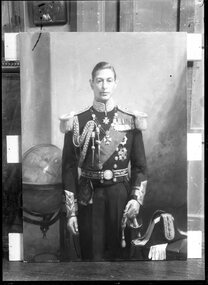 City of Melbourne Libraries
Photograph, Bull, Hugh Jones, 1897-1993, "A Royal Portrait" (Duke of York), 1933
... The dignitaries then feasted on a luncheon of turtle soup, poached schnapper, fillets of beef, roast chicken and ham, straw potatoes, green peas, Canberra Pudding (a pudding made with dripping, dried fruit and jam), fruit, ices, coffee and cheese. They toasted the King with non-alcoholic fruit punch as the Federal Capital Territory (later ACT) was a “dry” area and no speeches were made. ...The dignitaries then feasted on a luncheon of turtle soup, poached schnapper, fillets of beef, roast chicken and ham, straw potatoes, green peas, Canberra Pudding (a pudding made with dripping, dried fruit and jam), fruit, ices, coffee and cheese. They toasted the King with non-alcoholic fruit punch as the Federal Capital Territory (later ACT) was a “dry” area and no speeches were made. ...Published: The Age, Sat 14 October 1933 Published title: A Royal Portrait Published caption: "Seen at his studio, Alphington, Mr. W. B. Mclnnes's portrait of the Duke of York, which he painted recently on commission from the trustees of the Castlemaine Gallery, at St. John’s Wood, London, impresses as a vital record of one whose natural habitat is a palace, and whose place in life is one of near relationship to the throne of England. The Duke is painted in the uniform of the admiral of the fleet, a highly ornate vesture entailing much elaboration of gold and numerous medals, in dealing with which the artist has not failed to centre his attention on the head, and has succeeded in producing what is undoubtedly a soundly painted portrait and a good likeness. During the five fittings Mr. Mclnnes, apart from the ordinary social amenities, found his Royal sitter little inclined to talk, though he spoke feelingly of his trip to Australia and the pleasure it had given him: but with the Duchess the tendency to be sociable was much more clearly pronounced. She took, and expressed, a keen interest in the social and political matters of the day with a special concern for the supremacy of England and Australia in all questions relating to sport, such as cricket, tennis and golf. She spoke well of her portrait painted by Quinn, and regretted that she would not see the two hung side by side at the Castlemaine Gallery." Description: An unframed painting of a standing, middle-aged man dressed in the uniform of a Royal Navy admiral of the Fleet with medals, sash, ornate belt, cuffs and epaulettes. His left hand rests on the handle of a sword in its scabbard and his bicorn hat and white gloves are on a table beside him. To his right is a globe of the world showing Australia. Research by project volunteer, Fiona Collyer: In 1933, Castlemaine Art Gallery trustees commissioned artist W.B. McInnes (1889-1939) to paint a portrait of Prince Albert, Duke of York as a companion piece to the portrait of his wife, the Duchess of York, that the gallery had commissioned Australian official war artist James Quinn (1869-1951) to paint in 1930. During the First World War, the Duchess’s childhood home, Glamis Castle in Scotland was used as a makeshift military hospital and convalescence home for wounded soldiers. Many servicemen from the Castlemaine area recuperated there and had fond memories of the kindness of the teenage Lady Elizabeth Bowes-Lyon (1900-2002, later Duchess of York) who spent the war years running errands and aiding in the welfare and morale of the patients. In 1927, the Duke and Duchess of York (later King George VI and Queen Elizabeth) came to Australia to formally open the newly built Parliament House in Canberra and to tour the country. While visiting Victoria in April, they embarked on a whistle-stop train journey to Bendigo, stopping at Kyneton for ten minutes and Castlemaine for 15 minutes. At Kyneton, an excited crowd of 10,000 people welcomed the couple with “three cheers and three cheers for Baby Betty” before the Duchess was presented with a bouquet of locally grown roses and the Duke a bound album of photographs of noted beauty spots of the district. Next the Royal Couple stopped at Castlemaine to the cheers of 15,000 people. There the couple were presented with a basket of prime quality Harcourt apples and a pair of cot blankets, manufactured at Castlemaine Woollen Mills, a birthday gift for baby Princess Betty. The Duchess recognised Colonel W.E. James, of the Seventh Battalion, who had convalesced at Glamis Castle in 1917, and they chatted before the train departed, while the Duke shook hands with returned soldiers. Last stop was the town of Bendigo which was colourfully decorated with bunting and flags, arches and flowers. 3000 pigeons were released on their arrival and the liberated birds circled overhead for several minutes as if to welcome the Royal Couple. A crowd of 50,000 cheering people lined the streets in bright sunshine as the couple drove by. From an arch over Hargreaves Street, pretty girls showered the pair with rose petals. The Duke was presented with a gold nugget and an album, handsomely bound in morocco, of a history of the Bendigo mining industry, while the Duchess received a bouquet of prize winning white chrysanthemums. After 75 minutes in Bendigo they journeyed back to Melbourne for a State reception. While the couple were in Melbourne, the Duke often played lawn tennis at the Government House courts with three times Grand Slam champion Norman Brookes, who declared that while he considered the Duke a second class player whose serve lacked sting, he had a fine backhand and with time and practice he could become a first class player. The federal Parliament had previously been situated in Melbourne, but Canberra was chosen as the location for Australia’s capital as a compromise between fierce rival states, Victoria and NSW. It is written in the Constitution that the federal capital would be in “the State of NSW... distant not less than one hundred miles from Sydney.” The word Canberra is thought to derive from the local Ngunnawal word “Kanbarra” meaning “meeting place”. The Provisional Parliament House was a large, white, three storey building facetiously dubbed “The Wedding Cake”, plonked down in a bare, former sheep paddock. It was decorated for the event with Union Jacks and Australian red ensign flags. On 9 May, the day of the opening, the expectant crowd assembled in front of the building. Only two of the spectators were Aboriginal. One was Jimmy Clements (1847-1927, aka Nangar or Yangar, but popularly known as “King Billy”), accompanied by his three dogs. (The title “King” or “Queen” was often given by white settlers to Aborigines who were seen as allies and could maintain good relations between First Nations groups and the colonists. Some were given inscribed brass breastplates or gorgets to wear.) Jimmy was an excellent horse breaker and expert tracker for the police. He was also the nephew of “Queen” Nellie Hamilton (1842-1897) of the Canberra-Queanbeyan region, home of the Ngambri and Ngunnawal people. Nellie was the oldest surviving full-blooded Aboriginal woman in the district. The other was George John Noble (1840s-1928, aka Ooloogan, also “Marvellous” due to his regular use of the word). Both were initiated Wiradjuri walamira elders: “clever men” believed to have the ability to heal physical and spiritual ailments. They were also travelling showmen, skilled at boomerang and spear throwing and often performed at country agricultural shows and football matches. They had walked barefoot for three days from the Brungle Mission, near Gundagai. 11 May 1927, The Argus reported that “King Billy... claims sovereign rights to the Federal Territory” which the National Archives of Australia describes as “possibly the first recorded instance of Aboriginal protest at Parliament House in Canberra.” 10 May 1927, The Argus reported on Jimmy Clements: “During the wait great interest was taken in the appearance near the east stand of an aborigine, a member of the Gundagai tribe, and a well known character in the district. He was very old and grey and ruggedly picturesque. He was determined to go his own way in spite of the arguments of two inspectors and one sergeant of police. Immediately and instinctively the crowd in the stands rallied to his side. There were choruses of advice and encouragement for him to do as he pleased. A well-known clergyman stood up and called out that the aborigine had a better right than any man present to a place on the steps of the House of Parliament and in the Senate during the ceremony. The old man’s persistence and the sympathy of the crowd won him an excellent position and also a shower of small change that must have amounted to 30/ or 40/ [shillings].” At 10.30 am, Australia’s eighth Prime Minister, Mr Stanley Bruce (1923-1929) welcomed the Royal couple onto the crimson carpeted portico. Unfortunately, Dame Nellie Melba’s rendition of “God Save the King” and the greater part of the Duke’s reply was drowned out by the roar of squadrons of aeroplanes circling overhead. A brief religious service followed, conducted by leaders of the Methodist, Presbyterian and Anglican churches. Interestingly, there was no Roman Catholic representation at the ceremony even though around one quarter of Australians were Catholic at the time. The Duke unlocked the front doors with a golden key, then unveiled a statue of his father King George V by sculptor Sir Bertram Mackennal in the King’s Hall. Then the official party, Senators, members of the House of Representatives and invited guests entered the Senate chamber where the Duke read a message from the King, establishing Canberra as the seat of the Federal Government, watched on by Australia’s elite. The conclusion of the ceremony was announced by a gay fanfare of trumpets from the entrance of Parliament House and a 21 gun salute and answered by cheers from the crowd. The dignitaries then feasted on a luncheon of turtle soup, poached schnapper, fillets of beef, roast chicken and ham, straw potatoes, green peas, Canberra Pudding (a pudding made with dripping, dried fruit and jam), fruit, ices, coffee and cheese. They toasted the King with non-alcoholic fruit punch as the Federal Capital Territory (later ACT) was a “dry” area and no speeches were made. The diary entry that day of Ethel Baird, Lady Stonehaven, the wife of the Governor-General, is brief and to the point: “To P.H. & waited for Yorks. Ceremony went off without a hitch. Ghastly Banquet Lunch.” Later that day, the Duke mounted a coal black mare, police horse Number 303 which had been hastily re-named “Black Bess” for the occasion, to receive the final salute from the assembled troops and returned soldiers dressed in mufti. The RAAF squadron were flying overhead in “V” formations when suddenly, one of the planes, piloted by Flying Officer Francis Charles Ewen, left the formation, nose-diving 900 metres from Parliament House and landing behind the Y.W.C.A. refreshment marquee. Francis, aged only 28, tragically died of his wounds later that day. The Federal Capital Commission contracted Sargent’s Pies of Sydney to supply 5000 meals for the event. They supplied pies, sausage rolls, scones and sandwiches with the agreed price of 3 shillings a head. Only 1200 meals were served and the uneaten remainder dumped, with the Commission bearing the cost of the unsold food. An estimated crowd of 20,000 attended the opening, far fewer than the expected 100,000. Many visitors travelled long distances, bringing their own hampers of food and camping in tents as there was very limited accommodation available. Thousands of people around Australia listened to the ceremony broadcast on the wireless, with receiving sets installed in schools, public halls and workplaces and it was also filmed for posterity. The next morning, the Royal couple, along with Prime Minister Bruce and Mrs Bruce held an informal public reception on the steps of Parliament House where early settlers, residents and visitors to Canberra filed past them. The Press widely reported Jimmy Clements’ encounter with the Duke and Duchess. The Sun-Pictorial reported 11 May 1927: "MET THE DUKE. ABORIGINE KING HE APPROVED Sugarbag: Sports Suit. John Clements, otherwise King Billy, a full blooded aborigine king, aged 86, was among the 2000 who filed past the Duke and the Duchess at the public reception at Canberra to day. “How you likem Duke and Duchess Billy?” he was asked afterwards. “I think they are both very nice.” he replied in good English. King Billy was a very bedraggled figure, with tangled locks and a beard which almost hid his wrinkled and black face. He wore an old sports suit and carried a sugarbag. Passing the Duke and Duchess he turned full towards them. The crowd cheered, and the Duke and Duchess smiled. The Duke was particularly amused.” The Canberra Times reported 13 May 1927: "A REAL AUSTRALIAN. A quaint but pathetic figure stood in broad relief in the queue of ranks at the reception. Where his dusky forbears have gathered in native ceremonial for centuries past, a lone representative of a fast vanishing race saluted visiting Royalty. Despite the grotesque garb and untamed mane the aborigine comported himself not without dignity. With his three faithful dogs, he made an immediate target for a battery of cameras.” "The Argus reported 11 May 1927: "...an ancient aborigine who calls himself King Billy and who claims sovereign rights to the federal Territory walked slowly forward alone and saluted the Duke and Duchess. They cheerily acknowledged his greeting. The old aborigine, with his long, matted beard and nondescript clothing, is a popular identity of Canberra, and must be one of the most extraordinary figures who has received a Royal salute.” The Sun (Sydney) reported 10 May 1927: “Suddenly, in the midst of the forest of green and white colored hats of women, appeared a head with a shaggy leonine mane and a patriarchal beard. Jacky, the aboriginal, an identity of the district, who is also known as the King of Canberra, had arrived to testify to his loyalty. He saluted the Duke with an excellent dash, and shambled past with his faithful sheep dog aide-de-camp at his heels. The Duke and Duchess were highly amused at this quaint figure moving along with a sort of bodyguard of shrieking young boys and girls.” The Sydney Morning Herald 11 May 1927 mistook Jimmy for his friend “Marvellous”: “...the appearance of an aged aboriginal widely known in the district as “Marvellous, the uncrowned king of Queanbeyan." His beaming black countenance was almost hidden beneath a shock of hair and beard. Bare-footed and carrying a sugar bag in one hand and a tiny Australian flag in the other, he at first mistook a policeman at the foot of the steps for the Duke. To his great embarrassment and to the vast amusement of the onlookers, the policeman became the object of a hearty salutation. However, "Marvellous" was quickly shepherded back to a position in the procession and as he passed along brought his hand up to an approved military salute for the benefit of their Royal Highnesses. The Duke returned it with a special wave.” The Labor Daily 11 May 1927 irreverently reported on the scene: "People March Past. Some 400 people, old identities of Canberra marched past. They were mostly aged ladies with memories faithfully preserving the traditions of other days and curtsied reverently. The younger generations, who speedily joined the procession, behaved differently however. Surely it was the most motley collection that ever passed before Royalty. Men without collars jostled others well dressed. Fat women, young women, children of all heights and ages were there. The oldest inhabitants, in the persons of the abo, "Marbly", and his companion were present. The poor old fellows evidently were keen to get closer to the Duke than the procession dared go, but they were overawed by the stern glances of military men.” The Canberra Times reported 13 May 1927: "...and towards the end of the procession, a full-blooded aboriginal, bareheaded and barefooted, and carrying an old swag on his back, made a picturesque figure as he several times saluted the Royal couple, his old eyes beaming inexpressible delight.” The Register reported 11 May 1927: "PUBLIC MARCH PAST. Old “Jacky”, an aboriginal identity of the district, who has been following the proceedings of the various ceremonies with apparently great interest, appeared in the march past. He halted in front of the steps and raised his hand to his shaggy grey locks in an attempt at a salute. Smiling, the Duke returned the salute, and the Duchess bestowed a charming smile on the figure of mingled pathos and comedy.” Tweed Daily reported 12 May 1927: “King Billy” WAS THERE. Appropriately enough, the inevitable “King Billy” with his refreshing impression of possum and gum-leaves, was present at the dedication of the Federal capital at Canberra. Bare-footed, in a dingy old suit and battered felt hat, he wandered on to the empty stand after the illustrious assemblage had passed into Parliament House. A desolate figure in all that he stood for, he proved, an amiable representative of the dispossessed race. He cheerfully waved a Union Jack for the camera man, and grinned into the very eye of a movie man’s camera without flinching.” Footage of Jimmy filmed that day features in the film “The Birth Of White Australia” produced in 1928 and shows him enthusiastically waving a small Union Jack flag in front of Parliament House with his three dogs at his feet. The caption reads " "King Billy" calls for cheers for the son of the great white King across the seas. “Mine tinkit that pfellers father budgeree King liket me” supposedly says Jimmy." Jimmy told the Daily Telegraph, 13 May 1927 “I have opened your Parliament House on my own ground, now you can go and look at it." Jimmy died on 28 August 1927, aged 80. The Herald newspaper on 30 August 1927, published an illustration depicting Jimmy’s dog standing on his grave, his customary chimney pot hat leaning on his headstone. The caption reads: “The Dead King — His Only Mourner. Drawn by Will Dyson (King Billy, last of the Canberra aborigines, lived just long enough to see the Duke of York open Australia’s capital on the site where his tribe once roamed. He died in the Queanbeyan Hospital yesterday morning.)” A letter published in the Sydney Morning Herald, 19 September 1927 reported: "Old King Billy... Sir, ...I would like to mention... the passing away of one, if not the last remaining aboriginal chieftains. He may be called “Old King Billy,” and his death occurred here in Queanbeyan a few weeks ago. The removal of this well-known black has left another big gap in all that remains distinctively Australian in character. He was one of the last remaining tribe of the Monaro district, and one of the most predominant personalities throughout the Commonwealth. ...he had lived through 80 years all told. He was on many occasions sought by artists for his splendid physique and personality as a model, and many a journey he has had to make to Sydney on that account. A more striking and pronounced type could not be found. ...A very fine cast in lifelike form is to be seen in the Australian Museum, Sydney ...his last important appearance in public was at the Commonwealth celebrations at Canberra, to which territory he partly belonged. ...we have no aborigine statue chiselled to the memory of their race, a more fitting and lasting memorial could not be undertaken than to have one modelled from this fine figure and erected to the memory of his race at Canberra... It would be a fitting adornment if planted with the Australian gumtrees for any avenue or garden. [King Billy] ...a very intelligent fellow, responding readily to kindness and common sense. Hoping yet to see a befitting testimonial and a lasting memorial to a race that is rapidly and I may say, unfortunately, disappearing, I am etc., SYDNEY R.OAKLEY, Queanbeyan." The “lifelike form” referred to by the correspondent was a sculpture that Jimmy Clements had posed for: “The Wunderlich Aboriginal Group” for The Australian Museum in Sydney. In 1925, Mr Ernest Wunderlich, director of Wunderlich Limited, manufacturer of building materials and President of the Board of Trustees at The Australian Museum, commissioned renowned sculptor George Rayner Hoff (sculptor of the Anzac Memorial in Hyde Park, Sydney, National War Memorial in Adelaide, and “Lion” the original Holden Motor Company car emblem) to sculpt a life sized Aboriginal family group diorama as a gift to the Museum. There was much concern at this time that the Aboriginal population and especially the “full blooded” were fading into oblivion so fast that they may soon become extinct. Three “full blooded” Aborigines were chosen for models. An article in The Australian Museum magazine, July/September 1926 about The Wunderlich Aboriginal Group explained “...it will not be many years before the aborigine, in New South Wales and Victoria at least, will be an entity of the past. Every year sees a shrinkage in their number, and the coastal tribes that once roamed the Sydney district are, unfortunately, no longer with us. ...the man, who is hurling a boomerang, is Yangar, or “Jimmy Clements,” son of Gayan-Bleuet-Galoom, the late “King of Orange,” western New South Wales. “Jimmy” is an old man, but well preserved. He has a very retentive memory and recollects the various tribal customs and initiation ceremonies, but regarding these he is extremely reticent and will not communicate his “honoured secrets.” The female figure is “Nellie Walker,” a daughter of Geri-Bungel, and a native of Bombala, Monaro district, southern New South Wales. The boy is Harold Marsh, aged nine years, who was born at Kinchela, Macleay River, northern New South Wales. He is now living at the Brewarrina settlement... In the selection of aborigines great care had to be taken to ensure that the individuals were pure bloods, and to the Aborigines’ Protection Board and the Police Department of this State thanks are due for the valuable assistance rendered by them.” Ngarigo woman, Nellie Bungil Walker (1867-1932) had five children, two died as babies and her remaining children were taken from her. She worked as a domestic and was living at La Perouse Aboriginal Community, Sydney at the time of her sculpture’s creation. In the years after the sculpture was made, Nellie and Rayner remained friends. Yaegl boy Harold “Harry” Marsh was from the Kinchela Aboriginal Training Home for boys near Kempsey, (1924-1970), an agricultural training institution under the jurisdiction of the Aboriginal Protection Board to house Aboriginal boys forcibly removed from their families “in the interest of the moral or physical welfare” of the boys. The boys at Kinchela were aged 5-15 years old and referred to as numbers, not names and any connection to Aboriginal culture or language was forbidden. Brutal and cruel physical punishment and sexual assaults were rampant. Survivors recall being flogged and chained naked to a huge Morton Bay fig tree overnight or “sent down the line” where every boy was ordered to punch the “wrong doer” as hard as possible for fear that they would be next. The Kinchela children are acknowledged as part of the Stolen Generation. In 1925, Rayner Hoff created a terracotta bust “Harry Marsh” which is in the collection of the Art Gallery of New South Wales. The figures of the trio were modelled in clay before being cast in plaster and hand-coloured by Museum artist Miss Ethel A. King. The finished figures were completed with wigs and fur pelts and with Jimmy hurling a boomerang and Nellie holding a dilly-bag. They were placed in a glass cabinet in the Australian Ethnology Gallery. The subjects were not named. The Sydney Morning Herald 1 July 1926 critiqued the sculptures. "A GROUP OF STATUARY. MUSEUM’S ACQUISITION. Artistically the group is very fine, for the sculptor has caught his subjects in attitudes that reveal all the stalwart athletic lines of their bodies... The man, who is depicted as about 60 years of age, is bearded, immense, and savagely primitive-is throwing a boomerang, and beside him a boy, aged about 11 years is following beneath a shading hand, the flight of birds at which the hunter aims. Behind them, patient, obedient, stand(s) the woman waiting with her dilly bag to gather the spoils.” In 1996, Nellie’s daughter, Victoria Kempsey née Walker, happened to visit The Australian Museum and saw the sculpture of her mother, displayed semi-naked in a glass cabinet, alongside glass cabinets of taxidermied animals. She had last seen her mother 62 years previously when Nellie was dying from tuberculosis. Greatly distressed, Victoria wrote to the Museum requesting that they remove the sculpture, which they did. In 2023, a documentary was produced called “Her Name Is Nanny Nellie” which follows the journey of Nellie Walker’s great-granddaughter Auntie Irene Ridgeway discovering Nellie’s story, honouring her life and restoring her sculpture. Irene told Refinery29 Australia that “It was about reclaiming her life, reclaiming her history and who she really was as a real person. She was not a naked and unnamed lady standing in a museum. It's giving them back their families, they weren't just there to be looked at as flora and fauna or as 'natives'." The documentary was written and directed by Irene’s son Daniel King and premiered at the 2023 Adelaide Film Festival and broadcast on NITV. The restored sculpture of Nellie, dressed in 1920s style clothing was displayed at The Australian Museum, Sydney in The Bayala Nura Gallery in 2023. Irene wanted Nellie to be depicted in the way she actually was when she posed for the sculpture in 1925. The other two sculptures were not displayed due to ongoing conversations with family members and the fragility of the sculptures. It is anticipated that they may be displayed in the future. Melbourne born William Beckwith (Bill) McInnes (1889-1939) studied drawing at National Gallery School in Melbourne from the age of 14 under the tuition of artist Frederick McCubbin before succeeding his former teacher as Master of Drawing at the School from 1916-1934. He was acting Director of the NGV and Head of the National Gallery School from 1934. In 1927, Bill and official war artist H. Septimus Power were commissioned to paint the opening of the new federal Parliament House in Canberra. Septimus painted the general scene of the arrival of the Royal entourage in front of Parliament House, while Bill depicted the ceremony inside the Senate chamber. Bill was widely acclaimed for his landscapes and lauded as the heir to great Australian landscape artist Arthur Streeton. He won the Archibald Prize seven times (including the inaugural, a portrait of architect Desbrowe Annear) which made him a highly sought after portrait painter and he earned kudos for his commission to paint the Duke of York. During the breaks in painting the portrait, the pair chatted and Bill was surprised by the Duke’s wide knowledge of Australian affairs. The Duke was particularly interested to hear how the rabbit crisis was being handled. Bill’s work is held in major Australian galleries including the NGV, which has 12 of his paintings in their collection. Bill was married to fellow artist Violet McInnes and they lived at “The Poplars” in Alphington with their six children. Violet painted still life of flowers and portraits. In 1941, she entered her portrait of fellow artist Sybil Craig into the Archibald Prize and in 1945 Violet was appointed an official war artist. Defending his traditional style Bill said “...we in Australia have not been bitten by Cubism or Futurism or other of the “isms”...and I am glad of it”. References: THE DUCHESS OF YORK. (1931, December 7). The Argus (Melbourne, Vic. : 1848 - 1957), p. 8. Retrieved April 3, 2025, from http://nla.gov.au/nla.news-article4427568 WAR NURSE (1930, March 11). The Sun (Sydney, NSW : 1910 - 1954), p. 1. Retrieved April 3, 2025, from http://nla.gov.au/nla.news-article223714728 The Royal Visit. (1927, April 29). The Age (Melbourne, Vic. : 1854 - 1954), p. 9. Retrieved April 4, 2025, from http://nla.gov.au/nla.news-article205813465 Canberra. (1927, April 30). Advocate (Burnie, Tas. : 1890 - 1954), p. 5. Retrieved January 10, 2025, from http://nla.gov.au/nla.news-article68233606 Australian Dictionary of Biography, Nangar, https://adb.anu.edu.au/biography/nangar-33736 Australian Dictionary of Biography, Jimmy Clements, https://en.wikipedia.org/wiki/Jimmy_Clements Wikipedia, George John Noble, https://en.wikipedia.org/wiki/George_John_Noble PARLIAMENT AT CANBERRA. (1927, May 14). The Australasian (Melbourne, Vic. : 1864 - 1946), p. 37 (METROPOLITAN EDITION). Retrieved December 25, 2024, from http://nla.gov.au/nla.news-article140733921 CANBERRA CEREMONY (1927, May 10). The Argus (Melbourne, Vic. : 1848 - 1957), p. 19. Retrieved November 3, 2024, from http://nla.gov.au/nla.news-article3853643 CANBERRA. (1927, May 11). The Argus (Melbourne, Vic. : 1848 - 1957), p. 20. Retrieved November 24, 2024, from http://nla.gov.au/nla.news-article3853897 THE FINAL SCENES (1927, May 11). The Labor Daily (Sydney, NSW : 1924 - 1938), p. 5. Retrieved January 10, 2025, from http://nla.gov.au/nla.news-article236614453 TWIN SONS (1927, May 10). The Sun (Sydney, NSW : 1910 - 1954), p. 11. Retrieved April 4, 2025, from http://nla.gov.au/nla.news-article223616143 National Archives of Australia, Aboriginal [Jimmy Clements, a Wiradjuri elder] on steps of Parliament House (King Billy), https://recordsearch.naa.gov.au/SearchNRetrieve/Interface/ViewImage.aspx?B=3050026 Sydney Morning Herald, The chant of Jimmy Clements: I’ll do the honours on my ground, thanks, https://www.smh.com.au/national/the-chant-of-jimmy-clements-i-ll-do-the-honours-on-my-ground-thanks-20241023-p5kkt5.html MET THE DUKE (1927, May 11). The Sun News-Pictorial (Melbourne, Vic. : 1922 - 1954; 1956), p. 14. Retrieved November 3, 2024, from http://nla.gov.au/nla.news-article275177101 PUBLIC MARCH PAST. (1927, May 11). The Register (Adelaide, SA : 1901 - 1929), p. 11. Retrieved April 2, 2025, from http://nla.gov.au/nla.news-article54271512 A REAL AUSTRALIAN (1927, May 13). The Canberra Times (ACT : 1926 - 1995), p. 12. Retrieved December 18, 2024, from http://nla.gov.au/nla.news-article1213124 THE PEOPLE'S DAY (1927, May 13). The Canberra Times (ACT : 1926 - 1995), p. 3. Retrieved April 3, 2025, from http://nla.gov.au/nla.news-article1213105 KING BILLY" WAS THERE. (1927, May 12). Tweed Daily (Murwillumbah, NSW : 1914 - 1949), p. 2. Retrieved November 27, 2024, from http://nla.gov.au/nla.news-article190193273 A BUSY DAY. (1927, May 11). The Sydney Morning Herald (NSW : 1842 - 1954), p. 15. Retrieved November 3, 2024, from http://nla.gov.au/nla.news-article16374845 Nothing Wrong With Canberra Opening, Says "King Billy" (1927, May 13). The Daily Telegraph (Sydney, NSW : 1883 - 1930), p. 2. Retrieved November 3, 2024, from http://nla.gov.au/nla.news-article245750627 THIS IS MARVELLOUS! (1927, May 11). The Sun News-Pictorial (Melbourne, Vic. : 1922 - 1954; 1956), p. 16. Retrieved December 9, 2024, from http://nla.gov.au/nla.news-article275177155 Mildenhall's Canberra, Royal Visit, May 1927. Canberra citizens passing the Royal Party on the front steps of Parliament House at the Civic Reception 1927 [photograph], https://mildenhall.moadoph.gov.au/rephoto/62 Australian Dictionary of Biography, 1927 - Jimmy Clements, John Noble, and the Opening of Parliament House, https://adb.anu.edu.au/the-quest-for-indigenous-recognition/jimmy-clements YouTube, The Birth of White Australia (1928), amateurish racism on the big screen [Jimmy Clements at 11.12 minutes in], https://www.youtube.com/watch?v=OByX4iPsTgo YouTube, We Were Just Little Boys, https://m.youtube.com/watch?v=u4Hw9d91k2E WASTE AT CANBERRA. (1927, May 20). The South Eastern Times (Millicent, SA : 1906 - 1954), p. 1. Retrieved April 4, 2025, from http://nla.gov.au/nla.news-article200058308 YouTube, Museum of Australian Democracy at Old Parliament House, Whispers in the Corridors-An Aboriginal Presence, https://www.youtube.com/watch?v=fwifXP61M5Y History Snoop, Air Fatality in Canberra Scars an Historic Day in Australia, https://www.historysnoop.com/air-fatality-in-canberra/ YouTube, NFSA Films, The Opening Of Canberra, Australia's Capital City, https://www.youtube.com/watch?v=pOA8llA0iE0 Pauline Conolly, Pudding & Pies at Parliament House, https://paulineconolly.com/2022/pudding-and-pies-at-parliament-house/ THE MENU (1927, May 5). The Sun (Sydney, NSW : 1910 - 1954), p. 13 (FINAL EXTRA). Retrieved April 2, 2025, from http://nla.gov.au/nla.news-article223623278 PROMISING (1927, May 7). The Sun (Sydney, NSW : 1910 - 1954), p. 2. Retrieved December 15, 2024, from http://nla.gov.au/nla.news-article223616208 The Dead King -- His Only Mourner (1927, August 30). The Herald (Melbourne, Vic. : 1861 - 1954), p. 6. Retrieved November 3, 2024, from http://nla.gov.au/nla.news-article244196114 The VOICE of the CITY (1927, August 31). The Daily Telegraph (Sydney, NSW : 1883 - 1930), p. 4. Retrieved December 26, 2024, from http://nla.gov.au/nla.news-article246406061 THE LAST OF HIS TRIBE. (1927, September 2). Bairnsdale Advertiser and Tambo and Omeo Chronicle (Vic. : 1882 - 1946), p. 6. Retrieved December 24, 2024, from http://nla.gov.au/nla.news-article269318935 GONE WEST. (1927, September 17). The Irwin Index (Mingenew, WA : 1926 - 1956), p. 1. Retrieved December 23, 2024, from http://nla.gov.au/nla.news-article251554113 King Billy Dead. (1927, September 10). The Port Macquarie News and Hastings River Advocate (NSW : 1882 - 1950), p. 5. Retrieved December 1, 2024, from http://nla.gov.au/nla.news-article112534982 DEATH OF KING BILLY OF CANBERRA. (1927, September 16). Huon Times (Franklin, Tas. : 1910 - 1933), p. 5. Retrieved December 23, 2024, from http://nla.gov.au/nla.news-article136428435 OLD KING BILLY. (1927, September 19). The Sydney Morning Herald (NSW : 1842 - 1954), p. 5. Retrieved November 19, 2024, from http://nla.gov.au/nla.news-article16404722 "Marvellous" is Dead. (1928, March 30). The Gundagai Times and Tumut, Adelong and Murrumbidgee District Advertiser (NSW : 1868 - 1931), p. 2. Retrieved December 8, 2024, from http://nla.gov.au/nla.news-article122748136 LAST OF LACHLAN RIVER TRIBE (1926, May 3). Evening News (Sydney, NSW : 1869 - 1931), p. 7. Retrieved December 18, 2024, from http://nla.gov.au/nla.news-article117289515 Coal Strike Effects (1926, June 11). The Daily Telegraph (Sydney, NSW : 1883 - 1930), p. 14. Retrieved November 30, 2024, from http://nla.gov.au/nla.news-article245759732 SBS On Demand, Her name is Nanny Nellie, https://www.sbs.com.au/ondemand/movie/her-name-is-nanny-nellie/2300137539512 The Australian Museum Magazine, Vol. 2, No. 11, July-Sept 1926, The Wunderlich Aboriginal Group, https://shorturl.at/uViTe ABC News, King Billy and Marvellous were not invited to the 1927 opening of Parliament House — but that didn't stop their fight for sovereignty, https://shorturl.at/HGpjC Museum of Australian Democracy at Old Parliament House, The thieving diva: behind the scenes of the opening ceremony at Parliament House, https://www.moadoph.gov.au/explore/stories/heritage/the-thieving-diva-behind-the-scenes-of-the-opening-ceremony-at-parliament Refinery29, Beyond a museum glass case: one First Nations woman's quest to reclaim her ancestors' story, https://www.refinery29.com/en-au/my-name-is-nelly-documentary-irene-ridgeway-interview Sydney Morning Herald, Why it took 100 years to restore the dignity of Nanny Nellie, https://www.smh.com.au/national/why-it-took-100-years-to-restore-the-dignity-of-nanny-nellie-20230719-p5dpjo.html Australian Museum, Meeting Nanny Nellie, https://australian.museum/publications/explore_summer2024/nanny-nellie/ ABORIGINES. (1926, July 1). The Sydney Morning Herald (NSW : 1842 - 1954), p. 14. Retrieved November 29, 2024, from http://nla.gov.au/nla.news-article16302447 Wikipedia, Kinchela Aboriginal Boys Training Home, https://en.wikipedia.org/wiki/Kinchela_Aboriginal_Boys%27_Training_Home Art Gallery NSW, Harry Marsh by Rayner Hoff, https://www.artgallery.nsw.gov.au/collection/works/59.2000/ Art Gallery of South Australia, Lion (produced for the Holden Motor Company) by Rayner Hoff, https://www.agsa.sa.gov.au/collection-publications/collection/works/lion-produced-for-the-holden-motor-company/27253/ Wikipedia, William Beckwith McInnes, https://en.wikipedia.org/wiki/William_Beckwith_McInnes DUKE OF YORK PORTRAIT UNIVEILED IN CASTLEMAINE GALLERY (1933, December 4). The Sun News-Pictorial (Melbourne, Vic. : 1922 - 1954; 1956), p. 18. Retrieved April 4, 2025, from http://nla.gov.au/nla.news-article276125581 Castlemaine Art Museum, Portrait of His Royal Majesty the Duke of York, https://collection.castlemaineartmuseum.org.au/objects/181/portrait-of-his-royal-majesty-the-duke-of-yorkPhotographer notations on slide: "Portrait of Duke of York by W.B. McInnes 1933 B4".1930-1939, aboriginal culture, royal visits, openings (events), sculpture, land rights, museums, museum displays -
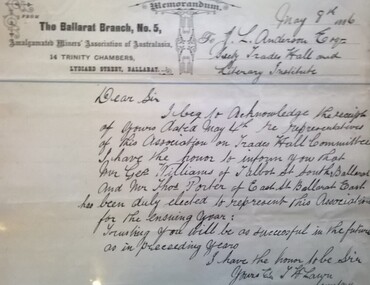 Unions Ballarat
General incoming correspondence of the Ballarat Trades and Labour Council, 1884-1923; 1925; 1931; 1937; 1938; 1949-1950; 1952-1955
Paper/letters stored in two boxes. Arranged in separate folders by year. The lists below are alphabetical. Located by year and number. 1884 - J.W. Graham, Secretary 18. Amalgamated Mining Engine Drivers' Association - regarding appointing a delegate to Council. 12 December 1884. 14. Bendigo Amalgamated Miners' Association, Mr Phillips, Secretary - regarding formation of a Bendigo Trades and Labor Council. 22 July 1884. 1. B? Secretary for Lands, Victoria - regarding deputation from Council to him. 8 January 1884. 15. A.R. Davie - regarding half holiday Union appointing delegates to Council. 77 July 1884. 8. D.M. Davies - regarding deputation to Minister for Lands, Victoria. 11 January 1884. 7. J.L. Dowe - regarding deputation to Minister for Lands, Victoria. 11 January 1884. 6. F.R. Fincham - regarding deputation to Minister for Lands, Victoria. 11 January 1884. 16. J.W. Grahame - regarding leave of absence. 10 October 1884. 17. W. Hosking - regarding alteration of rule 14. n.d. 2. J. Kline - regarding apologies for absence from Council meeting. 10 January 1884. A copy of a letter to The Courier is attached. 4. Painters' Union (Geoff Ludbrook) - regarding assisting at Eight Hour Anniversary. 11 January 1884. 13. J. Pearce - regarding apologies for absence from Council. 11 July 1884. 12. G. Rasy? - regarding apologies for absence from Council. 9 May 1884. 3. J.R. Richardson - regarding presence on deputation to Minister for Lands. 10 January 1884. 10. R.D. Reid - regarding apologies for absence from Council. 11 January 1884. 9. A. Sutherland - regarding presence on deputation to Minister for Lands. 10 January 1884. 11. Specifications for stamping marbles for Council. n.d. 5. A. Young - deputation to Minister for Lands. 10 January 1884. 1885 - J.L. Anderson, Secretary 8. Amalgamated Mining Engine Drivers' Association - regarding delegates to Council. 8 May 1885. 11. J. Anderson (Secretary of Council) to H. Uren MLA - regarding amalgamation of the Council with the City Free Library. 10 August 1885. 24. Ballarat Cricket Club - regarding using the oval for Eight Hour Anniversary. 9 December 1885. 7. Ballarat Woollen Mills Operative Union - regarding giving name of Union, list of Union members. 8 May 1885. 4. Ballarat Typographical Association - regarding printing of Council material. 8 May 1885. 2. J. Binner - regarding prizes given at Eight Hour Anniversary. 26 April 1885. 19. Cabmens Union, Ballarat - regarding delegate to Council. 8 October 1885. 12. Carpenters and Joiners Trade Society - regarding delegate to Council. 7 September 1885. 23. Carpenters and Joiners Trade Society - forwarding a copy of rules. 8 December 1885. 14. H. Clotz, et al - regarding Friday half holiday for hairdressers. 10 September 1885. 1. Eight Hours Anniversary Programme. 21 April 1885. 15. Friendly Society of Ironmoulders of Victoria, Ballarat Branch - new Secretary of same. 11 September 1885. 17. Friendly Society of Ironmoulders of Victoria, Ballarat Branch - regarding delegate to Council. 7 October 1885. 21. Friendly Society of Ironmoulders of Victoria, Ballarat Branch - regarding delegate to Council. 22 November 1885. 5. E. Ingram - regarding losses incurred at Eight Hour Anniversary. 8 May 1885. 20. L. Mills - regarding apologies for absence. 9 October 1885. 3. Painters' Union - regarding delegates to Council. 4 May 1885. 18. Painters' Union - regarding delegates to Council. 8 October 1885. 25. J. Pearce - regarding apologies for absence. 11 December 1885. 26. C. Salter - regarding donations to Eight Hours Anniversary. 14 December 1885. 6. A. Smith - regarding apologies for absence. 8 May 1885. 9. E.H. Swifte - regarding amalgamation of Council with Free City Library. 13 July 1885. 10. E.H. Swifte - regarding amalgamation of Council with Free City Library. 7 August 1885. 13. Tanners and Curriers of Ballarat - regarding forming a branch of the Union in Ballarat. 8 September 1885. 16. Trades and Labor Council, Brisbane - regarding formation of same. 8 November 1885. 7. J. Treloar - regarding apologies for absence. 8 May 1885. 1886 - J.L. Anderson, Secretary 7. Amalgamated Miners' Association of Australasia - regarding Delegates to Council. 8 May 1886. 3. Amalgamated Mining Engine Drivers Association, Ballarat Branch - regarding Delegates to Council. 7 May 1886. 5. Amalgamated Society of Engineers - regarding Delegates to Council. 11 May 1886. 1. Half Holiday Union, Ballarat - regarding Delegates to Council. 7 May 1886. 6. Operative Bakers' Society - regarding Delegates to Council. 11 May 1886. 4. Painters' Union - regarding Delegates to Council. 11 May 1886. 2. Victorian Operative Bootmakers Union, Ballarat Branch - regarding delegates to Council. 12 May 1886. 8. Ballarat United Friendly Societies' Dispensary - accepting an offer of a deputation to special meeting of General Committee. 1887 - T. Bayley, Secretary Nil. 1888 - T.S. Bayley, Secretary 24. Amalgamated Miners' Association of Australasia - regarding meeting to hear Dr Siscs on the Worn out Miners Sustentation Fund. 6 December 1888. 7. Australian Natives' Association, Ballarat Branch - regarding alienation of portion of public park. 21 June 1888. 19. Ballarat Trades and Labour Council (to various unions) - regarding support of direct labor representation in Parliament from Ballarat West. 20 October 1888. 11. Ballarat Typographical Society - regarding room for meeting. 6 July 1888. 22. A. Callaway (Chief Secretary for A. Deakin) - regarding names submitted for Commission of the Peace. 19 November 1888. 9. Eight Hours' Anniversary Committee - regarding money for tickets sold. 27 June 1888. 15. W.F. Emery - regarding apologies for absence. 14 September 1888. 6. Gillies (for the Victorian Premier) - regarding Chinese immigrants. 8 May 1888. 1. Grocers Association of Geelong - regarding joining Council. 14 April 1888. 5. Half Holiday Union - regarding delegates to Council. 3 May 1888. 18. Intercolonial Trades and Labor Union Congress, 6th, Hobart, 5-8 February 1888 (Hugh Kirk, Secretary of Hobart Trades and Labor Council) - regarding printed invitations to the Congress. 27 October 1888. 13. Ironworkers Assistants' Society of Victoria, Ballarat Branch - regarding delegates to Council. 8 August 1888. 14. Ironworkers Assistants' Society of Victoria, Ballarat Branch - regarding delegates to Council. 4 September 1888. 23. Ironworkers Assistants' Society of Victoria, Ballarat Branch - regarding delegates to Council. 14 December 1888. 8. H. Jones - regarding Major Dane's lectures. 25 June 1888. 2. Locomotive Engine Drivers and Firemen's Association - regarding delegates to Council. 17 April 1888. 17. A. McKenzie - regarding apologies for absence. n.d. 3. V.M. Pearson - regarding organisation of a trades union in Colac. 14 April 1888. 10. John Shiels - regarding overdraft of Council. 6 July 1888. 21. Tanners and Curriers Union, Ballarat Branch - regarding delegates to Council. 12 November 1888. 20. Trades Hall Council, Geelong - thanking for assistance from Council. 11 November 1888. 4. Trades Hall Council, Melbourne. (David Bennett, Secretary) - regarding new regulations by-laws and standing orders. 17 April 1888. 16. Victorian Operative Bricklayers Society - regarding end of dispute. 14 September 1888. 12. John Wilson - regarding Report of Committee on opening of the new Trades Hall. 13 July 1888. 1889 - J. Wilson, Secretary 8. Ballarat Woollen and Worsted Company - regarding support of products by working class. 2 November 1889. 9. Butchers Employees' Association - regarding delegate to Council. 2 December 1889. 1A. Copy of an award of the arbitration in the dispute between Messrs Whitten and Cairns and the Ballarat Bootmakers' Union. 14 February 1889. 10. Half Holiday Union - regarding delegate to Council. 3 December 1889. 1-6. Ironworkers Assistants' Society of Victoria, Ballarat Branch - regarding Phoenix Foundry dispute. 20 March 1889-29 March 1889. 11. Painters' Union - regarding formation of a non-union society. 4 December 1889. 13. Painters' Union - regarding formation of a non-union society. 6 December 1889. 12. Messers Stansfield, Bush and Shepphard, Decorators - accuses Painters' Union of instigating a strike. 5 December 1889. 7. Working Men's College and Trades Hall Council, Melbourne - regarding memorial to the late Hon. Francis Ormond. n.d. 1890 - J. Wilson, Secretary 81. James Alexander - regarding request for financial assistance. 30 October 1890. 21. Amalgamated Millers, Engine Drivers and Mill Employees' Association of Australasia - regarding supplying list of firms employing union labour. 4 June 1890. 2. Amalgamated Miners of Australasia (W.C. Spence, Secretary) - thanking Council for their supportive letter. March 1890. 52. Amalgamated Miners of Australasia, Ballarat Branch - regarding suggestion to canvass Ballarat district for funds for strikers. 88. Amalgamated Miners of Australasia (W.G. Spence) - regarding donation from residents of Clementston for Ballarat men out of work and not receiving funds from Council. 15. Amalgamated Society of Engineers, Ballarat Branch - regarding supplying list of shops employing Union labour. 28 April 1890. 44. Amalgamated Society of Engineers, Ballarat Branch - regarding giving numbers of men out of work. 30 September 1890. 69. Amalgamated Society of Engineers, Ballarat Branch - regarding approving members of their union being placed on the relief list. 23 October 1890. 70. T. Bailey - regarding apology for being unable to canvas for strike fund. 23 October 1990. 102. Balance sheet of strike fund of the Council and bundle of receipts. 18. Ballarat Plumbers' Union - regarding supplying a list of firms employing union labour. 6 June 1890. 16. Ballarat Saddle Harness and Collar Makers' Society - regarding supplying a list of firms employing union labour. 5 May 1890. 42. Ballarat Tailoresses' Union - regarding donation to strike fund. 25 September 1890. 45. Ballarat Town Council Employees - regarding donation to strike fund. n.d. 12. Ballarat Typographical Society - regarding supplying name of Secretary and list of firms employing union labour. 19 April 1990. 5. Ballarat Woollen Mills Operative's Union - regarding seeking advice on how to get men to join the union. 22 April 1890. 26B. E. Batterly - regarding apology for being unable to come to mass meeting about strike. 11 September 1890. 46. E. Blayney (hotel owner) - regarding donation to strike fund. n.d. 56. G. Blyman - regarding donation to strike fund. 8 October 1890. 55. J. Brady - regarding donation to strike fund. 6 October 1890. 76. J. Braidie et al - querying reason for getting no strike pay. 27 October 1890. 22. M. Bregazzi - regarding donation to strike fund. 2 September 1890. 34. M. Bregazzi - regarding donation to strike fund. 12 September 1980. 40. M. Bregazzi - regarding donation to strike fund. 23 September 1890. 72. M. Bregazzi - regarding donation to strike fund. 24 October 1890. 57. J. Clement - regarding donations from residents of Clementston for use in Ballarat. 9 October 1890. 3A. D.M. Davies (Minister of Mines, Victoria) - regarding cannot come to mass meeting in Ballarat (telegram). 12 September 1890. 53. W Davies et al - regarding seeking financial from Council though not members of a union. 6 October 1890. 59. W. Davies - objecting to refusal of financial assistance. 10 October 1890. 94. Hugh Dunlop - regarding request for financial assistance. 28 November 1890. 32. John Dunn - regarding apologies for unable to attend mass meeting. 12 September 1890. 60. John Dunn - regarding donation to strike fund. 11 October 1890. 71. W. Evans - regarding resignation as Treasurer and member from strike committee. 24 October 1890. 48. Fitzgerald Bros (Drapers) - regarding donation to strike fund. 1 October 1890. 63. Friendly Society of Ironmoulders of Victoria, Ballarat Branch - recommending financial assistance for a member of their Union. 13 October 1890. 29. J. Hancock - regarding being able to attend mass meeting (telegram). 12 September 1890. 74. Horse Drivers' Union, Ballarat - regarding request for financial help for a union member. 25 October 1890. 64. W. Howat - regarding letting of Academy of Music Ballarat for a meeting. 14 October 1890. 50. Hughes and Opie (Drapers) - donation to strike fund. 3 October 1890. 66. J. Hurst (Bucks Head Hotel owner) - regarding donation to strike fund. 18 October 1890. 25. Iron Founders' Society - regarding a request for financial assistance for out of work members. 9 September 1890. 87. Iron Founders' Trade Union, Ballarat - regarding request for financial help for out of work members. 23 September 1890. 39. Ironworkers' Assistants' Society of Victoria, Ballarat Branch (Mr Sheldon, Secretary) - regarding request for financial help for out of work members. 23 September 1890. 79. Ironworkers' Assistants' Society of Victoria, Ballarat Branch (Mr Sheldon, Secretary) -regarding request for financial help. 30 October 1890. 84. Ironworkers' Assistants' Society of Victoria, Ballarat Branch (Mr Sheldon, Secretary) - regarding eligibility of a member to be placed on the strike relief list. 6 November 1890. 89. Ironworkers' Assistants' Society of Victoria, Ballarat Branch (Mr Sheldon, Secretary) -regarding payment to Council of levies on working members for strike fund. 20 November 1890. 98. W. Kean (tobacconist) - regarding suggesting a concert to be held to help the strike relief fund and his offer to help. n.d. 61. W. Kenna (Warrenheip Breweries) - regarding donation to strike fund. 13 October 1890. 38. Joseph Kirtin (Auctioneer) - regarding donation to strike fund. 22 September 1890. 17. Labourers' Protective and Building Society - regarding names of contractors who employ union men. 12 May 1890. 62. D. Lessels - regarding recommendation of J. David for relief. 13 October 1890. 65. List of machinists out of work at the Phoenix Foundry, Ballarat. 14 October 1890. 78. John Lynch - regarding request for financial help. 27 October 1890. 85. John McAuly - regarding dispute settled at Horsham. 10 November 1980. 9. Jas Martin - regarding list of shops employing union men. 14 April 1890. 49. Jas Martin - regarding declaration of being out of work and needing financial help. 2 October 1890. 10. Masons' Society - regarding name of Secretary and list of shops employing union men. 15 April 1890. 58. Master Tailors' Association, Ballarat - regarding donation to strike fund. 10 October 1890. 90. W. Meher - regarding expression of thanks for money given. 24 November 1890. 27. W.E. Murphy - regarding able to come to mass meeting (telegram). 11 September 1890. 30. W.E. Murphy - regarding missed the train (telegram). 12 September 1890. 77. W.E. Murphy - regarding arranging a meeting (telegram). 27 October 1890. 83. W.E. Murphy - regarding thanks for money given. 31 October 1890. 3. Officers of the Ballarat Gas Company - regarding non-union bricklayer working for same. 8 March 1890. 19. Operative Bakers' Society - regarding list of employers using union labour. n.d. 20. Painters' Union - list of shops employing union men. n.d. 23. Painters' Union - regarding suggestion to call a meeting in support of Melbourne strikers. 6 September 1890. 24. Painters' Union - regarding donation to maritime strike, Melbourne. 6 September 1890. 51. Painters' Union - regarding donation to maritime strike, Melbourne. 5 October 1890. 86. G. Philbrook - regarding request for financial assistance. 18 November 1890. 97. G. Philbrook - regarding request for financial assistance. 22 December 1980. 82. T. Porter - regarding apology for absence. n.d. 35. Resolutions (passed at meeting) and list of movers and seconders. 12 September 1890. 41. Saddle, Harness and Collar Makers Society, Ballarat - regarding donation to strike fund. 25 September 1890. 4. Sandhurst and District Trades and Labour Council - regarding thanks for helping them obtain a building for use of their Council. 10 March 1890. 36. John Sayers (hotel owner) - regarding donation to strike fund. 17 September 1890. 93. (?), Sheldon - regarding receipt for money received from emergency fund. 28 November 1890. 26. W. Smith - regarding thanks for invitation to mass meeting (telegram). 10 September 1890. 99. T. (?) Stephen - financial help for members of his union. n.d. 100. Subscription list in aid of the strikers for Unionism by the shareholders and 'employees' of the Jubilee Mine, Long Gully, Black Ball, Scarsdale. n.d. 6. Tanners and Curriers, Ballarat Branch - regarding list of employers using union labour. 3 April 1890. 101. D. Temple (Secretary, Amalgamated Shearers' Union) - regarding request for copy of newspapers publishing correspondence between sheep owners and the Union. n.d. 37. Trades Hall Council, Melbourne. Committee of finance and control - regarding thanks to Ballarat Council for efforts to assist the cause of Labour. 18 September 1890. 43. Trades Hall Council, Melbourne. Committee of finance and control - regarding advice to Ballarat Council to distribute its own funds and applications for financial help. 29 September 1890. 67. Trades Hall Council, Melbourne. Committee of finance and control - regarding seeking continued financial aid from Council. 21 October 1890. 91. Trades Hall Council, Melbourne. (Secretary, D. Bennett) - regarding thanks to Ballarat Council for donation. 24 November 1890. 92. Trades Hall Council Melbourne, Committee of finance and control - regarding acknowledging receipt of money from Ballarat Council. 27 November 1890. 95. Trades Hall Council, Melbourne. (Secretary, D. Bennett) - regarding thanks to Ballarat Council for donation. 2 December 1890. 96. Trades Hall Council, Melbourne. (Secretary, D. Bennett) - regarding thanks to Ballarat Council for donation and explaining why amounts received to not appear in the "Age". 20 December 1890. 68. W. Treloar - regarding public meeting at Buninyong. 21 October 1890. 11. United Society of Boilermakers and Iron Shipbuilders of Victoria, Ballarat Branch - regarding list of shops employing union men. 10 April 1890. 26c. W.H. Uren (MLA) - regarding inability to come to mass meeting (telegram). 11 September 1890. 75. United Society of Boilermakers and Iron Shipbuilders of Victoria, Ballarat Branch - regarding request for funds for out of work members as own funds exhausted. 27 October 1890. 8. Victorian Operative Bootmakers' Union, Ballarat Branch - regarding giving name of union, list of shops using union men. 10 April 1890. 13. Victorian Operative Bricklayers' Society, Ballarat Branch - giving list of shops using union men. 24 April 1890. 14. Victorian Operative Bricklayers' Society, Ballarat Branch - giving name of Secretary. 24 April 1890. 33. N. Wanliss (Solicitor, Ballarat) - regarding donation to strike fund. 12 September 1890. 1. A.C. Whitten - regarding reply to charges of working a percentage system in his boot factory and men taking work home. 17 January 1890. 26a. A. Young (MLA) - regarding inability to attend mass meeting. 11 September 1890. 1891 - J. Wilson, Secretary 2. W.L. Anderson (Secretary, Ironmoulders Society) to W. Stokeld (Secretary, Ballarat Branch of Ironmoulders Society) - regarding conference with employers about wages and recognised public holidays. 18 May 1891. 3. W.L. Anderson (Secretary, Ironmoulders Society) to W. Stokeld (Secretary, Ballarat Branch of Ironmoulders Society) - regarding conference with employers about wages, striking and donation to shearers. 20 June 1890. 1. F. Meagher and E. Hobson - regarding The Industrial Labor League (newspaper cutting from the Ballarat Courier). 21 April 1891. 6. J. Verty - regarding asking J. Wilson (Secretary, Ballarat Trades and Labour Council) to come and speak at Allendale. 3 October 1891. 4. Victoria Reform League - regarding forwarding manifesto for Council's consideration. 21 September 1891. 5. P. (?) Wallis - regarding asking J. Wilson to come and speak at public meeting. Enclosed circular (not there). 21 September 1891. 7. J. Wilson - circular to Ironmoulders Society regarding money for Congress (7th Intercolonial) and refers to the Draft Scheme of Federation. n.d. 8. J. Wilson - circular to Ironmoulders Society regarding Eight Hour demonstration. n.d. 1892 – J. Wilson, Secretary Nil. 1893 - John Wilson, Secretary 9. W. Bannow - regarding seeking information about the Ballarat Trades and Labour Council constitution and affiliated unions. 11 April 1893. 1. Bendigo Miners' Association - regarding unemployment in Bendigo. 16 January 1893. 10. Bendigo and District Trades and Labour Council - suggesting a resolution to call Parliament together regarding unemployment and use of credit notes as legal tender. 16 May 1893. 3. Builders Labourers' Union - regarding stopping their meetings in the Ballarat Trades and Labour Council. 1 February 1893. 17.W.S. Curzon-Siggers - regarding Ballarat Relief Society Fund closed. 8 September 1893. 12. Doctor's certificate. 5 March 1893. 11. Henry Douglass - regarding difficulties of the Woollen Mills Union. 5 July 1893. 13. Federated Seamen's Union of Victoria - regarding visits to Ballarat, Creswick asking for financial help. 28 July 1893. 18. E. Hobson - regarding electoral support for H. Porter (Progressive Political League). n.d. 2. W.J. Lormer and S. Mauger - regarding inaugural meeting of the Protection Liberal and Federation Alliance. 30 January 1893. 6. Operative Bakers' Society, Ballarat - regarding non-union workers. 24 March 1893. 19. Operative Bootmakers' Union, Ballarat Branch - regarding employment of non-union foreman. 14 December 1893. 4. Painters' Union, Ballarat district - regarding its organisation. n.d. (missing) 5. Painters' Union, Ballarat district - regarding village settlements in Ballarat district. n.d. 14. Railway Department - regarding employment on lines. 4 August 1893. 15. Railway Department - regarding Ballarat men employed on railways. 16 August 1893. 8. John Wilson - regarding notice of motion to withdraw certificate of registration of the organisation from the Register. 8 April 1893. 16. John Wilson - regarding weavers’ strike and seeking donations from the Ironmoulders’ union. 22 August 1893. 7. Women's Christian Temperance Union of Victoria - regarding liquor consumption. 5 April 1893. 1894 - John Wilson, Secretary until his death in April 5. W. Anderson - regarding meeting about Parliament assembling. 26 February 1894. 8. H.J. Armytage - regarding meeting about Parliament assembling. 27 February 1894. 21. Balance sheet of the Council. 16 July 1894. 17. J. Barret, Secretary of Melbourne Trades Hall Council - regarding death of J. Wilson. 4 May 1894. 20. Joseph Barret (not the above) - regarding Chinese furniture. 11 August 1894. 31. Bendigo and District Cooperative Movement Society - regarding cooperative movement. 2 February 1894. 9. D.M. Davies – meeting regarding Parliament assembling. 27 February 1894. 15. John Dunn – meeting regarding Parliament assembling. 1 March 1894. 14. John Dunn – cannot come to meeting. n.d. 6. J.W. Kirton – meeting regarding Parliament assembling. 26 February 1894. 12. E. Murphy – meeting regarding Parliament assembling. 1 March 1894. 18. Operative Bootmakers’ Union, Ballarat Branch – regarding evening work. 28 June 1894. 16. To J.B. Patterson, Premier of Victoria, from Council – regarding resolutions passed at meeting about unemployment. 5 March 1894. 7. A.J. Peacock – meeting regarding Parliament assembling. 26 February 1894. 10. A.J. Peacock – telegram to advise non-attendance. 5 March 1894. 13. T. Porter – meeting regarding Parliament assembling. 5 March 1894. 1. Trades and Labor Council of Otago – regarding unionism in New Zealand. 23 January 1894. 19. United Labor and Liberal Party - regarding request for donations. 16 July 1894. 4. A.T. Vale - regarding meeting about Parliament assembling. 26 February 1894. 38. John Wilson - regarding request to Ironmoulders for donation to Eight Hour Sports Fund. 6 February 1894. 11. Alex Young - regarding meeting about Parliament assembling. 1 March 1894. 1895 – W. Hurtsfield, Secretary 1. J. Barret (Secretary of Melbourne Trades and Labor Council) - regarding pensioners working. 15 February 1895. 2. EP Date - regarding university extension lectures. 9 June 1895. 3. Agreement (unsigned) between the Trustees of the Ironmoulders' Society and the members thereof. n.d. 1896 - W. Hurtsfield, Secretary 10. Amalgamated Miners' Association - regarding dispute between BHP and miners. 9 October 1896. 4. Amalgamated Miners' Association, district - regarding aid for miners. 4 May 1896. 12. Ballarat Typographical Society - regarding request for Council to meet on Saturdays. 13 November 1896. 2. J. Barrett - regarding press for a Bill for Conciliation and Compulsory Arbitration. 22 July 1896. 7. J. Barrett - regarding cooperation, Labor-Liberal Party arbitration. 22 July 1896. 9. J. Barrett - regarding Employers' Law Liability Amendment Act. 26 August 1896. 9A. Bendigo Trades and Labor Council (A. Campbell, Secretary) - regarding opening of Hall. 31 August 1896. 11. Bendigo Trades and Labor Council (A. Campbell, Secretary) - Employers' Liability Amendment Act. 9 November 1896. 14. F.H. Bromly - regarding raising finance for W.A. Trenwith, M.P. n.d. 1. M. Campbell - regarding support for the People's Party. 5 February 1896. 3. H.M. Champion - regarding May Day Demonstration. March 1896. 6. Cigar Makers' Union - regarding employing non-union labor. 1 June 1896. 5. L. Corstorphan (Secretary, Woollen Mills' Union) - regarding new name of Union (Ballarat Operative Weavers' Union). 23 May 1896. 13. R. Surtees - impressions of W.A. 9 November 1896. 12. T. Young (Secretary, Ballarat Typographical Society) - regarding BHP and miners' dispute. 13 November 1896. 1897 - W. Hurtsfield, Secretary 1. S. Barker - regarding leaflet about International Labor Day. 2 May 1897. 4. J. Barrett - regarding Ben Tillet's visit to Victoria. 23 August 1897. 5. J. Barrett - regarding Ben Tillet's visit to Victoria. 23 August 1897. 6. J. Barrett - regarding subscription for Ben Tillet's visit. n.d. 2. Bendigo District Trades and Labor Council (H. Hanton, Secretary) - regarding corn and flour duties. 7 June 1897. 3. C. Harris - regarding Eight Hours' monies. 21 July 1897. 7. J.P. Jones - regarding finance for Tocsin. 30 August 1897. 1898 - W. Hurtsfield, Secretary 11. Adelaide Labor Conference 1898 - invitation. 8 August 1898. 1. J. Barrett - regarding conference of Labor bodies. 7 March 1898. 10. J. Barrett - private to Hurdsfield regarding resolutions of Melbourne Trades and Labor Council. 19 September 1898. 13. T. McCoates - regarding Ballarat Benevolent Asylum and Lying in Hospital and Ben Tillet. 22 November 1898. 3. Findley, E. - regarding finance of "Tocsin". 27 March 1898. 4. Findley, E. - regarding finance of "Tocsin". 24 March 1898. 2. P.J. Mullaney - regarding May Day, 1898. 27 March 1898. 6. A.C. Nichols - regarding Rating Reform League. 30 July 1898. 7. A.C. Nichols - regarding printed invitation to a public meeting to support R.R.L. 30 July 1898. 8. A.C. Nichols - printed leaflet from Single Tax League, Victoria. 8 July 1898. 8 July 1898. 9. A.C. Nichols - printed leaflet from Rating Reform League. n.d. 5. James Oldham - regarding portrait of James Stephens. 22 September 1898. 12. Wanliss and Gray (Solicitors) - regarding agreement. 22 September 1898. 1899 - W. Hurtsfield, Secretary 3. S. Barker and Dr Wm Moloney - regarding May Day, 1899. n.d. 8. J. Barrett - regarding Eight-Hours Bill. 29 August 1899. 9. J. Barrett - regarding draft scheme for Intercolonial Labor Federation. 30 May 1899. 7. T. Campbell - regarding resignation.18 August 1899. 6. Denmark - regarding printed material on lock out in Denmark; appeal for help. 2 May 1899. 1. H. Hanton - regarding People's Party, Bendigo. 13 February 1899. 2. H. Hanton - regarding People's Party, Bendigo. 16 February 1899. 5. M. Hirsch - regarding Committee of the Convention on unemployment. 25 April 1899. 4. J.B. Meier - regarding Victorian Tobacco Operatives Association and unemployment. 18 May 1899. 1900 - W. Hurtsfield, Secretary 9. Amalgamated Engine Drivers' Association, Bendigo Branch - regarding boycotting and dismissal of union men. 2 March 1900. 25. Amalgamated Miners' Association of Victoria, head office - regarding printed report of executive council meeting regarding Chiltern dispute. 25 September 1900. 26. Amalgamated Miners' Association of Victoria, head office - regarding covering letter for "25" (above). 15. Anti-Sweating League of Victoria - regarding list of office bearers. 26 July 1900. 1. John Barrett - regarding support for candidates of the United Labor Party. 17 January 1900. 2. John Barrett - regarding Australasian Labor Federation. 28 February 1900. 8. John Barrett - regarding fund for the family of late John Hancock, MLA. 13 February 1900. 19. John Barrett - regarding contesting seats in the coming State election and possibly in a Federal election. 18 July 1900. 21. Bootmakers' Union, Ballarat - regarding inspectors not using factories regarding infringements of Act. 31 July 1900. 17. J. Cairns - regarding late shopping. 3 July 1900. 10. Coach Makers Society - regarding branch of Union formed in Ballarat. 16 June 1900. 11. Coach Makers Society - regarding petition about wages. n.d. 12-13. Coach Makers Society - regarding petition about wages. 7 July 1900. (one document) 14. Coach Makers Society - regarding petition about wages. 17 July 1900. 22. J. Hume Cook, MLA - regarding old age pensions. 15 August 1900. 23. J. Hume Cook, MLA - regarding Herald newspaper cutting written by Cook on old age pensions. 13 August 1900. 18. J. Lemmon - regarding Woollen Mills Operatives' Union. 11 July 1900. 16. Master Butchers' Association, Ballarat and District - regarding printed notice regarding hours of business. 14 June 1900. 3-4. Melbourne Typographical Society - regarding subscriptions for the late J. Hancock's family. 15 January 1900. (one document) 20. O. Rees - regarding women's franchise. 19 July 1900. 24. United Council for Women's suffrage - women's franchise. 24 August 1900. 6. Victorian Amalgamated Butchers' Union - regarding photograph of John Hancock and about Mr Williams not being a delegate of the Union. 2 June 1900. 7. Victorian Amalgamated Butchers' Union - regarding photograph of John Hancock. 1 July 1900. 5. Tom Williams - regarding photograph of John Hancock. 5 May 1900. 1901 - W. Hurtsfield, Secretary 1. Ballarat Operative Bootmakers' Union - regarding resignation of Secretary, J. Eva. 2 April 1901. 2. Receipts, hiring agreement for a light generator. 2 August 1901. 1902 – W. Hurtsfield, Secretary Nil 1903 - W. Hurdsfield, Secretary 2. Amalgamated Miners' Association, Creswick Branch - regarding visit of Tom Mann to Creswick and Allendale. 8 May 1903. 3. Amalgamated Miners' Association, Creswick Branch - regarding visit of Tom Mann (telegram). 8 May 1903. 18. Ballarat Trades and Labour Council - Christmas card. 1903-1904. 11. Bendigo Trades and Labor Council - regarding request for Council's rules and standing orders. 24 October 1903. 1A. Andrew Christie - regarding visit of Tom Mann to Berringa. 5 April 1903. 9. Alfred Deakin - regarding thanks to Council for support. 28 September 1903. 12. Alfred Deakin - regarding meeting Council to discuss Arbitration Bill. 27 October 1903. 6. Eight Hour Demonstration Committee - regarding invitation to H. Brooks. 21 October 1903. 1B. Eight Hours Monument Fund - regarding unveiling of the monument. 3 April 1903. 14-16. Andrew Gray - regarding cooperative venture in mining coal at Outtrim. 9 November 1903. 10. Political Labour League (J. Eva, Secretary) - regarding deputation to Prime Minister for early introduction of an Arbitration and Conciliation Bill. 23 October 1903. 17. Protectionist Association of Victoria (S. Mauger, Secretary) - regarding distribution of their literature. 7 December 1903. 4. W.H. Rees - regarding visit of Tom Mann to Maryborough. 7 May 1903. 5C. Soldiers' Statue Fund, Ballarat - regarding meeting of Committee. 18 August 1903. 7. Trades Hall Council, Melbourne (Stephen Barker, Secretary) - regarding protesting dropping of Conciliation and Arbitration Bill. 16 September 1903. 8. Trades Hall Council, Melbourne (Stephen Barker, Secretary) - regarding petition regarding State Reform Bill. 19 September 1903. 5A. Trades Hall Council, Melbourne (Stephen Barker, Secretary) - regarding position occupied during late railway strike. ca 1 June 1903. 5B. Trades Hall Council, Melbourne (Stephen Barker, Secretary) - regarding petition about Conciliation and Arbitration Bill. 2 June 1903. 5D. Trades Hall Council, Melbourne (Stephen Barker, Secretary) - regarding helping Tinsmiths' Union. 7 July 1903. 13. Frank Tudor - regarding why there was a delay in answering a letter from the Council. 2 November 1903. 1904 - W. Hurtsfield, Secretary 4. Amalgamated Society of Engineers, Ballarat Branch - regarding iron trade and tariffs. 1 July 1904. 9-9A. P. Brandt - regarding Brandt's system of absolute majority vote. 30 July 1904. 12. Alfred Deakin - regarding details of imports and exports of iron and steel. 20 August 1904. 13, 13A, 13B. Alfred Deakin - regarding Arbitration Bill. 17 August 1904. 6. Eight Hours Celebration Union, Adelaide - invitation. July 1904. 14. Eureka Stockade Celebration - regarding celebration of the fiftieth anniversary. 1 September 1904. 11. Operative Bootmakers' Union - regarding delegates to Council. 12 August 1904. 7. Political Labor League - regarding raising funds for striking miners at Outtrim. 25 July 1904. 8. Political Labor League - regarding raising funds for striking miners at Outtrim. 29 July 1904. 15. Australian Workers Union - regarding raising funds for striking miners at Outtrim. n.d. 19. Preferential Trade with Great Britain - invitation to public meeting. 17 November 1904. 5. Robert Rogers (Secretary to the Premier of Victoria) - regarding acknowledgement of receiving letter. 22 July 1904. 21. Tom Mann Organisation Fund - printed balance sheet. 9 August 1904. 2. Edward Meagher - regarding high wages and their exploitation (printed pamphlet). 31 May 1904. 3. Trades Hall Council, Melbourne - regarding conference. 24 June 1904. 16. Trades Hall Council, Melbourne - regarding resolution submitted for consideration. 14 October 1904. 18. Trades Hall Council, Melbourne - regarding interstate Eight Hours Day. November 1904. 20, 20A. Trades Hall Council, Melbourne - regarding federal tariffs. 1904. 17. Victorian Agricultural Implement and Machine Makers' Society - regarding Sunshine Harvesting Works. 29 October 1904. 1. R. Williams (Town Clerk, Ballarat) - regarding Galloway monument as a drinking fountain. 28 April 1904. 1905 - W. Hurtsfield, Secretary 4. S.M. Bull - regarding gold saving machine. 3 August 1905. 1. Eight Hours Anniversary Union, Brisbane - regarding sympathy with fellow artisans in Russia. 26 January 1905. 10. Federal Labor Party - regarding Workers Trade Mark (union label). 18 December 1905. 2. National Progress Newspaper Society Ltd - establishment of new daily paper in Melbourne. 10 February 1905. 3. Secretary for Lands - regarding excising of part of common lands by Golf Club. 15 June 1905. 5. Secretary for Mines - regarding providing work for unemployed miners. 7 August 1905. 6. Secretary for Mines - regarding providing work for unemployed miners. 9 August 1905. 7. Secretary for Mines - regarding providing work for unemployed miners. 21 August 1905. 8. Trades Hall Council - regarding sweating in the tailoring trade. 16 August 1905. 9. Chas Vaughan and Co. - regarding whether trustees will comply with their request. 30 November 1905. 1906 - W. Hurtsfield, Secretary 1. Castlemaine Hibernian Sports Programme. 26 December 1906. 1907 - W. Hurtsfield, Secretary 1. Church of Christ - regarding renting the Council Hall. 7 August 1907. 2. R. McGregor - regarding interview with the Chief Secretary. 19 December 1907. 3. Timber Workers Relief Fund - regarding acknowledgement of donation. 21 May 1907. 1908 - W. Hurtsfield, Secretary 1. Federated Saw Mill, Timber Yard and General Woodworkers Employees' Association - regarding delegates to Council. 4 August 1908. 1909 – W. Hurtsfield, Secretary Nil. 1910 – W. Hurtsfield, Secretary Nil. 1911 – W. Keane, Secretary Nil. 1912 – W. Keane, Secretary Nil. 1913 – W. Keane, Secretary Nil. 1914 – W. Keane, Secretary Nil. 1915 – W. Keane, Secretary Nil. 1916 – W. Keane, Secretary 1. Interstate Trades Union Congress - regarding report of proceedings. 15-18 May 1916. 2. Resolutions of executive meeting. January 1916. 3. Australian Builders Laborers Federation, Victorian Branch - regarding establishing a Labor Daily for Victoria. 15 November 1916. 1917 - W.J. Kean, Secretary 1. Australian Boot Trade Employees' Association - regarding delegates to Council. 25 January 1917. 2. Ballarat Typographical Society - regarding delegates to Council. 22 January 1917. 3. W. Kean - to editor of The Courier regarding employees of Lucus and Co. not being allowed to join a union. 14 July 1917. 4. Newspaper cuttings from The Courier - Kean v. "contented" on class (n.d.); Kean v. Price Lucus and Co (see 3, above). 16 July 1917. 5. United Grocers, Tea and Dairy Produce Employees' Union - regarding applying for permission to hold annual conference of Victorian Branch at the Trades Hall. 24 January 1917. 6. Victorian Railways Union - circular regarding the strike ballot (printed). 14 March 1917. 7. From W. Kean to Mr. R. Rose - regarding W. Hughes' attempt at political party organisation in Ballarat. 12 March 1917. 1918 - W.J. Kean, Secretary 3. Agreement regarding Ballarat Trades and Labour Council building. 26 October 1918. 2. Citizens' Loyalist Committee - regarding meetings and fact the committee is not affiliated with any political party. 25 April 1918. 1. Newspaper cutting from Ballarat Courier - regarding Loyalist Meeting at Alfred Hall. 4 April 1918. 1919 - W. Kean, Secretary 1. E.J. Hogan, State Parliament House to W. Kean - regarding work at Ballarat North workshops. 10 January 1919. 1920 – W. Keane, Secretary Nil. 1921 – W. Keane, Secretary 1. Federated Moulders' (Metals) Union of Australia - regarding Report of the Federal Council Conference (printed). 17 January 1921. 2. Ironmoulders' Board - determination (printed). 6 April 1921. 1922 - W.J. McAdam, Secretary 1. Trades Hall Council, Melbourne. (E.J. Holloway, Secretary) - regarding report of Eight Hours Committee of Enquiry. 24 October 1922. 1923 – Secretary, Mr WJ McAdam 1. From FJ Jones, Secretary, Australian Timber Workers Union to Mr McAdam - Affiliation dues. 3 April 1923. 2. From Mr W. Powe to Mr McAdam – Union membership and request for Mr McAdam to visit Clunes and meet with him. 3 April 1923. 1924 – Secretary, W.J. McAdam Nil. 1925 – Secretary, W.J. McAdam Nil. 1926 – Secretary, S. Miller Nil. 1927 – Secretary, S. Miller Nil. 1928 – Secretary, S. Miller Nil. 1929 - Secretary, S. Miller Nil. 1930 - Secretary, S. Miller Nil. 1931 – Secretary, Mr S Miller 1. From John Jeanes, Assistant Registrar, Offices of the Registrar General and Registrar of Titles to Mr Miller. 8 October 1931. 1932 – Secretary, Mr S Miller Nil. 1933– Secretary, Mr S Miller Nil. 1934– Secretary, Mr S Miller Nil. 1935– Secretary, Mr S Miller Nil. 1936 – Secretary, Mr S Miller Nil. 1937 – Secretary, Mr S Miller 1. From Mr Miller to Managing Director, Ballarat Brewing Company – Requesting donation for BTLC Picnic Sports Meeting. 2 March 1937. 1938 – Secretary, Mr S Miller 1. From C. Knight, Secretary, Law Department to no addressee – Advising that Mr William Henry Green is authorised to take declarations etc under the Evidence act. 7 June 1938. 1939 – Secretary, Mr S Miller Nil. 1940 – Secretary, Mr S Miller Nil. 1941 – Secretary, Mr S Miller Nil. 1942 – Secretary, Mr S Miller/Mr WJ McAdam Nil. 1943 – Secretary, Mr WJ McAdam Nil. 1944 – Secretary, Mr WJ McAdam Nil. 1945 – Secretary, Mr WJ McAdam Nil. 1946 – Secretary, Mr WJ McAdam Nil. 1947 – Secretary, Mr WJ McAdam Nil. 1948 – Secretary, Mr WJ McAdam 1. From Mr/Ms Healy, Labour Council, Brisbane to Secretary Labour Council, Ballarat - telegram stamped 415 regarding current industrial action and unions being undermined by Premier Hanlon's Industrial Law Amendment Bill. 10 March 1948 2. From Accountant, Head Office, The Ballarat Brewing Co Ltd, to Mr WJ Mc Adam, Secretary, Ballarat Eight Hours Anniversary Committee - regarding donation of £2.2.0 to the Annual Eights Hours Celebrations. 23 April 1948 3. From Miss M Zacharin, Secretary, Jewish to Combat Fascism and Anti-Semitism to Secretary, Trades Hall, Ballarat - forwarding a copy of the pamphlet "Israel Reborn" (no longer attached, but can be viewed online at https://tinyurl.com/jccfas48) by Mrs. Evelyn Rothfield. Requests assistance with distribution of the pamphlet. 26 July, 1948 4. From Mrs A.W. Nicholson (signed Beryl Nicholson), Co-Secretary, Ballarat Baby Health Centres' Ladies Committee to Mr WJ McAdam, Secretary, Trades and Labor Council, Ballarat - Requesting partial rebate of rent paid for the Hall for a fundraising lecture/recital. 9 November 1948 1949 – Secretary, Mr WJ McAdam 1. From JS Toohey, Chairman and MB Duffy, Secretary, Industrial Printing and Publicity Co. Ltd., circular to Trade Union and ALP Branch Secretaries - Emphasising the need for "Labor Call" (previously Tocsin) to continue and encouraging subscriptions and/or bulk ordering. 2. From Thomas E. Carter, Ballarat ALP to Secretary, TLC, Ballarat - Regarding a deputation to the Premier about the Essential Services Act. 25 January 1949 3. From Russell Jones to "To Whom it May Concern", The Courier - Regarding Painters Union debate at BTLC on 25 August 1949; clarifying about severe censure of Mr TE Carter. 17 September 1949 4. Decisions of the ACTU Congress held Sydney, September 19 to 23, 1949 5. From William?, office of the Bishop of Ballarat to Mr WJ McAdam, Secretary, BTLC - Thanking WJ McAdam for his apology for an event at Craig's Hotel about slum conditions, offering to show films at BTLC and present a lecture. 6 October 1949 6. From William? office of the Bishop of Ballarat to Mr WJ McAdam, Secretary, BTLC - Thanking WJ McAdam for making the Hall available for an event the previous evening. 11 November 1949 1950 - Secretary Mr WJ McAdam 1. From H. Crutch, Property Officer, Department of the Interior to Mr McAdam – Lease of accommodation for Mr RT Pollard, MHR, no longer required. 20 January 1950. 2. From unnamed author to Mr D Aronson, Solicitor, Ballarat – Seeking legal opinion/interpretation of rules relating to provincial delegates on VTHC (with enclosures). 23 May 1950. 3. From Mr McAdam to Mr C Ellis, Secretary, Plasterer’s Union – Affiliation fees. 15 September 1950. 1951 – Secretary, Mr WJ McAdam Nil. 1952 – Secretary, Mr WJ McAdam 1. From Mr McAdam, Secretary, BTLC to Miss Wilkins, Philharmonic Singers - use of Trades Hall, insurance risk and care of the Hall piano. 10 September 1952. 1953 Secretary – Mr WJ McAdam 1. From AW Nicholson and RG Caddell, Greater Ballarat Association to Mr McAdam – Royal Tour decorations and lighting. 28 January 1953. 2. From Sunshine Biscuit Company to Mr McAdam – Supply of biscuits. 5 March 1953. 3. From L. Higgins, Secretary, Vehicle Builders Employees Federation to Mr McAdam – Donation to Ballarat Labor Day Appeal. 5 March 1953. 4. From Secretary, Clothing and Allied Trades Union of Australia to Mr McAdam – Donation to repair BTLC building (24 Camp Street, Ballarat). 5 March 1953. 5. From WJ Morrison, Manager, International Bookshop to “Dear Sir” – Complimentary copies of a pamphlet “Ballarat Riggers at Work” pamphlet (pamphlet copy not included). 5 March 1953. 6. From Mrs D Hughes to Mr McAdam – Regarding terms and entitlements relating to her dismissal. Letter From the Department of Labour about pay rights is attached. 7 March 1953. 7. From the State Secretary, The Victorian Potato, Onion and Vegetable Growers Association to Mr McAdam – Regarding an appointment for Mr Kinsella to address BTLC. 10 March 1953. 8. From Mr McAdam to JJ Sheehan, MLA – Workers Compensation Act – pressing for provision of compensation to parents of workers who die at work. 16 March 1953. 9. From Ballarat Brewing Company Ltd to Mr McAdam – Donation to Labor Day celebrations. 16 March 1953. 10. From Mr Arrowsmith, Campaign Director for Frank Hardy to Mr McAdam – Seeking permission for Frank Hardy, Communist Party candidate to address Council. 23 March 1953. 11. From ? to JV Stout, Secretary, VTHC – ACTU delegates provincial councils – protesting the method of counting votes. 9 April 1953. 12. From Fibson to BTLC – Telegram requesting advice about how much notice a temporary teacher needs to provide to their employer. 14 April 1953. 13. From Mr McAdam to Mr JV Stout, Secretary, VTHC – ACTU Delegates Provincial Council – nominations. 18 April 1953. 14. From the Town Clerk, Town Hall, Ballaarat to Mr McAdam – Requesting a list of executive officers at BTLC (list attached with reply). 23 April 1953. 15. From Mr McAdam to [blank] – Representation from the Society of Carpenters and Joiners and the Building Workers Industrial Union on BTLC. 2 May 1953. 16. From Mr McAdam to Mr G Hall, Secretary, ATMO Employees Association – Congratulating the Union of their successful campaign on behalf of tram conductors. 6 March 1953. (Back: General Board (Cake Ornament Section) pay determination.) 17. From Mr McAdam to Mr Maddern, City Clerk, City Hall, Ballarat – Seating needs in Ballarat Civic Hall. 6 May 1953. (Back: Victorian Government Gazette, 16 May 1951.) 18. From Mr McAdam to Mr Maddern, City Clerk, City Hall, Ballarat – Enforcement of the Weights and Measures Act by Ballarat Council. 6 May 1953. (Back: Wage rates Printing-Ink Grinders 1951.) 19. From Mr McAdam to Mr Bartrop, President Begonia Festival Committee – Enquiry about distribution of profits of Begonia Festival. 8 May 1953. (Back: Letterhead with beginning of a draft of this letter.) 20. From Mr McAdam to JV Stout, Secretary, VTHC – Eureka Centenary celebrations. 15 May 1953. 21. From Mr McAdam to ? - Recommendation of Council Executive seeking meeting of the rank and file – towards reaching agreement within the industry. 20 May 1953. 22. From Mr McAdam to the Hon W Galvin, MLA, Acting Premier – Resolution regarding Ballarat North railway workshops. Concern about outsourcing to private enterprise. Seeking improvement of work and a public enquiry. 10 June 1953. (Back: Government Gazette, 25 November 1952.) 23. From Mr McAdam to the Hon PL Coleman, MLA, Minister for Transport – Forwarding a Council motion supporting workers’ right to strike and the Minister’s interference in that. 10 June 1953. 24. From Mr McAdam to Mr JJ Sheehan, MLA – Letter of resolution: thanking him for assistance to the railway unions and requesting further help in training of railway engineers in Ballarat Railway Workshops. 12 June 1953. (Back: Government Gazette, 13 November 1952.) 25. From Mr McAdam to Mr Linaker, State Electricity Commission – Request that the timetable should synchronise with the train timetable on Sundays. 19 June 1953. (Back: Tar and Bitumen Board, Pay Department, 30 January 1951.) 26. From Mr McAdam to Mr Dawson, State Accident Insurance Officer – Workers compensation payment criteria – how payment corresponds with incremental pay rises. 19 June 1953. (Back: General Board – Blue Print Section. Pay rate determinations.) 27. From Mr Mc Adam to Mr JV Stout, Secretary, VTHC – Funding of provincial trades and labour council delegates to attend the ACTU congress in Sydney. 20 June 1953. 28. From LJ Buchanan, Honourable Secretary, Victorian Teachers Union to Mr McAdam – Typewritten and handwritten copies of same correspondence – reply to BTLC. Regarding children’s participation in the 1953 Begonia Festival. 23 June 1953. (Back: Extraordinary Government Gazette, 30 March 1953.) 29. From Mr McAdam to Mr Connell, Secretary, Fibrous Plasterers Union – Regarding overdue affiliation fees to BTLC. 25 June 1953. (Back: pay determinations sports grounds staff.) 30. From Mr JA Connell, Secretary, Fibrous Plasterers Union to Mr McAdam – Cheque for outstanding BTLC affiliation fees. 10 July 1953. 31. Circular from JT Long, Organising Secretary, Australian Convention on Peace and War to various recipients – Information on Peace and War Convention – pamphlet and A5 flyer attached. 14 July 1953. 32. From H Booley to Mr WJ McAdam – Resigning as BTLC delegate to VTHC. 19 July 1953. 33. No author or addressee – Election of Executive Committee, BTLC, financial position, delegates to Peace and War Convention, installation of new President. (Includes photocopies of the same document.) 34. No author or addressee – Peace Convention delegates’ expenses. August/September 1953. (Back: Government Gazette, 26 February 1953.) 35. From Mr McAdam to JV Stout, Secretary, VTHC – Advising resignation of Mr Booley as BTLC to VTHC; Mr Booley to be replaced by Mr JJ Brown. 11 August 1953. 36. From Mr McAdam to Mr JJ Brown, Unity Hall – Advising that the addressee was successful in his nomination as BTLC delegate to VTHC. N.d. (Back: Ballot paper, 20 September 1953.) 37. From Mr McAdam to Dr Evatt, MHR, Leader ALP – Requesting support in stopping the Menzies government interference in Amalgamated Engineering Union elections. 12 August 1953. 37A. From Dr Evatt, MHR, Leader ALP – Reply from Dr Evatt expressing legal inability to assist the Amalgamated Engineering Union. 24 August 1953. 37B. Mr McAdam to Mr R Joshua, MHR – Seeking Mr Joshua’s assistance by raising the above matter in parliament. 7 September 1953. (Back: Ballot paper, Trades and Labour Council Elections, 21 September 1953.) 38. From Mr McAdam to Mr JJ Sheehan, MLA – Requesting a date for a deputation from the Metal Trades Unions about pay rates. 12 August 1953. (Back: Ballot paper, Trades and Labour Council Elections, 21 September 1953.) 39. From Mr McAdam to Mr Maddern, City Clerk, Ballaarat – Road quality and pedestrian access in Ballarat North. 12 August 1953. (Back: Ballot paper, Trades and Labour Council Elections, 21 September 1953.) 40. From Mr McAdam to Mr Broadby, Secretary of the ACTU – Seeking support of the ACTU to resist government interference in Amalgamated Engineering Union’s elections. 12 August 1953. (Back: Trades and Labour Council elections, 1952.) 41. From Mr McAdam to Mr Buchanan, Secretary, Teachers Union – Regarding Teachers Union correspondence about children’s participation in the Begonia Festival. 13 August 1953. (Back: Regulations Weights and Measures Act.) 42. From Mr McAdam to Hon PL Coleman, MLC, Minister of Transport – Seeking clarification about abolition of penalty rates. 14 August 1953. (Back: Trades and Labour Council elections, 1952.) 43. From Mr McAdam to JV Stout, Secretary, VTHC – Requesting fifty copies of all ACTU reports in future. 24 August 1953. (Back: Trades and Labour Council elections, 1952.) 44. From Mr McAdam to Minister for Railways, Hobart. Regarding abolition of weekend penalty rates. 24 August 1953. (Back: Trades and Labour Council elections, 1952.) 45. From Mr McAdam to Minister for Railways, Adelaide. Regarding abolition of weekend penalty rates. 24 August 1953. (Back: Trades and Labour Council elections, 1952.) 46. From Mr McAdam to Minister for Railways, Sydney. Regarding abolition of weekend penalty rates. 24 August 1953. (Back: Trades and Labour Council elections, 1952.) 47. From Mr McAdam to Hon W Calvin, MLA, Chief Secretary, Melbourne – Seeking clarification of Workers’ Compensation Act; in particular, the clause regarding average weekly payments at the time of injury. (Back: Trades and Labour Council elections, 1952.) 48. From Mr McAdam to Cr JC Rowe, Chairman, By-laws Committee, City Hall, Ballarat – seeking a meeting of BTLC with the Town Hall by-laws committee about traffic hazards on Creswick Road and other parts. 24 August 1953. (Back: Trades and Labour Council elections, 1952.) 49. From Mr McAdam to Hon W Galvin, MLA, Chief Secretary, Melbourne - Seeking amendment of Workers Compensation Act so that workers may appeal decisions. Further, seeks that the government ensures payments are made once a fortnight as required in the regulations. 24 August 1953. (Back: Trades and Labour Council elections, 1952.) 50. From Mr McAdam to Hon J Cain, MLA, Premier of Victoria – Requesting government’s attention to dispensing of level crossings in Victoria. 24 August 1953. (Back: Trades and Labour Council elections, 1952.) 51. From Mr McAdam to JJ Sheehan, MLA – Seeking support to include craft unions/FEDFA members in the service agreement at Ballarat Base Hospital. 28 August 1953. 52. Council of Aboriginal Rights – Bulletin #2 (i) Sentence of hanging in WA (ii) Aboriginal Co-op Marble Bar (iii) Use of pidgin English (iv) Affiliation (v) Conditions at Dubbo NSW and Victoria. 8 September 1953. 53. From Mr McAdam to Mr GW Harris, Secretary, Convening Unions – Sending a copy of Council rules. 21 September 1953. (Back: Australian Theatrical and Amusement Employees’ Association – New wage agreement, 30 June 1953.) 54. From FJ Riley, Secretary, The Manufacturing Grocers Employees’ Federation to unspecified addressee. Regarding Match Industry Report; excises on matches and cigarette lighters. 21 September 1953. 55. Circular – Peace or War Convention. N.d. (Back: Trades and Labour Council elections, 1952.) 56. From Austin McCallum, President, Ballarat Y’s Men’s Club to Secretary, BTLC – Support for a play centre for mentally ill children. 26 September 1953. 57. Meeting 1 October 1953 - Carriers delivering on weekends. - Erection of crematorium in Ballarat. - Resolution opposing wages’ freeze. - Protesting manner that railway shop matters are dealt with by the Minister for Transport. (Back: Australian Theatrical and Amusement Employees’ Association – New wage agreement, 30 June 1953.) 58. From Mr McAdam to Hon J Cain, Premier of Victoria – Regarding action about service grants for Metal Trades Railwaymen. 2 October 1953. (Back: Financial statement 1/1/51-30/6/51.) 59. From Mr McAdam to Hon J Cain, Premier of Victoria – Protesting the Minister of Transport’s decision to have shop matters of Railwaymen dealt with by the ARU. 2 October 1953. (Back: Financial statement 1/1/51-30 June 1951.) 60. From Mr McAdam to Hon WP Barry, MLA – Urging that erection of the Ballarat New Cemetery proceeds as soon as possible. 2 October 1953. (Back: BWIU Investigation – conduct of election.) 61. From J Collins and W Vance to the President, BTLC – Apology regarding vandalism to BTLC building. N.d. 62. From JW Wilson, Association for Advancement of the Blind to Mr McAdam – Request for donation. 6 October 1953. 63. From Mr RJ Lightfoot, Secretary, Blind Workers Union to Mr McAdam – Melbourne Cup Sweep. 9 October 1953. 64. From Mr K Liversidge to BTLC – Sick leave entitlements. October 1953. 65. From Mrs Mary Haddow, Wonthaggi Old Age and Invalid Pensioners, to addressee not specified – Seeking assistance to improve income and other conditions for pensioners. 12 October 1953. 66. From Mr McAdam to Mr Maddern, City Clerk, Ballarat – Need for traffic lights (various sites) including safety issues and enforcement. 19 October 1953. (Back: flyer, “Are You A Trade Unionist?”) 67. From Mr McAdam to Hon J Cain, Premier of Victoria – Addressing dangerous level crossings. 19 October 1953. (Back: Ballot paper 21 September 1953.) 68. From Mr McAdam to Hon J Cain, Premier of Victoria – Thanking the Premier for the Long Service Leave Bill. 19 October 1953. (Back: flyer, “Are You A Trade Unionist?”) 69. From Mr McAdam to Mr JJ Sheehan, MLA – Crematorium in Ballarat New Cemetery. 20 October 1953. (Back: Ballot paper 21 September 1953.) 70. From F. Cutts, Mayor to no addressee. Public meeting regarding Centre for Mentally Retarded Children. 21 October 1953. 71. From Mr McAdam to Mr Swenson, Organiser, Begonia Festival - Regarding combined sports meeting on Labor Day 1953. 23 October 1953. (Back: Ballot paper 21 September 1953.) 72. From Doepal, Lilley and Taylor to Mr McAdam – Renewal workplace insurance (including yellow slip – explanation of Increased Bonus Distribution). 26 October 1953. 73. From Dick Diamond, Actors and Announcers Equity Association of Australia to Mr McAdam – Payment by “Ashton Varieties” to members who were stood down. 27 October 1953. 74. From Alexander, General Secretary, Actors Equity to Mr McAdam – Telegram urging BTLC to black ban Ashton’s follies show. 29 October 1953. 75. From A Wallace, Ministering Children’s League to Mr McAdam – A thank you for donation to the Ministering Children’s League. 29 October 1953. 76. From RA Hunt, State Electricity Commission to Mr EO Allan, c/- Mr McAdam – Inviting BTLC to purchase securities of 10-15 years. Prospectus attached. 29 October 1953. 77. From Mr RW Richards, Principal School of Mines and Industries, Ballarat – Seeking the continuing support of the School’s Prize Fund. 31 October 1953. 78. From Secretary, Kingsville Yarraville Citizens’ Band to Mr McAdam – Payment for use of Trades Hall space. 2 November 1953. 79. From Dick Diamond, Victorian Divisional Secretary, Actors and Announcers Equity Association of Australia to Mr McAdam – Thanking BTLC for support in relation to the dispute with Ashton’s Varieties. 4 November 1953. 80. From Mr Ritchie, Hon Secretary, Ballarat Fine Art Public Gallery Association to Mr McAdam – Declining BTLC’s offer to loan a portrait of Cardinal Manning. 4 November 1953. 81. Circular from Mrs N Stephens and Mrs B Ferguson, The Queen Elizabeth Benevolent Home – Seeking donation for Christmas gifts for elderly patients. 5 November 1953. 82. From Mr Maddern, Town Clerk, City of Ballarat to Mr McAdam- Declining request to install traffic lights at various sites. 10 November 1953. 83. From Mr Maddern, Town Clerk, City of Ballarat to Mr McAdam- Reply. Undertaking to inspect roads and footpaths in Ballarat North. 10 November 1953. 84. BTLC – Meeting 12 November 1953 - erection of crematorium - long service leave entitlements - workplace illnesses, including asbestosis - traffic control, Ballarat (Back: Ballot Paper, 21 September 1953.) 85. From Mr McAdam to Mr JJ Brown – Thanking him for report to Council regarding dust nuisance and health impacts. 16 November 1953. 86. From Mr McAdam to Mr W Gray, Secretary, Pensioners League Ballarat – Forwarding copy of letter from Wonthaggi Pensioners for opinion. 16 November 1953. (Back: Plastic Moulding Board Determination.) 87. From Mr W Gray, Secretary, Pensioners League Ballarat to Mr McAdam– Reply to BTLC regarding Wonthaggi Pensioners. 18 November 1953. 88. From Mrs N Stephens, President, Queen Elizabeth Benevolent Home Ladies’ Auxiliary – Christmas Tree Appeal – thanking BTLC for its donation. 19 November 1953. 89. From S Murray-Smith, Organising Secretary, Australian Peace Council to Mr McAdam – Thanking BTLC for its interest in the peace movement. Participation by ex-senator in a six-month fact finding mission abroad. 25 November 1953. 90. From Doepel, Lilley and Taylor to Mr McAdam – Request for BTLC to pay excess premium amount. 27 November 1953. 91. From CH Frampton, National Poultry Farmers Association to Mr McAdam – Wheat stabilisation – campaign for subsidy. 27 November 1953. 92. From WL Rowe, Secretary, Department of Health, to Mr McAdam – Deferred consideration of proposal to build crematorium until end of the financial year. 27 November 1953. 93. From WL Rowe, Secretary, Department of Health, to Hon J Jones, MLC – Deferred consideration of proposal to build crematorium until end of the financial year. 27 November 1953. 94. From Bruce Wallace, Hon Secretary, Ballaarat Begonia Festival to Mr McAdam - Reply. Ballarat Begonia Festival. Unable to combine with a sports meeting. 30 November 1953. 95. From RF Mayberry, Secretary, Mentally Retarded Children’s Welfare Association – no addressee – Confirmation that special school/playground has been trialled and will continue. Invitation to BTLC to become a member of the Association. 2 December 1953. 96. From Mr McAdam to Mr Styles, Secretary, Bendigo Trades Hall Council – Re-establishment of Provincial Councils Association and nominees from BTLC. 4 December 1953. (Back: Ballot Paper 21 September 1953.) 97. From RW Richards, School of Mines and Industries, Ballarat to Mr McAdam – Appreciation of money donated to the annual School of Mines prize. 14 December 1953. 98. From WK McMahon to Mr McAdam – Resignation as Trades and Labour Council representative on Ballarat Youth Council. 18 December 1953. 99. WJ McAdam – Secretary’s Report notes. N.d. 100. No author – Notes of BTLC meeting. n.d. 1954 Secretary – Mr WJ Mc Adam 1. BTLC - BTLC 1/7/53-31/12/53 Financial statement, Auditor’s Report. 21 January 1954. 2. WJ McAdam, Secretary, BTLC to PJ Hill, Secretary, Sheet Metal Workers’ Union – Regarding poor attendance of SMWU delegates at Council. 8 January 1954. 3. LA Chung to President, BTLC – Consent by LA Chung to be nominated as BTLC auditor. 12 January 1954. 4. William K. Moore, Ballarat Youth Centre to WJ McAdam, Secretary, BTLC – Request for financial support for Ballarat Youth Centre. 14 January 1954. 5. From ? to Mr Leslie Ashton, Sydney – Regarding matter referred to Industrial Registry. 14 January 1954. 6. From WJ McAdam to Hon John Cain, Premier of Victoria – Requesting the Premier that wages boards include a “preference unionists” clause in their judgements. 18 January 1954. (Other side: Government Gazette Victoria, 31 July 1953.) 7. From WJ McAdam, Secretary, BTLC to Mr Fogarty, Secretary of Central Gippsland Trades and Labour Council – Requesting most recent rules of Central Gippsland Trades and Labour Council. 20 January 1954. 8. From WJ McAdam, Secretary, BTLC to Mr GG Styles, Secretary of Bendigo Trades Hall Council – Regarding possible breach of BTLC rules. Status of Mr Walsh as delegate for Bendigo. 24 January 1954. (Other side: Ballot Paper 1953 Provincial Trades Hall Council Delegates at ACTU Congress.) 9. From WJ McAdam, Secretary, BTLC to Mr J Walsh, Ballarat - Seeking explanation about Mr Walsh’s nomination as a delegate for Bendigo Trades Hall. 25 January 1954. (Other side: Ballot Paper 1953 Provincial Trades Hall Council Delegates at ACTU Congress.) 10. From D. Diamond, Actors and Announcers Equity Association of Australia – Regarding whether there is a ban on Mr Ashton’s show in Ballarat. 28 January 1954. 11. From Mr McAdam, Secretary BTLC to Actors and Announcers Equity Association of Australia – Reply about black ban of Ashton’s show in Ballarat. 3 February 1954. 12. From JJ Browne, Armadale to Mr McAdam, Secretary, BTLC – Meetings of VTHC report. Concern about ALP’s sending in nominees for Clerks Union delegates to VTHC. 8 February 1954. 13. From K.E. Rash, Signwriter, Ballarat to Mr McAdam, Secretary, BTLC – Submission of design and quotation for window decoration for Queen’s visit to Ballarat. 17 February 1954. 14. From GV Stafford, Department of Health to Mr McAdam, Secretary, BTLC – Electrical defects at BTLC requiring attention. 18 February 1954. 15. From Mr McAdam, BTLC to GV Stafford, Department of Health – Advising that electrical defects at BTLC were rectified. 20 February 1954. (Other side: Ballot Paper 1953 Provincial Trades Hall Council Delegates at ACTU Congress.) 15A. From JW Wilson, Managing Secretary, Association for Advancement of the Blind to Mr McAdam – Request for donation. 22 February 1954. 16. From Mr McAdam, Secretary, BTLC to JJ Sheehan, MLA – Regarding protest from the Australian Tramways and Motor Omnibus Employees’ Association about the Hon. P.L. Coleman’s (MLC) using private enterprise to undermine the Tramway’s Union. 26 February 1954. (Other side: Ballot Paper 1953 Provincial Trades Hall Council Delegates at ACTU Congress.) 17. From GV Stafford, Department of Health to Mr McAdam, Secretary, BTLC – Advising that the Health Inspector will visit when next in Ballarat. 2 March 1954. 17A. From Colin Williams, Secretary, May Day Committee to no addressee – Circular. Regarding meeting of May Day Committee and requesting names of BTLC delegates who will attend. 17 March 1954. 18. From Mr McAdam, Secretary, BTLC to Mr JV Stout, ACTU – Interstate Executive support of ACTU. 18 March 1954. (Other side: Ballot Paper 1953 Provincial Trades Hall Council Delegates at ACTU Congress.) 19. From Mr McAdam, Secretary, BTLC to Senator Cooper, Minister for Repatriation – Protesting closure of repatriation ward at Ballarat Hospital. 18 March 1954. 20. From MP Brown, Secretary of BWIU to Mr McAdam, Secretary, BTLC – Advising that Mr S King is the delegate to Council for the Building Workers’ Industrial Union. 24 March 1954. 21. From unknown author, Secretary, Local Branch, Federated Engine Drivers and Firemen’s Association of Australia to Mr McAdam, Secretary, BTLC – Request for BTLC’s support of legislative change ensuring safety of engineers and foremen operating machinery and engines. 24 March 1954. 22. From Mr McAdam, Secretary, BTLC to Mr VG Delmenico, Trades Hall, Castlemaine – Regarding Labor Day celebrations – RSVP. 26 March 1954. (Other side: Determinations by the Shops Board, Brushmakers Board and Saddlery and Harness Board.) 23. ? - Proposed process for election of officers to BTLC Executive Committee. 1954. (Back: Government Gazette, 23 November 1951.) 24. From Mr McAdam to the Hon John Cain, MLA Premier of Victoria – Intention of the State Government to remove the authority of the Mines Department to issue certificates to members of their Association. 29 March 1954. 25. From Mr McAdam to Mr McDonald, Secretary, Trades Hall Council, Geelong – Nominations and delegates to represent Geelong Trades Hall Council and Ballarat Trades Hall Council. 20 April 1954. (Back: BTLC Financial Statement 1 January-30 June 1951) 26. From Mr McAdam to JJ Healey, Secretary, Cold Storage and Meat Preserving Employee’s Union – Dairy employees in Ballarat – rectifying underpayment. 22 April (Back: Financial Statement 1 January-30 June 1951) 27. From Mr McAdam to Mr R. Joshua, MHR – Regarding the Postal Department’s hiring a detective to make enquiry into a member's sick leave. 4 April 1954. 28. From Mr McAdam to Mr WC Robertson, President, RSS and AILA – Regarding closure of the repatriation ward, Ballarat Hospital. 5 April 1954. (Back: Financial Statement 1 January-30 June 1951) 29. From Mr McAdam to Mr C. McDonald, Secretary, Trades Hall Council, Geelong – Offer to assist Geelong Trades Hall Council to campaign and elect Hon J Dedman for the seat of Corio. 22 April 1954. 30. From Mr McAdam to Mr Mac Sween, Secretary, Clothing Trades Union – Sending a newspaper clipping about TCU Congress in Ballarat, encouraging TCU to change the venue to BTLC. (Clipping not included.) (Back: Financial Statement 1 January-30 June 1951) 31. From Ballarat Trades and Labour Council - Policy of BTLC on stabilisation of wheat. N.d. 32. Mr McAdam to Mr TE Carter, Eureka Centenary Committee – Requesting BTLC representation on the Ballarat Centenary Celebrations’ Committee. 17 May 1954. 33. Ballarat Trades and Labour Council – Motion about the quality of bread. 20 May 1954. 34. Mr McAdam to the Hon John Cain, MLA, Premier – Advising the Premier of BTLC support for the Deputation by the Metal Trade Unions to the Minister of Transport requesting a 5/- per day payrise. 24 May 1954. (Back: Government Gazette, Victoria 27 July 1953) 35. Mr McAdam to the Hon John Cain, MLA, Premier – Advising a motion from BTLC regarding improved standard of bread. 24 May 1954. (Back: Determinations Nickelward Board, Agricultural Implements Board, Shops Board) 36. From Jack Wood to Mr McAdam – Resolution by the ALP Federal Executive in June 1952 declaring News Weekly an anti-Labour Party organ. 4 June 1954. 37. From JV Stout, Secretary, VTHC to Mr McAdam – Visit by JN Stephen, St Bernardo’s Homes. 16 June 1954. 38. From Mr McAdam to Mr. MB John, Ballarat Base Hospital – Equity of service grants between members of the Artisans’ Union and the Hospital Employee’s Union. 18 June 1954. 39. From Mr McAdam to The Chief Inspector, Commonwealth Arbitration Inspectors – Request for Arbitration Inspector to visit Ballarat more regularly after three months of non-attendance. 23 June 1954. (Back: Determinations of the Commercial Clerks Board and the Shops Board (Fish and Poultry).) 40. From Mr McAdam to the Hon Slater, MLA – Refusal of management committee of Hospitals and Benevolent Homes to meet deputations from BTLC. 5 July 1954. 41. From Mr McAdam to Mr TW Carter, Secretary, Eureka Centenary Celebrations – Eureka Centenary programme. Noted that it does not include a pilgrimage to the statue of Peter Lalor. 20 July 1954. (Back: Wage rates Storemen and Packer 1953.) 42. From Mr McAdam to JV Stout, Secretary, VTHC – Union coverage and poaching of members by other unions. 20 July 1954. 43. From The Town Clerk, Ballarat Town Hall to BTLC – Letter including cutting (a description of BTLC) from the last Mayoral Annual Report. Requests current information about BTLC for the next report. 25 July 1954. 44. From Ministering Children’s League President to Mr McAdam – Requesting support for annual appeal. 28 July 1954. 45. From W. Carter to Mr McAdam – Meeting apology. 29 July 1954. 46. From Mr Brown, Secretary, Anti-Communist Union Movement to ??? (addressee name has been cut out) – Election of Theatrical Employees Union delegate to BTLC – ballot in progress. 3 August 1954. 47. From TE Carter, Eureka Centenary Committee to Mr McAdam – Pilgrimage to Peter Lalor’s Statue is now in the Centenary Program. 7 August 1954. 48. From Mr McAdam to TE Carter, Secretary, Eureka Centenary Committee – Requesting eight copies of the Centenary Program. 16 August 1954. 49. From JN Stephen, St Bernardo’s Homes to Mr McAdam – Regarding promulgation of leaflets about Dr Bernardo’s Homes. 17 August 1954. 50. From Mr McAdam to Mr Linaker, Manager, State Electricity Commission – Regarding income from Department of the Army. 23 August 1954. 51. From Mr Mc Adam to ? Regional Trades and Labour Councils – Eureka Centenary Celebrations. 31 August 1954. 51A. From VE Walmsley, Industrial Finance Department, Commonwealth Bank of Australia - Commonwealth Bank Industrial Travelling Scholarships- circular. N.d. 52. From Mr McAdam to Mr CJ O’Brien – Raising money for the widow of Jack Henry. 2 September 1954. 53. From Mr McAdam to the Hon S Merrifield, MLA, Minister of Public Works – Rate paying immigrants not granted a vote at the Wendouree election despite being on the roll. 14 September 1954. (Back: Nurserymen’s Board wage rates.) 54. From Mr McAdam to Mr Maddern, City Clerk, Ballarat – Improvement of traffic lights in Ballarat. 14 September 1954. 55. From Mr McAdam to Mr Dawson, Workers’ Compensation Board – Delay in workers’ compensation payment. 14 September 1954. 56. From Mr McAdam to Mr R Joshua, MHR – Closing of the Ballarat Telegraph Office at 5pm. 14 September 1954. (Back: Hairdressers’ Board pay rates 1953.) 57. From Mr McAdam to Mr Dawson, Workers’ Compensation Board – Eligibility for workers’ compensation. 14 September 1954. 58. From Mr McAdam to JV Stout, Secretary, VTHC – Exclusion of Dr Evatt at the Petrov Inquiry, preventing full disclosure of events. Seeking support. 16 September 1954. (Back: Opticians’ Board, pay rates 1953.) 59. From Town Clerk, Town Hall, Ballaarat to Mr McAdam – Unsatisfactory control of traffic in Ballarat (reply to correspondence). 21 September 1954. 60. From the Minister of Transport and Railway Administration Offices to Mr JJ Sheehan Esq, MLA – Train stops between Ballarat and Ballan. 27 September 1954. 60A. From JV Stout, Secretary, VTHC to all unions – Judgement by Privy Council regarding workers’ compensation award to Mrs D Sharpe; copy of determination and handwritten notes and a covering memo. 14 October 1954. 61. From the Secretary, the Ballarat Water Commissioners to Mr McAdam – Regarding loan of trucks to BTLC for the Eureka Celebrations Pageant. 18 October 1954. 62. From GE Davis, Licencing Department, Australasian Performing Rights Association Ltd to Mr McAdam – Overdue account (form of application for licence attached). 18 October 1954. 63. From LC Garner, Head Master, School of Mines to Mr McAdam – Talk to students by BTLC. 18 October 1954. 64. From TE Byrne, Barristers and Solicitors to Secretary, BTLC - Application for determination – JR Orchard. (Application not included.) 20 October 1954. (Back: Shops Board No. 9 (Drapers and Men’s Clothing pay rates.) 65A. Mr McAdam (Secretary) to the Victorian Secretary for Labor (Victoria) - seeking interpretation of clause 7 of the Factories and Shops (Long Service Leave Act) 65. From Mr McAdam to Mr JJ Sheehan, MLA - Resolution of appreciation for assistance given in securing service increments for craft unionists (FEDFA members). 10 November 1954. 66. From Mr McAdam to Mr JJ Sheehan, MLA – Protesting requirement to produce birth certificates as a prerequisite to a child’s commencing school. 19 November 1954. (Back: Federated Storemen and Packers Union, Metal Trades Award, pay rates 1953.) 67. From Mr McAdam to Mr O’Donoghue, Command Paymaster, Southern Command, Albert Park – Overpayment of £52 for Army rental of space at BTLC. 23 December 1954. (Back: Shops Board No. 19 (Confectionary, Pastry, Fruit and Vegetables, pay rates 1954.) 68. From Mr McAdam (?) to “The Editor” – Regarding long service leave entitlements. N.d. 69. From Mr McAdam (?) to Mr W Robertson, Secretary, Municipal Employees Union – Financial standing – CJ O’Brien. N.d. 70. Authors to “The Editor”: (a) John R. Steele (b) WJ McAdam (c) CT Collins (d) John R. Steele (e) WJ McAdam (f) WJ Mc Adam (g) WJ Mc Adam (h) no author – Productivity wages. N.d. (Back: Determinations Tanners Board, Jam Trade Board, Horsehair Board, Shops Board No. 15 (Grocers). 71. Motion negating decisions of the ACTU regarding non-productive workers, right to prosecute for unpaid union dues, union power at wages boards and National Service. N.d. 1955 Secretary – Mr W.J. Mc Adam 1. From Secretary of BTLC to JJ Sheehan, MLA - Seeking information about utilisation of funds allotted to the CRB. 25 March 1955. 2. From ? to The Honourable John Cain, MLA, Premier’s Office – Crematorium for Ballarat and funding to go with it. 6 April 1955 (Other side: Painters Board pay rates.) 3. From Secretary of BTLC to Dr HV Evatt – Labor Day dinner, Ballarat, 21 April 1955. 12 April 1955. 4. From JJ Sheehan, Minister for Housing to WJ McAdam, Secretary BTLC – Provisional acceptance to Eight Hours’ Anniversary 21 April 1955. From JJ Sheehan to WJ McAdam, Secretary BTLC. 19 April 1955. 5. From Secretary of BTLC to Mr Wishart, Chairman, Railway Commissioners - Request for attachment of a buffet car to the Melbourne: Horsham train. 20 May 1955. (Other side: Meat Industry Employers’ Union – Work Vote for Workers’ Candidates flyer.) 6. From unknown to Mr W Robertson, Secretary, Municipal Employees’ Union – Regarding MEU tickets to Labor Day Dinner. 20 May 1955. (Other side: Shops Board No. 21: Booksellers and Newsagents pay rates.) 7. From H. Hatfield, Ballarat, to Mr McAdam, BTLC Secretary – Regarding union dues from Mr Krikmann. 21 May 1955. 8. From Secretary of BTLC to JV Stout – Regarding Secretary of BTLC’S sick leave provisions. 27 May 1955. (Other side: Meat Industry Employers’ Union – Work Vote for Workers’ Candidates flyer.) 9. From Secretary of BTLC TO Mr Krikmann – Contributions to the union. 30 May 1955. 10. From ? to Mr Schellenberger, Hospital Employees Federation – Awards and conditions at Ballarat Orphanage. 2 June 1955. (Other side: Amendment to conditions – Cork Trade Board.) 11. Affiliation fees, BWIU – From Secretary of BTLC to Mr JC Chandler, Secretary, BWIU. 2 June 1955. (Other side: gardeners’ pay rates.) 12. Regarding Mr Robert Charles Morgan – clarification about workers’ compensation payment – from ? to Mr J Wilkinson, Workers’ Compensation Board, Melbourne. 4 June 1955. 13. Appointment of Commonwealth Arbitration Court Inspector for Ballarat – from Secretary of BTLC to Mr AE Urch, Secretary, Engine Drivers and Firemen’s Association. 15 July 1955. (Other side: Egg Packing Establishments pay rates.) 14. Regarding resolution recommending nationalisation of all transport systems – from Secretary of BTLC to Dr HV Evatt, MHR. 15 July 1955. 15. A. Regarding termination of lease at Trades Hall by the Army – from the Secretary of BTLC to Mr FJ Doolan, Department of the Interior. 15 July 1955. B. Final account for heating used by the Department of Army – from the Secretary of BTLC to FJ Doolan, Department of the Interior. 9 August 1955. (Other side: Hospitality workers’ pay rates.) 16. Appointment of inspector to police federal awards in Ballarat – Secretary of BTLC to Hon HE Holt, Minister for Labor. 15 July 1955. (Other side: Storemen and Packer’s pay rates.) 17. Requesting extension of Tradesmen’s Rights Act (due to expire) – Secretary of BTLC to Hon HE Holt, Minister for Labor. 18 July 1955. 18. Breach of the Musician’s Award, pay rates - ? to State Secretary of Labor, Melbourne. 19 July 1955. (Other side: Meat Industry Employers’ Union – Work Vote for Workers’ Candidates flyer.) 19. Regarding fine to the Boilermakers Union for raising funds to assist striking Ironmakers Union members – requesting that it be quashed – from Secretary of BTLC to Hon HE Holt, Minister of Labor. 19 July 1955. (Other side: Meat Industry Employers’ Union – Work Vote for Workers’ Candidates flyer.) 20. Regarding Workers Compensation claim by Mrs Tieman, St Patrick’s College – BTLC to the Principal of St Patrick’s College. 28 July 1955. (Other side: Meat Industry Employers’ Union – Work Vote for Workers’ Candidates flyer.) 21. Regarding motions of Council supporting price and rent control. Requests that the state government lends its support – from Secretary of BTLC to Hon Rylah, MLA. 29 July 1955. (Other side: Meat Industry Employers’ Union – Work Vote for Workers’ Candidates flyer.) 22. Regarding Long Service Leave Act – Secretary of BTLC to Mr Rylah, MLA. 29 July 1955. (Other side: Meat Industry Employers’ Union – Work Vote for Workers’ Candidates flyer.) 23. Regarding visit to Ballarat by Mr Stephen of Dr Bernardo’s Homes and donations to this organisation – from Secretary of BTLC to ? 3 August 1955. (Other side: Meat Industry Employers’ Union – Work Vote for Workers’ Candidates flyer.) 24. Regarding increase in railway fares and freight costs – Council resolution – from Secretary of BTLC to Hon HE Bolte, Premier of Victoria. 15 August 1955. (Other side: Garden Employees Board, pay rates.) 25. Regarding excess profits by GMH Co and underpayment of workers – from Secretary of BTLC to Right Hon. RG Menzies (PM Australia). 15 August 1955. (Other side: BTLC letter head and partial first draft of the above letter.) 26. Regarding control of business monopolies and consideration of graduated tax on profits – from Secretary of BTLC to Right Hon. RG Menzies (PM Australia). 16 August 1955. 27. Request for Premier to lift wages freeze and about restoration of quarterly cost of living adjustments – Secretary of BTLC to Hon HE Bolte, MLA (Premier of Victoria). 16 August 1955. 28. Regarding assistance for Tramway Employers’ Union of Geelong Trades Hall Council. Establishing government authority to control transport in Geelong – from Secretary of BTLC to Mr Poyser, Secretary, Geelong Trades and Labour Council. 16 August 1955. (Other side: Storemen and Packers’ pay rates.) 1956-1976 – Secretary, A.C. Williams 1976-1982 – Secretary, J. Burns 1982-1984 – Secretary, F.S. Knight 1984 – Secretary, G.A. Shearer 1985 – Secretary, G.A. Shearer 1986 – Secretary, G.A. Shearer 1. From F.S. Knight (Frazza), BTLC to Mr RB Yates, Assistant Secretary, Wages and Employment Conditions Policy Branch - Regarding the wages Accord and need for review of wage structures. 14 February 1986 2. From F.S. Knight (Frazza) to Mr J.J. Brown, Federal Industrial Officer, Unity Hall - Regarding work value of car and wagon painters, train examiners and 1987 – Secretary, G.A. Shearer 1. Authored by FS Knight - Speech delivered in 1987(?) - unsure of the occasion/launch - at which Bob Hawke (Prime Minister) and (John Cain) were present. References to the ALP, unions and communism. 1987(?) 1988 – Secretary, G.A. Shearer 1989 – Secretary, G.A. Shearer 1990 – Secretary, G.A. Shearer 1991 – Secretary, G.A. Shearer 1. From Mr F.S. Knight to Mrs Joan Kirner, Premier of Victoria - Regarding a fair deal for working class people especially in Victoria. F.S. Knight was a member of the ARU, Secretary of Ballarat Trades and Labour Council, a member of the Ballarat North ALP and long-time party supporter. 4 December 1991 2. From Mr F.S. Knight to The Editor, Herald-Sun Newspaper - Regarding immigration, ineffective management of industry and community needs. 4 December 1991 3. From Mr F.S. Knight to Mr John Halfpenny, Secretary, Victorian Trades Hall Council - Regarding terms and conditions for transport drivers and traffic management/roads in Ballarat. 5 December 1991 4. From F.S. Knight (?) to Senator Gareth Evans - Regarding the federal Labor Government's policies on poverty, Beijing massacre, foreign policy, Indonesia and ALP's electoral fortunes. 17 December 1991 1992 – Secretary, G.A. Shearer 1. From John Halfpenny, Secretary, Victorian Trades Hall Council to Mr Francis S. Knight - In response to Mr Knight's letter in 1991 about road transport; Mr Knight's concerns referred to the Transport Workers Union. 14 January 1992 1993 – Secretary, G.A. Shearer 1994 – Secretary, G.A. Shearer 1995 – Secretary, G.A. Shearer 1996 – Secretary, G.A. Shearer 1997 – Secretary, G.A. Shearer 1998 – Secretary, G.A. Shearer 1999 – Secretary, G.A. Shearer 2000 – Secretary, G.A. Shearer 2001 – Secretary, G.A. Shearer 2002 – Secretary, G.A. Shearer 2003 – Secretary, G.A. Shearer 2004 – Secretary, G.A. Shearer 2005 – Secretary, G.A. Shearer 2006 – Secretary, G.A. Shearer 2007 – Secretary, G.A. Shearer 2008 – Secretary, G.A. Shearer 2009 – Secretary, G.A. Shearer 2009-2014 – Secretary, P.R. Clempson 2014 - Secretary, B. Edgington The correspondence is a core historical source of information from the inception of BTLC, and represents the history of unionism in the Ballarat region. Correspondence relates to industrial campaigns, social justice and is of political significance to the region. Paper/letters stored in two boxes.correspondence, btlc, ballarat trades and labour council, eight hours anniversary committee, unions, ballarat trades hall, amalgamated mining engine drivers' association, bendigo amalgamated miners' association, lands, victoria, a.r. davie, delegates, d.m. davies, j.l. dowe, f.r. fincham, j.w. grahame, w. hosking, council rules, rules, j. kline, painters union, eight hour anniversary, j. pearce, g. rasy?, r.d. reid, h. richardson, a. sutherland, a. young, specifications, stamping marbles, j.l. anderson, h. uren, ballarat cricket club, city free library, membership, ballarat woollen mills operative union, ballarat typographical association, j. binner, cabmen union, carpenters and joiners trade society, h. clotz, hairdressers, friendly society of ironmoulders of victoria, e. ingram, l. mills, painters' union, c. salter, a. smith, e.h. swifte, tanners and curriers of ballarat, trades and labor council, brisbane, j. treloar, donations, free city library, amalgamated miners' association of australasia, amalgamated society of engineers, half holiday union, operative bakers' society, victorian operative bookmakers union, ballarat branch, t.s. bailey, dr siscs, worn out miners sustentation fund, parks, australian natives association, major dane, colac, overdraft, tanners and curriers union, trades hall council, melbourne, david bennett, victorian operative bricklayers society, industrial disputes, john wilson, ballarat woollen and worsted company, butchers employees' association, awards, ballarat bootmakers' union, whitten, cairns, stansfield, bush, shepphard, working men's college, francis ormond, phoenix foundry dispute, john alexander, amalgamated millers, engine drivers, and mill employees' association of australasia, amalgamated miners of australasia, w.g. spence, w.l. anderson, friendly ironmoulders' society, w. stokeld, wages, clementston, strike funds, t. bailey, ballarat plumbers union, ballarat saddle harness and collar makers' society, ballarat tailoresses' union, ballarat town council employees, e. batterly, e. blayney, g. blyman, m. bregazzi, j. clement, minister for mines, victoria, w. davies, hugh dunlop, john dunn, w. evans, fitzgerald bros, j. hancock, horse drivers' union ballarat, hughes and opie, academy of music ballarat, j. hurst, w. kean, w. kenna, warrenheip breweries, joseph kirton, labourers' protective and building society, d. lessels, john lynch, john mcauly, jas martin, masons' society, master tailors' association, ballarat, w. meher, j. david, w.e. murphy, ballarat gas company, g. philbrook, t. porter, maritime strike, saddle, harness and collar makers society, sandhurst and district trades and labour council, john sayers, sheldon, w. smith, t (?) stephen, jubilee mine, long gully, black ball, scarsdale, amalgamated shearers' union, sheep owners, united society of boilermakers and iron shipbuilders of victoria, w.h. uren, n. wanliss, a.c. whitten, f. meagher, e. hobson, p. (?) wallis, the industrial labour league, w. bannow, bendigo miners' association, bendigo and district trades and labour council, builders labourers' union, w.s. curzon-sniggers, henry douglass, federated seamans' union of victoria, w.j. lormer, s. mauger, railway department, h. porter, non-union workers, women's christian temperance union of victoria, j. barret, joseph barret, bendigo and district cooperative movement society, united labor and liberal party, alex young, e.p. date, w. herdafield, amalgamated miners' association barrier branch, eight hour sports fund, pensioners, bhp, broken hill proprietary, amalgamated miners' association hunter district, j. barrett, a. campbell, f.h. bromly, m. campbell, h.m. champion, w.a. trenwith, people's party, may day demonstration, cigar makers' union, l. corstorphan, r. surtees, t. young, s. barker, w. hurdsfield, h. hanton, c. harris, j.p. jones, ballarat operative weavers' union, international labor day, ben tillet, tocsin, adelaide labor conference, t. mccoates, e. findley, p.j. mullaney, ballarat benevolent asylum and lying in hospital, rating reform league, r.r.l., single tax league, victoria, james oldham, wanliss and gray, dr wm moloney, t. campbell, denmark, m. hirsch, james stephens, intercolonial labor federation, denmark lock out, people's party bendigo, committee of the convention on unemployment, j.b. meier, amalgamated engine drivers' association, bendigo branch, anti-sweating league of victoria, victorian tobacco operations association, chiltern dispute, united labour party, australasian labor federaton, elections, j. cairns, coach makers' society, j. hume cook, j. lemmon, master butchers' association, ballarat and district, o. rees, united council for women's suffrace, women's franchise, old age pensions, tom williams, amalgamated miners' association, creswick branch, tom mann, j. eva, andrew christie, alfred deakin, eight hour demonstration committee, eigh hours monument fund, andrew gray, protectionist association of victoria, soldiers' statue fund, ballarat, arbitration bill, h. brooks, arbitration and conciliation bill, stephen barker, state reform bill, tinsmiths' union, p. brandt, tariffs, eight hours celebration union, adelaide, eureka stockade, eureka stockade celebration, preferential trade with great britain, robert rogers, tom mann organisation fund, edward tregear, outtrim, victorian agricultural implement and machine makers' society, r. williams, s.m. bull, eight hours anniversary union, brisbane, federal labor party, national progress newspaper society ltd., sunshine harvesting works, galloway monument, gold saving machine, workers trade mark, union label, secretary for mines, chas vaughan and co., castlemaine hibernian sports programme, church of christ, r. mcgregor, timber workers relief fund, federated saw mill timber yard and general woodworkers employees' association, interstate trades union congress, australian builders labourers federation, united grocers, tea and dairy produce employees' union, victorian railways union, the courier, ballots, r. rose, w. hughes, citizens loyalist committee, e.j. hogan, e.j. holloway, eight hours committee of enquiry, minister for lands, wilkins, miss, philharmonic singers, f.s. knight -
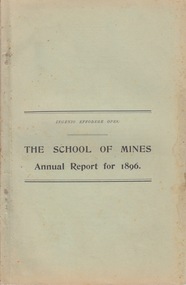 Federation University Historical Collection
Booklet - Annual Report and Calendar, Ballarat School of Mines Annual Report and Calendar, 1896
... . - president hon. r. t. vale - vice president r. denham pinnock - vice president the hon. sir w. j. clarke - trustee the hon. john warrington rogers - trustee the right reverend samuel thornton - trustee andrew anderson - trustee james millhinch - trustee james oddie - trustee the hon. henry cuthbert - honorary solicitor r. g. middleton - honorary treasurer charles kent - auditor fred. j. martell - director and registrar professor alf. mica smith - chemistry metallurgy natural philosophy professor purdie - geology mineralogy principles of mining professor g. j. dawbarn - mine and land surveying mining mechanics hydraulics civil engineering applied mechanics j. rowe - practical mining w. huey steele - electrical technology electricity and magnetism d. walker - chemistry and natural philosophy w. e. bennett - mathematics henry j. hall - freehand and perspective drawing a. e. c. kerr - mechanical drawing (machine construction and design) j. f. usher - paleontology zoology materia medica professor purdie - botany george clegg - building construction l. hart - photography h. g. a. brown - carpentry r. e. weir - veterinary science daniel walker henry cuthbert james millhinch jams oddie j.f. usher .1) Ballarat School of Mines Annual Report .2) Ballarat School of Mines calendar The Ballarat School of Mines Calendar and Annual Report 1896. ...The Ballarat School of Mines was the first Technical School on Australia..1) Ballarat School of Mines Annual Report .2) Ballarat School of Mines calendar The Ballarat School of Mines Calendar and Annual Report 1896. Associateship of The School, Calendar for 1896, Certificates Granted by Education Department 1894, Certificates Issued by The School 1895, Certificates Issued Prior to 1895, Certificates Issued by Education Department 1895, Examiners, Examination Fees, Fees, Honorary Correspondents, Life Governors, Meteorological Observations, Number of Students attended The School, Office Bearers, Professors and Lecturers, Report of the Superintendent of Laboratories, Report of the Professor of Mineralogy, Geology and Botany, Report of the Professor of Engineering, Report of the Lecturer on Mathematics, Report of the Instructor in Engineering Drawing, Report of the Lecturer on Electricity, Report of the Teacher of Drawing, Report of the Lecturer in Veterinary Science, Statement of Receipts and Expenditure for year 1895, Statistics - Student attending Lectures, Subscriptions and Donations, Subjects Included in Regulations Technical Schools, Time Tableballarat school of mines, examiners, examination fees, fees, honorary correspondents, life governors, meteorological observations, number of students attended the school, office bearers, professors and lecturers, report of the superintendent of laboratories, report of the professor of mineralogy, geology and botany, report of the professor of engineering, report of the lecturer on mathematics, report of the instructor in engineering drawing, report of the lecturer on electricity, report of the teacher of drawing, report of the lecturer in veterinary science, statement of receipts and expenditure for year 1895, statistics - student attending lectures, subscriptions and donations, subjects included in regulations technical schools, time table, annual report, calendar, andrew anderson j.p. - president, hon. r. t. vale - vice president, r. denham pinnock - vice president, the hon. sir w. j. clarke - trustee, the hon. john warrington rogers - trustee, the right reverend samuel thornton - trustee, andrew anderson - trustee, james millhinch - trustee, james oddie - trustee, the hon. henry cuthbert - honorary solicitor, r. g. middleton - honorary treasurer, charles kent - auditor, fred. j. martell - director and registrar, professor alf. mica smith - chemistry, metallurgy, natural philosophy, professor purdie - geology, mineralogy, principles of mining, professor g. j. dawbarn - mine and land surveying, mining mechanics, hydraulics, civil engineering, applied mechanics, j. rowe - practical mining, w. huey steele - electrical technology, electricity and magnetism, d. walker - chemistry and natural philosophy, w. e. bennett - mathematics, henry j. hall - freehand and perspective drawing, a. e. c. kerr - mechanical drawing (machine construction and design), j. f. usher - paleontology, zoology, materia medica, professor purdie - botany, george clegg - building construction, l. hart - photography, h. g. a. brown - carpentry, r. e. weir - veterinary science, daniel walker, henry cuthbert, james millhinch, jams oddie, j.f. usher -
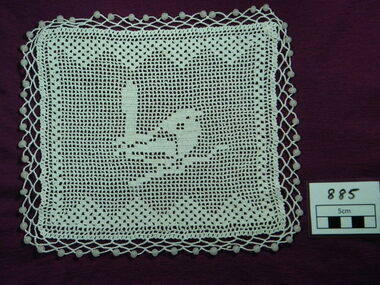 Blacksmith's Cottage and Forge
Jug cover, Early to mid 20th century
... She won prizes at local shows for cakes, jam making, and preserves. She was a well known identity in the town. lace ellen brown milk crochet jug cover home duties blue wren beads Square white beaded jug cover in ecru colored cotton. ...Covers were used to place over a jug to keep insects out of the liquid (usually milk). This sort of item was used in days before refrigeration. It also demonstrated womens ability to make items for the home.Part of Ellen Brown collection. Ellen Brown lived her whole life in Bacchus Marsh - she died aged 103 in 2009. She never married and excelled at home duties, eg., needlework, cooking. She won prizes at local shows for cakes, jam making, and preserves. She was a well known identity in the town.Square white beaded jug cover in ecru colored cotton. Crocheted central bird pattern with triangular pattern top and bottom. White beads attached on perimeter.lace, ellen brown, milk, crochet, jug cover, home duties, blue wren, beads -
Federation University Historical Collection
Photograph - Black and White, Review Panel for Ballarat University Status, 1993, 05/1993
... University of Ballarat Ballarat University COllege Bill pryor jams coglan bill gribble university establishment Black and white photograph of three men. ...The University of Ballarat was established in 1994. It later became Federation University Australia.Black and white photograph of three men. Two are shaking hands in front of a portrait of a woman. Left - right: Cr James Cogland (Mayor, City of Ballarat), Bill Gribble, Dr William Pryoruniversity of ballarat, ballarat university college, bill pryor, jams coglan, bill gribble, university establishment -
Eltham District Historical Society Inc
Document - Folder, Smith, Opal
... Opal Smith Ken Smith Quinn estate Montmorency Ambulance Station Montmorency Grand Boulevard Montmorency Bolton Street Eltham Main Road Montmorency Montmorency Primary School Parents Council Montmorency Primary School Reichelt Road Montmorency Eltham Cemetery Booth Clibborn Evangelical movement Laurie Smith Len Parker Brian Smith Russell J Smith Butterman's Track St Andrews Bev Smith Brendan Smith Rohan Smith Marty Smith Melanie Smith Montmorency Bowling Club Nillumbik Historical Society Country Women's Association Pamela Smith Matthew Smith Miriam Smith Alison Smith Cox's Orchards Mt Pleasant Road Eltham Victory Jam Factory Alphington Sue Law Pat Pearson Elsie McKenzie Eltham Leisure Centre Doll Smith Newspaper clippings, A4 photocopies, etc Smith, Opal Document Folder ...Opal (1914-2010) and husband Ken married in 1936 and moved to the new Quinn estate, Montmorency, in the mid 1930s. They ran various businesses and bought a farm in Butterman's Track, St Andrews. Ken was involved in local organisations and Opal was red Cross volunteer. Contents Typed notes: Sue Law, 10 November 2010, Address to Eltham District Historical Society about death of Opal Smith. Biographical details of Opal Smith and recent death. Typed notes: Russell J Smith (son of Opal Smith), 5 November 2010, Notes for celebrant at funeral of Opal Smith. Biographical details of Opal Smith and Montmorency in 1930s. Order of Service: Celebration of the life of Opal Smith, 8 November 2010, Le Pine Chapel, Eltham. Typed copy of a reading at service for Opal Smith: "I live on" (author unknown). Letter Sue Law to Russell Smith, 12 November 2010. Outlining her and friends' involvement with Opal Smith. Letter Russell Smith to Sue Law, 6 December 2010. Thanks for letter, providing requested material. Card Russell Smith to Sue Law, no date. Thanks from family. Newspaper clippings, A4 photocopies, etcopal smith, ken smith, quinn estate montmorency, ambulance station montmorency, grand boulevard montmorency, bolton street eltham, main road montmorency, montmorency primary school parents council, montmorency primary school, reichelt road montmorency, eltham cemetery, booth clibborn evangelical movement, laurie smith, len parker, brian smith, russell j smith, butterman's track st andrews, bev smith, brendan smith, rohan smith, marty smith, melanie smith, montmorency bowling club, nillumbik historical society, country women's association, pamela smith, matthew smith, miriam smith, alison smith, cox's orchards, mt pleasant road eltham, victory jam factory alphington, sue law, pat pearson, elsie mckenzie, eltham leisure centre, doll smith -
 Eltham District Historical Society Inc
Binder, Eltham District History, Eltham Road Board, 1856-1871; Research by Keith Chappel, 1971-1974
... Eltham District History, Eltham Road Board, 1856-1871 a. foley a. harkness a. mackie a. mcintyre a. von ziegler a.a. vivian a.d. kinninmont a.d. quadri a.h. grimshaw a.w. page aboriginal reserve aborigines abraham quarman abraham rooks abraham taylor adam goudie aenaes harrison agnes black agnes charlton agnes dalrymple ah chong ah cock ah hein ah lie ah sing albert lunson albert ness albert parker albert ramseyor alert hunt alex cameron alex eason alex mcandrew alexander crichton alexander donaldson alexander falconer alexander innes alexander james alexander mcdonald alexander miller alexander thompson alexander walker alexander white alfred armstrong alfred burgess alfred davey alfred deschamp alfred eddy alfred hinley alfred hooper alfred hubbard alfred lowman alfred smith alfred whelpton alice power allen heeps allwood amelia neuman amos taylor anderson andersons creek andrew brown andrew byrne andrew harkness andrew herbert andrew ross andrew smith angus mcdonald ann emmott ann mcphee ann odea ann plunkett ann snell ann tatty annie ashmore annie herbert annie stuart anthony beale anthony currie ants nest archibald mcphee arthur connor arthur lyttle arthur rooke arthur young arthurs creek arthurs creek school august ostling b.o. wallis barkers creek barr belton benjamin bain benjamin jenken benjamin lawford benjamin rice benjamin shaw benjamin smith benjamin wallis benjamin walton berry bismark hotel black calf gully black thursday boomers gully bridget bunker bridget hailes bridget kearse bruno hirt burns bushranger c. twiss c.h. bade caleb sherar caledonia caledonia diggings campbell hunter carl euman caroline davey catherine kennedy cathren brock cecilia farman chamberlain chapman charles caldwell charles campbell charles dale charles draper charles fowler charles green charles hawkins charles hempel charles hirt charles hirtson charles jefer charles jesse charles kerchevell charles lidgerwood charles morris charles peake charles prince charles rielly charles roberts charles rowand charles simms charles souter charles swan charles verso charles wells charles whelpton charles williams charles wingrove charles woodley charleys gully charlotte beltison charlotte goodwin ching ah hock christine brennan christine mckenzie christmas hills hotel christmas hills school christopher battaila christopher twiss chune grove church of england church of england school clarissa milton cleir hills colin amos constable quirke constable talty cornelius haley cornelius stewart cottles bridge councillors hotel cricket cucksons brewery d. nicholson d.w. morrissey dalry daniel charleston daniel harding daniel jepps daniel mccarthy daniel mckenzie daniel mcloughlin daniel oloughlin david boyd david christian david clark david creighton david rogers david rolfe david sharp david shawcross david smith david stevenson diamond accommodation store diamond reef mine dickson dixon bertram donald cameron donald mcmillan donaldson dougald mcphee dr barclay dugald mcphee dugald taylor duncan fraser duncan smith dungey e. hildebrand e. stichlins e.f. falkiner e.j. hughes e.m. garsed e.w. morrissey edith staff edmund clarke edmund cuckson edmund hall edmund picket edward bage edward beltison edward bunker edward ford edward hindley edward jackson edward jones edward kelly edward qualtrough edward staff edward tresain edward weller edward whelpton edward whilpson edwin biley edwin cartwright edwin cohen edwin deschamp edwin mcleish edwin rodda edwin smith effie rodda eliza bellamy eliza dawson eliza howell eliza nield eliza smith elizabeth cockshutt elizabeth eiles elizabeth fitch elizabeth gillespie elizabeth harris elizabeth herbert elizabeth hollow elizabeth le juge elizabeth plunkett elizabeth whelpton ellen hurst ellen kearse ellen quarman ellen sweeney ellen white ellis eltham cemetery eltham hotel eltham lower park eltham market eltham police station eltham pound eltham quarry eltham racecourse eltham roads board eltham school emile hude emily anderson emily blamire emily coutie emma smith emma taylor ephraim wyett ernest baillie ernest henrick ernest steer esther porter ethel baillie evan jones evelyn hotel evelyn observer ewen cameron ewen jones f. chrimes f. grundel f.e. falkiner f.r. howard fanny benson fanny white felix hude felix noisette ferdinand ramseyer flora vale florence hurst fogarty forbes mackenzie fords creek frances kearse francis baker francis hales francis raselli francis steer frank eiles frank rogerson frank tanner fraser fred hurst frederick falkiner frederick hurst frederick muller frederick nink frederick walker frederick wharington friedrich muller fryers gully furphy g. donaldson g. houghton g. turnbull geanetta hude george assender george bear george beare george benson george bird george boston george brain george brandt george burley george buswell george coutie george eiles george ewings george ford george godber george goodman george gray george griffiths george hall george herbert george horn george kirk george langhorne george mann george mclelland george mosely george neumayer george orchard george parish george porter george purcell george ralph george reid george rocke george rogers george rolfe george stebbing george stebbings george stebbins george switzer george symons george thompson georgina hilton glenda moriss glengloy gold goulstone greensborough police station gulf station h. jennings h. mann h.h. farquason hannah sunderland happy valley harkness harold scarce harriet hunt harriet smith harry hollow hazel glen healesville heinrich hirt helena peters henrietta hill henry arthur henry ashmore henry austin henry brown henry dendy henry dineen henry fowler henry gardner henry green henry griffin henry hart henry hirst henry hirt henry hopkinson henry hude henry hurst henry inch henry jones henry mills henry scarce henry st paul henry stevens henry stooke henry thomson henry vogt henry wallace henry wilson herbert rodda herman henrick hermann lampe hermann steinmann hester staff hitchill holbert honoree hude hotel de france hugh mccann humphrey peers humphrey spicer hurstbridge hurstbridge general store i.h. clarke ida adelskold ignatz kinzel ira pimm irene donaldson isaac briggs isaac hickson isaac hill isaac kerr isaac varby isaac williams isabella donaldson isabelle herbert j. dungate j. eccleston j. harkness j. hartley j. hude j. irvine j. jones j. manduell j. mason j. mcdonald j. mcnamara j. nichenson j. renahen j. scott j. seymour j.a. goold j.a. panton j.c. hughes j.d. thompson j.f. hughes j.f. johnstone j.g. walter j.h. taylor j.p. morris jack ewart jacob belsham jacob goldstein jacob morast jam loon james alexander james anderson james andrew james andrews james baines james batchelor james bond james bradford james brennan james brock james brown james brunning james buchanan james cockburn james cowan james dalrymple james donaldson james duckworth james goodwin james harding james harrison james hartley james hawkins james hewish james holinger james hughes james inglis james jamieson james johnson james johnston james kaye james kew james lindsay james lindsey james lynan james macpherson james mann james martley james mayger james mccutcheon james mcmahon james mcpherson james mess james miller james mitton james morton james murdoch james murdock james nickinson james orford james purcell james qualtrough james rudall james simpson james smith james spence james stonachan james stuart james suman james surman james sutherland james thompson james thomson james walker james walters james watts jane cleave jane donaldson jane mess jane sadler jane shaw jane thomson janefield jean borelli jeanette hudi jeanne hude johann muller john ainsworth john andrew john baillie john barr john beale john bell john bellin john blake john blyth john brock john brown john byers john cameron john candler john carter john cobbock john cockshank john cockshutt john coleman john connell john crozier john darroch john dennis john donaldson john elsworthy john fenton john fitch john gardner john gast john graham john grimshaw john haines john haley john harper john harris john hassall john hayes john heales john herbert john holland john holman john hood john horner john horton john hughes john jardine john johns john johnston john jones john kearse john kilpatrick john knell john lawrey john macadam john mandell john manduell john marker john mccoll john mccolly john mcdonald john mcintyre john mckimmie john mcnamara john mitchell john moore john morgan john muller john murray john pearson john peterson john petty john pullen john quinn john rawlings john ryder john sabelberg john scott john semar john serman john seymour john shawcross john smith john staff john steer john stephens john sweeney john thompson john thomson john trahy john walker john weller john wells john williams john williamson john yates john yeoman john young johnn mcdonnell joseph bull joseph burns joseph caldwell joseph caudwell joseph coutie joseph elliott joseph emmott joseph fayver joseph furphy joseph hall joseph hibbert joseph hilton joseph johns joseph lithgow joseph panton joseph rodda joseph sands joseph sanson joseph schubert joseph scott joseph shaw joseph smith joseph spedder joseph stevenson joseph verco joseph wilson josiah hollis josiah hullis josiah thomas judith furphy julie williams junction hotel kangaroo forest kangaroo ground kangaroo ground cemetery kangaroo ground general store kangaroo ground hotel kangaroo ground police station kangaroo ground post office kangaroo ground school kate bolger kath scarce katherine kearse kidd kinglake kinglake hotel kingstown l. storey lan quan lang latimour laura henrick laurence paterson leon berlioz levinia henrick lillian gillan linton little eltham long gully louis henrick louis le juge louis smith louisa steinmann louise miller lower plenty bridge hotel lucy tidell lydia qualtrough m.j. careton m.s. adams macrudden maggs mail coach maplestone margaret graham margaret hollins margaret kearse margaret kennedy margaret kinrade margaret lynch margaret mcbirney margaret steinmann marguerite borelli maria reilly maria st paul maria trew marian trew marianne miller marie wright marion hillier mark bunker martha herbert martin brennan mary alexander mary beltison mary bradford mary bridgman mary brock mary bull mary eiles mary hopkinson mary kearse mary lean mary mcinerney mary miller mary parmington mary pearson mary pickles mary robertson mary rodda mary ross mary smith mary surman mary weller matilda jordan matilda mcmillan matthias watson mawson mechanics institute michael callanan michael fenton michael kearse michael mctyne michael merritt michael oday michael odea midgley hall mills minnie watts miss bellon morgans gully mount joy mr donnan mr omeare mr page mrs greenaway mrs havard mrs hude mrs morris muller murrays bridge n.d. whyte ned kelly new caledonia creek nicholas rodda nillumbik norman mcphee old caledonia gully oliver gourlay one tree hill owen finnegan panton hill panton hill hotel panton hill post office panton hill school parambool patrick armstrong patrick bourke patrick burke patrick callaghan patrick green patrick harrington patrick kearse patrick lynch patrick mcintyre patrick o'callaghan patrick rodgers patrick sheahan peach grove perinella bull perry peter carrucan peter flyn peter ford peter lawlor peter patterson peter snodgrass peter watson philip korfman phillip gakden phillip kaufman phillip korfman pierce brennan pierce power poo long pound bend pretty hill queenstown queenstown cemetery queenstown police station queenstown school r. mackie r.a. davidson rebecca noisette rebecca weller reefers hotel research research gully research gully hotel research hotel research school rev dobinson rhoda coutie richard brook richard capper richard dunstan richard goulding richard heales richard lane richard matthews richard rodda richard searle richard smith richard wallis richard warren richard woolcott robert alice robert bourke robert burke robert charlton robert clarke robert cunningham robert dugdale robert grant robert hall robert harris robert hempel robert hill robert hurst robert lowman robert mcadam robert mckee robert nink robert norman robert pontessey robert sharp robert smith robert steel robert stevenson robert strong robert surnam robert wood robina joyce rogerson roman catholic church rossiter rudolph muller ruth mess ruth sadler ruth stevenson s. smith s. stewart salters rush sam deacon samuel bird samuel brace samuel cameron samuel candler samuel cole samuel cracknell samuel dagley samuel flier samuel furphy samuel merriman samuel moseley samuel mosley samuel smith sarah howard sarah moseley sarah raston sarah walters second watery gully school self shin hun simon armstrong smiths gully smiths gully mechanics institute smiths gully school sophia greenaway spanish gully st andrews st andrews hotel st helena stack stanley smith stephen gonnet stephenson turner stephensons bridge steven anderson stevensons corner sumner susan dickson susan street susan walke sutherland t. davidson t. mclaughlin t. symons t.a. aldwell t.b. drummond t.b. henderson t.e. johnston t.h. subelly tarrawarra theis theodore sabelberg theresa lynch thomas anderson thomas armstrong thomas baillie thomas batt thomas bell thomas benson thomas bibbs thomas boardman thomas bradford thomas bull thomas cattery thomas cochrane thomas cook thomas cottle thomas cousins thomas downward thomas edwards thomas evans thomas grierson thomas haines thomas harmer thomas hunniford thomas huntford thomas hurry thomas jardine thomas jones thomas kearse thomas kennedy thomas marland thomas martin thomas mcinerney thomas morrison thomas mundy thomas murphy thomas murray thomas peacock thomas plunkett thomas postlethwaite thomas prior thomas qualtrough thomas smith thomas stone thomas sunderland thomas swatling thomas sweeney thomas symons thomas walke thomas wall thomas wright thomas young tim shaw toll gate tom collins tommys hut true upper diamond creek upper diamond creek school view hill virtue hall w. cockayne w. craig w. foster w. marriott w. ridley w. trenoweth w.a. page w.b. andrew w.b. burnley w.b. phillips w.c. shortt w.w. herbert walter barlow walter hillier walter joyce walter knell walter mckimmie walter mcnicoll walter thomson walter wippell warburton carr warrandyte warrens hotel watery gully watsons creek watsons creek hotel wattle glen school wellers hotel weymss donaldson whipstick gully white cloud wild dog creek wild dog gully wiliam albert william aitken william albert william anderson william andrews william barr william barrow william bell william bond william bowden william bremmer william brewer william bridgman william burnley william buswell william cant william clarke william cleave william crozier william dawson william dodging william ellis william finn william fitzgibbon william ford william foster william garland william ghosley william golding william goodwin william graham william gray william grimshaw william hall william harding william herbert william hoilett william hopkinson william howitt william howlett william hubbard william hunt william inglis william jarrold william joyce william kidd william kilpatrick william kommer william lodge william mclaughlin william mcmurray william mitton william moore william mosley william murphy william nicholson william normage william norman william nuttall william phillips william quarman william ronald william sadler william scott william seaville william sharp william smith william spicer william taylor william thomson william tobin william underwood william walsh william walshe william walters william watkins william west william wilmot william wilson william wolverston william woods wolfe woodley yarra bank yow yow creek a. brewer a. easson a. edwards a. melville a.m. ross a.r. larrimour aborigine reserve advertisements agricultural district alan bernhard horsley albert frederick charles glover albert h price albert h.c. price albert henry charles price alex easson alexander campbell alexander melville alexander thomas haley alexander thomson alfred j. lowman alice may peake alie haley alistair knox alistair samuel knox allandale road allendale road allwood run andrew andrew mckay anton william brinkkotter archibald brown argus arthur chichester allen arthur edwin cracknell arthur john braid arthur robert traynor atlas of australia 1886 b. lawford b. mess barry thale houston basil y hall basil yaldwyn hall bell street benjamin baxter benjamin bowater benjamin thomas taylor benjaomin o. wallis bible street billis bolton street brewery brisbane street buckingham bushrangers c. brown c. carroll c. hirt c.s. haley c.s. wingrove c.t. harris caledonia run cam cattle charis meta alexander pelling charles brown charles ellis charles hicks bath charles newman clara gonnet claude bryan gibbs clifford henry goulding seear coleraine colin t. bell collectors collingwood commissioner airey coplin thomas bell cornelius john stewart cornelius sharp haley cornelius sharpe haley county of evelyn culla hill cutto hill d. ryan daily news newspaper dalton street daniel jepp derek cecil o'beirne diamond creek diamond creek post office diamond creek railway station diamond creek run diamond creek station diamond creek township divisions doctor donald alfred neil donald charles maling donald ingersole donald kennedy douglas anderson e. cameron e. falkiner e. stooke e.t. peers edward dumaresq edward heller edward james edward wilson edwin stooke elections electoral districts electoral roll electrified railway eltham eltham district description eltham district history eltham district road board eltham post office eltham railway station eltham road district eltham road district board eltham shire council eltham shire councillors eltham shire history eltham town common eltham village eltham-hurstbridge railway ely street eric dudley butler eric nichol staff eric percival harmer ernest james andrews eve may edwards evelyn and mornington division evelyn division everard albert hale ewn hugh cameron f. stone f.d. wickham flour mill fountain of friendship hotel francis bradley francis joseph favier francis regiereals(?) ...Eltham District History, Eltham Road Board, 1856-1871Two binders containing 486 A4 pages (photocopied) of mostly handwritten notes from research undertaken of Public Office Records of Victoria various holdings. Some photocopies from source reference books. Includes 20 page subject index (handwritten) at front and 5 pages of notes and sources at rear and a photocopy of short biography of Keith Chappel.a. foley, a. harkness, a. mackie, a. mcintyre, a. von ziegler, a.a. vivian, a.d. kinninmont, a.d. quadri, a.h. grimshaw, a.w. page, aboriginal reserve, aborigines, abraham quarman, abraham rooks, abraham taylor, adam goudie, aenaes harrison, agnes black, agnes charlton, agnes dalrymple, ah chong, ah cock, ah hein, ah lie, ah sing, albert lunson, albert ness, albert parker, albert ramseyor, alert hunt, alex cameron, alex eason, alex mcandrew, alexander crichton, alexander donaldson, alexander falconer, alexander innes, alexander james, alexander mcdonald, alexander miller, alexander thompson, alexander walker, alexander white, alfred armstrong, alfred burgess, alfred davey, alfred deschamp, alfred eddy, alfred hinley, alfred hooper, alfred hubbard, alfred lowman, alfred smith, alfred whelpton, alice power, allen heeps, allwood, amelia neuman, amos taylor, anderson, andersons creek, andrew brown, andrew byrne, andrew harkness, andrew herbert, andrew ross, andrew smith, angus mcdonald, ann emmott, ann mcphee, ann odea, ann plunkett, ann snell, ann tatty, annie ashmore, annie herbert, annie stuart, anthony beale, anthony currie, ants nest, archibald mcphee, arthur connor, arthur lyttle, arthur rooke, arthur young, arthurs creek, arthurs creek school, august ostling, b.o. wallis, barkers creek, barr, belton, benjamin bain, benjamin jenken, benjamin lawford, benjamin rice, benjamin shaw, benjamin smith, benjamin wallis, benjamin walton, berry, bismark hotel, black calf gully, black thursday, boomers gully, bridget bunker, bridget hailes, bridget kearse, bruno hirt, burns, bushranger, c. twiss, c.h. bade, caleb sherar, caledonia, caledonia diggings, campbell hunter, carl euman, caroline davey, catherine kennedy, cathren brock, cecilia farman, chamberlain, chapman, charles caldwell, charles campbell, charles dale, charles draper, charles fowler, charles green, charles hawkins, charles hempel, charles hirt, charles hirtson, charles jefer, charles jesse, charles kerchevell, charles lidgerwood, charles morris, charles peake, charles prince, charles rielly, charles roberts, charles rowand, charles simms, charles souter, charles swan, charles verso, charles wells, charles whelpton, charles williams, charles wingrove, charles woodley, charleys gully, charlotte beltison, charlotte goodwin, ching ah hock, christine brennan, christine mckenzie, christmas hills hotel, christmas hills school, christopher battaila, christopher twiss, chune grove, church of england, church of england school, clarissa milton, cleir hills, colin amos, constable quirke, constable talty, cornelius haley, cornelius stewart, cottles bridge, councillors hotel, cricket, cucksons brewery, d. nicholson, d.w. morrissey, dalry, daniel charleston, daniel harding, daniel jepps, daniel mccarthy, daniel mckenzie, daniel mcloughlin, daniel oloughlin, david boyd, david christian, david clark, david creighton, david rogers, david rolfe, david sharp, david shawcross, david smith, david stevenson, diamond accommodation store, diamond reef mine, dickson, dixon bertram, donald cameron, donald mcmillan, donaldson, dougald mcphee, dr barclay, dugald mcphee, dugald taylor, duncan fraser, duncan smith, dungey, e. hildebrand, e. stichlins, e.f. falkiner, e.j. hughes, e.m. garsed, e.w. morrissey, edith staff, edmund clarke, edmund cuckson, edmund hall, edmund picket, edward bage, edward beltison, edward bunker, edward ford, edward hindley, edward jackson, edward jones, edward kelly, edward qualtrough, edward staff, edward tresain, edward weller, edward whelpton, edward whilpson, edwin biley, edwin cartwright, edwin cohen, edwin deschamp, edwin mcleish, edwin rodda, edwin smith, effie rodda, eliza bellamy, eliza dawson, eliza howell, eliza nield, eliza smith, elizabeth cockshutt, elizabeth eiles, elizabeth fitch, elizabeth gillespie, elizabeth harris, elizabeth herbert, elizabeth hollow, elizabeth le juge, elizabeth plunkett, elizabeth whelpton, ellen hurst, ellen kearse, ellen quarman, ellen sweeney, ellen white, ellis, eltham cemetery, eltham hotel, eltham lower park, eltham market, eltham police station, eltham pound, eltham quarry, eltham racecourse, eltham roads board, eltham school, emile hude, emily anderson, emily blamire, emily coutie, emma smith, emma taylor, ephraim wyett, ernest baillie, ernest henrick, ernest steer, esther porter, ethel baillie, evan jones, evelyn hotel, evelyn observer, ewen cameron, ewen jones, f. chrimes, f. grundel, f.e. falkiner, f.r. howard, fanny benson, fanny white, felix hude, felix noisette, ferdinand ramseyer, flora vale, florence hurst, fogarty, forbes mackenzie, fords creek, frances kearse, francis baker, francis hales, francis raselli, francis steer, frank eiles, frank rogerson, frank tanner, fraser, fred hurst, frederick falkiner, frederick hurst, frederick muller, frederick nink, frederick walker, frederick wharington, friedrich muller, fryers gully, furphy, g. donaldson, g. houghton, g. turnbull, geanetta hude, george assender, george bear, george beare, george benson, george bird, george boston, george brain, george brandt, george burley, george buswell, george coutie, george eiles, george ewings, george ford, george godber, george goodman, george gray, george griffiths, george hall, george herbert, george horn, george kirk, george langhorne, george mann, george mclelland, george mosely, george neumayer, george orchard, george parish, george porter, george purcell, george ralph, george reid, george rocke, george rogers, george rolfe, george stebbing, george stebbings, george stebbins, george switzer, george symons, george thompson, georgina hilton, glenda moriss, glengloy, gold, goulstone, greensborough police station, gulf station, h. jennings, h. mann, h.h. farquason, hannah sunderland, happy valley, harkness, harold scarce, harriet hunt, harriet smith, harry hollow, hazel glen, healesville, heinrich hirt, helena peters, henrietta hill, henry arthur, henry ashmore, henry austin, henry brown, henry dendy, henry dineen, henry fowler, henry gardner, henry green, henry griffin, henry hart, henry hirst, henry hirt, henry hopkinson, henry hude, henry hurst, henry inch, henry jones, henry mills, henry scarce, henry st paul, henry stevens, henry stooke, henry thomson, henry vogt, henry wallace, henry wilson, herbert rodda, herman henrick, hermann lampe, hermann steinmann, hester staff, hitchill, holbert, honoree hude, hotel de france, hugh mccann, humphrey peers, humphrey spicer, hurstbridge, hurstbridge general store, i.h. clarke, ida adelskold, ignatz kinzel, ira pimm, irene donaldson, isaac briggs, isaac hickson, isaac hill, isaac kerr, isaac varby, isaac williams, isabella donaldson, isabelle herbert, j. dungate, j. eccleston, j. harkness, j. hartley, j. hude, j. irvine, j. jones, j. manduell, j. mason, j. mcdonald, j. mcnamara, j. nichenson, j. renahen, j. scott, j. seymour, j.a. goold, j.a. panton, j.c. hughes, j.d. thompson, j.f. hughes, j.f. johnstone, j.g. walter, j.h. taylor, j.p. morris, jack ewart, jacob belsham, jacob goldstein, jacob morast, jam loon, james alexander, james anderson, james andrew, james andrews, james baines, james batchelor, james bond, james bradford, james brennan, james brock, james brown, james brunning, james buchanan, james cockburn, james cowan, james dalrymple, james donaldson, james duckworth, james goodwin, james harding, james harrison, james hartley, james hawkins, james hewish, james holinger, james hughes, james inglis, james jamieson, james johnson, james johnston, james kaye, james kew, james lindsay, james lindsey, james lynan, james macpherson, james mann, james martley, james mayger, james mccutcheon, james mcmahon, james mcpherson, james mess, james miller, james mitton, james morton, james murdoch, james murdock, james nickinson, james orford, james purcell, james qualtrough, james rudall, james simpson, james smith, james spence, james stonachan, james stuart, james suman, james surman, james sutherland, james thompson, james thomson, james walker, james walters, james watts, jane cleave, jane donaldson, jane mess, jane sadler, jane shaw, jane thomson, janefield, jean borelli, jeanette hudi, jeanne hude, johann muller, john ainsworth, john andrew, john baillie, john barr, john beale, john bell, john bellin, john blake, john blyth, john brock, john brown, john byers, john cameron, john candler, john carter, john cobbock, john cockshank, john cockshutt, john coleman, john connell, john crozier, john darroch, john dennis, john donaldson, john elsworthy, john fenton, john fitch, john gardner, john gast, john graham, john grimshaw, john haines, john haley, john harper, john harris, john hassall, john hayes, john heales, john herbert, john holland, john holman, john hood, john horner, john horton, john hughes, john jardine, john johns, john johnston, john jones, john kearse, john kilpatrick, john knell, john lawrey, john macadam, john mandell, john manduell, john marker, john mccoll, john mccolly, john mcdonald, john mcintyre, john mckimmie, john mcnamara, john mitchell, john moore, john morgan, john muller, john murray, john pearson, john peterson, john petty, john pullen, john quinn, john rawlings, john ryder, john sabelberg, john scott, john semar, john serman, john seymour, john shawcross, john smith, john staff, john steer, john stephens, john sweeney, john thompson, john thomson, john trahy, john walker, john weller, john wells, john williams, john williamson, john yates, john yeoman, john young, johnn mcdonnell, joseph bull, joseph burns, joseph caldwell, joseph caudwell, joseph coutie, joseph elliott, joseph emmott, joseph fayver, joseph furphy, joseph hall, joseph hibbert, joseph hilton, joseph johns, joseph lithgow, joseph panton, joseph rodda, joseph sands, joseph sanson, joseph schubert, joseph scott, joseph shaw, joseph smith, joseph spedder, joseph stevenson, joseph verco, joseph wilson, josiah hollis, josiah hullis, josiah thomas, judith furphy, julie williams, junction hotel, kangaroo forest, kangaroo ground, kangaroo ground cemetery, kangaroo ground general store, kangaroo ground hotel, kangaroo ground police station, kangaroo ground post office, kangaroo ground school, kate bolger, kath scarce, katherine kearse, kidd, kinglake, kinglake hotel, kingstown, l. storey, lan quan, lang, latimour, laura henrick, laurence paterson, leon berlioz, levinia henrick, lillian gillan, linton, little eltham, long gully, louis henrick, louis le juge, louis smith, louisa steinmann, louise miller, lower plenty bridge hotel, lucy tidell, lydia qualtrough, m.j. careton, m.s. adams, macrudden, maggs, mail coach, maplestone, margaret graham, margaret hollins, margaret kearse, margaret kennedy, margaret kinrade, margaret lynch, margaret mcbirney, margaret steinmann, marguerite borelli, maria reilly, maria st paul, maria trew, marian trew, marianne miller, marie wright, marion hillier, mark bunker, martha herbert, martin brennan, mary alexander, mary beltison, mary bradford, mary bridgman, mary brock, mary bull, mary eiles, mary hopkinson, mary kearse, mary lean, mary mcinerney, mary miller, mary parmington, mary pearson, mary pickles, mary robertson, mary rodda, mary ross, mary smith, mary surman, mary weller, matilda jordan, matilda mcmillan, matthias watson, mawson, mechanics institute, michael callanan, michael fenton, michael kearse, michael mctyne, michael merritt, michael oday, michael odea, midgley hall, mills, minnie watts, miss bellon, morgans gully, mount joy, mr donnan, mr omeare, mr page, mrs greenaway, mrs havard, mrs hude, mrs morris, muller, murrays bridge, n.d. whyte, ned kelly, new caledonia creek, nicholas rodda, nillumbik, norman mcphee, old caledonia gully, oliver gourlay, one tree hill, owen finnegan, panton hill, panton hill hotel, panton hill post office, panton hill school, parambool, patrick armstrong, patrick bourke, patrick burke, patrick callaghan, patrick green, patrick harrington, patrick kearse, patrick lynch, patrick mcintyre, patrick o'callaghan, patrick rodgers, patrick sheahan, peach grove, perinella bull, perry, peter carrucan, peter flyn, peter ford, peter lawlor, peter patterson, peter snodgrass, peter watson, philip korfman, phillip gakden, phillip kaufman, phillip korfman, pierce brennan, pierce power, poo long, pound bend, pretty hill, queenstown, queenstown cemetery, queenstown police station, queenstown school, r. mackie, r.a. davidson, rebecca noisette, rebecca weller, reefers hotel, research, research gully, research gully hotel, research hotel, research school, rev dobinson, rhoda coutie, richard brook, richard capper, richard dunstan, richard goulding, richard heales, richard lane, richard matthews, richard rodda, richard searle, richard smith, richard wallis, richard warren, richard woolcott, robert alice, robert bourke, robert burke, robert charlton, robert clarke, robert cunningham, robert dugdale, robert grant, robert hall, robert harris, robert hempel, robert hill, robert hurst, robert lowman, robert mcadam, robert mckee, robert nink, robert norman, robert pontessey, robert sharp, robert smith, robert steel, robert stevenson, robert strong, robert surnam, robert wood, robina joyce, rogerson, roman catholic church, rossiter, rudolph muller, ruth mess, ruth sadler, ruth stevenson, s. smith, s. stewart, salters rush, sam deacon, samuel bird, samuel brace, samuel cameron, samuel candler, samuel cole, samuel cracknell, samuel dagley, samuel flier, samuel furphy, samuel merriman, samuel moseley, samuel mosley, samuel smith, sarah howard, sarah moseley, sarah raston, sarah walters, second watery gully school, self, shin hun, simon armstrong, smiths gully, smiths gully mechanics institute, smiths gully school, sophia greenaway, spanish gully, st andrews, st andrews hotel, st helena, stack, stanley smith, stephen gonnet, stephenson turner, stephensons bridge, steven anderson, stevensons corner, sumner, susan dickson, susan street, susan walke, sutherland, t. davidson, t. mclaughlin, t. symons, t.a. aldwell, t.b. drummond, t.b. henderson, t.e. johnston, t.h. subelly, tarrawarra, theis, theodore sabelberg, theresa lynch, thomas anderson, thomas armstrong, thomas baillie, thomas batt, thomas bell, thomas benson, thomas bibbs, thomas boardman, thomas bradford, thomas bull, thomas cattery, thomas cochrane, thomas cook, thomas cottle, thomas cousins, thomas downward, thomas edwards, thomas evans, thomas grierson, thomas haines, thomas harmer, thomas hunniford, thomas huntford, thomas hurry, thomas jardine, thomas jones, thomas kearse, thomas kennedy, thomas marland, thomas martin, thomas mcinerney, thomas morrison, thomas mundy, thomas murphy, thomas murray, thomas peacock, thomas plunkett, thomas postlethwaite, thomas prior, thomas qualtrough, thomas smith, thomas stone, thomas sunderland, thomas swatling, thomas sweeney, thomas symons, thomas walke, thomas wall, thomas wright, thomas young, tim shaw, toll gate, tom collins, tommys hut, true, upper diamond creek, upper diamond creek school, view hill, virtue hall, w. cockayne, w. craig, w. foster, w. marriott, w. ridley, w. trenoweth, w.a. page, w.b. andrew, w.b. burnley, w.b. phillips, w.c. shortt, w.w. herbert, walter barlow, walter hillier, walter joyce, walter knell, walter mckimmie, walter mcnicoll, walter thomson, walter wippell, warburton carr, warrandyte, warrens hotel, watery gully, watsons creek, watsons creek hotel, wattle glen school, wellers hotel, weymss donaldson, whipstick gully, white cloud, wild dog creek, wild dog gully, wiliam albert, william aitken, william albert, william anderson, william andrews, william barr, william barrow, william bell, william bond, william bowden, william bremmer, william brewer, william bridgman, william burnley, william buswell, william cant, william clarke, william cleave, william crozier, william dawson, william dodging, william ellis, william finn, william fitzgibbon, william ford, william foster, william garland, william ghosley, william golding, william goodwin, william graham, william gray, william grimshaw, william hall, william harding, william herbert, william hoilett, william hopkinson, william howitt, william howlett, william hubbard, william hunt, william inglis, william jarrold, william joyce, william kidd, william kilpatrick, william kommer, william lodge, william mclaughlin, william mcmurray, william mitton, william moore, william mosley, william murphy, william nicholson, william normage, william norman, william nuttall, william phillips, william quarman, william ronald, william sadler, william scott, william seaville, william sharp, william smith, william spicer, william taylor, william thomson, william tobin, william underwood, william walsh, william walshe, william walters, william watkins, william west, william wilmot, william wilson, william wolverston, william woods, wolfe, woodley, yarra bank, yow yow creek, a. brewer, a. easson, a. edwards, a. melville, a.m. ross, a.r. larrimour, aborigine reserve, advertisements, agricultural district, alan bernhard horsley, albert frederick charles glover, albert h price, albert h.c. price, albert henry charles price, alex easson, alexander campbell, alexander melville, alexander thomas haley, alexander thomson, alfred j. lowman, alice may peake, alie haley, alistair knox, alistair samuel knox, allandale road, allendale road, allwood run, andrew, andrew mckay, anton william brinkkotter, archibald brown, argus, arthur chichester allen, arthur edwin cracknell, arthur john braid, arthur robert traynor, atlas of australia 1886, b. lawford, b. mess, barry thale houston, basil y hall, basil yaldwyn hall, bell street, benjamin baxter, benjamin bowater, benjamin thomas taylor, benjaomin o. wallis, bible street, billis, bolton street, brewery, brisbane street, buckingham, bushrangers, c. brown, c. carroll, c. hirt, c.s. haley, c.s. wingrove, c.t. harris, caledonia run, cam, cattle, charis meta alexander pelling, charles brown, charles ellis, charles hicks bath, charles newman, clara gonnet, claude bryan gibbs, clifford henry goulding seear, coleraine, colin t. bell, collectors, collingwood, commissioner airey, coplin thomas bell, cornelius john stewart, cornelius sharp haley, cornelius sharpe haley, county of evelyn, culla hill, cutto hill, d. ryan, daily news newspaper, dalton street, daniel jepp, derek cecil o'beirne, diamond creek, diamond creek post office, diamond creek railway station, diamond creek run, diamond creek station, diamond creek township, divisions, doctor, donald alfred neil, donald charles maling, donald ingersole, donald kennedy, douglas anderson, e. cameron, e. falkiner, e. stooke, e.t. peers, edward dumaresq, edward heller, edward james, edward wilson, edwin stooke, elections, electoral districts, electoral roll, electrified railway, eltham, eltham district description, eltham district history, eltham district road board, eltham post office, eltham railway station, eltham road district, eltham road district board, eltham shire council, eltham shire councillors, eltham shire history, eltham town common, eltham village, eltham-hurstbridge railway, ely street, eric dudley butler, eric nichol staff, eric percival harmer, ernest james andrews, eve may edwards, evelyn and mornington division, evelyn division, everard albert hale, ewn hugh cameron, f. stone, f.d. wickham, flour mill, fountain of friendship hotel, francis bradley, francis joseph favier, francis regiereals(?), francis watson rosier, frank haley, frank wayne maas, franklin william nankervis, frederick charles barrett, frederick edward falkiner, frederick eldred griffith, frederick filed durham, frederick gration, frederick kirk gration, frederick vincent squire, fredrick ninck, g. drabble, g. haley, g. hodgkins, g. lee, g. thomas, g. thomson, g.d. boursiquot, g.f. belcher, garden hill, geoffrey charles dreverman, geology, george d'arley boursiquot, george ellis parker, george fletcher, george frederick belcher, george haley, george hirt, george louie cresp, george love, george robertson, george turnbull, george wise, godalmin street, gold mining, goodman, gordon melville, government gazette, graham lindsay bride, grazing, greenhill, greensborough, grierson, gun maker, h. g. james, h. stooke, h. taylor, h.g. jhones, h.t. beams, harold edward bartlett, heatherleigh, heidelberg, helen louise wells, henry creswell, henry gilbert jones, henry holloway, henry peers, herbert eric rundle, herbert hewitt, herbert rutter, hoddle, holiday resort, horace hilton, house of assembly, hugh larimour, hurst, i. barrow, i. rooks, ian g smedley, ian gordon smedley, industry, isaac rooks, isidore t. wilmor, j. alison, j. brown, j. cameron, j. carfrae & co., j. ferguson, j. frank, j. garthwaite, j. greaves, j. greitzner, j. irish, j. lindsay, j. murray, j. o'brien, j. stevenson, j. wilson, j.b. phipps, j.b. rodda, j.f. imley, j.g. foxton, j.g. fraser, j.h.f. hawke, j.k. zahn, j.m. holloway, j.p. imley, jack cato, jack clendinnen gill, jacob belcham, jacob greitzner, jakeb greitzner, james bailey, james cox, james d mealy, james darley mealy, james frank, james frederick mackay, james graham, james johnstone, james kay bryce, james mclaren, james murray, james oliver white, james pearson imley, james pearsons imley, james rosier, james ryan, jane thompson, jersey, johann karl zahn, john a porter, john alexander hampton lewis, john alison, john b. wilson, john barter bennett, john blackmore phipps, john blakemore phipps, john carfrae, john dane, john g. foxton, john gerald searle, john greaves, john green foxton, john greenlaw foxton, john henry sabelberg, john johnstone, john lee smith, john lindsay, john lindsay beale, john mann, john mason, john pape, john porter, john samuel lithgow, john stevenson, john verran mcconnell, john wilson, jonathan scott, joseph anderson panton, joseph bromley shallard, joseph garthwaite, joseph smedley, joseph walter henry bradbury, josiah morris holloway, k.e. dunstan, m kinglake, keelbundora, kenneth chareles crompton, kenneth donald macmillan, kenneth frederick hines, kenyon, kerby street, kinglake school, krelbundora, l. jenyns, l.m. bill, lancefield, land act 1862, land act 1865, land act 1869, land alienation, land settlement, legislative council, leopold kershaw lawry, leslie christopher docksey, leslie edward clarke, little eltham school, m. o'shea, m.h. fitzpatrick, mail run, mail service, main road, map, margaret moody, martin fogarty, mary leak, maxwell alexander spence, medical practitioner, michael o'shea, miss haley, moira, morang, mr. ford, mrs galbraith, n. gillies, n. rodda, name, names, neil stewart roberts, norman ernest charles williams, opening, orchard district, p. ryan, p.a.c o'farrell, p.p. cotter, parish of nillumbik, parish of nillumbik 1856, patrick costello, patrick turnbull, percy downer, peter andrew charles o'farrell, peter fair, peter graham, petr lawlor, phillip cumming, photographer, plenty river, polling place, polling places, porter street, portrait, post office, post office directory 1868, princes bridge, proclamation, r. boston, r. hepburn, r. lane, r. wadeson, r.d. mess, r.s.h. moody, radley (rodney) douglas quin, rag mill, railway lines, raymond clive duncan, registrar, research state school no. 2959, reserve for aborigines, reynolds road, richard jones and co, richard robert woolcott, river plenty, robert alan bell, robert benn (ship), robert cadden, robert cunningham white, robert david taylor, robert hepburn, robert kenneth marshall, robert miller, robert reid, robert stewart hull moody, robinia joyce, rodda family, rosemount, rupert norman maskell, ryans road, s. evans, s. wekey, samuel evans, samuel phillips, samuel ramsden, samuel w. scott, searle, shire of diamond valley, sigismund wekey, sly grog seller, sources, south province, south yarra, st kilda, stanley simpson addison, strathbogie, strippers of bark, stuart alexander donaldson, sweeneys lane, sweeny, sylvia ruth houston, t. archer, t. huntley, t. murray, t. stephens, t. watkins, t.a. stork, t.b. daling, t.b. darling, t.c. darling, t.milthorpe, t.p. cross, tannery, tenders, terence alphonsus collins, the explorers and early colonists of victoria, the story of the camera in australia, thomas bell darling, thomas clarke, thomas darling, thomas foster chuck, thomas grant, thomas henry bowman, thomas herbert power, thomas irvine, thomas maltby, thomas mccombie, thomas scarce, thomas sweeny, thornton street, town of eltham, vaccinations act, victorian government gazette, virtue hall station, virtue hill, w. archer, w. brown, w. gordon, w. inglis, w. jones, w. matthew, w. mcdonald, w. williams, w. wilson, w.r. belcher, w.t. fitzpatrick, walter craig, walter wipple, warringal, water wheel, wattle glen, whittlesea, william acland, william adams, william b. burnley, william buckingham, william c. farrell, william cleve, william craig, william frederick ford, william george gray, william henry hull, william john taylor, william john turner clarke, william johnson, william jones, william lorimer, william morris, william redmond belcher, william thomas cochrane, william vasey houghton, william walker, william wandliss herbert, william white, willie haley, willie stanley dawson, yan yean, yarra flats, yarra river, yielima, york street, yow yow gully, zig zag road, frederick george hurst, grimshaw, mrs s marshall, mrs mcclelland, bushfire, parish of greensborough, f. baker, h. hude, j.l. caudwell, m. borelli, p.e. clarke, church of england reserve, m. miller, t.j. carr, i.d. marshall, t.c. pickering, m.e. lazarus, w.r. gathercole, j.p. adam, p.f. plunkett, state school reserve, t. wilkinson, a.e. hopkinson, m.l. merritt, w.e. apted, e. cohen, g. brandt, j.j. foubister, h. foubister, w.h. hopkinson, mechanics institute & free library, j.o. hughes, church of england trusts corporation, c.a. brennan, j.a.d. brennan, e.m. tucker, j. carter, e. carter, p.e. plunkett, j. plunkett, cricket and recreation reserve, d.j. & e.i. ross, w. wigham, l.s. mendes -
 Bendigo Historical Society Inc.
Book - BUSH COLLECTION - LEDGER NO 154 - 11/9/1902
... BUSINESS Retail Bushs Bush Collection - Ledger No 154 - 11/9/1902 Aust Jam Coy Bairnsdale District Farmers' Co-op Coy Ltd Berry Henry Blogg Bros Brockoff & Coy Bush Albert Bush S A Bush F W Bush A Estate Bendigo Residence 251 View St Bush Amy Cordan & Co Crosby & Co Cannon J E Cockatoo Preserves Ltd Drevermann & Co Dudgeon and Arnell Dyason Prop Ltd Eclipse Soap & Candle Co Felton Grimwade & Co Fisher J and Coy Groves McVitty & Co Gans De Saxe Coy Harper and Co Hagemann J Hawkins A Jack & Co A Jefferson Miss Kitchen and Sons Prop Ltd King Bros Lewis and Whitty Long and Coy Levy Bros & Coy Mitchell and Coy Maffra Sugar Factory MacRobertson McKenzie J F and Coy McLintock and Co A McLeod's Soap Coy Noske Bros National Bank Peterson and Coy Phoenix Biscuit Coy Power patrick Joseph Parsons Bros & Co Parkin A C and Co Potter A Robur Tea Coy Ross Bros Russo Bros Ryan W Reid Bros James Sutherland & Sons Swallow and Ariell Saunders A Sniders I & B Sargood Bros Sims J & Co K Vogt Victoria Soap & Candle Coy United Soap and Perfumery Co Ltd McLeod's Soap Coy War Bonds Yates and Coy A Yeates Jas The National Bank of Australasia Limited Bendigo Commonwealth Treasurey Bonds a. 546 page ledger book for a General Produce Merchant. ...a. 546 page ledger book for a General Produce Merchant. No identification but could be Albert Bush? Alphabetical index at front. Approx half the pages are blank. Entries in black ink & Date from Feb 1909 to 1920. Sticker inside front cover with Reference Number - No 154 - 11/9/1902 and the name of the printer Andrew Jack & Co.,347 and 349 Flinders Lane Melbourne. Book has a brown leather cover with a red sticker with gold printing and border and the name Ledger printed on it. Inside the front and back covers is a dark blue, lighter blue and red marble pattern. b. Deposit slip but from The National Bank of Australasia Limited, stamped Bendigo in purple for a deposit of £50 and signed S A Bush. Receipt for Debentures left for Safe Custody, Bairnsdale Branch, due 1923 and 1927. Has description, numbers on Debentures and Total Face Value typed on Receipt. Not signed or dated. Also an unsigned and undated form that the Bank incurs no liability whatever in the event of destruction, theft, miscarriage or loss of the documents in transfer from Bairnsdale to Melbourne. Description of document, their number, value and due date are typed on the form.business, retail, bushs, bush collection - ledger no 154 - 11/9/1902, aust jam coy, bairnsdale district farmers' co-op coy ltd, berry henry, blogg bros, brockoff & coy, bush albert, bush s a, bush f w, bush a estate, bendigo residence 251 view st, bush amy, cordan & co, crosby & co, cannon j e, cockatoo preserves ltd, drevermann & co, dudgeon and arnell, dyason prop ltd, eclipse soap & candle co, felton grimwade & co, fisher j and coy, groves mcvitty & co, gans de saxe coy, harper and co, hagemann j, hawkins a, jack & co a, jefferson miss, kitchen and sons prop ltd, king bros, lewis and whitty, long and coy, levy bros & coy, mitchell and coy, maffra sugar factory, macrobertson, mckenzie j f and coy, mclintock and co a, mcleod's soap coy, noske bros, national bank, peterson and coy, phoenix biscuit coy, power patrick joseph, parsons bros & co, parkin a c and co, potter a, robur tea coy, ross bros, russo bros, ryan w, reid bros james, sutherland & sons, swallow and ariell, saunders a, sniders i & b, sargood bros, sims j & co, k vogt, victoria soap & candle coy, united soap and perfumery co ltd, mcleod's soap coy, war bonds, yates and coy a, yeates jas, the national bank of australasia limited bendigo, commonwealth treasurey bonds -
 Bendigo Historical Society Inc.
Photograph - LEGGO'S TIN CAN BAND 1915
... ORGANISATION Band leggo's tin can band Bendigo Leggo Leggo's tin can band jam tin band. Copy of black and white image : four rows of men dressed in jackets, beanie type hats with tins attached on top. ...Copy of black and white image : four rows of men dressed in jackets, beanie type hats with tins attached on top. Two men back LH row wearing army coats and hats. Two men RH side back are wearing army uniform.organisation, band, leggo's tin can band, bendigo, leggo, leggo's tin can band, jam tin band. -
 National Vietnam Veterans Museum (NVVM)
Booklet, British Army, British Army: Signal Training, Volume 6: Electronic Warfare, Pamphlet No. 3: Defence Against Commication Jamming, 1959, 1959
... British Army Booklet Signal Training Electronic Warfare Defence Against Communication Jamming A bluish coloured cardboard cover with black information on the front. ...A bluish coloured cardboard cover with black information on the front. Top right hand corner reads WO Code No: 9632. There are two metal staples and two punch holes down the left hand side. The booklet is cover with a plastic cover.british army, booklet, signal training, electronic warfare, defence against communication jamming -
Coal Creek Community Park & Museum
Tin, jam
... Peacock Gooseberry Cylindrical tin, sealed at both ends, with label on sides depicting fruits in yellow, red, green, dark green and purple and with red and green text. Tin, jam ...Cylindrical tin, sealed at both ends, with label on sides depicting fruits in yellow, red, green, dark green and purple and with red and green text.Peacock Gooseberry -
 Narre Warren and District Family History Group
Book, Doris Robson, Gaslight on the cobbles : family life in Stoke Newington, 1923-1955, 1998
... Children running around with great big slices of bread and jam - with the jam mixing with nose drippings and all going down the same way." ...Family Life in Stoke Newington, 1923-1955 Gaslight on the Cobbles reveals the everyday life of Stoke Newington people as seen through the eyes of a young girl. The daily lives of the people that she knew - their tears and laughter, their courage and determination to survive all that life could throw at them, are recalled with love and humour. "The people were always busy! Scuttling around shopping, cleaning windows, putting out washing, laughing or fighting! Children running around with great big slices of bread and jam - with the jam mixing with nose drippings and all going down the same way."non-fictionFamily Life in Stoke Newington, 1923-1955 Gaslight on the Cobbles reveals the everyday life of Stoke Newington people as seen through the eyes of a young girl. The daily lives of the people that she knew - their tears and laughter, their courage and determination to survive all that life could throw at them, are recalled with love and humour. "The people were always busy! Scuttling around shopping, cleaning windows, putting out washing, laughing or fighting! Children running around with great big slices of bread and jam - with the jam mixing with nose drippings and all going down the same way."stoke newington, childhood, the blitz -
 Narre Warren and District Family History Group
Book, Bill Bunbury, Reading labels on jam tins : living through difficult times, 1993
... Reading labels on jam tins : living through difficult times...This book tells recollections from ordinary people living through difficult times in Australia Reading labels on jam tins : living through difficult times Book Bill Bunbury Fremantle Arts Centre Press ...This book tells recollections from ordinary people living through difficult times in Australianon-fictionThis book tells recollections from ordinary people living through difficult times in Australiajack thomson, moore river settlement. -
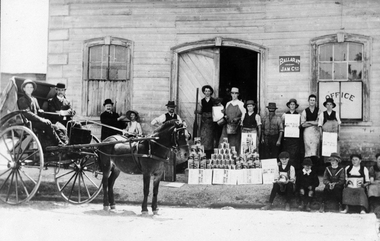 Ballaarat Mechanics' Institute (BMI Ballarat)
Ballarat Jam Co & Staff
... Please contact BMI for all print and usage inquiries. Ballarat Ballarat Jam Co & Staff ...This photograph is from the Max Harris Collection held by the Ballaraat Mechanics' Institute. Please contact BMI for all print and usage inquiries.ballarat -
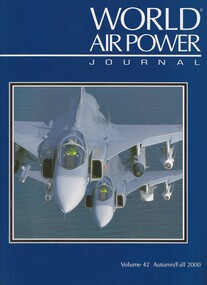 Moorabbin Air Museum
Book (item) - (SP) World Air Power Journal 42 Autumn 2000
... Combat Report: Air War Over Chechnya Briefings: SK 37E Viggen jammers 199th FS Hickam Eagles Austrian Air Force international exercises Boeing F/A-18E/F Super Hornet feature Special Operations C-141 Starlifter feature Focus Aircraft: Saab JAS 39 Gripen (43 pages) Exercise Gabon 2000 Nellis AFB range complex photo feature Variant Briefing: Fokker F27/50/60 USMC Twin Hueys feature Air Power Analysis: France part 1 Book (SP) World Air Power Journal 42 Autumn 2000 ...combat report: air war over chechnya, briefings: sk 37e viggen jammers, 199th fs hickam eagles, austrian air force international exercises, boeing f/a-18e/f super hornet feature, special operations c-141 starlifter feature, focus aircraft: saab jas 39 gripen (43 pages), exercise gabon 2000, nellis afb range complex photo feature, variant briefing: fokker f27/50/60, usmc twin hueys feature, air power analysis: france part 1 -
Moorabbin Air Museum
Article (Item) - Weapons - articles on rockets, cannons, USAF ASRAAM - Advanced Short Range Air-to-Air Missile & Jammers ALQ, Weapons - articles on rockets, cannons, USAF - ASRAAM - Advanced Short Range Air-to-Air Missile & Jammers ALQ
... Weapons - articles on rockets, cannons, USAF - ASRAAM - Advanced Short Range Air-to-Air Missile & Jammers ALQ Article Weapons - articles on rockets, cannons, USAF ASRAAM - Advanced Short Range Air-to-Air Missile & Jammers ALQ ... -
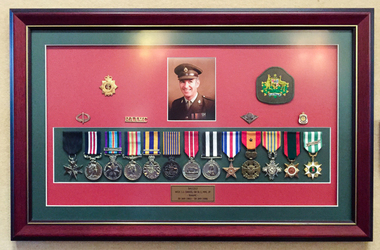 Tramways/East Melbourne RSL Sub Branch - RSL Victoria Listing id: 27511
Memorabilia - Medal Board, Ceremonial Medal Board for JJ Davis, 2001
... This plaque commemorates the deeds he performed and medals received. john jams davis john james davis j j davis vietnam nco photographs portraits badges medals Framed ceremonial medal board for JJ Davis. ...John James Davis (J.J. Davis) was Australia's most decorated NCO in the Vietnam conflict. This plaque commemorates the deeds he performed and medals received.Framed ceremonial medal board for JJ Davis. The piece includes a service photograph of JJ Davis in uniform, a fabric patch with the Australian Coat of Arms, five metal pins and 13 replica medals as listed below. The information plaque states '5411313 WO1 J.J. DAVIS, SB St J, MM, JP - RAAMC - 30 JAN 1963 - 30 JAN 1986. The five metal pins are: 1. Returned Services League Australia 2. Returned Active Service 3. RAAMC 4. Royal Australian Army Medical Corps 5. Knife surrounded by laurel leaves. Replica medals included are: 1. Military Medal 2. Australian Active Service Medal 1945-75, Vietnam 3. Vietnam Medal 4. Defence Force Medal with 1st Clasp 5. National Medal 6. Australian Defence Medal 7. St John 12 Year Long Service Medal with five year clasp 8. Silver Star (Unites States of America) 9. Gallantry Cross with Bronze Star (South Vietnam) 10. The Armed Forces Honour Medal (2nd Class) (South Vietnam) 11. Civil Action Medal (2nd Class) (South Vietnam) 12. Vietnamese Campaign Medal 13. ACT Emergency Service Medal (2003 Bushfires) john jams davis, john james davis, j j davis, vietnam, nco, photographs, portraits, badges, medals -
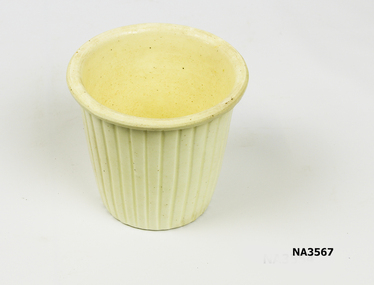 Whitehorse Historical Society Inc.
Container - Jam jar, not known
... Jar came from Bette Jones flower farm domestic items food storage & preservation Cream ceramic pot with ridged circumference Container Jam jar ...Jar came from Bette Jones flower farmCream ceramic pot with ridged circumferencedomestic items, food storage & preservation
