
Showing 33 items matching " 'sound steppers'"
-
 Bendigo Historical Society Inc.
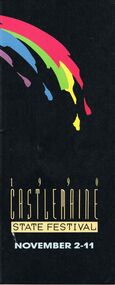
Document - CASTLEMAINE STATE FESTIVAL, CASTLEMAINE, 2 November 1990
... ... 'Sound Steppers'...Itchy Feet Pep Band, 'Sound Steppers', 'Legs on the Wall', Andrew Elliot, Antebodies. ...Itchy Feet Pep Band 'Sound Steppers' 'Legs on the Wall' Andrew Elliot Antebodies. ...Castlemaine State Festival, Castlemaine. 2 November 1990. Programme. From the Chairmen - Mr Bereck Segan. Melbourne Committee: B R Segan, O.B.E. (Chairman), M Besen, A.O. (Deputy Chairman), Mrs H Dore (Hon. Sec.), C Anzarut, N Bourke, Ms M Coillet, Prof. C Duckworth, G Fairfax, A.M., K MacKenzie-Forbes, A.M., Mrs B Margetts, Dr F R Moulds, I.S.O., R Nordlinger, J Parker, M.B.E., A Porter, Ms M Prendergast, C Pyett, Ms D Reilly, Mrs, Ms L Schiftan, P M Schiftan, D Segan, B J Stewart, Ms S Walker, Dr R Wlikie. Melbourne Committee: I O'Halloran, (Chairman), Mrs M Rilen (Hon.Sec.), Miss R Wood (Treas), Mrs L Bennet, Mrs M Bock, S Cox, Cr T Daniell, Mrs H Griffiths, B Heydon, N Jennings, Mrs C McKellar, Miss M Oliver, L O'Toole, F Ransome-Smith, J Shortal, Dr D Silver, Mrs V Victor-Gordon, Mes E Warren, Miss L Waters. Welcome to the 1990 Castlemaine State Festival. As one festival closes, planning for the next commences immediately.. . Mr Ian O'Halloran, Chairman, Castlemaine. Castlemaine State Festival Administration, Festival Manager: Phee Broadway, Manager's Assistant: Mary Harris, Technical Manager: Lis Pain, Drawing Prize Co-ordinator: Bev Singleton, Farnham Concert Co-Ordinator: Noel Jennings with Victorian Rock Foundation. Event Listings: Opening by Hon. Jim Kennan M.P., Deputy Premier and Minister for the Arts Castlemaine Stadium. Melbourne Symphony Orchestra, Conductor - Hiroyuki Iwaki, Soloist - Dong -Suk Kang. Royal Variety Club Grand Final Theatre Royal, Town Crier Mr Neville Stonehouse. Kilmna Wildflower Walk. 'Melbourne: Architecture Today and the year 2000' Professor Peter McIntyre, A.O. Wine tasting. Selected Antique Fair. Organ Recital, organist Michael Bottomly. Mickleford Tour. A Closer Look at Castlemaine, Castlemaine Historical Society. 'Local Brew' Love Letters by A R Gurney, Starring Julia Blake and Terry Norris Directed by George Fairfax A.M. The Noel Watson Show. John Pringle and Miriam Gormley sing Operatic Gems with the Rantos Collegium and conductor Nicholas Braithwaite. The Incredible Shrinking Mortgage Show', Pat Wilson and Adrian Barnes. Festival Nightcap, Mr P P an acrobatic delight. Breakfast with Potts in the Park. A Stroll Around Town, Historical Society guide. Gardens Open. Selected Antique Fair. Festive Family Fun, musician Natasha Moszenin, Fratellini Brothers, Tim Hurley, Wally Fair Ground Organ, Foundry Band, Megan Jones, Mr P P. A guided Tour, Mrs Marjorie Rilen. Goetz Richter - Violin, Jeanett Carrigan - Piano. 'King Lear', Berenice Kavanagh and Suzanne Kersten. The Chagell Ensemble, Rita Reichman, Piano, Semmy Stalhammer, Violin. Trevor Jones, Viola. David Pereira, Cello. Steven Reeves, Double Bass. 'The Incredible Shrinking Mortagage Show' Pat Wilson and Adrian Barnes. Festival Hymns. 'Recital' Hellen Noonan, Douglas Horton, David Chesworth, Jacqui Everett, Jude Gunson. Music for Flute and Piano, Dereck Jones - Flute, Jeanell Carrigan - Piano. 'Brass With Class' William Evans - trumpet, David Farrend - trumpet, Russell Davis - french horn, Ken McClimont - trombone, Eric Klay - bass trombone. Piano Recital - Richard Mapp. Chris Ludwick's Society Synocopators - Cup Eve Cabaret, Chris Ludowyk - trombone, Peter Gaudion- Trumpet, Richard Miller - reeds, Pip Avent - tuba, Cal Duffy's - drums. 'Cup Eve Comedy' Rachel Berger and Richard Stubbs. Festival Nightcap Mr P P. Botanical Gardens Tour Kevin Walsh. Alice's Adventures in Wonderland Glenn Elston. By arrangement with Feipp and Park Projects and Elston, Hocking and Woods Pty Ltd. Family Concert, Piano for 4 hands Jocelyn Abbott and Richard Mapp, actor Justin Shortal. Cup Day Sports Carnival. Fashion Parade, luncheon available at Georgians in George Clark Place. The Melba Trio, Carolyn Hayes - Oboe, Jane Stacvy - cor anglais, Seng Tong - Oboe. 'Images' Prudence Davis - flute, Jeffrey Crellin - oboe, Peter Lynch - guitar. 'Sounds in Time' Andree Cozens - soprano, Berenice Kavanagh - words, Dudley - Simons - piano, John Snowden - Guitar, Peter Taylor - Set design & lighting. 'Music for Celestial Voices' Laurence - Jenkins - organ, Mary Anderson - harp, Margot Anderson - harp, Margot Cory - soprano. 'Proms for Preps' Nehama Patkin. Organ Recital Keeith Bottomley. Kaweka Walk, Kaweka Reserve Committee. 'Camille Claudel'. The Tudor Choristers Musical Director - John O'Donnell. 'Something for Everyone' Nehama Patkin - piano, guitar and voice, Peter Clinch - saxaphone and clarinet, major Australian Orchastras. 'The Dock Brief' & 'What Shall We Tell Caroline' Neville Stonehouse, Kay Barker, David Bickart, Angela Walter. 'Bluebeard' The Rag & Bone Theatre Company. Poedijono and the Javanese Gamelan, Poedijono (Teacher), musician, dancer and puppeteer. Botanical Gardens Tour, Kevin Walsh, horticulturist and garden writer. 'Music through the Ages' 'Pizzicato' - classical guitar ensemble, Castlemaine Courthouse, Bruce Millar, Meryl Wilkinson, Greg Wilkinson, Greg James, Joan Maher, Danny Silver. Bach and Vivaldi - Elysium Ensemble Greg Dikmans - Art Director, flute & recorder, Julie Hewison - violin, Lucinda Moon - violin, Janet Ferandez - viola, Miriam Morris - cello, Rosemanry Westbrook - double bass, John O'Donnell - harpsichord. 'Handle by Candle' Laurence Jenkins. Sarah Grunstein at the Piano, Sarah Grunstein. 'Let the Children Sing' Castlemaine Children's Choir, director Michael Bottomley, soloist Peter Bottomley. 'Made in Australia' Phillip Day, Bruce Waston, & 'Twankydillo'. The Dancers Company of the Australian Ballet, Les Sylphides, Dame Peggy van Praagh, Sir John Betjeman, Robert Ray. 'The Wooden Child' Handspan Theatre, Douglass Horton, Ken Evans, Andre Greenwell, Peter J Wilson, Philip Lethean. Botanic Gardens Tour Kevin Walsh. Divine Accidents and Heavenly Venues' William (Bill) Akers, A.M., Director of Productions, Australian Ballet. Jazz at the Jail. Another Stroll round Castlemaine, Historical Society. Muckleford Tour, Naturalists Club. 'Sketches' The Argus Guitar Quartet, Jochen Sxhubert, Tania Ravbar, Samantha Tout, Chi Ly.Scores for Instruments and Voices, Phylis Bachelor. Fred Shade, flute; Mara Miller, Violin; Len Vorster, piano; Loris Synan, soprano; and the students of the Faculty of Music, Melbourne University. Music for Four Hands at One Keyboard, Jocelyn Abbot and Richard Mapp. Paul Grabowsky and the Groovematics, Paul Graboesky, piano. Andrew Gander, Drums. Doug de Vries, guitar. Bob Venier, Trumpet, Flugelhorn. Ian Chaplin, saxophone. Garry Costello, double bass. Shelley Scown, vocals. 'My Most Loved Songs' David Bickart - Basso. Chapliapin, McEachern, Pinza, Robeson, Dawson. A Stroll Around Town, Historical Society. Breakfast at Buda. Garden Open. Festival Eucharist, choir and orchestra Directed by Kevin Bottomley. Music, Madness, Magic. Itchy Feet Pep Band, 'Sound Steppers', 'Legs on the Wall', Andrew Elliot, Antebodies. A Guided Tour of Angligan Parish Church. John Farnham in Concert, The Chain Reaction Tour. John Farnham. Exhibitions: Aspects of France: The Australian Artist's View. Artsits include John Russell, Lloyd Rees, David Davies, John Dent, Eric Wilson, E Phillips Fox, Ethal Carrick, Rupert Bunny, Max Meldrum, Will Ashton, George Bell and others. Annemieke Mein: Embroidery and Applique. Castlemaine Artists Incorporated 6th Biennial Exhibition. Dominique Segan Castlemaine State Festival Drawing Prize 1990. 'Provocative Pieces'. 'Feathered Friends' Barbara Muir. Through the Looking Glass. Handmade - For Pleasure, Julie Cook - dolls and puppets; Traude Beilharz - hats; Gwen Cook - embroidery; Erika Beilharz - woven pieces. 'High Art' students of Castlemaine. 'Works in Wood' Laurie Vella. Old Telegraph Station, Pioneers and Old Residents Association, Jubilee booklet on sale. Studio Exhibition, Juliana Hilton: Prints, paintings decorated screens and furniture. Val Restarick: Pottery and outdoor planters. 2nd Biennial Ernest Leviny Commemorative Silver Exhibition, leading contemporary silversmiths; Hendrick Foster, Tony Kean, Mike Wilson, Flynn Bros, Andrew Last, Mark Edgoose, Peter Gerter, Beatrice Schlabowsly, Marian Hoskings, Karyn Kirby, Chris Sherwin, Peter McBride, Fran Allison. Ray Stanyer - Ceramic Paintings. Norman Anderson - Water Colour Studies. 'Australian & Baroque' David Terry. 'Mediterranean Images' Val Restarick. Framing Shop, Brian Harding. Exhibition of Women Artists, Liz Caffin, Mary Quinlton, Debra Watkins, Lorraine Le Plastrier. Maine Images, Jacki Bickart, Valarie Blake, Sue Breeney, Kate Burtchell, Janet Chapman, Diana Davidson, Betty Hall, Deidre Hull, Molly Maddox, Norma McKenzie, Beth Oag, Rhyll Plant, Michell Phillipson, Diane Thompson. Ceramics, Ian Drumond. 'The Esplanade of Palms' (Brickworks Exhibition), John Wilkins. Han Built Pottery, George Butcher. Hollis Gallery, Richard Hollis, Kathy Hollis. 'End of an Era', Castlemaine Technical College Student Exhibition. 'Building A Country', Commissioned by the Latrobe Library, the Australian State Library of Victoria. The Festival Exhibition. 'Colour - Three Way's, Alice Clague, Geoffrey Clague, Howard Tozer. Tonal Oil Painters and Tapestry Exhibition by a group of local artists, Albert Pollard, Shirley Anderson, Valerie Blake, Ivy Brown, Marjorie Byrne, Janet Chapman, Frances Cree, Colleen Hall, Loretta Harris, Phyllis McClure, Lorraine McDowell, Norma McLean, Margaret Maher, Winsome Morrat, Jean Perry, Martha Phillips, Alison Ross, Norma Sneddon, Val Story, Irene Szabo, Jean Wells, and Alan Winzor. Roma Dodson.'BarleyTwist Cottage', Bill Davies, Linda Long, Fred Kuhnl. Photography Exhibition: Faces and Souls. Children's Books and Illustrations, Meet the authors and illustrators. Burnett Gallery and Garden, Drew Lawson, photographer of Eaglehawk. Decorated Cakes & Sugar Craft Exhibition, Barbara Porter. Sponsored by Marong Hotel. The Central Victorian Unique Design & Restoration Centre, historical photographs, sketches, etc. Badger's Keep Nursery & Mr Badger's Shop, Margaret Lees, Bill Jackson. Carriage Builders & Restorers. 'Harmonious Inspirations X Four' Kristina Browning, Catherine Tait, Rod Pitt, Lindy McAboy, Castle Mice by Sonia. Historic Cottage, 'Orvil Dean Stud', John and Anne Murdock, Judy Dean. The Heritage of Maldon, Geoffery Stocks. Stanyer's Pottery, Dragon Magic, Annett Annand, Ellan Hansa. 2(two) copies of this program.event, entertainment, castemaine state festival, castlemaine state festival, castlemaine 1990. programme. chairmen - mr bereck segan. committee:b r segan, o.b.e. (chairman), m besen, a.o. (deputy chairman), mrs h dore (hon. sec.), c anzarut, n bourke, ms m coillet, prof. c duckworth, g fairfax, a.m., k mackenzie-forbes, a.m., mrs b margetts, dr f r moulds, i.s.o., r nordlinger, j parker, m.b.e., a porter, ms m prendergast, c pyett, ms d reilly, mrs, ms l schiftan, p m schiftan, d segan, b j stewart, ms s walker, dr r wlikie. melbourne committee: i o'halloran, (chairman), mrs m rilen (hon.sec.), miss r wood (treas), mrs l bennet, mrs m bock, s cox, cr t daniell, mrs h griffiths, b heydon, n jennings, mrs c mckellar, miss m oliver, l o'toole, f ransome-smith, j shortal, dr d silver, mrs v victor-gordon, mes e warren, miss l waters. mr ian o'halloran, chairman, castlemaine. castlemaine state festival administration, festival manager: phee broadway, manager's assistant: mary harris, technical manager: lis pain, drawing prize co-ordinator: bev singleton, farnham concert co-ordinator: noel jennings with victorian rock foundation. event listings: opening by hon. jim kennan m.p., deputy premier and minister for the arts castlemaine stadium. melbourne symphony orchestra, condustor - hiroyuki iwaki, soloist - dong -suk kang. royal variety club grand final theatre royal, town crier mr neville stonehouse. kilmna 'melbourne: professor peter mcintyre, a.o. organist michael bottomly. mickleford tour. castlemaine historical society. love letters by a r gurney, starring julia blake terry norris directed by george fairfax a.m. the noel watson show.john pringle and miriam gormley operatic rantos collegium and conductor nicholas braithwaite. the incredible shrinking mortgage show', pat wilson and adrian barnes., mr p p an acrobatic delight. potts in the park. a stroll around town, historical society guide. selected antique fair. festive family fun, musician natasha moszenin, fratellini brothers, tim hurley, wally fair ground organ, foundry band, megan jones, . a guided tour, mrs marjorie rilen. goetz richter - violin, jeanell carrigan - piano. 'king lear', berenice kavanagh and suzanne kersten. the chagell ensemble, rita reichman, piano, semmy stalhammer, violin. trevor jones, viola. david pereira, cello.steven reeves, double bass. pat wilson and adrian barnes. festival hymns. 'recital' hellen noonan, douglas horton, david chesworth, jacqui everett, jude gunson. music for flute and piano, dereck jones - flute, jeanell carrigan - piano. 'brass with class' william evans - trumpet, david farrend - trumpet, russell davis - french horn, ken mcclimont - trombone, eric klay - bass trombone. piano recital - richard mapp. chris ludwick's society synocopators - cabaret, chris ludowyk - trombone, peter gaudion- trumpet, richard miller - reeds, pip avent - tuba, cal duffy's - drums. 'cup eve comedy' rachel berger and richard stubbs. festival nightcap mr p p. botanicla gardens tour kevin walsh. alice's adventures in wonderland glenn elston. by arrangemnent with feipp and park projects and elston, hocking and woods pty ltd. family concert, piano for 4 hands jocelyn abbott richard mapp, actor justin shortal. cup day sports carnival. fashion parade, lucheon available ar georgians in george clark place. the melba trio, carolyn hayes - oboe, jane stacvy - cor anglais, seng tong - oboe. 'images' prudence davis - flute, jeffrey crellin - oboe, peter lynch - guitar. 'sounds in time' andree cozens - soprano, berenice kavanagh - words, dudley - simons - piano, john snowden - guitar, peter taylor - set design & lighting. 'music for celestial voices' laurence - jenkins - organ, mary anderson - harp, margot anderson - harp, margot cory - soprano. 'proms for preps' nehama patkin. organ recital keeith bottomley. kaweka walk, kaweka reserve committee. 'camille claudel'. the tudor choristers musical director - john o'donnell. 'something for everyone' nehama patkin - piano, guitar and voice, peter clinch - saxophone and clarinet, major australian orchastras.'the dock brief' & 'what shall we tell caroline' neville stonehouse, kay barker, david bickart, angela walter. 'bluebeard' the rag & bone theatre company. poedijono and the javanese gamelan, poedijono (teacher), musician, dancer and puppeteer. botanical gardens tour, kevin walsh, horticulturist and garden writer. 'music through the ages' 'pizzicato' - classical guitar ensemble, courthouse, bruce millar, meryl wilkinson, greg wilkinson, greg james, joan maher, danny silver. bach and vivaldi - elysium ensemble greg dikmans - art director, flute & recorder, julie hewison - violin, lucinda moon - violin, janet ferandez - viola, miriam morris - cello, rosemanry westbrook - double bass, john o'donnell - harpsichord. 'handle by candle' laurence jenkins. sarah grunstein at the piano, sarah grunstein. 'let the children sing' castlemaine children's choir, director michael bottomley, soloist peter bottomley. 'made in australia' phillip day, bruce waston, & 'twankydillo'. the dancers company of the australian ballet, les sylphides, dame peggy van praagh, sir john betjeman, robert ray. 'the wooden child' handspan theatre, douglass horton, ken evans, andre greenwell, peter j wilson, philip lethlean. botanic gardens tour kevin walsh. divine accidents and heavenly venues' william (bill) akers, a.m., director of productions, australian ballet. jazz at the jail. stroll round castlemaine, historical society. muckleford tour, naturalists club. 'sketches' the argus guitar quartet, jochen sxhubert, tania ravbar, samantha tout, chi ly.scores for instruments and voices, phylis bachelor. fred shade, flute; mara miller, violin; len vorster, piano; loris synan, soprano; students of the faculty of music, melbourne university. music for four hands at one keyboard, jocelyn abbot and richard mapp. paul grabowsky and the groovematics, paul graboesky, piano. andrew gander, drums. doug de vries, guitar. bob venier, trumpet, flugelhorn. ian chaplin, saxophone. garry costello, double bass. shelley scown, vocals. 'my most loved songs' david bickart - basso. chapliapin, mceachern, pinza, robeson, dawson. stroll around town, historical society. breakfast at buda. garden open. festival eucharist, choir and orchestra directed by kevin bottomley. music, madness, magic. itchy feet pep band, 'sound steppers', 'legs on the wall', andrew elliot, antebodies. a guided tour of angligan parish church. john farnham in concert. exhibitions: aspects of france: the australian artist's view. artsits include john russell, lloyd rees, david davies, john dent, eric wilson, e phillips fox, ethal carrick, rupert bunny, max meldrum, will ashton, george bell and others. annemieke mein: embroidery and applique. castlemaine artists incorportated 6th biennieal exibition. dominique segan castlemaine state festival drawing prize 1990. 'provocative pieces'.'feathered friends' barbara muir. through the looking glass. handmade - for pleasure, julie cook - dolls and puppets; traude beilharz - hats; gwen cook - embroidery; erika beilharz - woven pieces. 'high art' students of castlemaine. 'works in wood' laurie vella. old telegraph station, pioneers and old residents association, jubilee booklet on sale. studio exhibition, juliana hilton: prints, paintings decorated screens and furniture. val restarick: pottery and outdoor planters. 2nd biennial ernest leviny commemorative silver exhibition, leading contemporary silversmiths; hendrick foster, tony kean, mike wilson, flynn bros, andrew last, mark edgoose, peter gerter, beatrice schlabowsly, marian hoskings, karyn kirby, chris sherwin, peter mcbride, fran allison. ray stanyer - ceramic paintings. norman anderson - water colour studies. 'australian & baroque' david terry. 'mediterranean images' val restarick. framing shop, brian harding. exhibition of women artists, liz caffin, mary quinlton, debra watkins, lorraine le plastrier. maine images, jacki bickart, valarie blake, sue breeney, kate burtchell, janet chapman, diana davidson, betty hall, deidre hull, molly maddox, norma mckenzie, beth oag, rhyll plant, michell phillipson, diane thompson. ceramics, ian drumond. 'the esplanade of palms' (brickworks exhibition), john wilkins.han built pottery, george butcher. hollis gallery, richard hollis, kathy hollis. 'end of an era', castlemaine technical college student exhibition. 'building a country', commissioned by the latrobe library, the australian state library of victoria. the festival exhibition. 'colour - three way's, alice clague, geoffery clague, howard tozer. tonal oil painters and taperstry exhibition by a group of local artists, albert pollard, shirley anderson, valerie blake, ivy brown, marjorie byrne, janet chapman, frances cree, colleen hall, loretta harris, phyllis mcclure, lorraine mcdowell, norma mclean, margaret maher, winsome morrat, jean perry, martha phillips, alison ross, norma sneddon, val story, irene szabo, jean wells, and alan winzor. roma dodson.'barleytwist cottage', bill davies, linda long, fred kuhnl. photogralhy exhibition: faces and souls. children's books and illustrations, meet the authors and illustrators. burnett gallery and garden, drew lawson, photographer of eaglehawk. decorated cakes & sugar craft exhibition, barbara porter. sponsored by marong hotel. the central victorian unique design & restoration centre, historical photographs, sketches, etc. badger's keep nursery & mr badger's shop, margaret lees, bill jackson. carriage builders & restorers. 'harmonious inspirations x four' kristina browning, catherine tait, rod pitt, lindy mcaboy, castle mice by sonia. historic cottage, 'orvil dean stud', john and anne murdock, judy dean. the heritage of maldon, geoffery stocks. stanyer's pottery, dragon magic, annett annand, ellan hansa. -
 Flagstaff Hill Maritime Museum and Village
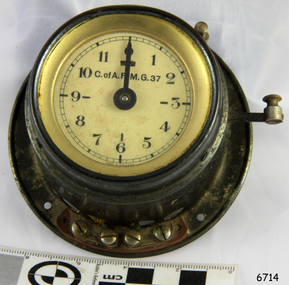
Timer, 1940s
... step forward in the automation of trunk calls. It substituted automatic switching and charging equipment for the originating trunk operator, and improved the quality of the system radically. Before the introduction of the Crossbar system there were often very long delays in obtaining a booked trunk call, and the quality of sound was often very poor. ...step forward in the automation of trunk calls. It substituted automatic switching and charging equipment for the originating trunk operator, and improved the quality of the system radically. Before the introduction of the Crossbar system there were often very long delays in obtaining a booked trunk call, and the quality of sound was often very poor. ...Australia's first telephone exchange was opened in Melbourne in August 1880. It was operated by the Melbourne Telephone Exchange Company. Owned by W. H. Masters and T. T. Draper, the Manager of the Company was H. Byron Moore. This was only two years after the world's first exchange in the United States, and just four years after Bell first spoke on a telephone. The exchange was located in the old Stock Exchange building at 367 Collins Street, a site now occupied by the Commonwealth Bank. In 1884, the operations of the Company, by then known as the Victorian Telephone Exchange Company, had grown considerably and were transferred to Wills Street, Melbourne. Private ownership of this company continued until 1887 when it was bought out by the Victorian Colonial Government. Other colonial governments followed this example. By 1910, the growth in telephone services made additional accommodation necessary. This could not be provided in the existing building in Wills Street and arrangements were made for a new exchange in Lonsdale Street. Alexander Graham Bell visited Australia in 1910 to advise the Federal Government's Postal Commission. Telephone exchanges were established in Adelaide with (48 subscribers), Hobart (10 subscribers) and Launceston (35 subscribers). The first exchange in Western Australia was established in 1887 and located in a small three-room cottage in Wellington Street, Perth with 17 subscribers. The year 1888 marked the opening of the Fremantle exchange in a small room at the rear of the Town Hall. There were nine subscribers. Australia's first automatic exchange was installed in the GPO in Sydney, in 1911, for internal use. But the first automatic exchange for public use was opened at Geelong in Victoria in the next year July 1912 with 800 subscribers. Melbourne's first automatic exchange was opened in the suburb of Brighton in 1914; the first public automatic exchange in NSW began operating at Newtown, Sydney in 1915; and Queensland's first was installed at South Brisbane in 1925. 1929 saw the opening of Tasmania's first automatic exchange in Hobart. an automatic telephone service. In June 1977, the manual telephone exchange at Swansea was replaced with an automatic service and made Tasmania the first State in Australia to have a fully automatic net work. The half-century following Federation saw the growth of the automatic operation; a great extension of trunk line services; The automatic telephone contributed greatly to the early popularity of telephones in Australia. It was a quicker and more convenient way of communicating with another person on the same exchange — instead of having to go through tedious processes with the operator. From its introduction, the number of automatic telephones in operation grew to a remarkable extent. In 1886, the first trunk link of 16 km was connected to the exchanges of Adelaide and Port Adelaide in South Australia. Then, in 1907, the first inter-capital telephone trunk line was opened between Sydney and Melbourne. It was followed by a line between Melbourne and Adelaide in 1914. Sydney and Brisbane were linked in 1923, and Perth and Adelaide in 1930. In 1930, the first overseas calls from Australia came possible with the introduction of a radio telephone service to England, and through there to Europe and America. A similar service opened to New Zealand in the same year. Initially, trunk channels linked different manual trunk exchanges. It was necessary for a succession of trunk operators to connect the appropriate channels, one after the other until the connection was made. As trunk traffic grew. the system became increasingly unsuitable. More trunk operators had to be employed and so labour costs increased. It was a tedious and slow way of making a long-distance call, and it was sometimes hard to hear, particularly when several exchanges were linked With technical advances, trunk switching moved from manual operation through a partly automatic phase. Automatic transit switching equipment was used and only a single operator was required to connect a trunk call to a wanted automatic subscriber. Until well beyond the middle of this century, the majority of trunk traffic went through this single telephonist control. In 1953, the number of telephones in use in Australia passed the one million mark. By then, the need for improvement in the automatic exchanges was be coming well recognised. The need was for a telephone switching system which would do a better job more economically than the conventional step-by-step ex-change. This led to the adoption of the Crossbar system as the standard in automatic telephone exchanges in 1960. The introduction of Crossbar switching was a big step forward in the automation of trunk calls. It substituted automatic switching and charging equipment for the originating trunk operator, and improved the quality of the system radically. Before the introduction of the Crossbar system there were often very long delays in obtaining a booked trunk call, and the quality of sound was often very poor. With Crossbar, Subscriber Trunk Dialing (STD) became a reality. A trunk call by STD was as easy to make and almost as fast to connect as a local call.The item was made around the 1940s and used up until the 1970s in manual cord telephone exchanges as a way to time and charge users for trunk calls made over the telecom system of the time. Post Master General dept. - Trunk Call Timer.Inscribed PMG, C. of A, 37. Bell chimes at 3 min increments.flagstaff hill, warrnambool, shipwrecked-coast, flagstaff-hill, flagstaff-hill-maritime-museum, maritime-museum, shipwreck-coast, flagstaff-hill-maritime-village, timer, trunk call, telephone, cord exchange -
 Flagstaff Hill Maritime Museum and Village
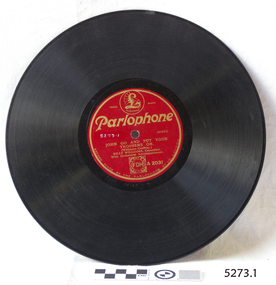
Audio - Gramophone Record, Parlophone Co. Ltd, John Go And Put Your Trousers On, Early-to-mid 20th century
... Common diameters of records: 7 inch, 10 inch, 12 inch and 16 inch Revolutions Per Minute include: 33 1/3, 45, 78 Minutes per side of record: 3, 5.5, 7, 8, 9, 12, 15 and 22 Labels, in minutes per side: Single Play 3-5 min, Extended Play (EP) 7-12 min, Long Play (LP) 12-22 min This gramophone represents a step in the evolution of recording sound. In the 19th century, the human voice was first recorded on wax cylinders and replayed. ...Thomas Edison (1847–1931), an American, invented the phonograph in 1877, making it possible to record sound waves vertically and reproduce them on a wax cylinder so they could be heard again. Later, the German American, Emile Berliner (1851-1929), improved on Edison’s principles, greatly increasing the quality of the reproduced sounds with his invention of the gramophone in 1887, which recorded the sound waves laterally onto a flat shellac disc, or ‘record’. Records could be mass-produced in a factory where audio recordings were converted to a physical copy of that recording on a plate-sized disc. A gramophone machine reproduced the sound by spinning the record on a turntable at a specified number of rotations per minute (RPM) and using a stylus or needle to transfer the vibration via a membrane to a speaker, which amplified the sound. Berliner helped set up affiliated businesses overseas. One of his representatives was William Barry Owen (1860–1914), who, on 23 February 1889, partnered with Edmund Trevor Lloyd Williams (1859–1946) in England to register The Gramophone Company. His Master’s Voice (HMV) soon became the company’s major recording label, popular worldwide. The label's logo, a dog looking into a gramophone horn, looking for his master’s voice, was based on a painting by English artist Francis Barraud, which featured a terrier called Nipper beside a gramophone. Early gramophone records were mostly made from a material referred to as shellac, a natural ingredient combined with slate powder, and a filler of manilla copal, wood resin, carnauba wax, and carbon black. Although Bakelite seemed a useful, synthetic product, it was unsuccessful as a product for records. Around the time of World War II, lightweight, flexible synthetic vinyl records began replacing shellac records. Common diameters of records: 7 inch, 10 inch, 12 inch and 16 inch Revolutions Per Minute include: 33 1/3, 45, 78 Minutes per side of record: 3, 5.5, 7, 8, 9, 12, 15 and 22 Labels, in minutes per side: Single Play 3-5 min, Extended Play (EP) 7-12 min, Long Play (LP) 12-22 min This gramophone represents a step in the evolution of recording sound. In the 19th century, the human voice was first recorded on wax cylinders and replayed. It was the beginning of a new era in sound. Then, in the 1880s, voice could be recorded onto flat discs like this record, reliably reproduced and replayed many times, even on portable devices. Later, in the mid-20th century the following generation of electronic audio recording began, and later that century, digital recording gave even better reproduction. The record represents a popular means of entertainment for personal and social activities, as well as in some businesses. Shellac gramophone record, red label. Title: John Go And Put Your Trousers On Artist: Billy Williams Publisher: Parlophone Co Ltd, London Number: 41413 Size: 10 inch"A2031"flagstaff hill, warrnambool, maritime village, maritime museum, flagstaff hill maritime museum and village, shipwreck coast, great ocean road, gramophone, phonograph, sound waves, record, reproduction, audio record, music, sound, thomas edison, emile berliner, 1887, shellac, rpm, william barry owen, edmund trevor lloyd williams, the gramophone company, his master’s voice, hmv, francis barraud, nipper, 10 inch, parlophone co ltd, london, john go and put your trousers on, billy williams -
 Flagstaff Hill Maritime Museum and Village
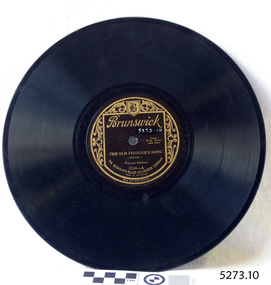
Audio - Gramophone Record, Brunswick Records, The Old Fiddlers Song, Early-to-mid 20th century
... Common diameters of records: 7 inch, 10 inch, 12 inch and 16 inch Revolutions Per Minute include: 33 1/3, 45, 78 Minutes per side of record: 3, 5.5, 7, 8, 9, 12, 15 and 22 Labels, in minutes per side: Single Play 3-5 min, Extended Play (EP) 7-12 min, Long Play (LP) 12-22 min This gramophone represents a step in the evolution of recording sound. In the 19th century, the human voice was first recorded on wax cylinders and replayed. ...Thomas Edison (1847–1931), an American, invented the phonograph in 1877, making it possible to record sound waves vertically and reproduce them on a wax cylinder so they could be heard again. Later, the German American, Emile Berliner (1851-1929), improved on Edison’s principles, greatly increasing the quality of the reproduced sounds with his invention of the gramophone in 1887, which recorded the sound waves laterally onto a flat shellac disc, or ‘record’. Records could be mass-produced in a factory where audio recordings were converted to a physical copy of that recording on a plate-sized disc. A gramophone machine reproduced the sound by spinning the record on a turntable at a specified number of rotations per minute (RPM) and using a stylus or needle to transfer the vibration via a membrane to a speaker, which amplified the sound. Berliner helped set up affiliated businesses overseas. One of his representatives was William Barry Owen (1860–1914), who, on 23 February 1889, partnered with Edmund Trevor Lloyd Williams (1859–1946) in England to register The Gramophone Company. His Master’s Voice (HMV) soon became the company’s major recording label, popular worldwide. The business based the label's logo of a dog looking into a gramophone horn for ‘his master’s voice’ was based on a painting by English artist Francis Barraud, which featured a terrier called Nipper beside a gramophone. Early gramophone records were mostly made from a material referred to as shellac, a natural ingredient combined with slate powder, and a filler of manilla copal, wood resin, carnauba wax, and carbon black. Although Bakelite seemed a useful, synthetic product, it was unsuccessful as a product for records. Around the time of World War II, lightweight, flexible synthetic vinyl records began replacing shellac records. Common diameters of records: 7 inch, 10 inch, 12 inch and 16 inch Revolutions Per Minute include: 33 1/3, 45, 78 Minutes per side of record: 3, 5.5, 7, 8, 9, 12, 15 and 22 Labels, in minutes per side: Single Play 3-5 min, Extended Play (EP) 7-12 min, Long Play (LP) 12-22 min This gramophone represents a step in the evolution of recording sound. In the 19th century, the human voice was first recorded on wax cylinders and replayed. It was the beginning of a new era in sound. Then, in the 1880s, voice could be recorded onto flat discs like this record, reliably reproduced and replayed many times, even on portable devices. Later, in the mid-20th century the following generation of electronic audio recording began, and later that century, digital recording gave even better reproduction. The record represents a popular means of entertainment for personal and social activities, as well as in some businesses. Shellac gramophone record with a black and gold label. Title: The Old Fiddlers Song Artist: Vernon Delhart, tenor Publisher: Brunswick Number:3234-A Size: 10 inchflagstaff hill, warrnambool, maritime village, maritime museum, flagstaff hill maritime museum and village, shipwreck coast, great ocean road, gramophone, phonograph, sound waves, record, reproduction, audio record, music, sound, thomas edison, emile berliner, 1887, shellac, rpm, william barry owen, edmund trevor lloyd williams, the gramophone company, his master’s voice, hmv, francis barraud, nipper, 10 inch, brunswick records, 3234-a, the old fiddlers song, vernon delhart (tenor) -
 Flagstaff Hill Maritime Museum and Village
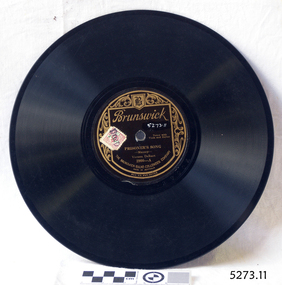
Audio - Gramophone Record, Brunswick Records, Prisoner's Song, Early-to-mid 20th century
... Common diameters of records: 7 inch, 10 inch, 12 inch and 16 inch Revolutions Per Minute include: 33 1/3, 45, 78 Minutes per side of record: 3, 5.5, 7, 8, 9, 12, 15 and 22 Labels, in minutes per side: Single Play 3-5 min, Extended Play (EP) 7-12 min, Long Play (LP) 12-22 min This gramophone represents a step in the evolution of recording sound. In the 19th century, the human voice was first recorded on wax cylinders and replayed. ...Thomas Edison (1847–1931), an American, invented the phonograph in 1877, making it possible to record sound waves vertically and reproduce them on a wax cylinder so they could be heard again. Later, the German American, Emile Berliner (1851-1929), improved on Edison’s principles, greatly increasing the quality of the reproduced sounds with his invention of the gramophone in 1887, which recorded the sound waves laterally onto a flat shellac disc, or ‘record’. Records could be mass-produced in a factory where audio recordings were converted to a physical copy of that recording on a plate-sized disc. A gramophone machine reproduced the sound by spinning the record on a turntable at a specified number of rotations per minute (RPM) and using a stylus or needle to transfer the vibration via a membrane to a speaker, which amplified the sound. Berliner helped set up affiliated businesses overseas. One of his representatives was William Barry Owen (1860–1914), who, on 23 February 1889, partnered with Edmund Trevor Lloyd Williams (1859–1946) in England to register The Gramophone Company. His Master’s Voice (HMV) soon became the company’s major recording label, popular worldwide. The business based the label's logo of a dog looking into a gramophone horn for ‘his master’s voice’ was based on a painting by English artist Francis Barraud, which featured a terrier called Nipper beside a gramophone. Early gramophone records were mostly made from a material referred to as shellac, a natural ingredient combined with slate powder, and a filler of manilla copal, wood resin, carnauba wax, and carbon black. Although Bakelite seemed a useful, synthetic product, it was unsuccessful as a product for records. Around the time of World War II, lightweight, flexible synthetic vinyl records began replacing shellac records. Common diameters of records: 7 inch, 10 inch, 12 inch and 16 inch Revolutions Per Minute include: 33 1/3, 45, 78 Minutes per side of record: 3, 5.5, 7, 8, 9, 12, 15 and 22 Labels, in minutes per side: Single Play 3-5 min, Extended Play (EP) 7-12 min, Long Play (LP) 12-22 min This gramophone represents a step in the evolution of recording sound. In the 19th century, the human voice was first recorded on wax cylinders and replayed. It was the beginning of a new era in sound. Then, in the 1880s, voice could be recorded onto flat discs like this record, reliably reproduced and replayed many times, even on portable devices. Later, in the mid-20th century the following generation of electronic audio recording began, and later that century, digital recording gave even better reproduction. The record represents a popular means of entertainment for personal and social activities, as well as in some businesses. Shellac gramophone record with a black and gold label. Title: Prisoner's Song Artist: Vernon Dalhart, tenor Publisher: Brunswick Records Number: A-2900 Size: 10 inchOn label, white sticker with red printflagstaff hill, warrnambool, maritime village, maritime museum, flagstaff hill maritime museum and village, shipwreck coast, great ocean road, gramophone, phonograph, sound waves, record, reproduction, audio record, music, sound, thomas edison, emile berliner, 1887, shellac, rpm, william barry owen, edmund trevor lloyd williams, the gramophone company, his master’s voice, hmv, francis barraud, nipper, 10 inch, brunswick records, a-2900, prisoner's song, vernon dalhart (tenor) -
 Flagstaff Hill Maritime Museum and Village
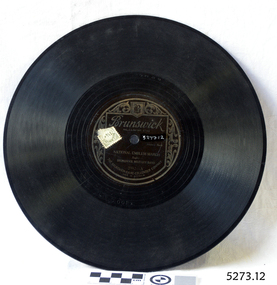
Audio - Gramophone Record, Brunswick Records, National Emblem March, Early-to-mid 20th century
... Common diameters of records: 7 inch, 10 inch, 12 inch and 16 inch Revolutions Per Minute include: 33 1/3, 45, 78 Minutes per side of record: 3, 5.5, 7, 8, 9, 12, 15 and 22 Labels, in minutes per side: Single Play 3-5 min, Extended Play (EP) 7-12 min, Long Play (LP) 12-22 min This gramophone represents a step in the evolution of recording sound. In the 19th century, the human voice was first recorded on wax cylinders and replayed. ...Thomas Edison (1847–1931), an American, invented the phonograph in 1877, making it possible to record sound waves vertically and reproduce them on a wax cylinder so they could be heard again. Later, the German American, Emile Berliner (1851-1929), improved on Edison’s principles, greatly increasing the quality of the reproduced sounds with his invention of the gramophone in 1887, which recorded the sound waves laterally onto a flat shellac disc, or ‘record’. Records could be mass-produced in a factory where audio recordings were converted to a physical copy of that recording on a plate-sized disc. A gramophone machine reproduced the sound by spinning the record on a turntable at a specified number of rotations per minute (RPM) and using a stylus or needle to transfer the vibration via a membrane to a speaker, which amplified the sound. Berliner helped set up affiliated businesses overseas. One of his representatives was William Barry Owen (1860–1914), who, on 23 February 1889, partnered with Edmund Trevor Lloyd Williams (1859–1946) in England to register The Gramophone Company. His Master’s Voice (HMV) soon became the company’s major recording label, popular worldwide. The business based the label's logo of a dog looking into a gramophone horn for ‘his master’s voice’ was based on a painting by English artist Francis Barraud, which featured a terrier called Nipper beside a gramophone. Early gramophone records were mostly made from a material referred to as shellac, a natural ingredient combined with slate powder, and a filler of manilla copal, wood resin, carnauba wax, and carbon black. Although Bakelite seemed a useful, synthetic product, it was unsuccessful as a product for records. Around the time of World War II, lightweight, flexible synthetic vinyl records began replacing shellac records. Common diameters of records: 7 inch, 10 inch, 12 inch and 16 inch Revolutions Per Minute include: 33 1/3, 45, 78 Minutes per side of record: 3, 5.5, 7, 8, 9, 12, 15 and 22 Labels, in minutes per side: Single Play 3-5 min, Extended Play (EP) 7-12 min, Long Play (LP) 12-22 min This gramophone represents a step in the evolution of recording sound. In the 19th century, the human voice was first recorded on wax cylinders and replayed. It was the beginning of a new era in sound. Then, in the 1880s, voice could be recorded onto flat discs like this record, reliably reproduced and replayed many times, even on portable devices. Later, in the mid-20th century the following generation of electronic audio recording began, and later that century, digital recording gave even better reproduction. The record represents a popular means of entertainment for personal and social activities, as well as in some businesses. Shellac gramophone record with a black and gold label. Title: National Emblem March Artist: Brunswick Military Band Publisher: Brunswick Number: A2002 Size: 10 inchOn the label is a cream coloured stamp with printed detailsflagstaff hill, warrnambool, maritime village, maritime museum, flagstaff hill maritime museum and village, shipwreck coast, great ocean road, gramophone, phonograph, sound waves, record, reproduction, audio record, music, sound, thomas edison, emile berliner, 1887, shellac, rpm, william barry owen, edmund trevor lloyd williams, the gramophone company, his master’s voice, hmv, francis barraud, nipper, 10 inch, brunswick records, a2002, national emblem march, brunswick military band -
 Flagstaff Hill Maritime Museum and Village
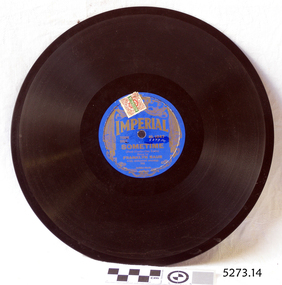
Audio - Gramophone Record, Imperial Records, Sometime, Early-to-mid 20th century
... Common diameters of records: 7 inch, 10 inch, 12 inch and 16 inch Revolutions Per Minute include: 33 1/3, 45, 78 Minutes per side of record: 3, 5.5, 7, 8, 9, 12, 15 and 22 Labels, in minutes per side: Single Play 3-5 min, Extended Play (EP) 7-12 min, Long Play (LP) 12-22 min This gramophone represents a step in the evolution of recording sound. In the 19th century, the human voice was first recorded on wax cylinders and replayed. ...Thomas Edison (1847–1931), an American, invented the phonograph in 1877, making it possible to record sound waves vertically and reproduce them on a wax cylinder so they could be heard again. Later, the German American, Emile Berliner (1851-1929), improved on Edison’s principles, greatly increasing the quality of the reproduced sounds with his invention of the gramophone in 1887, which recorded the sound waves laterally onto a flat shellac disc, or ‘record’. Records could be mass-produced in a factory where audio recordings were converted to a physical copy of that recording on a plate-sized disc. A gramophone machine reproduced the sound by spinning the record on a turntable at a specified number of rotations per minute (RPM) and using a stylus or needle to transfer the vibration via a membrane to a speaker, which amplified the sound. Berliner helped set up affiliated businesses overseas. One of his representatives was William Barry Owen (1860–1914), who, on 23 February 1889, partnered with Edmund Trevor Lloyd Williams (1859–1946) in England to register The Gramophone Company. His Master’s Voice (HMV) soon became the company’s major recording label, popular worldwide. The business based the label's logo of a dog looking into a gramophone horn for ‘his master’s voice’ was based on a painting by English artist Francis Barraud, which featured a terrier called Nipper beside a gramophone. Early gramophone records were mostly made from a material referred to as shellac, a natural ingredient combined with slate powder, and a filler of manilla copal, wood resin, carnauba wax, and carbon black. Although Bakelite seemed a useful, synthetic product, it was unsuccessful as a product for records. Around the time of World War II, lightweight, flexible synthetic vinyl records began replacing shellac records. Common diameters of records: 7 inch, 10 inch, 12 inch and 16 inch Revolutions Per Minute include: 33 1/3, 45, 78 Minutes per side of record: 3, 5.5, 7, 8, 9, 12, 15 and 22 Labels, in minutes per side: Single Play 3-5 min, Extended Play (EP) 7-12 min, Long Play (LP) 12-22 min This gramophone represents a step in the evolution of recording sound. In the 19th century, the human voice was first recorded on wax cylinders and replayed. It was the beginning of a new era in sound. Then, in the 1880s, voice could be recorded onto flat discs like this record, reliably reproduced and replayed many times, even on portable devices. Later, in the mid-20th century the following generation of electronic audio recording began, and later that century, digital recording gave even better reproduction. The record represents a popular means of entertainment for personal and social activities, as well as in some businesses. Shellac gramophone record with a blue and gold label. Title: Sometime Artist: Franklyn Baur, tenor, solo Publisher: Imperial Records Number:1547 Size: 14 inchWhite paper stamp with gold, red and green printflagstaff hill, warrnambool, maritime village, maritime museum, flagstaff hill maritime museum and village, shipwreck coast, great ocean road, gramophone, phonograph, sound waves, record, reproduction, audio record, music, sound, thomas edison, emile berliner, 1887, shellac, rpm, william barry owen, edmund trevor lloyd williams, the gramophone company, his master’s voice, hmv, francis barraud, nipper, imperial record, 1547, sometime, tenor solo, franklyn baur, 14 inch -
 Flagstaff Hill Maritime Museum and Village
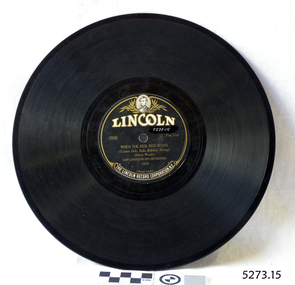
Audio - Gramophone Record, Lincoln Record Corporation, When The Red, Red Robin, Early-to-mid 20th century
... Common diameters of records: 7 inch, 10 inch, 12 inch and 16 inch Revolutions Per Minute include: 33 1/3, 45, 78 Minutes per side of record: 3, 5.5, 7, 8, 9, 12, 15 and 22 Labels, in minutes per side: Single Play 3-5 min, Extended Play (EP) 7-12 min, Long Play (LP) 12-22 min This gramophone represents a step in the evolution of recording sound. In the 19th century, the human voice was first recorded on wax cylinders and replayed. ...Thomas Edison (1847–1931), an American, invented the phonograph in 1877, making it possible to record sound waves vertically and reproduce them on a wax cylinder so they could be heard again. Later, the German American, Emile Berliner (1851-1929), improved on Edison’s principles, greatly increasing the quality of the reproduced sounds with his invention of the gramophone in 1887, which recorded the sound waves laterally onto a flat shellac disc, or ‘record’. Records could be mass-produced in a factory where audio recordings were converted to a physical copy of that recording on a plate-sized disc. A gramophone machine reproduced the sound by spinning the record on a turntable at a specified number of rotations per minute (RPM) and using a stylus or needle to transfer the vibration via a membrane to a speaker, which amplified the sound. Berliner helped set up affiliated businesses overseas. One of his representatives was William Barry Owen (1860–1914), who, on 23 February 1889, partnered with Edmund Trevor Lloyd Williams (1859–1946) in England to register The Gramophone Company. His Master’s Voice (HMV) soon became the company’s major recording label, popular worldwide. The business based the label's logo of a dog looking into a gramophone horn for ‘his master’s voice’ was based on a painting by English artist Francis Barraud, which featured a terrier called Nipper beside a gramophone. Early gramophone records were mostly made from a material referred to as shellac, a natural ingredient combined with slate powder, and a filler of manilla copal, wood resin, carnauba wax, and carbon black. Although Bakelite seemed a useful, synthetic product, it was unsuccessful as a product for records. Around the time of World War II, lightweight, flexible synthetic vinyl records began replacing shellac records. Common diameters of records: 7 inch, 10 inch, 12 inch and 16 inch Revolutions Per Minute include: 33 1/3, 45, 78 Minutes per side of record: 3, 5.5, 7, 8, 9, 12, 15 and 22 Labels, in minutes per side: Single Play 3-5 min, Extended Play (EP) 7-12 min, Long Play (LP) 12-22 min This gramophone represents a step in the evolution of recording sound. In the 19th century, the human voice was first recorded on wax cylinders and replayed. It was the beginning of a new era in sound. Then, in the 1880s, voice could be recorded onto flat discs like this record, reliably reproduced and replayed many times, even on portable devices. Later, in the mid-20th century the following generation of electronic audio recording began, and later that century, digital recording gave even better reproduction. The record represents a popular means of entertainment for personal and social activities, as well as in some businesses. Shellac gramophone record with a black and gold label. Title: When The Red, Red Robin Artist: Sammy Lanin and his Orchestra Publisher: Lincoln Record Corporation, N.Y. Number:2528 Size: 10 inchflagstaff hill, warrnambool, maritime village, maritime museum, flagstaff hill maritime museum and village, shipwreck coast, great ocean road, gramophone, phonograph, sound waves, record, reproduction, audio record, music, sound, thomas edison, emile berliner, 1887, shellac, rpm, william barry owen, edmund trevor lloyd williams, the gramophone company, his master’s voice, hmv, francis barraud, nipper, lincoln record corporation, new york, 2528, when the red red robin, sammy lanin and his orchestra, 10 inch -
 Flagstaff Hill Maritime Museum and Village
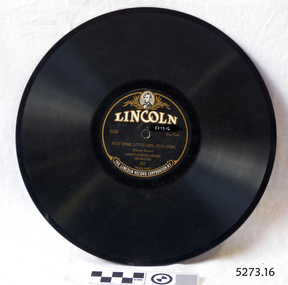
Audio - Gramophone Record, Lincoln Record Corporation, Stay Home Little Girl, Stay Home, Early-to-mid 20th century
... Common diameters of records: 7 inch, 10 inch, 12 inch and 16 inch Revolutions Per Minute include: 33 1/3, 45, 78 Minutes per side of record: 3, 5.5, 7, 8, 9, 12, 15 and 22 Labels, in minutes per side: Single Play 3-5 min, Extended Play (EP) 7-12 min, Long Play (LP) 12-22 min This gramophone represents a step in the evolution of recording sound. In the 19th century, the human voice was first recorded on wax cylinders and replayed. ...Thomas Edison (1847–1931), an American, invented the phonograph in 1877, making it possible to record sound waves vertically and reproduce them on a wax cylinder so they could be heard again. Later, the German American, Emile Berliner (1851-1929), improved on Edison’s principles, greatly increasing the quality of the reproduced sounds with his invention of the gramophone in 1887, which recorded the sound waves laterally onto a flat shellac disc, or ‘record’. Records could be mass-produced in a factory where audio recordings were converted to a physical copy of that recording on a plate-sized disc. A gramophone machine reproduced the sound by spinning the record on a turntable at a specified number of rotations per minute (RPM) and using a stylus or needle to transfer the vibration via a membrane to a speaker, which amplified the sound. Berliner helped set up affiliated businesses overseas. One of his representatives was William Barry Owen (1860–1914), who, on 23 February 1889, partnered with Edmund Trevor Lloyd Williams (1859–1946) in England to register The Gramophone Company. His Master’s Voice (HMV) soon became the company’s major recording label, popular worldwide. The business based the label's logo of a dog looking into a gramophone horn for ‘his master’s voice’ was based on a painting by English artist Francis Barraud, which featured a terrier called Nipper beside a gramophone. Early gramophone records were mostly made from a material referred to as shellac, a natural ingredient combined with slate powder, and a filler of manilla copal, wood resin, carnauba wax, and carbon black. Although Bakelite seemed a useful, synthetic product, it was unsuccessful as a product for records. Around the time of World War II, lightweight, flexible synthetic vinyl records began replacing shellac records. Common diameters of records: 7 inch, 10 inch, 12 inch and 16 inch Revolutions Per Minute include: 33 1/3, 45, 78 Minutes per side of record: 3, 5.5, 7, 8, 9, 12, 15 and 22 Labels, in minutes per side: Single Play 3-5 min, Extended Play (EP) 7-12 min, Long Play (LP) 12-22 min This gramophone represents a step in the evolution of recording sound. In the 19th century, the human voice was first recorded on wax cylinders and replayed. It was the beginning of a new era in sound. Then, in the 1880s, voice could be recorded onto flat discs like this record, reliably reproduced and replayed many times, even on portable devices. Later, in the mid-20th century the following generation of electronic audio recording began, and later that century, digital recording gave even better reproduction. The record represents a popular means of entertainment for personal and social activities, as well as in some businesses. Shellac gramophone record with a coloured label. Title: Stay Home Little Girl, Stay Home Artist: Johnny Johnson and his Orchestra. Publisher: The Lincoln Record Corporation, N.Y. 2516 Number:797 Size: 10 inchflagstaff hill, warrnambool, maritime village, maritime museum, flagstaff hill maritime museum and village, shipwreck coast, great ocean road, gramophone, phonograph, sound waves, record, reproduction, audio record, music, sound, thomas edison, emile berliner, 1887, shellac, rpm, william barry owen, edmund trevor lloyd williams, the gramophone company, his master’s voice, hmv, francis barraud, nipper, lincoln record corporation n.y. 2516, stay home little girl stay home, johnny johnson and his orchestra, 797, 10 inch -
 Flagstaff Hill Maritime Museum and Village
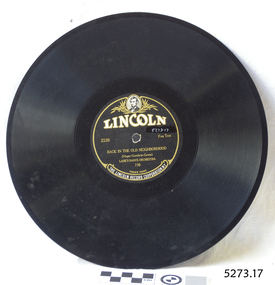
Audio - Gramophone Record, Lincoln Record Corporation, Back In The Old Neighborhood, Early-to-mid 20th century
... Common diameters of records: 7 inch, 10 inch, 12 inch and 16 inch Revolutions Per Minute include: 33 1/3, 45, 78 Minutes per side of record: 3, 5.5, 7, 8, 9, 12, 15 and 22 Labels, in minutes per side: Single Play 3-5 min, Extended Play (EP) 7-12 min, Long Play (LP) 12-22 min This gramophone represents a step in the evolution of recording sound. In the 19th century, the human voice was first recorded on wax cylinders and replayed. ...Thomas Edison (1847–1931), an American, invented the phonograph in 1877, making it possible to record sound waves vertically and reproduce them on a wax cylinder so they could be heard again. Later, the German American, Emile Berliner (1851-1929), improved on Edison’s principles, greatly increasing the quality of the reproduced sounds with his invention of the gramophone in 1887, which recorded the sound waves laterally onto a flat shellac disc, or ‘record’. Records could be mass-produced in a factory where audio recordings were converted to a physical copy of that recording on a plate-sized disc. A gramophone machine reproduced the sound by spinning the record on a turntable at a specified number of rotations per minute (RPM) and using a stylus or needle to transfer the vibration via a membrane to a speaker, which amplified the sound. Berliner helped set up affiliated businesses overseas. One of his representatives was William Barry Owen (1860–1914), who, on 23 February 1889, partnered with Edmund Trevor Lloyd Williams (1859–1946) in England to register The Gramophone Company. His Master’s Voice (HMV) soon became the company’s major recording label, popular worldwide. The business based the label's logo of a dog looking into a gramophone horn for ‘his master’s voice’ was based on a painting by English artist Francis Barraud, which featured a terrier called Nipper beside a gramophone. Early gramophone records were mostly made from a material referred to as shellac, a natural ingredient combined with slate powder, and a filler of manilla copal, wood resin, carnauba wax, and carbon black. Although Bakelite seemed a useful, synthetic product, it was unsuccessful as a product for records. Around the time of World War II, lightweight, flexible synthetic vinyl records began replacing shellac records. Common diameters of records: 7 inch, 10 inch, 12 inch and 16 inch Revolutions Per Minute include: 33 1/3, 45, 78 Minutes per side of record: 3, 5.5, 7, 8, 9, 12, 15 and 22 Labels, in minutes per side: Single Play 3-5 min, Extended Play (EP) 7-12 min, Long Play (LP) 12-22 min This gramophone represents a step in the evolution of recording sound. In the 19th century, the human voice was first recorded on wax cylinders and replayed. It was the beginning of a new era in sound. Then, in the 1880s, voice could be recorded onto flat discs like this record, reliably reproduced and replayed many times, even on portable devices. Later, in the mid-20th century the following generation of electronic audio recording began, and later that century, digital recording gave even better reproduction. The record represents a popular means of entertainment for personal and social activities, as well as in some businesses. Shellac gramophone record with a black and gold label. Title: Back In The Old Neighbourhood Artist: Lane's Dance Orchestra. Publisher: The Lincoln Record Corporation, N.Y. 2138 Number:738 Size: 10 inchflagstaff hill, warrnambool, maritime village, maritime museum, flagstaff hill maritime museum and village, shipwreck coast, great ocean road, gramophone, phonograph, sound waves, record, reproduction, audio record, music, sound, thomas edison, emile berliner, 1887, shellac, rpm, william barry owen, edmund trevor lloyd williams, the gramophone company, his master’s voice, hmv, francis barraud, nipper, the lincoln record corporation n.y. 2138, back in the old neighbourhood, lane's dance orchestra, 738 -
 Flagstaff Hill Maritime Museum and Village
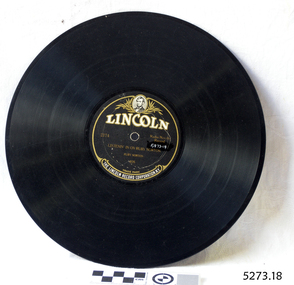
Audio - Gramophone Record, Lincoln Record Corporation, Listenin In On Ruby Norton, Early-to-mid 20th century
... Common diameters of records: 7 inch, 10 inch, 12 inch and 16 inch Revolutions Per Minute include: 33 1/3, 45, 78 Minutes per side of record: 3, 5.5, 7, 8, 9, 12, 15 and 22 Labels, in minutes per side: Single Play 3-5 min, Extended Play (EP) 7-12 min, Long Play (LP) 12-22 min This gramophone represents a step in the evolution of recording sound. In the 19th century, the human voice was first recorded on wax cylinders and replayed. ...Thomas Edison (1847–1931), an American, invented the phonograph in 1877, making it possible to record sound waves vertically and reproduce them on a wax cylinder so they could be heard again. Later, the German American, Emile Berliner (1851-1929), improved on Edison’s principles, greatly increasing the quality of the reproduced sounds with his invention of the gramophone in 1887, which recorded the sound waves laterally onto a flat shellac disc, or ‘record’. Records could be mass-produced in a factory where audio recordings were converted to a physical copy of that recording on a plate-sized disc. A gramophone machine reproduced the sound by spinning the record on a turntable at a specified number of rotations per minute (RPM) and using a stylus or needle to transfer the vibration via a membrane to a speaker, which amplified the sound. Berliner helped set up affiliated businesses overseas. One of his representatives was William Barry Owen (1860–1914), who, on 23 February 1889, partnered with Edmund Trevor Lloyd Williams (1859–1946) in England to register The Gramophone Company. His Master’s Voice (HMV) soon became the company’s major recording label, popular worldwide. The business based the label's logo of a dog looking into a gramophone horn for ‘his master’s voice’ was based on a painting by English artist Francis Barraud, which featured a terrier called Nipper beside a gramophone. Early gramophone records were mostly made from a material referred to as shellac, a natural ingredient combined with slate powder, and a filler of manilla copal, wood resin, carnauba wax, and carbon black. Although Bakelite seemed a useful, synthetic product, it was unsuccessful as a product for records. Around the time of World War II, lightweight, flexible synthetic vinyl records began replacing shellac records. Common diameters of records: 7 inch, 10 inch, 12 inch and 16 inch Revolutions Per Minute include: 33 1/3, 45, 78 Minutes per side of record: 3, 5.5, 7, 8, 9, 12, 15 and 22 Labels, in minutes per side: Single Play 3-5 min, Extended Play (EP) 7-12 min, Long Play (LP) 12-22 min This gramophone represents a step in the evolution of recording sound. In the 19th century, the human voice was first recorded on wax cylinders and replayed. It was the beginning of a new era in sound. Then, in the 1880s, voice could be recorded onto flat discs like this record, reliably reproduced and replayed many times, even on portable devices. Later, in the mid-20th century the following generation of electronic audio recording began, and later that century, digital recording gave even better reproduction. The record represents a popular means of entertainment for personal and social activities, as well as in some businesses. Shellac gramophone record with a black and gold label. Title: Listenin" In On Ruby Norton Artist: Ruby Norton. Publisher: The Lincoln Record Corporation N.Y. Number:2174 835 Size: 10 inchflagstaff hill, warrnambool, maritime village, maritime museum, flagstaff hill maritime museum and village, shipwreck coast, great ocean road, gramophone, phonograph, sound waves, record, reproduction, audio record, music, sound, thomas edison, emile berliner, 1887, shellac, rpm, william barry owen, edmund trevor lloyd williams, the gramophone company, his master’s voice, hmv, francis barraud, nipper, the lincoln record corporation n.y. 2174, listenin in on ruby norton, ruby norton, 835, 10 inch -
 Flagstaff Hill Maritime Museum and Village
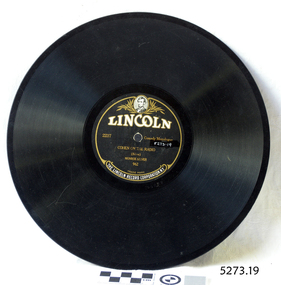
Audio - Gramophone Record, Lincoln Record Corporation, Cohen On The Radio, Early-to-mid 20th century
... Common diameters of records: 7 inch, 10 inch, 12 inch and 16 inch Revolutions Per Minute include: 33 1/3, 45, 78 Minutes per side of record: 3, 5.5, 7, 8, 9, 12, 15 and 22 Labels, in minutes per side: Single Play 3-5 min, Extended Play (EP) 7-12 min, Long Play (LP) 12-22 min This gramophone represents a step in the evolution of recording sound. In the 19th century, the human voice was first recorded on wax cylinders and replayed. ...Thomas Edison (1847–1931), an American, invented the phonograph in 1877, making it possible to record sound waves vertically and reproduce them on a wax cylinder so they could be heard again. Later, the German American, Emile Berliner (1851-1929), improved on Edison’s principles, greatly increasing the quality of the reproduced sounds with his invention of the gramophone in 1887, which recorded the sound waves laterally onto a flat shellac disc, or ‘record’. Records could be mass-produced in a factory where audio recordings were converted to a physical copy of that recording on a plate-sized disc. A gramophone machine reproduced the sound by spinning the record on a turntable at a specified number of rotations per minute (RPM) and using a stylus or needle to transfer the vibration via a membrane to a speaker, which amplified the sound. Berliner helped set up affiliated businesses overseas. One of his representatives was William Barry Owen (1860–1914), who, on 23 February 1889, partnered with Edmund Trevor Lloyd Williams (1859–1946) in England to register The Gramophone Company. His Master’s Voice (HMV) soon became the company’s major recording label, popular worldwide. The business based the label's logo of a dog looking into a gramophone horn for ‘his master’s voice’ was based on a painting by English artist Francis Barraud, which featured a terrier called Nipper beside a gramophone. Early gramophone records were mostly made from a material referred to as shellac, a natural ingredient combined with slate powder, and a filler of manilla copal, wood resin, carnauba wax, and carbon black. Although Bakelite seemed a useful, synthetic product, it was unsuccessful as a product for records. Around the time of World War II, lightweight, flexible synthetic vinyl records began replacing shellac records. Common diameters of records: 7 inch, 10 inch, 12 inch and 16 inch Revolutions Per Minute include: 33 1/3, 45, 78 Minutes per side of record: 3, 5.5, 7, 8, 9, 12, 15 and 22 Labels, in minutes per side: Single Play 3-5 min, Extended Play (EP) 7-12 min, Long Play (LP) 12-22 min This gramophone represents a step in the evolution of recording sound. In the 19th century, the human voice was first recorded on wax cylinders and replayed. It was the beginning of a new era in sound. Then, in the 1880s, voice could be recorded onto flat discs like this record, reliably reproduced and replayed many times, even on portable devices. Later, in the mid-20th century the following generation of electronic audio recording began, and later that century, digital recording gave even better reproduction. The record represents a popular means of entertainment for personal and social activities, as well as in some businesses. Shellac gramophone record with a black and gold label. Title: Cohen On The Radio Artist: Monroe Silver Publisher: The Lincoln Record Corporation N.Y. 2237 Number:962 Size: 10 inchflagstaff hill, warrnambool, maritime village, maritime museum, flagstaff hill maritime museum and village, shipwreck coast, great ocean road, gramophone, phonograph, sound waves, record, reproduction, audio record, music, sound, thomas edison, emile berliner, 1887, shellac, rpm, william barry owen, edmund trevor lloyd williams, the gramophone company, his master’s voice, hmv, francis barraud, nipper, the lincoln record corporation n.y. 2237, cohen on the radio, monroe silver, no 962, 10 inch -
 Flagstaff Hill Maritime Museum and Village
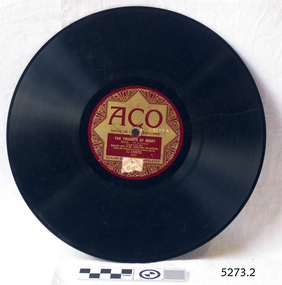
Audio - Gramophone Record, ACO, The Triumph of Right, Early-to-mid 20th century
... Common diameters of records: 7 inch, 10 inch, 12 inch and 16 inch Revolutions Per Minute include: 33 1/3, 45, 78 Minutes per side of record: 3, 5.5, 7, 8, 9, 12, 15 and 22 Labels, in minutes per side: Single Play 3-5 min, Extended Play (EP) 7-12 min, Long Play (LP) 12-22 min This gramophone represents a step in the evolution of recording sound. In the 19th century, the human voice was first recorded on wax cylinders and replayed. ...Thomas Edison (1847–1931), an American, invented the phonograph in 1877, making it possible to record sound waves vertically and reproduce them on a wax cylinder so they could be heard again. Later, the German American, Emile Berliner (1851-1929), improved on Edison’s principles, greatly increasing the quality of the reproduced sounds with his invention of the gramophone in 1887, which recorded the sound waves laterally onto a flat shellac disc, or ‘record’. Records could be mass-produced in a factory where audio recordings were converted to a physical copy of that recording on a plate-sized disc. A gramophone machine reproduced the sound by spinning the record on a turntable at a specified number of rotations per minute (RPM) and using a stylus or needle to transfer the vibration via a membrane to a speaker, which amplified the sound. Berliner helped set up affiliated businesses overseas. One of his representatives was William Barry Owen (1860–1914), who, on 23 February 1889, partnered with Edmund Trevor Lloyd Williams (1859–1946) in England to register The Gramophone Company. His Master’s Voice (HMV) soon became the company’s major recording label, popular worldwide. The business based the label's logo of a dog looking into a gramophone horn for ‘his master’s voice’ was based on a painting by English artist Francis Barraud, which featured a terrier called Nipper beside a gramophone. Early gramophone records were mostly made from a material referred to as shellac, a natural ingredient combined with slate powder, and a filler of manilla copal, wood resin, carnauba wax, and carbon black. Although Bakelite seemed a useful, synthetic product, it was unsuccessful as a product for records. Around the time of World War II, lightweight, flexible synthetic vinyl records began replacing shellac records. Common diameters of records: 7 inch, 10 inch, 12 inch and 16 inch Revolutions Per Minute include: 33 1/3, 45, 78 Minutes per side of record: 3, 5.5, 7, 8, 9, 12, 15 and 22 Labels, in minutes per side: Single Play 3-5 min, Extended Play (EP) 7-12 min, Long Play (LP) 12-22 min This gramophone represents a step in the evolution of recording sound. In the 19th century, the human voice was first recorded on wax cylinders and replayed. It was the beginning of a new era in sound. Then, in the 1880s, voice could be recorded onto flat discs like this record, reliably reproduced and replayed many times, even on portable devices. Later, in the mid-20th century the following generation of electronic audio recording began, and later that century, digital recording gave even better reproduction. The record represents a popular means of entertainment for personal and social activities, as well as in some businesses. Shellac gramophone record with a crimson and gold label. Title: The Triumph of Right Artist: H.M. Welsh Guards Publisher: ACO England Number: G15875 Size: 10 inchflagstaff hill, warrnambool, maritime village, maritime museum, flagstaff hill maritime museum and village, shipwreck coast, great ocean road, gramophone, phonograph, sound waves, record, reproduction, audio record, music, sound, thomas edison, emile berliner, 1887, shellac, rpm, william barry owen, edmund trevor lloyd williams, the gramophone company, his master’s voice, hmv, francis barraud, nipper, 10 inch, the triumph of right, h.m. welsh guards, aco england -
 Flagstaff Hill Maritime Museum and Village
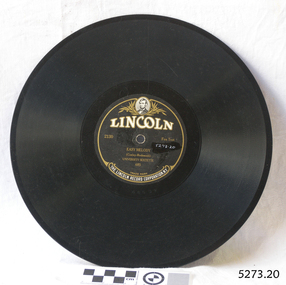
Audio - Gramophone Record, Lincoln Record Corporation, Easy Melody, Early-to-mid 20th century
... Common diameters of records: 7 inch, 10 inch, 12 inch and 16 inch Revolutions Per Minute include: 33 1/3, 45, 78 Minutes per side of record: 3, 5.5, 7, 8, 9, 12, 15 and 22 Labels, in minutes per side: Single Play 3-5 min, Extended Play (EP) 7-12 min, Long Play (LP) 12-22 min This gramophone represents a step in the evolution of recording sound. In the 19th century, the human voice was first recorded on wax cylinders and replayed. ...Thomas Edison (1847–1931), an American, invented the phonograph in 1877, making it possible to record sound waves vertically and reproduce them on a wax cylinder so they could be heard again. Later, the German American, Emile Berliner (1851-1929), improved on Edison’s principles, greatly increasing the quality of the reproduced sounds with his invention of the gramophone in 1887, which recorded the sound waves laterally onto a flat shellac disc, or ‘record’. Records could be mass-produced in a factory where audio recordings were converted to a physical copy of that recording on a plate-sized disc. A gramophone machine reproduced the sound by spinning the record on a turntable at a specified number of rotations per minute (RPM) and using a stylus or needle to transfer the vibration via a membrane to a speaker, which amplified the sound. Berliner helped set up affiliated businesses overseas. One of his representatives was William Barry Owen (1860–1914), who, on 23 February 1889, partnered with Edmund Trevor Lloyd Williams (1859–1946) in England to register The Gramophone Company. His Master’s Voice (HMV) soon became the company’s major recording label, popular worldwide. The business based the label's logo of a dog looking into a gramophone horn for ‘his master’s voice’ was based on a painting by English artist Francis Barraud, which featured a terrier called Nipper beside a gramophone. Early gramophone records were mostly made from a material referred to as shellac, a natural ingredient combined with slate powder, and a filler of manilla copal, wood resin, carnauba wax, and carbon black. Although Bakelite seemed a useful, synthetic product, it was unsuccessful as a product for records. Around the time of World War II, lightweight, flexible synthetic vinyl records began replacing shellac records. Common diameters of records: 7 inch, 10 inch, 12 inch and 16 inch Revolutions Per Minute include: 33 1/3, 45, 78 Minutes per side of record: 3, 5.5, 7, 8, 9, 12, 15 and 22 Labels, in minutes per side: Single Play 3-5 min, Extended Play (EP) 7-12 min, Long Play (LP) 12-22 min This gramophone represents a step in the evolution of recording sound. In the 19th century, the human voice was first recorded on wax cylinders and replayed. It was the beginning of a new era in sound. Then, in the 1880s, voice could be recorded onto flat discs like this record, reliably reproduced and replayed many times, even on portable devices. Later, in the mid-20th century the following generation of electronic audio recording began, and later that century, digital recording gave even better reproduction. The record represents a popular means of entertainment for personal and social activities, as well as in some businesses. Shellac gramophone record with a black and gold label. Title: Easy Melody Artist: University Sextette Publisher: The Lincoln Record Corporation N.Y. Number:2130 685 Size: 10 inchflagstaff hill, warrnambool, maritime village, maritime museum, flagstaff hill maritime museum and village, shipwreck coast, great ocean road, gramophone, phonograph, sound waves, record, reproduction, audio record, music, sound, thomas edison, emile berliner, 1887, shellac, rpm, william barry owen, edmund trevor lloyd williams, the gramophone company, his master’s voice, hmv, francis barraud, nipper, the lincoln record corporation n.y., 2130, easy melody, university sextette, 685 -
 Flagstaff Hill Maritime Museum and Village
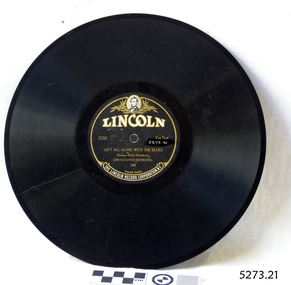
Audio - Gramophone Record, Lincoln Record Corporation, Left All Alone With The Blues, Early-to-mid 20th century
... Photograph Record This gramophone represents a step in the evolution of recording sound. In the 19th century, the human voice was first recorded on wax cylinders and replayed. ...Photograph RecordThis gramophone represents a step in the evolution of recording sound. In the 19th century, the human voice was first recorded on wax cylinders and replayed. It was the beginning of a new era in sound. Then, in the 1880s, voice could be recorded onto flat discs like this record, reliably reproduced and replayed many times, even on portable devices. Later, in the mid-20th century the following generation of electronic audio recording began, and later that century, digital recording gave even better reproduction. The record represents a popular means of entertainment for personal and social activities, as well as in some businesses. Shellac gramophone record with a black and gold label. Title: Left All Alone With The Blues Artist: Lincoln Dance Orchestra Publisher: The Lincoln Record Corporation, N.Y. 2153 Number:700 Size: 10 inchflagstaff hill, warrnambool, maritime village, maritime museum, flagstaff hill maritime museum and village, shipwreck coast, great ocean road, gramophone, phonograph, sound waves, record, reproduction, audio record, music, sound, thomas edison, emile berliner, 1887, shellac, rpm, william barry owen, edmund trevor lloyd williams, the gramophone company, his master’s voice, hmv, francis barraud, nipper, the lincoln record corporation n.y. 2153, left all alone with the blues, lincoln dance orchestra, 700 -
 Flagstaff Hill Maritime Museum and Village
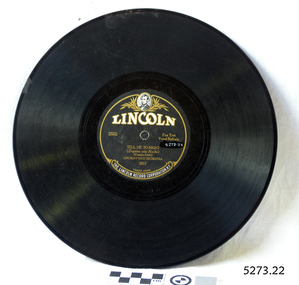
Audio - Gramophone Record, Lincoln Record Corporation, Tell Me To-Night, Early-to-mid 20th century
... Common diameters of records: 7 inch, 10 inch, 12 inch and 16 inch Revolutions Per Minute include: 33 1/3, 45, 78 Minutes per side of record: 3, 5.5, 7, 8, 9, 12, 15 and 22 Labels, in minutes per side: Single Play 3-5 min, Extended Play (EP) 7-12 min, Long Play (LP) 12-22 min This gramophone represents a step in the evolution of recording sound. In the 19th century, the human voice was first recorded on wax cylinders and replayed. ...Thomas Edison (1847–1931), an American, invented the phonograph in 1877, making it possible to record sound waves vertically and reproduce them on a wax cylinder so they could be heard again. Later, the German American, Emile Berliner (1851-1929), improved on Edison’s principles, greatly increasing the quality of the reproduced sounds with his invention of the gramophone in 1887, which recorded the sound waves laterally onto a flat shellac disc, or ‘record’. Records could be mass-produced in a factory where audio recordings were converted to a physical copy of that recording on a plate-sized disc. A gramophone machine reproduced the sound by spinning the record on a turntable at a specified number of rotations per minute (RPM) and using a stylus or needle to transfer the vibration via a membrane to a speaker, which amplified the sound. Berliner helped set up affiliated businesses overseas. One of his representatives was William Barry Owen (1860–1914), who, on 23 February 1889, partnered with Edmund Trevor Lloyd Williams (1859–1946) in England to register The Gramophone Company. His Master’s Voice (HMV) soon became the company’s major recording label, popular worldwide. The business based the label's logo of a dog looking into a gramophone horn for ‘his master’s voice’ was based on a painting by English artist Francis Barraud, which featured a terrier called Nipper beside a gramophone. Early gramophone records were mostly made from a material referred to as shellac, a natural ingredient combined with slate powder, and a filler of manilla copal, wood resin, carnauba wax, and carbon black. Although Bakelite seemed a useful, synthetic product, it was unsuccessful as a product for records. Around the time of World War II, lightweight, flexible synthetic vinyl records began replacing shellac records. Common diameters of records: 7 inch, 10 inch, 12 inch and 16 inch Revolutions Per Minute include: 33 1/3, 45, 78 Minutes per side of record: 3, 5.5, 7, 8, 9, 12, 15 and 22 Labels, in minutes per side: Single Play 3-5 min, Extended Play (EP) 7-12 min, Long Play (LP) 12-22 min This gramophone represents a step in the evolution of recording sound. In the 19th century, the human voice was first recorded on wax cylinders and replayed. It was the beginning of a new era in sound. Then, in the 1880s, voice could be recorded onto flat discs like this record, reliably reproduced and replayed many times, even on portable devices. Later, in the mid-20th century the following generation of electronic audio recording began, and later that century, digital recording gave even better reproduction. The record represents a popular means of entertainment for personal and social activities, as well as in some businesses. Shellac gramophone record with a black and gold label. Title: Tell Me To-Night Artist: Lincoln Dance Orchestra. Publisher: The Lincoln Record Corporation N.Y. 2552 Number:2057 Size: 10 inchflagstaff hill, warrnambool, maritime village, maritime museum, flagstaff hill maritime museum and village, shipwreck coast, great ocean road, gramophone, phonograph, sound waves, record, reproduction, audio record, music, sound, thomas edison, emile berliner, 1887, shellac, rpm, william barry owen, edmund trevor lloyd williams, the gramophone company, his master’s voice, hmv, francis barraud, nipper, the lincoln record corporation n.y. 2552, tell me to-night, lincoln dance orchestra, 2057 -
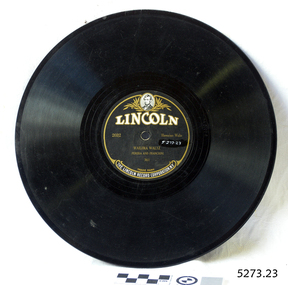 Flagstaff Hill Maritime Museum and Village
Audio - Gramophone Record, Lincoln Record Corporation, Wailima Waltz, Early-to-mid 20th century
... Common diameters of records: 7 inch, 10 inch, 12 inch and 16 inch Revolutions Per Minute include: 33 1/3, 45, 78 Minutes per side of record: 3, 5.5, 7, 8, 9, 12, 15 and 22 Labels, in minutes per side: Single Play 3-5 min, Extended Play (EP) 7-12 min, Long Play (LP) 12-22 min This gramophone represents a step in the evolution of recording sound. In the 19th century, the human voice was first recorded on wax cylinders and replayed. ...Thomas Edison (1847–1931), an American, invented the phonograph in 1877, making it possible to record sound waves vertically and reproduce them on a wax cylinder so they could be heard again. Later, the German American, Emile Berliner (1851-1929), improved on Edison’s principles, greatly increasing the quality of the reproduced sounds with his invention of the gramophone in 1887, which recorded the sound waves laterally onto a flat shellac disc, or ‘record’. Records could be mass-produced in a factory where audio recordings were converted to a physical copy of that recording on a plate-sized disc. A gramophone machine reproduced the sound by spinning the record on a turntable at a specified number of rotations per minute (RPM) and using a stylus or needle to transfer the vibration via a membrane to a speaker, which amplified the sound. Berliner helped set up affiliated businesses overseas. One of his representatives was William Barry Owen (1860–1914), who, on 23 February 1889, partnered with Edmund Trevor Lloyd Williams (1859–1946) in England to register The Gramophone Company. His Master’s Voice (HMV) soon became the company’s major recording label, popular worldwide. The business based the label's logo of a dog looking into a gramophone horn for ‘his master’s voice’ was based on a painting by English artist Francis Barraud, which featured a terrier called Nipper beside a gramophone. Early gramophone records were mostly made from a material referred to as shellac, a natural ingredient combined with slate powder, and a filler of manilla copal, wood resin, carnauba wax, and carbon black. Although Bakelite seemed a useful, synthetic product, it was unsuccessful as a product for records. Around the time of World War II, lightweight, flexible synthetic vinyl records began replacing shellac records. Common diameters of records: 7 inch, 10 inch, 12 inch and 16 inch Revolutions Per Minute include: 33 1/3, 45, 78 Minutes per side of record: 3, 5.5, 7, 8, 9, 12, 15 and 22 Labels, in minutes per side: Single Play 3-5 min, Extended Play (EP) 7-12 min, Long Play (LP) 12-22 min This gramophone represents a step in the evolution of recording sound. In the 19th century, the human voice was first recorded on wax cylinders and replayed. It was the beginning of a new era in sound. Then, in the 1880s, voice could be recorded onto flat discs like this record, reliably reproduced and replayed many times, even on portable devices. Later, in the mid-20th century the following generation of electronic audio recording began, and later that century, digital recording gave even better reproduction. The record represents a popular means of entertainment for personal and social activities, as well as in some businesses. Shellac gramophone record with a black and gold label. Title: Wailima Waltz Artist: Ferera and Franchini Publisher: The Lincoln Record Corporation N.Y. 2032 Number:361 Size: 10 inchflagstaff hill, warrnambool, maritime village, maritime museum, flagstaff hill maritime museum and village, shipwreck coast, great ocean road, gramophone, phonograph, sound waves, record, reproduction, audio record, music, sound, thomas edison, emile berliner, 1887, shellac, rpm, william barry owen, edmund trevor lloyd williams, the gramophone company, his master’s voice, hmv, francis barraud, nipper, the lincoln record corporation n.y. 2032, wailima waltz, ferera and franchin, 361 -
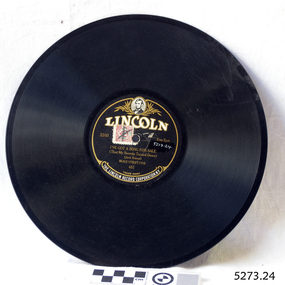 Flagstaff Hill Maritime Museum and Village
Audio - Gramophone Record, Lincoln Record Corporation, I've Got A Song For Sale, Early-to-mid 20th century
... Common diameters of records: 7 inch, 10 inch, 12 inch and 16 inch Revolutions Per Minute include: 33 1/3, 45, 78 Minutes per side of record: 3, 5.5, 7, 8, 9, 12, 15 and 22 Labels, in minutes per side: Single Play 3-5 min, Extended Play (EP) 7-12 min, Long Play (LP) 12-22 min This gramophone represents a step in the evolution of recording sound. In the 19th century, the human voice was first recorded on wax cylinders and replayed. ...Thomas Edison (1847–1931), an American, invented the phonograph in 1877, making it possible to record sound waves vertically and reproduce them on a wax cylinder so they could be heard again. Later, the German American, Emile Berliner (1851-1929), improved on Edison’s principles, greatly increasing the quality of the reproduced sounds with his invention of the gramophone in 1887, which recorded the sound waves laterally onto a flat shellac disc, or ‘record’. Records could be mass-produced in a factory where audio recordings were converted to a physical copy of that recording on a plate-sized disc. A gramophone machine reproduced the sound by spinning the record on a turntable at a specified number of rotations per minute (RPM) and using a stylus or needle to transfer the vibration via a membrane to a speaker, which amplified the sound. Berliner helped set up affiliated businesses overseas. One of his representatives was William Barry Owen (1860–1914), who, on 23 February 1889, partnered with Edmund Trevor Lloyd Williams (1859–1946) in England to register The Gramophone Company. His Master’s Voice (HMV) soon became the company’s major recording label, popular worldwide. The business based the label's logo of a dog looking into a gramophone horn for ‘his master’s voice’ was based on a painting by English artist Francis Barraud, which featured a terrier called Nipper beside a gramophone. Early gramophone records were mostly made from a material referred to as shellac, a natural ingredient combined with slate powder, and a filler of manilla copal, wood resin, carnauba wax, and carbon black. Although Bakelite seemed a useful, synthetic product, it was unsuccessful as a product for records. Around the time of World War II, lightweight, flexible synthetic vinyl records began replacing shellac records. Common diameters of records: 7 inch, 10 inch, 12 inch and 16 inch Revolutions Per Minute include: 33 1/3, 45, 78 Minutes per side of record: 3, 5.5, 7, 8, 9, 12, 15 and 22 Labels, in minutes per side: Single Play 3-5 min, Extended Play (EP) 7-12 min, Long Play (LP) 12-22 min This gramophone represents a step in the evolution of recording sound. In the 19th century, the human voice was first recorded on wax cylinders and replayed. It was the beginning of a new era in sound. Then, in the 1880s, voice could be recorded onto flat discs like this record, reliably reproduced and replayed many times, even on portable devices. Later, in the mid-20th century the following generation of electronic audio recording began, and later that century, digital recording gave even better reproduction. The record represents a popular means of entertainment for personal and social activities, as well as in some businesses. Shellac gramophone record with a black and gold label. Title: I've Got A Song For Sale Artist: Beale Street Five Publisher: The Lincoln Record Corporation N.Y. 2103 Number:652 Size: 10 inchflagstaff hill, warrnambool, maritime village, maritime museum, flagstaff hill maritime museum and village, shipwreck coast, great ocean road, gramophone, phonograph, sound waves, record, reproduction, audio record, music, sound, thomas edison, emile berliner, 1887, shellac, rpm, william barry owen, edmund trevor lloyd williams, the gramophone company, his master’s voice, hmv, francis barraud, nipper, the lincoln record corporation n.y. 2103, i've got a song for sale, beale street five, 652 -
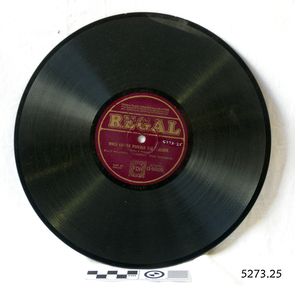 Flagstaff Hill Maritime Museum and Village
Audio - Gramophone Record, Regal Records, When Father Papered The Parlour, Early-to-mid 20th century
... Common diameters of records: 7 inch, 10 inch, 12 inch and 16 inch Revolutions Per Minute include: 33 1/3, 45, 78 Minutes per side of record: 3, 5.5, 7, 8, 9, 12, 15 and 22 Labels, in minutes per side: Single Play 3-5 min, Extended Play (EP) 7-12 min, Long Play (LP) 12-22 min This gramophone represents a step in the evolution of recording sound. In the 19th century, the human voice was first recorded on wax cylinders and replayed. ...Thomas Edison (1847–1931), an American, invented the phonograph in 1877, making it possible to record sound waves vertically and reproduce them on a wax cylinder so they could be heard again. Later, the German American, Emile Berliner (1851-1929), improved on Edison’s principles, greatly increasing the quality of the reproduced sounds with his invention of the gramophone in 1887, which recorded the sound waves laterally onto a flat shellac disc, or ‘record’. Records could be mass-produced in a factory where audio recordings were converted to a physical copy of that recording on a plate-sized disc. A gramophone machine reproduced the sound by spinning the record on a turntable at a specified number of rotations per minute (RPM) and using a stylus or needle to transfer the vibration via a membrane to a speaker, which amplified the sound. Berliner helped set up affiliated businesses overseas. One of his representatives was William Barry Owen (1860–1914), who, on 23 February 1889, partnered with Edmund Trevor Lloyd Williams (1859–1946) in England to register The Gramophone Company. His Master’s Voice (HMV) soon became the company’s major recording label, popular worldwide. The business based the label's logo of a dog looking into a gramophone horn for ‘his master’s voice’ was based on a painting by English artist Francis Barraud, which featured a terrier called Nipper beside a gramophone. Early gramophone records were mostly made from a material referred to as shellac, a natural ingredient combined with slate powder, and a filler of manilla copal, wood resin, carnauba wax, and carbon black. Although Bakelite seemed a useful, synthetic product, it was unsuccessful as a product for records. Around the time of World War II, lightweight, flexible synthetic vinyl records began replacing shellac records. Common diameters of records: 7 inch, 10 inch, 12 inch and 16 inch Revolutions Per Minute include: 33 1/3, 45, 78 Minutes per side of record: 3, 5.5, 7, 8, 9, 12, 15 and 22 Labels, in minutes per side: Single Play 3-5 min, Extended Play (EP) 7-12 min, Long Play (LP) 12-22 min This gramophone represents a step in the evolution of recording sound. In the 19th century, the human voice was first recorded on wax cylinders and replayed. It was the beginning of a new era in sound. Then, in the 1880s, voice could be recorded onto flat discs like this record, reliably reproduced and replayed many times, even on portable devices. Later, in the mid-20th century the following generation of electronic audio recording began, and later that century, digital recording gave even better reproduction. The record represents a popular means of entertainment for personal and social activities, as well as in some businesses. Shellac gramophone record with a red and gold label. Title: When Father Papered The Parlour Artist: Billy Williams Publisher: Regal Number: G6000 27407 Size: 10 inchflagstaff hill, warrnambool, maritime village, maritime museum, flagstaff hill maritime museum and village, shipwreck coast, great ocean road, gramophone, phonograph, sound waves, record, reproduction, audio record, music, sound, thomas edison, emile berliner, 1887, shellac, rpm, william barry owen, edmund trevor lloyd williams, the gramophone company, his master’s voice, hmv, francis barraud, nipper, regal, 27407, when father papered the parlour, billy williams, g6000 -
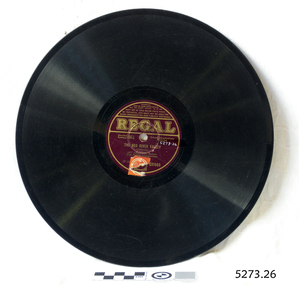 Flagstaff Hill Maritime Museum and Village
Audio - Gramophone Record, Regal Records, The Red River Valley, Early-to-mid 20th century
... Common diameters of records: 7 inch, 10 inch, 12 inch and 16 inch Revolutions Per Minute include: 33 1/3, 45, 78 Minutes per side of record: 3, 5.5, 7, 8, 9, 12, 15 and 22 Labels, in minutes per side: Single Play 3-5 min, Extended Play (EP) 7-12 min, Long Play (LP) 12-22 min This gramophone represents a step in the evolution of recording sound. In the 19th century, the human voice was first recorded on wax cylinders and replayed. ...Thomas Edison (1847–1931), an American, invented the phonograph in 1877, making it possible to record sound waves vertically and reproduce them on a wax cylinder so they could be heard again. Later, the German American, Emile Berliner (1851-1929), improved on Edison’s principles, greatly increasing the quality of the reproduced sounds with his invention of the gramophone in 1887, which recorded the sound waves laterally onto a flat shellac disc, or ‘record’. Records could be mass-produced in a factory where audio recordings were converted to a physical copy of that recording on a plate-sized disc. A gramophone machine reproduced the sound by spinning the record on a turntable at a specified number of rotations per minute (RPM) and using a stylus or needle to transfer the vibration via a membrane to a speaker, which amplified the sound. Berliner helped set up affiliated businesses overseas. One of his representatives was William Barry Owen (1860–1914), who, on 23 February 1889, partnered with Edmund Trevor Lloyd Williams (1859–1946) in England to register The Gramophone Company. His Master’s Voice (HMV) soon became the company’s major recording label, popular worldwide. The business based the label's logo of a dog looking into a gramophone horn for ‘his master’s voice’ was based on a painting by English artist Francis Barraud, which featured a terrier called Nipper beside a gramophone. Early gramophone records were mostly made from a material referred to as shellac, a natural ingredient combined with slate powder, and a filler of manilla copal, wood resin, carnauba wax, and carbon black. Although Bakelite seemed a useful, synthetic product, it was unsuccessful as a product for records. Around the time of World War II, lightweight, flexible synthetic vinyl records began replacing shellac records. Common diameters of records: 7 inch, 10 inch, 12 inch and 16 inch Revolutions Per Minute include: 33 1/3, 45, 78 Minutes per side of record: 3, 5.5, 7, 8, 9, 12, 15 and 22 Labels, in minutes per side: Single Play 3-5 min, Extended Play (EP) 7-12 min, Long Play (LP) 12-22 min This gramophone represents a step in the evolution of recording sound. In the 19th century, the human voice was first recorded on wax cylinders and replayed. It was the beginning of a new era in sound. Then, in the 1880s, voice could be recorded onto flat discs like this record, reliably reproduced and replayed many times, even on portable devices. Later, in the mid-20th century the following generation of electronic audio recording began, and later that century, digital recording gave even better reproduction. The record represents a popular means of entertainment for personal and social activities, as well as in some businesses. Shellac gramophone record with a burgundy and gold label. Title: The Red River Valley Artist: Art Leonard, baritone Publisher: Regal Number: T1232 G21555 Size: 10 inchflagstaff hill, warrnambool, maritime village, maritime museum, flagstaff hill maritime museum and village, shipwreck coast, great ocean road, gramophone, phonograph, sound waves, record, reproduction, audio record, music, sound, thomas edison, emile berliner, 1887, shellac, rpm, william barry owen, edmund trevor lloyd williams, the gramophone company, his master’s voice, hmv, francis barraud, nipper, regal, t1232, the red river valley, art leonard, g21555 -
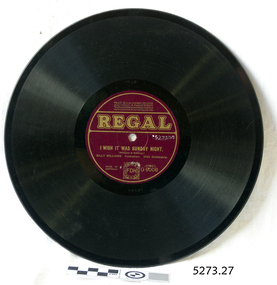 Flagstaff Hill Maritime Museum and Village
Audio - Gramophone Record, Regal Records, I Wish It Was Sunday Night, Early-to-mid 20th century
... Common diameters of records: 7 inch, 10 inch, 12 inch and 16 inch Revolutions Per Minute include: 33 1/3, 45, 78 Minutes per side of record: 3, 5.5, 7, 8, 9, 12, 15 and 22 Labels, in minutes per side: Single Play 3-5 min, Extended Play (EP) 7-12 min, Long Play (LP) 12-22 min This gramophone represents a step in the evolution of recording sound. In the 19th century, the human voice was first recorded on wax cylinders and replayed. ...Thomas Edison (1847–1931), an American, invented the phonograph in 1877, making it possible to record sound waves vertically and reproduce them on a wax cylinder so they could be heard again. Later, the German American, Emile Berliner (1851-1929), improved on Edison’s principles, greatly increasing the quality of the reproduced sounds with his invention of the gramophone in 1887, which recorded the sound waves laterally onto a flat shellac disc, or ‘record’. Records could be mass-produced in a factory where audio recordings were converted to a physical copy of that recording on a plate-sized disc. A gramophone machine reproduced the sound by spinning the record on a turntable at a specified number of rotations per minute (RPM) and using a stylus or needle to transfer the vibration via a membrane to a speaker, which amplified the sound. Berliner helped set up affiliated businesses overseas. One of his representatives was William Barry Owen (1860–1914), who, on 23 February 1889, partnered with Edmund Trevor Lloyd Williams (1859–1946) in England to register The Gramophone Company. His Master’s Voice (HMV) soon became the company’s major recording label, popular worldwide. The business based the label's logo of a dog looking into a gramophone horn for ‘his master’s voice’ was based on a painting by English artist Francis Barraud, which featured a terrier called Nipper beside a gramophone. Early gramophone records were mostly made from a material referred to as shellac, a natural ingredient combined with slate powder, and a filler of manilla copal, wood resin, carnauba wax, and carbon black. Although Bakelite seemed a useful, synthetic product, it was unsuccessful as a product for records. Around the time of World War II, lightweight, flexible synthetic vinyl records began replacing shellac records. Common diameters of records: 7 inch, 10 inch, 12 inch and 16 inch Revolutions Per Minute include: 33 1/3, 45, 78 Minutes per side of record: 3, 5.5, 7, 8, 9, 12, 15 and 22 Labels, in minutes per side: Single Play 3-5 min, Extended Play (EP) 7-12 min, Long Play (LP) 12-22 min This gramophone represents a step in the evolution of recording sound. In the 19th century, the human voice was first recorded on wax cylinders and replayed. It was the beginning of a new era in sound. Then, in the 1880s, voice could be recorded onto flat discs like this record, reliably reproduced and replayed many times, even on portable devices. Later, in the mid-20th century the following generation of electronic audio recording began, and later that century, digital recording gave even better reproduction. The record represents a popular means of entertainment for personal and social activities, as well as in some businesses. Shellac gramophone record with a burgundy and gold label. Title: I Wish It Was Sunday Night Artist: Billy Williams Publisher: Regal Number: 27921 G6006 Size: 10 inchflagstaff hill, warrnambool, maritime village, maritime museum, flagstaff hill maritime museum and village, shipwreck coast, great ocean road, gramophone, phonograph, sound waves, record, reproduction, audio record, music, sound, thomas edison, emile berliner, 1887, shellac, rpm, william barry owen, edmund trevor lloyd williams, the gramophone company, his master’s voice, hmv, francis barraud, nipper, regal, 27921, i wish it was sunday night, billy williams, g6006 -
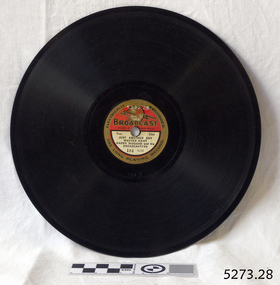 Flagstaff Hill Maritime Museum and Village
Audio - Gramophone Record, Vocalion Gramophone Co. Ltd (Broadcast records), Just Another Day Wasted Away, late 1920s to early 1930s
... Common diameters of records: 7 inch, 10 inch, 12 inch and 16 inch Revolutions Per Minute include: 33 1/3, 45, 78 Minutes per side of record: 3, 5.5, 7, 8, 9, 12, 15 and 22 Labels, in minutes per side: Single Play 3-5 min, Extended Play (EP) 7-12 min, Long Play (LP) 12-22 min This gramophone represents a step in the evolution of recording sound. In the 19th century, the human voice was first recorded on wax cylinders and replayed. ...Thomas Edison (1847–1931), an American, invented the phonograph in 1877, making it possible to record sound waves vertically and reproduce them on a wax cylinder so they could be heard again. Later, the German American, Emile Berliner (1851-1929), improved on Edison’s principles, greatly increasing the quality of the reproduced sounds with his invention of the gramophone in 1887, which recorded the sound waves laterally onto a flat shellac disc, or ‘record’. Records could be mass-produced in a factory where audio recordings were converted to a physical copy of that recording on a plate-sized disc. A gramophone machine reproduced the sound by spinning the record on a turntable at a specified number of rotations per minute (RPM) and using a stylus or needle to transfer the vibration via a membrane to a speaker, which amplified the sound. Berliner helped set up affiliated businesses overseas. One of his representatives was William Barry Owen (1860–1914), who, on 23 February 1889, partnered with Edmund Trevor Lloyd Williams (1859–1946) in England to register The Gramophone Company. His Master’s Voice (HMV) soon became the company’s major recording label, popular worldwide. The business based the label's logo of a dog looking into a gramophone horn for ‘his master’s voice’ was based on a painting by English artist Francis Barraud, which featured a terrier called Nipper beside a gramophone. Early gramophone records were mostly made from a material referred to as shellac, a natural ingredient combined with slate powder, and a filler of manilla copal, wood resin, carnauba wax, and carbon black. Although Bakelite seemed a useful, synthetic product, it was unsuccessful as a product for records. Around the time of World War II, lightweight, flexible synthetic vinyl records began replacing shellac records. Common diameters of records: 7 inch, 10 inch, 12 inch and 16 inch Revolutions Per Minute include: 33 1/3, 45, 78 Minutes per side of record: 3, 5.5, 7, 8, 9, 12, 15 and 22 Labels, in minutes per side: Single Play 3-5 min, Extended Play (EP) 7-12 min, Long Play (LP) 12-22 min This gramophone represents a step in the evolution of recording sound. In the 19th century, the human voice was first recorded on wax cylinders and replayed. It was the beginning of a new era in sound. Then, in the 1880s, voice could be recorded onto flat discs like this record, reliably reproduced and replayed many times, even on portable devices. Later, in the mid-20th century the following generation of electronic audio recording began, and later that century, digital recording gave even better reproduction. The record represents a popular means of entertainment for personal and social activities, as well as in some businesses. Shellac gramophone record with a red, cream and gold label. Title: Just Another Day Wasted Away Artist: Harry Bidgood and his Broadcasters Publisher: Broadcast, British Vocalion Number: A184 Size: 8 inch This small record was electronically recorded. It was promoted as Broadcast, The Long Playing Record.flagstaff hill, warrnambool, maritime village, maritime museum, flagstaff hill maritime museum and village, shipwreck coast, great ocean road, gramophone, phonograph, sound waves, record, reproduction, audio record, music, sound, thomas edison, emile berliner, 1887, shellac, rpm, william barry owen, edmund trevor lloyd williams, the gramophone company, his master’s voice, hmv, francis barraud, nipper, electrically recorded, the long playing record, broadcast, british vocalion, middlesex, a184, just another day wasted away, harry bidgood and his broadcasters, 8 inch -
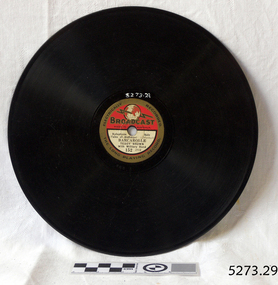 Flagstaff Hill Maritime Museum and Village
Audio - Gramophone Record, Vocalion Gramophone Co. Ltd (Broadcast records), Barcarole, late 1920s to early 1930s
... Common diameters of records: 7 inch, 10 inch, 12 inch and 16 inch Revolutions Per Minute include: 33 1/3, 45, 78 Minutes per side of record: 3, 5.5, 7, 8, 9, 12, 15 and 22 Labels, in minutes per side: Single Play 3-5 min, Extended Play (EP) 7-12 min, Long Play (LP) 12-22 min This gramophone represents a step in the evolution of recording sound. In the 19th century, the human voice was first recorded on wax cylinders and replayed. ...Thomas Edison (1847–1931), an American, invented the phonograph in 1877, making it possible to record sound waves vertically and reproduce them on a wax cylinder so they could be heard again. Later, the German American, Emile Berliner (1851-1929), improved on Edison’s principles, greatly increasing the quality of the reproduced sounds with his invention of the gramophone in 1887, which recorded the sound waves laterally onto a flat shellac disc, or ‘record’. Records could be mass-produced in a factory where audio recordings were converted to a physical copy of that recording on a plate-sized disc. A gramophone machine reproduced the sound by spinning the record on a turntable at a specified number of rotations per minute (RPM) and using a stylus or needle to transfer the vibration via a membrane to a speaker, which amplified the sound. Berliner helped set up affiliated businesses overseas. One of his representatives was William Barry Owen (1860–1914), who, on 23 February 1889, partnered with Edmund Trevor Lloyd Williams (1859–1946) in England to register The Gramophone Company. His Master’s Voice (HMV) soon became the company’s major recording label, popular worldwide. The business based the label's logo of a dog looking into a gramophone horn for ‘his master’s voice’ was based on a painting by English artist Francis Barraud, which featured a terrier called Nipper beside a gramophone. Early gramophone records were mostly made from a material referred to as shellac, a natural ingredient combined with slate powder, and a filler of manilla copal, wood resin, carnauba wax, and carbon black. Although Bakelite seemed a useful, synthetic product, it was unsuccessful as a product for records. Around the time of World War II, lightweight, flexible synthetic vinyl records began replacing shellac records. Common diameters of records: 7 inch, 10 inch, 12 inch and 16 inch Revolutions Per Minute include: 33 1/3, 45, 78 Minutes per side of record: 3, 5.5, 7, 8, 9, 12, 15 and 22 Labels, in minutes per side: Single Play 3-5 min, Extended Play (EP) 7-12 min, Long Play (LP) 12-22 min This gramophone represents a step in the evolution of recording sound. In the 19th century, the human voice was first recorded on wax cylinders and replayed. It was the beginning of a new era in sound. Then, in the 1880s, voice could be recorded onto flat discs like this record, reliably reproduced and replayed many times, even on portable devices. Later, in the mid-20th century the following generation of electronic audio recording began, and later that century, digital recording gave even better reproduction. The record represents a popular means of entertainment for personal and social activities, as well as in some businesses. Shellac gramophone record with a red, cream and gold label. Title: Barcarole Artist: Teddy Brown with his Military Band, Publisher: Broadcast, British Vocalion, Middlesex Number: A152 Size: 9 inch, Electrically recorded, promoted as Broadcast, The Long Playing Record.flagstaff hill, warrnambool, maritime village, maritime museum, flagstaff hill maritime museum and village, shipwreck coast, great ocean road, gramophone, phonograph, sound waves, record, reproduction, audio record, music, sound, thomas edison, emile berliner, 1887, shellac, rpm, william barry owen, edmund trevor lloyd williams, the gramophone company, his master’s voice, hmv, francis barraud, nipper, electrically recorded, the long playing record, broadcast, british vocalion, middlesex, a152, barcarole, teddy brown with his military band, 9 inch -
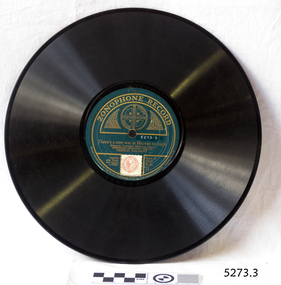 Flagstaff Hill Maritime Museum and Village
Audio - Gramophone Record, Zonophone Records, There's a new star in Heaven tonight, Early-to-mid 20th century
... Common diameters of records: 7 inch, 10 inch, 12 inch and 16 inch Revolutions Per Minute include: 33 1/3, 45, 78 Minutes per side of record: 3, 5.5, 7, 8, 9, 12, 15 and 22 Labels, in minutes per side: Single Play 3-5 min, Extended Play (EP) 7-12 min, Long Play (LP) 12-22 min This gramophone represents a step in the evolution of recording sound. In the 19th century, the human voice was first recorded on wax cylinders and replayed. ...Thomas Edison (1847–1931), an American, invented the phonograph in 1877, making it possible to record sound waves vertically and reproduce them on a wax cylinder so they could be heard again. Later, the German American, Emile Berliner (1851-1929), improved on Edison’s principles, greatly increasing the quality of the reproduced sounds with his invention of the gramophone in 1887, which recorded the sound waves laterally onto a flat shellac disc, or ‘record’. Records could be mass-produced in a factory where audio recordings were converted to a physical copy of that recording on a plate-sized disc. A gramophone machine reproduced the sound by spinning the record on a turntable at a specified number of rotations per minute (RPM) and using a stylus or needle to transfer the vibration via a membrane to a speaker, which amplified the sound. Berliner helped set up affiliated businesses overseas. One of his representatives was William Barry Owen (1860–1914), who, on 23 February 1889, partnered with Edmund Trevor Lloyd Williams (1859–1946) in England to register The Gramophone Company. His Master’s Voice (HMV) soon became the company’s major recording label, popular worldwide. The business based the label's logo of a dog looking into a gramophone horn for ‘his master’s voice’ was based on a painting by English artist Francis Barraud, which featured a terrier called Nipper beside a gramophone. Early gramophone records were mostly made from a material referred to as shellac, a natural ingredient combined with slate powder, and a filler of manilla copal, wood resin, carnauba wax, and carbon black. Although Bakelite seemed a useful, synthetic product, it was unsuccessful as a product for records. Around the time of World War II, lightweight, flexible synthetic vinyl records began replacing shellac records. Common diameters of records: 7 inch, 10 inch, 12 inch and 16 inch Revolutions Per Minute include: 33 1/3, 45, 78 Minutes per side of record: 3, 5.5, 7, 8, 9, 12, 15 and 22 Labels, in minutes per side: Single Play 3-5 min, Extended Play (EP) 7-12 min, Long Play (LP) 12-22 minThis gramophone represents a step in the evolution of recording sound. In the 19th century, the human voice was first recorded on wax cylinders and replayed. It was the beginning of a new era in sound. Then, in the 1880s, voice could be recorded onto flat discs like this record, reliably reproduced and replayed many times, even on portable devices. Later, in the mid-20th century the following generation of electronic audio recording began, and later that century, digital recording gave even better reproduction. The record represents a popular means of entertainment for personal and social activities, as well as in some businesses. Shellac gramophone record with a green and gold label. Title: There's a new star in Heaven tonight Artist: Veron Dalhart Publisher: Zonophone Records England Number: 112037 Size: 10 inchflagstaff hill, warrnambool, maritime village, maritime museum, flagstaff hill maritime museum and village, shipwreck coast, great ocean road, gramophone, phonograph, sound waves, record, reproduction, audio record, music, sound, thomas edison, emile berliner, 1887, shellac, rpm, william barry owen, edmund trevor lloyd williams, the gramophone company, his master’s voice, hmv, francis barraud, nipper, 10 inch, there's a new star in heaven tonight, veron dalhart, zonophone records, england -
 Flagstaff Hill Maritime Museum and Village
Audio - Gramophone Record, Vocalion Gramophone Co. Ltd (Broadcast records), Dancing Tamborine, late 1920s to early 1930s
... Common diameters of records: 7 inch, 10 inch, 12 inch and 16 inch Revolutions Per Minute include: 33 1/3, 45, 78 Minutes per side of record: 3, 5.5, 7, 8, 9, 12, 15 and 22 Labels, in minutes per side: Single Play 3-5 min, Extended Play (EP) 7-12 min, Long Play (LP) 12-22 min This gramophone represents a step in the evolution of recording sound. In the 19th century, the human voice was first recorded on wax cylinders and replayed. ...Thomas Edison (1847–1931), an American, invented the phonograph in 1877, making it possible to record sound waves vertically and reproduce them on a wax cylinder so they could be heard again. Later, the German American, Emile Berliner (1851-1929), improved on Edison’s principles, greatly increasing the quality of the reproduced sounds with his invention of the gramophone in 1887, which recorded the sound waves laterally onto a flat shellac disc, or ‘record’. Records could be mass-produced in a factory where audio recordings were converted to a physical copy of that recording on a plate-sized disc. A gramophone machine reproduced the sound by spinning the record on a turntable at a specified number of rotations per minute (RPM) and using a stylus or needle to transfer the vibration via a membrane to a speaker, which amplified the sound. Berliner helped set up affiliated businesses overseas. One of his representatives was William Barry Owen (1860–1914), who, on 23 February 1889, partnered with Edmund Trevor Lloyd Williams (1859–1946) in England to register The Gramophone Company. His Master’s Voice (HMV) soon became the company’s major recording label, popular worldwide. The business based the label's logo of a dog looking into a gramophone horn for ‘his master’s voice’ was based on a painting by English artist Francis Barraud, which featured a terrier called Nipper beside a gramophone. Early gramophone records were mostly made from a material referred to as shellac, a natural ingredient combined with slate powder, and a filler of manilla copal, wood resin, carnauba wax, and carbon black. Although Bakelite seemed a useful, synthetic product, it was unsuccessful as a product for records. Around the time of World War II, lightweight, flexible synthetic vinyl records began replacing shellac records. Common diameters of records: 7 inch, 10 inch, 12 inch and 16 inch Revolutions Per Minute include: 33 1/3, 45, 78 Minutes per side of record: 3, 5.5, 7, 8, 9, 12, 15 and 22 Labels, in minutes per side: Single Play 3-5 min, Extended Play (EP) 7-12 min, Long Play (LP) 12-22 min This gramophone represents a step in the evolution of recording sound. In the 19th century, the human voice was first recorded on wax cylinders and replayed. It was the beginning of a new era in sound. Then, in the 1880s, voice could be recorded onto flat discs like this record, reliably reproduced and replayed many times, even on portable devices. Later, in the mid-20th century the following generation of electronic audio recording began, and later that century, digital recording gave even better reproduction. The record represents a popular means of entertainment for personal and social activities, as well as in some businesses. Shellac gramophone record with a red, cream and gold label. Title: Dancing Tamborine Artist: Harry Bidgood and his Broadcasters Publisher: Broadcast, British Vocalion Number: A193 Size: 8 inch Electrically recorded, promoted by Broadcast as The Long Playing Record.flagstaff hill, warrnambool, maritime village, maritime museum, flagstaff hill maritime museum and village, shipwreck coast, great ocean road, gramophone, phonograph, sound waves, record, reproduction, audio record, music, sound, thomas edison, emile berliner, 1887, shellac, rpm, william barry owen, edmund trevor lloyd williams, the gramophone company, his master’s voice, hmv, francis barraud, nipper, electrically recorded, the long playing record, broadcast, british vocalion, middlesex, a193, dancing tamborine, harry bidgood and his broadcasters, 8 inch -
 Flagstaff Hill Maritime Museum and Village
Audio - Gramophone Record, Zonophone Records, The Wedding of Sandy McNab, Early-to-mid 20th century
... Common diameters of records: 7 inch, 10 inch, 12 inch and 16 inch Revolutions Per Minute include: 33 1/3, 45, 78 Minutes per side of record: 3, 5.5, 7, 8, 9, 12, 15 and 22 Labels, in minutes per side: Single Play 3-5 min, Extended Play (EP) 7-12 min, Long Play (LP) 12-22 min This gramophone represents a step in the evolution of recording sound. In the 19th century, the human voice was first recorded on wax cylinders and replayed. ...Thomas Edison (1847–1931), an American, invented the phonograph in 1877, making it possible to record sound waves vertically and reproduce them on a wax cylinder so they could be heard again. Later, the German American, Emile Berliner (1851-1929), improved on Edison’s principles, greatly increasing the quality of the reproduced sounds with his invention of the gramophone in 1887, which recorded the sound waves laterally onto a flat shellac disc, or ‘record’. Records could be mass-produced in a factory where audio recordings were converted to a physical copy of that recording on a plate-sized disc. A gramophone machine reproduced the sound by spinning the record on a turntable at a specified number of rotations per minute (RPM) and using a stylus or needle to transfer the vibration via a membrane to a speaker, which amplified the sound. Berliner helped set up affiliated businesses overseas. One of his representatives was William Barry Owen (1860–1914), who, on 23 February 1889, partnered with Edmund Trevor Lloyd Williams (1859–1946) in England to register The Gramophone Company. His Master’s Voice (HMV) soon became the company’s major recording label, popular worldwide. The business based the label's logo of a dog looking into a gramophone horn for ‘his master’s voice’ was based on a painting by English artist Francis Barraud, which featured a terrier called Nipper beside a gramophone. Early gramophone records were mostly made from a material referred to as shellac, a natural ingredient combined with slate powder, and a filler of manilla copal, wood resin, carnauba wax, and carbon black. Although Bakelite seemed a useful, synthetic product, it was unsuccessful as a product for records. Around the time of World War II, lightweight, flexible synthetic vinyl records began replacing shellac records. Common diameters of records: 7 inch, 10 inch, 12 inch and 16 inch Revolutions Per Minute include: 33 1/3, 45, 78 Minutes per side of record: 3, 5.5, 7, 8, 9, 12, 15 and 22 Labels, in minutes per side: Single Play 3-5 min, Extended Play (EP) 7-12 min, Long Play (LP) 12-22 minThis gramophone represents a step in the evolution of recording sound. In the 19th century, the human voice was first recorded on wax cylinders and replayed. It was the beginning of a new era in sound. Then, in the 1880s, voice could be recorded onto flat discs like this record, reliably reproduced and replayed many times, even on portable devices. Later, in the mid-20th century the following generation of electronic audio recording began, and later that century, digital recording gave even better reproduction. The record represents a popular means of entertainment for personal and social activities, as well as in some businesses. Shellac gramophone record with a green and gold label. Title: The Wedding of Sandy McNab Artist: Harry Lauder Publisher: Zonophone Records England Size: 10 inch Number: X-42793flagstaff hill, warrnambool, maritime village, maritime museum, flagstaff hill maritime museum and village, shipwreck coast, great ocean road, gramophone, phonograph, sound waves, record, reproduction, audio record, music, sound, thomas edison, emile berliner, 1887, shellac, rpm, william barry owen, edmund trevor lloyd williams, the gramophone company, his master’s voice, hmv, francis barraud, nipper, 10 inch, zonophone record, england, x-42793, the wedding of sandy mcnab, harry lauder -
 Flagstaff Hill Maritime Museum and Village
Audio - Gramophone Record, Zonophone Records, I shall have to ask my mother if she'll let me, Early-to-mid 20th century
... Common diameters of records: 7 inch, 10 inch, 12 inch and 16 inch Revolutions Per Minute include: 33 1/3, 45, 78 Minutes per side of record: 3, 5.5, 7, 8, 9, 12, 15 and 22 Labels, in minutes per side: Single Play 3-5 min, Extended Play (EP) 7-12 min, Long Play (LP) 12-22 min This gramophone represents a step in the evolution of recording sound. In the 19th century, the human voice was first recorded on wax cylinders and replayed. ...Thomas Edison (1847–1931), an American, invented the phonograph in 1877, making it possible to record sound waves vertically and reproduce them on a wax cylinder so they could be heard again. Later, the German American, Emile Berliner (1851-1929), improved on Edison’s principles, greatly increasing the quality of the reproduced sounds with his invention of the gramophone in 1887, which recorded the sound waves laterally onto a flat shellac disc, or ‘record’. Records could be mass-produced in a factory where audio recordings were converted to a physical copy of that recording on a plate-sized disc. A gramophone machine reproduced the sound by spinning the record on a turntable at a specified number of rotations per minute (RPM) and using a stylus or needle to transfer the vibration via a membrane to a speaker, which amplified the sound. Berliner helped set up affiliated businesses overseas. One of his representatives was William Barry Owen (1860–1914), who, on 23 February 1889, partnered with Edmund Trevor Lloyd Williams (1859–1946) in England to register The Gramophone Company. His Master’s Voice (HMV) soon became the company’s major recording label, popular worldwide. The business based the label's logo of a dog looking into a gramophone horn for ‘his master’s voice’ was based on a painting by English artist Francis Barraud, which featured a terrier called Nipper beside a gramophone. Early gramophone records were mostly made from a material referred to as shellac, a natural ingredient combined with slate powder, and a filler of manilla copal, wood resin, carnauba wax, and carbon black. Although Bakelite seemed a useful, synthetic product, it was unsuccessful as a product for records. Around the time of World War II, lightweight, flexible synthetic vinyl records began replacing shellac records. Common diameters of records: 7 inch, 10 inch, 12 inch and 16 inch Revolutions Per Minute include: 33 1/3, 45, 78 Minutes per side of record: 3, 5.5, 7, 8, 9, 12, 15 and 22 Labels, in minutes per side: Single Play 3-5 min, Extended Play (EP) 7-12 min, Long Play (LP) 12-22 min This gramophone represents a step in the evolution of recording sound. In the 19th century, the human voice was first recorded on wax cylinders and replayed. It was the beginning of a new era in sound. Then, in the 1880s, voice could be recorded onto flat discs like this record, reliably reproduced and replayed many times, even on portable devices. Later, in the mid-20th century the following generation of electronic audio recording began, and later that century, digital recording gave even better reproduction. The record represents a popular means of entertainment for personal and social activities, as well as in some businesses. Shellac gramophone record with a green and gold label. Title: I shall have to ask my mother if she'll let me Artist: Billy Williams Publisher: Zonophone Records England Number: X-3-42137 Size: 10 inchflagstaff hill, warrnambool, maritime village, maritime museum, flagstaff hill maritime museum and village, shipwreck coast, great ocean road, gramophone, phonograph, sound waves, record, reproduction, audio record, music, sound, thomas edison, emile berliner, 1887, shellac, rpm, william barry owen, edmund trevor lloyd williams, the gramophone company, his master’s voice, hmv, francis barraud, nipper, 10 inch, zonophone records england, x-3-42137. i shall have to ask my mother if she'll let me, billy williams -
 Flagstaff Hill Maritime Museum and Village
Audio - Gramophone Record, Columbia Records, Love Is Just A Little Bit Of Heaven, Early-to-mid 20th century
... Common diameters of records: 7 inch, 10 inch, 12 inch and 16 inch Revolutions Per Minute include: 33 1/3, 45, 78 Minutes per side of record: 3, 5.5, 7, 8, 9, 12, 15 and 22 Labels, in minutes per side: Single Play 3-5 min, Extended Play (EP) 7-12 min, Long Play (LP) 12-22 min This gramophone represents a step in the evolution of recording sound. In the 19th century, the human voice was first recorded on wax cylinders and replayed. ...Thomas Edison (1847–1931), an American, invented the phonograph in 1877, making it possible to record sound waves vertically and reproduce them on a wax cylinder so they could be heard again. Later, the German American, Emile Berliner (1851-1929), improved on Edison’s principles, greatly increasing the quality of the reproduced sounds with his invention of the gramophone in 1887, which recorded the sound waves laterally onto a flat shellac disc, or ‘record’. Records could be mass-produced in a factory where audio recordings were converted to a physical copy of that recording on a plate-sized disc. A gramophone machine reproduced the sound by spinning the record on a turntable at a specified number of rotations per minute (RPM) and using a stylus or needle to transfer the vibration via a membrane to a speaker, which amplified the sound. Berliner helped set up affiliated businesses overseas. One of his representatives was William Barry Owen (1860–1914), who, on 23 February 1889, partnered with Edmund Trevor Lloyd Williams (1859–1946) in England to register The Gramophone Company. His Master’s Voice (HMV) soon became the company’s major recording label, popular worldwide. The business based the label's logo of a dog looking into a gramophone horn for ‘his master’s voice’ was based on a painting by English artist Francis Barraud, which featured a terrier called Nipper beside a gramophone. Early gramophone records were mostly made from a material referred to as shellac, a natural ingredient combined with slate powder, and a filler of manilla copal, wood resin, carnauba wax, and carbon black. Although Bakelite seemed a useful, synthetic product, it was unsuccessful as a product for records. Around the time of World War II, lightweight, flexible synthetic vinyl records began replacing shellac records. Common diameters of records: 7 inch, 10 inch, 12 inch and 16 inch Revolutions Per Minute include: 33 1/3, 45, 78 Minutes per side of record: 3, 5.5, 7, 8, 9, 12, 15 and 22 Labels, in minutes per side: Single Play 3-5 min, Extended Play (EP) 7-12 min, Long Play (LP) 12-22 min This gramophone represents a step in the evolution of recording sound. In the 19th century, the human voice was first recorded on wax cylinders and replayed. It was the beginning of a new era in sound. Then, in the 1880s, voice could be recorded onto flat discs like this record, reliably reproduced and replayed many times, even on portable devices. Later, in the mid-20th century the following generation of electronic audio recording began, and later that century, digital recording gave even better reproduction. The record represents a popular means of entertainment for personal and social activities, as well as in some businesses. Shellac gramophone record with a purple and gold label. Title: Love Is Just A Little Bit Of Heaven Artist: Len Maurice Publisher: Columbia Number:0764 Size: 10 inchOn label, two torn paper stamps, one has blue printingflagstaff hill, warrnambool, maritime village, maritime museum, flagstaff hill maritime museum and village, shipwreck coast, great ocean road, gramophone, phonograph, sound waves, record, reproduction, audio record, music, sound, thomas edison, emile berliner, 1887, shellac, rpm, william barry owen, edmund trevor lloyd williams, the gramophone company, his master’s voice, hmv, francis barraud, nipper, 10 inch, columbia, 0764. love is just a little bit of heaven, len maurice -
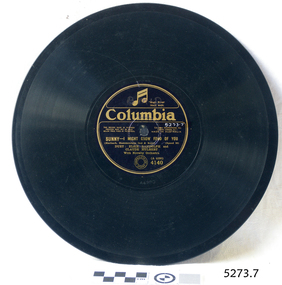 Flagstaff Hill Maritime Museum and Village
Audio - Gramophone Record, Columbia Records, Sunny I Might Grow Fond Of You, Early-to-mid 20th century
... Common diameters of records: 7 inch, 10 inch, 12 inch and 16 inch Revolutions Per Minute include: 33 1/3, 45, 78 Minutes per side of record: 3, 5.5, 7, 8, 9, 12, 15 and 22 Labels, in minutes per side: Single Play 3-5 min, Extended Play (EP) 7-12 min, Long Play (LP) 12-22 min This gramophone represents a step in the evolution of recording sound. In the 19th century, the human voice was first recorded on wax cylinders and replayed. ...Thomas Edison (1847–1931), an American, invented the phonograph in 1877, making it possible to record sound waves vertically and reproduce them on a wax cylinder so they could be heard again. Later, the German American, Emile Berliner (1851-1929), improved on Edison’s principles, greatly increasing the quality of the reproduced sounds with his invention of the gramophone in 1887, which recorded the sound waves laterally onto a flat shellac disc, or ‘record’. Records could be mass-produced in a factory where audio recordings were converted to a physical copy of that recording on a plate-sized disc. A gramophone machine reproduced the sound by spinning the record on a turntable at a specified number of rotations per minute (RPM) and using a stylus or needle to transfer the vibration via a membrane to a speaker, which amplified the sound. Berliner helped set up affiliated businesses overseas. One of his representatives was William Barry Owen (1860–1914), who, on 23 February 1889, partnered with Edmund Trevor Lloyd Williams (1859–1946) in England to register The Gramophone Company. His Master’s Voice (HMV) soon became the company’s major recording label, popular worldwide. The business based the label's logo of a dog looking into a gramophone horn for ‘his master’s voice’ was based on a painting by English artist Francis Barraud, which featured a terrier called Nipper beside a gramophone. Early gramophone records were mostly made from a material referred to as shellac, a natural ingredient combined with slate powder, and a filler of manilla copal, wood resin, carnauba wax, and carbon black. Although Bakelite seemed a useful, synthetic product, it was unsuccessful as a product for records. Around the time of World War II, lightweight, flexible synthetic vinyl records began replacing shellac records. Common diameters of records: 7 inch, 10 inch, 12 inch and 16 inch Revolutions Per Minute include: 33 1/3, 45, 78 Minutes per side of record: 3, 5.5, 7, 8, 9, 12, 15 and 22 Labels, in minutes per side: Single Play 3-5 min, Extended Play (EP) 7-12 min, Long Play (LP) 12-22 min This gramophone represents a step in the evolution of recording sound. In the 19th century, the human voice was first recorded on wax cylinders and replayed. It was the beginning of a new era in sound. Then, in the 1880s, voice could be recorded onto flat discs like this record, reliably reproduced and replayed many times, even on portable devices. Later, in the mid-20th century the following generation of electronic audio recording began, and later that century, digital recording gave even better reproduction. The record represents a popular means of entertainment for personal and social activities, as well as in some businesses. Shellac gramophone record with a purple and gold label. Title: Sunny I Might Grow Fond Of You Artist: Duet Elsie Randolph and Claude Hulbert Publisher: Columbia Number: A4290 Size: 10 inch flagstaff hill, warrnambool, maritime village, maritime museum, flagstaff hill maritime museum and village, shipwreck coast, great ocean road, gramophone, phonograph, sound waves, record, reproduction, audio record, music, sound, thomas edison, emile berliner, 1887, shellac, rpm, william barry owen, edmund trevor lloyd williams, the gramophone company, his master’s voice, hmv, francis barraud, nipper, 10 inch, columbia, a4290. sunny i might grow fond of you, duet elsie randolph and claude hulbert -
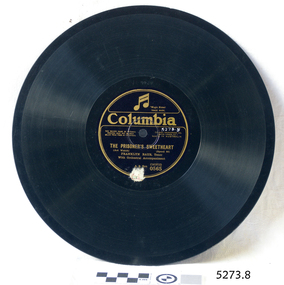 Flagstaff Hill Maritime Museum and Village
Audio - Gramophone Record, Columbia Records, The Prisoner's Sweetheart, Early-to-mid 20th century
... Common diameters of records: 7 inch, 10 inch, 12 inch and 16 inch Revolutions Per Minute include: 33 1/3, 45, 78 Minutes per side of record: 3, 5.5, 7, 8, 9, 12, 15 and 22 Labels, in minutes per side: Single Play 3-5 min, Extended Play (EP) 7-12 min, Long Play (LP) 12-22 min This gramophone represents a step in the evolution of recording sound. In the 19th century, the human voice was first recorded on wax cylinders and replayed. ...Thomas Edison (1847–1931), an American, invented the phonograph in 1877, making it possible to record sound waves vertically and reproduce them on a wax cylinder so they could be heard again. Later, the German American, Emile Berliner (1851-1929), improved on Edison’s principles, greatly increasing the quality of the reproduced sounds with his invention of the gramophone in 1887, which recorded the sound waves laterally onto a flat shellac disc, or ‘record’. Records could be mass-produced in a factory where audio recordings were converted to a physical copy of that recording on a plate-sized disc. A gramophone machine reproduced the sound by spinning the record on a turntable at a specified number of rotations per minute (RPM) and using a stylus or needle to transfer the vibration via a membrane to a speaker, which amplified the sound. Berliner helped set up affiliated businesses overseas. One of his representatives was William Barry Owen (1860–1914), who, on 23 February 1889, partnered with Edmund Trevor Lloyd Williams (1859–1946) in England to register The Gramophone Company. His Master’s Voice (HMV) soon became the company’s major recording label, popular worldwide. The business based the label's logo of a dog looking into a gramophone horn for ‘his master’s voice’ was based on a painting by English artist Francis Barraud, which featured a terrier called Nipper beside a gramophone. Early gramophone records were mostly made from a material referred to as shellac, a natural ingredient combined with slate powder, and a filler of manilla copal, wood resin, carnauba wax, and carbon black. Although Bakelite seemed a useful, synthetic product, it was unsuccessful as a product for records. Around the time of World War II, lightweight, flexible synthetic vinyl records began replacing shellac records. Common diameters of records: 7 inch, 10 inch, 12 inch and 16 inch Revolutions Per Minute include: 33 1/3, 45, 78 Minutes per side of record: 3, 5.5, 7, 8, 9, 12, 15 and 22 Labels, in minutes per side: Single Play 3-5 min, Extended Play (EP) 7-12 min, Long Play (LP) 12-22 min This gramophone represents a step in the evolution of recording sound. In the 19th century, the human voice was first recorded on wax cylinders and replayed. It was the beginning of a new era in sound. Then, in the 1880s, voice could be recorded onto flat discs like this record, reliably reproduced and replayed many times, even on portable devices. Later, in the mid-20th century the following generation of electronic audio recording began, and later that century, digital recording gave even better reproduction. The record represents a popular means of entertainment for personal and social activities, as well as in some businesses. Shellac gramophone record with a purple and gold label. Title: The Prisoner's Sweetheart Artist: tenor Franklyn Baur Publisher: Columbia Number:141812 Size: 10 inchflagstaff hill, warrnambool, maritime village, maritime museum, flagstaff hill maritime museum and village, shipwreck coast, great ocean road, gramophone, phonograph, sound waves, record, reproduction, audio record, music, sound, thomas edison, emile berliner, 1887, shellac, rpm, william barry owen, edmund trevor lloyd williams, the gramophone company, his master’s voice, hmv, francis barraud, nipper, 10 inch, columbia, 141812, the prisoner's sweetheart, franklyn baur (tenor)
