


Historical information
Thomas Edison (1847–1931), an American, invented the phonograph in 1877, making it possible to record sound waves vertically and reproduce them on a wax cylinder so they could be heard again. Later, the German American, Emile Berliner (1851-1929), improved on Edison’s principles, greatly increasing the quality of the reproduced sounds with his invention of the gramophone in 1887, which recorded the sound waves laterally onto a flat shellac disc, or ‘record’.
Records could be mass-produced in a factory where audio recordings were converted to a physical copy of that recording on a plate-sized disc. A gramophone machine reproduced the sound by spinning the record on a turntable at a specified number of rotations per minute (RPM) and using a stylus or needle to transfer the vibration via a membrane to a speaker, which amplified the sound.
Berliner helped set up affiliated businesses overseas. One of his representatives was William Barry Owen (1860–1914), who, on 23 February 1889, partnered with Edmund Trevor Lloyd Williams (1859–1946) in England to register The Gramophone Company. His Master’s Voice (HMV) soon became the company’s major recording label, popular worldwide. The business based the label's logo of a dog looking into a gramophone horn for ‘his master’s voice’ was based on a painting by English artist Francis Barraud, which featured a terrier called Nipper beside a gramophone.
Early gramophone records were mostly made from a material referred to as shellac, a natural ingredient combined with slate powder, and a filler of manilla copal, wood resin, carnauba wax, and carbon black. Although Bakelite seemed a useful, synthetic product, it was unsuccessful as a product for records. Around the time of World War II, lightweight, flexible synthetic vinyl records began replacing shellac records.
Common diameters of records: 7 inch, 10 inch, 12 inch and 16 inch
Revolutions Per Minute include: 33 1/3, 45, 78
Minutes per side of record: 3, 5.5, 7, 8, 9, 12, 15 and 22
Labels, in minutes per side: Single Play 3-5 min, Extended Play (EP) 7-12 min, Long Play (LP) 12-22 min
Significance
This gramophone represents a step in the evolution of recording sound. In the 19th century, the human voice was first recorded on wax cylinders and replayed. It was the beginning of a new era in sound. Then, in the 1880s, voice could be recorded onto flat discs like this record, reliably reproduced and replayed many times, even on portable devices. Later, in the mid-20th century the following generation of electronic audio recording began, and later that century, digital recording gave even better reproduction.
The record represents a popular means of entertainment for personal and social activities, as well as in some businesses.
Physical description
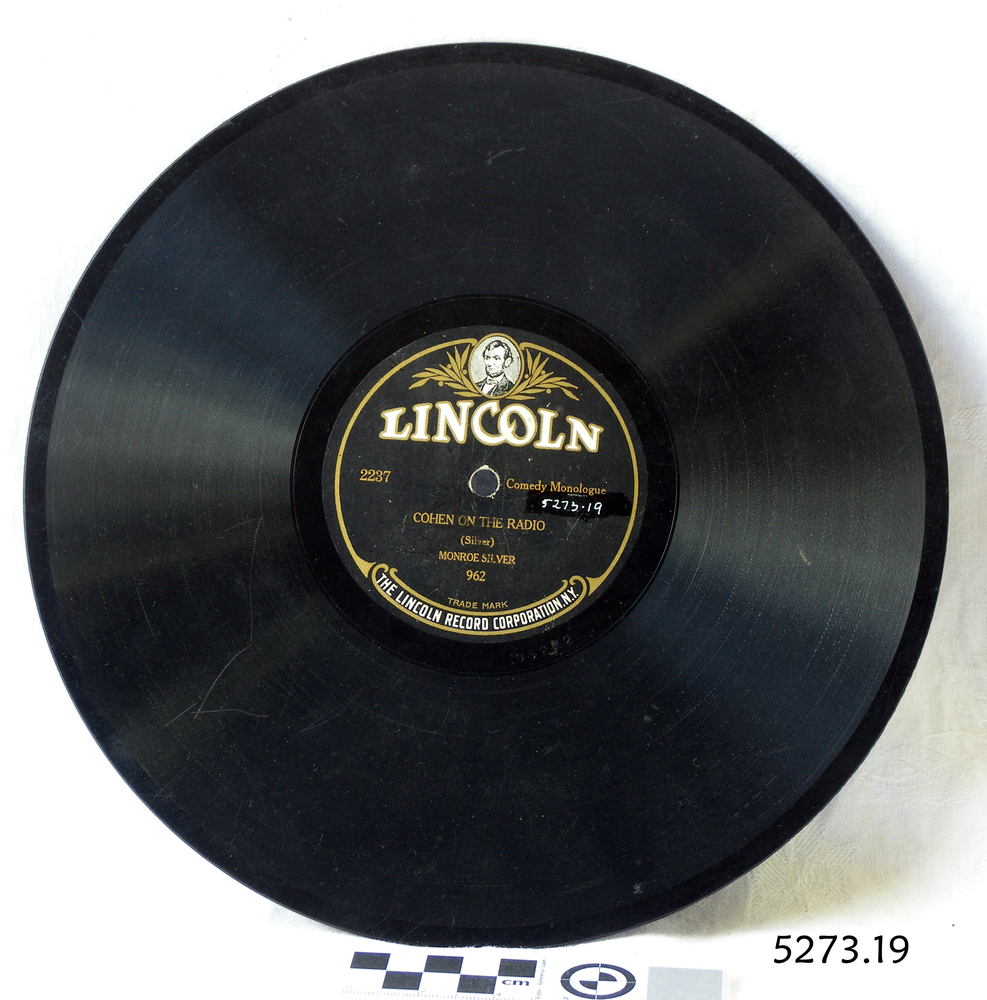
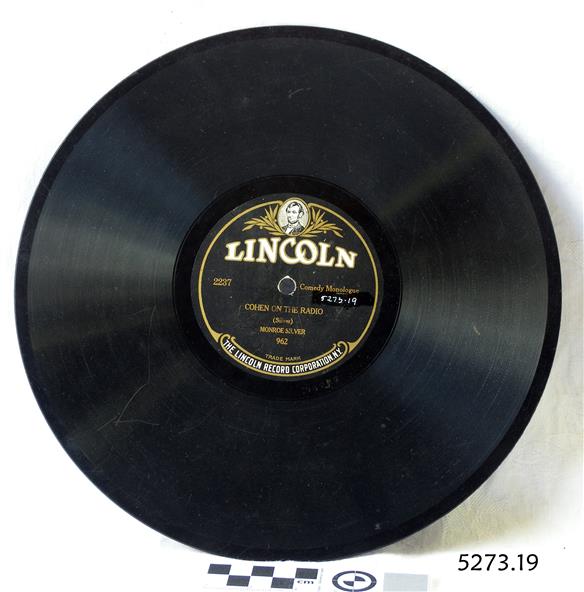
Shellac gramophone record with a black and gold label.
Title: Cohen On The Radio
Artist: Monroe Silver
Publisher: The Lincoln Record Corporation N.Y. 2237
Number:962
Size: 10 inch
Subjects
- flagstaff hill,
- warrnambool,
- maritime village,
- maritime museum,
- flagstaff hill maritime museum and village,
- shipwreck coast,
- great ocean road,
- gramophone,
- phonograph,
- sound waves,
- record,
- reproduction,
- audio record,
- music,
- sound,
- thomas edison,
- emile berliner,
- 1887,
- shellac,
- rpm,
- william barry owen,
- edmund trevor lloyd williams,
- the gramophone company,
- his master’s voice,
- hmv,
- francis barraud,
- nipper,
- the lincoln record corporation n.y. 2237,
- cohen on the radio,
- monroe silver,
- no 962,
- 10 inch
References
- Britannica Shellac
- National Science and Media Museum Making gramophone records
- Wikipedia Photograph Record