
Showing 64 items matching "nipper"
-
 Vision Australia
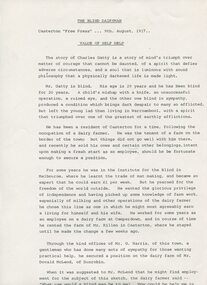
Document - Text, C.H. Nipper, Past and the Present 1866-1971 by C.H. Nipper - unordered extracts b, 1960-71
... Past and the Present 1866-1971 by C.H. Nipper - unordered extracts b...When author C.H. Nipper created historical overview of the first 60 years of the RVIB, various topics were covered by an unordered series of pages on individual topics. ...C.H. Nipper...Nipper ...When author C.H. Nipper created historical overview of the first 60 years of the RVIB, various topics were covered by an unordered series of pages on individual topics. These are: Education extracts from various newspapers (2 pages) Employment: - Dairyman (4 pages) Matilda Ann Aston (5 pages) Welfare Services (3 1/2 pages)14 page history of text and reproductions of articlesroyal victorian institute for the blind, c.h. nipper, employment, tilly aston, charles gatty, blindness, welfare services, rehabilitation -
 Vision Australia
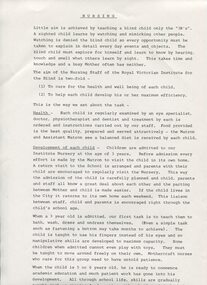
Document - Text, C.H. Nipper, Past and the Present 1866-1971 by C.H. Nipper - unordered extracts a, 1960-71
... Past and the Present 1866-1971 by C.H. Nipper - unordered extracts a...When author C.H. Nipper created historical overview of the first 60 years of the RVIB, various topics were covered by an unordered series of pages on individual topics. ...C.H. Nipper...Nipper ...When author C.H. Nipper created historical overview of the first 60 years of the RVIB, various topics were covered by an unordered series of pages on individual topics. These are: Admittance of Aboriginal people (1/2 page) Blinded soldiers (5 pages) Blindness - causes and prevention (4 pages) Buildings and Land (Snippets) - gas - grant of crown land - heating - insurance - water Change of name (1 page) Deaf-Blind and the Multiple Handicapped (3 pages) Education (9 pages, 1 missing) Employment: - Placement of blind people in employment (1 page) - Insurance brokerage as a profession of the blind by Fred C Tolstrup (3 pages) Fundraising (Snippets) - Coles Book Arcade - Sporting matches Kiosks for the Blind (1/2 page) Music (5 pages) Nursing (2 pages) Organ (Snippets) Ormond Hall (3 pages) Pensions (1/2 page) Rehabilitation Training centre (3 pages) Talking Book Library (1 1/2 pages)2 page foreward and 17 page historyroyal victorian institute for the blind, c.h. nipper, blind soldiers, deaf-blind, ormond hall, fundraising, rvib nursery, nellie melba, alice mcclelland, charles halle, blinded soldiers bowling club, talking books, employment, aboriginal and torrens strait islander people, pensions, fred c tolstrup, blindness, rehabilitation, education, buildings -
 Vision Australia
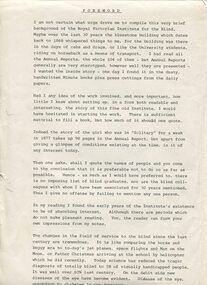
Document - Text, C.H. Nipper, Past and the Present 1866-1971 by C.H. Nipper, 1971
... Past and the Present 1866-1971 by C.H. Nipper...C.H. Nipper...Nipper Document Text C.H. Nipper ...A historical overview of the first 60 years of the RVIB, and some of the people and intentions behind it.2 page foreward and 17 page historyroyal victorian institute for the blind, c.h. nipper -
 City of Moorabbin Historical Society (Operating the Box Cottage Museum)
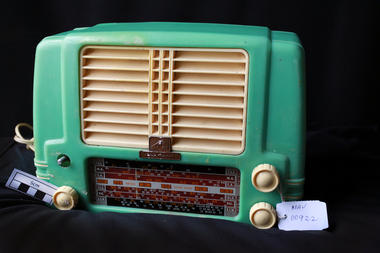
Communication Devices, Radio, 'HMV', c1930
... HMV stands for His Master's Voice, the title of a painting by Francis Barraud of the dog Nipper listening to a cylinder phonograph, which was bought by the Gramophone Company in 1899. ...A green mantel Radio set, 'HMV' , 'Little Nipper' c1930. The 4 tuning knobs are white, - one is missing - , the grill is white and the flex and plug are complete. ...Front ; HMV 'trade mark' ( dog with a cylinder phonograph' ) / " Little Nipper" ...For advertising purposes this was changed to a wind-up gramophone, and eventually used simply as a silhouette. hmv his master's voice radio gramaphones radio broadcasts early settlers pioneers market gardeners moorabbin cheltenham bentleigh london england little nipper painting mr biehl barraud francis Front ; HMV 'trade mark' ( dog with a cylinder phonograph' ) / " Little Nipper" A green mantel Radio set, 'HMV' , 'Little Nipper' c1930. ...The first HMV branded store was opened by the Gramophone Company on Oxford Street in 1921, and the HMV name was also used for television and radio sets manufactured from the 1930s onwards. HMV stands for His Master's Voice, the title of a painting by Francis Barraud of the dog Nipper listening to a cylinder phonograph, which was bought by the Gramophone Company in 1899. For advertising purposes this was changed to a wind-up gramophone, and eventually used simply as a silhouette.A green mantel Radio set, 'HMV' , 'Little Nipper' c1930. The 4 tuning knobs are white, - one is missing - , the grill is white and the flex and plug are complete. Front ; HMV 'trade mark' ( dog with a cylinder phonograph' ) / " Little Nipper" hmv, his master's voice radio, gramaphones, radio broadcasts, early settlers, pioneers, market gardeners, moorabbin, cheltenham, bentleigh, london england, little nipper painting, mr biehl, barraud francis -
 Vision Australia
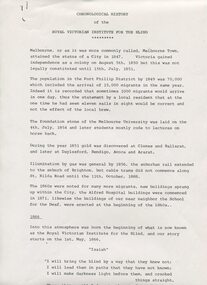
Document - Text, C.H. Nipper, Chronological History of the Royal Victorian Institute for the Blind, 1970?
... Possibly put together by C.H. Nipper, it covers the first meeting of the provisional committee for the Asylum and School for the Blind in 1866, application for land, buildings, financial concerns, development of school and nursery, introduction of library service and some employment services. ...C.H. Nipper...Nipper ...Chronological history of the RVIB, from newspaper and annual report sources. Possibly put together by C.H. Nipper, it covers the first meeting of the provisional committee for the Asylum and School for the Blind in 1866, application for land, buildings, financial concerns, development of school and nursery, introduction of library service and some employment services. The earlier section has more detail about the building, with minimal information after 1900.21 foolscap pages (missing page 11)royal victorian institute for the blind, c.h. nipper, deaf-blind, rehabilitation, education, employment, buildings, fundraising -
 Lakes Entrance Historical Society
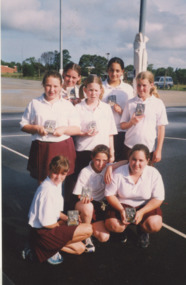
Photograph - Lakes Entrance Netball Nipper team runners up 2001, Lakes Post Newspaper
... Lakes Entrance Nipper Netball team runners up in recent grand final Jane Cameron Erini Pantopolous Jacqui O'Donnell Chelsea Bulmer Monica Davidson Emma Carstairs Ebony Stevens Jude Habe ...Colour photograph of Lakes Entrance Nipper Netball team runners up in recent grand final Jane Cameron Erini Pantopolous Jacqui O'Donnell Chelsea Bulmer Monica Davidson Emma Carstairs Ebony Stevens Jude Habe Lakes Entrance Victoria...Lakes Entrance Nipper Netball team runners up in recent grand final Jane Cameron Erini Pantopolous Jacqui O'Donnell Chelsea Bulmer Monica Davidson Emma Carstairs Ebony Stevens Jude Habe Sports Netball Recreation Clubs Colour photograph of Lakes Entrance Nipper Netball team runners up in recent grand final Jane Cameron Erini Pantopolous Jacqui O'Donnell Chelsea Bulmer Monica Davidson Emma Carstairs Ebony Stevens Jude Habe Lakes Entrance Victoria Photograph Lakes Entrance Netball Nipper team runners up 2001 Lakes Post Newspaper ...Lakes Entrance Nipper Netball team runners up in recent grand final Jane Cameron Erini Pantopolous Jacqui O'Donnell Chelsea Bulmer Monica Davidson Emma Carstairs Ebony Stevens Jude Habe Colour photograph of Lakes Entrance Nipper Netball team runners up in recent grand final Jane Cameron Erini Pantopolous Jacqui O'Donnell Chelsea Bulmer Monica Davidson Emma Carstairs Ebony Stevens Jude Habe Lakes Entrance Victoriasports, netball, recreation, clubs -
 Bendigo Historical Society Inc.
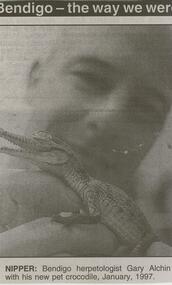
Newspaper - JENNY FOLEY COLLECTION: NIPPER
... Bendigo Advertiser ''The way we were'' from Wednesday, January 21, 2004. Nipper: Bendigo herpetologist Gary Alchin with his new pet crocodile, January 1997. ...Newspaper JENNY FOLEY COLLECTION: NIPPER ...BHS CollectionBendigo Advertiser ''The way we were'' from Wednesday, January 21, 2004. Nipper: Bendigo herpetologist Gary Alchin with his new pet crocodile, January 1997. The clip is in a folder.newspaper, bendigo advertiser, the way we were -
 Kiewa Valley Historical Society
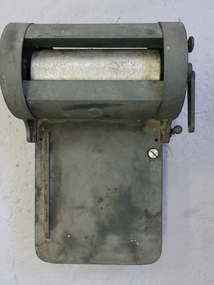
Fordigraph Machine
... In gold on the back "Fordigraph" and "The Nipper Fordigraph" with a blue circle made by 3 arcs with arrows. 2 labels on one side, screwed on. ...Used to make multiple copies of a document eg. in office at a school for eg. a newsletter Used at Bogong Primary School Fordigraph machine copying In gold on the back "Fordigraph" and "The Nipper Fordigraph" with a blue circle made by 3 arcs with arrows. 2 labels on one side, screwed on. ...Invented in 1923 by Wilhelm Ritzerfeld. A Spirit duplicator' refers to the alcohols that were a major component of the solvents used in the machine.Limited number of copies one could make from an original along with the low cost and corresponding low quality of copying. Used to make multiple copies of a document eg. in office at a school for eg. a newsletterUsed at Bogong Primary SchoolFormerly UKV 048 Solid black, heavy, steel machine on 4 legs with flat tray at the front and roller at the back. The roller has a cover on the sides and front. From the top you can see the silver roller which is operated by a handle on the right side. There is a small lever and 2 knobs on the same side.In gold on the back "Fordigraph" and "The Nipper Fordigraph" with a blue circle made by 3 arcs with arrows. 2 labels on one side, screwed on. The labels have a silver background and black print. "Off" and "On"fordigraph machine, copying -
 Vision Australia
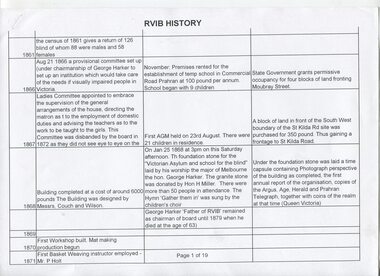
Document - Text, RVIB History
... Nipper....19 pages in table format, of events that occurred and people who were involved with the RVIB, and 1 page showing an aerial view of an unknown area. Based upon the Nipper document, this table was created by Jo Ann Matthews and C.H. ...19 pages in table format, of events that occurred and people who were involved with the RVIB, and 1 page showing an aerial view of an unknown area. Based upon the Nipper document, this table was created by Jo Ann Matthews and C.H. Nipper.19 pages in table format, of events that occurred and people who were involved with the RVIB, and 1 page showing an aerial view of an unknown areanon-fictionelizabeth maxwell, neil maxwell, royal victorian institute for the blind -
 Vision Australia
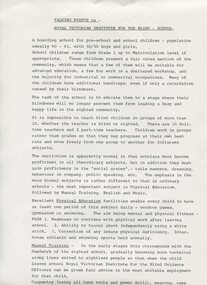
Document - Text, Talking Points re: Royal Victorian Institute for the Blind - school, 1950s
... Collected by C.H. Nipper during his writing of 'The Past and the Present 1866-1971' (a history of the RVIB). ...Collected by C.H. Nipper during his writing of 'The Past and the Present 1866-1971' (a history of the RVIB). ...Basis for presentation about the RVIB Burwood School. Collected by C.H. Nipper during his writing of 'The Past and the Present 1866-1971' (a history of the RVIB). 2 printed pages of foolscap paperroyal victorian institute for the blind, education -
 Vision Australia
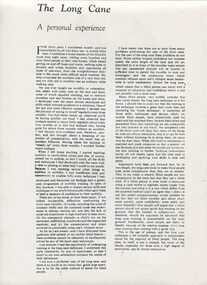
Document - Text, The Long Cane: a personal experience, 1968?
... Collected by C.H. Nipper during his writing of 'The Past and the Present 1866-1971' (a history of the RVIB). ...Collected by C.H. Nipper during his writing of 'The Past and the Present 1866-1971' (a history of the RVIB). ...Copy of an article on the author's experiences of mobility with a short cane and a long one. Collected by C.H. Nipper during his writing of 'The Past and the Present 1866-1971' (a history of the RVIB). 1 photocopied page from magazineroyal victorian institute for the blind, orientation and mobility -
 Vision Australia
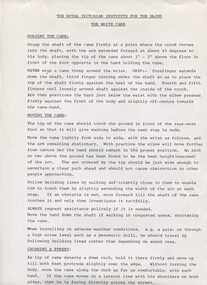
Document - Text, The White Cane, unknown
... Collected by C.H. Nipper during his writing of 'The Past and the Present 1866-1971' (a history of the RVIB). ...Collected by C.H. Nipper during his writing of 'The Past and the Present 1866-1971' (a history of the RVIB). ...Produced by the RVIB, this document outlines the physical operation of the cane, including holding, moving and utilising it in various circumstances. Collected by C.H. Nipper during his writing of 'The Past and the Present 1866-1971' (a history of the RVIB). 3 pages of foolscap printed pagesroyal victorian institute for the blind, orientation and mobility -
 Vision Australia
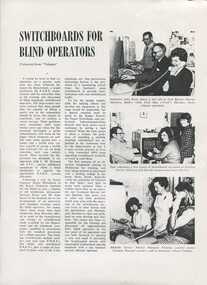
Document - Text, Switchboards for Blind Operators, 1969?
... Collected by C.H. Nipper during his writing of 'The Past and the Present 1866-1971' (a history of the RVIB). ...Collected by C.H. Nipper during his writing of 'The Past and the Present 1866-1971' (a history of the RVIB). ...Copy of article from the Telegen magazine on blind switchboard operators and training centre set up by the RVIB. Collected by C.H. Nipper during his writing of 'The Past and the Present 1866-1971' (a history of the RVIB). 1 foolscap photocopied page from magazineroyal victorian institute for the blind, employment, stanley marsden, john keast, joan barrett, brenda simpson, dawn neylon, margaret fleming, lorraine howard, gloria fielding -
 Vision Australia
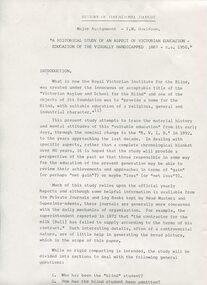
Document - Text, History of Educational Thought - T.M. Davidson, 1950s
... Collected by C.H. Nipper during his writing of 'The Past and the Present 1866-1971' (a history of the RVIB). ...Collected by C.H. Nipper during his writing of 'The Past and the Present 1866-1971' (a history of the RVIB). ...Assignment undertaken by T.M. Davidson on the historical study of an aspect of Victorian education - education of the visually handicapped 1867 - c.a. 1950. Collected by C.H. Nipper during his writing of 'The Past and the Present 1866-1971' (a history of the RVIB). 18 pages of foolscap printed pagesroyal victorian institute for the blind, education, t.m. davidson -
 Vision Australia
Document - Text, Facts about blind switchboard operators, 1969?
... Collected by C.H. Nipper during his writing of 'The Past and the Present 1866-1971' (a history of the RVIB). ...Collected by C.H. Nipper during his writing of 'The Past and the Present 1866-1971' (a history of the RVIB). ...Copy of pamphlet produced by RVIB to answer questions about the abilities of blind switchboard operators and how systems could be adapted for their use. Collected by C.H. Nipper during his writing of 'The Past and the Present 1866-1971' (a history of the RVIB). 4 paged paged pamphlet with photographsroyal victorian institute for the blind, employment, owen jones, john keast, gail thornton, doug sloan -
 Vision Australia
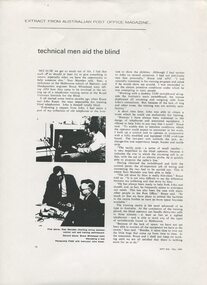
Document - Text, Technical men aid the blind, 1969
... Collected by C.H. Nipper during his writing of 'The Past and the Present 1866-1971' (a history of the RVIB). ...Collected by C.H. Nipper during his writing of 'The Past and the Present 1866-1971' (a history of the RVIB). ...Copy of article from the Feb-Mar 1969 Australian Post Office magazine on blind switchboard operators and training centre set up by the RVIB. Collected by C.H. Nipper during his writing of 'The Past and the Present 1866-1971' (a history of the RVIB). 1 photocopied page from magazineroyal victorian institute for the blind, employment, stanley marsden, john keast -
 Vision Australia
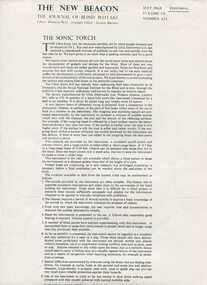
Document - Text, The Sonic Torch, 1968
... Collected by C.H. Nipper during his writing of 'The Past and the Present 1866-1971' (a history of the RVIB). ...Collected by C.H. Nipper during his writing of 'The Past and the Present 1866-1971' (a history of the RVIB). ...Copy of review in the The New Beacon: the journal of blind welfare magazine (May 1968, Vol LH, no. 613) on the Ultra Sonic Aid produced by Ultra Electronics. Collected by C.H. Nipper during his writing of 'The Past and the Present 1866-1971' (a history of the RVIB). 1 photocopied page from magazineroyal victorian institute for the blind, orientation and mobility -
 Vision Australia
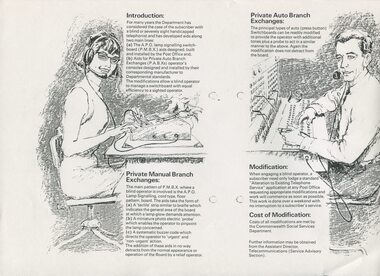
Document - Text, Branch Exchanges and blind switchboard operators, 1969?
... Collected by C.H. Nipper during his writing of 'The Past and the Present 1866-1971' (a history of the RVIB). ...Collected by C.H. Nipper during his writing of 'The Past and the Present 1866-1971' (a history of the RVIB). ...Copy of page from pamphlet about the modifications required for a blind switchboard operator for Private Manual Branch Exchanges (PBX) and Private Auto Branch Exchanges (PABX). Collected by C.H. Nipper during his writing of 'The Past and the Present 1866-1971' (a history of the RVIB). 1 foolscap photocopied page from pamphletroyal victorian institute for the blind, employment -
 Vision Australia
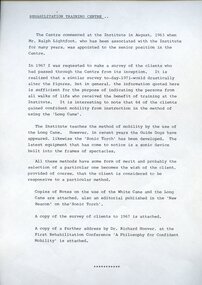
Document - Text, Rehabilitation Training Centre, 1970s
... Collected by C.H. Nipper during his writing of 'The Past and the Present 1866-1971' (a history of the RVIB). ...Collected by C.H. Nipper during his writing of 'The Past and the Present 1866-1971' (a history of the RVIB). ...Notes on the Rehabilitation Training Centre, which started in 1963. References to other documents (including in the archive) are made as well as a reprint of a newspaper article on switchboard training and reception employment. Collected by C.H. Nipper during his writing of 'The Past and the Present 1866-1971' (a history of the RVIB). 4 printed pages of foolscap paperroyal victorian institute for the blind, employment, rehabilitation, orientation and mobility, john keast, bruce whitehead -
 Bendigo Historical Society Inc.
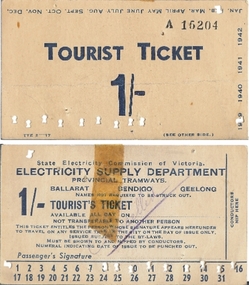
Document - BASIL MILLER COLLECTION: TRAMS TICKETS
... Note the clipped marks at the bottom edge made by the Conductors 'nipper'. A piece of adhesive tape has been placed from the top on the face of the ticket. ...Note the clipped marks at the bottom edge made by the Conductors 'nipper'. A piece of adhesive tape has been placed from the top on the face of the ticket. ...One 1/- (one shilling) State electricity Commission of Victoria, Electricity Supply Department, Provincial Tramways tourist's Ticket. No. A15204. This ticket has been used and been cancelled by a handwritten and underlined word Cancelled, in purple colour. Note the clipped marks at the bottom edge made by the Conductors 'nipper'. A piece of adhesive tape has been placed from the top on the face of the ticket. All printing on the face and the reverse side may be viewed on the scans attached.person, individual, basil miller -
 Vision Australia
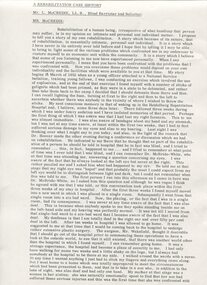
Document - Text, A Rehabilitation Case History by Lawrence McCredie, 1963
... Collected by C.H. Nipper during his writing of 'The Past and the Present 1866-1971' (a history of the RVIB). ...Collected by C.H. Nipper during his writing of 'The Past and the Present 1866-1971' (a history of the RVIB). ...Address given by Lawrence McCredie to a Rehabilitation Conference, held at Ormond Hall in February 1963. Collected by C.H. Nipper during his writing of 'The Past and the Present 1866-1971' (a history of the RVIB). Professor McCredie was the first blind person appointed to the board of the RVIB in 1956 and was involved until it's merger in 2005.10 pages of foolscap printed pagesroyal victorian institute for the blind, lawrence mccredie, rehabilitation -
 Vision Australia
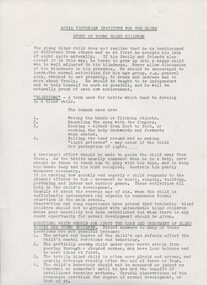
Document - Text, Study of Young Blind Children, unknown
... Collected by C.H. Nipper during his writing of 'The Past and the Present 1866-1971' (a history of the RVIB). ...Collected by C.H. Nipper during his writing of 'The Past and the Present 1866-1971' (a history of the RVIB). ...Advice provided to parents and carers of young children who were blind or vision impaired. It covers stimulation, physical movement, activities the child can undertake or be done with them, recommendations for toys and how to structure their physical environment. Collected by C.H. Nipper during his writing of 'The Past and the Present 1866-1971' (a history of the RVIB). 9 pages of foolscap printed pagesroyal victorian institute for the blind, education, child rearing -
 Vision Australia
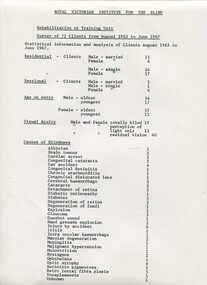
Document - Text, Survey of 72 clients from August 1963 to June 1967, 1967
... Collected by C.H. Nipper during his writing of 'The Past and the Present 1866-1971' (a history of the RVIB). ...Collected by C.H. Nipper during his writing of 'The Past and the Present 1866-1971' (a history of the RVIB). ...Raw results from a four year survey by the RVIB Rehabilitation or Training Unit, including causes of blindness, age, visual acuity, durating of blindness, nationality, educational level achieved, occupation, type of residence, mobility, employment and subjects undertaken. Collected by C.H. Nipper during his writing of 'The Past and the Present 1866-1971' (a history of the RVIB). 4 foolscap pages showing raw statistical dataroyal victorian institute for the blind, orientation and mobility, education -
 Bendigo Historical Society Inc.
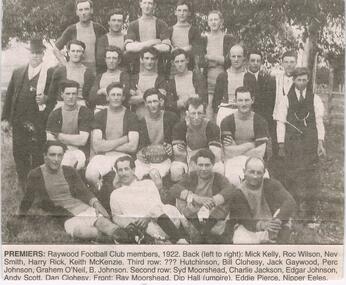
Newspaper - JENNY FOLEY COLLECTION: PREMIERS
... Front: Ray Moorshed, Dip Hall (umpire), Eddie Pierce, Nipper Eeles. The clip is in a folder....Front: Ray Moorshed, Dip Hall (umpire), Eddie Pierce, Nipper Eeles. The clip is in a folder. Newspaper JENNY FOLEY COLLECTION: PREMIERS ...Raywood played their first football match against Inglewood 30/1/1904. In 1949, Kamarooka, Neilborough and Raywood combined to form Northern United Football club.Bendigo Advertiser ''The way we were'' from 2003. Premiers: Raywood football club members, 1922. Back left to right: Mick Kelly, Roc Wilson, Nev Smith, Harry Rick, Keith McKenzie. Third row: ?? Hutchinson, bill Clohsey, Jack Gaywood, Perc Johnson, Grahem O'Neil, B. Johnson. Second row: Syd Moorshead, Charlie Jackson, Edgar Johnson, Andy Scott, Dan Clohsey. Front: Ray Moorshed, Dip Hall (umpire), Eddie Pierce, Nipper Eeles. The clip is in a folder.newspaper, bendigo advertiser, the way we were -
 Vision Australia
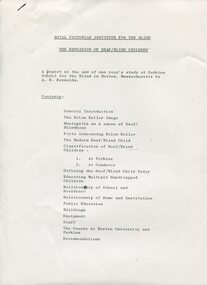
Document - Text, Education of Deaf/Blind Children by A.R. Reynolds, 1964
... Collected by C.H. Nipper during his writing of 'The Past and the Present 1866-1971' (a history of the RVIB). ...Collected by C.H. Nipper during his writing of 'The Past and the Present 1866-1971' (a history of the RVIB). ...A report at the end of one year's study at Perkins School for the Blind in Boston, Massachusetts. It covers the expectations raised by the story of Helen Keller, classification of students, the need for representation and work on communication techniques, and observations made on tours of various educational institutions in the USA and Holland. Collected by C.H. Nipper during his writing of 'The Past and the Present 1866-1971' (a history of the RVIB). 19 pages of foolscap printed pagesroyal victorian institute for the blind, education, deaf-blind, a.r. reynolds -
 Vision Australia
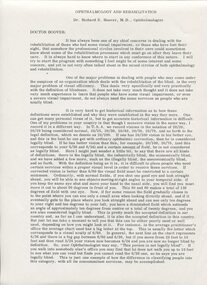
Document - Text, Ophthalmology and Rehabilitation - Dr Richard E. Hoover, 1963
... Collected by C.H. Nipper during his writing of 'The Past and the Present 1866-1971' (a history of the RVIB). ...Collected by C.H. Nipper during his writing of 'The Past and the Present 1866-1971' (a history of the RVIB). ...Address given by Dr Richard E. Hoover to a Rehabilitation Conference, held at Ormond Hall in February 1963. Collected by C.H. Nipper during his writing of 'The Past and the Present 1866-1971' (a history of the RVIB). Dr Hoover discusses the role of the ophthalmologist in rehabilitation for people with vision loss. Known as the 'Father of the Long Cane', Dr Hoover was invited to stay as a guest of the RVIB and, as well as the conference, gave several lectures to staff during his 6 week stay.9 pages of foolscap printed pagesroyal victorian institute for the blind, rehabilitation, richard hoover -
 Vision Australia
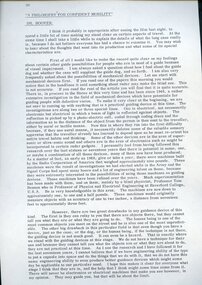
Document - Text, A Philosophy for Confident Mobility - Dr Hoover, 1963
... Collected by C.H. Nipper during his writing of 'The Past and the Present 1866-1971' (a history of the RVIB). ...Collected by C.H. Nipper during his writing of 'The Past and the Present 1866-1971' (a history of the RVIB). ...Address given by Dr Richard E. Hoover to a Rehabilitation Conference, held at Ormond Hall in February 1963. Collected by C.H. Nipper during his writing of 'The Past and the Present 1866-1971' (a history of the RVIB). Dr Hoover discusses how different devices can be tailored to individuals to provide them with confidence in travelling. Known as the 'Father of the Long Cane', Dr Hoover was invited to stay as a guest of the RVIB and, as well as the conference, gave several lectures to staff during his 6 week stay.7 pages of foolscap printed pagesroyal victorian institute for the blind, richard hoover, orientation and mobility -
 Emerald Museum & Nobelius Heritage Park
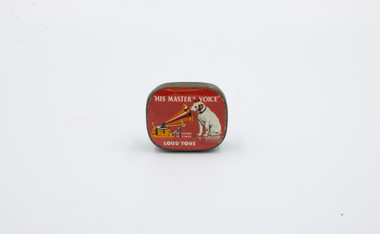
Container - Tin for Gramophone Needles, The Gramophone Company Limited, 1899 - c. 1931
... This small tin is decorated with a red-painted lid surface, depicting Nipper the dog - an iconic symbol of the company - curiously looking into a gramophone. ...Music 20th Century Front: " "HIS MASTER'S VOICE" / REGISTERED / TRADE MARK / LOUD TONE" Stop Side: "MADE IN Gt BRITAIN" Reverse: "APPROXIMATELY / 200 ENGLISH / GRAMOPHONE / NEEDLES / THE GRAMOPHONE / COMPANY LIMITED" This small tin is decorated with a red-painted lid surface, depicting Nipper the dog - an iconic symbol of the company - curiously looking into a gramophone. ...The Gramophone Company Limited acquired Francis Barraud's 1898 "His Master's Voice" artwork in 1899, after Edison Bell manager James Hough declined to purchase the artwork by stating that "dogs don't listen to phonographs." William Barry Owen of the Gramophone Company purchased the trademark on the condition that the original phonograph be replaced with a gramophone, and began using the artwork first in catalogues and gramophone machines, and in 1909 on record labels. It is unclear exactly when the artwork began to appear on gramophone needles. This specific tin was almost certainly made between 1899 - when the trademark was acquired - and 1931, when the Gramophone Company merged with the English Columbia Graphophone Company to form Electric and Musical Industries Ltd (EMI). However, the Gramophone Company was still used in some cases after this point, so it is not impossible that this tin could come from later. Gramophone needles were typically worn out after only one or a few uses, necessitating the purchasing of tins like this one filled with hundreds of needles to allow for constant replacements. "His Master's Voice" was an iconic brand in Australia for much of the 20th century, from the time of the Gramophone Company (when gramophones were still in use) through the subsequent EMI and HMV brands and the popularity of record players.This small tin is decorated with a red-painted lid surface, depicting Nipper the dog - an iconic symbol of the company - curiously looking into a gramophone. The red background is punctuated by white lettering, announcing the brand name and type of gramophone needle inside - 'Loud Tone'. The exposed metallic surface elsewhere on the tin is heavily tarnished everywhere except for parts of the bottom of the tin (which may have been exposed less than the rest of the tin if it was stored face-up). There is also partly faded, black lettering on the bottom of the tin, and a label on the stop side (opposite the hinge). The tin opens with a hinge, though it is now quite difficult to open. The inside of the tin is empty and undecorated, with similarly tarnished metallic surfaces.Front: " "HIS MASTER'S VOICE" / REGISTERED / TRADE MARK / LOUD TONE" Stop Side: "MADE IN Gt BRITAIN" Reverse: "APPROXIMATELY / 200 ENGLISH / GRAMOPHONE / NEEDLES / THE GRAMOPHONE / COMPANY LIMITED"music, 20th century -
 Flagstaff Hill Maritime Museum and Village
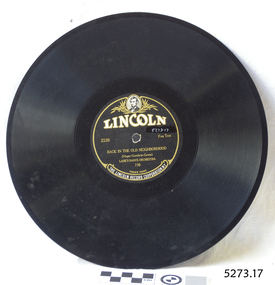
Audio - Gramophone Record, Lincoln Record Corporation, Back In The Old Neighborhood, Early-to-mid 20th century
... ...Nipper...The business based the label's logo of a dog looking into a gramophone horn for ‘his master’s voice’ was based on a painting by English artist Francis Barraud, which featured a terrier called Nipper beside a gramophone. Early gramophone records were mostly made from a material referred to as shellac, a natural ingredient combined with slate powder, and a filler of manilla copal, wood resin, carnauba wax, and carbon black. ...The business based the label's logo of a dog looking into a gramophone horn for ‘his master’s voice’ was based on a painting by English artist Francis Barraud, which featured a terrier called Nipper beside a gramophone. Early gramophone records were mostly made from a material referred to as shellac, a natural ingredient combined with slate powder, and a filler of manilla copal, wood resin, carnauba wax, and carbon black. ...Thomas Edison (1847–1931), an American, invented the phonograph in 1877, making it possible to record sound waves vertically and reproduce them on a wax cylinder so they could be heard again. Later, the German American, Emile Berliner (1851-1929), improved on Edison’s principles, greatly increasing the quality of the reproduced sounds with his invention of the gramophone in 1887, which recorded the sound waves laterally onto a flat shellac disc, or ‘record’. Records could be mass-produced in a factory where audio recordings were converted to a physical copy of that recording on a plate-sized disc. A gramophone machine reproduced the sound by spinning the record on a turntable at a specified number of rotations per minute (RPM) and using a stylus or needle to transfer the vibration via a membrane to a speaker, which amplified the sound. Berliner helped set up affiliated businesses overseas. One of his representatives was William Barry Owen (1860–1914), who, on 23 February 1889, partnered with Edmund Trevor Lloyd Williams (1859–1946) in England to register The Gramophone Company. His Master’s Voice (HMV) soon became the company’s major recording label, popular worldwide. The business based the label's logo of a dog looking into a gramophone horn for ‘his master’s voice’ was based on a painting by English artist Francis Barraud, which featured a terrier called Nipper beside a gramophone. Early gramophone records were mostly made from a material referred to as shellac, a natural ingredient combined with slate powder, and a filler of manilla copal, wood resin, carnauba wax, and carbon black. Although Bakelite seemed a useful, synthetic product, it was unsuccessful as a product for records. Around the time of World War II, lightweight, flexible synthetic vinyl records began replacing shellac records. Common diameters of records: 7 inch, 10 inch, 12 inch and 16 inch Revolutions Per Minute include: 33 1/3, 45, 78 Minutes per side of record: 3, 5.5, 7, 8, 9, 12, 15 and 22 Labels, in minutes per side: Single Play 3-5 min, Extended Play (EP) 7-12 min, Long Play (LP) 12-22 min This gramophone represents a step in the evolution of recording sound. In the 19th century, the human voice was first recorded on wax cylinders and replayed. It was the beginning of a new era in sound. Then, in the 1880s, voice could be recorded onto flat discs like this record, reliably reproduced and replayed many times, even on portable devices. Later, in the mid-20th century the following generation of electronic audio recording began, and later that century, digital recording gave even better reproduction. The record represents a popular means of entertainment for personal and social activities, as well as in some businesses. Shellac gramophone record with a black and gold label. Title: Back In The Old Neighbourhood Artist: Lane's Dance Orchestra. Publisher: The Lincoln Record Corporation, N.Y. 2138 Number:738 Size: 10 inchflagstaff hill, warrnambool, maritime village, maritime museum, flagstaff hill maritime museum and village, shipwreck coast, great ocean road, gramophone, phonograph, sound waves, record, reproduction, audio record, music, sound, thomas edison, emile berliner, 1887, shellac, rpm, william barry owen, edmund trevor lloyd williams, the gramophone company, his master’s voice, hmv, francis barraud, nipper, the lincoln record corporation n.y. 2138, back in the old neighbourhood, lane's dance orchestra, 738 -
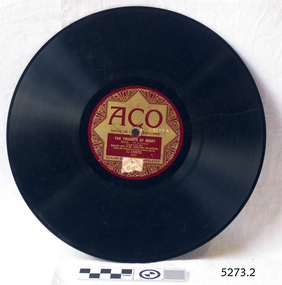 Flagstaff Hill Maritime Museum and Village
Audio - Gramophone Record, ACO, The Triumph of Right, Early-to-mid 20th century
... ...Nipper...The business based the label's logo of a dog looking into a gramophone horn for ‘his master’s voice’ was based on a painting by English artist Francis Barraud, which featured a terrier called Nipper beside a gramophone. Early gramophone records were mostly made from a material referred to as shellac, a natural ingredient combined with slate powder, and a filler of manilla copal, wood resin, carnauba wax, and carbon black. ...The business based the label's logo of a dog looking into a gramophone horn for ‘his master’s voice’ was based on a painting by English artist Francis Barraud, which featured a terrier called Nipper beside a gramophone. Early gramophone records were mostly made from a material referred to as shellac, a natural ingredient combined with slate powder, and a filler of manilla copal, wood resin, carnauba wax, and carbon black. ...Thomas Edison (1847–1931), an American, invented the phonograph in 1877, making it possible to record sound waves vertically and reproduce them on a wax cylinder so they could be heard again. Later, the German American, Emile Berliner (1851-1929), improved on Edison’s principles, greatly increasing the quality of the reproduced sounds with his invention of the gramophone in 1887, which recorded the sound waves laterally onto a flat shellac disc, or ‘record’. Records could be mass-produced in a factory where audio recordings were converted to a physical copy of that recording on a plate-sized disc. A gramophone machine reproduced the sound by spinning the record on a turntable at a specified number of rotations per minute (RPM) and using a stylus or needle to transfer the vibration via a membrane to a speaker, which amplified the sound. Berliner helped set up affiliated businesses overseas. One of his representatives was William Barry Owen (1860–1914), who, on 23 February 1889, partnered with Edmund Trevor Lloyd Williams (1859–1946) in England to register The Gramophone Company. His Master’s Voice (HMV) soon became the company’s major recording label, popular worldwide. The business based the label's logo of a dog looking into a gramophone horn for ‘his master’s voice’ was based on a painting by English artist Francis Barraud, which featured a terrier called Nipper beside a gramophone. Early gramophone records were mostly made from a material referred to as shellac, a natural ingredient combined with slate powder, and a filler of manilla copal, wood resin, carnauba wax, and carbon black. Although Bakelite seemed a useful, synthetic product, it was unsuccessful as a product for records. Around the time of World War II, lightweight, flexible synthetic vinyl records began replacing shellac records. Common diameters of records: 7 inch, 10 inch, 12 inch and 16 inch Revolutions Per Minute include: 33 1/3, 45, 78 Minutes per side of record: 3, 5.5, 7, 8, 9, 12, 15 and 22 Labels, in minutes per side: Single Play 3-5 min, Extended Play (EP) 7-12 min, Long Play (LP) 12-22 min This gramophone represents a step in the evolution of recording sound. In the 19th century, the human voice was first recorded on wax cylinders and replayed. It was the beginning of a new era in sound. Then, in the 1880s, voice could be recorded onto flat discs like this record, reliably reproduced and replayed many times, even on portable devices. Later, in the mid-20th century the following generation of electronic audio recording began, and later that century, digital recording gave even better reproduction. The record represents a popular means of entertainment for personal and social activities, as well as in some businesses. Shellac gramophone record with a crimson and gold label. Title: The Triumph of Right Artist: H.M. Welsh Guards Publisher: ACO England Number: G15875 Size: 10 inchflagstaff hill, warrnambool, maritime village, maritime museum, flagstaff hill maritime museum and village, shipwreck coast, great ocean road, gramophone, phonograph, sound waves, record, reproduction, audio record, music, sound, thomas edison, emile berliner, 1887, shellac, rpm, william barry owen, edmund trevor lloyd williams, the gramophone company, his master’s voice, hmv, francis barraud, nipper, 10 inch, the triumph of right, h.m. welsh guards, aco england
