
Showing 835 items matching " 1800s"
-
 Buninyong Visitor Information Centre
Document (item) - Information Folder, Diseases and Medical Conditions in the 1800s
... Diseases and Medical Conditions in the 1800s....Contains notes on names and descriptions of medical conditions in the 1800s. ...Contains notes on names and descriptions of medical conditions in the 1800s. Diseases and Medical Conditions in the 1800s. ...Includes extract from article entitled 'The evolution of Knowledge of these diseases" (Source unknown, requires research).disease, medicine, medical history -
 Victorian Aboriginal Corporation for Languages
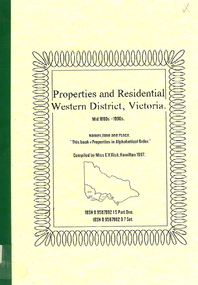
Book, Properties and residential : Western District, Victoria : mid 1800s - 1990s : names, time and place, 1997
... Properties and residential : Western District, Victoria : mid 1800s - 1990s : names, time and place...Lists properties, names of residents and addresses of properties and residences in Western District, Victoria from the mid 1800s to 1990s. Listed in alphabetical order according to the name of the property, residence or place....Properties and residential : Western District, Victoria : mid 1800s - 1990s : names, time and place Book E V Risk ...Lists properties, names of residents and addresses of properties and residences in Western District, Victoria from the mid 1800s to 1990s. Listed in alphabetical order according to the name of the property, residence or place.western district victoria, residential directory, real estate directory -
 Wodonga & District Historical Society Inc
Leisure object - Stereoscope - late 1800s - early 1900s
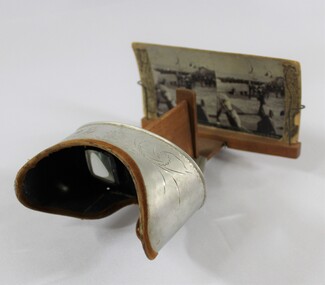
... Stereoscope - late 1800s - early 1900s...In the 1800s, the stereoscope was the only way to view with world in 3-D. ...In the 1800s, the stereoscope was the only way to view with world in 3-D. ...In the 1800s, the stereoscope was the only way to view with world in 3-D. A viewer would look through the lenses of the stereoscope's eyepiece to a card called a stereograph. On the stereograph, two of the same image were printed side by side, which when viewed through the stereograph transformed the one dimensional images into relatively life-like representations. A popular form of entertainment among the middle classes in Europe and America, people could use a stereoscope to view images of real faraway places, or fantastical magic scenes. The first patented stereo viewer was invented by Sir Charles Wheatstone in 1838, and remained a favoured leisure activity until the advent of cinema in the 1930s. This object contributes to our understanding of social life, leisure and entertainment in early twentieth century Wodonga, as well as providing interpretative capacity for themes including local history and social history. A wooden stereoscope with a cardboard 'view' of a streetscape.stereoscope, stereographs, entertainment, fun, leisure -
 Wodonga & District Historical Society Inc
Leisure object - Stereoscope - late 1800s - early 1900s
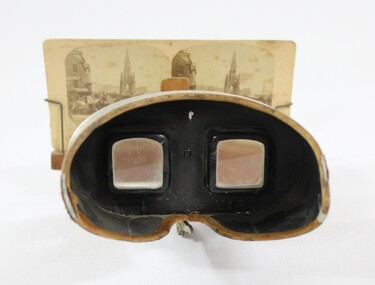
... Stereoscope - late 1800s - early 1900s...In the 1800s, the stereoscope was the only way to view with world in 3-D. ...In the 1800s, the stereoscope was the only way to view with world in 3-D. ...In the 1800s, the stereoscope was the only way to view with world in 3-D. A viewer would look through the lenses of the stereoscope's eyepiece to a card called a stereograph. On the stereograph, two of the same image were printed side by side, which when viewed through the stereograph transformed the one dimensional images into relatively life-like representations. A popular form of entertainment among the middle classes in Europe and America, people could use a stereoscope to view images of real faraway places, or fantastical magic scenes. The first patented stereo viewer was invented by Sir Charles Wheatstone in 1838, and remained a favoured leisure activity until the advent of cinema in the 1930s. This object contributes to our understanding of social life, leisure and entertainment in early twentieth century Wodonga, as well as providing interpretative capacity for themes including local history and social history.A wooden stereoscope with a cardboard 'view' of a streetscape.stereoscope, stereographs, entertainment, fun, leisure -
 Wodonga & District Historical Society Inc
Leisure object - Stereoscope - late 1800s - early 1900s
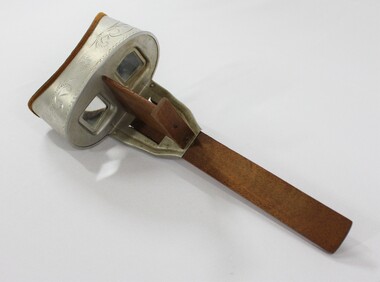
... Stereoscope - late 1800s - early 1900s...In the 1800s, the stereoscope was the only way to view with world in 3-D. ...In the 1800s, the stereoscope was the only way to view with world in 3-D. ...In the 1800s, the stereoscope was the only way to view with world in 3-D. A viewer would look through the lenses of the stereoscope's eyepiece to a card called a stereograph. On the stereograph, two of the same image were printed side by side, which when viewed through the stereograph transformed the one dimensional images into relatively life-like representations. A popular form of entertainment among the middle classes in Europe and America, people could use a stereoscope to view images of real faraway places, or fantastical magic scenes. The first patented stereo viewer was invented by Sir Charles Wheatstone in 1838, and remained a favoured leisure activity until the advent of cinema in the 1930s. This object contributes to our understanding of social life, leisure and entertainment in early twentieth century Wodonga, as well as providing interpretative capacity for themes including local history and social history.A wooden stereoscope with a cardboard 'view' of a streetscape.stereoscope, stereographs, entertainment, fun, leisure -
 Wodonga & District Historical Society Inc
Card - Stereoscope Cards - late 1800s - early 1900s
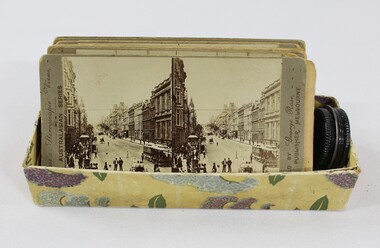
... Stereoscope Cards - late 1800s - early 1900s...In the 1800s, the stereoscope was the only way to view with world in 3-D. ...In the 1800s, the stereoscope was the only way to view with world in 3-D. ...In the 1800s, the stereoscope was the only way to view with world in 3-D. A viewer would look through the lenses of the stereoscope's eyepiece to a card called a stereograph. On the stereograph, two of the same image were printed side by side, which when viewed through the stereograph transformed the one dimensional images into relatively life-like representations. A popular form of entertainment among the middle classes in Europe and America, people could use a stereoscope to view images of real faraway places, or fantastical magic scenes. The first patented stereo viewer was invented by Sir Charles Wheatstone in 1838, and remained a favoured leisure activity until the advent of cinema in the 1930s. This object contributes to our understanding of social life, leisure and entertainment in early twentieth century Wodonga, as well as providing interpretative capacity for themes including local history and social history. A cardboard box full of stereoscope cards showing street views and landscape scenery. stereoscope, stereographs, entertainment, fun, leisure -
 Wodonga & District Historical Society Inc
Textile - Hamilton-Smith Collection Floral Lace - late 1800s - early 1900s
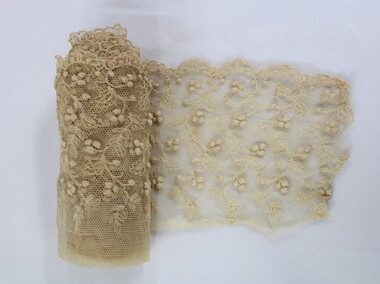
... Hamilton-Smith Collection Floral Lace - late 1800s - early 1900s...The Ellwood family had lived in north-east Victoria since the late 1800s. Grace’s mother, Rosina Ellwood nee Smale, was the first teacher at Baranduda in 1888, and a foundation member of the C.W.A. ...Hamilton-Smith Collection Floral Lace - late 1800s - early 1900s Textile Hamilton-Smith Collection Floral Lace - late 1800s - early 1900s ...The Hamilton-Smith collection was donated by the children of Grace Mary Hamilton-Smith nee Ellwood (1911-2004) and John Hamilton-Smith (1909-1984) who settled in Wodonga in the 1940s. The Ellwood family had lived in north-east Victoria since the late 1800s. Grace’s mother, Rosina Ellwood nee Smale, was the first teacher at Baranduda in 1888, and a foundation member of the C.W.A. Rosina and her husband Mark retired to Wodonga in 1934. Grace and John married at St. David’s Church, Albury in 1941. John was a grazier, and actively involved in Agricultural Societies. The collection contains significant items which reflect the local history of Wodonga, including handmade needlework, books, photographs, a wedding dress, maps, and material relating to the world wars. This item has well documented provenance and a known owner. It forms part of a significant and representative historical collection which reflects the local history of Wodonga. It contributes to our understanding of social and family life in early twentieth century Wodonga, as well as providing interpretative capacity for themes including local history and social history. A rolled bundle of cream coloured lace with a floral design.lace, needlework, embroidery, hamilton-smith, hamilton-smith collection, ellwood, wodonga -
 Wodonga & District Historical Society Inc
Clothing - Hamilton-Smith Collection Edwardian Dip-Waist Belt - late 1800s - early 1900s
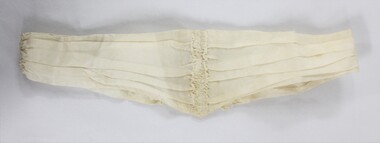
... Hamilton-Smith Collection Edwardian Dip-Waist Belt - late 1800s - early 1900s...The Ellwood family had lived in north-east Victoria since the late 1800s. Grace’s mother, Rosina Ellwood nee Smale, was the first teacher at Baranduda in 1888, and a foundation member of the C.W.A. ...Hamilton-Smith Collection Edwardian Dip-Waist Belt - late 1800s - early 1900s Clothing Hamilton-Smith Collection Edwardian Dip-Waist Belt - late 1800s - early 1900s ...The Hamilton-Smith collection was donated by the children of Grace Mary Hamilton-Smith nee Ellwood (1911-2004) and John Hamilton-Smith (1909-1984) who settled in Wodonga in the 1940s. The Ellwood family had lived in north-east Victoria since the late 1800s. Grace’s mother, Rosina Ellwood nee Smale, was the first teacher at Baranduda in 1888, and a foundation member of the C.W.A. Rosina and her husband Mark retired to Wodonga in 1934. Grace and John married at St. David’s Church, Albury in 1941. John was a grazier, and actively involved in Agricultural Societies. The collection contains significant items which reflect the local history of Wodonga, including handmade needlework, books, photographs, a wedding dress, maps, and material relating to the world wars. This item is unique, handmade and has a known owner. It forms part of a significant and representative historical collection which reflects the local history of Wodonga. It contributes to our understanding of social and family life in early twentieth century Wodonga, as well as providing interpretative capacity for themes including local history, social history and women’s history. A cream coloured, hand stitched cotton dip-waist belt from the Edwardian era, with metal fastening clasps. hamilton-smith, hamilton-smith collection, ellwood, wodonga, clothing, handmade, edwardian, historical clothing, belt, dip-waist belt -
 Wodonga & District Historical Society Inc
Textile - Hamilton-Smith Collection lace - late 1800s - early 1900s
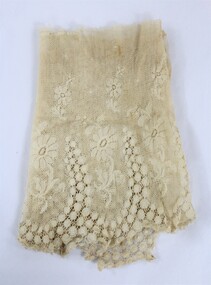
... Hamilton-Smith Collection lace - late 1800s - early 1900s...The Ellwood family had lived in north-east Victoria since the late 1800s. Grace’s mother, Rosina Ellwood nee Smale, was the first teacher at Baranduda in 1888, and a foundation member of the C.W.A. ...Hamilton-Smith Collection lace - late 1800s - early 1900s Textile Hamilton-Smith Collection lace - late 1800s - early 1900s ...The Hamilton-Smith collection was donated by the children of Grace Mary Hamilton-Smith nee Ellwood (1911-2004) and John Hamilton-Smith (1909-1984) who settled in Wodonga in the 1940s. The Ellwood family had lived in north-east Victoria since the late 1800s. Grace’s mother, Rosina Ellwood nee Smale, was the first teacher at Baranduda in 1888, and a foundation member of the C.W.A. Rosina and her husband Mark retired to Wodonga in 1934. Grace and John married at St. David’s Church, Albury in 1941. John was a grazier, and actively involved in Agricultural Societies. The collection contains significant items which reflect the local history of Wodonga, including handmade needlework, books, photographs, a wedding dress, maps, and material relating to the world wars. This item has well documented provenance and a known owner. It forms part of a significant and representative historical collection which reflects the local history of Wodonga. It contributes to our understanding of social and family life in early twentieth century Wodonga, as well as providing interpretative capacity for themes including local history and social history. Cream coloured lace with floral motif. hamilton-smith collection, hamilton-smith, ellwood, wodonga, sewing, domestic, lace, floral, clothing, edwardian -
 Wodonga & District Historical Society Inc
Textile - Hamilton-Smith Collection Beaded Textile - late 1800s - early 1900s
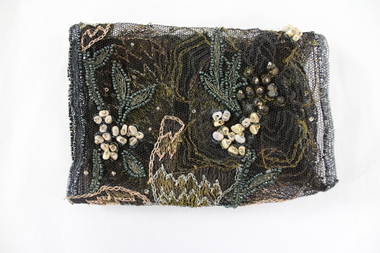
... Hamilton-Smith Collection Beaded Textile - late 1800s - early 1900s...The Ellwood family had lived in north-east Victoria since the late 1800s. Grace’s mother, Rosina Ellwood nee Smale, was the first teacher at Baranduda in 1888, and a foundation member of the C.W.A. ...Hamilton-Smith Collection Beaded Textile - late 1800s - early 1900s Textile Hamilton-Smith Collection Beaded Textile - late 1800s - early 1900s ...The Hamilton-Smith collection was donated by the children of Grace Mary Hamilton-Smith nee Ellwood (1911-2004) and John Hamilton-Smith (1909-1984) who settled in Wodonga in the 1940s. The Ellwood family had lived in north-east Victoria since the late 1800s. Grace’s mother, Rosina Ellwood nee Smale, was the first teacher at Baranduda in 1888, and a foundation member of the C.W.A. Rosina and her husband Mark retired to Wodonga in 1934. Grace and John married at St. David’s Church, Albury in 1941. John was a grazier, and actively involved in Agricultural Societies. The collection contains significant items which reflect the local history of Wodonga, including handmade needlework, books, photographs, a wedding dress, maps, and material relating to the world wars. In the nineteenth and early twentieth century prior to the mass production of clothing and textiles, needlework, alongside motherhood, was the defining work of women. Hand sewing and embroidery was central in the everyday lives and domestic roles of women.This item is unique, handmade and has a known owner. It forms part of a significant and representative historical collection which reflects the local history of Wodonga. It contributes to our understanding of social and family life in early twentieth century Wodonga, as well as providing interpretative capacity for themes including local history, social history and women’s history.Bronze and gold embroidery and bead work on black mesh.needlework, beading, sewing, sew, hamilton-smith collection, hamilton-smith, ellwood, handmade, domestic, women, women's history -
 Wodonga & District Historical Society Inc
Book - Hamilton-Smith Collection Bible c. 1800s - 1900s, Eyre and Spottiswoode, LTD
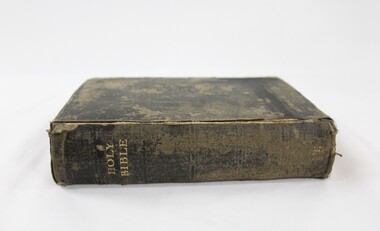
... Hamilton-Smith Collection Bible c. 1800s - 1900s...The Ellwood family had lived in north-east Victoria since the late 1800s. Grace’s mother, Rosina Ellwood nee Smale, was the first teacher at Baranduda in 1888, and a foundation member of the C.W.A. ...Hamilton-Smith Collection Bible c. 1800s - 1900s Book Hamilton-Smith Collection Bible c. 1800s - 1900s Eyre and Spottiswoode, LTD. ...The Hamilton-Smith collection was donated by the children of Grace Mary Hamilton-Smith nee Ellwood (1911-2004) and John Hamilton-Smith (1909-1984) who settled in Wodonga in the 1940s. The Ellwood family had lived in north-east Victoria since the late 1800s. Grace’s mother, Rosina Ellwood nee Smale, was the first teacher at Baranduda in 1888, and a foundation member of the C.W.A. Rosina and her husband Mark retired to Wodonga in 1934. Grace and John married at St. David’s Church, Albury in 1941. John was a grazier, and actively involved in Agricultural Societies. The collection contains significant items which reflect the local history of Wodonga, including handmade needlework, books, photographs, a wedding dress, maps, and material relating to the world wars. This Christian bible belonged to Grace Hamilton-Smith (nee Ellwood). The inscriptions indicate it was owned and used while she was at boarding school in Melbourne in the 1930s. It was published by the London printer Eyre and Spottiswood, established in 1739.This item has well documented provenance and a known owner. It forms part of a significant and representative historical collection which reflects the local history of Wodonga. It contributes to our understanding of social and family life in early twentieth century Wodonga, as well as providing interpretative capacity for themes including local history and social history.A black cloth bound Christian bible containing old and new testaments. On inner front page proper left upper corner in pencil: "Grace W Ellwood/"Braeside"/Bethonga./Victoria/Grace Ellwood/Morris Hall/Sth Yarra". On inner front paper proper left lower corner in pencil: "Grace Ellwood/Morris Hall/M.L.L. GLS/1925-6-7".bible, religion, christianity, hamilton-smith, ellwood, wodonga, school, jesus -
 Wodonga & District Historical Society Inc
Clothing - Hamilton-Smith Broderie Anglaise Collar - late 1800s - early 1900s
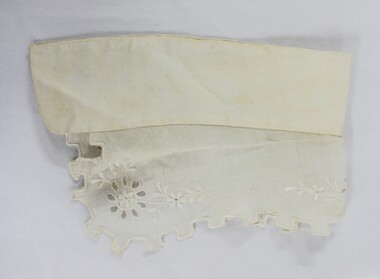
... Hamilton-Smith Broderie Anglaise Collar - late 1800s - early 1900s...The Ellwood family had lived in north-east Victoria since the late 1800s. Grace’s mother, Rosina Ellwood nee Smale, was the first teacher at Baranduda in 1888, and a foundation member of the C.W.A. ...Hamilton-Smith Broderie Anglaise Collar - late 1800s - early 1900s Clothing Hamilton-Smith Broderie Anglaise Collar - late 1800s - early 1900s ...The Hamilton-Smith collection was donated by the children of Grace Mary Hamilton-Smith nee Ellwood (1911-2004) and John Hamilton-Smith (1909-1984) who settled in Wodonga in the 1940s. The Ellwood family had lived in north-east Victoria since the late 1800s. Grace’s mother, Rosina Ellwood nee Smale, was the first teacher at Baranduda in 1888, and a foundation member of the C.W.A. Rosina and her husband Mark retired to Wodonga in 1934. Grace and John married at St. David’s Church, Albury in 1941. John was a grazier, and actively involved in Agricultural Societies. The collection contains significant items which reflect the local history of Wodonga, including handmade needlework, books, photographs, a wedding dress, maps, and material relating to the world wars. This collar was made using the broderie anglaise needlework technique that incorporates embroidery, cutwork and needle lace. This technique originated in sixteenth century Europe and became popular in England in the nineteenth century. In the nineteenth and early twentieth century prior to the mass production of clothing and textiles, needlework, alongside motherhood, was the defining work of women. Hand sewing and embroidery was central in the everyday lives and domestic roles of women.This item is unique, handmade and has a known owner. It forms part of a significant and representative historical collection which reflects the local history of Wodonga. It contributes to our understanding of social and family life in early twentieth century Wodonga, as well as providing interpretative capacity for themes including local history, social history and women’s history.A white cotton collar from the Edwardian period with broderie anglaise embroidery. hamilton-smith, hamilton-smith collection, needlework, clothing, sewing, embroidery, women, domestic, edwardian -
Ringwood and District Historical Society
Envelope, Packet: Maps of Ringwood from 1800s to late 1900s
... Packet: Maps of Ringwood from 1800s to late 1900s....History 1974; Maps of Ringwood Packet: Maps of Ringwood from 1800s to late 1900s. Envelope ...History 1974; Maps of Ringwood -
 Ringwood and District Historical Society
Newspaper, Yarra Valley Historical - A brief look at early life in the Yarra Valley during the mid 1800s to the 1900s (issued circa 2010)
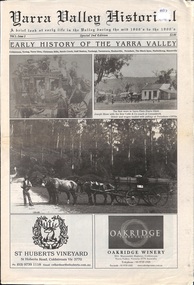
... Yarra Valley Historical - A brief look at early life in the Yarra Valley during the mid 1800s to the 1900s (issued circa 2010)...Yarra Valley Historical - A brief look at early life in the Yarra Valley during the mid 1800s to the 1900s (issued circa 2010) Newspaper ...Early History of the Yarra Valley (Vol l Issue 2) Coldstream, Yering, Christmas Hills, Steels Creek, Gulf Station, Toolangi, Tarrawarra, Healesville, Fernshaw, The Black Spur, Narbethong, Marysville. -
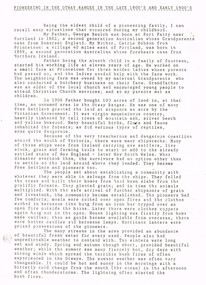 Otway Districts Historical Society
Document, Pioneering in the Otway Ranges in the late 1800s and early 1900s
... Pioneering in the Otway Ranges in the late 1800s and early 1900s....Pioneering in the Otway Ranges in the late 1800s and early 1900s. Document ...Two pages with the history of George Baulch and family in the Otway Ranges.A story about George Baulch and his family settling in the Otway Ranges in the late 1890s and early 1900s.Typed on paper with advertisments on the reverse side.george baulch; carrie hobson; portland; princetown; otway ranges; -
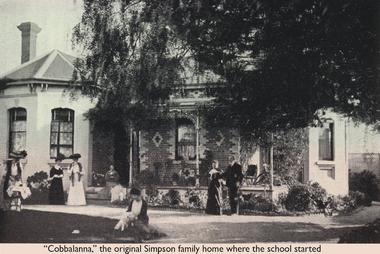 Mentone Girls' Grammar School Digital Archives
Book - Schooldays with the Simpsons, 1899-1906, Mentone Girls' Grammar Cobbalanna with the Simpsons 1800s
... Mentone Girls' Grammar Cobbalanna with the Simpsons 1800s...Mentone Girls' Grammar Cobbalanna with the Simpsons 1800s Book Schooldays with the Simpsons, 1899-1906 ..."Cobbalanna", the original Simpson family home where Mentone Girls' Grammar School started. -
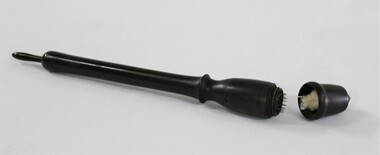 Wodonga & District Historical Society Inc
Functional object - Haeusler Collection unidentified medical object c.1800s
... Haeusler Collection unidentified medical object c.1800s...Haeusler Collection unidentified medical object c.1800s Functional object Haeusler Collection unidentified medical object c.1800s ...The Wodonga Historical Society Haeusler Collection provides invaluable insight into life in late nineteenth and early twentieth century north east Victoria. The collection comprises manuscripts, personal artefacts used by the Haeusler family on their farm in Wodonga, and a set of glass negatives which offer a unique visual snapshot of the domestic and social lives of the Haeusler family and local Wodonga community. The Haeusler family migrated from Prussia (Germany) to South Australia in the 1840s and 1850s, before purchasing 100 acres of Crown Land made available under the Victorian Lands Act 1862 (also known as ‘Duffy’s Land Act’) in 1866 in what is now Wodonga West. The Haeusler family were one of several German families to migrate from South Australia to Wodonga in the 1860s.This item has well documented provenance and a known owner. It forms part of a significant and representative historical collection which reflects the local history of Wodonga. It contributes to our understanding of domestic and family life in early twentieth century Wodonga, as well as providing interpretative capacity for themes including local history and social history.A long slender instrument turned from ebony (wood). A twist top cap at one end can be removed to reveal steel spikes in the body of the instrument. A thin handle at the opposite end of the instrument can be pushed inward to move the steel spikes out of the body of the instrument. There is cotton stored in the instruments cap.Nonemedical history, medical, medicine, disease, healthcare, health, medical instrument, medical equipment, haeusler collection, nineteenth century medicine, 19th century -
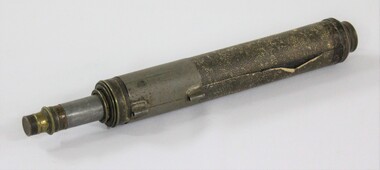 Wodonga & District Historical Society Inc
Functional object - Haeusler Collection Australian Made Telescope with Booklet c. late 1800s to early 1900s, The Union Mfg, & Agency Co
... Haeusler Collection Australian Made Telescope with Booklet c. late 1800s to early 1900s...Haeusler Collection Australian Made Telescope with Booklet c. late 1800s to early 1900s Functional object Haeusler Collection Australian Made Telescope with Booklet c. late 1800s to early 1900s The Union Mfg, & Agency Co. ...The Wodonga Historical Society Haeusler Collection provides invaluable insight into life in late nineteenth and early twentieth century north east Victoria. The collection comprises manuscripts, personal artefacts used by the Haeusler family on their farm in Wodonga, and a set of glass negatives which offer a unique visual snapshot of the domestic and social lives of the Haeusler family and local Wodonga community. The Haeusler family migrated from Prussia (Germany) to South Australia in the 1840s and 1850s, before purchasing 100 acres of Crown Land made available under the Victorian Lands Act 1862 (also known as ‘Duffy’s Land Act’) in 1866 in what is now Wodonga West. The Haeusler family were one of several German families to migrate from South Australia to Wodonga in the 1860s. This telescope belonged to Louis Haeusler (b.1878) and is one of the many objects in the Haeusler Collection that represent home and social life in early twentieth century Wodonga. It was manufactured by The Union Mfg [manufacturing], & Agency Co. in Melbourne. This item has well documented provenance and a known owner. It forms part of a significant and representative historical collection which reflects the local history of Wodonga. It contributes to our understanding of domestic and family life in early twentieth century Wodonga, as well as providing interpretative capacity for themes including local history and social history.Australian made telescope covered with a faux shagreen paper. Extends to three and a half feet long, with a five to ten mile sight range. On front of paper booklet: "TELESCOPE TALK/SOMETHING TO LOOK THROUGH/The Union Mfg, & Agency Co./299 ELIZABETH STREET,/MELBOURNE"telescope, recreation, family, haeusler collection, haeusler, wodonga -
 Wodonga & District Historical Society Inc
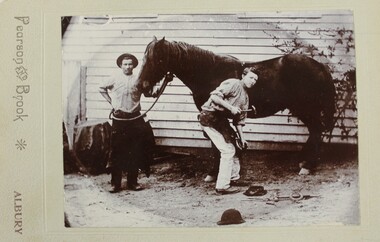
Photograph - Haeusler Collection Photograph of Two Men with a Horse late 1800s
... Haeusler Collection Photograph of Two Men with a Horse late 1800s...Haeusler Collection Photograph of Two Men with a Horse late 1800s Photograph Haeusler Collection Photograph of Two Men with a Horse late 1800s ...The Wodonga Historical Society Haeusler Collection provides invaluable insight into life in late nineteenth and early twentieth century north east Victoria. The collection comprises manuscripts, personal artefacts used by the Haeusler family on their farm in Wodonga, and a set of glass negatives which offer a unique visual snapshot of the domestic and social lives of the Haeusler family and local Wodonga community. The Haeusler family migrated from Prussia (Germany) to South Australia in the 1840s and 1850s, before purchasing 100 acres of Crown Land made available under the Victorian Lands Act 1862 (also known as ‘Duffy’s Land Act’) in 1866 in what is now Wodonga West. The Haeusler family were one of several German families to migrate from South Australia to Wodonga in the 1860s. This photograph was likely taken by Louis Haeusler (b.1887) with the photographic equipment in the Wodonga Historical Society Haeusler Collection. This photograph is one of many in the Haeusler Collection that represent daily life in late nineteenth and early twentieth century Wodonga.This item is unique and has well documented provenance and a known owner. It forms part of a significant and representative historical collection which reflects the local history of Wodonga. It contributes to our understanding of domestic and family life in early twentieth century Wodonga, as well as providing interpretative capacity for themes including local history and social history.Black and white photograph of two men in front of a weatherboard building. The man on the left is holding onto the bridle while the man on the right is shoeing the horse. Photography by Pearson and Brook studio, Albury. "PEARSON AND BROOK ALBURY"photograph, photography, horse, horses, portrait, portrait photography, haeusler collection, wodonga -
 Wodonga & District Historical Society Inc
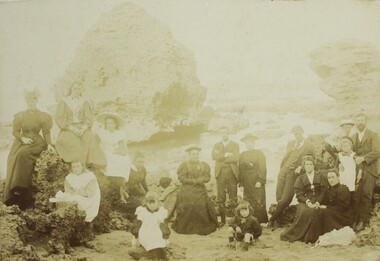
Photograph - Haeusler Collection Photograph Group Portrait by Seaside late 1800s
... Haeusler Collection Photograph Group Portrait by Seaside late 1800s...Haeusler Collection Photograph Group Portrait by Seaside late 1800s Photograph Haeusler Collection Photograph Group Portrait by Seaside late 1800s ...The Wodonga Historical Society Haeusler Collection provides invaluable insight into life in late nineteenth and early twentieth century north east Victoria. The collection comprises manuscripts, personal artefacts used by the Haeusler family on their farm in Wodonga, and a set of glass negatives which offer a unique visual snapshot of the domestic and social lives of the Haeusler family and local Wodonga community. The Haeusler family migrated from Prussia (Germany) to South Australia in the 1840s and 1850s, before purchasing 100 acres of Crown Land made available under the Victorian Lands Act 1862 (also known as ‘Duffy’s Land Act’) in 1866 in what is now Wodonga West. The Haeusler family were one of several German families to migrate from South Australia to Wodonga in the 1860s. The photographer and subjects of this photograph are unidentified. It belongs to a collection of Haeusler family personal belongings, and is possibly a family photograph. This item is unique and has well documented provenance and a known owner. It forms part of a significant and representative historical collection which reflects the local history of Wodonga. It contributes to our understanding of domestic and family life in early twentieth century Wodonga, as well as providing interpretative capacity for themes including local history and social history.A sepia toned group portrait photograph of people wearing Victorian era clothing at the seaside. photograph, photography, family photograph, portrait, photographic portrait, seaside, ocean, beach, victorian, wodonga, haeusler collection -
 Wodonga & District Historical Society Inc
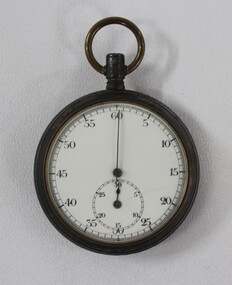
Functional object - Haeusler Collection Stop Watch late 1800s - early 1900s
... Haeusler Collection Stop Watch late 1800s - early 1900s...It contributes to our understanding of domestic and family life in early twentieth century Wodonga, as well as providing interpretative capacity for themes including local history, social history, and women’s history. jewellery watch clock timepiece wodonga haeusler collection social history stop watch An antique, alloy stop watch with white face Haeusler Collection Stop Watch late 1800s - early 1900s Functional object Haeusler Collection Stop Watch late 1800s - early 1900s ...The Wodonga Historical Society Haeusler Collection provides invaluable insight into life in late nineteenth and early twentieth century north east Victoria. The collection comprises manuscripts, personal artefacts used by the Haeusler family on their farm in Wodonga, and a set of glass negatives which offer a unique visual snapshot of the domestic and social lives of the Haeusler family and local Wodonga community. The Haeusler family migrated from Prussia (Germany) to South Australia in the 1840s and 1850s, before purchasing 100 acres of Crown Land made available under the Victorian Lands Act 1862 (also known as ‘Duffy’s Land Act’) in 1866 in what is now Wodonga West. The Haeusler family were one of several German families to imigrate from South Australia to Wodonga in the 1860s.This item has well documented provenance and a known owner. It forms part of a significant and representative historical collection which reflects the local history of Wodonga. It contributes to our understanding of domestic and family life in early twentieth century Wodonga, as well as providing interpretative capacity for themes including local history, social history, and women’s history. An antique, alloy stop watch with white face jewellery, watch, clock, timepiece, wodonga, haeusler collection, social history, stop watch -
 Wodonga & District Historical Society Inc
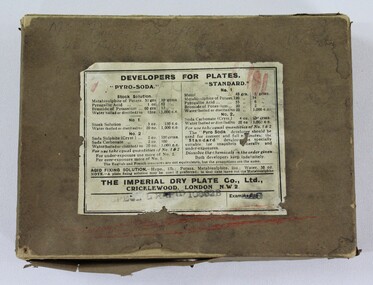
Functional object - Collection Glass Photographic Dry Plates Developer late 1800s - early 1900s, The Imperial Dry Plate Co., Ltd
... Collection Glass Photographic Dry Plates Developer late 1800s - early 1900s...Collection Glass Photographic Dry Plates Developer late 1800s - early 1900s Functional object Collection Glass Photographic Dry Plates Developer late 1800s - early 1900s The Imperial Dry Plate Co., Ltd. ...Dry plate photography was a photographic technology invented by R.L. Maddox in 1871. Images were captured on a glass plate covered in a gelatin emulsion, which acted as a photographic negative. A negative could then be stored to develop at a later time in a dark room. The introduction of this technology allowed for greater flexibility in photographic practice outside of indoor studios, as earlier wet plate photographic technology required immediate exposure and development. Dry plate photography was superseded by the invention of celluloid film in the early twentieth century. This object forms part of a significant and representative historical collection which reflects the local history of Wodonga. It contributes to our understanding of social life in early twentieth century Wodonga, as well as providing interpretative capacity for themes including local history, social history, and the history of photography.Box of dry glass negative plates for developing photographs. In pencil on face of box "MR PHIL GEEPER/46 THOMAS MITCHELL DRIVE WOD"photography, wet plate photography, dry plate photography, photos, haeusler collection, history of photography, historical photographs, technology, wodonga -
 Wodonga & District Historical Society Inc
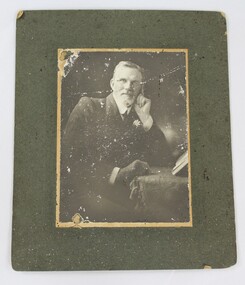
Photograph - Haeusler Collection Mounted Black and White Photographic Portrait late 1800s - early 1900s
... Haeusler Collection Mounted Black and White Photographic Portrait late 1800s - early 1900s...Haeusler Collection Mounted Black and White Photographic Portrait late 1800s - early 1900s Photograph Haeusler Collection Mounted Black and White Photographic Portrait late 1800s - early 1900s ...The Wodonga Historical Society Haeusler Collection provides invaluable insight into life in late nineteenth and early twentieth century north east Victoria. The collection comprises manuscripts, personal artefacts used by the Haeusler family on their farm in Wodonga, and a set of glass negatives which offer a unique visual snapshot of the domestic and social lives of the Haeusler family and local Wodonga community. The Haeusler family migrated from Prussia (Germany) to South Australia in the 1840s and 1850s, before purchasing 100 acres of Crown Land made available under the Victorian Lands Act 1862 (also known as ‘Duffy’s Land Act’) in 1866 in what is now Wodonga West. The Haeusler family were one of several German families to migrate from South Australia to Wodonga in the 1860s. This item has well documented provenance and a known owner. It forms part of a significant and representative historical collection which reflects the local history of Wodonga. A mounted black and white portrait photograph of a middle aged man with a white beard wearing a suit. photograph, photography, portrait, photographic portrait, haeusler, haeusler collection -
 Wodonga & District Historical Society Inc
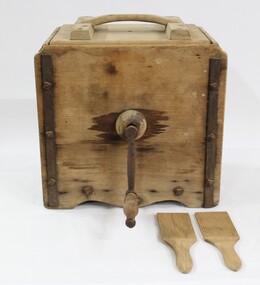
Functional object - Butter Churn - late 1800s - early 1900s, E. Cherry & Sons
... Butter Churn - late 1800s - early 1900s...Butter Churn - late 1800s - early 1900s Functional object Butter Churn - late 1800s - early 1900s E. ...North east Victoria was a major dairy producing region in the late nineteenth century. The first iteration of the Wodonga Butter Factory Ltd was established in 1892. Dairy was sent from farmers across the district for processing at the factory in Wodonga in the 1890s. Victorian creameries regularly exported frozen butter to London, stock was transported by rail for sale in Melbourne, and of course sold and consumed locally. E.W. Mann, of the prominent local Wodonga family, was a shareholder and was closely involved in the establishment of the Wodonga Butter Company. Many families living on farms also owned their own cow, and had equipment to process their own dairy products at home. This item has strong links to the history of Wodonga and north east Victoria. It has interpretative potential in the areas of local agricultural history, and the social history of food and farming.A wooden butter churn with metal turning handle, and two butter paddles and removal lid.butter, butter churn, dairy, cream, milk, cow, agriculture, farms, farmers, farm, food, social history, food history -
 City of Moorabbin Historical Society (Operating the Box Cottage Museum)
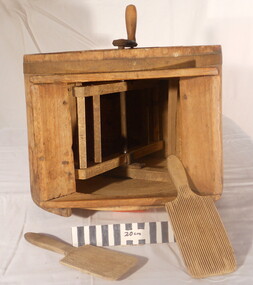
Functional object - Butter churn domestic, circa 1800s
... Circa late 1800s. Wooden domestic butter-churn. This is a paddle churn, a barrel that contains a paddle, which is operated by a handle. ...Circa late 1800s. Wooden domestic butter-churn consisting of a wooden barrel with a lid and a crank that manually turned a paddle inside to separate the butter fat from the butter milk ...circa 1800s...Circa late 1800s. Wooden domestic butter-churn. This is a paddle churn, a barrel that contains a paddle, which is operated by a handle. ...Circa late 1800s. Wooden domestic butter-churn. This is a paddle churn, a barrel that contains a paddle, which is operated by a handle. The paddle churned the butter inside the container when the handle was turned. Early settlers had to be self sufficient, growing their own vegetables, making tools and clothing and usually had a house cow to produce their milk supply. An unsigned note states it was used by a Chinese market-gardener’s family. From the mid 1800s into the1900s, there were numbers of Chinese market gardeners working in Bentleigh, Moorabbin, Mc Kinnon, and Cheltenham in the Shire of Moorabbin. After the sale of land following 'Dendy's Special Survey' 1841 many Chinese settlers rented allotments and established market gardens in the area and sold their produce to the increasing population of Melbourne at the markets in St Kilda and Melbourne.Circa late 1800s. Wooden domestic butter-churn consisting of a wooden barrel with a lid and a crank that manually turned a paddle inside to separate the butter fat from the butter milk 'BUTTER CHURN' written in chalk undated, unsignedchinese, melbourne, brighton, moorabbin, butter, cows, milk, pioneers, dairy, settlers, fruit, bentleigh, markets, mckinnon, cheltenham, vegetables, dendy henry -
 Kew Historical Society Inc
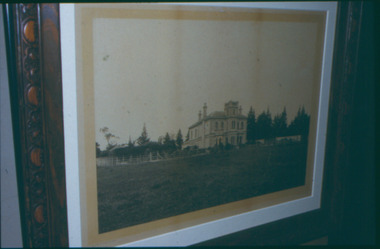
Slide - Snapshot of earliest framed photograph of Villa Alba
... "Villa Alba photo / 1800s"..."Villa Alba photo / 1800s" Digital copy of a oolour 35mm slide, framed in a plastic mount, of the earliest known photograph of Villa Alba, 44 Walmer Street, Kew, 3101. ...Built for William and Anna-Maria Greenlaw in the early 1880s, and with interiors decorated by the Paterson Bros, Villa Alba remained in private ownership until 1949. From 1950, the house was owned by a number of institutions. By 1984, the Villa Alba Preservation Society had been formed, and three years later, the Mount Royal Hospital granted a 25-year lease to Kew Council. In 2004, the title to Villa Alba was passed by the Victorian Government to The Villa Alba Museum Incorporated. Digital copy of a oolour 35mm slide, framed in a plastic mount, of the earliest known photograph of Villa Alba, 44 Walmer Street, Kew, 3101. "Villa Alba photo / 1800s"villa alba museum, historic houses -- kew (vic.), victorian architecture -- melbourne (vic.) -
Eltham District Historical Society Inc
Folder, Beckwith Family, 1800s
... Folder of information on Beckwith family, Kinglake, late 1800s...1800s...Beckwith Folder of information on Beckwith family, Kinglake, late 1800s Beckwith Family Folder ...Folder of information on Beckwith family, Kinglake, late 1800sbeckwith -
 Flagstaff Hill Maritime Museum and Village
Vice, 1800s
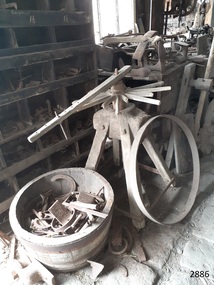
... A wheelwright’s spoke vice would have been very necessary for blacksmiths circa 1800s-1920s as it would have been used in the manufacture and repair of carts, wagons, coaches and other horse-drawn vehicles. ...Vice; wheelwright’s wheel spoke vice. Manufactured in 1800s. This was once belonged to Harry Goodall & Sons, blacksmith's of Terang. ...1800s...A wheelwright’s spoke vice would have been very necessary for blacksmiths circa 1800s-1920s as it would have been used in the manufacture and repair of carts, wagons, coaches and other horse-drawn vehicles. ...A wheelwright’s spoke vice was used to hold the wheel hub firmly while the spokes were hammered into the wheel hub, then the spokes would be joined to the wooden wheel felloe before finally the metal flat tyre, or later the rubber tyre, would be attached to the felloe. A wheelwright’s spoke vice would have been very necessary for blacksmiths circa 1800s-1920s as it would have been used in the manufacture and repair of carts, wagons, coaches and other horse-drawn vehicles. This wheelwright’s spoke vice was once used by Harry Goodall of H. Goodall & Sons Pty. Ltd. corner of McKinnon and High Streets, Terang. Victoria. Henry Goodall & Sons Henry Goodall (1870-1936) was proprietor of garages as H. Goodall & Sons Pty. Ltd., at both Terang (McKinnon and High Streets) and Mortlake (Dunlop Street). His business was in operation in at least in 1916 and perhaps well before, considering the date of the tyre bender and its use for wagons with wooden wheels. It was still in operation in 1953, chasing up debtors in Mount Gambier Court. Amongst the employees of H. Goodall & Sons Pty. Ltd. was Ernie Entwistle, a blacksmith (a soldier who died in 1916) and Alfred Hodgetts, radio expert (killed in a fatal accident in 1943, when he was in his early 30s). Henry Goodall was involved in the community as a Justice of Peace, a deputy coroner, President of the Mortlake Hospital, trustee of the Soldiers’ Memorial Hall, and as a prominent Freemason. He and his wife had two sons (Charles and John) and one daughter (Mrs. Chas. Newton, of Skipton). The wheelwright’s spoke vice is significant as it demonstrates how blacksmiths or wheelwrights could make new metal rims for wagon wheels for carts, wagons, stage coaches and carriages over a 135 years ago. The machine is a part of our social history as it demonstrates part of the process of making wagon wheels, which played an important part in aiding the continuation of daily transport needs that people had at the time, such as farming, personal transport and commercial activities. The tool is locally significant as it was used by a local company in Terang and Mortlake in their blacksmith, wheelwright and garage business. Vice; wheelwright’s wheel spoke vice. Manufactured in 1800s. This was once belonged to Harry Goodall & Sons, blacksmith's of Terang. Victoria.flagstaff hill, warrnambool, shipwrecked-coast, flagstaff-hill, flagstaff-hill-maritime-museum, maritime-museum, shipwreck-coast, flagstaff-hill-maritime-village, machinery, wagon wheel, steel rim wheels, henry goodall (1870-1936), terang, wheelwright tool, blacksmith trade, blacksmithing equipment and supplies, h. goodall & sons of terang, terang blacksmith, h. goodall & sons pty ltd, mortlake, ernie entwistle blacksmith, alfred hodgetts radio expert, charles goodall, john goodall, wheel hub, wheel spoke, wheel felloe, wheel tyre, wheel tire -
 Churchill Island Heritage Precinct
Weapon - Cannon, 1800s
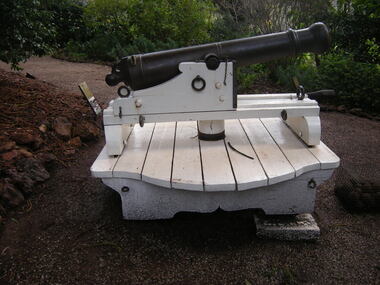
... ...1800s...The Churchill Island collection includes objects from the late 1800s. The collection is presented in sets and series, of which this object represents the early Amess era....1800s...The Churchill Island collection includes objects from the late 1800s. The collection is presented in sets and series, of which this object represents the early Amess era. ...The Churchill Island collection includes objects from the late 1800s. The collection is presented in sets and series, of which this object represents the early Amess era.The cannon was left on Churchill Island after the last private resident left and the Island was purchased by the Victorian State Government. During the time of ownership by Samuel Amess, the cannon was positioned in the front garden facing the bay. In 1982, the Victorian Conservation Trust sought to identify the manufacture and provenance of the cannon. Images held within the Churchill Island Museum and Archive demonstrate the annual use of the cannon by the Amess family, in particular the firing of the cannon on New Years Eve of each year.Six pounder cast iron smooth bore cannon, mounted on a white painted wooden carriage with four iron wheels.860 / FRECKchurchill island, cannon, samuel amess, 1800s, victorian conservation trust -
Port Melbourne Historical & Preservation Society
Photograph - CD-ROM, various Port Melbourne images, Charles Nettleton, 1875 - 1911
... Gives us a visual description of Bay Street and other highlights in the late 1800s to early 1900s...CD of digitised images from late 1800s to early 1900s. Images are of Bay St, from the North East; the Freemasons Hotel; Corner Beach and Stokes Streets...Gives us a visual description of Bay Street and other highlights in the late 1800s to early 1900s Natural environment - Beaches and foreshore Built Environment - Commercial Bay Street Beach Street Stokes Street Charles Nettleton Carlton Ale Fosters Lager Beer WHITTLE Business and Traders - Hotels Freemason's Tavern CD of digitised images from late 1800s to early 1900s. ...Gives us a visual description of Bay Street and other highlights in the late 1800s to early 1900sCD of digitised images from late 1800s to early 1900s. Images are of Bay St, from the North East; the Freemasons Hotel; Corner Beach and Stokes Streetsnatural environment - beaches and foreshore, built environment - commercial, bay street, beach street, stokes street, charles nettleton, carlton ale, fosters lager beer, whittle, business and traders - hotels, freemason's tavern
