
Showing 37 items matching " artist-run gallery"
-
 Women's Art Register
Archive (Series) - Cool Change Contemporary. Subject File 1
... ... Artist-Run Gallery...ARI Artist-Run Gallery Perth WA Contemporary Foolscap white archival 4 flap folder or document wallet Archive Cool Change Contemporary. ...Cataloguesari, artist-run gallery, perth, wa, contemporaryari, artist-run gallery, perth, wa, contemporary -
Women's Art Register
Archive (Collection) - Cool Change Contemporary Exhibition Archive
... ... Artist-Run Gallery...ARI Artist-Run Gallery Perth WA Contemporary Archive Cool Change Contemporary Exhibition Archive ...ari, artist-run gallery, perth, wa, contemporaryari, artist-run gallery, perth, wa, contemporary -
 The 69 Collective
Drawing, Julian Di Martino, 'No image provided', 2013
... artist-run initiative...artist-run space...art gallery...This artwork is part of 69Fifteen, the book published in 2013 celebrating 69 Smith Street Gallery’s 15th year in operation as an artist-run space. julian di martino 69 smith street artist-run initiative artist-run space art gallery biro paper melbourne art galleries conceptual art Textual rendering of artist's decision not to provide an image for 69 Smith Street Gallery's anniversary publication. ...This artwork is part of 69Fifteen, the book published in 2013 celebrating 69 Smith Street Gallery’s 15th year in operation as an artist-run space.Textual rendering of artist's decision not to provide an image for 69 Smith Street Gallery's anniversary publication.julian di martino, 69 smith street, artist-run initiative, artist-run space, art gallery, biro, paper, melbourne art galleries, conceptual art -
 The 69 Collective
Video Art, Jenny Gibson, Lineage - An Oral History of 69 Smith Street Gallery
... gallery...artist-run initiative...This work is the result of a series of interviews with committee members of 69 Smith Street Gallery, an artist-run gallery that operated in Collingwood between 1998 and 2016. ...This work is the result of a series of interviews with committee members of 69 Smith Street Gallery, an artist-run gallery that operated in Collingwood between 1998 and 2016. ...This work is the result of a series of interviews with committee members of 69 Smith Street Gallery, an artist-run gallery that operated in Collingwood between 1998 and 2016. These interviews taken between 2010 and 2011 feature artists who went on to form the creative group known as the 69 Collective.This work was part of The Line exhibition at Collingwood Gallery in 2018. The brief given to participating artists was to present works using the theme of the horizontal line. The artworks, in a range of mediums, were hung with a consistent line travelling through each piece around the perimeter of the gallery space. The line in each work, inferred or explicit, were carefully placed together to make this cohesive whole.oral history, video, 69 smith street gallery, artist-run initiative, artist-run space, melbourne art galleries, merle parker, julian di martino, marianne little, 69 collective, jenny gibson, art, video art -
 Nillumbik Shire Council
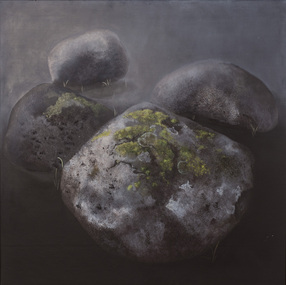
Painting: Penelope AITKEN (b.1967 Melb. AUS), Penelope Aitken, Mapping Mass & Void 10, 2008
... From 2006 - 2009 she was a board member of the Melbourne artist run gallery, West Space and she has also curated and coordinated numerous exhibitions and written and edited catalogues, articles and essays. ...From 2006 - 2009 she was a board member of the Melbourne artist run gallery, West Space and she has also curated and coordinated numerous exhibitions and written and edited catalogues, articles and essays. ...Penelope Aitken lives and works in Melbourne, Australia. She makes paintings and installations about relationships: between people, between things and between people and things. Recurring subjects include friendship, genealogy, romantic liaisons, and cross-cultural exchange as well as gardening, craft and landscape design. 'I am interested in the social, psychological and aesthetic motives behind organisation, belonging and displacement and I often make work that investigates such arrangements.' She has held regular solo exhibitions since 1995 and has been represented in group exhibitions since 1989. These have included shows in public and commercial galleries, artist run spaces, outdoor projects and festivals in Melbourne, Sydney, Perth, Brisbane, Bundaberg, Kuala Lumpur, Taipei, Tokyo and Famagusta, Northern Cyprus. Aitken has previously worked at the Australian Centre for Contemporary Art and at Asialink at the University of Melbourne. From 2006 - 2009 she was a board member of the Melbourne artist run gallery, West Space and she has also curated and coordinated numerous exhibitions and written and edited catalogues, articles and essays. She holds a Bachelor of Arts and a Bachelor of Education (Visual Arts) both from The University of Melbourne and completed her Masters of Fine Art at the Victorian College of the Arts in 2004. In 1997 Aitken was selected to be a studio artist for two years at Gertrude Contemporary Art Spaces, Melbourne and in 2000 she undertook an Australia Council Studio at the Taipei National University of the Arts, Taiwan. More recently she spent two months in 2007 at the Laughing Waters Residency, Birrarung, in Eltham, Victoria. There she began her current interest in the rocks used in the landscape designs of Gordon Ford. Paintings of Ford's rocks made since 2007 as well as glacial erratics, meteors, and other natural and displaced rocks were exhibited in March 2011 at the Light Factory Gallery in Eltham in a show called My History of here, and Second Nature, one work from this exhibition, was awarded first prize at Eltham Masterworks 2011. Other work made about rocks in nature and culture include: the project, A dark archive, as well as in two installations: You seem so settled for one that doesn't belong held at West Space in 2009 and Gathering these things to remind me of home shown in 2010 at the Bundaberg Regional Art Gallery, Queensland. In July and August 2007 Aitken undertook an arts recidency at Birrarung, a house and garden designed by Gordon Ford and managed as the Laughing Waters Artist in Residence Program by the Shire of Nillumbik Victoria. The rocks depicted in the painting 'Mapping Mass & Void 10' are all taken from the garden at Birrarung. Aitken has made reference to those rocks and the way in which Ford thought of the rocks as individuals that need to be handled and placed with consideration to show off their best aspects.oil and acrylic on linen ek prac 2015 -
 Eltham District Historical Society Inc
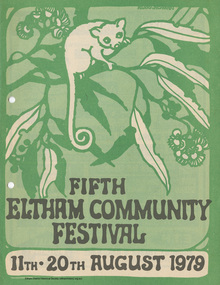
Booklet - Program, Progress Press, Fifth Eltham Community Festival, 11th - 20th August 1979, 1979
... Artist Showcase...Beth Knight...Bimbi World...Briar Hill Timber & Trading...Chantelle Boutique...Classic Fireplace & Rangehood Centre...Country Art Store...Debonaire Air Conditioning Pty Ltd...Diamond Valley Bathroom & Plumbing Centre...Diamond Valley Drapes...Diamond Valley News...Diamond Valley Windscreens...Eccacentre...Economy Timber & Hardware...Edens Hobbycraft & Art Supplies...Eltham Community Festival...Eltham Festival...Eltham Fun Run...Eltham Gallery...Event program, 101 events, Friday, August 10th through Sunday, August 17th and local advertisers: 1979, Alan Marshall (Pioneers and Painters), Aljon, Artist Showcase, Beth Knight, Bimbi World, Briar Hill Timber & Trading, Chantelle Boutique, Classic Fireplace & Rangehood Centre, Country Art Store, Debonaire Air Conditioning Pty Ltd, Diamond Valley Bathroom & Plumbing Centre, Diamond Valley Drapes, Diamond Valley News, Diamond Valley Windscreens, Eccacentre, Economy Timber & Hardware, Edens Hobbycraft & Art Supplies, Eltham Community Festival, Eltham Festival, Eltham Fun Run, Eltham Gallery, Eltham Hardware & Plumbing Supplies Pty Ltd, eltham hotel, Eltham Living and Learning Centre, Eltham Produce Store, Eltham Village Shopping Centre, Grimshaw Motor Cycles, Halchem, Kenton Footwear, L.T. ...Event program, 101 events, Friday, August 10th through Sunday, August 17th and local advertisers: 1979, Alan Marshall (Pioneers and Painters), Aljon, Artist Showcase, Beth Knight, Bimbi World, Briar Hill Timber & Trading, Chantelle Boutique, Classic Fireplace & Rangehood Centre, Country Art Store, Debonaire Air Conditioning Pty Ltd, Diamond Valley Bathroom & Plumbing Centre, Diamond Valley Drapes, Diamond Valley News, Diamond Valley Windscreens, Eccacentre, Economy Timber & Hardware, Edens Hobbycraft & Art Supplies, Eltham Community Festival, Eltham Festival, Eltham Fun Run, Eltham Gallery, Eltham Hardware & Plumbing Supplies Pty Ltd, eltham hotel, Eltham Living and Learning Centre, Eltham Produce Store, Eltham Village Shopping Centre, Grimshaw Motor Cycles, Halchem, Kenton Footwear, L.T. ...Event program, 101 events, Friday, August 10th through Sunday, August 17th and local advertisers: 1979, Alan Marshall (Pioneers and Painters), Aljon, Artist Showcase, Beth Knight, Bimbi World, Briar Hill Timber & Trading, Chantelle Boutique, Classic Fireplace & Rangehood Centre, Country Art Store, Debonaire Air Conditioning Pty Ltd, Diamond Valley Bathroom & Plumbing Centre, Diamond Valley Drapes, Diamond Valley News, Diamond Valley Windscreens, Eccacentre, Economy Timber & Hardware, Edens Hobbycraft & Art Supplies, Eltham Community Festival, Eltham Festival, Eltham Fun Run, Eltham Gallery, Eltham Hardware & Plumbing Supplies Pty Ltd, eltham hotel, Eltham Living and Learning Centre, Eltham Produce Store, Eltham Village Shopping Centre, Grimshaw Motor Cycles, Halchem, Kenton Footwear, L.T. Cabinets, Lamers Construction Pty Ltd, Lovittools, Maggie Lorraine, Marion & Julian Bruere, Montmorency Hardware, Montmorency Pets, Pegasus Interiors, Penguin Drycleaners, Pioneers and Painters, Program, R & S Slocum Floorcovering Pty Ltd, R.F. & D.M. Kidd, Sa Boutique, Siri Omberg, Skybeam Antennas, Specialised Sleep Centre, Style Interiors, The Living Water Bookshop, Thompsons Amcal Pharmacy, Valley Tiffany Lighting, Vonni’s, W. Hutchison16 pages, stapled, coloured1979, alan marshall (pioneers and painters), aljon, artist showcase, beth knight, bimbi world, briar hill timber & trading, chantelle boutique, classic fireplace & rangehood centre, country art store, debonaire air conditioning pty ltd, diamond valley bathroom & plumbing centre, diamond valley drapes, diamond valley news, diamond valley windscreens, eccacentre, economy timber & hardware, edens hobbycraft & art supplies, eltham community festival, eltham festival, eltham fun run, eltham gallery, eltham hardware & plumbing supplies pty ltd, eltham hotel, eltham living and learning centre, eltham produce store, eltham village shopping centre, grimshaw motor cycles, halchem, kenton footwear, l.t. cabinets, lamers construction pty ltd, lovittools, maggie lorraine, marion & julian bruere, montmorency hardware, montmorency pets, pegasus interiors, penguin drycleaners, pioneers and painters, program, r & s slocum floorcovering pty ltd, r.f. & d.m. kidd, sa boutique, siri omberg, skybeam antennas, specialised sleep centre, style interiors, the living water bookshop, thompsons amcal pharmacy, valley tiffany lighting, vonni’s, w. hutchison, eltham phoenix club -
 Eltham District Historical Society Inc
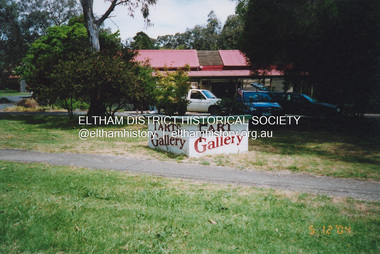
Photograph, Fay Bridge, Local humour added to Art Gallery sign, 559 Main Road, Eltham, 5 December 2004
... gallery closed at the end of November. The property was purchased in October 2004 for $565,000 by a local investment company, Sentinel Equities run by local residents Jethro and Suzanne Still. Plans to redevelop the property into offices and a gallery designed by Robert Marshall and supported by a number of local artists met with opposition from Eltham Gateway Action Group in 2007 over the proposed new building size and insufficient parking provision given the proposed reliance on the VicRoads reserve on Main Road for parking. ...gallery closed at the end of November. The property was purchased in October 2004 for $565,000 by a local investment company, Sentinel Equities run by local residents Jethro and Suzanne Still. Plans to redevelop the property into offices and a gallery designed by Robert Marshall and supported by a number of local artists met with opposition from Eltham Gateway Action Group in 2007 over the proposed new building size and insufficient parking provision given the proposed reliance on the VicRoads reserve on Main Road for parking. ...Photo taken immediately after the Wiregrass gallery closed at the end of November. The property was purchased in October 2004 for $565,000 by a local investment company, Sentinel Equities run by local residents Jethro and Suzanne Still. Plans to redevelop the property into offices and a gallery designed by Robert Marshall and supported by a number of local artists met with opposition from Eltham Gateway Action Group in 2007 over the proposed new building size and insufficient parking provision given the proposed reliance on the VicRoads reserve on Main Road for parking. The development proposal was finally approved by VCAT in January 2008 subject to VicRoads approving the use of the road reserve for parking. That did not happen and the property remains undeveloped 15 years later (August 2023).fay bridge collection, 559 main road eltham, 2004-12-05, eltham, eltham gallery, graffiti, main road, wiregrass gallery -
 Eltham District Historical Society Inc
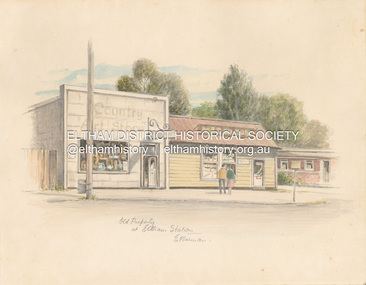
Artwork, other - Sketch, E. Foreman, Old property at Eltham Station, c.1980
... galleries opened and closed in Eltham. One such shop was Bimbadeen, next to Ansell and Muir's chicken shop opposite Eltham Lower Park. That business run by Don Brown, then a local artist...galleries opened and closed in Eltham. One such shop was Bimbadeen, next to Ansell and Muir's chicken shop opposite Eltham Lower Park. That business run by Don Brown, then a local artist ...Situated at 965 Main Road adjacent to the Eltham Railway Station, the Country Art Store was originally a hairdresser and Tattersalls agency In 1968 Pam Robinson and Caroline Shenton opened a small shop on the corner of Main Road and Napoleon Street. Four months later a damaged fire hyrdant flooded the store and ruined all their stock. The pair moved to the former hardresser shop at 965 Main Road, adjacent to the Eltham Railway Station, opposite the Stationmaster's house and opened the Country Art Store and adjacent gallery. At the time the only other shop selling pottery was the Potters Cottage in Warrandyte. During the 1970s the gallery was the Wiregrass Gallery. In 1993, after 25 years operating the Country Art Store, the pair decided to sell up and move to warmer climates. During the course of their business a number of craft shops and galleries opened and closed in Eltham. One such shop was Bimbadeen, next to Ansell and Muir's chicken shop opposite Eltham Lower Park. That business run by Don Brown, then a local artist was taken over as River Clay run by Leo Haanappel and Coeny Dommers but ultimately sat in a flood plain and was demolished. When the Country Art Store became available in 1993, Leo Haanappel and Coeny Dommers took it over. The premises became Platform 3095 cafe around 2015.Old Property at Eltha Station E. Foremanart store, country art store, country art store (eltham), eltham railway station, platform 3095, restaurants, shops, wiregrass gallery -
 Eltham District Historical Society Inc
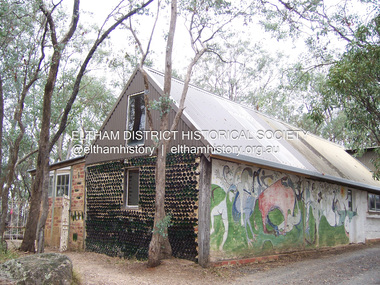
Photograph - Digital Photograph, Marguerite Marshall, Art Gallery at Clifton Pugh's Artists' Colony, Dunmoochin, Barreenong Road, Cottles Bridge, 5 February 2008
... run by a voluntary board of directors, headed by one of his sons, Shane Pugh. La Trobe University in Victoria stores and curates the art collection and organises its exhibition around Australia.2 The Foundation aims to protect and foster the natural environment and to provide residences, studios and community art facilities at a minimal cost for artists and environmental researchers. They reside at the non-profit organisation for a year at minimal cost. The buildings, some decorated with murals painted by Pugh and including a gallery...run by a voluntary board of directors, headed by one of his sons, Shane Pugh. La Trobe University in Victoria stores and curates the art collection and organises its exhibition around Australia.2 The Foundation aims to protect and foster the natural environment and to provide residences, studios and community art facilities at a minimal cost for artists and environmental researchers. They reside at the non-profit organisation for a year at minimal cost. The buildings, some decorated with murals painted by Pugh and including a gallery ...Art Gallery with mural painted by Clifton Pugh (1924-1990) at his Artists' Colony, Dunmoochin, Barreenong Road, Cottles Bridge. Following military service in the second world war, Clifton Pugh studied under artist Sir William Dargie at the National Gallery School in Melbourne as well as Justus Jorgensen, founder of Montsalvat. For a while he lived on the dole but also worked packing eggs for the Belot family saving sufficient to purchase six acres (2.4 ha) of land at Barreenong Road, Cottles Bridge. He accumulated more land and persuaded several other artists and friends to buy land nearby, resulting in a property of approximately 200 acres, stablishing it as one of the first artistic communes in Australia alongside Montsalvat in Eltham. It was around 1951 that Pugh felt he had '"done moochin' around" and so the name of the property evolved. He bought timber from Alistair Knox to build his house on the crest of a hill. Inspired by local goldminer's huts, it was a one room wattle-and-daub structure with dirt floor. Over the years it expanded with thick adobe walls made from local clay, high ceilings and stone floors. All materials other than the local earth were sourced from second hand materials, most found at wreckers' yards. Artists from across the nation were drawn to Dunmoochin, with several setting up houses and shacks on the property, maintaining their independence but sharing their artistic zeal. Artists who worked or resided at Dunmoochin included Mirka Mora, John Perceval, Albert Tucker, Fred Williams, Charles Blackman, Arthur Boyd and John Olsen. In 2002, Pugh's house along with its treasure trove of art and a library of some 20,000 books was destroyed by fire. Traces of Pugh's home remain with the presence of the Victorian doorframe archway with leadlight of intricate design, procured from a demolished Melbourne mansion; and two bronze life-sized female statues created by Pugh and cast by Matcham Skipper. In place of Pugh's house rose two double-storey mud-brick artists' studios topped with corrugated iron rooves curved like the wings of a bird with accommodation for seven. The original studios, gallery and other buildings survived the fire. Covered under Heritage Overlay, Nillumbik Planning Scheme. Published: Nillumbik Now and Then / Marguerite Marshall 2008; photographs Alan King with Marguerite Marshall.; p153 It’s not surprising that artist Clifton Pugh was drawn to Cottles Bridge to establish his artists’ colony Dunmoochin. Undisturbed by the clamour of modern life at Barreenong Road, Pugh was surrounded by the Australian bush he loved, and where his ashes were later scattered. The 200 acres (81ha) of bushland, broken by glimpses of rolling hills, has more than 50 species of orchids and Pugh shared his property with native animals including kangaroos, emus, phascogales, wombats, and diverse bird life. Pugh encouraged these creatures to join him in the bush by creating, with Monash University, a holding station where the animals were raised. Dunmoochin inspired Pugh for such paintings as in a book on orchids and the Death of a Wombat series.1 But his love for the bush was accompanied by the fear that Europeans were destroying it and much of his painting illustrated this fear and his plea for its conservation.2 However it was his house rather than the surrounding bush that was to be destroyed. Tragically in 2002 Pugh’s house, with its treasure of art and library of 20,000 art books, was destroyed by fire. Traces of the beauty of Pugh’s home still remain, however, in the magnificent Victorian doorframe archway with leadlight of intricate design procured from a demolished Melbourne mansion; and two bronze life-sized female statues created by Pugh and cast by Matcham Skipper. Now in place of Pugh’s house, are two double-storey mud-brick artists’ studios topped with corrugated roofs curved like birds’ wings, with accommodation for seven. The original studios, gallery and other buildings remain.3 Pugh grew up on his parents’ hobby farm at Briar Hill and attended the Briar Hill Primary School, then Eltham High School and later Ivanhoe Grammar. At 15 he became a copy boy for the Radio Times newspaper, then worked as a junior in a drafting office. Pugh was to have three wives and two sons. After serving in World War Two in New Guinea and Japan, Pugh studied under artist Sir William Dargie, at the National Gallery School in Melbourne.4 Another of his teachers was Justus Jörgensen, founder of Montsalvat the Eltham Artists’ Colony. Pugh lived on the dole for a while and paid for his first six acres (2.4ha) at Barreenong Road by working as an egg packer for the Belot family. Pugh accumulated more land and persuaded several other artists and friends to buy land nearby, resulting in the 200 acre property. They, too, purchased their land from the Belot family by working with their chickens. Around 1951 Pugh felt he had ‘Done moochin’ around’ and so the name of his property was born. Pugh bought some used timber from architect Alistair Knox to build his house on the crest of a hill. Inspired by local goldminers’ huts it was a one-room wattle-and-daub structure with a dirt floor. It was so small that the only room he could find for his telephone was on the fork of a tree nearby.5 Over the years the mud-brick house grew to 120 squares in the style now synonymous with Eltham. It had thick adobe walls (sun-dried bricks) made from local clay, high ceilings and stone floors with the entire structure made of second-hand materials – most found at wreckers’ yards. Pugh’s first major show in Melbourne in 1957, established him as a distinctive new painter, breaking away from the European tradition ‘yet not closely allied to any particular school of Australian painting’.6 Pugh became internationally known and was awarded the Order of Australia. He won the Archibald Prize for portraiture three times, although he preferred painting the bush and native animals. In 1990 not long before he died, Pugh was named the Australian War Memorial’s official artist at the 75th anniversary of the landing at Gallipoli. Today one of Pugh’s legacies is the Dunmoochin Foundation, which gives seven individual artists or couples and environmental researchers the chance to work in beautiful and peaceful surroundings, usually for a year. By November 2007, more than 80 people had taken part, and the first disabled artist had been chosen to reside in a new studio with disabled access.1 In 1989, not long before Pugh died in 1990 of a heart attack at age 65, he established the Foundation with La Trobe University and the Victorian Conservation Trust now the Trust for Nature. Pugh’s gift to the Australian people – of around 14 hectares of bushland and buildings and about 550 art works – is run by a voluntary board of directors, headed by one of his sons, Shane Pugh. La Trobe University in Victoria stores and curates the art collection and organises its exhibition around Australia.2 The Foundation aims to protect and foster the natural environment and to provide residences, studios and community art facilities at a minimal cost for artists and environmental researchers. They reside at the non-profit organisation for a year at minimal cost. The buildings, some decorated with murals painted by Pugh and including a gallery, were constructed by Pugh, family and friends, with recycled as well as new materials and mud-bricks. The Foundation is inspired by the tradition begun by the Dunmoochin Artists’ Cooperative which formed in the late 1950s as one of the first artistic communes in Australia. Members bought the land collaboratively and built the seven dwellings so that none could overlook another. But, in the late 1960s, the land was split into private land holdings, which ended the cooperative. Dunmoochin attracted visits from the famous artists of the day including guitarists John Williams and Segovia; singer and comedian Rolf Harris; comedian Barry Humphries; and artists Charles Blackman, Arthur Boyd and Mirka Mora. A potters’ community, started by Peter and Helen Laycock with Alma Shanahan, held monthly exhibitions in the 1960s, attracting local, interstate and international visitors – with up to 500 attending at a time.3 Most artists sold their properties and moved away. But two of the original artists remained into the new millennium as did relative newcomer Heja Chong who built on Pugh’s property (now owned by the Dunmoochin Foundation). In 1984 Chong brought the 1000-year-old Japanese Bizan pottery method to Dunmoochin. She helped build (with potters from all over Australia) the distinctive Bizan-style kiln, which fires pottery from eight to 14 days in pine timber, to produce the Bizan unglazed and simple subdued style. The kiln, which is rare in Australia, is very large with adjoining interconnected ovens of different sizes, providing different temperatures and firing conditions. Frank Werther, who befriended Pugh as a fellow student at the National Gallery Art School in Melbourne, built his house off Barreenong Road in 1954. Werther is a painter of the abstract and colourist style and taught art for about 30 years. Like so many in the post-war years in Eltham Shire, as it was called then, Werther built his home in stages using mud-brick and second-hand materials. The L-shaped house is single-storey but two-storey in parts with a corrugated-iron pitched roof. The waterhole used by the Werthers for their water supply is thought to be a former goldmining shaft.4 Alma Shanahan at Barreenong Road was the first to join Pugh around 1953. They also met at the National Gallery Art School and Shanahan at first visited each weekend to work, mainly making mud-bricks. She shared Pugh’s love for the bush, but when their love affair ended, she designed and built her own house a few hundred yards (metres) away. The mud-brick and timber residence, made in stages with local materials, is rectangular, single-storey with a corrugated-iron roof. As a potter, Shanahan did not originally qualify as an official Cooperative member.This collection of almost 130 photos about places and people within the Shire of Nillumbik, an urban and rural municipality in Melbourne's north, contributes to an understanding of the history of the Shire. Published in 2008 immediately prior to the Black Saturday bushfires of February 7, 2009, it documents sites that were impacted, and in some cases destroyed by the fires. It includes photographs taken especially for the publication, creating a unique time capsule representing the Shire in the early 21st century. It remains the most recent comprehenesive publication devoted to the Shire's history connecting local residents to the past. nillumbik now and then (marshall-king) collection, art gallery, clifton pugh, dunmoochin, cottlesbridge, cottles bridge, barreenong road -
 Eltham District Historical Society Inc
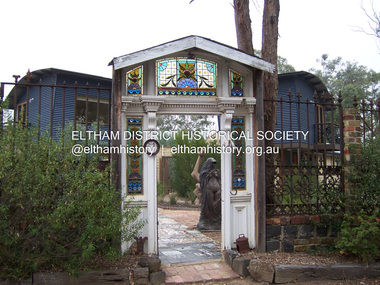
Photograph - Digital Photograph, Marguerite Marshall, Doorway of Clifton Pugh's former house at Dunmoochin, Barreenong Road, Cottles Bridge, 5 February 2008
... run by a voluntary board of directors, headed by one of his sons, Shane Pugh. La Trobe University in Victoria stores and curates the art collection and organises its exhibition around Australia.2 The Foundation aims to protect and foster the natural environment and to provide residences, studios and community art facilities at a minimal cost for artists and environmental researchers. They reside at the non-profit organisation for a year at minimal cost. The buildings, some decorated with murals painted by Pugh and including a gallery...run by a voluntary board of directors, headed by one of his sons, Shane Pugh. La Trobe University in Victoria stores and curates the art collection and organises its exhibition around Australia.2 The Foundation aims to protect and foster the natural environment and to provide residences, studios and community art facilities at a minimal cost for artists and environmental researchers. They reside at the non-profit organisation for a year at minimal cost. The buildings, some decorated with murals painted by Pugh and including a gallery ...Following military service in the second world war, Clifton Pugh studied under artist Sir William Dargie at the National Gallery School in Melbourne as well as Justus Jorgensen, founder of Montsalvat. For a while he lived on the dole but also worked packing eggs for the Belot family saving sufficient to purchase six acres (2.4 ha) of land at Barreenong Road, Cottles Bridge. He accumulated more land and persuaded several other artists and friends to buy land nearby, resulting in a property of approximately 200 acres, stablishing it as one of the first artistic communes in Australia alongside Montsalvat in Eltham. It was around 1951 that Pugh felt he had '"done moochin' around" and so the name of the property evolved. He bought timber from Alistair Knox to build his house on the crest of a hill. Inspired by local goldminer's huts, it was a one room wattle-and-daub structure with dirt floor. Over the years it expanded with thick adobe walls made from local clay, high ceilings and stone floors. All materials other than the local earth were sourced from second hand materials, most found at wreckers' yards. Artists from across the nation were drawn to Dunmoochin, with several setting up houses and shacks on the property, maintaining their independence but sharing their artistic zeal. Artists who worked or resided at Dunmoochin included Mirka Mora, John Perceval, Albert Tucker, Fred Williams, Charles Blackman, Arthur Boyd and John Olsen. In 2002, Pugh's house along with its treasure trove of art and a library of some 20,000 books was destroyed by fire. Traces of Pugh's home remain with the presence of the Victorian doorframe archway with leadlight of intricate design, procured from a demolished Melbourne mansion; and two bronze life-sized female statues created by Pugh and cast by Matcham Skipper. In place of Pugh's house rose two double-storey mud-brick artists' studios topped with corrugated iron rooves curved like the wings of a bird with accommodation for seven. The original studios, gallery and other buildings survived the fire. Covered under Heritage Overlay, Nillumbik Planning Scheme. Published: Nillumbik Now and Then / Marguerite Marshall 2008; photographs Alan King with Marguerite Marshall.; p155 It’s not surprising that artist Clifton Pugh was drawn to Cottles Bridge to establish his artists’ colony Dunmoochin. Undisturbed by the clamour of modern life at Barreenong Road, Pugh was surrounded by the Australian bush he loved, and where his ashes were later scattered. The 200 acres (81ha) of bushland, broken by glimpses of rolling hills, has more than 50 species of orchids and Pugh shared his property with native animals including kangaroos, emus, phascogales, wombats, and diverse bird life. Pugh encouraged these creatures to join him in the bush by creating, with Monash University, a holding station where the animals were raised. Dunmoochin inspired Pugh for such paintings as in a book on orchids and the Death of a Wombat series.1 But his love for the bush was accompanied by the fear that Europeans were destroying it and much of his painting illustrated this fear and his plea for its conservation.2 However it was his house rather than the surrounding bush that was to be destroyed. Tragically in 2002 Pugh’s house, with its treasure of art and library of 20,000 art books, was destroyed by fire. Traces of the beauty of Pugh’s home still remain, however, in the magnificent Victorian doorframe archway with leadlight of intricate design procured from a demolished Melbourne mansion; and two bronze life-sized female statues created by Pugh and cast by Matcham Skipper. Now in place of Pugh’s house, are two double-storey mud-brick artists’ studios topped with corrugated roofs curved like birds’ wings, with accommodation for seven. The original studios, gallery and other buildings remain.3 Pugh grew up on his parents’ hobby farm at Briar Hill and attended the Briar Hill Primary School, then Eltham High School and later Ivanhoe Grammar. At 15 he became a copy boy for the Radio Times newspaper, then worked as a junior in a drafting office. Pugh was to have three wives and two sons. After serving in World War Two in New Guinea and Japan, Pugh studied under artist Sir William Dargie, at the National Gallery School in Melbourne.4 Another of his teachers was Justus Jörgensen, founder of Montsalvat the Eltham Artists’ Colony. Pugh lived on the dole for a while and paid for his first six acres (2.4ha) at Barreenong Road by working as an egg packer for the Belot family. Pugh accumulated more land and persuaded several other artists and friends to buy land nearby, resulting in the 200 acre property. They, too, purchased their land from the Belot family by working with their chickens. Around 1951 Pugh felt he had ‘Done moochin’ around’ and so the name of his property was born. Pugh bought some used timber from architect Alistair Knox to build his house on the crest of a hill. Inspired by local goldminers’ huts it was a one-room wattle-and-daub structure with a dirt floor. It was so small that the only room he could find for his telephone was on the fork of a tree nearby.5 Over the years the mud-brick house grew to 120 squares in the style now synonymous with Eltham. It had thick adobe walls (sun-dried bricks) made from local clay, high ceilings and stone floors with the entire structure made of second-hand materials – most found at wreckers’ yards. Pugh’s first major show in Melbourne in 1957, established him as a distinctive new painter, breaking away from the European tradition ‘yet not closely allied to any particular school of Australian painting’.6 Pugh became internationally known and was awarded the Order of Australia. He won the Archibald Prize for portraiture three times, although he preferred painting the bush and native animals. In 1990 not long before he died, Pugh was named the Australian War Memorial’s official artist at the 75th anniversary of the landing at Gallipoli. Today one of Pugh’s legacies is the Dunmoochin Foundation, which gives seven individual artists or couples and environmental researchers the chance to work in beautiful and peaceful surroundings, usually for a year. By November 2007, more than 80 people had taken part, and the first disabled artist had been chosen to reside in a new studio with disabled access.1 In 1989, not long before Pugh died in 1990 of a heart attack at age 65, he established the Foundation with La Trobe University and the Victorian Conservation Trust now the Trust for Nature. Pugh’s gift to the Australian people – of around 14 hectares of bushland and buildings and about 550 art works – is run by a voluntary board of directors, headed by one of his sons, Shane Pugh. La Trobe University in Victoria stores and curates the art collection and organises its exhibition around Australia.2 The Foundation aims to protect and foster the natural environment and to provide residences, studios and community art facilities at a minimal cost for artists and environmental researchers. They reside at the non-profit organisation for a year at minimal cost. The buildings, some decorated with murals painted by Pugh and including a gallery, were constructed by Pugh, family and friends, with recycled as well as new materials and mud-bricks. The Foundation is inspired by the tradition begun by the Dunmoochin Artists’ Cooperative which formed in the late 1950s as one of the first artistic communes in Australia. Members bought the land collaboratively and built the seven dwellings so that none could overlook another. But, in the late 1960s, the land was split into private land holdings, which ended the cooperative. Dunmoochin attracted visits from the famous artists of the day including guitarists John Williams and Segovia; singer and comedian Rolf Harris; comedian Barry Humphries; and artists Charles Blackman, Arthur Boyd and Mirka Mora. A potters’ community, started by Peter and Helen Laycock with Alma Shanahan, held monthly exhibitions in the 1960s, attracting local, interstate and international visitors – with up to 500 attending at a time.3 Most artists sold their properties and moved away. But two of the original artists remained into the new millennium as did relative newcomer Heja Chong who built on Pugh’s property (now owned by the Dunmoochin Foundation). In 1984 Chong brought the 1000-year-old Japanese Bizan pottery method to Dunmoochin. She helped build (with potters from all over Australia) the distinctive Bizan-style kiln, which fires pottery from eight to 14 days in pine timber, to produce the Bizan unglazed and simple subdued style. The kiln, which is rare in Australia, is very large with adjoining interconnected ovens of different sizes, providing different temperatures and firing conditions. Frank Werther, who befriended Pugh as a fellow student at the National Gallery Art School in Melbourne, built his house off Barreenong Road in 1954. Werther is a painter of the abstract and colourist style and taught art for about 30 years. Like so many in the post-war years in Eltham Shire, as it was called then, Werther built his home in stages using mud-brick and second-hand materials. The L-shaped house is single-storey but two-storey in parts with a corrugated-iron pitched roof. The waterhole used by the Werthers for their water supply is thought to be a former goldmining shaft.4 Alma Shanahan at Barreenong Road was the first to join Pugh around 1953. They also met at the National Gallery Art School and Shanahan at first visited each weekend to work, mainly making mud-bricks. She shared Pugh’s love for the bush, but when their love affair ended, she designed and built her own house a few hundred yards (metres) away. The mud-brick and timber residence, made in stages with local materials, is rectangular, single-storey with a corrugated-iron roof. As a potter, Shanahan did not originally qualify as an official Cooperative member.This collection of almost 130 photos about places and people within the Shire of Nillumbik, an urban and rural municipality in Melbourne's north, contributes to an understanding of the history of the Shire. Published in 2008 immediately prior to the Black Saturday bushfires of February 7, 2009, it documents sites that were impacted, and in some cases destroyed by the fires. It includes photographs taken especially for the publication, creating a unique time capsule representing the Shire in the early 21st century. It remains the most recent comprehenesive publication devoted to the Shire's history connecting local residents to the past. nillumbik now and then (marshall-king) collection, art gallery, clifton pugh, dunmoochin, cottlesbridge, cottles bridge, barreenong road -
 Eltham District Historical Society Inc
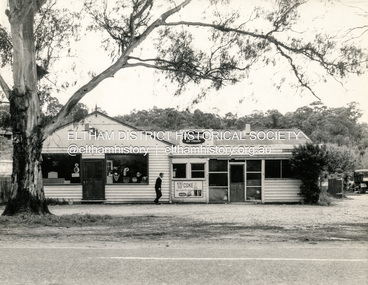
Photograph, George W. Bell, Eltham South Milk Bar, opposite Eltham Lower Park, c.1960
... The residence section to the right was developed as an art, pottery and crafts gallery, Bimbadeen, run by Don Brown, then a local artist. It was taken over in the late 1980s as River Clay run by Leo Haanappel and Coeny Dommers. ...The residence section to the right was developed as an art, pottery and crafts gallery, Bimbadeen, run by Don Brown, then a local artist. It was taken over in the late 1980s as River Clay run by Leo Haanappel and Coeny Dommers. ...Site of original tea rooms opposite what was then Eltham Park, now Eltham Lower Park on Main Road, present-day 573 Main Road since early 1970s, immediately prior to which it was 271 Main Road. It is believed a Mrs M Willoughby operated the tea rooms around October 1919. Arthur James McDonald became proprietor of the Eltham Park Tea Rooms some time between 1942 and 1945. In the 1942 Electoral Roll he was recorded living in Moonee Ponds as an aircraft fitter and was then recorded as a tea-room proprietor at Main Road, Eltham in the 1946 Electoral Roll. By 1949 he had moved to Leongatha where he was a café proprietor. A picture of the 1934 floods (EDHS_00103) shows the tea rooms surrounded by waist height flood waters. This building was a different structure. It is not known whether the building was demolished and rebuilt because of this flood event or sometime later to the building seen in this photograph, however it appears to be of a mid-1950s style. During the 1950s it was a milk bar as seen in this photograph and served Devonshire teas in the late 1950s, open only on weekends to service the park and miniature railway opposite. Locals who were children of the late 1950s on recall buying bags of lollies and drinks such as Blue Heaven Spider (ice cream float) and crackers for cracker night. At one point the shop also had pinball machines. It is believed the section of the building to the right was a residence. By the time the Shire of Eltham celebrated its centenary in 1971, the Eltham South Milk Bar was under new management. During the 1980s the shop was operated by Ansell and Muir and they offered takeaway fast food, such as spring rolls and especially hot chicken and chips. Locals also fondly recall their chicken schnitzel with lemon juice. It is remembered as one of the best takeaway food shops, fresh food and fast service with great parking. The residence section to the right was developed as an art, pottery and crafts gallery, Bimbadeen, run by Don Brown, then a local artist. It was taken over in the late 1980s as River Clay run by Leo Haanappel and Coeny Dommers. Unfortunately, the store stood within the 1934 flood zone and the property was unable to be redeveloped. The former Shire of Eltham acquired the land, and the building was subsequently demolished. In December 1993 company registration for Ansell and Muir Prestige Catering was cancelled and the business dissolved. The location is now the site of the current Fleur de Feliss flower stall tent. 17 December 1993 company registration cancelled for Ansell and Muir Prestige Catering Pty. Ltd. [CORPORATIONS LAW Subsection 574(1) (1994, January 12). Commonwealth of Australia Gazette. Periodic (National : 1977 - 2011), p. 20. Retrieved May 24, 2026, from http://nla.gov.au/nla.news-article238039370]Black and white photograph of Eltham South Store later Ansell & Muir c.1960573 main road eltham, 1960, a.j. mcdonald, ansell, ansell and muir, arthur james mcdonald, bimbadeen gallery, eltham, eltham park tea rooms, eltham south, george w. bell collection, main road eltham, milk bar, muir, riverclay craft gallery, shops, take away food -
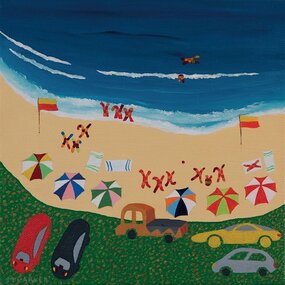 The 69 Collective
Painting, Merle Parker, Australia Day Chromosomes
... gallery...artist-run initiative...This artwork is part of 69Fifteen, the book published in 2013 celebrating 69 Smith Street Gallery’s 15th year in operation as an artist-run space. merle parker 69 smith street gallery artist-run initiative artist-run space painting chromosome melbourne galleries Colourful painting of chromosome figures playing on a beach. ...This artwork is part of 69Fifteen, the book published in 2013 celebrating 69 Smith Street Gallery’s 15th year in operation as an artist-run space.Colourful painting of chromosome figures playing on a beach.merle parker, 69 smith street gallery, artist-run initiative, artist-run space, painting, chromosome, melbourne galleries -
 The 69 Collective
Photograph, Jenny Gibson, Towards Braidwood, 2011
... gallery...artist-run initiative...This artwork is part of 69Fifteen, the book published in 2013 celebrating 69 Smith Street Gallery’s 15th year in operation as an artist-run space. jenny gibson 69 smith street gallery artist-run initiative artist-run space photography landscape melbourne art galleries colour photography digital photography Blurred vision of a tree against brown landscape and blue/grey sky. ...This artwork is part of 69Fifteen, the book published in 2013 celebrating 69 Smith Street Gallery’s 15th year in operation as an artist-run space.Blurred vision of a tree against brown landscape and blue/grey sky.jenny gibson, 69 smith street gallery, artist-run initiative, artist-run space, photography, landscape, melbourne art galleries, colour photography, digital photography -
 The 69 Collective
Painting, Nikki D'Emden, Dead Azalea
... gallery...artist-run initiative...This artwork is part of 69Fifteen, the book published in 2013 celebrating 69 Smith Street Gallery’s 15th year in operation as an artist-run space. nikki d'emden 69 smith street gallery artist-run initiative painting artist-run space melbourne art galleries nikkidemden.com Oil painting and gold leaf on a birch panel Dead Azalea Painting Nikki D'Emden ...This artwork is part of 69Fifteen, the book published in 2013 celebrating 69 Smith Street Gallery’s 15th year in operation as an artist-run space.Oil painting and gold leaf on a birch panelnikki d'emden, 69 smith street gallery, artist-run initiative, painting, artist-run space, melbourne art galleries, nikkidemden.com -
 The 69 Collective
Sculpture, Clodagh Holahan, Art Nouveau
... gallery...artist-run space...This artwork is part of 69Fifteen, the book published in 2013 celebrating 69 Smith Street Gallery’s 15th year in operation as an artist-run space. clodagh holahan 69 smith street gallery artist-run space artist-run initiative sculpture melbourne galleries clodagh-holahan.com Bronze sculpture on a polished granite circular base. ...This artwork is part of 69Fifteen, the book published in 2013 celebrating 69 Smith Street Gallery’s 15th year in operation as an artist-run space.Bronze sculpture on a polished granite circular base. Female subject is wearing a long flowing dressclodagh holahan, 69 smith street gallery, artist-run space, artist-run initiative, sculpture, melbourne galleries, clodagh-holahan.com -
 The 69 Collective
Artwork, E. Justine Cromb, Springtime
... gallery...artist-run initiative...This artwork is part of 69Fifteen, the book published in 2013 celebrating 69 Smith Street Gallery’s 15th year in operation as an artist-run space. e justine cromb 69 smith street gallery artist-run initiative artist-run space mixed media birdlife in art melbourne art galleries Image of two birds sitting on a tree branch with flowers. ...This artwork is part of 69Fifteen, the book published in 2013 celebrating 69 Smith Street Gallery’s 15th year in operation as an artist-run space.Image of two birds sitting on a tree branch with flowers. The background is light blue, the branch is dark blue and the birds and flowers are made from cut-out pieces of metal.e justine cromb, 69 smith street gallery, artist-run initiative, artist-run space, mixed media, birdlife in art, melbourne art galleries -
 The 69 Collective
Artwork, Louis Balis, Casting the Shadow of an Ant
... gallery...artist-run initiative...This artwork is part of 69Fifteen, the book published in 2013 celebrating 69 Smith Street Gallery’s 15th year in operation as an artist-run space. louis balis 69 smith street gallery artist-run initiative artist-run space melbourne art galleries maquette shadow sculpture photograph ant [email protected] This artwork shows a wooden type sculpture depicting an ant. ...This artwork is part of 69Fifteen, the book published in 2013 celebrating 69 Smith Street Gallery’s 15th year in operation as an artist-run space.This artwork shows a wooden type sculpture depicting an ant. A blue spotlight on the ant is casting a shadow on a floor.louis balis, 69 smith street gallery, artist-run initiative, artist-run space, melbourne art galleries, maquette, shadow, sculpture, photograph, ant, [email protected] -
 The 69 Collective
Photograph, Aneta Bozic, After Life: Mouse, 2012
... gallery...artist-run initiative...This artwork is part of 69Fifteen, the book published in 2013 celebrating 69 Smith Street Gallery’s 15th year in operation as an artist-run space....This artwork is part of 69Fifteen, the book published in 2013 celebrating 69 Smith Street Gallery’s 15th year in operation as an artist-run space. aneta bozic 69 smith street gallery artist-run initiative artist-run space melbourne art galleries photography colour photography animal photography death in art www.anetabozic.com Colour digital print of a dead mouse. ...This artwork is part of 69Fifteen, the book published in 2013 celebrating 69 Smith Street Gallery’s 15th year in operation as an artist-run space.Colour digital print of a dead mouse. Image is a cropped detail of the animal's hind legs and tail.aneta bozic, 69 smith street gallery, artist-run initiative, artist-run space, melbourne art galleries, photography, colour photography, animal photography, death in art, www.anetabozic.com -
 The 69 Collective
Painting and Sculpture, Theo L.A. den Brinker, Sura 7, 2008
... gallery...artist-run initiative...This artwork is part of 69Fifteen, the book published in 2013 celebrating 69 Smith Street Gallery’s 15th year in operation as an artist-run space....This artwork is part of 69Fifteen, the book published in 2013 celebrating 69 Smith Street Gallery’s 15th year in operation as an artist-run space. theo den brinker 69 smith street gallery artist-run initiative artist-run space melbourne art galleries painting sculpture Digital print. ...This artwork is part of 69Fifteen, the book published in 2013 celebrating 69 Smith Street Gallery’s 15th year in operation as an artist-run space.Digital print. Series of panels featuring text. The text is printed over the image of radical Muslim cleric Abu Bakar Bashir.theo den brinker, 69 smith street gallery, artist-run initiative, artist-run space, melbourne art galleries, painting, sculpture -
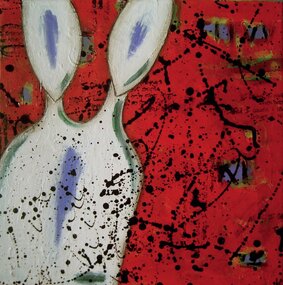 The 69 Collective
Painting, Liza Posar, Together We Mix, 2012
... gallery...artist-run initiative...This artwork is part of 69Fifteen, the book published in 2013 celebrating 69 Smith Street Gallery’s 15th year in operation as an artist-run space....This artwork is part of 69Fifteen, the book published in 2013 celebrating 69 Smith Street Gallery’s 15th year in operation as an artist-run space. liza posar 69 smith street gallery artist-run initiative artist-run space melbourne art galleries painting graffiti Painted using acrylics, ink and charcoal on canvas. ...This artwork is part of 69Fifteen, the book published in 2013 celebrating 69 Smith Street Gallery’s 15th year in operation as an artist-run space.Painted using acrylics, ink and charcoal on canvas. This abstract image features what looks like two figures merged into one against a red background with sprays of black paint. liza posar, 69 smith street gallery, artist-run initiative, artist-run space, melbourne art galleries, painting, graffiti -
 The 69 Collective
Painting, Julie Harmsworth, Walk in the Sun, April 2013
... gallery...artist-run initiative...This artwork is part of 69Fifteen, the book published in 2013 celebrating 69 Smith Street Gallery’s 15th year in operation as an artist-run space....This artwork is part of 69Fifteen, the book published in 2013 celebrating 69 Smith Street Gallery’s 15th year in operation as an artist-run space. julie harmsworth 69 smith street gallery artist-run initiative artist-run space melbourne art galleries painting abstract art abstract painting www.incarastudio.com.au Acrylic painting. ...This artwork is part of 69Fifteen, the book published in 2013 celebrating 69 Smith Street Gallery’s 15th year in operation as an artist-run space.Acrylic painting. Abstract image comprising twelve canvases. Colour scheme includes yellow, brown, aqua and green.julie harmsworth, 69 smith street gallery, artist-run initiative, artist-run space, melbourne art galleries, painting, abstract art, abstract painting, www.incarastudio.com.au -
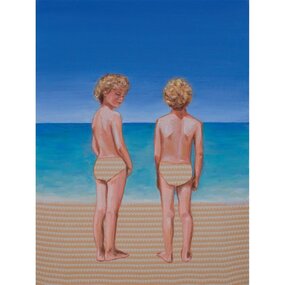 The 69 Collective
Painting, Leah Mariani, Beach bums, 2013
... gallery...artist-run initiative...This artwork is part of 69Fifteen, the book published in 2013 celebrating 69 Smith Street Gallery’s 15th year in operation as an artist-run space....This artwork is part of 69Fifteen, the book published in 2013 celebrating 69 Smith Street Gallery’s 15th year in operation as an artist-run space. leah mariani 69 smith street gallery artist-run initiative artist-run space melbourne art galleries painting www.leahmariani.com Oil on cotton fabric. ...This artwork is part of 69Fifteen, the book published in 2013 celebrating 69 Smith Street Gallery’s 15th year in operation as an artist-run space.Oil on cotton fabric. Image of two young boys standing beside each other looking out to sea. They are painted against a background of blue-green water and a clear blue sky. The pattern on the sand is repeated in the boys' swimming costumes. One of the boys has his head turned away from the water.leah mariani, 69 smith street gallery, artist-run initiative, artist-run space, melbourne art galleries, painting, www.leahmariani.com -
 The 69 Collective
Painting, Amy Mills, Over Mountains Of Mist, 2012
... gallery...artist-run initiative...This artwork is part of 69Fifteen, the book published in 2013 celebrating 69 Smith Street Gallery’s 15th year in operation as an artist-run space....This artwork is part of 69Fifteen, the book published in 2013 celebrating 69 Smith Street Gallery’s 15th year in operation as an artist-run space. amy mills 69 smith street gallery artist-run initiative artist-run space melbourne art galleries painting www.amymills.com.au Acrylic on canvas. ...This artwork is part of 69Fifteen, the book published in 2013 celebrating 69 Smith Street Gallery’s 15th year in operation as an artist-run space.Acrylic on canvas. Stylistic depiction of mountains in blue tones, set under a golden sky.amy mills, 69 smith street gallery, artist-run initiative, artist-run space, melbourne art galleries, painting, www.amymills.com.au -
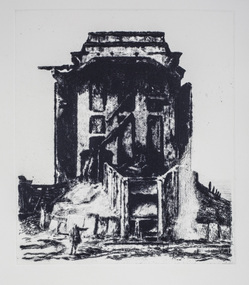 Nillumbik Shire Council
Print (drypoint): Rick AMOR (b.1948 Melbourne, AUS), Rick Amor, 'The Ruin' from 'The Baldessin & Friends' commemorative folio, 2016
... Gallery of Australia, Canberra. In 1975 he represented Australia in the Sao Paulo Biennale, before living and working in Paris until his return to St Andrews in 1977. In 1978 George was killed in a car accident aged 39 years. In 2001 Tess returned to St Andrews to reclaim the run-down studio and reconstitute it as The Baldessin Press & Studio - a printmaking retreat. It operates in George’s memory, so that artists...Gallery of Australia, Canberra. In 1975 he represented Australia in the Sao Paulo Biennale, before living and working in Paris until his return to St Andrews in 1977. In 1978 George was killed in a car accident aged 39 years. In 2001 Tess returned to St Andrews to reclaim the run-down studio and reconstitute it as The Baldessin Press & Studio - a printmaking retreat. It operates in George’s memory, so that artists ...Painter, printmaker and sculptor Rick Amor is one of Australia's most distinguished senior artists. He was a good friend of the late George Baldessin and three times Archibald Prize winner Clifton Pugh, having lived and worked at Pugh's property, Dunmoochin in Cottles Bridge, Nillumbik during the 1980s and 90s. George Baldessin (1939-1978) was born in San Biagio di Callalta, in the Veneto in Northern Italy and arrived in Australia ten years later. A printmaker and sculptor he built his bluestone studio at St Andrews (Nillumbik) in 1971 with his partner Tess and the three Hails brothers, Rob, Doug and Don. Made of recycled materials the studio today contains all of George’s equipment including the large press, which he modelled himself with the help of Neil Jeffrey (Enjay Presses). George won many prizes throughout his career and is represented in many of Australia's public art collections including his famous 'Pears' sculpture in front of the National Gallery of Australia, Canberra. In 1975 he represented Australia in the Sao Paulo Biennale, before living and working in Paris until his return to St Andrews in 1977. In 1978 George was killed in a car accident aged 39 years. In 2001 Tess returned to St Andrews to reclaim the run-down studio and reconstitute it as The Baldessin Press & Studio - a printmaking retreat. It operates in George’s memory, so that artists may continue to create, perpetuating the generous spirit of George. 'The Ruin' is one of eight prints in the 'Baldessin & Friends commemorative folio. The folio was conceived by Tess Edwards as a fundraising initiative in celebration of the The Baldessin Press & Studio's fifteen year anniversary, and as a way to honour George Baldessin's memory. The folio is a unique coming together of seven very different and acclaimed artists who are connected by their friendship to the missing eighth member, George Baldessin. The Baldessin Press & Studio is a not-for-profit organisation created in memory of the late George Baldessin (1939-1978), whose original studio is now open to the public for creative use and as a practical legacy to living artists. The Studio is located in St Andrews, Nillumbik. Rick Amor has been an ardent supporter of the Baldessin Press & Studio and a great patron of living artists. In 2014 the Press partnered with Amor and the State Library of Victoria to create The Amor Residency at The Baldessin Press & Studio, which is part of the Library's annual fellowship program. 'The Ruin' was based on a plein air painting done by Rick Amor on a trip to Broken Hill in 2001 and reflects on death and the passing of time so eloquently portrayed by the industrial ruins of NSW. In the tradition of a Piranesi, the work emphasises the transience of life and the triumph of time. Black and white drypoint etching in which a small figure, a traveller; located bottom left, points to a large crumbling edifice (building), a stage like space in the background. Ed.14/25baldessin, print, drypoint, amor, 2018 ekphrasis, ruin, etching, ekphrasis2018 -
 Nillumbik Shire Council
Print (etching & acquatint): George BALDESSIN (b.1939 ITA – d.1978 AUS), George Baldessin, ‘Portrait II’ from 'The Baldessin & Friends' commemorative folio, 1966 (printed 2017)
... Gallery of Australia, Canberra. In 1975 he represented Australia in the Sao Paulo Biennale, before living and working in Paris until his return to St Andrews in 1977. In 1978 George was killed in a car accident aged 39 years. In 2001 Tess returned to St Andrews to reclaim the run-down studio and reconstitute it as The Baldessin Press & Studio - a printmaking retreat. It operates in George’s memory, so that artists...Gallery of Australia, Canberra. In 1975 he represented Australia in the Sao Paulo Biennale, before living and working in Paris until his return to St Andrews in 1977. In 1978 George was killed in a car accident aged 39 years. In 2001 Tess returned to St Andrews to reclaim the run-down studio and reconstitute it as The Baldessin Press & Studio - a printmaking retreat. It operates in George’s memory, so that artists ...George Baldessin (1939-1978) was born in San Biagio di Callalta, in the Veneto in Northern Italy and arrived in Australia ten years later. A printmaker and sculptor he built his bluestone studio at St Andrews (Nillumbik) in 1971 with his partner Tess and the three Hails brothers, Rob, Doug and Don. Made of recycled materials the studio today contains all of George’s equipment including the large press, which he modelled himself with the help of Neil Jeffrey (Enjay Presses). George won many prizes throughout his career and is represented in many of Australia's public art collections including his famous 'Pears' sculpture in front of the National Gallery of Australia, Canberra. In 1975 he represented Australia in the Sao Paulo Biennale, before living and working in Paris until his return to St Andrews in 1977. In 1978 George was killed in a car accident aged 39 years. In 2001 Tess returned to St Andrews to reclaim the run-down studio and reconstitute it as The Baldessin Press & Studio - a printmaking retreat. It operates in George’s memory, so that artists may continue to create, perpetuating the generous spirit of George. This work chosen for the folio is from an incomplete edition from 1966. It has been printed on Baldessin's original 1974 cast aluminium Enjay press (designed and made in collaboration with Neil Jeffreys) and restored specifically for this project by Dan Jones. In addition Deanna Hitti has used Baldessin's original Japanese Torinoko paper, stored safely in his studio for over forty years. ‘Portrait II’ is one of eight prints in the 'Baldessin & Friends commemorative folio. The folio was conceived by Tess Edwards as a fundraising initiative in celebration of the The Baldessin Press & Studio's fifteen year anniversary, and as a way to honour George Baldessin's memory. The Baldessin Press & Studio is a not-for-profit organisation created in memory of the late George Baldessin (1939-1978), whose original studio is now open to the public for creative use and as a practical legacy to living artists. The Studio is located in St Andrews, Nillumbik. The folio is a unique coming together of seven very different and acclaimed artists who are connected by their friendship to the missing eighth member, George Baldessin. This print is a fine example of Baldessin's primary interest of the figure, which displays great sensitivity to and observation of the human condition. Distortion, exaggeration and fragmentation were employed by Baldessin as tools to animate and scrutinize the displaced, dispossessed and alienated figure, flattened against the picture plane. Black and white distorted and exaggerated figure (head and shoulders), with hands raised to the face and the figure's right eye. acquatint, etching, baldessin, ekphrasis2018, figure -
 Nillumbik Shire Council
Print (etching, acquatint, stencil): Jock CLUTTERBUCK (b.1945), Jock Clutterbuck, ‘Frosty Night Cartouche’ from 'The Baldessin & Friends' commemorative folio, 2016
... Gallery of Australia, Canberra. In 1975 he represented Australia in the Sao Paulo Biennale, before living and working in Paris until his return to St Andrews in 1977. In 1978 George was killed in a car accident aged 39 years. In 2001 Tess returned to St Andrews to reclaim the run-down studio and reconstitute it as The Baldessin Press & Studio - a printmaking retreat. It operates in George’s memory, so that artists...Gallery of Australia, Canberra. In 1975 he represented Australia in the Sao Paulo Biennale, before living and working in Paris until his return to St Andrews in 1977. In 1978 George was killed in a car accident aged 39 years. In 2001 Tess returned to St Andrews to reclaim the run-down studio and reconstitute it as The Baldessin Press & Studio - a printmaking retreat. It operates in George’s memory, so that artists ...Jock Clutterbuck is a sculptor and printmaker of national significance, known for his sophisticated abstract forms with underlying esoteric mysticism. Clutterbuck overlapped with Baldessin when he studied sculpture and printmaking at the Royal Melbourne Institute of Technology, RMIT (1965-66). He taught at RMIT from (1969-73) before lecturing in sculpture at the Victorian College of the Arts (1974-2000). He is represented in many national and international public art collections and is a recipient of many National prizes and awards. George Baldessin (1939-1978) was a printmaker and sculptor who built his bluestone studio at St Andrews (Nillumbik) in 1971. The bluestone studio was hand built by George, his partner Tess and the three Hails brothers, Rob, Doug and Don. Made of recycled materials the studio today contains all of George’s equipment including the large press, which he modelled himself with the help of Neil Jeffrey (Enjay Presses). George won many prizes throughout his career and is represented in many of Australia's public art collections including his famous 'Pears' sculpture in front of the National Gallery of Australia, Canberra. In 1975 he represented Australia in the Sao Paulo Biennale, before living and working in Paris until his return to St Andrews in 1977. In 1978 George was killed in a car accident aged 39 years. In 2001 Tess returned to St Andrews to reclaim the run-down studio and reconstitute it as The Baldessin Press & Studio - a printmaking retreat. It operates in George’s memory, so that artists may continue to create, perpetuating the generous spirit of George.‘Frosty Night Cartouche’ is one of eight prints in the 'Baldessin & Friends commemorative folio. The folio was conceived by Tess Edwards as a fundraising initiative in celebration of the The Baldessin Press & Studio's fifteen year anniversary, and as a way to honour George Baldessin's memory. The Baldessin Press & Studio is a not-for-profit organisation created in memory of the late George Baldessin (1939-1978), whose original studio is now open to the public for creative use and as a practical legacy to living artists. The Studio is located in St Andrews, Nillumbik. The folio is a unique coming together of seven very different and acclaimed artists who are connected by their friendship to the missing eighth member, George Baldessin. Following a visit to the Press in 2015, Clutterbuck was reminded of a suite of paintings he had produced some thirty years earlier inspired by plein-air drawings of the night sky. This print attempts to capture something of the enchantment, mystery and drama of a frosty rural property where Clutterbuck spent many years. It is a frost dreaming; a subtle personal homage to Baldessin, embodying the reverence of a fellow artist towards an old friend. In pencil (handwritten): low plate: left '14/25' (edition); centre 'Frosty Night Cartouche' (title); right 'Jock Clutterbuck' (signature); low paper: right emboss 'GB' (Baldessin Press & Studio monogram)ekphrasis2018, symbols -
 Nillumbik Shire Council
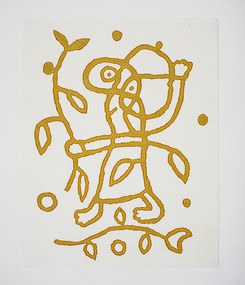
Print (etching): Michael LEUNIG (b.1945 Vic, AUS), Michael Leunig, ‘Pilgrim’ from 'The Baldessin & Friends' commemorative folio, 2016
... Gallery of Australia, Canberra. In 1975 he represented Australia in the Sao Paulo Biennale, before living and working in Paris until his return to St Andrews in 1977. In 1978 George was killed in a car accident aged 39 years. In 2001 Tess returned to St Andrews to reclaim the run-down studio and reconstitute it as The Baldessin Press & Studio - a printmaking retreat. It operates in George’s memory, so that artists...Gallery of Australia, Canberra. In 1975 he represented Australia in the Sao Paulo Biennale, before living and working in Paris until his return to St Andrews in 1977. In 1978 George was killed in a car accident aged 39 years. In 2001 Tess returned to St Andrews to reclaim the run-down studio and reconstitute it as The Baldessin Press & Studio - a printmaking retreat. It operates in George’s memory, so that artists ...Michael Leunig is an Australian cartoonist, poet and cultural commentator. His best known works include The Adventures of Vasco Pyjama and the Curly Flats series. Leunig was declared one of Australian Living Treasures by the National Trust of Australia in 1999. George Baldessin (1939-1978) was a printmaker and sculptor who built his bluestone studio at St Andrews (Nillumbik) in 1971 with his partner Tess and the three Hails brothers, Rob, Doug and Don. Made of recycled materials the studio today contains all of George’s equipment including the large press, which he modelled himself with the help of Neil Jeffrey (Enjay Presses). George won many prizes throughout his career and is represented in many of Australia's public art collections including his famous 'Pears' sculpture in front of the National Gallery of Australia, Canberra. In 1975 he represented Australia in the Sao Paulo Biennale, before living and working in Paris until his return to St Andrews in 1977. In 1978 George was killed in a car accident aged 39 years. In 2001 Tess returned to St Andrews to reclaim the run-down studio and reconstitute it as The Baldessin Press & Studio - a printmaking retreat. It operates in George’s memory, so that artists may continue to create, perpetuating the generous spirit of George.one colour (yellow) etching on Somerset paper. Thick lines weave in and out to produce a figure reminiscent of his 'curly flat' characters holding a long stem flower/vine. ekphrasis2018, pilgrim, baldessin, leunig -
 Nillumbik Shire Council
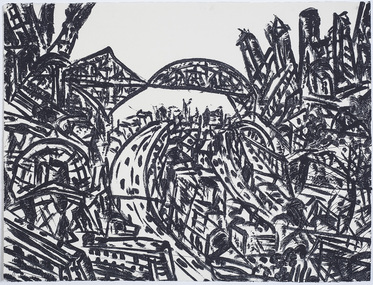
Print (sugarlift etching): Jan SENBERGS (b.1939 Lativia, arrived AUS 1950), Jan Sensbergs, 'New Jersey - rust belt' from the 'Baldessin & Friends' commemorative folio, 2016
... Gallery of Australia, Canberra. In 1975 he represented Australia in the Sao Paulo Biennale, before living and working in Paris until his return to St Andrews in 1977. In 1978 George was killed in a car accident aged 39 years. In 2001 Tess returned to St Andrews to reclaim the run-down studio and reconstitute it as The Baldessin Press & Studio - a printmaking retreat. It operates in George’s memory, so that artists...Gallery of Australia, Canberra. In 1975 he represented Australia in the Sao Paulo Biennale, before living and working in Paris until his return to St Andrews in 1977. In 1978 George was killed in a car accident aged 39 years. In 2001 Tess returned to St Andrews to reclaim the run-down studio and reconstitute it as The Baldessin Press & Studio - a printmaking retreat. It operates in George’s memory, so that artists ...Jan Senbergs was born in Riga, Latvia, in 1939 and came to Australia when he was ten. Senbergs’ work has been characterised by a simple and bold aesthetic. From lush landscapes to barren urban spaces, his body of work signifies an artist who has continually experimented with shape, form and motif, a fundamental humanist vision, a finely-honed sense of the absurd, and a rigorous studio practice spanning printmaking, drawing and painting. Senbergs is Baldessin's exact contemporary. He was also born in Europe and fled his homeland because of the war, arriving in Melbourne in 1950. Like George, Senbergs also worked at the RMIT and in 1973 represented Australia at the Bienal de Sao Paulo. Senbergs first met George when he was living in St. Kilda. George asked if he could screen print his 'Argus' catalogue for a show at the gallery in the Argus building. George Baldessin (1939-1978) was born in San Biagio di Callalta, in the Veneto in Northern Italy and arrived in Australia ten years later. A printmaker and sculptor he built his bluestone studio at St Andrews (Nillumbik) in 1971. The bluestone studio was hand built by George, his partner Tess and the three Hails brothers, Rob, Doug and Don. Made of recycled materials the studio today contains all of George’s equipment including the large press, which he modelled himself with the help of Neil Jeffrey (Enjay Presses). George won many prizes throughout his career and is represented in many of Australia's public art collections including his famous 'Pears' sculpture in front of the National Gallery of Australia, Canberra. In 1975 he represented Australia in the Sao Paulo Biennale, before living and working in Paris until his return to St Andrews in 1977. In 1978 George was killed in a car accident aged 39 years. In 2001 Tess returned to St Andrews to reclaim the run-down studio and reconstitute it as The Baldessin Press & Studio - a printmaking retreat. It operates in George’s memory, so that artists may continue to create, perpetuating the generous spirit of George.'New Jersey - rust belt' is one of eight prints in the 'Baldessin & Friends commemorative folio. The folio was conceived by Tess Edwards as a fundraising initiative in celebration of the The Baldessin Press & Studio's fifteen year anniversary, and as a way to honour George Baldessin's memory. The Baldessin Press & Studio is a not-for-profit organisation created in memory of the late George Baldessin (1939-1978), whose original studio is now open to the public for creative use and as a practical legacy to living artists. The Studio is located in St Andrews, Nillumbik. The folio is a unique coming together of seven very different and acclaimed artists who are connected by their friendship to the missing eighth member, George Baldessin. This print finds its' origins in the time Senbergs spent at Harvard in America in 1989-90. In the context of Baldessin it explores an industrial urban surreal vision that was common to both artist. The image captures the life force of the city revealing the keen and observant eye of Jan Senbergs. Similar in sensibility to his large scale charcoal drawings of the 1990s, the artwork is not only a record of what the artist sees, but of what interest him. By following the movement of each line the viewer can witness the artist's eye travelling through, over and around each element of the urban landscape. The scale is deceptive with the image bled to the full-size of the sheet of paper like a microcosm of a much bigger whole. sugar lift etching of an urban (cityscape - New Jersey) scene - bridges, roads, buildings, in thick black brushstrokes. The image is busy; full of energy and movement. A bleed print in which the paper barely contains the city scape. In pencil (handwritten): top centre: left '14/25' (edition); centre 'New Jersey-Rustbelt' (title); right 'Jan Senbergs' (signature); print, sugarlift etching, urban landscape, ekphrasis2018, new jersey, line, rust belt -
 Nillumbik Shire Council
Print (etching and photo polymer): Imants TILLERS (b.1967 Syd., AUS) in posthumous collaboration with George BALDESSIN (b.1939 Treviso ITA – d.1978 Melb., AUS), Imants Tillers, 'Unsaid + Nameless' from the 'Baldessin & Friends' commemorative folio, 1976; completed 2016
... Gallery of Australia, Canberra. In 1975 he represented Australia in the Sao Paulo Biennale, before living and working in Paris until his return to St Andrews in 1977. In 1978 George was killed in a car accident aged 39 years. In 2001 Tess returned to St Andrews to reclaim the run-down studio and reconstitute it as The Baldessin Press & Studio - a printmaking retreat. It operates in George’s memory, so that artists...Gallery of Australia, Canberra. In 1975 he represented Australia in the Sao Paulo Biennale, before living and working in Paris until his return to St Andrews in 1977. In 1978 George was killed in a car accident aged 39 years. In 2001 Tess returned to St Andrews to reclaim the run-down studio and reconstitute it as The Baldessin Press & Studio - a printmaking retreat. It operates in George’s memory, so that artists ...Imants Tillers has been identified as a quintessential postmodern artist in his use of appropriation and quotation. Since 1981 he has used his signature canvas boards to explore themes relevant to contemporary culture, from the centre/periphery debates of the 1980s to the effects of migration, displacement and diaspora. Most recently, his paintings have been concerned with place, locality and evocations of the landscape. Imants Tillers and Baldessin met on their way to the Bienal de Sao Paulo in 1975 and in the following year worked on two collaborative etching plates in Paris that were printed by Pierre Giarudon. 'Unsaid + Nameless' harks back to his experiences with Baldessin in Paris forty years ago. It is a poignant image of absence that can be read in the tradition of the momento mori. George Baldessin (1939-1978) was born in San Biagio di Callalta, in the Veneto in Northern Italy and arrived in Australia ten years later. A printmaker and sculptor he built his bluestone studio at St Andrews (Nillumbik) in 1971 with his partner Tess and the three Hails brothers, Rob, Doug and Don. Made of recycled materials the studio today contains all of George’s equipment including the large press, which he modelled himself with the help of Neil Jeffrey (Enjay Presses). George won many prizes throughout his career and is represented in many of Australia's public art collections including his famous 'Pears' sculpture in front of the National Gallery of Australia, Canberra. In 1975 he represented Australia in the Sao Paulo Biennale, before living and working in Paris until his return to St Andrews in 1977. In 1978 George was killed in a car accident aged 39 years. In 2001 Tess returned to St Andrews to reclaim the run-down studio and reconstitute it as The Baldessin Press & Studio - a printmaking retreat. It operates in George’s memory, so that artists may continue to create, perpetuating the generous spirit of George.'Unsaid + Nameless' is one of eight prints in the 'Baldessin & Friends commemorative folio. The folio was conceived by Tess Edwards as a fundraising initiative in celebration of the The Baldessin Press & Studio's fifteen year anniversary, and as a way to honour George Baldessin's memory. The Baldessin Press & Studio is a not-for-profit organisation created in memory of the late George Baldessin (1939-1978), whose original studio is now open to the public for creative use and as a practical legacy to living artists. The Studio is located in St Andrews, Nillumbik. The folio is a unique coming together of seven very different and acclaimed artists who are connected by their friendship to the missing eighth member, George Baldessin. In 1976 Baldessin and Tillers embarked on the collaborative work 'According to des Esseintes'; a post modern Surrealist game of consequences and sequences. In homage to his friendship and work, Tillers completed an unfinished Baldessin plate from 1976 inspired from their 'des Esseintes' collaboration. The addition of Odilon Redon's 'smiling spider' is indicative of Tiller's broader post-modern approach. Solar plate etching of Odilon Redon's 'Laraignee souriante' (The Smiling Spider) on an incomplete plate etched by George Baldessin in 1976 on Somerset paper. Other images include skewed perspectives of a wooden window frame, 'wooden' floor or table(?) folded sheet of paper and unknown apparatus. In pencil (handwritten): low plate: left '14/25' (edition); centre: 'Unsaid + Nameless' (title); right 'Imants Tillers' (signature); low paper: right emboss 'GB' (Baldessin Press & Studio monogram)solar plate etching, george baldessin, somerset paper, spider, line, ekphrasis2018, odilon redon, appropriation, post modern, surrealism, collaboration, paris, folio -
 Nillumbik Shire Council
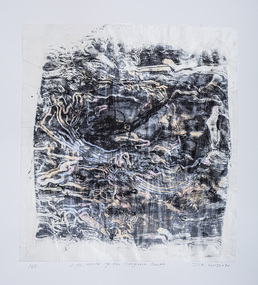
Print (woodcut and etching on chine-colle): John WOLSELEY (b.1938 Somerset, UK; arrived 1976 Melb., AUS), John Wolseley, 'Life world of the Longicorn beetle' from the 'Baldessin & Friends commemorative folio', 2016
... Gallery of Australia, Canberra. In 1975 he represented Australia in the Sao Paulo Biennale, before living and working in Paris until his return to St Andrews in 1977. In 1978 George was killed in a car accident aged 39 years. In 2001 Tess returned to St Andrews to reclaim the run-down studio and reconstitute it as The Baldessin Press & Studio - a printmaking retreat. It operates in George’s memory, so that artists...Gallery of Australia, Canberra. In 1975 he represented Australia in the Sao Paulo Biennale, before living and working in Paris until his return to St Andrews in 1977. In 1978 George was killed in a car accident aged 39 years. In 2001 Tess returned to St Andrews to reclaim the run-down studio and reconstitute it as The Baldessin Press & Studio - a printmaking retreat. It operates in George’s memory, so that artists ...Painter, printmaker and installation artist John Wolseley was born in Somerset, England. He lived and worked throughout Europe before relocating to Australia in 1976. His work explores how people dwell and move within landscape. Wolseley see's himself as a hybrid mix of artist and scientist; one who tries to relate the minutiae of the natural world - leaf, feather and beetle wing - to the abstract dimensions of the earth's dynamic systems. Using techniques of watercolour, collage, frottage, nature printing and other methods of direct physical or kinetic contact Wolseley finds ways of collaborating with the actual plants, birds, trees, rocks and earth of a particular place. George Baldessin was one of the first artists John Wolseley met when he arrived in Australia in 1976. Both immigrated to Australia and connected through this shared experience. They were both at 'Realities Gallery' with Marianne Baillieu in the 1970s and 80s. George Baldessin (1939-1978) was born in San Biagio di Callalta, in the Veneto in Northern Italy and arrived in Australia ten years later. A printmaker and sculptor he built his bluestone studio at St Andrews (Nillumbik) in 1971 with his partner Tess and the three Hails brothers, Rob, Doug and Don. Made of recycled materials the studio today contains all of George’s equipment including the large press, which he modelled himself with the help of Neil Jeffrey (Enjay Presses). George won many prizes throughout his career and is represented in many of Australia's public art collections including his famous 'Pears' sculpture in front of the National Gallery of Australia, Canberra. In 1975 he represented Australia in the Sao Paulo Biennale, before living and working in Paris until his return to St Andrews in 1977. In 1978 George was killed in a car accident aged 39 years. In 2001 Tess returned to St Andrews to reclaim the run-down studio and reconstitute it as The Baldessin Press & Studio - a printmaking retreat. It operates in George’s memory, so that artists may continue to create, perpetuating the generous spirit of George. 'Life world of the Longicorn beetle' is one of eight prints in the 'Baldessin & Friends commemorative folio. The folio was conceived by Tess Edwards as a fundraising initiative in celebration of the The Baldessin Press & Studio's fifteen year anniversary, and as a way to honour George Baldessin's memory. The Baldessin Press & Studio is a not-for-profit organisation created in memory of the late George Baldessin (1939-1978), whose original studio is now open to the public for creative use and as a practical legacy to living artists. The Studio is located in St Andrews, Nillumbik. The folio is a unique coming together of seven very different and acclaimed artists who are connected by their friendship to the missing eighth member, George Baldessin. Communion and collaboration with nature are central to Wolseley's practice. He assembles different drawing methods to represent a kind of inventory or document about the state of the earth. His interest is to paint the processes and energy field of the living systems of this land. 'Life world of the Longicorn beetle' is his continued exploration of Australia's natural eco-systems. The beetle attacks the eucalypt and in the process of tunnelling into the wood of the tree leaves scribbly patterns. The work celebrates the cycle of life, and the wisdom and delicacy of these creatures. This three dimensional work consisting of three layers of paper is a varied edition, offering just the slightest difference between each print, reflective of variation in nature. The found log used as a woodcut acknowledges the interconnectedness of nature and living beings; the log is not apart from the art and the beetle has become an active artistic collaborator. An intimate and layered print of a tree log with line trails from the Longicorn beetle. Patches of pink, yellow and orange watercolour placed randomly. Woodcut from found log and etching on chine-colle with water colour on Gampi (top layer), Mulberry (middle layer) and Arches (bottom layer) paper. In pencil (handwritten): low plate: left '14/25' (edition); centre 'Life world of the Longicorn beetle' (title); right 'John Wolseley' (signature); low paper: right emboss 'GB' (Baldessin Press & Studio monogram)woodcut, etching, chine-colle, landscape, environment, longicorn beetle, print, baldessin, ekphrasis2018, eco, mixed media
