
Showing 123 items matching " associations organisation and societies"
-
 Bendigo Historical Society Inc.
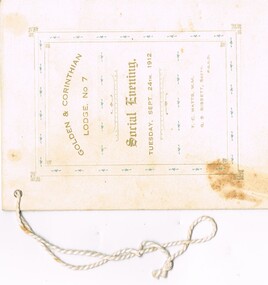
Document - LYDIA CHANCELLOR COLLECTION: GOLDEN & CORINTHIAN LODGE
... SOCIETIES...SOCIETIES Freemasons programme Lydia Chancellor collection programme Freemasonry Freemasons Golden & Corinthian Lodge No. 7 Clubs and associations organisation societies program A cream programme with gold print and blue decorative ink with a cord attachment. ...A cream programme with gold print and blue decorative ink with a cord attachment. On the front cover are the words, ' Golden & Corinthian Lodge, No. 7 Social Evening, Tuesday, Sept. 24th 1912. T.C. Watts, W.M. G.S. Bissett, Secty, P.G.S.D.' On the inside is an outline of the programme including the Reception by the Worshipful Master Wor. Bro. T.C. Watts, 8 p.m. This is followed by Euchre 8.30 -10 p.m., refreshments and harmony.societies, freemasons, programme, lydia chancellor, collection, programme, freemasonry, freemasons, golden & corinthian lodge no. 7, clubs and associations, organisation, societies, program -
 Bendigo Historical Society Inc.
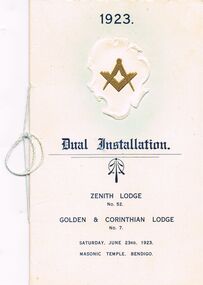
Document - LYDIA CHANCELLOR COLLECTION; DUAL INSTALLATION PROGRAMME ZENITH LODGE & CORINTHIAN LODGE
... SOCIETIES...SOCIETIES Freemasons programme Lydia Chancellor collection programme Freemasonry Freemasons Masonic Temple Bendigo clubs & associations organisation Zenith Lodge Golden & Corinthian Lodge societies A cream programme with a blue tinge around a freemason symbol and blue print. ...A cream programme with a blue tinge around a freemason symbol and blue print. On the outside cover are the words,' 1923. Dual Installation. Zenith Lodge No. 52. Golden & Corinthian Lodge No. 7. Saturday, June 23rd., 1923. Masonic Temple, Bendigo.' On the inside of the programme is the programme itself and the menu. M. Hicks, Caterer. Cambridge Press, Print. Attached is a blue cotton cord.societies, freemasons, programme, lydia chancellor, collection, programme, freemasonry, freemasons, masonic temple, bendigo, clubs & associations, organisation, zenith lodge, golden & corinthian lodge, societies -
 Bendigo Historical Society Inc.
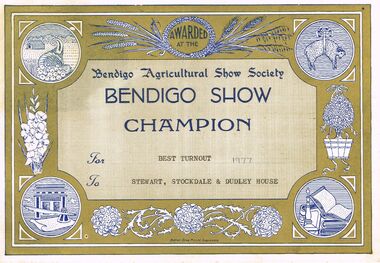
Document - LYDIA CHANCELLOR COLLECTION; BENDIGO SHOW CHAMPION
... ... societies...CIVIC MEMENTOES Presentations bendigo agricultural show society Lydia Chancellor collection Bendigo Agricultural Show Society societies clubs and associations organisation certificate champion agriculture Bendigo community A brown blue and white certificate with the words, ' Awarded at the Bendigo Agricultural Show Society Bendigo Show Champion For Best Turnout To Stewart, Stockdale & Dudley House.' ...A brown blue and white certificate with the words, ' Awarded at the Bendigo Agricultural Show Society Bendigo Show Champion For Best Turnout To Stewart, Stockdale & Dudley House.' Bolton Bros. Pty. Ltd. Engravers.civic mementoes, presentations, bendigo agricultural show society, lydia chancellor, collection, bendigo agricultural show society, societies, clubs and associations, organisation, certificate, champion, agriculture, bendigo community -
 Bendigo Historical Society Inc.
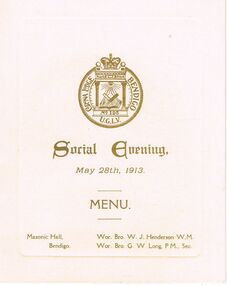
Document - LYDIA CHANCELLOR COLLECTION; CORONA LODGE NO. 195 SOCIAL EVENING MENU
... associations... societies... organisation...SOCIETIES Freemasons menu Lydia Chancellor collection menu Corona Lodge Freemasons Freemasonry clubs and associations societies organisation food catering hospitality Cream card with gold lettering. ...Cream card with gold lettering. On the front of the menu are the words, ' Corona Lodge U.G.L.V. No. 195. Social Evening, May 28th, 1913. Menu. Masonic Hall, Bendigo. Wor. Bro. W.J. Henderson W.M., Wor. Bro. G. W. Long. P.M., Sec.' On the inside is the menu. Wor. Bro. Chas. H. Leggo, Caterer.societies, freemasons, menu, lydia chancellor, collection, menu, corona lodge, freemasons, freemasonry, clubs and associations, societies, organisation, food, catering, hospitality -
 Bendigo Historical Society Inc.
Document - LYDIA CHANCELLOR COLLECTION; CORONA LODGE SOCIAL EVENING MENU
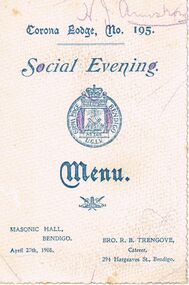
... associations... societies... organisation...SOCIETIES Freemasons menu Lydia Chancellor collection Corona Lodge Masonic Hall Bendigo Freemasons Freemasonry menu food hospitality catering clubs and associations societies organisation A cream card with blue printing. ...A cream card with blue printing. On the front cover are the words, ' Corona Lodge, No. 195, Social Evening Menu Masonic Hall, Bendigo. April 27th, 1908. Bro. R.B. Trengove, Caterer, 294 Hargreaves St., Bendigo. On the inside is the menu in blue ink. On the front cover is written ' H.J. Armstrong in purple and various names in purple written on back.societies, freemasons, menu, lydia chancellor, collection, corona lodge, masonic hall, bendigo, freemasons, freemasonry, menu, food, hospitality, catering, clubs and associations, societies, organisation -
 Bendigo Historical Society Inc.
Document - LYDIA CHANCELLOR COLLECTION; ROTARY CLUB OF BENDIGO PROGRAMME
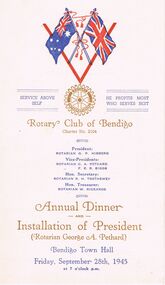
... ... societies...CLUBS AND ASSOCIATIONS Sport rotary Lydia Chancellor collection clubs Rotary associations event organisation societies community dinner program programme A cream programme with blue and gold print and the red, white and blue insignia of Rotary. ...A cream programme with blue and gold print and the red, white and blue insignia of Rotary. On the front is the insignia and the words 'Rotary Club of Bendigo, Annual Dinner and Installation of President (Rotarian George A. Pethard) Bendigo Town Hall, Friday, September 28th, 1945 at 7 o'clock p.m. On the inside is the programme and the menu. On the back is a list of Past Presidents from 1925 - 1945.clubs and associations, sport, rotary, lydia chancellor, collection, clubs, rotary, associations, event, organisation, societies, community, dinner, program, programme -
 Bendigo Historical Society Inc.
Document - LYDIA CHANCELLOR COLLECTION: SOUVENIR OF ANPEX 1950
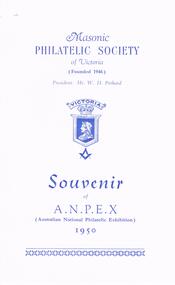
... associations... societies... recreation... organisation...PHILATELY Stamps exhibition Lydia Chancellor Collection collection postage stamps clubs and associations societies recreation organisation organization clubs entertainments A cream soft covered document titled 'Souvenir of A.N.P.E.X (Australian National Philatelic Exhibition)1950.' ...A cream soft covered document titled 'Souvenir of A.N.P.E.X (Australian National Philatelic Exhibition)1950.' Masonic Philatelic Society of Victoria. Founded 1946. President: Mr. W. H. Pethard. On inside page is an outline of a musical programme held at Scotts Hotel October 5th, 1950. Accompanying the booklet is a collection of 8 blue 1950 ' on to Melbourne' stamps and 8 pink 'on to Melbourne stamps. All stamps published by the Australian National Philatelic Exhibition & Centenary of Australian Postage Stamps.philately, stamps, exhibition, lydia chancellor collection, collection, postage stamps, clubs and associations, societies, recreation, organisation, organization, clubs, entertainments -
 Cheese World Museum
Certificate, Government Champion Certificate, 1951
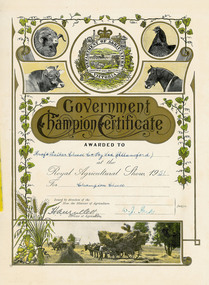
... Dairy companies entered competitions organised by the Dairy Industry Association and associated organisations and local agricultural societies to encourage improvement in products. ...Dairy companies entered competitions organised by the Dairy Industry Association and associated organisations and local agricultural societies to encourage improvement in products. ...Kraft-Walker Cheese Company commenced in Allansford in 1935 leasing the factory premises from Warrnambool Cheese and Butter Factory Company. Dairy companies entered competitions organised by the Dairy Industry Association and associated organisations and local agricultural societies to encourage improvement in products. Some of these awards are considered prestigious and highly regarded within the industry. The certificates were passed to Cheese World Museum by the factory management.This certificate was held by the factory management until transfer to Cheese World Museum. The certificate provides an insight into the dairy industry during the 1950s.Cream card certificate from Royal Agricultural Show has a plain line border on left, bottom and right side with inner border of green vine plant on left, top and right side. A sheaf of oats and a scene of haymaking complete the border design. The top of the certificate has the Department of Agriculture Victoria logo flanked by circular images of a sheep and cow on the left and a hen and horse on the right. The centre of the certificate has a gold shape overprinted with black.Government Champion Certificate/ Awarded to Kraft Walker Cheese Co Pty Ltd (Allansford) at the Royal Agricultural Show 1951/ for Champion Cheese/ Issued by direction of/Hon. the Minister for Agriculture/H A Mullett/ Director of Agriculture/ W J Park/ Judgesallansford, kraft walker cheese company, cheese manufacture, dairy awards, product awards, warrnambool cheese and butter factory company, kraft walker pty ltd, royal agricultural show, department of agriculture victoria, cheeses, cheese manufac, warrnambool cheese and butter -
 Cheese World Museum
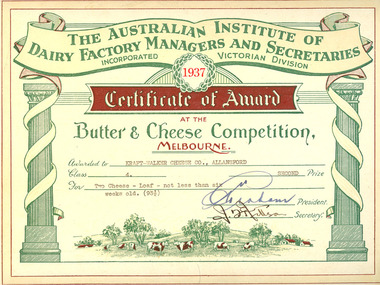
Certificate, Certificate of Award 1937, 1937
... Dairy companies entered competitions organised by the Dairy Industry Association and associated organisations and local agricultural societies to encourage improvement in products. ...Dairy companies entered competitions organised by the Dairy Industry Association and associated organisations and local agricultural societies to encourage improvement in products. ...Kraft-Walker Cheese Company commenced in Allansford in 1935 leasing the factory premises from Warrnambool Cheese and Butter Factory Company. Dairy companies entered competitions organised by the Dairy Industry Association and associated organisations and local agricultural societies to encourage improvement in products. Some of these awards are considered prestigious and highly regarded within the industry. The certificates were passed to Cheese World Museum by the factory management.This certificate was held by the factory management until transfer to Cheese World Museum. The certificate provides an insight into the dairy industry during the late 1930s.Product award printed on beige card in pale green with a column design along the sides and brown fine line border. A green rural scene containing brown and white cows is printed along the bottom edge.The Australian Institute of Dairy Factory Managers & Secretaries Incorporated Victorian Division/Certificate of Award 1937/at the Butter & Cheese Competition, Melbourne/ Awarded to Kraft-Walker Cheese Co. Allansford/Class 4/ Second Prize/For Two Cheese-Loaf-not less than six weeks old (93/12)allansford, dairy awards, product awards, warrnambool cheese and butter factory company ltd, kraft-walker cheese co, australian institute of dairy factory managers & secretaries incorporated, cheeses -
 Cheese World Museum
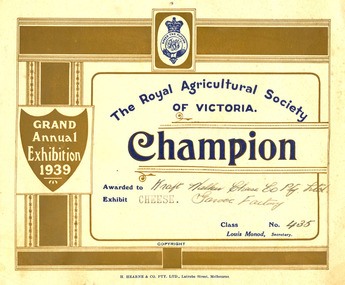
Certificate, Grand Annual Exhibition 1939, 1939
... Dairy companies entered competitions organised by the Dairy Industry Association and associated organisations and local agricultural societies to encourage improvement in products. ...Dairy companies entered competitions organised by the Dairy Industry Association and associated organisations and local agricultural societies to encourage improvement in products. ...Kraft-Walker Cheese Company commenced in Allansford in 1935 leasing the factory premises from Warrnambool Cheese and Butter Factory Company. Dairy companies entered competitions organised by the Dairy Industry Association and associated organisations and local agricultural societies to encourage improvement in products. Some of these awards are considered prestigious and highly regarded within the industry. The certificates were passed to Cheese World Museum by the factory management. This certificate was held by the factory management until transfer to Cheese World Museum. The certificate provides an insight into the dairy industry during the late 1930s.A white card with gold and blue print. The is a gold band along the top and bottom and borders in gold. A 'prize cup' is printed in gold on the left hand side. Text is in blue print.Royal Agricultural Society of Victoria/ Grand Annual Exhibition 1939/ Champion Awarded to Kraft Walker Cheese Co Pty Ltd/ Exhibit Cheese Garvoc Factory/ Class No 435/ Louis Monod, Secretary/ COPYRIGHT/ H HEARNE & CO PTY LTD, Latrobe Street, Melbourneallansford, dairy awards, kraft walker cheese co pty ltd, royal agricultural society of victoria, agricultural shows, product awards, garvoc cheese and butter factory -
 Cheese World Museum
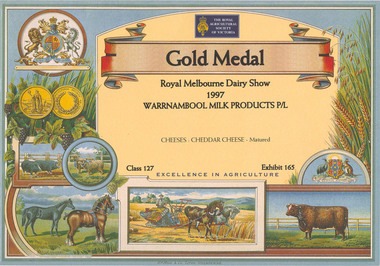
Certificate, 1997
... Dairy companies entered competitions organised by the Dairy Industry Association and associated organisations and local agricultural societies to encourage improvement in products. ...Dairy companies entered competitions organised by the Dairy Industry Association and associated organisations and local agricultural societies to encourage improvement in products. ...Kraft-Walker Cheese Company commenced in Allansford in 1935 leasing the factory premises from Warrnambool Cheese and Butter Factory Company. Dairy companies entered competitions organised by the Dairy Industry Association and associated organisations and local agricultural societies to encourage improvement in products. Some of these awards are considered prestigious and highly regarded within the industry. The certificates were passed to Cheese World Museum by the factory management.A blue background full colour certificate and a cream cartouche with a darker banner across it and the insignia of the Royal Agricultural Society of Victoria; in the lower right hand corner of this section is the Australian coat of arms; around this are grasses, grapes and wheat. On the left hand side and across the bottom are images in various shapes. The circular image on the top shows a Royal coat of arms; below are two gold medals featuring a female and a laurel wreath; underneath is an image of two black sheep and a blue ringed circle has two sheep with blue ribbons around their necks standing in front of a wooden fence. Along the bottom are three images -first a black riding horse together with a brown shire horse in harness; second a horse drawn harvester; third a brown prize bull.THE ROYAL/AGRICULTURAL/SOCIETY/ OF VICTORIA Gold Medal/Royal Melbourne Dairy Show/1997/WARRNAMBOOL MILK PRODUCTS P/L/Class 127/Exhibit 165/EXCELLENCE IN AGRICULTURE allansford, dairy awards, product awards, warrnambool milk products, warrnambool cheese and butter factory company, royal melbourne dairy show, agricultural shows -
 Vision Australia
Text, The Association for the Blind Illawarra Community Centre annual meeting minutes 24/9/1976 to 10/9/1993, 1976-1993
... for the Blind (AFB), Better hearing Australia, Department of Community Services - Rehabilitation unit, Diabetes Found of Victoria, Epilepsy Foundation of Victoria, Paraplegic and Quadriplegic Association of Victoria, Social Organisation for the Handicapped, Victorian Deaf Society and Yooralla Society of Victoria. ... for the Blind (AFB), Better hearing Australia, Department of Community Services - Rehabilitation unit, Diabetes Found of Victoria, Epilepsy Foundation of Victoria, Paraplegic and Quadriplegic Association of Victoria, Social Organisation for the Handicapped, Victorian Deaf Society and Yooralla Society of Victoria. ...These meetings were held at the Illawarra Community Centre and the minutes include Present, National Anthem, Tributes, Apologies, Notice of convening the meeting, Life Governors, Confirmation of previous minutes and Reports from The Chairman, Financial. 1/10/1985 Mrs Heath, founding chairman of the Illawarra Community Centre highlighted that the Centre is based on a unique concept of integrating organisations which traditionally functioned in isolation. The outstanding success of the Centre at this time is consistent with the initial planning and development. At 1985 the Centre had the following user groups Association for the Blind (AFB), Better hearing Australia, Department of Community Services - Rehabilitation unit, Diabetes Found of Victoria, Epilepsy Foundation of Victoria, Paraplegic and Quadriplegic Association of Victoria, Social Organisation for the Handicapped, Victorian Deaf Society and Yooralla Society of Victoria. 2 paper registersassociation for the blind -
 Wodonga & District Historical Society Inc
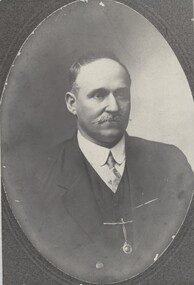
Photograph - Fred Rochow Railways Collection - John Bennet Bruce, Victorian Railways
... It was donated to the Wodonga Historical Society by Fred Rochow, a railwayman who spent many years based in Wodonga. ...It was donated to the Wodonga Historical Society by Fred Rochow, a railwayman who spent many years based in Wodonga. ...The Fred Rochow Railways Collection incorporates photos related to the operation of the Wodonga Railway Station including different types of trains and railways staff C. 1930 – 1990. It was donated to the Wodonga Historical Society by Fred Rochow, a railwayman who spent many years based in Wodonga. He joined the Victorian Railways on 17th June l947 and retired in 1988. For some time, he was a member of the Australian Federated Union of Locomotive Enginemen and served a term as a member of the Trades Hall Council. He had an extensive knowledge of the struggles that took place to achieve better conditions for railway workers. Fred worked for many years as a fireman and then worked his way up the ranks to driver, experiencing many changes from the days of steam locomotives through to diesel trains, locomotives and even the modern XPT train. He worked throughout Victoria at different stages of his career, with his final working years focused on the northeast of Victoria and the Albury to Melbourne line. After his retirement, Fred continued to share his love of steam miniature trains with the community. Locomotive Engine Drivers and Firemen’s Association - The first railway union in the world was created in Melbourne in 1861 with the formation of the Locomotive Engine Drivers Association of Victoria. The Association was formed seven years after the official opening of Victoria’s first railway line in 1854. In 1872, the association expanded to include firemen. The name of the association became the Locomotive Engine Drivers and Firemen’s Association to reflect the change in constitution. Over time this Association amalgamated with organisations in other states and eventually became the Australian Federated Union of Locomotive Employees which still operates today.This collection has local and statewide significance as it captures images of trains, locomotives and personnel who operated the railway services in Wodonga and throughout Northeast Victoria. The railways played a critical role in opening up Victoria and connecting Australia for trade, business, social communication and transport. A portrait of John Bennet Bruce. He was born on 8 February 1865. John started his railway career in North Melbourne on 13T February 1885. He achieved his driving certification in North Melbourne on 24 December 1899. John became President of the North Melbourne branch of in 1910. He transferred to Wodonga in 4 September 1914.railways wodonga, fred rochow, john bennet bruce, locomotive engine drivers and firemen’s association -
 Flagstaff Hill Maritime Museum and Village
Book - Reference Medical/First Aid, James Cantlie, First Aid to the Injured, 1915
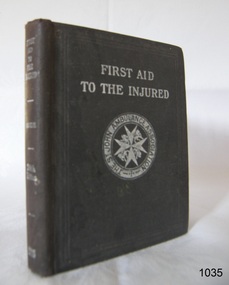
... Noted on the flyleaf is the term Med-chi, which refers to medical-surgical societies. In the late 19th century, military and civilian medical figures connected to medical-surgical societies as they collaborated with the War Department and the Order of St John to formulate systematic first aid and stretcher-handling instruction for civilians. ...Noted on the flyleaf is the term Med-chi, which refers to medical-surgical societies. In the late 19th century, military and civilian medical figures connected to medical-surgical societies as they collaborated with the War Department and the Order of St John to formulate systematic first aid and stretcher-handling instruction for civilians. ...First Aid to the Injured was the official training manual of the St John Ambulance Association, arranged to follow the syllabus of their First Aid course. It was written by James Cantlie for the St John Ambulance Association. The volume is a practical instructional text covering anatomy basics, how to treat fractures, dislocations, sprains and strains, circulation and blood loss, the nervous system, poisoning cases, and the organisation of first aid response essentially a comprehensive guide to the principles and practice of First Aid, reflecting the state of medical knowledge at the time.Hard cover book, First Aid to The Injured Author: James Cantlie Publisher: St John Ambulance Association Date: 1915 Further Information: Black colour with white titles and a St Johns icon or logo to front cover.non-fictionFirst Aid to the Injured was the official training manual of the St John Ambulance Association, arranged to follow the syllabus of their First Aid course. It was written by James Cantlie for the St John Ambulance Association. The volume is a practical instructional text covering anatomy basics, how to treat fractures, dislocations, sprains and strains, circulation and blood loss, the nervous system, poisoning cases, and the organisation of first aid response essentially a comprehensive guide to the principles and practice of First Aid, reflecting the state of medical knowledge at the time.flagstaff hill, warrnambool, shipwrecked-coast, flagstaff-hill, flagstaff-hill-maritime-museum, maritime-museum, shipwreck-coast, flagstaff-hill-maritime-village, first aid to the injured, book -
 Mission to Seafarers Victoria
Programme - Service, Seafarers Service - Choral Mattins, 2017
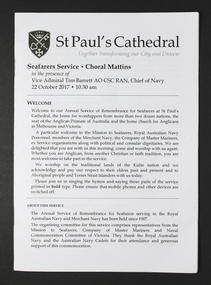
... Representatives come from the Royal and Merchant Navies, the commercial world, shipping companies, mission and philanthropic societies, veterans’ associations, labour unions, youth and leisure organisations, but anyone is welcome to attend. seafarers service 2017 st paul's cathedral melbourne battle of trafalgar trafalgar day horatio nelson Two fold paper booklet printed in black ink Seafarers Service - Choral Mattins Programme Service ...Seafarers Service 22 October 2017 The first Seafarers Service was held on 23 October 1905 in the St Paul's Cathedral in London to celebrate the Centenary of the Battle of Trafalgar and the death of Vice-Admiral Horatio Nelson on 21 October 1805. Reverend Alfred Gurney Goldsmith launched the first Seafarers Service two years later and the first service was held on Sunday 10 November 1907. The service continues to reflect the full range of the maritime activities in Australia. Representatives come from the Royal and Merchant Navies, the commercial world, shipping companies, mission and philanthropic societies, veterans’ associations, labour unions, youth and leisure organisations, but anyone is welcome to attend.Two fold paper booklet printed in black inkseafarers service, 2017, st paul's cathedral, melbourne, battle of trafalgar, trafalgar day, horatio nelson -
 Greensborough Historical Society
Newsletter, Greenhills and North Greensborough Progress Association, Community News: official journal of the Greenhills and Nth. Greensborough Progress Association and the Apollo Parkways Progress Association. 18th August, 1977. Edition No. 7/77, 18/08/1977
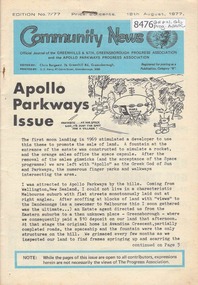
... A digital copy of this Newsletter is available from Greensborough Historical Society...., School and Kinder news, Putter and puff-puffs at Poulter, Nursing Mothers Association, Parent Australia, A to Z of local activities and organisations in the vicinity of A.P. ...Apollo Parkways issue, To join or not to join [Apollo Parkways Progress Association], Pitfalls for land buyers, Thumbs down, to a thumbs up idea! [Apollo Parkways fingerparks], Letter to the Editor, Caring and sharing, From the Council Chamber, Make contact at CONTACT!, School and Kinder news, Putter and puff-puffs at Poulter, Nursing Mothers Association, Parent Australia, A to Z of local activities and organisations in the vicinity of A.P. A digital copy of this Newsletter is available from Greensborough Historical Society.Newsletter, 24 p., illus.greenhills and north greensborough progress association, greenhills, apollo parkways progress association, apollo parkways -
 Flagstaff Hill Maritime Museum and Village
Photograph - Portrait, William Roy Angus, c. 1920's
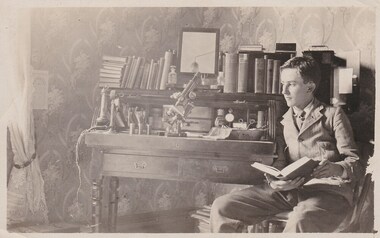
... Dr Angus and his wife Gladys were very involved in Warrnambool’s society with a strong interest in civic affairs. ...Dr Angus and his wife Gladys were very involved in Warrnambool’s society with a strong interest in civic affairs. ...This is a photograph of (William) Roy Angus, at his desk as a medical student in Adelaide, South Australia. It was donated to Flagstaff Hill Maritime Museum and Village by the family. He later qualified as Doctor William Roy Angus, Surgeon and Oculist. It is part of the “W.R. Angus Collection” which includes historical medical equipment, surgical instruments and materials once belonging to Dr Edward Ryan and Dr Thomas Francis Ryan, (both of Nhill, Victoria) as well as Dr Angus’ own belongings. The Collection’s history spans the medical practices of the two Doctors Ryan, from 1885-1926 plus that of Dr Angus, up until 1969. ABOUT THE “W.R. ANGUS COLLECTION” updated 20-01-2023 Doctor William Roy Angus M.B., B.S., Adel., 1923, F.R.C.S. Edin.,1928 (also known as Dr Roy Angus) was born in Murrumbeena, Victoria on 28th June 1901 and lived until 1970. He qualified as a doctor, M.B.B.S. (Bachelor of Medicine-Bachelor of Surgery) in the 1923 at University of Adelaide, was Resident Medical Officer at the Royal Adelaide Hospital in 1924 and for a period was house surgeon to Sir (then Mr.) Henry Simpson Newland, from whom he acquired his interest in plastic surgery. He was also House Surgeon to Dr J.J. O’Grady, under whom he did his early Ophthalmological training. Dr Angus was briefly an Assistant to Dr Riddell of Kapunda, then commenced private practice at Curramulka, Yorke Peninsula, SA, where he was a physician, surgeon and chemist. In 1926, he was appointed as the new Medical Assistant to Dr Thomas Francis Ryan (T.F. Ryan, or Tom), in Nhill, Victoria, whose practice had been established by his brother, Dr Edward Ryan. Consequently, a considerable amount of eye work was done. Dr Angus’ experiences included radiology and pharmacy. In 1927 he was Acting House Surgeon in Dr Tom Ryan’s six-month trip abroad. Dr Angus had become engaged to Gladys Forsyth and they decided he further his studies overseas in the UK in 1927, sailing in the ship SS Banffshire. He studied at London University College Hospital and at Edinburgh Royal Infirmary and in 1928, was awarded FRCS (Fellow from the Royal College of Surgeons), Edinburgh, Scotland. He worked his passage back to Australia as a Ship’s Surgeon on the Australian Commonwealth Line T.S.S. Largs Bay, which was purchased by the White Star Line in 1928. He returned to South Australia, where he practised general surgery 1928-1932. He was a surgeon at the Curramulka Hospital, Yorke Peninsula, South Australia. Dr Angus was a ‘flying doctor’ for the A.I.M. (Australian Inland Ministry) Aerial Medical Service in 1928. Its first station was in the remote town of Oodnadatta, where Dr Angus was stationed. He was locum tenens there on North-South Railway at 21 Mile Camp. He took up this ‘flying doctor’ position in response to a call from Dr John Flynn; the organisation was later known as the Flying Doctor Service, then the Royal Flying Doctor Service. His work during this time involved general surgery, eye work, plastic surgery, radiology, pathology and even dental surgery. Dr Angus married Gladys in 1929, in Ballarat. (They went on to have one son (Graham 1932, born in SA) and two daughters (Helen (died 12/07/1996) and Berenice (Berry), both born at Mira, Nhill ). According to Berry, her mother Gladys made a lot of their clothes. She was very talented and did some lovely embroidery including lingerie for her trousseau and beautifully handmade baby clothes. In 1933 Dr Angus returned to Nhill and purchased a share of the Nelson Street practice and Mira hospital (a 2-bed ward at the Nelson Street Practice) from Dr Les Middleton one of the Middleton Brothers, the current owners of what previously once Dr Tom Ryan’s practice, where Dr Angus was previously Medical Assistant. Dr Tom and his brother had worked as surgeons including in eye surgery. Dr Tom Ryan performed many of his operations in the Mira private hospital on his premises. He had been House Surgeon at the Nhill Hospital from 1902-1926. Dr Tom Ryan had one of the only two pieces of radiology equipment in Victoria during his practicing years – The Royal Melbourne Hospital had the other one. Over the years Dr Tom Ryan had gradually set up what was effectively a training school for country general-practitioner-surgeons. Each patient was carefully examined, including using the X-ray machine, and any surgery was discussed and planned with Dr Ryan’s assistants several days in advance. Dr Angus gained experience in using the X-ray machine there during his time as assistant to Dr Ryan. The doctors Ryan were related to the Ryan Eye Doctors in Melbourne. When Dr Angus bought into the Nelson Street premises in Nhill he was also appointed as the Nhill Hospital’s Honorary House Surgeon 1933-1938. His practitioner’s plate from his Nhill surgery is now mounted on the doorway to the Port Medical Office at Flagstaff Hill Maritime Village, Warrnambool. When Dr Angus took up practice in Dr Edward and Dr Tom Ryan’s old premises, he obtained their extensive collection of historical medical equipment and materials spanning 1884-1926. A large part of this collection is now on display at the Port Medical Office at Flagstaff Hill Maritime Village in Warrnambool. In 1939 Dr Angus and his family moved to Warrnambool where he purchased “Birchwood,” the 1852 home and medical practice of Dr John Hunter Henderson, at 214 Koroit Street. (This property was sold in1965 to the State Government and is now the site of the Warrnambool Police Station. and an ALDI store is on the land that was once their tennis court). The Angus family could afford gardeners, cooks and maids; their home was a popular place for visiting dignitaries to stay whilst visiting Warrnambool. Dr Angus had his own silkworm farm at home in a Mulberry tree. His young daughter used his centrifuge for spinning the silk. Dr Angus was appointed on a part-time basis as Port Medical Officer (Health Officer) in Warrnambool and held this position until the 1940s when the government no longer required the service of a Port Medical Officer in Warrnambool; he was thus Warrnambool’s last serving Port Medical Officer. (Masters of immigrant ships arriving in port reported incidents of diseases, illness and death and the Port Medical Officer made a decision on whether the ship required Quarantine and for how long, in this way preventing contagious illness from spreading from new immigrants to the residents already in the colony.) Dr Angus was a member of the Australian Medical Association, for 35 years and a surgeon at the Warrnambool Base Hospital from 1939-1942, Soon after his move to Warrnambool, war was declared. Dr Angus joined the Australian Department of Defence as a Surgeon Captain during WWII 1942-45, in Ballarat, Victoria, and in Bonegilla, N.S.W., at 106 A.G.H., completing his service just before the end of the war due to suffering from a heart attack. During his twelve moth convalescence and rehabilitation, he carved an intricate and ‘most artistic’ chess set from the material that dentures were made from. He returned to Warrnambool to commence practice as an ophthalmologist, pioneering artificial eye improvements. He was an Honorary Consultant Ophthalmologist at Warrnambool Base Hospital for 31 years. He made monthly visits to Portland as a visiting surgeon, to perform eye surgery. He represented the Victorian South-West subdivision of the Australian Medical Association as its secretary between 1949 and 1956 and as chairman from 1956 to 1958. Altogether he had interests in nine various medical organisations. In his personal life, Dr Angus was a Presbyterian and treated Sunday as a Sabbath, a day of rest. He would visit 3 or 4 country patients on a Sunday, taking his children along ‘for the ride’ and visiting with him. Sunday evenings he would play the pianola or piano and sing Scottish songs to his family. He loved Scottish music. He owned a farm in the Heytesbury district, where he found his hobbies of metalwork and carpentry useful in the workshop. He also enjoyed painting, mainly watercolour, and took part in many exhibitions. One of Dr Angus’ patients was Margaret MacKenzie, author of a book on local shipwrecks that she’d seen as an eyewitness from the late 1880’s in Peterborough, Victoria. In the early 1950’s Dr Angus, painted a picture of a shipwreck for the cover jacket of Margaret’s book, Shipwrecks and More Shipwrecks. She was blind in later life and her daughter wrote the actual book for her. Dr Angus and his wife Gladys were very involved in Warrnambool’s society with a strong interest in civic affairs. He had an interest in people and the community They were both involved in the creation of Flagstaff Hill, including the layout of the gardens. After serving in the Army, Dr Angus studied ophthalmology and became a Clinical Assistant at the Royal Melbourne Eye and Ear Hospital. He had been interested in an article on cartilage grafting by Dr Lyndon Peer of St. Barnabas Medical Centre, New Jersey, U.S., which he happened to see in a dental journal. After thought and research, Dr Angus decided to try his idea of living intrascleral implants and was able to present a paper on his results at the Combined Scientific Meeting of the O.S.A. at Surfers’ Paradise in 1962. This was followed by a further report on the results of the different methods used, given in Adelaide at the O.S.A. meeting in 1965. In 1967, during an extended holiday abroad, he was invited to spend time at the Barraquer Institute in Barcelona. While there, showed a film of his operation with slides and, translated by Professor Barraquer, gave an abridged lecture. He was elected as a member of the Instituto Barraquer, one of only a few Australians to receive the honour. He received many requests for copies of his paper. He was also invited to lecture and show the films in England and at the St Barnabas Medical Centre in New Jersey. He completed his work on Living Intrascleral Implants and gave his final paper and film Inaugural Meeting of the Australian College of Ophthalmologists in Melbourne in October 1969. Angus received accolades from the Ophthalmological Society of Australasia for this work. Two weeks after presenting his paper in Melbourne in 1969 Dr Angus became critically ill. He died on 28th March 1970. His family requested his practitioner’s plate, medical instruments and some personal belongings to be displayed in the Port Medical Office surgery at Flagstaff Hill Maritime Village, and be called the “W. R. Angus Collection”. The W.R. Angus Collection is significant for still being located at the site it is connected with, Doctor Angus being the last Port Medical Officer in Warrnambool. The collection of medical instruments and other equipment is culturally significant, being a historical example of medicine from the late 19th to mid-20th century. Dr Angus assisted Dr Tom Ryan, a pioneer in the use of X-rays and in ocular surgery. Photograph, black and white, of (William) Roy Angus as a student at his desk in his study, pre 1923. Part of the W.R. Angus Collection.flagstaff hill, warrnambool, shipwrecked coast, flagstaff hill maritime museum, maritime museum, shipwreck coast, flagstaff hill maritime village, great ocean road, dr w r angus, dr ryan, surgical instrument, t.s.s. largs bay, warrnambool base hospital, nhill base hospital, mira hospital, flying doctor, roy angus photograph, roy angus student, photographic history, w.r. angus collection, w.r. angus biography, pianola, piano, scotland, scottish music -
 Flagstaff Hill Maritime Museum and Village
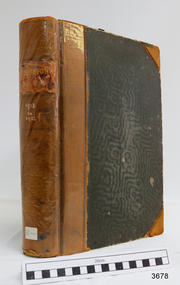
Book - Library Record Book, Ralph Eric Pattison, Warrnambool Mechanics’ Institute (WMI) Accessions Book (1913–1922), before 1918
... The Art Gallery kept the 19th Century art collection and some of the artefacts from the museum. The Historic Society has some items the State Museum has some items. ...Library record book from the Warrnambool Mechanics Institute known as an "Accessions Book" the book shows the type and number of books as listed in the Mechanics Institute. This specific volume is part of the Pattison Collection, named after Ralph Eric Pattison, the city librarian who began the Herculean task of organising the (WMI) massive, disorganised collection in 1935. The Record books from this period are "meticulous records" that typically include. titles and Authors of all books purchased or donated. Acquisition Dates Providing a timeline of the districts literary and intellectual interests. Costs and Suppliers often showing books ordered from Melbourne or overseas. In addition how the books were classified and how the library was organised before modern Dewey Decimal systems were fully implemented. The Warrnambool Mechanics’ Institute (WMI) Accessions Book (1913–1922) is a primary historical record that documents the acquisition of library materials during a pivotal era for the institution. In UK in early 1800's the word 'mechanic' was applied to a broader range of skills such as working man, tradesman or artisan. Mechanics' Institutes were formed originally for voluntary, self-funded organisations, to improve the education of working men and to instruct them on their various trades. The germ of the idea came from a class formed in 1799 by Professor George Birbeck in Glasgow, Scotland, for journeymen mechanics (apprentice trade workers), with the first Institutes being organised in London and Manchester in the 1820's. By then the original aim had broadened and the Mechanics' Institutes were established as popular agencies of adult education. The Mechanics' Institutes were run by committees that provided facilities for a meeting room, hall suitable for lectures, and a library. Funding was raised locally and often supplemented by grants from government agencies for the purchase of books and other resources. Activities were community based. In Australia, Mechanics' Institutes were set up in New South Wales and in Tasmania in the late 1820's. Mechanics' Institutes began in Victoria, with the first one in Melbourne dating from 1839, providing similar services but in time offered services tailored to their specific area.Hard cover, olive green cover with brown protective cloth on corners. Page edges have colored marble pattern. non-fictionLibrary record book from the Warrnambool Mechanics Institute known as an "Accessions Book" the book shows the type and number of books as listed in the Mechanics Institute. This specific volume is part of the Pattison Collection, named after Ralph Eric Pattison, the city librarian who began the Herculean task of organising the (WMI) massive, disorganised collection in 1935. The Record books from this period are "meticulous records" that typically include. titles and Authors of all books purchased or donated. Acquisition Dates Providing a timeline of the districts literary and intellectual interests. Costs and Suppliers often showing books ordered from Melbourne or overseas. In addition how the books were classified and how the library was organised before modern Dewey Decimal systems were fully implemented. The Warrnambool Mechanics’ Institute (WMI) Accessions Book (1913–1922) is a primary historical record that documents the acquisition of library materials during a pivotal era for the institution. In UK in early 1800's the word 'mechanic' was applied to a broader range of skills such as working man, tradesman or artisan. Mechanics' Institutes were formed originally for voluntary, self-funded organisations, to improve the education of working men and to instruct them on their various trades. The germ of the idea came from a class formed in 1799 by Professor George Birbeck in Glasgow, Scotland, for journeymen mechanics (apprentice trade workers), with the first Institutes being organised in London and Manchester in the 1820's. By then the original aim had broadened and the Mechanics' Institutes were established as popular agencies of adult education. The Mechanics' Institutes were run by committees that provided facilities for a meeting room, hall suitable for lectures, and a library. Funding was raised locally and often supplemented by grants from government agencies for the purchase of books and other resources. Activities were community based. In Australia, Mechanics' Institutes were set up in New South Wales and in Tasmania in the late 1820's. Mechanics' Institutes began in Victoria, with the first one in Melbourne dating from 1839, providing similar services but in time offered services tailored to their specific area.flagstaff hill, warrnambool, shipwrecked coast, flagstaff hill maritime museum, maritime museum, shipwreck coast, flagstaff hill maritime village, great ocean road, warrnambool mechanics' institute, mechanics' institute records warrnambool, record book c1918, patterson collection, library books, ralph patterson, mechanics institute, warrnambool council, book collection -
 Flagstaff Hill Maritime Museum and Village
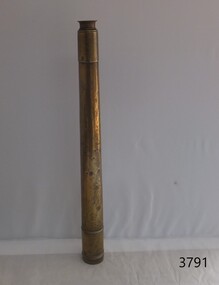
Instrument - Marine Telescope, 1870-1880
... organisations, such as the “Microscopical Society of London”, the “Meteorological Society”, and the “Royal”. Then in 1908 the company of W. Watson & Son, opticians and camera makers, took over John Browning's company since 1901 John Browning had been semi-retired but in 1908 he fully retired and moved to Bournemouth in Hampshire. He died in Cheltenham, Gloucestershire in 1925. The telescope is significant for its association ...This telescope was amongst various items collected from a sea dive in Port Phillip Bay. The diver was the caretaker of the Port Lonsdale Lighthouse, who dived on various wrecks in the bay during the 1960's. After the caretaker's death, his son sold off many of the shipwreck artefacts. The telescope was purchased from the caretaker's son in the 1990's by a previous owner of the Marine Shop, Queenscliff, Victoria. John Browning was particularly well known for his scientific advances in the fields of spectroscopy, astronomy, and optometry. Between 1856 and 1872, Browning acquired provisional patents for designs of numerous scientific instruments. He was also the recipient of an award at the 1862 International Exhibition held in London. Also recognised for his temperature-compensated aneroid barometer. Browning's scientific instruments were used in physics, chemistry, and biology. The products he designed and manufactured included spectroscopes, telescopes, microscopes, barometers, photometers, cameras, ophthalmologist, and electrical equipment such as electric lamps. John Browning was born around 1831 in Kent, England. His father, William Spencer Browning, was a maker of nautical instruments. John Browning's great-grandfather was also an instrument maker as well as John’s brother Samuel Browning of the firms Spencer & Browning and Spencer, Browning & Rust, who also manufactured navigational instruments. The latter firm was in operation in London from 1784 to 1840 and was succeeded by the firm of Spencer, Browning & Co. John Browning initially intended to follow the medical profession and entered Guy's Hospital, a teaching hospital and a school of medicine. Despite having passed the required examinations, however, he abandoned his plans. Instead, he apprenticed with his father, William Spencer Browning. At the same time, in the late 1840s, he was a student attending the Royal College of Chemistry several days per week. By the early 1870s, practical optics had become John Browning's primary interest, and he listed his occupation as an optician on the census records from 1871 to 1901. He was well known among London's ophthalmic surgeons for his various ophthalmic instruments. He had a large part in reforming the art of crafting spectacles. Other achievements were as an author of the book, How to Use Our Eyes and How to Preserve them by the Aid of Spectacles. Published in 1883, the book included thirty-seven illustrations, including a diagram demonstrating the anatomy of the eye. In 1895, he was one of the founders of the "British Ophthalmology" the first professional organisation for optometry. He was not only its first president but also registered as its first member so many considered him to be the first professional optometrist. Other professional organisations he belonged too was as a member of “The Aeronautical Society of Great Britain”. In 1871 constructing the first wind tunnel located at Greenwich Marine Engineering Works. He was also a member of other scientific organisations, such as the “Microscopical Society of London”, the “Meteorological Society”, and the “Royal”. Then in 1908 the company of W. Watson & Son, opticians and camera makers, took over John Browning's company since 1901 John Browning had been semi-retired but in 1908 he fully retired and moved to Bournemouth in Hampshire. He died in Cheltenham, Gloucestershire in 1925.The telescope is significant for its association with one of the world’s leading scientific instrument makers and inventor of the 19th and early 20th century. It is believed the donation came off a wreck either in Port Philip Bay or between Point Lonsdale and the Nepean Heads making it a significant maritime historical artefact. Its provenance is good given it was taken off a wreck in this area by the Point Lonsdale lighthouse caretaker. Examples of John Browning's telescopes because of their scientific and historical importance are highly valued by collectors.Marine style single draw brass telescope with a sunshade. The single draw has no split and the second cartridge is held in a long brass tube within the single draw, mounted from the objective end. The eyepiece is flat and at the end of the first draw in a very faded engraving that is believed to read "John Browning, 63 Strand, and should read London under the word strand but this is hard to establish given the engravings condition. This interpretation of the engraving has been arrived at by examination of other John Browning telescope engraving examples."John Browning, engraved to the first tube in copper plate style "63 STRAND" Engraved under in capital textflagstaff hill, flagstaff hill maritime museum and village, warrnambool, maritime museum, maritime village, great ocean road, shipwreck coast, shipwreck artefact, port phillip bay, port lonsdale lighthouse, wreck, 1960’s diver, queenscliff marine shop, john browning, telescope, spectroscopy, optometry, scientific instruments, william spencer browning, optician, navigational instrument, microscopical society of london, aeronautical society, marine technology -
 Flagstaff Hill Maritime Museum and Village
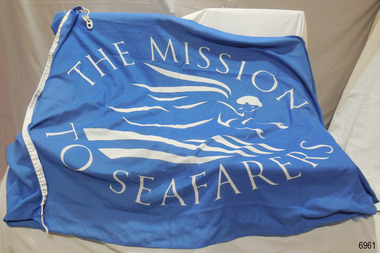
Flag - The Mission to Seafarers, circa 2000
... The ‘Flying Angel’ (the angel of Revelation) became the official logo of the Society and gained great popularity. In July 2000 the Missions to Seamen changed its name to the Mission to Seafarers to better reflect the group's function, an unbiased society that cares for all who earn their living at sea. ...The flag represents The Mission to Seafarers worldwide organisation. From about the year 2000 particular flag was once flown from Flagstaff Hill's masthead on top of the turret on the St Nicholas Seamen's Church but this practice ceased around 2010 for safety reasons. The Australian beginnings were in 1856 when the Church of England (Anglican Church) established the ‘Society for Promoting Missions to Seamen Afloat, at Home and Abroad. Lord Shaftesbury was the first President and Mr William Kingston was the first Secretary. Its Constitution declared: (1)) the Object is the spiritual welfare of the seafaring classes at home and abroad. (2) In pursuance of this Object, Society will use every means consistent with the principles and received practice of the Church of England. Mr Kingston’s wife and sister designed a flag to clearly depict the Society’s Objects. It depicted the first of the three angels in Revelation 14, who possessed ‘an eternal gospel to proclaim to those who dwell on the earth, to every nation and tribe and language and people. The ‘Flying Angel’ (the angel of Revelation) became the official logo of the Society and gained great popularity. In July 2000 the Missions to Seamen changed its name to the Mission to Seafarers to better reflect the group's function, an unbiased society that cares for all who earn their living at sea. The Logo was modernised and simplified, the word changed to 'seafarer' to be gender-neutral. The angel logo no longer holds a book (Bible). The organisation states: “The Mission to Seafarers is an Anglican organisation ... The Mission offers fellowship and a warm welcome in centres where seafarers can relax away from their ships, meet local people and contact their homes, from ports around the world. The Mission provides and promotes” … “The Mission to Seafarers now has a presence in 200 ports in 50 countries worldwide. This makes us the largest sea-port-based welfare organisation in the world. We provide support to seafarers 365 days per year, regardless of their rank, nationality, gender or religion” This flag was a gift from the Mission to Seafarers Victoria at the time of the organisation's change of name from the Missions to Seamen. It was flown from the Masthead on top of the turret on the St Nicholas Seamen's Church at Flagstaff Hill from the years 2000 to around 2010. The donation of this flag signifies the ongoing association between the historical organisation and St Nicholas Seamen's Church building at Flagstaff Hill', which displays an extensive collection of furniture and furnishings from that organisation's Williamstown branch. The design on the flag is an example of several updates of the flag over the organisation's lifetime.Flag, fine linen, The Mission to Seafarers. Rectangle of blue fabric with white text around white flying angel logo. Flag has a plastic hook on top of the halyard.Printed "THE MISSION TO SEAFARERS" and logo of FLYING ANGEL symbolflagstaff hill, warrnambool, shipwrecked coast, flagstaff hill maritime museum, maritime museum, shipwreck coast, flagstaff hill maritime village, great ocean road, missions to seamen victoria, mission to seafarers, flying angel’s club, st nicholas seaman’s church williamstown, mission to seafarers flag, flag, missions to seamen, turret -
 Flagstaff Hill Maritime Museum and Village
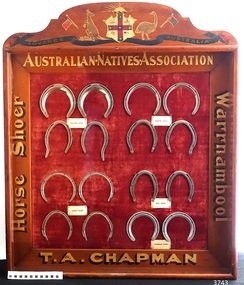
Memorabilia - Horseshoe Case, 1906 – 1907
... Association (ANA) were a non-partisan and non-sectarian, friendly society founded in Melbourne, Australia in April 1871. It was set-up for the benefit of Australian-born white men, and membership was restricted exclusively to that group. Men of other races including the Chinese and Indigenous people were not allowed to join. The ANA had relatively progressive views on women (for the time) and attracted suffragists seeking support for their cause, and in 1894, the ANA advocated for women’s enfranchisement. Although, white women were only admitted as members from 1964. The organisation...Association (ANA) were a non-partisan and non-sectarian, friendly society founded in Melbourne, Australia in April 1871. It was set-up for the benefit of Australian-born white men, and membership was restricted exclusively to that group. Men of other races including the Chinese and Indigenous people were not allowed to join. The ANA had relatively progressive views on women (for the time) and attracted suffragists seeking support for their cause, and in 1894, the ANA advocated for women’s enfranchisement. Although, white women were only admitted as members from 1964. The organisation ...The horseshoes in this purpose-built display case were made by Thomas Alfred Chapman in 1906-1907. Chapman operated a blacksmith’s shop in Mortlake Rd, Purnim, about 15 mins drive from Warrnambool. Chapman made this horseshoe case especially for the 3rd Exhibition of Australian Manufacturers and Products, held in the Exhibition Building in Melbourne, which was organised and promoted by the Australian Natives Association (ANA). Reference is made to the horseshoe case in the Exhibition’s Souvenir Catalogue of 1907 on page 85, under the heading 'In the Machinery Section the following exhibits are also shown … 'CHAPMAN, T.A. , Woolsthorpe, via Warrnambool, Case of Horseshoes'. The Australian Natives’ Association (ANA) were a non-partisan and non-sectarian, friendly society founded in Melbourne, Australia in April 1871. It was set-up for the benefit of Australian-born white men, and membership was restricted exclusively to that group. Men of other races including the Chinese and Indigenous people were not allowed to join. The ANA had relatively progressive views on women (for the time) and attracted suffragists seeking support for their cause, and in 1894, the ANA advocated for women’s enfranchisement. Although, white women were only admitted as members from 1964. The organisation was most prominent in Victoria and sought to shape Australia’s national identity and was a training ground for businessmen, trade unionists and politicians including many of Australia’s early prime ministers such as Edmund Barton, Alfred Deakin, James Scullin and Francis Forde, and the first Australian-born governor-general, Isaac Isaacs, was a member. By 1910 it had developed into a nationwide association with real political and social influence, and members would participate in many activities. The ANA lobbied strongly for anti-Chinese legislation and were an ardent believer of colonial unification. Its mission and efforts are largely credited for the successful referendums that resulted in Federation of the six Australian colonies into a new nation, the association’s most important legacy. The ANA was also a supporter of trade protection, and were a staunch advocate of the first act of Australia's new parliament, the Immigration Restriction Act 1901 (cth) or commonly known as the White Australia Policy, which became one of the central pillars of Australian nationalism in the 20th-century. The ANA campaigned against the Australian Federal Government's new immigration policy after the Second World War (non-British immigration from southern and central Europe) in order to maintain a 'white Australia', and resisted changes when the Labor government during the 1970s fully dismantled and abandoned the White Australia Policy. The ANA merged with Manchester Unity Independent Order of Oddfellows, in 1993 to become Australian Unity Ltd. The display case of horseshoes changed hands several times, going from its maker Thomas Chapman to his mother then various other members of his family. The case was also displayed at the Lee Family’s butcher shop at 188 Liebig St Warrnambool, and in the Purnim Hotel during the Warrnambool May Races. In the late 1950s the horseshoe case went to Thomas’s son, Brian. He was a Master Farrier and completed his apprenticeship at Flemington Racecourse, and in Warrnambool he owned a blacksmith business at the Warrnambool Racecourse Grounds. Brian later operated a blacksmith’s at Flagstaff Hill, where his customers would bring their horses to be shod. Brian passed away in August 2017. The horseshoe case is significant as an example of trades in the early 20th century in Western Victoria, Australia. It is also significant as an example of horseshoes from the early 20th century. The horseshoe display case is also significant for its association with the Australian Exhibition of 1907, showcasing Australian produce and manufacturing to the world. The horseshoe display case is locally significant for its association with local families, essential businesses and community events. Display case of homemade horseshoes. Wooden case with glass front containing 16 horse shoes grouped in sets, each set with a label: Made 1906-1907 for Australian Exhibition of 1907 by Thomas Alfred Chapman of Warrnambool. The case contains (a) complete chrome set each of Trotting Shoes, Hunting Shoes and Racing Plates, and (b) one pair of Hind Polo Shoes and one pair of Front Aluminium Shoes. The wooden frame has gold lettering on each side proclaiming “Australian Natives Association, T.A. Chapman, horse shoer, Warrnambool” and is topped by a painted Australian coat of arms. Gold lettering on frame, in the order of top/bottom/ left/right “AUSTRALIAN.NATIVES.ASSOCIATION / T.A. CHAPMAN / Horse Shoer / Warrnambool”flagstaff hill, warrnambool, shipwrecked coast, maritime museum, shipwreck coast, horseshoe display case 1906-1907, chromed set of trotting shoes 1906-1907, chrome set of hunting shoes 1906-1907, chrome set of racing plates 1906-1907, pair of hind polo shoes 1906-1907, pair of front aluminium shoes 1906-1907, australian exhibition 1907, australian natives association (ana), t.a. chapman horse shoer warrnambool, thomas alfred chapman, brian chapman, brian “snacks” chapman, blacksmith warrnambool, warrnambool may races, warrnambool racecourse, purnim hotel, lee family’s butcher shop warrnambool -
 Mission to Seafarers Victoria
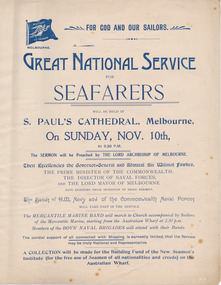
Flyer, Victorian Seamen's Mission, Great National Service for Seafarers, 1907
... Representatives come from the Royal and Merchant Navies, the commercial world, shipping companies, mission and philanthropic societies, veterans’ associations, labour unions, youth and leisure organisations, but anyone is welcome to attend. seafarers service 1907 reverend alfred gurney goldsmith dr lowther clarke archibishop of melbourne st paul cathedral admiral sir wilmot fawkes seamen's mission missions to seamen battle of trafalgar trafalgar day horatio nelson Small flyer in cream colour paper and printed in blue ink. ...The first Seafarers Service was held on 23 October 1905 in the St Paul's Cathedral in London to celebrate the Centenary of the Battle of Trafalgar and the death of Vice-Admiral Horatio Nelson on 21 October 1805. Reverend Alfred Gurney Goldsmith launched the first Seafarers Service two years later and the first service was held on Sunday 10 November 1907.The service continue to reflect the full range of the maritime activities in Australia. Representatives come from the Royal and Merchant Navies, the commercial world, shipping companies, mission and philanthropic societies, veterans’ associations, labour unions, youth and leisure organisations, but anyone is welcome to attend.Small flyer in cream colour paper and printed in blue ink. Flying angel flag at the top left corner.seafarers service, 1907, reverend alfred gurney goldsmith, dr lowther clarke, archibishop of melbourne, st paul cathedral, admiral sir wilmot fawkes, seamen's mission, missions to seamen, battle of trafalgar, trafalgar day, horatio nelson -
 Mission to Seafarers Victoria
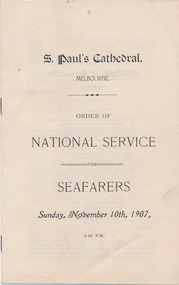
Programme, The Victoria Missions to Seamen, Great National Service for Seafarers, 1907
... Representatives come from the Royal and Merchant Navies, the commercial world, shipping companies, mission and philanthropic societies, veterans’ associations, labour unions, youth and leisure organisations, but anyone is welcome to attend. seafarers service 1907 reverend alfred gurney goldsmith dr lowther clarke archibishop of melbourne st paul cathedral admiral sir wilmot fawkes seamen's mission missions to seamen battle of trafalgar trafalgar day horatio nelson 8 pages booklet in cream colour printed in black ink. ...The first Seafarers Service was held on 23 October 1905 in the St Paul's Cathedral in London to celebrate the Centenary of the Battle of Trafalgar and the death of Vice-Admiral Horatio Nelson on 21 October 1805. Reverend Alfred Gurney Goldsmith launched the first Seafarers Service two years later and the first service was held on Sunday 10 November 1907 and has been held every year since.The service continue to reflect the full range of the maritime activities in Australia. Representatives come from the Royal and Merchant Navies, the commercial world, shipping companies, mission and philanthropic societies, veterans’ associations, labour unions, youth and leisure organisations, but anyone is welcome to attend.8 pages booklet in cream colour printed in black ink.seafarers service, 1907, reverend alfred gurney goldsmith, dr lowther clarke, archibishop of melbourne, st paul cathedral, admiral sir wilmot fawkes, seamen's mission, missions to seamen, battle of trafalgar, trafalgar day, horatio nelson -
 Mission to Seafarers Victoria
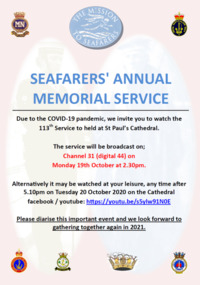
Flyer, Mission to Seafarers Victoria, Annual Seafarers Service 19 October 2020, 19 October 2020
... Representatives come from the Royal and Merchant Navies, the commercial world, shipping companies, mission and philanthropic societies, veterans’ associations, labour unions, youth and leisure organisations, but anyone is welcome to attend. ...The first Seafarers Service was held on 23 October 1905 in the St Paul's Cathedral in London to celebrate the Centenary of the Battle of Trafalgar and the death of Vice-Admiral Horatio Nelson on 21 October 1805. Reverend Alfred Gurney Goldsmith launched the first Seafarers Service two years later and the first service was held on Sunday 10 November 1907.The service continue to reflect the full range of the maritime activities in Australia. Representatives come from the Royal and Merchant Navies, the commercial world, shipping companies, mission and philanthropic societies, veterans’ associations, labour unions, youth and leisure organisations, but anyone is welcome to attend. During the pandemic, the event, like many others, happened without public so was broadcasted live on Channel 31 on the 19 October 2020, and then livestreamed on Tube on 20 October 2020.Flyer invitent to watch the annual seafarers service broadcasted in 2020covid, 2020, online, youtube, live broadcast, st paul's cathedral, melbourne, merchant navy, royal australian navy, ran, mission to seafarers, seafarers service, pandemic, nigel porteous, reverend onofre punnay, inni punnay, channel 31, battle of trafalgar, trafalgar day, horatio nelson -
 Mission to Seafarers Victoria
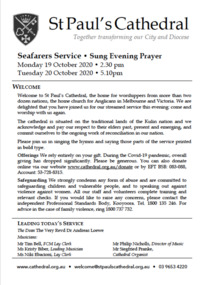
Programme - Service, Mission to Seafarers Victoria, Annual Seafarers Service 19 October 2020, 19 October 2020
... Representatives come from the Royal and Merchant Navies, the commercial world, shipping companies, mission and philanthropic societies, veterans’ associations, labour unions, youth and leisure organisations, but anyone is welcome to attend. ...The first Seafarers Service was held on 23 October 1905 in the St Paul's Cathedral in London to celebrate the Centenary of the Battle of Trafalgar and the death of Vice-Admiral Horatio Nelson on 21 October 1805. Reverend Alfred Gurney Goldsmith launched the first Seafarers Service two years later and the first service was held on Sunday 10 November 1907.The service continue to reflect the full range of the maritime activities in Australia. Representatives come from the Royal and Merchant Navies, the commercial world, shipping companies, mission and philanthropic societies, veterans’ associations, labour unions, youth and leisure organisations, but anyone is welcome to attend. During the pandemic, the event, like many others, happened without public so was broadcasted live on Channel 31 on the 19 October 2020, and then livestreamed on Tube on 20 October 2020.Program of service of the annual seafarers service broadcasted in 2020covid, 2020, online, youtube, live broadcast, st paul's cathedral, melbourne, merchant navy, royal australian navy, ran, mission to seafarers, seafarers service, pandemic, nigel porteous, reverend onofre punnay, inni punnay, channel 31, battle of trafalgar, trafalgar day, horatio nelson -
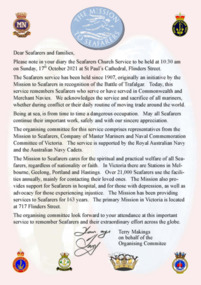 Mission to Seafarers Victoria
flyer, Mission to Seafarers Victoria, Annual Seafarers Service 17 October 2021, 17 October 2021
... Representatives come from the Royal and Merchant Navies, the commercial world, shipping companies, mission and philanthropic societies, veterans’ associations, labour unions, youth and leisure organisations, but anyone is welcome to attend. ...The first Seafarers Service was held on 23 October 1905 in the St Paul's Cathedral in London to celebrate the Centenary of the Battle of Trafalgar and the death of Vice-Admiral Horatio Nelson on 21 October 1805. Reverend Alfred Gurney Goldsmith launched the first Seafarers Service two years later and the first service was held on Sunday 10 November 1907.The service continue to reflect the full range of the maritime activities in Australia. Representatives come from the Royal and Merchant Navies, the commercial world, shipping companies, mission and philanthropic societies, veterans’ associations, labour unions, youth and leisure organisations, but anyone is welcome to attend. The service was performed on Sunday 17 October 2021.Flyer invitation to the annual seafarers service 17 October 2021covid, 2020, online, youtube, live broadcast, st paul's cathedral, melbourne, merchant navy, royal australian navy, ran, mission to seafarers, seafarers service, pandemic, nigel porteous, reverend onofre punnay, inni punnay, channel 31, battle of trafalgar, trafalgar day, horatio nelson -
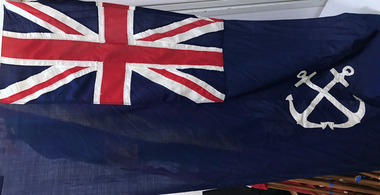 Mission to Seafarers Victoria
Flag, Melbourne Harbour Trust
... Representatives come from the Royal and Merchant Navies, the commercial world, shipping companies, mission and philanthropic societies, veterans’ associations, labour unions, youth and leisure organisations, but anyone is welcome to attend. flag melbourne harbour trust m.h.t. seafarers service M.H.T written in black pen Large blue rectangular flag with the Blue Ensign and two white anchors on the right Melbourne Harbour Trust Flag ...The first Seafarers Service was held on 23 October 1905 in the St Paul's Cathedral in London to celebrate the Centenary of the Battle of Trafalgar and the death of Vice-Admiral Horatio Nelson on 21 October 1805. Reverend Alfred Gurney Goldsmith launched the first Seafarers Service two years later and the first service was held on Sunday 10 November 1907. National and house flags are used during the annual Seafarers Service. The Melbourne Harbor Trust was established in 1877 to improve and operate port facilities for the growing city of Melbourne. It was superseded by the Port of Melbourne Authority in 1978 and later by the Port of Melbourne Corporation. The service continue to reflect the full range of the maritime activities in Australia. Representatives come from the Royal and Merchant Navies, the commercial world, shipping companies, mission and philanthropic societies, veterans’ associations, labour unions, youth and leisure organisations, but anyone is welcome to attend.Large blue rectangular flag with the Blue Ensign and two white anchors on the rightM.H.T written in black penflag, melbourne harbour trust, m.h.t., seafarers service -
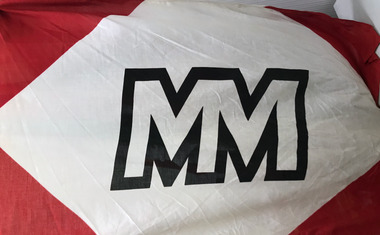 Mission to Seafarers Victoria
Flag - House flag, Messageries Maritimes
... Representatives come from the Royal and Merchant Navies, the commercial world, shipping companies, mission and philanthropic societies, veterans’ associations, labour unions, youth and leisure organisations, but anyone is welcome to attend. flag seafarers service messageries maritimes m.m. shipping company house flag Messageries Maritimes written in black pen Large red rectangular flag with large M.M in black on a white diamond shape. ...The first Seafarers Service was held on 23 October 1905 in the St Paul's Cathedral in London to celebrate the Centenary of the Battle of Trafalgar and the death of Vice-Admiral Horatio Nelson on 21 October 1805. Reverend Alfred Gurney Goldsmith launched the first Seafarers Service two years later and the first service was held on Sunday 10 November 1907. National and house flags are used during the annual Seafarers Service. Messageries Maritimes was a French merchant shipping company. It was originally created in 1851. In 1977 it merged with Compagnie générale transatlantique to form Compagnie générale maritime. In 1996 CGM was privatized and sold to Compagnie Maritime d'Affrètement (CMA) to form CMA CGM.The service continue to reflect the full range of the maritime activities in Australia. Representatives come from the Royal and Merchant Navies, the commercial world, shipping companies, mission and philanthropic societies, veterans’ associations, labour unions, youth and leisure organisations, but anyone is welcome to attend.Large red rectangular flag with large M.M in black on a white diamond shape.Messageries Maritimes written in black penflag, seafarers service, messageries maritimes, m.m., shipping company, house flag -
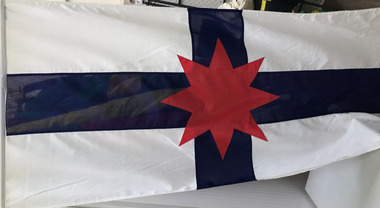 Mission to Seafarers Victoria
Flag - House flag, Adelaide Steamship
... Representatives come from the Royal and Merchant Navies, the commercial world, shipping companies, mission and philanthropic societies, veterans’ associations, labour unions, youth and leisure organisations, but anyone is welcome to attend. flag seafarers service adelaide steamship shipping company house flag Adelaide Steamship written in black pen Large white rectangular flag with a navy cross and a red 8 arms star. ...The first Seafarers Service was held on 23 October 1905 in the St Paul's Cathedral in London to celebrate the Centenary of the Battle of Trafalgar and the death of Vice-Admiral Horatio Nelson on 21 October 1805. Reverend Alfred Gurney Goldsmith launched the first Seafarers Service two years later and the first service was held on Sunday 10 November 1907. National and house flags are used during the annual Seafarers Service. The Adelaide Steamship Company was an Australian shipping company and later a diversified industrial and logistics conglomerate. It was formed by a group of South Australian businessmen in 1875. The service continue to reflect the full range of the maritime activities in Australia. Representatives come from the Royal and Merchant Navies, the commercial world, shipping companies, mission and philanthropic societies, veterans’ associations, labour unions, youth and leisure organisations, but anyone is welcome to attend.Large white rectangular flag with a navy cross and a red 8 arms star.Adelaide Steamship written in black penflag, seafarers service, adelaide steamship, shipping company, house flag -
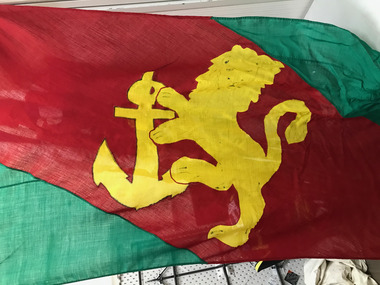 Mission to Seafarers Victoria
Flag - House flag, Eastern & Australian (E&A)
... Representatives come from the Royal and Merchant Navies, the commercial world, shipping companies, mission and philanthropic societies, veterans’ associations, labour unions, youth and leisure organisations, but anyone is welcome to attend. flag seafarers service shipping company e&a eastern and australian house flag E & A written in black pen Large green flag with crest of a gold lion rampant holding a gold fouled anchor on a red stripe. ...The first Seafarers Service was held on 23 October 1905 in the St Paul's Cathedral in London to celebrate the Centenary of the Battle of Trafalgar and the death of Vice-Admiral Horatio Nelson on 21 October 1805. Reverend Alfred Gurney Goldsmith launched the first Seafarers Service two years later and the first service was held on Sunday 10 November 1907. National and house flags are used during the annual Seafarers Service. Eastern and Australian Steam Ship Company, a small line which played a strong part in Australian maritime history, providing links from Australia (in particular Queensland) and New Zealand to South-east Asia from 1873 to 1983.The service continue to reflect the full range of the maritime activities in Australia. Representatives come from the Royal and Merchant Navies, the commercial world, shipping companies, mission and philanthropic societies, veterans’ associations, labour unions, youth and leisure organisations, but anyone is welcome to attend.Large green flag with crest of a gold lion rampant holding a gold fouled anchor on a red stripe.E & A written in black penflag, seafarers service, shipping company, e&a, eastern and australian, house flag
