
Showing 426 items matching " australian flora"
-
 University of Melbourne, Burnley Campus Archives
Poster, The Art of Australian Flora 'First Fleet to Contemporary', 1991
... The Art of Australian Flora 'First Fleet to Contemporary'......history of Australian flora...Printed sheets of art-work for display: The Art of Australian Flora. Rolled sheets and cardboard tube addressed to Terry baker 'First Fleet to Contemporary' Includes Ikebana, Bonsai And Sculpture...Pescott's book, "The Native Flowers of Victoria," is mentioned exhibition ikebana bonsai sculpture history of Australian flora e de pescott art Printed sheets of art-work for display: The Art of Australian Flora. ...E. E. Pescott's book, "The Native Flowers of Victoria," is mentionedPrinted sheets of art-work for display: The Art of Australian Flora. Rolled sheets and cardboard tube addressed to Terry baker 'First Fleet to Contemporary' Includes Ikebana, Bonsai And Sculptureexhibition, ikebana, bonsai, sculpture, history of australian flora, e de pescott, art -
 Bendigo Historical Society Inc.
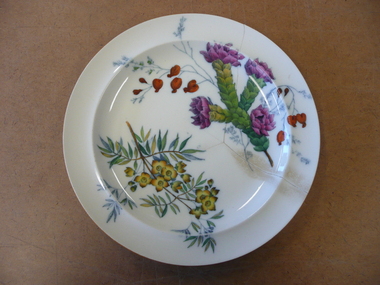
Domestic Object - AUSTRALIAN FLORA PLATE
... AUSTRALIAN FLORA PLATE...Wedgewood china plate decorated with Australian native flora in shades of green, yellow, red & orange....Domestic Object AUSTRALIAN FLORA PLATE ...Wedgewood china plate decorated with Australian native flora in shades of green, yellow, red & orange.Wedgewood DM1W A1927domestic equipment, food consumption, plates -
 Hymettus Cottage & Garden Ballarat
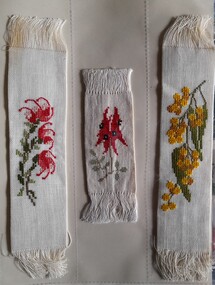
Functional object - Bookmarks, Australian Flora Embroidered bookmarks
... Australian Flora Embroidered bookmarks......Australian flora...Embroidery Wattle Kangaroo Paw Sturt Desert Pea Bookmarks Craft Australian flora Australian Flora Embroidered bookmarks Functional object Bookmarks ...embroidery, wattle, kangaroo paw, sturt desert pea, bookmarks, craft, australian flora -
Friends of Ballarat Botanical Gardens History Group
Work on paper - Gondwana Timeline, Geological History and Australian Flora, unknown
... Geological History and Australian Flora...Geological History and Australian Flora...Gardens Ballarat None 3 pages of black print on white paper plus 2 pages listing Gondwana Plant Families Geological History and Australian Flora Work on paper Gondwana Timeline ...The Gondwana Timeline relates to plants in the Ballarat Botanical GardensThis article gives important historical perspective on plants in the Ballarat Botanical Gardens and becomes more significant in view of climate change.3 pages of black print on white paper plus 2 pages listing Gondwana Plant Families Nonejohn garner, doctor, john garner collection, ballarat botanical gardens, friends of ballarat botanical gardens, doctor keith corbett, gondwana timeline, geological history and australian flora, gondwana plant families, tree -ferns, the monkey puzzle tree., gardens, ballarat -
 Embroiderers Guild, Victoria
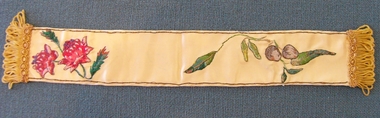
Textile - Australian Flora Bookmark, Mid 20th century
... Australian Flora Bookmark...Gold satin and fringes. Textile Australian Flora Bookmark ...Gifted by Lady Amies.Modern design of Australian flowers. Waratah, gum leaves and nuts. Gold satin and fringes.embroidery, surface stitchery, mid 20th century, australia -
University of Melbourne, Burnley Campus Archives
Document - Advertisement, G.R. Cochrane et al, Australian flora in colour: flowers and plants of Victoria
... Australian flora in colour: flowers and plants of Victoria...g.r. cochrane b. a. fuhrer e.r. rotherham j.h. willis flowers plants victoria australia Advertisement for book by Cochrane, Fuhrer, Rotherham and Willis Australian flora in colour: flowers and plants of Victoria Document Advertisement G.R. ...Advertisement for book by Cochrane, Fuhrer, Rotherham and Willisg.r. cochrane, b. a. fuhrer, e.r. rotherham, j.h. willis, flowers, plants, victoria, australia -
 RMIT Design Archives
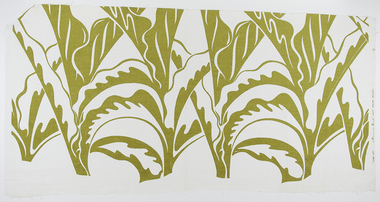
Textile lengths, Canna leaf
... ...Australian Flora...Burke’s modern abstract textile designs incorporated motifs and colours inspired by Australian Indigenous art, Pacific Island cultures, Australian flora and fauna, English gardens, and the sea and its wildlife. ...Burke’s modern abstract textile designs incorporated motifs and colours inspired by Australian Indigenous art, Pacific Island cultures, Australian flora and fauna, English gardens, and the sea and its wildlife. ...Dr. Frances Mary Burke (1907 - 1994) was a textile designer and printer, businesswoman, artist and Australian design advocate and retailer. Burke’s modern abstract textile designs incorporated motifs and colours inspired by Australian Indigenous art, Pacific Island cultures, Australian flora and fauna, English gardens, and the sea and its wildlife. Following Burke’s death in 1994, her life-long companion Miss Fabie Chamberlain donated the contents of Burke’s studio to RMIT University.Single colour screenprint, white fabric with chartreuse coloured print of positive large format design featuring large stylised canna leaf motif.Printed on selvedge 'CANNA LEAF' a "Frances Burke" UNIT COLOUR DESIGN'textile, australian flora, rmit design archives -
University of Melbourne, Burnley Campus Archives
Document, VCAH, "First Fleet to Contemporary" Art and Horticulture, 1991
... ...art of australian flora...Documentation on exhibition The Art of Australian Flora; "First Fleet to Contemporary" held at Burnley 22.09.191-05.10.1991 as part of the Centenary celebrations.. ...exhibition art of australian flora art art exhibition brochure catalogue invitation advertisement floral art Documentation on exhibition The Art of Australian Flora; "First Fleet to Contemporary" held at Burnley 22.09.191-05.10.1991 as part of the Centenary celebrations.. ...Documentation on exhibition The Art of Australian Flora; "First Fleet to Contemporary" held at Burnley 22.09.191-05.10.1991 as part of the Centenary celebrations.. Artwork also held - see B10.0137. 1. Invitation to historical display of botanical artworks. 2. Photocopy of advertisement. 3. Faxed copy of typed notes with handwritten ammendments 17.09.1991. 4. Typed notes: Final Listing Burnley Centennoial Art Show 17.09.1991. labelling for artworks. Handwritten notation. 5. Newspaper article: Floral art from the first settlers on in The Age "Home" 24.09.1991 p 30. 6. Brochure - guide to the exhibition. 7. 3 page catalogue of 71 Exhibits in the Centenary Art Exhibition Spring 1991.exhibition, art of australian flora, art, art exhibition, brochure, catalogue, invitation, advertisement, floral art -
 Chiltern Athenaeum Trust
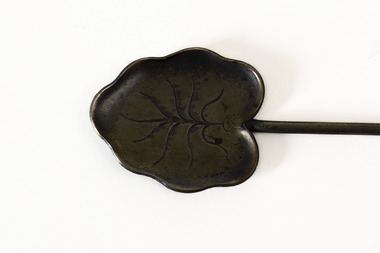
Domestic object - Spoon belonging to W.C.Busse
... ...australian flora...The use of Australian flora to decorate silverware is of particular interest and diversity'. ...The use of Australian flora to decorate silverware is of particular interest and diversity'. ...Wilfred Clarence Busse, born in Chiltern in 1898, His family moved to the region during the gold rush and continued to reside in the area, purchasing land adjacent the Murray River. Busse completed his secondary education at Wesley College in Melbourne then studied law at the University of Melbourne. Busse went on to become a barrister, often in the chambers of Sir Leo Finn Bernard Cussen (1859-1933) a judge of the Supreme Court of Victoria. He worked most of his life in Chiltern as a Barrister and Solicitor and gained the unofficial title of historian of Chiltern, leaving behind several manuscript histories and a scrap book. Busse was an avid fictional writer and in 1930 he published two novels. Time spent on a Victorian station in his early twenties, as well as careful documentary research, informed the writing of his historical novels of bush life. "The Blue Beyond; A Romance of the Early Days in South Eastern Australia” and "The Golden Plague: A Romance of the Early Fifties." "The Golden Plague” won the T. E. Role gold medal for the best historical novel which went on to become a best seller. Busse often drew inspiration for his novels from his younger years living Chiltern. His passion for the region lead him to write “The History of Chiltern” which was published in a serial form in the Chiltern Federal Standard from 1922-1923. Wilfred Clarence Busse was a member of Chiltern Athenaeum (where this object is now held) up until his death in 1960, he is buried in the Barnawartha Cemetery. The leaf shaped motif of this particular spoon appears to be stylised in a simple form of decorative arts and craft or even Art Nouveau style favoured in Europe between 1880-1920 and less representational than examples of Australiana flora captured in silversmithing from the 1850's onwards. According to Christine Erratt, due to the goldrush in the 1850's, there was increased wealth in the colony and an influx of immigrants from Europe to Australia who brought with them silversmithing skills which began ‘the golden age’ of Australian silver', Erratt says that 'Australia's unique flora has been portrayed in the decorative arts since the early colonial times of the last decade of the 18th century. The use of Australian flora to decorate silverware is of particular interest and diversity'. It is likely that those producing silverware at the time would be drawing on the decorative arts movement while incorporating elements of the natural beauty in the flora of their newfound environment into the silverware they produced. There are no discerning maker hallmarks to place where it was produced or ascertain the material accurately.Wilfred Clarence Busse was of social significance to Chiltern, he helped to document the cultural story of the area in his published works "The Golden Plague" and "The Beyond Blue" by recounting his own upbringing in a bush lifestyle. He was a respected Barrister and was the unofficial historian of the Chiltern Athenaeum for many years. This spoon represents a window into the domestic life of this person who was well loved in the area, and it continues its relationship to Busse as well as Chiltern by being held within the very collection he helped to maintain in his life. Domestic objects tell us the story about how people lived, objects of daily use hold particular meaning in that they can tell us the story of an individual, we feel closer to their life and habits, it humanises and connects us across time. A tarnished small silver teaspoon with leaf-shaped head and slim handlesilverware, wilfred clarence busse, busse, chiltern, chiltern athenaeum, federal standard, t. e. role, "the blue beyond, a romance of the early days in south eastern australia”, "the golden plague: a romance of the early fifties.", "the golden plague”, wesley college, university of melbourne, sir leo finn bernard cussen, supreme court of victoria, gold rush, murray river, “the history of chiltern”, silversmithing, spoon, decorative arts, floral, flora, australiana, australian flora, arts and craft movement, australian silver, cussen -
 Embroiderers Guild, Victoria
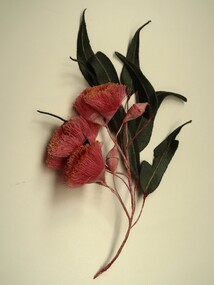
Textile - 3D Botanical Embroidery of Silver Princess Eucalyptus, Lynne Stone, 2025
... Australian native flora...Lynne Stone is a Victorian based textile artist specialising in botanical embroideries of Australian native flora. Lynne has used her technical skills to develop a software program for her sewing machine to automatically stitch some elements of her designs. ...Australian native flora flora Botanical model of Eucalyptus Caesia "Silver Princess" in flower with open flowers, flower buds and leaves. ...Lynne Stone is a Victorian based textile artist specialising in botanical embroideries of Australian native flora. Lynne has used her technical skills to develop a software program for her sewing machine to automatically stitch some elements of her designs. Botanical model of Eucalyptus Caesia "Silver Princess" in flower with open flowers, flower buds and leaves. Embroidered using machine embroidery on an organza base. Wrapped wires and hand embroidered elements, hand coloured.australian native flora, flora -
 Embroiderers Guild, Victoria
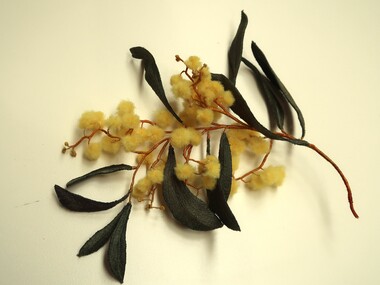
Textile - 3D Botanical Embroidery of Acacia Pycnantha "Golden Wattle", Lynne Stone, 2025
... Australian native flora...Lynne Stone is a Victorian based textile artist specialising in botanical embroideries of Australian native flora. Lynne has used her technical skills to develop a software program for her sewing machine to automatically stitch some elements of her designs. ...Australian native flora flora Botanical model of Acacia Pycnantha "Golden Wattle" in flower with open flowers, flower buds and leaves. ...Lynne Stone is a Victorian based textile artist specialising in botanical embroideries of Australian native flora. Lynne has used her technical skills to develop a software program for her sewing machine to automatically stitch some elements of her designs. Botanical model of Acacia Pycnantha "Golden Wattle" in flower with open flowers, flower buds and leaves. Embroidered using machine embroidery on an organza base. Wrapped wires and hand embroidered elements, hand coloured.australian native flora, flora -
 Bendigo Historical Society Inc.
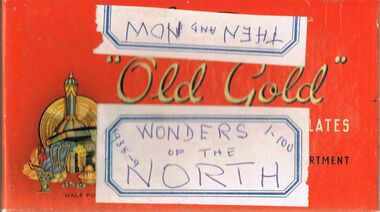
Newspaper - LYDIA CHANCELLOR COLLECTION: WONDERS OF THE NORTH. FAMOUS PEOPLE
... Australia... place... Aboriginal... Australian Aborigines... Aborigines... Northern Australian... Australian flora...PLACE Land rural life Lydia Chancellor collection Australia place Aboriginal Australian Aborigines Aborigines Northern Australian Australian flora Australian fauna fauna flora plants Australian plants Australian animals animals Australian lighthouses lighthouses sciences botany tourism famous people male person Wonders of the north 1-100 1938-9 Then and Now 'A small orange Old Gold chocolate box containing 2 newspaper columns. ...'A small orange Old Gold chocolate box containing 2 newspaper columns. (i) Wonders of the North' series 1-100. 1938-1939. (ii). This series of clips contains references to Aboriginal/Indiginous people. 'Then and Now Public Men'. These clips have a young/older photo and the positions they held in their professional life. Both columns from the 'Sun-News Pictorial' newspaper.Wonders of the north 1-100 1938-9 Then and Nowplace, land, rural life, lydia chancellor, collection, australia, place, aboriginal, australian aborigines, aborigines, northern australian, australian flora, australian fauna, fauna, flora, plants, australian plants, australian animals, animals, australian lighthouses, lighthouses, sciences, botany, tourism, famous people, male, person -
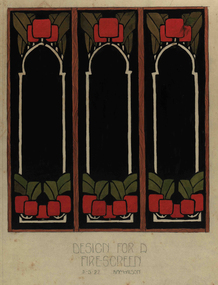 Federation University Historical Collection
Painting - Ballarat Technical Art School Folio, Ivy Wilson, Artwork by Ivy Wilson, c1920-1922, 1920 - 22 (originals)
... ...Australian flora...Alternatively, given her focus on textile-based arts, she may have been an evening trade student. ballarat school of mines wilson ballarat technical art school dressmaking art Ivy Wilson Stencilling stencil embroidery Australian flora Australian birds A number of digitised images taken from a folder of works by Ivy Wilson undertaken at the Ballarat School of Mines Technical Art School between 1920 and 1922. ...Ivy WILSON (1907-1998) Ballarat | Australia Ivy Wilson lived at 17 Mair Street with her parents while she studied at the Ballarat Technical Art School. Her student folio contains several stencils hand-cut from paper and card. Among them are stylised graphics of correa, waratah, gum, and kangaroo apple as well as kookaburras, cockatoos and a koala. One example of a wreath was subsequently translated into embroidered needlework. Wilson’s folio possibly consists of mostly junior technical work, as she appears to only have sat a single senior Education Department examination, Drawing Plant Forms from Nature. Alternatively, given her focus on textile-based arts, she may have been an evening trade student. A number of digitised images taken from a folder of works by Ivy Wilson undertaken at the Ballarat School of Mines Technical Art School between 1920 and 1922. The folio of work was later donated 'In memory of my mother Ivy Wilson'.ballarat school of mines, wilson, ballarat technical art school, dressmaking, art, ivy wilson, stencilling, stencil, embroidery, australian flora, australian birds -
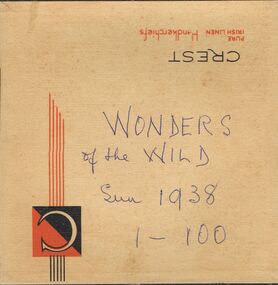 Bendigo Historical Society Inc.
Newspaper - LYDIA CHANCELLOR COLLECTION: WONDERS OF THE WILD
... ... Australian flora...PLACE Land wildlife Lydia Chancellor collection wildllife Australian flora Australian fauna plants animals Australian plants Australian animals Australian wildlife marine life Australian marine life Australia sciences Wonders of the Wild. ...A handkerchief box containing 'The Sun-News Pictorial,' cuttings on 'The Wonders of the Wild.' These clips contain photos of Insects, flora, birds, fish, lizards, snakes, trees, marine animals. In serial form 1-100. Dated 1938.Wonders of the Wild. Sun 1938. 1-100place, land, wildlife, lydia chancellor, collection, wildllife, australian flora, australian fauna, plants, animals, australian plants, australian animals, australian wildlife, marine life, australian marine life, australia, sciences -
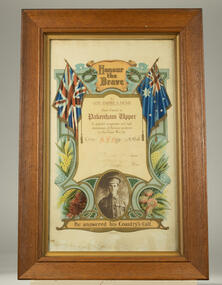 Narre Warren and District Family History Group
Certificate - Certificate of Appreciation to Lance Corporal Albert Francis Nye
... Certificate is coloured and decorated with the British and Australian flags, Australian flora and a picture of the recipient....Certificate is coloured and decorated with the British and Australian flags, Australian flora and a picture of the recipient. ...Welcome home socials were organised by many communities for their returned soldiers. Pakenham Upper held their welcome home social in October 1919 with about 300 people in attendance. Lance Corporal Albert Francis Nye was the son of James and Mary Ann Nye of Pakenham Upper. Albert enlisted in 1916 and served in France. He returned to Australia in 1919 and married Alice Maud Beadle in 1920. Certificate of Appreciation in wooden frame behind glass. Certificate is coloured and decorated with the British and Australian flags, Australian flora and a picture of the recipient.the great war, ww1 -
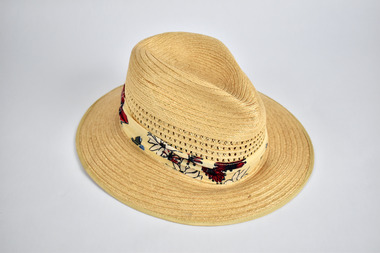 National Wool Museum
Uniform - 1992 Barcelona Olympic Games Akubra Hat, Akubra, c1992
... Sides of crown woven with decorative pattern and hatband printed with native Australian flora. ...Sides of crown woven with decorative pattern and hatband printed with native Australian flora. Uniform 1992 Barcelona Olympic Games Akubra Hat Akubra ...About the 1992 Barcelona Olympic Games donator Doug Pleasance wrote- During the 1980s the Australian wool industry was at its most prosperous times with record numbers of sheep producing wool receiving ever increasing values due to the success of the Reserve Price Scheme, and the overall guidance of the Australian Wool Corporation (AWC). As a humble technichian, my role was a low profile newly created position of “Controller, Technical Marketing” where wool was to be marketed on its technical properties, as distinct from the “Product Marketing Group” which exploited trhe traditional high profile approach of marketing wool;s superior fashion attributes. The Woolmark was the tool central to this approach. The 1992 Barcelona Olympic Games saw an evolutionary change in designer selection. A Declaration of Interest Form was communicated to over forty potential designers. The task and especially tight timelines that were involved deterred many aspirants, however, there remained eight designers with the potential we were seeking. These eight designers were paid $3,000 per submission and the winning designer, Wendy Powitt, was paid $15,000. For the first time the judging panel included two athletes, one male swimmer and one female basketballer, their influence was pivotal. The ensemble consisted of three elements- 1. The Official Uniform which was used for travel and all official functions. This included: a tailored blazer and trouser/skirt (all water repellent) by Fletcher Jones, pure wool olive-green faille fabric by Foster Valley, cotton PE formal shirt by Pelaco, pure wool knitwear by Spangaro, printed wool tie by TD Noone, wool nylon socks by Holeproof and footwear by Hush Puppy. 2. Opening Ceremony Uniform a lightweight wool fabric printed with floral designs that had been inspired by the work of Australian artist Margaret Preston. This included: Lightweight W/PE shorts by Fletcher Jones in Foster Valley Fabric, socks by Holeproof and footwear by Hush Puppy. 3. Village Clothing was designed to be highly visible garments to make it easy to ‘spot the Aussie’ and helped to contribute to good team spirit. This included: A pure wool shirt featuring blocks of contrasting colours, and a newly developed stretch 50:50 wool/cotton fabric by Bradmill was made into shorts and jeans by Fletcher Jones.Straw hat by brand ‘Akubra’ in the style ‘Olympian’, size 59. Sides of crown woven with decorative pattern and hatband printed with native Australian flora. Labels: Akubra / 59 / Olympian / MADE IN AUSTRALIA1992 barcelona olympics, uniform, australian wool corporation, hat -
 Federation University Historical Collection
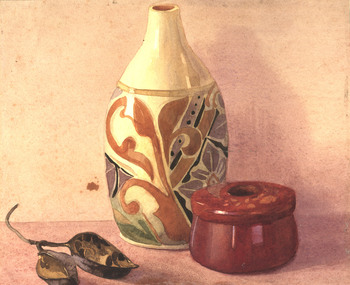
Work on paper - Compositions, sketches and studies from student folio, Edith Alice Watson, Composition of Form and Colour, 1930-1933
... ...Australian flora...Australian native floral elements to design. Upon graduating, Watson taught at the Murtoa High School, living with her parents until their deaths in 1972 and 1988 when she was 74 years old. Alice Watson died in Ballarat, aged 95, having conserved her beautiful student folio, which was generously gifted to the Federation University permanent Historical Collection by the Watson family. ballarat technical art school edith alice watson ornament flora alumni composition composition of form and colour General Design Australian flora light and shade commercial art Seven paintings undertaken by Edith Alice (Alice) Watson at the Ballarat Technical Art School, a division of the Ballarat School of Mines. ...Edith (Alice) WATSON (1914–2010) Murtoa | Australia Alice Watson studied at the Ballarat Technical Art School (at the School of Mines, Ballarat) from 1930 until 1933. Watson sat several departmental exams, including drawing and painting plant forms from nature, lettering, Composition of Form and Colour and advanced General Design, as well as dressmaking and embossed leatherwork. Her folio applies many Australian native floral elements to design. Upon graduating, Watson taught at the Murtoa High School, living with her parents until their deaths in 1972 and 1988 when she was 74 years old. Alice Watson died in Ballarat, aged 95, having conserved her beautiful student folio, which was generously gifted to the Federation University permanent Historical Collection by the Watson family. commercial artSeven paintings undertaken by Edith Alice (Alice) Watson at the Ballarat Technical Art School, a division of the Ballarat School of Mines. ballarat technical art school, edith alice watson, ornament, flora, alumni, composition, composition of form and colour, general design, australian flora, light and shade, commercial art -
 Orbost & District Historical Society
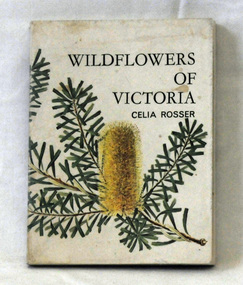
book, Wildflowers of Victoria, 1967
... Rosser-Celia wildflowers banksia Australian-flora...Rosser-Celia wildflowers banksia Australian-flora A small book titled Wildflowers of Victoria and written by Celia Rosser. ...Born Celia Elizabeth Prince in 1930, Celia Rosser began painting Australian wildflowers early in her artistic career. She first began painting Banksias after seeing a Banksia serrata near her home in Orbost, Victoria. She lived in Orbost in the 1960's( her husband had been posted to Orbost High School) where she painted and drew native flowers , in particular, banksias. Her first exhibition was at Leveson Gallery in Melbourne in 1965, and included three watercolours of Banksia species. Two years later she published Wildflowers of Victoria.Celia Elizabeth Rosser (born 1930) is a renowned Australian botanical illustrator, best known for having published The Banksias, a three-volume series of monographs containing watercolour paintings of every Banksia species. She began painting Australian wildflowers early in her artistic career. She first began painting Banksias after seeing a Banksia serrata near her home in Orbost, Victoria.A small book titled Wildflowers of Victoria and written by Celia Rosser. It was published in 1967 by Jacaranda Press. The covers are stiff card and it has an illustration of a banksia on the front cover. It has 105 pp and contains coloured illustrations. This book was the third part of the Jacaranda wildflower guides series. The book is designed to carry around in a pocket or purse.rosser-celia wildflowers banksia australian-flora -
 Bendigo Historical Society Inc.
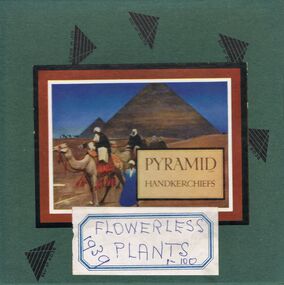
Newspaper - LYDIA CHANCELLOR COLLECTION: FLOWERLESS PLANTS
... ... Australian flora...SCIENCES General plants Lydia Chancellor collection plants flora Australian flora plants Australian plants fungi botany sciences Flowerless plants 1-100. 1939. ...A green handkerchief box containing newspaper cuttings from 'The Sun-News Pictorial,' on flowerless plants. A series from 1-100. Dated 1939.Flowerless plants 1-100. 1939.sciences, general, plants, lydia chancellor, collection, plants, flora, australian flora, plants, australian plants, fungi, botany, sciences -
 Chiltern Athenaeum Trust
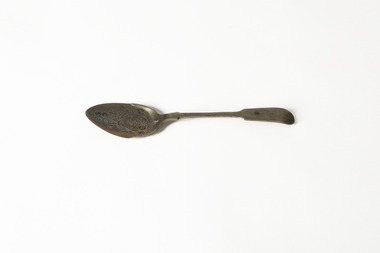
Domestic object - Spoon belonging to W.C.Busse
... ...australian flora...The floral motif on this particular spoon appears to be stylised in the decorative arts and craft style favoured in Europe between 1880-1920 and less representational than examples of Australiana flora captured in silversmithing from the 1850's onwards produced in Australia. ...Australia” "The Golden Plague: A Romance of the Early Fifties." "The Golden Plague” Wesley College University of Melbourne Sir Leo Finn Bernard Cussen Supreme Court of Victoria gold rush Murray River “The History of Chiltern” silversmithing spoon decorative arts floral flora australiana australian flora arts and craft movement australian silver cussen DON/ BP/ A silver tablespoon with floral embossed head and hallmarks embossed on reverse handle Domestic object Spoon belonging to W.C.Busse ...Wilfred Clarence Busse, born in Chiltern in 1898, His family moved to the region during the gold rush and continued to reside in the area, purchasing land adjacent the Murray River. Busse completed his secondary education at Wesley College in Melbourne then studied law at the University of Melbourne. Busse went on to become a barrister, often in the chambers of Sir Leo Finn Bernard Cussen (1859-1933) a judge of the Supreme Court of Victoria. He worked most of his life in Chiltern as a Barrister and Solicitor and gained the unofficial title of historian of Chiltern, leaving behind several manuscript histories and a scrap book. Busse was an avid fictional writer and in 1930 he published two novels. Time spent on a Victorian station in his early twenties, as well as careful documentary research, informed the writing of his historical novels of bush life. "The Blue Beyond; A Romance of the Early Days in South Eastern Australia” and "The Golden Plague: A Romance of the Early Fifties." "The Golden Plague” won the T. E. Role gold medal for the best historical novel which went on to become a best seller. Busse often drew inspiration for his novels from his younger years living Chiltern. His passion for the region lead him to write “The History of Chiltern” which was published in a serial form in the Chiltern Federal Standard from 1922-1923. Wilfred Clarence Busse was a member of Chiltern Athenaeum (where this object is now held) up until his death in 1960, he is buried in the Barnawartha Cemetery. The floral motif on this particular spoon appears to be stylised in the decorative arts and craft style favoured in Europe between 1880-1920 and less representational than examples of Australiana flora captured in silversmithing from the 1850's onwards produced in Australia. It is likely that those producing silverware at the time would be drawing on the decorative arts movement while incorporating elements of the natural beauty in the flora of their newfound environment into the silverware they produced. This spoon seems more likely to have been produced in Europe and imported to the colony. The hallmarks on the handle DON and BP indicate it may have been produced from English electroplating silver which is a more cost effective product than solid silver, most likely produced by Cooper Brothers, Don Plate Works, established in Sheffield in 1866 who distributed silverware in Europe, America and the colonies well into the 1950's.Wilfred Clarence Busse was of social significance to Chiltern, he helped to document the cultural story of the area in his published works "The Golden Plague" and "The Beyond Blue" by recounting his own upbringing in a bush lifestyle. He was a respected Barrister and was the unofficial historian of the Chiltern Athenaeum for many years. This spoon represents a window into the domestic life of this person who was well loved in the area, and it continues its relationship to Busse as well as Chiltern by being held within the very collection he helped to maintain in his life. Domestic objects tell us the story about how people lived, objects of daily use hold particular meaning in that they can tell us the story of an individual, we feel closer to their life and habits, it humanises and connects us across time. Wilfred Busse ate food and he did it from a beautiful silver floral detailed spoon.A silver tablespoon with floral embossed head and hallmarks embossed on reverse handleDON/ BP/silverware, wilfred clarence busse, busse, chiltern, chiltern athenaeum, federal standard, t. e. role, "the blue beyond, a romance of the early days in south eastern australia”, "the golden plague: a romance of the early fifties.", "the golden plague”, wesley college, university of melbourne, sir leo finn bernard cussen, supreme court of victoria, gold rush, murray river, “the history of chiltern”, silversmithing, spoon, decorative arts, floral, flora, australiana, australian flora, arts and craft movement, australian silver, cussen -
 Chiltern Athenaeum Trust
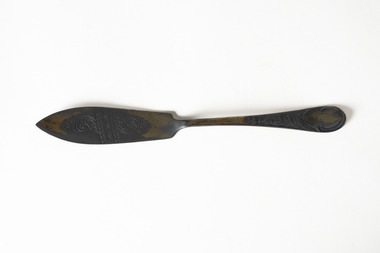
Domestic object - Butter knife belonging to W.C.Busse
... ...australian flora...The delicate swirling fernlike motif on this particular butter knife appears to be stylised in either Art deco the decorative arts and craft style favoured in Europe between 1880-1930's and less representational than examples of Australiana flora captured in silversmithing from the 1850's onwards produced in Australia. ...Australia” "The Golden Plague: A Romance of the Early Fifties." "The Golden Plague” Wesley College University of Melbourne Sir Leo Finn Bernard Cussen Supreme Court of Victoria gold rush Murray River “The History of Chiltern” silversmithing decorative arts floral flora australiana australian flora arts and craft movement australian silver cussen cutlery butter knife knife silverplate A tarnished metal butter knife with engraved and embossed spiral fern details on the knife and handle Domestic object Butter knife belonging to W.C.Busse ...Wilfred Clarence Busse, born in Chiltern in 1898, His family moved to the region during the gold rush and continued to reside in the area, purchasing land adjacent the Murray River. Busse completed his secondary education at Wesley College in Melbourne then studied law at the University of Melbourne. Busse went on to become a barrister, often in the chambers of Sir Leo Finn Bernard Cussen (1859-1933) a judge of the Supreme Court of Victoria. He worked most of his life in Chiltern as a Barrister and Solicitor and gained the unofficial title of historian of Chiltern, leaving behind several manuscript histories and a scrap book. Busse was an avid fictional writer and in 1930 he published two novels. Time spent on a Victorian station in his early twenties, as well as careful documentary research, informed the writing of his historical novels of bush life. "The Blue Beyond; A Romance of the Early Days in South Eastern Australia” and "The Golden Plague: A Romance of the Early Fifties." "The Golden Plague” won the T. E. Role gold medal for the best historical novel which went on to become a best seller. Busse often drew inspiration for his novels from his younger years living Chiltern. His passion for the region lead him to write “The History of Chiltern” which was published in a serial form in the Chiltern Federal Standard from 1922-1923. Wilfred Clarence Busse was a member of Chiltern Athenaeum (where this object is now held) up until his death in 1960, he is buried in the Barnawartha Cemetery. Likely Silverplate due to the intensity of the tarnishing of the metal, with indecipherable hallmarks on the handle, the method of production and the maker mark are unclear. The delicate swirling fernlike motif on this particular butter knife appears to be stylised in either Art deco the decorative arts and craft style favoured in Europe between 1880-1930's and less representational than examples of Australiana flora captured in silversmithing from the 1850's onwards produced in Australia. It is likely that those producing silverware at the time would be drawing on the decorative arts movement while incorporating elements of the natural beauty in the flora of their newfound environment into the silverware they produced.Wilfred Clarence Busse was of social significance to Chiltern, he helped to document the cultural story of the area in his published works "The Golden Plague" and "The Beyond Blue" by recounting his own upbringing in a bush lifestyle. He was a respected Barrister and was the unofficial historian of the Chiltern Athenaeum for many years. This butter knife represents a window into the domestic life of this person who was well loved in the area, and it continues its relationship to Busse as well as Chiltern by being held within the very collection he helped to maintain in his life. Domestic objects tell us the story about how people lived, objects of daily use hold particular meaning in that they can tell us the story of an individual, we feel closer to their life and habits, it humanises and connects us across time. Wilfred Busse ate food, he buttered his bread and he did it with a wonderfully decorated silver butter knife.A tarnished metal butter knife with engraved and embossed spiral fern details on the knife and handlesilverware, wilfred clarence busse, busse, chiltern, chiltern athenaeum, federal standard, t. e. role, "the blue beyond, a romance of the early days in south eastern australia”, "the golden plague: a romance of the early fifties.", "the golden plague”, wesley college, university of melbourne, sir leo finn bernard cussen, supreme court of victoria, gold rush, murray river, “the history of chiltern”, silversmithing, decorative arts, floral, flora, australiana, australian flora, arts and craft movement, australian silver, cussen, cutlery, butter knife, knife, silverplate -
 Embroiderers Guild, Victoria
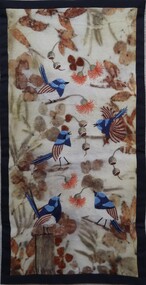
Textile - Embroidered Wool Hanging Ollie Fraser, Olwyn Fraser, "Busy Superb Fairy Wrens", July 2025
... Australian flora...Ollie draws local birds and stitches them on recycled woollen fabric that she has dyed using local indigenous leaves and bark Contemporary Victorian artwork representing eco-art practices inspired by local flora and fauna. Australian flora Eucalypt leaves birds fairy wren Recycled wool blanketing base, eco-dyed and printed using indigenous Victorian flora and eucalypt leaves. ...Commissioned by Embroiderers Guild Victoria from Victorian Textile artist Ollie Fraser, Ballarat in January 2025. Ollie draws local birds and stitches them on recycled woollen fabric that she has dyed using local indigenous leaves and barkContemporary Victorian artwork representing eco-art practices inspired by local flora and fauna.Recycled wool blanketing base, eco-dyed and printed using indigenous Victorian flora and eucalypt leaves. Backed with black cotton fabric. Embroidered with five blue fairy wrens and five flowering gumnuts and seven closed gumnuts.australian flora, eucalypt leaves, birds, fairy wren -
 National Alpine Museum of Australia
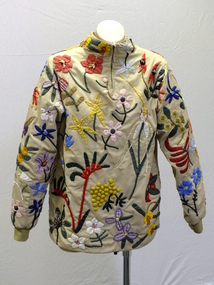
Ski Jacket, About 1967
... ...australian flora...The use of an Australian wildflower motif and of these pieces in the Fashion Group's Walkabout Tour also speak to her involvement in and promotion of the Australian fashion industry during the 1960s. skiing ski clothing fashion design australian fashion australian flora None Ski jacket and matching cap appliqued with Australian wildflowers. ...This jacket and cap were designed by Rosalie 'Rosa' Kiessling about 1967. They formed part of the Fashion Group Inc's Walkabout Tour of the USA in 1967 which aimed to promote Australian fashion design in America. German by birth Rosalie, grew up skiing and ice skating, studied fashion design in Munich and worked designing women’s ski wear and lingerie before migrating to Australia via New Zealand in 1939 with her husband. As skiing increased in popularity following the end of WWII, Rosalie’s business grew reaching its peak during the 1960s. Though it was never large; at most she employed three staff. Her designs featured in the pages of Australian Vogue, Flair and the Women’s Weekly throughout the 1960s and received coverage from newspapers in Australia, New Zealand the United States. Rosalie was closely involved with the Swiss Club of Victoria, the Australian Wool Board and the Fur Traders Association, participating in numerous fashion shows and awards run by these groups. In the late 1960s she became involved with the Melbourne Branch of the Fashion Group Inc, a worldwide non-commercial association of women involved in the fashion industry. Rosalie continued to design and manufacture fashionable but functional ski wear until the late 1970s, although increasing imports from large overseas manufactures and constant new innovations in fabric technology made it difficult for her to compete in a relatively small industry. This ski jacket and cap illustrate Rosalie Kiessling's emphasis on practical glamour. She was the first Australian ski wear manufacturer to bring high fashion to ski wear design; which though common in the boutiques of St Mortiz, Chamonix and St Anton was new to Australia. The use of an Australian wildflower motif and of these pieces in the Fashion Group's Walkabout Tour also speak to her involvement in and promotion of the Australian fashion industry during the 1960s.Ski jacket and matching cap appliqued with Australian wildflowers.Noneskiing, ski clothing, fashion design, australian fashion, australian flora -
 Wangaratta Art Gallery
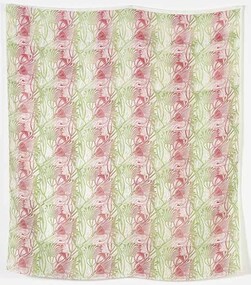
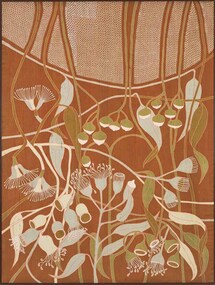
Textile, Christine Upton, Gum Blossoms, 1989-1992
... ...australian flora...Australia, parts of Great Britain, USA, Europe and South East Asia. The masterful skills of Upton are seen in this work through its high quality and being an exquisite example of lino block printing. wangaratta art galley print lino block flora gum christine upton textile australian flora A repetitive pattern of gum blossoms that has been printed on a rectangular piece of pure silk twill in green and red ink by a lino block. ...The inks used were fabric printing inks and two colours were applied at the one time on the same roller, the roller being inked with green on one side and red on the other. The roller was a sponge paint roller 100mm wide. The technique used was 'soft bed release'. This is where the fabric is placed over a soft bed (woolen blanket with cotton overlay) and the inked block is placed on top of the fabric, then body weight is applied to the back of the block by placing the hands on the block and transferring weight through the body and into the hands. The block is then lifted and the process starts allover again.Rural City of Wangaratta CollectionA repetitive pattern of gum blossoms that has been printed on a rectangular piece of pure silk twill in green and red ink by a lino block.wangaratta art galley, print, lino block, flora, gum, christine upton, textile, australian flora -
 Wangaratta Art Gallery
Textile, Christine Upton, Gumnuts Galore, 1984
... ...australian flora...Her works are found in private and public collections throughout Australia, parts of Great Britain, USA, Europe and South East Asia. wangaratta art gallery christine upton batik gumnuts flora australian flora textile A rectangular design of gumnuts on silk created through the batik technique using natural dyes in shades of red, brown, and green Gumnuts Galore Textile Christine Upton ...Upton has used the traditional technique of Indonesian batik to create 'Gumnuts Galore'. Batik has a long history in the world and is believed to have originated on the island of Java in Indonesia. The designs traditionally used in batik are imbued with meaning and powerful symbolism to reflect the culture and beliefs of the place where it was made and for whom it was made for. Upton has instilled her piece such meaning and symbolism by depicting eucalyptus leaves and gumnuts which evokes a sense of belonging and pride.Rural City of Wangaratta Collection, purchased with funds from the Wangaratta Art CouncilA rectangular design of gumnuts on silk created through the batik technique using natural dyes in shades of red, brown, and greenwangaratta art gallery, christine upton, batik, gumnuts, flora, australian flora, textile -
 Mont De Lancey
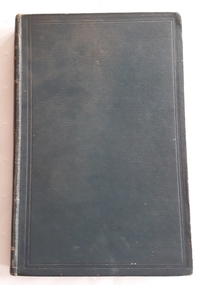
Book, Alfred J Ewart, The Weeds, Poison Plants, and Naturalised Aliens of Victoria, 1909
... ...Australian Flora...Australian Plants Plants Botany Australian Flora Weeds Alfred J.Ewart, D.Sc., Ph.D., F.L.S. was the Government Botanist and Professor of Botany in the Melbourne University and was assisted by J.R.Tovey, Herbarium Assistant. ...Alfred J.Ewart, D.Sc., Ph.D., F.L.S. was the Government Botanist and Professor of Botany in the Melbourne University and was assisted by J.R.Tovey, Herbarium Assistant. Detailed coloured plates are throughout the book. It has two parts: Part 1 - Poisonous, Injurious, and Proclaimed Weeds (Native and Introduced), With The Coloured Plates. Part 11 - Census of The Naturalised Aliens And Introduced Exotics. P.110A dark green hardcover book with a self embossed pattern and lines around the edges of the covers. The title Weeds, Poison Plants and Naturalised Aliens of Victoria is printed on the spine at the top in gold lettering with double gold lines above and below. The author Ewart. is printed in the middle with the date of publication 1909 at the bottom. Alfred J.Ewart, D.Sc., Ph.D., F.L.S. was the Government Botanist and Professor of Botany in the Melbourne University and was assisted by J.R.Tovey, Herbarium Assistant. Detailed coloured plates are throughout the book. It has two parts. P.110 Inside is a tan coloured piece of paper printed with the Department of Agriculture, Victoria. The title: Fungus Diseases or Citrus Trees in Australia, and Their Treatment: with Twelve Coloured Plate and 186 Figures. Presumably this is from another book which was donated by the same people. The book has not been located as yet.non-fictionAlfred J.Ewart, D.Sc., Ph.D., F.L.S. was the Government Botanist and Professor of Botany in the Melbourne University and was assisted by J.R.Tovey, Herbarium Assistant. Detailed coloured plates are throughout the book. It has two parts: Part 1 - Poisonous, Injurious, and Proclaimed Weeds (Native and Introduced), With The Coloured Plates. Part 11 - Census of The Naturalised Aliens And Introduced Exotics. P.110australian plants, plants, botany, australian flora, weeds -
Federation University Art Collection
Bookplate, ‘Ex Libris Judi Jewell’
... The book plate depicts the flowers of Australian native flora ...The society was instrumental in promoting the art of the bookplate through establishment of the Australian Bookplate Design competition. bookplate printmaking Australian Bookplate Design awards keith Wingrove Memorial Trust Twigden The book plate depicts the flowers of Australian native flora ‘Ex Libris Judi Jewell’ Bookplate ...After a quiet period, interest in bookplates in Australia began to increase in the early 1970s, Entrepreneurial art and book collectors such as Edwin Jewell and others commissioned multiple Bookplate designs from a range of well known fine artists. At a 1997 meeting in Melbourne of the Ephemera Society of Australia Edwin Jewell and others announced the formation of the Australian Bookplate Society. The society was instrumental in promoting the art of the bookplate through establishment of the Australian Bookplate Design competition.The book plate depicts the flowers of Australian native flora Twigdenbookplate, printmaking, australian bookplate design awards, keith wingrove memorial trust -
 Embroiderers Guild, Victoria
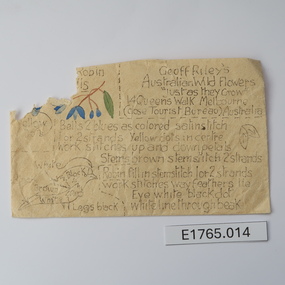
Textile - Geoff Riley embroidery design envelope - Robin red breast & Blue bells, Geoff Riley, 1920's-1956/7
... Australia... Australian native flora...From deceased estate of EGV member Geoff Riley 20th century Australia Australian native flora Australian native fauna See images Printed envelope with pattern and stitch directions -Robin Red breast and Blue bells on front of envelope. ...From deceased estate of EGV memberPrinted envelope with pattern and stitch directions -Robin Red breast and Blue bells on front of envelope. Small bundle of threads inside envelope. Designed and sold by Geoff Riley, water colour artist from his shop "The Wildflower Shop", 14 Queen's Walk, Melbourne from the 1930' to the 1950's. See imagesgeoff riley, 20th century, australia, australian native flora, australian native fauna -
 Embroiderers Guild, Victoria
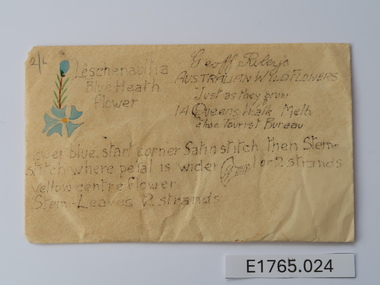
Textile - Geoff Riley embroidery design envelope - Leschenaullia Blue Heath Flower, Geoff Riley, 1920's-1956/7
... Australia... Australian native flora...From deceased estate of EGV member Geoff Riley 20th century Australia Australian native flora Australian native fauna See images Printed envelope with pattern and stitch directions -Leschenaullia Blue Heath Flower. ...From deceased estate of EGV memberPrinted envelope with pattern and stitch directions -Leschenaullia Blue Heath Flower. Bundle of threads inside envelope. Designed and sold by Geoff Riley, water colour artist from his shop "The Wildflower Shop", 14 Queen's Walk, Melbourne from the 1930' to the 1950's. See imagesgeoff riley, 20th century, australia, australian native flora, australian native fauna -
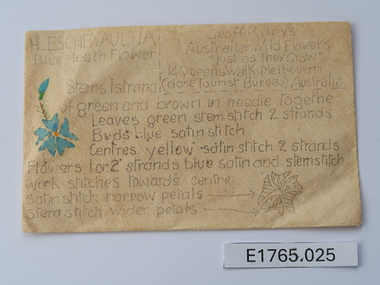 Embroiderers Guild, Victoria
Textile - Geoff Riley embroidery design envelope - Leschenaullia Blue Heath Flower, Geoff Riley, 1920's-1956/7
... Australia... Australian native flora...From deceased estate of EGV member Geoff Riley 20th century Australia Australian native flora Australian native fauna See images Printed envelope with pattern and stitch directions -Leschenaullia Blue Heath Flower. ...From deceased estate of EGV memberPrinted envelope with pattern and stitch directions -Leschenaullia Blue Heath Flower. Bundle of threads inside envelope. Designed and sold by Geoff Riley, water colour artist from his shop "The Wildflower Shop", 14 Queen's Walk, Melbourne from the 1930' to the 1950's. See imagesgeoff riley, 20th century, australia, australian native flora, australian native fauna
