
Showing 52 items matching " ayrshire"
-
 Embroiderers Guild, Victoria
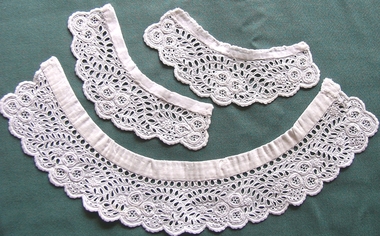
Accessory - Collar and Cuffs, Late 19th century
... ... Ayrshire...Very fine white cotton, late Ayrshire with eyelets and lace fillings. Buttonholed, scolloped edges. ...Ayrshire?, Scotland...Embroidery Garments Late 19th century Scotland Ayrshire Very fine white cotton, late Ayrshire with eyelets and lace fillings. ...Very fine white cotton, late Ayrshire with eyelets and lace fillings. Buttonholed, scolloped edges. Two cuffs with cotton binding, collar with linen bindings.embroidery, garments, late 19th century, scotland, ayrshire -
 Embroiderers Guild, Victoria
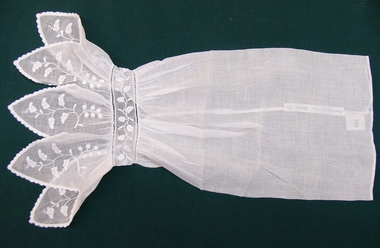
Accessory - 19th C Ayrshire Whitework on Muslin Under Sleeve, Mid 19th century
... An undersleeve in Ayrshire work. A five pointed frill is drawn into a decorative band which fastens with a button and a loop. ...Ayrshire, Scotland...Embroidery Ayrshire work Garments Scotland Mid 19th Century An undersleeve in Ayrshire work. ...An undersleeve in Ayrshire work. A five pointed frill is drawn into a decorative band which fastens with a button and a loop. Scalloped buttonhole decorates the edges, padded satin stitch is used for the floral decoration on cuff and frill.embroidery, ayrshire work, garments, scotland, mid 19th century -
 Flagstaff Hill Maritime Museum and Village
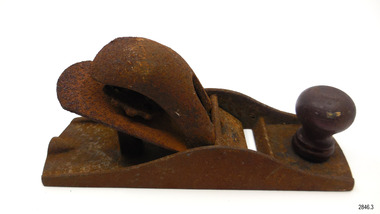
Tool - Box plane, Stewart Spiers, mid-1900s
... This small metal plane was manufactured in 1909 by Spiers-Stewart, Ayr, Ayrshire, Scotland. Stewart Spiers began making planes in Ayr in around 1840. ...Ayr, Ayrshire, Scotland...This small metal plane was manufactured in 1909 by Spiers-Stewart, Ayr, Ayrshire, Scotland. Stewart Spiers began making planes in Ayr in around 1840. ...This small metal plane was manufactured in 1909 by Spiers-Stewart, Ayr, Ayrshire, Scotland. Stewart Spiers began making planes in Ayr in around 1840. The business continued successfully as a small operation until the mid-1930s.This plane is an example of tools made overseas and used in the 1900's. Box plane; hand operated small metal plane with round wooden knob. Plane has separate blade and blade cap. Inscription on blade cap is indecipherable. Originally marked as made by Spiers."SPIERS"flagstaff hill, warrnambool, maritime-museum, maritime village, shipwreck coast, tradesman's tool, plane, box plane, tool, spiers-stewart, early 20th century, scotland, hand tool, stewart spiers, spiers, woodworking -
 Embroiderers Guild, Victoria
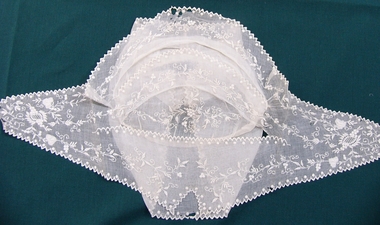
Headwear - Lady's Cap, Late 19th century
... ... Ayrshire...Ayrshire embroidery on fine cream muslin. Traditional stitchery in floral design....Purchased by Guild member from the Misses Cochrane Embroidery Caps Ayrshire Scotland Late 19th century Ayrshire embroidery on fine cream muslin. ...Purchased by Guild member from the Misses CochraneAyrshire embroidery on fine cream muslin. Traditional stitchery in floral design.embroidery, caps, ayrshire, scotland, late 19th century -
 Embroiderers Guild, Victoria
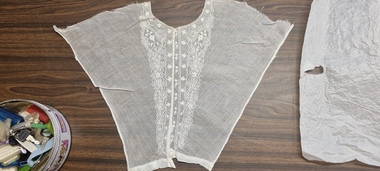
Accessory - Ayrshire Blouse Insert
... ... Ayrshire...Fine cream batiste Ayrshire work front panels for blouse insert. ...Donation from estate of Jean Goldberg past EGV member Bought in New York 19th century Ayreshire work Blouse Ayrshire Fine cream batiste Ayrshire work front panels for blouse insert. ...Donation from estate of Jean Goldberg past EGV member Bought in New YorkFine cream batiste Ayrshire work front panels for blouse insert. Attached unevenly at base.19th century, ayreshire work, blouse, ayrshire -
 Embroiderers Guild, Victoria
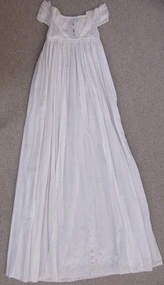
Clothing - Ayrshire Christening Gown, 1840-60
... ... Ayrshire...Typical fine Ayrshire, high standard with classical flower, fillings and skirt wings....Clothing Ayrshire Christening Gown ...Found in a collection bag by Miss Thelma Crawford and brought to Guild.Typical fine Ayrshire, high standard with classical flower, fillings and skirt wings.embroidery, ayrshire, christening robe, 1840-60, scotland -
 Glenelg Shire Council Cultural Collection
Book, Ayrshire Village Sketches and Poems, 1896
... Ayrshire Village Sketches and Poems...Dark green and gold graphics on front cover - floral design. Ayrshire Village Sketches and Poems Book Book David Mackie ...Light green cloth-covered covers and spine. Gold text. Dark green and gold graphics on front cover - floral design.poem, social history, local history -
Glenelg Shire Council Cultural Collection
Book - Book - Whiffs By The Wayside, Greene, J.H. (The Ayrshire Vagabond), Whiffs By The Wayside, 1896
... Greene, J.H. (The Ayrshire Vagabond)...Whiffs By The Wayside Book Book - Whiffs By The Wayside Greene, J.H. (The Ayrshire Vagabond) ...Red, cloth-covered covers and spine. Impressed parallel lines top and bottom of covers. -
 Embroiderers Guild, Victoria
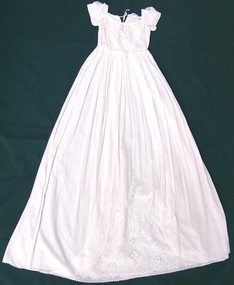
Clothing - Ayrshire Christening Gown, Mid 19th Century
... Fine Ayrshire Embroidery. Robe is typical Ayrshire with triangular bodice and "wings" on skirt....Embroidery Embroidery- Garments Embroidery- Mid 19th Century Embroidery - Ayrshire Embroidery - Whitework Fine Ayrshire Embroidery. ...Purchased by donor for 2/- at a jumble sale. (2 shillings in 1960 or about 20c in decimal currency, in 2026 about $3.70).Fine Ayrshire Embroidery. Robe is typical Ayrshire with triangular bodice and "wings" on skirt.embroidery, embroidery- garments, embroidery- mid 19th century, embroidery - ayrshire, embroidery - whitework -
Embroiderers Guild, Victoria
Container - Mauchline ware needle book, Needle book
... Ayrshire, Scotland ...Souvenir ware production in England grew in conjunction with the industrial revolution, rising middle class and world development. Mauchline ware manufacturers produced many sewing items, this is one of those. Gold rush and growth of Australian colonies saw Australian scenes being used on the Scottish made souvenir ware. This shows a view of Melbourne c 1870's, looking west along Bourke Street from Spring Street. This was donated to the Embroiderers Guild by descendants of the Leviny family of Castlemaine. Ernest Leviny was a significant goldsmith and jeweller in the young colony, his single daughters lived in the family home "Buda' and were very creative artists in many art forms. Mauchline ware souvenirs represent the growth of transport, travel and in this image, a view of Melbourne,Victoria c 1870's Needle book with mauchline ware sycamore wood covers showing transfer ware images of Weymouth. Purple velvet hinge, purple silk lining with pockets inside the covers for needle packets. Ochre coloured flannel leaves with pinked edges with a yellow metal safety pin and a packet of 19 crewel needles. The Bay, Cliffs and Pier, Weymouthmauchline ware, needlebook -
 Embroiderers Guild, Victoria
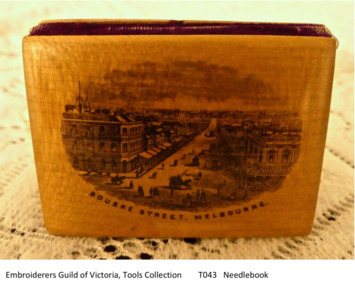
Container - Mauchline ware needle book, Needle book
... Ayrshire, Scotland ...Souvenir ware production in England grew in conjunction with the industrial revolution, railways and rising middle class. Mauchline ware manufacturers produced many sewing items, this is one of those. Weymouth was a seaside resort which George III had favoured in the era when visiting the seaside was seen as good for the health.Mauchline ware souvenirs represent the growth of transport and the middle class in UK. Weymouth had become a popular seaside resort after George III regularly visited.Needle book with mauchline ware sycamore wood cover. front cover showing transfer ware image of Bourke Street, Melbourne. Purple velvet hinge, purple silk lining with pockets inside the covers for needle packets. Replacement leaf of cream coloured wool flannel with pinked edges. Contains two needles and one packet of four calyx eyed needlesBourke Street, Melbournemauchline ware, needlebook -
 Embroiderers Guild, Victoria
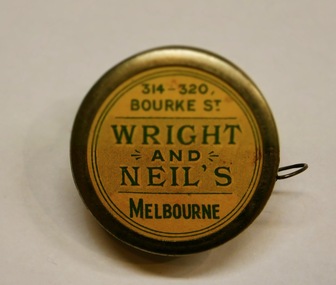
Tool - Tape Measure, Tape measure for Melbourne Drapers, ?1890's
... Ayrshire, Scotland ...Rare advertising tape measure for Wright & Neil's Melbourne Drapery Store (?1894-1911) whose premises were purchased in 1911 by Myers Ltd This was donated to the Embroiderers Guild by descendants of the Leviny family of Castlemaine. Ernest Leviny was a significant goldsmith and jeweller in the young colony, his single daughters lived in the family home "Buda' and were very creative artists in many art forms. Rare advertising tape measure for Wright & Neil's Melbourne Drapery Store (?1894-1911) This was donated to the Embroiderers Guild by descendants of the Leviny family of Castlemaine, an imortant artisitic family of VictoriaRound metal silver coloured spring loaded tape measure. Tape is marked in inches in blue. Metal ring pull. Yellow labels front and versoWRIGHT & NEIL'S, 314-320 BOURKE ST, MELBOURNE. (VERSO) FOR FAMOUS DAINTY W&N WHITE UNDERCLOTHINGtape measure, melbourne drapers, levinhy family, wright & neil's -
 Embroiderers Guild, Victoria
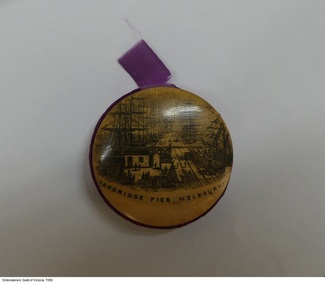
Tool - Mauchline ware Pincushion, ?1890's
... Ayrshire, Scotland ...Rare Mauchline ware pin cushion with an early Melbourne scene. Sandridge was renamed Port Melbourne in 1884. Mauchline transfer images of Australian scenes are rare This was donated to the Embroiderers Guild by descendants of the Leviny family of Castlemaine. Ernest Leviny was a significant goldsmith and jeweller in the young colony, his single daughters lived in the family home "Buda' and were very creative artists in many art forms. This was donated to the Embroiderers Guild by descendants of the Leviny family of Castlemaine, an imortant artisitic family of VictoriaMauchline transfer ware pin disc, fuscia velvet cushion between circular wood. Two black pins.Torn ribbon at top. Transfer ware image shows many tall sailing ships moored alongside a pier (image c 1870's).(Top) SANDRIDGE PIER, MELBOURNE. levinhy family, mauchline ware -
 Embroiderers Guild, Victoria
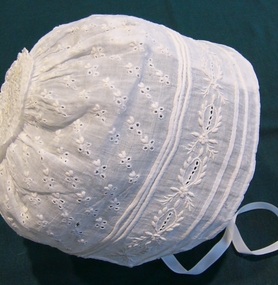
Headwear - Ayrshire Baby's Bonnet, Late 19th century
... ... Ayrshire...Decorative circle on back, a decorative band around the face in Ayrshire style. Three pin tucks around the face. ...Machine or handmade? Headwear Ayrshire Baby's Bonnet ...Said by donor ( (in 1976) to have been warn by 4 generations of her family.Fine white linen with fine sprigs all over. Decorative circle on back, a decorative band around the face in Ayrshire style. Three pin tucks around the face. Nylon ties have been added much later. Machine or handmade?embroidery, whitework, bonnets, late 19th century, ayrshire, scotland -
 Dandenong/Cranbourne RSL Sub Branch
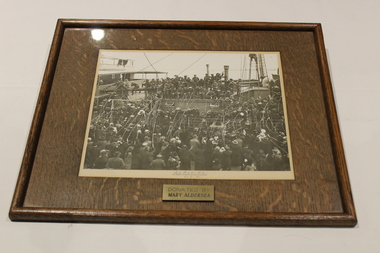
Photograph - Framed photograph, Circa early 1900s
... Inscribed "Ayrshire" 3-7-16....The vessel pictured is the HMAT Ayrshire. She saw service during WW1 between1914 and 1918. ...AYESHIRE was part of the second Convoy of Australian and New Zealand Troops December 1914. 7,763 gross tons. 140.2 x 17.9 metres. Cargo steamship (refrigerated) built by Hawthorn Leslie, Hebburn for Elderslie SS Company Ltd, Glasgow 1902. Twin screw, triple expansion engine making 13 knots, 1910 owned by the Scottish Shire Line Ltd, London and registered at Glasgow.Wooden framed sepia photograph of Servicemen aboard ship being farewelled by family and friends.The vessel pictured is the HMAT Ayrshire. She saw service during WW1 between1914 and 1918. Inscribed "Ayrshire" 3-7-16. -
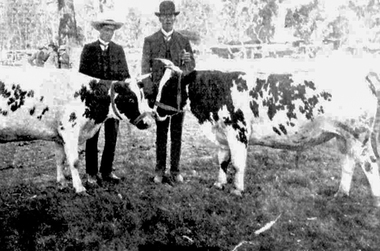 Grantville History Group U3A
Photograph, The Grantville and Jeetho Agricultural Society's Annual Show: February 1907
... Grantville Show 1907e: A good pair of ayrshires and their owners at the Grantville Agricultural Show, 1907. ...Grantville Show 1907e: A good pair of ayrshires and their owners at the Grantville Agricultural Show, 1907. ...Grantville Show 1907e: A good pair of ayrshires and their owners at the Grantville Agricultural Show, 1907. -
Dandenong & District Historical Society
Book - Berwick Nostalgia, Berwick Nostalgia- The Berwick-Pakenham Historical Society, 19 August 2026
... Book Title front Cover & Ayrshire Cattle Adverst on back cover...Berwick - 157 years of History including Shire Premises, Post Office, Shire Halls, Farming in the area, Berwick campus of Monash University, Nostalgic Look & Pictorial History of Berwick Education Farming First Land sales First building of homes Book Title front Cover & Ayrshire Cattle Adverst on back cover 4 Colour Process front Cover - Black Printed back cover Adverts for 1915 Berwick Nostalgia- The Berwick-Pakenham Historical Society Book Berwick Nostalgia ...4 Colour Process front Cover - Black Printed back cover Adverts for 1915non-fictioneducation, farming, first land sales, first building of homes -
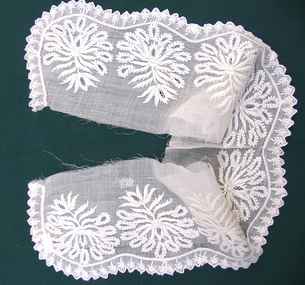 Embroiderers Guild, Victoria
Textile - Piece of whitework, Late 19th century
... Late Ayrshire work (machined?) Applied machine made motifs with hand embroidered pulled thread. ...Embroidery Ayrshire work Whitework Late 19th century Scotland Late Ayrshire work (machined?) ...Late Ayrshire work (machined?) Applied machine made motifs with hand embroidered pulled thread. Scolloped border, Machine made.embroidery, ayrshire work, whitework, late 19th century, scotland -
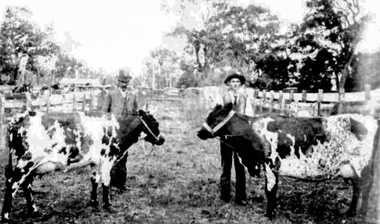 Grantville History Group U3A
Photograph, The Grantville and Jeetho Agricultural Society's Annual Show: February 1906
... The Grantville Show 1906c: Mr Myles Bunn's (Bena) Prize Ayrshires. It isn't clear which, if either, man is Myles Bunn....The Grantville Show 1906c: Mr Myles Bunn's (Bena) Prize Ayrshires. It isn't clear which, if either, man is Myles Bunn. ...The Grantville Show 1906c: Mr Myles Bunn's (Bena) Prize Ayrshires. It isn't clear which, if either, man is Myles Bunn. -
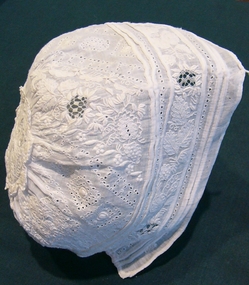 Embroiderers Guild, Victoria
Headwear - Ayrshire Baby's Bonnet, Early 19th century
... Classical Ayrshire embroidery. Very fine design covering the whole bonnet. ...Embroidery Ayrshire work Scotland Bonnets Early 19th century Classical Ayrshire embroidery. ...Classical Ayrshire embroidery. Very fine design covering the whole bonnet. Decorative circle at the crown and needlepoint fillings, all different in some of the flowers.embroidery, ayrshire work, scotland, bonnets, early 19th century -
 Embroiderers Guild, Victoria
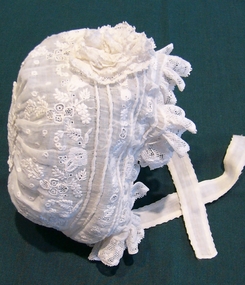
Headwear - Ayrshire Baby's Bonnet, Mid 19th century
... Classic Ayrshire bonnet which has a lace frill and rosette which were added at a later date when more decorative bonnets were in style....Embroidery Ayrshire work Bonnets Mid 19th Century Scotland Classic Ayrshire bonnet which has a lace frill and rosette which were added at a later date when more decorative bonnets were in style. ...Classic Ayrshire bonnet which has a lace frill and rosette which were added at a later date when more decorative bonnets were in style.embroidery, ayrshire work, bonnets, mid 19th century, scotland -
 Embroiderers Guild, Victoria
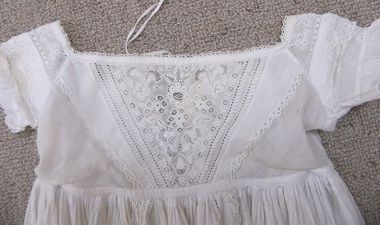
Clothing - Ayrshire Christening Gown, c. 1870
... Classical Ayrshire embroidery worked on fine lawn, with decorative "V" shaped bodice, winged and embroidered skirt and finely embroidered, scalloped lawn edge. ...Embroidery Ayrshire work Christening Robe Late 19th century Scotland Classical Ayrshire embroidery worked on fine lawn, with decorative "V" shaped bodice, winged and embroidered skirt and finely embroidered, scalloped lawn edge. ...Classical Ayrshire embroidery worked on fine lawn, with decorative "V" shaped bodice, winged and embroidered skirt and finely embroidered, scalloped lawn edge. Sleeves are 4 tiered, embroidered and pleated.embroidery, ayrshire work, christening robe, late 19th century, scotland -
 Embroiderers Guild, Victoria
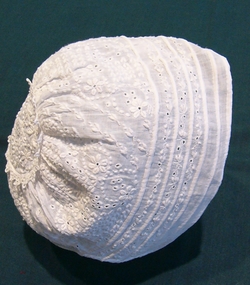
Headwear - Ayrshire Baby's Bonnet, 1876
... Linen fabric with the background entirely covered in fine design worked in satin stitch and tiny eyelets. Traditional Ayrshire circle at the back with a needlepoint filling. ...Traditional Ayrshire circle at the back with a needlepoint filling. ...Worn by 4 generations of donor's familyLinen fabric with the background entirely covered in fine design worked in satin stitch and tiny eyelets. Traditional Ayrshire circle at the back with a needlepoint filling. Also edge with detached buttonhole lace edging.embroidery, bonnets, late 19th century, scotland, ayrshire work -
 Embroiderers Guild, Victoria
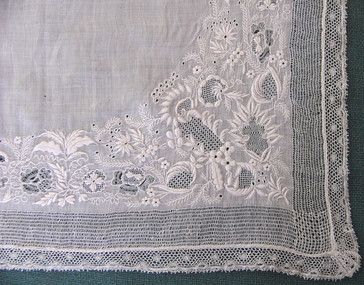
Accessory - Handkerchief, c, 1850
... Fine white linen in the classical Ayrshire style. Needlepoint lace fillings in a border of satin stitched leaves and flowers. ...Handkerchief belonged to one of the Strathmore family. Embroidery Ayrshire work Scotland Mid 19th Century Fine white linen in the classical Ayrshire style. ...Handkerchief belonged to one of the Strathmore family.Fine white linen in the classical Ayrshire style. Needlepoint lace fillings in a border of satin stitched leaves and flowers. Hem has 2 cm band of drawn thread work, edged with fine lace.embroidery, ayrshire work, scotland, mid 19th century -
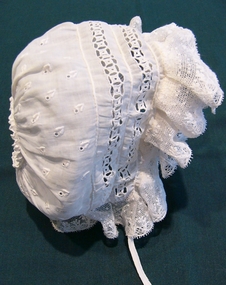 Embroiderers Guild, Victoria
Headwear - Ayrshire Baby's Bonnet, Mid 19th century
... Fine white lawn with classical Ayrshire embroidery with small circle at back and delicate sprigged ground with two bands along the edge with draw straings. ...Embroidery Ayrshire work Bonnets Late 19th century Scotland Fine white lawn with classical Ayrshire embroidery with small circle at back and delicate sprigged ground with two bands along the edge with draw straings. ...Fine white lawn with classical Ayrshire embroidery with small circle at back and delicate sprigged ground with two bands along the edge with draw straings. The double machine-lace frill was probably added later.embroidery, ayrshire work, bonnets, late 19th century, scotland -
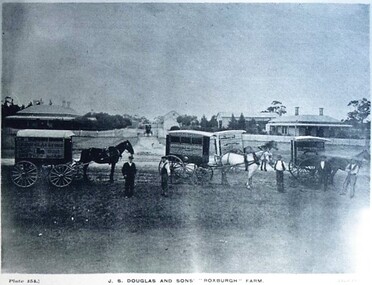 City of Ballarat Libraries
Postcard - Card Box Photographs, J.S. Douglas and Sons 'Roxburgh' Farm
... Champion Jersey Bull 'Hero'. Ayrshire Stud. Milking Time. Plates 154, 155, 159, 160 & 161 Chuck Photo Series....Champion Jersey Bull 'Hero'. Ayrshire Stud. Milking Time. Plates 154, 155, 159, 160 & 161 Chuck Photo Series. ...View from the Yard. Champion Jersey Bull 'Hero'. Ayrshire Stud. Milking Time. Plates 154, 155, 159, 160 & 161 Chuck Photo Series.j.s. douglas, roxburgh farm, farming, building, persons, costume, livestock -
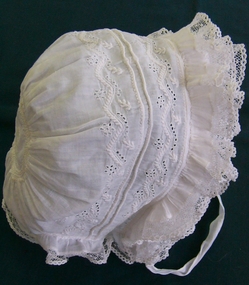 Embroiderers Guild, Victoria
Headwear - Ayrshire Baby Bonnet, Mid 19th century
... Traditionally worked using white thread onto a fine white muslin, Ayrshire embroidery is recognisable by stylised floral motifs with areas of filled in cutwork. ...Headwear Ayrshire Baby Bonnet ...Traditionally worked using white thread onto a fine white muslin, Ayrshire embroidery is recognisable by stylised floral motifs with areas of filled in cutwork. Developed from Dresden embroidery (a form of pulled work) and tambour embroidery, it uses a range of stitches, including satin stitch, chain stitch, eyelets and buttonhole edging as well as a range of lace filling stitches. The technique became popular in the early nineteenth century, when the previous fashion of elaborate gowns with hooped skirts was replaced by looser, simpler white cotton muslin garments. Although the elegant simplicity was favoured, women also desired some decoration. However, looms of the time could not create complex designs, so women turned to hand stitching.Using cotton muslin woven in Ayrshire, local women and girls would complete the intricate whitework to help supplement their family income. Mainly produced at home, Ayrshire whitework garments would be initially completed by one person. However, as the technique became more popular and the industry developed, to ensure high quality work, a piece would be passed around so that each embroiderer could focus on completing the stitches they specialised in.It is believed that the designs and motifs used in Ayrshire whitework were inspired by lace filling stitches found within an inset in a French Christening robe that was bought to Scotland by Lady Mary Montgomery, who then lent it to Mrs Jamieson of Ayr. She copied the stitches used within the robe and taught them to her outworkers, and she also produced plain muslin that was stamped with a water-soluble blue ink design that made embroidering the designs neater and more efficient. Ayrshire work became popular quite quickly, and it was incorporated into collars, cuffs and caps as well as children’s clothes and bonnets. Pieces were exported across Europe and the British Empire. As the decades progressed, technology advanced, resulting in looms that could incorporate decoration into the weave of the cloth, reducing the need for hand embroidered Ayrshire whitework.A triple frill of Buckingham lace, followed by two bands of fine embroidery - eyelets and satin stitch, and tucking, with small circle at crown.embroidery, whitework, bonnets, mid 19th century, scotland, garments -
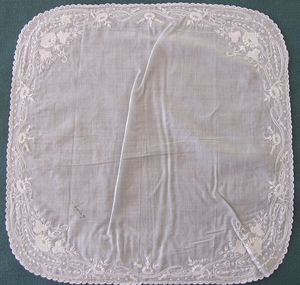 Embroiderers Guild, Victoria
Accessory - Handkerchief, Mid 19th century
... ... Ayrshire...Embroidery Ayrshire Scotland Mid 19th Century Emily (inked) Fine white cotton with floral sprays in a border design. ...Fine white cotton with floral sprays in a border design. Edge finished in buttonhole scallops. Embroidered in white.Emily (inked)embroidery, ayrshire, scotland, mid 19th century -
 Embroiderers Guild, Victoria
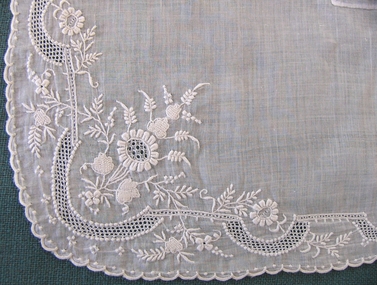
Accessory - Handkerchief, Mid 19th century
... ... Ayrshire...Embroidery Ayrshire Scotland Mid 19th Century Fine white cotton with sprays of flowers in the corners. ...Fine white cotton with sprays of flowers in the corners. Continuous band of open work, and an edge of scalloped buttonhole with satin stitch dots.embroidery, ayrshire, scotland, mid 19th century -
 Whitehorse Historical Society Inc.
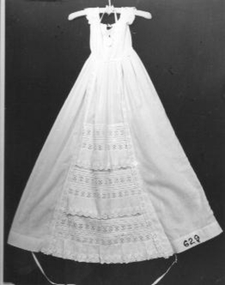
Clothing - Christening Gown
... Long white Christening robe with Ayrshire embroidery on a vee shaped bodice front coming to a point at the waist with a small opening under the point. ...Laundered 30/10/1999 costume infants' Long white Christening robe with Ayrshire embroidery on a vee shaped bodice front coming to a point at the waist with a small opening under the point. ...Laundered 30/10/1999Long white Christening robe with Ayrshire embroidery on a vee shaped bodice front coming to a point at the waist with a small opening under the point. If the baby was a boy the point was left showing an if a girl it was tucked into the opening. Tucking across the front panel. Drawstring at neck.lace and pin tucking down front. Drawstring neckcostume, infants'
