
Showing 68 items matching " bullock h."
-
 Glen Eira Historical Society
Document - Orrong Road, 225/225A, St. Kilda East
... ... Bullock H....A history of the creation and ownership of 225/225A Orrong Road Caulfield researched by H. Bullock and Rosalind Landells and dated to 25/07/1988. ...A history of the creation and ownership of 225/225A Orrong Road Caulfield researched by H. Bullock and Rosalind Landells and dated to 25/07/1988. ...A history of the creation and ownership of 225/225A Orrong Road Caulfield researched by H. Bullock and Rosalind Landells and dated to 25/07/1988. Includes handwritten notes regarding the same subject.orrong road, st. kilda east, lempriere william george, greenmeadows, clarke william, shire of caulfield, councillors, caulfield city, caulfield, bullock h., landells rosalind, brighton historical society, land subdivision, spence david, david street, flats, cooke jordan, cooke w. -
Glen Eira Historical Society
Letter - Anthony Street, 10, Ormond
... ... Bullock H...It was researched by Miss H. Bullock and Mrs Rosalind Landells....It was researched by Miss H. Bullock and Mrs Rosalind Landells. Bentleigh Ormond Anthony Street Ormond Station Ormond Francis Sir North Road Station Railway stations Market gardens Brennan’s estate Hawthorn Road Frankston railway line Depression 1929-1939 Chapman Vernon Sutherland Edward Cruickshank M Cruickshank N Cruickshank brothers Plant nurseries Murray Road Stone R R Stone L M Dougherty Conquest Real Estate Real estate agents Bullock H Landells Rosalind Land subdivision Auctions Letter Anthony Street, 10, Ormond ...Typed and handwritten notes regarding the history of Ormond and more specifically 10 Anthony Street, Bentleigh/Ormond, dated to 27/10/1995. It was researched by Miss H. Bullock and Mrs Rosalind Landells.bentleigh, ormond, anthony street, ormond station, ormond francis sir, north road station, railway stations, market gardens, brennan’s estate, hawthorn road, frankston railway line, depression 1929-1939, chapman vernon, sutherland edward, cruickshank m, cruickshank n, cruickshank brothers, plant nurseries, murray road, stone r r, stone l m, dougherty conquest real estate, real estate agents, bullock h, landells rosalind, land subdivision, auctions -
Glen Eira Historical Society
Document - St. Georges Road, 10, Elsternwick
... ... Bullock H....A typed research report dated to 25/11/1987 by H. Bullock and R. Landells discussing the history of the ownership and occupancy of Kent at 10 St. ...A typed research report dated to 25/11/1987 by H. Bullock and R. Landells discussing the history of the ownership and occupancy of Kent at 10 St. ...A typed research report dated to 25/11/1987 by H. Bullock and R. Landells discussing the history of the ownership and occupancy of Kent at 10 St. Georges Road, Elsternwick and briefly the history of the street’s subdivision.kent, st. georges road, elsternwick, davis p., duffy road, george street, copland oeric rev., eberach louis, lynch james, white charles j., white a. a. miss, smith h. w., sherlock j. mrs, sharp frederick j., ripponlea, elsternwick railway station, bullock h., landells r., land subdivision, victorian style, house names -
Glen Eira Historical Society
Document - Denver Crescent, 18, Elsternwick, 'Wendouree'
... ... Bullock H...A copy of a typed report dated 25/2/1989 concerning 18 Denver Crescent, Elsternwick by H Bullock and Rosalind Landells. The report contains a description of the location and of the residents of the house. ...A copy of a typed report dated 25/2/1989 concerning 18 Denver Crescent, Elsternwick by H Bullock and Rosalind Landells. The report contains a description of the location and of the residents of the house. ...A copy of a typed report dated 25/2/1989 concerning 18 Denver Crescent, Elsternwick by H Bullock and Rosalind Landells. The report contains a description of the location and of the residents of the house. An undated unattributed handwritten draft of part of the report is also included.dixon edward r, morrell george h, stocker hw, bullock h, rosalind landells, denver crescent, elsternwick, o’neill henry, o’neill college estate, brighton historical society, houses, land subdivision, wendouree -
Glen Eira Historical Society
Document - Archibald Street,|2,|Elsternwick
... ... Bullock H....A copy of typed, brief research notes by Miss H. Bullock and Mrs Rosalind Landells dated April 22, 1988 concerning the history of 2 Archibald Street, Elsternwick. ...A copy of typed, brief research notes by Miss H. Bullock and Mrs Rosalind Landells dated April 22, 1988 concerning the history of 2 Archibald Street, Elsternwick. ...A copy of typed, brief research notes by Miss H. Bullock and Mrs Rosalind Landells dated April 22, 1988 concerning the history of 2 Archibald Street, Elsternwick. The notes list the occupants of the house from 1893 to 1967 and mention the cricketer W. H. Ponsford who lived nearby. An undated, unattributed hand-written summary of the same information is also included.ponsford w.h., donaldson george, donaldson harriet, timms l., richtman u., lay l.a., nielson bent folmer, archibald street, gisborne street, elsternwick, bullock h., landells rosalind, carre-riddell subdivision, 2 archibald street, land subdivision -
Glen Eira Historical Society
Article - Carrington Grove, 8, St Kilda East
... ... Bullock H...A one page typed report dated 05/08/1989, by H Bullock and R Landells, containing a brief history of the house at 8 Carrington Grove from 1914 to 1989. ...A one page typed report dated 05/08/1989, by H Bullock and R Landells, containing a brief history of the house at 8 Carrington Grove from 1914 to 1989. ...A one page typed report dated 05/08/1989, by H Bullock and R Landells, containing a brief history of the house at 8 Carrington Grove from 1914 to 1989. The report provides a list of occupants and briefly mentions Charles Carrington and Lord Loch after whom Loch Avenue and Carrington Grove was named. The file also includes one page of accompanying handwritten working notes. The file also includes a photocopy of an article from a book, title and publication details unknown, containing a biography of Charles Robert Carrington. A one page research note by Chloe Stapleton, dated 08/05/2012, identifies the source of the article.carrington grove, st kilda east, loch avenue, heads of state, governors, officials, depression 1890s, economic depression, world war 1914-1918, carrington charles robert, harrop thomas s, harrop r, koesis l, mitchell n i, bullock h, landells r -
Glen Eira Historical Society
Letter - MONUMENTS AND NATIONAL REGISTER
... ... Bullock H. Miss...Ballantyne to an unveiling ceremony at Hopetoun Gardens. 3/A typewritten letter (1 page), dated 05/10/1986, from John Adams, Convenor of the Memorials Committee of the Royal Historical Society of Victoria, to Miss H. Bullock, thanking the latter for her contributions to the Society’s Memorials Project (which presumably consists of the recording of the location of all memorials located in Victoria), and confirming the acknowledgement of four memorials located in Caulfield. 4/A one page typewritten letter, with handwritten note, dated 07/05/1987, from Chilla Bulbeck, project coordinator of the National Register of the Australian Bicentennial Authority, to Mr. ...Cannons Festivals and Celebrations Invitations Hopetoun Gardens Mayors Glenhuntly Road Glen Huntly Road Caulfield City Hall Polglase Norma Adams John Bullock H. Miss Royal Historical Society of Victoria Memorials Committee Memorials Project ‘Kadimah’ Caulfield Grammar School Rosstown Railway Bambra Park Elsternwick Begonia Street Gardenvale Bulbeck Chilla Australian Bicentennial Authority National Register of Unusual Monuments Project Jowett Memorial Drinking Fountain Ross Bob Office of Surveyor General Geodetic Survey Office of Surveyor General Letter MONUMENTS AND NATIONAL REGISTER ...This file contains five items pertaining to plaques, memorials and monuments located in Glen Eira: 1/Three letters (1 page each) pertaining to a statue of Isabelle Webb adorning the Caulfield City Hall. The first letter, typewritten, dated 14/07/80, is addressed from J. Pollet, Honorary Secretary of the Caulfield Historical Society, to Mr. G. Calder, City Manager of Caulfield, and announces that the Society has identified the previously unidentified statue and wishes to provide a plaque for it. The second letter, handwritten, dated 20/09/1980, is addressed from Mr. R. Ballantyne of the Caulfield Historical Society to Calder, and laments that the Caulfield City Council has not responded to the first letter. The third letter, typewritten, dated 24/10/1980, is addressed from G. J. Walker, Deputy Manager-Administrator of the City of Caulfield, to Ballantyne, and notifies the latter of the Council’s acceptance of the Society’s offer to provide a plaque. Also included are the invoice and delivery docket for the plaque. 2/A typewritten letter (1 page), dated 26/06/1985, from Norma Polglase, secretary to mayor Brian Rudzki, inviting Mr. and Mrs. R. Ballantyne to an unveiling ceremony at Hopetoun Gardens. 3/A typewritten letter (1 page), dated 05/10/1986, from John Adams, Convenor of the Memorials Committee of the Royal Historical Society of Victoria, to Miss H. Bullock, thanking the latter for her contributions to the Society’s Memorials Project (which presumably consists of the recording of the location of all memorials located in Victoria), and confirming the acknowledgement of four memorials located in Caulfield. 4/A one page typewritten letter, with handwritten note, dated 07/05/1987, from Chilla Bulbeck, project coordinator of the National Register of the Australian Bicentennial Authority, to Mr. R. Ballantyne, thanking the latter for agreeing to act as a recorder for the Project. Attached are 12 pages extrapolating on the Project and a list (2 copies) of monuments thus far acknowledged, although none of this contains anything of relevance specifically to Glen Eira. 5/A typewritten letter, dated 29/11/1996, from Bob Ross, Senior Surveyor of the Geodetic Survey of the Office of the Surveyor General, to the Caulfield Historical Society, requesting the latter’s assistance in identifying any historic survey marks located within Glen Eira, as part of a greater project to identify all such survey marks located within Victoria. Also included is a leaflet extrapolating on the project and featuring a form for documenting survey marks, although this contains nothing of relevance specifically to Glen Eira.glen eira, caulfield, plaques, monuments and memorials, walker g. j., ballantyne r. mr., caulfield historical society, statues, webb isabelle, webb isabella, calder g, pollet j, city of caulfield, caulfield city council, city hall, hawthorn road, glen eira road, neville street, glenhuntly, thompson p. mr., arrow engraving & foundry co., rudzki brian j. p. cr., ballantyne mrs., cannons, festivals and celebrations, invitations, hopetoun gardens, mayors, glenhuntly road, glen huntly road, caulfield city hall, polglase norma, adams john, bullock h. miss, royal historical society of victoria, memorials committee, memorials project, ‘kadimah’, caulfield grammar school, rosstown railway, bambra park, elsternwick, begonia street, gardenvale, bulbeck chilla, australian bicentennial authority, national register of unusual monuments project, jowett memorial drinking fountain, ross bob, office of surveyor general, geodetic survey office of surveyor general -
Glen Eira Historical Society
Document - Vadlure Avenue, 2, St. Kilda East
... ... Bullock H....Elisha E. Elisha D. Bullock H. Landells Rosalind Document Vadlure Avenue, 2, St. ...Printed and handwritten research from Brighton Historical Society giving brief details on 2 Vadlure Avenue, regarding subdivision of land formerly grounds of Kilwinning and residents of property from 1931 to 1974. Dated 19/01/1988.vadlure avenue, st. kilda east, service james, land subdivisions, 'kilwinning', denman street, kosky samuel, mcardle daniel j., elisha e., elisha d., bullock h., landells rosalind -
Glen Eira Historical Society
Letter - Oak Avenue, 7, Elsternwick, 'Leongatha/ Corpach'
... ... Bullock H. (Miss)...R Anderson A. M. (Mrs) Bullock H. (Miss) Landells Rosalind. Postal workers Depression 1890s Anglican Church Letter Oak Avenue, 7, Elsternwick, 'Leongatha/ Corpach' ...A typed copy of correspondence from Brighton Historical Society, dated 29/11/1988, detailing the history of residents from construction of 7 Oak Ave, Elsternwick in 1888 through to 1974. The letter also details the names Leongatha and Corpach, giving a brief history on the name Corpach. The second document is handwritten working notes with the same details as the correspondence.oak avenue, wimble h (mrs), hazard f.a., elsternwick, cuthbert kingston, weymuss charles, leongatha, cuthbert e (mrs), cameron william c., corpach, teague maggie, gardener hugh (rev), mcnaughton james, teague j.h. (mrs), sabelberg thomas, crawford edward, cameron margaret, platt james w, platt ellis. r, anderson a. m. (mrs), bullock h. (miss), landells rosalind., postal workers, depression 1890s, anglican church -
Glen Eira Historical Society
Document - Elizabeth Street, 37, Elsternwick
... ... Bullock H...Karimba Lucknow Conus Elsternwick Elizabeth Street Ward Andrew Architectural styles Architectural features Federation style Rippon Lea estate Elsternwick Urban Conservation Area English Domestic Revival Bent Thomas Sir Sargood Frederick Sir Thomson Winnie Thomson Mrs Segrave William Muller Fritz Griffiths Mrs Goold James C Montgomery Winifred Asmuss Henry J Officer Ellen Montgomery Bert Brighton Historical Society Bullock H Landells Rosalind Meyer Leopold D Goold Annie Gange Leslie A Gange M Edwardian style Miller Fritz Meyer E C House names Document Elizabeth Street, 37, Elsternwick ...A three page copy of a Caulfield Conservation Study by Andrew Ward, dated 09/1994, on the house at 37 Elizabeth Street, Elsternwick, formerly known as Conus, then Karimba and finally renamed Lucknow. The study includes a brief description of the architectural features of the house, history of the occupancy, a statement of significance and a black and white photograph (100mm x 154mm) of the exterior of the house. The file also includes a one page research report by the Brighton Historical Society, dated 18/11/1988, on the occupancy of the house at 37 Elizabeth Street, Elsternwick and its early history. Also included is one page of unattributed, undated, handwritten working notes.karimba, lucknow, conus, elsternwick, elizabeth street, ward andrew, architectural styles, architectural features, federation style, rippon lea estate, elsternwick urban conservation area, english domestic revival, bent thomas sir, sargood frederick sir, thomson winnie, thomson mrs, segrave william, muller fritz, griffiths mrs, goold james c, montgomery winifred, asmuss henry j, officer ellen, montgomery bert, brighton historical society, bullock h, landells rosalind, meyer leopold d, goold annie, gange leslie a, gange m, edwardian style, miller fritz, meyer e c, house names -
Glen Eira Historical Society
Document - Bertram Street, 37, Elsternwick
... ... Bullock H...Bertram Street Elsternwick Prowse Reginald Watson George J Gardenvale Parnell Street Muntz Street Muntz Edwin Parnell Muntz Thomas B Surveyors Engineers Gardenvale Station Market gardens Small and Edwards Land developers Gardenvale on the Hill Bullock H Landells Rosalind Document Bertram Street, 37, Elsternwick ...A one page copy of correspondence dated 22/04/1988 concerning Bertram Street, 37, Elsternwick, the Gardenvale Railway Station and land sales in the area. Researched by the Brighton Historical Society. The file also includes a one page handwritten excerpt from the publication Sand, Swamp and Heath by Murray and Wells, about the subdivision named Gardenvale and the occupiers of Bertram Street, 37, Elsternwick.bertram street, elsternwick, prowse reginald, watson george j, gardenvale, parnell street, muntz street, muntz edwin parnell, muntz thomas b, surveyors, engineers, gardenvale station, market gardens, small and edwards, land developers, gardenvale on the hill, bullock h, landells rosalind -
Glen Eira Historical Society
Document - ROSEMONT, KOOYONG ROAD, 112A, CAULFIELD NORTH
... ... Bullock H Miss...E Holst Edward Balaclava Road Howitt Street Rosemont Street Bullock H Miss Landells Rosalind Document ROSEMONT, KOOYONG ROAD, 112A, CAULFIELD NORTH ...Two items about this property, both 110 and 112 Kooyong Road: 1/Photocopied carbon copy about 110 Kooyong Road, which is situated in the grounds of ‘Rosemont’ farm. Includes details of former residents to 1985. Photocopied black and white photo by Carol Stals, c.2013. 2/Two photocopied colour photos of ‘Rosemont’, 112 Kooyong Road, taken by Carol Stals, c.2013.kooyong road, caulfield north, rosemont farm, howitt. godfrey dr, howitt alfred, henderson garnet w, henderson m. m miss, haskin joseph, anstee w. e, holst edward, balaclava road, howitt street, rosemont street, bullock h miss, landells rosalind -
Glen Eira Historical Society
Document - Hawthorn Road, 284, Caulfield
... ... Bullock H. Miss...Land Sales Land Subdivision Migrants Houses Tram Services Bullock H. Miss Landells R. Miss Document Hawthorn Road, 284, Caulfield ...Report dated 02/05/1988 about 284 Hawthorn Road, Caulfield by the Brighton Historical Society. It provides a history of this site from 1852 to 1974 including tenants and owners from 1923 to 1974. Handwritten working notes are included.hawthorn road, caulfield, mill road, maxwell nellie, glen john, stevens gar, watson george v.e., niblett thomas a., johnson stanley, williams millie, crawford walter h., usher gordon r., paton m.h. mrs., marriot, murray s., land sales, land subdivision, migrants, houses, tram services, bullock h. miss, landells r. miss -
Glen Eira Historical Society
Document - Elizabeth Street, 39, Elsternwick
... H... Bullock Hilary...Nyalong Elizabeth Street Elsternwick Thomson Ellen Stevenson William E Stevenson Alice Stephenson William E Stephenson Alice Marschner E Small F H Bullock Hilary Landells Rosalind Brighton Historical Society Flats Federation style Architectural styles Architectural features House names Document Elizabeth Street, 39, Elsternwick ...A one page typed research report, dated 15/01/1988, by the Brighton Historical Society, regarding the occupancy of house Nyalong at 39 Elizabeth Street, Elsternwick. The file also includes one page of handwritten working notes, undated and unattributed.nyalong, elizabeth street, elsternwick, thomson ellen, stevenson william e, stevenson alice, stephenson william e, stephenson alice, marschner e, small f h, bullock hilary, landells rosalind, brighton historical society, flats, federation style, architectural styles, architectural features, house names -
Glen Eira Historical Society
Document - Liscard St, 9, Elsternwick
... A typed copy of a one-page report dated 16 May 1988 by H. Bullock and Rosalind Landells of Brighton Historical Society regarding the history and occupany of 9 Liscard Street, Elsternwick from 1888-1974. ...A typed copy of a one-page report dated 16 May 1988 by H. Bullock and Rosalind Landells of Brighton Historical Society regarding the history and occupany of 9 Liscard Street, Elsternwick from 1888-1974. ...A typed copy of a one-page report dated 16 May 1988 by H. Bullock and Rosalind Landells of Brighton Historical Society regarding the history and occupany of 9 Liscard Street, Elsternwick from 1888-1974. An undated hand-written note of the same information is included.liscard street, glen eira road, elsternwick, doyle estelle mrs, trew william tracey, cobbledick f.j. mrs, larsen rasmur j., johnson e. mrs, larsen bertha mrs, larsen roy, corkhill, depression 1890s -
Glen Eira Historical Society
Document - Carre Street, 6, Elsterwick
... One page copy of typed notes on the history of nine past owners of 6 Carre Street, Elsternwick by H Bullock and Rosalind Landells of the Brighton Historical Society, dated 19/01/1989. ...One page copy of typed notes on the history of nine past owners of 6 Carre Street, Elsternwick by H Bullock and Rosalind Landells of the Brighton Historical Society, dated 19/01/1989. ...One page copy of typed notes on the history of nine past owners of 6 Carre Street, Elsternwick by H Bullock and Rosalind Landells of the Brighton Historical Society, dated 19/01/1989. The file also includes one page of undated and unattributed handwritten notes providing a briefer version of the information included in the typed notes.carre street, elsternwick, riddell estate, riddell john carre, cavers carre, hopton edward t, fosberry john, cock alfred h, fricker john g, russell edward, russell elizabeth mrs, caircross alfred b, cairncross alfred b, walker alice, walker n, cavenagh r g, sheather n w, richardson glynn, bolte c v, butterworth j f, watt w, rattray m, houses, fosbery john -
Glen Eira Historical Society
Document - Beauville Avenue, 22, Murrumbeena
... It includes some background on the Beauville Estate and its development in the 1930s by AV Jennings Construction Co. Written by H. Bullock and R. Landells....It includes some background on the Beauville Estate and its development in the 1930s by AV Jennings Construction Co. Written by H. Bullock and R. Landells. Loh Felix MA Curran Norman D. ...This file contains 1 item: 1/Typed article with handwritten working notes by the Brighton Historical Society dated November 3, 1988, about the history of 22 Beauville Avenue, Murrumbeena. It includes some background on the Beauville Estate and its development in the 1930s by AV Jennings Construction Co. Written by H. Bullock and R. Landells.loh felix ma, curran norman d., curran m. mrs., jennings albert v. sir, bullock hilary, landells rosalind, residential development, brighton historical society, beauville avenue, murrumbeena, beauville estate, av jennings construction co., colonial gas association -
Glenelg Shire Council Cultural Collection
Photograph - Sheet of 10 contact prints - Various Portland historic buildings and landmarks, c. 1970
... Identifying numbers 5715a, b, c, d, e, f, g, h, i, j (a) Portland form Battery Point (b) Henty Beach, looking south (c) Palmer Street Primary School, No. 489 (d) Guardian Office, Bentinck Street (e) Railway Station Harbour Baths Bentinck Street (f) Jane Henty - wife of Stephen (g) bullock dray, bush (h) Ocean Pier (i) Bentinck Street Percy Street (j) Henty Beach...Identifying numbers 5715a, b, c, d, e, f, g, h, i, j (a) Portland form Battery Point (b) Henty Beach, looking south (c) Palmer Street Primary School, No. 489 (d) Guardian Office, Bentinck Street (e) Railway Station Harbour Baths Bentinck Street (f) Jane Henty - wife of Stephen (g) bullock dray, bush (h) Ocean Pier (i) Bentinck Street Percy Street (j) Henty Beach Photograph Sheet of 10 contact prints - Various Portland historic buildings and landmarks ...Sheet of 10 contact prints of rephotographed photographs. Identifying numbers 5715a, b, c, d, e, f, g, h, i, j (a) Portland form Battery Point (b) Henty Beach, looking south (c) Palmer Street Primary School, No. 489 (d) Guardian Office, Bentinck Street (e) Railway Station Harbour Baths Bentinck Street (f) Jane Henty - wife of Stephen (g) bullock dray, bush (h) Ocean Pier (i) Bentinck Street Percy Street (j) Henty BeachFront: (a) Portland from Battery Point. - The Rose Series (c) .... School, Portland Vic. - Toys Photo (d) Bentinck Street The Guardian Office Portland. - Magnus Photo (e) Railway Harbour & Jetty (f) Price $3.70 (i) Bentinck Street Percy Street The Harbour and Town of Portland (j) Henty Beach, Portland -
 Flagstaff Hill Maritime Museum and Village
Functional object - Urinal, circa 1825
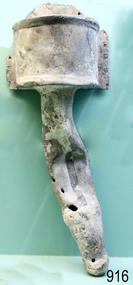
... H. Browne, completed a successful round trip from Launceston to London (carrying wool and whale oil loaded in Portland), returning in late November of that year carrying a general cargo including house bricks used for ballast. On the 11th of January 1839, the Children sailed from Launceston for Adelaide, with 24 passengers, 14 crew, and an awkward mixed cargo, including 1500 sheep, 8 bullocks, 7 horses, farming implements, and six whaleboats with associated whaling gear. ...H. Browne, completed a successful round trip from Launceston to London (carrying wool and whale oil loaded in Portland), returning in late November of that year carrying a general cargo including house bricks used for ballast. On the 11th of January 1839, the Children sailed from Launceston for Adelaide, with 24 passengers, 14 crew, and an awkward mixed cargo, including 1500 sheep, 8 bullocks, 7 horses, farming implements, and six whaleboats with associated whaling gear. ...The urinal was probably situated in the forward part of the ship rather than the stern, being one of two placed on either side of the deck and housed immediately adjacent to the doors into the forward castle, or crew sleeping quarters. The toilets on maritime vessels were (and still are) called the ‘heads’, after the sanitation arrangements common until the end of the eighteenth century. The name was given to the ‘head’ of the ship, forward of the forecastle and around the beak or bowsprit. These first lavatories were floored with grating or nets so the force of the sea could wash them clean, and they were always used on the lee or non-weather side so the effluent fell directly into the water rather than back on board. The Children's wrecking: The barque Children was one of the first vessels to be lost in the Western District. The vessel was wrecked to the east of Warrnambool on 14th January 1838. When it ran ashore in hurricane-force winds, 22 passengers and crew were fortunate to escape being battered to death on the rocks. The Children broke up within 20 minutes, sweeping sixteen of those on board to their deaths. After eleven days, the rescued survivors, all of whom were injured, had been taken to Portland. According to Lloyd's Shipping Register 1837-1839, the Children was built in 1825 at Liverpool and operated by owners Gordon & Co, of London. Registration number 123/1837, James Henty then bought her in 1837 as a three-masted barque of 254 tons, with a hull of “part pitch pine, felt sheathed” and “coppered in 1837” at Launceston, registered number 6/1837. In 1838, the Children, under her master Captain H. Browne, completed a successful round trip from Launceston to London (carrying wool and whale oil loaded in Portland), returning in late November of that year carrying a general cargo including house bricks used for ballast. On the 11th of January 1839, the Children sailed from Launceston for Adelaide, with 24 passengers, 14 crew, and an awkward mixed cargo, including 1500 sheep, 8 bullocks, 7 horses, farming implements, and six whaleboats with associated whaling gear. One account states that when the Children was “put out from port, she was light and badly ballasted”. The vessel immediately encountered four days of hurricane-force storms, eventually clearing on the early morning of the 14th. However, it was too late to take accurate measurements of the sun or stars to establish their position relative to the coast. The Children collided with a limestone stack at the entrance of what is now Childers Cove, and the seas smashed the vessel into pieces within half an hour. All the cargo and 16 lives were lost, including 9 children. The Henty brothers contributed £150 towards a fund for the 22 survivors at a memorial service held in Launceston later that year. It was a major financial setback for James Henty and his brothers, but one from which they recovered. In a submission to the Governor of New South Wales dated 24 March 1840, the Henrys summarised their work over the previous six years of establishing the Portland settlement, stating “Six stations have been occupied, one at Portland Bay three at the open country about 60 miles inland called ‘Merino Downs’ They have erected two houses at Portland Bay and two others at Merino Downs”.The urinal recovered from the Children's wreck is significant as part of the original fittings of the early 19th-century barque. The 1839 wreck and recovered artefacts are examples of the construction methods and materials used in that era and can be used to study the evolution of shipbuilding methods and principles. The wreck of the Children is of state significance as one of colonial Victoria’s earliest and most significant maritime disasters, and one of the first vessels lost in the Western District. This is recognised by its inclusion on the Victorian Heritage Register, VHR No. S116. Little is left on the seabed to mark the tragedy, apart from some of the house bricks intended for the Henty settlement. A lead urinal with a rounded back at the top splash plate with an attached semi-circular receptacle or basin (20cm deep and projecting forward 30cm). At the sides are flanges with bolt holes connecting to a ship's wall. The urinal is drained by a funnel-shaped outlet also made of lead, reducing from a 10cm radius to a joined 5 cm pipe. The urinal was recovered from the wreck of the CHILDREN.flagstaff hill, warrnambool, flagstaff-hill, flagstaff-hill-maritime-museum, shipwreck-coast, shipwreck artefact, the children, lead ship’s plumbing, crew urinal, the ‘heads’, ship plumbing, james henty, portland bay, urinal, ship's urinal, ship’s fitting, ship’s lead plumbing, ship’s toilet, ship’s urinal, children, childer’s cove, port campbell, 1839 shipwreck, james henty and co, henty brothers, captain h. browne, portland -
 Flagstaff Hill Maritime Museum and Village
Weapon - Cannon, circa 1825
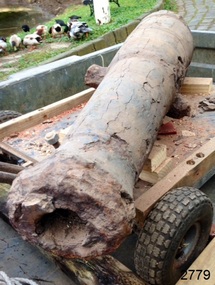
... H. Browne, was on a voyage from Launceston to Adelaide when it foundered in rough conditions at Childers Cove, west of Peterborough, on 14 January 1839. On board were 14 crew members and 24 passengers, including 9 children. The ship’s cargo was awkwardly balanced: it carried 1500 sheep, 8 bullocks...H. Browne, was on a voyage from Launceston to Adelaide when it foundered in rough conditions at Childers Cove, west of Peterborough, on 14 January 1839. On board were 14 crew members and 24 passengers, including 9 children. The ship’s cargo was awkwardly balanced: it carried 1500 sheep, 8 bullocks ...In an article dated 26 March 1963, the Warrnambool Standard reported: “A cannon which has lain on the ocean floor since the barque, Children, was wrecked at Childer’s Cove on January 15, 1839, was raised by three Warrnambool skindivers at the weekend … The cannon, weighing about 750 lb. and 4-ft. 6-in. in length … is in excellent order considering the length of time it has remained underwater”. No conservation measures were taken at that time, other than chipping off the marine growth with hammers and cold chisels. The minutes for the 4 February 1974 meeting of the Flagstaff Hill Planning Board recorded that “a cannon recovered some time ago was lying in the garden of [one of the three original divers] and that it could be picked up at any time”. Peter Ronald, past Manager and Diver for Flagstaff Hill, notes that the CHILDREN cannon would have been recovered by the other divers around 1964. When the cannon came into care of Flagstaff Hill, it was given basic conservation relevant to the time. (At the same meeting, the Board was advised of the recovery of an anchor from the wreck of the CHILDREN by Flagstaff Hill divers (Peter Ronald, Colin Goodall and Gary Hayden, and Hank Howey and Andrew Coffee), and its interim relocation in the sea at the end of the Warrnambool Breakwater while awaiting conservation). About the ship CHILDREN 1825-1839: The sailing ship Children was a wooden, three-masted barque constructed of pitch pine in 1825 at Liverpool. It was felt sheathed and was coppered during an upgrade in 1837. The ship was only 29 metres long and 254 tons in weight; it had two decks and a square stern. The James Henty & Co., a pioneering family from Portland, Victoria, purchased the Children in 1837 for use as a coastal trader. The Children, under the command of Captain H. Browne, was on a voyage from Launceston to Adelaide when it foundered in rough conditions at Childers Cove, west of Peterborough, on 14 January 1839. On board were 14 crew members and 24 passengers, including 9 children. The ship’s cargo was awkwardly balanced: it carried 1500 sheep, 8 bullocks, 7 horses, 5000 London house bricks, 6 whaling boats with associated gear, and general trade goods including beef, pork, tobacco, tipe, butter, lime juice, horse hair, curtains, lead shot, beer and spirits. The hurricane-force winds drove the Children into the limestone stack at the entrance to the cove. The seas smashed it into pieces within twenty minutes. The bodies of sixteen of those who had lost their lives were spread across the shore, along with wreckage from the ship and the cargo of animals. Those who survived suffered injuries; they were rescued and taken by horse and cart to Campbell’s farm, near the whaling station at Port Fairy. They arrived at Portland eleven days after the wreck. The wrecking of the Children is one of colonial Victoria’s earliest and most significant maritime disasters. Little is left to mark the tragedy, apart from some house bricks intended for the Henty family’s Portland Bay settlement. Artefacts recovered in the 1960s to early 1970s include this signal cannon, an anchor, the bottom half of her ship’s bell, and two portions of a ship’s fitting, at one time thought to be a brass porthole frame, London housing bricks and timber flooring. Despite its poor condition, the CHILDREN’s signal cannon remains an important and interpretable record of its demise. From 2015, the CHILDREN cannon has been undergoing the first stages of further conservation.The signal cannon recovered from the Children's wreck is significant as part of the original fittings of the early 19th-century barque. It is an example of maritime defence in the early to mid-19th century. The 1839 wreck and recovered artefacts are examples of the construction methods and materials used in that era and can be used to study the evolution of shipbuilding methods and principles. The wreck of the Children is of state significance as one of colonial Victoria’s earliest and most significant maritime disasters, and one of the first vessels lost in the Western District. This is recognised by its inclusion on the Victorian Heritage Register, VHR No. S116. Little is left on the seabed to mark the tragedy, apart from some of the house bricks intended for the Henty settlement. Signal cannon: a 1.3 metre iron 6pdr cannon recovered from the wreck of the CHILDREN. The shape of the cannon tapers from a thick round breech to a flared muzzle, with an 8-centimetre bore, and two side trunnions for pivoting on a wooden gun carriage. It was recovered from the shipwreck site of the CHILDREN by local divers in 1963. This small muzzle-loading signal cannon is in poor and unrestored condition. The cannon’s upper profile of smooth grey metal casing has corroded off, leaving an extensively oxidised rough red surface of crumbling iron. The bottom half of the cannon remains intact, although the outer smooth casing also appears to be separating from the iron core of the barrel. The original grey casting is also missing from the breech and muzzle ends of the cannon. Corrosion and spalling of the upper surface layer of the cannon have removed the maker’s marks and specificationsflagstaff hill, flagstaff hill maritime museum and village, warrnambool, maritime museum, maritime village, great ocean road, shipwreck coast, shipwreck artefact, children, barque, three-masted, liverpool, childer’s cove, port campbell, 1839 shipwreck, 1939 wreck, james henty and co, henty brothers, captain h. browne, first mate t. gay, second mate w. wentworth, portland, portland bay, 1939, ship’s cannon, signal cannon, conservation of marine artefacts, 6pdr small bore cannon, defence -
 Flagstaff Hill Maritime Museum and Village
Equipment - Anchor, Before 1831
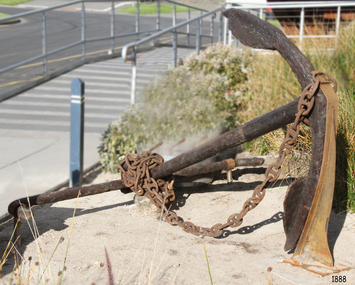
... H. Browne. On board the CHILDREN were 24 passengers, including 9 children, the captain and 14 crew; livestock of 1500 sheep, 8 bullocks and 7 horses; general cargo of beef, pork, tobacco, tripe, butter, limejuice, horse hair, currants, lead shot, beer and spirits; 5,000 house bricks from London; and six whaling boats with associated whaling gear. ...H. Browne. On board the CHILDREN were 24 passengers, including 9 children, the captain and 14 crew; livestock of 1500 sheep, 8 bullocks and 7 horses; general cargo of beef, pork, tobacco, tripe, butter, limejuice, horse hair, currants, lead shot, beer and spirits; 5,000 house bricks from London; and six whaling boats with associated whaling gear. ...The anchor is from the wooden sailing ship CHILDREN, which was wrecked at Childers Cove east of Warrnambool on the 14th of January 1839 with the loss of 16 lives. The Children anchor was raised from the wreck site by Flagstaff Hill Divers: Peter Ronald, Garry Hayden (Terang, still), Tim Goodall (now Warrnambool), and Colin Goodall (now Warrnambool), on Sunday, 3rd January 1974. A week or so later, it was dragged up the cliffs and taken to Warrnambool. It is now on display near the entrance to the Maritime Museum and Village. It appears to be a Pering’s Improved Anchor, developed at Portsmouth after 1813. The addition of broad curvature to the anchor arms provided a stronger purchase than the pre-existing Admiralty Old Pattern Long Shanked Anchor with straight arms. However, the evidence of hammer-welding of the separate pieces of the arms and palms to the central shank, peaked crown and flat palms, suggests the manufacture is before the 1831 Rodger’s Anchor design, which cast both arms and their flukes as one piece that was then attached to the shank by a bolt through the crown. This identification seems consistent with the date of the CHILDREN’s construction in 1824. The CHILDREN was a three-masted barque with a wooden hull built at Liverpool in England. The vessel was bought by the Henty family of Portland (Australia Felix) in 1837 for regular coastal trading between Van Diemens Land (now Tasmania), the Port Phillip District of New South Wales and South Australia. Only 255 tons burden (92 feet in length, with a beam of 25 feet and depth of 17 feet), it sailed from Launceston bound for Adelaide in late December 1838, on its first Australian voyage and under the English master who had brought the barque out, Captain H. Browne. On board the CHILDREN were 24 passengers, including 9 children, the captain and 14 crew; livestock of 1500 sheep, 8 bullocks and 7 horses; general cargo of beef, pork, tobacco, tripe, butter, limejuice, horse hair, currants, lead shot, beer and spirits; 5,000 house bricks from London; and six whaling boats with associated whaling gear. The vessel was battered by gale-force north-westerly winds shortly after setting out from Launceston on 11 January 1839, and adverse sailing conditions persisted for the next four days. At 11 pm on the 14th of January 1839, and many miles north and east of the captain’s navigated position, the CHILDREN struck the Pinnacle, a limestone stack off what is now called Childers Cove. Within half an hour, the ship was destroyed. As well as the loss of livestock and cargo, 16 passengers and crew perished, including the captain, six men, one woman and nine children. In 1931, shifting sands at Childers Cove uncovered the skeleton of an adult male. In 1951, another two skeletons were exposed by storms, an adult male and a child. In 1963, some district scuba divers retrieved a small signal cannon from the site. And in 1974, Flagstaff Hill recovered the anchor and some house bricks. The anchor recovered from the Children's wreck is significant as part of the equipment of the early 19th-century barque. The 1839 wreck and recovered artefacts are examples of the construction methods and materials used in that era and can be used to study the evolution of shipbuilding methods and principles. The wreck of the Children is of state significance as one of colonial Victoria’s earliest and most significant maritime disasters, and one of the first vessels lost in the Western District. This is recognised by its inclusion on the Victorian Heritage Register, VHR No. S116. Little is left on the seabed to mark the tragedy, apart from some of the house bricks intended for the Henty settlement. A large forged, wrought iron anchor from the wreck of the CHILDREN. Flat hammer-welded flukes on opposing curved arms and a peaked crown. It has a metal, elbowed stock or cross-bar and a heavy-duty pinned, flat-ring shackle for the anchor chain. It is in fair condition but extensively corroded after 135 years on the seabed. flagstaff hill, flagstaff hill maritime museum and village, warrnambool, maritime museum, maritime village, great ocean road, shipwreck coast, shipwreck artefact, children, barque, three-masted, liverpool, childer’s cove, port campbell, 1839 shipwreck, 1939 wreck, james henty and co, henty brothers, captain h. browne, first mate t. gay, second mate w. wentworth, portland, portland bay, anchor, ship’s anchor, peter ronald, garry hayden, tim goodall, colin goodall, pering’s improved anchor -
 Flagstaff Hill Maritime Museum and Village
Functional object - Nail, circa 1825
... H. Browne, completed a successful round trip from Launceston to London (carrying wool and whale oil loaded in Portland), returning in late November of that year carrying a general cargo including house bricks used for ballast. On the 11th of January 1839, the Children sailed from Launceston for Adelaide, with 24 passengers, 14 crew, and an awkward mixed cargo, including 1500 sheep, 8 bullocks, 7 horses, and farming implements, and six whaleboats with associated whaling gear. ...H. Browne, completed a successful round trip from Launceston to London (carrying wool and whale oil loaded in Portland), returning in late November of that year carrying a general cargo including house bricks used for ballast. On the 11th of January 1839, the Children sailed from Launceston for Adelaide, with 24 passengers, 14 crew, and an awkward mixed cargo, including 1500 sheep, 8 bullocks, 7 horses, and farming implements, and six whaleboats with associated whaling gear. ...Nails such as this solid copper nail were forged by blacksmiths. A nail of this length could have been used for the ship's decking. It was recovered from the shipwreck of the barque Children. The Children wrecking: The barque Children was one of the first vessels to be lost in the Western District the vessel was wrecked to the east of Warrnambool on 14th January 1838. When it ran ashore in hurricane-force winds, 22 passengers and crew were fortunate to escape being battered to death on the rocks. The Children broke up within 20 minutes, sweeping sixteen of those on board to their deaths. After eleven days, the survivors, all of whom were injured, were rescued and taken to Portland. According to Lloyd's Shipping Register 1837-1839, the Children was built in 1825 at Liverpool and operated by owners Gordon & Co, of London. Registration number 123/1837, James Henty then bought her in 1837 as a three-masted barque of 254 tons, with a hull of “part pitch pine, felt sheathed” and “coppered in 1837” at Launceston registered number 6/1837. In 1838 the Children, under her master Captain H. Browne, completed a successful round trip from Launceston to London (carrying wool and whale oil loaded in Portland), returning in late November of that year carrying a general cargo including house bricks used for ballast. On the 11th of January 1839, the Children sailed from Launceston for Adelaide, with 24 passengers, 14 crew, and an awkward mixed cargo, including 1500 sheep, 8 bullocks, 7 horses, and farming implements, and six whaleboats with associated whaling gear. One account states that when the Children were “put out from port she was light and badly ballasted”. The vessel immediately encountered four days of hurricane-force storms, eventually clearing on the early morning of the 14th. However, it was too late to take accurate measurements of the sun or stars to establish their position relative to the coast. The Children collided with a limestone stack at the entrance of Childers Cove, and the seas smashed her into pieces within half an hour. All the cargo and 16 lives were lost including 8 children. The Henty brothers contributed £150 towards a fund for the 22 survivors at a memorial service held in Launceston later that year. It was a major financial setback for James Henty and his brothers, but one from which they recovered. In a submission to the Governor of New South Wales dated 24 March 1840, the Henty’s summarised their work over the previous six years of establishing the Portland settlement stating. “Six stations have been occupied, one at Portland Bay three at the open country about 60 miles inland called ‘Merino Downs’ They have erected two houses at Portland Bay and two others at Merino Downs”.This nail is significant as part of the vessels original fixtures. The Children was delivering cargo intended for the Portland Bay settlement of her owners the James Henty brothers The wreck is also significant as one of the first vessels to have been lost in the Western District of Warrnambool. As a result the shipwreck of the Children is registered with the Victorian Heritage Register S116. Ship's nail, copper, with a washer attached. The nail has a round head, solid round shank and a flat end. It is bent, twisted and has indentations in the centre section. The nail was recovered from the wreck of the CHILDREN.warrnambool, flagstaff-hill-maritime-museum, shipwreck-coast, shipwreck artefact, the children, nail, copper nail, ship's nail, children shipwreck -
 Flagstaff Hill Maritime Museum and Village
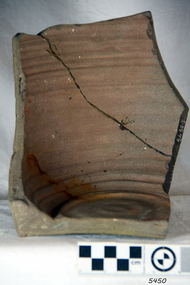
Bowl
... H. Browne, completed a successful round trip from Launceston to London (carrying wool and whale oil loaded in Portland), returning in late November of that year (carrying a general cargo including the house bricks). On the 11th January 1839, the CHILDREN sailed from Launceston for Adelaide, with 24 passengers, 14 crew, and an awkward mixed cargo, including 1500 sheep, 8 bullocks, 7 horses, and farming implements, and six whaleboats with associated whaling gear. ...H. Browne, completed a successful round trip from Launceston to London (carrying wool and whale oil loaded in Portland), returning in late November of that year (carrying a general cargo including the house bricks). On the 11th January 1839, the CHILDREN sailed from Launceston for Adelaide, with 24 passengers, 14 crew, and an awkward mixed cargo, including 1500 sheep, 8 bullocks, 7 horses, and farming implements, and six whaleboats with associated whaling gear. ...According to Lloyd's Shipping Register 1837-1839, the CHILDREN was built in 1825 at Liverpool and operated by owners Gordon & Co, of London. London registered number 123/1837. James Henty then bought her in 1837 as a three-masted barque of 254 tons, with a hull of “part pitch pine, felt sheathed” and “coppered 1837”. Launceston registered number 6/1837. In 1838 the CHILDREN, under her master Captain H. Browne, completed a successful round trip from Launceston to London (carrying wool and whale oil loaded in Portland), returning in late November of that year (carrying a general cargo including the house bricks). On the 11th January 1839, the CHILDREN sailed from Launceston for Adelaide, with 24 passengers, 14 crew, and an awkward mixed cargo, including 1500 sheep, 8 bullocks, 7 horses, and farming implements, and six whaleboats with associated whaling gear. One account states that when the CHILDREN “put out from port she was light and badly ballasted”. The vessel immediately encountered four days of hurricane force storms, eventually clearing on the early morning of the 14th to “west force 10”, but too late to take accurate measurements of the sun or stars to establish their position relative to the coast. The CHILDREN collided with a limestone stack at the entrance of Childers Cove, and the seas smashed her into pieces within half an hour. All the cargo and 16 lives were lost (including 8 children). The Henty’s contributed £150 towards a fund for the 22 survivors at a memorial service held in Launceston later that year. It was a major financial setback for the Henty’s, but one from which they recovered. In a submission to the Governor of New South Wales dated 24 March 1840, the Henty’s summarised their work over the previous six years of settlement: “Six stations have been occupied, one at Portland Bay…three at the open country about 60 miles inland called ‘Merino Downs’…They have erected two houses at Portland Bay and two others at Merino Downs”. The shipwreck of the CHILDREN is of State significance ― Victorian Heritage Register S116Part of terracotta bowl from the wreck of the Children, 2 segments have been glued together.flagstaff hill, warrnambool, shipwrecked-coast, flagstaff-hill, flagstaff-hill-maritime-museum, maritime-museum, shipwreck-coast, flagstaff-hill-maritime-village, children -
 Flagstaff Hill Maritime Museum and Village
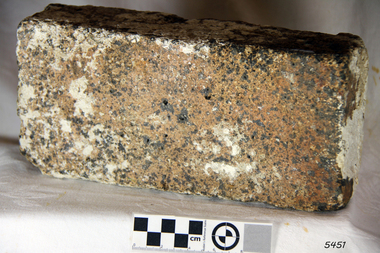
Ceramic - Clay Brick, ca 1837
... H. Browne, completed a successful round trip from Launceston to London carrying wool and whale oil loaded in Portland, returning in late November of that year carrying a general cargo including the house bricks. On the 11th January 1839, the CHILDREN sailed from Launceston for Adelaide, with 24 passengers, 14 crew, and an awkward mixed cargo, including 1500 sheep, 8 bullocks, 7 horses, farming implements, and six whaleboats with associated whaling gear, and house bricks for the Hentys' settlement in Portland. ...H. Browne, completed a successful round trip from Launceston to London carrying wool and whale oil loaded in Portland, returning in late November of that year carrying a general cargo including the house bricks. On the 11th January 1839, the CHILDREN sailed from Launceston for Adelaide, with 24 passengers, 14 crew, and an awkward mixed cargo, including 1500 sheep, 8 bullocks, 7 horses, farming implements, and six whaleboats with associated whaling gear, and house bricks for the Hentys' settlement in Portland. ...According to Lloyds Shipping Register 1837-1839, the CHILDREN was built in 1825 at Liverpool and operated by owners Gordon & Co, of London. London registered number 123/1837. James Henty then bought the vessel in 1837 as a three-masted barque of 254 tons, with a hull of “part pitch pine, felt sheathed” and “coppered 1837”. Launceston registered number 6/1837. In 1838, the CHILDREN, under her master Captain H. Browne, completed a successful round trip from Launceston to London carrying wool and whale oil loaded in Portland, returning in late November of that year carrying a general cargo including the house bricks. On the 11th January 1839, the CHILDREN sailed from Launceston for Adelaide, with 24 passengers, 14 crew, and an awkward mixed cargo, including 1500 sheep, 8 bullocks, 7 horses, farming implements, and six whaleboats with associated whaling gear, and house bricks for the Hentys' settlement in Portland. One account states that when the CHILDREN “put out from port, it was light and badly ballasted”. The vessel immediately encountered four days of hurricane force storms, eventually clearing on the early morning of the 14th to “west force 10”, but too late to take accurate measurements of the sun or stars to establish their position relative to the coast. The CHILDREN collided with a limestone stack at the entrance of what is now called Childers Cove, and the seas smashed it into pieces within half an hour. All the cargo and 16 lives were lost, including 9 children. The Hentys contributed £150 towards a fund for the 22 survivors at a memorial service held in Launceston later that year. It was a major financial setback for the Henrys, but one from which they recovered. In a submission to the Governor of New South Wales dated 24 March 1840, the Henty’s summarised their work over the previous six years of settlement: “Six stations have been occupied, one at Portland Bay…three at the open country about 60 miles inland called ‘Merino Downs’…They have erected two houses at Portland Bay and two others at Merino Downs”. The London house bricks recovered from the Children's wreck are significant as part of the cargo of the early 19th-century barque. The bricks were intended for the owner of the Children, the Henty family, for their Portland settlement. The 1839 wreck and recovered artefacts are examples of the construction methods and materials used in that era and can be used to study the evolution of shipbuilding methods and principles. The wreck of the Children is of state significance as one of colonial Victoria’s earliest and most significant maritime disasters, and one of the first vessels lost in the Western District. This is recognised by its inclusion on the Victorian Heritage Register, VHR No. S116. Little is left on the seabed to mark the tragedy, apart from some of the house bricks intended for the Henty settlement. Clay brick: house brick from London, with some with white marine encrustation, recovered from the wreck of the ship CHILDREN. The brick is an oblong shape and is constructed of a coarse-grained conglomerate. flagstaff hill, flagstaff hill maritime museum and village, warrnambool, maritime museum, maritime village, great ocean road, shipwreck coast, shipwreck artefact, children, barque, three-masted, liverpool, childer’s cove, port campbell, 1839 shipwreck, 1939 wreck, james henty and co, henty brothers, captain h. browne, first mate t. gay, second mate w. wentworth, portland, portland bay, 1939, bricks, london house bricks, clay bricks -
 Flagstaff Hill Maritime Museum and Village
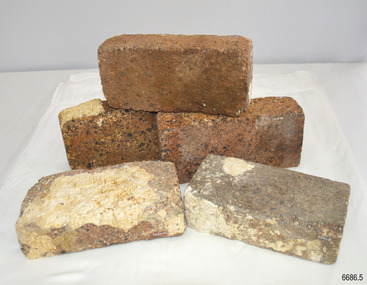
Ceramic - Clay Bricks, Circa 1838
... H. Browne, completed a successful round trip from Launceston to London carrying wool and whale oil loaded in Portland, returning in late November of that year carrying general cargo, including house bricks. On the 11th of January 1839, the CHILDREN sailed from Launceston for Adelaide, with 24 passengers, 14 crew, and an awkward mixed cargo, including 1500 sheep, 8 bullocks, 7 horses, farming implements, and six whaleboats with associated whaling gear. ...H. Browne, completed a successful round trip from Launceston to London carrying wool and whale oil loaded in Portland, returning in late November of that year carrying general cargo, including house bricks. On the 11th of January 1839, the CHILDREN sailed from Launceston for Adelaide, with 24 passengers, 14 crew, and an awkward mixed cargo, including 1500 sheep, 8 bullocks, 7 horses, farming implements, and six whaleboats with associated whaling gear. ...These bricks are a sample of “5000 house bricks from London” carried by the CHILDREN as ballast, and intended for the Portland Bay settlement of her owners, Henty Bros. Flagstaff Hill divers recovered the bricks from Childers Cove in February 1974 and noted, “These bricks are the major feature of the wreck site. Subsequent notes indicate “The hull structure has broken up, leaving few visible remains, except for piles of house bricks intended for the Hentys of Portland”. According to Lloyds Shipping Register 1837-1839, the CHILDREN was built in 1825 at Liverpool and operated by owners Gordon & Co, of London, London registered number 123/1837; James Henty then bought her in 1837 as a three-masted barque of 254 tons, with a hull of “part pitch pine, felt sheathed” and “coppered 1837”. Launceston registered number 6/1837. In 1838, the CHILDREN, under her master Captain H. Browne, completed a successful round trip from Launceston to London carrying wool and whale oil loaded in Portland, returning in late November of that year carrying general cargo, including house bricks. On the 11th of January 1839, the CHILDREN sailed from Launceston for Adelaide, with 24 passengers, 14 crew, and an awkward mixed cargo, including 1500 sheep, 8 bullocks, 7 horses, farming implements, and six whaleboats with associated whaling gear. One account states that when the CHILDREN “put out from port, it was light and badly ballasted”. The vessel immediately encountered four days of hurricane-force storms, eventually clearing on the early morning of the 14th to “west force 10”, but too late to take accurate measurements of the sun or stars to establish their position relative to the coast. The CHILDREN collided with a limestone stack at the entrance of Childers Cove, and the seas smashed her into pieces within half an hour. All the cargo and 16 lives were lost (including 9 children). The Hentys contributed £150 towards a fund for the 22 survivors at a memorial service held in Launceston later that year. It was a major financial setback for the Hentys, but one from which they recovered. In a submission to the Governor of New South Wales dated 24 March 1840, the Hentys summarised their work over the previous six years of settlement: “Six stations have been occupied, one at Portland Bay…three at the open country about 60 miles inland called ‘Merino Downs’…They have erected two houses at Portland Bay and two others at Merino Downs”.These bricks are significant as a sample of 5000 house bricks carried from London as ballast by the Children and were intended for the Portland Bay settlement of her owners, James Henty & Co. The 1839 wreck and recovered artefacts are examples of the construction methods and materials used in that era and can be used to study the evolution of shipbuilding methods and principles. The wreck of the Children is of state significance as one of colonial Victoria’s earliest and most significant maritime disasters, and one of the first vessels lost in the Western District. This is recognised by its inclusion on the Victorian Heritage Register, VHR No. S116. Little is left on the seabed to mark the tragedy, apart from some of the house bricks intended for the Henty settlement. Five ‘house bricks from London’, some with white marine encrustation, recovered from the wreck of the ship CHILDREN. The bricks are oblong shaped and constructed of a blue-coloured and coarse-grained conglomerate. One brick is higher, shorter and narrower, than the other four bricks.flagstaff hill, flagstaff hill maritime museum and village, warrnambool, maritime museum, maritime village, great ocean road, shipwreck coast, shipwreck artefact, children, barque, three-masted, liverpool, childer’s cove, port campbell, 1839 shipwreck, 1939 wreck, james henty and co, henty brothers, captain h. browne, first mate t. gay, second mate w. wentworth, portland, portland bay, 1939, bricks, london house bricks, clay bricks -
 Ringwood and District Historical Society
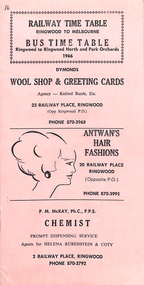
Document, Victorian Railways Timetable Ringwood to Melbourne and Bus Timetable Ringwood to Ringwood North and Park Orchards. 1966 with Advertising fo local businesses
... McKay Chemist, Major Quality Butchers, Heathwood Food Store and Ray Bullock's Food Store, WIlton & Hoskin Furniture REmovalists, L.A.Greem Authroised Newsagent, S&M McCormack Milk Bar and Self Service Store, Norwood Fruit Supply, The Luncheonette Tea Rooms and Milk Bar, Park View Coffee Lounge, Dot Vrancken Fruit Supply, Ringwood Poultry Supply, North Ringwood Fruit Centre, Norman's Hardware, K&H.M.McCoubrie Nursery, Williams Fuel and Produce, J&J Harris Quality Butchers, Park Orchards P.O. Store (J&H...McKay Chemist, Major Quality Butchers, Heathwood Food Store and Ray Bullock's Food Store, WIlton & Hoskin Furniture REmovalists, L.A.Greem Authroised Newsagent, S&M McCormack Milk Bar and Self Service Store, Norwood Fruit Supply, The Luncheonette Tea Rooms and Milk Bar, Park View Coffee Lounge, Dot Vrancken Fruit Supply, Ringwood Poultry Supply, North Ringwood Fruit Centre, Norman's Hardware, K&H.M.McCoubrie Nursery, Williams Fuel and Produce, J&J Harris Quality Butchers, Park Orchards P.O. Store (J&H ...Pink and Buff multi-sheet card with train and bus timetables; and advertising for numerous local businesses incl Dymonds Wook Shop & Greeting Cards, Antwan's Hair Fashions, P. M. McKay Chemist, Major Quality Butchers, Heathwood Food Store and Ray Bullock's Food Store, WIlton & Hoskin Furniture REmovalists, L.A.Greem Authroised Newsagent, S&M McCormack Milk Bar and Self Service Store, Norwood Fruit Supply, The Luncheonette Tea Rooms and Milk Bar, Park View Coffee Lounge, Dot Vrancken Fruit Supply, Ringwood Poultry Supply, North Ringwood Fruit Centre, Norman's Hardware, K&H.M.McCoubrie Nursery, Williams Fuel and Produce, J&J Harris Quality Butchers, Park Orchards P.O. Store (J&H Bale); Hunters Pharmacy, Ringwood Dry Cleaners, P. Webb Ringwood FLorist. -
Glen Eira Historical Society
Document - Tucker Road, 240, McKinnon
... A photocopy of undated research notes by Hilary Bullock f Brighton Historical Society describing the history of the property at 240 Tucker Road, McKinnon includes a brief history of the area and a list of the tenants from 1880 to 1955. Tucker Road McKinnon Masters William H ...A photocopy of undated research notes by Hilary Bullock f Brighton Historical Society describing the history of the property at 240 Tucker Road, McKinnon includes a brief history of the area and a list of the tenants from 1880 to 1955.tucker road, mckinnon, masters william h., manchester road, north road, draper thomas t., masters w. h. and co., electrical apparatus, market gardeners, market gardens, mcdonald henry, hewton d.r., church of england centre road, centre road, marquis leslie, monger arthur, devereaux john, priddeth charles, ianson h., chinese community, andrews james h., builders, land subdivisions, manufacturing industry, telegraph, telephones -
Glen Eira Historical Society
Document - St Joseph's Catholic Church Elsternwick
... Bullock Hilary A... St James church... North Road... Gardenvale... South Caulfield... Glenhuntly... Leadlights... Pioneers... Dolan M Father... Walsh Walter... Daly Timothy... Cleary J H...Handwritten additions researched by Claire Barton St Joseph's Roman Catholic Church Orrong Road Elsternwick Carey M Rev Catholic Church Foundation stone Bullock Hilary A St James church North Road Gardenvale South Caulfield Glenhuntly Leadlights Pioneers Dolan M Father Walsh Walter Daly Timothy Cleary J H Meehan Kathleen Document St Joseph's Catholic Church Elsternwick ...Three documents about the history of this church: 1/Handwritten notes by Hilary Bullock dated 1978 on the beginning of St Joseph's Church Elsternwick plus recording that Margaret Stewart Bullock wrote a history of this church in 1973 for Brighton Historical Society. 2/Carbon copy reprinted article by Kathleen Meehan, dated 9/10/1978, on the history of St Joseph's Church Elsternwick including early parish priests. 3/Typed article taken from Golden Jubilee booklet on church's history. Handwritten additions researched by Claire Bartonst joseph's roman catholic church, orrong road, elsternwick, carey m rev, catholic church, foundation stone, bullock hilary a, st james church, north road, gardenvale, south caulfield, glenhuntly, leadlights, pioneers, dolan m father, walsh walter, daly timothy, cleary j h, meehan kathleen -
Glen Eira Historical Society
Document - Hengar, Glen Eira Road, 356, Elsternwick
... Bullock Hilary... Hengar... Glen Eira Road... Elsternwick... Holloway J M... Langdon Henry J... Rosecraddock... Beemery Park Estate... Lirrewa... Caulfield Town Hall... Langdon Family... Deanmead A... Griffith Alfred... Langdon E E... Langdon H...Landells Rosalind Bullock Hilary Hengar Glen Eira Road Elsternwick Holloway J M Langdon Henry J Rosecraddock Beemery Park Estate Lirrewa Caulfield Town Hall Langdon Family Deanmead A Griffith Alfred Langdon E E Langdon H J Langdon Laura Langdon Henry Langdon Bessie Sadler Emily Amy Brenton V C Herz S Beth Riukan Girls’ College Happy Days Kindergarten Florence Herald Herbert Happy Days Child Minding Manners and customs Preschools Document Hengar, Glen Eira Road, 356, Elsternwick ...A copy of two page typed report by Hilary Bullock and Rosalind Landells, dated 18/01/1990, on the history of Hengar, a dower house built for the Langdon family in 1887/1888. The report includes an explanation of the term dower house, outlines the land sale history since 1851 and gives a brief history of the occupancy of Hengar from 1888 to 1989. The file also includes one page of undated, unattributed handwritten working notes.landells rosalind, bullock hilary, hengar, glen eira road, elsternwick, holloway j m, langdon henry j, rosecraddock, beemery park estate, lirrewa, caulfield town hall, langdon family, deanmead a, griffith alfred, langdon e e, langdon h j, langdon laura, langdon henry, langdon bessie, sadler emily amy, brenton v c, herz s, beth riukan girls’ college, happy days kindergarten, florence herald herbert, happy days child minding, manners and customs, preschools -
Glen Eira Historical Society
Document - Hotham Street, 112, St Kilda East
... Bullock and Rosalind Landells of the Brighton Historical Society, dated 04/1989. The research provides a brief history from circa 1909 to 1974 of the property Palmyra and its occupancy. On other page of undated, unattributed, handwritten working notes accompany the report. Palmyra The Palms Hotham Street St Kilda East East St Kilda The Melby Subdivision Peterson William Josephs Harris Sholl Justice Scholl Reginald R Lawrence Beatrice Mrs Palmyra Guesthouse Margolin M Baker Mary. Mrs Calvert Leonard Lyons K C McArthur K W MacDonald R Freelander H ...One item about the occupancy history of this property: 1/A copy of one page of typed research notes on Palmyra also known as The Palms, by Hilary Bullock and Rosalind Landells of the Brighton Historical Society, dated 04/1989. The research provides a brief history from circa 1909 to 1974 of the property Palmyra and its occupancy. On other page of undated, unattributed, handwritten working notes accompany the report.palmyra, the palms, hotham street, st kilda east, east st kilda, the melby subdivision, peterson william, josephs harris, sholl justice, scholl reginald r, lawrence beatrice mrs, palmyra guesthouse, margolin m, baker mary. mrs, calvert leonard, lyons k c, mcarthur k w, macdonald r, freelander h, cormer r mrs, architectural styles, edwardian style, federation style, guest houses, depression 1929-1939, world war 1939-1945, house names, the palms guesthouse
