
Showing 12 items matching " buzzard."
-
 Warrnambool and District Historical Society Inc.
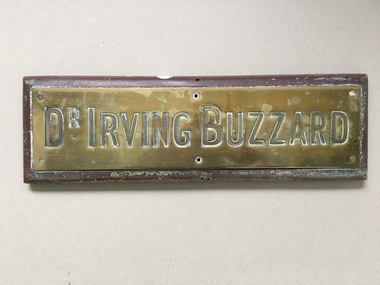
Brass Plate, Dr Irving Buzzard
... Dr Irving Buzzard...Irving Buzzard was born in Moonee Ponds in 1897. His study of medicine was interrupted by his enrolment in the AIF in World War 1, where he served on the hospital ship " Kanowns". ...Dr Irving Buzzard...Name is stamped and while nam Dr Irving Buzzard Brass Plate ...Irving Buzzard was born in Moonee Ponds in 1897. His study of medicine was interrupted by his enrolment in the AIF in World War 1, where he served on the hospital ship " Kanowns". After discharge in 1916 he returned to his studies, graduating in 1922. he came to Warrnambool in 1929 after purchasing the Cambourne Clinic from Dr Hedley Dunstan. He practised as a GP until the outbreak of WW2. His speciality was gynaecology and obstetrics. He retired from Warrnambool practice in 1964 and moved to Melbourne.he was involved in many different organisations , being a member of local sporting clubs as well as community groups such as Rotary and the freemasons. He died in June 1981.A link to one of Warrnambool's longest serving doctors of the 20th century which has historical and social significance.Small rectangular brass plate with six screw holes. Mounted on timber which is painted brown. Name is stamped and while namDr Irving Buzzardwarrnambool, warrnambool doctors, dr irving buzzard, cambourne clinic doctors -
 Warrnambool and District Historical Society Inc.
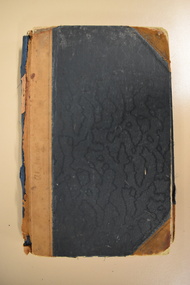
Administrative record - Journal of Dr Buzzard, 1930s & 1940s
... This journal has been used by the Warrnambool doctor, Irving Buzzard to record his surgical operations and procedures from 1931 to 1944. ...Dr Irving Buzzard, Warrnambool...Administrative record Journal of Dr Buzzard Dr Irving Buzzard, Warrnambool ...This journal has been used by the Warrnambool doctor, Irving Buzzard to record his surgical operations and procedures from 1931 to 1944. Dr Irving Buzzard (1897-1981) was one of Warrnambool's best-known doctors, especially in the field of gynaecology and obstetrics. He came to Warrnambool in 1929 with his practice at Cambourne in Raglan Parade. He left Warrnambool in 1964. Whilst in Warrnambool he was active in medical associations and local community affairs. The Irving Buzzard Midwifery prize is awarded annually by the Australian Nursing and Midwifery Federation (Victorian branch).This journal is of considerable significance as it gives an insight into the work of a general medical practitioner in Warrnambool in the first half of the 20th century (For instance, the journal records that in 1931 Dr Buzzard carried out 38 major operations and 132 minor procedures.)This is a ledger of 193 pages with a hardboard black cover and the remains of brown leather binding on the spine and cover corners. The cover is partly detached from the pages. The pages contain printed red lines and handwritten entries in black ink. Pages 1 to 72 are missing and there are many blank pages.dr irving buzzard, warrnambool doctors, irving buzzard midwifery prize -
 The Beechworth Burke Museum
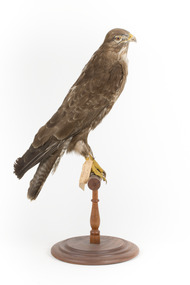
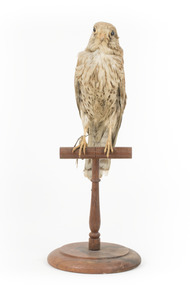
Animal specimen - Common Buzzard, Trustees of the Australian Museum, 1860- 1880
... The Common buzzard, a medium-sized raptor, is found across Europe and Asia, and in Africa in the winter months. ...This Common Buzzard is brown in colour with lighter markings on the chest. ...Swing tag: 30 / Buzzard / Catalogue page 52. / Metal tag: 4043 /...The Common buzzard, a medium-sized raptor, is found across Europe and Asia, and in Africa in the winter months. ...The Common buzzard, a medium-sized raptor, is found across Europe and Asia, and in Africa in the winter months. It is the UK’s commonest bird of prey, found in nearly every county. Due to their large size and their brown color, they are often confused with other species, especially the Red kite and the Golden eagle. They may look the same from a distance, but the Common buzzard has a very distinctive call, like a cat’s mew, and a distinctive flying shape. When soaring and gliding, the tail is fanned and its wings are often held in a shallow 'V'. The colour of individuals varies from dark brown to much lighter, though they all have a finely barred tail and dark wingtips. This species occurs across Europe and Russia, and parts of Northern Africa and Asia in the cooler winter months. It lives in a range of habitats, especially woodland, moorland, pasture, scrub, arable land, marsh bog, villages, and sometimes towns and cities. This particular specimen has been mounted in a correct stylised fashion. This specimen is part of a collection of almost 200 animal specimens that were originally acquired as skins from various institutions across Australia, including the Australian Museum in Sydney and the National Museum of Victoria (known as Museums Victoria since 1983), as well as individuals such as amateur anthropologist Reynell Eveleigh Johns between 1860-1880. These skins were then mounted by members of the Burke Museum Committee and put-on display in the formal space of the Museum’s original exhibition hall where they continue to be on display. This display of taxidermy mounts initially served to instruct visitors to the Burke Museum of the natural world around them, today it serves as an insight into the collecting habits of the 19th century.This specimen is part of a significant and rare taxidermy mount collection in the Burke Museum. This collection is scientifically and culturally important for reminding us of how science continues to shape our understanding of the modern world. They demonstrate a capacity to hold evidence of how Australia’s fauna history existed in the past and are potentially important for future environmental research. This collection continues to be on display in the Museum and has become a key part to interpreting the collecting habits of the 19th century.This Common Buzzard is brown in colour with lighter markings on the chest. It has a white patch of feathers on the back of its head and it has darker wingtips and yellow feet. This specimen stands upon a wooden platform and has an identification tag tied around its leg.Swing tag: 30 / Buzzard / Catalogue page 52. / Metal tag: 4043 /taxidermy mount, taxidermy, animalia, burke museum, beechworth, australian museum, skin, reynell eveleigh johns, bird, common buzzard, bird of prey -
 Bendigo Military Museum
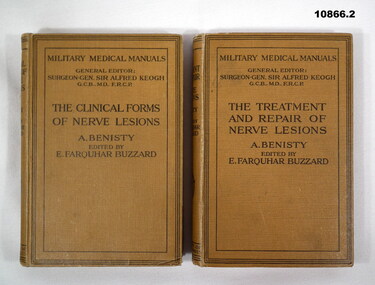
Book - MILITARY MEDICAL MANUAL, A. BENISTY, "THE TREATMENT AND REPAIR OF NERVE LESIONS". and "THE CLINICAL FORMS OF NERVE LESIONS", 1918
... ...E. FARGUHAR BUZZARD, M.D. F.R.C.P....BENISTY E. FARGUHAR BUZZARD, M.D. F.R.C.P. University of London Press Ltd ...1. & 2. Hardcover books. Cover cardboard with id brown buckram. Black ink print on front and spine. 181 pages, cut, plain, white paper. These are medical manuals with many black and white health themed illustrations. 1. Front end papers - two adhesive labels. 2. Front end papers - one adhesive label and owner's signature.Label information. 1. Top - gold print on black background "EX LIBRIS/ SIR SYDNEY SUNDERLAND" Bottom - black print on white background “ANGUS & ROBERTSON/ New & Second-hand Booksellers/ Publishers to University/ 89 Castlereagh St. Sydney" 2. Label per "Top", Handwritten - black ink pen "Sydney Sunderland" and grey lead pencil "RR".publications, books, manual, medical -
 Wangaratta RSL Sub Branch
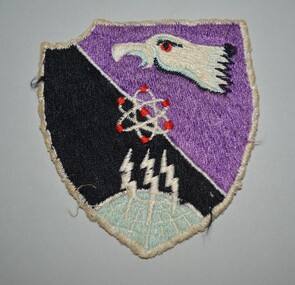
Badge - Cloth badge, c1965
... Known as the "Bien Hoa Buzzards," they flew combat missions in Vietnam from November 1965 to October 1969. ...Embroided cotton patch consisting of a shield design featuring a white buzzard's head with a red eye, set against a divided background of black and purple....Known as the "Bien Hoa Buzzards," they flew combat missions in Vietnam from November 1965 to October 1969. ...U.S. military produced unit patch of the 510th Tactical Fighter Squadron. The design represented the squadron's global reach, striking speed, and technological tactical power. Known as the "Bien Hoa Buzzards," they flew combat missions in Vietnam from November 1965 to October 1969. Operating out of Bien Hoa Air Base, the squadron flew the North American F-100 Super Sabre, completing over 27,200 combat missions in Southeast Asia. Embroided cotton patch consisting of a shield design featuring a white buzzard's head with a red eye, set against a divided background of black and purple.unit badge, patch, vietnam war, 510th tactical fighter squadron, usaf -
 The Beechworth Burke Museum
Animal specimen - Common Buzzard, Trustees of the Australian Museum, 1860-1880
... The Common Buzzard is part of the buteo genus (Latin for buzzard or hawk) which indicates it is part of the raptor group whose features include a medium to large build, a strong body and larger wings. ...With similar colourings and features to a range of raptor species, the Common Buzzard can often be mistaken for other varieties of buteo and raptor. ...The Common Buzzard is part of the buteo genus (Latin for buzzard or hawk) which indicates it is part of the raptor group whose features include a medium to large build, a strong body and larger wings. ...The Common Buzzard is part of the buteo genus (Latin for buzzard or hawk) which indicates it is part of the raptor group whose features include a medium to large build, a strong body and larger wings. The family includes birds of prey such as hawks and buzzards. Like their name suggests, Common Buzzards are very ‘common’ in the UK but can also be found in other parts of Europe, Africa and Asia. The birds’ habitat consists of woodland, shrubland, forest, wetlands and countryside, and they can live in cold, tropical and temperate climate zones. Similar to other raptor species, Common Buzzards make their nests in tree branches or tree forks. With finely tuned hearing, they are able to detect small marsupials, and their diet consists of small amphibians, birds and mammals. Normally solitary, these raptors can occasionally be seen with others. Common Buzzards are classified as of ‘Least Concern’ on the IUCN Red List. While there is some noticeable fading of this particular taxidermy specimen’s plumage, it is relatively well presented. The completely black eyes and string through the nose of the specimen seem to be taxidermy/curatorial choices, as this is not something that is normally found on living versions today, and the eyes of Common Buzzards are normally golden eyes with black pupils. It is interesting to note, when considering the selected artificial eyes, that the original swing tag labeled this specimen as Saleo tinnunculus Lina, a form of kestrel (known to have complete black eyes), which perhaps explains this taxidermist choice. As a Common Buzzard, this particular specimen could have had its frame and breast area bulked out a little more, as birds within the buteo genus are generally recognised to be of medium to large build. Overall however, this is a fairly reasonable and accurate representation of the species. This specimen is part of a collection of almost 200 animal specimens that were originally acquired as skins from various institutions across Australia, including the Australian Museum in Sydney and the National Museum of Victoria (known as Museums Victoria since 1983), as well as individuals such as amateur anthropologist Reynell Eveleigh Johns between 1860-1880. These skins were then mounted by members of the Burke Museum Committee and put-on display in the formal space of the Museum’s original exhibition hall where they continue to be on display. This display of taxidermy mounts initially served to instruct visitors to the Burke Museum of the natural world around them, today it serves as an insight into the collecting habits of the 19th century.This specimen is part of a significant and rare taxidermy mount collection in the Burke Museum. This collection is scientifically and culturally important for reminding us of how science continues to shape our understanding of the modern world. They demonstrate a capacity to hold evidence of how Australia’s fauna history existed in the past and are potentially important for future environmental research. This collection continues to be on display in the Museum and has become a key part to interpreting the collecting habits of the 19th century.With similar colourings and features to a range of raptor species, the Common Buzzard can often be mistaken for other varieties of buteo and raptor. The bird’s plumage generally varies by location, but normally includes a variety of shades of brown, commonly with darker brown on its back and lighter coloured feathers on its breast, underbelly areas and face. These birds normally have fine bands on their tail and darker tipped wings. Common Buzzards have smaller heads with a band of yellow around the base of their small curved beaks and golden yellow eyes. This particular specimen’s feathers have faded and he stands upon a wooden perch with an identifying tag hanging from its right leg.Swing Tag: Swing tag obverse seems to read: ‘…io [? First few symbols aren’t clear]/ Saleo /tinnunculus/ Lina [there is also another illegible symbol on the tag in the centre on the second line] Swing tag reverse: illegible sections of text and the beginning of a number ‘403…[?]. Metal tag: 1032[?]taxidermy mount, taxidermy, animalia, burke museum, beechworth, australian museum, skin, reynell eveleigh johns, bird, common buzzard, buteo, hawks, raptors, birds of prey, buzzards -
 Bendigo Historical Society Inc.
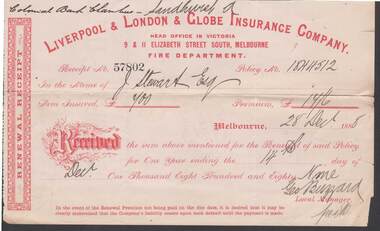
Document - CONNELLY, TATCHELL, DUNLOP COLLECTION: LIVERPOOL & LONDON GLOBE INSURANCE COMPANY
... ... Buzzard....Renewal Receipt issued for policy for J.Stewart Esq, sum insured 700/-/-. Signed Geo. Buzzard, Local Manager....BUSINESS Legal connelly tatchell collection CONNELLY TATCHELL COLLECTION Buzzard. J. Stewart. receipt issued by Liverpool & London & globe Insurance company, Elizabeth St, South Melbourne, Fire Department. ...receipt issued by Liverpool & London & globe Insurance company, Elizabeth St, South Melbourne, Fire Department. Issued on 28 December, 1888. Renewal Receipt issued for policy for J.Stewart Esq, sum insured 700/-/-. Signed Geo. Buzzard, Local Manager.business, legal, connelly, tatchell collection, connelly, tatchell collection, buzzard., j. stewart. -
 Whitehorse Historical Society Inc.
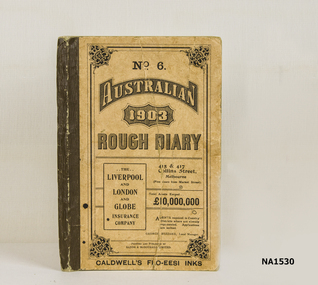
Book - Diary, 1903
... The Liverpool and London .......George Buzzard, Local Manager...documents diaries The Liverpool and London .......George Buzzard, Local Manager No. 6 Australian 1903 Diary Book Diary ...No. 6 Australian 1903 DiaryThe Liverpool and London .......George Buzzard, Local Managerdocuments, diaries -
 Glenelg Shire Council Cultural Collection
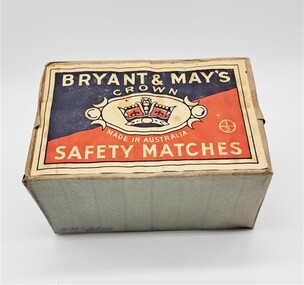
Functional object - Box of Matches - Bryant & May, Bryant & May, 1940s
... Top: Bryant & May's / Crown / Made in Australia / Safety Matches / 1/3 Under: From / Leighton & Margaret Buzzard / 4.2.88 Side: Strike One Side / 1940s...Australian Manufacure Industry 1940s Domestic Portland Glenelg Shire Melbourne Richmond Bryant & May Top: Bryant & May's / Crown / Made in Australia / Safety Matches / 1/3 Under: From / Leighton & Margaret Buzzard / 4.2.88 Side: Strike One Side / 1940s Rectangular carboard box. ...The Bryant & May factory was located in Richmond, Melbourne and was a typical red-brick Victorian factory. It manufactured matches throughout the 20th century but had adopted the brand name - Redheads - by 1946.Bryant & May was a significant Quaker owned business which was founded in the mid 1800s in the UK. They spread to various countries including Australia where they produced the Crown Safety Matches during the early 1900s through to the 1940s when they took the brand name Red Heads. The factory in Richmond is listed on the Victorian Heritage Register. Rectangular carboard box. Wrapped in light brown paper. The top of the box has a coloured label fixed onto it. The label is mainly navy blue and red with white text. The label has the words ' Bryant & May's Safety Matches' printed on it. There is a picture of a crown in the centre in an oval. The box is unopened. There are several smaller boxes of matches inside. On the opposite side to the label there is text written in a black marker pen.Top: Bryant & May's / Crown / Made in Australia / Safety Matches / 1/3 Under: From / Leighton & Margaret Buzzard / 4.2.88 Side: Strike One Side / 1940saustralian manufacure, industry, 1940s, domestic, portland, glenelg shire, melbourne, richmond, bryant & may -
 Warrnambool and District Historical Society Inc.
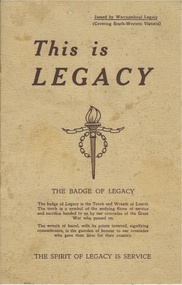
Work on paper - Booklet, This is Legacy, 1947
... The Warrnambool club was founded in 1947 and this booklet lists the office bearers as Chas Watts, I Buzzard, D B de Beaurepaire, A K Browne R Potter, N K Morris, P H Allen, W J Tolmie, J Paterson, b C Stronach, L G Stevens, T b Patrick, R S Robinson, J O Tait. ...The Warrnambool club was founded in 1947 and this booklet lists the office bearers as Chas Watts, I Buzzard, D B de Beaurepaire, A K Browne R Potter, N K Morris, P H Allen, W J Tolmie, J Paterson, b C Stronach, L G Stevens, T b Patrick, R S Robinson, J O Tait. ...Dark cream coloured soft card cover with brown text. Title is in larger text with the Legacy emblem in the centre of the front cover. The back cover has the poem, Flanders Field and the legacy response. Eight pages which has text and some photographs. A list of Warrnambool office bearers is on the inside back cover. non-fictionlegacy 1947, warrnambool history, warrnambool legacy -
 Ballarat Base Hospital Trained Nurses League
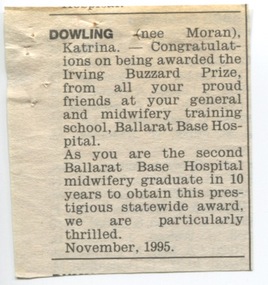
State Midwifery Award, Irving Buzzard Prize to Katrina Dowling (nee Moran), November 1995
... Dowling, moran, State, Midwifery, Award, Irving Buzzard Prize, 1995 Hard copy State Midwifery Award, Irving Buzzard Prize to Katrina Dowling (nee Moran), November 1995 ...Hard copydowling, moran, state, midwifery, award, irving buzzard prize, 1995 -
 Moorabbin Air Museum
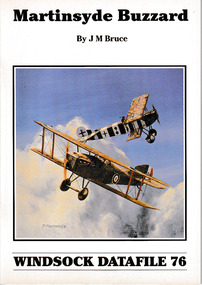
Magazine (item) - (SP) Windsock Datafiles No 076- Martinsyde Buzzard
... Magazine (SP) Windsock Datafiles No 076- Martinsyde Buzzard ...
