
Showing 60 items matching " commercial establishment"
-
 Glen Eira Historical Society
Article - Brunning, Leslie Herbert Ashby
... ... Commercial establishment...Brunning George Brunning George Edward Brunning Herbert Brunning’s Nurseries G Brunning and Sons St Kilda Brunning Street Brighton Road Gardening St Kilda Council Agricultural industry Commercial establishment Article Brunning, Leslie Herbert Ashby ...An extract about Brunning’s Nurseries, St Kilda, taken from John Butler Cooper’s The History of St Kilda, from its first settlement to a city and after 1840 to 1930, Vol II. The extract is a short history of Brunning’s Nurseries, St Kilda. Includes a handwritten note by Deborah Towns citing the source, dated 08/07/2011.brunning george, brunning george edward, brunning herbert, brunning’s nurseries, g brunning and sons, st kilda, brunning street, brighton road, gardening, st kilda council, agricultural industry, commercial establishment -
 Surrey Hills Historical Society Collection
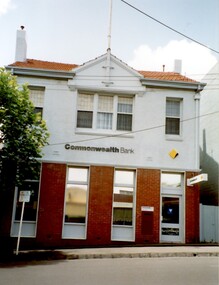
Photograph, Commonwealth Bank of Australia, 107 Union Road, Surrey Hills, 1991
... ...commercial establishment...(See Bendigo Bank file) commonwealth bank state savings bank of victoria commercial establishment union road surrey hills A colour photograph of a two storey building with a red terracotta tiled roof. signage indicates it is occupied by the Commonwealth Bank of Australia. ...This was originally built as a State Savings Bank of Victoria branch in 1916. The first manager was Mr Campbell Cameron. On 26 August 1990, the Commonwealth Bank of Australia (CBA) entered into an agreement with the Treasurer of Victoria for a merger with the State Bank of Victoria (SBV). All former State banks were given new signage in November 1992. The CBA operated the branch for a relatively short period of time with the branch closing in 2000. Community pressure for a local bank resulted in the Bendigo Bank opening a branch on the site in 2002. (See Bendigo Bank file)A colour photograph of a two storey building with a red terracotta tiled roof. signage indicates it is occupied by the Commonwealth Bank of Australia. The upper storey is rendered; the lower part of the building is red brick. The lower storey windows have been 'modernised'; the upper storey ones are in keeping with a build of the early 20th century. Adjacent to the door there appears to be an automatic teller machine.commonwealth bank, state savings bank of victoria, commercial establishment, union road, surrey hills -
 Falls Creek Historical Society
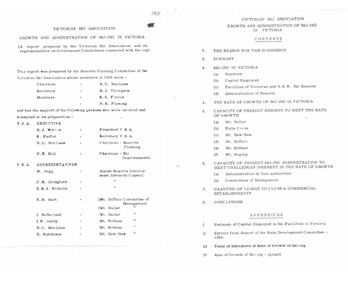
Document - Victorian Ski Association Report - Growth & Administration Of Skiing In Victoria
... Bogong; Capacity of the present administration to meet challenges related to growth ; the granting of leases to Clubs and Commercial Establishments and an estimate of Capital employed in Ski Facilities in Victoria. ...Bogong; Capacity of the present administration to meet challenges related to growth ; the granting of leases to Clubs and Commercial Establishments and an estimate of Capital employed in Ski Facilities in Victoria. ...Bob (Herman) Hymans (a former member of the Royal Netherlands Navy) was born in Bloemendaal, Holland on 30th September 1922. During World War II he fought against the Japanese in the Dutch East Indies (now Indonesia) and was imprisoned in Changi and on the Burma Railway. After gaining qualifications as a Ski Instructor, Bob arrived in Falls Creek in July 1950. Working as an Instructor and Supervisor at Bogong Lodge, Bob decided his future was in accommodation. He was successful in negotiating an indenture for land from the State Electricity Commission (SEC). It took Bob two years to build his Grand Coeur Chalet but, tragically, it was burned down in August 1961. Bob also built the first Chairlift in Australia. This was a single chairlift and the structure was built from wooden electricity poles. He was constantly full of new ideas and proposals for the village. Bob Hymans died on 7th July 2007. This Collection of documents and letters tells the story of Bob's endeavours to develop Falls Creek into the ski village it is today.This item is significant because it documents the growth of the Skiing Industry in Victoria up until 1966.A detailed report into the "Growth and Administration of Skiing in Victoria" produced by the Victorian Ski Association. Different pages in the report include:- Introduction and contents; reasons for completing this Submission and Summary: Analysis of capital employed on Victoria's snowfields; Facilities of NSW and Vic Ski Resorts; Administration of resorts: the growth of skiing in Victoria; an analysis of resorts at Mt Buller, Falls Creek, Mt. Baw Baw, Mt. Buffalo, Mt. Hotham and Mt. Bogong; Capacity of the present administration to meet challenges related to growth ; the granting of leases to Clubs and Commercial Establishments and an estimate of Capital employed in Ski Facilities in Victoria. It also includes a table and a graph representing the growth rate of skiing in Victoria.falls creek tourist area management committee, falls creek administration, sewerage system falls creek -
 Warrnambool and District Historical Society Inc.
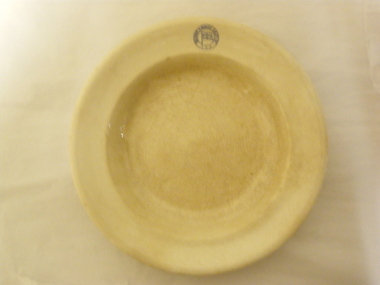
Plate (Belfast & Koroit S.N. Co.), Late 1920s
... This plate was made by the Calyx Porcelain and Paint Company which was based in Western Australia and made china for commercial establishments from the 1920s to the 1990s when the company was then known as Australian Fine China. ...This plate was made by the Calyx Porcelain and Paint Company which was based in Western Australia and made china for commercial establishments from the 1920s to the 1990s when the company was then known as Australian Fine China. ...This plate was made by the Calyx Porcelain and Paint Company which was based in Western Australia and made china for commercial establishments from the 1920s to the 1990s when the company was then known as Australian Fine China. The plate was used by the Belfast and Koroit Steam Navigation Company based in Port Fairy. It was founded in 1882 and operated two ships, the Casino and the Bellinger, servicing the Western Ports between Melbourne and Portland. The Casino was wrecked at Apollo Bay in 1932. Later the company operated the ship, Dawn and survived as a shipping company until the late 1930s.This plate is of interest because it was used by the Belfast and Koroit Steam Navigation Company in the 1920s and 30s. This company was important in the maritime history of Warrnambool, especially in the transportation of potatoes from the Warrnambool region. The Casino, the most important ship operated by the Belfast and Koroit Steam Navigation Company, was also important as a passenger and cargo ship prominent in Warrnambool’s maritime historyThis is a circular-shaped cream soup bowl or dinner plate. On the edge of the plate there is a blue embedded stamp in the shape of a circle with the flag of the steamship company inside. On the base of the plate is the maker’s information in green print. The base of the plate is much crazed and discoloured‘Belfast & Koroit S.N. Co. Ltd.’ ‘Made in Australia, Calyx, W.A.’ belfast & koroit steam navigation company, history of warrnambool -
 Kiewa Valley Historical Society
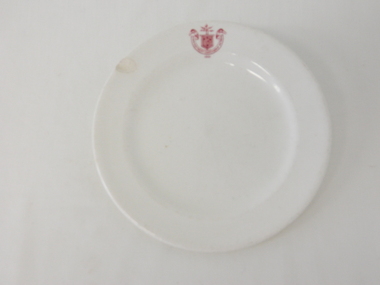
Plate Bread & Butter, Circa 1921
... The 5mm thickness of the ceramic suggests this plate belongs to a commercial kitchen/eating establishment (mess) and not a domestic dining room. ...The 5mm thickness of the ceramic suggests this plate belongs to a commercial kitchen/eating establishment (mess) and not a domestic dining room. ...This item was used by the State Electricity Commission of Victoria in their mess rooms for their workers during the construction of the Kiewa Hydro Electricity Scheme. The imprint of the year "1921" was to identify the year that the SECV was formed and relieved the private VHEC (Victorian Hydro-Electric Company). As the scheme was of such a huge, isolated and time consuming nature the feeding of its workers was quite demanding of cutlery and crockery. The use of sturdy English cups and saucers was essential. The period of construction and the isolation of the Kiewa Valley area placed heavy demand for "solid" crockery that could wear abusive handling. This period in time was one when crockery, whether for domestic or commercial use, was imported from "mother" England. This scenario was more so for governmental bodies such as rail, jails and electricity providers than domestic users. The influx of cheaper Asian crockery had not yet begun.This type of crockery item was used by the thousands of SEC Victorian staff and construction workers involved in the building of the Kiewa Hydro Electricity Scheme, over the extensive period (1938 to 1961). This was a period when Government bodies and other semi- government organisations were still tide to the "establishments" of "mother" England. It was a period in Australia's development when the Asian influence was very weak and the established ties to England and Europe was still very strong. The majority of heavy equipment and machinery was either made in England or Europe. Local expertise in dam construction and water management in alpine terrain came from migrants for England and Europe. The quality of workmanship from big steel manufacturing plants in England and Europe could not be matched from anywhere else in the developed world.This item is a white ceramic plate (bread & butter). It is made in England and is of strong and durable ceramic. The bottom of the plate is flat with edges sloping out (to position the bread) and the extended rim is to catch any spillages. The 5mm thickness of the ceramic suggests this plate belongs to a commercial kitchen/eating establishment (mess) and not a domestic dining room. The indent bottom of the plate is 5mm deep with a side curvature ratio of 2:5. The ceramic is glazed to a commercial standard (see KVHS 0128 for its saucer part of a dinner set.The seal of the State Electricity Commission Of Victoria is imprinted on the top inside rim within a curved scroll. Snuggled within the borders of the scroll is a banner with the five stars of the southern cross and an arm with a closed fist projecting from the top with five lightning bolts projecting outwards. On the underside "Vitrified sold by Cafe & Hotel Supplies Pty Ltd Dunn Bennett & Co. Ltd. Burslem Made in England"saucer, plate, secv, state electricity commission of victoria, crockery -
 Sunbury Family History and Heritage Society Inc.
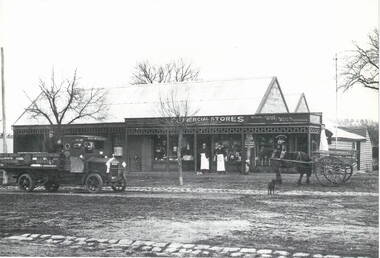
Photograph, Commercial Stores
... He later built the Commercial Hotel also in Macedon Street and near the Ballcourt Hotel.Before the railway arrived in Sunbury, Macedon Street was Sunbury's main commercial centre. After the establishment of the railway, the commercial centre shifted close to the railway station. ...He later built the Commercial Hotel also in Macedon Street and near the Ballcourt Hotel.Before the railway arrived in Sunbury, Macedon Street was Sunbury's main commercial centre. After the establishment of the railway, the commercial centre shifted close to the railway station. ...Commercial Stores was owned and run by Peter Eadie from Perthshire in Scotland, whose brothers were John and Robert. Peter and Robert arrived in Sunbury in 1864 to help their brother John with his milling enterprise. In 1866, Peter purchased the blue stone general store in Macedon Street near the bridge. He later built the Commercial Hotel also in Macedon Street and near the Ballcourt Hotel.Before the railway arrived in Sunbury, Macedon Street was Sunbury's main commercial centre. After the establishment of the railway, the commercial centre shifted close to the railway station. The Eadie family's stately home, 'Dunblane', was on the corner of Brook and Jackson Street.A Lutheran Church now occupies the lower section of the land fronting Brook Street, but the home has a local heritage listing. Peter Eadie became a Shire of Bulla councillor and President in 1880. Dunblane is from the Scots Gaelic -'dun' is a fortified hill and 'Blane' a missionary.The Eadie Family established one of Sunbury's general stores in the town and were involved in many other commercial activities.A print of a non-digital black and white photograph of a country general store. A medium sized vintage open tray truck is parked in front of the shop on the LHSand a horse-drawn open cart is on the RHS of the image.eadie family, peter eadie, commercial stores, macedon street, businesses -
 Flagstaff Hill Maritime Museum and Village
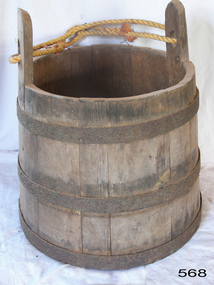
Domestic object - Coopered Bucket, 1960 to 1980
... In early colonial timeswhen ready-made products were scarce so the trades of coopers, blacksmiths, metal smiths, carpenters, builders and others were necessary for domestic, commercial and industrial establishment. Warrnambool Shipwreck Coast Flagstaff Hill Flagstaff Hill Maritime Museum Flagstaff Hill Maritime Village bucket wooden bucket container domestic bucket Cooper Cooper trade coopered bucket Wooden coopered bucket; three metal bands around vertical wooden planks that form the body of the bucket. ...This bucket was made from vertical planks of wood with bands of metal around it for strength. Buckets such as this were made by coopers, who had expertise in making wooden barrels. Wood or animal skin was used to make buckets in colonial times when other materials were unavailable. Buckets had many uses in domestic and agricultural life including carrying, measuring and storing. Cooper tradesmen used carpentry and blacksmithing skills to make a wide range of wooden containers and other objects. They sometimes used water or steam to bend and mould the timber.The bucket is an example of a product made from wood and iron by an experienced Cooper. In early colonial timeswhen ready-made products were scarce so the trades of coopers, blacksmiths, metal smiths, carpenters, builders and others were necessary for domestic, commercial and industrial establishment.Wooden coopered bucket; three metal bands around vertical wooden planks that form the body of the bucket. Two lugs extend higher than the planks and have a rope joined between them.warrnambool, shipwreck coast, flagstaff hill, flagstaff hill maritime museum, flagstaff hill maritime village, bucket, wooden bucket, container, domestic bucket, cooper, cooper trade, coopered bucket -
 The Beechworth Burke Museum
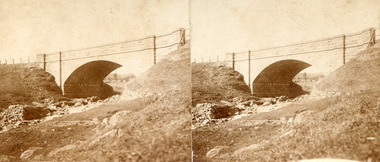
Photograph - Stereoscopic Photograph, Unknown c1875
... Beechworth held a distinct role in the administrative and commercial management of Victoria's north-eastern goldfields, with many objects and structures still well preserved from the towns establishment. ...Beechworth held a distinct role in the administrative and commercial management of Victoria's north-eastern goldfields, with many objects and structures still well preserved from the towns establishment. ...Depicted in the photograph is Newtown Bridge or the Newtown Falls Bridge, in Beechworth, Victoria. Noted for its location, detailed craftsmanship and stonemasonry by Scottish stonemasons the Newtown Bridge was built in the 19th century provincial town of Beechworth (completed in 1875). The bridge was built over Spring Creek, spanning 6.3 meters wide and 24.8 meters tall. Beechworth held a distinct role in the administrative and commercial management of Victoria's north-eastern goldfields, with many objects and structures still well preserved from the towns establishment. The bridge indicates the growth of the town, replacing a previous timber structure as well as its association to the mining activity in the area and the rapid increase in Australia's economy that led to investment and development of roads and railways. The local granite used in the construction of the single arch Newtown Bridge makes the bridge and other buildings made with the granite unique to the area, the honey-toned material distinct to Beechworth. This photograph is historically significant as it provides insight into the industrial development of Beechworth and the surrounding area, contributed to by the goldfields. The photograph further captures the representation of vernacular engineering traditions and Scottish stonemasonry.Two sepia-toned rectangular photographs featuring a bridge in the background printed on matte photographic paper mounted on card.Reverse: 97.2324/ Newtown Bridge/ Beechworthbridge, newtown beechworth, newtown bridge, newtown, beechworth, beechworth falls bridge, beechworth mining district, spring creek, -
 Marysville & District Historical Society
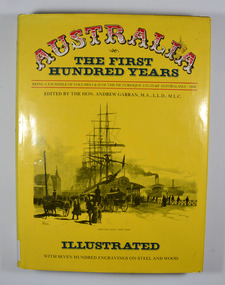
Book, IPC Books Pty Limited, Australia-The First Hundred Years-Being a facsimile of Volumes I & II of the Picturesque Atlas of Australia-1888, 1886
... The Picturesque Atlas was designed to give a graphic and summarised conception of Australasian history and life from the days of the earliest Portuguese, Spanish, Dutch, English and French navigators to the 1880's, embracing such salient events as the landing of Captain Cook in 1770. the discoveries of voyagers, explorers an pioneer missionaries; the founding of the different colonies; the establishment of representative government and the marvellous political, commercial and social development which characterises the people of Australia....The Picturesque Atlas was designed to give a graphic and summarised conception of Australasian history and life from the days of the earliest Portuguese, Spanish, Dutch, English and French navigators to the 1880's, embracing such salient events as the landing of Captain Cook in 1770. the discoveries of voyagers, explorers an pioneer missionaries; the founding of the different colonies; the establishment of representative government and the marvellous political, commercial and social development which characterises the people of Australia. history australia explorers voyagers missionaries politics commercial development social development The Picturesque Atlas was designed to give a graphic and summarised conception of Australasian history and life from the days of the earliest Portuguese, Spanish, Dutch, English and French navigators to the 1880's, embracing such salient events as the landing of Captain Cook in 1770. the discoveries of voyagers, explorers an pioneer missionaries; the founding of the different colonies; the establishment of representative government and the marvellous political, commercial and social development which characterises the people of Australia. ...The Picturesque Atlas was designed to give a graphic and summarised conception of Australasian history and life from the days of the earliest Portuguese, Spanish, Dutch, English and French navigators to the 1880's, embracing such salient events as the landing of Captain Cook in 1770. the discoveries of voyagers, explorers an pioneer missionaries; the founding of the different colonies; the establishment of representative government and the marvellous political, commercial and social development which characterises the people of Australia.Dust cover has an illustration depicting Circular Quay, West Side in the early days of Australia.non-fictionThe Picturesque Atlas was designed to give a graphic and summarised conception of Australasian history and life from the days of the earliest Portuguese, Spanish, Dutch, English and French navigators to the 1880's, embracing such salient events as the landing of Captain Cook in 1770. the discoveries of voyagers, explorers an pioneer missionaries; the founding of the different colonies; the establishment of representative government and the marvellous political, commercial and social development which characterises the people of Australia.history, australia, explorers, voyagers, missionaries, politics, commercial development, social development -
 Federation University Historical Collection
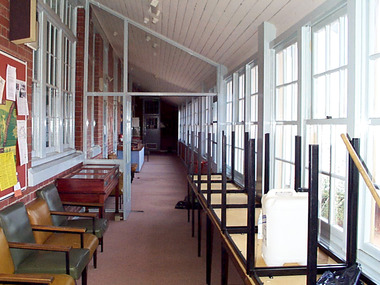
Photograph, Top floor corridor in the Former Ballarat Junior Technical School Building, 12/1997
... The time capsule should have been opened in 2020, the 150th anniversary of the establishment of the Ballarat School of Mines, but was postponed due to successive lockdowns during the Covid19 pandemic. The time capsule was opened in 2022. ballarat school of mines time capsule ballarat junior technical school prospects training restaurant classroom commercial kitchen information technology Top floor corridor in the Former Ballarat Junior Technical School Building. ...This image was on a CD-ROM which was placed in a time capsule in December 1997, just before the Ballarat School of Mines merged with the University of Ballarat (now Federation University Australia). The time capsule should have been opened in 2020, the 150th anniversary of the establishment of the Ballarat School of Mines, but was postponed due to successive lockdowns during the Covid19 pandemic. The time capsule was opened in 2022.Top floor corridor in the Former Ballarat Junior Technical School Building. Ini 1997 the ground floor of this building housed Prospects Training Restaurant.ballarat school of mines, time capsule, ballarat junior technical school, prospects training restaurant, classroom, commercial kitchen, information technology -
 Federation University Historical Collection
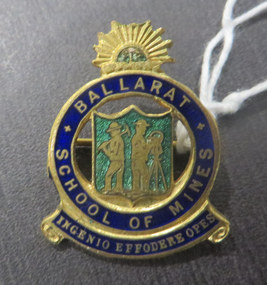
Object, Stokes & Sons Pty Ltd, Ballarat School of Mines Badge, c1930s
... She taught the 'Touch' Method of typing, Commercial Correspondence, Shorthand and Office Routine. Tertiary education at Ballarat began with the establishment of the School of Mines in 1870, making it Australia's third oldest tertiary institution. ...She taught the 'Touch' Method of typing, Commercial Correspondence, Shorthand and Office Routine. Tertiary education at Ballarat began with the establishment of the School of Mines in 1870, making it Australia's third oldest tertiary institution. ...This badge was used by Hester Clara Darby, teacher at the Ballarat School of Mines. Hester joined the staff of SMB as an assistant to senior Commercial classes in April 1916. On 01 February 1921 she was appointed a lecturer in Commercial Correspondence and Office Routine. She taught the 'Touch' Method of typing, Commercial Correspondence, Shorthand and Office Routine. Tertiary education at Ballarat began with the establishment of the School of Mines in 1870, making it Australia's third oldest tertiary institution. Classes began in surveying, mathematics, chemistry and a decade later they included metallurgy, assaying and geology. The technical division provided such programs as wool classing, plumbing and bricklaying. In 1967, it was split into three separate institutions, Ballarat School of Industries, Ballarat Technical School, and Ballarat Institute of Advanced Education. Then in 1976 the Ballarat Institute of Advanced Education became into Ballarat College of Advanced Education. The Ballarat School of Industries and Ballarat Technical School became the School of Mines and Industries, Ballarat (SMB). In 1998, the Ballarat School of Mines and Industries and the Horsham-based Wimmera Institute of TAFE merged with the University of Ballarat. The university merged with Monash University's Gippsland (Churchill) campus in 2013 and the merged schools are now the Federation University AustralialBallarat School of Mines Badge made of gold coloured metal with blue and green enamel.On face - Ballarat School of Mines, Ingenio Effodere Opesballarat school of mines badge, badge, coat of arms, hester clara darby, hester darby -
 City of Moorabbin Historical Society (Operating the Box Cottage Museum)
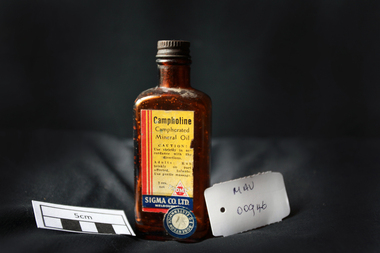
Manufactured Glass, brown bottle 'Campholine', c1950
... The entrepreneurial Leete had been part of a move in 1904 among a group of commercially-minded chemists to put up proprietary preparations. 1913 - 1927 Initially, the fortunes of the Sigma enterprise relied on E. H. Leete ‘working from home’, and even as late as 1915 company address was in Claremont Avenue Malvern. Following the establishment...The entrepreneurial Leete had been part of a move in 1904 among a group of commercially-minded chemists to put up proprietary preparations. 1913 - 1927 Initially, the fortunes of the Sigma enterprise relied on E. H. Leete ‘working from home’, and even as late as 1915 company address was in Claremont Avenue Malvern. Following the establishment ...Sigma was founded by two Melbourne pharmacists in 1912, it has grown to become one of the key players in Australia’s pharmacy industry .Edwin Thomas Church (1864 – 1947) and Ernest Holloway Leete a prominent chemist and a member of the College of Pharmacy who had established his own pharmacy in 1897. The entrepreneurial Leete had been part of a move in 1904 among a group of commercially-minded chemists to put up proprietary preparations. 1913 - 1927 Initially, the fortunes of the Sigma enterprise relied on E. H. Leete ‘working from home’, and even as late as 1915 company address was in Claremont Avenue Malvern. Following the establishment of the business in 1912, the Sigma Company Limited was located at Flinders Lane, Melbourne. Sigma – Tromax, 1928 E.H. Leete after sixteen years, said he would not stand again as a director of the company because interests were also turning elsewhere. He was assisting another company as its agent in the motor trade. 1938 to1953 was characterised by steady growth for Sigma, accelerated by manufacturing opportunities during World War Two. Between 1975 and 1996 the company was transformed as it entered a period of both consolidation and rapid growth. The appointment, in 1996, of new Managing Director, George Savvides, marked a break from the past. Today Sigma is a leading full line wholesale and distribution business to pharmacy. Sigma is also the owner of some of Australia’s best known pharmacy brands in Amcal, Guardian and Amcal MaxA triangular shaped, brown glass, bottle with a metal screw top containing ‘Campholine’Front label : Campholine / Camphorated / Mineral Oil / CAUTION ! / Use strictly in accordance / with the directions / Adults : Rub briskly on parts affected . Infants ; Use gentle massage . / 20z. / TROMAX / SIGMA CO. Ltd. / MELBOURNE / Label Sticker : ROBERTSON OF ELSTERNWICK 1/ 8 pharmacy, medicines, campholine, glassware, bottles, moorabbin, bentleigh, cheltenham, melbourne, tromax-sigma co ltd, leete ernest, church edwin, sigma company pty ltd -
 City of Moorabbin Historical Society (Operating the Box Cottage Museum)
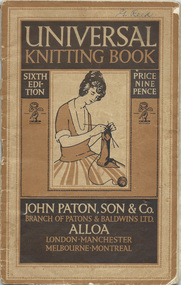
Booklet - 'Universal Knitting Book' Paton, John Paton, Son & Co. 6th Edition 1923, c1923
... commercial knitting machines. The two companies merged in 1920 and diversified into producing wool for home knitters, as well as publishing knitting patterns under the "Patons Rose" and "Baldwins Beehive" trademark. By the mid-1930s, the company had establishments...commercial knitting machines. The two companies merged in 1920 and diversified into producing wool for home knitters, as well as publishing knitting patterns under the "Patons Rose" and "Baldwins Beehive" trademark. By the mid-1930s, the company had establishments ...Gladys Reed was a member of the Ormond Choral Society c 1950. who performed plays and musicals the City of Moorabbin and she was skilled in hand knitting, crochet and dressmaking. Her garments were used by her family and the Ormond Choral Society . Patons' & Baldwin Ltd began as two separate companies: J & J Baldwin and Partners, founded in the late 1770s by James Baldwin of Halifax, West Yorkshire, England, and John Paton Son & Co., founded in 1814 by John Paton of Alloa, Scotland. Both men had formed their businesses using the spinning mule developed by Samuel Crompton. They mainly produced yarns for commercial knitting machines. The two companies merged in 1920 and diversified into producing wool for home knitters, as well as publishing knitting patterns under the "Patons Rose" and "Baldwins Beehive" trademark. By the mid-1930s, the company had establishments across Scotland and Northern England, Canada, New Zealand, Launceston, Tasmania, Australia. The company branched out into various related lines of business, and the development of new products such as nylon and Terylene. In 1961, the company was merged with J & P Coats Ltd. The Patons trademark is still in use today.The yarn production facility at Alloa was closed in 1999 and the large factory in Launceston, Tasmania, Australia,closed in 1997. In 1952 J. & P. Coats and the Clark Thread Co. merged.and in 1961 a merger with Patons and Baldwins created Coats Patons. In 2015 the business returned to the market as "Coats Group".Patons' knitting books have been used by hand knitters in many countries since they were published early in 20thC Gladys Reed and other residents of the City of Moorabbin used these pattern guides to make clothing for their families and community c1950A printed paper booklet with 64 pages of knitting and crochet patterns, instructions, photographs bound by 2 metal staplesFront Cover ; UNIVERSAL/ KNITTING BOOK / SIXTH / ED / ITION / PRICE / NINE / PENCE / Photo of lady knitting / Trade Mark / JOHN PATON, SON & CO. / BRANCH OF PATONS & BALDWINS LTD. / ALLOA / LONDON, MANCHESTER / MELBOURNE / MONTREAL Written top right ; G Reed Back Cover ; Trade Mark / Registered / THIS TRADE MARK / IS YOUR GUARANTEE / WHEN BUYING / PATONS' ALLOA / KNITTING WOOLS knitting, crochet, craftwork, john paton son & co., baldwin j &j ltd, aloa scotland, launceston tasmania, melbourne, knitting mills, knitting books, coates j&p ltd, early settlers, moorabbin shire, mechanics institute cheltenham, ormond choral society, postworld war 11 settlers, housing estates moorabbin 1950, bentleigh, ormond, moorabbin, cheltenham, drama societies, musical society cheltenham, clark judy, reed gladys, reed george -
 Bendigo Military Museum
Photograph - CSP In-house Bid Announcement, Army Survey Regiment, Fortuna, Bendigo, 1994
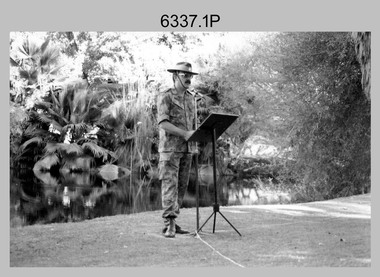
... At this meeting CO LTCOL Duncan Burns announced that under Defence’s Commercial Support Program (CSP), the In-House bid submitted in 1993 by a team led by then CO LTCOL Bob McHenry was successful. The In-House bid proposed the establishment...At this meeting CO LTCOL Duncan Burns announced that under Defence’s Commercial Support Program (CSP), the In-House bid submitted in 1993 by a team led by then CO LTCOL Bob McHenry was successful. The In-House bid proposed the establishment ...This is a set of 14 photographs of an All-Staff meeting held by the lake at the Army Survey Regiment, Fortuna, Bendigo on the 24th of April 1994. At this meeting CO LTCOL Duncan Burns announced that under Defence’s Commercial Support Program (CSP), the In-House bid submitted in 1993 by a team led by then CO LTCOL Bob McHenry was successful. The In-House bid proposed the establishment of an organisation based at Fortuna to carry out non-core production with 150 of the 373 Survey Corps positions converted to Defence civilian positions. 110 of the Defence civilian positions would be filled voluntarily by military personnel under Section 81B of the Public Service Act 1992 with the remaining 40 positions filled by Public Service recruitment. Other options offered to Survey Corps personnel were postings to 1st Topographic Survey Squadron in Enoggera, QLD, transfer to another Corps in the Australian Army or discharge from the ADF. The In-House bid also proposed 143 Survey Corps military positions to remain at Fortuna to perform ‘core strategic non-sovereign tasks.’ However, Army subsequently decided to abolish the 143 positions, disband 4th Field Survey Squadron, Adelaide, SA and lastly, the demise of the Royal Australian Survey Corp in June 1996. This period of the Army Survey Regiment’s history is covered in more detail in pages 160 to 162 of Valerie Lovejoy’s book 'Mapmakers of Fortuna – A history of the Army Survey Regiment’ ISBN: 0-646-42120-4.This is a set of 14 photograph of an All-Staff Meeting held at the Army Survey Regiment, Fortuna, Bendigo on the 24th of April 1994, to announce the success of Army’s Defence’s Commercial Support Program (CSP) In-house Bid. The Black and white photos are on photographic paper and scanned at 300 dpi. They are part of the Army Survey Regiment’s Collection. .1) to .3) - Photo, black & white, 1994. CO LTCOL Duncan Burns briefing Army Survey Regiment personnel and civilians. .4) to .5P - Photo, black & white, 1994. D-SVY COL Simon Lemon briefing Army Survey Regiment personnel and civilians. .6) - Photo, black & white, 1994. L to R: D-SVY COL Simon Lemon, unidentified civilian. .7) - Photo, black & 1994. L to R: SCMA WO1 Alan Hancox, unidentified civilian. .8) - Photo, black & 1994. RSM WO1 Phil Meagher. .9) - Photo, black & 1994. WO2 Rob Bogumil. .10) - Photo, black & 1994. Left Row: all unidentified. Centre Row L to R: unidentified (x2), SGT Jim Ash, CPL Steve Linane, CPL Andrew Quin, SGT Craig Kellet, unidentified. Back row L to R: unidentified (x2), SGT Barry Miller, SSGT Steve Winner, SPR Shane Campbell, SPR Karen McQuaigue, CPL Geoff Webb. .11) - Photo, black & 1994. L to R: CPL Warren ‘Waldo’ Shirley, COL COMDT COL Don Swiney MBE. .12) - Photo, black & 1994. L to R: LT Scott Seefeld, CAPT Bin Fashar Sutiman (Indonesian Army), LT Darren Radford, CAPT Gary Warnest, unidentified US exchange officer. .13) - Photo, black & 1994. L to R: unidentified, SGT Mark Host, LT Anthony Chamberlayne, unidentified (x2), Mr Tony Spurling. .14) - Photo, black & 1994. L to R: unidentified US exchange officer, CAPT Bill Griggs, CAPT Matt Jackson CSM, LT Darren Radford, unidentified, LT Scott Seefeld, SGT Mark Host, LT Gordon Muir, CAPT Gary Warnest, LT Anthony Chamberlayne, unidentified (x2), LT Colin Davidson.No personnel are identified. Annotated with date on folder sleeve.royal australian survey corps, rasvy, army svy regt, army survey regiment, fortuna, asr -
 Bendigo Military Museum
Administrative record - Army Survey Regiment Minute - Activity Changes at Fortuna, Army Survey Regiment, 10.03.1995
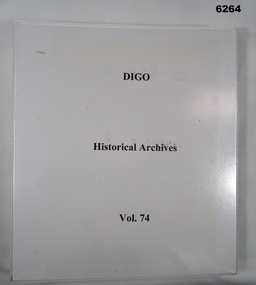
... Commercial Support Programme. The new organisation to be called "The Army Topographical Support Establishment" (ATSE). contains information concerning the transition from an Army to a civilian establishment including the proposed manning and pay rates. ...Commercial Support Programme. The new organisation to be called "The Army Topographical Support Establishment" (ATSE). contains information concerning the transition from an Army to a civilian establishment including the proposed manning and pay rates. ...A 'Minute' paper describing the Army Activity Changes at Fortuna as a result of the Commercial Support Programme. The new organisation to be called "The Army Topographical Support Establishment" (ATSE). contains information concerning the transition from an Army to a civilian establishment including the proposed manning and pay rates. The other items in the folder are listed under the Notes heading.A4 Paper in a Manilla folder with an "Arnos" fastener, 6 x pages. This is one of 23 miscellaneous documents in a four-ring binder. Items are listed "A to V" under this item number 6264. The binder is labelled DIGO Historical Archives Vol 74.royal australian survey corps, rasvy, fortuna, army survey regiment, army svy regt, asr, army topographical support establishment, atse -
Glen Eira Historical Society
Article - Grand Union Tramway Junction, Balaclava Road and Hawthorn Road
... Prahran and Malvern Tramways Trust Caulfield Leader Bayside Weekly Tooke Craig Tourist attractions Grand Union Tramways Junction Caulfield Junction Cable Car Tramways Tram shelters Building Sheds Alma Road Orrong Road Caulfield Electric Line Balaclava Junction Elsternwick Railway Station Caulfield station Caulfield Station loop Tram services Transport establishments Thoroughfares Buildings Structures Establishments Parts of buildings or structures Documents Commercial industry Sites Historic sites Melbourne Bayside Weekly Article Grand Union Tramway Junction, Balaclava Road and Hawthorn Road ...This file contains three items. 1. A three-page Caulfield Conservation Study of the Balaclava Road/Hawthorn Road Tramway Crossing, undertake by Andrew Ward and dated September 1994. Study includes a brief history of the junction and a statement of significance. Study also includes Four black and white photographs of the junction and of architectural details of the tram tracks. 2. A letter from the Conservation Manager of the National Trust of Australia (Victoria) to the manager of the Planning Section for the City of Glen Eira, dated 15/06/2001 and attached to a six-page Classification Report. The letter informs of the Classification of the Grand Union Junction at the intersection of Balaclava and Hawthorn Road by the national trust, signed by Conservation Manager Ian Pausacker. Classification Report includes details such as the date of construction, a statement of significance, history of the junction, physical description of the junction and the condition of the junction at the time of writing. Report also includes a map of the Melbourne Tram Network drafted by Keith Kings and dated 01/005/1956, with illustration of the layout of fifteen tram depots, and updated aerial illustration of the Grand Union Junction, and a further map of Melbourne Tramways developed by North Melbourne Electric Tramways and Lighting Co. and Prahran and Malvern Tramways Trust, drafted by Keith Kings and dated January 1914 with illustrations of three tram depots. 3. Two articles from the Caulfield Leader written by Aaron Langmaid and dated 13/02/2007 and the Melbourne Bayside Weekly dated 21/02/2007 written by Joanne Sim, both concerning the Grand Union Junction. The article from the Caulfield Leader includes a picture of Executive Officer of the council of Tramway Museum of Australia Craig Tooke in front of the intersection. The article from the Bayside Weekly includes a picture of a tram passing through the junction and a brief history of the junction and tram network in Caulfield. The article also refers to twp local tram shelters at the intersection of Dandenong Road and Alma Road and also Orrong Road and Balaclava Road.caulfield, caulfield conservation, study, balaclava road, hawthorn road, grand union junction, ward andrew, tramway crossings, transport, acland street, caulfield racecourse, tram tracks, race events, event, tram routes, thorough fares, melbourne and metropolitan tramways board, prahran and malvern tramway trust, prahran and malvern district tramways, caulfield electric tramways, caulfield city council, architectural detail, city of glen eira, balaclava road and hawthorn road intersection, balaclava road and hawthorn road junction, dandenong road, glenhuntly road, four-way tram junctions, access covers darling road, cast metal access covers, hadfields patent, caulfield park, tram systems, tram networks, heritage, tramway heritage, kings keith, tram depots, glenhuntly depot, maps, glen eira, melbourne electric tramways, north melbourne electric tramways and lighting co., prahran and malvern tramways trust, caulfield leader, bayside weekly, tooke craig, tourist attractions, grand union tramways junction, caulfield junction, cable car tramways, tram shelters, building, sheds, alma road, orrong road, caulfield electric line, balaclava junction, elsternwick railway station, caulfield station, caulfield station loop, tram services, transport establishments, thoroughfares, buildings, structures, establishments, parts of buildings or structures, documents, commercial industry, sites, historic sites, melbourne bayside weekly -
Glen Eira Historical Society
Document - Banks in Caulfield
... Banks Banks Mergers Bank Deposits Bank Withdrawals Documents Banking Pass Books Business and Finance Annual Reports Bank Equipment Commercial Equipment Bank Branches Carnegie Carnegie Koornang Road 86 Caulfield East Caulfield East Derby Road 9 Caulfield South Caulfield South Glen Huntly Road 790 Elsternwick Elsternwick Glen Huntly Road 324 Elsternwick Glen Huntly Road 426 Glen Huntly Glen Huntly Glen Huntly Road 1173 Murrumbeena Murrumbeena Murrumbeena Road 59 Ormond Ormond North Road Ormond North Road 553 Garden Vale Caulfield Caulfield West Caulfield Hawthorn Road 242 Commercial Establishments The State Savings Bank of Victoria The State Savings Bank of Victoria Elsternwick Branch The English Scottish and Australian Bank Limited The Australian and New Zealand Bank Limited The Australian and New Zealand Banking Group Limited Document Banks in Caulfield ...This file contains two items. 1. A hand written list of branches of the English, Scottish and Australian Bank Limited and its merger the Australia and New Zealand Banking Group Limited, undated and author unknown. The list records the opening dates of branches in Carnegie, Caulfield East, Caulfield South, Elsternwick, Glen Huntly, Murrumbeena, Ormond, Garden Vale, Caulfield and Caulfield West encompassing years from 1886 to 1927, listing also the merger of the two banks as being in 1970 as well as 1852 as being the founding year of the English, Scottish, and Australian Bank Limited. 2. Three identical Elsternwick State Savings Bank withdrawal slips, from the 1910s. All three are blank, and include brief directions for filling in the slip typed at the bottom. Also included on the slip is a decorative illustration.banks, banks mergers, bank deposits, bank withdrawals, documents, banking, pass books, business and finance, annual reports, bank equipment, commercial equipment, bank branches, carnegie, carnegie koornang road 86, caulfield east, caulfield east derby road 9, caulfield south, caulfield south glen huntly road 790, elsternwick, elsternwick glen huntly road 324, elsternwick glen huntly road 426, glen huntly, glen huntly glen huntly road 1173, murrumbeena, murrumbeena murrumbeena road 59, ormond, ormond north road, ormond north road 553, garden vale, caulfield, caulfield west, caulfield hawthorn road 242, commercial establishments, the state savings bank of victoria, the state savings bank of victoria elsternwick branch, the english scottish and australian bank limited, the australian and new zealand bank limited, the australian and new zealand banking group limited -
 Glen Eira Historical Society
Album - Album page, Koornang Road, Circa 1972
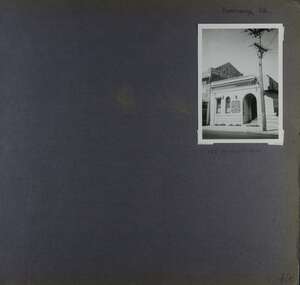
... All photographs are black and white except where stated, with 386 photographs over 198 pages. 1970 Sands & McDougall Directory shows UFS Dispensary at address. trevor hart koornang road carnegie rosstown dispensary pharmacies shops commercial establishments ufs dispensary arches Handwritten: Koornang Rd [top right] / 162 KOORNANG RD [under photo] / 106 [bottom right] Page 106 of Photograph Album with one photograph (portrait) of a pharmacy on Koornang Road. ...This photograph is part of the Caulfield Historical Album 1972. This album was created in approximately 1972 as part of a project by the Caulfield Historical Society to assist in identifying buildings worthy of preservation. The album is related to a Survey the Caulfield Historical Society developed in collaboration with the National Trust of Australia (Victoria) and Caulfield City Council to identify historic buildings within the City of Caulfield that warranted the protection of a National Trust Classification. Principal photographer thought to be Trevor Hart, member of Caulfield Historical Society. Most photographs were taken between 1966-1972 with a small number of photographs being older and from unknown sources. All photographs are black and white except where stated, with 386 photographs over 198 pages. 1970 Sands & McDougall Directory shows UFS Dispensary at address.Page 106 of Photograph Album with one photograph (portrait) of a pharmacy on Koornang Road.Handwritten: Koornang Rd [top right] / 162 KOORNANG RD [under photo] / 106 [bottom right]trevor hart, koornang road, carnegie, rosstown, dispensary, pharmacies, shops, commercial establishments, ufs dispensary, arches -
 Kiewa Valley Historical Society
Saucer Ceramic, circa 1940's to 1950's
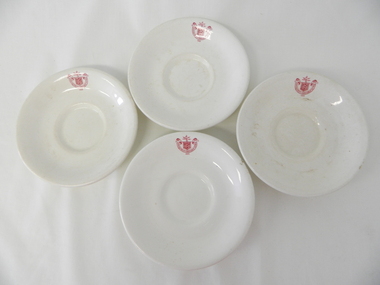
... commercial use, was imported from "mother" England. This scenario was more so for governmental bodies such as rail, jails and electricity providers than domestic users. The influx of cheaper Asian crockery had not yet begun. This type of crockery item was used by the thousands of SEC Victorian staff and construction workers involved in the building of the Kiewa Hydro Electricity Scheme, over the extensive period (1938 to 1961). This was a period when Government bodies and other semi- government organisations were still tied to the "establishments ...This item was used by the State Electricity Commission of Victoria in their mess rooms for their workers during the construction of the Kiewa Hydro Electricity Scheme. The imprint of the year "1921" was to identify the year that the SECV was formed and relieved the private VHEC (Victorian Hydro-Electric Company). As the scheme was of such a huge, isolated and time consuming nature the feeding of its workers was quite demanding of cutlery and crockery. The use of sturdy English cups and saucers was essential. The period of construction and the isolation of the Kiewa Valley area placed heavy demand for "solid" crockery that could wear abusive handling. This period in time was one when crockery, whether for domestic or commercial use, was imported from "mother" England. This scenario was more so for governmental bodies such as rail, jails and electricity providers than domestic users. The influx of cheaper Asian crockery had not yet begun.This type of crockery item was used by the thousands of SEC Victorian staff and construction workers involved in the building of the Kiewa Hydro Electricity Scheme, over the extensive period (1938 to 1961). This was a period when Government bodies and other semi- government organisations were still tied to the "establishments" of "mother" England. It was a period in Australia's development when the Asian influence was very weak and the established ties to England and Europe was still very strong. The majority of heavy equipment and machinery was either made in England or Europe. Local/European expertise in dam construction and water management in alpine terrain came from migrants or specially recruited English and Europe specialists. The quality of workmanship from big steel manufacturing plants in England and Europe could not be matched from anywhere else in the developed world.This item is a white ceramic State Electricity Commission Of Victoria saucer (tea /coffee). It is made in England and is of strong and durable ceramic. The bottom cup indent is for either tea or coffee cups of a similar ceramic structure. The 5mm thickness of the ceramic suggests this saucer belongs to a commercial kitchen environment and not domestic. The indent bottom of the saucer is 5mm deep with a side curvature ratio of 2:5. The ceramic is glazed to a commercial standard (worker's mess). See also KVHS 0128 (B to D)The seal of the State Electricity Commission Of Victoria is imprinted on the top inside rim within a curved scroll. Snuggled within the borders of the scroll is a banner with the five stars of the southern cross and an arm with a closed fist projecting from the top with five lightning bolts projecting outwards. On the underside "Vitrified sold by Cafe & Hotel Supplies Pty Ltd Dunn Bennett & Co. Ltd. Burslem Made in England"saucer, plate, secv, state electricity commission of victoria, crockery, mt beauty chalet, bogong mess hall -
 Kiewa Valley Historical Society
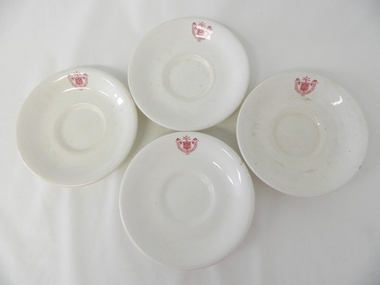
Saucer Ceramic, from 1921 to 1961
... commercial use, was imported from "mother" England. This scenario was more so for governmental bodies such as rail, jails and electricity providers than domestic users. The influx of cheaper Asian crockery had not yet begun. This type of crockery item was used by the thousands of SEC Victorian staff and construction workers involved in the building of the Kiewa Hydro Electricity Scheme, over the extensive period (1938 to 1961). This was a period when Government bodies and other semi- government organisations were still tied to the "establishments ...This item was used by the State Electricity Commission of Victoria in their mess rooms for their workers during the construction of the Kiewa Hydro Electricity Scheme. The imprint of the year "1921" was to identify the year that the SECV was formed and relieved the private VHEC(Victorian Hydro-Electric Company). As the scheme was of such a huge, isolated and time consuming nature the feeding of its workers was quite demanding of cutlery and crockery. The use of sturdy English cups and saucers was essential. The period of construction and the isolation of the Kiewa Valley area placed heavy demand for "solid" crockery that could wear abusive handling. This period in time was one when crockery, whether for domestic or commercial use, was imported from "mother" England. This scenario was more so for governmental bodies such as rail, jails and electricity providers than domestic users. The influx of cheaper Asian crockery had not yet begun.This type of crockery item was used by the thousands of SEC Victorian staff and construction workers involved in the building of the Kiewa Hydro Electricity Scheme, over the extensive period (1938 to 1961). This was a period when Government bodies and other semi- government organisations were still tied to the "establishments" of "mother" England. It was a period in Australia's development when the Asian influence was very weak and the established ties to England and Europe was still very strong. The majority of heavy equipment and machinery was either made in England or Europe. Local/European expertise in dam construction and water management in alpine terrain came from migrants or English and European specialist. The quality of workmanship from big steel manufacturing plants in England and Europe could not be matched from anywhere else in the developed world.This item is a white ceramic saucer (tea /coffee). It is made in England and is of strong and durable ceramic. The bottom cup indent is for either tea or coffee cups of a similar ceramic structure. The 5mm thickness of the ceramic suggests this saucer belongs to a commercial kitchen environment and not domestic. The indent bottom of the saucer is 5mm deep with a side curvature ratio of 2:5. The ceramic is glazed to a commercial standard (worker's mess). See also KVHS 0128 (A,C and D) The seal of the State Electricity Commission Of Victoria is imprinted on the top inside rim within a curved scroll. Snuggled within the borders of the scroll is a banner with the five stars of the southern cross and an arm with a closed fist projecting from the top with five lightning bolts projecting outwards. On the underside "Vitrified sold by Cafe & Hotel Supplies Pty Ltd Dunn Bennett & Co. Ltd. Burslem Made in England"saucer, plate, secv, state electricity commission of victoria, crockery, mt beauty chalet, bogong mess hall -
 Kiewa Valley Historical Society
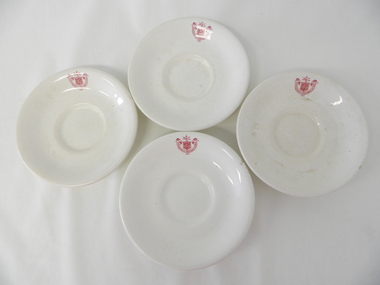
Saucer Ceramic, from 1921 to 1961
... commercial use, was imported from "mother" England. This scenario was more so for governmental bodies such as rail, jails and electricity providers than domestic users. The influx of cheaper Asian crockery had not yet begun. This type of crockery item was used by the thousands of SEC Victorian staff and construction workers involved in the building of the Kiewa Hydro Electricity Scheme, over the extensive period (1938 to 1961). This was a period when Government bodies and other semi- government organisations were still tied to the "establishments ...This item was used by the State Electricity Commission of Victoria in their mess rooms for their workers during the construction of the Kiewa Hydro Electricity Scheme. The imprint of the year "1921" was to identify the year that the SECV was formed and relieved the private VHEC (Victorian Hydro-Electric Company). As the scheme was of such a huge, isolated and time consuming nature the feeding of its workers was quite demanding of cutlery and crockery. The use of sturdy English cups and saucers was essential. The period of construction and the isolation of the Kiewa Valley area placed heavy demand for "solid" crockery that could wear abusive handling. This period in time was one when crockery, whether for domestic or commercial use, was imported from "mother" England. This scenario was more so for governmental bodies such as rail, jails and electricity providers than domestic users. The influx of cheaper Asian crockery had not yet begun.This type of crockery item was used by the thousands of SEC Victorian staff and construction workers involved in the building of the Kiewa Hydro Electricity Scheme, over the extensive period (1938 to 1961). This was a period when Government bodies and other semi- government organisations were still tied to the "establishments" of "mother" England. It was a period in Australia's development when the Asian influence was very weak and the established ties to England and Europe was still very strong. The majority of heavy equipment and machinery was either made in England or Europe. Local/European expertise in dam construction and water management in alpine terrain came from migrants and specialist recruited from England and Europe. The quality of workmanship from big steel manufacturing plants in England and Europe could not be matched from anywhere else in the developed world.This item is a white ceramic saucer (tea /coffee). It is made in England and is of strong and durable ceramic. The bottom cup indent is for either tea or coffee cups of a similar ceramic structure. The 5mm thickness of the ceramic suggests this saucer belongs to a commercial kitchen environment and not domestic. The indent bottom of the saucer is 5mm deep with a side curvature ratio of 2:5. The ceramic is glazed to a commercial standard (worker's mess). See also KVHS 0128 ( A,B&D)The seal of the State Electricity Commission Of Victoria is imprinted on the top inside rim within a curved scroll. Snuggled within the borders of the scroll is a banner with the five stars of the southern cross and an arm with a closed fist projecting from the top with five lightning bolts projecting outwards. On the underside "Vitrified sold by Cafe & Hotel Supplies Pty Ltd Dunn Bennett & Co. Ltd. Burslem Made in England"saucer, plate, secv, state electricity commission of victoria, crockery, mt beauty chalet, bogong mess hall -
 Kiewa Valley Historical Society
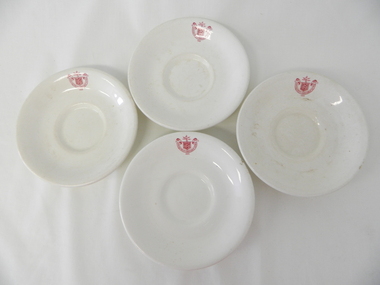
Saucer Ceramic, Circa 1921
... commercial use, was imported from "mother" England. This scenario was more so for governmental bodies such as rail, jails and electricity providers than domestic users. The influx of cheaper Asian crockery had not yet begun. This type of crockery item was used by the thousands of SEC Victorian staff and construction workers involved in the building of the Kiewa Hydro Electricity Scheme, over the extensive period (1938 to 1961). This was a period when Government bodies and other semi- government organisations were still tied to the "establishments ...This item was used by the State Electricity Commission of Victoria in their mess huts/rooms for their workers during the construction of the Kiewa Hydro Electricity Scheme. The imprint of the year "1921" was to identify the year that the SECV was formed and relieved the private VHEC (Victorian Hydro-Electric Company). As the scheme was of such a huge, isolated and time consuming nature the feeding of its workers was quite demanding of cutlery and crockery. The use of sturdy English cups and saucers was essential. The period of construction and the isolation of the Kiewa Valley area placed heavy demand for "solid" crockery that could wear abusive handling. This period in time was one when crockery, whether for domestic or commercial use, was imported from "mother" England. This scenario was more so for governmental bodies such as rail, jails and electricity providers than domestic users. The influx of cheaper Asian crockery had not yet begun.This type of crockery item was used by the thousands of SEC Victorian staff and construction workers involved in the building of the Kiewa Hydro Electricity Scheme, over the extensive period (1938 to 1961). This was a period when Government bodies and other semi- government organisations were still tied to the "establishments" of "mother" England. It was a period in Australia's development when the Asian influence was very weak and the established ties to England and Europe was still very strong. The majority of heavy equipment and machinery was either made in England or Europe. Local and European expertise in dam construction and water management in alpine terrain came from migrants for England and Europe. The quality of workmanship from big steel manufacturing plants in England and Europe could not be matched from anywhere else in the developed world. These saucers were used in the mess huts including later in the Bogong mess hall and the Mount Beauty Chalet.This item is a white ceramic saucer (tea /coffee). It is made in England and is of strong and durable ceramic. The bottom cup indent is for either tea or coffee cups of a similar ceramic structure. The 5mm thickness of the ceramic suggests this saucer belongs to a commercial kitchen environment and not domestic. The indent bottom of the saucer is 5mm deep with a side curvature ratio of 2:5. The ceramic is glazed to a commercial standard (worker's mess). See also KVHS 0128 (A to C)The seal of the State Electricity Commission Of Victoria is imprinted on the top inside rim within a curved scroll. Snuggled within the borders of the scroll is a banner with the five stars of the southern cross and an arm with a closed fist projecting from the top with five lightning bolts projecting outwards. On the underside "Vitrified sold by Cafe & Hotel Supplies Pty Ltd Dunn Bennett & Co. Ltd. Burslem Made in England"saucer, plate, secv, state electricity commission of victoria, crockery, mt beauty chalet, bogong mess hall -
 Kiewa Valley Historical Society
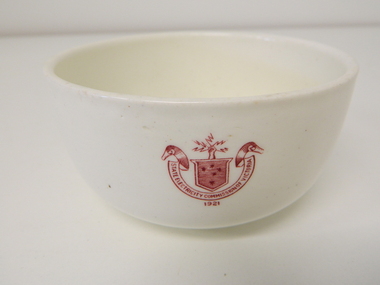
Bowl Ceramic, circa mid to late 1900's
... commercial use, was imported from "mother" England. This scenario was more so for governmental bodies such as rail, jails and electricity providers than domestic users. The influx of cheaper Asian crockery had not yet begun. This type of crockery item was used by the thousands of SEC Victorian staff and construction workers involved in the building of the Kiewa Hydro Electricity Scheme, over the extensive period (1938 to 1961). This was a period when Government bodies and other semi- government organisations were still tied to the "establishments ...This bowl was used by the State Electricity Commission of Victoria in their mess rooms for their workers during the construction of the Kiewa Hydro Electric Scheme. The imprint of the year "1921" was to identify the year that the SECV was formed which relieved the private VHEC (Victorian Hydro-Electric Company). As the scheme was of such a huge scope, isolated and time consuming nature, the feeding of its workers was quite demanding of cutlery and crockery. The use of sturdy English cups and saucers was essential. The period of construction and the isolation of the Kiewa Valley area placed heavy demand for "solid" crockery that could wear abusive handling. This period in time was one when crockery, whether for domestic or commercial use, was imported from "mother" England. This scenario was more so for governmental bodies such as rail, jails and electricity providers than domestic users. The influx of cheaper Asian crockery had not yet begun.This type of crockery item was used by the thousands of SEC Victorian staff and construction workers involved in the building of the Kiewa Hydro Electricity Scheme, over the extensive period (1938 to 1961). This was a period when Government bodies and other semi- government organisations were still tied to the "establishments" of "mother" England. It was a period in Australia's development when the Asian influence was very weak and the established ties to England and Europe was still very strong. The majority of heavy equipment and machinery was either made in England or Europe. Local/European expertise in dam construction and water management in alpine terrain came from migrants and specialist recruited from England and Europe. The quality of workmanship from big steel manufacturing plants in England and Europe could not be matched from anywhere else in the developed world.This item is a white ceramic State Electricity Commission of Victoria bowl. It is made in England and is of strong and durable ceramic. The 5mm thickness of the ceramic suggests this bowl (cereal/soup) belongs to a commercial kitchen environment and not domestic. The indent bottom of the bowl is 5mm deep with a side curvature ratio of 2:5. The ceramic is glazed to a commercial standard (worker's mess). See also KVHS 0128 (B to D) for other ceramic crockery. The seal of the State Electricity Commission of Victoria is imprinted on the top outside rim within a curved scroll and a raised fist with electrical "charges" extending out.. Snuggled within the borders of the scroll is a banner with the five stars of the Southern Cross . On the underside "Vitrified sold by Cafe & Hotel Supplies Pty Ltd Dunn Bennett & Co. Ltd. Burslem Made in England"ceramic crockery, plate, secv, state electricity commission of victoria, crockery, mt beauty chalet, bogong mess hall -
 Kiewa Valley Historical Society
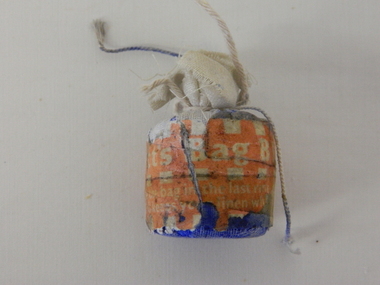
Bag Whitening Agent Reckitts, circa early 1900s
... The anti establishment revolt came later in the 1950's onward took longer to migrate from the cities and larger rural townships to eventually sneak into the Kiewa valley. domestic and commercial laundries starch and whitening additive washing brightener This "blue bag" is a whitening agent wrapped in flannel or muslin, or sold ready bagged (1 ounce).It was used in the final rinse to "whiten white coloured clothes" The string was used to facilitate finger grip onto the "bag" after the wash had finished for easy removal to stop the hand and other surfaces from being stained by the blue colour residue drips. ...This little bag of "whitener" additive for the washing of white clothes was manufactured in Hull in the United Kingdom mid and later 1900's. The Manufacturer, Ricketts, was one of the first manufacturers to employ women in equal proportions with males (a rarity before 1914). This product was used to improve the appearance of white fabrics. This ability to use a product that would "whiten" clothes chemically rather than the "hard boiling" of clothes was a time saver and a lot easier on the fabrics. This is a boon to rural families where time was of the essence (boiling took time). The blue coloring was introduced because the white colour perception is enhanced by the blue (fadeable and not permanent). The "washing machine industry" of the late 1900's emphasised "whitening" agents that were not so haphazard in producing blue stains, and allowed a "gentle" washing action. This item is very significant in detailing the early 1900's rural household domestic "chore" of washing white clothes to a "social" standard of cleanliness. White shirts were the mark cleanliness that those outside of the family judged the family unit by. The best clothes were worn to church on Sundays. Hard and mostly rural activities/work in the Kiewa Valley encompassing farming, crop cultivation, cattle/sheep and "field work" to do with the SEC Vic Hydro Scheme involved provided a stain prone environment. As appearances, of clothing, was on the whole not significant it was a different scenario at social and religious scenes. The ability to attain "brilliant" white shirts, dresses and bonnets by a less drastic method to that of "boiling" of clothes in vats, was a boon of that "era". The anti establishment revolt came later in the 1950's onward took longer to migrate from the cities and larger rural townships to eventually sneak into the Kiewa valley.This "blue bag" is a whitening agent wrapped in flannel or muslin, or sold ready bagged (1 ounce).It was used in the final rinse to "whiten white coloured clothes" The string was used to facilitate finger grip onto the "bag" after the wash had finished for easy removal to stop the hand and other surfaces from being stained by the blue colour residue drips.domestic and commercial laundries, starch and whitening additive, washing brightener -
 Kiewa Valley Historical Society
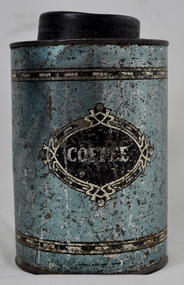
Tin Coffee Cylindrical, circa mid to late 1900's
... establishment of grocery stores in Tawonga and Mount Beauty in the supply of previously "hard to get" groceries. This transition was precipitated by the SEC Vic Hydro Scheme of the 1940's to 1960's which increased the valley's population level three fold. kitchen containers domestic food storage bulk stocks of dried condiments "COFFEE" within an elongated spherical "art deco" four pointed banner of silver and black colouring This cylindrical tin has a pull/push lid(for easy access to the contents). The container is labelled for "coffee" however it has no commercial ...This "coffee" tin has by the "art deco" appearance its origins in the late 1950's to 1960's. This time period was one of accelerated growth both in the physical (housing) sense and the mental (new ideas and inventions) changes in "attitudes". These occurred more rapidly in cities but had its effects on the rural environment. The drinking of coffee was spurred on by easier distribution of imported food and drinks. Advertising by stronger radio links and then by television brought the variety of foods and drinks to semi isolated rural regions. The accessibility through greater information channels becoming available brought with it unbelievable ranges of goods and foodstuffs. Rural regions still relied on bulk supplies and relatively larger storage containers than those in cities. This "bulk" buying and storage "syndrome" was a lingering result of many years of "drought" periods when road transports met delays from flooded roadways in supplying population centres in the Kiewa Valley. The construction phases in building the SEC Vic Hydro electricity Scheme in the eastern sections of the Victorian Alps brought many changes to the quiet rural regions in the Kiewa Valley. Changes in population and social mores. The influx of a varied , mostly temporary, and "European flavoured cuisine" changes the "cuppa tea only" flavour to the have a "coffee break". The subliminal influence of the "American" films changed those children growing up in the post 1950s from the "English tea" to the "American coffee". This "Americanisation process has influenced not only rural Australia but also other areas throughout the world.This "insignificant" coffee tin is very significant as it demonstrates that the Kiewa Valley was becoming more accessible to reliable coffee supplies and general food items.The container was part of a "set" of containers that included tea, sugar,biscuits,flour, rice and other family condiments. This type of kitchen storage containers was brought about through changing patterns in tea and coffee useage and overall consumption. Household demands for faster "self help" cooking especially beveridges and the greater choice of kitchen "utensils" was brought on by easier access to products due to a lessening of the area's "isolation" by having a reliable (all weather) road system and an ever increasing population growth. The need for travelling goods/merchant supply caravans to service the area became a diminishing factor, as a result of the establishment of grocery stores in Tawonga and Mount Beauty in the supply of previously "hard to get" groceries. This transition was precipitated by the SEC Vic Hydro Scheme of the 1940's to 1960's which increased the valley's population level three fold.This cylindrical tin has a pull/push lid(for easy access to the contents). The container is labelled for "coffee" however it has no commercial manufacturer's label to establish that it was bought with coffee ingredients in it. The majority of the container's external surface has a "metallic" light blue colour with two sets of silver rings confining black (horizontal spotted) rectangles. "COFFEE" within an elongated spherical "art deco" four pointed banner of silver and black colouringkitchen containers, domestic food storage, bulk stocks of dried condiments -
Bendigo Historical Society Inc.
Administrative record - Commercial Egg Producers' Association of Victoria (CEPA) Central Council Correspondence, 1978
... Commercial Egg Producers Association of Victoria to the Minister of Agriculture. Farmers are frustrated by the excessive amount of statistical forms they are required to complete. 8504.34ae The document is a formal letter proposing the establishment of a Liaison Committee at the Diagnostic Centre. 8504.34af The document is a formal letter addressing the need for improved egg unloading facilities at grading floors in Bendigo. ...Commercial Egg Producers Association of Victoria to the Minister of Agriculture. Farmers are frustrated by the excessive amount of statistical forms they are required to complete. 8504.34ae The document is a formal letter proposing the establishment of a Liaison Committee at the Diagnostic Centre. 8504.34af The document is a formal letter addressing the need for improved egg unloading facilities at grading floors in Bendigo. ...The Commercial Egg Producers' Association of Victoria was active by the 1930s, engaging in industry management and lobbying.The Commercial Egg Producer's Association (CEPA) had branches in Bendigo, South Bendigo, Eaglehawk, Wedderburn, Murrabit and Euroa.CEPA Commercial Egg Producer's Association (Bendigo Region) correspondence, for the year 1978. This item includes the following documents: 8504.34a The Commercial Egg Producers' Association of Victoria conference agenda December 1978 8504.34b Notice of half yearly Conference Dec 1978 8504.34c A letter congratulating Mr. Tom Austin on his appointment to the Cabinet. 8504.34d A formal letter from the Secretary of an association, K. Fitzgibbon, addressed to the Chairman of the Beef and Meat Enquiry. The key points are:Purpose: The association is inquiring about the possibility of submitting evidence to the Beef and Meat Enquiry. 8504.34e This document is a formal inquiry from the Central Council of the C.E.P.A. to the Australian Wheatgrowers Federation regarding wheat storage for egg producers near Bendigo. The key points are:The Central Council is requesting information about arrangements for holding wheat for egg producers within 40 km of Bendigo. 8504.34f A recommendation letter made to submit information to the Senate Standing Committee on National Resources regarding the adequacy of quarantine and control measures for protecting Australia's pastoral industries from exotic livestock and plant diseases. 8504.34g The document is a letter from the Commercial Egg Producers' Association of Victoria to the Victorian Egg Marketing Board, expressing concerns about rumored changes to payment schedules for egg producers. 8504.34h The document is a protest letter from an association representing small poultry producers regards Rising Government Charges and License Fees 8504.34i This document to the Department of agriculture highlights concerns from a conference regarding the insufficient penalties for non-compliance with the Hen Quota regulations in Victoria. 8504.34j This document is a formal correspondence dated July 17, 1978, from K. Fitzgibbon (Secretary) to Mr. J. Bourchier at Hills Bazaar, Bendigo. 8504.34k This document is a formal letter from K. Fitzgibbon (Secretary) to Mr. D. McClure, M.L.A., enclosing copies of two letters previously sent to Mr. Wishart, Director General of the Department of Agriculture. The correspondence follows a recent conference and is intended to keep Mr. McClure informed of communications with the Department of Agriculture. 8504.34l This document is a formal letter dated July 17, 1978, from K. Fitzgibbon (Secretary) to Mr. F. Grimwade, M.L.A. 8504.34m This document is a formal letter from K. Fitzgibbon (Secretary) to Mr. W. Ebery, M.L.A., dated July 17, 1978. The main points are:The letter transmits copies of two letters that were sent to Mr. Wishart, Director General of the Department of Agriculture. 8504.34n This document is a formal correspondence dated July 17, 1978, from K. Fitzgibbon (Secretary) to Mr. B. Reid, M.L.C. The key points are:The letter encloses copies of two letters previously sent to Mr. Wishart, Director General of the Department of Agriculture. 8504.34o This document is a formal letter from K. Fitzgibbon (Secretary) to Mr. S. McDonald, dated July 17, 1978. The key points are:The letter serves as a cover note, enclosing copies of two letters sent to Mr. Wishart, Director General of the Department of Agriculture. 8504.34p This document is a formal inquiry from the Poultry Industry Association to the Diagnostic Centre regarding the establishment of a Liaison Committee. A panel of representatives from the Poultry Industry Association is provided for the committee, including Broadbent, J. Scott, R. Stephens, and Fitzgibbon. 8504.34q The document is a letter from the Commercial Egg Producers Association of Victoria, advocating for the introduction of a standardized Stock Feed Wheat Price across Australia 8504.34r The document provides a contact and organizational listing for the Commercial Egg Producers' Association of Victoria. 8504.34s The document is a formal letter from the Commercial Egg Producers' Association of Victoria to the Grains Division of the Victorian Farmers' Union 8504.34t This document is a formal letter from the Commercial Egg Producers' Association of Victoria, addressed to the Minister of Agriculture, nominating candidates for vacancies on the Victorian Egg Marketing Board. 8504.34u Meeting Announcement of the annual Central Council meeting 8504.34v The document outlines the agenda for a commercial egg producers' conference, highlighting several industry concerns and proposals 8504.34w This document is a letter from the Secretary of the Commercial Egg Producers Association of Victoria to the N.S.W. Egg Marketing Board. Concern about N.S.W. egg quotas - The Association believes N.S.W. has not reduced its egg quotas to the appropriate level 8504.34x The letter is a protest regarding the Victorian Egg Marketing Board's decision to transfer the Sympag License at Kangaroo Flat to Crystal Egg Co. in Bendigo. 8504.34y The document is a formal letter from an association to the Victorian Egg Marketing Board, requesting a review and potential increase in the prices for 2nd grade eggs. 8504.34z The Commercial Egg Producers Association requests that Agricultural Officers receive periodic refresher training, specifically for procedures like blood sampling. 8504.34aa This document is a formal complaint from an association addressed to the manager of Crystal Egg Co. The association is concerned that farmers are not receiving their own fillers back after grading. Fillers from one farm may be returned to another farm, rather than to their original owner.The association highlights a potential disease risk if fillers are mixed between farms. 8504.34ab The letter is a formal complaint addressed to the Secretary of the Victorian Egg Marketing Board. The association is concerned that farmers are not receiving their own fillers back after grading. Fillers from one farm may be returned to another farm, rather than to their original owner.The association highlights a potential disease risk if fillers are mixed between farms. 8504.34ac The document is a formal letter from the Commercial Egg Producers Association to the Victorian Egg Marketing Board. The key points are:The Association recommends that all fertile eggs be classified as second quality. This grading is suggested as a precautionary measure to protect market standards. 8504.34ad The document is a formal letter from the Secretary of the Commercial Egg Producers Association of Victoria to the Minister of Agriculture. Farmers are frustrated by the excessive amount of statistical forms they are required to complete. 8504.34ae The document is a formal letter proposing the establishment of a Liaison Committee at the Diagnostic Centre. 8504.34af The document is a formal letter addressing the need for improved egg unloading facilities at grading floors in Bendigo. The Central Council of the Commercial & Producers Association of Victoria discussed concerns about unloading facilities at two grading floors in Bendigo. 8504.34ag Minutes from the the association's half yearly Conference Dec 1978 8504.34ah Minutes from the the association's annual Conference June 1978 8504.34ai Minutes from the the association's Executive Meeting May 1978 8504.34aj Minutes from the the association's half yearly Conference Dec 1977 8504.34ak Minutes from the the association's annual Conference June 1977egg producer's information, correspondence, cepa, commercial egg producers' association -
Bendigo Historical Society Inc.
Administrative record - Commercial Egg Producers' Association of Victoria (CEPA) Central Council Correspondence, 1983
... Bruce Reid confirms receiving a letter and a submission from the Commercial Egg Producers' Association regarding the Victorian Egg Marketing Board's "Dockage Discussion Paper 8504.39aj The document discusses pooling return economy airfare costs for delegates attending an Australian Council of Egg Producers meeting in Sydney.The pooling is based on airfares effective as of October 3, 1983 8504.39ak From the Australian Council of Egg Producers - The document announces the establishment of a Senate Select Committee on Animal Welfare in Australia, outlining its purpose and structure 8504.39al Australian Council of Egg Producers outcomes from the poultry welfare meeting 8504.39am Australian Council of Egg Producers General Meeting Minutes October 1983 8504.39an Australian Council of Egg Producers Objectives and Purposes 8504.39ao This document is a formal letter from David Kennedy, Member for Bendigo in the Victorian Legislative Assembly, addressed to Mr. ...Bruce Reid confirms receiving a letter and a submission from the Commercial Egg Producers' Association regarding the Victorian Egg Marketing Board's "Dockage Discussion Paper 8504.39aj The document discusses pooling return economy airfare costs for delegates attending an Australian Council of Egg Producers meeting in Sydney.The pooling is based on airfares effective as of October 3, 1983 8504.39ak From the Australian Council of Egg Producers - The document announces the establishment of a Senate Select Committee on Animal Welfare in Australia, outlining its purpose and structure 8504.39al Australian Council of Egg Producers outcomes from the poultry welfare meeting 8504.39am Australian Council of Egg Producers General Meeting Minutes October 1983 8504.39an Australian Council of Egg Producers Objectives and Purposes 8504.39ao This document is a formal letter from David Kennedy, Member for Bendigo in the Victorian Legislative Assembly, addressed to Mr. ...The Commercial Egg Producers' Association of Victoria was active by the 1930s, engaging in industry management and lobbying.The Commercial Egg Producer's Association (CEPA) had branches in Bendigo, South Bendigo, Eaglehawk, Wedderburn, Murrabit and Euroa.CEPA Commercial Egg Producer's Association (Bendigo Region) correspondence, for the year 1983. This item includes the following documents: 8504.39a The Commercial Egg Producers' Association of Victoria contacted the office of David Kennedy, M.L.A., regarding eggs purchased by VicRail. 8504.39b From David Kennedy MLA to CEPA re representation. 8504.39c This letter from the Minister of Agriculture to the Secretary of the Commercial Egg Producers' Association of Victoria addresses the following key points:Acknowledgement of Correspondence:The Minister thanks the Association for their letter regarding the Discussion Paper on the proposed Egg Industry Stabilization Bill. 8504.39d This formal letter from the Minister of Agriculture communicates the following: The Governor in Council has officially appointed the Chairman, Deputy Chairman, and two additional Members to the Victorian Egg Marketing Board.The appointments are for various terms of office.The letter follows up on earlier communications regarding these appointments. A statement detailing the specifics of the appointments is included with the letter. 8504.39e From the Minister of Agriculture - outlines the upcoming Victorian Egg Marketing Board's appointment process and communication regarding the Chairman's position. 8504.39f This document is a formal letter from the Minister of Agriculture requesting nominations for qualified producers to be appointed to the Victorian Egg Marketing Board. Expiration of Current Terms:The terms of Mr. P. J. Carter and Mr. D. J. Foster as producer members will expire on 30 June 1983. 8504.39g The Victorian Egg Marketing Board shared a report on an experimental trial conducted in Gippsland focusing on Brown Eggs, with plans to discuss findings with producer organizations soon 8504.39h This document is a formal invitation from the Victorian Egg Marketing Board to representatives of the Commercial Egg Producers Association of Victoria. The Board requests a meeting to discuss several important industry issues: Egg Pricing and Cost of Production PoliciesReview and discussion of current pricing strategies and production costs affecting the Victorian egg industry.Hen Quotas for 1983/84Consideration of quota allocations for egg-laying hens in the upcoming year.Future Policy for Brown Egg Marketing Evaluation and planning for marketing brown eggs, including insights from recent marketing trials. 8504.39i This document is a formal letter from the Victorian Egg Marketing Board to the Commercial Egg Producers' Association of Victoria. The Board is sending two copies of a sales presenter to the Association for distribution to executives and members. The sales presenter is intended for the retail trade in Victoria.The sales presenter contains all relevant information about the upcoming "Plant-a-Herb" promotion. The Board expects this material will help the Association's executives by consolidating all details in one place.The letter is signed by Selwyn M. Hall, Deputy General Manager, and dated 25th February 1983. 8504.39j The Chairman of the Victorian Egg Marketing Board is circulating information about tenderizing spent hens to industry stakeholders. The letter is addressed to Mr. K. Fitzgibbon, Secretary of the Commercial Egg Producers Association.The purpose is to encourage discussion among producers to potentially gain advantages from this information. 8504.39k This document is a formal letter from the Victorian Egg Marketing Board to the Commercial Egg Producers Association, proposing a meeting to discuss recent industry developments. 8504.39l Various Circulars from the Victorian Egg Marketing Board for during the year 1983 8504.39m The Victorian Egg Marketing Board is inviting the Commercial Egg Producers Association to a meeting to discuss egg pricing.The meeting is scheduled for Thursday, 26th May at 3:30 p.m.The Association may send up to four delegates. 8504.39n Here are the key points from the letter by the Victorian Egg Marketing Board regarding the proposed brown egg marketing scheme 8504.39o This document is a formal invitation from the Victorian Egg Marketing Board for a cocktail reception 8504.39p This letter from the Victorian Egg Marketing Board to the Secretary of the Commercial Egg Producers Association outlines the agenda for an upcoming board meeting scheduled for May 26, 1983. 8504.39q Victorian Egg Marketing Board Meeting Darft Summary of Discussions, May 1983 8504.39r This document is a formal communication from the Victorian Egg Marketing Board addressing concerns about egg cartons not fitting larger eggs. 8504.39s This document is a formal letter from the Department of Agriculture Victoria addressing the staffing and support for the poultry industry in the Bendigo district. The Department acknowledges Mr. Evans' valuable work as a poultry officer.Mr. Evans has been promoted to Assistant Principal Officer, Poultry Industry Services, and will continue contributing to the industry, eventually relocating to Melbourne. 8504.39t The document is a formal response from the Poultry Farmer Licensing Review Committee regarding a complaint about illegal hen quota transfer and egg trade matters. 8504.39u This document is an invitation and agenda overview for the 1983 Annual Conference of the Victorian Farmers & Graziers Association (VFGA) Egg Producers Group. 8504.39v The document is a formal letter from the Crystal Egg Company addressing industry concerns and operational updates. 8504.39w The document is a formal letter from Crysta Egg Company to the Commercial Egg Producers Association proposing a new system for grading fee increases. 8504.39x The Chrystal Egg Company has held extensive discussions with egg producers about increasing grading charges, as the last increase was in November 1981.The timing and size of the increase were considered, with efforts to minimize the impact on producers, especially due to drought-related feed price increases.The introduction of a sliding scale for service fees, effective July 11th, 1982, means larger consignments will have lower per-dozen fees, while smaller consignments will pay higher rates. 8504.39y The document is a formal letter from the Crystal Egg Company addressing operational challenges related to egg collection and grading schedules 8504.39z Crystal Egg Company letter. The document addresses concerns and recommendations regarding dockage and cartage subsidies for egg producers in Victoria, Australia, specifically focusing on the Bendigo franchise zone. 8504.39aa From Egg Farmers of Victoria: Various News Circulars for the year 1983 8504.39ab This document is a formal communication from the Victorian Egg Marketing Board regarding the distribution of a discussion paper on grading floors to egg producers and related organizations. 8504.39ac The document outlines the Victorian Egg Marketing Board's considerations and plans regarding egg education and donations to schools 8504.39ad The document outlines plans by the Egg Farmers of Victoria to improve egg production forecasting 8504.39ae Victorian Egg Marketing Board - Office of the Chairman - The document provides detailed surplus figures by grade (in thousands of dozens) for the last three months of the 1982/83 period 8504.39af Egg Farmers of Victoria letter - The Board is addressing inefficiencies and unnecessary costs related to egg dockage, specifically unnecessary double handling and excessive cartage of eggs. 8504.39ag This document is a formal letter from a Member of the Legislative Council (Mr. Dunn, M.L.C., Member for North Western Province) to Mr. K. Fitzgibbon, Secretary of the Commercial Egg Producers Association of Victoria. The National Party is open to discussing issues raised in the Minister of Agriculture's Discussion Paper on the Egg Industry with the Association. 8504.39ah The Minister of Agriculture, Eric Kent, responds to a letter from Eddie Hann, Deputy Leader of the National Party, regarding a submission by the Commercial Egg Producers' Association. The submission concerns dockage issues and was sent to the Victorian Egg Marketing Board following their discussion paper. 8504.39ai This document is a formal letter from Bruce Reid, a Victorian politician, addressed to Mr. K. Fitzgibbon, Secretary of the Commercial Egg Producers' Association of Victoria. Bruce Reid confirms receiving a letter and a submission from the Commercial Egg Producers' Association regarding the Victorian Egg Marketing Board's "Dockage Discussion Paper 8504.39aj The document discusses pooling return economy airfare costs for delegates attending an Australian Council of Egg Producers meeting in Sydney.The pooling is based on airfares effective as of October 3, 1983 8504.39ak From the Australian Council of Egg Producers - The document announces the establishment of a Senate Select Committee on Animal Welfare in Australia, outlining its purpose and structure 8504.39al Australian Council of Egg Producers outcomes from the poultry welfare meeting 8504.39am Australian Council of Egg Producers General Meeting Minutes October 1983 8504.39an Australian Council of Egg Producers Objectives and Purposes 8504.39ao This document is a formal letter from David Kennedy, Member for Bendigo in the Victorian Legislative Assembly, addressed to Mr. K. Fitzgibbon, Secretary of C.E.P.A. Acknowledgement: David Kennedy thanks Mr. Fitzgibbon for sharing his organization's views on a discussion paper regarding egg industry stabilization.Enclosure: Kennedy includes a letter from Eric Kent, Minister of Agriculture, which discusses a proposed review of transport subsidies for the egg industry. 8504.39ap Notice of The Central Council annual meeting is scheduled for Friday, 17th June 1983 at 1:00 p.m. at City Hall, Bendigo. 8504.39aq This document is a formal letter nominating candidates for two producer vacancies on the Victorian Egg Marketing Board. 8504.39ar The document is a formal letter from the Victorian Egg Marketing Association addressed to the Minister of Agriculture, Hon. Eric Kent. The Association is responding to notification that the current Chairman's term for the Victorian Egg Marketing Board will expire on June 30, 1983. 8504.39as The document is a formal letter from CEPA to the managing director of the Crystal Egg Company, addressing concerns about proposed fee increases. 8504.39at The document is a letter from K. Fitzgibbon, Secretary to the Victorian Egg Marketing Board, expressing opposition to the introduction of brown eggs into the market. 8504.39au To the Minister of Agriculture. CEPA opposes the Victorian Egg Marketing Board's plan to introduce brown eggs in August 1984. 8504.39av The executive meeting minutes of the Commercial Egg Producers Association of Victoria, held on June 10, 1983, focused on discussing proposed principles for an Egg Industry Stabilization policy. 8504.39aw CEPA Half Yearly Conference Nov 1983 Minutes 8504.39ax The document outlines proposed principles and regulations for stabilizing and managing the egg industry, focusing on licensing, quotas, exemptions, and industry funding. 8504.39ay CEPA Annual Conference June 1983 Business Paper 8504.39az CEPA Central Council Executive Meeting Minutes July 1983 8504.39aaa This document is a formal letter from John Bourchier, MP, addressing concerns raised by the Commercial Egg Producers Association regarding diesel rebate policies. The government currently does not plan to change its diesel rebate program, despite concerns from egg producers. 8504.39aab From the Crystal Egg Company letter:Grading Charges and Inflation 8504.39aac This document is a formal response from the Poultry Farmer Licensing Review Committee to a query about alleged illegal hen quota transfers 8504.39aad From the Department of Agriculture Victoria. This departmental letter addresses the staffing and support for the poultry industry in Victoria, focusing on the Bendigo District Centre. 8504.39aae This document outlines the handling and fee policies for Class B egg consignments from the Victorian Egg Marketing Board. 8504.39aaf This document is a formal letter from the Minister of Agriculture to David Kennedy MLA; addressing concerns from the Commercial Egg Producers' Association regarding hen quota transfers and regulations in the egg industry. 8504.39aag This document from the Victorian Egg Marketing Board outlines key industry standards and policies regarding egg handling and regulatory compliance 8504.39aah This document from the Victorian Egg Marketing Board outlines procedures and fees related to egg grading and consignments 8504.39aai This letter from the Minister of Agriculture addresses concerns about interstate egg marketing between Victoria and New South Wales. 8504.39aaj Four page circular 29/83 This document is an invitation and agenda for an egg industry meeting organized by the Victorian Egg Marketing Board, scheduled for April 6, 1983. The meeting focuses on maximizing profits through the production of larger eggs and addresses key industry topics 8504.39aak Notice of CEPA Annual Meeting May 1983 8504.39aal This document is a circular from the Victorian Egg Marketing Board, dated June 3, 1983, discussing dockage costs and egg transport logistics for the 1982/83 period. 8504.39aam The document is a formal statement by the directors of the Commercial Egg Producers' Association Co-operative Limited regarding the financial year ending March 31, 1983 8504.39aan Minutes of the CEPA Annual Conference 17 June 1983 8504.39aao This document is a formal letter from The Federation Insurance Limited to policyholders, outlining important amendments to the Workers' Compensation Act and the resulting responsibilities for employers. 8504.39aap Egg Farmer of Victoria four page newsletter June 1983 8504.39aaq Hand Written Letter to the Victorian Egg Marketing Board titled "Dockage Discussion Paper" from Joan Heard, Secretary CEPA 8504.39aar 11 pages The document proposes legislative reforms to consolidate and modernize the regulation of Victoria's poultry and egg industries. Poultry Industry LegislationConsolidation of LawsCombines the Poultry Processing Act and Broiler Chicken Industry Act into a single Act for streamlined administration. 8504.39aas This document outlines plans by the Egg Farmers of Victoria to improve egg production forecasting through enhanced data collection and computer modeling 8504.39aat This document is a formal letter from the Egg Farmers of Victoria to the Commercial Egg Producers Association regarding production forecasting 8504.39aau This document is a formal letter to the Victorian Egg Marketing Board, along with their relply; expressing concerns from the Bendigo and South Bendigo branches of the C.E.P.A. regarding the company's publicity and sales strategies for microwave oven demonstrations. 8504.39aav Minutes of the Half yearly CEPA Conference 24 Nov 1983 8504.39aaw This document is a letter from John Brumby, Federal Member for Bendigo, to the Minister for Finance. Small primary producers who purchase less than 1,000 litres of diesel fuel per year are not eligible for the diesel fuel rebate, while larger producers are eligible. 8504.39aax From John Cain, Victorian Attorney General, This document outlines the main legal principles regarding trespass 8504.39aay Seven pages. This document is a discussion paper from the Minister of Agriculture regarding egg industry stabilization policies and legislative considerations. The paper is intended to gather feedback from stakeholders in the egg industry on issues related to stabilization policies before drafting new legislation. 8504.39aaz Information sheet. The Central Victoria Group Apprenticeship Scheme is a non-profit organization designed to address the decline in apprentice numbers by providing a flexible, shared apprenticeship model for employers in Central Victoria. 8504.39aaaa This document is a notice for the upcoming meeting of the Coliban Water Investigation Committee, and previous minutes. Tuesday, December 7, 1982 Time: 8:00 p.m.Location: City Hall, Bendigo 8504.39aaab This document is a notice for the upcoming meeting of the Coliban Water Investigation Committee, and previous minutes. Tuesday, Feb 8, 1982 Time: 8:00 p.m.Location: City Hall, Bendigo 8504.39aaac This document is a notice for the upcoming meeting of the Coliban Water Investigation Committee, and previous minutes. Tuesday, Jan 27th 1982 Time: 8:00 p.m.Location: City Hall, Bendigo 8504.39aaad This document provides the essential daily nutrient requirements for laying hens consuming 115 grams of feed per dayegg producer's information, correspondence, cepa, commercial egg producers' association -
Glen Eira Historical Society
Album - Photograph Album, Beauville Estate Album, 2001
... The estate is distinguished by its aesthetic values, as is the earlier and comparable Hillcrest Estate, which are formed by a combination of restrained diversity in house styles, with the exception of no. 30 in the emerging International style, and by a landscaped garden environment. murrumbeena houses beauville avenue architectural styles 1930's inter war style a.v. jennings av jennings jennings brick houses beauville estate murrumbeena road lindsay avenue gloucester court dalny road a v jennings construction co beauville estate heritage area glen eira city council architectural features plans shops residential development tennis courts housing estates builders building regulations local government commercial development history maps photographs commercial establishments jennings group limited land subdivision gardens beauville historic area sir albert victor jennings Colour photographs of house exteriors, as well as parks and tennis courts on the Beauville Estate. ...Originally labelled "Beauville Estate, Established 1936, Still Thriving 65 years on, 10th March 2001", the Beauville Estate Album contains colour photographs of houses in the Estate. They were taken around the time of the Beauville Estate’s 65th Heritage Celebration held on 10/03/2001 and donated to the Caulfield Historical Society shortly afterwards. Photographer Bev Baxter. Glen Eira’s Heritage Management Plan by Andrew Ward (1996) Vol 2 p78 states that by the end of 1934, the first 3 houses had been built in this housing estate.City of Glen Eira’s Heritage Management Plan Vol 2 p79 (p84 of the pdf version) – HO12 Beauville Estate and environs, Murrumbeena: The Beauville Historic Area is important at the State level as the first large housing estate undertaken by the AV Jennings Construction Co, later Jennings Group Limited, Victoria’s largest home builder. It is important also as a very early estate development incorporating a range of features other than houses and including made roads, shops and recreation facilities. In this respect it was the forerunner of the comprehensively planned housing estate of the post war era. The estate is distinguished by its aesthetic values, as is the earlier and comparable Hillcrest Estate, which are formed by a combination of restrained diversity in house styles, with the exception of no. 30 in the emerging International style, and by a landscaped garden environment.Colour photographs of house exteriors, as well as parks and tennis courts on the Beauville Estate. murrumbeena, houses, beauville avenue, architectural styles, 1930's, inter war style, a.v. jennings, av jennings, jennings, brick houses, beauville estate, murrumbeena road, lindsay avenue, gloucester court, dalny road, a v jennings construction co, beauville estate heritage area, glen eira city council, architectural features, plans, shops, residential development, tennis courts, housing estates, builders, building regulations, local government, commercial development, history, maps, photographs, commercial establishments, jennings group limited, land subdivision, gardens, beauville historic area, sir albert victor jennings -
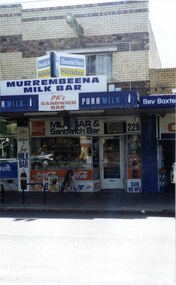 Glen Eira Historical Society
Photograph, Murrumbeena Road, 229, Murrumbeena, 2001
... The estate is distinguished by its aesthetic values, as is the earlier and comparable Hillcrest Estate, which are formed by a combination of restrained diversity in house styles, with the exception of no. 30 in the emerging International style, and by a landscaped garden environment. murrumbeena architectural styles 1930's inter war style a.v. jennings av jennings jennings beauville estate murrumbeena road milk bars commercial establishments flats sir albert victor jennings a v jennings construction co beauville estate heritage area glen eira city council architectural features jennings group limited land subdivision beauville historic area shops brick features window displays advertising signs murrembeena (sic) milk bar MURREMBEENA (sic) MILK BAR / PK's / SANDWICH / BAR / MILK BAR & Sandwich Bar / 229 / SUB NEWS Colour photograph of a section of a double storey, unpainted brick, commercial property containing shops at ground level all with awnings over the footpath. ...Originally labelled "Beauville Estate, Established 1936, Still Thriving 65 years on, 10th March 2001", the Beauville Estate Album contains colour photographs of houses in the Estate. They were taken around the time of the Beauville Estate’s 65th Heritage Celebration held on 10/03/2001 and donated to the Caulfield Historical Society shortly afterwards. Photographer unknown. From Glen Eira’s Heritage Management Plan by Andrew Ward (1996) Vol 2 p78: In Murrumbeena Road, the shops which form part of the estate are a simple cream brick row relieved by manganese bricks in bands across the upper storeys. City of Glen Eira’s Heritage Management Plan Vol 2 p79 (this is p84 of the pdf version) – HO12 Beauville Estate and environs, Murrumbeena: The Beauville Historic Area is important at the State level as the first large housing estate undertaken by the AV Jennings Construction Co, later Jennings Group Limited, Victoria’s largest home builder. It is important also as a very early estate development incorporating a range of features other than houses and including made roads, shops and recreation facilities. In this respect it was the forerunner of the comprehensively planned housing estate of the post war era. The estate is distinguished by its aesthetic values, as is the earlier and comparable Hillcrest Estate, which are formed by a combination of restrained diversity in house styles, with the exception of no. 30 in the emerging International style, and by a landscaped garden environment. Colour photograph of a section of a double storey, unpainted brick, commercial property containing shops at ground level all with awnings over the footpath. This specific property is a milk bar on street level with plate glass windows and door, colourful advertising and "229' in the top right section of the window. Shop signage says "MURREMBEENA MILK BAR". The upper storey brick residence features a large window, a flat roof and decorative two tone banded brickwork. MURREMBEENA (sic) MILK BAR / PK's / SANDWICH / BAR / MILK BAR & Sandwich Bar / 229 / SUB NEWSmurrumbeena, architectural styles, 1930's, inter war style, a.v. jennings, av jennings, jennings, beauville estate, murrumbeena road, milk bars, commercial establishments, flats, sir albert victor jennings, a v jennings construction co, beauville estate heritage area, glen eira city council, architectural features, jennings group limited, land subdivision, beauville historic area, shops, brick features, window displays, advertising signs, murrembeena (sic) milk bar -
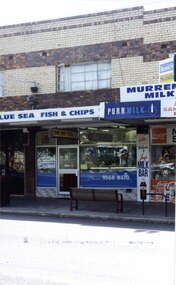 Glen Eira Historical Society
Photograph, Murrumbeena Road, 229A, Murrumbeena, 2001
... The estate is distinguished by its aesthetic values, as is the earlier and comparable Hillcrest Estate, which are formed by a combination of restrained diversity in house styles, with the exception of no. 30 in the emerging International style, and by a landscaped garden environment. murrumbeena architectural styles 1930's inter war style a.v. jennings av jennings jennings beauville estate murrumbeena road milk bars commercial establishments flats fish & chip shops sir albert victor jennings a v jennings construction co beauville estate heritage area glen eira city council architectural features jennings group limited land subdivision beauville historic area brick features restaurants BLUE SEA FISH & CHIPS / TAKE AWAY FOOD Colour photograph of a section of a double storey, unpainted brick, commercial property containing shops at ground level all with awnings over the footpath. ...Originally labelled "Beauville Estate, Established 1936, Still Thriving 65 years on, 10th March 2001", the Beauville Estate Album contains colour photographs of houses in the Estate. They were taken around the time of the Beauville Estate’s 65th Heritage Celebration held on 10/03/2001 and donated to the Caulfield Historical Society shortly afterwards. Photographer unknown. From Glen Eira’s Heritage Management Plan by Andrew Ward (1996) Vol 2 p78: In Murrumbeena Road, the shops which form part of the estate are a simple cream brick row relieved by manganese bricks in bands across the upper storeys.City of Glen Eira’s Heritage Management Plan Vol 2 p79 (this is p84 of the pdf version) – HO12 Beauville Estate and environs, Murrumbeena: The Beauville Historic Area is important at the State level as the first large housing estate undertaken by the AV Jennings Construction Co, later Jennings Group Limited, Victoria’s largest home builder. It is important also as a very early estate development incorporating a range of features other than houses and including made roads, shops and recreation facilities. In this respect it was the forerunner of the comprehensively planned housing estate of the post war era. The estate is distinguished by its aesthetic values, as is the earlier and comparable Hillcrest Estate, which are formed by a combination of restrained diversity in house styles, with the exception of no. 30 in the emerging International style, and by a landscaped garden environment. Colour photograph of a section of a double storey, unpainted brick, commercial property containing shops at ground level all with awnings over the footpath. This specific property is a fish and chip shop. The upper storey brick residence features a curtained window, a flat roof and decorative two tone bands of brickwork. It has a large street seat on the footpath out front.BLUE SEA FISH & CHIPS / TAKE AWAY FOODmurrumbeena, architectural styles, 1930's, inter war style, a.v. jennings, av jennings, jennings, beauville estate, murrumbeena road, milk bars, commercial establishments, flats, fish & chip shops, sir albert victor jennings, a v jennings construction co, beauville estate heritage area, glen eira city council, architectural features, jennings group limited, land subdivision, beauville historic area, brick features, restaurants
