
Showing 87 items matching " district jubilee"
-
 Orbost & District Historical Society
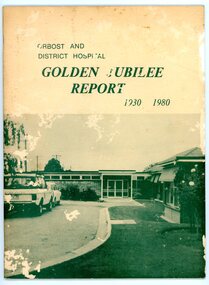
Booklet - Orbost Hospital Report, Mail Print Orbost, ORBOST AND DISTRICT HOSPITAL GOLDEN JUBILEE REPORT 1930-1980, 1980
... ORBOST AND DISTRICT HOSPITAL GOLDEN JUBILEE REPORT 1930-1980...This is a 50 year (Golden Jubilee) report of the Orbost & District Hospital and is a record of an important event for the Orbost District. ...ORBOST AND DISTRICT HOSPITAL GOLDEN JUBILEE REPORT 1930-1980...ORBOST AND DISTRICT HOSPITAL GOLDEN JUBILEE REPORT 1930-1980 Booklet Orbost Hospital Report Mail Print Orbost Orbost & District Hospital ...This is a 50 year (Golden Jubilee) report of the Orbost & District Hospital and is a record of an important event for the Orbost District. The hospital was founded in 1930 after many years of lobbying and fundraising by local people. This booklet contains the names of senior staff and office bearers in 1980. This item is significant because it is a brief record of the first 50 years of the Orbost & District Hospital. It also contains the names of the staff, and office bearers from 1980.This 19 page booklet has a cream cover with black printing on the top section of the cover. The bottom section has a large b/w photograph of buildings and cars. ORBOST AND DISTRICT HOSPITAL GOLDEN JUBILEE REPORT 1930-1980medical services, orbost hospital, golden jubilee -
 Kew Historical Society Inc
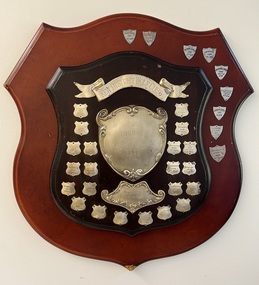
Award, Kew District Wolf Cubs Jubilee Sports Trophy, 1959-1994
... Kew District Wolf Cubs Jubilee Sports Trophy...Engraved: 'Kew District Wolf Cubs / Jubilee Sports Trophy 1958 / Presented by Willsmere Lodge". ...Local and statewide significance to the history of Scouts (&Cubs) in Victoria. scouts - trophies cubs - trophies wolf cubs -- kew (Vic) swimming trophies Engraved: 'Kew District Wolf Cubs / Jubilee Sports Trophy 1958 / Presented by Willsmere Lodge". ...Local and statewide significance to the history of Scouts (&Cubs) in Victoria.Combined inner original [1959] and outer newer [1981] wooden shield(s) with nickel plate (sic) shields listing 31 Kew Cub group winners of swimming competitions from 1959 to 1994 [missing shield for 1983] of the Kew District Wolf Cubs.Engraved: 'Kew District Wolf Cubs / Jubilee Sports Trophy 1958 / Presented by Willsmere Lodge". scouts - trophies, cubs - trophies, wolf cubs -- kew (vic), swimming trophies -
 Merbein District Historical Society
Booklet, Merbein Historian No 27, Mar.2007
... ... District jubilee...Bert Curtis World War 11 Judy Hyde Merbein Memories 1930's District jubilee Bronwyn Zrna Houses Don Kimpton Martha Barraclough Murray River Flood Merbein Bernadette Wells Merbein Historian No 27 Booklet ...bert curtis, world war 11, judy hyde, merbein memories 1930's, district jubilee, bronwyn zrna, houses, don kimpton, martha barraclough, murray river flood merbein, bernadette wells -
 Stawell Historical Society Inc
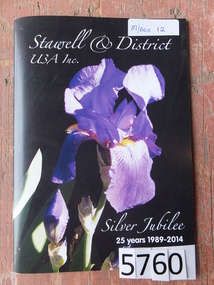
Book, Margo Woodcock, Stawell & District U3A Inc - Silver Jubilee 25 years 1989-2014, 2014
... Stawell & District U3A Inc - Silver Jubilee 25 years 1989-2014...Stawell & District U3A Inc. Silver Jubilee 1989 -2014...A History of the Stawell And District U3A for the first 25 Years stawell education Stawell & District U3A Inc. Silver Jubilee 1989 -2014 Black Card cover with purple Iris on front and Back Stawell & District U3A Inc - Silver Jubilee 25 years 1989-2014 Book Margo Woodcock Hightech Printing ...A History of the Stawell And District U3A for the first 25 YearsBlack Card cover with purple Iris on front and BackStawell & District U3A Inc. Silver Jubilee 1989 -2014stawell education -
Lakes Entrance Historical Society
Book, Auer Valerie, Tubbut - Notes on History of Tubbut district - Prepared for School Jubilee 1941-1991, 1991
... Tubbut - Notes on History of Tubbut district - Prepared for School Jubilee 1941-1991...Tubbut - Notes on History of Tubbut district - Prepared for School Jubilee 1941-1991 Book Auer Valerie ...Notes on the settlement of Tubbut, East Gippsland, Victoria, particularly since 1929 when the Land Board opened this isolated area for selection. Extracts from minutes of Tubbut Hall Committee, reminiscences of school teachers, some photograph.settlers, schools -
 Bendigo Historical Society Inc.
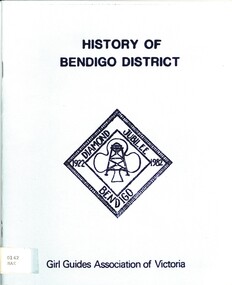
Book - HISTORY OF BENDIGO DISTRICT GIRL GUIDES ASSOCIATION OF VICTORIA DIAMOND JUBILEE, 1982
... HISTORY OF BENDIGO DISTRICT GIRL GUIDES ASSOCIATION OF VICTORIA DIAMOND JUBILEE...'History of Bendigo District - Diamond Jubilee 1922 - 1982, Girl Guides Association of Victoria. ...GIRL GUIDES ASSOCIATION History 1922 - 1982 Bendigo Girl Guides Diamond Jubilee. 'History of Bendigo District - Diamond Jubilee 1922 - 1982, Girl Guides Association of Victoria. ...'History of Bendigo District - Diamond Jubilee 1922 - 1982, Girl Guides Association of Victoria. Researched by Margaret Baker, Bette McLaughlin, Berry Wallace, Agnes Watson, Norma Young. Light blue cover. 33 pages with photos.girl guides association, history, 1922 - 1982, bendigo, girl guides, diamond jubilee. -
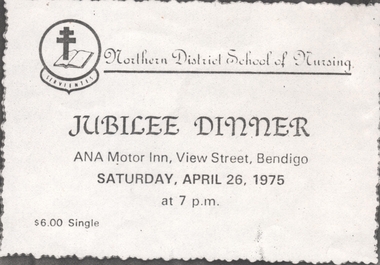 Northern District School of Nursing. Managed by Bendigo Historical Society Inc.
Document - NDSN Staff Nurse Course - photocopy of invitation to NDSN Jubilee Dinner April 1975, 1975
... A photocopy of an invitation to attend the Northern District School of Nursing Jubilee Dinner at the ANA Motor Inn, View Street, Bendigo on Saturday 26 April 1975. ...Nurse Education Nursing administration invitation A photocopy of an invitation to attend the Northern District School of Nursing Jubilee Dinner at the ANA Motor Inn, View Street, Bendigo on Saturday 26 April 1975. ...The Northern District School of Nursing opened in 1950 to address the issues around nurse recruitment, training and education that had previously been hospital based. The residential school was to provide theoretical and in-house education and practical training over three years. The students would also receive practical hands-on training in the wards of associated hospitals. The Northern District School of Nursing operated from Lister House, Rowan Street, Bendigo. It was the first independent school of nursing in Victoria and continued until it closed in 1989.A photocopy of an invitation to attend the Northern District School of Nursing Jubilee Dinner at the ANA Motor Inn, View Street, Bendigo on Saturday 26 April 1975. Price for single attendance at the event is $6.00.nurse education, nursing administration, invitation -
Ringwood and District Historical Society
Container, Ringwood Garden Club Inc - Tub of Artefacts and Documents to be catalogued
... Upwey & District Garden Club, 1977, Jubilee Carnival of Flowers. Ringwood garden Club, Vic. ...Upwey & District Garden Club, 1977, Jubilee Carnival of Flowers. Ringwood garden Club, Vic. ...RINGWOOD GARDEN CLUB INC. The following is a list of items that are stored at the RDHS Archive site, from the Ringwood Garden Club. This box of items does not include all the archival items from the Club, the Minutes will be kept at the home of the Archive Officer. Medal: From the Royal Horticultural Society of Victoria. Won at Box Hill show, in 1978. Badge: An early Ringwood Horticultural & Agricultural Society badge. Old Photograph: “Judging the Fruit Exhibits”, circa 1908. Certificate: 3rd. Prize at the 2009 Hanging Basket Competition, from the R.H.S.V. Shield: From the National Dahlia Society of Victoria, Annual Inter Society Championship In 1975. Won by the then: Ringwood & District Horticultural Garden Club. Tray: The Bill McDowell Perpetual Trophy for Amateur Cut Flowers: winners from 1973 to 1987. Old Photograph: From the Royal Agricultural Society of Victoria, awarded at the Royal Melbourne Show in 1947, First Prize, Ringwood. Certificate: From the Melbourne City Council: Festival of Progress, held in 1951, to Commemorate the Centenary of Victorian Government. Certificate of Merit: from past winners at shows. (5) Certificates: 2 unused Certificates of Merit, 1 unused Champion certificate. Garden Competition Certificates: from 1959 to 1981. Poster: Early Autumn Show poster displayed in shop Windows. Hortico Prize Certificates: 2 unused, $10.00 & $5.00 value. Tape Recording: Recorded history of the Ringwood Garden Club, talk given by the late Hugh McCall on 23/9/1996, Club’s centenary. Prize Cards: 41 First Prize” cards from Mrs. D. Holloway & 27 “Second Prize” cards, from 1956 to 1960. Prize Cards: 2 First Prize & 1 Second Prize card from Mrs. Holloway at the 1st. Heathmont Boy Scouts in 1958. Prize Cards: 4 Prize Cards from the Upwey & District Garden Club. 3 lsts., 12nd. Prize Card: from the Boronia & District H & A. Society: 1st. Prize, (no other information) Prize Card: from the R.H.S.V.: Second Prize for 1 Vase of Daffodils, Mr W Rosel. Prize Card: from the Dandenong Ranges Floral Festival, Easter Show, First Prize, Mrs Holloway in April, 1957 plus a Second Prize, same year. Prize Card: from the Mitcham Horticultural Society, Autumn Show, Mrs Holloway, 1 Bowl of Floating Flowers in 1958. Laminated Certificates: from the Great Victorian Hanging Basket Competition by the R.H.S.V. (no years mentioned) Club Syllabus: from 1980 to 2015. Photographs: from winners at our shows and judges at those shows. Ribbons: Ringwood Horticultural Society, 1962, Champion, Exhibit in Vegetables. Upwey & District Garden Club, 1977, Jubilee Carnival of Flowers. Ringwood garden Club, Vic. Large Dahlia Championships, 1983,6 Dahlias, D.V.’s. National Dahlia Soc. of Vic., Autumn Show, 1975, Inter-Societies Championship. Upwey & District Garden Club, 1980 Carnival of Flowers, Mountain Dist. Cham’s. “ “ “ “ , Spring Show, 1973. “ “ “ “ , Carnival of Flowers, 1984, Inter Society Exhibit. “ “ “ “ , “ “ “ , 1982. Best Exhibit. Healesville Garden Club: Autumn Show, Best Exhibit, Cut Flower Section. Ringwood Garden Club, Autumn Show, 1964, Best Exhibit in Vegetables. Upwey & District Garden Club, 1974 Carnival of Flowers. Ringwood Garden Club, Spring 1986, Best Exhibit in Junior Cookery. Ringwood & District Hort. & Graden Club, Autumn Show, 1974, Best Floral Art. Ringwood garden Club, Autumn 1989, Ringwood Amateur Dahlia Championship, Ringwood Horticultural Society, Autumn Show, 1963, Best Exhibit in Vegetables. Ringwood H & A Society: Autumn Show, 1957, Best Exhibit Floral Art. Ringwood & District Horticultural & Garden Club, Spring Show, 1973, Best Floral Art Exhibit. Upwey & District Garden Club, Carnival of Flowers, 1985. Mountain District Championships, Inter-Society Exhibit. Yarra Glen A. & H. Society Inc. Annual Show: small blue sash-style ribbon. Small Ribbons: from Victoria 150, a second (red) & 3rd. (green) Felt Badges: 1 green for Secretary: 1 blue for Judge. Rosette: 3rd. Prize at the Hanging Basket Competition in 2009. Blue Folder: contains photographs, prize cards, certificates, awards, etc. Albums: 4 photo, albums of garden shows, floral art, Spring Celebration photos and Newspaper articles. * All items placed in the container were placed there on 2nd. September, 2019. -
 Federation University Historical Collection
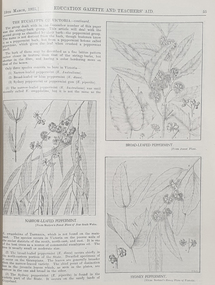
Book, Victoria Education Gazette and Teachers' Aid, 1921-1930, 1921-1930
... Jubilee Exhibition, Domestic Arts, Louis Pasteur, .5) Victoria League of Victoria, An Endowment Scheme (Pine Plantations), School Endowment Plantations, Protecting our trees by Owen Jones,. Victorian State Schools Horticultural Society, Sloyd Woodwork, School Forestry, Thomas Brodribb Obituary and portrait, Imperial Education Conference London, school Management and Method, School plantations, Eucalypt plantations in the Bendix and Heathcote District, Junior Red Cross, Jubilee Education Exhibition, Gould League Competitions, handwriting, The School Magazine, Frank Tate in London, Victorian beetles, Council of Public Education, Villers Bretonneux and its new School, Death of Samuel Summons, Woodwork Summer School, Swimming, Japanese Relief Fund, Retirement of John Cross, reminiscences of the Late Mr Albert Mattingley .6) Thomas H. ...Jubilee Exhibition, Domestic Arts, Louis Pasteur, .5) Victoria League of Victoria, An Endowment Scheme (Pine Plantations), School Endowment Plantations, Protecting our trees by Owen Jones,. Victorian State Schools Horticultural Society, Sloyd Woodwork, School Forestry, Thomas Brodribb Obituary and portrait, Imperial Education Conference London, school Management and Method, School plantations, Eucalypt plantations in the Bendix and Heathcote District, Junior Red Cross, Jubilee Education Exhibition, Gould League Competitions, handwriting, The School Magazine, Frank Tate in London, Victorian beetles, Council of Public Education, Villers Bretonneux and its new School, Death of Samuel Summons, Woodwork Summer School, Swimming, Japanese Relief Fund, Retirement of John Cross, reminiscences of the Late Mr Albert Mattingley .6) Thomas H. ...The Victoria Education Gazette and Teachers' Aid was published for Victoria's teachers and was sent to all school on the state. In 1920 The Ballarat School of Mines had donated 136 pounds 14 shillings and 10 pence to the Victorian Education Department's War Relief Account, and the Ballarat Junior Technical School had donated 10 pounds 6 shillings and 10 pence.Ten black hard covered volumes with red tape spine, covering 1921 to 1930. The gazettes include Education Department appointments, transfers, resignations and retirements, vacancies, notices, queries, notices of books, examination papers, original articles, lesson plans, suggestions for lessons, drawing, obituaries, notes on nature study, mathematics, music, sloyd woodwork, English grammar, Victorian State School Swimming Clubs, Geography, penmanship, science, History, Latin, Geography, The School Garden, horticulture, singing, World War One; ANZAC Day, lifesaving, Astronomy, Empire Day, ANZAC Buffet London, Victorian Education Department's War Relief Fund .1) 1928. Articles include: New Caledonia, Swimming and Lifesaving, School forestry, a visit to the pyramids, Exploration of Gippsland, paul de Strezelecki, Angus McMillan, Villers Bretonneux Memorial School, American Black Walnut, Red Gum, Messmate Stringybark, The Great Barrier Reef, retirement of Frank Tate, Stawell High School, Report on Some Aspects of Education in the United States, Jubilee Education Exhibition , New School Readers; measured Drawing Images include: Macarthur Street School's Plantation, Maryborough School Plantation, Pinus Insignis (Radiata) ready for Milling, Creswick State Forest, Metalwork, Daylesford Pine Plantation four years old, Henry Harvey (art Inspector); Omeo School Endowment Plantation; Frank Tate; Stawell High School Drawings From Casts; Lake Tyers School Endowment Plantation, measured drawing, Thomas H. Stuart, GEorge Swinburne. J.R. Tantham-Fryer, Cookery Class, John Edward Thomas. .3) War Savings Stampsm Swimming and Life-saving, Teh Rural School System of Victoria, Imaginative Composition, ANZAC Day, Retardation, Teh Bright Child Hudson Hard Obituary, Leeches, Relief for Distress in Europe, Dental, Teachers' Library, History of Portarlington, J.E. Stevens Obituary, Victorian Teachers in England Images: Swimming and Life-Saving Medallion .3) Swimming and Lifesaving, Bronze medallion, Victoria Leage of Victori, War Savings Stamps, Rural School Sytem of Victoria, .4) War Relief, Talbot Colony for Epileptics Masonmeadows, Discipline New and Old (Percy Samson), Soldier teachers, Preservation of Australian Birds, Arbor Day, Jubilee of Free Education, Teaching Geography, Poery in Schools, School Committees, Shelter Pavilion, Mysia Memorial School, Clovers, Jubilee Exhibition, Domestic Arts, Louis Pasteur, .5) Victoria League of Victoria, An Endowment Scheme (Pine Plantations), School Endowment Plantations, Protecting our trees by Owen Jones,. Victorian State Schools Horticultural Society, Sloyd Woodwork, School Forestry, Thomas Brodribb Obituary and portrait, Imperial Education Conference London, school Management and Method, School plantations, Eucalypt plantations in the Bendix and Heathcote District, Junior Red Cross, Jubilee Education Exhibition, Gould League Competitions, handwriting, The School Magazine, Frank Tate in London, Victorian beetles, Council of Public Education, Villers Bretonneux and its new School, Death of Samuel Summons, Woodwork Summer School, Swimming, Japanese Relief Fund, Retirement of John Cross, reminiscences of the Late Mr Albert Mattingley .6) Thomas H. Trengrove and the Villers Bretonneux School hall and pilaster carvings, forestry, visit of Maryborough teachers to Ballarat Water Reserves, noxious weeds, relief for Distressed Europe, The Dalton Plan, Empire Day, Retirement of Mr Fussell, Centenary of Hume and Hovell Expedition, League of Kindness, Effective Nature Study in a Rural School, Some Facts About Paper and their Bearing Upon School Plantations, Council of the Working Men's College Melbourne, Maria Montessori, University Vacation School, Horticulture in State Schools, An Informal Chat About French Schools (C.R. McRae), The Vacation School, Johann Heinrich Pestalozzi, Inspector's Report on a 5th-class School, Can Children Write Verse, John Adams, Victoria League of Victoria, R.F. Toutcher, Sir James Barbie's Address to High-School Girls, Impressions of a High School Teacher Abroad (R.D. Collman), The Spirit of the School Plantation Scheme, Monument of the Late Mr and Mrs A.T. Sharp at Box Hill Cemetery, The Teaching of Geography, The Treatment of Poetry in Class, Two Difficult Arithmetic Lessons, Location of Principal Australian Timbers, Dr John Smyth, Stammering and its Influence on Education, Wireless Broadcasting as an Educational Medium, Boys School at Villers Brettonneux, The New School at Villers Brettonneux, Bird Day, Messmate or Stringybark, What Every Woman Knows, Director's Report on Denmark .7)1925 . Includes: School Forestry, horticulture, J.H. Betheras retirement, Ivanhoe School, Coburg School, Moorabool Junior Technical School, Villers Bretonneux School hall and pilaster carvings, Francis Ormond, William Charles Kernot, Corsican Pnes at Creswick, Ballarat High School Plantation, Workin Men's College, RMIT, Naorrow LEafed Peppermint, Education and World Peace, Eucalypts of Victoria, John C. Eccles, Blue Gum. Manners, Giving the Poorly Nourished Boy A Chance, Native Ferns, Marybourough Technical School, Memorial School at Villers-Brettonneux .8) Experimental Plots in Country Schools (W.W. Gay), Villers Bretonneaux and its Memorial School. nominated classes for Art Teachers, The Teachers Act 1925, Horsham High School, Richmond Technical School, Farewell to Messrs C.R. Long and Ponsonby Carew-Smyth, Frank Tate, Phyiscal Training, Arbor Day, ANZAC Day, Shakespeare Day,Bendigo Junior Techncial School, Musical Appreciation, Motor Dental Unit, School Camps, Education Act of 1872: Mr Angus McKay's Part (George Mackay), A Bush Fire Experience (Irene Stable), Black Sunday, Californian Red Pine, Women's Education in America, Farewell to Lord and Lady Stradbroke, Grevilia Robusta, Silky Oak, Redwood, John E. Grant, The Need for Research (Donald Clark), Junior Drama, Ida D. Marshall, John Pounds, Australian Books, Fish Creek School, State Boundaries, History in the Curriculum, Ceramic Art in Australia (Percy E. Everett), Choice of School Songs, Tasmanian Beech, Should History be Taught on a National or an International Basis, Hydatid Disease, James Holland Obituary, Florrie Hodges, Queensland Maple, Post Bushfire Ruins at Fumina, Arbor Day at Fumina, Queensland Rosewood, Omeo Endowment Plantation, Bird Day, Junior Red Cross, Pioneers' Day, Edward Henty, Junior Technical Schools, Yellow Pine, History and Progress of Needlework, A.B.C. of Astronomy, Northumberland Mental tests, Queensland Red Cedar, Teh Globe Theatre, .9) 1927 includes The ABC of Astronomy, Atr Theatre, English Beech, Angus McMillan Art Pottery, School Singing, State Schools' Nursery, School endowment plantations, Making a Man, experimental proof of Charles's Law, John Smyth obituary and portrait, Linton Pine Planation, motivation of arithmetic, Women's Classes at Dookie, Swimming and Lifesaving, Pioneers Day, Drawing, Ballarat High School planation, biting fly, Tir-Na-N'og, John Byatt retirement and portrait, Technical Schools Conference at Daylesford, Ethel Osborne and portrait, library. Francis Thompson portrait, Adam Lindsay Gordon, Solar movement, motor transport, Liverpool Cathedral, Teh Story of the Cathedral, Bendigo School of Mines, Omeo School pine plantation, Egypt and the Nile, Self-Criticism Images include Ballarat High School Pine Plantation, Vale Park, Francis Ormond, Woking Men's College (RMIT), W.N. Kernot, A Stand of Corsican Pines at Creswick, Victoria .10) Some Remarks on the Relationship of the technical Schools to the University (Donald Clark) , Present Day Education in England , Memorial to Joseph Cornwall, Spelling, motivation, Singing, State Scholarships, Agriculture, T.W. Bothroyd, The Swimmer - A Summer School Sketch (H.H. Croll), Swimming woodwork, Farewell to Dr Sutton. ,Drowning, War Savings Movement, White Beech. George S. Browne , Example of School Honor Book, Blackwood, Optimistic teacher, Soldier settlement around Shapparton, Oral Hygiene, Cinema Machines, Basketball, Wakter M. Camble obituary, ANZAC day Pilgrimage in England, Froebel's System, Montessori Method, War Relief Fund, New Zealand Kauri Tree, Bat Tenis at a Bush School., Advice to Australian Girls, Chrysanthemums, Royal Visit, National Parks of Victoria, Maurice Copland Obituary, total eclipse of the Moon, School libraries, The teacher and the COmmunity (A.M. Barry), The Reading Lesson, Swimming and Life-saving, MElbourne Teachers' College War Memorial Windows Old Trainees War Memorial, Cultivating a Natinoal Art education gazette, school, education, teaching, teacher, world war one, school plantations, macarthur street pine plantation, school forestry, creswick state forest, anzac day, armistance celebrations, frank tate, frank tate retirement, drawing from cast, education department school readers, lake tyers pine plantation, w.n. kernot, rmit, working men's college, francis ormond, pine plantations, calenbeem park, creswick, villers-brettonneux school hall and carvings, thomas trengrove, corsican pines, creswick, pine endowment plantations, mccarthur st primary school pine plantation, ballarat high school pine plantation, vale park, mount pleasant primary school pine plantation, golden point pine plantation, angus macmillan, paul de strzelecki, gippsland, villers-bretonneaux memorial school, francis thompson, english ash, pestalozzi centenary, shakespeare day, swimming classes, clear pine, cinema in education, american black walnut, red gum, thomas wolliam bothroyd obituary, and portrait, physical training displays, teaching of spelling, ohm's law, blue gum -
 Flagstaff Hill Maritime Museum and Village
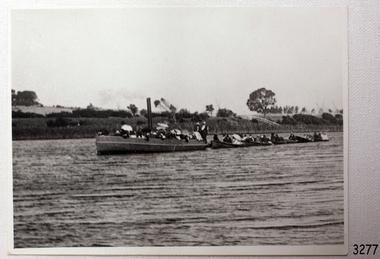
Photograph - Vessel, Steam Launch, Mrs. A. Dawson, Lady Loch, Feb 1907 - Jun 1910
... district. It shows an example of the pleasure craft of that era. The history of the Lady Loch includes the history of fishing and boat hire businesses of that period. The photograph is also connected with an early Warrnambool buat builder James Flett & Sons. representing the maritime history of the town. flagstaff hill warrnambool shipwrecked-coast flagstaff-hill flagstaff-hill-maritime-museum maritime-museum shipwreck-coast flagstaff-hill-maritime-village lady of the lake lady of the lake steamer lady loch steamer lake colac steamer hopkins river warrnambool jubilee park warrnambool francis maria mann andrew abernathy nelson iiird hopkins hotel nelson's boathouse chapman's boathouse flett's boathouse fanny (francis) nelson james flett & sons Photograph, black and white, of the steam launch Lady Loch towing five rowing boats downstream on the Hopkins River from Jubilee Park towards the river mouth. ...The photograph shows the steam launch Lady Loch towing five rowing boats full of passengers on the Hopkins River at Warrnambool. The boat is travelling downstream from the riverbank near Jubilee Park towards Warrnambool and the river mouth. A similar trip in 1909 was a fund-raising excursion when the Lady Loch was to tow boats from Flett & Sons' boating establishment on the Hopkins River, travelling towards Jubilee Park. The photograph was taken between February 1907 and June 1910 by Mrs A. G. Dawson from the Hopkins River Bank at “Allandale”, which she was leasing. She took another photograph that day, which was published in the Warrnambool Standard on 24th March 1973. At the time of the photograph the launch Lady Loch was owned by James Flett & Son who operated a boatshed on the bend of the Hopkins River. The boat was described as “a fine little steamer”. In 1916 it was licenced to carry 42 passengers. The LADY LOCH: - In February 1884 Mr Sutton’s steam launch had the name of Lady of the Lake. The boat was part of the entertainment for a Sunday school picnic at Ballarat Lake and Gardens. In October 1884 Mr Ivey from Lake Wendouree purchased two vessels, the steamer Ballarat and Mr Sutton’s well-known and popular launch, Lady of the Lake, to join his own fleet of pleasure boats. In November 1887 Mr Mark Hooper’s purchase of a ‘new’ pleasure boat, Lady of the Lake, arrived in Colac to be an addition to his boating business. The launch had been transported by road from Ballarat, but the boiler and the engine had travelled by rail the previous day. In June 1888, Fanny Nelson purchased the steam launch Lady of the Lake for her Nelson’s Boating and Fishing Establishment on the Hopkins River, Warrnambool. She renamed it Lady Loch. People have suggested the mane was in honour of the wife of the then-current Governor of Victoria, Sir Henry Loch, and the local paper stated that Lady Loch flew the Governor’s colours of yellow, black and blue on her first trip under Nelson’s ownership, Sunday 12th August 1888. In 1890 Fanny Nelson sold her complete business, including Lady Loch, to Mr Chapman. in January 1897 James Flett & Sons, already involved in boating, purchased the business from Chapman. In January 1916, Flett advertised everything for sale, including the boatshed and the steam launch Lady Loch. NOTE: - at least three vessels in Victoria were named Lady Loch; a river launch (ca 1884-ca 1916), a steamer ferry (1884-1920s) and a government steam lighthouse tender HMS Lady Loch (1886-1962)The photograph of the Lady Loch pleasure steamer represents the social and recreational activities of late 19th-century people from Warrnambool and the local district. It shows an example of the pleasure craft of that era. The history of the Lady Loch includes the history of fishing and boat hire businesses of that period. The photograph is also connected with an early Warrnambool buat builder James Flett & Sons. representing the maritime history of the town.Photograph, black and white, of the steam launch Lady Loch towing five rowing boats downstream on the Hopkins River from Jubilee Park towards the river mouth. There are many figures on the boats. The photograph was taken from a property called Allandale on the south river bank between February 1907 and June 1910. The photographer was Mrs A. G. Dawson. The Lady Loch was owned by Mr James Flett & Sons at that time. The photograph is mounted on card.flagstaff hill, warrnambool, shipwrecked-coast, flagstaff-hill, flagstaff-hill-maritime-museum, maritime-museum, shipwreck-coast, flagstaff-hill-maritime-village, lady of the lake, lady of the lake steamer, lady loch steamer, lake colac steamer, hopkins river warrnambool, jubilee park warrnambool, francis maria mann, andrew abernathy nelson iiird, hopkins hotel, nelson's boathouse, chapman's boathouse, flett's boathouse, fanny (francis) nelson, james flett & sons -
 Mission to Seafarers Victoria
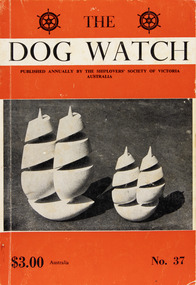
Journal (item) - Periodicals-Annual, Shiplovers' Society of Victoria, The Annual Dog Watch
... Bonwick 11 1980 The Goldon Jubilee Part 1 - - 16 " " Part 2 - - 18 " " Part 3 - - 19 Days in Sail - Captain W. J. Cowling - 23 "Old Man River" - I. Harris - 32 Present State and Prospects of the Port Phillip District of New South Wales - Charles Griffiths - 37 Hoboes of the Sea - Captain F. ...Bonwick 11 1980 The Goldon Jubilee Part 1 - - 16 " " Part 2 - - 18 " " Part 3 - - 19 Days in Sail - Captain W. J. Cowling - 23 "Old Man River" - I. Harris - 32 Present State and Prospects of the Port Phillip District of New South Wales - Charles Griffiths - 37 Hoboes of the Sea - Captain F. ...This journal provides the reader with glimpses of the adventures and hardships of a seaman's life. Many of the stories are of sailing ships.Contributes to our knowledge of the importance of shipping and places on record those stories of the sea which would otherwise be lost.Contents Foreword - Senator G. S. Davidson- 5 Editorial - C. E. Bonwick 11 1980 The Goldon Jubilee Part 1 - - 16 " " Part 2 - - 18 " " Part 3 - - 19 Days in Sail - Captain W. J. Cowling - 23 "Old Man River" - I. Harris - 32 Present State and Prospects of the Port Phillip District of New South Wales - Charles Griffiths - 37 Hoboes of the Sea - Captain F. Klebingat - 42 The Stateships Story - N. S. Smith - 46 "Down at Wallaroo" - D. M. Fyfe - 54 Characters - R. N. Thiele - 58 The Lauriston from Newcastle to Tal Tal - R. W. Rudd - 64 From Information for Pylgrymes Unto the Holy Lande 1498 - - 68 s.s. "Port Campbell" First Voyage - I. L. Barton - 70 Maritime Inspection in Finland - Captain Eino Koivistoinen - 81 Wool from Genoa - J. M. MacKenzie - 86 "Polly Woodside" -- The Man Who Made it Happen - Captain G. Heyen, M.B.E. - 91 To Trinidad by "Kilmaurs" - Alexander Cameron - 102 "Oodle" - K. Bull - 109 Ship Talk - Guy H. Jennery - 110 A Glimpse of Ships and Men - W. P. Shemmeld - 113 Book Reviews - 120sailing ships, steamships, shipping, seafaring life, shiplovers' society of victoria, dog watch -
 Flagstaff Hill Maritime Museum and Village
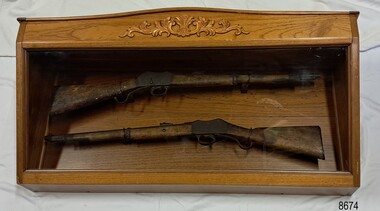
Weapon - Historic Rifles, Royal Small Arms Factory, 1877-1900
... district. In December 1854, Woodford Police barracks and stables were built on the hill by the Merri River on Bridge Road east, where Jubilee Park now stands. ...district. In December 1854, Woodford Police barracks and stables were built on the hill by the Merri River on Bridge Road east, where Jubilee Park now stands. ...Martini-Henry Artillery Carbin rifles were made by the Royal Small Arms Factory at Enfield, Britain, from 1877 until 1900. Many were distributed to the British Colonies, including this pair, which was allocated to the Woodford Police, Victoria Police District of Warrnambool, Southwest Victoria. The Carbine model rifles were shorter than the standard rifles and more suited to mounted police and troopers. It is likely that in the early 20th century, Victoria Police replaced the two carbines with more modern firearms, and the outdated guns were stored in the stables. The rifles were left there and likely forgotten about due to changes in police staff. In 1915, police authorities announced that they would be replacing patrol horses with bicycles and would also close some smaller police stations. This affected Woodford Police Station, which closed in 1917. The forgotten firearms remained in the stables and were noticed by schoolboy Robert Jellie in 1940 and seen again in 1946. In 1995, the property was sold by the Education Department to a private owner. The Woodford Community donated the pair of Martini-Henry Carbines to the Victoria Police Museum in the late 1990s for mounting and display, which was funded by the Victoria Police Historical Society Inc. The decorative wood and glass display case and frame were designed to preserve the significant history of the guns. On November 1st 1999, the display was presented to Warrnambool Police and the local community due to the historical significance of the Woodford Police Station. In 2025, these items were formally deaccessioned by the Victoria Police Museum, and ownership was transferred to the Warrnambool Police Station. On March 10th, 2025, the display was transferred to Flagstaff Hill Maritime Museum and Village, where the historical story of the Martini-Henry Carbines could continue to be preserved and accessed by local families, the community, visitors to the area, and online visitors. WOODFORD POLICE: - The small settlement at Woodford was established in the 1840s around the Merri River where there was a ford across the water and a bridge from 1848 to 1851. The area was settled very early in Victoria’s history, and the river crossing provided travellers with access to the early route between Port Fairy (named Belfast at that time), Warrnambool and Melbourne. Occasionally, a Warrnambool police trooper would ride through Woodford and the district. In December 1854, Woodford Police barracks and stables were built on the hill by the Merri River on Bridge Road east, where Jubilee Park now stands. A local mounted trooper kept law and order in the area. In 1856, a lock-up was installed, and the first Woodford Police Station was in action in 1857. By 1871, the police station had been moved from the hill to land across the Merri River bridge, on the southern side of Bridge Road west, near Mill Street. In 1890, the police residence there was replaced by a stone Edwardian-style building with the stables and lock-up behind it and the old police station at the rear. The police continued to have a presence in Woodford until it was closed by the Police Commissioner in July 1917 for economic reasons. The residence was used for government housing until 1923, when it was taken over by the Education Department for the school teacher’s home. In 1995, it became privately owned. THE MARTINI-HENRY ARTILLERY CARBINE: - The Martini-Henry rifles were made in Britain from 1871 at the Royal Small Arms factory at Enfield and were stamped with the symbol of the Royal Cipher (Crown over VR) over ENFIELD to identify their origin. They were named after two of several people who helped design this method: Swiss Friederich von Martini and Scotsman Alexander Henry. The design was breech-loaded, and the inner barrel was rifled. A thumb rest was incorporated into the top right of the bullet receiver’s chamber. The small teardrop lever on the right side of the rifle showed whether the rifle was ready to be shot. In 1877, the shorter, lighter-weight Carbine version of the firearm was produced for mounted troops and artillery. Its official name was “Carbine, B.L., Rifled, Martini-Henry.” The bullets were slightly lighter in weight than those used for the longer rifle. The sight position was adjusted for the shorter gun, and wings were added to the sight on the tip, making it easier to slide the rifle back into a saddle bag. Some of the later Carbines also had leather sight covers screwed to the stock to prevent them from catching on the saddle bags. The Carbines had accessories available, such as barrel extensions with bayonets and swivels for adding slings. The Martini-Henry Carbine designs were later modified to fire the British .303 ammunition. Eventually, by 1900, the Martini-Henry Carbines were replaced by the Lee Enfield gun design. The pair of Martini-Henry Carbine firearms represents policing in the early pre-1900 days of colonial settlement; Woodford was one of the first townships settled in Victoria, and it had a police presence from 1854 until 1917. The rifles and display provide a historic connection between the location of Woodford and relatives and associates. The carbine rifles show a stage in the evolution of weapon design, adapted to suit mounted troops, and adding features to streamline use and storage. The ammunition was also improved during this progression. The carbines are important for their connection to policing law and order in a remote area. They are significant for their association with the township of Woodford, which was important to travel in the southwest Victoria district, providing access across a river for a road between Port Fairy and Melbourne, and later Warrnambool, and supplying food, goods and accommodation for the travellers. A pair of mounted rifles is mounted behind glass in a timer case, accompanied by a framed display of two photographs and an account of the rifles’ history. The case and display each have a horizontal board with a gently curved edge and carved decorations added. The identical firearms are British-made Martini Henry Carbine breach-loaded rifled guns, supplied by Britain to its Colonial troops from around 1877. The rifles are lever-action, single-shot .500 calibre weapons. They have a teardrop lever on their right side. They were used by Victoria Police mounted troops at the Woodford Police Station, Victoria. The black and white photographs were taken in 1946. The left photograph has a circled area; the right photograph is an enlarged view of the circled area, showing the Woodford Police Station in detail. The printed text is on textured paper with the Victoria Police watermark. It gives a summary of the rifle’s history. There is an inscription on the left photograph. Left photograph, handwritten in white pen: “WOODFORD” Document’s print: “During the late 1840s the small town of Woodford grew around the crossing of the Merri River on the Melbourne/Port Fairy Rad. Woodford was proclaimed a township in 1854 and a police quarters was established there in 1857. The police station remained until 1917 when it was closed and police service from then on was provided from Warrnambool. The building was then used as a school residence and is now privately owned. In !940 Robert JELLIE, then a schoolboy, observed two rifles mounted on the wall of the disused stable at the rear of the old police building. Following the devastating flood of 1946 (see photograph above) the rifles were again seen in the room next to the stable but were not seen again until the building was sold by the Education Department many years later. It was a recognition of the historical value of the rifles which led to their donation to the Warrnambool Police Complex. The rifles have been authenticated by the Victoria Police Armoury as being Victoria Police issue some time before 1900. The rifles are an identical pair of the famous British-made Martini Henry, a .500 inch calibre military weapon widely used by British Colonial troops. Victoria Police and the wider community of Warrnambool are indebted to the members of the Woodford community for their fine gesture in donating the rifles for mounting so that their historical importance can be preserved and they can be displayed for generations to come. This display was funded by the Victoria Police Historical Society Incorporated, and presented on the first day of November, 1999.”flagstaff hill maritime museum and village, great ocean road, shipwreck coast, martini henry, victoria police, woodford police station, rifle, carbine, display case, british, martini henry carbine, breech-loaded, rifled, colonial, single-shot, .500 calibre, weapon, gun, 1877, troops, mounted troops, merri river, victoria police woodford, victoria police warrnambool, victoria police melbourne, police quarters, robert jellie, school residence, stable, 1946 flood, victoria police armoury, identical pair, british colonial troops, victoria police historical society incorporated, woodford, bicycles, found by a schoolboy, edwardian-style building, victoria police museum, warrnambool police station -
 Flagstaff Hill Maritime Museum and Village
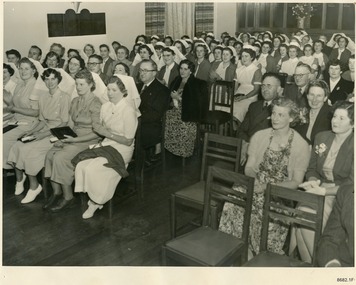
Work on paper - Photograph with envelope, Dr. W. R. Angus Warrnambool & District Base Hospital, c1951
... District Base Hospital...Nurses Graduation...Ralph Illidge...1951 Warrnambool...Jubilee...Roy Angus Warrnambool & District Base Hospital Nurses Graduation Ralph Illidge 1951 Warrnambool Jubilee Year Australia 1901-1951 ophthalmology MR McMILLAN/MR J NED TAYLOR/MRS J TAYLOR/ SISTER STEWART/ DR W R ANGUS/MRS ANGUS/Ralph Illidge WARRNAMBOOL on the back of the photograph. ...This photograph is part of the “W.R. Angus Collection” that includes historical medical equipment, surgical instruments and material once belonging to Dr Edward Ryan and Dr Thomas Francis Ryan, (both of Nhill, Victoria) as well as Dr Angus’ own belongings. The Collection’s history spans the medical practices of the two Doctors Ryan, from 1885-1926 plus that of Dr Angus, up until 1969. This sepia photograph is from circa 1950s and came in an envelope with a postage mark commemorating the Australian Jubilee of 1901 and a 2-penny stamp with King George VI. The photo includes Dr. Angus in the second row wearing glasses, his wife Mrs. Angus seated behind in the third row. John Lindsay, Committee Member WDBH, is possibly in the third row on the right. It is probably Sister June H. Stewart, Matron, wearing glasses is seated behind Mrs. Angus. Mr. J. Taylor was Hon. Treasurer. All these names are inscribed on the back of the photograph. The envelope that the photo came is has a note “NURSES GRADUATION WARRNAMBOOL HOSPITAL ?1951/PHOTOGRAPH OF GRADS. The 1951 Report of the Warrnambool and District Base Hospital cites McMillian as a Committee Member, Mr. Taylor as Honorary Treasurer and Dr. Angus was Medical Officer to Diseases of the Eye, Ear, Nose and Throat. It is wondered if this building is the one used by the hospital and removed to 54 Banyan Street, Warrnambool for the use of Legacy? The W.R. Angus Collection is significant for still being located at the site it is connected with, Doctor Angus being the last Port Medical Officer in Warrnambool. The collection of medical instruments and other equipment is culturally significant, being an historical example of medicine from late 19th to mid-20th century. Dr Angus assisted Dr Tom Ryan, a pioneer in the use of X-rays and in ocular surgery.Sepia photograph of nurses and guests seated in rows at an official function. MR McMILLAN/MR J NED TAYLOR/MRS J TAYLOR/ SISTER STEWART/ DR W R ANGUS/MRS ANGUS/Ralph Illidge WARRNAMBOOL on the back of the photograph.flagstaff hill, warrnambool, maritime village, maritime museum, flagstaff hill maritime museum and village, shipwreck coast, great ocean road, dr. w.r. angus, dr. roy angus, warrnambool & district base hospital, nurses graduation, ralph illidge, 1951 warrnambool, jubilee year australia, 1901-1951, ophthalmology -
 Flagstaff Hill Maritime Museum and Village
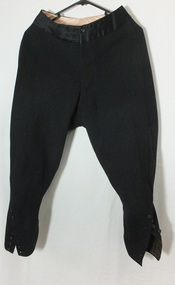
Clothing - Riding Habit, Jodhpurs, 1920s
... Though an offer to build public baths to commemorate the Queen Victoria Jubilee in 1897 was not proceeded with, the town acquired a hospital, a reserve on Mount Leura, a clock tower and a cricket pavilion, as well as notable donations from the Manifolds to St Paul's Church and the grammar school. Edward was a keen polo player and racing man. He was also a successful owner of steeplechasers and a committeeman of the Victoria Racing Club for many years. He was also a member of many Western District...Though an offer to build public baths to commemorate the Queen Victoria Jubilee in 1897 was not proceeded with, the town acquired a hospital, a reserve on Mount Leura, a clock tower and a cricket pavilion, as well as notable donations from the Manifolds to St Paul's Church and the grammar school. Edward was a keen polo player and racing man. He was also a successful owner of steeplechasers and a committeeman of the Victoria Racing Club for many years. He was also a member of many Western District ...The Manifolds were a significant pioneering pastoral family in Western Victoria. The donated riding jodhpurs originally belonged to Mrs Edward Manifold, formally Beatrice Mary Synnot Anderson. Beatrice was Edward Manifold’s cousin once removed whom he married in 1900. Edward, the son of John Manifold, was born on 15 November 1868 and educated at Geelong and Melbourne Grammar schools and at Trinity Hall, Cambridge (B.A., 1891). He chose the Danedite portion of land at Purrumbete, and on the death of his bachelor brother Thomas Peter (1863-1895), after a hunting accident, he took over his allocation, Wiridgil. He also owned Boortkoi, near Hexham and on these properties, he ran merino sheep, a Lincoln stud which dated back to 1870, and Shorthorn cattle. 3000 acres were also leased to dairy farmers. Edward was a member of Hampden Shire Council in 1909-31 and three times president at Camperdown. The town was largely bordered by Manifold land and partly dependent upon the local pastoral dynasties, which benefited the local area from the families’ various business interests. Though an offer to build public baths to commemorate the Queen Victoria Jubilee in 1897 was not proceeded with, the town acquired a hospital, a reserve on Mount Leura, a clock tower and a cricket pavilion, as well as notable donations from the Manifolds to St Paul's Church and the grammar school. Edward was a keen polo player and racing man. He was also a successful owner of steeplechasers and a committeeman of the Victoria Racing Club for many years. He was also a member of many Western District racing clubs. On the 16 July 1900, Edward had married his sixteen-year-old cousin Beatrice Mary Synnot Anderson by whom he had three sons Thomas Peter, Andrew and Robert Edward Manifold. Edwards's estate at his death was valued for probate at nearly £500,000. Edward died following an operation on 14 February 1931 at a private hospital in Yarra Vale Melbourne. Beatrice passed away in 1954, aged 79 in Ballarat where she was born in 1874. Contextual historic Family background: The Manifold brothers Thomas (1809-1875), John (1811-1877) and Peter (1817-1885) were the fourth, fifth and sixth sons of William Manifold and Mary, nee Barnes, of Courthouse Farm, Bromborough, Cheshire, England. The family had decided to emigrate to Van Diemen's Land. Thomas was sent ahead, arriving in Hobart Town on 23rd January 1828 with £1500 and a letter of recommendation from the Colonial Office. Thomas acquired 1280 acres on the west bank of the Tamar River. John and Peter, with their parents and three sisters, arrived on 8th July 1831. Land grants by then had finished but William brought ninety acres next to his son Thomas’ land and on the combined properties the family built Kelso House. The Manifolds’ properties were comparatively poor and when news of the Port Phillip District, in Victoria reached Thomas, he lost no time in coming to see for himself in February 1836. He was impressed with what he saw and hurried back to Tasmania to buy lambs and ewes. With one of his brothers, on July 9th he landed his stores at Point Henry and proceeded to occupy both sides of the Moorabool River. Thomas, at the end of the year, returned to Tasmania and left Peter and John to run the new property. Thomas, however, returned to Victoria for several visits and on one of these visits he, along with his brothers, examined the country near Ballarat. In December 1838 they managed to penetrate the Stony Rises, and Peter and John reached Lake Purrumbete and the Mount Leura country. During this time, on 4th July 1838, Thomas married Jane Elizabeth, eldest daughter of Captain Walter Synnot, formerly of Ballinate, County Armagh, Ireland, and then of Van Diemen's Land. Thomas joined his brothers, and they occupied the Purrumbete run in January 1839. On the journey to Purrumbete they could not take their stock and drays through the Stony Rises, so went north of Lake Corangamite, to the neck of land between it and Lake Gnarpurt. By April the move from Moorabool area was complete. As yet they had no hut and were working day and night, but their delight in their new run was unbounded. John wrote to his mother: “We are at last got to the land we wished for it is a beautiful place, and cannot be surpassed by any I have ever seen”. The three brothers occupied Purrumbete together, breeding both sheep and cattle until Thomas went to Grassmere run on the Merri River near Warrnambool in 1844. John and Peter soon gave up breeding sheep but retained the well-known '3M' brand for the cattle. These were Shorthorns, derived from four bulls originally imported by the Boldon brothers and later improved by further importations, and were renowned for size and quality. By the time of the gold rush in 1851, John and Peter were breeding over 1000 head a year, as well as fattening stores. The diggings at this time had disorganised Grassmere by drawing away Thomas's men, and his wife decided to take her two sons and two daughters to Europe for their education. Thomas gave up the property next year, went to England to join his family, and eventually brought the family back to live in Melbourne. At Purrumbete things were different. The brothers, John and Peter, preferred black stockmen to white, so the discovery of gold upset them very little while providing the very market they required. John was on his second visit to England when the rush started, and Peter went in his turn soon after John returned. On 2 September 1856 John married Marion Thomson, at Cormiston, Van Diemen's Land. They had four daughters and five sons, from three of whom, William Thomson, James Chester and Edward, the later generations of the family descend. Through the years the brothers had to contend with the scab, fluke and footrot, depression, rabbits, bush fires and pleuro-pneumonia. In 1861 they appointed as manager Henry Manifold Matson, their nephew, who had already been with them for five years. Thomas died in Melbourne on 7 November 1875, John at Purrumbete on 3 January 1877 and Peter at Purrumbete on 31 July 1885. Devout members of the Church of England, John and Peter, during their lives, gave generously towards building St Paul's Church, Camperdown, and guaranteed part of the vicar's stipend. Peter was a member of the Hampden and Heytesbury Roads Board from 1859 and carried on into the Hampden Shire Council when it was formed in 1864. However, it was not for public works that they were known, but for their personal example. In a new land where speculators and adventurers were all too common, the Manifold brothers were among those who intended it to be their home and their children's home. Industrious, unpretentious and hospitable, they were respected in their community as men of the highest integrity. This riding habit is a characteristic example of the type and style of riding clothes that well-dressed ladies wore in the 1920s. It highlights the changes that were beginning in society for women. Prior to 1918 ladies still had to ride side-saddle with skirts over Jodhpurs. Society of the time regarded women riding astride as unseemly and just not done. This riding habit is particularly significant on a number of levels, it shows the beginnings of change in society's attitudes through women's fashion after the First World War. A change that was to bring a start to a more liberating societal attitude towards women after the successful establishment of the Representation of People Act 1918 that gave women the right to vote. This garments provenance is linked to one of Victoria's important pioneering families the Manifolds, one of the first families that came from Van Diemen's land to settle the Western District of Victoria in 1844. Originally the garment belonged to the wife of the great-grandson of pioneer William Manifold, Edward Manifold who married Beatrice May Synnot Anderson, Edwards Cousin in 1900. The garment was made by the Mayfair tailors J. Busvine & Co. in the early to mid-1920s (estimate) who at the turn of the century were tailors to the Courts of Europe. Their clothing is highly collectible today and examples can be found in a number of significant museum collections around the world, notably the Metropolitan Museum of Art in New York and the FIDM in Los Angeles. Jodhpurs, part of a three-piece, side saddle riding habit tailored for Mrs Edward Manifold, with four buttons to the front material black woolen twill the legs are cuffed below the knee with 8 buttons holes which are reinforced to the inside with fabric. Cream Satin waistband and removable chamois lining to the seat makers label Busvines Co. tailored for Mrs Edward Manifold.Embroidered in blue on a Satin Cream label to Jodhpurs "Busvine Ltd / 4, Brook St, London. W. No." Hand written in black ink script "523/ Mrs Edward Manifold"flagstaff hill, warrnambool, shipwrecked coast, flagstaff hill maritime museum, maritime museum, side saddle riding habit, side saddle riding outfit, breeches, mrs edward manifold, beatrice manifold, shipwreck coast, flagstaff hill maritime village, great ocean road -
 Flagstaff Hill Maritime Museum and Village
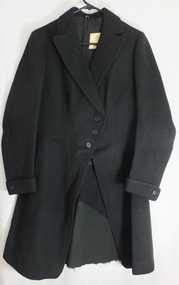
Clothing - Riding Habit, jacket, Early 20th Century
... Though an offer to build public baths to commemorate the Queen Victoria Jubilee in 1897 was not proceeded with, the town acquired a hospital, a reserve on Mount Leura, a clock tower and a cricket pavilion, as well as notable donations from the Manifolds to St Paul's Church and the grammar school. Edward was a keen polo player and racing man. He was also a successful owner of steeplechasers and a committeeman of the Victoria Racing Club for many years. He was also a member of many Western District...Though an offer to build public baths to commemorate the Queen Victoria Jubilee in 1897 was not proceeded with, the town acquired a hospital, a reserve on Mount Leura, a clock tower and a cricket pavilion, as well as notable donations from the Manifolds to St Paul's Church and the grammar school. Edward was a keen polo player and racing man. He was also a successful owner of steeplechasers and a committeeman of the Victoria Racing Club for many years. He was also a member of many Western District ...The Manifolds were a significant pioneering pastoral family in Western Victoria. The donated riding jacket originally belonged to Mrs Edward Manifold, formally Beatrice Mary Synnot Anderson. Beatrice was Edward Manifold’s cousin once removed whom he married in 1900. Edward, the son of John Manifold, was born on 15 November 1868 and educated at Geelong and Melbourne Grammar schools and at Trinity Hall, Cambridge (B.A., 1891). He chose the Danedite portion of land at Purrumbete, and on the death of his bachelor brother Thomas Peter (1863-1895), after a hunting accident, he took over his allocation, Wiridgil. He also owned Boortkoi, near Hexham and on these properties, he ran merino sheep, a Lincoln stud which dated back to 1870, and Shorthorn cattle. 3000 acres were also leased to dairy farmers. Edward was a member of Hampden Shire Council in 1909-31 and three times president at Camperdown. The town was largely bordered by Manifold land and partly dependent upon the local pastoral dynasties, which benefited the local area from the families’ various business interests. Though an offer to build public baths to commemorate the Queen Victoria Jubilee in 1897 was not proceeded with, the town acquired a hospital, a reserve on Mount Leura, a clock tower and a cricket pavilion, as well as notable donations from the Manifolds to St Paul's Church and the grammar school. Edward was a keen polo player and racing man. He was also a successful owner of steeplechasers and a committeeman of the Victoria Racing Club for many years. He was also a member of many Western District racing clubs. On the 16 July 1900, Edward had married his sixteen-year-old cousin Beatrice Mary Synnot Anderson by whom he had three sons Thomas Peter, Andrew and Robert Edward Manifold. Edwards's estate at his death was valued for probate at nearly £500,000. Edward died following an operation on 14 February 1931 at a private hospital in Yarra Vale Melbourne. Beatrice passed away in 1954, aged 79 in Ballarat where she was born in 1874. Contextual historic Family background: The Manifold brothers Thomas (1809-1875), John (1811-1877) and Peter (1817-1885) were the fourth, fifth and sixth sons of William Manifold and Mary, nee Barnes, of Courthouse Farm, Bromborough, Cheshire, England. The family had decided to emigrate to Van Diemen's Land. Thomas was sent ahead, arriving in Hobart Town on 23rd January 1828 with £1500 and a letter of recommendation from the Colonial Office. Thomas acquired 1280 acres on the west bank of the Tamar River. John and Peter, with their parents and three sisters, arrived on 8th July 1831. Land grants by then had finished but William brought ninety acres next to his son Thomas’ land and on the combined properties the family built Kelso House. The Manifolds’ properties were comparatively poor and when news of the Port Phillip District, in Victoria reached Thomas, he lost no time in coming to see for himself in February 1836. He was impressed with what he saw and hurried back to Tasmania to buy lambs and ewes. With one of his brothers, on July 9th he landed his stores at Point Henry and proceeded to occupy both sides of the Moorabool River. Thomas, at the end of the year, returned to Tasmania and left Peter and John to run the new property. Thomas, however, returned to Victoria for several visits and on one of these visits he, along with his brothers, examined the country near Ballarat. In December 1838 they managed to penetrate the Stony Rises, and Peter and John reached Lake Purrumbete and the Mount Leura country. During this time, on 4th July 1838, Thomas married Jane Elizabeth, eldest daughter of Captain Walter Synnot, formerly of Ballinate, County Armagh, Ireland, and then of Van Diemen's Land. Thomas joined his brothers, and they occupied the Purrumbete run in January 1839. On the journey to Purrumbete they could not take their stock and drays through the Stony Rises, so went north of Lake Corangamite, to the neck of land between it and Lake Gnarpurt. By April the move from Moorabool area was complete. As yet they had no hut and were working day and night, but their delight in their new run was unbounded. John wrote to his mother: “We are at last got to the land we wished for it is a beautiful place, and cannot be surpassed by any I have ever seen”. The three brothers occupied Purrumbete together, breeding both sheep and cattle until Thomas went to Grassmere run on the Merri River near Warrnambool in 1844. John and Peter soon gave up breeding sheep but retained the well-known '3M' brand for the cattle. These were Shorthorns, derived from four bulls originally imported by the Boldon brothers and later improved by further importations, and were renowned for size and quality. By the time of the gold rush in 1851, John and Peter were breeding over 1000 head a year, as well as fattening stores. The diggings at this time had disorganised Grassmere by drawing away Thomas's men, and his wife decided to take her two sons and two daughters to Europe for their education. Thomas gave up the property next year, went to England to join his family, and eventually brought the family back to live in Melbourne. At Purrumbete things were different. The brothers, John and Peter, preferred black stockmen to white, so the discovery of gold upset them very little while providing the very market they required. John was on his second visit to England when the rush started, and Peter went in his turn soon after John returned. On 2 September 1856 John married Marion Thomson, at Cormiston, Van Diemen's Land. They had four daughters and five sons, from three of whom, William Thomson, James Chester and Edward, the later generations of the family descend. Through the years the brothers had to contend with the scab, fluke and footrot, depression, rabbits, bush fires and pleuro-pneumonia. In 1861 they appointed as manager Henry Manifold Matson, their nephew, who had already been with them for five years. Thomas died in Melbourne on 7 November 1875, John at Purrumbete on 3 January 1877 and Peter at Purrumbete on 31 July 1885. Devout members of the Church of England, John and Peter, during their lives, gave generously towards building St Paul's Church, Camperdown, and guaranteed part of the vicar's stipend. Peter was a member of the Hampden and Heytesbury Roads Board from 1859 and carried on into the Hampden Shire Council when it was formed in 1864. However, it was not for public works that they were known, but for their personal example. In a new land where speculators and adventurers were all too common, the Manifold brothers were among those who intended it to be their home and their children's home. Industrious, unpretentious and hospitable, they were respected in their community as men of the highest integrity. This riding habit is a characteristic example of the type and style of riding clothes that well-dressed ladies wore in the 1920s. It highlights the changes that were beginning in society for women. Prior to 1918 ladies still had to ride side-saddle with skirts over Jodhpurs. Society of the time regarded women riding astride as unseemly and just not done. This riding habit is particularly significant on a number of levels, it shows the beginnings of change in society's attitudes through women's fashion after the First World War. A change that was to bring a start to a more liberating societal attitude towards women after the successful establishment of the Representation of People Act 1918 that gave women the right to vote. This garments provenance is linked to one of Victoria's important pioneering families the Manifolds, one of the first families that came from Van Diemen's land to settle the Western District of Victoria in 1844. Originally the garment belonged to the wife of the great-grandson of pioneer William Manifold, Edward Manifold who married Beatrice May Synnot Anderson, Edwards Cousin in 1900. The garment was made by the Mayfair tailors J. Busvine & Co. in the early to mid-1920s (estimate) who at the turn of the century were tailors to the Courts of Europe. Their clothing is highly collectible today and examples can be found in a number of significant museum collections around the world, notably the Metropolitan Museum of Art in New York and the FIDM in Los Angeles. A riding jacket, part of a three-piece, side saddle riding habit tailored for Mrs Edward Manifold. Knee length English woolen jacket black in colour, seamed and fitted to the female client's figure, fastening from the waist with three bone buttons to rather high lapels. The sleeves are long with closely fitted cuffs and one button and lined with cream satin. The jacket is fitted to the waist and flared to below the hips with a 35 cm vent to the back. Lower back to the jacket is reinforced with removable fabric and the jacket is lined with black twill cotton, there is a cream satin label, with makers' emblem Busvine. Circa 1920s Label to Jacket Embroidered in gold with a Royal logo on a Cream Satin label “By Special /Appointment” “To Her Majesty/The Queen”, “Busvine / Ltd / London 4 Brook St. W. / No” “hand written in purple ink 315 / Mrs Edward Manifold”flagstaff hill, warrnambool, shipwrecked coast, flagstaff hill maritime museum, maritime museum, side saddle riding habit, mrs edward manifold, edward manifold, busvines, shipwreck coast, flagstaff hill maritime village, great ocean road -
 Flagstaff Hill Maritime Museum and Village
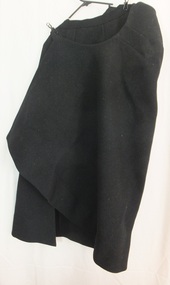
Clothing - Riding Habit, Skirt, 1920s
... Though an offer to build public baths to commemorate the Queen Victoria Jubilee in 1897 was not proceeded with, the town acquired a hospital, a reserve on Mount Leura, a clock tower and a cricket pavilion, as well as notable donations from the Manifolds to St Paul's Church and the grammar school. Edward was a keen polo player and racing man. He was also a successful owner of steeplechasers and a committeeman of the Victoria Racing Club for many years. He was also a member of many Western District...Though an offer to build public baths to commemorate the Queen Victoria Jubilee in 1897 was not proceeded with, the town acquired a hospital, a reserve on Mount Leura, a clock tower and a cricket pavilion, as well as notable donations from the Manifolds to St Paul's Church and the grammar school. Edward was a keen polo player and racing man. He was also a successful owner of steeplechasers and a committeeman of the Victoria Racing Club for many years. He was also a member of many Western District ...The Manifolds were a significant pioneering pastoral family in Western Victoria. The donated riding skirt originally belonged to Mrs Edward Manifold, formally Beatrice Mary Synnot Anderson. Beatrice was Edward Manifold’s cousin once removed whom he married in 1900. Edward, the son of John Manifold, was born on 15 November 1868 and educated at Geelong and Melbourne Grammar schools and at Trinity Hall, Cambridge (B.A., 1891). He chose the Danedite portion of land at Purrumbete, and on the death of his bachelor brother Thomas Peter (1863-1895), after a hunting accident, he took over his allocation, Wiridgil. He also owned Boortkoi, near Hexham and on these properties, he ran merino sheep, a Lincoln stud which dated back to 1870, and Shorthorn cattle. 3000 acres were also leased to dairy farmers. Edward was a member of Hampden Shire Council in 1909-31 and three times president at Camperdown. The town was largely bordered by Manifold land and partly dependent upon the local pastoral dynasties, which benefited the local area from the families’ various business interests. Though an offer to build public baths to commemorate the Queen Victoria Jubilee in 1897 was not proceeded with, the town acquired a hospital, a reserve on Mount Leura, a clock tower and a cricket pavilion, as well as notable donations from the Manifolds to St Paul's Church and the grammar school. Edward was a keen polo player and racing man. He was also a successful owner of steeplechasers and a committeeman of the Victoria Racing Club for many years. He was also a member of many Western District racing clubs. On the 16 July 1900, Edward had married his sixteen-year-old cousin Beatrice Mary Synnot Anderson by whom he had three sons Thomas Peter, Andrew and Robert Edward Manifold. Edwards's estate at his death was valued for probate at nearly £500,000. Edward died following an operation on 14 February 1931 at a private hospital in Yarra Vale Melbourne. Beatrice passed away in 1954, aged 79 in Ballarat where she was born in 1874. Contextual historic Family background: The Manifold brothers Thomas (1809-1875), John (1811-1877) and Peter (1817-1885) were the fourth, fifth and sixth sons of William Manifold and Mary, nee Barnes, of Courthouse Farm, Bromborough, Cheshire, England. The family had decided to emigrate to Van Diemen's Land. Thomas was sent ahead, arriving in Hobart Town on 23rd January 1828 with £1500 and a letter of recommendation from the Colonial Office. Thomas acquired 1280 acres on the west bank of the Tamar River. John and Peter, with their parents and three sisters, arrived on 8th July 1831. Land grants by then had finished but William brought ninety acres next to his son Thomas’ land and on the combined properties the family built Kelso House. The Manifolds’ properties were comparatively poor and when news of the Port Phillip District, in Victoria reached Thomas, he lost no time in coming to see for himself in February 1836. He was impressed with what he saw and hurried back to Tasmania to buy lambs and ewes. With one of his brothers, on July 9th he landed his stores at Point Henry and proceeded to occupy both sides of the Moorabool River. Thomas, at the end of the year, returned to Tasmania and left Peter and John to run the new property. Thomas, however, returned to Victoria for several visits and on one of these visits he, along with his brothers, examined the country near Ballarat. In December 1838 they managed to penetrate the Stony Rises, and Peter and John reached Lake Purrumbete and the Mount Leura country. During this time, on 4th July 1838, Thomas married Jane Elizabeth, eldest daughter of Captain Walter Synnot, formerly of Ballinate, County Armagh, Ireland, and then of Van Diemen's Land. Thomas joined his brothers, and they occupied the Purrumbete run in January 1839. On the journey to Purrumbete they could not take their stock and drays through the Stony Rises, so went north of Lake Corangamite, to the neck of land between it and Lake Gnarpurt. By April the move from Moorabool area was complete. As yet they had no hut and were working day and night, but their delight in their new run was unbounded. John wrote to his mother: “We are at last got to the land we wished for it is a beautiful place, and cannot be surpassed by any I have ever seen”. The three brothers occupied Purrumbete together, breeding both sheep and cattle until Thomas went to Grassmere run on the Merri River near Warrnambool in 1844. John and Peter soon gave up breeding sheep but retained the well-known '3M' brand for the cattle. These were Shorthorns, derived from four bulls originally imported by the Boldon brothers and later improved by further importations, and were renowned for size and quality. By the time of the gold rush in 1851, John and Peter were breeding over 1000 head a year, as well as fattening stores. The diggings at this time had disorganised Grassmere by drawing away Thomas's men, and his wife decided to take her two sons and two daughters to Europe for their education. Thomas gave up the property next year, went to England to join his family, and eventually brought the family back to live in Melbourne. At Purrumbete things were different. The brothers, John and Peter, preferred black stockmen to white, so the discovery of gold upset them very little while providing the very market they required. John was on his second visit to England when the rush started, and Peter went in his turn soon after John returned. On 2 September 1856 John married Marion Thomson, at Cormiston, Van Diemen's Land. They had four daughters and five sons, from three of whom, William Thomson, James Chester and Edward, the later generations of the family descend. Through the years the brothers had to contend with the scab, fluke and footrot, depression, rabbits, bush fires and pleuro-pneumonia. In 1861 they appointed as manager Henry Manifold Matson, their nephew, who had already been with them for five years. Thomas died in Melbourne on 7 November 1875, John at Purrumbete on 3 January 1877 and Peter at Purrumbete on 31 July 1885. Devout members of the Church of England, John and Peter, during their lives, gave generously towards building St Paul's Church, Camperdown, and guaranteed part of the vicar's stipend. Peter was a member of the Hampden and Heytesbury Roads Board from 1859 and carried on into the Hampden Shire Council when it was formed in 1864. However, it was not for public works that they were known, but for their personal example. In a new land where speculators and adventurers were all too common, the Manifold brothers were among those who intended it to be their home and their children's home. Industrious, unpretentious and hospitable, they were respected in their community as men of the highest integrity. This riding habit is a characteristic example of the type and style of riding clothes that well-dressed ladies wore in the 1920s. It highlights the changes that were beginning in society for women. Prior to 1918 ladies still had to ride side-saddle with skirts over Jodhpurs. Society of the time regarded women riding astride as unseemly and just not done. This riding habit is particularly significant on a number of levels, it shows the beginnings of change in society's attitudes through women's fashion after the First World War. A change that was to bring a start to a more liberating societal attitude towards women after the successful establishment of the Representation of People Act 1918 that gave women the right to vote. This garments provenance is linked to one of Victoria's important pioneering families the Manifolds, one of the first families that came from Van Diemen's land to settle the Western District of Victoria in 1844. Originally the garment belonged to the wife of the great-grandson of pioneer William Manifold, Edward Manifold who married Beatrice May Synnot Anderson, Edwards Cousin in 1900. The garment was made by the Mayfair tailors J. Busvine & Co. in the early to mid-1920s (estimate) who at the turn of the century were tailors to the Courts of Europe. Their clothing is highly collectible today and examples can be found in a number of significant museum collections around the world, notably the Metropolitan Museum of Art in New York and the FIDM in Los Angeles. Safety skirt/apron, part of a three-piece, side saddle riding habit tailored for Mrs Edward Manifold. This side saddle skirt is made from black woolen material fixing at the waist with two metal hooks and three buttons to the front opening. One internal concealed pocket lining to the top part of the apron made of cotton the seat is shaped for side saddle riding and the skirt wraps around the body the longer side draped over the leg that is in the stirrup. flagstaff hill, warrnambool, shipwrecked coast, flagstaff hill maritime museum, maritime museum, side saddle riding habit, side saddle safety skirt, side saddle apron, mrs edward manifold, beatrice manifold, female riding habit 1920s, shipwreck coast, flagstaff hill maritime village, great ocean road -
 Greensborough Historical Society
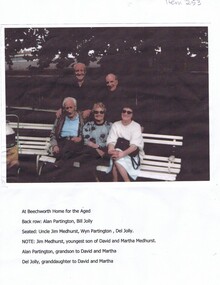
Newspaper - Newspaper clipping, Jim had his own jubilee, 1971_
... district. His father played football for the Old Brittanias, a fore runner of the Collingwood Football Club. greensborough football club diamond valley football league golden jubilee jim medhurst joe poulter dvfl Some pencil markings in photocopy. ...Tells the story of the 50th Anniversary celebrations of the Diamond Valley Football League. In particular it centres on Jim Medhurst the only former player present from the Greensborough team that won the inaugural 1921 premiership. Jim Medhurst's ancestors were a pioneering family in the district. His father played football for the Old Brittanias, a fore runner of the Collingwood Football Club.A photocopy of a newspaper clipping, a coloured photograph of the Medhursts c 1971 and a gilt and blue coloured metal badge.Some pencil markings in photocopy.greensborough football club, diamond valley football league, golden jubilee, jim medhurst, joe poulter, dvfl -
 Glenelg Shire Council Cultural Collection
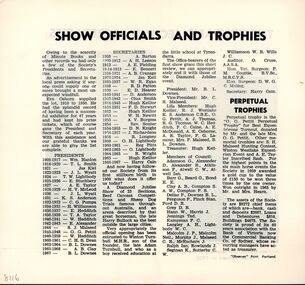
Souvenir - Booklet - Portland and District P. A. & H Show, Feb-67
... Twelve page Souvenir History, produced for the Portland and District Pastoral, Agricultural and Horticultural Association's Diamond Jubilee Show. ...1 3.69 Twelve page Souvenir History, produced for the Portland and District Pastoral, Agricultural and Horticultural Association's Diamond Jubilee Show. ...Twelve page Souvenir History, produced for the Portland and District Pastoral, Agricultural and Horticultural Association's Diamond Jubilee Show. Friday and Saturday 17 & 18 Feb. 1967Front: 'B. Vivian' - handwritten, blue biro 11?1 3.69agricultural, society, 1967 -
 Orbost & District Historical Society
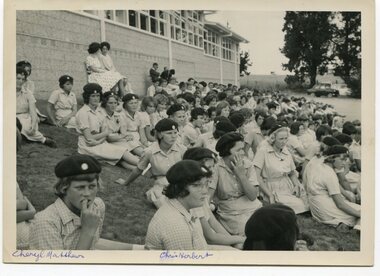
black and white photograph, 13 March 1962
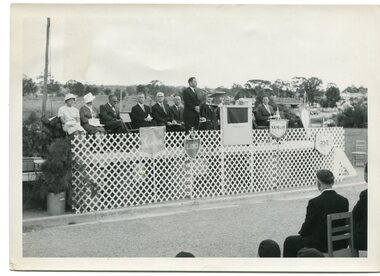
... Jubilee celebrations . Two girls in the front are Cheryl Matthews and Chris Herbert. Orbost High School / Orbost Secondary College has played a significant part in the education of senior students in the Orbost district . ...The photograph shows students watching the Orbost High School Golden Jubilee celebrations . Two girls in the front are Cheryl Matthews and Chris Herbert.Orbost High School / Orbost Secondary College has played a significant part in the education of senior students in the Orbost district . It is the sole senior educational institution. This item is representative of its historyA black / white photograph of studentssitting on lawns outside the Orbost High School.on back - "Orbost H.S. Golden Jubilee 1962" on front - " Cheryl Matthews, Chris Herbert"education-orbost orbost-high-school-golden-jubilee -
 Orbost & District Historical Society
black and white photograph, 13 March 1962
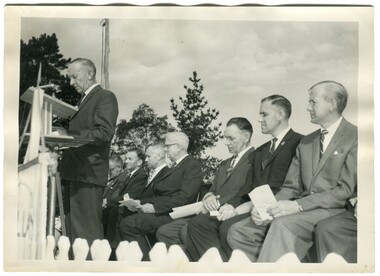
... Jubilee celebrations 1962. Orbost High School / Orbost Secondary College has played a significant part in the education of senior students in the Orbost district . ...The photograph shows Mary Gilbert, Nan Pardew, Alex McDonald (head of Dept of Education), Harry Perry, Bruce Osborne (Head Master), Bruce Evans (M.L.C.), Peter Nixon (minister For the Interior), Mr Truscott (Orbost Shire Councillor) and Colin Lyons (Senior Master) at the Orbost High School Golden Jubilee celebrations 1962.Orbost High School / Orbost Secondary College has played a significant part in the education of senior students in the Orbost district . It is the sole senior educational institution. This item is representative of its historyA black / white photograph of a man on an outside stage addressing an audience with other officials sitting on the stage behind him,on back - " Nam??" Golden Jubilee 1962" -
 Orbost & District Historical Society
black and white photograph, 13 March 1962
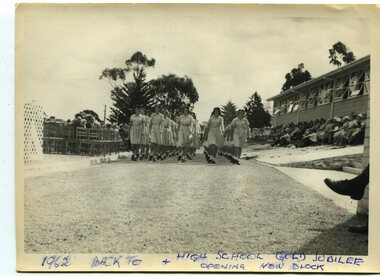
... Jubilee celebrations for Orbost High School in 1962. Orbost High School / Orbost Secondary College has played a significant part in the education of senior students in the Orbost district . ...This photograph shows Harry Perry (School Council President); Bruce Osborns (Orbost High Head Teacher); Alex McDonald (head of Dept of Education); Bert May; Bruce Evans (M.L.C.) and Peter Nixon (minister For The Interior). It was taken at the Golden Jubilee celebrations for Orbost High School in 1962.Orbost High School / Orbost Secondary College has played a significant part in the education of senior students in the Orbost district . It is the sole senior educational institution. This item is representative of its historyA black / white photograph of seven men wearing suits sitting on a stage with one man addressing an audience.on back - names + Orbost H.s. Golden Jubilee"education-orbost orbost-high-school-golden-jubilee -
 Orbost & District Historical Society
black and white photograph, March 13 1962
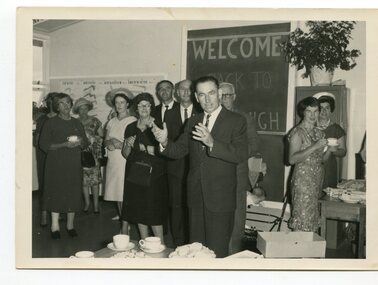
... Jubilee of the Orbost High School in 1962. Orbost High School / Orbost Secondary College has played a significant part in the education of senior students in the Orbost district . ...The photo shows the Orbost Marching Girls at the Golden Jubilee of the Orbost High School in 1962.Orbost High School / Orbost Secondary College has played a significant part in the education of senior students in the Orbost district . It is the sole senior educational institution. This item is representative of its historyA black / white photograph of female students marching at the Orbost High School with a crowd watching.front bottom - "1962 Back To + High School Gold Jubilee opening new block" on back - "Golden Jubilee 1962. Girls marching"education- orbost orbost-high-school-golden-jubilee orbost--marching-girls -
 Orbost & District Historical Society
black and white photograph, 1962
... district . It is the sole senior educational institution. This item is representative of its history and is a useful reference tool. orbost-education orbost-high-school on back - Bert May, Orbost H.S. Jubilee ...This photo shows Bert May addressing a group of ladiers at the 1962 Golden Jubilee of the Orbost High School. Bert May served as the Member for Gippsland in the Legislative Council from 1957 until 1973. With earlier levels of schooling available at the Orbost State School or nearby schools of Newmerella and Jarrahmond School, it was not until April 1912, and after much campaigning from parents and other notable community members, that the Orbost Higher Elementary School was opened. Mr Richard Trembath was appointed the new Head teacher of Orbost Higher Elementary School and was assisted by Miss Olga Hirst. The senior class consisted of 26 pupils, and the junior class, 16 pupils. A limited curriculum was available which included lessons in Latin, Arithmetic, Algebra, Geometry, Geography, History, Drawing and advanced English. (ref. O.S.C. website)Orbost High School / Orbost Secondary College has played a significant part in the education of senior students in the Orbost district . It is the sole senior educational institution. This item is representative of its history and is a useful reference tool.A black / white photograph of a man giving a speech to a group of ladies in a classroom. all are standing.on back - Bert May, Orbost H.S. Jubilee 1962orbost-education orbost-high-school -
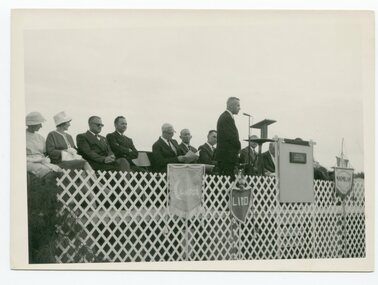 Orbost & District Historical Society
black and white photograph, 1962
... district . It is the sole senior educational institution. orbost -education orbost-high-school back - hand-written - "Orbost H.S. Jubilee ...This photograph was taken at the Golden Jubilee of Orbost High School in 1962. Bert May is addressing crowds. Bert May served as the Member for Gippsland in the Legislative Council from 1957 until 1973. With earlier levels of schooling available at the Orbost State School or nearby schools of Newmerella and Jarrahmond School, it was not until April 1912, and after much campaigning from parents and other notable community members, that the Orbost Higher Elementary School was opened. Mr Richard Trembath was appointed the new Head teacher of Orbost Higher Elementary School and was assisted by Miss Olga Hirst. The senior class consisted of 26 pupils, and the junior class, 16 pupils. A limited curriculum was available which included lessons in Latin, Arithmetic, Algebra, Geometry, Geography, History, Drawing and advanced English. (info. from O.S.C. website.Orbost High School / Orbost Secondary College has played a significant part in the education of senior students in the Orbost district . It is the sole senior educational institution. A black / white photograph of Mr Bert May, on a stage, addressing an audience, most seated, some standing behind him.back - hand-written - "Orbost H.S. Jubilee, 1962 - Bert May".orbost -education orbost-high-school -
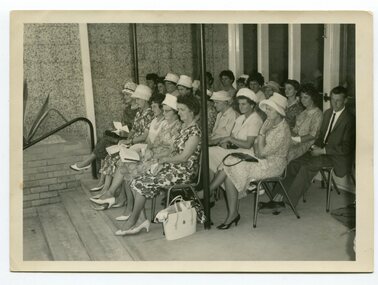 Orbost & District Historical Society
black and white photograph, 1962
... district . It is the sole senior educational institution. on back - hand-written - " Orbost H.s. Jubilee ...In 2012, Orbost Secondary College and the wider community celebrated 100 years of secondary education in Orbost. With earlier levels of schooling available at the Orbost State School or nearby schools of Newmerella and Jarrahmond School, it was not until April 1912, and after much campaigning from parents and other notable community members, that the Orbost Higher Elementary School was opened. Mr Richard Trembath was appointed the new Head teacher of Orbost Higher Elementary School and was assisted by Miss Olga Hirst. The senior class consisted of 26 pupils, and the junior class, 16 pupils. A limited curriculum was available which included lessons in Latin, Arithmetic, Algebra, Geometry, Geography, History, Drawing and advanced English. (info. O.S.C. website)Orbost High School / Orbost Secondary College has played a significant part in the education of senior students in the Orbost district . It is the sole senior educational institution. A black / white photograph of a group of ladies seated on chairs outside the Orbost High School.on back - hand-written - " Orbost H.s. Jubilee, 1962 - Welfare Ladies & Edna Towns, Joan Liddell" -
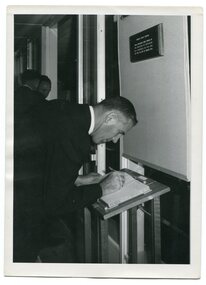 Orbost & District Historical Society
black and white photograph, 1962
... district . It is the sole senior educational institution. on back - hand-written -" Orbost H. S. Golden Jubilee ...This is a photograph of Bruce Evans, Member of the Victorian Legislative Assembly, signing the visitors' book at the Orbost High School Golden Jubilee in 1962. In 2012, Orbost Secondary College and the wider community celebrated 100 years of secondary education in Orbost. With earlier levels of schooling available at the Orbost State School or nearby schools of Newmerella and Jarrahmond School, it was not until April 1912, and after much campaigning from parents and other notable community members, that the Orbost Higher Elementary School was opened. Mr Richard Trembath was appointed the new Head teacher of Orbost Higher Elementary School and was assisted by Miss Olga Hirst. The senior class consisted of 26 pupils, and the junior class, 16 pupils. A limited curriculum was available which included lessons in Latin, Arithmetic, Algebra, Geometry, Geography, History, Drawing and advanced English. (inf0. from O.S.C. website)Orbost High School / Orbost Secondary College has played a significant part in the education of senior students in the Orbost district . It is the sole senior educational institution. A black / white photograph of a man in a suit signing a book.on back - hand-written -" Orbost H. S. Golden Jubilee 1962. Bruce Evans M.L.A. signing Visitors' Book>" -
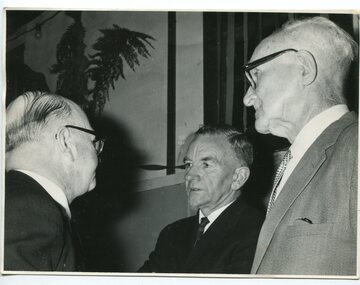 Orbost & District Historical Society
black and white photograph, 1962
... Jubilee celebrations in 1962. It shows Crs Truscott, Mr R. Osborne (1960-1963 Orbost High School Headmaster, and Mr George Cameron. Orbost High School / Orbost Secondary College has played a significant part in the education of senior students in the Orbost district . ...This photograph was taken at the Orbost High School Golden Jubilee celebrations in 1962. It shows Crs Truscott, Mr R. Osborne (1960-1963 Orbost High School Headmaster, and Mr George Cameron.Orbost High School / Orbost Secondary College has played a significant part in the education of senior students in the Orbost district . It is the sole senior educational institution. A black / white photograph of three men in suits.on back - hand-written -" Orbost H.S. Jubilee, 1962, Crs. Truscott, Osbourne & Geo. Cameron"education-orbost orbost-high-school -
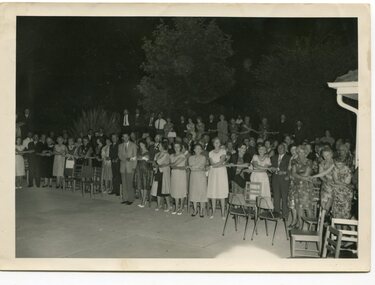 Orbost & District Historical Society
black and white photograph, 1962
... Jubilee celebrations for the Orbost High School. Orbost High School / Orbost Secondary College has played a significant part in the education of senior students in the Orbost district . ...This photograph was taken while crowds are singing Auld Lang Syne at the end of the 1962 Golden Jubilee celebrations for the Orbost High School.Orbost High School / Orbost Secondary College has played a significant part in the education of senior students in the Orbost district . It is the sole senior educational institution. This item is representative of its history.A black / white photograph of a large group of people holding hands and singing. It is night time.on back - "Auld Lang Syne 1962"education-orbost orbost-high-school-golden-jubilee -
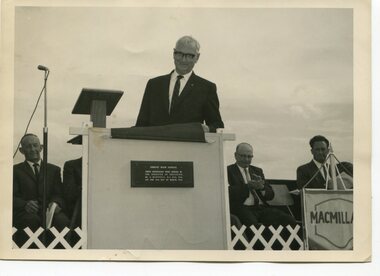 Orbost & District Historical Society
black and white photograph, 13 March 1962
... Jubilee of the Orbost High School. Orbost High School / Orbost Secondary College has played a significant part in the education of senior students in the Orbost district . ...This photograph shows Mr Alex McDonald, the head of the Education Department, opening the new extensions at the 1962 Golden Jubilee of the Orbost High School.Orbost High School / Orbost Secondary College has played a significant part in the education of senior students in the Orbost district . It is the sole senior educational institution. This item is representative of its historyA black / white photograph of a man standing behind a lectern on a stage delivering a speech. There are other seated behind him.on back - " Mr Alex McDonald, head of Education Depet. Orbost H.S. Jubilee, 1962" -
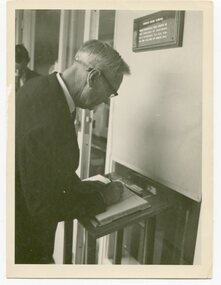 Orbost & District Historical Society
black and white photograph
... Jubilee of Orbost High School in 1962. Orbost High School / Orbost Secondary College has played a significant part in the education of senior students in the Orbost district . ...Mr Alex McDonald , head of the Department of Education, signed the visitors' book at the Golden Jubilee of Orbost High School in 1962.Orbost High School / Orbost Secondary College has played a significant part in the education of senior students in the Orbost district . It is the sole senior educational institution. This item is representative of its historyA black / white photograph of a man wearing glasses signing a book.on back - "Orbost H.S. Jubilee 1962.Alex McDonald"education-orbost orbost-high-school-golden-jubilee
