
Showing 784 items matching " dock"
-
 Queenscliffe Maritime Museum
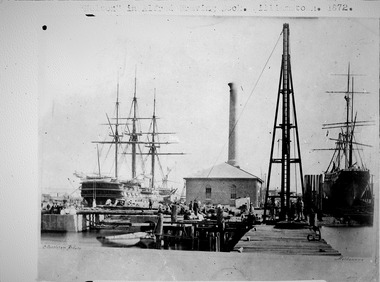
Photograph - Reproduced Photograph, "Nelson" in Alfred Graving Dock Williamstown, Victoria 1872
... "Nelson" in Alfred Graving Dock Williamstown, Victoria 1872...She was the first ship to dock in the newly constructed Alfred Graving Dock in Williamstown, Victoria....A black and white photograph of the sailing ship HMS later HMVS Nelson docked at the Alfred Graving Dock, Williamstown, 1872..."Nelson" in Alfred Graving Dock Williamstown, Victoria 1872...She was the first ship to dock in the newly constructed Alfred Graving Dock in Williamstown, Victoria. ...HMS Nelson was a 126-gun ship of the line of the Royal Navy. Launched on 4 July 1814 at Woolwich Dockyard she was later converted into a screw ship in 1860, and was cut down to a two-decker and fitted with an engine of 2,102 indicated horsepower. In 1865, HMVS Nelson was given to the colony of Victoria as a training ship. She was outfitted and rigged for £42,000 and sailed for Australia in October 1867. Travelling via the Cape of Good Hope, she arrived in February 1868. She was the first ship to dock in the newly constructed Alfred Graving Dock in Williamstown, Victoria.Possibly the first training ship of the Victorian Navy which had a base in Swan Island in Queenscliffe.A black and white photograph of the sailing ship HMS later HMVS Nelson docked at the Alfred Graving Dock, Williamstown, 1872"Nelson" in Alfred Graving Dock Williamstown, Victoria 1872hms nelson, hmvs nelson, alfred graving dock, williamstown -
 Mission to Seafarers Victoria
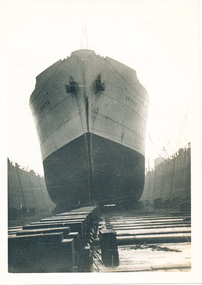
Photograph - Photograph, Black and white, Allan Charles Quinn, Ariston in dry dock, 26 August 1947
... Ariston in dry dock...This photograph shows the front of the ship while in the dry dock....A black and white photograph of the Ariston in dry dock....Handwritten on reverse in black ink: ARISTON IN DRY DOCK / 26.8.47 / D (in pencil). There is also a small mark in blue ink in the left hand bottom corner....The photograph is part of a series of five, depicting the Ariston in dry docks in Hoboken, New jersey, on the 26th of August, 1947. ...The photograph is part of a series of five, depicting the Ariston in dry docks in Hoboken, New jersey, on the 26th of August, 1947. This photograph shows the front of the ship while in the dry dock.This is a photograph from the Allan Charles Quinn collection which is a collection of letters and photograph depicting aspects of life at sea for a young man in the era immediately following World War II.A black and white photograph of the Ariston in dry dock.Handwritten on reverse in black ink: ARISTON IN DRY DOCK / 26.8.47 / D (in pencil). There is also a small mark in blue ink in the left hand bottom corner.allan-quinn, photograph, dry-docks, hoboken, new-jersey, ariston -
 Mission to Seafarers Victoria
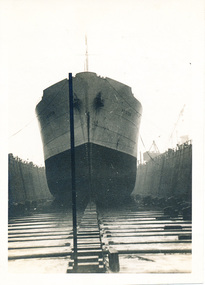
Photograph - Photograph, Black and white, Allan Charles Quinn, Aniston in dry dock Hoboken, New Jersey, 26 August 1947
... Aniston in dry dock Hoboken, New Jersey...This photograph shows the front of the ship while in the dry dock....Black and white photograph of the Aniston in dry dock, in Hoboken, New Jersey....Handwritten in black ink on reverse: ANISTON IN DRY DOCK / HOBOKEN NEW JERSEY / 26.8.47 / D (in pencil). ...The photograph is part of a series of five, depicting the Aniston in dry docks in Hoboken, New jersey, on the 26th of August, 1947. ...The photograph is part of a series of five, depicting the Aniston in dry docks in Hoboken, New jersey, on the 26th of August, 1947. This photograph shows the front of the ship while in the dry dock.This is a photograph from the Allan Charles Quinn collection which is a collection of letters and photograph depicting aspects of life at sea for a young man in the era immediately following World War II.Black and white photograph of the Aniston in dry dock, in Hoboken, New Jersey.Handwritten in black ink on reverse: ANISTON IN DRY DOCK / HOBOKEN NEW JERSEY / 26.8.47 / D (in pencil). There is also a small blue mark in the bottom left hand corner.allan-quinn, photograph, aniston, dry-docks, hoboken, new-jersey -
 Queenscliffe Maritime Museum
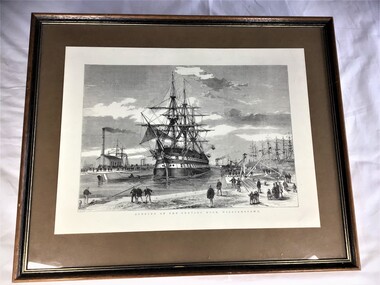
Print - Framed copy of an engraving of the sailing ship 'Nelson' in the Alfred Graving Dock in Williamstown, 1868, HMVS Nelson in the Alfred Graving Dock, Williamstown, Victoria, 1868
... HMVS Nelson in the Alfred Graving Dock, Williamstown, Victoria, 1868 ...A framed copy of an engraving entitled: 'Opening of the Graving Dock, Williamstown'....Opening of the Graving Dock, Williamstown...HMVS Nelson Alfred Graving Dock Williamstown Opening of the Graving Dock, Williamstown A framed copy of an engraving entitled: 'Opening of the Graving Dock, Williamstown'. ...As the White Ensign was reserved entirely for the use of the Royal Navy, the Admiral decided to approve of a new ensign for the Victorian Navy and this was flown for the first time from Nelson on 9th March 1870. The new ensign was very similar to the present day national flag and incorporated the Union flag with five white stars on a blue field.Following upon a series of ‘Russian scares’ in the 1870s, Nelson presumably by permission of the Admiralty, was converted into a fighting ship for the Victorian Navy; she was cut down to a single- decker, the fore and mizzen masts were removed, and the armament modified by the landing of several of the old muzzle-loaders and the addition of a number of new breech-loading guns. This conversion was carried out in the new drydock in 1881.A framed copy of an engraving entitled: 'Opening of the Graving Dock, Williamstown'.Opening of the Graving Dock, Williamstownhmvs nelson, alfred graving dock, williamstown -
 Victorian Railway History Library
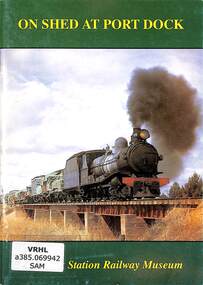
Book, R. Sampson, On Shed at Port Dock, 1997
... On Shed at Port Dock......Port Dock Station Railway Museum (S.A.) Inc Publications...On Shed at Port Dock Book R. Sampson Port Dock Station Railway Museum (S.A.) ...Details about the Port Dock railway museum in Adelaide South Australia and the collection of rollingstock and railway memorabiliaill, p.40.non-fictionDetails about the Port Dock railway museum in Adelaide South Australia and the collection of rollingstock and railway memorabiliarailway and tramway preservation - australia, mile end railway museum - south australia -
 Victorian Railway History Library
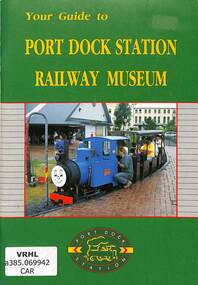
Book, Carter, Mark, Port Dock Station Railway Museum, 1992
... Port Dock Station Railway Museum......Port Dock Station Railway Museum (S.A.) Inc Publications...Port Dock Station Railway Museum Book Carter, Mark R. ...Details about the Port Dock railway museum in Adelaide South Australia and the collection of rollingstock and railway memorabiliaill, p.40.non-fictionDetails about the Port Dock railway museum in Adelaide South Australia and the collection of rollingstock and railway memorabiliarailway and tramway preservation - australia, mile end railway museum - south australia -
 Mission to Seafarers Victoria
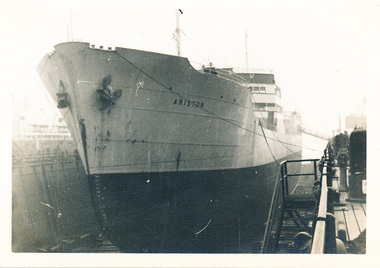
Photograph - Photograph, Black and white, Allan Charles Quinn, Ariston in dry dock, 26 August 1947
... Ariston in dry dock...This photograph shows the front and side of the ship while in the dry dock....A black and white photograph of the Ariston in dry dock, in Hoboken, New Jersey....The photograph is part of a series of five, depicting the Ariston in dry docks in Hoboken, New jersey, on the 26th of August, 1947. ...The photograph is part of a series of five, depicting the Ariston in dry docks in Hoboken, New jersey, on the 26th of August, 1947. This photograph shows the front and side of the ship while in the dry dock.This is a photograph from the Allan Charles Quinn collection which is a collection of letters and photograph depicting aspects of life at sea for a young man in the era immediately following World War II.A black and white photograph of the Ariston in dry dock, in Hoboken, New Jersey.Handwritten in black ink on reverse: ARISTON IN DRY SOCK / 26.8.47 / D (handwritten in pencil). There is also a small mark in blue ink in the bottom right hand corner.allan-quinn, photograph, dry-docks, hoboken, new-jersey, ariston -
 Mission to Seafarers Victoria
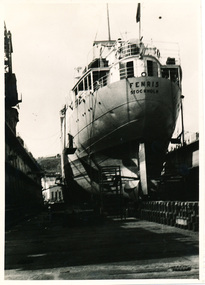
Photograph - Photograph, Black and white, Allan Charles Quinn, In Dry Dock, 18 May 1949
... In Dry Dock...This photograph shows the front and side of the ship while in the dry dock....A black and white photograph of the M/S Fenris in dry dock, in Stockholm....A black and white photograph of the M/S Fenris in dry dock, in Stockholm. In Dry Dock Photograph Photograph, Black and white Allan Charles Quinn ...The photograph is part of a series of six, depicting the Fenris in dry docks in at Finn Boda ship yards, in Stockholm, Sweden, between the 4th and the 27th of May, 1948. This photograph shows the front and side of the ship while in the dry dock.This is a photograph from the Allan Charles Quinn collection which is a collection of letters and photograph depicting aspects of life at sea for a young man in the era immediately following World War II.A black and white photograph of the M/S Fenris in dry dock, in Stockholm.On reverse: STOCKHOLM / 18-5-49 handwritten in blue ink. There is also an indecipherable mark handwritten in pencil below this.allan-quinn, photograph, fenris, dry-dock, sweden, stockholm, 1949 -
 Port Melbourne Historical & Preservation Society
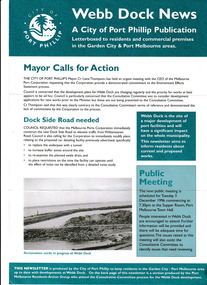
Newsletter, Webb Dock News, 1996
... Webb Dock News...The Mayor, Cr Liana THOMPSON, expressed concern that the development plans for Webb Dock changed regularly and were nor being referred to the Consultative Committee. ...The folded A3 newsletter is headed Webb Dock News was produced & letterboxed by the City of Port Phillip to keep residents & businesses in Port Melbourne informed of the developments at the dock. ...Webb Dock News Newsletter ...The Mayor, Cr Liana THOMPSON, expressed concern that the development plans for Webb Dock changed regularly and were nor being referred to the Consultative Committee. These concerns are set out and a date for a Public meeting announced. The folded A3 newsletter is headed Webb Dock News was produced & letterboxed by the City of Port Phillip to keep residents & businesses in Port Melbourne informed of the developments at the dock. piers and wharves - webb dock, local government - city of port phillip, port melbourne residents action group, liane thompson -
 Flagstaff Hill Maritime Museum and Village
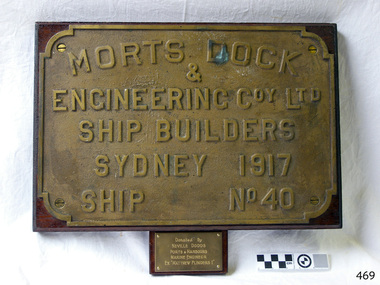
Plaque - Nameplate, Morts Dock & Engineering Co. Ltd, Matthew Flinders I, 1917
... The Matthew Flinders was constructed by Morts Dock & Engineering Coy. Ltd in Sydney, New South Wales. ...The plate is from a vessel, the dredge Matthew Flinders I, ship no. 40, built by Morts Dock & Engineering Coy Ltd in Sydney, and registered in 1917. ...On nameplate: "MORTS DOCK / & / ENGINEERING COY. LTD. / SHIP BUILDERS / SYDNEY 1917 / SHIP NO 40" On small plaque: "Donated by / NEVILLE DODDS / PORTS & HARBOURS / MARINE ENGINEER / EX "MATTHEW FLINDERS I"...Morts Dock & Engineering Co. Ltd....The Matthew Flinders was constructed by Morts Dock & Engineering Coy. Ltd in Sydney, New South Wales. ...This nameplate was attached to the steel steamer Matthew Flinders I, a Suction Hopper Dredge used for pumping up sit and sanding from seabeds. It was donated by the Marine Engineer, Neville Dodds, from Ports and Harbours, from the Matthew Flinders I. The Matthew Flinders was constructed by Morts Dock & Engineering Coy. Ltd in Sydney, New South Wales. Identified as Ship No. 40, the dredge had twin screw engines that were made in Sydney. Its gross tonnage was 1180. It was launched on July 15th, 1916, and registered in 1917 at the Port of Melbourne by the owner, the Department of Public Works in Victoria. Unlike bucket dredges, the Matthew Flinders did not use permanent moorings but instead had bow and stern anchors. It travelled forward on the bow anchor, taking up a strip of even-depth wilt from the bed below. A local newspaper noted that the Matthew Flinders has many advantages that were especially useful for its work at Warrnambool. Warrnambool Harbour had been experiencing silting and sanding for many years. The problem continued even after the construction of the Breakwater in 1890, which was overseen by New Zealand engineer Arthur Dudley Dobson. Melbourne’s Department of Ports and Harbours sent the new Matthew Flinders to dredge the heavy silting in the Warrnambool Harbour in May 1919. This work was previously done by the smaller dredge, the Pioneer. However, after a month of work, the Matthew Flinders was returned to Melbourne for alterations to make it suitable for work in the heavy seas it experienced at Warrnambool. Both dredges were sent up from Melbourne when required over the years to periodically attend to the silting in the Harbour, but the Matthew Flinders was preferred because of its efficiency. It was still dredging the Harbour even in July 1938. The ship’s original master was J G Rosney. In February 1922 Percy Taylor from Ports and Harbours joined the Matthew Flinders as a Mate. 1923 the master in charge was Captain Dunbar. In August 1926 Percy Taylor was appointed as her Master and was later transferred to the Pioneer as Master in 1933. 1930 the dredges were no longer required as the Harbour was no longer suitable as a port. However, one source notes that the Matthew Flinders was still dredging the Harbour in 1938.This nameplate is significant for its association with the suction hopper dredge Matthew Flinders I, which was used to remove the build-up of silt and sand from the Warrnambool Harbour, allowing shipping activities to continue to operate in the Port of Warrnambool. The nameplate identifies the vessel and shows that it was built in Australia in the early 20th century for use within Australia. The need for dredging in the Warrnambool Harbour was a serious and ongoing problem, as silting continued to happen after a series of measures were taken to try and resolve the issue. Eventually, the Harbour could no longer function successfully as a port.Brass nameplate, rectangular with cut-away corners and moulded text, mounted with screws on timber. The plate is from a vessel, the dredge Matthew Flinders I, ship no. 40, built by Morts Dock & Engineering Coy Ltd in Sydney, and registered in 1917. A small rectangular engraved plaque below the nameplate gives further details of the ship and the donor.On nameplate: "MORTS DOCK / & / ENGINEERING COY. LTD. / SHIP BUILDERS / SYDNEY 1917 / SHIP NO 40" On small plaque: "Donated by / NEVILLE DODDS / PORTS & HARBOURS / MARINE ENGINEER / EX "MATTHEW FLINDERS I"flagstaff hill, warrnambool, maritime village, maritime museum, flagstaff hill maritime museum & village, shipwreck coast, great ocean road, dredge, mathew flinders i, steel steam ship, twin screw engines, nsw, state of victoria, suction hopper, public works melbourne, warrnambool harbour, lady bay, sanding, silting, breakwater, morts dock & engineering co ltd, captain dunbar, ship no. 40, niville dodds, ports & harbours, marine engineer, marine technology, ship relic, percy taylor, matthew flinders, pioneer -
 Seaworks Maritime Museum
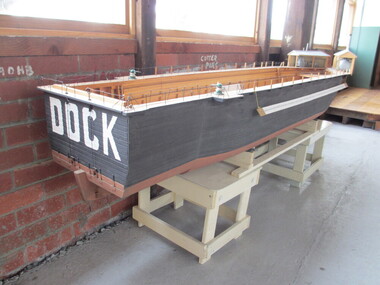
Model dry dock, Cliff Gibson
... Model of the second wooden floating dock at willianstown. Length o/a 206 feet. ...Large wooden model of the second floating dock at Williamstown. Made from wood painted black with the work dock painted in white ..."DOCK"...Model of the second wooden floating dock at willianstown. Length o/a 206 feet. ...Model of the second wooden floating dock at willianstown. Length o/a 206 feet. Beam inside 35ft 6in. Operated 1895-1958. Constructed from the burnt Hull of the sailing ship Habitant which caught fire on the 7th June 1894. Model constructed by Cliff Gibson. Large wooden model of the second floating dock at Williamstown. Made from wood painted black with the work dock painted in white "DOCK" -
 Port Melbourne Historical & Preservation Society
Photograph, Paddle Steamer Weeroona in Dule's and Orr's Dry Dock, 1900s
... Paddle Steamer Weeroona in Dule's and Orr's Dry Dock...Two men in foreground standing on dock floor. Shows wooden dock walls and pump house on right....Two men in foreground standing on dock floor. Shows wooden dock walls and pump house on right. ...Copyright Queenscliff Historical museum. Paddle Steamer Weeroona in Duke's and Orr's Dry Dock. Black and white photo . Shows vessel resting on keel blocks. Two men in foreground standing on dock floor. Shows wooden dock walls and pump house on right.transport - shipping, maritime, ps weeroona, duke's and orr's dry dock -
 Ballarat Heritage Services
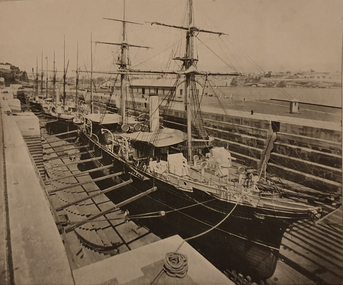
Image, Sutherland Dock, Sydney, c1918, c1918
... Sutherland Dock, Sydney, c1918...Black and white image of boats in Sydney's Sutherland Dock....immigration boat ship port sutherland dock sydney Black and white image of boats in Sydney's Sutherland Dock. ...Black and white image of boats in Sydney's Sutherland Dock.immigration, boat, ship, port, sutherland dock, sydney -
 Mission to Seafarers Victoria
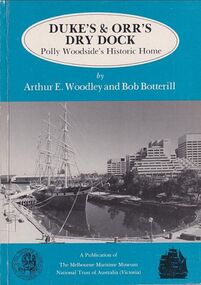
Book, Arthur E. Woodley et al, Duke’s & Orr’s Dry Dock, Polly Woodside’s Historic Home, 1985
... Duke’s & Orr’s Dry Dock, Polly Woodside’s Historic Home...Covering the early graving docks on the Yarra in the 1870s, through the period of two dry docks known as Duke's Dock and Orr's Dock, the closure of Orr's Dock in 1932, and the remaining single dock known as Duke's and Orr's. ...Covering the early graving docks on the Yarra in the 1870s, through the period of two dry docks known as Duke's Dock and Orr's Dock, the closure of Orr's Dock in 1932, and the remaining single dock known as Duke's and Orr's. ...70 pages : illustrations, facsimiles, mapsnon-fictionduke and orr dry dock, polly woodside, national trust, yarra river, south wharf, interest group -
 Geelong RSL Sub Branch
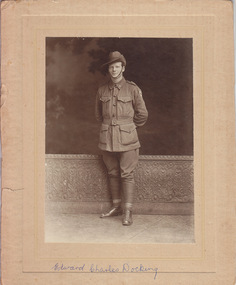
Photographs - Docking Family, early/mid 20 Century
... These photographs are of the Docking Brothers, Edward C, Arthur A and Victor Roy - all served overseas during WW1 and came home. ...Original Black and White and Sepia photographs of the Docking Family. ...1814 Edward C Docking WW1 The photographs have been attached to white A4 paper and identified by a niece of 2128 Arthur A Docking WW1 Docking Family. ...These photographs are originals from the Docking Family. WW1 WW2 Docking Family Changi 1814 Edward C Docking WW1 The photographs have been attached to white A4 paper and identified by a niece of 2128 Arthur A Docking WW1 Docking Family. ...These photographs are of the Docking Brothers, Edward C, Arthur A and Victor Roy - all served overseas during WW1 and came home. Melville Roy (son of Victor Roy) - served during WW2 and was a POW in Changi. The three brothers were born on Prahan, Victoria but relocated to Western Australia.These photographs are originals from the Docking Family.Original Black and White and Sepia photographs of the Docking Family. 1814 Edward C Docking WW1 The photographs have been attached to white A4 paper and identified by a niece of 2128 Arthur A Docking WW1 Docking Family. Victor Roy Docking WW1 Melville Roy Docking WW2 POW Changi?ww1, ww2, docking family, changi -
 Mission to Seafarers Victoria
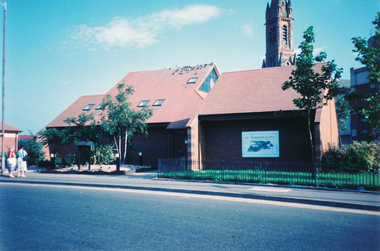
Photograph - Photograph, Colour, 1991?
... The centre is at the main dock gate (Corry Road) within easy walking distance of most ships on North Shore. ...Mission located in the docks in Belfast North Ireland. Behind is the St Joseph's Church Sailortown....Dock Street, Belfast, North Ireland...The centre is at the main dock gate (Corry Road) within easy walking distance of most ships on North Shore. ...The centre is at the main dock gate (Corry Road) within easy walking distance of most ships on North Shore. Facilities include a Flying Angel Centre with free Wifi & computer access, a bar and café, currency exchange, a choice of mobile phone & internet cards, pool table, chapel, gift shop, clothes shop and lounge area. Belfast is one of the many centres from the Mission to Seafarers network around the world.Mission located in the docks in Belfast North Ireland. Behind is the St Joseph's Church Sailortown.mission to seafarers, seamen's mission, mission to seamen, belfast, north ireland, ports -
 Glenelg Shire Council Cultural Collection
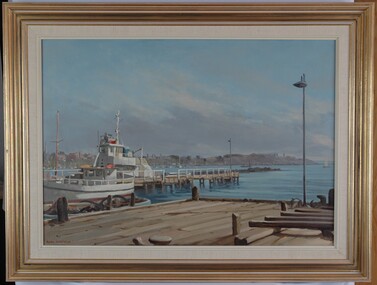
Painting, Whalers Point from Harbour Trust Dock, n.d
... Whalers Point from Harbour Trust Dock...View of harbour and jetties from a dock. Dock is in foreground. A white fishing vessel is berthed at a jetty positioned near the dock. ...Back: (no inscription) View of harbour and jetties from a dock. Dock is in foreground. A white fishing vessel is berthed at a jetty positioned near the dock. ...Port of Portland CollectionView of harbour and jetties from a dock. Dock is in foreground. A white fishing vessel is berthed at a jetty positioned near the dock. In background is a view of the foreshore with buildings. The water is pale blue with darker blue details. The sky is blue with grey wash depicting clouds near horizon line. Mounted in thick cream canvas mount, framed under glass in wooden gold painted frame.Front: Signature - Ramon Horsfield (lower left) (orange paint). Back: (no inscription)port of portland -
Glenelg Shire Council Cultural Collection
Photograph, View of packaged timber products stored on dock before loading onto ship, 12/05/1976
... View of packaged timber products stored on dock before loading onto ship...View of packaged timber products stored on dock before loading onto ship. Packages have bird droppings on them. ...View of packaged timber products stored on dock before loading onto ship Photograph Photograph ...Port of Portland Authority archivesFront: (no inscriptions) Back: Lamaria - P Pulp 12-5-76 (pencil, centre)port of portland -
 Ballarat Heritage Services
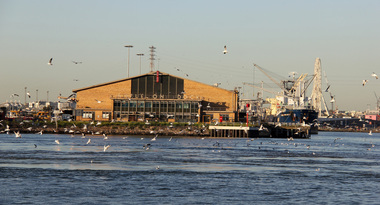
Digital photographs, L.J. Gervasoni, Yarra River Melbourne Docklands Victoria Dock, 2015
... Yarra River Melbourne Docklands Victoria Dock......dock...yarra river melbourne docklands yarra river dock docklands shipping port channel water victoria dock Digital Images Yarra River Melbourne Docklands Victoria Dock Digital photographs L.J. ...Digital Imagesyarra river melbourne docklands, yarra river, dock, docklands, shipping, port, channel, water, victoria dock -
 Ballarat Heritage Services
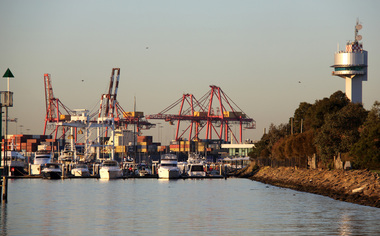
Digital photographs, L.J. Gervasoni, Yarra River Melbourne Docklands container dock cranes, 2015
... Yarra River Melbourne Docklands container dock cranes......dock...yarra river melbourne docklands yarra river dock docklands shipping port channel water container cranes Digital Images Yarra River Melbourne Docklands container dock cranes Digital photographs L.J. ...Digital Imagesyarra river melbourne docklands, yarra river, dock, docklands, shipping, port, channel, water, container, cranes -
 Mission to Seafarers Victoria
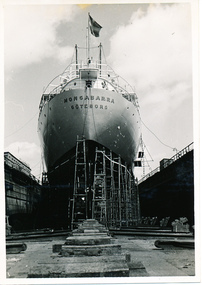
Photograph - Photograph, Black and white, Allan Charles Quinn, M/S "Mongabarra" in dry-dock at Eriksbergs, 1950
... M/S "Mongabarra" in dry-dock at Eriksbergs...The ship is directly in the middle of the photograph taking from the very front of the ship in the dry-dock. There are several ladders lined up along the left-hand side of the ship beginning from the ships front. ...M/S "Mongabarra" in dry-dock at Eriksbergs Photograph Photograph, Black and white Allan Charles Quinn ...This series of photographs captures life at sea and the conditions on the ship M/S "Mongabarra" in 1950. This photograph was reproduced and exhibited by the Mission to Seafarers as part of the exhibition "Letters from Abroad" in 2012.This photograph is part of the Allan Quinn collection, which is a pictorial autobiography, and it represents one of many moments of his time abroad as a seafarer.Black and white photograph of the M/S "Mongabarra" Goteborg in Eriksbergs dockyard, Gothenburg, Sweden. The ship is directly in the middle of the photograph taking from the very front of the ship in the dry-dock. There are several ladders lined up along the left-hand side of the ship beginning from the ships front. There are several wooden planks lying on the ground in front of the ship and walls either side of the ship.ship, sweden, mongabarra, allan quinn collection, allan quinn, gothenburg, drydock, shipyard, dockyard, eriksbergs, letters-from-abroad -
 City of Melbourne Libraries
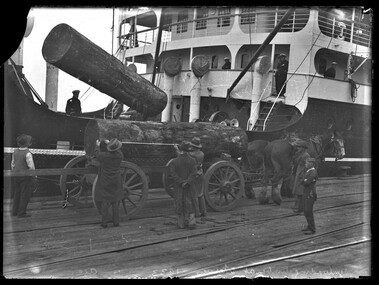
Photograph (item), Bull, Hugh Jones, 1897-1993, Unloading timber at Victoria Dock, 1933
... Unloading timber at Victoria Dock...By the time construction was completed, the dock was 39 hectares and hailed as the second-largest dock in the world (behind Cavendish Dock, Barrow-in-Furness). ...By the time construction was completed, the dock was 39 hectares and hailed as the second-largest dock in the world (behind Cavendish Dock, Barrow-in-Furness). ...Photographer notations on slide: "Unloading Timber at Wharves 1933 Age B5" Published: Age (Melbourne, Vic.: 1854- ), Tuesday 15 August 1933 MAHOGANY FROM MANILA. (1933, August 15). The Age (Melbourne, Vic. : 1854 - 1954), p. 11. Retrieved January 16, 2026, from http://nla.gov.au/nla.news-article204377024 Published title: MAHOGANY FROM MANILA Published Caption: Age Tue 15 Aug 1933 Caption: Unloading Mahogany Logs brought from Manila, Philippine Islands, by the steamer Taiping, which berthed yesterday at Victoria Dock. The vessel discharged twenty logs, each weighing three tons, the first shipment of this type of timber landed in Melbourne. Research by Project Volunteer, Louise McKenzie: This photograph in many ways epitomises Melbourne in the 1930s. It is a time of enormous growth, development and change. But before delving into that, the photo itself is very powerful. The huge mahogany logs being unloaded appear to be so heavy that the ship itself seems to list to port as they are craned over the side. They are being levered into a cart to which two large and sturdy Clydesdale horses are hitched. In contrast to the traditional horses, the wharf is crisscrossed with modern railway tracks. Unloading is both mechanical and manual, and the scene is one of intense interest to a young boy bystander. The ship appears to be squat and solid, but the whole image also gives a feeling of movement and intensity. The mahogany being delivered to Melbourne would be intended for high quality furniture. In the 1930s Australia actually had a growing timber industry, but much of the eucalyptus wood was being utilised for mass produced furniture, and much of this furniture would then have had a veneer applied to it. The fact that it was economic to import this timber from the “Philippine Islands” – not a traditional trading market for Australia – reflects a Victorian economy that was strong enough to support a growing demand for good quality furniture Mahogany was described as a classic, strong hardwood, often used for dark opulent furniture. In the 1930s the importation of timber from Manila (Philippines) to Australia was a notable trade, particularly in Philippine Lauan (often referred to as Philippine Mahogany), which was used as a cheaper alternative to other hardwoods. 1930s furniture, dominated by the art deco style, used a mix of luxurious exotic woods like mahogany, macassar and ebony for high-end pieces, often veneered over less expensive woods such as walnut, birch and poplar, and with plywood, chrome and lacquer also popular for more practical, streamlined designs during the Depression era. By the mid 1930s timber mills were being relocated away from the immediate dock area, but the fact that these logs were being transported by horse-drawn cart implies that the load would not have had to be taken too far for milling. 1885 the Melbourne Harbour Trust Commissioners had decided that land in or near the city was far too valuable to be used as timber yards. Furthermore, large stacks of timber posed a fire risk. The Trust asked the Victorian Government to reserve a site on the east side of the Yarra River opposite Yarraville and Spotswood. Here, in 1889, the Trust began building six jetties and a wharf specifically for the landing of timber. Clydesdale horses were initially brought to Victoria from Tasmania in the 1830s, and with the 1850s gold rush they were imported direct from Scotland. Melbourne was from its earliest years an important centre of horse-breeding from both imported and colonial-bred stock, providing the well-built draught horse for pulling heavily loaded wagons, the harness horse for delivery work and drawing coaches, and the saddle-horse used for riding. Stud breeding facilities were advertised from the early 1840s. By the 1870s the horse export trade was thriving, and the Port of Melbourne was the country's busiest exporter of horses to Indian, Asian and New Zealand markets. Kirk's Melbourne Horse and Carriage Bazaar in Bourke Street first advertised for business in 1840, and by the 1850s Bourke Street West was famed for its horse bazaars and saleyards. The Victorian Clydesdale Horse Society reports that Clydesdale working horses were a vital part of Melbourne's infrastructure and agricultural industry in the 1930s, when they reached the peak of their popularity despite the increasing competition from mechanization. Their main roles and usage at this time were: • City Delivery: Clydesdales were a common sight for metropolitan deliveries, particularly for breweries (such as Carlton & United Breweries), milk runs, and bread deliveries. • Industrial Work: They were heavily used for hauling cargo at the docks, in construction, and at specialized sites like the Truganina Explosives Reserve, where they pulled wagons. • Agriculture: In surrounding rural areas, they were the primary power source for ploughing and agricultural machinery. • Specialization: By the 1930s, the Clydesdale was smaller and more compact than the Shire or Percheron breeds, making them ideal for navigation in urban environments. After the 1930s their numbers decreased due to the onset of WWI and mechanisation. Wartime petrol rationing led to a brief revival for the working horse, as suburban tradesmen, now used to motor delivery, took their old jinkers out of mothballs. By 1947, however, only 1.5% of city traffic was horse-drawn. In 1952 the large horse cartage company A. Kellet Pty Ltd sold its 250 horses and converted its Richmond stables to storage. In the 1950s at Station and Princes piers, wharf labourers refused to work with the six draught horses still being used to haul trolleys and which were soon superseded by the fork lift, semi-trailer and mobile crane. Where carefully trained horses had once shunted trains in city goods yards, a few hundred a week were now being killed at the abattoirs for pet and human consumption. The last MCC dray horse was withdrawn from service in 1958, but some of the few remaining working animals are used by the mounted police for crowd control at demonstrations and football games. The death knell had also sounded for the associated trades of farrier, saddler and blacksmith. Our photo, therefore, showing the wharf with both the haulage Clydesdales and the rail lines, is a strong visual summary of the social and economic changes experienced in Victoria in the 1930s and on towards the 1950s. Our photo is located at Victoria Dock (also known as Victoria Harbour) which is still an active component of Melbourne’s port system. In 1892 the West Melbourne Dock (later Victoria Dock) was opened, downstream and immediately west of the Spencer Street railway shunting yards. It contained a swing basin for ships, replacing the one which had been provided on the south side of the river, later to be the Duke and Orr dry dock, west of the Charles Grimes Bridge. Further west was the South Wharf along the river bank. The history of Victoria Dock is extremely well described by Ashley Smith in his 2 March 2022 article in Docklands News, and its accompanying aerial photo of the Dock taken in 1934. He writes: "In the early 1930s Victoria Dock was one of the biggest sites for trade and export in Melbourne. A constant queue of ships sailed in, unloaded their cargo, recharged and reloaded, then left for the next port. Around the time this photo was taken (found in a 1934 photo book), the trapezium-shaped basin had been through some changes since its construction in the 1890s. The 497-metre-long Central Pier, finished in 1919, now featured six sheds to house the ever-increasing volume of cargo. The entrance had also been widened in the 1920s to allow better access. Some of the berths featured three-ton jib electric cranes to help with loading cargo and a rail network connected to the State Railway service. By the time construction was completed, the dock was 39 hectares and hailed as the second-largest dock in the world (behind Cavendish Dock, Barrow-in-Furness). To further save costs, excavations were dug to a more reasonable seven metres below low water, instead of British engineer Sir John Coode’s recommended 8.3 metres. Even then, the costs were still around £900,000. It was envisaged, with the extra wharfage, that around thirty 90-metre ships could berth inside. On March 22, 1892, Victoria Dock was opened by Victoria’s Governor, the Earl of Hopetoun (later Australia’s first Governor-General) who opened the sluice to let the Yarra in. It took six days to fill the basin with The Leader newspaper estimating that it would take another six months to completely fill (March 26, 1892). In the end, it took nearly a year before the first ship was allowed to enter on February 20, 1893, when the steamer Hubbuck sailed in to unload 1200 tonnes of cargo in 15 hours. The Argus (February 23, 1893) reported that the ship’s captain, J. R. Brodie, called the Yarra “better than the Thames”, and compared Victoria Dock favourably to the Albert Dock (Liverpool)." This would be a good time to move our focus on to the Taiping, which is the transporter of these giant mahogany logs. The Taiping was a steel-hulled, single-screw passenger-cargo Chinese steamer, which today has the dubious legacy of being involved in a collision headlined as “The Chinese Titanic”. It was constructed by the Hong Kong and Shampoa Dock Company at its facility in Hong Kong, with completion in 1926 for service under the Australia Oriental Line. Her gross register tonnage measured 4,324 tons, reflecting her design for inter-island and coastal trade routes, accommodating both passengers and freight. She operated routes connecting Australian ports with East Asian destinations. As World War II approached, Taiping continued predominantly working the trade routes between China and Australia, until December 1941, when she evacuated women and children from Hong Kong to Manila just before Japanese forces overran the region. She then safely reached Australia despite enemy air raids. Taiping was then requisitioned by the Royal Navy and repurposed as a victualling stores issuing ship for the Eastern Fleet, supporting logistical needs in the Pacific and Indian oceans. Returned to the Australian Oriental Line in 1947, she underwent refitting and by mid-1948 was chartered to the Shanghai Shipping Company, and modified for greater passenger accommodation – approximately 500 passengers. In 1948/49 the Chinese Civil War took place. The Taiping departed Shanghai on 26 January 1949 as one of the final vessels evacuating civilians from to Keelung Harbour in Taiwan. Reports indicate that the Taiping carried double the rated capacity of passengers i.e. 1000. The ship carried families, military personnel, civilians, carrying personal belongings, gold and valuables in hope of resettlement in Nationalist Taiwan. It also held heavy cargo in the form of silver and gold bullion loaded by the Central Bank of China. Because of the risk of patrols, and to conserve fuel, the Captain took the ship away from the usual open-sea passage, and instead navigated along the coast. He also extinguished navigation lights to avoid detection. Shortly after midnight on 27 January 1949 the Taiping collided with the smaller cargo steamer Chien Yuan in the East China Sea near the Zhoushan Archipelago. The Chien Yuan was also operating in darkness. The subsequent collision was catastrophic. The Chien Yuan sank with in 5 minutes, with the loss of 72 of its 74 crew. The Taiping sustained severe structural compromise from the broadside strike and initially remained afloat, then made a swift descent into the freezing water, with no attempt at an organised evacuation. No formal recovery process was instigated, however a distress signal went out. 32 survivors were picked up by the Australian destroyer HMAS Warramunga (on patrol nearby), a passing US vessel found 2 more, and local Zhoushan fishermen retrieved others. In the end, only 37 people survived. The event is remembered as a poignant moment in the mass migration to Taiwan, with families tragically separated. A memorial to the disaster exists at the Keelung Harbour naval base on Taiwan. With its total of over 1,500 deaths, it constituted one of the worst peacetime maritime losses. It is sometimes referred to as the “Oriental Titanic” because of the similarly large loss of life and speed of demise with the RMS Titanic in 1912. A fictional depiction of this event appears in the John Woo movies “The Crossing (Part 1) (2014), and The Crossing II (2015), known in Chinese as “Taiping Wheel”. The narrative weaves a story around pre-disaster romances and wartime turmoil among passengers, culminating in the ship’s rapid sinking. “The production, a high-budget Sino-Taiwanese-Hong Kong co-effort, portrays the event as a microcosm of the 1940s Sino-Japanese and civil war legacies, though critics noted the melodramatic style prioritizing spectacle over historical precision.” In conclusion, it is nice to return to our photo, and observe the people involved in this moment. The dockworkers are, so typical of the 1930s, dressed in what looks to us like formal clothing – dark suits or coats, white shirts, and black hats. I am particularly drawn to the young boy, bare-headed, arms crossed, and so intent on the unloading process. He too is wearing a white shirt, black trousers and jacket, and black shoes. This is 1933 Melbourne – but the haircut he is sporting is now very “hipster” and modern in 2026 Melbourne. References: MAHOGANY FROM MANILA. (1933, August 15). The Age (Melbourne, Vic. : 1854 - 1954), p. 11. Retrieved January 30, 2026, from http://nla.gov.au/nla.news-article204377024 Wikipedia, Taiping steamer, https://en.wikipedia.org/wiki/Taiping_(steamer) Wikipedia, Victoria Dock, https://en.wikipedia.org/wiki/Victoria_Dock_(Melbourne) Docklands News, Ashley Smith, 2 Mar 2022, https://www.docklandsnews.com.au/victoria-dock/ Living Histories: Heritage Council of Victoria, Jill Barnard, 2008, Jetties and Piers, https://livinghistories.net.au/wp-content/uploads/2015/11/Jetties-ONL-intro_Part-1.pdf eMelbourne, Wharves and Docks, https://www.emelbourne.net.au/biogs/EM01612b.htm Australian Academy of Technological Sciences – Harvesting Wood, https://www.austehc.unimelb.edu.au/tia/225.html Old Treasury Building, On the Water – The Docks, https://tinyurl.com/3wkbk66m Old Treasury Building, On The Road, https://tinyurl.com/dw44yr3t Port of Melbourne, Victorian Places, https://www.victorianplaces.com.au/port-of-melbourne Docklands Heritage Study - Environmental History, https://mvga-prod-files.s3.ap-southeast-4.amazonaws.com/public/2024-05/docklands-heritage-review-thematic-environmental-history-1991.pdf eMelbourne, Horses, https://www.emelbourne.net.au/biogs/EM00723b.htm Victorian Clydesdale Horse Society, https://www.clydesdalesvic.org.au/history The Crossing, https://letterboxd.com/film/the-crossing-i/Photographer notations on slide: "Unloading Timber at Wharves 1933 Age B5"ships, shipping, timber industry, shipwrecks, horses, docks, wharves, 1930-1939, wars, docklands -
 Mission to Seafarers Victoria
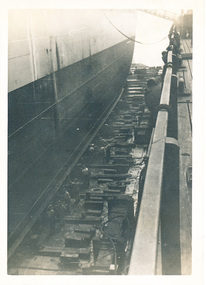
Photograph - Photograph, Black and white, Allan Charles Quinn, 26 August 1947
... The photograph is part of a series of five, depicting the Aniston in dry docks in Hoboken, New jersey, on the 26th of August, 1947. ...Black and white photograph of workers painting the "bootopping"of the Aniston, while in dry dock....Handwritten in black ink on reverse: WORKERS PAINTING / BOOTOPPING IN DOCK / 26.8.47 / D (in pencil). There is also a small mark in blue ink in the bottom left hand corner....The photograph is part of a series of five, depicting the Aniston in dry docks in Hoboken, New jersey, on the 26th of August, 1947. ...The photograph is part of a series of five, depicting the Aniston in dry docks in Hoboken, New jersey, on the 26th of August, 1947. This photograph shows workers painting the "bootopping"of the ship.This is a photograph from the Allan Charles Quinn collection which is a collection of letters and photograph depicting aspects of life at sea for a young man in the era immediately following World War II.Black and white photograph of workers painting the "bootopping"of the Aniston, while in dry dock.Handwritten in black ink on reverse: WORKERS PAINTING / BOOTOPPING IN DOCK / 26.8.47 / D (in pencil). There is also a small mark in blue ink in the bottom left hand corner.allan-quinn, photograph, aniston, dry-docks, hoboken, new-jersey, bootopping -
 Mission to Seafarers Victoria
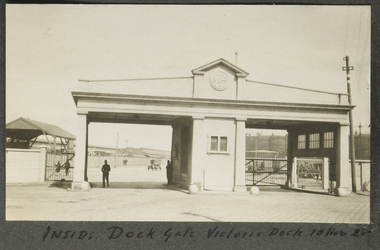
Photograph - Photograph, Sepia, Inside Dock Gate Victoria Dock 10 Nov. 1928, 10 November 1928
... Inside Dock Gate Victoria Dock 10 Nov. 1928 ...victoria dock 1928 fan album port melbourne melbourne harbour trust mht gasworks docklands on page 10 Inside Dock Gate Victoria Dock 10 Nov. 1928 Photograph Photograph, Sepia ...on page 10victoria dock, 1928, fan album, port melbourne, melbourne harbour trust, mht, gasworks, docklands -
 Mission to Seafarers Victoria
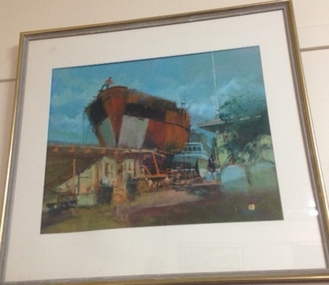
Painting, (Dry dock), Late 20th C or early 21st Century
... (Dry dock)...The hull appears to be in a dry dock with a stylized figure with a red top and blue pants looks down from the prow at the set of low buildings and yard in the foreground. ...Sealed at back with brown paper mostly intact and a corded hanging system. (Dry dock) Painting Painting ...Marine art, Maritime artLarge framed glazed landscape format painting depicting in foreground a rusty hull of a ship against a deep aqua blue sky. The hull appears to be in a dry dock with a stylized figure with a red top and blue pants looks down from the prow at the set of low buildings and yard in the foreground. Another ship appears to be moored behind the rusty hull but only the bridge of the ship is visible. At near right in foreground there appear to be two rounded graves or headstones.The frame is sharply beaded and with gilding. The painting has a window mount and is glazed with glass. Paint surface is thinly but intensley painted and seems to be gouache or watercolour on paper. Sealed at back with brown paper mostly intact and a corded hanging system.at lower right corner quadrant there seems to be a mainly rectangular ciphertankers, marine painting, artwork-paintings -
 Eltham District Historical Society Inc
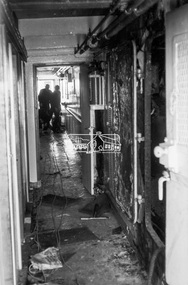
Photograph, George Coop, Fire damaged Wilhelmsen Line ship Tomar at Victoria Dock, Melbourne, Jan. 1968
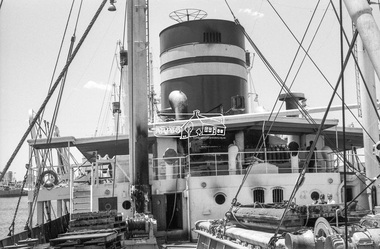
... Fire damaged Wilhelmsen Line ship Tomar at Victoria Dock, Melbourne...This photo was taken when the ship was brought up to Victoria Docks (No. 26 South Wharf) where George and other passengers were allowed to retrieve their luggage. ...lid=2961287 https://www.flickr.com/photos/wheelhouseno/8131145299 George Coop Collection Tomar (ship) Victoria Docks Wilhelmsen Line Digital TIFF file Scan of 35mm Kodak Plus-X Pan black and white negative transparency Fire damaged Wilhelmsen Line ship Tomar at Victoria Dock, Melbourne Photograph Photograph George Coop ...When George Coop and wife Helen following several years teaching in Canada, they bought a passage aboard the Wilhelmsen line cargo ship, Tomar departing Oslo, Norway for Melbourne, Australia. Whilst crossing the Bass Strait near Robe, South Australia, a generator in the engine room caught fire threatening the ship's fuel oil tanks, forcing the Captain to order the 43 crew and 8 passengers to abandon ship. They spent many hours in a lifeboat before being rescued. This photo was taken when the ship was brought up to Victoria Docks (No. 26 South Wharf) where George and other passengers were allowed to retrieve their luggage. The ship was then taken to Kaohsiung, Taiwan for scrapping. See also https://www.shipsnostalgia.com/media/tomar.450919/ http://www.shipspotting.com/gallery/photo.php?lid=2726028 http://www.shipspotting.com/gallery/photo.php?lid=2961287 https://www.flickr.com/photos/wheelhouseno/8131145299Digital TIFF file Scan of 35mm Kodak Plus-X Pan black and white negative transparencygeorge coop collection, tomar (ship), victoria docks, wilhelmsen line -
 Eltham District Historical Society Inc
Photograph, George Coop, Fire damaged Wilhelmsen Line ship Tomar at Victoria Dock, Melbourne, Jan. 1968
... Fire damaged Wilhelmsen Line ship Tomar at Victoria Dock, Melbourne...This photo was taken when the ship was brought up to Victoria Docks (No. 26 South Wharf) where George and other passengers were allowed to retrieve their luggage. ...lid=2961287 https://www.flickr.com/photos/wheelhouseno/8131145299 George Coop Collection Tomar (ship) Victoria Docks Wilhelmsen Line Digital TIFF file Scan of 35mm Kodak Plus-X Pan black and white negative transparency Fire damaged Wilhelmsen Line ship Tomar at Victoria Dock, Melbourne Photograph Photograph George Coop ...When George Coop and wife Helen following several years teaching in Canada, they bought a passage aboard the Wilhelmsen line cargo ship, Tomar departing Oslo, Norway for Melbourne, Australia. Whilst crossing the Bass Strait near Robe, South Australia, a generator in the engine room caught fire threatening the ship's fuel oil tanks, forcing the Captain to order the 43 crew and 8 passengers to abandon ship. They spent many hours in a lifeboat before being rescued. This photo was taken when the ship was brought up to Victoria Docks (No. 26 South Wharf) where George and other passengers were allowed to retrieve their luggage. The ship was then taken to Kaohsiung, Taiwan for scrapping. See also https://www.shipsnostalgia.com/media/tomar.450919/ http://www.shipspotting.com/gallery/photo.php?lid=2726028 http://www.shipspotting.com/gallery/photo.php?lid=2961287 https://www.flickr.com/photos/wheelhouseno/8131145299Digital TIFF file Scan of 35mm Kodak Plus-X Pan black and white negative transparencygeorge coop collection, tomar (ship), victoria docks, wilhelmsen line -
 Flagstaff Hill Maritime Museum and Village
Photograph, The Barquentine "Speculant" at Melbourne Docks, before 1911
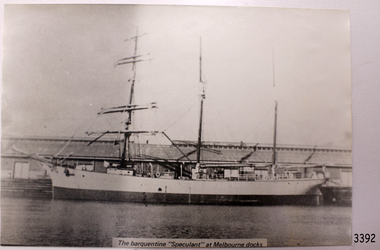
... In 1911 the SPECULANT had been attempting to depart Warrnambool for almost the entire month of January to undergo docking and overhaul in Melbourne. A month of east and south-easterly winds had forced her to remain sheltered in Lady Bay, Warrnambool apart from one morning of northerlies, when an attempt was made to round Cape Otway; she had to return to shelter in Portland after failing to make any headway. ...Photograph, black and white, titled "The barquentine "Speculant", at Melbourne Docks"...Title below photograph reads "The barquentine "Speculant", at Melbourne Docks"...The SPECULANT is listed on the Victorian Heritage Register VHR S626 flagstaff hill warrnambool shipwrecked-coast flagstaff-hill flagstaff-hill-maritime-museum maritime-museum shipwreck-coast flagstaff-hill-maritime-village photograph speculant melbourne docks cumming and ellis international timber trade f. j. mcgennan and co. warrnambool capt. james jacobsen warrnambool maritime history Title below photograph reads "The barquentine "Speculant", at Melbourne Docks" Photograph, black and white, titled "The barquentine "Speculant", at Melbourne Docks" The Barquentine "Speculant" at Melbourne Docks Photograph ...This photograph is of the barque "SPECULANT" during one of her voyages to Melbourne. The barquentine SPECULANT was a steel, three-masted sailing ship built in 1895 in Inverkeithing, Scotland, registered in Warrnambool, Victoria and wrecked at Cape Paton, Victoria, 10th February 1911. The SPECULANT had been involved in the timber trade between the United Kingdom and Russia, until sold to its Warrnambool owners and timber merchants Messrs. P.J. McGennan & Co. (Peter John McGennan) in 1902 for 3000 pounds and had her sailed to Warrnambool as her new port. Peter John McGennan was born in 1844 and worked as a builder and cooper in Holyhead, Anglesea, Wales. He immigrated to Australia in 1869 as a free settler and arrived in Warrnambool in 1871 and undertook management of a property in Grassmere for Mr. Palmer. Peter met his wife Emily in South Melbourne and they married in 1873. They had ten children including Harry who lived to 1965, and Andrew who lived until 1958. (The other children were their four brothers - John who was killed in the Dardenalles aged 35, Frederick who died aged 8, Peter who died aged 28, Frank who died aged 5 weeks - and four sisters - Beatrice who died age 89, Edith who died aged 49, Blanche who died aged 89 and Eveline who died aged 48.) In 1874 Peter starting a boating establishment on the Hopkins River. In 1875 he opened up a Coopers business in Kepler Street next to what was Bateman, Smith and Co., moving to Liebig Street, next to the Victoria Hotel, in 1877. In 1882 he then moved to Lava Street (which in later years was the site of Chandlers Hardware Store). He was associated with the establishment of the Butter Factory at Allansford. He started making Butter Boxes to his own design and cheese batts for the Butter Factory. In 1896 established a Box Factory in Davis Street Merrivale, employing 24 people at its peak, (it was burnt down in 1923); and in Pertobe Road from 1912 (now the Army Barracks building). Peter was a Borough Councillor for Albert Ward from 1885 to 1891, he commenced the Foreshore Trust (including the camping grounds along Pertobe Road), and he was an inaugural Director of the Woollen Mill in Harris Street, buying an extensive share-holding in 1908 from the share trader Edward Vidler. They lobbied the Town Hall to have a formal ‘Cutting’ for the waters of the Merri River to be redirected from its natural opening south of Dennington, to its existing opening near Viaduct Road, in order to have the scourings from the wool at the Woollen Mill discharged into the sea. He sold Butter Boxes around the state, and had to ship them to Melbourne by rail. Peter’s purchase of the SPECULANT in 1902 enabled him to back-load white pine from Kaipara, New Zealand to Warrnambool to make his butter boxes then, to gain profitability, buy and ship potatoes and other primary produce bound to Melbourne. (McGennan & Co. had also owned the LA BELLA, which had traded in timber as well, until she was tragically wrecked with the loss of seven lives, after missing the entrance channel to Warrnambool harbour in 1905. It appears that the SPECULANT was bought to replace the LA BELLA.) In 1911 the SPECULANT had been attempting to depart Warrnambool for almost the entire month of January to undergo docking and overhaul in Melbourne. A month of east and south-easterly winds had forced her to remain sheltered in Lady Bay, Warrnambool apart from one morning of northerlies, when an attempt was made to round Cape Otway; she had to return to shelter in Portland after failing to make any headway. With only 140 tons of sand ballast aboard, the ship would not have been easy to handle. Captain Jacobsen and his crew of nine, mainly Swedes, decided to make for Melbourne, leaving Portland Harbour on 5th February 1911. By the 9th they had reached Cape Otway, where they encountered a moonless night, constant heavy rain, and a heavy sea with a south-easterly wind blowing. After safely rounding Cape Otway the course was changed to east, then north-east to take the vessel to a point six miles off Cape Patton, following the orders of Captain Jacobsen, who told the crew to be very careful with the steering, as the wind and sea was running to leeward. The patent log (used to measure speed) had been out of order for the last four months as no-one in Warrnambool was able to fix it: it was intended to have it repaired in Melbourne. In the meantime the crew measured the vessel's speed by looking over the side and estimating wind strength. This compounded the difficulties of imprecise positioning, as the strong cross wind and sea were acting on the lightly laden vessel to steadily drive it towards the shore. At 3.30am on Friday 10 February 1911 Captain Jacobsen and the first mate were looking over the side of the vessel when they heard the sound of breakers and suddenly struck the rocks. The crew immediately knew they had no chance of getting the SPECULANT off, and attempted to rescue themselves by launching the lifeboat, which was instantly smashed to pieces. One of the crew then volunteered to take a line ashore, and the rest of the crew were all able to drag themselves to shore, some suffering hand lacerations from the rocks. Once ashore they began to walk along the coast towards Lorne, believing it was the nearest settlement. Realising their mistake as dawn broke they returned westwards to Cape Patton, and found a farm belonging to Mr C. Ramsden, who took them in and gave them a change of clothes and food. After resting for a day and returning to the wreck to salvage some of their personal possessions, at 10am on Saturday they set out for Apollo Bay, a voyage that took six hours, sometimes wading through flooded creeks up to their necks. The Age described the wreck as "listed to starboard. All the cabin is gutted and the ballast gone. There is a big rock right through the bottom of her, and there is not the slightest hope of getting her off". A Board of Marine inquiry found that Captain Jacobson was guilty of careless navigation by not taking steps to accurately verify the position of the vessel with respect to Cape Otway when the light was visible and by not setting a safe and proper course with respect to the wind and sea. It suspended his certificate for 6 months and ordered him to pay costs. The location of the wreck site was marked for a long time by two anchors on the shoreline, until in 1970 the larger of the two anchors was recovered by the Underwater Explorers' Club and mounted on the foreshore at Apollo Bay. The bell from the wreck was also donated to the Apollo Bay Surf Lifesaving Club but is recorded to have been stolen. Rusting remains of the wreck can still be found on the shoreline on the southern side of, and directly below Cape Patton. Parts of the SPECULANT site have been buried by rubble from construction and maintenance works to the Great Ocean Road, as well as by naturally occurring landslides. Peter J McGennan passed away in 1920. The Gates in the western wall of the Anglican Church in Henna Street/Koroit St are dedicated to him for his time of community work, which is matched with other prominent Warrnambool citizens; Fletcher Jones, John Younger, J.D.E (Tag) Walter, and Edward Vidler. After Peter J McGennan's death Harry, Andrew and Edith continued to operate the family business until July 11th 1923 when the company was wound up. (Andrew lived in Ryot Street Warrnambool, near Lava Street.) Harry McGennan (Peter and Emily’s son) owned the Criterion Hotel in Kepler Street Warrnambool (now demolished). His son Sid and wife Dot lived in 28 Howard Street (corner of Nelson Street) and Sid managed the Criterion until it was decided by the family to sell, and for he remained Manager for the new owners until he retired. Harry commenced the Foreshore Trust in Warrnambool around 1950. The McGennan Carpark in Pertobe Road is named after Harry and there are Memorial-Stone Gates in his memory. (The Gates were once the original entrance to the carpark but are now the exit.). Peter’s great-grandson, also called Andrew, is a Security Officer in Warrnambool. The Patent Log (also called a Taffrail log) from the SPECULANT, mentioned above, and a number of photographs, are now part of the Collection at Flagstaff Hill Maritime Village. The SPECULANT is historically significant as the largest ship to have been registered in Warrnambool, and is believed to have been the largest barquentine to visit Melbourne. It is evidence of the final days of large commercial sailing vessels involved in the Victorian and New Zealand timber trade. The SPECULANT is listed on the Victorian Heritage Register VHR S626Photograph, black and white, titled "The barquentine "Speculant", at Melbourne Docks"Title below photograph reads "The barquentine "Speculant", at Melbourne Docks"flagstaff hill, warrnambool, shipwrecked-coast, flagstaff-hill, flagstaff-hill-maritime-museum, maritime-museum, shipwreck-coast, flagstaff-hill-maritime-village, photograph, speculant, melbourne docks, cumming and ellis, international timber trade, f. j. mcgennan and co. warrnambool, capt. james jacobsen, warrnambool maritime history -
 Dandenong/Cranbourne RSL Sub Branch
Work on paper - HMAS Napier in Colombo Graving Dock
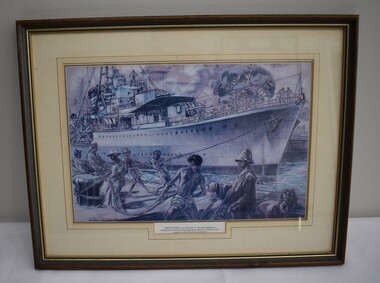
... The wording " graving " refers to the ship being put into dry dock to clean and coat the bottom of the ship. ...Framed work on paper depicting HMAS Napier in graving dock. Coloured crayons with water colour heightened with white on paper....Inscription below picture " HMAS Napier one of the five ' N' class fleet destroyers transferred on loan from the Royal Navy between 1940 and 1945, is eased into the Colombo graving dock" ....The wording " graving " refers to the ship being put into dry dock to clean and coat the bottom of the ship. ...The wording " graving " refers to the ship being put into dry dock to clean and coat the bottom of the ship. The artist Roy Cecil Hodgkinson #VX93432 attained the rank of Captain. Saw action abroad during 1939 and 1945 and was repatriated .His occupation was a cartoonist illustrator. In 1942 Roy was appointed as an Official War Artist by the Australian War Memorial. During his appointment he served in Northern Australia, New Guinea, Ceylon , India and Burma.Framed work on paper depicting HMAS Napier in graving dock. Coloured crayons with water colour heightened with white on paper.Inscription below picture " HMAS Napier one of the five ' N' class fleet destroyers transferred on loan from the Royal Navy between 1940 and 1945, is eased into the Colombo graving dock" . -
 Flagstaff Hill Maritime Museum and Village
Equipment - Speaking Tube, Morts Dock & Engineering Co. Ltd, circa 1941
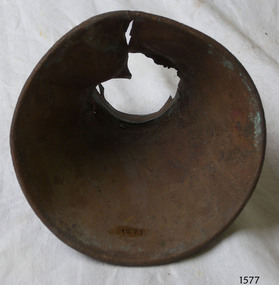
... Morts Dock & Engineering Co. Ltd....Equipment Speaking Tube Australia NSW Sydney Morts Dock & Engineering Co. Ltd. Royal Australian Navy (RAN) Southern Cross Diving and Salvage ...This brass speaking tube or voice pipe was used by the crew to communicate within the ship. It was recovered from the wreck of the Royal Australian Navy vessel, HMAS Warrnambool in 1948. The HMAS Warrnambool J202 was commissioned by the Royal Australian Navy for use as a minesweeper during World War II. The Bathurst Class Corvette, fitted out with a range of armaments, was launched in Sydney 1941 and was. The ship began service in Bass Strait in 1941. At the end of the year it called into its namesake city, Warrnambool, where the crew paraded for the public marching eastwards along Timor Street. A gift of books for the ship’s personnel and a plaque bearing the City of Warrnambool’s Coat of Arms were presented to the ship. The ship was involved in evacuating a family of nine from the Dutch East Indies that was later successful in its challenge of Australia’s Immigration Restriction Act (White Australia Polity). The ship had many other appointments around Australia. On 13th September 1947 HMAS Warrnambool was leading a flotilla of minesweepers in northern Queensland’s coastal waters, clearing mines previously laid to defend Australia. The ship hit a mine, which exploded and very quickly sunk the ship. Boats from the nearby ships rescued most of the seamen although one was killed at the time. The survivors were taken by the HMAS Swan II to Darwin, and they went from there to hospitals in Brisbane and Sydney. Three of these men later died from their injuries. A number of items were recovered by Navy divers in 1948 including the ship’s bell and a plaque with Warrnambool’s Coat of Arms. In 1972-75 the wreck was sold and other items were salvaged. In 1995 a memorial plaque was erected in Warrnambool near the RSL. NOTE: The RAN built a second HMAS Warrnambool FCPB204, launched in 1981 and decommissioned in 2005. There was also a steam ship SS Warrnambool built in London 1892 and broken up in 1926. [A more detailed history can be found in our Collection Record 3477.] This speaking tube is an example of communication used in the mid-1900s on board a vessel. It is significant is significant for its association with Royal Australian Navy and its vessel, HMAS Warrnambool (J202). The HMAS Warrnambool played a nationally significant role in overturning Australia’s Immigration Restriction Act 1901 (colloquially known as the White Australia policy). The ship rescued, and brought to Australia, Samuel and Annie Jacob and their family after they evacuated Dutch East India. The family was threatened with deportation and made the first successful appeal to High Court regarding that Act. The HMAS Warrnambool has - Local significance for being the namesake of the City of Warrnambool - Local significance, having docked in Warrnambool Harbour - Local significance, the crew having paraded in Timor Street, Warrnambool - State significance for its first patrol being in Bass Strait. - National significance, being present in Timor at the Japanese surrender - National significance, shown by the significance of the ship’s bell being curated as Military Heritage and Technology at the Australian War Memorial. - National significance as part of Australia’s defence force history, being one of only four Bathurst class corvettes lost while in Australian service, the only Bathurst class corvette lost after World War II, the only RAN vessel to be sunk by a mine, and associated with the last four Navy deaths of WWIISpeaking tube or voice pipe, brass, conical shape, broken off at base. Wide end has a rolled edge. Recovered from HMAS Warrnambool, sunk on 13-09-1947.flagstaff hill, maritime village, maritime museum, warrnambool, shipwreck coast, mort's dock & engineering co ltd, h.m.a.s. warrnambool, hmas warrnambool, hmas warrnambool i, hmas warrnambool j202, hmas swan ii, j202, world war ii, bathurst class corvette, royal australian navy, ran, sydney built ship, bass strait patrol, sea mine patrol, mine sweeper, mine clearance, navy divers, great barrier reef, cockburn reef, southern cross diving and salvage, warrnambool city council, cr j r astbury, mayor j r astbury, warrnambool patriotic fund, seal, coat of arms, ship’s bell, hmas warrnambool 1941, shipwreck by sea mine 1947, sinking ship, sunk ship, sea rescue, life saving, lifesaving, speaking tube, voice pipe, communication on ship, marine technology, marine equipment, minesweeper
