
Showing 72 items matching " dr quick"
-
 Bendigo Historical Society Inc.
Document - BILL ASHMAN COLLECTION: CORRESPONDENCE
... ... Dr Balcombe Quick...He also mentions that he had a visit from Dr Hurley and Dr. Belcombe Quick....He also mentions that he had a visit from Dr Hurley and Dr. Belcombe Quick. Document BILL ASHMAN COLLECTION: CORRESPONDENCE ...Letter, dated 23/1/48, to Mr. F. Stevenson. Written on paper with printed letterhead. Dr. W. N. Abbott printed in the left top corner. The writer mentions the General Manager of Scalebuoys in Germany. Also mentions negative structures and x-ray film and light effects. He also mentions that he had a visit from Dr Hurley and Dr. Belcombe Quick.sciences, instruments - general, scalebuoy, bill ashman collection - correspondence, dr w n abbott, mr f stevenson, dr engelbert, prof fiegl, dr gwynne, wilson, radio-physics lab, dr hurley, dr balcombe quick, melb univ lab, prof burnet -
 Bendigo Historical Society Inc.
Document - PETER ELLIS COLLECTION: LETTER
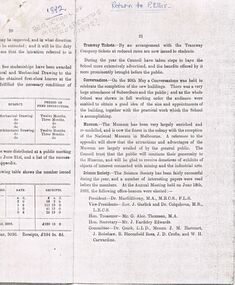
... ... Dr Quick...MUSEUMS Peter Ellis Collection Bendigo School of Mines Dr MacGillivray Rev J Garlick Dr Colquhoun Mr G Alec Thomson Mr J Eardsley Edwards Dr Quick J M Harcourt J Robshaw R Bloomfield Rees J D Crofts W H Carwardine Dr Dendy Professor Marshall Hall Professor Baldwin Spencer Department of Education Sir Frederick McCoy Baron Von Mueller J W Faul John Robshaw Henry Jackson J B Lillie MacKay Melbourne University Mr A South Department of Forestry Mr Perrin The Pharmacy Board of Victoria Education Department Photocopies of some pages mentioning the Museum. ...Photocopies of some pages mentioning the Museum. Part of a letter by P H MacGillivray, President, Report on the Botany Class, Report on the Chemistry and Metallurgy Classes, The Museum, including what exhibits, attendance of visitors and opening times. A number of pages of Donations to the Museum from 1/7 1891 to 30/6/1892, including the names and address of the donors. There is a list of the Classification of Specimens (received during the year). Also mentioned is Botany - Lecturer - J B Lillie Mackay and Zoology - Lecturer - J B Lillie Mackay. There is also a part of the printing about Architectural and Geometrical Drawing, Machine and Building Construction - Teacher - W H E Nicolai.museums, peter ellis collection, bendigo school of mines, dr macgillivray, rev j garlick, dr colquhoun, mr g alec thomson, mr j eardsley edwards, dr quick, j m harcourt, j robshaw, r bloomfield rees, j d crofts, w h carwardine, dr dendy, professor marshall hall, professor baldwin spencer, department of education, sir frederick mccoy, baron von mueller, j w faul, john robshaw, henry jackson, j b lillie mackay, melbourne university, mr a south, department of forestry, mr perrin, the pharmacy board of victoria, education department -
 Bendigo Historical Society Inc.
Document - CONNELLY, TATCHELL, DUNLOP COLLECTION: DOCUMENT
... ... Dr Quick...BUSINESS Legal connelly & tatchell Connelly & Tatchell Collection - Document F Rockes Bennett Attenborough Wilks & Connelly Miss Brierley Mr Webster Dr Quick Itemised account signed by Connelly, dated 26 Sept 1888, re quashing order and other legalwork. ...Itemised account signed by Connelly, dated 26 Sept 1888, re quashing order and other legalwork.business, legal, connelly & tatchell, connelly & tatchell collection - document, f rockes, bennett attenborough wilks & connelly, miss brierley, mr webster, dr quick -
 Bendigo Historical Society Inc.
Document - CONNELLY, TATCHELL, DUNLOPCOLLECTION: RECEIPT QUICK & HYETT
... Invoice from Quick & Hyett, Dr Quick . Barkly Hyett Barrister & Solicitor Molesworth Chambers, Bull Street, Bendigo 19th. ...Invoice from Quick & Hyett, Dr Quick . Barkly Hyett Barrister & Solicitor Molesworth Chambers, Bull Street, Bendigo 19th. ...Invoice from Quick & Hyett, Dr Quick . Barkly Hyett Barrister & Solicitor Molesworth Chambers, Bull Street, Bendigo 19th. October, 1894, issued to Connelly , Tatchell & Dunlop for 267/15/-. Dr. Quick and Barkly Hyett, Barristers & Solicitors written on top LH side. Bottom right corner has a brown one penny stampbusiness, legal, connelly, tatchell, connelly, tatchell, john quick, barkly hyett. -
 Bendigo Historical Society Inc.
Book - LONG GULLY HISTORY GROUP COLLECTION: REFERENDUM - THE AUSTRALIAN WAY
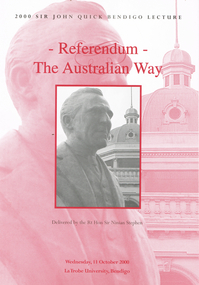
... Quick and Hyett... Edmund Burke... Alfred Deakin... Playford... The Australian Natives Association... Edmund Barton... Sir Robert Garran... Dr...BENDIGO History long gully history group The Long Gully History Group - Referendum - The Australian Way 2000 Sir John Quick Bendigo Lecture Rt Hon Sir Ninian Stephen La Trobe University Bendigo Robertson Hyetts Quick Hyett and Rymer Quick and Hyett Edmund Burke Alfred Deakin Playford The Australian Natives Association Edmund Barton Sir Robert Garran Dr John Quick University of Melbourne Michele Matthews Mrs Cheryle Parker Book titled - Referendum - The Australian Way, delivered by the Rt Hon Sir Ninian Stephen on Wednesday, 11 October 2000, La Trobe University, Bendigo. ...Book titled - Referendum - The Australian Way, delivered by the Rt Hon Sir Ninian Stephen on Wednesday, 11 October 2000, La Trobe University, Bendigo. The 2000 Sir John Quick Bendigo Lecture. The lecture was written by Michele Matthews. Lecture mentions how the referendums in this country came to be. It was the Swiss Federation that served as the model on which the founding fathers of our constitution relied in selecting the referendum as the instrument of constitutional change. Mentioned in the back of the book is a short life story of Sir John Quick and his work in Australian Federation. Also one about The Rt. Hon. Sir Ninian Stephen.bendigo, history, long gully history group, the long gully history group - referendum - the australian way, 2000 sir john quick bendigo lecture, rt hon sir ninian stephen, la trobe university bendigo, robertson hyetts, quick hyett and rymer, quick and hyett, edmund burke, alfred deakin, playford, the australian natives association, edmund barton, sir robert garran, dr john quick, university of melbourne, michele matthews, mrs cheryle parker -
 Bendigo Historical Society Inc.
Newspaper - LONG GULLY HISTORY GROUP COLLECTION: GEORGE TO THE FORE
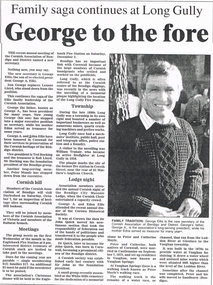
... ... Dr John Quick...BHS Collection BENDIGO History long gully history group The Long Gully History Group - George to the fore The Cornish Association of Bendigo and District George Ellis George A Ellis Leanne Lloyd Edna Ellis Ted Hocking Rob Lloyd Peter Mundy Cornish Association of Victoria Eaglehawk Fire Station William Trahair St Matthew's Anglican Church Bendigo City Masonic Lodge Cornish Choir Corowa Historical Society Dr John Quick Sir John Quick White Hill Cemetry Peter and Catherine Moyle Copy of a newspaper article titled Family saga continues at Long Gully George to the fore. ...BHS CollectionCopy of a newspaper article titled Family saga continues at Long Gully George to the fore. A photo of George is included and printed under it it mentions that George Ellis is the new secretary of the Cornish Association of Bendigo and District. George's father, George A., is the associations long-serving president, while his mother Edna served as treasurer for many years. Sir John Quick is also mentioned. He was born in Cornwall.bendigo, history, long gully history group, the long gully history group - george to the fore, the cornish association of bendigo and district, george ellis, george a ellis, leanne lloyd, edna ellis, ted hocking, rob lloyd, peter mundy, cornish association of victoria, eaglehawk fire station, william trahair, st matthew's anglican church, bendigo city masonic lodge, cornish choir, corowa historical society, dr john quick, sir john quick, white hill cemetry, peter and catherine moyle -
 Bendigo Historical Society Inc.
Document - CORNISH COLLECTION: COPY OF PAGES FROM 'BENDIGO AND VICINITY' RE JOHN QUICK
... ...Dr John Quick...PERSON Government Dr John Quick Energetic Mining Company. New Chum Mine. ...Document. Copy of pages from 'Bendigo and Vicinity' (p. 554 & 55) re John Quick, LL.D., Ex MLA with detail of the life of John Quick (second page ends with information about Federation League and the Australian Constitution - further information to complete the section (third page?) on Quick would need to be sourced from original.person, government, dr john quick, energetic mining company. new chum mine. bendigo advertiser. -
 Bendigo Historical Society Inc.
Photograph - ANA Photograph Collage
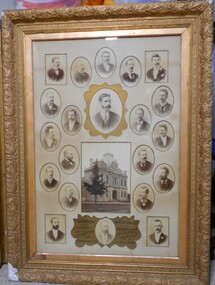
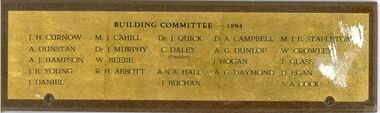
... "BUILDING COMMITTEE - 1894" J H CURNOW M J CAHILL Dr J QUICK D A CAMPBELL M J E STAPLETON A DUNSTAN Dr J MURPHY C DALEY (President) A G DUNLOP W CROWLEY A J HAMPSON W BEEBE J HOGAN T GLASS J B YOUNG R H ABBOTT A.N.A. ..."BUILDING COMMITTEE - 1894" J H CURNOW M J CAHILL Dr J QUICK D A CAMPBELL M J E STAPLETON A DUNSTAN Dr J MURPHY C DALEY (President) A G DUNLOP W CROWLEY A J HAMPSON W BEEBE J HOGAN T GLASS J B YOUNG R H ABBOTT A.N.A. ...The A.N.A. Hall in View Street was opened in August 1894. The Sandhurst Branch was started on August 26th, 1874. In July 1874, several gentlemen met together, and when a sufficient number had given in their names and sufficient promises of support had been received, the board of directors were approached with a view to forming a branch of the association in Bendigo. On August 26, 1874, the inception took place. The building was demolished in 1971. Photo collage of members of the Building Committee of the Sandhurst Branch of the Australian Natives' Association. Twenty sepia coloured photos recessed in oval or rectangular shaped opening with gold coloured edging, on backing board. One larger photo is surrounded by gold coloured pattern with scalloped edge. Below this is a photo of the ANA building in View Street. Banner beneath the Photo of the ANA building "Presented to Mr Chas. the Sandhurst Branch ANA in Recognition of His Valuable Service as President in Year 1894". The collage is framed in gold coloured ornate wooden frame. Plaque attached to lower edge of frame lists names of men in the photos. "BUILDING COMMITTEE - 1894" J H CURNOW M J CAHILL Dr J QUICK D A CAMPBELL M J E STAPLETON A DUNSTAN Dr J MURPHY C DALEY (President) A G DUNLOP W CROWLEY A J HAMPSON W BEEBE J HOGAN T GLASS J B YOUNG R H ABBOTT A.N.A. HALL A G DAYMOND D EGAN J DANIEL J BUCHAN S A COCK ana, australian natives' association, sandhurst, photo collage -
 Bendigo Historical Society Inc.
Plaque - Plaque from ANA Photograph Collage
... "BUILDING COMMITTEE - 1894" J H CURNOW M J CAHILL Dr J QUICK D A CAMPBELL M J E STAPLETON A DUNSTAN Dr J MURPHY C DALEY (President) A G DUNLOP W CROWLEY A J HAMPSON W BEEBE J HOGAN T GLASS J B YOUNG R H ABBOTT A.N.A. ..."BUILDING COMMITTEE - 1894" J H CURNOW M J CAHILL Dr J QUICK D A CAMPBELL M J E STAPLETON A DUNSTAN Dr J MURPHY C DALEY (President) A G DUNLOP W CROWLEY A J HAMPSON W BEEBE J HOGAN T GLASS J B YOUNG R H ABBOTT A.N.A. ...The A.N.A. Hall in View Street was opened in August 1894. The Sandhurst Branch was started on August 26th, 1874. In July 1874, several gentlemen met together, and when a sufficient number had given in their names and sufficient promises of support had been received, the board of directors were approached with a view to forming a branch of the association in Bendigo. On August 26, 1874, the inception took place. The building was demolished in 1971. Plaque formerly attached to the lower edge of the framed photo collage of the Building Committee of the Sandhurst Branch of the Australian Natives' Association. It lists names of men in the photos. Names printed on gold coloured paper mounted on piece of masonite, matching the position on the collage. "BUILDING COMMITTEE - 1894" J H CURNOW M J CAHILL Dr J QUICK D A CAMPBELL M J E STAPLETON A DUNSTAN Dr J MURPHY C DALEY (President) A G DUNLOP W CROWLEY A J HAMPSON W BEEBE J HOGAN T GLASS J B YOUNG R H ABBOTT A.N.A. HALL A G DAYMOND D EGAN J DANIEL J BUCHAN S A COCK ana, australian natives' association, sandhurst, photo collage -
 Bendigo Historical Society Inc.
Document - CONNELLY, TATCHELL, DUNLOP COLLECTION: LEGAL PAPERS, 1886
... ... Quick J? Dr...Connelly, Tatchell & Dunlop - Legal Papers. 1 - 1886 - Post Office Telegraph from Dunlop A Geo re Sharpe. 2 - 1886 - Letter from Symonds E, Treasury, Melbourne re Baird J O compensation. To Quick J? Dr. 3 - 1886 - Post Office Telegraph from Mendell W re Affidavit. 4 - 1886 - Letter from Mills B, 181 Swanston Street, Melbourne re Meade Jas insolvency. 5 - 1886 - Letter from Bennett & Co re Cameron James deceased. 6 - 1886 - Letter from Mendell W, Melbourne re Lazarus B deceased. 7 - 1886 - Letter from Bennett & Co re Sterry v Trestrail. 8 - 1886 - Letter from Bennett & Co re Irving & Hughes. 9 - 1886 - Letter from Motteram & Hyett, Solicitors, McCrae Street, Sandhurst re Brown & Sharpe....COTTAGE Miners Connelly Tatchell & Dunlop Dunlop A Geo Sharpe Symonds E Baird J O Quick J? Dr Mendell W Mills B Meade Jas Bennett & Co Cameron James Lazarus B Sterry Trestrail Irving Hughes Motteram & Hyett Brown Document. ...Document. Connelly, Tatchell & Dunlop - Legal Papers. 1 - 1886 - Post Office Telegraph from Dunlop A Geo re Sharpe. 2 - 1886 - Letter from Symonds E, Treasury, Melbourne re Baird J O compensation. To Quick J? Dr. 3 - 1886 - Post Office Telegraph from Mendell W re Affidavit. 4 - 1886 - Letter from Mills B, 181 Swanston Street, Melbourne re Meade Jas insolvency. 5 - 1886 - Letter from Bennett & Co re Cameron James deceased. 6 - 1886 - Letter from Mendell W, Melbourne re Lazarus B deceased. 7 - 1886 - Letter from Bennett & Co re Sterry v Trestrail. 8 - 1886 - Letter from Bennett & Co re Irving & Hughes. 9 - 1886 - Letter from Motteram & Hyett, Solicitors, McCrae Street, Sandhurst re Brown & Sharpe.cottage, miners, connelly, tatchell & dunlop, dunlop a geo, sharpe, symonds e, baird j o, quick j? dr, mendell w, mills b, meade jas, bennett & co, cameron james, lazarus b, sterry, trestrail, irving, hughes, motteram & hyett, brown -
 The Beechworth Burke Museum
Photograph - Lantern Slide, c1900
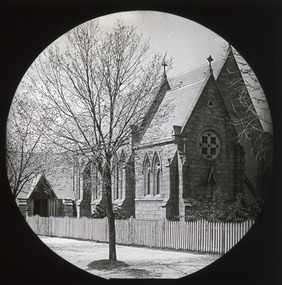
... quickly grew to be the second largest religious group in the area; this was primarily due to the work of Father William Tierney, a priest from Dublin who arrived in Beechworth in 1859. Tierney personally fostered the growth of many Catholic schools and churches in Beechworth, as he viewed it to be a significant area for the prosperity of the religion. St. Josephs Church was officially established in 1866, with the Bishop of Melbourne, Dr...quickly grew to be the second largest religious group in the area; this was primarily due to the work of Father William Tierney, a priest from Dublin who arrived in Beechworth in 1859. Tierney personally fostered the growth of many Catholic schools and churches in Beechworth, as he viewed it to be a significant area for the prosperity of the religion. St. Josephs Church was officially established in 1866, with the Bishop of Melbourne, Dr ...Taken in the year 1900, this glass slide captures an image of St. Joseph's Church, a Roman Catholic Church that is still present today at 9 Church Street, Beechworth. This was one of many churches that was established in Beechworth during the second half of the nineteenth-century. This trend began with a focus on Anglican faith; however, in the early 1850s, Father Patrick Smyth, a priest from Maynooth, Ireland, advocated for the establishment of a Roman Catholic Church in the town. Roman Catholicism quickly grew to be the second largest religious group in the area; this was primarily due to the work of Father William Tierney, a priest from Dublin who arrived in Beechworth in 1859. Tierney personally fostered the growth of many Catholic schools and churches in Beechworth, as he viewed it to be a significant area for the prosperity of the religion. St. Josephs Church was officially established in 1866, with the Bishop of Melbourne, Dr Goold, laying the foundational stone of the building. The estimated cost of the building in its entirety was approximately twenty-thousand pounds. Further additions to the building - including a second aisle, tower and spire - were proposed for the church, but were ultimately never built. Lantern slides, sometimes called 'magic lantern' slides, are glass plates on which an image has been secured for the purpose of projection. Glass slides were etched or hand-painted for this purpose from the Eighteenth Century but the process became more popular and accessible to the public with the development of photographic-emulsion slides used with a 'Magic Lantern' device in the mid-Nineteenth Century. Photographic lantern slides comprise a double-negative emulsion layer (forming a positive image) between thin glass plates that are bound together. A number of processes existed to form and bind the emulsion layer to the base plate, including the albumen, wet plate collodion, gelatine dry plate and woodburytype techniques. Lantern slides and magic lantern technologies are seen as foundational precursors to the development of modern photography and film-making techniques.This glass slide captures social and historical significance as it represents the development of Beechworth as a prosperous and thriving town; a development that occurred during the second half of the nineteenth-century. It also shows the development of religious institutions in the area, specifically the growth of Catholicism. Thin translucent sheet of glass with a circular image printed on the front and framed in a black backing. It is held together by metal strips to secure the edges of the slide.burke museum, beechworth, lantern slide, slide, glass slide, plate, burke museum collection, photograph, monochrome, churches beechworth, st. joseph's church, catholicism beechworth, roman catholic churches beechworth, father patrick smyth, father william tierney -
 Flagstaff Hill Maritime Museum and Village
Journal - Diary, before 6th January 1966
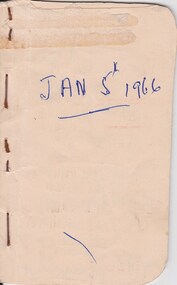
... Dr. Angus from and envelope addressed to him at his home and surgery in Warrnambool and postmarked 22nd Dec. 1965. The pages have been carefully shaped, corners rounded, and stapled together. The diary is dated for the beginning of the following year, January 5th 1966. It would be the perfect size to slip into a pocket or hide in the palm of the hand, ready to give a quick...Dr. Angus from and envelope addressed to him at his home and surgery in Warrnambool and postmarked 22nd Dec. 1965. The pages have been carefully shaped, corners rounded, and stapled together. The diary is dated for the beginning of the following year, January 5th 1966. It would be the perfect size to slip into a pocket or hide in the palm of the hand, ready to give a quick ...This pocket sized diary includes appointment times and addresses plus other personal notes made by Dr. Roy Angus (William.Roy Angus). It was made by Dr. Angus from and envelope addressed to him at his home and surgery in Warrnambool and postmarked 22nd Dec. 1965. The pages have been carefully shaped, corners rounded, and stapled together. The diary is dated for the beginning of the following year, January 5th 1966. It would be the perfect size to slip into a pocket or hide in the palm of the hand, ready to give a quick reminder of details. This diary was donated to Flagstaff Hill Maritime Village by the family of Doctor William Roy Angus, Surgeon and Oculist. It is part of the “W.R. Angus Collection” that includes historical medical equipment, surgical instruments and material once belonging to Dr Edward Ryan and Dr Thomas Francis Ryan, (both of Nhill, Victoria) as well as Dr Angus’ own belongings. The Collection’s history spans the medical practices of the two Doctors Ryan, from 1885-1926 plus that of Dr Angus, up until 1969. ABOUT THE “W.R.ANGUS COLLECTION” Doctor William Roy Angus M.B., B.S., Adel., 1923, F.R.C.S. Edin.,1928 (also known as Dr Roy Angus) was born in Murrumbeena, Victoria in 1901 and lived until 1970. He qualified as a doctor in 1923 at University of Adelaide, was Resident Medical Officer at the Royal Adelaide Hospital in 1924 and for a period was house surgeon to Sir (then Mr.) Henry Simpson Newland. Dr Angus was briefly an Assistant to Dr Riddell of Kapunda, then commenced private practice at Curramulka, Yorke Peninsula, SA, where he was physician, surgeon and chemist. In 1926, he was appointed as new Medical Assistant to Dr Thomas Francis Ryan (T.F. Ryan, or Tom), in Nhill, Victoria, where his experiences included radiology and pharmacy. In 1927 he was Acting House Surgeon in Dr Tom Ryan’s absence. Dr Angus had become engaged to Gladys Forsyth and they decided he would take time to further his studies overseas in the UK in 1927. He studied at London University College Hospital and at Edinburgh Royal Infirmary and in 1928, was awarded FRCS (Fellow from the Royal College of Surgeons), Edinburgh. He worked his passage back to Australia as a Ship’s Surgeon on the on the Australian Commonwealth Line’s T.S.S. Largs Bay. Dr Angus married Gladys in 1929, in Ballarat. (They went on to have one son (Graham 1932, born in SA) and two daughters (Helen (died 12/07/1996) and Berenice (Berry), both born at Mira, Nhill ) Dr Angus was a ‘flying doctor’ for the A.I.M. (Australian Inland Ministry) Aerial Medical Service in 1928 . The organisation began in South Australia through the Presbyterian Church in that year, with its first station being in the remote town of Oodnadatta, where Dr Angus was stationed. He was locum tenens there on North-South Railway at 21 Mile Camp. He took up this ‘flying doctor’ position in response to a call from Dr John Flynn; the organisation was later known as the Flying Doctor Service, then the Royal Flying Doctor Service. A lot of his work during this time involved dental surgery also. Between 1928-1932 he was surgeon at the Curramulka Hospital, Yorke Peninsula, South Australia. In 1933 Dr Angus returned to Nhill where he’d previously worked as Medical Assistant and purchased a share of the Nelson Street practice and Mira hospital from Dr Les Middleton one of the Middleton Brothers, the current owners of what was once Dr Tom Ryan’s practice. Dr L Middleton was House Surgeon to the Nhill Hospital 1926-1933, when he resigned. [Dr Tom Ryan’s practice had originally belonged to his older brother Dr Edward Ryan, who came to Nhill in 1885. Dr Edward saw patients at his rooms, firstly in Victoria Street and in 1886 in Nelson Street, until 1901. The Nelson Street practice also had a 2 bed ward, called Mira Private Hospital ). Dr Edward Ryan was House Surgeon at the Nhill Hospital 1884-1902 . He also had occasions where he successfully performed veterinary surgery for the local farmers too. Dr Tom Ryan then purchased the practice from his brother in 1901. Both Dr Edward and Dr Tom Ryan work as surgeons included eye surgery. Dr Tom Ryan performed many of his operations in the Mira private hospital on his premises. He too was House Surgeon at the Nhill Hospital 1902-1926. Dr Tom Ryan had one of the only two pieces of radiology equipment in Victoria during his practicing years – The Royal Melbourne Hospital had the other one. Over the years Dr Tom Ryan gradually set up what was effectively a training school for country general-practitioner-surgeons. Each patient was carefully examined, including using the X-ray machine, and any surgery was discussed and planned with Dr Ryan’s assistants several days in advance. Dr Angus gained experience in using the X-ray machine there during his time as assistant to Dr Ryan. Dr Tom Ryan moved from Nhill in 1926. He became a Fellow of the Royal Australasian College of Surgeons in 1927, soon after its formation, a rare accolade for a doctor outside any of the major cities. He remained a bachelor and died suddenly on 7th Dec 1955, aged 91, at his home in Ararat. Scholarships and prizes are still awarded to medical students in the honour of Dr T.F. Ryan and his father, Dr Michael Ryan, and brother, John Patrick Ryan. ] When Dr Angus bought into the Nelson Street premises in Nhill he was also appointed as the Nhill Hospital’s Honorary House Surgeon 1933-1938. His practitioner’s plate from his Nhill surgery states “HOURS Daily, except Tuesdays, Fridays and Saturday afternoons, 9-10am, 2-4pm, 7-8pm. Sundays by appointment”. This plate is now mounted on the doorway to the Port Medical Office at Flagstaff Hill Maritime Village, Warrnambool. Dr Edward Ryan and Dr Tom Ryan had an extensive collection of historical medical equipment and materials spanning 1884-1926 and when Dr Angus took up practice in their old premises he obtained this collection, a large part of which is now on display at the Port Medical Office at Flagstaff Hill Maritime Village in Warrnambool. During his time in Nhill Dr Angus was involved in the merging of the Mira Hospital and Nhill Public Hospital into one public hospital and the property titles passed on to Nhill Hospital in 1939. In 1939 Dr Angus and his family moved to Warrnambool where he purchased “Birchwood,” the 1852 home and medical practice of Dr John Hunter Henderson, at 214 Koroit Street. (This property was sold in1965 to the State Government and is now the site of the Warrnambool Police Station. ). The Angus family was able to afford gardeners, cooks and maids; their home was a popular place for visiting dignitaries to stay whilst visiting Warrnambool. Dr Angus had his own silk worm farm at home in a Mulberry tree. His young daughter used his centrifuge for spinning the silk. Dr Angus was appointed on a part-time basis as Port Medical Officer (Health Officer) in Warrnambool and held this position until the 1940’s when the government no longer required the service of a Port Medical Officer in Warrnambool; he was thus Warrnambool’s last serving Port Medical Officer. (The duties of a Port Medical Officer were outlined by the Colonial Secretary on 21st June, 1839 under the terms of the Quarantine Act. Masters of immigrant ships arriving in port reported incidents of diseases, illness and death and the Port Medical Officer made a decision on whether the ship required Quarantine and for how long, in this way preventing contagious illness from spreading from new immigrants to the residents already in the colony.) Dr Angus was a member of the Australian Medical Association, for 35 years and surgeon at the Warrnambool Base Hospital 1939-1942, He served as a Surgeon Captain during WWII 1941-45, in Ballarat, Victoria, and in Bonegilla, N.S.W., completing his service just before the end of the war due to suffering from a heart attack. During his convalescence he carved an intricate and ‘most artistic’ chess set from the material that dentures were made from. He then studied ophthalmology at the Royal Melbourne Eye and Ear Hospital and created cosmetically superior artificial eyes by pioneering using the intrascleral cartilage. Angus received accolades from the Ophthalmological Society of Australasia for this work. He returned to Warrnambool to commence practice as an ophthalmologist, pioneering in artificial eye improvements. He was Honorary Consultant Ophthalmologist to Warrnambool Base Hospital for 31 years. He made monthly visits to Portland as a visiting surgeon, to perform eye surgery. He represented the Victorian South-West subdivision of the Australian Medical Association as its secretary between 1949 and 1956 and as chairman from 1956 to 1958. In 1968 Dr Angus was elected member of Spain’s Barraquer Institute of Barcelona after his research work in Intrasclearal cartilage grafting, becoming one of the few Australian ophthalmologists to receive this honour, and in the following year presented his final paper on Living Intrasclearal Cartilage Implants at the Inaugural Meeting of the Australian College of Ophthalmologists in Melbourne In his personal life Dr Angus was a Presbyterian and treated Sunday as a Sabbath, a day of rest. He would visit 3 or 4 country patients on a Sunday, taking his children along ‘for the ride’ and to visit with him. Sunday evenings he would play the pianola and sing Scottish songs to his family. One of Dr Angus’ patients was Margaret MacKenzie, author of a book on local shipwrecks that she’d seen as an eye witness from the late 1880’s in Peterborough, Victoria. In the early 1950’s Dr Angus, painted a picture of a shipwreck for the cover jacket of Margaret’s book, Shipwrecks and More Shipwrecks. She was blind in later life and her daughter wrote the actual book for her. Dr Angus and his wife Gladys were very involved in Warrnambool’s society with a strong interest in civic affairs. Their interests included organisations such as Red Cross, Rostrum, Warrnambool and District Historical Society (founding members), Wine and Food Society, Steering Committee for Tertiary Education in Warrnambool, Local National Trust, Good Neighbour Council, Housing Commission Advisory Board, United Services Institute, Legion of Ex-Servicemen, Olympic Pool Committee, Food for Britain Organisation, Warrnambool Hospital, Anti-Cancer Council, Boys’ Club, Charitable Council, National Fitness Council and Air Raid Precautions Group. He was also a member of the Steam Preservation Society and derived much pleasure from a steam traction engine on his farm. He had an interest in people and the community He and his wife Gladys were both involved in the creation of Flagstaff Hill, including the layout of the gardens. After his death (28th March 1970) his family requested his practitioner’s plate, medical instruments and some personal belongings be displayed in the Port Medical Office surgery at Flagstaff Hill Maritime Village, and be called the “W. R. Angus Collection”. The W.R. Angus Collection is significant for still being located at the site it is connected with, Doctor Angus being the last Port Medical Officer in Warrnambool. The collection of medical instruments and other equipment is culturally significant, being an historical example of medicine from late 19th to mid-20th century. Dr Angus assisted Dr Tom Ryan, a pioneer in the use of X-rays and in ocular surgery. Diary belonging to Dr. Roy Angus, part of the W.R. Angus Collection, titled "Jan 5th 1966". Hand made diary made from manilla envelope, 16 pages cut to size and stapled together, postmark and address label are on the pages . Contains contacts and appointments written in blue pen. Inscriptions; postmark "Adelaide 22 Dec 1965 PAID" and address label "Mr. W.R. Angus, 214 Koroit St, Warrnambool" Inscriptions; postmark "Adelaide 22 Dec 1965 PAID" and address label "Mr. W.R. Angus, 214 Koroit St, Warrnambool"flagstaff hill, warrnambool, shipwrecked coast, flagstaff hill maritime museum, maritime museum, shipwreck coast, flagstaff hill maritime village, great ocean road, dr w r angus, w.r. angus diary, w.r. angus appointments, w.r. angus contacts, w.r. angus stationery -
 Flagstaff Hill Maritime Museum and Village
Book - Referance Book, Thomas Curson Hansard Junior, Hansards Pocket Peerage, 1854
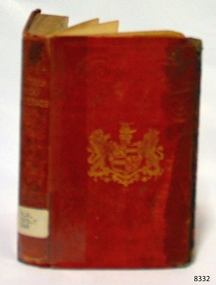
... Luke was incredibly fast, fiercely organised, and meticulously accurate; he quickly caught the eye of prominent figures like Edmund Burke and Dr Samuel Johnson. ...Luke was incredibly fast, fiercely organised, and meticulously accurate; he quickly caught the eye of prominent figures like Edmund Burke and Dr Samuel Johnson. ...This volume is a genealogical and biographical reference directory of the British nobility. It was designed as a compact, portable handbook detailing the titles, lineages, coats of arms, and family histories of the peers of Great Britain and Ireland, as well as bishops and baronets. While Thomas Curson Hansard is famous for establishing the printing of Britain's official parliamentary debates (Hansard), his firm also published these highly practical, condensed pocket guides for politicians, gentlemen, and libraries who needed quick access to the details of high society and parliamentary ranks.Hansards Pocket Peerage Publisher: T C Newby Date: 1854 Further Information: Signed by John Pascoe Fawknernon-fictionThis volume is a genealogical and biographical reference directory of the British nobility. It was designed as a compact, portable handbook detailing the titles, lineages, coats of arms, and family histories of the peers of Great Britain and Ireland, as well as bishops and baronets. While Thomas Curson Hansard is famous for establishing the printing of Britain's official parliamentary debates (Hansard), his firm also published these highly practical, condensed pocket guides for politicians, gentlemen, and libraries who needed quick access to the details of high society and parliamentary ranks.flagstaff hill, warrnambool, shipwrecked coast, flagstaff hill maritime museum, maritime museum, shipwreck coast, flagstaff hill maritime village, great ocean road, book, pattison collection, warrnambool library, warrnambool mechanics’ institute, ralph eric pattison, corangamite regional library service, warrnambool city librarian, mechanics’ institute library, victorian library board, warrnambool books and records, warrnambool children’s library, hansards pocket peerage, thomas cautley newby, thomas curson hansard junior, john pascoe fawkner -
 Flagstaff Hill Maritime Museum and Village
Functional object - Desk Pencil Sharpener, Mid 1900's
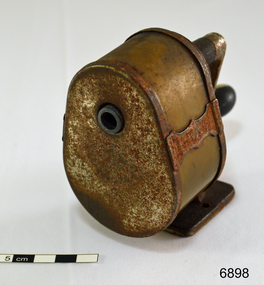
... quickly sharpen the pencil, with a more precise finish than a single-blade device. Some cylindrical sharpeners have only one helical cutter cylinder, but most have two cylinders or more. https://en.wikipedia.org/wiki/Pencil_sharpener This mechanical pencil sharpener once belonged to Dr...quickly sharpen the pencil, with a more precise finish than a single-blade device. Some cylindrical sharpeners have only one helical cutter cylinder, but most have two cylinders or more. https://en.wikipedia.org/wiki/Pencil_sharpener This mechanical pencil sharpener once belonged to Dr ...Cylindrical (planetary) sharpeners: These mechanisms are also called planetary sharpeners, in reference to their use of planetary gears. A larger, stationary planetary sharpener can be mounted on a desk or wall and powered by a hand crank. Typically, the pencil is inserted into the sharpener with one hand, and the crank is turned with the other. This rotates a set of helical cylindrical cutters in the mechanism, set at an acute angle to each other. The multiple cutting edges quickly sharpen the pencil, with a more precise finish than a single-blade device. Some cylindrical sharpeners have only one helical cutter cylinder, but most have two cylinders or more. https://en.wikipedia.org/wiki/Pencil_sharpener This mechanical pencil sharpener once belonged to Dr. Angus. It was one of his personal belongings and would have been used in his office. The mechanical pencil sharpener has provision for attaching it to a flat surface such as a desk. The user would insert the pencil into the hole in the front of the sharpener, wind the handle around several times until the pencil is the desired sharpness then remove the pencil. The plastic compartment is clear so that the user can see when it needs emptying, slide down the metal braces on the side of it, remove and empty the compartment and fit it back onto the stand. The sharpener was donated to Flagstaff Hill Maritime Village by the family of Doctor William Roy Angus, Surgeon and Oculist. It is part of the “W.R. Angus Collection” includes historical medical equipment, surgical instruments and material once belonging to Dr Edward Ryan and Dr Thomas Francis Ryan, (both of Nhill, Victoria) as well as Dr Angus’ own belongings. The Collection’s history spans the medical practices of the two Doctors Ryan, from 1885-1926 plus that of Dr Angus, up until 1969. ABOUT THE “W.R.ANGUS COLLECTION” Doctor William Roy Angus M.B., B.S., Adel., 1923, F.R.C.S. Edin.,1928 (also known as Dr Roy Angus) was born in Murrumbeena, Victoria in 1901 and lived until 1970. He qualified as a doctor in 1923 at University of Adelaide, was Resident Medical Officer at the Royal Adelaide Hospital in 1924 and for a period was house surgeon to Sir (then Mr.) Henry Simpson Newland. Dr Angus was briefly an Assistant to Dr Riddell of Kapunda, then commenced private practice at Curramulka, Yorke Peninsula, SA, where he was physician, surgeon and chemist. In 1926, he was appointed as new Medical Assistant to Dr Thomas Francis Ryan (T.F. Ryan, or Tom), in Nhill, Victoria, where his experiences included radiology and pharmacy. In 1927 he was Acting House Surgeon in Dr Tom Ryan’s absence. Dr Angus had become engaged to Gladys Forsyth and they decided he further his studies overseas in the UK in 1927. He studied at London University College Hospital and at Edinburgh Royal Infirmary and in 1928, was awarded FRCS (Fellow from the Royal College of Surgeons), Edinburgh. He worked his passage back to Australia as a Ship’s Surgeon on the on the Australian Commonwealth Line’s T.S.S. Largs Bay. Dr Angus married Gladys in 1929, in Ballarat. (They went on to have one son (Graham 1932, born in SA) and two daughters (Helen (died 12/07/1996) and Berenice (Berry), both born at Mira, Nhill ) According to Berry, her mother Gladys made a lot of their clothes. She was very talented and did some lovely embroidery including lingerie for her trousseau and beautifully handmade baby clothes. Dr Angus was a ‘flying doctor’ for the A.I.M. (Australian Inland Ministry) Aerial Medical Service in 1928 . Its first station was in the remote town of Oodnadatta, where Dr Angus was stationed. He was locum tenens there on North-South Railway at 21 Mile Camp. He took up this ‘flying doctor’ position in response to a call from Dr John Flynn; the organisation was later known as the Flying Doctor Service, then the Royal Flying Doctor Service. A lot of his work during this time involved dental surgery also. Between 1928-1932 he was surgeon at the Curramulka Hospital, Yorke Peninsula, South Australia. In 1933 Dr Angus returned to Nhill and purchased a share of the Nelson Street practice and Mira hospital (a 2 bed ward at the Nelson Street Practice) from Dr Les Middleton one of the Middleton Brothers, the current owners of what previously once Dr Tom Ryan’s practice. Dr Tom and his brother had worked as surgeons included eye surgery. Dr Tom Ryan performed many of his operations in the Mira private hospital on his premises. He had been House Surgeon at the Nhill Hospital 1902-1926. Dr Tom Ryan had one of the only two pieces of radiology equipment in Victoria during his practicing years – The Royal Melbourne Hospital had the other one. Over the years Dr Tom Ryan had gradually set up what was effectively a training school for country general-practitioner-surgeons. Each patient was carefully examined, including using the X-ray machine, and any surgery was discussed and planned with Dr Ryan’s assistants several days in advance. Dr Angus gained experience in using the X-ray machine there during his time as assistant to Dr Ryan. When Dr Angus bought into the Nelson Street premises in Nhill he was also appointed as the Nhill Hospital’s Honorary House Surgeon 1933-1938. His practitioner’s plate from his Nhill surgery is now mounted on the doorway to the Port Medical Office at Flagstaff Hill Maritime Village, Warrnambool. When Dr Angus took up practice in the Dr Edward and Dr Tom Ryan’s old premises he obtained their extensive collection of historical medical equipment and materials spanning 1884-1926. A large part of this collection is now on display at the Port Medical Office at Flagstaff Hill Maritime Village in Warrnambool. In 1939 Dr Angus and his family moved to Warrnambool where he purchased “Birchwood,” the 1852 home and medical practice of Dr John Hunter Henderson, at 214 Koroit Street. (This property was sold in1965 to the State Government and is now the site of the Warrnambool Police Station. and an ALDI sore is on the land that was once their tennis court). The Angus family was able to afford gardeners, cooks and maids; their home was a popular place for visiting dignitaries to stay whilst visiting Warrnambool. Dr Angus had his own silk worm farm at home in a Mulberry tree. His young daughter used his centrifuge for spinning the silk. Dr Angus was appointed on a part-time basis as Port Medical Officer (Health Officer) in Warrnambool and held this position until the 1940’s when the government no longer required the service of a Port Medical Officer in Warrnambool; he was thus Warrnambool’s last serving Port Medical Officer. (Masters of immigrant ships arriving in port reported incidents of diseases, illness and death and the Port Medical Officer made a decision on whether the ship required Quarantine and for how long, in this way preventing contagious illness from spreading from new immigrants to the residents already in the colony.) Dr Angus was a member of the Australian Medical Association, for 35 years and surgeon at the Warrnambool Base Hospital 1939-1942, He served with the Australian Department of Defence as a Surgeon Captain during WWII 1942-45, in Ballarat, Victoria, and in Bonegilla, N.S.W., completing his service just before the end of the war due to suffering from a heart attack. During his convalescence he carved an intricate and ‘most artistic’ chess set from the material that dentures were made from. He then studied ophthalmology at the Royal Melbourne Eye and Ear Hospital and created cosmetically superior artificial eyes by pioneering using the intrascleral cartilage. Angus received accolades from the Ophthalmological Society of Australasia for this work. He returned to Warrnambool to commence practice as an ophthalmologist, pioneering in artificial eye improvements. He was Honorary Consultant Ophthalmologist to Warrnambool Base Hospital for 31 years. He made monthly visits to Portland as a visiting surgeon, to perform eye surgery. He represented the Victorian South-West subdivision of the Australian Medical Association as its secretary between 1949 and 1956 and as chairman from 1956 to 1958. In 1968 Dr Angus was elected member of Spain’s Barraquer Institute of Barcelona after his research work in Intrasclearal cartilage grafting, becoming one of the few Australian ophthalmologists to receive this honour, and in the following year presented his final paper on Living Intrasclearal Cartilage Implants at the Inaugural Meeting of the Australian College of Ophthalmologists in Melbourne In his personal life Dr Angus was a Presbyterian and treated Sunday as a Sabbath, a day of rest. He would visit 3 or 4 country patients on a Sunday, taking his children along ‘for the ride’ and to visit with him. Sunday evenings he would play the pianola and sing Scottish songs to his family. One of Dr Angus’ patients was Margaret MacKenzie, author of a book on local shipwrecks that she’d seen as an eye witness from the late 1880’s in Peterborough, Victoria. In the early 1950’s Dr Angus, painted a picture of a shipwreck for the cover jacket of Margaret’s book, Shipwrecks and More Shipwrecks. She was blind in later life and her daughter wrote the actual book for her. Dr Angus and his wife Gladys were very involved in Warrnambool’s society with a strong interest in civic affairs. He had an interest in people and the community They were both involved in the creation of Flagstaff Hill, including the layout of the gardens. After his death (28th March 1970) his family requested his practitioner’s plate, medical instruments and some personal belongings be displayed in the Port Medical Office surgery at Flagstaff Hill Maritime Village, and be called the “W. R. Angus Collection”. The W.R. Angus Collection is significant for still being located at the site it is connected with, Doctor Angus being the last Port Medical Officer in Warrnambool. The collection of medical instruments and other equipment is culturally significant, being an historical example of medicine from late 19th to mid-20th century. Dr Angus assisted Dr Tom Ryan, a pioneer in the use of X-rays and in ocular surgery. Pencil sharpener, mechanical, part of the W.R. Angus Collection. Metal stand and frame, plastic compartment to hold the shavings. Rotating plastic handle. Metal front on compartment has a re-inforced hole for inserting pencil. Plastic oompartment has sliding metal bracket on each side to allow its removal. Base has two holes for mounting on flat surface. Mid 1900's. flagstaff hill, warrnambool, shipwrecked coast, flagstaff hill maritime museum, maritime museum, shipwreck coast, flagstaff hill maritime village, great ocean road, dr w r angus, dr ryan, surgical instrument, t.s.s. largs bay, warrnambool base hospital, nhill base hospital, mira hospital, flying doctor, pencil sharpener, mechanical pencil sharpener, office equipment, office stationery -
 Flagstaff Hill Maritime Museum and Village
Badge - Australian Military cloth patch, Army Medical Corps, 108 Australian General Hospital, 1939-1945
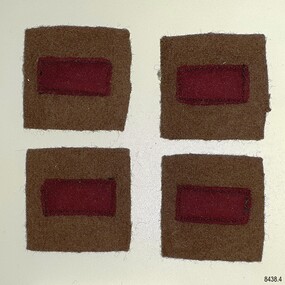
... Dr Angus was a Surgeon Captain for the Australian Defence Forces in the Army Medical Corps, 108 Australian General Hospital and 106 Australian General Hospital, stationed in Ballarat, Victoria, and in Bonegilla, N.S.W. He completed his service just before the end of the war due to suffering from a heart attack. In World War I the troops of the Australian Military Forces staked coloured flags of various shapes and colours in the ground where they camped to identify their units. These flag codes were quickly...Dr Angus was a Surgeon Captain for the Australian Defence Forces in the Army Medical Corps, 108 Australian General Hospital and 106 Australian General Hospital, stationed in Ballarat, Victoria, and in Bonegilla, N.S.W. He completed his service just before the end of the war due to suffering from a heart attack. In World War I the troops of the Australian Military Forces staked coloured flags of various shapes and colours in the ground where they camped to identify their units. These flag codes were quickly ...The four cloth patches belonged to Dr William Roy Angus and are now part of Flagstaff Hill’s comprehensive W.R. Angus Collection, donated by the family of Dr W R Angus (1901-1970), surgeon and oculist. The badges date to the Second World War era, when Dr Angus was a Surgeon Captain for the Australian Defence Forces in the Army Medical Corps, 108 Australian General Hospital and 106 Australian General Hospital, stationed in Ballarat, Victoria, and in Bonegilla, N.S.W. He completed his service just before the end of the war due to suffering from a heart attack. In World War I the troops of the Australian Military Forces staked coloured flags of various shapes and colours in the ground where they camped to identify their units. These flag codes were quickly recognised. The system worked so well that miniature flags were called colour patches. They became part of the uniform, to be worn on both sleeves just below the shoulder. The system was slightly modified for use in the Second World War. The W.R. Angus Collection: - The W.R. Angus Collection includes historical medical equipment, surgical instruments and material belonging to Dr Edward Ryan and Dr Thomas Francis Ryan, (both of Nhill, Victoria) and Dr Angus’ own belongings. The Collection’s history spans the medical practices of the two Doctors Ryan, from 1885-1926 plus that of Dr Angus, up until 1969. It includes historical medical and surgical equipment and instruments from the doctors Edward and Thomas Ryan of Nhill, Victoria. Dr Angus married Gladys in 1927 at Ballarat, the nearest big city to Nhill where he began as a Medical Assistant. He was also Acting House surgeon at the Nhill hospital where their two daughters were born. During World War II He served as a Military Doctor in the Australian Defence Forces. Dr Angus and his family moved to Warrnambool in 1939, where Dr Angus operated his own medical practice. He later added the part-time Port Medical Officer responsibility and was the last person appointed to that position. Both Dr Angus and his wife were very involved in the local community, including the planning stages of the new Flagstaff Hill and the layout of the gardens there. Dr Angus passed away in March 1970.Dr W R Angus (1901-1970), surgeon and oculist, collected a range of military objects including those he personally used during his time as Surgeon Captain in the Australian Defence Forces in World War II. The objects allow insight into military life in the early-to-mid 20th century. The W.R. Angus Collection is significant for still being located at the site it is connected with, Doctor Angus being the last Port Medical Officer in Warrnambool. The Collection includes historical medical objects that date back to the late 1800s.Badges; set of four cloth patches, red rectangles on brown squares. Insignia of the Australian Defence Forces, Army Medical Corps, 108 Australian General Hospital, WWII era. Dr W R Angus owned the cloth patches that are now part of the W. R. Angus Collection.flagstaff hill, warrnambool, maritime village, maritime museum, shipwreck coast, great ocean road, flagstaff hill maritime museum and village, dr w r angus, w.r. angus collection, australian army, surgeon captain, ballarat, bonegilla, badge, insignia, badge collection, world war 2, second world war, australian defence forces, army medical corps, 108 australian general hospital, great war, military uniform, 106 australian general hospital, 1939-1945 -
 Flagstaff Hill Maritime Museum and Village
Badge - Australian Military cloth patch, Army Medical Corps, 106 Australian General Hospital, 1939-1945
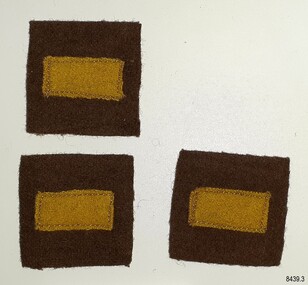
... Dr Angus was a Surgeon Captain for the Australian Defence Forces in the Army Medical Corps, 108 Australian General Hospital and 106 Australian General Hospital, stationed in Ballarat, Victoria, and in Bonegilla, N.S.W. He completed his service just before the end of the war due to suffering from a heart attack. In World War I the troops of the Australian Military Forces staked coloured flags of various shapes and colours in the ground where they camped to identify their units. These flag codes were quickly...Dr Angus was a Surgeon Captain for the Australian Defence Forces in the Army Medical Corps, 108 Australian General Hospital and 106 Australian General Hospital, stationed in Ballarat, Victoria, and in Bonegilla, N.S.W. He completed his service just before the end of the war due to suffering from a heart attack. In World War I the troops of the Australian Military Forces staked coloured flags of various shapes and colours in the ground where they camped to identify their units. These flag codes were quickly ...The three cloth patches belonged to Dr William Roy Angus and are now part of Flagstaff Hill’s comprehensive W.R. Angus Collection, donated by the family of Dr W R Angus (1901-1970), surgeon and oculist. The badges date to the Second World War era, when Dr Angus was a Surgeon Captain for the Australian Defence Forces in the Army Medical Corps, 108 Australian General Hospital and 106 Australian General Hospital, stationed in Ballarat, Victoria, and in Bonegilla, N.S.W. He completed his service just before the end of the war due to suffering from a heart attack. In World War I the troops of the Australian Military Forces staked coloured flags of various shapes and colours in the ground where they camped to identify their units. These flag codes were quickly recognised. The system worked so well that miniature flags were called colour patches. They became part of the uniform, to be worn on both sleeves just below the shoulder. The system was slightly modified for use in the Second World War. The W.R. Angus Collection: - The W.R. Angus Collection includes historical medical equipment, surgical instruments and material belonging to Dr Edward Ryan and Dr Thomas Francis Ryan, (both of Nhill, Victoria) and Dr Angus’ own belongings. The Collection’s history spans the medical practices of the two Doctors Ryan, from 1885-1926 plus that of Dr Angus, up until 1969. It includes historical medical and surgical equipment and instruments from the doctors Edward and Thomas Ryan of Nhill, Victoria. Dr Angus married Gladys in 1927 at Ballarat, the nearest big city to Nhill where he began as a Medical Assistant. He was also Acting House surgeon at the Nhill hospital where their two daughters were born. During World War II He served as a Military Doctor in the Australian Defence Forces. Dr Angus and his family moved to Warrnambool in 1939, where Dr Angus operated his own medical practice. He later added the part-time Port Medical Officer responsibility and was the last person appointed to that position. Both Dr Angus and his wife were very involved in the local community, including the planning stages of the new Flagstaff Hill and the layout of the gardens there. Dr Angus passed away in March 1970.Dr W R Angus (1901-1970), surgeon and oculist, collected a range of military objects including those he personally used during his time as Surgeon Captain in the Australian Defence Forces in World War II. The objects allow insight into military life in the early-to-mid 20th century. The W.R. Angus Collection is significant for still being located at the site it is connected with, Doctor Angus being the last Port Medical Officer in Warrnambool. The Collection includes historical medical objects that date back to the late 1800s.Badges; set of three cloth patches, yellow rectangles on brown squares. Insignia of the Australian Defence Forces, Army Medical Corps, 106 Australian General Hospital, WII era. Dr W R Angus owned the cloth patches that are now part of the W. R. Angus Collection.flagstaff hill, warrnambool, maritime village, maritime museum, shipwreck coast, great ocean road, flagstaff hill maritime museum and village, dr w r angus, w.r. angus collection, australian army, surgeon captain, ballarat, bonegilla, badge, insignia, world war 1, 1914-1918, badge collection, world war 2, second world war, australian defence forces, army medical corps, 108 australian general hospital, great war, military uniform, 106 australian general hospital -
 Flagstaff Hill Maritime Museum and Village
Accessory - Traveller's Pouch, Lyall Robertson Pty Ltd, ca 1946
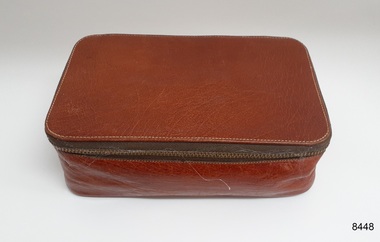
... Dr Angus passed away in March 1970. This traveller's pouch is significant for its connection with the firm Lyall Robertson Pty Ltd of Victoria, a home-based enterprise of the 1940s with quickly grew to employ much staff to make its good quality goods. ...The Robex traveller’s pouch may have originally contained men’s grooming set or toiletries such as shaving accessors and soap. The leather strap inside the lid was designed to hold items like a toothbrush, comb or razor. The owner, Dr W.R. Angus, had used the pouch to store his personal memorabilia including epaulettes and various Australian Army-issued items from WWII. It seems likely that he wore the epaulettes on a uniform when he worked his passage to or from the UK as a young Ship’s Surgeon, with the purpose of furthering his studies overseas in 1927-1928. He travelled outward on the SS Banffshire and homeward on the Commonwealth Line’s T.S.S. Largs Bay. The pouch dates from 1946 at the earliest. The Robex leather accessories brand was made by Lyall Robertson Pty. Ltd., Sandringham, Victoria. Robertson established his home business in the 1940s and went on to be a leading firm with over 200 staff. The Robex trademark was registered on July 5th, 1946. The leather pouch is now part of Flagstaff Hill’s comprehensive W.R. Angus Collection, donated by the family of Dr W R Angus (1901-1970), surgeon and oculist. The W.R. Angus Collection: - The W.R. Angus Collection includes historical medical equipment, surgical instruments and material belonging to Dr Edward Ryan and Dr Thomas Francis Ryan, (both of Nhill, Victoria) and Dr Angus’ own belongings. The Collection’s history spans the medical practices of the two Doctors Ryan, from 1885-1926 plus that of Dr Angus, up until 1969. It includes historical medical and surgical equipment and instruments from the doctors Edward and Thomas Ryan of Nhill, Victoria. Dr Angus married Gladys in 1927 at Ballarat, the nearest big city to Nhill where he began as a Medical Assistant. He was also Acting House surgeon at the Nhill hospital where their two daughters were born. During World War II Dr Angus served as a Military Doctor. He was a Surgeon Captain for the Australian Defence Forces, Army Medical Corps, stationed in Ballarat, Victoria, and in Bonegilla, N.S.W. He completed his service just before the end of the war due to suffering from a heart attack. Dr Angus and his family moved to Warrnambool in 1939, where Dr Angus operated his own medical practice. He later added the part-time Port Medical Officer responsibility and was the last person appointed to that position. Both Dr Angus and his wife were very involved in the local community, including the planning stages of the new Flagstaff Hill and the layout of the gardens there. Dr Angus passed away in March 1970.This traveller's pouch is significant for its connection with the firm Lyall Robertson Pty Ltd of Victoria, a home-based enterprise of the 1940s with quickly grew to employ much staff to make its good quality goods. It is also connected with the local doctor, W.R. Angus and Warrnambool's Medical History. Dr W R Angus (1901-1970), surgeon and oculist, collected a range of military objects including those he personally used during his time as Surgeon Captain in the Australian Defence Forces in World War II. The W.R. Angus Collection is significant for still being located at the site it is connected with, Doctor Angus being the last Port Medical Officer in Warrnambool. The Collection includes historical medical objects that date back to the late 1800s.Traveller's pouch; tan water buffalo calf leather with brass zipper closure, cream-coloured fabric lining, and leather straps inside the lid for securing items. A silver embossed logo is on the lining of the base of the pouch. The Robex brand was made by Lyall Robertson Pty. Ltd in Victoria. The pouch belonged to Dr W R Angus and is now part of the W. R. Angus Collection.Stamped inside the base “ROBEX / WATER BUFFALO” and a silver logo [shield] flagstaff hill, warrnambool, maritime village, maritime museum, shipwreck coast, great ocean road, flagstaff hill maritime museum and village, dr w r angus, w.r. angus collection, australian army, world war 2, second world war, ww 2, army issue, wwii, traveller's pouch, personal grooming accessory, robex, buffalo calf leather, lyall robertson pty. ltd, ss banffshire, t.s.s. largs bay, leather goods, travel goods -
 Flagstaff Hill Maritime Museum and Village
Functional object - Thermometer, Late 19th - early 20th century
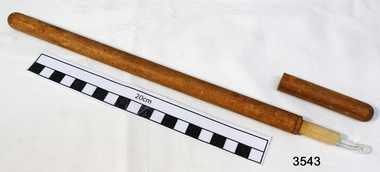
... Digital ear thermometers also produce a quick and accurate temperature. Dr. Jacob Fraden invented an infared thermometer called the Thermoscan Human Ear Thermometer in 1984. ...Digital ear thermometers also produce a quick and accurate temperature. Dr. Jacob Fraden invented an infared thermometer called the Thermoscan Human Ear Thermometer in 1984. ...The Thermoscope The thermometer dates back to the early 1600s, with Galileo’s invention of the “thermoscope.” Galileo’s device could determine whether temperature was rising or falling, but was not able to detect the actual scale of the temperature. In 1612, Italian inventor and physician Sanctorius was the first to put a numerical scale on the thermoscope. His product was also designed for taking temperature from a patient’s mouth. However, neither Galileo’s nor Sanctorius’ thermoscopes were very accurate. Standardized Scales In 1709, Daniel Gabriel Fahrenheit invented his first thermometer using alcohol. He later introduced the mercury thermometer in 1714, which was more accurate and predictable. The Fahrenheit temperature scale was standardized in 1724 with a freezing point of 32 degrees and a boiling point of 212 degrees. Fahrenheit’s mercury thermometer is recognized as the first modern thermometer with a standardized scale. The Celsius scale was invented in 1742 by Anders Celsius, with a freezing point of 0 degrees and a boiling point of 100 degrees. This scale was accepted into the international conference on weights and measurements in 1948. The Kelvin Scale, measuring extreme temperatures, was developed by Lord Kelvin in 1848. Registering Thermometers Early versions of the thermometer were not able to hold the temperature after they were moved. You can imagine how this made it hard for doctors to correctly read a patient’s temperature. The first thermometer that could register and hold onto temperature was built by James Six in 1782. Today, it is known as Six’s thermometer. Since then, the mercury thermometer was adapted to read a patients temperature after leaving the body. Registering thermometers are still used today and are reset by shaking down the mercury to the bottom of the tube. The Modern Devices Modern Day Thermometers This brings us to the first practical clinical thermometer, which was invented in 1867 by Sir Thomas Allbutt. The device was portable, about 6 inches long and was capable of recording a patient’s temperature in 5 minutes. Now, there are a few options for clinical and home use. Liquid filled thermometers have been adapted based on the designs of inventors like Fahrenheight and Six are still used today. Digital thermometers, like the Omron Compact Digital Thermometer, are capable of finding a temperature and producing an electronic number within a minute of use. Digital ear thermometers also produce a quick and accurate temperature. Dr. Jacob Fraden invented an infared thermometer called the Thermoscan Human Ear Thermometer in 1984. These thermometers use an infared light to scan the heat radiation in a patient’s ear or forehead. The thermometer, like many medical devices, has made strides in efficiency and accuracy. As medical technology continues to advance, businesses in the medical device industry must be prepared to move with it. This thermometer was donated to Flagstaff Hill Maritime Village by the family of Doctor William Roy Angus, Surgeon and Oculist. It is part of the “W.R. Angus Collection” that includes historical medical equipment, surgical instruments, and material once belonging to Dr. Edward Ryan and Dr. Thomas Francis Ryan, (both of Nhill, Victoria) as well as Dr. Angus’ own belongings. The Collection’s history spans the medical practices of the two Doctors Ryan, from 1885-1926 plus that of Dr. Angus, up until 1969. ABOUT THE “W.R.ANGUS COLLECTION” Doctor William Roy Angus M.B., B.S., Adel., 1923, F.R.C.S. Edin.,1928 (also known as Dr. Roy Angus) was born in Murrumbeena, Victoria in 1901 and lived until 1970. He qualified as a doctor in 1923 at the University of Adelaide, was Resident Medical Officer at the Royal Adelaide Hospital in 1924 and for a period was house surgeon to Sir (then Mr.) Henry Simpson Newland. Dr. Angus was briefly an Assistant to Dr. Riddell of Kapunda, then commenced private practice at Curramulka, Yorke Peninsula, SA, where he was a physician, surgeon, and chemist. In 1926, he was appointed as a new Medical Assistant to Dr. Thomas Francis Ryan (T.F. Ryan, or Tom), in Nhill, Victoria, where his experiences included radiology and pharmacy. In 1927 he was Acting House Surgeon in Dr. Tom Ryan’s absence. Dr. Angus had become engaged to Gladys Forsyth and they decided he would take time to further his studies overseas in the UK in 1927. He studied at London University College Hospital and at Edinburgh Royal Infirmary and in 1928, was awarded FRCS (Fellow from the Royal College of Surgeons), Edinburgh. He worked his passage back to Australia as a Ship’s Surgeon on the Australian Commonwealth Line’s SS Largs Bay. Dr. Angus married Gladys in 1929, in Ballarat. (They went on to have one son (Graham 1932, born in SA) and two daughters (Helen (died 12/07/1996) and Berenice (Berry), both born at Mira, Nhill ) Dr. Angus was a ‘flying doctor’ for the A.I.M. (Australian Inland Ministry) Aerial Medical Service in 1928. The organisation began in South Australia through the Presbyterian Church that year, with its first station being in the remote town of Oodnadatta, where Dr. Angus was stationed. He was locum tenens there on North-South Railway at 21 Mile Camp. He took up this ‘flying doctor’ position in response to a call from Dr. John Flynn; the organisation was later known as the Flying Doctor Service, then the Royal Flying Doctor Service. A lot of his work during this time involved dental surgery also. Between 1928-1932 he was a surgeon at the Curramulka Hospital, Yorke Peninsula, South Australia. In 1933 Dr. Angus returned to Nhill where he’d previously worked as Medical Assistant and purchased a share of the Nelson Street practice and Mira hospital from Dr. Les Middleton one of the Middleton Brothers, the current owners of what was once Dr. Tom Ryan’s practice. Dr. L Middleton was House Surgeon at the Nhill Hospital from 1926-1933 when he resigned. [Dr. Tom Ryan’s practice had originally belonged to his older brother Dr. Edward Ryan, who came to Nhill in 1885. Dr. Edward saw patients in his rooms, firstly in Victoria Street and in 1886 in Nelson Street, until 1901. The Nelson Street practice also had a 2-bed ward, called Mira Private Hospital ). Dr. Edward Ryan was House Surgeon at the Nhill Hospital from 1884-1902. He also had occasions where he successfully performed veterinary surgery for the local farmers too. Dr. Tom Ryan then purchased the practice from his brother in 1901. Both Dr. Edward and Dr. Tom Ryan work as surgeons including in eye surgery. Dr. Tom Ryan performed many of his operations in the Mira private hospital on his premises. He too was House Surgeon at the Nhill Hospital from 1902-1926. Dr. Tom Ryan had one of the only two pieces of radiology equipment in Victoria during his practicing years – The Royal Melbourne Hospital had the other one. Over the years Dr. Tom Ryan gradually set up what was effectively a training school for country general-practitioner-surgeons. Each patient was carefully examined, including using the X-ray machine, and any surgery was discussed and planned with Dr. Ryan’s assistants several days in advance. Dr. Angus gained experience in using the X-ray machine there during his time as assistant to Dr. Ryan. Dr. Tom Ryan moved from Nhill in 1926. He became a Fellow of the Royal Australasian College of Surgeons in 1927, soon after its formation, a rare accolade for a doctor outside any of the major cities. He remained a bachelor and died suddenly on 7th Dec 1955, aged 91, at his home in Ararat. Scholarships and prizes are still awarded to medical students in the honour of Dr. T.F. Ryan and his father, Dr. Michael Ryan, and brother, John Patrick Ryan. ] When Dr. Angus bought into the Nelson Street premises in Nhill he was also appointed as the Nhill Hospital’s Honorary House Surgeon from 1933-1938. His practitioner’s plate from his Nhill surgery states “HOURS Daily, except Tuesdays, Fridays and Saturday afternoons, 9-10 am, 2-4 pm, 7-8 pm. Sundays by appointment”. This plate is now mounted on the doorway to the Port Medical Office at Flagstaff Hill Maritime Village, Warrnambool. Dr. Edward Ryan and Dr. Tom Ryan had an extensive collection of historical medical equipment and materials spanning 1884-1926 and when Dr. Angus took up practice in their old premises he obtained this collection, a large part of which is now on display at the Port Medical Office at Flagstaff Hill Maritime Village in Warrnambool. During his time in Nhill Dr. Angus was involved in the merging of the Mira Hospital and Nhill Public Hospital into one public hospital and the property titles were passed on to Nhill Hospital in 1939. In 1939 Dr Angus and his family moved to Warrnambool where he purchased “Birchwood,” the 1852 home and medical practice of Dr. John Hunter Henderson, at 214 Koroit Street. (This property was sold in1965 to the State Government and is now the site of the Warrnambool Police Station. ). The Angus family was able to afford gardeners, cooks, and maids; their home was a popular place for visiting dignitaries to stay whilst visiting Warrnambool. Dr. Angus had his own silkworm farm at home in a Mulberry tree. His young daughter used his centrifuge for spinning the silk. Dr. Angus was appointed on a part-time basis as Port Medical Officer (Health Officer) in Warrnambool and held this position until the 1940’s when the government no longer required the service of a Port Medical Officer in Warrnambool; he was thus Warrnambool’s last serving Port Medical Officer. (The duties of a Port Medical Officer were outlined by the Colonial Secretary on 21st June 1839 under the terms of the Quarantine Act. Masters of immigrant ships arriving in port reported incidents of diseases, illness, and death and the Port Medical Officer made a decision on whether the ship required Quarantine and for how long, in this way preventing contagious illness from spreading from new immigrants to the residents already in the colony.) Dr. Angus was a member of the Australian Medical Association, for 35 years and a surgeon at the Warrnambool Base Hospital from 1939-1942, He served as a Surgeon Captain during WWII1942-45, in Ballarat, Victoria, and in Bonegilla, N.S.W., completing his service just before the end of the war due to suffering from a heart attack. During his convalescence, he carved an intricate and ‘most artistic’ chess set from the material that dentures were made from. He then studied ophthalmology at the Royal Melbourne Eye and Ear Hospital and created cosmetically superior artificial eyes by pioneering using the intrascleral cartilage. Angus received accolades from the Ophthalmological Society of Australasia for this work. He returned to Warrnambool to commence practice as an ophthalmologist, pioneering artificial eye improvements. He was Honorary Consultant Ophthalmologist at Warrnambool Base Hospital for 31 years. He made monthly visits to Portland as a visiting surgeon, to perform eye surgery. He represented the Victorian South-West subdivision of the Australian Medical Association as its secretary between 1949 and 1956 and as chairman from 1956 to 1958. In 1968 Dr. Angus was elected a member of Spain’s Barraquer Institute of Barcelona after his research work in Intrasclearal cartilage grafting, becoming one of the few Australian ophthalmologists to receive this honour, and in the following year presented his final paper on Living Intrasclearal Cartilage Implants at the Inaugural Meeting of the Australian College of Ophthalmologists in Melbourne In his personal life, Dr. Angus was a Presbyterian and treated Sunday as a Sabbath, a day of rest. He would visit 3 or 4 country patients on a Sunday, taking his children along ‘for the ride’ and to visit with him. Sunday evenings he would play the pianola and sing Scottish songs to his family. One of Dr. Angus’ patients was Margaret MacKenzie, author of a book on local shipwrecks that she’d seen as an eyewitness from the late 1880s in Peterborough, Victoria. In the early 1950’s Dr. Angus, painted a picture of a shipwreck for the cover jacket of Margaret’s book, Shipwrecks, and More Shipwrecks. She was blind in later life and her daughter wrote the actual book for her. Dr. Angus and his wife Gladys were very involved in Warrnambool’s society with a strong interest in civic affairs. Their interests included organisations such as the Red Cross, Rostrum, Warrnambool and District Historical Society (founding members), Wine and Food Society, Steering Committee for Tertiary Education in Warrnambool, Local National Trust, Good Neighbour Council, Housing Commission Advisory Board, United Services Institute, Legion of Ex-Servicemen, Olympic Pool Committee, Food for Britain Organisation, Warrnambool Hospital, Anti-Cancer Council, Boys’ Club, Charitable Council, National Fitness Council, and Air Raid Precautions Group. He was also a member of the Steam Preservation Society and derived much pleasure from a steam traction engine on his farm. He had an interest in people and the community He and his wife Gladys were both involved in the creation of Flagstaff Hill, including the layout of the gardens. After his death (28th March 1970) his family requested his practitioner’s plate, medical instruments, and some personal belongings be displayed in the Port Medical Office surgery at Flagstaff Hill Maritime Village, and be called the “W. R. Angus Collection”. The W.R. Angus Collection is significant for still being located at the site it is connected with, Doctor Angus being the last Port Medical Officer in Warrnambool. The collection of medical instruments and other equipment is culturally significant, being an historical example of medicine from late 19th to mid-20th century. Dr Angus assisted Dr Tom Ryan, a pioneer in the use of X-rays and in ocular surgery. Long cylindrical glass thermometer with mercury bulb, inside a light weight wooden cylinder with top, (W.R. Angus Collection) Temperature scale in fahrenheit. flagstaff hill, warrnambool, shipwrecked-coast, flagstaff-hill, flagstaff-hill-maritime-museum, maritime-museum, shipwreck-coast, flagstaff-hill-maritime-village, thermometer, dr w r angus, medical equipment, surgical instrument, dr ryan, ophthalmology, s.s. largs bay, warrnambool base hospital, nhill base hospital, flying doctor, medical history, medical treatment, mira hospital, medical education -
 Orbost & District Historical Society
minute book, 24.8.1884 - 19.11.1926
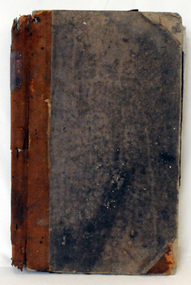
... The origin of mechanics' institutes is attributed to Dr George Birkbeck, who in 1799 gave a series of free lectures for the working men of Glasgow. At the time, 'mechanic' meant artisan, tradesman or working man. The movement spread quickly...The origin of mechanics' institutes is attributed to Dr George Birkbeck, who in 1799 gave a series of free lectures for the working men of Glasgow. At the time, 'mechanic' meant artisan, tradesman or working man. The movement spread quickly ...A Mechanics’ Institute hall was constructed in 1885 and opened as Orbost's first library. It was situated in Browning Street, Orbost. The hall is still in use today as a community venue. Mechanics' Institutes are the forerunners of public libraries and adult education in Australia. The origin of mechanics' institutes is attributed to Dr George Birkbeck, who in 1799 gave a series of free lectures for the working men of Glasgow. At the time, 'mechanic' meant artisan, tradesman or working man. The movement spread quickly throughout the British Empire. The first Victorian Mechanics' Institute was the Melbourne Mechanics' Institute established in 1839. From the 1850s, Mechanics' Institutes quickly spread throughout Victoria wherever a hall or library, or a school was needed. This ledger was used by the Orbost Mechanics' Institute from 1884 until 1926. The item was donated to Orbost & District Historical society from P.R.O.V. as a Place of Deposit (POD) item for safe keeping by a local history group or museum.The Mechanics' Institute was a very early feature of the Orbost community. The building became a community facility used for a variety of essential civic needs in particular a library. It also provided a suitable venue for community social requirements and functions.A heavy minute book with faded black covers and brown binding. The edges of the pages are marbled as are the end covers. Pages inside are blue with hand-written black ink records. It contains minutes from the Orbost Mechanics Institute.on spine on red leather in gold lettering: "MINUTE BOOK"minute-book orbost-mechanics'-institute -
 Geoffrey Kaye Museum of Anaesthetic History
Container - Bottle, Ethyl Chloride, Medicinal Chemicals Corporation Pty. Ltd, c. 1932
... quickly so that when it is sprayed onto the skin it produces very cold temperatures. “Refrigeration anesthesia”, or cryoanesthesia, refers to the anesthesia produced when the skin is significantly cooled.Due to its rapid onset, ethyl chloride was often used to induce general anaesthesia. It would be followed by a second anaesthetic, such as ether or nitrous oxide, which would be used for the remainder of the procedure. (The Wood Library Museum, 2016) The bottle has clear side and base mould seams which indicate it was made using a cup bottom mould. ethyl chloride medco medicinal chemicals corporation pty. ltd dr ...Ethyl chloride was first used as a general anaesthetic in 1847, by Johann Ferdinand Heyfelder (1798-1869), a German surgeon. Once ethyl chloride became readily available, it was again taken up as a general anaesthetic in the late 1890s (USA). Ethyl chloride evaporates very quickly so that when it is sprayed onto the skin it produces very cold temperatures. “Refrigeration anesthesia”, or cryoanesthesia, refers to the anesthesia produced when the skin is significantly cooled.Due to its rapid onset, ethyl chloride was often used to induce general anaesthesia. It would be followed by a second anaesthetic, such as ether or nitrous oxide, which would be used for the remainder of the procedure. (The Wood Library Museum, 2016) The bottle has clear side and base mould seams which indicate it was made using a cup bottom mould.Glass bottle with paper label, metal fastening at the top and cream coloured plastic sealant at the neck. The bottle has clear side and base mould seams which indicate it was made using a cup bottom mould.Printed on main label at front: 100 c.c. 3 1/2 fl. ozs. / MEDICINAL CHEMICALS CORP [illegible] / MEDCO / ETHYL CHLORIDE / PURE / This Product conforms to all the re-/quirements of the BRITISH PHARMA-/COPCEIA, 1932, for / GENERAL ANAESTHESIA / Manufactured by / MEDICINAL CHEMICALS CORPORATION PTY. LIMITED / 39 Martin Place, Sydney Printed on round label on reverse side: 6d. / Cred [illegible]this container if returned in good order and condition. Stamped into underside of bottle: CM / S99ethyl chloride, medco, medicinal chemicals corporation pty. ltd, dr [e.s] holloway, bottle -
 Bendigo Historical Society Inc.
Document - Sir John Quick Committee Minutes, Michele Matthews Collection
... Sir John Quick Lecture speaker - Dr. Janet McCalman, University of Melbourne. ...Sir John Quick Lecture speaker - Dr. Janet McCalman, University of Melbourne. ...The Sir John Quick Committee was formed in 1991 to commemorate the achievements of Sir John Quick who played a prominent role in the federation of Australia. The Committee aimed to raise awareness of the contribution of Sir John Quick and to ensure that he was recognized for the part he played.1. Minutes of meeting of the Sir John Quick Committee held on 1.8.1996. Four typed pages on white paper. Items discussed No need to amalgamate with the Federation Committee. value in both Committees. Sir John Quick Lecture speaker - Dr. Janet McCalman, University of Melbourne. Noted that John Quick statue was moved without notification. Suggestion that it was time to change program of events from birth/death anniversaries to generate more activities reflecting the work of Sir John Quick and involvement of community groups. sir john quick lecture, sir john quick statue -
 Bendigo Historical Society Inc.
Document - Sir John Quick Committee Minutes, Michele Matthews Collection
... Includes a letter from La Trobe University advising that the Speaker for the 1998 Sir John Quick Lecture would be Dr. Al Luloff, Professor of Rural Sociology at the Pennsylvania State University. ...Includes a letter from La Trobe University advising that the Speaker for the 1998 Sir John Quick Lecture would be Dr. Al Luloff, Professor of Rural Sociology at the Pennsylvania State University. ...The Sir John Quick Committee was formed in 1991 to commemorate the achievements of Sir John Quick who played a prominent role in the federation of Australia. The Committee aimed to raise awareness of the contribution of Sir John Quick and to ensure that he was recognized for the part he played.1. Agenda for meeting of the Sir John Quick Committee to be held on 4.6.1998. Four typed pages on white paper. Includes a letter from La Trobe University advising that the Speaker for the 1998 Sir John Quick Lecture would be Dr. Al Luloff, Professor of Rural Sociology at the Pennsylvania State University. Includes a two page Biosketch of A. E. LULOFF. 2. Minutes for meeting of the Sir John Quick Committee held on 4.6.1998. Items discussed Ceremony to commemorate the death of Sir John Quick. "The Coming Commonwealth" Convention 1998 Sir John Quick Lecture Centenary of Federation issues. 3. Invitation card and RSVP card for 1998 Sir John Quick lecture. Cream coloured card with burgundy printing. La Trobe University Coat of Arms in top LH corner. RSVP card has return address printed on the reverse side.sir john quick lecture, a e luloff -
 Bendigo Historical Society Inc.
Book - LONG GULLY HISTORY GROUP COLLECTION: TOWNS AND GOWNS
... Dr Janet McCalman... The Third Sir John Quick Bendigo Lecture...BENDIGO History long gully history group The Long Gully History Group - Towns and Gowns - the Humanities and the Community La Trobe University Dr Janet McCalman The Third Sir John Quick Bendigo Lecture Melbourne University Sir Robert Menzies Senator Amanda Vanstone Helen Daniel Roland Barthes Basil Blackwell University of Melbourne Booklet titled Towns and Gowns: the Humanities and the Community, by Dr Janet McCalman, Prize-winning author and Australian Research Council Research Fellow. ...Booklet titled Towns and Gowns: the Humanities and the Community, by Dr Janet McCalman, Prize-winning author and Australian Research Council Research Fellow. La Trobe University, Bendigo 28 November 1996. The front cover has a red and white photo of Dr Janet McCalman. The subject of the book is education.bendigo, history, long gully history group, the long gully history group - towns and gowns - the humanities and the community, la trobe university, dr janet mccalman, the third sir john quick bendigo lecture, melbourne university, sir robert menzies, senator amanda vanstone, helen daniel, roland barthes, basil blackwell, university of melbourne -
 Bendigo Historical Society Inc.
Book - LONG GULLY HISTORY GROUP COLLECTION: THE MYTH OF THE PLAYING FIELD
... Dr John White... La Trobe University Bendigo... The Fourth Sir John Quick...Book titled The Myth of the Level Playing Field, by Dr John White, Global Chief Executive, Visy Industries. La Trobe University, Bendigo The fourth Sir John Quick Bendigo Lecture. 15 September 1997. ...BENDIGO History long gully history group The Long Gully History Group - The Myth of the Level Playing Field Dr John White La Trobe University Bendigo The Fourth Sir John Quick Bendigo Lecture Visy Industries Hugh Mackay Australian Constitution BHP Berlei John Howard Business Council of Australia Transfield Defence Systems Williamstown Naval Dockyard Cockatoo Naval Dockyard Newcastle State Dockyard Royal Australian Navy Richard Pratt Australian Defence Industries Australian Submarine Corporation Lee Kuan Yew Book titled The Myth of the Level Playing Field, by Dr John White, Global Chief Executive, Visy Industries. ...Book titled The Myth of the Level Playing Field, by Dr John White, Global Chief Executive, Visy Industries. La Trobe University, Bendigo The fourth Sir John Quick Bendigo Lecture. 15 September 1997. The cover is in shades of blue and white. It has a small photo of Dr John White above a picture of a building. Industries and employment are discussed in the lecture.bendigo, history, long gully history group, the long gully history group - the myth of the level playing field, dr john white, la trobe university bendigo, the fourth sir john quick bendigo lecture, visy industries, hugh mackay, australian constitution, bhp, berlei, john howard, business council of australia, transfield defence systems, williamstown naval dockyard, cockatoo naval dockyard, newcastle state dockyard, royal australian navy, richard pratt, australian defence industries, australian submarine corporation, lee kuan yew -
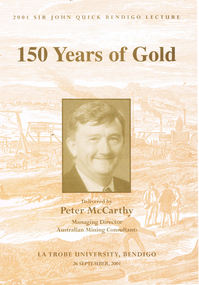 Bendigo Historical Society Inc.
Book - LONG GULLY HISTORY GROUP COLLECTION: 150 YEARS OF GOLD
... Dr Jones... 'Captain' Edward Brown... Eureka Rebellion... Sir John Quick...BENDIGO History long gully history group The Long Gully History Group - 150 Years of Gold Peter McCarthy Australian Mining Consultants La Trobe University Bendigo Robertson Hyetts Sir John Quick Quick Hyett and Rymer Quick and Hyett National Library of Australia Charles Joseph La Trobe James Gumm Hargreaves Melbourne Argus Henry Frenchham The Times Gibbons James Esmond Dr Barker Thomas Hiscock Alfred Clarke Geelong Advertiser Wat Tyler Dunlop and Regan Commissioner Doveton Sub Commissioner Armstrong Captain Dana Argus Armstrong Stewart Gibson Margaret Kennedy Convict's Prevention Act Micky O'Halloran Throckmorton Anti-Gold-License Association G E Thomson Dr Jones 'Captain' Edward Brown Eureka Rebellion Sir John Quick Mark Twain Australian Federation Mining Exchanges Alfred Deakin The Amalgamated Miner's Association Robert Clark Britian's National Miners' Association Silicosis Tuberculosis Walter Summons Bendigo Amalgamated Mines Great War Gold Mines of Australia Bendigo Mines Limited Nell Gwynne Carshalton Shaft Napoleon Shaft George Lansell Fortuna Villa The Four Deborah Mines World War Two Central Deborah North Deborah William Kelly The Edwards Works Newstead Dredge Jim Crow Dredge Adelong Dredge Calder Freeway Bendigo Mining NL Randolph Bedford CRA Ltd Sovereign Hill Ballarat Historical Park Association RMIT Melbourne University Macquarie University Australasian Institute of Mining and Metallurgy Institution of Engineers Australia Mineral Industry Consultants Association Joint Ore Reserves Committee CEO Institute Anthea McCarthy Michele Matthews Sir John Quick Committee City of Greater Bendigo The Hon Justice Michael Kirby Mr Don Blackmore Murray Darling Basin Commission Dr Janet McCalman Australian Research Council Dr John White Visy Industries Dr Al Luloff Mrs Delys Sargeant The Rt Hon Ninian Stephen Book titled 150 Years of Gold delivered by Peter McCarthy, Managing Director Australian Mining Consultants at La Trobe University, Bendigo on 26 September, 2001, the 2001 Sir John Quick Bendigo Lecture. ...Book titled 150 Years of Gold delivered by Peter McCarthy, Managing Director Australian Mining Consultants at La Trobe University, Bendigo on 26 September, 2001, the 2001 Sir John Quick Bendigo Lecture. Book cover, inside and out has a beige copy of a wood engraving of Hustlers Reef, Sandhurst with a tan tone photo of Peter McCarthy on the centre front. Mining is mentioned from the late 1840s to the present day. In the back is a career history of Peter McCarthy and a short life story of Sir John Quick. Also in the back is a list of past lectures from 1994 to 2000.bendigo, history, long gully history group, the long gully history group - 150 years of gold, peter mccarthy, australian mining consultants, la trobe university bendigo, robertson hyetts, sir john quick, quick hyett and rymer, quick and hyett, national library of australia, charles joseph la trobe, james gumm, hargreaves, melbourne argus, henry frenchham, the times, gibbons, james esmond, dr barker, thomas hiscock, alfred clarke, geelong advertiser, wat tyler, dunlop and regan, commissioner doveton, sub commissioner armstrong, captain dana, argus, armstrong, stewart gibson, margaret kennedy, convict's prevention act, micky o'halloran, throckmorton, anti-gold-license association, g e thomson, dr jones, 'captain' edward brown, eureka rebellion, sir john quick, mark twain, australian federation, mining exchanges, alfred deakin, the amalgamated miner's association, robert clark, britian's national miners' association, silicosis, tuberculosis, walter summons, bendigo amalgamated mines, great war, gold mines of australia, bendigo mines limited, nell gwynne, carshalton shaft, napoleon shaft, george lansell, fortuna villa, the four deborah mines, world war two, central deborah, north deborah, william kelly, the edwards works, newstead dredge, jim crow dredge, adelong dredge, calder freeway, bendigo mining nl, randolph bedford, cra ltd, sovereign hill, ballarat historical park association, rmit, melbourne university, macquarie university, australasian institute of mining and metallurgy, institution of engineers australia, mineral industry consultants association, joint ore reserves committee, ceo institute, anthea mccarthy, michele matthews, sir john quick committee, city of greater bendigo, the hon justice michael kirby, mr don blackmore, murray darling basin commission, dr janet mccalman, australian research council, dr john white, visy industries, dr al luloff, mrs delys sargeant, the rt hon ninian stephen -
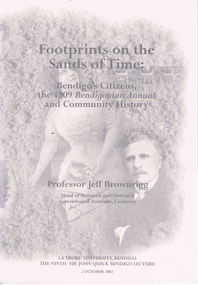 Bendigo Historical Society Inc.
Book - LONG GULLY HISTORY GROUP COLLECTION: FOOTPRINTS ON THE SANDS OF TIME
... BENDIGO History long gully history group The Long Gully History Group - Footprints on the Sands of Time Professor Jeff Brownrigg Research and Outreach Screensound Australia La Trobe University Bendigo Sir John Quick Bendigonian Annual Bendigo School of Mines British Empire Alfred Deakin Sir William Lyne King O'Malley's Commonwealth Bank Telstra Sir Frederick Holder Robert Garran John McKay The Mirror Henry Gyles Turner Fischer State Library of Victoria Bishop Reville Bendigo Evening News Bendigo Independent Bendigo Advertiser Melbourne University Melbourne Age Richard Twopenny Mr Donald Clarke Esq Bendigo's Butter Factory Madame Carandini Amy Sherwin Nellie Melba Oscar Commetant Shamrock Hotel Constitutional Convention Adelaide Frederick Holder Edmund Barton Catherine Helen Spence Elizabeth Nicholls Women's Christian Temperance Union Mary Lee Rose Scott Susan Margery Maybanke Anderson Vida Goldstein Bendigonian Annual Amy Castles Alice Crawford Edward Allan Bindley Joseph Castles Mercy Conent Freeman's Journal Catholic Press Therese Radic Melba State Library of Victoria Cardinal Moran De Quiros Bulletin John Norton D Headon J Brownrigg Lili Sharp Eileen Castles Mike Sutcliffe Melbourne Argus Frank Cusack David Horsfall Alvin Tracey Melbourne's Advocate Press Amy Sherwin Frances Saville Lalla Miranda Hugo Gorlitz Samuels Family Louis August Samuels Kate (Catherina) Samuels Madame Benda Mathilde Marchesi Emily Dyason Erna (Lovie) Mueller The German Chapter German heritage Society Bendigo Bertha Rossow Hamilton Hill Beatrice English Anthony Palamountain Alfred Bottoms A C Bartlemann Dorothy Penfold Dr Penfold Penfold Gallery Pauline Bindley E A Bindley Willie Murdoch Sister Mary Tarcisia Sisters of Mercy Peter Dawson Bendigo's Chinese Populatin Masonic Hall Ashman's Dry-cleaners Walter Murdoch Lily Baxter Walter Savage Landor Robert Garran Ada Colley Australian Journal of Communication Michelle Matthews Book titled Footprints on the Sands of Time: Bendigo's Citizens, the 1909 Bendigonian Annual and Community History with a grey tone cover with images of Sir John Quick, Amy Castles, Amy and Eileen Castles and Anthony Palamountain on the front and back covers. ...Book titled Footprints on the Sands of Time: Bendigo's Citizens, the 1909 Bendigonian Annual and Community History with a grey tone cover with images of Sir John Quick, Amy Castles, Amy and Eileen Castles and Anthony Palamountain on the front and back covers. La Trobe University, Bendigo The Ninth Sir John Quick Bendigo Lecture 2 October 2002. Lecture by Professor Jeff Brownrigg, Head of Research and Outreach ScreenSound Australia, Canberra. Mentioned in the book is Sir John Quick, Some women of the early 20th Century, Bendigo's singers and opera singers and why communities all over Australia must face up to the challenges of global media by first recognizing the value of their own stories. Mentioned at the back of the book is a brief mention of Professor Jeff Brownrigg's career, John Quick's career and a list of The Sir John Quick Bendigo Lecture Series from 1994 to 2001.bendigo, history, long gully history group, the long gully history group - footprints on the sands of time, professor jeff brownrigg, research and outreach screensound australia, la trobe university bendigo, sir john quick, bendigonian annual, bendigo school of mines, british empire, alfred deakin, sir william lyne, king o'malley's commonwealth bank, telstra, sir frederick holder, robert garran, john mckay, the mirror, henry gyles turner, fischer, state library of victoria, bishop reville, bendigo evening news, bendigo independent, bendigo advertiser, melbourne university, melbourne age, richard twopenny, mr donald clarke esq, bendigo's butter factory, madame carandini, amy sherwin, nellie melba, oscar commetant, shamrock hotel, constitutional convention adelaide, frederick holder, edmund barton, catherine helen spence, elizabeth nicholls, women's christian temperance union, mary lee, rose scott, susan margery, maybanke anderson, vida goldstein, bendigonian annual, amy castles, alice crawford, edward allan bindley, joseph castles, mercy conent, freeman's journal, catholic press, therese radic melba, state library of victoria, cardinal moran, de quiros, bulletin, john norton, d headon, j brownrigg, lili sharp, eileen castles, mike sutcliffe, melbourne argus, frank cusack, david horsfall, alvin tracey, melbourne's advocate press, amy sherwin, frances saville, lalla miranda, hugo gorlitz, samuels family, louis august samuels, kate (catherina) samuels, madame benda, mathilde marchesi, emily dyason, erna (lovie) mueller, the german chapter, german heritage society bendigo, bertha rossow, hamilton hill, beatrice english, anthony palamountain, alfred bottoms, a c bartlemann, dorothy penfold, dr penfold, penfold gallery, pauline bindley, e a bindley, willie murdoch, sister mary tarcisia, sisters of mercy, peter dawson, bendigo's chinese populatin, masonic hall, ashman's dry-cleaners, walter murdoch, lily baxter, walter savage landor, robert garran, ada colley, australian journal of communication, michelle matthews -
 Bendigo Historical Society Inc.
Book - LONG GULLY HISTORY GROUP COLLECTION: ALOIS ALZHEIMER
... The Long Gully History Group - Alois Alzheimer: Gone but not Forgotten, Associate Professor Tony Snell, Bendigo Health Care Group, La Trobe University Bendigo, Ronald Reagan, Australian Alzheimer's Association, Alois Alzheimer, Colin Masters, Henry Brobaty, Centre for Rural Rehabilitation and Aged Care, Alzheimer's Association, The Australian Society for Geriatric Medicine, The Loddon Mallee Dementia Management Strategy, Gavin Jennings, Medical Journal of Australia, Peter Panegyres, Monash University, Sir John Quick, Bendigo ANA, Michele Matthews, The Hon Justice Michael Kirby, Mr Don Blackmore, Dr Janet McCalman, Dr John White, Dr Al Luloff, Mrs Delys Sargeant, The Rt Hon Sir Ninian Stephen, Mr Peter McCarthy, Professor Jeff Brownrigg...BENDIGO History long gully history group The Long Gully History Group - Alois Alzheimer: Gone but not Forgotten, Associate Professor Tony Snell, Bendigo Health Care Group, La Trobe University Bendigo, Ronald Reagan, Australian Alzheimer's Association, Alois Alzheimer, Colin Masters, Henry Brobaty, Centre for Rural Rehabilitation and Aged Care, Alzheimer's Association, The Australian Society for Geriatric Medicine, The Loddon Mallee Dementia Management Strategy, Gavin Jennings, Medical Journal of Australia, Peter Panegyres, Monash University, Sir John Quick, Bendigo ANA, Michele Matthews, The Hon Justice Michael Kirby, Mr Don Blackmore, Dr Janet McCalman, Dr John White, Dr Al Luloff, Mrs Delys Sargeant, The Rt Hon Sir Ninian Stephen, Mr Peter McCarthy, Professor Jeff Brownrigg Book LONG GULLY HISTORY GROUP COLLECTION: ALOIS ALZHEIMER ...The Long Gully History Group - Alois Alzheimer: Gone but not Forgotten, Associate Professor Tony Snell, Bendigo Health Care Group, La Trobe University Bendigo, Ronald Reagan, Australian Alzheimer's Association, Alois Alzheimer, Colin Masters, Henry Brobaty, Centre for Rural Rehabilitation and Aged Care, Alzheimer's Association, The Australian Society for Geriatric Medicine, The Loddon Mallee Dementia Management Strategy, Gavin Jennings, Medical Journal of Australia, Peter Panegyres, Monash University, Sir John Quick, Bendigo ANA, Michele Matthews, The Hon Justice Michael Kirby, Mr Don Blackmore, Dr Janet McCalman, Dr John White, Dr Al Luloff, Mrs Delys Sargeant, The Rt Hon Sir Ninian Stephen, Mr Peter McCarthy, Professor Jeff Brownriggbendigo, history, long gully history group -
 Bendigo Historical Society Inc.
Newspaper - LONG GULLY HISTORY GROUP COLLECTION: BENDIGO'S CENTURY VOLUME THREE: 1920 - 1929
... Quick... Prime Minister Billy Hughes... State Rivers and Water Supply Commission... Diptheria... Edna Stevens... Bendigo Railway Workshops... Watson Sustenance Fund... Sir Joseph Cook... Dr...BENDIGO History long gully history group The Long Gully History Group - Bendigo's Century - Volume Three: 1920 - 1929 Bendigo Advertiser Duke and Duchess of York Cr E M Vains R Putnam A J Taylor J H Jackson W Crowley Sandhurst Football Club George Lansell St Peter's Church Bendigo Junior Technical School Prince of Wales Unity Mine Mr W Wilson Badak Tin Mining Syndicate Mr T W OrtonMr H Scarborough Mr Raleigh General Sir W R Birdwood The Soldiers' Memorial Committee Bendigo City Council RSL Memorial Hall Captain G C Wilson Lietenant R J Parer Lieutenant J C McIntosh Cr J P Carolin H K Morris E A Morris Turf Tavern Hotel Rev Donald Baker All Saints' Pro--Cathedral Keck's Nursery Bendigo Amalgamated Goldfields Rising Sun Hotel Leanne McDonnell Most Rev John McCarthy Sir John Quick Prime Minister Billy Hughes State Rivers and Water Supply Commission Diptheria Edna Stevens Bendigo Railway Workshops Watson Sustenance Fund Sir Joseph Cook Dr Lanza Bendigo Amalgamated Goldfields Bendigo Benevolent Asylum Miner's Phthisis Bendigo Gas Company Electric Light Company Bendigo Sewerage Authority Commonwealth bank Cr Curnow the Earl of Stradbroke Dame Nellie Melba Princess Theatre Lt-Col G Hurry H SW Lawson Countess of Stradbroke Clunes Woollen Mills Girton College Mrs Polglaise Mrs Kennedy Gold Discovery Memorial Cr M G Giudice Victorian Co-operative Freezing Company Bendigo Brick and Tile Company Mr Lawson Soldiers' Memorial Windermere Hotel Toni Riley Pharmacy Bendigo Gaol Mr A A Dunstan MLA New Red White and Blue Mine Claude de Vere Walter Osborne Sir John and Lady Quick Jonathan Smalley Bendigo Advertiser St Paul's Bells Mr T Cambridge Epsom Public Hall Bendigo School of Mines Major Lansell Mr H S W Lawson Cr David Andrew Colonel Hurry Mr S Bruce Bendigo Sewerage Authority Eppalock Weir Scheme Bendigo Football League R S L Memorial Major G V Lansell Lempriere MR S M Bruce Sandhurst Hotel Market Square Big Hill Tunnel Bendigo Football League Bendigo United Cricket Club South Bendigo Rex Sacred Heart Cathedral Hercules Mine Gillies Aids & Appliance Shop Anne Caudle Centre Fizelle & Mulqueen South New Moon Mine Bendigo Sewerage Authority Mr A A Kelley Epsom Sewerage Works White Hills Botanical Gardens Mr J Sternberg MLC Bendigo Book of Remembrance Bendigo Football League Senator General Drake-Brockman Captain Dyett School of Mines Handschin and Romus Hanro (Aust.) ...Newspaper supplement titled Bendigo's Century Volume Three: 1920 - 1929. Front page has a photo of The Duke and Duchess of York visit to Bendigo, 1927. Each year has heading of Who's Who, Weather, Sport and Business. First years are 1910 - 1919 titled The way we were. 1920 is titled Prince hailed. 1921 - City racks up a milestone. 1922 - Furore erupts. 1923 - Felons escape from city gaol. 1924 - Bid to finish RSL memorial. 1925 - Foul odour over sewerage plan. 1926 - Lest we forget Bendigo's fallen. 1927 - Royal Visit captures city. 1928 - Four shot in farm tragedy. 1929 - Billie's trip to remember.bendigo, history, long gully history group, the long gully history group - bendigo's century - volume three: 1920 - 1929, bendigo advertiser, duke and duchess of york, cr e m vains, r putnam, a j taylor, j h jackson, w crowley, sandhurst football club, george lansell, st peter's church, bendigo junior technical school, prince of wales, unity mine, mr w wilson, badak tin mining syndicate, mr t w ortonmr h scarborough, mr raleigh, general sir w r birdwood, the soldiers' memorial committee, bendigo city council, rsl memorial hall, captain g c wilson, lietenant r j parer, lieutenant j c mcintosh, cr j p carolin, h k morris, e a morris, turf tavern hotel, rev donald baker, all saints' pro--cathedral, keck's nursery, bendigo amalgamated goldfields, rising sun hotel, leanne mcdonnell, most rev john mccarthy, sir john quick, prime minister billy hughes, state rivers and water supply commission, diptheria, edna stevens, bendigo railway workshops, watson sustenance fund, sir joseph cook, dr lanza, bendigo amalgamated goldfields, bendigo benevolent asylum, miner's phthisis, bendigo gas company, electric light company, bendigo sewerage authority, commonwealth bank, cr curnow, the earl of stradbroke, dame nellie melba, princess theatre, lt-col g hurry, h sw lawson, countess of stradbroke, clunes woollen mills, girton college, mrs polglaise, mrs kennedy, gold discovery memorial, cr m g giudice, victorian co-operative freezing company, bendigo brick and tile company, mr lawson, soldiers' memorial, windermere hotel, toni riley pharmacy, bendigo gaol, mr a a dunstan mla, new red white and blue mine, claude de vere, walter osborne, sir john and lady quick, jonathan smalley, bendigo advertiser, st paul's bells, mr t cambridge, epsom public hall, bendigo school of mines, major lansell, mr h s w lawson, cr david andrew, colonel hurry, mr s bruce, bendigo sewerage authority, eppalock weir scheme, bendigo football league, r s l memorial, major g v lansell, lempriere, mr s m bruce, sandhurst hotel, market square, big hill tunnel, bendigo football league, bendigo united cricket club, south bendigo rex, sacred heart cathedral, hercules mine, gillies, aids & appliance shop, anne caudle centre, fizelle & mulqueen, south new moon mine, bendigo sewerage authority, mr a a kelley, epsom sewerage works, white hills botanical gardens, mr j sternberg mlc, bendigo book of remembrance, bendigo football league, senator general drake-brockman, captain dyett, school of mines, handschin and romus, hanro (aust.) bendigo knitting mills, charles handschin, farmers' union, andrew sunstan mla, country progressive party, john allan, captain g j c dyett, eahlehawk ufs dispensary, data fundamentals, the duke and duchess of york, the hercules mine, cr j a michelsen, lansell family, bendigo agricultural society, huntly shire council, bendigo creek trust, south african war memorial, cr j h curnow, st paul's church of england diamond jubilee, bendigo chamber of commerce, bendigo freezing works, bendigo pottery, bendigo trotting club, new red white and blue mine, the conservatory, cr e g batchelder, hercules mine, billie rigby, bendigo railway station, travellers' aid society, eppalock weir, the state rivers and water supply commission, bendigo railway workshops, frank grove, cr curnow, electric supply company, state electricity commission, australian aero club, bendigo preserving company, jardine, busbridge, feeman, mr h pearce, bfl, fred wood -
 Bendigo Historical Society Inc.
Newspaper - LONG GULLY HISTORY GROUP COLLECTION: BENDIGO'S CENTURY VOLUME FOUR: 1930 - 1939
... Quick Snr... Ironbark Foundry... Bendigo Evening News... Bendigo Independent... Bendigo Advertiser... Deakin Governmnet... Sir Charles Kingsford Smith... Southern Cross... Eppalock Weir... Bendigo Art Gallery... The Hercules Mine... Gillies... Aids & Appliance Shop... Anne Caudle Centre... Bill Woodfull... Harold Larwood...Dr...BENDIGO History long gully history group The Long Gully History Group - Bendigo's Century - Volume Four: 1930 - 1939 Eaglehawk Cricket Club Ernst Mueller The Bendigo Stock ExchangeL L Dungey T Williams M P Kelly C Mueller E Hommoloff R Kelly T H Busst T Hall R Tremabath E A Woodcock C Burridge Charshalton Mine Edith and G V Lansell Laboratory St Andrew's Church RSL Memorial Hall Mr Gordon Carter Sir John Monash State Electricity Commission Cr R Watson Colonel GT V Lansell Empire Press Congress Bendigo Advertiser Mr E J Hogan Eppalock Weir Lyric Theatre Bendigo Red Cross Mrs George Mackay St Andrew's Presbyterian Church Mrs William Hunter Right Rev John Douse Langley Monsignor Rooney Bendigo Art Gallery The Ironbark Mine Coliban Water Mr W Wright Station 3BO Amalgamated Wireless of Australia Ltd Advance Bendigo Group The North League St Aidan's Orphanage Bendigo Freezing Works Mr W Wright Bendigo Advertiser Mr W J Stephens Advance Bendigo Group North League Garden Gully United Gold Mining Company Bendigo Football League Sir John Quick John Quick Snr Ironbark Foundry Bendigo Evening News Bendigo Independent Bendigo Advertiser Deakin Governmnet Sir Charles Kingsford Smith Southern Cross Eppalock Weir Bendigo Art Gallery The Hercules Mine Gillies Aids & Appliance Shop Anne Caudle Centre Bill Woodfull Harold Larwood Dr John McCarthy The Hercules Douglas Jardine Don Bradman Sacred Heart Cathedral Joseph Stapleton John Lynch Bert McConchie New Red White and Blue Mine Royal Humane Society William James Vernon Shaw South New Moon Mine Bendigo Hospital Bendigo Base Hospital Duke of Gloucester RSL Memorial Hall Electricity Commission Eaglehawk Borough Council The Plaza Backhaus Estate Amalgamated Freezing Company Fortuna Villa Mrs Edith Lansell Colonel Lansell The Hercules Mine Toni Riley Pharmacy Boardwalk Barkly Hyett The Big Blue Consolidated Company The Bendigo Hospital Eaglehawk Football Team Kurmala Wing of the Bendigo Base Hospital Sir Isaac Isaacs Lyric Theatre Sir John Quick Hanro Knitting Mills St Luke's Toddlers Home St Aidan's Orphanage RSL Memorial Hall Lord and Lady Huntingfield Cr Michelsen Bendigo Art Gallery Bendigo Agricultural Show New Blue Mine Joseph Stapleton Bendigo Law Association Bendigo Hospital Committee of Management Bendigo Rotary Club Mr J McRae Education Department Andrew Sunstan Sir Stanley Argyle Bendigo Football League North Blue Mining Company Cr Staples King George V King Edward VIII Cr J A Michelsen Andrew McLay Bendigo Advertiser Cohn Bros Mrs Wallis Simpson King George VI Capping Mine Shafts 1936 Bendigo Art Gallery Madge Freemen William John Leslie Cross Judge Wasley The Myer Emporium The Baptist Church Salvation Army Ron Masters The Central Nell Gwyn Sir John Quick Leanne McDonnell Windermere Hotel Rev Donald Baker John Rumbold Central Nell Gwynne The Beehive Building The Beehive Store James Buick and Co Thomas Hope Henderson Buick Henderson & Co Mr Goodison Mr R O Henderson Lt-Col Henderson Angus Mackay Bendigo Sewerage Authority Mr S Gordon Moore Commercial Bank of Sydney Bendigo Advertiser Edward Alan Morcom Polio DR Gardner Kerr The Right Rev Conald Baker Ridley Theological College Newspaper supplement titled Bendigo's Century Volume Four: 1930 - 1939. ...Newspaper supplement titled Bendigo's Century Volume Four: 1930 - 1939. Front page is titled Bendigo's Century and has a photo of some women at the Bendigo Jockey Club, 1930s. Each year has heading of Who's Who, Weather, Sport and Business. First years are 1930 - 1939 titled A look back when. The page has photos of the Eaglehawk Cricket Club's first A Grade cricket premier ship team (1932 - 1933)., The monument to the late Bendigo mining magnate Ernst Mueller in Rosalind Park, The Bendigo Stock Exchange in the early 1930's - pictured are L L Dungey, T Williams, M P Kelly, C Mueller, E Hommoloff, R Kelly, T H Busst, T Hall, R Trembath, E A Woolcock, and C Burridge, the Carshalton mine in 1936 and The Edith and G V Lansell Laboratory at the Bendigo Hospital. 1930 - a photo of St Andrew's Church, the sundial outside the RSL Memorial Hall, The late Monsignor Rooney and The late John Douse Langley. The Ironbark Mine was the top gold producer. 1931 - Radio station goes on air, 1932 - Sir John dies, 1933 Bodyline men come to town, 1934 - Heroic rescues, 1935 - Hospital's new wing opened, 1936 - King mourned, 1937 - Beehive store towers above, 1938 - Mining shows mixed results and 1939 - Outbreak of war sobering.bendigo, history, long gully history group, the long gully history group - bendigo's century - volume four: 1930 - 1939, eaglehawk cricket club, ernst mueller, the bendigo stock exchangel l dungey, t williams, m p kelly, c mueller e hommoloff, r kelly, t h busst, t hall, r tremabath, e a woodcock, c burridge, charshalton mine, edith and g v lansell laboratory, st andrew's church, rsl memorial hall, mr gordon carter, sir john monash, state electricity commission, cr r watson, colonel gt v lansell, empire press congress, bendigo advertiser, mr e j hogan, eppalock weir, lyric theatre, bendigo red cross, mrs george mackay, st andrew's presbyterian church, mrs william hunter, right rev john douse langley, monsignor rooney, bendigo art gallery, the ironbark mine, coliban water, mr w wright, station 3bo, amalgamated wireless of australia ltd, advance bendigo group, the north league, st aidan's orphanage, bendigo freezing works, mr w wright, bendigo advertiser, mr w j stephens, advance bendigo group, north league, garden gully united gold mining company, bendigo football league, sir john quick, john quick snr, ironbark foundry, bendigo evening news, bendigo independent, bendigo advertiser, deakin governmnet, sir charles kingsford smith, southern cross, eppalock weir, bendigo art gallery, the hercules mine, gillies, aids & appliance shop, anne caudle centre, bill woodfull, harold larwood, dr john mccarthy, the hercules, douglas jardine, don bradman, sacred heart cathedral, joseph stapleton, john lynch, bert mcconchie, new red white and blue mine, royal humane society, william james, vernon shaw, south new moon mine, bendigo hospital, bendigo base hospital, duke of gloucester, rsl memorial hall, electricity commission, eaglehawk borough council, the plaza, backhaus estate, amalgamated freezing company, fortuna villa, mrs edith lansell, colonel lansell, the hercules mine, toni riley pharmacy, boardwalk, barkly hyett, the big blue consolidated company, the bendigo hospital, eaglehawk football team, kurmala wing of the bendigo base hospital, sir isaac isaacs, lyric theatre, sir john quick, hanro knitting mills, st luke's toddlers home, st aidan's orphanage, rsl memorial hall, lord and lady huntingfield, cr michelsen, bendigo art gallery, bendigo agricultural show, new blue mine, joseph stapleton, bendigo law association, bendigo hospital committee of management, bendigo rotary club, mr j mcrae, education department, andrew sunstan, sir stanley argyle, bendigo football league, north blue mining company, cr staples, king george v, king edward viii, cr j a michelsen, andrew mclay, bendigo advertiser, cohn bros, mrs wallis simpson, king george vi, capping mine shafts 1936, bendigo art gallery, madge freemen, william john leslie cross, judge wasley, the myer emporium, the baptist church, salvation army, ron masters, the central nell gwyn, sir john quick, leanne mcdonnell, windermere hotel, rev donald baker, john rumbold, central nell gwynne, the beehive building, the beehive store, james buick and co, thomas hope henderson, buick henderson & co, mr goodison, mr r o henderson, lt-col henderson, angus mackay, bendigo sewerage authority, mr s gordon moore, commercial bank of sydney, bendigo advertiser, edward alan morcom, polio, dr gardner kerr, the right rev conald baker, ridley theological college -
 Bendigo Historical Society Inc.
Newspaper - LONG GULLY HISTORY GROUP COLLECTION: BENDIGO'S CENTURY VOLUME SIX: 1950 - 1959
... Dr John McCarthy... Jack Davey... 1950 Empire Games... Hercules Gold Mines... Amy Castles... Ben Templeton... Cobb & Co... Cr Norman Oliver... Reg Parker... Fred Amer... Les Hammer... Colonel George Victor Lansell... John Quick...BENDIGO History long gully history group The Long Gully History Group - Bendigo's Century - Volume Six: 1950 - 1959 Gillies' Corner Bendigo Advertiser John Lienhop MLC North Deborah Mine Les Gillies Alan Gillies Norm Gillies Black Swan Hotel Sir Dallas Brooks Cr A G Weynton Bert Mundy Cr Poulston The Northern District School of Nursing Lister House The Bendigo Free Library Rev Dr C Irving Shamrock Hotel Sir Albert Dunstan The Most Rev Dr John McCarthy Jack Davey 1950 Empire Games Hercules Gold Mines Amy Castles Ben Templeton Cobb & Co Cr Norman Oliver Reg Parker Fred Amer Les Hammer Colonel George Victor Lansell John Quick Mr L W Galvin Mr P J Clarey MHR hanro Knitting Mills Flooding Bendigo Pottery Snow Fall The Last Lamp-lighter The North Deborah Aids & Appliance Shop Boardwalk The late King George VI The North Deborah Beehive Building St Paul's St Kilian's Upper Reserve Bendigo Trades Hall Bendigo Blackout Bendigo Hospital Shamrock Hotel Gerald Smith Britannia Hotel Mr A J Harris William Morris (Billy) Hughes Andrew Hampson Deborah Anticline North Deborah Central Deborah Diamond Hill Mine North Nell Gynne Mine Robert Ross Haverfield Sandhurst Commercial Courier Arthur Moore Lloyd Robert Ross haverfield Angus Mackay JJ Casey James Henderson David Stuart Bendigo Independent Colonel George Lansell Bendigo Base Hospital Bendigo Town Hall Victorian Electric traction Association the mOst Rev B D Stewart St Vincent's Memorial College Commonwealth Athletic Club South Atlas Racetrack Harp and Shamrock Hotel Mr and Mrs F Drake Cr F W Clayton Cr R Poulston J H Abbott & Co Sir George Lansell Clan Macleod Bendigo Gaol Queen Alexandra Fountain Belfast Hotel Commonwealth Bank St Vincent's College Lyric Threatre Des Duguid Brian Cahill Lord's Raceway Red White & Blue Extended Gold Mining Company NL Central Napoleon Gold MiningCompany NL Joss House Harry John Bendigo Advertiser Mr Leggatt University of Melbourne ANZ Bank Golden Drive-in Theatre Bank of Australasia John Brown Industries Bendigo Football League Bendigo Trotting Club Faith Leech RACV Bendigo Sewereage Authority Bendigo Base Hospital Bendigo Benevolent Asylum Henry Bolte Jack Davey Russell Oakley Neville Stilwell Channel Seven Bendigo's Olympic Pool Annie Caudle Centre Strathfieldsaye Aerodrome Committee Southern Airlines Cr D J Osborn Cairn Curran Reservoir State Savings Bank Commonwealth Bank of Australasia Belfast Hotel Bennett's Arcade Eppalock Weir Bendigo Cenotaph Sir Edmund Herring Cr A S Craig Bendigo Creche Bendigo High School Bendigo Pottery Shamrock Hotel The Venerable Ronald Richards Bishop Riley All Saints Cathedral Mr Albert Bush Bendigo Arcade Company Ltd Woolworths Bull's Head Hotel Pike's Corner Arcade Hotel Upper Coliban Reservoir Cr Tom Flood Crystal Egg Co Sailor's Guide Central Deborah Central Nell Gwynne Mine Bendigo Benevolent Home Ron Masters George Daniel Eppalock Dam Water Commission Public Works Committee Bendigo Central Victoria Telecasters Ltd Channel Nine Royal Princess Theatre Sir George Lansell Volunteer Defence Corps Bendigo Independent Countess Erna Cadorin Count Ettore Cadorin Ernst Mueller Sutex Pty Ltd Dick Turner Marco Cavasassi Newspaper supplement titled Bendigo's Century Volume six: 1950 - 1959. ...Newspaper supplement titled Bendigo's Century Volume six: 1950 - 1959. Front page has a photo of Gillies' famous corner, 1954. Each year has heading of Who's Who, Weather, Sport and Business. First year is 1950 titled Gillies: it's a Bendigo icon. 1951 is titled It's party time. 1952 - City mourns King George. 1953 - Mining ceases. 1954 - City thrilled at royal visit. 1955 - Push to save old Joss House. 1956 - Olympic fever grips Bendigo. 1957 - State Cabinet visits Bendigo. 1958 - Plan to keep historic mine. 1959 - Water storage woes solved. Back page has the Gillies Story.bendigo, history, long gully history group, the long gully history group - bendigo's century - volume six: 1950 - 1959, gillies' corner, bendigo advertiser, john lienhop mlc, north deborah mine, les gillies, alan gillies, norm gillies, black swan hotel, sir dallas brooks, cr a g weynton, bert mundy, cr poulston, the northern district school of nursing, lister house, the bendigo free library, rev dr c irving, shamrock hotel, sir albert dunstan, the most rev dr john mccarthy, jack davey, 1950 empire games, hercules gold mines, amy castles, ben templeton, cobb & co, cr norman oliver, reg parker, fred amer, les hammer, colonel george victor lansell, john quick, mr l w galvin, mr p j clarey mhr, hanro knitting mills, flooding, bendigo pottery, snow fall, the last lamp-lighter, the north deborah, aids & appliance shop, boardwalk, the late king george vi, the north deborah, beehive building, st paul's, st kilian's, upper reserve, bendigo trades hall, bendigo blackout, bendigo hospital, shamrock hotel, gerald smith, britannia hotel, mr a j harris, william morris (billy) hughes, andrew hampson, deborah anticline, north deborah, central deborah, diamond hill mine, north nell gynne mine, robert ross haverfield, sandhurst commercial courier, arthur moore lloyd, robert ross haverfield, angus mackay, jj casey, james henderson, david stuart, bendigo independent, colonel george lansell, bendigo base hospital, bendigo town hall, victorian electric traction association, the most rev b d stewart, st vincent's memorial college, commonwealth athletic club, south atlas racetrack, harp and shamrock hotel, mr and mrs f drake, cr f w clayton, cr r poulston, j h abbott & co, sir george lansell, clan macleod, bendigo gaol, queen alexandra fountain, belfast hotel, commonwealth bank, st vincent's college, lyric threatre, des duguid, brian cahill, lord's raceway, red white & blue extended gold mining company nl, central napoleon gold miningcompany nl, joss house, harry john, bendigo advertiser, mr leggatt, university of melbourne, anz bank, golden drive-in theatre, bank of australasia, john brown industries, bendigo football league, bendigo trotting club, faith leech, racv, bendigo sewereage authority, bendigo base hospital, bendigo benevolent asylum, henry bolte, jack davey, russell oakley, neville stilwell, channel seven, bendigo's olympic pool, annie caudle centre, strathfieldsaye aerodrome committee, southern airlines, cr d j osborn, cairn curran reservoir, state savings bank, commonwealth bank of australasia, belfast hotel, bennett's arcade, eppalock weir, bendigo cenotaph, sir edmund herring, cr a s craig, bendigo creche, bendigo high school, bendigo pottery, shamrock hotel, the venerable ronald richards, bishop riley, all saints cathedral, mr albert bush, bendigo arcade company ltd, woolworths, bull's head hotel, pike's corner, arcade hotel, upper coliban reservoir, cr tom flood, crystal egg co, sailor's guide, central deborah, central nell gwynne mine, bendigo benevolent home, ron masters, george daniel, eppalock dam, water commission, public works committee, bendigo central victoria telecasters ltd, channel nine, royal princess theatre, sir george lansell, volunteer defence corps, bendigo independent, countess erna cadorin, count ettore cadorin, ernst mueller, sutex pty ltd, dick turner, marco cavasassi
