
Showing 58 items matching " dyed fabric"
-
 Embroiderers Guild, Victoria
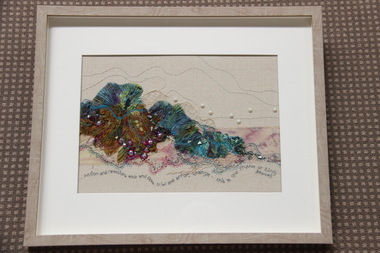
Artwork, other - Picture, Ebb and Flow, 2017
... ... Dyed fabric...Creatively manipulated hand dyed fabric, on a fawn background, depicting ocean wave, with embellishment of tiny shells, beads and sequins with some simple stitching....Applique Fabric Manipulation Embroidery Beads Smocking Dyed fabric Action and reaction , ebb and flow, trial and error, change - this is the rhythm of living. ...Made by Rhonda Justus for the Guild's 2017 exhibition and purchased for the collection.Creatively manipulated hand dyed fabric, on a fawn background, depicting ocean wave, with embellishment of tiny shells, beads and sequins with some simple stitching.Action and reaction , ebb and flow, trial and error, change - this is the rhythm of living. (B. Barton)applique, fabric manipulation, embroidery, beads, smocking, dyed fabric -
 Glenelg Shire Council Cultural Collection
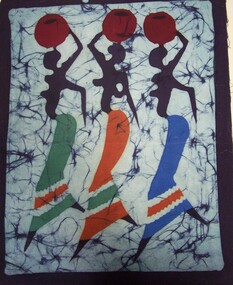
Artwork, other - Batik, 2005
... Blue, red and green batik-dyed fabric, depicting three women carrying vases on their heads....Blue, red and green batik-dyed fabric, depicting three women carrying vases on their heads. ...Exhibited in Malawi Arts and Craft exhibition, Portland Arts Centre, April 2006.Blue, red and green batik-dyed fabric, depicting three women carrying vases on their heads. -
 Embroiderers Guild, Victoria
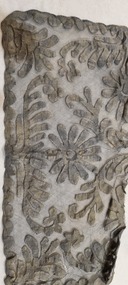
Textile - Applique Corset Sides
... Two remnants of needle-turned applique on cotton tulle. Grey hand dyed fabric. Side pieces for corset....Two remnants of needle-turned applique on cotton tulle. Grey hand dyed fabric. Side pieces for corset. Textile Applique Corset Sides ...Two remnants of needle-turned applique on cotton tulle. Grey hand dyed fabric. Side pieces for corset. -
 Embroiderers Guild, Victoria
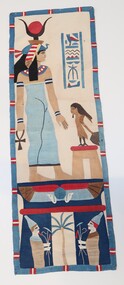
Textile - Egyptian Applique Panel, Early 20th Century
... Egyptian applique hanging, possibly folk art Egyptian Khayamiya. Brightly dyed fabrics appliqued depicting standing figure, hieroglyphic inscriptions and various other symbols....Egyptian applique hanging, possibly folk art Egyptian Khayamiya. Brightly dyed fabrics appliqued depicting standing figure, hieroglyphic inscriptions and various other symbols. ...Folk art style hanging "khayamiya", souvenir of Egypt probably early 20th C. Touristic khayamiya were made from the 1890s through to the present day, and were notably popular after the discovery of Tutankhamun's tomb in 1922. These are often smaller, and are figurative appliques, usually featuring motifs from ancient Egypt or what were then contemporary scenes of Egyptian life, especially folkloric scenes. They were generally purchased by international travelers to Egypt as popular Egyptian souvenirs.Egyptian applique hanging, possibly folk art Egyptian Khayamiya. Brightly dyed fabrics appliqued depicting standing figure, hieroglyphic inscriptions and various other symbols. -
 Whitehorse Historical Society Inc.
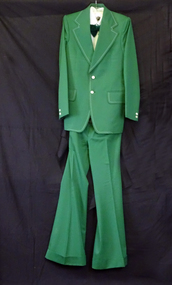
Clothing - Suit, Shirt and Bowtie, 1973
... In 1973 when Brian Schultz was working as a dye chemist at Yarra Falls (a Textile Factory making fabrics for school uniforms, suits etc.) in Abbotsford, he was invited by his friend to be his best man. He chose the colour green, dyed the fabric himself, and took the fabric to a tailor in Smith Street, Collingwood to have the suits made up for the December wedding. ...In 1973 when Brian Schultz was working as a dye chemist at Yarra Falls (a Textile Factory making fabrics for school uniforms, suits etc.) in Abbotsford, he was invited by his friend to be his best man. He chose the colour green, dyed the fabric himself, and took the fabric to a tailor in Smith Street, Collingwood to have the suits made up for the December wedding. ...In 1973 when Brian Schultz was working as a dye chemist at Yarra Falls (a Textile Factory making fabrics for school uniforms, suits etc.) in Abbotsford, he was invited by his friend to be his best man. He chose the colour green, dyed the fabric himself, and took the fabric to a tailor in Smith Street, Collingwood to have the suits made up for the December wedding. The green shirt which Brian wore with the green suit at the wedding in 1973 came in handy when he wore it 37 years later at his son's 30th birthday Halloween dress up party, when he dressed up as The Hulk. He cut up the sleeves of the shirt and painted himself green. For the December wedding, the groom wore a white suit, lemon shirt and emerald green velvet bow tie.Green two piece suit with shirt and bow tie. 1. Single breasted jacket with two pearl buttons centre and smaller buttons on sleeves. White stitching around collar edge and down the front on pockets. 2. Trousers with wide belt carrier, zip fly, cuffs wide with 6cm turnback. 3. Shirt is a polyester fine knit, pale green with dark green buttons and collar stitched with dark green edge-stitching. 4. Dark green velvet and ready-tied bow tie..MENS SLACKS BY TRAVELLERS APPAREL - For the man who goes placescostume, male -
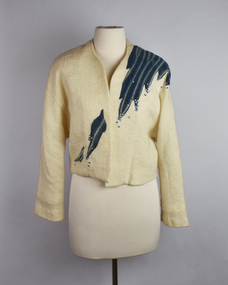 National Wool Museum
Clothing - Jacket, Mrs Jean Inglis, 1988
... Specific to this jacket, the fabric for the dyed section was made with the same fabric as the rest of the jacket. ...This blue dyed section of fabric is dotted with the occasional blue sequin. ...This blue dyed section of fabric is dotted with the occasional blue sequin. ...This jacket is by the prolific spinner and weaver Jean Inglis. It has been woven with a warp of commercially brought wool & a weft of hand spun Corriedale. It is completed in a Swedish lace style of weaving. The highlight of the jacket is the blue section of fabric on the top left shoulder of the wearer, which works down to the bottom right hip. This pattern looks like long thin individual separate sections of fabric stitched to the jacket; however, only one section of fabric has been added. A dying technique has been utilised to give the appearance of multiple sections. This Japanese dyeing technique is called Shibori, “to wring, squeeze or press". It is a manual tie-dyeing technique, which produces several different patterns on fabric. The specific pattern on this fabric is known as Kumo Shibori. It utilises bound resistance. This technique involves folding sections of the cloth very finely and evenly. Then the cloth is bound in very close sections. The result is a very specific spider-like design. This design requires very precise technique. Specific to this jacket, the fabric for the dyed section was made with the same fabric as the rest of the jacket. A section of the excess fabric was concertina wrapped around a 100mm pipe and tied up before dying. This gives the consistent straight blue lines, with no bleed from the dye. The sections were then sewed into the jacket with the occasional sequin added for additional decoration and glamour. The jacket won 1st prize at the 1988 Geelong Show. Jean was assisted by the dress maker Ruth Randell with some of the design and sewing. Jean always found sewing “a bit of a bore”. The jacket also has an attached swing tag. It was added to provide information to the judges at the Melbourne Show on how the jacket was created. It comes complete with Jean’s self-proclaimed terrible handwriting. It was donated to the National Wool Museum in 2021.Cream singled breasted jacket with no overlap. The jacket has no column of buttons for fastening, or lapels. It is designed to be plain, to not draw attention. The jacket is highlighted by the Shibori dyed waves on the top left shoulder of the wearer, which works down to the bottom right hip. This blue dyed section of fabric is dotted with the occasional blue sequin. Internally, the jacket features a white silk lining for comfort. The jacket ends in a straight cut hem, including at the cuffs. The jacket has an attached swing tag. The swing tag is cream with a printed thin black boarder. Within the boarder, handwriting in black ink is found. It has a hole punch in the top left corner of the swing tag for attaching to the jacket.hand spun, hand weaving, textile design, textile production, shibori, kumo shibori -
 Embroiderers Guild, Victoria
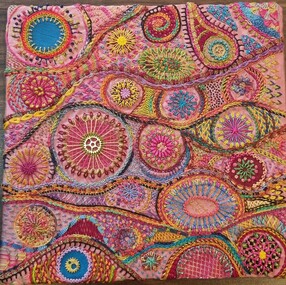
Textile - Creative Embroidery Panel, Jennifer Rowe, 2024
... Jenny Rowe says: This piece was inspired by some hand dyed threads, interesting fabrics and a piece called Soleil Rouge by Celcile Meraglia which I saw on Pinterest. ...Jenny Rowe says: This piece was inspired by some hand dyed threads, interesting fabrics and a piece called Soleil Rouge by Celcile Meraglia which I saw on Pinterest. ...Jenny Rowe says: This piece was inspired by some hand dyed threads, interesting fabrics and a piece called Soleil Rouge by Celcile Meraglia which I saw on Pinterest. I began by ironing various size circles and ovals on to the silk dupion backing. I then drew the lines that surround them and divided the spaces. These were worked by couching various threads and tapes, loads o chain stitch (my favourite) whipped, laced, over worked with running stitch in a contrasting colour or with buttonhole stitch worked into the side. Stitches used for the circles and filling include - fly , lazy daisy, Chinese and French knots, raised chain bands, up and down buttonhole, spider web, herringbone, feather, Palestrina, Roumanian and seed stitches. I used these as the whim took me and I kept going back and forth adding layers until I just had to say STOP! Finally I added a few cogs in a nod to steam punk, one of my favourite styles. It was a wonderful piece to use many different stitches and all those lovely threads in your stash. I had tremendous fun stitching this. Example of contemporary creative surface stitcherySilk dupion panel designed and embroidered with surface embroidery using many different stitches and threads. Embellished with metal cogs in a nod to steam punk style. floral, freeform, steam punk -
 National Wool Museum
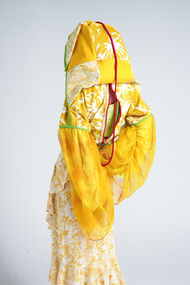
Clothing - 35 Life, Canwen Zhao, 2022
... For the sleeves, quick-drying, sun-protective sport fabric forms the base, overlaid with discarded silk fabric dyed with turmeric and plant dyes. This not only ensures functionality but also adds a sense of elegance. ...For the sleeves, quick-drying, sun-protective sport fabric forms the base, overlaid with discarded silk fabric dyed with turmeric and plant dyes. This not only ensures functionality but also adds a sense of elegance. ...Canwen Zhao was awarded the $10,000 We The Makers Acquisitive Prize for '35 Life' in 2023. Artist Statement: "35life" is a sustainable fashion project that transforms second-hand clothing materials into urban street outdoor-style products. Highlighting prominent Chinese classic red and green colours not only conveys eastern aesthetics but also adds a sense of unity to the clothing collection. The high-saturation and high-brightness full-colour palette keeps the clothing consistently "fresh," allowing any trendy colours to seamlessly integrate into the project's designs, thus extending the lifespan of the garments. Additionally, all clothing items can quickly transform into a stylish bag for convenient daily carrying and home storage. These bags are made from leftover fabric generated during the production process and serve as original packaging for sale. This approach not only reduces excessive packaging but also enhances the chances of resale in the second-hand market. The project draws inspiration from the traditional Chinese cultural concept of "huo feng ding," meaning "exchange the old for the new." it's also influenced by the designer's personal experience with health issues, making the designs suitable for individuals who can't be exposed to sunlight for extended periods, adapting to the changing urban lifestyle. 35life aims to provide visually pleasing and comfortable dressing experiences for urban dwellers who are busy with work and experience high levels of stress. Unlike traditional design patterns, this project adopts a unique design approach. It selects 3-5 pieces of raw materials based on their colours, and then disassembles them through structural lines. While retaining most of their functionality, these materials are rearranged and assembled on a flat surface before being shaped on a dress form. Subsequently, various ways of creating storage bags are derived from the initial clothing prototypes. After refining the designs, the final products are developed, and similar materials are used to create samples. Therefore, under this design methodology, even for the same garment, it is impossible to produce two identical pieces of clothing. Each garment is truly one-of-a-kind, which enhances its rarity and contributes to the longevity of the fashion pieces. The project includes various types of clothing, each with unique storage methods. This yellow look, named "elegant beach sunscreen monarch," draws its fashion inspiration from traditional Han Chinese attire and its storage concept from the Chinese cultural concept of "jiu jiu gui yi." the design employs flat pattern cutting, utilizing materials from the second-hand market such as beach towels, children's waterproof clothing, and women's dresses. Similar colours and patterns are reassembled through cutting and combining. For the sleeves, quick-drying, sun-protective sport fabric forms the base, overlaid with discarded silk fabric dyed with turmeric and plant dyes. This not only ensures functionality but also adds a sense of elegance. The length can be adjusted using drawstrings. Artist Bio: Zhao Canwen is a multidisciplinary fashion designer with a strong passion for integrating art, history, culture, and sustainable design. With over 15 years of experience in painting, she draws inspiration from ancient Chinese philosophy and aesthetics, which gives her a unique sense of beauty. After 8 years of fashion and art training, she possesses a keen insight into current trends and tends to combine art with commercial needs. Zhao's design style is diverse, characterized by a multidimensional approach, a focus on colour application, and storytelling through details.Outfit consisting of six pieces: - Orange plastic eye wear with green paint - Pair of red and green metal clip on earrings - Red beaded phone case with attached beads on string - Pair of red and green painted running shoes - Yellow and green hooded garment with red piping and zips - Brown bag with green beaded handlessustainable, fashion, we the makers, art, culture, design, chinese philosophy, prize -
 City of Moorabbin Historical Society (Operating the Box Cottage Museum)
Sewing Equipment, reel of nylon thread, c1950
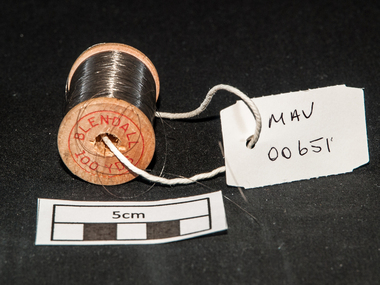
... fabric at the 1939 New York World's Fair. Nylon was intended to be a synthetic replacement for silk and substituted for it in many different products after silk became scarce during World War II. It replaced silk in military applications such as parachutes and flak vests, and was used in many types of vehicle tyres. Nylon is clear and colourless, or milky, but is easily dyed...fabric at the 1939 New York World's Fair. Nylon was intended to be a synthetic replacement for silk and substituted for it in many different products after silk became scarce during World War II. It replaced silk in military applications such as parachutes and flak vests, and was used in many types of vehicle tyres. Nylon is clear and colourless, or milky, but is easily dyed ...Nylon is a thermoplastic, silky material, first used commercially in a nylon-bristled toothbrush (1938), followed more famously by women's stockings ("nylons"; 1940) after being introduced as a fabric at the 1939 New York World's Fair. Nylon was intended to be a synthetic replacement for silk and substituted for it in many different products after silk became scarce during World War II. It replaced silk in military applications such as parachutes and flak vests, and was used in many types of vehicle tyres. Nylon is clear and colourless, or milky, but is easily dyed. Multi-stranded nylon cord and rope is slippery and tends to unravel. The ends can be melted and fused with a heat source such as a flame or electrode to prevent this.A wooden reel of ' BLONDAL' Nylon sewing thread 100ydsBLONDAL 100ydsmoorabbin, brighton, early settlers, pioneers, cheltenham, dressmaking, craftwork, nylon thread, blondal pty ltd -
 Flagstaff Hill Maritime Museum and Village
Fur Collar, 1930’S
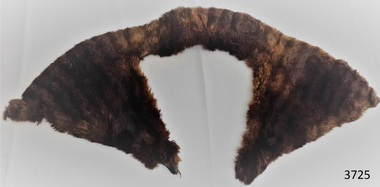
... Rabbit fur collar, wide lapels, very soft fur with dyed pattern of light and dark brown stripes. Collar is lined with a heavy dark green woollen fabric. ...Rabbit fur collar, wide lapels, very soft fur with dyed pattern of light and dark brown stripes. Collar is lined with a heavy dark green woollen fabric. ...The donors of this fur collar believe the collar to be between 80-90 years old. It was worn by the donor’s grandmother and mother as an accessory to Warrnambool and district balls and dances. It may have also been worn for warmth! The donors believe the fur would have been purchased in either Melbourne or Toorak. This fur could have been worn by either men or women. This fur collar is representative of fashion accessories in Warrnambool and District in the 1930’s.Fur collar, 1930’s. Rabbit fur collar, wide lapels, very soft fur with dyed pattern of light and dark brown stripes. Collar is lined with a heavy dark green woollen fabric. Between the fur and the lining there is a felt interfacingflagstaff hill, warrnambool, shipwrecked coast, flagstaff hill maritime museum, maritime museum, shipwreck coast, flagstaff hill maritime village, great ocean road, fur collar, fur stole, fur accessory, clothing 1930’s, fashion 1930’s, fashion accessory, rabbit fur -
 National Wool Museum
Textile - DIY Deluge Design No. 5, Alison Withers, 2023
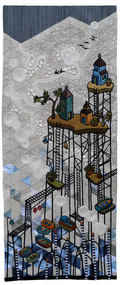
... Made by piecing, applique and free machine stitching, using industrial felt, hand dyed merino felt, woollen suiting, cotton fabric, wool theatre curtain backing and cotton and polyester thread....Made by piecing, applique and free machine stitching, using industrial felt, hand dyed merino felt, woollen suiting, cotton fabric, wool theatre curtain backing and cotton and polyester thread. ...Artist Alison Withers work DIY Deluge Design No. 5 was awarded Expressions: The Wool Quilt Acquisitive Award in 2023. Works were received from across Australasia and internationally from some of quilting’s most highly regarded and awarded artists. Finalists work was displayed at Art Quilt Australia 2023 presented by Ozquilt Network and the National Wool Museum from 12 August to 12 November 2023. Artist Statement: It's clear we need to adapt the anatomy of our human spaces to become more resilient to the increasingly unavoidable impacts of climate change. Made by piecing, applique and free machine stitching, using industrial felt, hand dyed merino felt, woollen suiting, cotton fabric, wool theatre curtain backing and cotton and polyester thread.Rectangular portrait orientated art quilt depicting an environmental scene including boats, lights, elevated buildings, plants and birds on a background of shades of cream, blue and grey. A baton is sewn into the back at the bottom.Back: DIY Deluge Design No.5 / Alison Withersquilt, ozquilt network, prize, wool, art, felt, piecing, applique -
 National Wool Museum
Textile - Physician Blanket Sample, Collins Bros Mill Pty Ltd
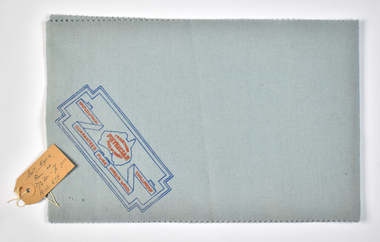
... wool fabric blankets sample physician Collins Bros Mill Pty Ltd front: [tag] SW3 Dyed / Blue 4 / 37 ½ lln(?) ...Long crinkle cut blue fabric sample with label stamped in ink. A brown paper tag is attached with string with hand written blue text.front: [tag] SW3 Dyed / Blue 4 / 37 ½ lln(?) – 70 yds / PeNo 678 front: [label] TRADEMARK / PHYSICIAN / REG No 76880 / SPOTLESS FINISH / CHILLPROOF / GUARENTEED PURE VIRGIN WOOLwool, fabric, blankets, sample, physician, collins bros mill pty ltd -
 Embroiderers Guild, Victoria
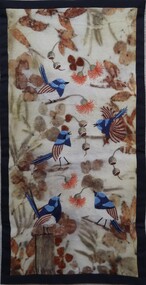
Textile - Embroidered Wool Hanging Ollie Fraser, Olwyn Fraser, "Busy Superb Fairy Wrens", July 2025
... Ollie draws local birds and stitches them on recycled woollen fabric that she has dyed using local indigenous leaves and bark...Recycled wool blanketing base, eco-dyed and printed using indigenous Victorian flora and eucalypt leaves. Backed with black cotton fabric. ...Australian flora Eucalypt leaves birds fairy wren Recycled wool blanketing base, eco-dyed and printed using indigenous Victorian flora and eucalypt leaves. Backed with black cotton fabric. ...Commissioned by Embroiderers Guild Victoria from Victorian Textile artist Ollie Fraser, Ballarat in January 2025. Ollie draws local birds and stitches them on recycled woollen fabric that she has dyed using local indigenous leaves and barkContemporary Victorian artwork representing eco-art practices inspired by local flora and fauna.Recycled wool blanketing base, eco-dyed and printed using indigenous Victorian flora and eucalypt leaves. Backed with black cotton fabric. Embroidered with five blue fairy wrens and five flowering gumnuts and seven closed gumnuts.australian flora, eucalypt leaves, birds, fairy wren -
 National Wool Museum
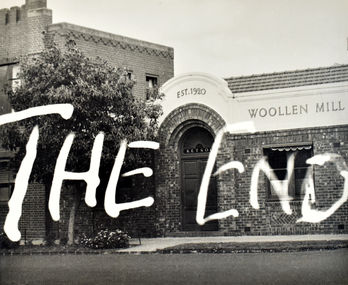
Photograph - Returned Sailors and Soldiers Mill, Norm Holroyd, 1960's - 1970's
... dyed, spun into yarn and woven. It specialised in heavy worsted cloths, high-quality tweed, and its signature "Retsol" and "Monarch" pure-wool travelling rugs, later adapting its machinery to blend natural wool with artificial fibres as mid-century market demands shifted. R. S. & S Mill Returned Sailors and Soldiers Mill Newtown Geelong World War I Soldiers Veterans Co-operative Textile Industry Woollen Mills Wool Worsted Cloth Tweed Retsol Monarch Travel Rugs Machinery Factory Working Life Norm Holroyd Photo Album Photography Design Fabric back: [handwritten] 45 Black and white photograph attached to cardboard backing with sticky tape. ...One of thirty eight photographs from a photo album featuring images of the Returned Sailors and Soldiers Woollen Mill in Newtown, Geelong. The images were taken between the 1960's-1970's by Norm Holroyd who worked at the mills. They were developed in his own private dark room and kept at his home for private viewing. The Returned Sailors and Soldiers Woollen Mill operated as a self-sufficient co-operative, funded and run by World War I veterans using their War Gratuity Bonds. The facility functioned as a complete raw-to-finished assembly line where raw fleece was brought on-site to be scoured, carded, dyed, spun into yarn and woven. It specialised in heavy worsted cloths, high-quality tweed, and its signature "Retsol" and "Monarch" pure-wool travelling rugs, later adapting its machinery to blend natural wool with artificial fibres as mid-century market demands shifted.Black and white photograph attached to cardboard backing with sticky tape. Image shows a building exterior with text. Backing card has four holes in left side.back: [handwritten] 45r. s. & s mill, returned sailors and soldiers mill, newtown, geelong, world war i, soldiers, veterans, co-operative, textile industry, woollen mills, wool, worsted cloth, tweed, retsol, monarch, travel rugs, machinery, factory, working life, norm holroyd, photo album, photography, design, fabric -
 National Wool Museum
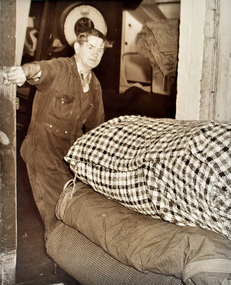
Photograph - Returned Sailors and Soldiers Mill, Norm Holroyd, 1960's - 1970's
... dyed, spun into yarn and woven. It specialised in heavy worsted cloths, high-quality tweed, and its signature "Retsol" and "Monarch" pure-wool travelling rugs, later adapting its machinery to blend natural wool with artificial fibres as mid-century market demands shifted. R. S. & S Mill Returned Sailors and Soldiers Mill Newtown Geelong World War I Soldiers Veterans Co-operative Textile Industry Woollen Mills Wool Worsted Cloth Tweed Retsol Monarch Travel Rugs Machinery Factory Working Life Norm Holroyd Photo Album Photography Design Fabric back: [handwritten] 34 Black and white photograph attached to cardboard backing with sticky tape. ...One of thirty eight photographs from a photo album featuring images of the Returned Sailors and Soldiers Woollen Mill in Newtown, Geelong. The images were taken between the 1960's-1970's by Norm Holroyd who worked at the mills. They were developed in his own private dark room and kept at his home for private viewing. The Returned Sailors and Soldiers Woollen Mill operated as a self-sufficient co-operative, funded and run by World War I veterans using their War Gratuity Bonds. The facility functioned as a complete raw-to-finished assembly line where raw fleece was brought on-site to be scoured, carded, dyed, spun into yarn and woven. It specialised in heavy worsted cloths, high-quality tweed, and its signature "Retsol" and "Monarch" pure-wool travelling rugs, later adapting its machinery to blend natural wool with artificial fibres as mid-century market demands shifted.Black and white photograph attached to cardboard backing with sticky tape. Image shows a man moving woollen fabrics on a trolley through a doorway. Backing card has four holes in left side.back: [handwritten] 34r. s. & s mill, returned sailors and soldiers mill, newtown, geelong, world war i, soldiers, veterans, co-operative, textile industry, woollen mills, wool, worsted cloth, tweed, retsol, monarch, travel rugs, machinery, factory, working life, norm holroyd, photo album, photography, design, fabric -
 National Wool Museum
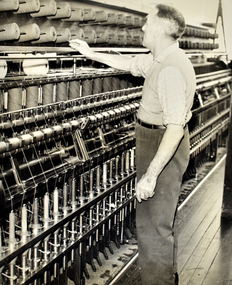
Photograph - Loom, Returned Sailors and Soldiers Mill, Norm Holroyd, 1960's - 1970's
... dyed, spun into yarn and woven. It specialised in heavy worsted cloths, high-quality tweed, and its signature "Retsol" and "Monarch" pure-wool travelling rugs, later adapting its machinery to blend natural wool with artificial fibres as mid-century market demands shifted. R. S. & S Mill Returned Sailors and Soldiers Mill Newtown Geelong World War I Soldiers Veterans Co-operative Textile Industry Woollen Mills Wool Worsted Cloth Tweed Retsol Monarch Travel Rugs Machinery Factory Working Life Norm Holroyd Photo Album Photography Design Fabric back: [handwritten] 19 Black and white photograph attached to cardboard backing with sticky tape. ...One of thirty eight photographs from a photo album featuring images of the Returned Sailors and Soldiers Woollen Mill in Newtown, Geelong. The images were taken between the 1960's-1970's by Norm Holroyd who worked at the mills. They were developed in his own private dark room and kept at his home for private viewing. The Returned Sailors and Soldiers Woollen Mill operated as a self-sufficient co-operative, funded and run by World War I veterans using their War Gratuity Bonds. The facility functioned as a complete raw-to-finished assembly line where raw fleece was brought on-site to be scoured, carded, dyed, spun into yarn and woven. It specialised in heavy worsted cloths, high-quality tweed, and its signature "Retsol" and "Monarch" pure-wool travelling rugs, later adapting its machinery to blend natural wool with artificial fibres as mid-century market demands shifted.Black and white photograph attached to cardboard backing with sticky tape. Image shows a man standing at a loom. Backing card has four holes in left side.back: [handwritten] 19r. s. & s mill, returned sailors and soldiers mill, newtown, geelong, world war i, soldiers, veterans, co-operative, textile industry, woollen mills, wool, worsted cloth, tweed, retsol, monarch, travel rugs, machinery, factory, working life, norm holroyd, photo album, photography, design, fabric -
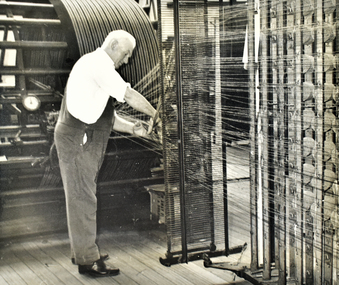 National Wool Museum
Photograph - Returned Sailors and Soldiers Mill, Norm Holroyd, 1960's - 1970's
... dyed, spun into yarn and woven. It specialised in heavy worsted cloths, high-quality tweed, and its signature "Retsol" and "Monarch" pure-wool travelling rugs, later adapting its machinery to blend natural wool with artificial fibres as mid-century market demands shifted. R. S. & S Mill Returned Sailors and Soldiers Mill Newtown Geelong World War I Soldiers Veterans Co-operative Textile Industry Woollen Mills Wool Worsted Cloth Tweed Retsol Monarch Travel Rugs Machinery Factory Working Life Norm Holroyd Photo Album Photography Design Fabric back: [handwritten] 21 Black and white photograph attached to cardboard backing with sticky tape. ...One of thirty eight photographs from a photo album featuring images of the Returned Sailors and Soldiers Woollen Mill in Newtown, Geelong. The images were taken between the 1960's-1970's by Norm Holroyd who worked at the mills. They were developed in his own private dark room and kept at his home for private viewing. The Returned Sailors and Soldiers Woollen Mill operated as a self-sufficient co-operative, funded and run by World War I veterans using their War Gratuity Bonds. The facility functioned as a complete raw-to-finished assembly line where raw fleece was brought on-site to be scoured, carded, dyed, spun into yarn and woven. It specialised in heavy worsted cloths, high-quality tweed, and its signature "Retsol" and "Monarch" pure-wool travelling rugs, later adapting its machinery to blend natural wool with artificial fibres as mid-century market demands shifted.Black and white photograph attached to cardboard backing with sticky tape. Image shows a man operating wool processing machinery. Backing card has four holes in left side.back: [handwritten] 21r. s. & s mill, returned sailors and soldiers mill, newtown, geelong, world war i, soldiers, veterans, co-operative, textile industry, woollen mills, wool, worsted cloth, tweed, retsol, monarch, travel rugs, machinery, factory, working life, norm holroyd, photo album, photography, design, fabric -
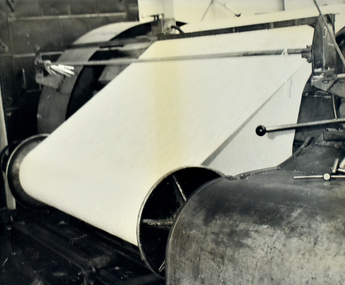 National Wool Museum
Photograph - Returned Sailors and Soldiers Mill, Norm Holroyd, 1960's - 1970's
... dyed, spun into yarn and woven. It specialised in heavy worsted cloths, high-quality tweed, and its signature "Retsol" and "Monarch" pure-wool travelling rugs, later adapting its machinery to blend natural wool with artificial fibres as mid-century market demands shifted. R. S. & S Mill Returned Sailors and Soldiers Mill Newtown Geelong World War I Soldiers Veterans Co-operative Textile Industry Woollen Mills Wool Worsted Cloth Tweed Retsol Monarch Travel Rugs Machinery Factory Working Life Norm Holroyd Photo Album Photography Design Fabric back: [handwritten] 22 Black and white photograph attached to cardboard backing with sticky tape. ...One of thirty eight photographs from a photo album featuring images of the Returned Sailors and Soldiers Woollen Mill in Newtown, Geelong. The images were taken between the 1960's-1970's by Norm Holroyd who worked at the mills. They were developed in his own private dark room and kept at his home for private viewing. The Returned Sailors and Soldiers Woollen Mill operated as a self-sufficient co-operative, funded and run by World War I veterans using their War Gratuity Bonds. The facility functioned as a complete raw-to-finished assembly line where raw fleece was brought on-site to be scoured, carded, dyed, spun into yarn and woven. It specialised in heavy worsted cloths, high-quality tweed, and its signature "Retsol" and "Monarch" pure-wool travelling rugs, later adapting its machinery to blend natural wool with artificial fibres as mid-century market demands shifted.Black and white photograph attached to cardboard backing with sticky tape. Image shows wool processing machinery. Backing card has four holes in left side.back: [handwritten] 22r. s. & s mill, returned sailors and soldiers mill, newtown, geelong, world war i, soldiers, veterans, co-operative, textile industry, woollen mills, wool, worsted cloth, tweed, retsol, monarch, travel rugs, machinery, factory, working life, norm holroyd, photo album, photography, design, fabric -
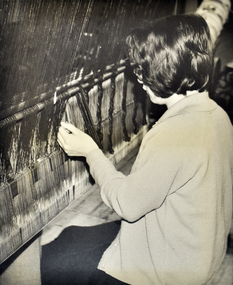 National Wool Museum
Photograph - Loom, Returned Sailors and Soldiers Mill, Norm Holroyd, 1960's - 1970's
... dyed, spun into yarn and woven. It specialised in heavy worsted cloths, high-quality tweed, and its signature "Retsol" and "Monarch" pure-wool travelling rugs, later adapting its machinery to blend natural wool with artificial fibres as mid-century market demands shifted. R. S. & S Mill Returned Sailors and Soldiers Mill Newtown Geelong World War I Soldiers Veterans Co-operative Textile Industry Woollen Mills Wool Worsted Cloth Tweed Retsol Monarch Travel Rugs Machinery Factory Working Life Norm Holroyd Photo Album Photography Design Fabric back: [handwritten] 25 Black and white photograph attached to cardboard backing with sticky tape. ...One of thirty eight photographs from a photo album featuring images of the Returned Sailors and Soldiers Woollen Mill in Newtown, Geelong. The images were taken between the 1960's-1970's by Norm Holroyd who worked at the mills. They were developed in his own private dark room and kept at his home for private viewing. The Returned Sailors and Soldiers Woollen Mill operated as a self-sufficient co-operative, funded and run by World War I veterans using their War Gratuity Bonds. The facility functioned as a complete raw-to-finished assembly line where raw fleece was brought on-site to be scoured, carded, dyed, spun into yarn and woven. It specialised in heavy worsted cloths, high-quality tweed, and its signature "Retsol" and "Monarch" pure-wool travelling rugs, later adapting its machinery to blend natural wool with artificial fibres as mid-century market demands shifted.Black and white photograph attached to cardboard backing with sticky tape. Image shows a woman working at a loom. Backing card has four holes in left side.back: [handwritten] 25r. s. & s mill, returned sailors and soldiers mill, newtown, geelong, world war i, soldiers, veterans, co-operative, textile industry, woollen mills, wool, worsted cloth, tweed, retsol, monarch, travel rugs, machinery, factory, working life, norm holroyd, photo album, photography, design, fabric -
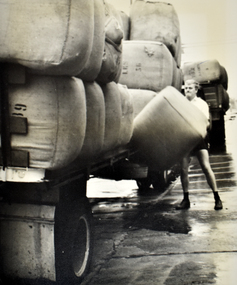 National Wool Museum
Photograph - Returned Sailors and Soldiers Mill, Norm Holroyd, 1960's - 1970's
... dyed, spun into yarn and woven. It specialised in heavy worsted cloths, high-quality tweed, and its signature "Retsol" and "Monarch" pure-wool travelling rugs, later adapting its machinery to blend natural wool with artificial fibres as mid-century market demands shifted. R. S. & S Mill Returned Sailors and Soldiers Mill Newtown Geelong World War I Soldiers Veterans Co-operative Textile Industry Woollen Mills Wool Worsted Cloth Tweed Retsol Monarch Travel Rugs Machinery Factory Working Life Norm Holroyd Photo Album Photography Design Fabric back: [handwritten] 1 Black and white photograph attached to cardboard backing with sticky tape. ...One of thirty eight photographs from a photo album featuring images of the Returned Sailors and Soldiers Woollen Mill in Newtown, Geelong. The images were taken between the 1960's-1970's by Norm Holroyd who worked at the mills. They were developed in his own private dark room and kept at his home for private viewing. The Returned Sailors and Soldiers Woollen Mill operated as a self-sufficient co-operative, funded and run by World War I veterans using their War Gratuity Bonds. The facility functioned as a complete raw-to-finished assembly line where raw fleece was brought on-site to be scoured, carded, dyed, spun into yarn and woven. It specialised in heavy worsted cloths, high-quality tweed, and its signature "Retsol" and "Monarch" pure-wool travelling rugs, later adapting its machinery to blend natural wool with artificial fibres as mid-century market demands shifted.Black and white photograph attached to cardboard backing with sticky tape. Image shows a man loading a wool bale onto a trailer for transport. Backing card has four holes in left side.back: [handwritten] 1r. s. & s mill, returned sailors and soldiers mill, newtown, geelong, world war i, soldiers, veterans, co-operative, textile industry, woollen mills, wool, worsted cloth, tweed, retsol, monarch, travel rugs, machinery, factory, working life, norm holroyd, photo album, photography, design, fabric -
 National Wool Museum
Photograph - Returned Sailors and Soldiers Mill, Norm Holroyd, 1960's - 1970's
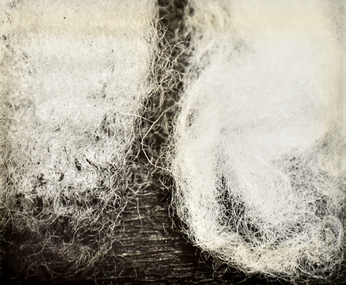
... dyed, spun into yarn and woven. It specialised in heavy worsted cloths, high-quality tweed, and its signature "Retsol" and "Monarch" pure-wool travelling rugs, later adapting its machinery to blend natural wool with artificial fibres as mid-century market demands shifted. R. S. & S Mill Returned Sailors and Soldiers Mill Newtown Geelong World War I Soldiers Veterans Co-operative Textile Industry Woollen Mills Wool Worsted Cloth Tweed Retsol Monarch Travel Rugs Machinery Factory Working Life Norm Holroyd Photo Album Photography Design Fabric Black and white photograph showing wool fibres in detail. ...One of thirty eight photographs from a photo album featuring images of the Returned Sailors and Soldiers Woollen Mill in Newtown, Geelong. The images were taken between the 1960's-1970's by Norm Holroyd who worked at the mills. They were developed in his own private dark room and kept at his home for private viewing. The Returned Sailors and Soldiers Woollen Mill operated as a self-sufficient co-operative, funded and run by World War I veterans using their War Gratuity Bonds. The facility functioned as a complete raw-to-finished assembly line where raw fleece was brought on-site to be scoured, carded, dyed, spun into yarn and woven. It specialised in heavy worsted cloths, high-quality tweed, and its signature "Retsol" and "Monarch" pure-wool travelling rugs, later adapting its machinery to blend natural wool with artificial fibres as mid-century market demands shifted.Black and white photograph showing wool fibres in detail.r. s. & s mill, returned sailors and soldiers mill, newtown, geelong, world war i, soldiers, veterans, co-operative, textile industry, woollen mills, wool, worsted cloth, tweed, retsol, monarch, travel rugs, machinery, factory, working life, norm holroyd, photo album, photography, design, fabric -
 National Wool Museum
Photograph - Returned Sailors and Soldiers Mill, Norm Holroyd, 1960's - 1970's
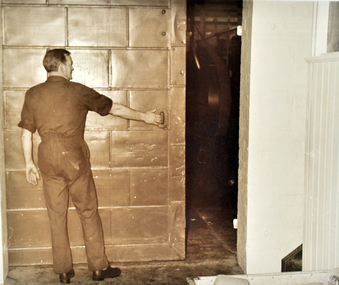
... dyed, spun into yarn and woven. It specialised in heavy worsted cloths, high-quality tweed, and its signature "Retsol" and "Monarch" pure-wool travelling rugs, later adapting its machinery to blend natural wool with artificial fibres as mid-century market demands shifted. R. S. & S Mill Returned Sailors and Soldiers Mill Newtown Geelong World War I Soldiers Veterans Co-operative Textile Industry Woollen Mills Wool Worsted Cloth Tweed Retsol Monarch Travel Rugs Machinery Factory Working Life Norm Holroyd Photo Album Photography Design Fabric Black and white photograph attached to cardboard backing with sticky tape. ...One of thirty eight photographs from a photo album featuring images of the Returned Sailors and Soldiers Woollen Mill in Newtown, Geelong. The images were taken between the 1960's-1970's by Norm Holroyd who worked at the mills. They were developed in his own private dark room and kept at his home for private viewing. The Returned Sailors and Soldiers Woollen Mill operated as a self-sufficient co-operative, funded and run by World War I veterans using their War Gratuity Bonds. The facility functioned as a complete raw-to-finished assembly line where raw fleece was brought on-site to be scoured, carded, dyed, spun into yarn and woven. It specialised in heavy worsted cloths, high-quality tweed, and its signature "Retsol" and "Monarch" pure-wool travelling rugs, later adapting its machinery to blend natural wool with artificial fibres as mid-century market demands shifted.Black and white photograph attached to cardboard backing with sticky tape. Image shows a man opening a sliding door inside a factory. Backing card has four holes in left side.r. s. & s mill, returned sailors and soldiers mill, newtown, geelong, world war i, soldiers, veterans, co-operative, textile industry, woollen mills, wool, worsted cloth, tweed, retsol, monarch, travel rugs, machinery, factory, working life, norm holroyd, photo album, photography, design, fabric -
 National Wool Museum
Photograph - Wool Processing, Returned Sailors and Soldiers Mill, Norm Holroyd, 1960's - 1970's
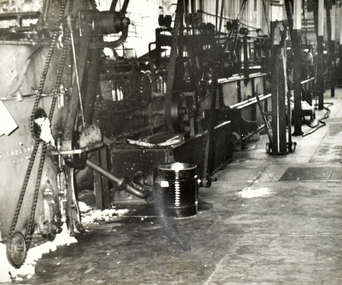
... dyed, spun into yarn and woven. It specialised in heavy worsted cloths, high-quality tweed, and its signature "Retsol" and "Monarch" pure-wool travelling rugs, later adapting its machinery to blend natural wool with artificial fibres as mid-century market demands shifted. R. S. & S Mill Returned Sailors and Soldiers Mill Newtown Geelong World War I Soldiers Veterans Co-operative Textile Industry Woollen Mills Wool Worsted Cloth Tweed Retsol Monarch Travel Rugs Machinery Factory Working Life Norm Holroyd Photo Album Photography Design Fabric back: [handwritten] 4 Black and white photograph attached to cardboard backing with sticky tape. ...One of thirty eight photographs from a photo album featuring images of the Returned Sailors and Soldiers Woollen Mill in Newtown, Geelong. The images were taken between the 1960's-1970's by Norm Holroyd who worked at the mills. They were developed in his own private dark room and kept at his home for private viewing. The Returned Sailors and Soldiers Woollen Mill operated as a self-sufficient co-operative, funded and run by World War I veterans using their War Gratuity Bonds. The facility functioned as a complete raw-to-finished assembly line where raw fleece was brought on-site to be scoured, carded, dyed, spun into yarn and woven. It specialised in heavy worsted cloths, high-quality tweed, and its signature "Retsol" and "Monarch" pure-wool travelling rugs, later adapting its machinery to blend natural wool with artificial fibres as mid-century market demands shifted.Black and white photograph attached to cardboard backing with sticky tape. Image shows wool processing machinery. Backing card has four holes in left side.back: [handwritten] 4r. s. & s mill, returned sailors and soldiers mill, newtown, geelong, world war i, soldiers, veterans, co-operative, textile industry, woollen mills, wool, worsted cloth, tweed, retsol, monarch, travel rugs, machinery, factory, working life, norm holroyd, photo album, photography, design, fabric -
 National Wool Museum
Photograph - Returned Sailors and Soldiers Mill, Norm Holroyd, 1960's - 1970's
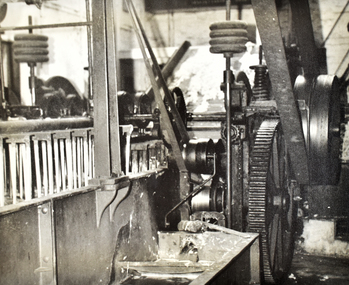
... dyed, spun into yarn and woven. It specialised in heavy worsted cloths, high-quality tweed, and its signature "Retsol" and "Monarch" pure-wool travelling rugs, later adapting its machinery to blend natural wool with artificial fibres as mid-century market demands shifted. R. S. & S Mill Returned Sailors and Soldiers Mill Newtown Geelong World War I Soldiers Veterans Co-operative Textile Industry Woollen Mills Wool Worsted Cloth Tweed Retsol Monarch Travel Rugs Machinery Factory Working Life Norm Holroyd Photo Album Photography Design Fabric Black and white photograph showing machinery processing wool. ...One of thirty eight photographs from a photo album featuring images of the Returned Sailors and Soldiers Woollen Mill in Newtown, Geelong. The images were taken between the 1960's-1970's by Norm Holroyd who worked at the mills. They were developed in his own private dark room and kept at his home for private viewing. The Returned Sailors and Soldiers Woollen Mill operated as a self-sufficient co-operative, funded and run by World War I veterans using their War Gratuity Bonds. The facility functioned as a complete raw-to-finished assembly line where raw fleece was brought on-site to be scoured, carded, dyed, spun into yarn and woven. It specialised in heavy worsted cloths, high-quality tweed, and its signature "Retsol" and "Monarch" pure-wool travelling rugs, later adapting its machinery to blend natural wool with artificial fibres as mid-century market demands shifted.Black and white photograph showing machinery processing wool.r. s. & s mill, returned sailors and soldiers mill, newtown, geelong, world war i, soldiers, veterans, co-operative, textile industry, woollen mills, wool, worsted cloth, tweed, retsol, monarch, travel rugs, machinery, factory, working life, norm holroyd, photo album, photography, design, fabric -
 National Wool Museum
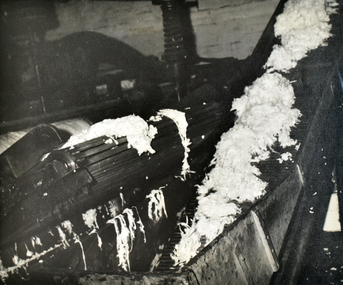
Photograph - Wool Processing, Returned Sailors and Soldiers Mill, Norm Holroyd, 1960's - 1970's
... dyed, spun into yarn and woven. It specialised in heavy worsted cloths, high-quality tweed, and its signature "Retsol" and "Monarch" pure-wool travelling rugs, later adapting its machinery to blend natural wool with artificial fibres as mid-century market demands shifted. R. S. & S Mill Returned Sailors and Soldiers Mill Newtown Geelong World War I Soldiers Veterans Co-operative Textile Industry Woollen Mills Wool Worsted Cloth Tweed Retsol Monarch Travel Rugs Machinery Factory Working Life Norm Holroyd Photo Album Photography Design Fabric back: [handwritten] 6 Black and white photograph attached to cardboard backing with sticky tape. ...One of thirty eight photographs from a photo album featuring images of the Returned Sailors and Soldiers Woollen Mill in Newtown, Geelong. The images were taken between the 1960's-1970's by Norm Holroyd who worked at the mills. They were developed in his own private dark room and kept at his home for private viewing. The Returned Sailors and Soldiers Woollen Mill operated as a self-sufficient co-operative, funded and run by World War I veterans using their War Gratuity Bonds. The facility functioned as a complete raw-to-finished assembly line where raw fleece was brought on-site to be scoured, carded, dyed, spun into yarn and woven. It specialised in heavy worsted cloths, high-quality tweed, and its signature "Retsol" and "Monarch" pure-wool travelling rugs, later adapting its machinery to blend natural wool with artificial fibres as mid-century market demands shifted.Black and white photograph attached to cardboard backing with sticky tape. Image shows a close up of wool processing machinery. Backing card has four holes in left side.back: [handwritten] 6r. s. & s mill, returned sailors and soldiers mill, newtown, geelong, world war i, soldiers, veterans, co-operative, textile industry, woollen mills, wool, worsted cloth, tweed, retsol, monarch, travel rugs, machinery, factory, working life, norm holroyd, photo album, photography, design, fabric -
 National Wool Museum
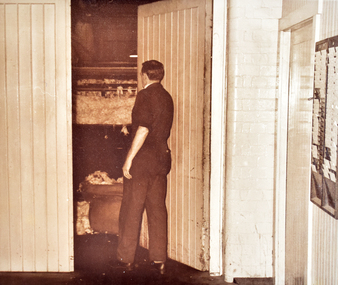
Photograph - Returned Sailors and Soldiers Mill, Norm Holroyd, 1960's - 1970's
... dyed, spun into yarn and woven. It specialised in heavy worsted cloths, high-quality tweed, and its signature "Retsol" and "Monarch" pure-wool travelling rugs, later adapting its machinery to blend natural wool with artificial fibres as mid-century market demands shifted. R. S. & S Mill Returned Sailors and Soldiers Mill Newtown Geelong World War I Soldiers Veterans Co-operative Textile Industry Woollen Mills Wool Worsted Cloth Tweed Retsol Monarch Travel Rugs Machinery Factory Working Life Norm Holroyd Photo Album Photography Design Fabric back: [handwritten] 7 Black and white photograph attached to cardboard backing with sticky tape. ...One of thirty eight photographs from a photo album featuring images of the Returned Sailors and Soldiers Woollen Mill in Newtown, Geelong. The images were taken between the 1960's-1970's by Norm Holroyd who worked at the mills. They were developed in his own private dark room and kept at his home for private viewing. The Returned Sailors and Soldiers Woollen Mill operated as a self-sufficient co-operative, funded and run by World War I veterans using their War Gratuity Bonds. The facility functioned as a complete raw-to-finished assembly line where raw fleece was brought on-site to be scoured, carded, dyed, spun into yarn and woven. It specialised in heavy worsted cloths, high-quality tweed, and its signature "Retsol" and "Monarch" pure-wool travelling rugs, later adapting its machinery to blend natural wool with artificial fibres as mid-century market demands shifted.Black and white photograph attached to cardboard backing with sticky tape. Image shows a man walking through a doorway inside a factory with time card racks to the right, and wool processing machinery in the background. Backing card has four holes in left side.back: [handwritten] 7r. s. & s mill, returned sailors and soldiers mill, newtown, geelong, world war i, soldiers, veterans, co-operative, textile industry, woollen mills, wool, worsted cloth, tweed, retsol, monarch, travel rugs, machinery, factory, working life, norm holroyd, photo album, photography, design, fabric -
 National Wool Museum
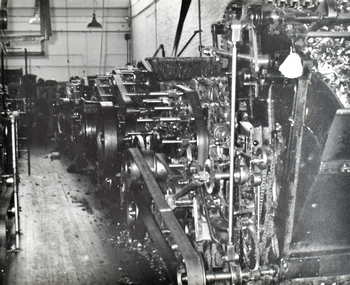
Photograph - Machinery, Returned Sailors and Soldiers Mill, Norm Holroyd, 1960's - 1970's
... dyed, spun into yarn and woven. It specialised in heavy worsted cloths, high-quality tweed, and its signature "Retsol" and "Monarch" pure-wool travelling rugs, later adapting its machinery to blend natural wool with artificial fibres as mid-century market demands shifted. R. S. & S Mill Returned Sailors and Soldiers Mill Newtown Geelong World War I Soldiers Veterans Co-operative Textile Industry Woollen Mills Wool Worsted Cloth Tweed Retsol Monarch Travel Rugs Machinery Factory Working Life Norm Holroyd Photo Album Photography Design Fabric back: [handwritten] 8 Black and white photograph attached to cardboard backing with sticky tape. ...One of thirty eight photographs from a photo album featuring images of the Returned Sailors and Soldiers Woollen Mill in Newtown, Geelong. The images were taken between the 1960's-1970's by Norm Holroyd who worked at the mills. They were developed in his own private dark room and kept at his home for private viewing. The Returned Sailors and Soldiers Woollen Mill operated as a self-sufficient co-operative, funded and run by World War I veterans using their War Gratuity Bonds. The facility functioned as a complete raw-to-finished assembly line where raw fleece was brought on-site to be scoured, carded, dyed, spun into yarn and woven. It specialised in heavy worsted cloths, high-quality tweed, and its signature "Retsol" and "Monarch" pure-wool travelling rugs, later adapting its machinery to blend natural wool with artificial fibres as mid-century market demands shifted.Black and white photograph attached to cardboard backing with sticky tape. Image shows wool processing machinery inside a factory. Backing card has four holes in left side.back: [handwritten] 8r. s. & s mill, returned sailors and soldiers mill, newtown, geelong, world war i, soldiers, veterans, co-operative, textile industry, woollen mills, wool, worsted cloth, tweed, retsol, monarch, travel rugs, machinery, factory, working life, norm holroyd, photo album, photography, design, fabric -
 National Wool Museum
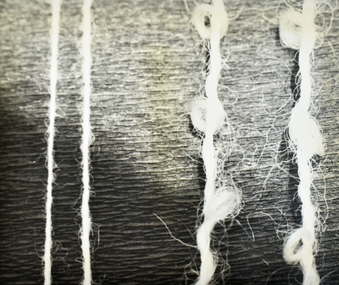
Photograph - Returned Sailors and Soldiers Mill, Norm Holroyd, 1960's - 1970's
... dyed, spun into yarn and woven. It specialised in heavy worsted cloths, high-quality tweed, and its signature "Retsol" and "Monarch" pure-wool travelling rugs, later adapting its machinery to blend natural wool with artificial fibres as mid-century market demands shifted. R. S. & S Mill Returned Sailors and Soldiers Mill Newtown Geelong World War I Soldiers Veterans Co-operative Textile Industry Woollen Mills Wool Worsted Cloth Tweed Retsol Monarch Travel Rugs Machinery Factory Working Life Norm Holroyd Photo Album Photography Design Fabric back: [handwritten] 17 Black and white photograph attached to cardboard backing with sticky tape. ...One of thirty eight photographs from a photo album featuring images of the Returned Sailors and Soldiers Woollen Mill in Newtown, Geelong. The images were taken between the 1960's-1970's by Norm Holroyd who worked at the mills. They were developed in his own private dark room and kept at his home for private viewing. The Returned Sailors and Soldiers Woollen Mill operated as a self-sufficient co-operative, funded and run by World War I veterans using their War Gratuity Bonds. The facility functioned as a complete raw-to-finished assembly line where raw fleece was brought on-site to be scoured, carded, dyed, spun into yarn and woven. It specialised in heavy worsted cloths, high-quality tweed, and its signature "Retsol" and "Monarch" pure-wool travelling rugs, later adapting its machinery to blend natural wool with artificial fibres as mid-century market demands shifted.Black and white photograph attached to cardboard backing with sticky tape. Image shows detail of woollen thread. Backing card has four holes in left side.back: [handwritten] 17r. s. & s mill, returned sailors and soldiers mill, newtown, geelong, world war i, soldiers, veterans, co-operative, textile industry, woollen mills, wool, worsted cloth, tweed, retsol, monarch, travel rugs, machinery, factory, working life, norm holroyd, photo album, photography, design, fabric -
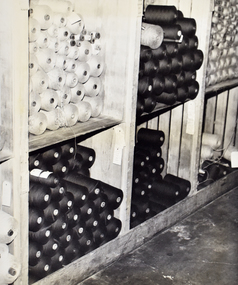 National Wool Museum
Photograph - Returned Sailors and Soldiers Mill, Norm Holroyd, 1960's - 1970's
... dyed, spun into yarn and woven. It specialised in heavy worsted cloths, high-quality tweed, and its signature "Retsol" and "Monarch" pure-wool travelling rugs, later adapting its machinery to blend natural wool with artificial fibres as mid-century market demands shifted. R. S. & S Mill Returned Sailors and Soldiers Mill Newtown Geelong World War I Soldiers Veterans Co-operative Textile Industry Woollen Mills Wool Worsted Cloth Tweed Retsol Monarch Travel Rugs Machinery Factory Working Life Norm Holroyd Photo Album Photography Design Fabric back: [handwritten] 16 Black and white photograph attached to cardboard backing with sticky tape. ...One of thirty eight photographs from a photo album featuring images of the Returned Sailors and Soldiers Woollen Mill in Newtown, Geelong. The images were taken between the 1960's-1970's by Norm Holroyd who worked at the mills. They were developed in his own private dark room and kept at his home for private viewing. The Returned Sailors and Soldiers Woollen Mill operated as a self-sufficient co-operative, funded and run by World War I veterans using their War Gratuity Bonds. The facility functioned as a complete raw-to-finished assembly line where raw fleece was brought on-site to be scoured, carded, dyed, spun into yarn and woven. It specialised in heavy worsted cloths, high-quality tweed, and its signature "Retsol" and "Monarch" pure-wool travelling rugs, later adapting its machinery to blend natural wool with artificial fibres as mid-century market demands shifted.Black and white photograph attached to cardboard backing with sticky tape. Image shows wool on spools in storage compartments. Backing card has four holes in left side.back: [handwritten] 16r. s. & s mill, returned sailors and soldiers mill, newtown, geelong, world war i, soldiers, veterans, co-operative, textile industry, woollen mills, wool, worsted cloth, tweed, retsol, monarch, travel rugs, machinery, factory, working life, norm holroyd, photo album, photography, design, fabric -
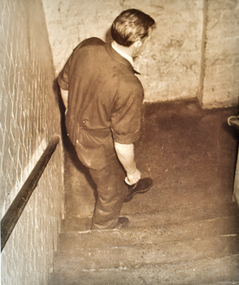 National Wool Museum
Photograph - Returned Sailors and Soldiers Mill, Norm Holroyd, 1960's - 1970's
... dyed, spun into yarn and woven. It specialised in heavy worsted cloths, high-quality tweed, and its signature "Retsol" and "Monarch" pure-wool travelling rugs, later adapting its machinery to blend natural wool with artificial fibres as mid-century market demands shifted. R. S. & S Mill Returned Sailors and Soldiers Mill Newtown Geelong World War I Soldiers Veterans Co-operative Textile Industry Woollen Mills Wool Worsted Cloth Tweed Retsol Monarch Travel Rugs Machinery Factory Working Life Norm Holroyd Photo Album Photography Design Fabric back: [handwritten] 15 Black and white photograph attached to cardboard backing with sticky tape. ...One of thirty eight photographs from a photo album featuring images of the Returned Sailors and Soldiers Woollen Mill in Newtown, Geelong. The images were taken between the 1960's-1970's by Norm Holroyd who worked at the mills. They were developed in his own private dark room and kept at his home for private viewing. The Returned Sailors and Soldiers Woollen Mill operated as a self-sufficient co-operative, funded and run by World War I veterans using their War Gratuity Bonds. The facility functioned as a complete raw-to-finished assembly line where raw fleece was brought on-site to be scoured, carded, dyed, spun into yarn and woven. It specialised in heavy worsted cloths, high-quality tweed, and its signature "Retsol" and "Monarch" pure-wool travelling rugs, later adapting its machinery to blend natural wool with artificial fibres as mid-century market demands shifted.Black and white photograph attached to cardboard backing with sticky tape. Image shows a man walking down a stairwell. Backing card has four holes in left side.back: [handwritten] 15r. s. & s mill, returned sailors and soldiers mill, newtown, geelong, world war i, soldiers, veterans, co-operative, textile industry, woollen mills, wool, worsted cloth, tweed, retsol, monarch, travel rugs, machinery, factory, working life, norm holroyd, photo album, photography, design, fabric
