



Historical information
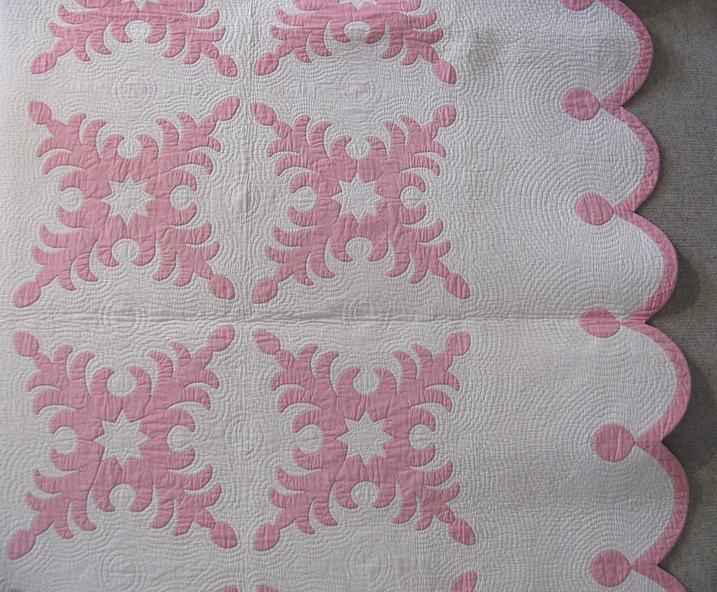
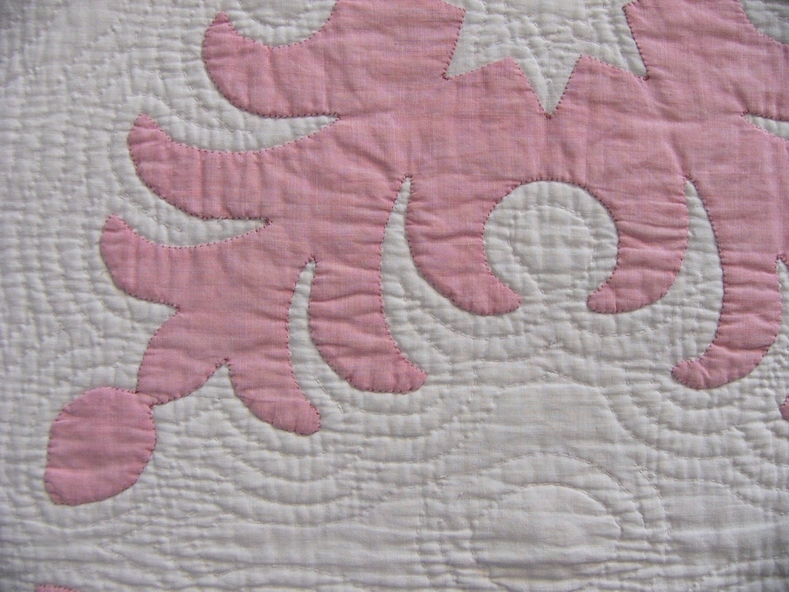
An Hawaiian quilt is a distinctive quilting style of the Hawaiian Islands that uses large radially symmetric applique patterns. Motifs often work stylized botanical designs in bold colours on a white background. Hawaiian quilt appliqué is made from a single cut on folded fabric. Quilting stitches normally follow the contours of the appliqué design.
Hawaiian quilting derives from the kapa moe, an indigenous bed cover textile. Kapa was constructed from the inner bark of local trees. Traditional kapa was beaten and felted, then dyed in geometric patterns.
Quilting may have begun in the Hawaiian islands with the arrival of missionaries and Western fabrics in the 1820s. The climate of Hawaii is unsuitable for cotton cultivation and kapa is unsuitable for quilting so all Hawaiian quilts are constructed from imported material. The earliest written reference comes from Isabella Bird who visited Hawaii in 1870 and wrote a travelogue Six Months in the Sandwich Islands.
Significance
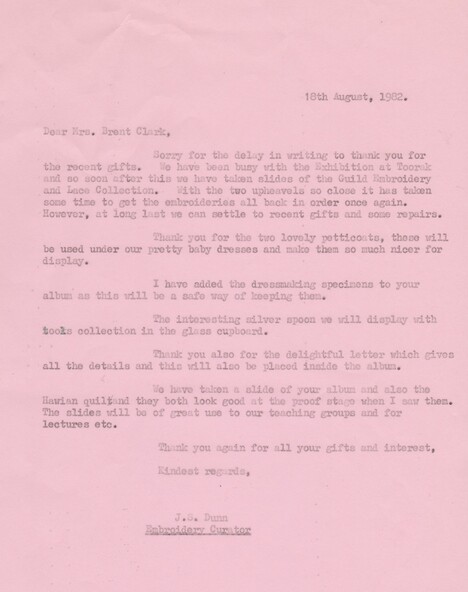
Worked by Mrs Brent Clark and daughter. An American design of the 19th century, worked and adapted from a photograph by the donor.
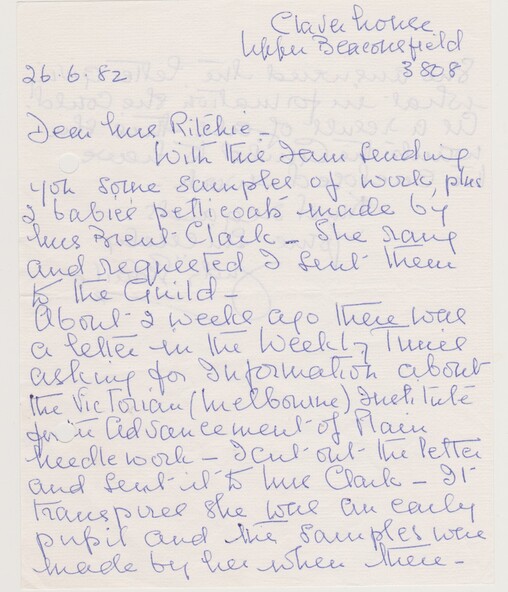
Mrs Brent Clark was an early pupil of the Victorian Institute for the Advancement of Plain Needlework (Melbourne) and Foundation member of the EGV.
Physical description
Background of fine white cotton, quilted in running stitch. Appliqued design known as 'Friendship Plume" is in pink cotton, with a 3 cms scalloped border, also in pink.
