
Showing 20 items matching " eucalyptus oil industry"
-
 Bendigo Historical Society Inc.
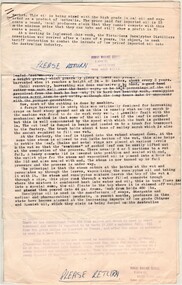
Document - AULSEBROOK COLLECTION: ARTICLE ON THE HISTORY OF EUCALYPTUS OIL INDUSTRY IN BENDIGO
... AULSEBROOK COLLECTION: ARTICLE ON THE HISTORY OF EUCALYPTUS OIL INDUSTRY IN BENDIGO...Eucalyptus oil...Bendigo industry...Aulsebrook Collection: Article on the history of Eucalyptus oil industry in Bendigo -4 pages stapled together, 1st page a small note, 2nd page typed article on the oil industry, 2 last pages, larger pages typed comprehensive information on the oil industry and specific types of oils...Eucalyptus oil Bendigo industry Aulsebrook Collection: Article on the history of Eucalyptus oil industry in Bendigo -4 pages stapled together, 1st page a small note, 2nd page typed article on the oil industry, 2 last pages, larger pages typed comprehensive information on the oil industry and specific types of oils Document AULSEBROOK COLLECTION: ARTICLE ON THE HISTORY OF EUCALYPTUS OIL INDUSTRY IN BENDIGO ...Aulsebrook Collection: Article on the history of Eucalyptus oil industry in Bendigo -4 pages stapled together, 1st page a small note, 2nd page typed article on the oil industry, 2 last pages, larger pages typed comprehensive information on the oil industry and specific types of oilseucalyptus oil, bendigo industry -
 Bendigo Historical Society Inc.
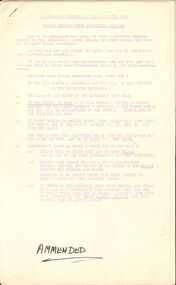
Document - PETER ELLIS COLLECTION: A GUIDE FOR DRIVERS ON THE WHIPSTICK TOUR
... ... Eucalyptus Oil Industry...The Bendigo Whipstick mentions area, suggestions of where the name Whipstick came from, shrubs and flowers with their flowering times, descriptions of some of them and some information on the Mallee Fowl. The Eucalyptus Oil Industry paragraph mentions the beginnings of the industry. ...The Bendigo Whipstick mentions area, suggestions of where the name Whipstick came from, shrubs and flowers with their flowering times, descriptions of some of them and some information on the Mallee Fowl. The Eucalyptus Oil Industry paragraph mentions the beginnings of the industry. ...A Guide for Drivers on the Whipstick Tour. First page gives assembly area, driving in convoy and negotiating water or boggy patches across the road. Amended written at the end of the page. Directions with mileage and items of interest for the tour on Sunday September 9th (no year). A Whipstick Map 1971 showing State Forest, Crown Lands, Uncleared Mallee - Private (shown in different colours) Water Reserve and Roads. Noted are Flora and Fauna - Plants, Birds & Mammals, and areas of State Forest and Southern State Forest with Mallee Scrub area noted. Also State Forest & Crown Lands Total Area and a map scale. The Bendigo Whipstick mentions area, suggestions of where the name Whipstick came from, shrubs and flowers with their flowering times, descriptions of some of them and some information on the Mallee Fowl. The Eucalyptus Oil Industry paragraph mentions the beginnings of the industry. Mentioned are the different uses of oils (perfumery, industrial and medicinal) and the different species of eucalypt used for each and various products. Also notes on the growing, harvesting and refining of eucalyptus. P Ellis at the end of the page. The next two and a half pages mentions reserves, and at the end acknowledgements. Includes a spare copy of 'The Bendigo Whipstick' by P Ellis.bendigo, history, early bendigo, peter ellis collection, a guide for drivers on the whipstick tour, the whipstick 1971 map, shire of marong, shire of east loddon, shire of huntly, borough of eaglehawk, city of bendigo, shire of strathfieldsaye, the bendigo whipstick, eucalyptus oil industry, eaglehawk town hall, lightning hill lookout, eaglehawk rifle range, new moon mines, blue jacket reservoir, maggetti's wine hall, camp hotel (ex), skylark dam, eucalyptus oil production, eucalyptus factory, whipstick eucalyptus farm, ruedin's eucalyptus factory, dutch bowls, governor philip, sir joseph banks, john white, baron von mueller, joseph bosisto, commonwealth government, perfumery oils, industrial oils, medicinal oils, p ellis, dr frith, csiro wildlife division, harley webster, forests commission, vincent serventy, victorian national parks association, bendigo field naturalists club -
 Bendigo Historical Society Inc.
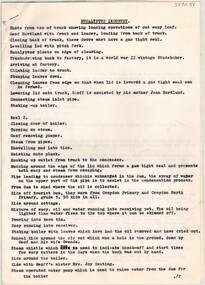
Document - AULSEBROOK COLLECTION: EUCALYPTUS INDUSTRY SCRIPT FOR A REEL AND ARTICLE ON THE EUCALYPTUS INDUSTRY
... Eucalyptus oil...Bendigo industry...Hartland's Farm Eucalyptus oil Bendigo industry Aulsebrook collection: Eucalyptus Industry Script for and article on the Eucalyptus Industry and Hartland Farm history -5 pages, typed, -Script for 4 reels, and article on pages 4 and 5 Document AULSEBROOK COLLECTION: EUCALYPTUS INDUSTRY SCRIPT FOR A REEL AND ARTICLE ON THE EUCALYPTUS INDUSTRY ...Aulsebrook collection: Eucalyptus Industry Script for and article on the Eucalyptus Industry and Hartland Farm history -5 pages, typed, -Script for 4 reels, and article on pages 4 and 5hartland's farm, eucalyptus oil, bendigo industry -
 Bendigo Historical Society Inc.
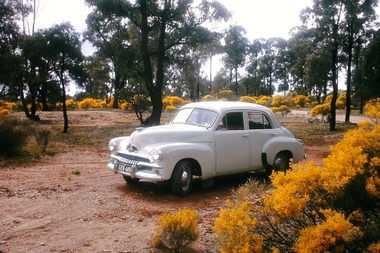
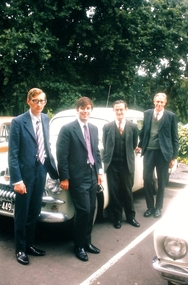
Slide - Peter Ellis Collection, Portrait, Cars and the Whipstick, c1970-1972
... When the numerous gold mines declined in production, the eucalyptus oil industry became an important source of work. ...When the numerous gold mines declined in production, the eucalyptus oil industry became an important source of work. ...When the numerous gold mines declined in production, the eucalyptus oil industry became an important source of work. The first eucalyptus oil producer in Bendigo was a chemist called Richard Sandner who operated a plant and refinery in Bridge Street from 1876. By 1900, many other distillers operated on the northern edge of Bendigo and in the Whipstick. In 1926, the Forest Commision established a eucalyptus distillery at Gunyah in Wellsford State Forest. See the Wellsford Forest Note for more information. Today, there are just two eucalypt distilleries operating in Bendigo. Most of the world’s eucalyptus oil is now produced overseas. Peter Ellis Collection: eight slides of his Holden FJ and a friend's car in the Whipstick Forest. Peter Ellis was a chemistry lecturer at the Bendigo Institute of Technolgyhistory, bendigo, peter ellis collection, bendigo institute of technology, b.i.t., whipstick bendigo, bendigo state forests, eucalyptus oil -
 Bendigo Historical Society Inc.
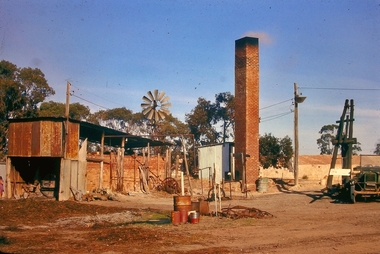
Slide - Peter Ellis Collection, the Whipstick and Eucalyptus Oil Production, c1970-1972
... When the numerous gold mines declined in production, the eucalyptus oil industry became an important source of work. ...When the numerous gold mines declined in production, the eucalyptus oil industry became an important source of work. ...When the numerous gold mines declined in production, the eucalyptus oil industry became an important source of work. The first eucalyptus oil producer in Bendigo was a chemist called Richard Sandner who operated a plant and refinery in Bridge Street from 1876. By 1900, many other distillers operated on the northern edge of Bendigo and in the Whipstick. In 1926, the Forest Commision established a eucalyptus distillery at Gunyah in Wellsford State Forest. See the Wellsford Forest Note for more information. Today, there are just two eucalypt distilleries operating in Bendigo. Most of the world’s eucalyptus oil is now produced overseas. Peter Ellis Collection: eight slides of Whirrakee Wattle regeneration near Bagshot, Eucalyptus History museum, Ruedin's Steam Traction engine, Eucalyptus oil condensor and a Mallee roller to rip out the eucalytpus trees. Peter was a chemistry lecturer at the Bendigo Institute of technology.history, bendigo, peter ellis collection, bendigo institute of technology, b.i.t., whipstick bendigo, bendigo state forests, eucalyptus oil, malle roller, whirrakee wattle, bagshot, steam traction engine, eucalyptus oil condensor -
 Bendigo Historical Society Inc.
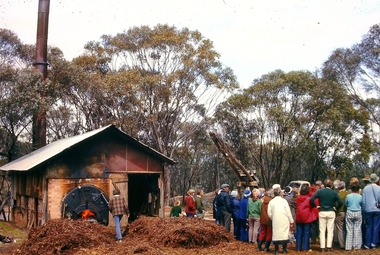
Slide - Peter Ellis Collection, the Whipstick and Eucalyptus Oil Production, Feb 1973
... When the numerous gold mines declined in production, the eucalyptus oil industry became an important source of work. ...When the numerous gold mines declined in production, the eucalyptus oil industry became an important source of work. ...When the numerous gold mines declined in production, the eucalyptus oil industry became an important source of work. The first eucalyptus oil producer in Bendigo was a chemist called Richard Sandner who operated a plant and refinery in Bridge Street from 1876. By 1900, many other distillers operated on the northern edge of Bendigo and in the Whipstick. In 1926, the Forest Commision established a eucalyptus distillery at Gunyah in Wellsford State Forest. See the Wellsford Forest Note for more information. Today, there are just two eucalypt distilleries operating in Bendigo. Most of the world’s eucalyptus oil is now produced overseas.Peter Ellis Collection: sixteen slides of the Eucalyptus History museum, Whipstick Forest, and a deputation ready to meet R J Hamer, the Premier of Victoria. Peter was a chemistry lecturer at the Bendigo Institute of technology.history, bendigo, peter ellis collection, bendigo institute of technology, b.i.t., whipstick bendigo, bendigo state forests, eucalyptus oil, whirrakee wattle, r j hamer -
 Bendigo Historical Society Inc.
Slide - Peter Ellis Collection, the Whipstick and Eucalyptus Oil Production, Solomon Gully Reserve Quarry Hill, Quarry Hill Golf Course Extensions Some history of the Whipstick, 1970-1990
... When the numerous gold mines declined in production, the eucalyptus oil industry became an important source of work. ...When the numerous gold mines declined in production, the eucalyptus oil industry became an important source of work. ...When the numerous gold mines declined in production, the eucalyptus oil industry became an important source of work. The first eucalyptus oil producer in Bendigo was a chemist called Richard Sandner who operated a plant and refinery in Bridge Street from 1876. By 1900, many other distillers operated on the northern edge of Bendigo and in the Whipstick. In 1926, the Forest Commision established a eucalyptus distillery at Gunyah in Wellsford State Forest. See the Wellsford Forest Note for more information. Today, there are just two eucalypt distilleries operating in Bendigo. Most of the world’s eucalyptus oil is now produced overseas. SOLOMON GULLY CIRCUIT WALK - Solomon Gully Nature Conservation Reserve. Rangers say this is a great place to see heaps of Bendigo Waxflowers. A 1.5km, unsurfaced track. It is rough and steep in places, but suitable for families. Closed shoes with a good drip are recommend. The track is popular with families and runners. There is parking available off Burnside St (opposite Quarry Hill / Bendigo Lawn Cemetery).Peter Ellis Collection, t16 slides of the Whipstick and Eucalyptus Oil Production, Solomon Gully Reserve Quarry Hill, Quarry Hill Golf Course Extensions Some history of the Whipstick.history, bendigo, peter ellis collection, whipstick bendigo, bendigo state forests, eucalyptus oil, solomon gully reserve quarry hill bendigo, whipstick hotel shamrock, magetti's wallace reef wine hall, whipstick, frederick the great mine sebastian, quarry hill golf course -
 Bendigo Historical Society Inc.
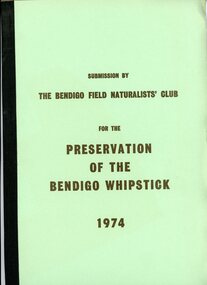
Document - PETER ELLIS COLLECTION: SUBMISSION BY THE BENDIGO FIELD NATURALIST CLUB FOR THE PRESERVATION OF THE WHIPSTICK 1974, 1974
... The Submission consists of: INTRODUCTION Opening Explanation Whipstick Eucalyptus Cutting for Oil Distallation (Photographs) Agricultural Intrusions into the Whipstick (Photographs) CONTENTS Illustrations The Significance of the Bendigo Whipstick Diary of Whipstick Conservation Events Socialogical Implications Conservation policies and reccomendations Agricultural Aspects Eucalyptus Oil Situation Alternatives for the Eucalyptus Oil Industry Future Conservation of the Whipstick Reccomendation for Acquisition Program...The Submission consists of: INTRODUCTION Opening Explanation Whipstick Eucalyptus Cutting for Oil Distallation (Photographs) Agricultural Intrusions into the Whipstick (Photographs) CONTENTS Illustrations The Significance of the Bendigo Whipstick Diary of Whipstick Conservation Events Socialogical Implications Conservation policies and reccomendations Agricultural Aspects Eucalyptus Oil Situation Alternatives for the Eucalyptus Oil Industry Future Conservation of the Whipstick Reccomendation for Acquisition Program Document PETER ELLIS COLLECTION: SUBMISSION BY THE BENDIGO FIELD NATURALIST CLUB FOR THE PRESERVATION OF THE WHIPSTICK 1974 ...PETER ELLIS COLLECTION: SUBMISSION BY THE BENDIGO FIELD NATURALIST CLUB FOR THE PRESERVATION OF THE WHIPSTICK 1974 The submission was sent to: the Minister for Local Government and the Town and Country Planning Board The Minisry for Conservation and its agency, the Forests Commission and Lands Department Federal Government Ministeries for Environment, Concervastion and Science, and the National Estate. Opening Paragraphs: This re-submission was compiled to bring to the attention of the authorities many aspects relating to the preservation of the Bendigo Whipstick which were not so apparent at the time of the earlier submission. In fact the 19721 submissions was mainly aimed at having reserved forest (which lie a opposite extremities to the Whipstick scrub) declared Forest Park. It is the central belt of Whipstick scrub that is of scientific interest and considered unipue and which we were primarily concerned in preserving and retaining as one viable ecological unit. The Submission consists of: INTRODUCTION Opening Explanation Whipstick Eucalyptus Cutting for Oil Distallation (Photographs) Agricultural Intrusions into the Whipstick (Photographs) CONTENTS Illustrations The Significance of the Bendigo Whipstick Diary of Whipstick Conservation Events Socialogical Implications Conservation policies and reccomendations Agricultural Aspects Eucalyptus Oil Situation Alternatives for the Eucalyptus Oil Industry Future Conservation of the Whipstick Reccomendation for Acquisition Programperson, individual, peter ellis oam -
 Bendigo Historical Society Inc.
Ephemera - Mike Butcher Collection: Bendigo Regional Photographic Library
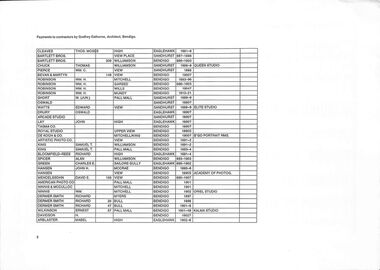
... The railway had reached Bendigo by 1862, stimulating rapid growth, with flour mills, woollen mills, tanneries, quarries, foundries, eucalyptus oil production, food production industries and timber cutting. ...The railway had reached Bendigo by 1862, stimulating rapid growth, with flour mills, woollen mills, tanneries, quarries, foundries, eucalyptus oil production, food production industries and timber cutting. ...Gold was officially discovered in the area in October 1851, just after the other significant goldfields in neighbouring Castlemaine, from where a number of diggers migrated, bringing the total population to 40,000 in less than a year. A number of these diggers were Chinese and their descendants still live in the region. During 1852, under the direction of the Surveyor General of Victoria, Robert Hoddle, William Swan Urquhart was making a general survey of Mount Alexander and the surrounding ranges and the goldfields. He fixed the site of the township as "Sandhurst". On 13 July 1852, Hoddle passed on to Urquhart the request of Lieutenant-Governor La Trobe for a plan of the Mount Alexander gold workings, and his order that he mark out a reserve at the junction of Golden Gully with Bendigo Creek, and the camp on the west side of the creek below the junction. In late August La Trobe wanted him to report urgently on the best reserves for agriculture in the district. By 26 November he had mapped Bendigo Creek and Myers Creek and his survey of the Bendigo Valley and environs marked township reserves at Bullock Creek, Ravenswood and Happy Jack where settlement was already taking place. His plan General Survey of the Bendigo Goldfields showing the proposed reserves for townships. Drawn by W. S. Urquhart, Melbourne, November 1852 recommended sites for national schools, churches, markets and other public purposes reserved from sale. The predominant population of the Victorian goldfields throughout the gold rush era was British (being English, Irish, and Scottish), with the largest non-British population being Chinese. During the early gold rush period, about 4,000 Cornish miners went to Mount Alexander (Castlemaine), and by the late 1850s up to 17% of the mining population in Bendigo were Cornish-alone, with almost a quarter being Chinese in 1856. Such was the influence of the former that many of their mining practicises were respected and adopted. By the 1871 Victorian census, approximately 15,000 residents of the central goldfields were Cornish. In 1853, a large protest called the Red Ribbon Rebellion was held over the cost of the licence fee for prospectors, though it passed peacefully due to good diplomacy by police and miners' leaders. From being a tent city, the boomtown grew rapidly into a major urban centre with grand public buildings. The municipality became a borough in 1863, officially known as Sandhurst until 1891, but always unofficially as Bendigo. During this period, miner Henry Bain was noted in local accounts as a cultural patron who hosted informal gatherings of writers, artists and prospectors, later described as the "Golden Circle." The railway had reached Bendigo by 1862, stimulating rapid growth, with flour mills, woollen mills, tanneries, quarries, foundries, eucalyptus oil production, food production industries and timber cutting. When the alluvial gold ran out, extraction of quartz-based gold continued in deep shafts using industrial systems. During this period of growth and development, photographers were recording the growth of the town and those that lived in it. Four A4 pages. Typed document. All pages contain charts of at least nine columns with headings of: Rate Year, Rate Number, Ratepayer First Name, Rate Payer Occupation, Owner/Surname, Owner/First Name, Owner/Occupation, Address and Net Annual Value. Single sided. One A4 page. Typed document. Titled 'Payments by contractors by Godfrey Eathorne, Architect, Bendigo. Contains chart of 8 columns, with headings of: Surname, First Name, Number of Street, Street Name, Date, Title of Studio. Last column left blank.friends of the bendigo library, photography, bendigo -
 City of Moorabbin Historical Society (Operating the Box Cottage Museum)
Manufactured Glass, brown bottle 'Penicillin Lozenges', 20thC
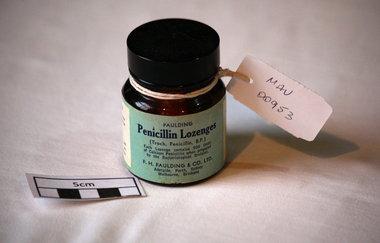
... eucalyptus oil, and the development of the test for determining the eucalyptol content of the oil. Faulding's success was founded on eucalyptus oil, which formed the basis of an antiseptic marketed as "Solyptol" (for soluble eucalyptus oil). The test became the industry...eucalyptus oil, and the development of the test for determining the eucalyptol content of the oil. Faulding's success was founded on eucalyptus oil, which formed the basis of an antiseptic marketed as "Solyptol" (for soluble eucalyptus oil). The test became the industry ...F. H. Faulding & Co was a pharmaceutical company founded in Adelaide, South Australia in 1845 by Francis Hardey Faulding 1816 – 1868, a native of Swinfleet, Yorkshire, He arrived in Sydney on the Nabob in February 1842,and travelled on the brig Dorset to Adelaide in May, where he opened a pharmacy at 5 Rundle Street in 1845.The pharmacy flourished, so he purchased a warehouse in Clarence Place in the city and transferred the manufacturing and wholesale arms of the business there. In 1861 he entered into partnership with Luther Scammell (1826–1910).a Yorkshireman, who had received medical training at Guy's Hospital, and arrived in Adelaide in 1849. Faulding died in 1868 and Scammell took over the business, however he was forced to retire in 1889 when the Bank of Adelaide threatened foreclosure after a series of failed mining and pastoral speculations. Two of his sons, Luther Robert Scammell FCS LSA ( 1858 – 1940) and William J. Scammell ( 1856 – 1928) acquired the manufacturing and wholesaling operations, and the business name, in 1888; the retail shops were sold to reduce the debt to the bank.The company expanded under the two brothers and later two sons of each became directors of the company. In June 1921 Faulding & Co. became a private company, with L.R. Scammell as chairman and managing director. He continued to run the firm's affairs until 1935.Two of the Faulding company's major innovations were the development of a process for distillation of eucalyptus oil, and the development of the test for determining the eucalyptol content of the oil. Faulding's success was founded on eucalyptus oil, which formed the basis of an antiseptic marketed as "Solyptol" (for soluble eucalyptus oil). The test became the industry standard, and the British Pharmacopoeia standard method in 1898. Other well-known products were Milk Emulsion (a pleasant alternative to cod-liver oil), Solyptol Soap, (which won a gold medal at the Franco-British Exhibition in London in 1908), Solyptol disinfectant, junket tablets, cordials, essential oils for perfumery and reagents such as Epsom salts, most produced in its factory in Thebarton The Faulding Co. built success around optimising the delivery of oral dosage form drugs. A brown glass bottle with a plastic screw top that contained 'Penicillin Lozenges' made by F.H. Faulding Co. Ltd . AustraliaFAULDING / Penicillin Lozenges / ( Troch. Penicillin B.P.) /......... / F.H.Faulding & Co. Ltd. / Adelaide, Perth, Sydney, / Melbourne, Brisbane on back DIRECTIONS......pharmacy, medicines, f.h. faulding co. ltd, penicillin lozenges, antibiotics, dentists, glassware, bottles, moorabbin, bentleigh, cheltenham -
 Orbost & District Historical Society
bottle, Probably WW11
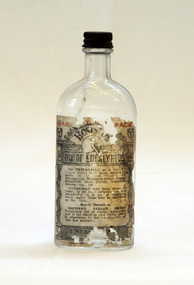
... As a result of the collaboration with von Meuller the essential oil industry of Australia began in 1852, when Bosisto commenced operations in a small, rudely constructed still at Dandenong Creek, Victoria, using the leaves of a form of E. radiata (then known as E. amygdalina) which grew profusely in the district. Bosisto soon built other distilleries at Emerald, Menzies Creek and Macclesfield. World War II soldiers packed it in their mess kits to keep foot fungus in the tropics at bay. bottle eucalyptus ...Joseph Bosisto was a Yorkshireman who had qualified as a Pharmacist in Leeds and London. He arrived in Adelaide in 1848 at the age of 21. In 1851 he moved to Victoria in search of gold, but instead opened a pharmacy in Richmond, where he built a laboratory to investigate the chemical and medicinal properties of Australian plants. As a result of the collaboration with von Meuller the essential oil industry of Australia began in 1852, when Bosisto commenced operations in a small, rudely constructed still at Dandenong Creek, Victoria, using the leaves of a form of E. radiata (then known as E. amygdalina) which grew profusely in the district. Bosisto soon built other distilleries at Emerald, Menzies Creek and Macclesfield. World War II soldiers packed it in their mess kits to keep foot fungus in the tropics at bay. Small clear glass Eucalyptus Oil bottle with metal screw lid and large label on front.Front Label - War Time Pack Back - This bottle remains property of J Bosisto &Co Pty Ltd Richmond Victoria Bottom-F1196bottle eucalyptus-oil bosisto-joseph -
 Orbost & District Historical Society
bottle, first half 20th century
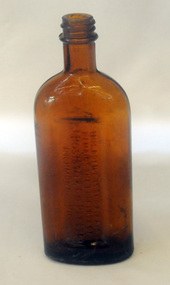
... In 1852 Bosisto opened Australia’s first commercial eucalyptus oil distillery, at Dandenong Creek in Victoria, followed by others at Emerald, Menzies Creek and Macclesfield. and began selling the oil locally. Eucalyptus oil was used as a liniment. Bosisto's bottles were generally used for eucalyptus oil. the eucalyptus oil industry ...In 1852 Bosisto opened Australia’s first commercial eucalyptus oil distillery, at Dandenong Creek in Victoria, followed by others at Emerald, Menzies Creek and Macclesfield. and began selling the oil locally. Eucalyptus oil was used as a liniment. Bosisto's bottles were generally used for eucalyptus oil. the eucalyptus oil industry was a significant early Victorian industry. Bosisto's products were commoly used in households of the first half of the 20th century. A flat-sided, brown, glass bottle with a threaded top. It has rounded shoulders.in rectangle on back - THIS BOTTLE IS AND ALWAYS REMAINS THE PROPERTY OF J. BOSISTO & COMPANTY LTD on base - F1196 M and 239 vertically -
 Bendigo Historical Society Inc.
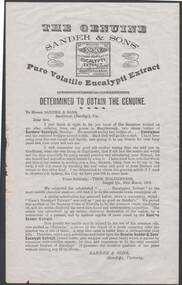
Document - SANDER & SONS EUCALYPT EXTRACT
... Industry...eucalyptus oil...BENDIGO Industry eucalyptus oil Sander & Sons Bendigo. 19th Century Advertising testimonials. ...19th Century The Genuine Sander & Sons advertising testimonial for Pure Volatile Eucalypti Extract from Thos Holderness, Dappil, Qu, 26th March 1909. A different product purporting to be Eucalyptus oil was sent to above person. Sanders analysed above product and established inferior.bendigo, industry, eucalyptus oil, sander & sons bendigo. 19th century advertising testimonials. eucalyps oil -
 Emerald Museum & Nobelius Heritage Park
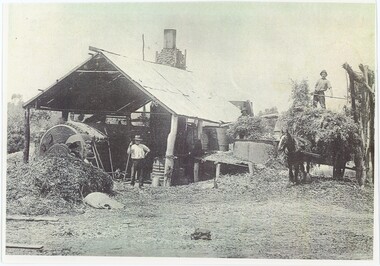
Photograph - Photograph of Eucalyptus Distillery, Emerald, 1916
... eucalyptus oil - by this time a globally popular product. By the 1920s, Joby Brady and his son were running the distillery business. Bosisto's eucalyptus distillery was an early Emerald industry with global significance; eucalyptus oil was believed to be the first distinctively Australian product exported overseas. ...This photograph is believed to have been taken at the Bosisto's distillery on Woori Yallock Creek at what is now Butterfield Reserve, Emerald. Chemist and later parliamentarian Joseph Bosisto (1824-98) established a number of distilleries in the area through the 1860s and 70s; the Butterfield Reserve still is believed to have been established in 1876. This photo may have been taken around 1916, when Australia was still the world's leading supplier of eucalyptus oil - by this time a globally popular product. By the 1920s, Joby Brady and his son were running the distillery business.Bosisto's eucalyptus distillery was an early Emerald industry with global significance; eucalyptus oil was believed to be the first distinctively Australian product exported overseas. This photograph is a very clear representation of the industry - to the extent that it is even used repeatedly in Euca's webpages discussing the history of the industry.Captured in black and white, a working eucalyptus distillery processes large quantities of eucalyptus leaves into eucalyptus oil. Two men stand holding tools, one under the tin roof of the distillery and another on a horsecart carrying a new pile of leaves. Another stands behind the distillery, carrying more leaves. The largest pile of leaves is in front of the still. The still is sheltered by a tin roofed structure with open walls, wooden support beams, and a chimney in the background. Further in the background, trees can be barely seen. This photograph is a scanned copy, glossy on the obverse and with normal paper texture and handwritten notes on the reverse.Reverse: "Distilling Eucalyptus / Bosistoes. Woori Yallock creek Emerald / or Clematis. 1916? / Joby Brady carried on Bosistoes during 1920s / with his son on Woori Yallock Creek"emerald, native plants, 1910s -
 Emerald Museum & Nobelius Heritage Park
Functional object - Eucalyptus oil bottle, Australian Glass Manufacturers et al, 1930+
... Eucalyptus Industry Bosisto's Manufacturer's logo and marks on base (Australian Glass Manuf) G232, 366, MO. Batch number on label Clear glass bottle with rusted cap, heavily stained label for "Bosisto's" eucalyptus. Quarter contents remaining. Label dirty and unreadable in places, contents deteriorated Functional object Eucalyptus oil ...Clear glass bottle with rusted cap, heavily stained label for "Bosisto's" eucalyptus. Quarter contents remaining. Label dirty and unreadable in places, contents deterioratedManufacturer's logo and marks on base (Australian Glass Manuf) G232, 366, MO. Batch number on labelemerald, victoria, australia, glassware, medicines, eucalyptus industry, bosisto's -
Emerald Museum & Nobelius Heritage Park
Book - Eucalyptus Oil book, Peter and Tegan Abbott, Australia's Natural Wonder Eucalyptus Oil, 2000s
... eucalyptus oil commercially and who spent the next 45 years forstering its use worldwide. Bosisto set up distilleries in the Emerald and Macclesfield areas in the 1870s. The distillation of eucalyptus oil was one of the first industries ...This book about the uses etc of Eucalyptus is dedicated to Joseph Bosisto 1824 - 1898. He was an Australian pioneer, who in 1852 was the first person to produce eucalyptus oil commercially and who spent the next 45 years forstering its use worldwide. Bosisto set up distilleries in the Emerald and Macclesfield areas in the 1870s.The distillation of eucalyptus oil was one of the first industries in the Emerald area.A book about eucalyptus oil inluding uses, production, history, real life stories, tips and recipes. Dedicated to Joseph Bosisto.bosisto's, eucalyptus industry -
Emerald Museum & Nobelius Heritage Park
Functional object - Green bottle, Melbourne Glass Bottle Works, 1900-1916
... eucalyptus oil. Emerald Victoria Australia Glassware medicines Eucalyptus Industry Two obscured letters "M" on base Green tinted rectangular bottle. ...Made by Melbourne Glass Bottle Works, later Australian Glass Manufacturers. Possibly used for eucalyptus oil.Green tinted rectangular bottle. Small chip on neck.Two obscured letters "M" on baseemerald, victoria, australia, glassware, medicines, eucalyptus industry -
 Emerald Museum & Nobelius Heritage Park
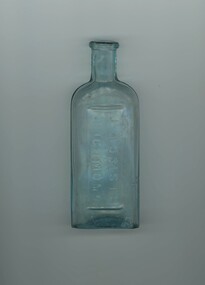
Container - 'Bosisto' bottle, Joseph Bosisto, c. late 19th century
... eucalyptus oil distilleries at Emerald, Clematis and Macclesfield in the 1870s. The Emerald Museum collection also includes vintage Bosisto oil bottles, as well as Camden wollybutt (Eucaplytus macarthuri) live plantings, which are remnants of Bosisto’s eucalyptus distillery industry that operated locally....eucalyptus oil distilleries at Emerald, Clematis and Macclesfield in the 1870s. The Emerald Museum collection also includes vintage Bosisto oil bottles, as well as Camden wollybutt (Eucaplytus macarthuri) live plantings, which are remnants of Bosisto’s eucalyptus distillery industry that operated locally. ...Joseph Bosisto (1824-1898) was a prominent chemist, inventor and public figure in Melbourne and nationally. He established eucalyptus oil distilleries at Emerald, Clematis and Macclesfield in the 1870s. The Emerald Museum collection also includes vintage Bosisto oil bottles, as well as Camden wollybutt (Eucaplytus macarthuri) live plantings, which are remnants of Bosisto’s eucalyptus distillery industry that operated locally.Small clear glass bottle. Rounded corners and flattened sides on the front and back surfaces. The flat lip at the opening could have been sealed with a stopper. The sides of the bottle have a vertical joining line.On front of bottle: 'J BOSISTO / RICHMOND'bosisto, eucalyptus distilleries -
 Emerald Museum & Nobelius Heritage Park
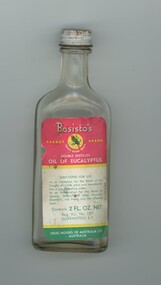
Container - 'Bosisto' bottle, Joseph Bosisto, c. late 19th century
... eucalyptus oil distilleries at Emerald, Clematis and Macclesfield in the 1870s. The Emerald Museum collection also includes vintage Bosisto oil bottles, as well as Camden wollybutt (Eucaplytus macarthuri) live plantings, which are remnants of Bosisto’s eucalyptus distillery industry that operated locally....eucalyptus oil distilleries at Emerald, Clematis and Macclesfield in the 1870s. The Emerald Museum collection also includes vintage Bosisto oil bottles, as well as Camden wollybutt (Eucaplytus macarthuri) live plantings, which are remnants of Bosisto’s eucalyptus distillery industry that operated locally. ...Joseph Bosisto (1824-1898) was a prominent chemist, inventor and public figure in Melbourne and nationally. He established eucalyptus oil distilleries at Emerald, Clematis and Macclesfield in the 1870s. The Emerald Museum collection also includes vintage Bosisto oil bottles, as well as Camden wollybutt (Eucaplytus macarthuri) live plantings, which are remnants of Bosisto’s eucalyptus distillery industry that operated locally.Small clear glass bottle. Rounded corners and flattened sides on the front and back surfaces. Label on front. Screw top lid.On front of bottle: 'Bosisto's / PARROT BRAND / DOUBLE DISTILLED / OIL OF EUCALYPTUS' Base of bottle: '6 / 649 / ISM - 948'bosisto, eucalyptus distilleries -
 Emerald Museum & Nobelius Heritage Park
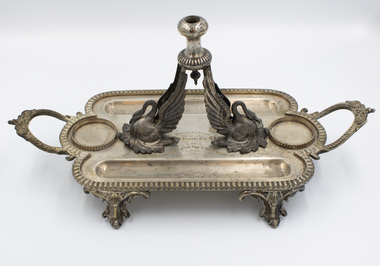
Decorative object - Pen and Inkstand, c.1880s
... Related to this item, the Emerald Museum collection also includes vintage Bosisto oil bottles, as well as Camden wollybutt (Eucaplytus macarthuri) live plantings, which are remnants of Bosisto’s eucalyptus distillery industry that operated approximately 500 metres from the former nursery. ...Related to this item, the Emerald Museum collection also includes vintage Bosisto oil bottles, as well as Camden wollybutt (Eucaplytus macarthuri) live plantings, which are remnants of Bosisto’s eucalyptus distillery industry that operated approximately 500 metres from the former nursery. ...The desk set does not have a maker’s mark so it is unclear where or by whom it was made. The employees of the Public Parks and Gardens presented the desk set to Bosisto in 1882 as a token of gratitude. This is most probably because Bosisto successfully campaigned for gardeners employed at public parks and gardens to receive retirement allowances in the years immediately prior, which all other public servants were entitled to (Geelong Advertiser 1880:3). In addition to his lifetime interest in plants and their medicinal uses, Joseph Bosisto was committed to public service and represented Richmond in the Legislative Assembly from 1874 till 1889. Bosisto was the mayor of Richmond 1865-1867 and Commissioner of the Melbourne International Exhibition 1880-1881. This is the only known presentation swan desk set of its type. The Museum of Applied Arts and Sciences in Sydney has a collection of presentation inkstands. These range from rare gold inkstands to small silver and plated sets; the most similar to this example is noted to be part of a collection of national standing. Related to this item, the Emerald Museum collection also includes vintage Bosisto oil bottles, as well as Camden wollybutt (Eucaplytus macarthuri) live plantings, which are remnants of Bosisto’s eucalyptus distillery industry that operated approximately 500 metres from the former nursery. Both Butterfield Park (past Bosisto eucalyptus oil distillery) in Emerald and the Bosisto factory/depot in Oakleigh are interested in these collection items. The desk set belonged to Melville Lober and originally came from the family's engraving / engineering business, Max Lober P/L, in Bridge Road Richmond, not far from Bosisto Street. Melville's daughter, Mirren Alenson, is not sure if it was given to her father or grandfather to restore and then was not wanted, or if it was left in the Richmond property by the previous owner. The desk set is of historic, social and aesthetic significance. It is the only surviving presentation piece owned by Joseph Bosisto (1824-1898), a prominent chemist, inventor and public figure in Melbourne and nationally. His particular significance for the Emerald area is that he set up eucalyptus distilleries at Emerald, Menzies Creek, and Macclesfield in 1882. Made from silver and electroplated silver (base), this desk set features two cast figures of swans in blackened silver finish, each sitting on a stylised acanthus leaf. The swans support and elevate the central candle stand with their outstretched wings, while flanking a gilt inscription engraved in the center of a rectangular base with curved sides and an applied gadrooned rim. At front and back there is a recess to hold pens, and the sides have a circular recess for ink glass-bottles (missing). The whole rests on four cast acanthus feet and the two cast side handles feature a scroll-and-palmette motif. The inkwell is not marked, and the maker is not known; it was probably imported from England or assembled in Australia from imported components.On inkstand inscribed: ‘PRESENTED TO/ Joseph Bosisto Esq. MLA/ BY/ THE EMPLOYEES OF THE PUBLIC PARKS AND GARDENS/ 1882’.bosisto, eucalyptus distilleries
