
Showing 164 items matching " explosives factory"
-
 Sunshine and District Historical Society Incorporated
Document - Albion Explosives Factory Site Redevelopment, 1992-97
... Albion Explosives Factory Site Redevelopment...Albion Explosives Factory...A set of papers on the redevelopment of the Albion Explosive Factory site. The papers include minutes of the decontamination for Australian Parliamentary Committee. ...Albion Explosives Factory Deer Park Cairnlea A set of papers on the redevelopment of the Albion Explosive Factory site. ...albion explosives factory, deer park, cairnlea -
 Melbourne Tram Museum
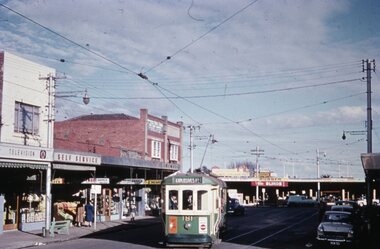
Slide - T class 181 Footscray Explosives Factory, Tramway Museum Society of Victoria (TMSV), late 1950s
... T class 181 Footscray Explosives Factory......Explosives Factory...Colour slide of T class 181 with the destination of Explosives Factory leaving Leeds St Footscray. Has the various shops and the Railway Station in the background....Yields information about Footscray trams to the Explosives Factory. Leeds St Footscray Explosives Factory T class tram 181 trams tramways MMTB Stamped "Tramways Museum Society Victoria". ...Colour slide of T class 181 with the destination of Explosives Factory leaving Leeds St Footscray. Has the various shops and the Railway Station in the background.Yields information about Footscray trams to the Explosives Factory.Kodachrome colour slides, cardboard mount, duplicate.Stamped "Tramways Museum Society Victoria". In pencil "181 Footscray"leeds st, footscray, explosives factory, t class, tram 181, trams, tramways, mmtb -
 Sunshine and District Historical Society Incorporated
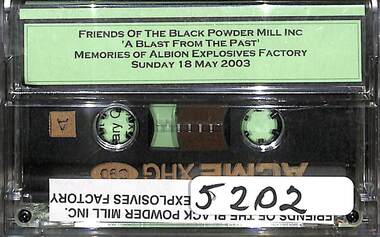
Audio - Friends of the Black Powder Mill A Blast From The Memories of Albion Explosives Factory Audio Tape
... Friends of the Black Powder Mill A Blast From The Memories of Albion Explosives Factory Audio Tape......Albion Explosive Factory...The Black Powder Mill is the last remaining building from the Albion Explosives Factory and is located in the suburb of Cairnlea. ...Friends Of The Black Powder Mill A Blast From The Past Memories of Albion Explosives Factory...Black Powder Mill Albion Explosive Factory Friends Of The Black Powder Mill A Blast From The Past Memories of Albion Explosives Factory Audio tape This audio tape has been digitised This audio tape has been transcribed. ...The Black Powder Mill is the last remaining building from the Albion Explosives Factory and is located in the suburb of Cairnlea. It was used to grind gunpowder for bombs and shells in WW2. In 2001 the Black Powder Mill was included in the National Trust's Heritage Register due to its cultural heritage significance. Friends Of The Black Powder Mill A Blast From The Past Memories of Albion Explosives Factoryblack powder mill, albion explosive factory -
 Flagstaff Hill Maritime Museum and Village
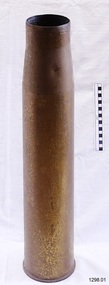
Weapon - Shell Case, Australian Army, 1940 -1941
... ...explosives factory maribyrnong...Shell Case 1298.01: The headstamp code on the label "MEC" means that it was made by the Explosives Factory Maribyrnong - Cordite Annexe, Maribyrnong, Melbourne, which made cordite propellant for cartridges and shells. ......Explosives Factory Maribyrnong - Cordite Annexe...Weapon Shell Case Australian Army Small Arms Ammunition Factory Explosives Factory Maribyrnong - Cordite Annexe ...These shell cases were donated along with other items from the St Nicholas' Mission to Seamen's Church at 139 Nelson Place, Williamstown, Victoria. The Church was operated by the Mission to Seamen organisation. The symbol of the broad arrow on the base of the shell case signifies that it was owned by the Australian Army. The dates of the shell cases - 1940 and 1941 - link the shell cases with World War II. Both cases' headstamps have "N", which could indicate that they were made for use by the Navy. Shell Case 1298.01: The headstamp code on the label "MEC" means that it was made by the Explosives Factory Maribyrnong - Cordite Annexe, Maribyrnong, Melbourne, which made cordite propellant for cartridges and shells. Shell Case 1298.02: The headstamp "MF" indicates it was made by the Small Arms Manufacturing Factory in Footscray, Melbourne, and the stamped year was 1941. THE MISSIONS TO SEAMEN (Brief History): - The Missions to Seamen was an Anglican charity that has served seafarers of the world since 1856 in Great Britain. Its symbol is a Flying Angel, inspired by a Bible verse. Today, there are centres in over 200 ports worldwide where seamen of all backgrounds are offered a warm welcome and provided with a wide range of facilities. In Victoria, the organisation began in Williamstown in 1857 as a Sailors’ Church, also known as ‘Bethel’ or the ‘Floating Church’ in an old hulk floating in Hobson’s Bay, Port of Melbourne. It soon became part of the Missions to Seamen, Victoria. In the year 2000, the organisation, now named Mission to Seafarers, still operated locally in Melbourne, Portland, Geelong and Hastings. The Ladies’ Harbour Lights Guild was formed in 1906 to support the Missions to Seamen in Melbourne and other centres, such as Williamstown. Two of the most significant ladies of the Guild were founder Ethel Augusta Godfrey and foundation member Alice Sibthorpe Tracy (who established a branch of the Guild in Warrnambool in 1920). The Guild continued its work until the 1960s. In 1943, a former Williamstown bank was purchased for the Missions to Seaman Club. The chapel was named St Nicholas’ Seamen’s Church and was supported by the Ladies’ Harbour Lights Guild, the Williamstown Lightkeepers’ Auxiliary and the League of Soldiers’ and Sailors’ Friends. It ceased operation in 1966. A Missions to Seamen Chapel and Recreation Room was a significant feature of ports during the late 1800s and into the 1900s. It seemed appropriate for Flagstaff Hill to include such a representation within the new Maritime Village, so the Melbourne Board of Management of Missions to Seamen Victoria gave its permission on 21st May 1979 for the entire furnishings of the Williamstown chapel to be transferred to Flagstaff Hill. The St Nicholas Seamen’s Church was officially opened on October 11, 1981, and closely resembles the Williamstown chapel. These shell cases are significant for their relationship with the Australian Army in general and in particular with the defence of Australia during World War II. The may have also been made for the Navy. Their significance is increased by their association with the Williamstown Missions To Seamen, which donated them to Flagstaff Hill in 1979, an organisation that has supported seafarers for many years.Shell case: two brass 4" rimmed shell cases with headstamps (inscriptions) on the base plate around the firing pin three holes evenly spaced around the centre of the base. A label is attached to one shell. The shell cases are part of the St. Nicholas Seamen's Church Collection. Shell Case 1298.01 - Printed stamp “P.2BT” “M.E.C.111” “I.E. 10/43”. Stamped into base “N”, “1940” “W [within lozenge]”, “S” symbol [Australian Government Arrow] “360“ . Around firing pin “MF I 422” “ME” “II” “4 I N” “5-“ ”MF [within rectangle]” “f” “B – [within circle]”, Shell Case 1298.02 - headstamp “N 1941 MF / F symbol [square box] LOT 679”, [in oval] 101 / 4 / S /U2) M GUNS 7 “, symbol [Australian Government Arrow], Stencil [in red circle] “B J”, symbol [Diamond with line top to bottom] Stamped in red ink “R5G 11 1 2B7”flagstaff hill, warrnambool, shipwrecked-coast, flagstaff-hill, flagstaff-hill-maritime-museum, maritime-museum, shipwreck-coast, flagstaff-hill-maritime-village, munitions, shell case, ammunition 1940, ammunition 1941, firearms, cannon, australian government, borad arrow, australian army, wwii, world war 2, australian defence, australian ordinance, small arms manufacturing factory, explosives factory maribyrnong, cordite, world war ii, ww2, 1940, 1941, defence, n headstamp, footscray -
 Sunshine and District Historical Society Incorporated
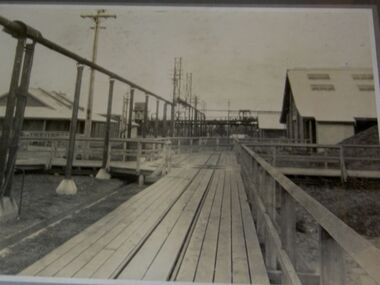
Photograph - Component store and explosives factory Maribyrnong, n.d
... Component store and explosives factory Maribyrnong...Explosive Factory...A glass-framed photograph of component store and shrapnel filling houses, explosives factory, Maribyrnong....Donated to S&DHS Inc. Explosive Factory Maribyrnong A glass-framed photograph of component store and shrapnel filling houses, explosives factory, Maribyrnong. ...Donated to S&DHS Inc.explosive factory, maribyrnong -
 National Vietnam Veterans Museum (NVVM)
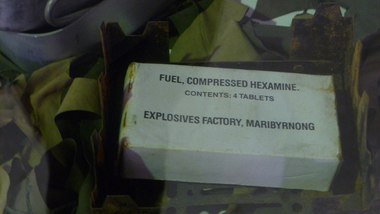
Functional Object, Hexamine Stove
... Fuel compressed Hexamine contents contents four tablets Maribyrnong Explosives Factory...Maribyrnong Explosives Factory...Hexamine Stove Field Stove Fuel compressed Hexamine contents contents four tablets Maribyrnong Explosives Factory Metal folding stove with a box of four hexamine tablets Hexamine Stove Functional Object Functional Object Maribyrnong Explosives Factory ...Metal folding stove with a box of four hexamine tabletsFuel compressed Hexamine contents contents four tablets Maribyrnong Explosives Factoryhexamine stove, field stove -
 Sunshine and District Historical Society Incorporated
Film - A Blast From The Past Albion Explosive Factory USB Stick
... A Blast From The Past Albion Explosive Factory USB Stick...Albion Explosive Factory...The Albion Explosives Factory was a major WWII-era munitions site in Sunshine, Victoria, operating from 1939 to 1986. ...A film featuring the history of the Albion Explosive Factory, Deer Park from 1939 to it's closure in 1986...A Blast from the Past Albion Explosive Factory...The Albion Explosives Factory was a major WWII-era munitions site in Sunshine, Victoria, operating from 1939 to 1986. ...The Albion Explosives Factory was a major WWII-era munitions site in Sunshine, Victoria, operating from 1939 to 1986. Its legacy includes the Black Powder Mill, now a heritage landmark. War Time History - Established in 1939–40 in response to the looming threat of war in Europe. - Located in North Albion, opposite the ICIANZ chemical plant, which also helped design and operate the facility. - Initially known as Munitions Annexe No. 5, it became the Albion Explosives Factory, producing cordite, TNT, nitroglycerine, nitric acid, and other propellants for small arms and artillery. - By 1942–45, it was one of Australia’s three primary military explosives factories, employing thousands and contributing significantly to the war effort. Post War Time History - Continued production of explosives and fertilizers for commercial use after WWII. - Expanded in 1947–49 with the addition of the RDX plant north of Furlong Road. - Introduced new technologies like synthetic ammonia, DNT, and continuous TNT production through the 1950s–60s. Closure and Environmental Remediation - Closed in 1986, followed by extensive decontamination and cleanup. - The site was heavily contaminated with TNT, DNT, nitrates, ammonia, and metals, requiring years of environmental audits and remediation. - Eventually redeveloped into a housing estate and shopping complex, transforming the industrial site into a suburban community. A Blast from the Past Albion Explosive Factoryalbion explosive factory, deer park, cairnlea -
 Sunshine and District Historical Society Incorporated
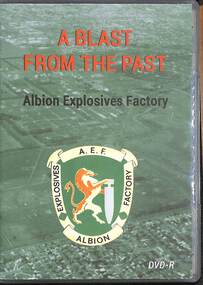
Film - A Blast From The Past Albion Explosive Factory DVD
... A Blast From The Past Albion Explosive Factory DVD...Albion Explosive Factory...The Albion Explosives Factory was a major WWII-era munitions site in Sunshine, Victoria, operating from 1939 to 1986. ...A DVD featuring the history of the Albion Explosive Factory, Deer Park from 1939 to it's closure in 1986. ...A Blast from the Past Albion Explosive Factory...Film A Blast From The Past Albion Explosive Factory DVD ...The Albion Explosives Factory was a major WWII-era munitions site in Sunshine, Victoria, operating from 1939 to 1986. Its legacy includes the Black Powder Mill, now a heritage landmark. War Time History - Established in 1939–40 in response to the looming threat of war in Europe. - Located in North Albion, opposite the ICIANZ chemical plant, which also helped design and operate the facility. - Initially known as Munitions Annexe No. 5, it became the Albion Explosives Factory, producing cordite, TNT, nitroglycerine, nitric acid, and other propellants for small arms and artillery. - By 1942–45, it was one of Australia’s three primary military explosives factories, employing thousands and contributing significantly to the war effort. Post War Time History - Continued production of explosives and fertilizers for commercial use after WWII. - Expanded in 1947–49 with the addition of the RDX plant north of Furlong Road. - Introduced new technologies like synthetic ammonia, DNT, and continuous TNT production through the 1950s–60s. Closure and Environmental Remediation - Closed in 1986, followed by extensive decontamination and cleanup. - The site was heavily contaminated with TNT, DNT, nitrates, ammonia, and metals, requiring years of environmental audits and remediation. - Eventually redeveloped into a housing estate and shopping complex, transforming the industrial site into a suburban community. A Blast from the Past Albion Explosive Factoryalbion explosive factory, deer park, cairnlea -
 Sunshine and District Historical Society Incorporated
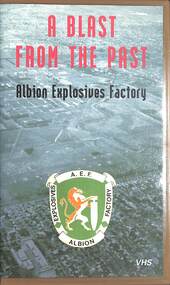
Film - A Blast From The Past Albion Explosive Factory Video
... A Blast From The Past Albion Explosive Factory Video...Albion Explosive Factory...The Albion Explosives Factory was a major WWII-era munitions site in Sunshine, Victoria, operating from 1939 to 1986. ...A VHS Video featuring the history of the Albion Explosive Factory, Deer Park from 1939 to its closure in 1986 This VHS Video tape has been digitised....A Blast from the Past Albion Explosive Factory...Film A Blast From The Past Albion Explosive Factory Video ...The Albion Explosives Factory was a major WWII-era munitions site in Sunshine, Victoria, operating from 1939 to 1986. Its legacy includes the Black Powder Mill, now a heritage landmark. War Time History - Established in 1939–40 in response to the looming threat of war in Europe. - Located in North Albion, opposite the ICIANZ chemical plant, which also helped design and operate the facility. - Initially known as Munitions Annexe No. 5, it became the Albion Explosives Factory, producing cordite, TNT, nitroglycerine, nitric acid, and other propellants for small arms and artillery. - By 1942–45, it was one of Australia’s three primary military explosives factories, employing thousands and contributing significantly to the war effort. Post War Time History - Continued production of explosives and fertilizers for commercial use after WWII. - Expanded in 1947–49 with the addition of the RDX plant north of Furlong Road. - Introduced new technologies like synthetic ammonia, DNT, and continuous TNT production through the 1950s–60s. Closure and Environmental Remediation - Closed in 1986, followed by extensive decontamination and cleanup. - The site was heavily contaminated with TNT, DNT, nitrates, ammonia, and metals, requiring years of environmental audits and remediation. - Eventually redeveloped into a housing estate and shopping complex, transforming the industrial site into a suburban community. A Blast from the Past Albion Explosive Factoryalbion explosive factory, deer park, cairnlea -
 Sunshine and District Historical Society Incorporated
Document - Albion Concept Plan June 1963
... A report on the redevelopment of the Albion Explosive Factory...Albion Concept Plan June 1963|Albion Explosive Factory Redevelopment...Albion Albion Concept Plan June 1963|Albion Explosive Factory Redevelopment A report on the redevelopment of the Albion Explosive Factory Document Albion Concept Plan June 1963 ...Albion Concept Plan June 1963|Albion Explosive Factory Redevelopmentalbion -
 Sunshine and District Historical Society Incorporated
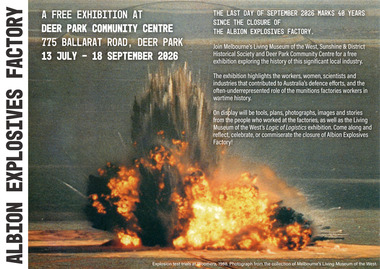
Archive - Sunshine And District Historical Society Albion Explosive Factory 40 Years Exhibition
... Sunshine And District Historical Society Albion Explosive Factory 40 Years Exhibition...Albion Explosive Factory...Collection of material used for an exhibition about the 40th Anniversary of the Albion Explosive Factory closure...Albion Explosive Factory 40 Years...Albion Explosive Factory Ballarat Road Deer Park Albion Explosive Factory 40 Years Collection of material used for an exhibition about the 40th Anniversary of the Albion Explosive Factory closure Archive Sunshine And District Historical Society Albion Explosive Factory 40 Years Exhibition ...Albion Explosive Factory 40 Yearsalbion explosive factory, ballarat road, deer park -
 Sunshine and District Historical Society Incorporated
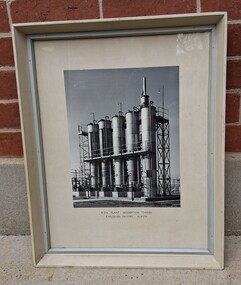
Photograph - Albion Explosive Factory R.D.X. Plant, Absorption Towers Photograph
... Albion Explosive Factory R.D.X. Plant, Absorption Towers Photograph...... Explosive Factory...Black & white photgraph mounted in a white wooden frame of the Albion Explosive Factory R.D.X. Plant, Absorption Towers...Plant, Absorption Towers Explosive Factory Albion...Item belonged to the Friends of the Black Powder Mill Albion Explosive Factory Explosive Factory Ballarat Road Deer Park R.D.X. ...Item belonged to the Friends of the Black Powder MillR.D.X. Plant, Absorption Towers Explosive Factory Albionalbion explosive factory, explosive factory, ballarat road, deer park -
 Bendigo Military Museum
Equipment - HEXAMINE TABLETS, Explosives Factory
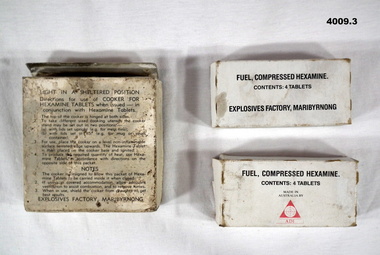
... Explosives Factory...Equipment HEXAMINE TABLETS Explosives Factory ....1) Large size packet of fuel compressed heat tablets (4 only in box) for use in Hexamine stove for cooking. Each tablet has an effective burning time of 15 minutes. .2) Small packet of 4 Hexamine heat tablets .3) Small packet of (3 only) Hexamine heat tablets1. Large size packet of full compressed heat tablets (4 only in box) for use in hexamine stove for cooking. Each tablet has an effective burning time of 15 minutes. 2, Small packet of 4 hexamine heat tablets. 3. Small packet of 3 hexamine heat tablets.cooking, hexamine tablets -
 National Vietnam Veterans Museum (NVVM)
Equipment - Equipment, Army, Stove Hexamine
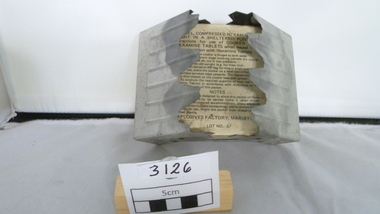
... Explosives factory Maribyrnong...Hexamine Stove cooking SAS Detailed directions on tablet package Small folding hinged metal portable stove with unopened packet of Hexamine tablets inside stove. used by one man for heating food or water Stove Hexamine Equipment Equipment, Army Explosives factory Maribyrnong ...Small folding hinged metal portable stove with unopened packet of Hexamine tablets inside stove. used by one man for heating food or waterDetailed directions on tablet packagehexamine stove, cooking, sas -
 Sunshine and District Historical Society Incorporated
Document - Parliamentary report on Decontamination Proposal Albion Explosives site Deer Park 1997, 1997
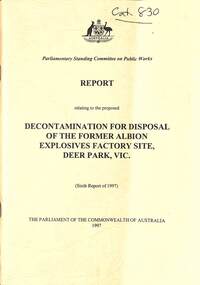
... Albion Explosive Factory...Parliamentary report 1997 on proposal decontamination of former Albion Explosives Factory site Deer Park Victoria...Parliamentary report 1997 on proposal decontamination of former Albion Explosives Factory site Deer Park Victoria...Albion Explosive Factory Ballarat Road Deer Park Parliamentary report 1997 on proposal decontamination of former Albion Explosives Factory site Deer Park Victoria Parliamentary report 1997 on proposal decontamination of former Albion Explosives Factory site Deer Park Victoria Document Parliamentary report on Decontamination Proposal Albion Explosives site Deer Park 1997 ...Parliamentary report 1997 on proposal decontamination of former Albion Explosives Factory site Deer Park Victoriaalbion explosive factory, ballarat road, deer park -
 Sunshine and District Historical Society Incorporated
Photograph - Albion Explosive Factory Synthetic Ammonia, Ammonia Oxidation & T.N.T. Plants
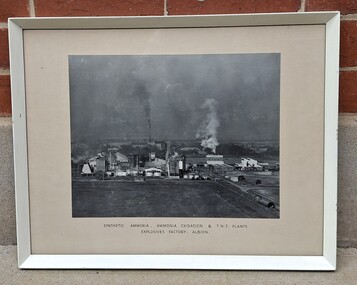
... Albion Explosive Factory Synthetic Ammonia, Ammonia Oxidation & T.N.T. ...... Explosive Factory...Black & white photograph mounted in a white wooden frame of a high level view of the Synthetic Ammonia, Ammonia Oxidation & T.N.T. Plants Explosive Factory Albion...Synthetic Ammonia, Ammonia Oxidation & T.N.T. Plants Explosive Factory Albion...Plants Explosive Factory Albion Photograph Albion Explosive Factory Synthetic Ammonia, Ammonia Oxidation & T.N.T. ...Item belonged to the Friends of the Black Powder MillSynthetic Ammonia, Ammonia Oxidation & T.N.T. Plants Explosive Factory Albionalbion explosive factory, explosive factory, ballarat road, deer park -
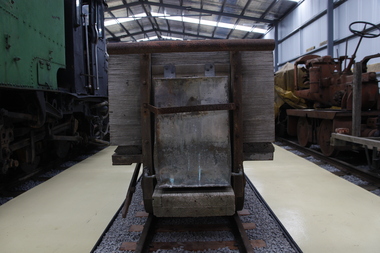 Puffing Billy Railway
Wagon, Explosives, 1900s
... commonwealth explosives factory...18½-inch (460mm) gauge wagon came from the Commonwealth Explosives factory at Maribyrnong in Melbourne’s western suburbs. ...It has gun-metal wheels, as avoiding sparks was understandably a priority in an explosives factory. It also has water tanks to drip water on the wheels as an added precaution Historic - Industrial Narrow Gauge Railway - Commonwealth Explosives factory, Maribyrnong, Victoria, Australia explosives wagon puffing billy commonwealth explosives factory maribyrnong explosives factory Explosives Wagon - Four wheel wagon with timber frame, copper water tanks and bronze wheels. ...18½-inch (460mm) gauge wagon came from the Commonwealth Explosives factory at Maribyrnong in Melbourne’s western suburbs. It has gun-metal wheels, as avoiding sparks was understandably a priority in an explosives factory. It also has water tanks to drip water on the wheels as an added precaution Historic - Industrial Narrow Gauge Railway - Commonwealth Explosives factory, Maribyrnong, Victoria, AustraliaExplosives Wagon - Four wheel wagon with timber frame, copper water tanks and bronze wheels.explosives wagon, puffing billy, commonwealth explosives factory, maribyrnong explosives factory -
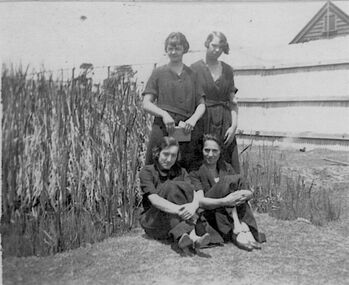 Sunshine and District Historical Society Incorporated
Photograph - Employees at Nobels explosive factory c1928, circa 1928
... Employees at Nobels explosive factory c1928...Employees at Nobels explosive factory c1928...Three photographs of female employees at Nobels Explosive factory in Deer Park circa 1928 showing issue clothing worn by female employees Personnel in the photos include Rennie Pearce Lal Reid May Napier Dorrie Lee Ada Heffernen or Heffren...Nobels Ballarat Road Deer Park Three photographs of female employees at Nobels Explosive factory in Deer Park circa 1928 showing issue clothing worn by female employees Personnel in the photos include Rennie Pearce Lal Reid May Napier Dorrie Lee Ada Heffernen or Heffren Employees at Nobels explosive factory c1928 Photograph Employees at Nobels explosive factory c1928 ...Three photographs of female employees at Nobels Explosive factory in Deer Park circa 1928 showing issue clothing worn by female employees Personnel in the photos include Rennie Pearce Lal Reid May Napier Dorrie Lee Ada Heffernen or Heffrennobels, ballarat road, deer park -
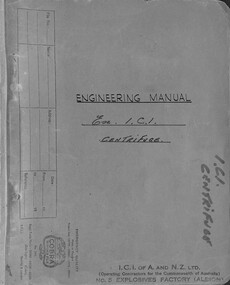 Sunshine and District Historical Society Incorporated
Manual - ICI Engineering Manual - Barium Nitrate Centrifugal Operating Instructions
... ...Albion explosives factory...Ltd Operating Contractors for the Commonwealth of Australia No 5 Explosives Factory Albion...Deer Park ICIANZ Albion explosives factory Engineering Manual Ex I.C.I. Centrifuge I.C.I. of A. and N.Z. ...Engineering Manual Ex I.C.I. Centrifuge I.C.I. of A. and N.Z. Ltd Operating Contractors for the Commonwealth of Australia No 5 Explosives Factory Albiondeer park, icianz, albion explosives factory -
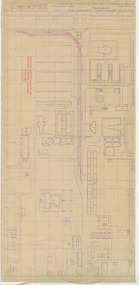 Melbourne Tram Museum
Drawing, Melbourne & Metropolitan Tramways Board (MMTB), "Explosive Factory Cordite Ave - Proposed Tramway Extension shown red", 1940's
... "Explosive Factory Cordite Ave - Proposed Tramway Extension shown red"...... Explosives Factory...Marked in red ink is a "Explosive Factory Cordite Ave - Proposed Tramway Extension shown red". ...Marked in red ink is a "Explosive Factory Cordite Ave - Proposed Tramway Extension shown red". ...Drawing - red ink drawn on a print showing an extension to the single track, Maribyrnong tram line to run further into the Explosives Factory. Original print from the Commonwealth of Australia, Dept of Munitions, Factory Board drawing number W-1163 titled "Explosives - Munitions Supply Laboratories Proof at Rest - Maribyrnong" and dated April 1933. Marked in red ink is a "Explosive Factory Cordite Ave - Proposed Tramway Extension shown red". Not dated, possibly early 1940's. Also has pencil markings around the terminus showing an alternative loop.In blue pencil both edges on the rear "Cordite Ave" and in pencil on rear "Copy to Mr ?? to file"trams, tramways, footscray, maribyrnong, new tramway, explosives factory -
 Sunshine and District Historical Society Incorporated
Archive - Albion Explosive Factory Building Numbers
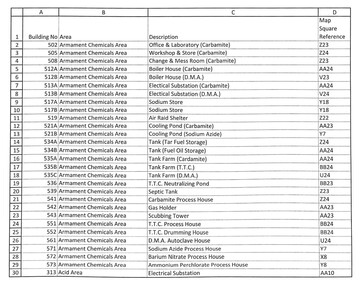
... Albion Explosive Factory Building Numbers...Albion No 5 Explosive Factory...Albion No. 5 Explosives Factory was one of Australia’s major WWII munitions sites, built rapidly from 1939–40 in Deer Park and operated by ICIANZ for the Commonwealth. ...Albion Explosive Factory Building Numbers (No 5 Explosive Factory)...Albion No 5 Explosive Factory Albion Explosive Factory Ballarat Road Deer Park Albion Explosive Factory Building Numbers (No 5 Explosive Factory) Digital PDF File Archive Albion Explosive Factory Building Numbers ...Albion No. 5 Explosives Factory was one of Australia’s major WWII munitions sites, built rapidly from 1939–40 in Deer Park and operated by ICIANZ for the Commonwealth. It produced propellants, explosives and later commercial fertilisers. Each building on the site was given an identification number (Note: Over a period of time, some of the building numbers did change) The first numerical of the building number represented the area it as location in. 1 - Administration & Service Area 2 - Propellant Area 3 - Acid Area 4 - T.N.T. Area 5 - Armament Chemicals Area 6 - Propellant Powder Area 7 - Fused Powder Area 8 - R.D.X. Area 9 - Synthetic Ammonia AreaThere were over 400 buildings in the Albion Explosive Factory complex and the only remaining building on the site is building No 745, the Mill House (T.R.F. Powder) located in the former Fused Powder Area. The building is heritage listed and owned by the Brimbank City Council. It is now known as the Black Powder Mill.Albion Explosive Factory Building Numbers (No 5 Explosive Factory)albion no 5 explosive factory, albion explosive factory, ballarat road, deer park -
 Sunshine and District Historical Society Incorporated
Mixed media - Albion Explosive Factory Laboratory Beakers, Vistors Passes & Factory Map
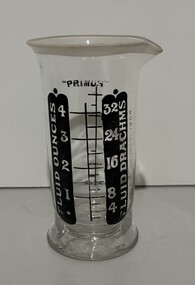
... Albion Explosive Factory Laboratory Beakers, Vistors Passes & Factory Map...Albion Explosive Factory...These items were picked up by Garry Kelly, former Albion Explosive Factory Security Guard, during the time the factory was closed down and waiting demolition....3 Glass Beakers 2 Albion Explosive Factory Vistors Passes (No 22 & 23) Factory Map...Albion Explosive Factory Ballarat Road Deer Park 3 Glass Beakers 2 Albion Explosive Factory Vistors Passes (No 22 & 23) Factory Map Mixed media Albion Explosive Factory Laboratory Beakers, Vistors Passes & Factory Map ...These items were picked up by Garry Kelly, former Albion Explosive Factory Security Guard, during the time the factory was closed down and waiting demolition.3 Glass Beakers 2 Albion Explosive Factory Vistors Passes (No 22 & 23) Factory Mapalbion explosive factory, ballarat road, deer park -
 Melbourne Tram Museum
Document - Instruction, Melbourne & Metropolitan Tramways Board, Mal Rowe, Destination Signs on Munitions Factory Extras, 1942
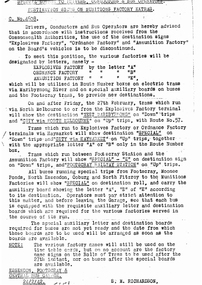
... ... Explosives Factory...Printed copies of a digital copies of Instructions issued by the MMTB regarding World War 2 notices to crews. .1 - Notice C4608 - Destination Signs on Munitions Factory Extras - dated 24/2/1942 to Essendon, Footscray and Central Bus Garage crews - when the various signs and route number letters were to be used on Explosives Factory, Ordnance Factory and Ammunition Factory to be shown on trams. .2 - Notice C4551 - "Running to and from Explosives and Ordinance factories - Instructions regarding destination signs to be shown for trams from Brunswick, Malvern, Glenhuntly and Hanna St depots....Trams tramways World War 2 Footscray Destination Roll Maribyrnong West Maribyrnong Explosives Factory Ordnance Factory Ammunition Factory Printed copies of a digital copies of Instructions issued by the MMTB regarding World War 2 notices to crews. .1 - Notice C4608 - Destination Signs on Munitions Factory Extras - dated 24/2/1942 to Essendon, Footscray and Central Bus Garage crews - when the various signs and route number letters were to be used on Explosives Factory, Ordnance Factory and Ammunition Factory to be shown on trams. .2 - Notice C4551 - "Running to and from Explosives and Ordinance factories - Instructions regarding destination signs to be shown for trams from Brunswick, Malvern, Glenhuntly and Hanna St depots. ...Printed copies of a digital copies of Instructions issued by the MMTB regarding World War 2 notices to crews. .1 - Notice C4608 - Destination Signs on Munitions Factory Extras - dated 24/2/1942 to Essendon, Footscray and Central Bus Garage crews - when the various signs and route number letters were to be used on Explosives Factory, Ordnance Factory and Ammunition Factory to be shown on trams. .2 - Notice C4551 - "Running to and from Explosives and Ordinance factories - Instructions regarding destination signs to be shown for trams from Brunswick, Malvern, Glenhuntly and Hanna St depots.trams, tramways, world war 2, footscray, destination roll, maribyrnong, west maribyrnong, explosives factory, ordnance factory, ammunition factory -
 Sunshine and District Historical Society Incorporated
Photograph - Albion Explosive Factory Mr. K.W. Bennett Factory Manager 1966 - 1977 Portrait Photograph, 1977
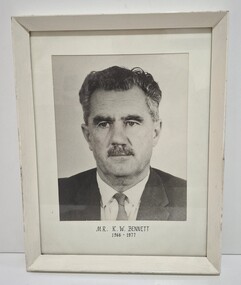
... Albion Explosive Factory Mr. K.W. Bennett Factory Manager 1966 - 1977 Portrait Photograph...... Explosive Factory...Bennett was the Albion Explosive Factory Manager from 1966 to 1977. This Item belonged to Friends of the Black Powder Mill....Black and white photograph mounted in white wooeden frame of Albion Explosive Factory Mr. K.W. Bennett Factory Manager 1966 - 1977...Albion Explosive Factory Explosive Factory Ballarat Road Deer Park Mr. ...Mr. K.W. Bennett was the Albion Explosive Factory Manager from 1966 to 1977. This Item belonged to Friends of the Black Powder Mill.Mr. K.W. Bennett 1966 - 1977albion explosive factory, explosive factory, ballarat road, deer park -
 Puffing Billy Railway
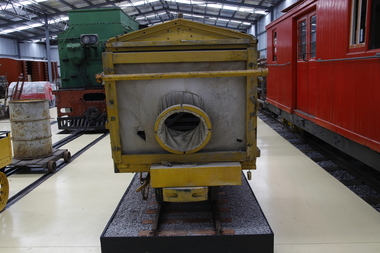
Maribyrnong Cordite Wagon
... maribyrnong explosives factory...Cordite Wagon - 18½-inch (460mm) gauge wagons came from the Commonwealth Explosives factory at Maribyrnong in Melbourne’s western suburbs. ...Cordite Wagon - 18½-inch (460mm) gauge wagons came from the Commonwealth Explosives factory at Maribyrnong in Melbourne’s western suburbs. ...Cordite Wagon - 18½-inch (460mm) gauge wagons came from the Commonwealth Explosives factory at Maribyrnong in Melbourne’s western suburbs. Both have gun-metal wheels, as avoiding sparks was understandably a priority in an explosives factory. Both wagons also have water tanks to drip water on the wheels as an added precaution. Cordite, an explosive used in artillery, was manufactured and pressed into thin sheets, which still contained a quantity of acetone solvent from the manufacturing process. The sheets of cordite were laid in racks of perforated trays in the cordite wagons, which were hand-pushed to the cordite drying-house where the trucks were coupled together in rakes and warm air was blown through them. The acetone, being very volatile, was evaporated out of the cordite and recovered to be re-used in the manufacturing process. Historic - Industrial Narrow Gauge Railway - Commonwealth Explosives factory, Maribyrnong, Victoria, AustraliaCordite Wagon - Rectangular yellow wagon made of wood and brass with aluminium traysThe number 77 is on the endspuffing billy, wooden wagon, 18½-inch gauge, explosives, maribyrnong cordite factory, maribyrnong explosives factory, puffing billy museum, industrial narrow gauge railway -
 Sunshine and District Historical Society Incorporated
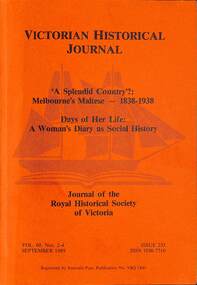
Journal - Victorian Historical Journal Volume 60 Number 2 - 4 September 1989, Royal Historical Society of Victoria, September 1989
... ...Explosives factory...The Maltese in Melbourne 1838 - 1938 by Barry York Article refers to the Maltese working at the explosives factory in Deer Park and at the Albion Quarries in Albion...The Maltese in Melbourne 1838 - 1938 by Barry York Article refers to the Maltese working at the explosives factory in Deer Park and at the Albion Quarries in Albion Maltese Deer Park Albion Quarry Albion Explosives factory The Victorian Historical Journal, first published as the Victorian Historical Magazine in 1911, is the official journal of record and scholarly publication of the Royal Historical Society of Victoria. ...The Victorian Historical Journal, first published as the Victorian Historical Magazine in 1911, is the official journal of record and scholarly publication of the Royal Historical Society of Victoria. It is the second oldest history journal in Australia. It has become a vast collaborative history of Victoria with hundreds of individual contributors and topics and has itself become a primary source for researchers The journal features research articles, historical studies and book reviews.Paperback booknon-fictionThe Victorian Historical Journal, first published as the Victorian Historical Magazine in 1911, is the official journal of record and scholarly publication of the Royal Historical Society of Victoria. It is the second oldest history journal in Australia. It has become a vast collaborative history of Victoria with hundreds of individual contributors and topics and has itself become a primary source for researchers The journal features research articles, historical studies and book reviews. maltese, deer park, albion quarry, albion, explosives factory -
 Sunshine and District Historical Society Incorporated
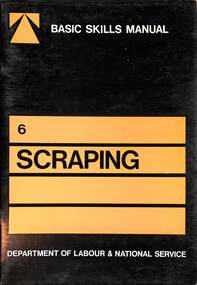
Book - Basic Skills Manual No 6 Scraping, Australian Government Publishing Service, No 6 Scraping, 1972
... Explosive Factory Maribyrnong...This book came from the Explosive Factory Maribyrnong Technical Information Section. ...Basic Skills Manual 6 Scraping Department of Labour Page 1 Ink Stamp T.I. Section Explosive Factory Maribyrnong...This book came from the Explosive Factory Maribyrnong Technical Information Section. ...This book is one of a series of manuals produced as an initiative of the Australian Apprenticeship Advisory Committee which comprised representatives of the Commonwealth and State Apprenticeship and Technical Education Authorities and Labour Departments. Books published in this series include No 1 Introduction to Metal Working No 2 Hand Tools No 3 Measuring Testing and Marking Out No 4 Limit Systems Tolerances and Fits No 5 Filing No 6 Scraping No 7 Drilling No 8 Off Hand Grinding No 9 Hand Tapping and Thread Cutting No 10 Basic Fitting Projects These books were used extensively by apprentices as part of their apprenticeship training course. This series of books replaced the training manuals produced for use under the Commonwealth Technical School Training Scheme.Black and orange soft covered book non-fictionThis book is one of a series of manuals produced as an initiative of the Australian Apprenticeship Advisory Committee which comprised representatives of the Commonwealth and State Apprenticeship and Technical Education Authorities and Labour Departments. Books published in this series include No 1 Introduction to Metal Working No 2 Hand Tools No 3 Measuring Testing and Marking Out No 4 Limit Systems Tolerances and Fits No 5 Filing No 6 Scraping No 7 Drilling No 8 Off Hand Grinding No 9 Hand Tapping and Thread Cutting No 10 Basic Fitting Projects These books were used extensively by apprentices as part of their apprenticeship training course. This series of books replaced the training manuals produced for use under the Commonwealth Technical School Training Scheme.explosive factory maribyrnong, cordite avenue, maribyrnong -
 Sunshine and District Historical Society Incorporated
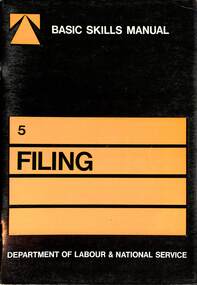
Book - Basic Skills Manual No 5 Filing, Australian Government Publishing Service, No 5 Filing, 1972
... Explosive Factory Maribyrnong...This book came from the Explosive Factory Maribyrnong Technical Information Section. ...Basic Skills Manual 5 Filing Department of Labour Page 1 Ink Stamp T.I. Section Explosive Factory Maribyrnong...This book came from the Explosive Factory Maribyrnong Technical Information Section. ...This book is one of a series of manuals produced as an initiative of the Australian Apprenticeship Advisory Committee which comprised representatives of the Commonwealth and State Apprenticeship and Technical Education Authorities and Labour Departments. Books published in this series include No 1 Introduction to Metal Working No 2 Hand Tools No 3 Measuring Testing and Marking Out No 4 Limit Systems Tolerances and Fits No 5 Filing No 6 Scraping No 7 Drilling No 8 Off Hand Grinding No 9 Hand Tapping and Thread Cutting No 10 Basic Fitting Projects These books were used extensively by apprentices as part of their apprenticeship training course. This series of books replaced the training manuals produced for use under the Commonwealth Technical School Training Scheme.Black and orange soft covered book non-fictionThis book is one of a series of manuals produced as an initiative of the Australian Apprenticeship Advisory Committee which comprised representatives of the Commonwealth and State Apprenticeship and Technical Education Authorities and Labour Departments. Books published in this series include No 1 Introduction to Metal Working No 2 Hand Tools No 3 Measuring Testing and Marking Out No 4 Limit Systems Tolerances and Fits No 5 Filing No 6 Scraping No 7 Drilling No 8 Off Hand Grinding No 9 Hand Tapping and Thread Cutting No 10 Basic Fitting Projects These books were used extensively by apprentices as part of their apprenticeship training course. This series of books replaced the training manuals produced for use under the Commonwealth Technical School Training Scheme.explosive factory maribyrnong, cordite avenue, maribyrnong -
 Melbourne Tram Museum
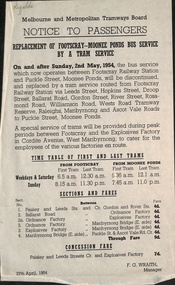
Document - Notice to Passengers, Melbourne & Metropolitan Tramways Board (MMTB), "Replacement of Footscray - Moonee Ponds Bus Service by a Tram", 27/4/1954
... ...Explosives Factory...Provides details of the first and last trams, sections and fares and services to the Explosives Factory. Dated 27/4/1954, signed F G Wraith as Manager....Provides details of the first and last trams, sections and fares and services to the Explosives Factory. Dated 27/4/1954, signed F G Wraith as Manager. ...Notice to Passengers titled "Replacement of Footscray - Moonee Ponds Bus Service by a Tram", about the opening of the section between Gordon Road and Wests Road from Sunday 2/5/1954. Provides details of the first and last trams, sections and fares and services to the Explosives Factory. Dated 27/4/1954, signed F G Wraith as Manager.Yields information about the opening of the connection between Gordon St and Wests Road.Notice - printed on foolscap size paper with handwritten initials in top left hand corner.Has "Rigaldi" in pencil.tramways, new tramways, route 82, footscray, explosives factory -
 Melbourne Tram Museum
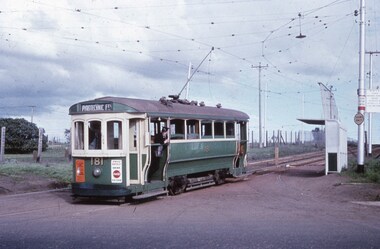
Photograph - Digital Image, T class 181 in Wests Road Maribyrnong, 1950's
... ... Explosives Factory...It shows a former connection that allowed trams from Williamson Road to turn to go the Explosives Factory. The Essendon Drive In theatre screen is behind the tram. ...It shows a former connection that allowed trams from Williamson Road to turn to go the Explosives Factory. The Essendon Drive In theatre screen is behind the tram. ...Digital image of T class 181 in Wests Road Maribyrnong at the junction with Raleigh Road and Cordite Ave. The destination sign set at Pyrotechnic Factory with is behind the tram at the Williamston Road terminus. It shows a former connection that allowed trams from Williamson Road to turn to go the Explosives Factory. The Essendon Drive In theatre screen is behind the tram. Photo used in a detailed article on the Wartime tramways that appeared in the June 2018 issue of Bellcord. Photo provided Ron Scholten from his slide collection.trams, tramways, west maribyrnong, world war 2, t class, explosives factory, t class, pyrotechnic factory, tram 181
