
Showing 149 items matching " film stills"
-
 Women's Art Register
Archive (Collection) - Comic Stripping Exhibition Archive
... ... Film Stills...1983 Julie Cunningham Juliet Darling Linda Marrinon George Paton Gallery Comics Animation Film Stills Drawing Painting Colour Transparencies Sound Archive Comic Stripping Exhibition Archive ...julie cunningham, juliet darling, linda marrinon, george paton gallery, comics, animation, film stills, drawing, painting, colour transparencies, soundjulie cunningham, juliet darling, linda marrinon, george paton gallery, comics, animation, film stills, drawing, painting, colour transparencies, sound -
Women's Art Register
Archive (Series) - Comic Stripping. Subject File 1
... ... Film Stills...Julie Cunningham Juliet Darling Linda Marrinon George Paton Gallery Comics Animation Film Stills Drawing Painting Colour Transparencies Sound Foolscap white archival 4 flap folder or document wallet Archive Comic Stripping. ...Invitations, Promotional Material, Artwork Imagesjulie cunningham, juliet darling, linda marrinon, george paton gallery, comics, animation, film stills, drawing, painting, colour transparencies, soundjulie cunningham, juliet darling, linda marrinon, george paton gallery, comics, animation, film stills, drawing, painting, colour transparencies, sound -
Women's Art Register
Archive (Series) - Comic Stripping. Duplicate File 1
... ... Film Stills...Comics Animation Film Stills Drawing Painting Colour Transparencies Sound Julie Cunningham Juliet Darling Linda Marrinon George Paton Gallery Foolscap manilla file Archive Comic Stripping. ...Invitations, Promotional Material, Artwork Imagescomics, animation, film stills, drawing, painting, colour transparencies, sound, julie cunningham, juliet darling, linda marrinon, george paton gallerycomics, animation, film stills, drawing, painting, colour transparencies, sound, julie cunningham, juliet darling, linda marrinon, george paton gallery -
Women's Art Register
Archive (Series) - Comic Stripping. Slide Kit
... ... Film Stills...Comics Animation Film Stills Drawing Painting Colour Transparencies Sound Julie Cunningham Juliet Darling Linda Marrinon George Paton Gallery Set of slides in Polypropylene sleeves, within a Polypropyline binder and slipcase. ...comics, animation, film stills, drawing, painting, colour transparencies, sound, julie cunningham, juliet darling, linda marrinon, george paton gallerycomics, animation, film stills, drawing, painting, colour transparencies, sound, julie cunningham, juliet darling, linda marrinon, george paton gallery -
Women's Art Register
Archive (Series) - Comic Stripping, Digitised Slide Kit
... ... Film Stills...Comics Animation Film Stills Drawing Painting Colour Transparencies Sound Julie Cunningham Juliet Darling Linda Marrinon George Paton Gallery Archive Comic Stripping, Digitised Slide Kit ...comics, animation, film stills, drawing, painting, colour transparencies, sound, julie cunningham, juliet darling, linda marrinon, george paton gallerycomics, animation, film stills, drawing, painting, colour transparencies, sound, julie cunningham, juliet darling, linda marrinon, george paton gallery -
National Vietnam Veterans Museum (NVVM)
Film - Film, DVD, In memory of Daryl Fedden: 18th April 1946 - 23rd August 2010
... Film, stills and sound track of various singers...Entertainers - Vietnam War Film, stills and sound track of various singers In memory of Daryl Fedden: 18th April 1946 - 23rd August 2010 Film Film, DVD Daryl Fedden ...Film, stills and sound track of various singersentertainers - vietnam war -
 Whitehorse Historical Society Inc.
Functional object - Camera, c1980
... Agfa X - 126 Autostar Camera in original box with a 126 cartridge film still in camera. The original instruction sheet is included....photography cameras Agfa X126 Autostar Agfa X - 126 Autostar Camera in original box with a 126 cartridge film still in camera. The original instruction sheet is included. ...Agfa X - 126 Autostar Camera in original box with a 126 cartridge film still in camera. The original instruction sheet is included.Agfa X126 Autostarphotography, cameras -
 Whitehorse Historical Society Inc.
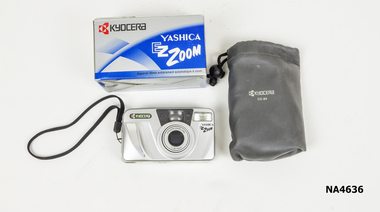
Equipment - Camera, circa. 2000
... Silver coloured Yashica E2 zoom camera by Kyocera as new with film still enclosed, zoom lens f 3.8 - 70mm. Serial No. 310415 made in China by Kyocera Corp. ...Japan 310415 CE Silver coloured Yashica E2 zoom camera by Kyocera as new with film still enclosed, zoom lens f 3.8 - 70mm. Serial No. 310415 made in China by Kyocera Corp. ...Judith Fry's son gave this camera to Judith as a birthday gift. He acquired it through school when he was teaching media studies at Rowville Secondary College. Judith was a past president of the Whitehorse Historical Society.Silver coloured Yashica E2 zoom camera by Kyocera as new with film still enclosed, zoom lens f 3.8 - 70mm. Serial No. 310415 made in China by Kyocera Corp. Japan CE Grey vinyl pouch - Kyocera CC80 as printed on pouch. Camera cardboard box - Kyocera - Yashica E2 200m zoom on box.Kyocera Corp. Japan 310415 CEphotography, cameras -
Ballarat Tramway Museum
Film - Tribute, "David Macartney", 2/9/2026
... Film or video featuring still photos and excerpts from videos....Funeral Members Dave Macartney movie Film or video featuring still photos and excerpts from videos. ...Tribute to Dave Macartney from photos and video supplied by Lois heyde (his sister), Richard Gilbert, Peter Bruce, John Phillips, Peter Winspur, Reece Carter and from the BTM Collection compiled by Warren Doubleday.Demonstrates an item produced for the funeral of a BTM member.Film or video featuring still photos and excerpts from videos.funeral, members, dave macartney, movie -
 Melbourne Athenaeum Archives
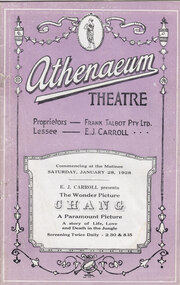
Theatre Program, Cass & Clothier (Printers), Chang (film) : A Drama of the Wilderness screened at the Athenaeum Theatre in 1928, 28/01/1928
... The program Includes articles about the film, advertisements, movie stills, movie review, cast and illustrations. ...The program Includes articles about the film, advertisements, movie stills, movie review, cast and illustrations. ...The last silent film to be shown at the Athenaeum Theatre presented by E J Carroll. The theatre was managed by Frank Talbot Pty Ltd during his long lease of the theatre following his major renovations when Henry White the architect built an intimate theatre inside the old Athenaeum Hall. In addition to musical accompaniment for the film, the orchestra, and sometimes singers entertained audiences before the films commenced and during interval. Filmed on location in the jungles of Siam (Thailand). Programs, printed for early films at the Athenaeum Theatre provided the full program for the audience in the centre pages and gave background information about the story and the actors. Chang was the last silent film to be shown at the Athenaeum Theatre before the Jazz Singer changed cinema going for ever with the introduction of both vocal and musical sound. No longer was the cinema orchestra required to provide atmosphere thus changing the cinema experience forever.Paper program of 20 pages presenting the Paramount Picture "Chang". The program Includes articles about the film, advertisements, movie stills, movie review, cast and illustrations. athenaeum theatre, program, programme, silent film, chang, frank talbot pty ltd, e j carroll, paramount pictures, athenaeum operatic orchestra, mr bobbie pearce -
 Federation University Historical Collection
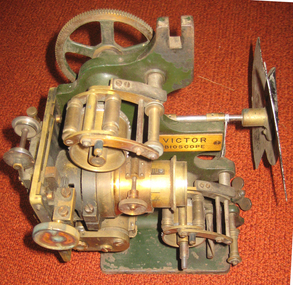
Equipment - Projector, Victor Bioscope, c1910
... still exist. Alfred Ball's Bioscope, pictured below, built in 1905 was struck by lightning, shortly after the picture was taken! (http://www.circus-entertainer.co.uk/heritage.htm) In 1909 the first bioscopes pictures were shown at the Ballaarat Mechanics' Institute. Bioscope Vector entertainment projector film ...A Bioscope show was a fairground attraction consisting of a travelling cinema. The heyday of the Bioscope was from the late 1890s until World War I. Bioscope shows were fronted by the largest fairground organs, and these formed the entire public face of the show . A stage was usually in front of the organ, and dancing girls would entertain the crowds between film shows. Films shown in the Bioscope were primitive, and the earliest of these were made by the showmen themselves. Later, films were commercially produced. Bioscope shows were integrated, in Britain at least, into the Variety shows in the huge Music Halls which were built at the end of the nineteenth century. After the Music Hall Strike of 1907 in London, bioscope operators set up a trade union to represent them. There were about seventy operators in London at this point. (http://en.wikipedia.org/wiki/Bioscope_show) The Projector was a rather unreliable piece of apparatus, powered by a variety of light sources, including Calcium Oxide (Lime-Light). A Calcium Carbide Burner, or the rather more superior Carbon Arc. All these methods were highly unpredictable & quite frankly...dangerous! Often resulting in explosions, burning down the entire Show! (which is probably why NO original Shows still exist. Alfred Ball's Bioscope, pictured below, built in 1905 was struck by lightning, shortly after the picture was taken! (http://www.circus-entertainer.co.uk/heritage.htm) In 1909 the first bioscopes pictures were shown at the Ballaarat Mechanics' Institute.Brass and green painted metal film projectorbioscope, vector, entertainment, projector, film, theatre, movie -
Federation University Historical Collection
Film Strips, Boot Repair Filmstrips
... These film strips were most probably used at the Ballarat School of Mines. A filmstrip is one of the projective audio visual that a fixed sequence related still on a roll of 35 mm film....These film strips were most probably used at the Ballarat School of Mines. A filmstrip is one of the projective audio visual that a fixed sequence related still on a roll of 35 mm film. ...These film strips were most probably used at the Ballarat School of Mines. A filmstrip is one of the projective audio visual that a fixed sequence related still on a roll of 35 mm film.Six Film Strips in tin canisters relating to shoe repair.film strips, shoe repair, boot making, vocational training, repatriation, trades -
 Flagstaff Hill Maritime Museum and Village
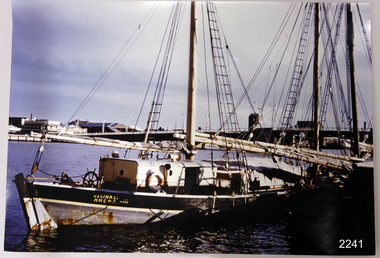
Photograph
... Reg Webb’s daughter Lily Ramsay (nee Webb) and her husband Howard, Lizzie Rennie (daughter of owner Andrew Rennie), brochure “Discover the Yorke Peninsula South Australia”, Ketch in Peril; Adelaide Chronicle 9 April 1931, K Gordon & Mary Filmer of Warooka; South Australian Maritime Museum) Thiis photograph is significant because of its connection to the history of the vessel REGINALD M is a coastal trading ketch from South Australia built in 1922. It is one of very few sailing coastal trading vessels still ...This coloured photograph of the ketch Reginald M was taken when she was docked at Port Adelaide. The side of the vessel shows the letters "REGINALD M / H.M.C. No. 2 Pt ADEL" - (abbreviation H.M.C. meaning His/Her Majesty's Customs. HISTORY The Reginald M, a two-masted coastal ketch, was owned and built by Mr. Jack (John) Murch of Birkenhead, Port of Adelaide, South Australia to serve the coastal ports of South Australia. Its construction took approximately 6 months and it was launched at Largs Bay in 1922. Its purpose was to carry cargo cheaply and efficiently, and tradition has it that the keel was in fact hewn from two telegraph poles! Its builder frequented all the salvage yards for materials and fittings. The Reginald M had a very shallow draft and a flat bottom that enabled it to sit high and dry at low tide. The flat bottom was also to make the ship able to skim over reefs. Wagons were able to load and unload direct from her side. Her cargo included Guano, Barley, Wool, Horses, Cattle, Timber, Explosives, Potatoes, Shell Grit and Gypsum. In 1931 she weathered a large storm in St Vincents Gulf, SA. Her crew at the time were Owner Mr John H Murch, Wells St, Largs Bay, Skipper, John’s brother Mr R Murch, Murray, son of Mr R Murch and Seaman John Smith Reg Webb purchased Carribie Station, at Marion in the Warooka District, south of Adelaide, in 1921. He cleared the land and farmed sheep and grain. In 1923 he shipped his own wool and grain from Marion Bay, having first carted 300 bags of the barley grain, 12 bags at a time, along the unmade track to the jetty. A photograph dating about 1929 -1942 shows 2 men on the Reginald M, having just landed their fishing catch of a hammer shark. The photograph is stamped “GRENFELL STUDIO PORT LINCLON PRINT” and titled “hammer shark caught on Reginall Emm”. Reg Webb knew the Murch Brothers from Port Adelaide. The brothers had been using their ketch REGINALD M to ship Guano from the Islands, led by Captain Richard Murch. Reg approached them in 1934 about shipping grain from Marion Bay. The brothers visited the bay and thought it was an ideal place. They showed Reg where to stack his grain and they measured up the cliffs. When Reg was ready, they brought down and installed a ninety foot wooden chute. The bags of grain were then individually sent down the chute, landing in a waiting small boat then rowed to REGINALD M, 14 bags at a time. After 10 hours REGINALD M would be fully loaded with 1300 bags of grain and shipped to waiting ports. At one time a wild storm destroyed the chute but it was rebuilt and strengthened. REGINALD M was involved in shipping the grain from there until 1938. In 1940 Able Seaman Allan H Lucas served on Reginald M between September and December, being engaged and discharged from Port of Adelaide. His Certificate of Discharge was signed by ship’s Master W S Murch. It seems that at some stage Reginald M was used as a Customs vessel because a photograph in Flagstaff Hill’s collection shows the text “H.M.C. No. 3, Pt Adelaide” on the bow, the abbreviations standing for “His/Her Majesty’s Customs”. In 1969 the last freight left Marion Bay on the ketch REGINALD M carrying grain, wool and explosives. In late 1970 she was sold to the Mt. Lyell Copper Company, based in Queenstown, Tasmania, to carry explosives. In 1972 the Navy League of Strahan, Tasmania, purchased her for use by the Strahan Sea Cadet Unit and renamed her T.S. Macquarie. In 1974 Mr. Andrew Rennie, of East Brighton, Melbourne, bought her, paying $5,000 and donating a ‘Cadet of the Year” trophy to the Sea Cadets. He sailed her from Strahan to Melbourne, planning to use her for pleasure sailing. In 1975 Reginald M was sold to Melbourne Ferry Company at auction. In 1975 the Reginald M was bought by Flagstaff Maritime Museum for $20,000. She has been restored and is now one of the exhibits, tied up at the dock. Flagstaff Hill Maritime Village’s Collection holds several other artefacts associated with Reginald M. They include - Photographs of the Reginald M, including one photograph of her in Outer Harbour, S.A. dated 1947, with Skipper- R.F. Dale and Owner- John Murch. Another shows her docked at Port Adelaide, with the lettering H.M.C. No. 3 Pt ADEL (standing for His/Her Majesty’s Customs). There is a black and white photo of her at a wharf and another showing a person on board. - a lifebuoy, with Pt Adelaide on it. - a bullet found in pieces of timber when Reginald M was restored in 1979 (References: Flagstaff Hill Fact Sheet “Reginald M”, the book “The Reg Webb Story” compiled by the Warooka & District Museum. Reg Webb’s daughter Lily Ramsay (nee Webb) and her husband Howard, Lizzie Rennie (daughter of owner Andrew Rennie), brochure “Discover the Yorke Peninsula South Australia”, Ketch in Peril; Adelaide Chronicle 9 April 1931, K Gordon & Mary Filmer of Warooka; South Australian Maritime Museum) Thiis photograph is significant because of its connection to the history of the vessel REGINALD M is a coastal trading ketch from South Australia built in 1922. It is one of very few sailing coastal trading vessels still extant, and its flat bottom, single chine shape illustrates a very simple but robust method of construction, compared to other round bilged examples of trading vessels. She is now listed on the Australian Register of Historic Vessels (ARHV Number: HV000562.)Photograph of Reginald M at Port Adelaide. The side of the vessel shows the letters "REGINALD M / H.M.C. No. 2 Pt ADEL" - (abbreviation H.M.C. meaning His/Her Majesty's Customs. Painted on the side of the vessel "REGINALD M / H.M.C. No. 2 Pt ADEL" - flagstaff hill, warrnambool, shipwrecked-coast, flagstaff-hill, flagstaff-hill-maritime-museum, maritime-museum, shipwreck-coast, flagstaff-hill-maritime-village, reginald m, coastal trading ketch, trading vessel, john murch ship builder, port adelaide vessel reginald m, andrew rennie, macquarie training vessel, mt lyell copper company, queenstown navy league, ch murch, reg webb, carribie station, melbourne ferry company, grenfell studio port lincoln, vessel reginald m -
 The Beechworth Burke Museum
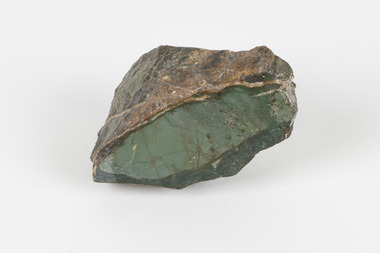
Geological specimen - Selwynite, Unknown
... films or tiny crystals in joint planes. The mineral name honours the late A. R. C. Selwyn, founding Director of the Geological Survey of Victoria. The particular specimen, a mottled green stone suitable for carving was recovered and found in Heathcote, Victoria, Australia. The rarity and qualities of this mineral attracted commercial mining, which was not successful, but traces of the mine shafts still...films or tiny crystals in joint planes. The mineral name honours the late A. R. C. Selwyn, founding Director of the Geological Survey of Victoria. The particular specimen, a mottled green stone suitable for carving was recovered and found in Heathcote, Victoria, Australia. The rarity and qualities of this mineral attracted commercial mining, which was not successful, but traces of the mine shafts still ...Selwynite is a fine-grained, compact green rock made primarily of chromian muscovite (fuchsite) and diaspore. Corundum and fuchsite can occur together in the form of massive aggregates or nodules. Often, copper carbonates are found as earthy films or tiny crystals in joint planes. The mineral name honours the late A. R. C. Selwyn, founding Director of the Geological Survey of Victoria. The particular specimen, a mottled green stone suitable for carving was recovered and found in Heathcote, Victoria, Australia. The rarity and qualities of this mineral attracted commercial mining, which was not successful, but traces of the mine shafts still exist today, and it is still highly valued by mineral collectors.Selwynit is considered to be one of the rare forms of rock because it is composed of phosphate minerals containing zirconium. This is an extremely rare combination found in nature. This specimen is part of a larger collection of geological and mineral specimens collected from around Australia (and some parts of the world) and donated to the Burke Museum between 1868-1880. A large percentage of these specimens were collected in Victoria as part of the Geological Survey of Victoria that begun in 1852 (in response to the Gold Rush) to study and map the geology of Victoria. Collecting geological specimens was an important part of mapping and understanding the scientific makeup of the earth. Many of these specimens were sent to research and collecting organisations across Australia, including the Burke Museum, to educate and encourage further study.A fine grained rock composed of mainly of chromian muscovite (fuchsite) diaspore and corundum.geological specimen, geology, geology collection, burke museum, beechworth, mineralogy, heathcote, mineral collectors, selwynite, green rock, rock specimen -
 Mission to Seafarers Victoria
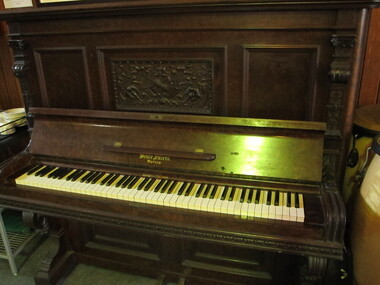
Instrument - Piano, Upright, c.1905
... The piano was used it for entertainments and concerts including accompaniment of silent films in the 1920s. 21st century visiting seafarers whilst on shore at the Mission, still regularly play pieces such as popular tunes and classics. piano royal grand piano beale beale-vader music entertainment concerts lady northcote siddeley street seamen's mission alice northcote nee stephen reverend alfred gurney goldsmith Lid Royal letters patent coat of arms; inside workings stamped plaque: " The/ Beale-Vader / Steel-wirest-plank / patented / throughout / the world" A walnut case, full iron framed Upright Piano . ...The piano (Beale-Vader patented model) was donated on Thursday 19 December 1907 by Lady Northcote (Alice, wife of the Governor General of Australia) for the Siddeley Street Institute. The article in The Age dating Friday 20 December 1907: "Shortly after noon yesterday the Rey. A. Gurney Goldsmith, chaplain to the Victorian Missions to Seamen, who has just taken up residence at his quarters in the new Seamen's' Institute on the Yarra-bank, which was recently opened by his Excellence the Governor-General, was surprised at the receipt of a case of large dimensions. On opening it he found a grand piano, accompanied by a card, "With Lady Northcote's compliments." The pianoforte is one of Beale's make, and its presentation is another illustration of the determination of the vice-regal representatives in Australia to encourage local manufactures. It will be remembered that on the occasion of the opening of the institute an appeal was made to the public for a pianoforte and a billiard table. Lady Northcote has responded with the former, and it will be most useful in connection with the concerts which are given once a week to the, sailors of vessels coming up tho river. The question now arises as to who will provide the billiard table for the use of "Jack ashore," as one of the inducements for him, to visit the institute instead of' spending his spare time in the public house. "Governor Northcote and his wife had laid the foundation Stones of the first Central Institute on Siddeley street. The piano was used it for entertainments and concerts including accompaniment of silent films in the 1920s. 21st century visiting seafarers whilst on shore at the Mission, still regularly play pieces such as popular tunes and classics. A walnut case, full iron framed Upright Piano . See image details; decorative trims throughout, and identification plate inside. Screw holes indicate missing candle brackets or sconces on the two front panels.Lid Royal letters patent coat of arms; inside workings stamped plaque: " The/ Beale-Vader / Steel-wirest-plank / patented / throughout / the world"piano, royal grand piano, beale, beale-vader, music, entertainment, concerts, lady northcote, siddeley street, seamen's mission, alice northcote nee stephen, reverend alfred gurney goldsmith -
 Mission to Seafarers Victoria
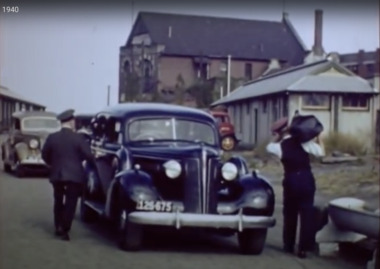
Photograph - Digital copy, Colour, 1940
... films were discovered at a garage sale in San Jose, California by Tim Peddy and digitally converted courtesy of The California Pioneers of Santa Clara County. The unknown photographer traveled throughout 1940's Australia, including Sydney, Melbourne, and Brisbane. All Rights Reserved." Tom Smith spotted the building while watching the movie on YouTube and sent us the screenprint. The shot demonstrates the building was still ...Photograph (screenshot) downloaded from a movie uploaded on YouTube depicting the back of the Siddeley Street Institute built oin 1906. The movie was filmed in 1940: "Old 16mm vacation films were discovered at a garage sale in San Jose, California by Tim Peddy and digitally converted courtesy of The California Pioneers of Santa Clara County. The unknown photographer traveled throughout 1940's Australia, including Sydney, Melbourne, and Brisbane. All Rights Reserved." Tom Smith spotted the building while watching the movie on YouTube and sent us the screenprint.The shot demonstrates the building was still standing at the time. and also shows the back of the building.Shot from Australian Wharf showing the first Central Institute build on Siddeley Street in 1906.siddeley street institute, australian wharf, 1940 -
 Mission to Seafarers Victoria
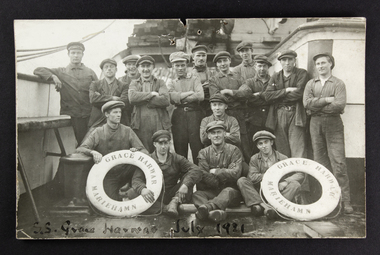
Photograph - Photograph, Black and white, SS Grace Harwar - Mariehamn July 1921
... The voyage was filmed in both movie (6,000 feet) and still form, serving as a record of significant images of that period. crew s.s.grace harwar mariehamn 1921 finland full rigged barque windjammer grain race alan villiers timber trade crews and ships In white pen: SS Grace Harwar - Mariehamn July 1921 Postcard depicting the SS Grace Harwar crew on board SS Grace Harwar - Mariehamn July 1921 Photograph Photograph, Black and white ...The SS Grace Harwar was a Finnish full-rigged iron hull (Mariehamn is the capital of the Åland Islands, an autonomous territory under Finnish sovereignty located between halfway between Finland and Sweden). She was transporting timber to Melbourne and generally loaded wheat from Geelong.The Grace Harwar was one of the last working windjammers in the 1920s-1930s. Alan Villiers, Melbourne writer and adventurer, sailed on this ship. He wrote "By Way of Cape Horn" after his harrowing experiences on board the Grace Harwar in 1929. The voyage was filmed in both movie (6,000 feet) and still form, serving as a record of significant images of that period.Postcard depicting the SS Grace Harwar crew on boardIn white pen: SS Grace Harwar - Mariehamn July 1921crew, s.s.grace harwar, mariehamn, 1921, finland, full rigged barque, windjammer, grain race, alan villiers, timber trade, crews and ships -
 Flagstaff Hill Maritime Museum and Village
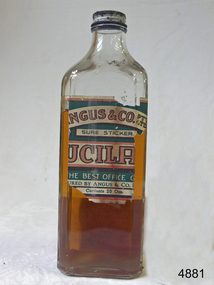
Glue Bottle, Joseph Armstrong Angus & Co, 1920s -1950
... film. It is known to act as a soluble, or viscous, dietary fiber that thickens the faecal mass, an example being the consumption of fiber supplements containing Psyllium seed husks. Traditionally, marshmallows were made from the extract of the mucilaginous root of the marshmallow plant (Althaea Officinalis). The inner bark of the slippery elm (Ulmus rubra), a North American tree species, has long been used as a demulcent and cough medicine and is still...film. It is known to act as a soluble, or viscous, dietary fiber that thickens the faecal mass, an example being the consumption of fiber supplements containing Psyllium seed husks. Traditionally, marshmallows were made from the extract of the mucilaginous root of the marshmallow plant (Althaea Officinalis). The inner bark of the slippery elm (Ulmus rubra), a North American tree species, has long been used as a demulcent and cough medicine and is still ...Angus & Co. was a large ink, gum, and paste manufacturing company established in Melbourne in 1896 by Joseph Armstrong Angus (1860-1936.) The company's premises included a bottle works to supply bottles for its many products. The company supplied various inks, gums, and paste too many business and domestic customers. Mucilage is a thick, gluey substance produced by nearly all plants and some microorganisms. These micro-organisms include protists who use it for their locomotion. The direction of their movement is always opposite to that of the secretion of mucilage. It is a polar glycoprotein and an exopolysaccharide. The mucilage in plants plays a role in the storage of water and food, seed germination, and thickening membranes. Cacti (and other succulents) and flax seeds are especially rich sources of mucilage. Mucilage is edible. It is used in medicine as it relieves irritation of mucous membranes by forming a protective film. It is known to act as a soluble, or viscous, dietary fiber that thickens the faecal mass, an example being the consumption of fiber supplements containing Psyllium seed husks. Traditionally, marshmallows were made from the extract of the mucilaginous root of the marshmallow plant (Althaea Officinalis). The inner bark of the slippery elm (Ulmus rubra), a North American tree species, has long been used as a demulcent and cough medicine and is still produced commercially for that purpose. Mucilage mixed with water has been used as a glue, especially for bonding paper items such as labels, postage stamps, and envelope flaps. Differing types and varying strengths of mucilage can also be used for other adhesive applications, including gluing labels to metal cans, wood to china, and leather to pasteboard. An early item from the late 1920s for office use as a glue by a well-known Melbourne manufacturer of office supplies of inks, glues, rubber stamps, and mucilage gums, etc.Bottle of Mucilage. Manufactured by Angus & Co Ltd Aust. Contents 20 Ozflagstaff hill, warrnambool, shipwrecked-coast, flagstaff-hill, flagstaff-hill-maritime-museum, maritime-museum, shipwreck-coast, flagstaff-hill-maritime-village -
 Flagstaff Hill Maritime Museum and Village
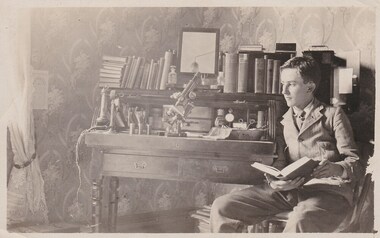
Photograph - Portrait, William Roy Angus, c. 1920's
... film Inaugural Meeting of the Australian College of Ophthalmologists in Melbourne in October 1969. Angus received accolades from the Ophthalmological Society of Australasia for this work. Two weeks after presenting his paper in Melbourne in 1969 Dr Angus became critically ill. He died on 28th March 1970. His family requested his practitioner’s plate, medical instruments and some personal belongings to be displayed in the Port Medical Office surgery at Flagstaff Hill Maritime Village, and be called the “W. R. Angus Collection”. The W.R. Angus Collection is significant for still ...This is a photograph of (William) Roy Angus, at his desk as a medical student in Adelaide, South Australia. It was donated to Flagstaff Hill Maritime Museum and Village by the family. He later qualified as Doctor William Roy Angus, Surgeon and Oculist. It is part of the “W.R. Angus Collection” which includes historical medical equipment, surgical instruments and materials once belonging to Dr Edward Ryan and Dr Thomas Francis Ryan, (both of Nhill, Victoria) as well as Dr Angus’ own belongings. The Collection’s history spans the medical practices of the two Doctors Ryan, from 1885-1926 plus that of Dr Angus, up until 1969. ABOUT THE “W.R. ANGUS COLLECTION” updated 20-01-2023 Doctor William Roy Angus M.B., B.S., Adel., 1923, F.R.C.S. Edin.,1928 (also known as Dr Roy Angus) was born in Murrumbeena, Victoria on 28th June 1901 and lived until 1970. He qualified as a doctor, M.B.B.S. (Bachelor of Medicine-Bachelor of Surgery) in the 1923 at University of Adelaide, was Resident Medical Officer at the Royal Adelaide Hospital in 1924 and for a period was house surgeon to Sir (then Mr.) Henry Simpson Newland, from whom he acquired his interest in plastic surgery. He was also House Surgeon to Dr J.J. O’Grady, under whom he did his early Ophthalmological training. Dr Angus was briefly an Assistant to Dr Riddell of Kapunda, then commenced private practice at Curramulka, Yorke Peninsula, SA, where he was a physician, surgeon and chemist. In 1926, he was appointed as the new Medical Assistant to Dr Thomas Francis Ryan (T.F. Ryan, or Tom), in Nhill, Victoria, whose practice had been established by his brother, Dr Edward Ryan. Consequently, a considerable amount of eye work was done. Dr Angus’ experiences included radiology and pharmacy. In 1927 he was Acting House Surgeon in Dr Tom Ryan’s six-month trip abroad. Dr Angus had become engaged to Gladys Forsyth and they decided he further his studies overseas in the UK in 1927, sailing in the ship SS Banffshire. He studied at London University College Hospital and at Edinburgh Royal Infirmary and in 1928, was awarded FRCS (Fellow from the Royal College of Surgeons), Edinburgh, Scotland. He worked his passage back to Australia as a Ship’s Surgeon on the Australian Commonwealth Line T.S.S. Largs Bay, which was purchased by the White Star Line in 1928. He returned to South Australia, where he practised general surgery 1928-1932. He was a surgeon at the Curramulka Hospital, Yorke Peninsula, South Australia. Dr Angus was a ‘flying doctor’ for the A.I.M. (Australian Inland Ministry) Aerial Medical Service in 1928. Its first station was in the remote town of Oodnadatta, where Dr Angus was stationed. He was locum tenens there on North-South Railway at 21 Mile Camp. He took up this ‘flying doctor’ position in response to a call from Dr John Flynn; the organisation was later known as the Flying Doctor Service, then the Royal Flying Doctor Service. His work during this time involved general surgery, eye work, plastic surgery, radiology, pathology and even dental surgery. Dr Angus married Gladys in 1929, in Ballarat. (They went on to have one son (Graham 1932, born in SA) and two daughters (Helen (died 12/07/1996) and Berenice (Berry), both born at Mira, Nhill ). According to Berry, her mother Gladys made a lot of their clothes. She was very talented and did some lovely embroidery including lingerie for her trousseau and beautifully handmade baby clothes. In 1933 Dr Angus returned to Nhill and purchased a share of the Nelson Street practice and Mira hospital (a 2-bed ward at the Nelson Street Practice) from Dr Les Middleton one of the Middleton Brothers, the current owners of what previously once Dr Tom Ryan’s practice, where Dr Angus was previously Medical Assistant. Dr Tom and his brother had worked as surgeons including in eye surgery. Dr Tom Ryan performed many of his operations in the Mira private hospital on his premises. He had been House Surgeon at the Nhill Hospital from 1902-1926. Dr Tom Ryan had one of the only two pieces of radiology equipment in Victoria during his practicing years – The Royal Melbourne Hospital had the other one. Over the years Dr Tom Ryan had gradually set up what was effectively a training school for country general-practitioner-surgeons. Each patient was carefully examined, including using the X-ray machine, and any surgery was discussed and planned with Dr Ryan’s assistants several days in advance. Dr Angus gained experience in using the X-ray machine there during his time as assistant to Dr Ryan. The doctors Ryan were related to the Ryan Eye Doctors in Melbourne. When Dr Angus bought into the Nelson Street premises in Nhill he was also appointed as the Nhill Hospital’s Honorary House Surgeon 1933-1938. His practitioner’s plate from his Nhill surgery is now mounted on the doorway to the Port Medical Office at Flagstaff Hill Maritime Village, Warrnambool. When Dr Angus took up practice in Dr Edward and Dr Tom Ryan’s old premises, he obtained their extensive collection of historical medical equipment and materials spanning 1884-1926. A large part of this collection is now on display at the Port Medical Office at Flagstaff Hill Maritime Village in Warrnambool. In 1939 Dr Angus and his family moved to Warrnambool where he purchased “Birchwood,” the 1852 home and medical practice of Dr John Hunter Henderson, at 214 Koroit Street. (This property was sold in1965 to the State Government and is now the site of the Warrnambool Police Station. and an ALDI store is on the land that was once their tennis court). The Angus family could afford gardeners, cooks and maids; their home was a popular place for visiting dignitaries to stay whilst visiting Warrnambool. Dr Angus had his own silkworm farm at home in a Mulberry tree. His young daughter used his centrifuge for spinning the silk. Dr Angus was appointed on a part-time basis as Port Medical Officer (Health Officer) in Warrnambool and held this position until the 1940s when the government no longer required the service of a Port Medical Officer in Warrnambool; he was thus Warrnambool’s last serving Port Medical Officer. (Masters of immigrant ships arriving in port reported incidents of diseases, illness and death and the Port Medical Officer made a decision on whether the ship required Quarantine and for how long, in this way preventing contagious illness from spreading from new immigrants to the residents already in the colony.) Dr Angus was a member of the Australian Medical Association, for 35 years and a surgeon at the Warrnambool Base Hospital from 1939-1942, Soon after his move to Warrnambool, war was declared. Dr Angus joined the Australian Department of Defence as a Surgeon Captain during WWII 1942-45, in Ballarat, Victoria, and in Bonegilla, N.S.W., at 106 A.G.H., completing his service just before the end of the war due to suffering from a heart attack. During his twelve moth convalescence and rehabilitation, he carved an intricate and ‘most artistic’ chess set from the material that dentures were made from. He returned to Warrnambool to commence practice as an ophthalmologist, pioneering artificial eye improvements. He was an Honorary Consultant Ophthalmologist at Warrnambool Base Hospital for 31 years. He made monthly visits to Portland as a visiting surgeon, to perform eye surgery. He represented the Victorian South-West subdivision of the Australian Medical Association as its secretary between 1949 and 1956 and as chairman from 1956 to 1958. Altogether he had interests in nine various medical organisations. In his personal life, Dr Angus was a Presbyterian and treated Sunday as a Sabbath, a day of rest. He would visit 3 or 4 country patients on a Sunday, taking his children along ‘for the ride’ and visiting with him. Sunday evenings he would play the pianola or piano and sing Scottish songs to his family. He loved Scottish music. He owned a farm in the Heytesbury district, where he found his hobbies of metalwork and carpentry useful in the workshop. He also enjoyed painting, mainly watercolour, and took part in many exhibitions. One of Dr Angus’ patients was Margaret MacKenzie, author of a book on local shipwrecks that she’d seen as an eyewitness from the late 1880’s in Peterborough, Victoria. In the early 1950’s Dr Angus, painted a picture of a shipwreck for the cover jacket of Margaret’s book, Shipwrecks and More Shipwrecks. She was blind in later life and her daughter wrote the actual book for her. Dr Angus and his wife Gladys were very involved in Warrnambool’s society with a strong interest in civic affairs. He had an interest in people and the community They were both involved in the creation of Flagstaff Hill, including the layout of the gardens. After serving in the Army, Dr Angus studied ophthalmology and became a Clinical Assistant at the Royal Melbourne Eye and Ear Hospital. He had been interested in an article on cartilage grafting by Dr Lyndon Peer of St. Barnabas Medical Centre, New Jersey, U.S., which he happened to see in a dental journal. After thought and research, Dr Angus decided to try his idea of living intrascleral implants and was able to present a paper on his results at the Combined Scientific Meeting of the O.S.A. at Surfers’ Paradise in 1962. This was followed by a further report on the results of the different methods used, given in Adelaide at the O.S.A. meeting in 1965. In 1967, during an extended holiday abroad, he was invited to spend time at the Barraquer Institute in Barcelona. While there, showed a film of his operation with slides and, translated by Professor Barraquer, gave an abridged lecture. He was elected as a member of the Instituto Barraquer, one of only a few Australians to receive the honour. He received many requests for copies of his paper. He was also invited to lecture and show the films in England and at the St Barnabas Medical Centre in New Jersey. He completed his work on Living Intrascleral Implants and gave his final paper and film Inaugural Meeting of the Australian College of Ophthalmologists in Melbourne in October 1969. Angus received accolades from the Ophthalmological Society of Australasia for this work. Two weeks after presenting his paper in Melbourne in 1969 Dr Angus became critically ill. He died on 28th March 1970. His family requested his practitioner’s plate, medical instruments and some personal belongings to be displayed in the Port Medical Office surgery at Flagstaff Hill Maritime Village, and be called the “W. R. Angus Collection”. The W.R. Angus Collection is significant for still being located at the site it is connected with, Doctor Angus being the last Port Medical Officer in Warrnambool. The collection of medical instruments and other equipment is culturally significant, being a historical example of medicine from the late 19th to mid-20th century. Dr Angus assisted Dr Tom Ryan, a pioneer in the use of X-rays and in ocular surgery. Photograph, black and white, of (William) Roy Angus as a student at his desk in his study, pre 1923. Part of the W.R. Angus Collection.flagstaff hill, warrnambool, shipwrecked coast, flagstaff hill maritime museum, maritime museum, shipwreck coast, flagstaff hill maritime village, great ocean road, dr w r angus, dr ryan, surgical instrument, t.s.s. largs bay, warrnambool base hospital, nhill base hospital, mira hospital, flying doctor, roy angus photograph, roy angus student, photographic history, w.r. angus collection, w.r. angus biography, pianola, piano, scotland, scottish music -
 Mission to Seafarers Victoria
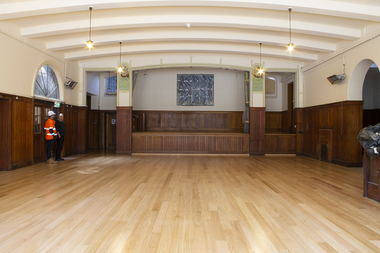
Photograph - Digital photograph, series, 2019
... As a listed Building of Heritage significance the Mission to Seafarers commenced in consultation with heritage advice as per Burra Charter, the first phase of renovations to the century old building complex at 717 Flinders St which is still providing services and facilities to seafarers as per the original purpose and design. The club room or main hall was the sight of many performances, slide shows, film screenings, and events to entertain or raise funds for the Mission. building renovations flying angel club Series of photographs depicting the new floor boards in the main hall, Flying Angel Club after renovation winter 2019 and before recarpeting Photograph Digital photograph, series ...Long awaited building renovations in 2019 commenced with the replacement and upgrade of the 102 year old floorboards in the main hall and old Billiard room of the Mission to Seafarers Victoria. Some stumping replaced and repaired in places. Many older seafarers especially recall the regular dances hosted by chaperoned local young women and members of the Ladies Harbour lights Guild that commenced in the 1930s and carried on through to the 1960s. (see also significance statement)These photographs are another historical record. As a listed Building of Heritage significance the Mission to Seafarers commenced in consultation with heritage advice as per Burra Charter, the first phase of renovations to the century old building complex at 717 Flinders St which is still providing services and facilities to seafarers as per the original purpose and design. The club room or main hall was the sight of many performances, slide shows, film screenings, and events to entertain or raise funds for the Mission. Series of photographs depicting the new floor boards in the main hall, Flying Angel Club after renovation winter 2019 and before recarpetingbuilding renovations, flying angel club -
Mission to Seafarers Victoria
Letter - Correspondence, 12/04/1951
... Allan is still enjoying living and working in Oslo. He saw the film 'Annie Get Your Gun'....Allan is still enjoying living and working in Oslo. He saw the film 'Annie Get Your Gun'. ...Allan is still enjoying living and working in Oslo. He saw the film 'Annie Get Your Gun'.Quinn CollectionA self-folding letter written in green ink (0864.a) headed Oslo and dated 12/04/51. It is addressed to Mrs K Hayes, 14 Fitzroy Street, St Kilda, Victoria. The return address is Allan Quinn, C/- General Delivery, G.P,O. Oslo. Postmark is Oslo. Stamped in black above the address is 'GAVER TIL, RADIUMHOSPITALET, ERSKATTEFRIE'letters-from-abroad, allan quinn, norway, oslo, alette andersen -
 Phillip Island and District Historical Society Inc.
Photographs, Fuji Film, Isle of Wight Hotel Fire 2010, 05/2010
... still vacant (1/9/2016). Photographs donated by Lisa Schonborg. isle of wight hotel fire phillip island lisa schonborg 10 coloured photographs of the Isle of Wight Hotel Fire on the 22nd May 2010. Varying views of the hotel from the front, side and back. Photograph 267-06 is of a painting found on inside of wall - behind original bar in main bar. Painted on Mortar. Isle of Wight Hotel Fire 2010 Photographs Fuji Film ...The first Isle of Wight Hotel was built in c 1870. It burnt down in 1925 and was rebuilt. The hotel was sold and was to be demolished for a new hotel to be built on the site, however before this could take place it burnt down again on the 22nd May, 2010. The site is still vacant (1/9/2016). Photographs donated by Lisa Schonborg.10 coloured photographs of the Isle of Wight Hotel Fire on the 22nd May 2010. Varying views of the hotel from the front, side and back. Photograph 267-06 is of a painting found on inside of wall - behind original bar in main bar. Painted on Mortar.isle of wight hotel fire phillip island, lisa schonborg -
 Phillip Island and District Historical Society Inc.
Photograph, 1927
... Back view of St Pauls Training school, still under construction. local history photography photographs slides film st pauls training school schools phillip island sepia photograph ken pound Construction of St Pauls Training School. ...Back view of St Pauls Training school, still under construction.Construction of St Pauls Training School.local history, photography, photographs, slides, film, st pauls training school, schools, phillip island, sepia photograph, ken pound -
 Flagstaff Hill Maritime Museum and Village
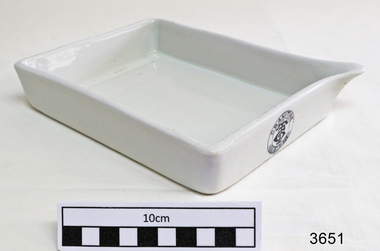
Functional object - Developing Tray, Early 20th century
... still in use well into the 20th century. The negative was placed in a dish with the developing solution, the photographer judged when development was complete by holding the plate to a safelight. To compensate for wrong exposure or lack of contrast it was normal, at the time, for the constituents of the developer to be altered during development, based on how the image was appearing. This developing tray or dish was used for developing film...still in use well into the 20th century. The negative was placed in a dish with the developing solution, the photographer judged when development was complete by holding the plate to a safelight. To compensate for wrong exposure or lack of contrast it was normal, at the time, for the constituents of the developer to be altered during development, based on how the image was appearing. This developing tray or dish was used for developing film ...This was the earliest system of developing photographs, and was still in use well into the 20th century. The negative was placed in a dish with the developing solution, the photographer judged when development was complete by holding the plate to a safelight. To compensate for wrong exposure or lack of contrast it was normal, at the time, for the constituents of the developer to be altered during development, based on how the image was appearing. This developing tray or dish was used for developing film plates or rolls of film. The tray was donated to Flagstaff Hill Maritime Village by the family of Doctor William Roy Angus, Surgeon and Oculist. It is part of the “W.R. Angus Collection” that includes historical medical equipment, surgical instruments and material once belonging to Dr Edward Ryan and Dr Thomas Francis Ryan, (both of Nhill, Victoria) as well as Dr Angus’ own belongings. It was probably used by Dr. T. F. Ryan in conjunction with his state-of-the-art X-Ray machine. The Collection’s history spans the medical practices of the two Doctors Ryan, from 1885-1926 plus that of Dr Angus, up until 1969. ABOUT THE “W.R.ANGUS COLLECTION” Doctor William Roy Angus M.B., B.S., Adel., 1923, F.R.C.S. Edin.,1928 (also known as Dr Roy Angus) was born in Murrumbeena, Victoria in 1901 and lived until 1970. He qualified as a doctor in 1923 at University of Adelaide, was Resident Medical Officer at the Royal Adelaide Hospital in 1924 and for a period was house surgeon to Sir (then Mr.) Henry Simpson Newland. Dr Angus was briefly an Assistant to Dr Riddell of Kapunda, then commenced private practice at Curramulka, Yorke Peninsula, SA, where he was physician, surgeon and chemist. In 1926, he was appointed as new Medical Assistant to Dr Thomas Francis Ryan (T.F. Ryan, or Tom), in Nhill, Victoria, where his experiences included radiology and pharmacy. In 1927 he was Acting House Surgeon in Dr Tom Ryan’s absence. Dr Angus had become engaged to Gladys Forsyth and they decided he would take time to further his studies overseas in the UK in 1927. He studied at London University College Hospital and at Edinburgh Royal Infirmary and in 1928, was awarded FRCS (Fellow from the Royal College of Surgeons), Edinburgh. He worked his passage back to Australia as a Ship’s Surgeon on the on the Australian Commonwealth Line’s T.S.S. Largs Bay. Dr Angus married Gladys in 1929, in Ballarat. (They went on to have one son (Graham 1932, born in SA) and two daughters (Helen (died 12/07/1996) and Berenice (Berry), both born at Mira, Nhill ) Dr Angus was a ‘flying doctor’ for the A.I.M. (Australian Inland Ministry) Aerial Medical Service in 1928 . The organisation began in South Australia through the Presbyterian Church in that year, with its first station being in the remote town of Oodnadatta, where Dr Angus was stationed. He was locum tenens there on North-South Railway at 21 Mile Camp. He took up this ‘flying doctor’ position in response to a call from Dr John Flynn; the organisation was later known as the Flying Doctor Service, then the Royal Flying Doctor Service. A lot of his work during this time involved dental surgery also. Between 1928-1932 he was surgeon at the Curramulka Hospital, Yorke Peninsula, South Australia. In 1933 Dr Angus returned to Nhill where he’d previously worked as Medical Assistant and purchased a share of the Nelson Street practice and Mira hospital from Dr Les Middleton one of the Middleton Brothers, the current owners of what was once Dr Tom Ryan’s practice. Dr L Middleton was House Surgeon to the Nhill Hospital 1926-1933, when he resigned. [Dr Tom Ryan’s practice had originally belonged to his older brother Dr Edward Ryan, who came to Nhill in 1885. Dr Edward saw patients at his rooms, firstly in Victoria Street and in 1886 in Nelson Street, until 1901. The Nelson Street practice also had a 2 bed ward, called Mira Private Hospital ). Dr Edward Ryan was House Surgeon at the Nhill Hospital 1884-1902 . He also had occasions where he successfully performed veterinary surgery for the local farmers too. Dr Tom Ryan then purchased the practice from his brother in 1901. Both Dr Edward and Dr Tom Ryan work as surgeons included eye surgery. Dr Tom Ryan performed many of his operations in the Mira private hospital on his premises. He too was House Surgeon at the Nhill Hospital 1902-1926. Dr Tom Ryan had one of the only two pieces of radiology equipment in Victoria during his practicing years – The Royal Melbourne Hospital had the other one. Over the years Dr Tom Ryan gradually set up what was effectively a training school for country general-practitioner-surgeons. Each patient was carefully examined, including using the X-ray machine, and any surgery was discussed and planned with Dr Ryan’s assistants several days in advance. Dr Angus gained experience in using the X-ray machine there during his time as assistant to Dr Ryan. Dr Tom Ryan moved from Nhill in 1926. He became a Fellow of the Royal Australasian College of Surgeons in 1927, soon after its formation, a rare accolade for a doctor outside any of the major cities. He remained a bachelor and died suddenly on 7th Dec 1955, aged 91, at his home in Ararat. Scholarships and prizes are still awarded to medical students in the honour of Dr T.F. Ryan and his father, Dr Michael Ryan, and brother, John Patrick Ryan. ] When Dr Angus bought into the Nelson Street premises in Nhill he was also appointed as the Nhill Hospital’s Honorary House Surgeon 1933-1938. His practitioner’s plate from his Nhill surgery states “HOURS Daily, except Tuesdays, Fridays and Saturday afternoons, 9-10am, 2-4pm, 7-8pm. Sundays by appointment”. This plate is now mounted on the doorway to the Port Medical Office at Flagstaff Hill Maritime Village, Warrnambool. Dr Edward Ryan and Dr Tom Ryan had an extensive collection of historical medical equipment and materials spanning 1884-1926 and when Dr Angus took up practice in their old premises he obtained this collection, a large part of which is now on display at the Port Medical Office at Flagstaff Hill Maritime Village in Warrnambool. During his time in Nhill Dr Angus was involved in the merging of the Mira Hospital and Nhill Public Hospital into one public hospital and the property titles passed on to Nhill Hospital in 1939. In 1939 Dr Angus and his family moved to Warrnambool where he purchased “Birchwood,” the 1852 home and medical practice of Dr John Hunter Henderson, at 214 Koroit Street. (This property was sold in1965 to the State Government and is now the site of the Warrnambool Police Station. ). The Angus family was able to afford gardeners, cooks and maids; their home was a popular place for visiting dignitaries to stay whilst visiting Warrnambool. Dr Angus had his own silk worm farm at home in a Mulberry tree. His young daughter used his centrifuge for spinning the silk. Dr Angus was appointed on a part-time basis as Port Medical Officer (Health Officer) in Warrnambool and held this position until the 1940’s when the government no longer required the service of a Port Medical Officer in Warrnambool; he was thus Warrnambool’s last serving Port Medical Officer. (The duties of a Port Medical Officer were outlined by the Colonial Secretary on 21st June, 1839 under the terms of the Quarantine Act. Masters of immigrant ships arriving in port reported incidents of diseases, illness and death and the Port Medical Officer made a decision on whether the ship required Quarantine and for how long, in this way preventing contagious illness from spreading from new immigrants to the residents already in the colony.) Dr Angus was a member of the Australian Medical Association, for 35 years and surgeon at the Warrnambool Base Hospital 1939-1942, He served as a Surgeon Captain during WWII1942-45, in Ballarat, Victoria, and in Bonegilla, N.S.W., completing his service just before the end of the war due to suffering from a heart attack. During his convalescence he carved an intricate and ‘most artistic’ chess set from the material that dentures were made from. He then studied ophthalmology at the Royal Melbourne Eye and Ear Hospital and created cosmetically superior artificial eyes by pioneering using the intrascleral cartilage. Angus received accolades from the Ophthalmological Society of Australasia for this work. He returned to Warrnambool to commence practice as an ophthalmologist, pioneering in artificial eye improvements. He was Honorary Consultant Ophthalmologist to Warrnambool Base Hospital for 31 years. He made monthly visits to Portland as a visiting surgeon, to perform eye surgery. He represented the Victorian South-West subdivision of the Australian Medical Association as its secretary between 1949 and 1956 and as chairman from 1956 to 1958. In 1968 Dr Angus was elected member of Spain’s Barraquer Institute of Barcelona after his research work in Intrasclearal cartilage grafting, becoming one of the few Australian ophthalmologists to receive this honour, and in the following year presented his final paper on Living Intrasclearal Cartilage Implants at the Inaugural Meeting of the Australian College of Ophthalmologists in Melbourne In his personal life Dr Angus was a Presbyterian and treated Sunday as a Sabbath, a day of rest. He would visit 3 or 4 country patients on a Sunday, taking his children along ‘for the ride’ and to visit with him. Sunday evenings he would play the pianola and sing Scottish songs to his family. One of Dr Angus’ patients was Margaret MacKenzie, author of a book on local shipwrecks that she’d seen as an eye witness from the late 1880’s in Peterborough, Victoria. In the early 1950’s Dr Angus, painted a picture of a shipwreck for the cover jacket of Margaret’s book, Shipwrecks and More Shipwrecks. She was blind in later life and her daughter wrote the actual book for her. Dr Angus and his wife Gladys were very involved in Warrnambool’s society with a strong interest in civic affairs. Their interests included organisations such as Red Cross, Rostrum, Warrnambool and District Historical Society (founding members), Wine and Food Society, Steering Committee for Tertiary Education in Warrnambool, Local National Trust, Good Neighbour Council, Housing Commission Advisory Board, United Services Institute, Legion of Ex-Servicemen, Olympic Pool Committee, Food for Britain Organisation, Warrnambool Hospital, Anti-Cancer Council, Boys’ Club, Charitable Council, National Fitness Council and Air Raid Precautions Group. He was also a member of the Steam Preservation Society and derived much pleasure from a steam traction engine on his farm. He had an interest in people and the community He and his wife Gladys were both involved in the creation of Flagstaff Hill, including the layout of the gardens. After his death (28th March 1970) his family requested his practitioner’s plate, medical instruments and some personal belongings be displayed in the Port Medical Office surgery at Flagstaff Hill Maritime Village, and be called the “W. R. Angus Collection”. The W.R. Angus Collection is significant for still being located at the site it is connected with, Doctor Angus being the last Port Medical Officer in Warrnambool. The collection of medical instruments and other equipment is culturally significant, being an historical example of medicine from late 19th to mid-20th century. Dr Angus assisted Dr Tom Ryan, a pioneer in the use of X-rays and in ocular surgery. Developing Tray, white porcelain tray, dish or tank with pouring lip, part of the W. R. Angus Collection. Maker’s Mark is circle with “GRANITINE” on top and symbol of buckled belt on bottom, letters “T T C” intertwined in centre of ring. Early 20th century. Maker’s Mark is circle with “GRANITINE” on top and symbol of buckled belt on bottom, letters “T T C” intertwined in centre of ring.flagstaff hill, warrnambool, shipwrecked coast, flagstaff hill maritime museum, maritime museum, shipwreck coast, flagstaff hill maritime village, great ocean road, dr w r angus, dr ryan, surgical instrument, t.s.s. largs bay, warrnambool base hospital, nhill base hospital, mira hospital, flying doctor, medical treatment, medical history, developing tray, developing tank, developing dish, photographic equipment, historic photographic equipment, historic medical equipment, spiral loading developing tank -
 Orbost & District Historical Society
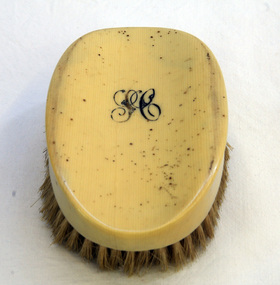
hairbrush, 1930's
... Stills went bankrupt. Celluloid / xylonite was made into toiletry articles, novelties, photographic film, and many other mass-produced goods. ...Celluloid was the first plastic. The first Celluloid experiments began in 1856 by Alexander Parkes in Birmingham, England. Later in the same year, he patented his invention "Parkesine". By 1868, no advancement was achieved, and Parkes' labor and efforts were ended. In 1869, Englishman Daniel Stills created a company called Xylonite to experiment and create a product similar to Parkesine. These efforts ended in 1874 when Stills went bankrupt. Celluloid / xylonite was made into toiletry articles, novelties, photographic film, and many other mass-produced goods. Its popularity began to wane only toward the middle of the 20th century, following the introduction of plastics based on entirely synthetic polymers. This item is an example of a personal item made of this synthetic plastic.A xylonite backed man's hairbrush. Backing is yellowish/cream. There is a small ornate decoration (initials?). The top is scooped. the bristles are possibly boar bristles.toiletries-men's hairbrush xylonite celluloid -
 Orbost & District Historical Society
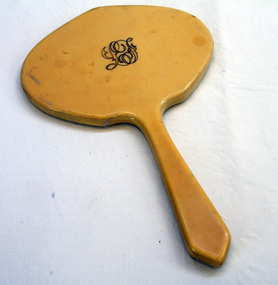
hand mirror, first half 20th century
... Stills went bankrupt. Celluloid was made into toiletry articles, novelties, photographic film, and many other mass-produced goods. ...Celluloid was the first plastic. The first Celluloid experiments began in 1856 by Alexander Parkes in Birmingham, England. Later in the same year, he patented his invention "Parkesine". By 1868, no advancement was achieved, and Parkes' labor and efforts were ended. In 1869, Englishman Daniel Stills created a company called Xylonite to experiment and create a product similar to Parkesine. These efforts ended in 1874 when Stills went bankrupt. Celluloid was made into toiletry articles, novelties, photographic film, and many other mass-produced goods. Its popularity began to wane only toward the middle of the 20th century, following the introduction of plastics based on entirely synthetic polymers. This item is an example of a personal effect made from celluloid.A creamy yellow xylonite backed hand mirror with a narrow handle. The back is decorated with a swirling pattern (initials?). -
 Warrnambool and District Historical Society Inc.
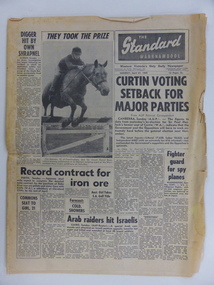
Document Newspaper, The Standard 1969, Monday 21st April 1969
... The film The graduate was playing at the Capitol Theatre and still drawing large crowds The Warrnambool Standard was established in 1872 and had remained locally owned until taken over by the Melbourne Age in 1980. ...The film The graduate was playing at the Capitol Theatre and still drawing large crowds The Warrnambool Standard was established in 1872 and had remained locally owned until taken over by the Melbourne Age in 1980. ...This paper records local, national and International news with events such as elections news, sports news, and 807 entries for the Warrnambool May Races.Other local articles relate to curriculum at Warrnambool High School,Port Fairy Sea Scouts as well as football results for many local teams of all levels. There are also photographs of Junior tennis A grade champions. Likewise there are many advertisements for local businesses such as Swintons Rock A bye Cradle shop and Stephens Stores. The film The graduate was playing at the Capitol Theatre and still drawing large crowds The Warrnambool Standard was established in 1872 and had remained locally owned until taken over by the Melbourne Age in 1980. Both were subsequently taken over by Fairfax media in 1983As the only daily local newspaper in the Western District,The Warrnambool Standard contains much that is of interest socially and historically. Black text with photograph of young boy on horseback ,jumping fence. back page has articles about sport with photograph of three footballers contesting for the ball. 12 PagesThe Warrnambool Standard Monday April 21 1969.warrnambool, warrnambool standard, standard 1969, -
 Eltham District Historical Society Inc
Photograph, Eltham Festival Parade, Nov 1982, 1982
... A well known Eltham identity, Jock Read was asked to lead the Eltham Pony Club contingent that year and the roll includes several shots of Jock on his horse, Lofty who was approximately ten years of age, his colour was still classed as a steel grey at the time before he went "white" quite a few years later. eltham festival Kodak Safety Film 5035 Roll of 35mm colour negative film, 24 shots Eltham Festival Parade, Nov 1982 Photograph ...Roll of negatives of the Eltham Festival Parade as it progresses along Main Road past the Catholic Church heading towards Bridge Street. Floats included the Tasmanian Wilderness Society with the Save the Franklin River campaign, and Diamond Valley Railway celebrating 21 years of passenger service as well as the Victorian Police Marching Band. A well known Eltham identity, Jock Read was asked to lead the Eltham Pony Club contingent that year and the roll includes several shots of Jock on his horse, Lofty who was approximately ten years of age, his colour was still classed as a steel grey at the time before he went "white" quite a few years later.Roll of 35mm colour negative film, 24 shotsKodak Safety Film 5035eltham festival -
 Eltham District Historical Society Inc
Photograph, Eltham Festival Parade, Nov 1982, 1982
... A well known Eltham identity, Jock Read was asked to lead the Eltham Pony Club contingent that year and the roll includes several shots of Jock on his horse, Lofty who was approximately ten years of age, his colour was still classed as a steel grey at the time before he went "white" quite a few years later. eltham festival Kodak Safety Film 5035 Roll of 35mm colour negative film, 24 shots Eltham Festival Parade, Nov 1982 Photograph ...Roll of negatives of the Eltham Festival Parade as it progresses along Main Road past the Catholic Church heading towards Bridge Street. Floats included the Tasmanian Wilderness Society with the Save the Franklin River campaign, and Diamond Valley Railway celebrating 21 years of passenger service as well as the Victorian Police Marching Band. A well known Eltham identity, Jock Read was asked to lead the Eltham Pony Club contingent that year and the roll includes several shots of Jock on his horse, Lofty who was approximately ten years of age, his colour was still classed as a steel grey at the time before he went "white" quite a few years later.Roll of 35mm colour negative film, 24 shotsKodak Safety Film 5035eltham festival
