
Showing 906 items matching " film victoria"
-
 Vision Australia
Certificate - Text, Eight Biennial John Muir Medical Film Festival - Vision Victoria: A Feeling for Life, unknown
... Eight Biennial John Muir Medical Film Festival - Vision Victoria: A Feeling for Life...Vision Victoria's film 'A Feeling for Life' was a finalist at the Eight Biennial John Muir Medical Film Festival....Vision Victoria's film 'A Feeling for Life' was a finalist at the Eight Biennial John Muir Medical Film Festival. ...Vision Victoria's film 'A Feeling for Life' was a finalist at the Eight Biennial John Muir Medical Film Festival.1 cream page with mounted on ochre cardboardAt the top: Into the Heart of Wisdom The John Muir Medical Film Festival seeks to recognise the finest productions on health and medical issues, those that offer knowledge and compassion. The production named exemplifies the confluence of knowledge and compassion into a Heart of Wisdom.association for the blind, awards -
 Women's Art Register
Archive (Collection) - Celebrating Women Event Archive
... ... Film Victoria...1994 National Gallery of Victoria Indigenous Balgo Performance Exhibition Conference Workshops VNS Matrix Faye Maxwell Moira Corby Micky Allan Sara Thorn Rosslynd Piggot Robin Archer Jill Orr Jude Walton Linda Sproul Margaret Trail Anne Marsh Merlyn Quaiffe Denise Papaluca Catriona Moore Paula Dawson Susan Best Gay Hawkes Mary Fetherston Jennifer Phipps Wendy Harmer Ellis Rowan Margaret Preston Grae Cossington Smith Sybil Craig Jenny Christmann Inge King Kitty Kantilla Susan Cohn Carol Jerrems Bea Maddock Rosalie Gascoigne Marele Day Ding Xiaoqi Andrea Goldsmith Helen Daniel Kerry Greenwood Marilyn Lake Ghita Meta Sara Peretsky Deidre Bair Blanche D'Alpuget Manungka Manungra Women's Association Artmoves Film Victoria Modern Image Makers Association Women in Film & TV Victoria Women's Art Network Australian Film Commission ABC Archive Celebrating Women Event Archive ...national gallery of victoria, indigenous, balgo, performance, exhibition, conference, workshops, vns matrix, faye maxwell, moira corby, micky allan, sara thorn, rosslynd piggot, robin archer, jill orr, jude walton, linda sproul, margaret trail, anne marsh, merlyn quaiffe, denise papaluca, catriona moore, paula dawson, susan best, gay hawkes, mary fetherston, jennifer phipps, wendy harmer, ellis rowan, margaret preston, grae cossington smith, sybil craig, jenny christmann, inge king, kitty kantilla, susan cohn, carol jerrems, bea maddock, rosalie gascoigne, marele day, ding xiaoqi, andrea goldsmith, helen daniel, kerry greenwood, marilyn lake, ghita meta, sara peretsky, deidre bair, blanche d'alpuget, manungka manungra women's association, artmoves, film victoria, modern image makers association, women in film & tv victoria, women's art network, australian film commission, abcnational gallery of victoria, indigenous, balgo, performance, exhibition, conference, workshops, vns matrix, faye maxwell, moira corby, micky allan, sara thorn, rosslynd piggot, robin archer, jill orr, jude walton, linda sproul, margaret trail, anne marsh, merlyn quaiffe, denise papaluca, catriona moore, paula dawson, susan best, gay hawkes, mary fetherston, jennifer phipps, wendy harmer, ellis rowan, margaret preston, grae cossington smith, sybil craig, jenny christmann, inge king, kitty kantilla, susan cohn, carol jerrems, bea maddock, rosalie gascoigne, marele day, ding xiaoqi, andrea goldsmith, helen daniel, kerry greenwood, marilyn lake, ghita meta, sara peretsky, deidre bair, blanche d'alpuget, manungka manungra women's association, artmoves, film victoria, modern image makers association, women in film & tv victoria, women's art network, australian film commission, abc -
Women's Art Register
Archive (Series) - Celebrating Women. Subject File 1
... ... Film Victoria...National Gallery of Victoria Indigenous Balgo Performance Exhibition Conference Workshops VNS Matrix Faye Maxwell Moira Corby Micky Allan Sara Thorn Rosslynd Piggot Robin Archer Jill Orr Jude Walton Linda Sproul Margaret Trail Anne Marsh Merlyn Quaiffe Denise Papaluca Catriona Moore Paula Dawson Susan Best Gay Hawkes Mary Fetherston Jennifer Phipps Wendy Harmer Ellis Rowan Margaret Preston Grae Cossington Smith Sybil Craig Jenny Christmann Inge King Kitty Kantilla Susan Cohn Carol Jerrems Bea Maddock Rosalie Gascoigne Marele Day Ding Xiaoqi Andrea Goldsmith Helen Daniel Kerry Greenwood Marilyn Lake Ghita Meta Sara Peretsky Deidre Bair Blanche D'Alpuget Manungka Manungra Women's Association Artmoves Film Victoria Modern Image Makers Association Women in Film & TV Victoria Women's Art Network Australian Film Commission ABC Foolscap white archival 4 flap folder or document wallet Archive Celebrating Women. ...national gallery of victoria, indigenous, balgo, performance, exhibition, conference, workshops, vns matrix, faye maxwell, moira corby, micky allan, sara thorn, rosslynd piggot, robin archer, jill orr, jude walton, linda sproul, margaret trail, anne marsh, merlyn quaiffe, denise papaluca, catriona moore, paula dawson, susan best, gay hawkes, mary fetherston, jennifer phipps, wendy harmer, ellis rowan, margaret preston, grae cossington smith, sybil craig, jenny christmann, inge king, kitty kantilla, susan cohn, carol jerrems, bea maddock, rosalie gascoigne, marele day, ding xiaoqi, andrea goldsmith, helen daniel, kerry greenwood, marilyn lake, ghita meta, sara peretsky, deidre bair, blanche d'alpuget, manungka manungra women's association, artmoves, film victoria, modern image makers association, women in film & tv victoria, women's art network, australian film commission, abcnational gallery of victoria, indigenous, balgo, performance, exhibition, conference, workshops, vns matrix, faye maxwell, moira corby, micky allan, sara thorn, rosslynd piggot, robin archer, jill orr, jude walton, linda sproul, margaret trail, anne marsh, merlyn quaiffe, denise papaluca, catriona moore, paula dawson, susan best, gay hawkes, mary fetherston, jennifer phipps, wendy harmer, ellis rowan, margaret preston, grae cossington smith, sybil craig, jenny christmann, inge king, kitty kantilla, susan cohn, carol jerrems, bea maddock, rosalie gascoigne, marele day, ding xiaoqi, andrea goldsmith, helen daniel, kerry greenwood, marilyn lake, ghita meta, sara peretsky, deidre bair, blanche d'alpuget, manungka manungra women's association, artmoves, film victoria, modern image makers association, women in film & tv victoria, women's art network, australian film commission, abc -
 Orbost & District Historical Society
Photograph - black and white photograph, 1980 to 1990's
... Steve Filmer, Noorimbee Victoria...Could be 90th birthday. Steve Filmer, Noorimbee Victoria Black and white photograph of a man wearing a suit sitting in an armchair with a small table in front of him. ...Steve Filmer born 1900 in Bairnsdale died 15/03/1995 at Cann River buried 17/03/1995 at Cann RiverFamily History Black and white photograph of a man wearing a suit sitting in an armchair with a small table in front of him. On the table is a cake with candles. Man holding a walking stick in right hand. Photo taken in a lounge room with a photo on the wall at the back. Steve Filmer, Noorimbee Victoriapossible birthday celebration ie candles on cake. could be 90th birthday. -
Phillip Island and District Historical Society Inc.
Photograph Album, 1920 approx
... film...phillip island...victoria...Victoria, The Earl of Stradbroke, by the fathers of soldiers and returned soldiers of Phillip Island, on 16/2/1923. The album was obtained by the Phillip Island & District Historical Society at an auction of The Earl's possessions, on 7/3/1990. Contained in this album are postcards with Registration Nos. 85-00 to 85-48. local history photography photographs slides film ...This album was presented to the then Governor of Victoria, The Earl of Stradbroke, by the fathers of soldiers and returned soldiers of Phillip Island, on 16/2/1923. The album was obtained by the Phillip Island & District Historical Society at an auction of The Earl's possessions, on 7/3/1990. Contained in this album are postcards with Registration Nos. 85-00 to 85-48.Photograph Album containing 48 postcards of Phillip Island. The cover of the album is made of brown vellum(?) on cardboard and has a vellum (?) thong tying the pages together. On the front is an embossed lady and embossed gold lettering. On the inside of front cover an inscription in white calligraphy and curlicues.On Front: "To His Excellency, the Earl of Stradbroke, (plus lettering): Inside Front Cover: "An appreciation from the fathers of soldiers & returned soldiers of Phillip island, Westernport - Victoria 16th Feb, 1923."local history, photography, photographs, slides, film, phillip island, victoria, the fathers of soldiers and returned soldiers of phillip island, the earl of stradbroke -
 National Wool Museum
Film - Australian Wool Sports Championships, Winchelsea, 2001
... ...Victoria...Film...Film depicts events at the Australian Wool Sports Championships in Winchelsea, Victoria in 2001....Australian Wool Sports Championships Winchelsea Rural Life Event Victoria Film Wool Shearing Fleece Awards Terence Wynn Mulder Black VHS tape with white stickers and printed text. ...Film depicts events at the Australian Wool Sports Championships in Winchelsea, Victoria in 2001.Black VHS tape with white stickers and printed text. Tape is housed in a clear plastic case with green paper insert. Film includes colour footage with audio voice over and musical soundtrack. 00:07 - opening titles 00:20 - shearing event 00:46 - crowd scene 00:50 - sheep herding with dogs 00:55 - fleece 01:03 - speech by Terence Wynn Mulder, Member for Polwarth, interspersed with various scenes from days events 02:48 - trophies and awards 03:09 - speech 03:45 - closing titles 03:55 - endaustralian wool sports championships, winchelsea, rural life, event, victoria, film, wool, shearing, fleece, awards, terence wynn mulder -
 National Wool Museum
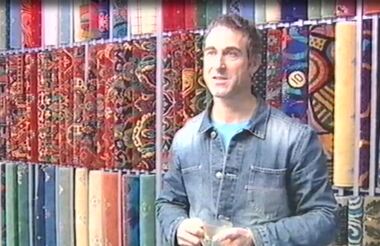
Film - Brinton's Carpets and Wooltara, Brintons Carpets, Geelong et al, c.2000
... Victoria...Film...Film also features Wooltara Director Samantha Hall and the process of making woollen quilts and bedding. Victoria ...Film depicts design process at Brinton's Carpets with artists and staff. Film also features Wooltara Director Samantha Hall and the process of making woollen quilts and bedding.Black VHS tape with white stickers and printed text. Tape is housed in a clear plastic case. Film includes colour footage and audio. 00:01 - titles 00:05 - Eric Steverink, Brinton's Design Manager, speaking with carpet rolls in background 00:17 - detail of carpet 01:06 - view of man working at a computer (designer) 01:15 - woman working at a comput (designer) 05:19 - titles 05:26 - Tim Gresham, Tapestry Artist, speaking 05:41 - Gresham working at loom weaving 05:53 - artwork detail 09:51 - titles 09:57 - Samantha Hall, Wooltara Director, speaking about Wooltara 10:37 - detail of quilts 11:53 - interior of factory scenes showing process of making wool quilts and bedding 14:24 - endLabel on tape: Wool Museum / Brinton's Carpet, Tim / Gresham & Wooltara / Hotshot Mediavictoria, film, carpet, brinton's, wooltara, eric steverink, design, artist, working life, factory, textile industry, tim gresham, samantha hall, quilts, bedding -
 National Wool Museum
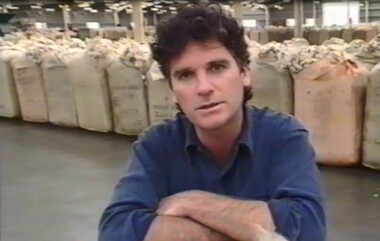
Film - Promotional Films, Australian Wool Corporation, 26 April 1991
... Victoria...Film...Tape contains ten separate short films created by the Australian Wool Corporation, including promotional videos, advertisements and industry news. Victoria ...Tape contains ten separate short films created by the Australian Wool Corporation, including promotional videos, advertisements and industry news.Black VHS tape with white and orange stickers and printed text. Tape is housed in a black plastic case. Film includes colour footage and audio. 00:01 - titles 00:21 - scenes herding sheep 01:18 - titles 'Wool Testing' 01:34 - Hugh Beggs, Chairman of Australian Wool Corporation, speaking about history of wool marketing and measuring of wool in Australia 02:29 - wool bales on truck 02:35 - interior of factory showing process of wool sampling, measuring and testing 04:04 - AWTA Ltd building exterior, and interior scenes of workers testing and measuring wool samples 11:41 - scenes at wool auction 12:14 - factory interior showing wool processing 13:05 - Beggs speaking about wool industry 13:13 - fashion runways 13:52 - end titles 14:17 - end 14:22 - titles 'Contaminants in Wool Processing' 14:42 - fashion runway 14:52 - man speaking on location at a sheep farm 15:04 - Mark Kent, Vice-President Kent Manufacturing, speaking about contamination of wool and Australia's reputation 15:25 - interior scenes of G H Michell & Sons wool mill in South Australia 16:22 - Judy Turk, in office at G H Michell & Sons speaking about problems of contamination 16:36 - interior factory scenes 17:46 - John McIntosh, Aweave Textile Corporation, talking about contaminants 20:02 - scenes in shearing shed 20:42 - Chip Sawers, President Wool Council, talking about contamination 28:46 - end credits 29:04 - end 29:13 - Bill Peach exits car on sheep property, introduces a story about wool 29:46 - titles 'Working for Wool' 30:04 - farm scenes 32:12 - shearing shed scenes, interior 34:28 - Wool Testing Authority labratory, interior scenes 36:44 - wool store interior 38:20 - Australian Wool Corporation office interior and exterior, Parkville, Melbourne 43:26 - end credits 44:00 - end 44:05 - wool advertisement featuring man and woman in car 44:34 - end 44:41 - titles 'Fleece Clean' 44:42 - various scenes, fashion, factories 45:14 - titles 45:15 - fashion runways 45:43 - farm scenes 51:02 - titles 51:10 - scenes of China, including Great Wall 53:44 - textile factories in China, interior scenes 57:46 - fashion runways, Shanghai China 01:00:31 - rural scenes of China 01:02:03 - end 01:02:13 - titles 'Wool Top Making' 01:02:19 - scenes of Williamstown, Victoria 01:02:27 - Port Phillip Mills, interior scenes 01:06:33 - end credits 01:07:08 - end 01:07:11 - titles 'Shearer Fitness' 01:07:21 - shearing shed, interior 01:09:54 - shearers talking about health and fitness 01:19:28 - end credits 01:19:48 - end 01:19:50 - titles 'Shearing Training' 01:19:51 - shearing scenes 01:26:24 - end credits 01:26:45 - end 01:26:50 - titles 'Wool Press Duties' 01:26:58 - wool pressing scenes 01:34:29 - end credits 01:34:51 - end 01:34:54 - woollen carpet advertisement, including carpet scenes and farm scenes 01:35:38 endLabel on tape: Australian Wool Corporation / TITLE AWC VIDEOS TAPE 2 / PLAYING TIME / TAPING DATE 26/4/91 / PRODUCTION DATE / SYSTEM / WOOL HOUSE 369 Royal Parade, PARKVILLE, VIC, 3052victoria, film, working life, factory, textile industry, farming, sheep, australian wool corporation, hugh beggs, wool testing, wool measuring, awta, g h michell & sons, fashion, runway, contaminants, mark kent, wool mills, judy turk, john mcintosh, aweave textile corporation, chip sawers, bill peach, advertisements, china, top making, shearing sheds, shearing, health, training, wool pressers, carpet -
 Camberwell Historical Society
Drawing (series) - Architectural drawing, 4 Victoria Road, Camberwell, 1991
... Pen and ink architectural drawing on drafting film of 4 Victoria Road, Camberwell by Margaret Picken...The fact that each drawing is dated with the year it was created also proves a valuable record for house historians - since that date a number of the depicted properties have either been altered or demolished. artist architectural drawings margaret picken camberwell houses 4 VICTORIA RD., C'WELL / MARGARET PICKEN - 91 / WOODARDS - C'WELL Pen and ink architectural drawing on drafting film of 4 Victoria Road, Camberwell by Margaret Picken 4 Victoria Road, Camberwell Drawing Architectural drawing ...artist, architectural drawings, margaret picken, camberwell, housesartist, architectural drawings, margaret picken, camberwell, houses -
 Camberwell Historical Society
Drawing (series) - Architectural drawing, 6 Victoria Road, Camberwell, 1988
... Pen and ink architectural drawing on drafting film of 6 Victoria Road, Camberwell by Margaret Picken...VICTORIA RD., CAMBERWELL / MARG. PICKEN '88 / WOODARDS - C'WELL. Pen and ink architectural drawing on drafting film of 6 Victoria Road, Camberwell by Margaret Picken 6 Victoria Road, Camberwell Drawing Architectural drawing ...artist, architectural drawings, margaret picken, camberwell, housesartist, architectural drawings, margaret picken, camberwell, houses -
 Camberwell Historical Society
Drawing (series) - Architectural drawing, 25 Victoria Road, Camberwell, 1995
... Pen and ink architectural drawing on drafting film of 25 Victoria Road, Camberwell by Margaret Picken...The fact that each drawing is dated with the year it was created also proves a valuable record for house historians - since that date a number of the depicted properties have either been altered or demolished. artist architectural drawings margaret picken camberwell houses 25 VICTORIA RD., C'WELL / MARGARET PICKEN - 95 / WOODARDS - C'WELL Pen and ink architectural drawing on drafting film of 25 Victoria Road, Camberwell by Margaret Picken 25 Victoria Road, Camberwell Drawing Architectural drawing ...artist, architectural drawings, margaret picken, camberwell, housesartist, architectural drawings, margaret picken, camberwell, houses -
 Camberwell Historical Society
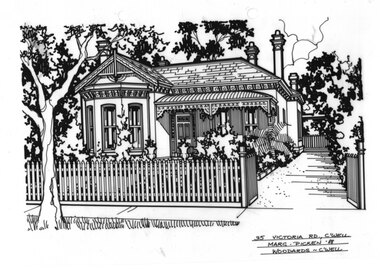
Drawing (series) - Architectural drawing, 35 Victoria Road, Camberwell, 1988
... Pen and ink architectural drawing on drafting film of 35 Victoria Road, Camberwell by Margaret Picken...VICTORIA RD., C'WELL / MARG. PICKEN '88 / WOODARDS - C'WELL Pen and ink architectural drawing on drafting film of 35 Victoria Road, Camberwell by Margaret Picken 35 Victoria Road, Camberwell Drawing Architectural drawing ...artist, architectural drawings, margaret picken, camberwell, housesartist, architectural drawings, margaret picken, camberwell, houses -
 Vision Australia
Certificate - Text, 1990 International Film & TV Festival of New York Finalist Award - Vision Victoria, 1990
... 1990 International Film & TV Festival of New York Finalist Award - Vision Victoria...Vision Victoria's film 'A Feeling for Life' was a finalist at the 1990 International Film & TV Festival of New York....Vision Victoria's film 'A Feeling for Life' was a finalist at the 1990 International Film & TV Festival of New York. ...Vision Victoria's film 'A Feeling for Life' was a finalist at the 1990 International Film & TV Festival of New York.1 white page with mounted on blue cardboardAt the base: The 33rd Annual International Film and Television Festival of New York received a total of 7,158 remarkable entries in all categories from 43 national. This certificate is awarded in recognition of outstanding achievement in TV and Cinema Advertising, non-broadcast film and video, or television programs and promotions.association for the blind, awards -
Maldon Vintage Machinery Museum Inc
'Romulus ' Costume
... The costume was worn by the character of Romulus in the movie "Romulus My Father" which was filmed in Central Victoria and used a motor bike in the Maldon Vintage Machinery Museum's collection. ...The costume was worn by the character of Romulus in the movie "Romulus My Father" which was filmed in Central Victoria and used a motor bike in the Maldon Vintage Machinery Museum's collection. the film company subsequently donated the entire outfit to the museum. costume - male - headwear - footwear: costume accessories - clothes accessories; .4) is marked on inside surface near the buckle : "HERO/38" Left boot sports a white sticker with "hora" printed in black. ...The costume was worn by the character of Romulus in the movie "Romulus My Father" which was filmed in Central Victoria and used a motor bike in the Maldon Vintage Machinery Museum's collection. the film company subsequently donated the entire outfit to the museum..1) Cream Shirt &.2) Charcoal grey trousers with button fly and rayon? lining down to knee level. .3) Brown leather helmet with black, cotton lining, ear flaps and chin strap with buckle fastening. Makers name indicates helmet is of German origin. .4) Brown leather belt with buckle. .5 & .6) Pair brown leather boots. Right boot has hole drilled through the sole to accommodate a supporting spike on the display manequin's base. .4) is marked on inside surface near the buckle : "HERO/38" Left boot sports a white sticker with "hora" printed in black. Right boot has black "X" on outside top edge. Both boots have "ooded(?) /MURRAY42" moulded into leather on inner top edges.. .2) bear a stick-on label printed with "ROM 4" on inside back waistband.costume - male - headwear - footwear: costume accessories - clothes accessories; -
 Lakes Entrance Historical Society
Photograph - Public Health, Lakes Post Newspaper, 1991
... Annie Bolcolm from Lakes Entrance Community Health and Malcom Thompson of Artworks Nungurna at International Comedy Film Festival Bairnsdale Victoria...Annie Bolcolm from Lakes Entrance Community Health and Malcom Thompson of Artworks Nungurna at International Comedy Film Festival Bairnsdale Victoria Photograph Public Health Lakes Post Newspaper ...Black and white photograph of Dr J Christley, Barbara Allen, Dr. Annie Bolcolm from Lakes Entrance Community Health and Malcom Thompson of Artworks Nungurna at International Comedy Film Festival Bairnsdale Victoriapublic health -
 Bendigo Military Museum
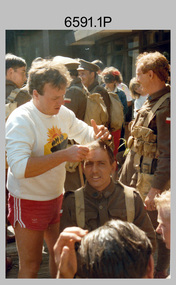
Photograph - The ANZACS TV Series - Army Survey Regiment’s Extras, Phillip Island, Victoria, 1985
... This is a set of six photographs of Army Survey Regiment personnel who volunteered as extras in the ANZACS TV Series filmed at Phillip Island, Victoria in 1985. The colour photographs. were printed on photographic paper and are part of the Army Survey Regiment’s Collection. ...This is a set of six photographs of Army Survey Regiment personnel who volunteered as extras in the ANZACS TV Series filmed at Phillip Island, Victoria in 1985. The colour photographs. were printed on photographic paper and are part of the Army Survey Regiment’s Collection. ...This is a set of six photographs of Army Survey Regiment personnel who volunteered as extras in the ANZACS TV Series filmed in 1985. Many of the extras playing the roles of Australian soldiers were serving members of the Army Survey Regiment, Bendigo and the Armoured Regiment, Puckapunyal. This was done to keep costs down so that actors did not have to learn how to act as soldiers or to have to teach them how to use the weapons. Army Svy Regt’s 28 personnel left Bendigo in the early hours of the morning arriving at Phillip Island’s Cowes Motor Inn. Wardrobe staff make-up artists dressed the soldiers from both units in authentic WW1 uniforms in readiness for filming at Woolamai Surf Beach, on the other side of Phillip Island. Filming for the day involved a battle scene simulation of the beach landings at Gallipoli, Turkey. A long day of filming ensued, with 8 arduous re-takes of charges from the beach to the steep cliffs, and the scrubland beyond the cliffs before the producers were satisfied with the footage. The producers provided ample refreshments back at Cowes Motor Inn at the end of the day, before Army Svy Regt’s 28 personnel departed on the 4-hr trip back to Bendigo. This is a set of six photographs of Army Survey Regiment personnel who volunteered as extras in the ANZACS TV Series filmed at Phillip Island, Victoria in 1985. The colour photographs. were printed on photographic paper and are part of the Army Survey Regiment’s Collection. The photographs were scanned at 300 dpi. A newspaper article published by the Bendigo Advertiser on the 29th of October 1985 is stored with the photos. .1) - Photo, colour, 1985. A hairdresser attends to Garry Hudson’s hair at the Cowes Motor Inn. Glen Weatherall is on far right. .2) - Photo, colour, 1985. Production staff preparing a scene at the cliff base at Woolamai Surf Beach. .3) - Photo, colour, 1985. A make-up artist applies simulated wounds to an unidentified soldier. .4) - Photo, colour, 1985. Production staff preparing a beach landing scene. .5) - Photo, colour, 1985. Extras from the Army Svy Regt and 1st Armd Regt gather at Woolamai Surf Beach. L to R in foreground: Gary Tremain, Graham Hales, unidentified, Dave Lawler, unidentified. .6) - Photo, colour, 1985. The 28 extras from the Army Svy Regt at Woolamai Surf Beach. Standing L to R: Terry McIntyre, unidentified, Ian Fitzgerald, unidentified, John Reid, unidentified, Gary Tremain, unidentified (x2), Chad Hardwick, unidentified, Dave Lawler, Barry Hogan, Terry Danger, Peter Imeson, Garry Hudson. Kneeling L to R: unidentified, Peter Ball, Harald Mai, Paul Baker, Alan Staley, Ian McKenzie, Brad Peppler. Sitting: Rod Skidmore. ‘Filming of “ANZACS” 1985’ annotated on cover sleeve.royal australian survey corps, rasvy, army survey regiment, army svy regt, fortuna -
 The Beechworth Burke Museum
Audio - Oral History, Joyce Snow
... This oral history account is socially and historically significant as these accounts provide a unique insight into the day-to-day life of the town's residents during the 20th century, many of which will have now been lost if they had not been preserved. burke museum beechworth hospital oral history nursing nurse first world war prisoners of war tatatura Moonrapna peritontitis doctors tuck shops Largactil rock films Victoria Park Kings in Grass Castle Durack Duracks glory box d'oylies Joyce Snow This is a digital copy of a recording that was originally captured on a cassette tape. ...Joyce Snow was born in Avenel and came to Beechworth at the age of twenty-three. She grew up at Bundarta, a place just out of Shepparton. Her father was a soldier who was part of the 37th Battallion while her mother's family were some of the pioneers of Beechworth--the Duracks. She finished school at about thirteen years old, did a correspondence course, and when she was old enough, she went training for nursing. Joyce was a trained nurse at the old Mooroopna Base, Hospital. She working at a Hospital in Shepparton when Manpower sent her to Beechworth. She arrived at Beechworth in 1943 at a train in Wangaratta. She had been a nurse in Beechworth for more than seven years. She got married in Beechworth and had three children, two girls and one boy. By the time of her third child, she studied a one year supplementary course on Psychy at May Day. Joyce had nursed prisoners of the First World War. She shared about the differences of medical practice back then in comparison to now. This oral history recording was part of a project conducted by Jennifer Williams in the year 2000 to capture the everyday life and struggles in Beechworth during the twentieth century. This project involved recording seventy oral histories on cassette tapes of local Beechworth residents which were then published in a book titled: Listen to what they say: voices of twentieth century Beechworth. These cassette tapes were digitised in July 2021 with funds made available by the Friends of the Burke.Joyce Snow's account of her life in the early 20th century is historically and socially significant to the cultural heritage of the region. She gave information about the settlements and life of the prisoners of First World War, the early forms of entertainment, education system and societal roles. She also mentioned changes in employment and migrant communities. This oral history account is socially and historically significant as these accounts provide a unique insight into the day-to-day life of the town's residents during the 20th century, many of which will have now been lost if they had not been preserved.This is a digital copy of a recording that was originally captured on a cassette tape. The cassette tape is black with a horizontal white strip and is currently stored in a clear flat plastic rectangular container. It holds up 40 minutes of recordings on each side.Joyce Snowburke museum, beechworth, hospital, oral history, nursing, nurse, first world war, prisoners of war, tatatura, moonrapna, peritontitis, doctors, tuck shops, largactil, rock films, victoria park, kings in grass castle, durack, duracks, glory box, d'oylies -
 The Beechworth Burke Museum
Geological specimen - Selwynite, Unknown
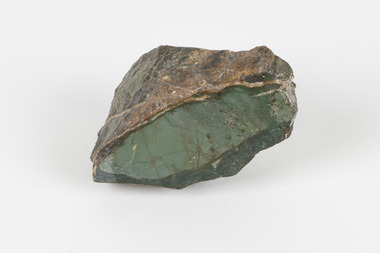
... films or tiny crystals in joint planes. The mineral name honours the late A. R. C. Selwyn, founding Director of the Geological Survey of Victoria. ...films or tiny crystals in joint planes. The mineral name honours the late A. R. C. Selwyn, founding Director of the Geological Survey of Victoria. ...Selwynite is a fine-grained, compact green rock made primarily of chromian muscovite (fuchsite) and diaspore. Corundum and fuchsite can occur together in the form of massive aggregates or nodules. Often, copper carbonates are found as earthy films or tiny crystals in joint planes. The mineral name honours the late A. R. C. Selwyn, founding Director of the Geological Survey of Victoria. The particular specimen, a mottled green stone suitable for carving was recovered and found in Heathcote, Victoria, Australia. The rarity and qualities of this mineral attracted commercial mining, which was not successful, but traces of the mine shafts still exist today, and it is still highly valued by mineral collectors.Selwynit is considered to be one of the rare forms of rock because it is composed of phosphate minerals containing zirconium. This is an extremely rare combination found in nature. This specimen is part of a larger collection of geological and mineral specimens collected from around Australia (and some parts of the world) and donated to the Burke Museum between 1868-1880. A large percentage of these specimens were collected in Victoria as part of the Geological Survey of Victoria that begun in 1852 (in response to the Gold Rush) to study and map the geology of Victoria. Collecting geological specimens was an important part of mapping and understanding the scientific makeup of the earth. Many of these specimens were sent to research and collecting organisations across Australia, including the Burke Museum, to educate and encourage further study.A fine grained rock composed of mainly of chromian muscovite (fuchsite) diaspore and corundum.geological specimen, geology, geology collection, burke museum, beechworth, mineralogy, heathcote, mineral collectors, selwynite, green rock, rock specimen -
 The Beechworth Burke Museum
Photograph - Lantern Slide, 1901
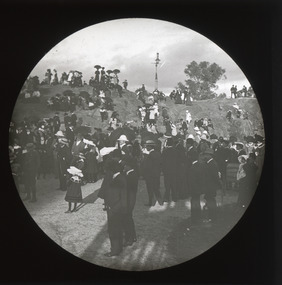
... It is also an example of an early photographic and film-making technology in use in regional Victoria in the time period. ...This glass slide captures the unveiling of the two cannons at Queen Victoria Park which were secured by Sir Isaac Isaacs and presented to Beechworth in 1901. In the foreground, elegantly dressed ladies and dapper gentlemen can be seen gathering around the park's iconic rock, with excited children looking on from the sides. Atop of the rock stands an intricately designed gas lamp that has since been removed but evidence of its existence still remains. The unveiling of these two cannons would have been a celebratory affair for those in attendance, marking a momentous occasion for Beechworth residents that was captured in this lantern slide. Sir Isaac Isaacs was an influential figure in Beechworth, having grown up and studied there. He began his education at the Common school and eventually graduated as dux of the Beechworth Grammar School. His commitment to public service was evident early on and he was elected to the Legislative Assembly in 1892, representing Bogong, a district which included Yackandandah and Beechworth. During his time in office he pushed for better education, healthcare, employment opportunities and housing for the people of Beechworth. Lantern slides, sometimes called 'magic lantern' slides, are glass plates on which an image has been secured for the purpose of projection. Glass slides were etched or hand-painted for this purpose from the Eighteenth Century but the process became more popular and accessible to the public with the development of photographic-emulsion slides used with a 'Magic Lantern' device in the mid-Nineteenth Century. Photographic lantern slides comprise a double-negative emulsion layer (forming a positive image) between thin glass plates that are bound together. A number of processes existed to form and bind the emulsion layer to the base plate, including the albumen, wet plate collodion, gelatine dry plate and woodburytype techniques. Lantern slides and magic lantern technologies are seen as foundational precursors to the development of modern photography and film-making techniques.This glass slide captures social and historical significance as it represents a moment of celebration for Beechworth residents and symbolises an important milestone in the town's history. This lantern slide stands testament to a special moment in Beechworth’s history and its significance continues to be remembered today. It is also an example of an early photographic and film-making technology in use in regional Victoria in the time period.Thin translucent sheet of glass with a circular image printed on the front and framed in a black backing. It is held together by metals strips to secure the edges of the slide. burke museum, beechworth, lantern slide, slide, glass slide, plate, burke museum collection, photograph, monochrome, queen victoria park, rock, victoria, cannons, isaac isaacs, governor-general, politicians, judges, indigo shire, north-east victoria, 19th century, nineteenth century, parks -
 The Beechworth Burke Museum
Photograph - Lantern Slide, c1900
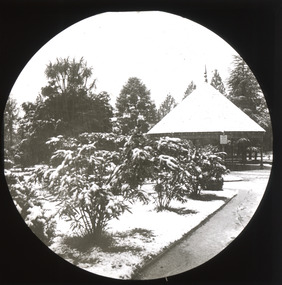
... It is also an example of an early photographic and film-making technology in use in regional Victoria in the time period. ...This image shows a pathway in the gardens adjacent to Beechworth's Town Hall at the beginning of the Twentieth Century, around the time of Australia's Federation. The pathway leading to a circular rotunda or covered seating area with a steep conical roof is lined with shrubs set in grass verges that appear to be covered with snow. It is unknown whether the snowfall or a factor to do with the gardens occasioned the taking of the image, which at the time may have been an exotic practice. Climate records going back to 1908 indicate that snow in winter is not unusual due to Beechworth's elevation and orientation, and the Town Hall itself was built in 1859. Lantern slides, sometimes called 'magic lantern' slides, are glass plates on which an image has been secured for the purpose of projection. Glass slides were etched or hand-painted for this purpose from the Eighteenth Century but the process became more popular and accessible to the public with the development of photographic-emulsion slides used with a 'Magic Lantern' device in the mid-Nineteenth Century. Photographic lantern slides comprise a double-negative emulsion layer (forming a positive image) between thin glass plates that are bound together. A number of processes existed to form and bind the emulsion layer to the base plate, including the albumen, wet plate collodion, gelatine dry plate and woodburytype techniques. Lantern slides and magic lantern technologies are seen as foundational precursors to the development of modern photography and film-making techniques. This glass slide is significant because it provides insight into Beechworth's social amenities and climate in the early Twentieth Century, around the time of Australia's Federation into one nation. It is also an example of an early photographic and film-making technology in use in regional Victoria in the time period. Thin translucent sheet of glass with a circular image printed on the front and framed in a black backing. It is held together by metals strips to secure the edges of the slide.burke museum, beechworth, lantern slide, slide, glass slide, plate, burke museum collection, photograph, monochrome, town hall, town hall gardens, snow, rotunda, magic lantern, indigo shire, north-east victoria, nineteenth century, 1900s, twentieth century, emulsion slides -
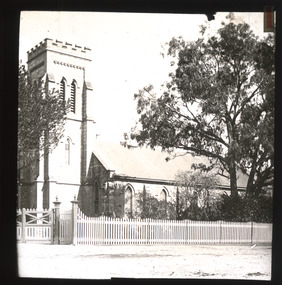 The Beechworth Burke Museum
Photograph - Lantern Slide, c1900
... It is also an example of an early photographic and film-making technology in use in regional Victoria in the time period. ...Beechworth's Anglican Church, Christ Church St Peter and St Paul, has served the Beechworth community since 1858 in its present form, following its beginnings in a tent in 1855. The Victorian branch of the National Trust classified the building as regionally significant in 1959 and the organ as of significance to the nation in 1992. Building a place for Anglican worship was a priority in the early days of Beechworth's settlement as the town was a site of regional administration due to its association with the economic and social expansion of Victoria during the Gold Rush period. The Church garden features several significant trees monitored by the Beechworth Treescape Group, including a cork oak growing near the Ford Street entrance, an Atlantic cedar, a bunya or bunya-bunya pine and two kurrajongs. Some of these long-established trees may be visible in this lantern-slide image. Lantern slides, sometimes called 'magic lantern' slides, are glass plates on which an image has been secured for the purpose of projection. Glass slides were etched or hand-painted for this purpose from the Eighteenth Century but the process became more popular and accessible to the public with the development of photographic-emulsion slides used with a 'Magic Lantern' device in the mid-Nineteenth Century. Photographic lantern slides comprise a double-negative emulsion layer (forming a positive image) between thin glass plates that are bound together. A number of processes existed to form and bind the emulsion layer to the base plate, including the albumen, wet plate collodion, gelatine dry plate and woodburytype techniques. Lantern slides and magic lantern technologies are seen as foundational precursors to the development of modern photography and film-making techniques.This glass slide is significant because it provides insight into Beechworth's social amenities and religious infrastructure in the late Nineteenth Century. It is also an example of an early photographic and film-making technology in use in regional Victoria in the time period.Thin translucent sheet of glass with a square image printed on the front and framed in a black backing. It is held together by metals strips to secure the edges of the slide.Obverse: 1 /beechworth, lantern slide, slide, glass slide, plate, burke museum collection, photograph, monochrome, christ church, indigo shire, north-east victoria, churches, architecture, anglican, religion, atlantic cedar, organ, magic lantern, christ church st peter and st paul, beechworth treescape group, cork oak, bunya pine, bunya bunya, kurrajong, quercus suber, cedrus atlantica f. glauca, araucaria bidwillii, brachychiton populneus -
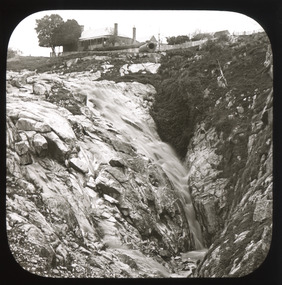 The Beechworth Burke Museum
Photograph - Lantern Slide, c1900
... It is also an example of an early photographic and film-making technology in use in regional Victoria in the time period. ...This image shows the gorge adjacent to Beechworth in approximately 1900. Although the exact location of the photograph is yet to be determined, the present-day Beechworth Gorge Walk includes views of the Cascades at the point at which Spring Creek flows into the valley on the level below. Gold-sluicing techniques in use in the town during periods of active gold extraction may have altered the landscape since the photograph was taken, however. In the 1850s a mill was built at the top of the Spring Creek falls by Russian-born Louis Chevalier, brother of artist Nicholas Chevalier. The mill supplied the town with lumber that supported the town's initial construction boom. Lantern slides, sometimes called 'magic lantern' slides, are glass plates on which an image has been secured for the purpose of projection. Glass slides were etched or hand-painted for this purpose from the Eighteenth Century but the process became more popular and accessible to the public with the development of photographic-emulsion slides used with a 'Magic Lantern' device in the mid-Nineteenth Century. Photographic lantern slides comprise a double-negative emulsion layer (forming a positive image) between thin glass plates that are bound together. A number of processes existed to form and bind the emulsion layer to the base plate, including the albumen, wet plate collodion, gelatine dry plate and woodburytype techniques. Lantern slides and magic lantern technologies are seen as foundational precursors to the development of modern photography and film-making techniques.This glass slide is significant because it provides insight into Beechworth's built environment and natural landscape in the early Twentieth Century, around the time of Australia's Federation. It is also an example of an early photographic and film-making technology in use in regional Victoria in the time period.Thin translucent sheet of glass with a square image printed on the front and framed in a black backing. It is held together by metals strips to secure the edges of the slide.burke museum, beechworth, lantern slide, slide, glass slide, plate, burke museum collection, photograph, monochrome, indigo shire, north-east victoria, spring creek falls, beechworth gorge, louis chevalier, nicholas chevalier, lumber industry, timber industry, 1850s, construction, building, mill, mills, waterfall -
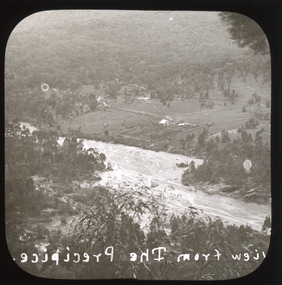 The Beechworth Burke Museum
Photograph - Lantern Slide, c1900
... It is also an example of an early photographic and film-making technology in use in regional Victoria in the time period. ...This image shows a semi-aerial view of a property along a river adjacent to Beechworth in approximately 1900. The photographer has capitalised words in the label, indicating that 'The Precipice' may have suggested a particular rather than a general vantage point to local people at the time. Although the exact location of the photograph is yet to be determined, Beechworth Gorge is popular today with hikers and nearby Mt Stanley is noted for its views. Lantern slides, sometimes called 'magic lantern' slides, are glass plates on which an image has been secured for the purpose of projection. Glass slides were etched or hand-painted for this purpose from the Eighteenth Century but the process became more popular and accessible to the public with the development of photographic-emulsion slides used with a 'Magic Lantern' device in the mid-Nineteenth Century. Photographic lantern slides comprise a double-negative emulsion layer (forming a positive image) between thin glass plates that are bound together. A number of processes existed to form and bind the emulsion layer to the base plate, including the albumen, wet plate collodion, gelatine dry plate and woodburytype techniques. Lantern slides and magic lantern technologies are seen as foundational precursors to the development of modern photography and film-making techniques.This glass slide is significant because it provides insight into Beechworth's built environment and natural landscape in the early Twentieth Century, around the time of Australia's Federation. It is also an example of an early photographic and film-making technology in use in regional Victoria in the time period.Thin translucent sheet of glass with a square image printed on the front and framed in a black backing. It is held together by metals strips to secure the edges of the slide.Obverse: Image from The Precipice. /burke museum, beechworth, lantern slide, slide, glass slide, plate, burke museum collection, photograph, monochrome, views, landscapes, farmsteads, rivers, beechworth gorge, mt stanley, emulsion, the precipice -
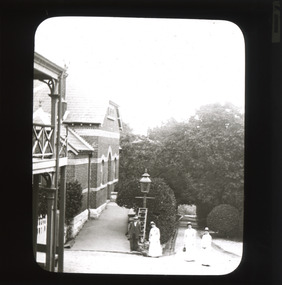 The Beechworth Burke Museum
Photograph - Lantern Slide, c1900
... It is also an example of an early photographic and film-making technology in use in regional Victoria in the time period. ...This image appears to show nurses at what is now the Mayday Hills Mental Asylum arriving for work in approximately 1900. These individuals are part of a long history of nursing in Beechworth. Three medical or social welfare facilities opened in the mid-1800s as part of a push by the township to become a regional centre for Government services. These were the Ovens District Hospital (opened in 1857), the Ovens Benevolent Asylum (opened in 1863), and the Beechworth Mental Hospital (opened in 1867 and renamed Mayday Hills Hospital at Centenary celebrations in 1967). It was recognised that the unsettled living conditions, poverty and relative isolation of the Goldfields environment could produce 'mental disturbances' which required local treatment facilities as services in Melbourne were too far away. Carole Woods' publication 'A Titan's Field' describes activities undertaken by patients at Beechworth Mental Hospital as including monthly balls and occasional concerts as well as work to make the facility self-supporting such as farm work and making clothes. She mentions a report in 1870 that the approximately 300 patients were clean and neat with 'no-one in restraint or seclusion' but that by 1905 the organisation had 623 patients which placed strain on building infrastructure such as heating and water supplies, leading to high turnover of nurses and other issues. A program of building works to extend and improve facilities followed over subsequent decades. Lantern slides, sometimes called 'magic lantern' slides, are glass plates on which an image has been secured for the purpose of projection. Glass slides were etched or hand-painted for this purpose from the Eighteenth Century but the process became more popular and accessible to the public with the development of photographic-emulsion slides used with a 'Magic Lantern' device in the mid-Nineteenth Century. Photographic lantern slides comprise a double-negative emulsion layer (forming a positive image) between thin glass plates that are bound together. A number of processes existed to form and bind the emulsion layer to the base plate, including the albumen, wet plate collodion, gelatine dry plate and Woodburytype techniques. Lantern slides and magic lantern technologies are seen as foundational precursors to the development of modern photography and film-making techniques This glass slide is significant because it provides insight into Beechworth's social and medical amenities in the early Twentieth Century, around the time of Australia's Federation into one nation. It is also an example of an early photographic and film-making technology in use in regional Victoria in the time period.Thin translucent sheet of glass with a rectangular image printed on the front and framed in a black backing. It is held together by metals strips to secure the edges of the slide.Obverse: i /burke museum, beechworth, lantern slide, slide, glass slide, plate, burke museum collection, photograph, monochrome, magic lantern, indigo shire, north-east victoria, nineteenth century, 1900s, twentieth century, emulsion slides, nursing, nurses, mental hospitals, lunatic asylums, asylums, social services, social welfare, insane asylums, mental health, infrastructure -
 The Beechworth Burke Museum
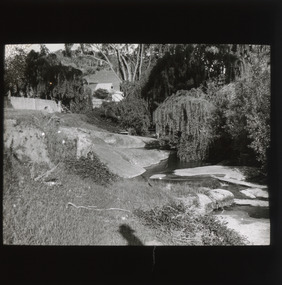
Photograph - Lantern Slide, c1900
... It is also an example of an early photographic and film-making technology in use in regional Victoria in the time period. ...This image shows a view of a properties bordering a river in the vicinity of Beechworth in approximately 1900. Although the exact location of the photograph is yet to be determined, the water source pictured may feed into the bigger system that flows through Beechworth Gorge. A man wearing a hat, possibly the photographer, is silhouetted in the foreground of the picture. Lantern slides, sometimes called 'magic lantern' slides, are glass plates on which an image has been secured for the purpose of projection. Glass slides were etched or hand-painted for this purpose from the Eighteenth Century but the process became more popular and accessible to the public with the development of photographic-emulsion slides used with a 'Magic Lantern' device in the mid-Nineteenth Century. Photographic lantern slides comprise a double-negative emulsion layer (forming a positive image) between thin glass plates that are bound together. A number of processes existed to form and bind the emulsion layer to the base plate, including the albumen, wet plate collodion, gelatine dry plate and woodburytype techniques. Lantern slides and magic lantern technologies are seen as foundational precursors to the development of modern photography and film-making techniques.This glass slide is significant because it provides insight into Beechworth's built environment and natural landscape in the early Twentieth Century, around the time of Australia's Federation. It is also an example of an early photographic and film-making technology in use in regional Victoria in the time period.Thin translucent sheet of glass with a square image printed on the front and framed in a black backing. It is held together by metals strips to secure the edges of the slide.burke museum, beechworth, lantern slide, slide, glass slide, plate, burke museum collection, photograph, monochrome, photographer, beechworth gorge, river, stream, water source, 1900s -
 The Beechworth Burke Museum
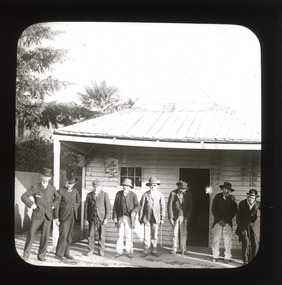
Photograph - Lantern Slide, c1900
... It is also an example of an early photographic and film-making technology in use in regional Victoria in the time period. ...This image shows six older Chinese men standing in a row with two younger non-Chinese men outside a small wooden business or official building in the Beechworth region, circa 1900. The two non-Chinese men are wearing clothes of the period that indicate relative prosperity (such as three piece suits, top hats, and a pocket handkerchief), whereas most of the Chinese men are wearing Western-style working clothes of the era. One Chinese man at the far right of the image is wearing similar garments to the non-Chinese men, including a bowler hat and longer, more tailored suit jacket. Chinese miners were a significant cultural group in Beechworth's gold rush period. Carole Woods' history of Beechworth, 'A Titan's Field', details that there were approximately 60 Chinese people in the area in 1855, more than 1000 in 1856 and 4700 (a quarter of the population) in 1857, despite the introduction in 1855 of official policies such as additional taxes formulated by the Victorian Government to limit access by Chinese immigrants. Most Chinese miners in the region came from southern China and had formerly worked as merchants, mechanics, farmers and shop-keepers. Chinese people were subjected to a 'protectorate' system, ostensibly to minimise the potential for conflict with other groups; this system required Chinese people to live in designated 'hygienic' camps with paid Chinese headmen who supervised the village and enforced the protectorate's rules. Chinese people were required to purchase an annual protection ticket to fund this system. The protectorate system was abolished in 1861, before this image was taken in approximately 1900, but it may still provide insight into social stratification or relationships between and within cultural groups in Beechworth resulting from such practices. Lantern slides, sometimes called 'magic lantern' slides, are glass plates on which an image has been secured for the purpose of projection. Glass slides were etched or hand-painted for this purpose from the Eighteenth Century but the process became more popular and accessible to the public with the development of photographic-emulsion slides used with a 'Magic Lantern' device in the mid-Nineteenth Century. Photographic lantern slides comprise a double-negative emulsion layer (forming a positive image) between thin glass plates that are bound together. A number of processes existed to form and bind the emulsion layer to the base plate, including the albumen, wet plate collodion, gelatine dry plate and Woodburytype techniques. Lantern slides and magic lantern technologies are seen as foundational precursors to the development of modern photography and film-making techniques.This glass slide is significant because it provides insight into Beechworth's cultural and social relationships in the early Twentieth Century, in particular the experiences of Chinese miners. It is also an example of an early photographic and film-making technology in use in regional Victoria in the time period.Thin translucent sheet of glass with a circular image printed on the front and framed in a black backing. It is held together by metals strips to secure the edges of the slide.burke museum, beechworth, lantern slide, slide, glass slide, plate, burke museum collection, photograph, monochrome, magic lantern, indigo shire, north-east victoria, nineteenth century, 1900s, twentieth century, emulsion slides, chinese, chinese miners, protectorate system, protection licence, immigration, racism, classism, social groups, cultural groups, taxes, hygiene camps -
 The Beechworth Burke Museum
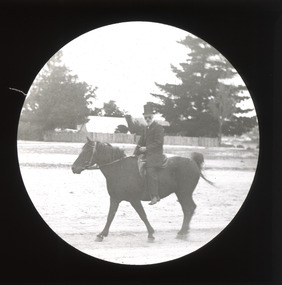
Photograph - Lantern Slide, c1900
... It is also an example of an early photographic and film-making technology in use in regional Victoria in the time period. ...This image of a man on horseback is thought to have been taken in Beechworth in approximately 1900. The man pictured may be Chinese. Chinese miners were a significant cultural group in Beechworth's gold rush period. Carole Woods' history of Beechworth, 'A Titan's Field', details a rapid increase in the Chinese population beginning in 1856 that led to Government discrimination and hostility from other miners. Many Chinese people who came to the Victorian goldfields had formerly worked as merchants, mechanics, farmers and shop-keepers. The pictured individual is wearing Western-style clothes indicating prosperity, such as a top hat, so may have held an official position or provided services to the community rather than working as a miner. Lantern slides, sometimes called 'magic lantern' slides, are glass plates on which an image has been secured for the purpose of projection. Glass slides were etched or hand-painted for this purpose from the Eighteenth Century but the process became more popular and accessible to the public with the development of photographic-emulsion slides used with a 'Magic Lantern' device in the mid-Nineteenth Century. Photographic lantern slides comprise a double-negative emulsion layer (forming a positive image) between thin glass plates that are bound together. A number of processes existed to form and bind the emulsion layer to the base plate, including the albumen, wet plate collodion, gelatine dry plate and Woodburytype techniques. Lantern slides and magic lantern technologies are seen as foundational precursors to the development of modern photography and film-making techniques.This glass slide is significant because it provides insight into Beechworth's cultural and social relationships in the early Twentieth Century, in particular the experiences of Chinese people. It is also an example of an early photographic and film-making technology in use in regional Victoria in the time period.Thin translucent sheet of glass with a circular image printed on the front and framed in a black backing. It is held together by metals strips to secure the edges of the slide.burke museum, beechworth, lantern slide, slide, glass slide, plate, burke museum collection, photograph, monochrome, magic lantern, indigo shire, north-east victoria, nineteenth century, 1900s, twentieth century, emulsion slides, chinese, chinese miners, immigration, racism, classism, social groups, cultural groups, horse riding, horses, equestrian, horseback -
 The Beechworth Burke Museum
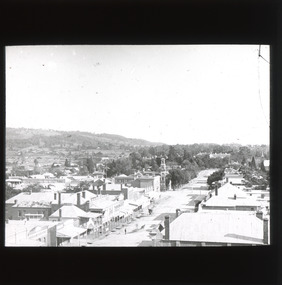
Photograph - Lantern Slide, c1900
... It is also an example of an early photographic and film-making technology in use in regional Victoria in the time period. ...This image shows a semi-aerial view of commercial and official properties lining Ford Street, Beechworth, in approximately 1900. The tower of Christ Church of St Peter and St Paul can be seen in the middle section of the photograph, on the left-hand side of the street. The Church was constructed in 1858 with the tower added to the structure in 1864. Lantern slides, sometimes called 'magic lantern' slides, are glass plates on which an image has been secured for the purpose of projection. Glass slides were etched or hand-painted for this purpose from the Eighteenth Century but the process became more popular and accessible to the public with the development of photographic-emulsion slides used with a 'Magic Lantern' device in the mid-Nineteenth Century. Photographic lantern slides comprise a double-negative emulsion layer (forming a positive image) between thin glass plates that are bound together. A number of processes existed to form and bind the emulsion layer to the base plate, including the albumen, wet plate collodion, gelatine dry plate and woodburytype techniques. Lantern slides and magic lantern technologies are seen as foundational precursors to the development of modern photography and film-making techniques.This glass slide is significant because it provides insight into Beechworth's built environment and commercial and official infrastructure in the early Twentieth Century, around the time of Australia's Federation into one nation. It is also an example of an early photographic and film-making technology in use in regional Victoria in the time period.Thin translucent sheet of glass with a square image printed on the front and framed in a black backing. It is held together by metals strips to secure the edges of the slide.burke museum, beechworth, lantern slide, slide, glass slide, plate, burke museum collection, photograph, monochrome, ford street, christ church of st peter and st paul, church tower, landmarks, 1900, shopping facilities, public buildings, 1900s, built environment, streetscape -
 The Beechworth Burke Museum
Photograph - Lantern Slide, c1900
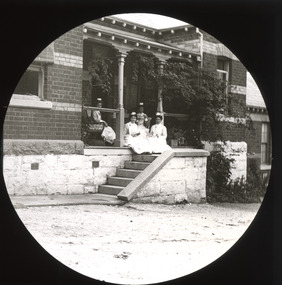
... It is also an example of an early photographic and film-making technology in use in regional Victoria in the time period. ...This image appears to show nurses at what is now the Mayday Hills Mental Asylum in approximately 1900. These individuals are part of a long history of nursing in Beechworth. Three medical or social welfare facilities opened in the mid-1800s as part of a push by the township to become a regional centre for Government services. These were the Ovens District Hospital (opened in 1857), the Ovens Benevolent Asylum (opened in 1863), and the Beechworth Mental Hospital (opened in 1867 and renamed Mayday Hills Hospital at Centenary celebrations in 1967). It was recognised that the unsettled living conditions, poverty and relative isolation of the Goldfields environment could produce 'mental disturbances' which required local treatment facilities as services in Melbourne were too far away. Carole Woods' publication 'A Titan's Field' describes activities undertaken by patients at Beechworth Mental Hospital as including monthly balls and occasional concerts as well as work to make the facility self-supporting such as farm work and making clothes. She mentions a report in 1870 that the approximately 300 patients were clean and neat with 'no-one in restraint or seclusion' but that by 1905 the organisation had 623 patients which placed strain on building infrastructure such as heating and water supplies, leading to high turnover of nurses and other issues. A program of building works to extend and improve facilities followed over subsequent decades. Lantern slides, sometimes called 'magic lantern' slides, are glass plates on which an image has been secured for the purpose of projection. Glass slides were etched or hand-painted for this purpose from the Eighteenth Century but the process became more popular and accessible to the public with the development of photographic-emulsion slides used with a 'Magic Lantern' device in the mid-Nineteenth Century. Photographic lantern slides comprise a double-negative emulsion layer (forming a positive image) between thin glass plates that are bound together. A number of processes existed to form and bind the emulsion layer to the base plate, including the albumen, wet plate collodion, gelatine dry plate and Woodburytype techniques. Lantern slides and magic lantern technologies are seen as foundational precursors to the development of modern photography and film-making techniques.This glass slide is significant because it provides insight into Beechworth's social and medical amenities in the early Twentieth Century, around the time of Australia's Federation into one nation. It is also an example of an early photographic and film-making technology in use in regional Victoria in the time period.Thin translucent sheet of glass with a circular image printed on the front and framed in a black backing. It is held together by metals strips to secure the edges of the slide.burke museum, beechworth, lantern slide, slide, glass slide, plate, burke museum collection, photograph, monochrome, magic lantern, indigo shire, north-east victoria, nineteenth century, 1900s, twentieth century, emulsion slides, nursing, nurses, mental hospitals, lunatic asylums, asylums, social services, social welfare, insane asylums, mental health, infrastructure -
 The Beechworth Burke Museum
Photograph - Lantern Slide, c1900
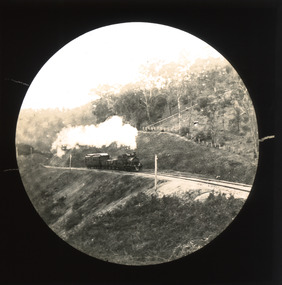
... It is also an example of an early photographic and film-making technology in use in regional Victoria in the time period. ...This slide shows a train proceeding along the Beechworth rail trail in approximately 1900. The rail line to Beechworth was the subject of significant lobbying by local officials such as John Orr and G.B. Kerferd in the 1860s, as it was recognised that the poor quality of roads to Melbourne and Albury hindered trade and formed a barrier to the social development of the town. The subsequent positioning of Beechworth on a branch rather than a main line was not considered ideal to achieve these aims, but the Everton-to-Beechworth and Beechworth-to-Yackandandah components of the line cost an average of £7,277 per mile and State Government officials felt the need in the area did not justify the cost of a direct line. The Beechworth Railway Station was officially opened on the 29th of September 1876 and ran services twice daily to Melbourne, transporting nearly 12,000 passengers and around 6,500 tons of cargo in 1900. It closed in 1976 and is today used as a cycling trail used by locals and promoted as a feature of the area to tourists. Lantern slides, sometimes called 'magic lantern' slides, are glass plates on which an image has been secured for the purpose of projection. Glass slides were etched or hand-painted for this purpose from the Eighteenth Century but the process became more popular and accessible to the public with the development of photographic-emulsion slides used with a 'Magic Lantern' device in the mid-Nineteenth Century. Photographic lantern slides comprise a double-negative emulsion layer (forming a positive image) between thin glass plates that are bound together. A number of processes existed to form and bind the emulsion layer to the base plate, including the albumen, wet plate collodion, gelatine dry plate and Woodburytype techniques. Lantern slides and magic lantern technologies are seen as foundational precursors to the development of modern photography and film-making techniques.This glass slide is significant because it provides insight into Beechworth's social amenities and transport infrastructure in the late Nineteenth Century. It is also an example of an early photographic and film-making technology in use in regional Victoria in the time period.Thin translucent sheet of glass with a circular image printed on the front and framed in a black backing. It is held together by metal strips to secure the edges of the slide.burke museum, beechworth, lantern slide, slide, glass slide, plate, burke museum collection, photograph, monochrome, indigo shire, north-east victoria, rail trail, beechworth rail trail, beechworth station, everton, wangaratta, wodonga, albury, rail transport, cargo transport, g.b. kerferd, john orr, murray to mountains rail trail, cycling, biking, railway
