
Showing 20 items matching " franc"
-
 Kilmore Historical Society
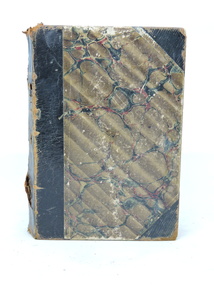
Emily' Choice, Emily's Choice, 1875
... An Australian tale written by Maud Jeanne Franc, author of "Marian" and "Vermont Vale, etc. ...Maud Jeanne Franc...An Australian tale written by Maud Jeanne Franc, author of "Marian" and "Vermont Vale, etc. ...An Australian tale written by Maud Jeanne Franc, author of "Marian" and "Vermont Vale, etc. New Edition.Brown/green marbelled board cover with black leather spine and corners. Spine torn and worn. "Mechanics Institute Kilmore' printed on spine in gilt. Corners of cover very worn, loss of marbelling. Binding loose. 358 pp. Fair condition.Flyleaf, '434' crossed out in red ink. '256' hand written in red ink/Kilmore Mechanics Institute stamp.adult fiction, kilmore mechanics institute library. -
 Stawell Historical Society Inc
Book, Maud Jean Franc, Minnie’s Mission, 1889
... Maud Jean Franc...To Martha Trask Minnie’s Mission Book Maud Jean Franc ...Campbells Bridge Presbyterian Sunday School. To Martha Traskstawell education religion -
 Bendigo Military Museum
Photograph - PORTRAITS, PHOTOGRAPHIC, August 1942
... .2) “With best wishes from Franc Russell”...Photographs Army portraits .2) “With best wishes from Franc Russell” Three Photos all the same person, rectangular shape B & W portraits, soldier in uniform no hat on. .1)This one on a brownish card with cobweb interwoven design. .2).3) Both the same, .2) has hand written details on. ...It is unsure who this is, photos came in with collection relating to the Myers brothers 38th Bn WW1.Three Photos all the same person, rectangular shape B & W portraits, soldier in uniform no hat on. .1)This one on a brownish card with cobweb interwoven design. .2).3) Both the same, .2) has hand written details on..2) “With best wishes from Franc Russell”photographs, army, portraits, -
 Bendigo Military Museum
Currency - CURRENCY, ASSORTED, estimated 1940-1945
... Banknotes from various countries. .1) 5 Sen, bluish colour, Asian .2) 1/2 shilling, Japanese Govt, purplish colour .3) 5 Yen, green, red & blue .4) Asian , redish colour, RF 302054 .5) 5 Francs, Noumea, redish colour .6) 20 Francs Noumea, purple/ green, with lyrebird illustration ...Currency notes Asian Banknotes from various countries. .1) 5 Sen, bluish colour, Asian .2) 1/2 shilling, Japanese Govt, purplish colour .3) 5 Yen, green, red & blue .4) Asian , redish colour, RF 302054 .5) 5 Francs, Noumea, redish colour .6) 20 Francs Noumea, purple/ green, with lyrebird illustration Currency CURRENCY, ASSORTED ...In the collection belonging to H.J.B.Burrell BEM MM, VX 59659. Refer Cat No 298.4 for his service details.Banknotes from various countries. .1) 5 Sen, bluish colour, Asian .2) 1/2 shilling, Japanese Govt, purplish colour .3) 5 Yen, green, red & blue .4) Asian , redish colour, RF 302054 .5) 5 Francs, Noumea, redish colour .6) 20 Francs Noumea, purple/ green, with lyrebird illustration currency, notes, asian -
 Beaufort Historical Society
Photograph, Eurambeen Hotel and Wedding August 15 1906, August 1906
... on rear "Wedding day of Tom Liston and Nora Kelly Eurambeen Hotel Joe Franc and Auntie Ellen left of Photo...Liston/Kelly Wedding reported to be first nuptial mass at Beaufort Roman Catholic Church Beaufort - People Liston Family Kelly Family Beaufort District Hotels Eurambeen on rear "Wedding day of Tom Liston and Nora Kelly Eurambeen Hotel Joe Franc and Auntie Ellen left of Photo Black and White Photograph Eurambeen Hotel and Wedding August 15 1906 Photograph ...Early Hotel and Wedding at Eurambeen. Pioneer families. Eurambeen Hotel first licensed by Matthew Kelly Dec 1884. License Taken over by his wife Catherine after Matthew's death in July 1888. Closed in March 1919.Early Hotel at Eurambeen. Liston/Kelly Wedding reported to be first nuptial mass at Beaufort Roman Catholic ChurchBlack and White Photographon rear "Wedding day of Tom Liston and Nora Kelly Eurambeen Hotel Joe Franc and Auntie Ellen left of Photobeaufort - people, liston family, kelly family, beaufort district hotels, eurambeen -
 Slovenian Association Melbourne
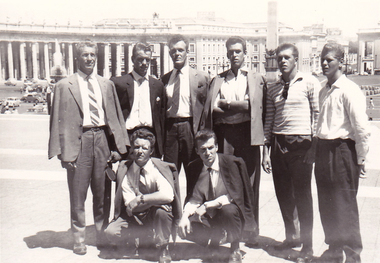
Rome, photo, Rome 1960, M Krsevan, L Markic, F Saule, R Koloini, K Strancar, Florjan, D Ziberna and I Mihelj, 31/7/1960
... Miro Krsevan, Alojz Markic, Franc Savle, Rudi Koloini, Karlo Strancar, Florijan Vidmar , Darjo Ziberna and Ivo Mihelj...Miro Krsevan, Alojz Markic, Franc Savle, Rudi Koloini, Karlo Strancar, Florijan Vidmar , Darjo Ziberna and Ivo Mihelj Rome 1960, M Krsevan, L Markic, F Saule, R Koloini, K Strancar, Florjan, D Ziberna and I Mihelj Rome, photo ...A group of Slovenian friends on a sightseeing trip from refugee camp Latina to the eternal city of ROMERefugees to Italy, Slovenian riends exploring RomeBlack and white photo of a group of Slovenian refugees from Latina on a visit to Rome. Miro Krsevan, Alojz Markic, Franc Savle, Rudi Koloini, Karlo Strancar, Florijan Vidmar , Darjo Ziberna and Ivo Miheljslovenians visiting rome, slovenian association melbourne -
 Slovenian Association Melbourne
Photo Mountaineers Dance - Planinska zabava 1955, Mountaineers Dance - Planinska zabava 1955, 1955
... Some people who attended: Mici Hartman, Max Hartman senior, Mima Adamic, Martin Adamic, Marijan Persic, Franc Hartman, Tinka Verbic, Zladko Verbic, Zerdoner Vekoslav, Mrs Potocnik....Some people who attended: Mici Hartman, Max Hartman senior, Mima Adamic, Martin Adamic, Marijan Persic, Franc Hartman, Tinka Verbic, Zladko Verbic, Zerdoner Vekoslav, Mrs Potocnik. ...Slovenians are very proud of their mountain Mt Triglav, towering 2864m high in the Alps region of Slovenia. It is their symbol of greatness, might, power and strength. They love to sing songs about Mt Triglav, they used the mountain as the emblem and in many ways culturally.The Aljaž tower was built with card and painted for the occasionBlack and white photo of some participants of the Mountaineers dance in 1955 held at Prahran Town hall. Some people who attended: Mici Hartman, Max Hartman senior, Mima Adamic, Martin Adamic, Marijan Persic, Franc Hartman, Tinka Verbic, Zladko Verbic, Zerdoner Vekoslav, Mrs Potocnik.The photo showcases the Aljaž tover, which stands on top of Mt Triglav, the highest mountain in Slovenia (2984m) and the participants enjoying the eventmt trigla, aljaž tower, slovenian alps, slovenian club melbourne -
 Supreme Court of Victoria Library
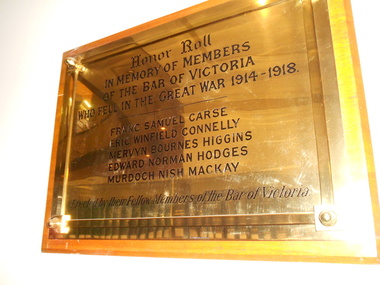
Memorial Board, PJ King, World War One Memorial Board - Bar Council, 1920
... Honor Roll in memory of members of the Bar of Victoria who fell in the Great War 1914-1918, Franc Samuel Carse, Eric Winfield Connelly, Mervyn Bourne Higgins, Edward Norman Hodges, Murdoch Nish Mackay, Erected by their fellow members of the Bar of Victoria...Two of the men commemorated on the board were sons of judges (Higgins, son of the Justice Henry Bourne Higgins of the High Court and Hodges, son of Justice Henry Hodges of the Supreme Court). Franc Carse was related by marriage to the a’Beckett family (also judges of the Court) and his father in law was on the Supreme Court Library committee in 1914. ...Library Committee minutes from 1920 discuss the placing of an Honour Board in the Library, there was obviously some discussion from the Ballarat and Bendigo Law Associations about whom should be placed on the board and whether it was appropriate that it be located in the library. The board was donated by the Committee of Counsel, from the Bar and so only commemorates barristers. It is curious that this was not placed in Selborne Chambers where many barristers had rooms including one of the men on the Board (Higgins). This board joined the much bigger LIV memorial board that celebrates all Victorian lawyers who served during WWI.While memorial boards are a common addition to many public and civic building after World War One. This memorial board is the only one that commemorates members of the Bar, in that sense it is of great significance to the legal community. Two of the men commemorated on the board were sons of judges (Higgins, son of the Justice Henry Bourne Higgins of the High Court and Hodges, son of Justice Henry Hodges of the Supreme Court). Franc Carse was related by marriage to the a’Beckett family (also judges of the Court) and his father in law was on the Supreme Court Library committee in 1914. Eric Connelly and Murdoch Mackay shared rooms in Selborne Chambers. Connelly died in late 1918 in France, a member of General Pompey Elliott’s staff. Connelly had previously taken part in the Gallipoli landings in April 1915. Mackay served at Gallipoli and died in France in 1916, he was Major, but only 25 at the time of his death.brass and wood, black lettering.Honor Roll in memory of members of the Bar of Victoria who fell in the Great War 1914-1918, Franc Samuel Carse, Eric Winfield Connelly, Mervyn Bourne Higgins, Edward Norman Hodges, Murdoch Nish Mackay, Erected by their fellow members of the Bar of Victoriamemorial boards; carse, connelly, higgins, hodges, mackay -
 Slovenian Association Melbourne
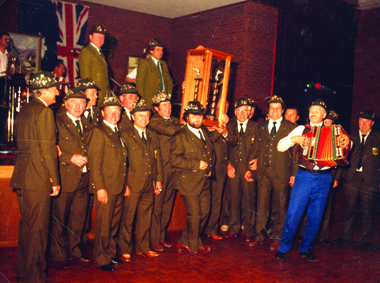
Colour photo, Slovenian Association melbourne Hunters and Anglers section Perpetual Trophy
... First Row: Stan Prosenak,Stefan Baligac, Tone Knap, Franc Arnus, unknown, Marijan Preloznik, Joze Golenko, Viktor Lampe, Martin Adamic Second row:Tilio Udovic, Valter Prosenak. ...First Row: Stan Prosenak,Stefan Baligac, Tone Knap, Franc Arnus, unknown, Marijan Preloznik, Joze Golenko, Viktor Lampe, Martin Adamic Second row:Tilio Udovic, Valter Prosenak. ...Colour photo of the celebration of winning the Perpetual trophy for air rifle shooting competiotion among the Slovenian Hunters group in Victoria. First Row: Stan Prosenak,Stefan Baligac, Tone Knap, Franc Arnus, unknown, Marijan Preloznik, Joze Golenko, Viktor Lampe, Martin Adamic Second row:Tilio Udovic, Valter Prosenak. On stage: Frank Fekonja, Slavko Licen. slovenian association melbourne, hunters and anglers, trophy -
 Bendigo Military Museum
Currency - COINS
... Collection of 7 coins from Britain, Belgium, Germany and France .1 British penny, bronze .2 German 10 pfennig, silver coloured, 1912 .3 German 1 pfennig, bronze coloured, 1900 .4 French 1 franc, silver coloured, 1913 .5 French 25 centime, silver coloured, 1905 .6 French 25 centime, silver coloured, 1903 .7 Belgian coin...Refer Cat No 1280 for service details. nuimismatics coins Collection of 7 coins from Britain, Belgium, Germany and France .1 British penny, bronze .2 German 10 pfennig, silver coloured, 1912 .3 German 1 pfennig, bronze coloured, 1900 .4 French 1 franc, silver coloured, 1913 .5 French 25 centime, silver coloured, 1905 .6 French 25 centime, silver coloured, 1903 .7 Belgian coin Currency COINS ...The coins were collected by Jack Grinton No 1043, 38th Batt AIF during 1916-19. Part of the Grinton collection which contained hundreds of negatives and developed photos that he took during the War. Refer Cat No 1280 for service details.Collection of 7 coins from Britain, Belgium, Germany and France .1 British penny, bronze .2 German 10 pfennig, silver coloured, 1912 .3 German 1 pfennig, bronze coloured, 1900 .4 French 1 franc, silver coloured, 1913 .5 French 25 centime, silver coloured, 1905 .6 French 25 centime, silver coloured, 1903 .7 Belgian coinnuimismatics, coins -
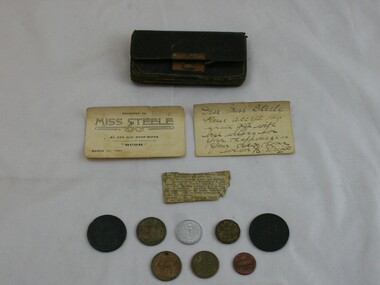 Emerald Museum & Nobelius Heritage Park
Domestic object - Leather purse, Unknown maker, 1907
... Coins - UK 1943 threepence, 2 X UK 1907 halfpenny (one with hole in it), French 1952 twenty franc, USA one cent, UK 1906 one shilling. ...Coins - UK 1943 threepence, 2 X UK 1907 halfpenny (one with hole in it), French 1952 twenty franc, USA one cent, UK 1906 one shilling. ...This purse was a donation to the Fernlea House Opportunity Shop in Emerald which the shop then donated to the Museum. The identity of Miss Steele is a mystery but it is impressive that printed cards were manufactured on the occasion of her leaving her workplace in the city for the "Bush"Small leather purse with brass clips and 4 compartments containing hand written note to "Mrs. Steele" from "Mrs Wright" and old coins and tokens. Coins - UK 1943 threepence, 2 X UK 1907 halfpenny (one with hole in it), French 1952 twenty franc, USA one cent, UK 1906 one shilling. Card -presented to Miss Steele by her old shop mates. "Bush" March 27, 1907. Newspaper cutting - in back pocket, T.W. Bull, disease reader and herbalist - advertisement.Card: printed 'Presented to Miss Steele, by her old shop-mates on the occasion of her leaving for the "BUSH". March 27, 1907.' Card: handwritten 'Dear Miss Steele, Please accept this small gift with best wishes for your happiness in your new home. With love N. Wright'purse, 1900s, coins -
 Women's Art Register
Archive (Collection) - Bessie Davidson Artist Archive
... ... Franc...1879-1965 Figurative Modernism Franc Margaret Preston Societé des Beaux Arts Slon des Tuileries Femmes Peintres Femmes Artistes Modernes Paris Chevalier de la Légion d'Honneur. ...figurative, modernism, franc, margaret preston, societé des beaux arts, slon des tuileries, femmes peintres, femmes artistes modernes paris, chevalier de la légion d'honneur. , paintingfigurative, modernism, franc, margaret preston, societé des beaux arts, slon des tuileries, femmes peintres, femmes artistes modernes paris, chevalier de la légion d'honneur. , painting -
Women's Art Register
Archive (Series) - Davidson, Bessie. Artist File 1
... ... Franc...Figurative Modernism Franc Margaret Preston Societé des Beaux Arts Slon des Tuileries Femmes Peintres Femmes Artistes Modernes Paris Chevalier de la Légion d'Honneur. ...Promotional Material, Biographyfigurative, modernism, franc, margaret preston, societé des beaux arts, slon des tuileries, femmes peintres, femmes artistes modernes paris, chevalier de la légion d'honneur. , paintingfigurative, modernism, franc, margaret preston, societé des beaux arts, slon des tuileries, femmes peintres, femmes artistes modernes paris, chevalier de la légion d'honneur. , painting -
Women's Art Register
Archive (Series) - Bessie Davidson. Duplicate File 1
... ... Franc...Painting Figurative Modernism Franc Margaret Preston Societé des Beaux Arts Slon des Tuileries Femmes Peintres Femmes Artistes Modernes Paris Chevalier de la Légion d'Honneur. ...Promotional Material, Biographypainting, figurative, modernism, franc, margaret preston, societé des beaux arts, slon des tuileries, femmes peintres, femmes artistes modernes paris, chevalier de la légion d'honneur.painting, figurative, modernism, franc, margaret preston, societé des beaux arts, slon des tuileries, femmes peintres, femmes artistes modernes paris, chevalier de la légion d'honneur. -
 Seaworks Maritime Museum
Menu
... "m.v PORT SYDNEY Voyage 31/ LANDFALL DINNER/ Walpole Cocktail/ Cream Rowsell/ Crumbed Salmon Francine/ Tomato Finchaven/ Roast Keane Turkey St. Franc/ Baked Ham Myrtle/ Brussels Dubois Macedoine a la Morgan/ Gairdner & Punter Potatoes/ COLD BUFFET/ Spare ribs of Liddle Sydney Sausage/ Salad Nicole/ Coupe Barr-None White Sauce/ Coffee/ Saturday 5th October 1968 At Sea/ The names of the passengers woven into the menu"..."m.v PORT SYDNEY Voyage 31/ LANDFALL DINNER/ Walpole Cocktail/ Cream Rowsell/ Crumbed Salmon Francine/ Tomato Finchaven/ Roast Keane Turkey St. Franc/ Baked Ham Myrtle/ Brussels Dubois Macedoine a la Morgan/ Gairdner & Punter Potatoes/ COLD BUFFET/ Spare ribs of Liddle Sydney Sausage/ Salad Nicole/ Coupe Barr-None White Sauce/ Coffee/ Saturday 5th October 1968 At Sea/ The names of the passengers woven into the menu" Paper menu printed with black text Menu ...Paper menu printed with black text"m.v PORT SYDNEY Voyage 31/ LANDFALL DINNER/ Walpole Cocktail/ Cream Rowsell/ Crumbed Salmon Francine/ Tomato Finchaven/ Roast Keane Turkey St. Franc/ Baked Ham Myrtle/ Brussels Dubois Macedoine a la Morgan/ Gairdner & Punter Potatoes/ COLD BUFFET/ Spare ribs of Liddle Sydney Sausage/ Salad Nicole/ Coupe Barr-None White Sauce/ Coffee/ Saturday 5th October 1968 At Sea/ The names of the passengers woven into the menu" -
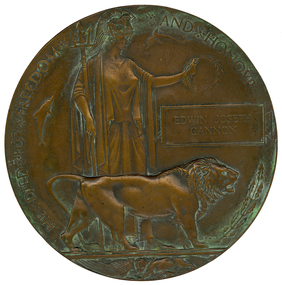 Federation University Historical Collection
Medal - Numismatics, 'Dead Man's Penny' for Edwin Joseph 'Ted' Cannon, c1919
... Another listing gives his effects as "identity disc, letters, photos, wallet, 2 books, Mexican Dollar, 1 cent (Ceylon), 3 German Straps, Fountain Pen, Cigarette-holder, Franc Note, 50 centimes Note, devotional book, mirror, rosary, scapula, metal ring, two combs, book of views, nail clippers, badges, tie clip, Egyptian stamp....Another listing gives his effects as "identity disc, letters, photos, wallet, 2 books, Mexican Dollar, 1 cent (Ceylon), 3 German Straps, Fountain Pen, Cigarette-holder, Franc Note, 50 centimes Note, devotional book, mirror, rosary, scapula, metal ring, two combs, book of views, nail clippers, badges, tie clip, Egyptian stamp. ...The Dead Man’s Penny is a commemorative medallion which was presented to the next-of-kin of the men and women from England and the Empire who died during World War One. The Dead Man’s Penny was accompanied by a letter from King George V, stating ‘I join with my grateful people in sending you this memorial of a brave life given for others in the Great War’.[http://nma.gov.au/blogs/education/2010/11/14/dead-mans-penny/] Popularly known as the "Dead Man’s Penny", because of the similarity in appearance to the somewhat smaller penny coin. 1,355,000 plaques were issued, which used a total of 450 tonnes of bronze, and continued to be issued into the 1930s to commemorate people who died as a consequence of the war. [http://en.wikipedia.org/wiki/Memorial_Plaque_(medallion)] It was decided that the design of the plaque was to be picked from submissions made in a public competition. Over 800 designs were submitted and the competition was won by the sculptor and medallist Edward Carter Preston with his design called Pyramus, receiving a first place prize of £250.[http://en.wikipedia.org/wiki/Memorial_Plaque_(medallion)] They were initially made at the Memorial Plaque Factory, 54/56 Church Road, Acton, W3, London from 1919. Early plaques did not have a number stamped on them but later ones have a number stamped behind the lion's back leg. [http://en.wikipedia.org/wiki/Memorial_Plaque_(medallion)] Ted Cannon's plaquette does not have a stamped number. Ted Cannon was a gifted artist and cartoonist who studied at the Ballarat School of Mines Technical Art School. During the Battle of Pozieres on the Western Front Ted Cannon worked with the Scout Platoon sketching the enemy's gun emplacements. Ted proved invaluable to the Brigade and brought he came under the attention of the Australian High Command. On 13 September 1916 Ted was given a special assignment for General C.B.B. White. Ted was sent out forward of the Old Mill at Verbrandenmolen (in the Ypres Salient) to draw a panorama of the German lines in the area from Hill 60 to The Bluff. It was a hazardous task and Ted was warned to be careful. Tragically he was sniped by an enemy machine-gunner and sustained severe abdominal wounds. Stretcher-bearers rushed him to the 17th Casualty Clearing Station where he was operated on by the doctors at 8.30 that night. With little chance of success, but ever resilient, Ted remained conscious almost to the end. He died early in the morning of the 14 September 1916. His body was buried in the large Military Cemetery at Lijssenthoek. The effects of the late Ted Cannon were returned to his parents. These were an autograph book, three brushes, prayer book, housewife, whistle, book, hymn book, curios. Another listing gives his effects as "identity disc, letters, photos, wallet, 2 books, Mexican Dollar, 1 cent (Ceylon), 3 German Straps, Fountain Pen, Cigarette-holder, Franc Note, 50 centimes Note, devotional book, mirror, rosary, scapula, metal ring, two combs, book of views, nail clippers, badges, tie clip, Egyptian stamp.[http://recordsearch.naa.gov.au/scripts/Imagine.asp?B=3202589] Ted Cannon was an only child. It is not known how the 'Dead Man's Penny' came into the ownership of the donor, but it is thought that it may have been left in a house owned by the donor's mother. Further information on Ted Cannon can be found at http://bih.ballarat.edu.au/index.php/Edwin_J._Cannon and http://www.ballarat.edu.au/about-ub/history/art-and-historical-collection/ub-honour-roll/c/edwin-joseph-ted-cannon-1895-1916Large bronze medallion or plaquette featuring an image of Lady Britannia surrounded by two dolphins (representing Britain’s sea power) and a lion (representing Britain) standing over a defeated eagle (symbolising Germany). Around the outer edge of the medallion are the words ‘He died for freedom and honour’. Next to Lady Britannia is the deceased solider’s name, with no rank provided to show equality in their sacrifice. (http://nma.gov.au/blogs/education/2010/11/14/dead-mans-penny) The plaque was distributed throughout the British Empire, and the first plaques were distributed in Australia in 1922 "Returned home" by W. & O. Mayne, 2013. ted cannon, edwin joseph cannon, cannon, world war 1, world war -
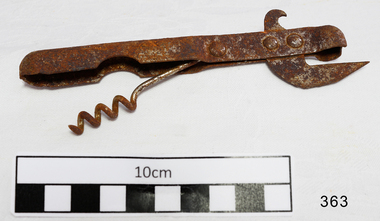 Flagstaff Hill Maritime Museum and Village
Domestic object - Can Opener, Bottle Opener & Corkscrew
... In 1795, Napoleon, to whom the phrase "an army marches on its stomach" is attributed, offered 12,000 francs to anyone who could find a way to preserve food. ...In 1795, Napoleon, to whom the phrase "an army marches on its stomach" is attributed, offered 12,000 francs to anyone who could find a way to preserve food. ...It took 15 years to invent the can. It took 100 more to invent a standard way to open it. In the 19th century, decades after the invention of canning, there were virtually no can openers. Canned food, such as sardines, came with its own "key" to peel back the tin lid. Birth of the can One of the oddest things about the can opener is that the can predates it by almost 150 years. Though common today, cans were once military-grade technology. In 1795, Napoleon, to whom the phrase "an army marches on its stomach" is attributed, offered 12,000 francs to anyone who could find a way to preserve food. Without any knowledge of bacteria or their role in food spoilage, scientists didn't even know where to begin. It took 15 years before a chef named Nicholas Appert claimed the prize after successfully jarring food. Soon after that, his countryman Philippe de Girard came up with a variant on Appert's method—metal tins—and sold the idea to the British. Spoiled food, and the sickness it caused, was a widespread problem. The public would have benefited from canned food, but for decades cans were almost exclusively for the army and the navy. The canning process, with its hours of boiling and steaming, its scrupulous cleanliness, its heated metal, and its need for a great deal of disposable material, made canned food far too expensive for anyone but the military. No can openers were needed or even possible. The metal of early cans was too thick to make openers practical. Soldiers and sailors had plenty of sharp objects on hand and made ample use of them when they wanted to eat. During the 19th century, the process of canning was refined and mechanised, and the metal wall of the average can slimmed down enough that a civilian could get it open—if that civilian had the right tool. No one had that tool yet, so early cans had to open themselves. In other words, they came with built-in openers. The result was a confusing but pleasing free-for-all, in terms of product engineering. Each type of food came with its own kind of can, and each kind of can came with its own kind of opener. Tinned fish and meat were often sold in rectangular cans. These cans were fitted with a "key" that would roll down the top of the can. Coffee, beans, and other types of meat were packaged in cylinders with metal strips that could be peeled back with their own kinds of built-in keys. Cans of milk, which didn't need to be completely opened, came with puncture devices. As tinned food became more common, its containers became more regular. A nice cylindrical can became the norm, and, as these cans filled kitchens, more engineers put their minds to finding a convenient way to open all of them. The first standalone can opener worked on a simple principle: point, stab, and pull. From the mid-19th century to the end of World War I, the typical can opener looked roughly like a wrench, if the lower 'jaw' of the wrench were replaced with a blade. People used the blade to puncture the top of the can near its edge, push the upper jaw against the side of the can, and drag the blade through the metal along the rim. Because meat was the first and most popular canned substance, these can openers were often shaped to look like cows and given the nickname 'bully beef can openers'. The bully beef can opener, popular in the mid-19th century, resulted in many lost fingers. Later, a corkscrew was added that was seated in the handle, and could be pulled out for use. Bully beef can openers were so common, effective, and sturdy that they are still frequently available on collectors' sites. Some are advertised as “still working,” and every last one of them is, without a doubt, soaked in the blood of our ancestors. Dragging a sharp blade along the edge of a can is certain to cause injury sooner or later. So once people got a reliable can shape and a reliable way to get the can open, the search was on for a reliable way to get a can open without the possibility of losing a finger. The answer came in 1925, from the Star Can Opener Company of San Francisco. This is probably the first can opener that resembles the one people have in their kitchens today. Instead of using a blade to pry open a metal can, buyers could clamp the edge of the can between two wheels and twist the handle of one of the wheels to move the blade around the lip. The Star can openers weren't perfect. Compared to the bully beef model, they were flimsy and breakable, but they probably prevented a few injuries. Six short years after the Star model came to market, the first electric can opener was invented. It was patented in 1931 by the Bunker Clancey Company of Kansas City, who had already been sued by the Star Can Opener Company for trying sell a double-wheeled can opener like the Star model (the case was dismissed). The electric can opener must have seemed like the wave of the future and a sure-fire seller, but it proved to be too far ahead of its time. In 1931 not that many households had electricity, and those that did weren't interested in buying can openers. The Bunker Clancey Company was subsequently bought by the Rival Company, which still makes small appliances like can openers today. It took another 25 years for electrically powered can openers to become practical. In the 1950s, Walter Hess Bodle and his daughter, Elizabeth Bodle, developed an electric can opener in the family garage. Walter came up with the opener's blades and motor, and Elizabeth sculpted the outside. Their can opener was a free-standing unit that could sit on the kitchen counter. The Udico brand of the Union Die Casting Company put it on the market in time for Christmas in 1956 and had great success with it. Over the next few years it came out in different styles and colours, and, like the bully beef can opener, has become a collector's item. Also like the bully beef model, Udico can openers often still work. They don't make 'em like they used to. Although there have been some design changes and refinements over the last sixty years, there have yet to be any more leaps forward in can opener technology. If you're resentfully opening a can, you are almost certainly doing it using the Star design, manually forcing the can between two wheels, or the Bodle design, clamping the can into a free-standing electrical opener. Whether or not you enjoy your holiday meals, at least you can be happy that you are not getting poisoned by your own food or cutting open your hand with the blade you use to get at it. That's something, right?The can opener, Bottle opener and the corkscrew are still very important and essential items in most kitchens.Metal can opener, chromed, with bottle opener, and a corkscrew seated in the handle.None.flagstaff hill, warrnambool, shipwrecked-coast, flagstaff-hill, flagstaff-hill-maritime-museum, maritime-museum, shipwreck-coast, flagstaff-hill-maritime-village, canning, can opener, corkscrew, bottle opener, kitchen equipment -
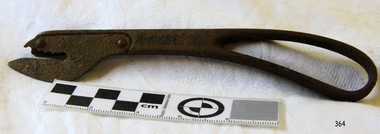 Flagstaff Hill Maritime Museum and Village
Domestic object - Can Opener
... In 1795, Napoleon, to whom the phrase "an army marches on its stomach" is attributed, offered 12,000 francs to anyone who could find a way to preserve food. ...In 1795, Napoleon, to whom the phrase "an army marches on its stomach" is attributed, offered 12,000 francs to anyone who could find a way to preserve food. ...It took 15 years to invent the can. It took 100 more to invent a standard way to open it. In the 19th century, decades after the invention of canning, there were virtually no can openers. Canned food, such as sardines, came with its own "key" to peel back the tin lid. Birth of the can One of the oddest things about the can opener is that the can predates it by almost 150 years. Though common today, cans were once military-grade technology. In 1795, Napoleon, to whom the phrase "an army marches on its stomach" is attributed, offered 12,000 francs to anyone who could find a way to preserve food. Without any knowledge of bacteria or their role in food spoilage, scientists didn't even know where to begin. It took 15 years before a chef named Nicholas Appert claimed the prize after successfully jarring food. Soon after that, his countryman Philippe de Girard came up with a variant on Appert's method—metal tins—and sold the idea to the British. Spoiled food, and the sickness it caused, was a widespread problem. The public would have benefited from canned food, but for decades cans were almost exclusively for the army and the navy. The canning process, with its hours of boiling and steaming, its scrupulous cleanliness, its heated metal, and its need for a great deal of disposable material, made canned food far too expensive for anyone but the military. No can openers were needed or even possible. The metal of early cans was too thick to make openers practical. Soldiers and sailors had plenty of sharp objects on hand and made ample use of them when they wanted to eat. During the 19th century, the process of canning was refined and mechanised, and the metal wall of the average can slimmed down enough that a civilian could get it open—if that civilian had the right tool. No one had that tool yet, so early cans had to open themselves. In other words, they came with built-in openers. The result was a confusing but pleasing free-for-all, in terms of product engineering. Each type of food came with its own kind of can, and each kind of can came with its own kind of opener. Tinned fish and meat were often sold in rectangular cans. These cans were fitted with a "key" that would roll down the top of the can. Coffee, beans, and other types of meat were packaged in cylinders with metal strips that could be peeled back with their own kinds of built-in keys. Cans of milk, which didn't need to be completely opened, came with puncture devices. As tinned food became more common, its containers became more regular. A nice cylindrical can became the norm, and, as these cans filled kitchens, more engineers put their minds to finding a convenient way to open all of them. The first standalone can opener worked on a simple principle: point, stab, and pull. From the mid-19th century to the end of World War I, the typical can opener looked roughly like a wrench, if the lower 'jaw' of the wrench were replaced with a blade. People used the blade to puncture the top of the can near its edge, push the upper jaw against the side of the can, and drag the blade through the metal along the rim. Because meat was the first and most popular canned substance, these can openers were often shaped to look like cows and given the nickname 'bully beef can openers'. The bully beef can opener, popular in the mid-19th century, resulted in many lost fingers. Bully beef can openers were so common, effective, and sturdy that they are still frequently available on collectors' sites. Some are advertised as “still working,” and every last one of them is, without a doubt, soaked in the blood of our ancestors. Dragging a sharp blade along the edge of a can is certain to cause injury sooner or later. So once people got a reliable can shape and a reliable way to get the can open, the search was on for a reliable way to get a can open without the possibility of losing a finger. The answer came in 1925, from the Star Can Opener Company of San Francisco. This is probably the first can opener that resembles the one people have in their kitchens today. Instead of using a blade to pry open a metal can, buyers could clamp the edge of the can between two wheels and twist the handle of one of the wheels to move the blade around the lip. The Star can openers weren't perfect. Compared to the bully beef model, they were flimsy and breakable, but they probably prevented a few injuries. Six short years after the Star model came to market, the first electric can opener was invented. It was patented in 1931 by the Bunker Clancey Company of Kansas City, who had already been sued by the Star Can Opener Company for trying sell a double-wheeled can opener like the Star model (the case was dismissed). The electric can opener must have seemed like the wave of the future and a sure-fire seller, but it proved to be too far ahead of its time. In 1931 not that many households had electricity, and those that did weren't interested in buying can openers. The Bunker Clancey Company was subsequently bought by the Rival Company, which still makes small appliances like can openers today. It took another 25 years for electrically powered can openers to become practical. In the 1950s, Walter Hess Bodle and his daughter, Elizabeth Bodle, developed an electric can opener in the family garage. Walter came up with the opener's blades and motor, and Elizabeth sculpted the outside. Their can opener was a free-standing unit that could sit on the kitchen counter. The Udico brand of the Union Die Casting Company put it on the market in time for Christmas in 1956 and had great success with it. Over the next few years it came out in different styles and colours, and, like the bully beef can opener, has become a collector's item. Also like the bully beef model, Udico can openers often still work. They don't make 'em like they used to. Although there have been some design changes and refinements over the last sixty years, there have yet to be any more leaps forward in can opener technology. If you're resentfully opening a can, you are almost certainly doing it using the Star design, manually forcing the can between two wheels, or the Bodle design, clamping the can into a free-standing electrical opener. Whether or not you enjoy your holiday meals, at least you can be happy that you are not getting poisoned by your own food or cutting open your hand with the blade you use to get at it. That's something, right?The can opener is still a very important and essential item in most kitchens.Can opener, right handed, metal, upper blade section serrated, inscription 'Peerless Pat.Feb 11-90'.Peerless Pat.Feb 11-90flagstaff hill, warrnambool, shipwrecked-coast, flagstaff-hill, flagstaff-hill-maritime-museum, maritime-museum, shipwreck-coast, flagstaff-hill-maritime-village, cannning, can opener, kitchen equipment -
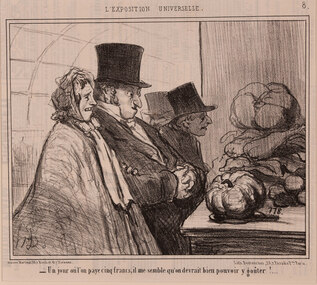 Bass Coast Shire Council - Robert Smith Collection
Artwork, other - 2671 Un jour ou l'on paye cinq francs, Honore Daumier
... French 1808 - 1879 Initialled l.l in stone Lithograph Honore Daumier Artwork, other 2671 Un jour ou l'on paye cinq francs ... ...French 1808 - 1879LithographInitialled l.l in stone -
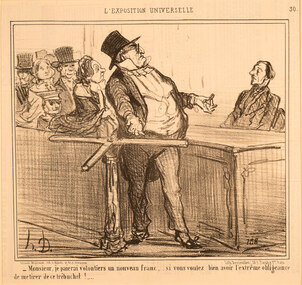 Bass Coast Shire Council - Robert Smith Collection
Artwork, other - 2693 Monsieur, je paierai...un nouveau franc...(Prudhomme), Honore Daumier
... French 1808 - 1879 Initialled l.l in stone Lithograph Honore Daumier Artwork, other 2693 Monsieur, je paierai...un nouveau franc...(Prudhomme) ...French 1808 - 1879LithographInitialled l.l in stone
