
Showing 8 items matching " free classical style"
-
 Glen Eira Historical Society
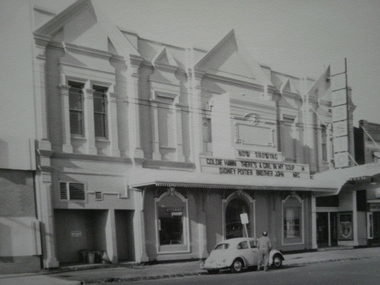
Article - ELSTERNWICK CLASSIC CINEMA
... ... Free Classical Style...Richardson Frank G. architecture stairs Associated Theatres Limited Ballantyne and Hared balconies architectural features entrances Depression 1929-1939 Astor dancehalls Esquire Theatre Prentice George Plottel Joseph architects Cowper Murphy and Associates Sharon Cinema Tamir Eddie Readings Free Classical Style plans business people Njoo Alex Tamir family Article ELSTERNWICK CLASSIC CINEMA ...This file contains 4 items relating to the Elsternwick Classic Cinema: 1/1 original black and white photograph of the Elsternwick Classic Cinema, 9 Gordon Street Elsternwick. Date and photographer unknown. 2/ 2 photocopied photos of the Elsternwick Classic Theatre in its various stages of operation. One photo is of it as the Dorchester Dance Hall between 1938 and 1946 and the other is of the Classic Cinema in 1994. Photographers unknown. 3/National Trust of Australia (Victoria) Classification Report on Elsternwick Theatre with attached cover letter addressed to the Manager of the Planning Section, City of Glen Eira Council, from Ian Pausacker from the National Trust dated 04/10/2000. The report includes a statement of significance, history, description, context and floor plans of the theatre. 4/1 newspaper article written by Alex Njoo from the Caulfield/Port Philip Leader, 31/01/2012, congratulating the Tamir family on their conservation of the Elsternwick Classic Cinema. Includes a colour photo of the Tamirs, photographer unknown.elsternwick classic cinema, gordon street, elsternwick, dorchester dance hall, national trust of australia, national trust register, elsternwick theatre, pausacker ian, classic cinema, entertainment, cinemas, theatres, victorian style, elsternwick public hall, skating rink company limited, selwyn street, victorian permanent building society, community centres, films, shows and exhibitions, film projectors, amalgamate picture company ltd., richardson frank g., architecture, stairs, associated theatres limited, ballantyne and hared, balconies, architectural features, entrances, depression 1929-1939, astor, dancehalls, esquire theatre, prentice george, plottel joseph, architects, cowper murphy and associates, sharon cinema, tamir eddie, readings, free classical style, plans, business people, njoo alex, tamir family -
 Warrnambool and District Historical Society Inc.
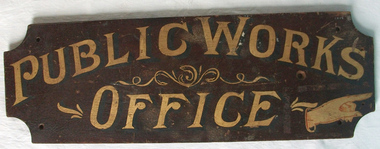
Sign - Public Works Office
... The building while no longer used as a court house is a building of significance to Warrnambool as well as to the state of Victoria, being one of six around the state which were built in free classical style. This sign denotes the waiting room for witnesses which was situated on the western side of the building....The building while no longer used as a court house is a building of significance to Warrnambool as well as to the state of Victoria, being one of six around the state which were built in free classical style. This sign denotes the waiting room for witnesses which was situated on the western side of the building. ...This sign points has two different messages. The first states Public Works Office, which was operational in Victoria between 1855 and 1987 dealt with many aspects of the states infrastructure. It had many different reponsibilities and roles from building government accommodation and fit out of buildings, licences for unused roads and water ways, main roads and bridges, ports and harbour,and water supplies. Much of this work was managed through local offices such as the one at Warrnambool. The sign on the reverse which states Witnesses Waiting Room relates to the court house which is where this sign originated.The Warrnambool court house was built in 1870-71 by the Victorian Public Works department and it is possible that this sign relates to that period.It is one of a number of public buildings built in the period 1870-1890 including the Police station and stables and police quarters, the Post Office and drill Hall , all in the same vicinity. This building reflects the growth of the town and also the importance it held at the time from a state level. The building while no longer used as a court house is a building of significance to Warrnambool as well as to the state of Victoria, being one of six around the state which were built in free classical style. This sign denotes the waiting room for witnesses which was situated on the western side of the building.A tangible link which provides historical and social significance to Warrnambool.Rectangular wooden sign with rounded corners. There is text on both sides painted in gold paint with shadow in black. One side is a darker brown stain . There are screw holes in each corner.and one hole on left middle of sign. Rounded edge on one side.Side 1:Witnesses Waiting Room Side 2:Public Works Office.warrnambool, warrnambool court house, public works department warrnambool -
 City of Greater Bendigo - Civic Collection
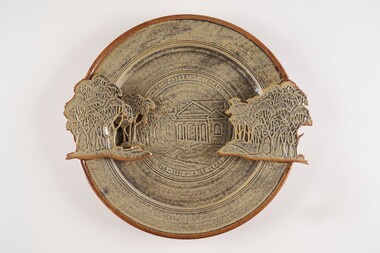
Decorative object - Ceramic platter, Bendigo Pottery, Strathfieldsaye Shire 1866 - 1991, 1991
... The Strathfieldsaye Shire Hall is a brick building designed in the Free Classical manner. This style was favoured by the Public Works Department for a number of public buildings including Shire Halls and courthouses. ...The Strathfieldsaye Shire Hall is a brick building designed in the Free Classical manner. This style was favoured by the Public Works Department for a number of public buildings including Shire Halls and courthouses. ...Graham Masters is a potter based at Sweenies Creek, just outside Bendigo, Victoria who specialises in a patented technique of low relief stoneware depicting Australian animals and landscapes. He obtained a Diploma of Art and Design in Ceramics from the Bendigo Institute of Technology in 1973, then operated a pottery for a year in Bendigo, before becoming an employee, then a partner at Maldon Pottery, Victoria with Neville Wilson and Thomas Metcalf. He left Maldon to set up his own pottery at Sweenies Creek in 1984. (1.) (Judith Pearce). Built in 1869, the (former) Strathfieldsaye Shire Hall is one of The City of Bendigo's earliest surviving public buildings. Designed by George Steane and built by George Pallett in 1869 the Strathfieldsaye Shire Hall has aesthetic significance as a purpose built Shire Hall designed in the Free Classical manner. It is also of importance as an early example of the novel system of cavity wall construction. The building is largely intact and unaltered. Other important elements include the arched portico of the main entrance with brick arched features on either side; the brick quoining and dressings to the round arch windows; the three gabled roof; and the matching chimneys that reinforce the symmetrical design. The Hall has social significance as a temporary schooling facility in the 1870s and as a flood refuge in 1889. The Strathfieldsaye Shire Hall is a brick building designed in the Free Classical manner. This style was favoured by the Public Works Department for a number of public buildings including Shire Halls and courthouses. The form includes a central taller volume flanked by matching smaller gables. In the case of the Shire Hall these would be occupied by the Shire Secretary and Shire Engineer whilst the larger volume was the council chamber. The portico at the front is designed with a flat arch in the centre and matching smaller arches each side. The face red brick is unadorned apart from a plain string course at the roof springing point, brick quoining and dressings to the round arch windows. There are matching chimneys that are located to reinforce the symmetrical design and the original roof is believed to have been slate but is now corrugated iron. Large wheel thrown ceramic platter with a shallow well, broad flaring ledge and raised on a high foot rim. Rim decorated with slab rolled gum trees protruding on centre left and right sides of plater. which reflect the low relief image of trees and the Strathfieldsaye Shire Hall on the surface of the plate. Glazed with golden brown and cream. Front centre top; 'Shire of Strathfieldsaye'. Front lower centre '1866 - 1991 - 125 Years'. Signed 'G Master / 1991' on rim centre right. Reverse; signed 'G Master' / 1991. Bendigo Pottery stamp.shire of strathfieldsaye, bendigo pottery -
 Federation University Historical Collection
Photograph - Black and White, Former Ballarat Library, c1960
... Free Library Reserve. A number of changes have occurred since 1910s - the Classical Revival facade replaced with an angled facade in a stripped Classical style with Art Deco features and high parapet. ...Free Library Reserve. A number of changes have occurred since 1910s - the Classical Revival facade replaced with an angled facade in a stripped Classical style with Art Deco features and high parapet. ...First known development on this site was the establishment of the Government Camp from the early 1850s. It was established to accommodate officials, troopers and police who were needed to administer the goldfields. Some permanent buildings were constructed. Lack of materials and bad weather prolonged the building of more permanent buildings and most men were still living in tents. Area was known as Camp Reserve. In 1864 a subdivision map shows the reserve be used for Public Buildings. Library applied for land on corner of Sturt and Camp Streets in 1878. 1880s plans show section of the reserve be used for a Free Library and Reading Room. Lease was granted and the old mining boardroom was initially used. Land for additional building to house a Museum and Art Gallery sought and agreement reached in 1882-3. Compensation paid to owners and library granted the land. Plans for a new library building with tower and lantern roof abandoned due to lack of funds. It wasn't until 1895 that a solution to funding was found and the library was able to begin constructing the complex of buildings on the Free Library Reserve. A number of changes have occurred since 1910s - the Classical Revival facade replaced with an angled facade in a stripped Classical style with Art Deco features and high parapet. Building is now part of Federation UniversityPhotograph of former library. Shows a two-storey rendered brick building in a Classical style. Some Art Deco features. Central pair of double windows with single window either side. High parapet above.government camp, goldfields, camp reserve, free library, reading room, sturt street, camp street, museum, art gallery, troopers, police, barracks, camp street -
Bendigo Historical Society Inc.
Document - Fortuna - Health, Reports and Risk Assessments of the Site, 2008
... The Villa is built in a number of architectural styles, namely Victorian Italianate and Victorian Free Classical, with Federation influences. ...The Villa is built in a number of architectural styles, namely Victorian Italianate and Victorian Free Classical, with Federation influences. ...Theodore Ballerstedt originally purchased the Fortuna site from the Crown in 1857. The firstimprovements at Fortuna were undertaken by the Ballerstedt family and consisted of a small mill and house. At the peak of the mining era (c.1860s) Fortuna was central to the deep alluvial gold mining operations of Bendigo. In 1871 Theodore Ballerstedt sold the house, mine and associated works to George Lansell 'The Quartz King'. During his time at Fortuna, Lansell owned 13 mines and directed a further 73 in Bendigo. The primary building on the site is the Fortuna Villa. With the wealth Lansell generated from gold mining he funded the continuous expansion of the Villa and surrounding grounds. The Villa is built in a number of architectural styles, namely Victorian Italianate and Victorian Free Classical, with Federation influences. The surrounding landscape featured up to seven decorative lakes in the early 1870s, including one larger lake which still remains today. The former lakes were originally used as disposal points for tailings produced in the gold processing activities at the site. Fortuna was occupied by the Department of Defence from 1942 and was compulsorily acquired for Army use in 1957. Since that time Fortuna has been occupied by the Army and other various Defence organisations. During Defence's ownership, additional buildings were constructed and existing buildings were modified for re-use. In 1992 Defence purchased the adjoining undeveloped property, commonly known as the Bush Block. This parcel of land adjoins the main Fortuna landholding. It is approximately 0.8 hectares in size and is predominately covered in vegetation regrowth. Heritage investigations note that the uniqueness of Fortuna lies in the mixture of architectural styles of the Villa. The relationship between mining and domestic areas and the. close proximity of the two is considered rare to Australian domestic building of that time.Fortuna - Health, Reports and Risk Assessments of the Site This item contains the following documents: 11217.75a Fortuna Defense Site - Health Risk Assessment Final Report - 50 pages and appendices A to M - Contact the BHS for details 11217.75b Fortuna Defense Site - Structural inspection and report on various buildings, Department of Defence, Fortuna Site, 30 Chum Street Bendigo - Contact the BHS for details 11217.75c Fortuna Defense Site - Department of Defence Summary Report on Property Disposals Bendigo - Contact the BHS for details 11217.75d Fortuna Defense Site - Department of Defence Report on unexploded ordnance - Contact the BHS for details 11217.75e Fortuna Defense Site - Department of Defence Phase 1 Summary Report on Property Disposals Bendigo - Contact the BHS for details 11217.75f Fortuna Defense Site - Health Risk Assessment Final Report - 50 pages and appendices A to M - Contact the BHS for details 11217.75g Fortuna Defense Site - Environmental Site Assessment - Contact the BHS for detailsnon-fictionbendigo, fortuna, george lansell -
 Bendigo Historical Society Inc.
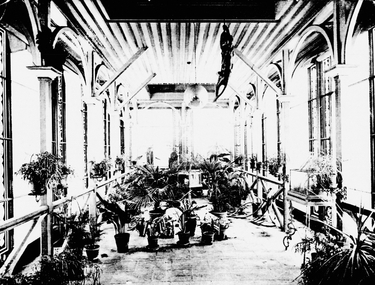
Photograph - Fortuna - Photos (Photo-copies) of Furnished Rooms, Abt 1900
... The Villa is built in a number of architectural styles, namely Victorian Italianate and Victorian Free Classical, with Federation influences. ...The Villa is built in a number of architectural styles, namely Victorian Italianate and Victorian Free Classical, with Federation influences. ...Theodore Ballerstedt originally purchased the Fortuna site from the Crown in 1857. The firstimprovements at Fortuna were undertaken by the Ballerstedt family and consisted of a small mill and house. At the peak of the mining era (c.1860s) Fortuna was central to the deep alluvial gold mining operations of Bendigo. In 1871 Theodore Ballerstedt sold the house, mine and associated works to George Lansell 'The Quartz King'. During his time at Fortuna, Lansell owned 13 mines and directed a further 73 in Bendigo. The primary building on the site is the Fortuna Villa. With the wealth Lansell generated from gold mining he funded the continuous expansion of the Villa and surrounding grounds. The Villa is built in a number of architectural styles, namely Victorian Italianate and Victorian Free Classical, with Federation influences. The surrounding landscape featured up to seven decorative lakes in the early 1870s, including one larger lake which still remains today. The former lakes were originally used as disposal points for tailings produced in the gold processing activities at the site. Heritage investigations note that the uniqueness of Fortuna lies in the mixture of architectural styles of the Villa. The relationship between mining and domestic areas and the. close proximity of the two is considered rare to Australian domestic building of that time.Fortuna - Photos (Photo-copies) of Furnished Rooms This item contains the following 12 documents: 11217.76a Black and White photo of the Gymnasium, a man standing between the horizontal bars and another behind sitting on the exercise bench 11217.76b Black and White photo of a living room with chairs and small table 11217.76c Black and White photo of the conservatory with pot plants 11217.76d Black and White photo of a music room with piano, chairs and a coffee table 11217.76e Black and White photo of a bedroom with sofa, chair and iron framed bed 11217.76f Black and White photo of the games room complete with Billiard Table 11217.76g Black and White photo of the living room, the walls adorned with painting and photographs 11217.76h Black and White photo of the family bedroom, with a child's bed and a large four-poseter with curtains 11217.76i Black and White photo of possibly the function or ballroom 11217.76j Black and White photo of a small room or elcove for quiet conversations 11217.76k Black and White photo of the staircase and statue 11217.76l Black and White photo of the conservatorynon-fictionbendigo, fortuna, george lansell, fortuna furnishings -
 Bendigo Historical Society Inc.
Drawing - Fortuna - Drawing Presented to Brian McLachlon, abt 2000
... The Villa is built in a number of architectural styles, namely Victorian Italianate and Victorian Free Classical, with Federation influences. ...The Villa is built in a number of architectural styles, namely Victorian Italianate and Victorian Free Classical, with Federation influences. ...Theodore Ballerstedt originally purchased the Fortuna site from the Crown in 1857. The firstimprovements at Fortuna were undertaken by the Ballerstedt family and consisted of a small mill and house. At the peak of the mining era (c.1860s) Fortuna was central to the deep alluvial gold mining operations of Bendigo. In 1871 Theodore Ballerstedt sold the house, mine and associated works to George Lansell 'The Quartz King'. During his time at Fortuna, Lansell owned 13 mines and directed a further 73 in Bendigo. Fortuna was occupied by the Department of Defence from 1942 and was compulsorily acquired for Army use in 1957. Since that time Fortuna has been occupied by the Army and other various Defence organisations. During Defence's ownership, additional buildings were constructed and existing buildings were modified for re-use. In 1992 Defence purchased the adjoining undeveloped property, commonly known as the Bush Block. This parcel of land adjoins the main Fortuna landholding. It is approximately 0.8 hectares in size and is predominately covered in vegetation regrowth. Heritage investigations note that the uniqueness of Fortuna lies in the mixture of architectural styles of the Villa. The relationship between mining and domestic areas and the. close proximity of the two is considered rare to Australian domestic building of that time. The primary building on the site is the Fortuna Villa. With the wealth Lansell generated from gold mining he funded the continuous expansion of the Villa and surrounding grounds. The Villa is built in a number of architectural styles, namely Victorian Italianate and Victorian Free Classical, with Federation influences. The surrounding landscape featured up to seven decorative lakes in the early 1870s, including one larger lake which still remains today. The former lakes were originally used as disposal points for tailings produced in the gold processing activities at the site. Heritage investigations note that the uniqueness of Fortuna lies in the mixture of architectural styles of the Villa. The relationship between mining and domestic areas and the. close proximity of the two is considered rare to Australian domestic building of that time.Fortuna - Drawing Presented to Brian McLachlon This item contains the following documents: 11217.77a Six copies Black and White drawing by Jason Nickson (cleaner) presented to Brian McLachlon on his transfer to the USA. Drawing shows Brian on a motor bike being farewelled by the Fortuna Villa (holding a baby named DIGO) and welcomed by the Statue of Liberty and the US flagnon-fictionbendigo, fortuna, george lansell, jason nickson fortuna cleaner, brian mclochlon fortuna -
Bendigo Historical Society Inc.
Plan - Fortuna - Survey Unit Layouts, April 1982
... The Villa is built in a number of architectural styles, namely Victorian Italianate and Victorian Free Classical, with Federation influences. ...The Villa is built in a number of architectural styles, namely Victorian Italianate and Victorian Free Classical, with Federation influences. ...Theodore Ballerstedt originally purchased the Fortuna site from the Crown in 1857. The firstimprovements at Fortuna were undertaken by the Ballerstedt family and consisted of a small mill and house. At the peak of the mining era (c.1860s) Fortuna was central to the deep alluvial gold mining operations of Bendigo. In 1871 Theodore Ballerstedt sold the house, mine and associated works to George Lansell 'The Quartz King'. During his time at Fortuna, Lansell owned 13 mines and directed a further 73 in Bendigo. Fortuna was occupied by the Department of Defence from 1942 and was compulsorily acquired for Army use in 1957. Since that time Fortuna has been occupied by the Army and other various Defence organisations. During Defence's ownership, additional buildings were constructed and existing buildings were modified for re-use. In 1992 Defence purchased the adjoining undeveloped property, commonly known as the Bush Block. This parcel of land adjoins the main Fortuna landholding. It is approximately 0.8 hectares in size and is predominately covered in vegetation regrowth. Heritage investigations note that the uniqueness of Fortuna lies in the mixture of architectural styles of the Villa. The relationship between mining and domestic areas and the. close proximity of the two is considered rare to Australian domestic building of that time. The primary building on the site is the Fortuna Villa. With the wealth Lansell generated from gold mining he funded the continuous expansion of the Villa and surrounding grounds. The Villa is built in a number of architectural styles, namely Victorian Italianate and Victorian Free Classical, with Federation influences. The surrounding landscape featured up to seven decorative lakes in the early 1870s, including one larger lake which still remains today. The former lakes were originally used as disposal points for tailings produced in the gold processing activities at the site. Heritage investigations note that the uniqueness of Fortuna lies in the mixture of architectural styles of the Villa. The relationship between mining and domestic areas and the. close proximity of the two is considered rare to Australian domestic building of that time.Fortuna - Survey Unit Layouts This item contains the following documents: 11217.84a Layout of workspace and equipment used by the Army Survey Group 11217.84b Layout of workspace and equipment used by the Army Survey Group 11217.84c Layout of workspace and equipment used by the Army Survey Groupnon-fictionbendigo, fortuna, george lansell
