
Showing 26 items matching " gift recipient"
-
 Lakes Entrance Historical Society
Book, Australian Tax Office, Australian Taxation 2012, 2012
... A guide to tax deductible gifts recipient status for community organisations....Taxation A guide to tax deductible gifts recipient status for community organisations. ...A guide to tax deductible gifts recipient status for community organisations.taxation -
 Musculoskeletal Health Australia (now held by the Glen Eira Historical Society)
Photograph - Group photo
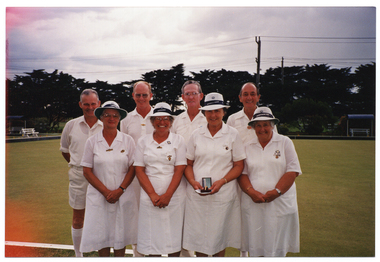
... ... gift recipient...Eight lawn bowls players pose for a photo on the bowling green (date and location unknown) on the occasion of the unidentified woman in the front row being the recipient of a gift of a gold watch....Eight lawn bowls players pose for a photo on the bowling green (date and location unknown) on the occasion of the unidentified woman in the front row being the recipient of a gift of a gold watch. arthritis foundation of victoria afv gift recipient gold watch lawn bowls bowling green bowling court grass court bowls club club members Colour photo of eight people, four men and four women, standing in two rows on a grass bowling court. ...Eight lawn bowls players pose for a photo on the bowling green (date and location unknown) on the occasion of the unidentified woman in the front row being the recipient of a gift of a gold watch.Colour photo of eight people, four men and four women, standing in two rows on a grass bowling court. One woman is holding a gold watch in a presentation case in her hand.arthritis foundation of victoria, afv, gift recipient, gold watch, lawn bowls, bowling green, bowling court, grass court, bowls club, club members -
 Musculoskeletal Health Australia (now held by the Glen Eira Historical Society)
Photograph - Group photo
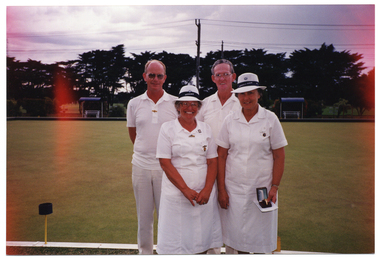
... ... gift recipient...Eight lawn bowls players pose for a photo on the bowling green (date and location unknown) on the occasion of the unidentified woman in the front row being the recipient of a gift of a gold watch....Eight lawn bowls players pose for a photo on the bowling green (date and location unknown) on the occasion of the unidentified woman in the front row being the recipient of a gift of a gold watch. arthritis foundation of victoria afv gift recipient gold watch lawn bowls bowling green bowling court grass court bowls club club members Colour photo of four people, two men and two women, standing in two rows on a grass bowling court. ...Eight lawn bowls players pose for a photo on the bowling green (date and location unknown) on the occasion of the unidentified woman in the front row being the recipient of a gift of a gold watch.Colour photo of four people, two men and two women, standing in two rows on a grass bowling court. One woman is holding a gold watch in a presentation case in her hand.arthritis foundation of victoria, afv, gift recipient, gold watch, lawn bowls, bowling green, bowling court, grass court, bowls club, club members -
 Warrnambool and District Historical Society Inc.
Newspaper - The Argus, The Argus Melbourne, 1925
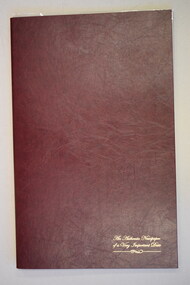
... On the outside cover in gold writing," An Authentic newspaper of a very important date, in this case August 15 1925 which was the birthdate of the gift recipient Mrs Sheila O'Keefe a local district resident. ...On the outside cover in gold writing," An Authentic newspaper of a very important date, in this case August 15 1925 which was the birthdate of the gift recipient Mrs Sheila O'Keefe a local district resident. ...This paper contains mostly news items and advertisements of the day. However some items contained within are fictional in nature.This is an original Argus in a maroon leather folder. The paper itself is a 32 page broadsheet which slides inside the folder for protection. A certificate of authenticity is glued to the inside cover of the folder.non-fictionThis paper contains mostly news items and advertisements of the day. However some items contained within are fictional in nature.warrnambool, the argus 1925, winslow, o'keefe, o'keeffe -
 Emerald Museum & Nobelius Heritage Park
B/W Photograph, December 1904
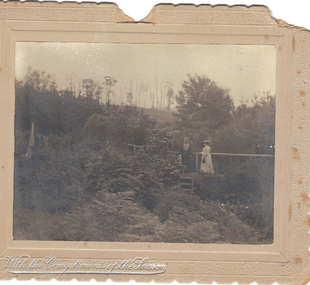
... The card was probably sent as a Christmas gift to an unknown recipient by "H & GB", presumably a married couple. ...The card was probably sent as a Christmas gift to an unknown recipient by "H & GB", presumably a married couple. ...The card was probably sent as a Christmas gift to an unknown recipient by "H & GB", presumably a married couple. The two women in the photo might be known to sender and receiver, or might even be the receivers. The scene is suspected to be in the grounds of the Country Club at Emerald, Victoria.As the card is clearly dated, and the figures clearly named, it is a record of people resident in Emerald. From it we can make out some details of their dress and the physical surroundings of the time.B/W photograph mounted on embossed cardboard with crimped edges. It depicts two women standing on a small bridge over a creek in dense vegetation. There are trees in the background and ferns in the foreground. Front bottom left: silver embossed "With the Compliments of the Season" Rear: Handwritten "Mrs Airey & Miss Doolan on Bridge over Creek From ?H & ?GB 18?/12/1904" At bottom: "May be Country Club"airey, doolan, creek, country club, 1904 -
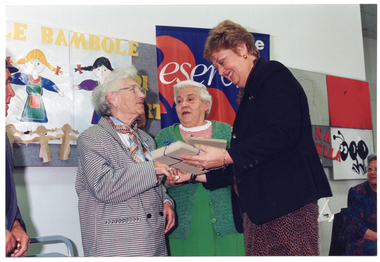 Musculoskeletal Health Australia (now held by the Glen Eira Historical Society)
Photograph - Group photo, 1996
... In this photo, AFV's CEO, Shirley Caulfield, hands out some "thank you" gifts to various recipients at the launch....In this photo, AFV's CEO, Shirley Caulfield, hands out some "thank you" gifts to various recipients at the launch. arthritis foundation of victoria afv osteoporosis victoria ov culturally and linguistically diverse cald languages other than english lote migrant communities bilingual Italian move it or lose it brochures thank you gifts 1996 COL photo of a woman holding a small stack of wrapped gifts as she shakes the hand of an elderly woman, while another woman looks on. ...This series of photos were taken in 1996 at the launch of the bilingual "Move it or Lose it" brochures for the Italian community. As a result of a commitment by the Arthritis Foundation of Victoria (AFV), incorporating Osteoporosis Victoria (OV), to better reach and serve the multicultural community, bilingual brochures were produced in several languages. In this photo, AFV's CEO, Shirley Caulfield, hands out some "thank you" gifts to various recipients at the launch.COL photo of a woman holding a small stack of wrapped gifts as she shakes the hand of an elderly woman, while another woman looks on. Behind them is a woman (seated), a colourful freestanding banner, and a display board.arthritis foundation of victoria, afv, osteoporosis victoria, ov, culturally and linguistically diverse, cald, languages other than english, lote, migrant communities, bilingual, italian, move it or lose it, brochures, thank you gifts, 1996 -
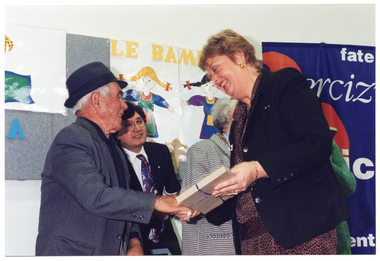 Musculoskeletal Health Australia (now held by the Glen Eira Historical Society)
Photograph - Group photo, 1996
... In this photo, AFV's CEO, Shirley Caulfield, hands out some "thank you" gifts to various recipients at the launch....In this photo, AFV's CEO, Shirley Caulfield, hands out some "thank you" gifts to various recipients at the launch. arthritis foundation of victoria afv osteoporosis victoria ov culturally and linguistically diverse cald languages other than english lote migrant communities bilingual Italian move it or lose it brochures thank you gifts 1996 COL photo of a woman holding a wrapped gift as she shakes the hand of an elderly man, while another man looks on. ...This series of photos were taken in 1996 at the launch of the bilingual "Move it or Lose it" brochures for the Italian community. As a result of a commitment by the Arthritis Foundation of Victoria (AFV), incorporating Osteoporosis Victoria (OV), to better reach and serve the multicultural community, bilingual brochures were produced in several languages. In this photo, AFV's CEO, Shirley Caulfield, hands out some "thank you" gifts to various recipients at the launch.COL photo of a woman holding a wrapped gift as she shakes the hand of an elderly man, while another man looks on. Beside them is a woman (partially obscured), a colourful freestanding banner, and a display board.arthritis foundation of victoria, afv, osteoporosis victoria, ov, culturally and linguistically diverse, cald, languages other than english, lote, migrant communities, bilingual, italian, move it or lose it, brochures, thank you gifts, 1996 -
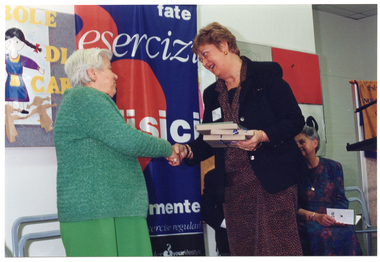 Musculoskeletal Health Australia (now held by the Glen Eira Historical Society)
Photograph - Group photo, 1996
... In this photo, AFV's CEO, Shirley Caulfield, hands out some "thank you" gifts to various recipients at the launch....In this photo, AFV's CEO, Shirley Caulfield, hands out some "thank you" gifts to various recipients at the launch. arthritis foundation of victoria afv osteoporosis victoria ov culturally and linguistically diverse cald languages other than english lote migrant communities bilingual Italian move it or lose it brochures thank you gifts 1996 COL photo of a woman holding a small stack of wrapped gifts as she shakes the hand of an elderly woman. ...This series of photos were taken in 1996 at the launch of the bilingual "Move it or Lose it" brochures for the Italian community. As a result of a commitment by the Arthritis Foundation of Victoria (AFV), incorporating Osteoporosis Victoria (OV), to better reach and serve the multicultural community, bilingual brochures were produced in several languages. In this photo, AFV's CEO, Shirley Caulfield, hands out some "thank you" gifts to various recipients at the launch.COL photo of a woman holding a small stack of wrapped gifts as she shakes the hand of an elderly woman. Behind them is a woman (seated) and a colourful freestanding banner.arthritis foundation of victoria, afv, osteoporosis victoria, ov, culturally and linguistically diverse, cald, languages other than english, lote, migrant communities, bilingual, italian, move it or lose it, brochures, thank you gifts, 1996 -
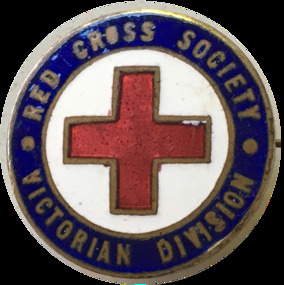 City of Moorabbin Historical Society (Operating the Box Cottage Museum)
Badge - WWI Red Cross Buttons
... The effect of this work for the recipients was to bring comfort in its truest sense, for a seemingly trivial gift of a bar of chocolate of a pair of dry socks could bring the most profound relief for a soldier on the Western Front. ...The effect of this work for the recipients was to bring comfort in its truest sense, for a seemingly trivial gift of a bar of chocolate of a pair of dry socks could bring the most profound relief for a soldier on the Western Front. ...The International Committee of the Red Cross was formed in 1862. Initially its purpose was to try and find ways of overcoming the inadequacy of army medical services so as to alleviate the suffering of those wounded in armed conflict. Over time it has extended its work to include many forms of humanitarian aid in times of peace and war. The Australian Red Cross Society (ARCS) was formed just after the outbreak of the First World War in August 1914, originally as a branch of the British Red Cross. It is especially remembered in the provision of “comforts” for soldiers overseas. Enormous sums of money were raised, and thousands of women volunteers contributed their time by making vast quantities of clothing: socks, vests, mittens, mufflers, pyjamas and a variety of linen. Items were sent to headquarters located in the state capitals, often using government houses as depots, where, after being sorted and packed by yet more volunteers, they were sent to Britain or the front. The effect of this work for the recipients was to bring comfort in its truest sense, for a seemingly trivial gift of a bar of chocolate of a pair of dry socks could bring the most profound relief for a soldier on the Western Front. From the date of its inception until the armistice the ARCS dispatched 395,695 food parcels and 36,339 clothing parcels Between 1914 and 1918 more than £3,500,00 was collected and spent on Red Cross services to the Australian Forces and Empire Forces. During WW1 and WW2 Red Cross raised funds selling buttons.Early settlers in Moorabbin Shire held fundraising events for the support of Red Cross Victoria and made cakes and knitted socks, gloves and scarves for distribution to serving men and women Metal buttons with printing on themRed Crossred cross, fund raising buttons, wwi, wwii, french red cross, british red cross, market gardeners, early settlers, moorabbin shire, bentleigh, cheltenham, caulfield repatriation hospital -
 City of Moorabbin Historical Society (Operating the Box Cottage Museum)
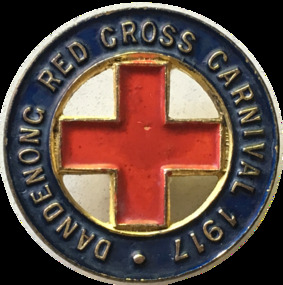
Badge - Red Cross - Springvale, 1917
... The effect of this work for the recipients was to bring comfort in its truest sense, for a seemingly trivial gift of a bar of chocolate of a pair of dry socks could bring the most profound relief for a soldier on the Western Front. ...The effect of this work for the recipients was to bring comfort in its truest sense, for a seemingly trivial gift of a bar of chocolate of a pair of dry socks could bring the most profound relief for a soldier on the Western Front. ...The International Committee of the Red Cross was formed in 1862. Initially its purpose was to try and find ways of overcoming the inadequacy of army medical services so as to alleviate the suffering of those wounded in armed conflict. Over time it has extended its work to include many forms of humanitarian aid in times of peace and war. The Australian Red Cross Society (ARCS) was formed just after the outbreak of the First World War in August 1914, originally as a branch of the British Red Cross. It is especially remembered in the provision of “comforts” for soldiers overseas. Enormous sums of money were raised, and thousands of women volunteers contributed their time by making vast quantities of clothing: socks, vests, mittens, mufflers, pyjamas and a variety of linen. Items were sent to headquarters located in the state capitals, often using government houses as depots, where, after being sorted and packed by yet more volunteers, they were sent to Britain or the front. The effect of this work for the recipients was to bring comfort in its truest sense, for a seemingly trivial gift of a bar of chocolate of a pair of dry socks could bring the most profound relief for a soldier on the Western Front. From the date of its inception until the armistice the ARCS dispatched 395,695 food parcels and 36,339 clothing parcels Between 1914 and 1918 more than £3,500,00 was collected and spent on Red Cross services to the Australian Forces and Empire Forces. During WW1 and WW2 Red Cross raised funds selling buttons.This Carnival was an example of the support given to Red Cross by market gardeners, early settler families and schools in Moorabbin ShireDandenong Red Cross Carnival 1917red cross, dandenong, springvale, chelsea, dingley, keysborough -
 Ringwood and District Historical Society
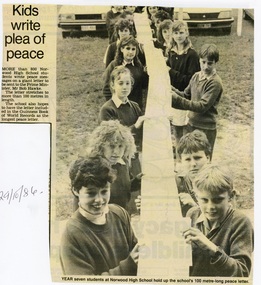
Newspaper - Clippings, Norwood High School, Ringwood, Victoria
... gift to mark his visit to the school. Local newspaper reports from October 1986 and June 1987 - Guinness Book of World Records attempt for longest letter on the subject of peace and subsequent visit to school by recipient, Prime Minister Hawke following student invitation. ...Local newspaper reports from October 1986 and June 1987 - Guinness Book of World Records attempt for longest letter on the subject of peace and subsequent visit to school by recipient, Prime Minister Hawke following student invitation.Photo 17/6/87: Debbie Chandler and Richard Ball present Mr Hawke with a gift to mark his visit to the school. -
 Warrnambool and District Historical Society Inc.
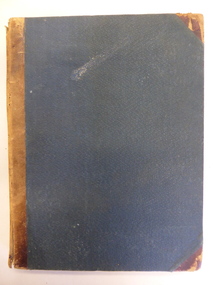
Book, The Technical Educator Vol 4, Late 19th century
... The books were a gift to the Warrnambool and District Historical Society from Bill Wines and it is presumed that he was the recipient of the books in 1938. ...The books were a gift to the Warrnambool and District Historical Society from Bill Wines and it is presumed that he was the recipient of the books in 1938. ...These books originally belonged to James Martin of Beeac and have been passed on to his grandson, William James Wines, in 1938. The books were a gift to the Warrnambool and District Historical Society from Bill Wines and it is presumed that he was the recipient of the books in 1938. The Wine families were pioneer settlers in the Woodford area, and later in the Mailors Flat district (Job and Ellen Wines and Charles Wines). Bill Wines was noted for his lifetime interest in Warrnambool cycling and his recording of the history of the Melbourne to Warrnambool Cycling Classic (one day race).These four volumes are of antiquarian interest as examples of technical education books from the late 19th century. They are also of interest because they belonged to a member of the Wines family, Bill Wines, late of Warrnambool, and his grandfather before him, James Martin. This is Volume 4 of a four volume set of an encyclopedia on technical education. They have dark blue covers with leather binding on the spines and cover edges. The leather binding is partly torn and stained. Some of the inside binding is partly detached. Two of the volumes have colour plates at the beginning of the text and all have many black and white illustrations and drawings. The inscriptions are handwritten in black ink and one inscription had been handwritten on a piece of paper and pasted into the inside front cover. ‘James Martin Beeac August 3rd 1893’ ‘To Wm. Jas. Wines from his grandfather, J. Martin on November 20th 1938’ ‘Direct gift from Mr Bill Wines Crawly (sic) Street’wines families, woodford and mailors flat, history of warrnambool -
 Warrnambool and District Historical Society Inc.
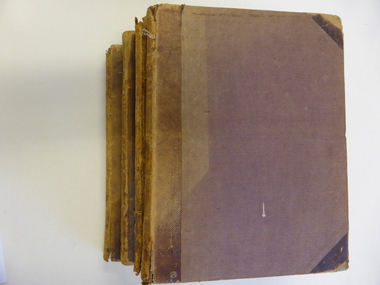
Book, The Technical Educator Vol 1, Late 19th century
... The books were a gift to the Warrnambool and District Historical Society from Bill Wines and it is presumed that he was the recipient of the books in 1938. ...The books were a gift to the Warrnambool and District Historical Society from Bill Wines and it is presumed that he was the recipient of the books in 1938. ...These books originally belonged to James Martin of Beeac and have been passed on to his grandson, William James Wines, in 1938. The books were a gift to the Warrnambool and District Historical Society from Bill Wines and it is presumed that he was the recipient of the books in 1938. The Wine families were pioneer settlers in the Woodford area, and later in the Mailors Flat district (Job and Ellen Wines and Charles Wines). Bill Wines was noted for his lifetime interest in Warrnambool cycling and his recording of the history of the Melbourne to Warrnambool Cycling Classic (one day race).These four volumes are of antiquarian interest as examples of technical education books from the late 19th century. They are also of interest because they belonged to a member of the Wines family, Bill Wines, late of Warrnambool, and his grandfather before him, James Martin. These are four volumes of an encyclopedia on technical education. They have dark blue covers with leather binding on the spines and cover edges. The leather binding is partly torn and stained. Some of the inside binding is partly detached. Two of the volumes have colour plates at the beginning of the text and all have many black and white illustrations and drawings. The inscriptions are handwritten in black ink and one inscription had been handwritten on a piece of paper and pasted into the inside front cover. ‘James Martin Beeac August 3rd 1893’ ‘To Wm. Jas. Wines from his grandfather, J. Martin on November 20th 1938’ ‘Direct gift from Mr Bill Wines Crawly (sic) Street’ wines families, woodford and mailors flat, history of warrnambool, bill wines -
 Warrnambool and District Historical Society Inc.
Ashtray, Geelong Crest, 1920s
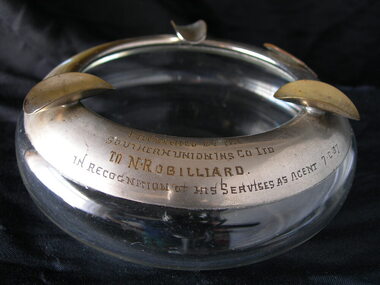
... This ash tray is of interest as an example of the type of gift given to employees in the 1920s. It is believed that the recipient was a resident of Warrnambool. norman robilliard southern union insurance company of australia Badge: ‘Souvenir City of Geelong’ Inscription: ‘Presented by the Southern Union Ins Co Ltd to N. ...This ash tray is a souvenir of the City of Geelong and has been inscribed and used in 1927 as a presentation piece by the Southern Union Insurance Company of Australia. It has been presented to an employee of the company, N. Robilliard. He is possibly the son of James and Ellen Robilliard, De Jersey Norman Robilliard, who died in Warrnambool in 1973. This ash tray is of interest as an example of the type of gift given to employees in the 1920s. It is believed that the recipient was a resident of Warrnambool. This is a circular clear glass ash tray with a silver-coloured metal rim around the top edge. There are four metal scoops and a metal badge affixed to the top rim. There is also an inscription engraved on the metal rim. The silver rim is tarnished. Badge: ‘Souvenir City of Geelong’ Inscription: ‘Presented by the Southern Union Ins Co Ltd to N. Robilliard in recognition of his service as agent 7.2.27’ norman robilliard, southern union insurance company of australia -
 Warrnambool and District Historical Society Inc.
Book, The Technical Educator Vol 2, Late 19th century
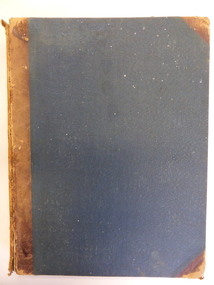
... The books were a gift to the Warrnambool and District Historical Society from Bill Wines and it is presumed that he was the recipient of the books in 1938. ...The books were a gift to the Warrnambool and District Historical Society from Bill Wines and it is presumed that he was the recipient of the books in 1938. ...These books originally belonged to James Martin of Beeac and have been passed on to his grandson, William James Wines, in 1938. The books were a gift to the Warrnambool and District Historical Society from Bill Wines and it is presumed that he was the recipient of the books in 1938. The Wine families were pioneer settlers in the Woodford area, and later in the Mailors Flat district (Job and Ellen Wines and Charles Wines). Bill Wines was noted for his lifetime interest in Warrnambool cycling and his recording of the history of the Melbourne to Warrnambool Cycling Classic (one day race).These four volumes are of antiquarian interest as examples of technical education books from the late 19th century. They are also of interest because they belonged to a member of the Wines family, Bill Wines, late of Warrnambool, and his grandfather before him, James Martin. This is Volume 2 of a four volume set of an encyclopedia on technical education. They have dark blue covers with leather binding on the spines and cover edges. The leather binding is partly torn and stained. Some of the inside binding is partly detached. Two of the volumes have colour plates at the beginning of the text and all have many black and white illustrations and drawings. The inscriptions are handwritten in black ink and one inscription had been handwritten on a piece of paper and pasted into the inside front cover. ‘James Martin Beeac August 3rd 1893’ ‘To Wm. Jas. Wines from his grandfather, J. Martin on November 20th 1938’wines families, woodford and mailors flat, history of warrnambool, bill wines -
 Warrnambool and District Historical Society Inc.
Book, The Technical Educator Volume 3
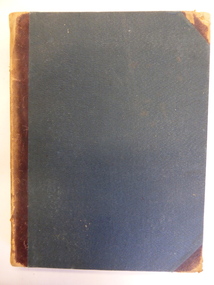
... The books were a gift to the Warrnambool and District Historical Society from Bill Wines and it is presumed that he was the recipient of the books in 1938. ...The books were a gift to the Warrnambool and District Historical Society from Bill Wines and it is presumed that he was the recipient of the books in 1938. ...These books originally belonged to James Martin of Beeac and have been passed on to his grandson, William James Wines, in 1938. The books were a gift to the Warrnambool and District Historical Society from Bill Wines and it is presumed that he was the recipient of the books in 1938. The Wine families were pioneer settlers in the Woodford area, and later in the Mailors Flat district (Job and Ellen Wines and Charles Wines). Bill Wines was noted for his lifetime interest in Warrnambool cycling and his recording of the history of the Melbourne to Warrnambool Cycling Classic (one day race).These four volumes are of antiquarian interest as examples of technical education books from the late 19th century. They are also of interest because they belonged to a member of the Wines family, Bill Wines, late of Warrnambool, and his grandfather before him, James Martin. This is Volume 3 of a four volume set of an encyclopedia on technical education. They have dark blue covers with leather binding on the spines and cover edges. The leather binding is partly torn and stained. Some of the inside binding is partly detached. Two of the volumes have colour plates at the beginning of the text and all have many black and white illustrations and drawings. The inscriptions are handwritten in black ink and one inscription had been handwritten on a piece of paper and pasted into the inside front cover. ‘James Martin Beeac August 3rd 1893’ ‘To Wm. Jas. Wines from his grandfather, J. Martin on November 20th 1938’wines families, woodford and mailors flat, history of warrnambool -
4th/19th Prince of Wales's Light Horse Regiment Unit History Room
Princess Mary Gift Tin, 1914
... recipient a 'victorious new year'. The wounded on leave or in hospital, nurses, and the widows or parents of those killed were also entitled to the gift. ...recipient a 'victorious new year'. The wounded on leave or in hospital, nurses, and the widows or parents of those killed were also entitled to the gift. ...In November 1914, an advertisement was placed in the national press inviting monetary contributions to a 'Sailors & Soldiers Christmas Fund' which had been created by Princess Mary, the seventeen year old daughter of King George V and Queen Mary. The purpose was to provide everyone wearing the King's uniform and serving overseas on Christmas Day 1914 with a 'gift from the nation'. The response was truly overwhelming, and it was decided to spend the money on an embossed brass box, based on a design by Messrs Adshead and Ramsey. The contents varied considerably; officers and men on active service afloat or at the front received a box containing a combination of pipe, lighter, 1 oz of tobacco and twenty cigarettes in distinctive yellow monogrammed wrappers. Non-smokers and boys received a bullet pencil and a packet of sweets instead. Indian troops often got sweets and spices, and nurses were treated to chocolate. Many of these items were despatched separately from the tins themselves, as once the standard issue of tobacco and cigarettes was placed in the tin there was little room for much else apart from the greeting card All boxes, irrespective of recipient, contained a Christmas card and a picture of the Princess. Those which were not distributed until after Christmas were sent out with a card wishing the recipient a 'victorious new year'. The wounded on leave or in hospital, nurses, and the widows or parents of those killed were also entitled to the gift. Prisoners of war at the time had theirs reserved until they were repatriated. Great efforts were made to distribute the gifts in time for Christmas, and huge demands were made on an already stretched postal service. More than 355,000 were successfully delivered by the deadline. As time pressed on, a shortage of brass meant that many entitled personnel did not receive their gift until as late as the summer of 1916, and in January 1919 it was reported that 'considerable' numbers had still not been distributed. Orders for brass strip were placed with the USA, who were not yet involved in the war, and a large consignment was lost with the ship 'Lusitania'. As so much brass was being consumed in the production of weapons and munitions, the quality of the boxes which were manufactured late on was poor, being of a plated inferior alloy, when compared with the earlier pure brass examples. When the fund finally closed in 1920, almost £200,000 had been donated for the provision of more than two and a half million boxes with contents. The 'tin' is approximately 5" long by 3¼" wide by 1¼" deep with a double-skinned, hinged, lid. The surface of the lid depicts the head of Princess Mary in the centre, surrounded by a laurel wreath and flanked on either side by the 'M' monogram. At the top, a decorative cartouche contains the words 'Imperium Britannicum' with a sword and scabbard either side. On the lower edge, another cartouche contains the words 'Christmas 1914', which is flanked by the bows of battleships forging through a heavy sea. In the corners, small roundels house the names of the Allies: Belgium, Japan, Montenegro and Servia; France and Russia are at the edges, each superimposed on three furled flags or standards. -
 Warrnambool and District Historical Society Inc.
Book, Men and Manners, 1945
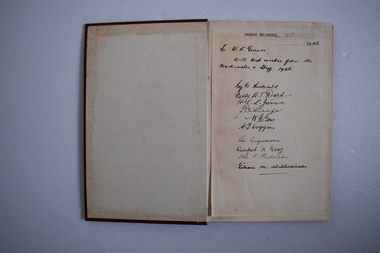
... This book is of interest as it was given as a farewell gift to a member of the Warrnambool High School staff in 1946 and contains the signatures of ten fellow teachers, including the Headmaster, Roy Andrews. The recipient ...This book was one of several independent publications dealing with Australian and Pacific topics. The author, J. Alex. Allan, was a Councillor with the Historical Society of Victoria. The book is less important than the inscription on the first page which indicates that the book was a gift from the staff of Warrnambool High School to William L. Grauer, a teacher who was leaving the school in 1946. Mr Grauer, born in Warrnambool in 1915, became Supervisor of School Forestry in 1968 and served in in the Australian Army and Air Force in World War Two. The Grauers were a prominent early family in the Allansford area and descendants still live today in Allansford and Warrnambool. Warrnambool High School opened in 1907 as the Warrnambool Agricultural High School and merged with Warrnambool North Technical School in 1994 to become Warrnambool College. This book is of interest as it was given as a farewell gift to a member of the Warrnambool High School staff in 1946 and contains the signatures of ten fellow teachers, including the Headmaster, Roy Andrews. The recipient of the book, William Grauer, was a member of a prominent family in the Allansford area.This is a hard- cover book (Social and Economic Sketch of Victorian History) of 172 pages. It has a plain dark red leather cover with a buff-coloured strip pasted on the spine. It is by J. Alex. Allan and was printed in 1945. There are 19 chapters and an Epilogue. There are several pages of black and white photographs. Spine: ‘Cheshire, Men and Manners in Australia, Allan’ On frontispiece: ‘To W.L. Grauer, With best wishes from the Headmaster & Staff, 1946, Roy W. Andrews, Betty H.T. Ward, H.E.L.Jones, S.A.O’Keefe, W.B.Gow,.A.F. Coggins, Leo Ingwersen, Winifred B. Gray, Ida L. Henderson, Lilian M. Williamson’ w.l. grauer, warrnambool high school -
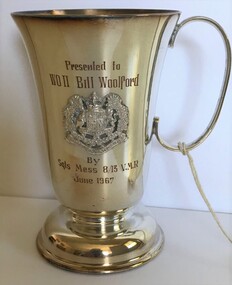 8th/13th Victorian Mounted Rifles Regimental Collection
Functional object - Silver plate tankard
... Often a gift of this type would be hung in the mess signifying the recipient would maintain close contact with mess and the regiment....Often a gift of this type would be hung in the mess signifying the recipient would maintain close contact with mess and the regiment. ...Warrant Officer Class Two Bill Woolford served with the Royal Marines during World War Two. Following the war he served in Hong Kong before migrating to Australia in the 1950s. He joined the Victorian Police and was posted to Wodonga. There he joined 8/13 Victorian Mounted Rifles serving as Squadron Sergeant Major until his retirement in 1967. This tankard was presented to him on his retirement. Often a gift of this type would be hung in the mess signifying the recipient would maintain close contact with mess and the regiment.Representative of a parting gift from the sergeants mess to a retiring NCO.Silver plate tankard with 8/13 Victoriann Mounted Rifles collar badge soldered to side and engraved with presentation details.Presented to / WOII Bill Woolford / by / Sgts Mess 8/13 VMR / June 1967military, drinking, silverware, woolford bill wo2, vmr, sergeants mess -
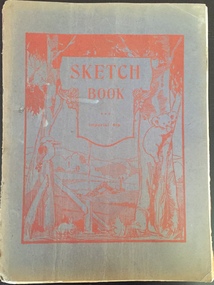 Kew Historical Society Inc
Album, Kenneth Bailey, Art Therapy Sketchbook : Kew Mental Hospital, 1952-1969
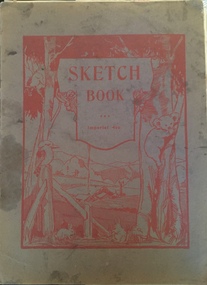
... gift for looking after him”. Herbert Chambers retired from the Kew Asylum in c.1970 after working there for almost thirty years. The Kew Historical Society has been the recipient of a number of important collections relating to the Kew Mental Hospital and the Children's Cottages, Kew, including their former incarnations. ...Herbert Joseph Chambers was born in 1912 in Clifton Hill, Victoria. Later he was to live in Clark and Charles Streets in Northcote, in South Caulfield, and finally in Mentone. While he may have worked at the Kew Asylum before 1945, that year was when he was presented with a Certificate issued by the Department of Mental Hygiene (Victoria) declaring that he had completed training and passed the examinations required to work as a 'Mental Attendant’. The document is dated 19th December 1945 and signed by the Director of the Department and by the Co-Examiners. From at least 1945, he was to work as a member of the male staff of the Asylum, mainly in the Refractory Ward. A donor gifted to the Kew Historical Society in February 2019 a number of items collected by Herbert Chambers in his work at the Asylum. These include his Certificate of Registration, a photograph taken of him with two colleagues at Circular Quay in Sydney, a notebook containing ‘SP’ betting records of male asylum staff, and five sketchbooks with artwork created by Kenneth Bailey, a patient of the Asylum. Herbert Chambers’ period of employment at the Kew Asylum coincided with the employment of the English psychiatrist Dr Eric Cunningham Dax (1908-2008) as Chairman of the Mental Hygiene Authority in 1952. Dr Dax introduced an art therapy program into Victorian psychiatric hospitals, including Kew, where it is likely that the five sketchbooks were created. The sketchbooks are believed to have been presented to Chambers by ***** as a “gift for looking after him”. Herbert Chambers retired from the Kew Asylum in c.1970 after working there for almost thirty years.The Kew Historical Society has been the recipient of a number of important collections relating to the Kew Mental Hospital and the Children's Cottages, Kew, including their former incarnations. This is an important donation in this context as it includes five sketchbooks by a patient in an art therapy program at the Hospital. Art therapy programs were introduced by Dr Eric Cunningham Dax to Victorian asylums in the 1950s. The sketchbooks contain incomplete drawings and finished artworks. The donor believes that the patient who created the sketchbooks suffered from Schizophrenia. The sketchbooks are historically significant as representative examples of works created by patients in the program and for what they reveal about how mental illness may be manifested in a patient's artworks. The most significant repository of comparable works is held by the Dax Centre at Melbourne University.One of five sketchbooks with illustrations by Kenneth Bailey, a patient of the Kew Mental Hospital in an art therapy program, during the 1950s or 1960s. No work is dated although a number of the drawings/paintings are signed with the artist's name. art therapy, kew mental hospital, herbert joseph chambers, dr eric cunningham dax -
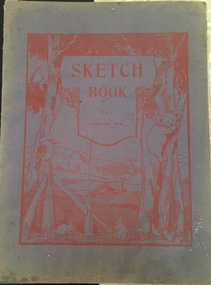 Kew Historical Society Inc
Album - Art therapy sketchbook, Kenneth Bailey, Imperial 4to Sketchbook, Kew Mental Hospital, 1952-1969
... gift for looking after him”. Herbert Chambers retired from the Kew Asylum in c.1970 after working there for almost thirty years. The Kew Historical Society has been the recipient of a number of important collections relating to the Kew Mental Hospital and the Children's Cottages, Kew, including their former incarnations. ...Herbert Joseph Chambers was born in 1912 in Clifton Hill, Victoria. Later he was to live in Clark and Charles Streets in Northcote, in South Caulfield, and finally in Mentone. While he may have worked at the Kew Asylum before 1945, that year was when he was presented with a Certificate issued by the Department of Mental Hygiene (Victoria) declaring that he had completed training and passed the examinations required to work as a 'Mental Attendant’. The document is dated 19th December 1945 and signed by the Director of the Department and by the Co-Examiners. From at least 1945, he was to work as a member of the male staff of the Asylum, mainly in the Refractory Ward. A donor gifted to the Kew Historical Society in February 2019 a number of items collected by Herbert Chambers in his work at the Asylum. These include his Certificate of Registration, a photograph taken of him with two colleagues at Circular Quay in Sydney, a notebook containing ‘SP’ betting records of male asylum staff, and five sketchbooks with artwork created by Kenneth Bailey, a patient of the Asylum. Herbert Chambers’ period of employment at the Kew Asylum coincided with the employment of the English psychiatrist Dr Eric Cunningham Dax (1908-2008) as Chairman of the Mental Hygiene Authority in 1952. Dr Dax introduced an art therapy program into Victorian psychiatric hospitals, including Kew, where it is likely that the five sketchbooks were created. The sketchbooks are believed to have been presented to Chambers by **** as a “gift for looking after him”. Herbert Chambers retired from the Kew Asylum in c.1970 after working there for almost thirty years.The Kew Historical Society has been the recipient of a number of important collections relating to the Kew Mental Hospital and the Children's Cottages, Kew, including their former incarnations. This is an important donation in this context as it includes five sketchbooks by a patient in an art therapy program at the Hospital. Art therapy programs were introduced by Dr Eric Cunningham Dax to Victorian asylums in the 1950s. The sketchbooks contain incomplete drawings and finished artworks. The donor believes that the patient who created the sketchbooks suffered from Schizophrenia. The sketchbooks are historically significant as representative examples of works created by patients in the program and for what they reveal about how mental illness may be manifested in a patient's artworks. The most significant repository of comparable works is held by the Dax Centre at Melbourne University.One of five sketchbooks with illustrations by Kenneth Bailey, a patient of the Kew Mental Hospital in an art therapy program, during the 1950s or 1960s. No work is dated although a number of the drawings/paintings are signed with the artist's name. art therapy, kew mental hospital, herbert joseph chambers, dr eric cunningham dax -
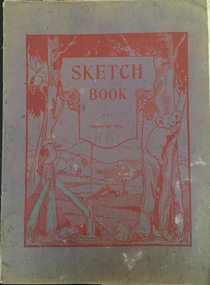 Kew Historical Society Inc
Album - Art therapy sketchbook, Kenneth Bailey, Imperial 4to Sketchbook, Kew Mental Hospital, 1952-1969
... gift for looking after him”. Herbert Chambers retired from the Kew Asylum in c.1970 after working there for almost thirty years. The Kew Historical Society has been the recipient of a number of important collections relating to the Kew Mental Hospital and the Children's Cottages, Kew, including their former incarnations. ...Herbert Joseph Chambers was born in 1912 in Clifton Hill, Victoria. Later he was to live in Clark and Charles Streets in Northcote, in South Caulfield, and finally in Mentone. While he may have worked at the Kew Asylum before 1945, that year was when he was presented with a Certificate issued by the Department of Mental Hygiene (Victoria) declaring that he had completed training and passed the examinations required to work as a 'Mental Attendant’. The document is dated 19th December 1945 and signed by the Director of the Department and by the Co-Examiners. From at least 1945, he was to work as a member of the male staff of the Asylum, mainly in the Refractory Ward. A donor gifted to the Kew Historical Society in February 2019 a number of items collected by Herbert Chambers in his work at the Asylum. These include his Certificate of Registration, a photograph taken of him with two colleagues at Circular Quay in Sydney, a notebook containing ‘SP’ betting records of male asylum staff, and five sketchbooks with artwork created by Kenneth Bailey, a patient of the Asylum. Herbert Chambers’ period of employment at the Kew Asylum coincided with the employment of the English psychiatrist Dr Eric Cunningham Dax (1908-2008) as Chairman of the Mental Hygiene Authority in 1952. Dr Dax introduced an art therapy program into Victorian psychiatric hospitals, including Kew, where it is likely that the five sketchbooks were created. The sketchbooks are believed to have been presented to Chambers by ***** as a “gift for looking after him”. Herbert Chambers retired from the Kew Asylum in c.1970 after working there for almost thirty years.The Kew Historical Society has been the recipient of a number of important collections relating to the Kew Mental Hospital and the Children's Cottages, Kew, including their former incarnations. This is an important donation in this context as it includes five sketchbooks by a patient in an art therapy program at the Hospital. Art therapy programs were introduced by Dr Eric Cunningham Dax to Victorian asylums in the 1950s. The sketchbooks contain incomplete drawings and finished artworks. The donor believes that the patient who created the sketchbooks suffered from Schizophrenia. The sketchbooks are historically significant as representative examples of works created by patients in the program and for what they reveal about how mental illness may be manifested in a patient's artworks. The most significant repository of comparable works is held by the Dax Centre at Melbourne University.One of five sketchbooks with illustrations by Kenneth Bailey, a patient of the Kew Mental Hospital in an art therapy program, during the 1950s or 1960s. No work is dated although a number of the drawings/paintings are signed with the artist's name. art therapy, kew mental hospital, herbert joseph chambers, dr eric cunningham dax -
 Kew Historical Society Inc
Album - Art therapy sketchbook, Kenneth Bailey, Imperial 4to Sketchbook, Kew Mental Hospital, 1952-1969
... gift for looking after him”. Herbert Chambers retired from the Kew Asylum in c.1970 after working there for almost thirty years. The Kew Historical Society has been the recipient of a number of important collections relating to the Kew Mental Hospital and the Children's Cottages, Kew, including their former incarnations. ...Herbert Joseph Chambers was born in 1912 in Clifton Hill, Victoria. Later he was to live in Clark and Charles Streets in Northcote, in South Caulfield, and finally in Mentone. While he may have worked at the Kew Asylum before 1945, that year was when he was presented with a Certificate issued by the Department of Mental Hygiene (Victoria) declaring that he had completed training and passed the examinations required to work as a 'Mental Attendant’. The document is dated 19th December 1945 and signed by the Director of the Department and by the Co-Examiners. From at least 1945, he was to work as a member of the male staff of the Asylum, mainly in the Refractory Ward. A donor gifted to the Kew Historical Society in February 2019 a number of items collected by Herbert Chambers in his work at the Asylum. These include his Certificate of Registration, a photograph taken of him with two colleagues at Circular Quay in Sydney, a notebook containing ‘SP’ betting records of male asylum staff, and five sketchbooks with artwork created by Kenneth Bailey, a patient of the Asylum. Herbert Chambers’ period of employment at the Kew Asylum coincided with the employment of the English psychiatrist Dr Eric Cunningham Dax (1908-2008) as Chairman of the Mental Hygiene Authority in 1952. Dr Dax introduced an art therapy program into Victorian psychiatric hospitals, including Kew, where it is likely that the five sketchbooks were created. The sketchbooks are believed to have been presented to Chambers by ***** as a “gift for looking after him”. Herbert Chambers retired from the Kew Asylum in c.1970 after working there for almost thirty years.The Kew Historical Society has been the recipient of a number of important collections relating to the Kew Mental Hospital and the Children's Cottages, Kew, including their former incarnations. This is an important donation in this context as it includes five sketchbooks by a patient in an art therapy program at the Hospital. Art therapy programs were introduced by Dr Eric Cunningham Dax to Victorian asylums in the 1950s. The sketchbooks contain incomplete drawings and finished artworks. The donor believes that the patient who created the sketchbooks suffered from Schizophrenia. The sketchbooks are historically significant as representative examples of works created by patients in the program and for what they reveal about how mental illness may be manifested in a patient's artworks. The most significant repository of comparable works is held by the Dax Centre at Melbourne University.One of five sketchbooks with illustrations by Kenneth Bailey, a patient of the Kew Mental Hospital in an art therapy program, during the 1950s or 1960s. No work is dated although a number of the drawings/paintings are signed with the artist's name. art therapy, kew mental hospital, herbert joseph chambers, dr eric cunningham dax -
 Kew Historical Society Inc
Album - Art therapy sketchbook, Kenneth Bailey, Moderne Drawing & Scribbling Book, Kew Mental Hospital, 1952-1969
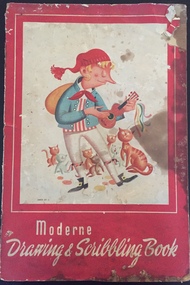
... gift for looking after him”. Herbert Chambers retired from the Kew Asylum in c.1970 after working there for almost thirty years. The Kew Historical Society has been the recipient of a number of important collections relating to the Kew Mental Hospital and the Children's Cottages, Kew, including their former incarnations. ...Herbert Joseph Chambers was born in 1912 in Clifton Hill, Victoria. Later he was to live in Clark and Charles Streets in Northcote, in South Caulfield, and finally in Mentone. While he may have worked at the Kew Asylum before 1945, that year was when he was presented with a Certificate issued by the Department of Mental Hygiene (Victoria) declaring that he had completed training and passed the examinations required to work as a 'Mental Attendant’. The document is dated 19th December 1945 and signed by the Director of the Department and by the Co-Examiners. From at least 1945, he was to work as a member of the male staff of the Asylum, mainly in the Refractory Ward. A donor gifted to the Kew Historical Society in February 2019 a number of items collected by Herbert Chambers in his work at the Asylum. These include his Certificate of Registration, a photograph taken of him with two colleagues at Circular Quay in Sydney, a notebook containing ‘SP’ betting records of male asylum staff, and five sketchbooks with artwork created by Kenneth Bailey, a patient of the Asylum. Herbert Chambers’ period of employment at the Kew Asylum coincided with the employment of the English psychiatrist Dr Eric Cunningham Dax (1908-2008) as Chairman of the Mental Hygiene Authority in 1952. Dr Dax introduced an art therapy program into Victorian psychiatric hospitals, including Kew, where it is likely that the five sketchbooks were created. The sketchbooks are believed to have been presented to Chambers by **** as a “gift for looking after him”. Herbert Chambers retired from the Kew Asylum in c.1970 after working there for almost thirty years.The Kew Historical Society has been the recipient of a number of important collections relating to the Kew Mental Hospital and the Children's Cottages, Kew, including their former incarnations. This is an important donation in this context as it includes five sketchbooks by a patient in an art therapy program at the Hospital. Art therapy programs were introduced by Dr Eric Cunningham Dax to Victorian asylums in the 1950s. The sketchbooks contain incomplete drawings and finished artworks. The donor believes that the patient who created the sketchbooks suffered from Schizophrenia. The sketchbooks are historically significant as representative examples of works created by patients in the program and for what they reveal about how mental illness may be manifested in a patient's artworks. The most significant repository of comparable works is held by the Dax Centre at Melbourne University.One of five sketchbooks with illustrations by ******, a patient of the Kew Mental Hospital in an art therapy program, during the 1950s or 1960s. No work is dated although a number of the drawings/paintings are signed with the artist's name. art therapy, kew mental hospital, herbert joseph chambers, dr eric cunningham dax -
 Returned Nurses RSL Sub-branch
Book - Hardback book, Alister Taylor, The Australian roll of honour: honoured by the Queen 1952-1998, including recipients of national honours 1997 and 1998, 1999
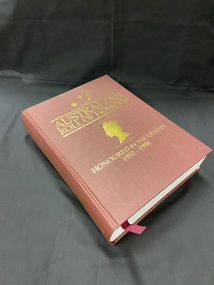
... 'This book is the gift of Betty Constance Lawson MBE to the Returned Nurses Club of Victoria November 2000' [Handwritten in blue in on the back of the first page] Hardcover book with a burgundy cover and gold writing. The Australian roll of honour: honoured by the Queen 1952-1998, including recipients ...A large volume that lists the individuals who received royal honours during 1952-1998 and national honours in 1997 and 1998 in Australia. This book also provides information on the national honours system with detailed descriptions on each medal, order, award and decoration.Hardcover book with a burgundy cover and gold writing.non-fictionA large volume that lists the individuals who received royal honours during 1952-1998 and national honours in 1997 and 1998 in Australia. This book also provides information on the national honours system with detailed descriptions on each medal, order, award and decoration. decorations of honour australia, medals, awards, order of australia -
Save the Dandenongs League Inc.
Archive (item), Save the Dandenongs League Incorporated, Betty Marsden [Australian Taxation Office - A taxation guide for deductible gift recipients and donors]
... Betty Marsden [Australian Taxation Office - A taxation guide for deductible gift recipients and donors] Archive Save the Dandenongs League Incorporated ...
