
Showing 13 items matching " good hope company"
-
 Linton and District Historical Society Inc
Mining company registration form, Good Hope Company
... Good Hope Company ...... Good Hope Company...The page lists information about the Good Hope gold mining company at Black Lead, 'Old Linton'. ...The page lists information about the Good Hope gold mining company at Black Lead, 'Old Linton'. ...The page lists information about the Good Hope gold mining company at Black Lead, 'Old Linton'. There is also a separate registration for an "area for machinery". Information about the Good Hope company includes mining registration numbers (213 and 214), date of registration (24th May 1862, for both registrations), class of mining, extent of claim, location, names of shareholders and their mining right numbers, and transfers of share ownership which have taken place.A3 size photocopy of a page which has probably come from a register of mining companies, most likely maintained at the Smythesdale Court of Mines or another local Court of Mines. (The actual source of the document is not known.) The page is numbered "58" at the top left.gold mining, mining companies, court of mines, registration forms, shareholders, good hope company, hugh taylor cochrane, john main (mayne?), andrew mckay, ralph walton, william wenmouth (weymouth?), john renwick, joseph bachelor, john ferguson, documents and records, mining company registers -
 Linton and District Historical Society Inc
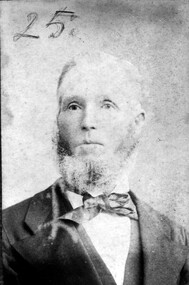
Photograph, Mr Cochrane (probably Hugh Taylor Cochrane)
... Hugh Taylor Cochrane was a shareholder in the Good Hope Company at Linton in 1862. Part of Old Lintonian collection ; No. 25....Hugh Taylor Cochrane was a shareholder in the Good Hope Company at Linton in 1862. Part of Old Lintonian collection ; No. 25. ...Hugh Taylor Cochrane, a farmer, miner and works contractor, was living at Linton from the early 1860s with his wife Catherine. The Cochranes had six chilfren, at least two of whom became teachers in Linton. Hugh Taylor Cochrane was a shareholder in the Good Hope Company at Linton in 1862. Part of Old Lintonian collection ; No. 25.Sepia photograph of gentleman with beard and sideburns wearing suit and bow tie.mr cochrane, old lintonian collection, hugh taylor cochrane -
 Marysville & District Historical Society
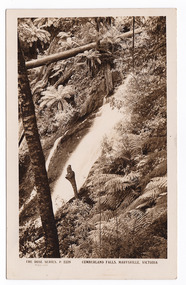
Postcard (item) - Black and white postcard, Rose Stereograph Company, Cumberland Falls, Marysville, Victoria, 1913-1967
... good en-/ joyment. I think this is all hoping all at home are well/ with love Myrtle. A black and white photograph of the Cumberland Falls which are in Cambarville. The Rose Series of postcards P. 2328. Cumberland Falls, Marysville, Victoria Postcard Black and white postcard Rose Stereograph Company ...A postcard in a series produced by the Rose Stereograph Company in Victoria, Australia as a souvenir of Marysville.A black and white photograph of the Cumberland Falls which are in Cambarville. These falls are located on the Marysville-Wood's Point Road. Cambarville is notable for its giant mountain ash (Eucalyptus regnans) trees within the Cumberland Memorial Scenic Reserve, and relics from former sawmills and gold mining. The Big Culvert is located nearby on the Marysville - Woods Point Road, which was historically part of the Yarra Track. Cambarville was established as a timber mill town in the 1940s. Timber mill owners A Cameron and FJ Barton named Cambarville. They established the mill to salvage timber from trees destroyed in the 1939 bushfires. Cambarville was impacted by the 2009 Black Saturday bushfires and any remaining structures were destroyed.POST CARD REAL PHOTO/ THE "ROSE" SERIES DE LUXE PRODUCED IN AUSTRALIA PUBLISHED BY THE ROSE STEREOGRAPHS/ Armadale, Victoria. "Tyrone"/ Buxton/ via Alexandra/ 5-1-54 Dear Auntie/ Just a card to let you know everything is/ all right, the weather just beautiful it could not/ be better. We saw Em May the other day they seem/ to be having a great time they looked good-oh./ We have not been out the last two or three days/ we are having a good rest a lot of our crowd/ have gone home so I suppose there will be a new/ lot coming. We held a cricket match between our/ house & Glasgow we beat them & they supplied/ us with a couple boxes of chocolates but it was good en-/ joyment. I think this is all hoping all at home are well/ with love Myrtle.cumberland falls, cambarville, marysville, victoria, waterfalls, p. 2328, rose series postcard, postcard, souvenir, mountain ash, mining, timber mills, big culvert, yarra track, a cameron, fj barton, black saturday bushfires, 1939 bushfires, eucalyptus regnans -
Federation University Historical Collection
Book - Book - Scrapbook, Ballarat College of Advanced Education: Scrapbook of newspaper cutting, Book 11; May 1982 to November 1982
... The cuttings cover the period from 8 May 1982 to 30 November 1982. . employment advertisements application for enrolment outline of courses dr dennis else warning on hearing hazards sculptures to suit the home repairs to bcae building environment the key to good health potter milton moon harnessing of wind power chemistry contest winners companies help students mildura shire buys sculpture peter blizzard wind power unit steve palmer turn on the tap national safety council award andrew barnard work value recognised stan sweatman reorganisation for colleges seminar for tertiary education hopes come true bcae new creche unis out to earn a dollar open day at bcae victorian industrial safety convention dennis else from england ralph vernon from texas canoeing display cinema's great sin film expert jerzy toeplitz tim palmer to study in united states educationalist daryl siedentop from america life on groote eylandt wendy berglin will longstaff ballarat artist not represented at art gallery winning with sports psychology recognition for peter fryar exercise can save $274m course in human behaviour hostel take-over serious threat beaufort house hostel sandy blythe full recognition for bcae librarianship course Book with grey cover, front. ...Newspaper cuttings relating to Ballarat College of Advanced Education. These are from various newspapers and include The Age, Ballarat Courier, The Australian, The Herald. The cuttings cover the period from 8 May 1982 to 30 November 1982. . Book with grey cover, front. Spiral bound.employment advertisements, application for enrolment, outline of courses, dr dennis else, warning on hearing hazards, sculptures to suit the home, repairs to bcae building, environment the key to good health, potter milton moon, harnessing of wind power, chemistry contest winners, companies help students, mildura shire buys sculpture, peter blizzard, wind power unit, steve palmer, turn on the tap, national safety council award, andrew barnard, work value recognised, stan sweatman, reorganisation for colleges, seminar for tertiary education, hopes come true, bcae new creche, unis out to earn a dollar, open day at bcae, victorian industrial safety convention, dennis else from england, ralph vernon from texas, canoeing display, cinema's great sin, film expert jerzy toeplitz, tim palmer to study in united states, educationalist daryl siedentop from america, life on groote eylandt, wendy berglin, will longstaff ballarat artist, not represented at art gallery, winning with sports psychology, recognition for peter fryar, exercise can save $274m, course in human behaviour, hostel take-over serious threat, beaufort house hostel, sandy blythe, full recognition for bcae librarianship course -
Federation University Historical Collection
Book - Book - Scrapbook, Ballarat College of Advanced Education: Scrapbook of newspaper cutting, Book 19; October 1986 to February 1987
... hope...dean of business...thelma rungkat librarian...call for wide review...e j tippett obituary...keith twyford applied biology...mystery of platypus...$205000 to increase student intake...engineers find answers...how to make a good drop...rhonda galbally...awards for our stars...victorian regional theatre company...The cuttings cover the period from 4 October 1986 to 26 February 1987. . employment advertisements application for enrolment outline of courses ballarat college of advanced education bcae honor for students european wasps geology head retires philip day kaolin waste used on roads physical education display ray richards entertainer painted a paradise off to hawaii patrick hope dean of business thelma rungkat librarian call for wide review e j tippett obituary keith twyford applied biology mystery of platypus $205000 to increase student intake engineers find answers how to make a good drop rhonda galbally awards for our stars victorian regional theatre company david adden brooke selwyn hoffman sculptor study by video coming managing your health ohs courses begin dennis else champagne prize for kym hodder symphony orchestra for ballarat book of the year award garry kinnane more courses better facilities peter widmer exhibition michael wilson beauty in ceramics east in ballarat brew pacific malting susan parks on exchange from u s students without housing cracks in tertiary system simon woodward actor hamlet record enrolments in business courses sensitivity in paintings tamara bekier hamlet my shock Book with yellow cover, front. ...Newspaper cuttings relating to Ballarat College of Advanced Education. These are from various newspapers and include The Age, Ballarat Courier, The Australian, The Herald. The cuttings cover the period from 4 October 1986 to 26 February 1987. . Book with yellow cover, front. Spiral bound.employment advertisements, application for enrolment, outline of courses, ballarat college of advanced education, bcae, honor for students, european wasps, geology head retires, philip day, kaolin waste used on roads, physical education display, ray richards entertainer, painted a paradise, off to hawaii, patrick hope, dean of business, thelma rungkat librarian, call for wide review, e j tippett obituary, keith twyford applied biology, mystery of platypus, $205000 to increase student intake, engineers find answers, how to make a good drop, rhonda galbally, awards for our stars, victorian regional theatre company, david adden brooke, selwyn hoffman sculptor, study by video coming, managing your health, ohs courses begin, dennis else, champagne prize for kym hodder, symphony orchestra for ballarat, book of the year award, garry kinnane, more courses better facilities, peter widmer exhibition, michael wilson, beauty in ceramics, east in ballarat brew, pacific malting, susan parks on exchange from u s, students without housing, cracks in tertiary system, simon woodward actor, hamlet, record enrolments in business courses, sensitivity in paintings, tamara bekier, hamlet my shock -
 Marysville & District Historical Society
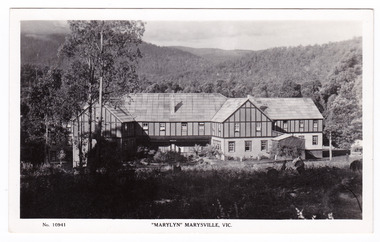
Postcard (item) - Black and white postcard, Rose Stereograph Company, "MARYLYN", MARYSVILLE, VIC, 1913-1967
... good. The walks and the/ scenery are beautiful./ We have giggled ever since/ we arrived ^ here. Last night/ I got under the shower and/ discovered I didn't have my/ towel with me, so I had to/ put my dressing gown on and/ make a run for it. How is/ Pat, no fights I hope./ Lots of love. Joan A black and white postcard from Marylyn Guest House in Marysville. Marylyn was a part of the Mary Chain of guest houses built by Eric Dowdle in the Depression years. The postcard was produced by the Rose Stereograph Company ...A black and white postcard from Marylyn Guest House in Marysville. Marylyn was a part of the Mary Chain of guest houses built by Eric Dowdle in the Depression years. The postcard was produced by the Rose Stereograph Company as a souvenir of Marysville.A black and white postcard from Marylyn Guest House in Marysville.No. 10941 POST CARD The "Rose" Series/ De Luxe A Real Photograph/ Produced in Australia Published by the Rose Stereograph Co./ Armadale, Victoria. "Mary-Lyn"/ Marysville/ Friday/ Dear Joyce/ Just a note to let you know I am/ behaving myself and/ thinking of Ian all the time./ The weather has been very/ good. The walks and the/ scenery are beautiful./ We have giggled ever since/ we arrived ^ here. Last night/ I got under the shower and/ discovered I didn't have my/ towel with me, so I had to/ put my dressing gown on and/ make a run for it. How is/ Pat, no fights I hope./ Lots of love. Joanmarysville, victoria, australia, mary chain guest houses, marylyn, eric dowdle, rose series, rose stereograph company, postcard, souvenir, no. 10941 -
 Marysville & District Historical Society
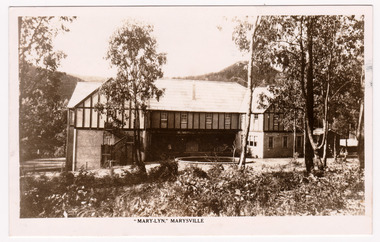
Postcard (item) - Black and white postcard, Rose Stereograph Company, "MARYLYN," MARYSVILLE, 1913-1967
... company postcard souvenir POST CARD The "Rose" Series/ De Luxe A Real Photograph/ Produced in Australia Published by the Rose Stereograph Co.,/ Armadale, Victoria. Dear Nip/ I thought you would like/ to see Marylyn House. How are you/ going. Isn't it lovely weather we have/ been playing Golf nearly all the time/ the last 2 days. Gee I miss seeing/ you a lot Nip. Are you going out/ Saturday night. I suppose we will go/ to the Pictures here. Well Evelyn so long,/ till next week. Love from John. XXX/ XX for Marie/ I hope they had a good ...A black and white postcard from Marylyn Guest House in Marysville. Marylyn was a part of the Mary Chain of guest houses built by Eric Dowdle in the Depression years. The postcard was produced by the Rose Stereograph Company as a souvenir of Marysville.A black and white postcard from Marylyn Guest House in Marysville.POST CARD The "Rose" Series/ De Luxe A Real Photograph/ Produced in Australia Published by the Rose Stereograph Co.,/ Armadale, Victoria. Dear Nip/ I thought you would like/ to see Marylyn House. How are you/ going. Isn't it lovely weather we have/ been playing Golf nearly all the time/ the last 2 days. Gee I miss seeing/ you a lot Nip. Are you going out/ Saturday night. I suppose we will go/ to the Pictures here. Well Evelyn so long,/ till next week. Love from John. XXX/ XX for Marie/ I hope they had a good time/ Camping.marysville, victoria, australia, mary chain guest houses, marylyn, eric dowdle, rose series, rose stereograph company, postcard, souvenir -
 Marysville & District Historical Society
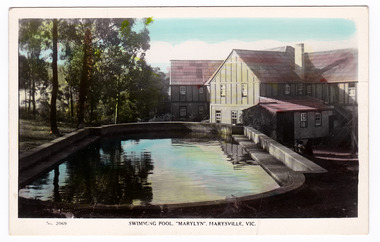
Postcard (item) - Colour tinted postcard, Rose Stereograph Company, SWIMMING POOL, "MARYLYN", MARYSVILLE, VIC, 1913-1967
... A colour tinted postcard from Marylyn Guest House in Marysville. marysville victoria australia mary chain guest houses marylyn eric dowdle rose series rose stereograph company postcard souvenir no. 2069 No. 2069 POST CARD A Real Photograph Produced in Australia Dear Brian,/ It is very nice up here/ plenty to eat + a good bed we have been/ for a couple of nice walks there are plenty/ of blackberry's about, If your Father comes up/ next Sunday I hope you + Ray will come too/ as you would enjoy yourselves. ...A colour tinted postcard from Marylyn Guest House in Marysville. Marylyn was a part of the Mary Chain of guest houses built by Eric Dowdle in the Depression years. The postcard was produced by the Rose Stereograph Company as a souvenir of Marysville.A colour tinted postcard from Marylyn Guest House in Marysville.No. 2069 POST CARD A Real Photograph Produced in Australia Dear Brian,/ It is very nice up here/ plenty to eat + a good bed we have been/ for a couple of nice walks there are plenty/ of blackberry's about, If your Father comes up/ next Sunday I hope you + Ray will come too/ as you would enjoy yourselves. Love Mum.marysville, victoria, australia, mary chain guest houses, marylyn, eric dowdle, rose series, rose stereograph company, postcard, souvenir, no. 2069 -
 Marysville & District Historical Society
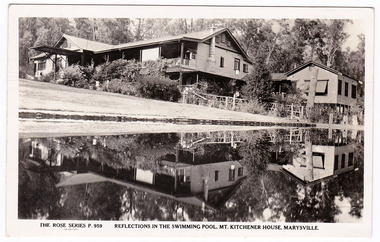
Postcard (item) - Black and white postcard, Rose Stereograph Company, REFLECTIONS IN THE SWIMMING POOL, MT. KITCHENER HOUSE, MARYSVILLE, 1913-1967
... company postcard souvenir p. 959 THE ROSE SERIES P. 959/ COPYRIGHT POST CARD The "Rose" Series/ De Luxe A Real Photograph/ Produced in Australia Published by the Rose Stereograph Co.,/ Armadale, Victoria. Thursday/ 14/10/47 Dear Miss Lloyd,/ How are you? Well,/ Mt. Kitchener House has certainly come up to/ expectations. We can't fault the food -/ we simply eat it. Weather has been very kind/ although showery today. Gave Mrs Hull message/ which was appreciated. Have had some good tennis/ + tomorrow morning hope ...A black and white postcard of the pool at Mt. Kitchener House in Marysville that was produced by the Rose Stereograph Company as a souvenir of Marysville.A black and white postcard of the pool at Mt. Kitchener House in Marysville that was produced by the Rose Stereograph Company as a souvenir of Marysville.THE ROSE SERIES P. 959/ COPYRIGHT POST CARD The "Rose" Series/ De Luxe A Real Photograph/ Produced in Australia Published by the Rose Stereograph Co.,/ Armadale, Victoria. Thursday/ 14/10/47 Dear Miss Lloyd,/ How are you? Well,/ Mt. Kitchener House has certainly come up to/ expectations. We can't fault the food -/ we simply eat it. Weather has been very kind/ although showery today. Gave Mrs Hull message/ which was appreciated. Have had some good tennis/ + tomorrow morning hope to go riding - weather permitting./ Has the ground glass found its way into the/ Brig's cuppa tea yet? Hope you're not working too hard/ Cheerio for now. Kindest regards from Fay + Ronmarysville, victoria, australia, mt kitchener house, accommodation, rose series, rose stereograph company, postcard, souvenir, p. 959 -
 Flagstaff Hill Maritime Museum and Village
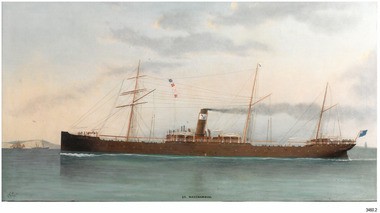
Photograph - Vessel, Sail and Steam Ship, S.S. Warrnambool
... company’s house flag. The Lund Line ships were given Australian place names beginning with the letter “W”. Master Mariner, Captain Joshua Ilbery, was lost at sea without a trace in 1909, along with the ship SS Waratah. The ‘no frills’ service carried passengers and cargo to and from Europe around the Cape of Good Hope...company’s house flag. The Lund Line ships were given Australian place names beginning with the letter “W”. Master Mariner, Captain Joshua Ilbery, was lost at sea without a trace in 1909, along with the ship SS Waratah. The ‘no frills’ service carried passengers and cargo to and from Europe around the Cape of Good Hope ...This photograph and a matching earlier photograph are images of a 1989 oil-on-canvas painting owned by the donor. They show the British sail and steam ship SS Warrnambool at Dover Strait in the English Channel. Each photograph was accompanied by a letter, one written in 2001 and the other in 2003, confirming that the artist of the painting was by Charles Keith Miller, signed with his initials “CKM” and dated “1893”. The images show the ship’s home flag with a diagonal blue anchor flying from the masthead. The same symbol is painted on the ship’s black funnel. The signal flags on the foremast display ‘M’ ‘R’ ‘V’ ‘B’, with each flag signalling a meaning in the International Code of Signals. While the SS Warrnambool was visiting Melbourne on its maiden voyage on December 1, 1892, a painting of that Lind Line ship by marine artist C.K. Miller was presented to the Town Council of Warrnambool by Mr. William Lund of London, owner of the Lind Line, or Blue Anchor Line. At that time, the Ladies of Warrnambool presented the ship with a ‘house’ flag bearing the Blue Anchor Line’s symbol, made by them especially for the occasion during the preceding moth. On December 6, the homeward bound ship anchored for a short time off the Port of Warrnambool, and a boat was launched from Lady Bay to take a group of friends to the ship with a delivery of gifts. After three cheers each for the ship and its Captain the SS Warrnambool continued its journey towards Britain via Adelaide. Although the painting was gifted in December 1892, it is post-dated “1893”. The reason for the discrepancy is unclear but whatever the reason, the provenance of the painting was confirmed at auctions of this painting and other works by the same artist. CHARLES KEITH MILLER 1836-1907:- Captain Charles Miller left his home in Scotland at the age of 15 years for a life at sea. He earned his Master’s Certificate ten years later. After being the captain of sailing ships, he moved to the steamships because they were faster. He married in 1866 and settled in Glasgow. Over the following eleven years, he and his wife had five children, then sadly, his wife passed away. Captain Miller returned to the sea for a while, but in 1888, he gave up his sea life to spend his time as a marine artist. His understanding of seafaring life and vessels, combined with his artistic skills, enabled him to produce fine art, and several galleries and museums have collections of his sought-after works. S.S. WARRNAMBOOL 1892-1925:- The sail and steamship SS Warrnambool was built in 1892 by the Sunderland Ship Building Company for the Lund Line of London, founded by William Lund in 1869, and registered in London. It efficiently carried passengers and cargo worldwide, including Australia, under its master, Captain Joshua Edward Ilbery, who had many years of experience with the Lund’s Blue Anchor Line, or BAL, which owned a fleet of sail and steamships. The funnels its steamships were painted black, with a white band around the top bearing a diagonal blue anchor and chain, also shown on the company’s house flag. The Lund Line ships were given Australian place names beginning with the letter “W”. Master Mariner, Captain Joshua Ilbery, was lost at sea without a trace in 1909, along with the ship SS Waratah. The ‘no frills’ service carried passengers and cargo to and from Europe around the Cape of Good Hope, stopping at various ports. The ship was involved in bringing home returned soldiers in 1895. At one time, it carried a doctor from Victoria, Australia, to assist at the war front in South Africa. The ship had a very good reputation for its cargo arriving almost always in excellent condition. Exported goods from Australia included iron safes, flour, wool, apples, frozen rabbits, butter, cheese, pork, cattle, poultry and sheep. One remarkable delivery contained Ostriches for Queen Victoria, and they survived the journey well. The SS Warrnambool was sold in 1900 to the British and South American Steam Navigation Co. Ltd of Liverpool and was renamed ‘Harmodius’. R.P. Houston & Company of London managed the company, and its Houston Line funnels were red with a black top. The Harmodius was sold in 1919 to K.S.S. Co. Ltd, managed by Kaye Son & Co. Ltd. of Liverpool, and was renamed ‘Kut’. The line had black funnels with a white ‘K’ in a diamond or between white stripes. In 1926, it was purchased by T.W. Ward Ltd. and broken up. NOTE- other vessels named “Warrnambool” Two other vessels carried the name “Warrnambool” (1)- HMAS Warrnambool J202 (1941-1947), a Bathurst-class corvette vessel owned by the Royal Australian Navy, was destroyed by a mine. (2)- HMAS Warrnambool FCPB204 (1980-2005), a Fremantle Class Patrol Boat of the RAN. The photograph is significant for its association with the painting "SS Warrnambool" by renowned marine artist Charles Keith Miller, whose paintings are well valued. The painting by C K Miller, the photograph, both bear the name Warrnambool, and the house flag of the Lind Line, are connected through the gifts exchanged between the ship company owner, the Town of Warrnambool and the Ladies of Warrnambool. The images connect the SS Warrnambool to the international trade of cargo and passengers. Coloured photograph of a painting depicting the Blue Anchor Line’s 1892 steamship S.S. Warrnambool. The three-masted ship in calm water. Its sails are lowered, and smoke is rising from its funnel. It displays four raised signal flags, a house flag and a blue ensign on the ship. The funnel also bears the house flag's symbol. There are figures on deck. The signature of the painting's artist, CKM (Charles Keith Miller), and a title on the lower edge of the photograph.House flag symbol, [diagonal blue anchor on white background] Text "CKM" and "1893" Text "S. S. WARRNAMBOOL."flagstaff hill, warrnambool, photograph, steam ship warrnambool, flagstaff hill maritime village, shipwreck coast, ss warrnambool, captain, charles keith miller, ckm, 1893, william lund, warrnambool town council, blue anchor line, lund line, ladies of warrnambool, house flag, diagonal blue anchor, captain miller, sunderland ship building company, migrant ship, 1892 ship, home flag, bal, australian export, s.s.warrnambool, dover strait, english chanel, port of warrnambool, lady bay, mrvb, captain charles miller, captain joshua edward iibery, ostriches, queen victoria, british and south american steam navigation co., harmodius, r.p. houston & company, houston line, k.s.s. co. ltd, kaye son & co. ltd, kut, t.w. ward ltd -
 Bendigo Historical Society Inc.
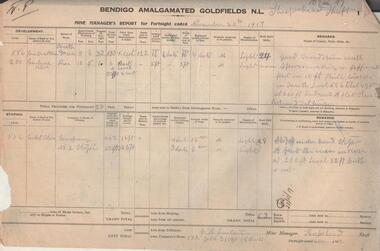
Administrative record - Bendigo Amalgamated Goldfields N.L. Mine Manager's Reports, 1917 - 1920
... In 1917 Bendigo Amalgamated Goldfield Ltd was formed from the amalgamation of 35 companies with operations on the Garden Gully, Sheepshead, Deborah and Derby lines of reef hoping to increase profits of these existing operations through economies of scale. This was difficult to achieve as the shafts involved were spread throughout the goldfield. Diamond drilling and good...In 1917 Bendigo Amalgamated Goldfield Ltd was formed from the amalgamation of 35 companies with operations on the Garden Gully, Sheepshead, Deborah and Derby lines of reef hoping to increase profits of these existing operations through economies of scale. This was difficult to achieve as the shafts involved were spread throughout the goldfield. Diamond drilling and good ...In 1917 Bendigo Amalgamated Goldfield Ltd was formed from the amalgamation of 35 companies with operations on the Garden Gully, Sheepshead, Deborah and Derby lines of reef hoping to increase profits of these existing operations through economies of scale. This was difficult to achieve as the shafts involved were spread throughout the goldfield. Diamond drilling and good geological practices were introduced (Pabst was Chief Geologist) leading to some exploration success. However costs were rising rapidly and in 1923 the directors, deciding that mining would soon become unprofitable, dissolved the company returning assets to the original vendors. J.H. Lenten, Mine Manager, received his second class Mine Manager's certificate in September, 1914 at an examination held at the Bendigo Law Courts. One hundred pages of fortnightly manager's reports for Bendigo Amalgamated Goldfields N.L., Sheepshead Shaft. Reports consist of two pages for each fortnight, signed by J.H. Lenten, Mine Manager. Dates of reports range from November 20th, 1917 to 5th May 1920. Categories reported on include: development, stoping, tons from tributors, tons Company's stone, plant and machinery, underground workings, number of rock drill shifts, firewood used, coal burnt, and general remarks. charcoal burnt., lifting waterbendigo, margaret roberts, , goldmining, bendigo amalgamated goldfields, sheepshead shaft, j.h. lenten, mine manager -
 Wangaratta RSL Sub Branch
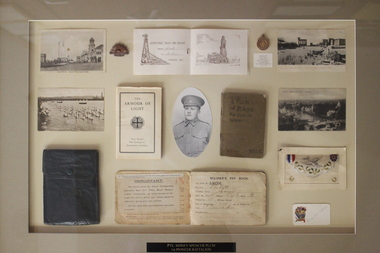
Mixed media - Framed photograph and objects, Pte Sidney Spencer Plum
... hoping that you and every body is the same. We have some great fogs over here, it rained all one night. We had a very good Christmas we got a billy issued to us and it had every thing in it. The Captain of our company...hoping that you and every body is the same. We have some great fogs over here, it rained all one night. We had a very good Christmas we got a billy issued to us and it had every thing in it. The Captain of our company ...Collection of personal effects that belonged to Private SIdney Spencer Plum, 3431 1st Pioneer Battalion. SIdney was born on 3/1/1894 at Dockers Plains via Wangaratta. He attended both North Wangaratta and Dockers Plains schools. He was a Blacksmith aged 21 years when he enlisted on 12/6/1915 and embarked on 11/10/1915 on board HMAT Nestor. He was wounded three times and was discharged from the AIF on 16/3/1919. Items include oval photo of Sidney Plum in the centre surrounded by four post cards, one embroidered post card of a dove with an envelope in it's beak with the Union Jack and French flag, a Greetings From The Front" booklet, "The Armour of Light" bible, "A Form of Prayer for open air services" book, Soldier's Pay Book, a "To my dear Mother" card, a black leather pouch, a rising sun badge, round gold medallion. A framed montage of personal items belonging to Private Sydney Spencer PLUM compiled by his family to honour his memory and service. In addition to general military issue the remaining items were most likely purchased whilst on leave in France and England during the first world war. Postcards particularly embroidered postcards were sent home to loved ones and friends.Framed Collection of personal effects - Private Sidney Spencer Plum, 1st Pioneer Battalion. Includes oval photo of Sidney Plum in the centre surrounded by four post cards, one embroidered post card of a dove with an envelope in it's beak with the Union Jack and French flag, a Greetings From The Front" booklet, "The Armour of Light" bible, "A Form of Prayer for open air services" book, Soldier's Pay Book, a "To my dear Mother" card, a black leather pouch, a risen sun badge, round gold coloured medalion. Frame has a donation plaque.Front: Pte Sidney Spencer Plum, 1st Pioneer Battalion. Donated by Max & Hilary (Plum) Ryan and Sylvia Reed (Plum) of Wangarattaa Back: Wangaratta Picture Framers 9 Oct 2003. Also has messages from front postcards; Dear Mother, Just a few lines to let you know that I am alright hoping that you and all the rest is well too. We have had three fogs over here and it is very cold at night. I was picked in Cairo and they had some Turkey Officers an a German spy in gaol there. I wrote to Aunt Nelline. I got two letters from Alf. Maude Saxby hasnt wrote to me since I was up there on final leave. I get the letters quicker. I got Alf photos all right. I will be having Christmas in London. Well I think this is all this. I remain you son Sid. Tell Alf to send me over the Age so I can see how the war is going. I suppose Dad and the rest is busy harvesting now. Glad to hear that you got the photos all right. I think this is all this time from Sid same address as before. Dear Mother, Just a few lines to let you know that I am keeping well hoping that you and every body is the same. We have some great fogs over here, it rained all one night. We had a very good Christmas we got a billy issued to us and it had every thing in it. The Captain of our company gave me a Christmas pudding. All the same I wished I were back in Australia again. I think this is all this time. Yours truely son Sid, 25/12/15plum, sidney, world war 1, postcards, embroidered postcard, soldier's pay book, leather pouch, bible, prayer book, sydney -
 City of Melbourne Libraries
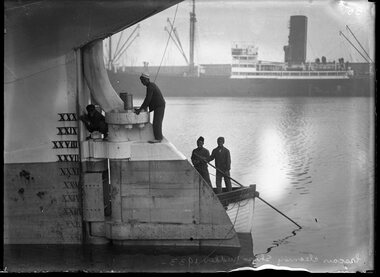
Photograph, Bull, Hugh Jones, 1897-1993, Lascars cleaning ship's rudder
... Good Hope, who were employed to work on colonial merchant ships. The practice ran from the 16th century to the mid 20th century”. Indian seamen were used as early as the 16th century by Portuguese explorer Vasgo da Gama in his successful voyage to India, and subsequently by Portuguese ships in the 16th and 17th centuries. “Through the Portuguese and Spanish maritime world empires, some Indian lascars found their way onto English merchant ships, and were among the sailors on the first English East India Company...Good Hope, who were employed to work on colonial merchant ships. The practice ran from the 16th century to the mid 20th century”. Indian seamen were used as early as the 16th century by Portuguese explorer Vasgo da Gama in his successful voyage to India, and subsequently by Portuguese ships in the 16th and 17th centuries. “Through the Portuguese and Spanish maritime world empires, some Indian lascars found their way onto English merchant ships, and were among the sailors on the first English East India Company ...Published: unknown, however, on 26 June 1935 a similar, but not the exact photo in the McKenzie Collection, was published in The Age: Published title: Shipping Victorian Flour to the East Published Caption: Flour and wheat figure prominently in all cargoes carried by ships trading to Chinese, Japanese and Eastern ports. Victorian millers are eager to extend lids outlet for their produce, and every opportunity is grasped. The pictures show Australian labourers unloading from railway trucks some of the 2300 tons of flour which will go into the hold of the Burns, Philp motor ship Neptuna for shipment to Hong Kong, while Chinese seamen are busy cleaning and painting the rudder post of the ship. Hard by the Neptuna, other ships are taking on flour for the East. Research by Project Volunteer, Louise McKenzie: The image was described by Hugh Bull on the rear of the glass plate as – “Lascars cleaning ships rudder 1933”. Basically, a “lascar” is a seaman. Image No. 032 in the McKenzie Collection shows two lascars perched on the rudder of a ship, with two others standing in a rowboat along side. They are dressed in baggy trousers and jackets and wearing caps. Across a very calm dock area is a single funnel ship with on-deck derricks. The rudder of the ship being cleaned is white, with large black roman numbering denoting the depth at which the ship is sitting, depending on whether it is loaded or empty. Whilst the exact photo in the McKenzie Collection has yet to be located in The Age in 1933, the date when it was taken, there is a photo published in The Age on 25 June 1935 which appears to be one of a series of photos taken on the same day, featuring lascars cleaning a ship’s rudder. It bears a striking resemblance to MCK 032, but it is taken from a slightly different angle. The 1935 published photo is a close up of a ship’s rudder being cleaned, with same style of roman numerals in black on the white of the rudder. One lascar is standing on the rudder, one is standing in a small clinker style rowboat, with its characteristic wooden overlapping hull planks, holding a broom; two more lascars are sitting in the bow and stern of the rowboat. The ship being cleaned is in a dock, as a wharf and warehouses can be seen in the background, the water is very calm, and there are two other ships moored nearby – one across the other side of the dock with a black and white hull and derricks on its deck, and one adjacent, with its mooring lines clearly visible. The lascars are wearing caps, baggy trousers and jackets. Compelling similarities therefore exist between the two images. Whilst it is difficult to positively identify the cultural background of these particular lascars in either photo, the newspaper article dated June 1935 advises they are “Chinese”. This is possibly because the ship they are associated with, the Neptuna, is reported to have sailed from Melbourne on this date, bound for Hong Kong. However, the men are probably from South East Asia. Wikipedia describes the term “Southeast Asia” as covering ” … the people of Southeast Asia from prehistory to the present in two distinct sub-regions: Mainland Southeast Asia (or Indochina) and Maritime Southeast Asia (or Insular Southeast Asia). Mainland Southeast Asia comprises Cambodia, Laos, Myanmar (or Burma), Peninsular Malaysia, Thailand and Vietnam whereas Maritime Southeast Asia comprises Brunei, Cocos (Keeling) Islands, Christmas Island, East Malaysia, East Timor, Indonesia, Philippines and Singapore. Additionally, Wikipedia “Lascars” states that “Lascars were sailors from the Indian subcontinent, South East Asia, the Arab world, British Somaliland and lands east of the Cape of Good Hope, who were employed to work on colonial merchant ships. The practice ran from the 16th century to the mid 20th century”. Indian seamen were used as early as the 16th century by Portuguese explorer Vasgo da Gama in his successful voyage to India, and subsequently by Portuguese ships in the 16th and 17th centuries. “Through the Portuguese and Spanish maritime world empires, some Indian lascars found their way onto English merchant ships, and were among the sailors on the first English East India Company (EIC) ships to sail to India.” In the 17th Century “When the English adopted the term "lascar", they initially used it for all Asian sailors on English-flagged ships, but after 1661 and the Portuguese ceded Bombay to England, the term was used mainly to describe Indian sailors specifically. The term "topaze" was used to describe Indo-Portuguese personnel, especially those from Bombay, Thana, Diu, Dammam and Cochin. The term "sepoy" was used to describe Indian soldiers in European service. The number of lascars employed on EIC East Indiamen was so great that the Parliament of England restricted their employment via the Navigation Acts (in force from 1660 onwards) which required that 75% of the crew onboard English-flagged ships importing goods from Asia be English subjects. The restriction arose due to the high rates of illnesses and death among European sailors on East Indiamen, and their frequent desertions in Asia, which left such ships short of crew for the return voyage. Another reason was the frequent impressment of European sailors from EIC East Indiamen by the Royal Navy in times of war“. The term “impressment” colloquially refers to “the “press gang” …”a type of conscription of people into a military force, especially a naval force, via intimidation and physical coercion, conducted by an organized group (hence “gang”). .. The large size of the British Royal Navy in the Age of Sail meant impressment was most commonly associated with Great Britain.”. (Wikipedia – Impressment). By the 20th century these sailors served on British ships under "lascar agreements", which allowed shipowners more control than was the case in ordinary articles of agreement. The sailors could be transferred from one ship to another and retained in service for up to three years at one time. “Lascars served all over the world in the period leading up to the First World War. Lascars were barred from landing at some ports, such as in British Columbia. At the beginning of World War I, there were 51,616 lascars working on British merchant ships in and around the British Empire. In World War II thousands of lascars served in the war and died on vessels throughout the world, especially those of the British India Steam Navigation Company, P&O and other British shipping companies. The lack of Canadian naval manpower led to the employment of a total of 121 Catholic Goans and 530 Muslim British Indians on the Empress vessels of the Canadian Pacific Railway, such as the Empress of Asia and Empress of Japan. These ships served in the Indian Ocean both as ANZAC convoy ships and in actions at Aden. The ships were placed under the British Admiralty as part of Canada's contribution to the war effort and all of the Indian men were awarded medals by the Admiralty, though none of them were delivered. In the 1950s the use of the term "lascar" declined with the ending of the British Empire. The Indian “Lascar Act” of 1832 was finally repealed in 1963. However, "traditional" Indian deck and Pakistani engine crews continued to be used in Australia until 1986 when the last crew was discharged from the P&O and replaced by a general-purpose crew of Pakistanis. The term lascar has been widely used to engender an element of exoticism in literature eg “Sir Arthur Conan Doyle created a Lascar foil to Sherlock Holmes in "The Man with the Twisted Lip" in 1891. Lascars aboard the ship Patna figure prominently in the early chapters of Joseph Conrad's novel Lord Jim. Frances Hodgson Burnett's novel A Little Princess features a lascar named Ram Dass. Also, Caleb Carr portrays two lascars as bodyguards for a Spanish diplomat near the end of The Angel of Darkness. In Wuthering Heights, it is speculated that Heathcliff, the main character, may be of lascar origin." (Wikipedia – Lascar) And what has become of these “forgotten heroes of the World Wars”? The South Asian Heritage Trust, which seeks to commemorate, mark and celebrate South Asian cultures, stories, and communities, published an article in July 2025 entitled – The Lascars: Seafaring Roots of Modern Britain. It particularly honours the role of the 80,000 lascars who served Britain in WWI, and the over 100,000 who served in the British Merchant Navy in WWII, and concludes: “The hardships faced by Lascars were profound. They were often assigned the most dangerous tasks, lived in substandard conditions aboard ships and, even after their immense contributions to the war efforts, many veterans found it difficult to secure the recognition, pensions and rights afforded to other veterans. Many were employed under ‘Asiatic Articles’, which offered less protection and lower pay than their European counterparts. Yet, their legacy endures. The multicultural fabric of areas like East London owes much to these early seafarers and settlers. The East London Mosque, established in 1910, became an important spiritual and community hub. Today, efforts to bring their stories out of the shadows are growing. The Museum of London Docklands features exhibits on their history. Memorials, such as the P&O headstone in Dover for the 22 Lascar crew members of the SS Maloja sunk in 1916 and the careful restoration of the Lascar War Memorial in Kolkata, serve as important reminders of the sacrifices. The journey of the Lascars – from their homelands, along dangerous wartime shipping routes, to the docklands of Britain – is a story of personal courage and of a rich contribution to Britain’s history and identity.” The ship MV Neptuna, mentioned in the 1935 article, had that year been purchased from a German company by Australian-owned Burns Philp, with Australian Government assistance, and it was instrumental in ensuring the shipment of rice from Vietnam to Papua New Guinea. Rice is still a household staple in PNG. Despite it being introduced into PNG more than 100 years ago, the crop has not been sufficiently integrated into the country’s traditional agricultural production system, and today PNG imports still account for nearly 98% of rice. (Spotlight Magazine Sept. 2016) The 1935 newspaper article states that the Neptuna is involved in moving flour for the East. Australian wheat exports began in 1845, but were not regular until the 1870s. New land clearing methods in Australia allowed large tracts of land to be cleared more efficiently – this included the invention of the iconic ‘stump jump’ plough. With the success of the wheat harvests, flour mills began to spring up around the country. By the 1870s, many large country towns had their own mills, with around 500 mills producing flour across the country. Flour exports were an important part of the wheat industry until around the 1930s. After the Second World War, many of Australia’s export partners (which were mainly in the developing nations of Asia) began setting up their own flour industries and the Australian product was no longer in demand. In 1942 MV Neptuna was being utilised for the war effort, and carrying depth charges and other armaments for Australia, when on 19 February it was sunk in a bombing raid on Darwin, and where part of her hull still lies. References: SHIPPING VICTORIAN FLOUR TO THE EAST. (1935, June 25). The Age (Melbourne, Vic. : 1854 - 1954), p. 11. Retrieved July 23, 2025, from http://nla.gov.au/nla.news-article204357218 Age (Melbourne, Vic. : 1854 - 1954), Tuesday 25 June 1935, page 11 Wikipedia, Clinker (boat building), https://en.wikipedia.org/wiki/Clinker_(boat_building) Wikipedia, Lascar, https://en.wikipedia.org/wiki/Lascar Wikipedia, History of Southeast Asia, https://en.wikipedia.org/wiki/History_of_Southeast_Asia Wikipedia, Impressment, https://en.wikipedia.org/wiki/Impressment NEPTUNA LEAVES FOR CHINA WITH TOURISTS (1935, June 25). The Herald (Melbourne, Vic. : 1861 - 1954), p. 5. Retrieved July 23, 2025, from http://nla.gov.au/nla.news-article244841163 National Research Institute SPOTLIGHT paper Vol 9, Issue 7, https://pngnri.org/images/Publications/Spotlight_No_9_Vol_7_-_201609_-_Sofe__Odhuno_-_Rice_Import_Quota1.pdf South Asian Heritage Trust, The Lascars: Seafaring Roots of Modern Britain, July 11,2025 : Royal British Legion. https://southasianheritage.org.uk/royal-british-legion/the-lascars-seafaring-roots-of-modern-britain/ Photographer notations on slide: "Lascars cleaning ships rudder 1933".lascars, ships, 1930-1939, employment, ethnic communities
