
Showing 24 items matching " hair sculpture"
-
 Women's Art Register
Archive (Collection) - Jo Michael Artist Archive
... ... Hair Sculpture...Body Art Hair Sculpture Archive Jo Michael Artist Archive ...body art, hair sculpturebody art, hair sculpture -
Women's Art Register
Archive (Series) - Michael, Jo. Artist File 1
... ... Hair Sculpture...Body Art Hair Sculpture Foolscap white archival 4 flap folder or document wallet Archive Michael, Jo. ...Newspaper Clippingsbody art, hair sculpturebody art, hair sculpture -
Women's Art Register
Archive (Series) - Jo Michael. Duplicate File 1
... ... Hair Sculpture...Body Art Hair Sculpture Foolscap manilla file Archive Jo Michael. ...Newspaper Clippingsbody art, hair sculpturebody art, hair sculpture -
 The Beechworth Burke Museum
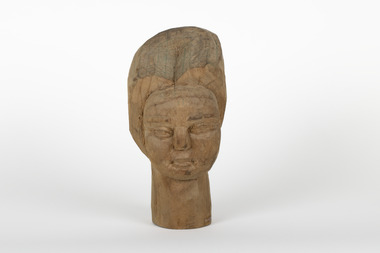
Sculpture - Carving, c1977
... A limb of a tree roughly carved into the shape of a woman's face, featuring a thick hair style, slanted eyes, delicate mouth, and long neck. Pen notations on top of sculpture....Beechworth Burke Museum Mayday Hills Asylum sculpture wood carving A limb of a tree roughly carved into the shape of a woman's face, featuring a thick hair style, slanted eyes, delicate mouth, and long neck. ...Carving of a small female head made by a patient of Mayday Hills Asylum. A grid has been drawn across the top with Romanian letters written within the cells.Mayday Hills Asylum was one of the three largest psychiatric hospitals in Victoria, and played an important role in the treatment of mental health illnesses from its establishment in 1867 to its closure in 1995. As part of prescribed treatment, many patients participated in craft activities were they were able to create an array of objects. A limb of a tree roughly carved into the shape of a woman's face, featuring a thick hair style, slanted eyes, delicate mouth, and long neck. Pen notations on top of sculpture.beechworth, burke museum, mayday hills asylum, sculpture, wood carving -
 Glenelg Shire Council Cultural Collection
Sculpture - Figurehead - Regia, c. 1835
... hair set in curls and a bun on the back of head. Figurehead is torso only. Inspection suggests that it has been cut from the wreck or from the rest of the figurehead's body. Sculpture ...Part of the collection purchased by the City of Portland from Kurtze's museum. Brendon Kurtze believed it was from the 'Constant', but the wreck was later proven to be the 'Regia' by V.A.S.Wooden painted figurehead believed to be from the barque 'Regia' (built 1835). Painted white female with floral wreath in hair, holding a scroll in both hands, sash over right shoulder, diamond-shaped object on ribbon around neck, beaded necklace, dress with puffed short sleeves, bare arms, hair set in curls and a bun on the back of head. Figurehead is torso only. Inspection suggests that it has been cut from the wreck or from the rest of the figurehead's body.Front: (no inscriptions) Back: (no inscriptions) -
 Flagstaff Hill Maritime Museum and Village
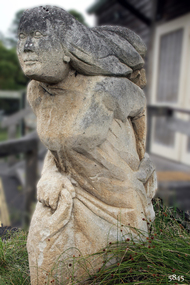
Sculpture - Limestone, Lady in the Wind
... The sculpture titled "Lady in the Wind" by Robert Ulmann. Subject is a robed woman moving forward, long hair streaming behind her, clutching fabric of skirt in each hand. .... / Presented by Ivor and Deirdre Scott " The sculpture titled "Lady in the Wind" by Robert Ulmann. Subject is a robed woman moving forward, long hair streaming behind her, clutching fabric of skirt in each hand. ...The late Robert Ulmann (1927-1999) was a well-known local Warrnambool artist, creating murals, sculptures and art works. The sculpture 'Lady in the Wind' was presented to Flagstaff Hill Maritime Village by Dr Ivor (Ivor Philip Quentin Scott 16-08/1928 - 1/11/2016) and his wife Deirdre Scott (dec.). This sculpture is significant for being a creation of Robert Ulmann, well known local Warrnambool artist. The sculpture titled "Lady in the Wind" by Robert Ulmann. Subject is a robed woman moving forward, long hair streaming behind her, clutching fabric of skirt in each hand. Created in 1975. Made of Mount Gambier stone. Plaque describing the sculpture is on a nearby wall. The sculpture was presented to Flagstaff hill by Ivor and Deirdre Scott."Robert Ulmann / "LADY IN THE WIND " ' Sculpture, Mt Gambier Stone, 1975. / Presented by Ivor and Deirdre Scott "flagstaff hill, warrnambool, shipwrecked-coast, flagstaff-hill, flagstaff-hill-maritime-museum, maritime-museum, shipwreck-coast, flagstaff-hill-maritime-village, robert ulmann, sculpture in warrnambool, lady in the wind sculpture, warrnambool artist, flagstaff hill maritime village sculpture, ivor philip quentin scott, deirdre scott, ivor scott, lady in the wind -
 Phillip Island and District Historical Society Inc.
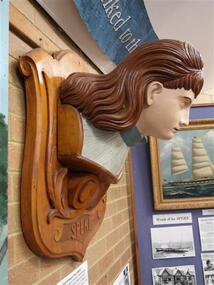
Sculpture - Figurehead, Late 19th Century
... Painted aspects of hair, face, collar. Mounted on an undecorated wooden shield. Sculpture Figurehead ...Saved from the ship Speke which ran aground on the coast of Phillip Island on the 22nd of February 1906. The figure head of the Speke was in the shape of woman, wearing a flowing white dress with blue cuffs and collar and carrying a large bunch of daffodils. It was originally nine feet four inches long. This sculpture went missing after the event and decades later the head only was re-discovered in Mr Thompson’s garage. It was then restored by Headmaster Kevin and the senior children of Cowes State school in 1940.The Speke was an all steel ship built in Wales in 1891. She was delivering wheat to Geelong and confused a bushfire in Cowes for navigation lights. Many local people salvaged goods from the resulting wreckage. The Speke was an all steel ship built in Wales in 1891. She was delivering wheat to Geelong and confused a bushfire in Cowes for navigation lights. Many local people salvaged goods from the resulting wreckage.Large wooden figure head, carved to resemble a woman. Painted aspects of hair, face, collar. Mounted on an undecorated wooden shield.phillip island, speke, kitty miller bay, figurehead, cowes state school -
 Eltham District Historical Society Inc
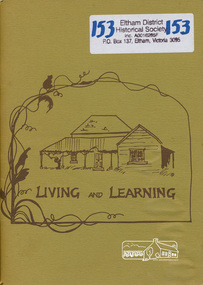
Book, Clipper Press, Living and Learning, 1977
... Subjects include enrolment day, bee keeping, Bridge Club,Carpentry and woodcarving, looking and sharing, creative dancing, crochet, dressmaking, film making, Friends of the Creek, Diamond Creek, accessibility, hair cutting, herb gardening, home handyman skills, homestead cooking, living with goats, native plants, North Riding Project, gardening, painting, playhouse, play reading, puppetry, sculpture, spinning, weaving, winemaking and yoga. ...Subjects include enrolment day, bee keeping, Bridge Club,Carpentry and woodcarving, looking and sharing, creative dancing, crochet, dressmaking, film making, Friends of the Creek, Diamond Creek, accessibility, hair cutting, herb gardening, home handyman skills, homestead cooking, living with goats, native plants, North Riding Project, gardening, painting, playhouse, play reading, puppetry, sculpture, spinning, weaving, winemaking and yoga. ...Shire of Eltham Living and Learning Centre is located at 739 Main Road, Eltham. The purpose of the Centre is: To provide an opportunity to come together individually and in groups in an atmosphere of equality, sharing their skills and experiences in order to improve the quality of their living. Tutors are not paid and fees are not charges on the understanding that the idea of sharing and co-operating spreads and everyone enjoys the results. This book was compiled by volunteers involved at the centre recording feelings, views of their experiences within the groups at the centre. It includes recipes, poems, stories and sketches, some of local scenes. It also includes an early history of the Centre compiled by the first Co-ordinator. Subjects include enrolment day, bee keeping, Bridge Club,Carpentry and woodcarving, looking and sharing, creative dancing, crochet, dressmaking, film making, Friends of the Creek, Diamond Creek, accessibility, hair cutting, herb gardening, home handyman skills, homestead cooking, living with goats, native plants, North Riding Project, gardening, painting, playhouse, play reading, puppetry, sculpture, spinning, weaving, winemaking and yoga. This book is significant in documenting the early history of the Eltham Living and Learning centre including the concepts of community co-operation and life-long learning for adults. It connects the current users of the Centre and the wider community with this local history which is part of the character represented in the twentieth century history of the Eltham area. Softcover [64] p.eltham living and learning centre, co-operative, education -
 Royal Australian and New Zealand College of Obstetricians & Gynaecologists (RANZCOG)
Sculpture - Carved wooden figurine of a neurologist, Germany, Jaschke Pretzl, c. 1950s
... hair style. The figure is atop a small wooden base, one side of which carries handwriting that reads 'Nervenarzt/Raus! Sie gehen mir/auf die Nerven!' The underside of the plinth is printed with a stamp that reads 'Handgeschnitzte/Pretxl/Figur'. Sculpture ...This is a German made figurine, attributed to Jaschke Pretzl. Loosely translated, the label text on the figurine says 'Neurologist' and 'Out! They're getting on my nerves!'. Stamp printed on underside of base says that this is a hand-carved figure.Carved wooden figurine. Depicts a man in a white coat, red tie, and glasses, standing with his hands at his side. He has a receding hairline, and a mohawk-like hair style. The figure is atop a small wooden base, one side of which carries handwriting that reads 'Nervenarzt/Raus! Sie gehen mir/auf die Nerven!' The underside of the plinth is printed with a stamp that reads 'Handgeschnitzte/Pretxl/Figur'. 'Nervenarzt/Raus! Sie gehen mir/auf die Nerven!'/'Handgeschnitzte/Pretxl/Figur'obstetrics -
 Royal Australian and New Zealand College of Obstetricians & Gynaecologists (RANZCOG)
Sculpture - Glass statue of a gynaecologist, Jaroslav Brychta, c. 1930s
... hair, a grey beard, and spectacles. He is holding a baby to his chest, with the baby facing towards the man, head pointing down. The man is holding the baby's ankles in his right hand, and the baby's bottom in his left hand. Sculpture ...Glass statuette of a man holding a baby. The man is dressed as a doctor, in white clothing, and has grey hair, a grey beard, and spectacles. He is holding a baby to his chest, with the baby facing towards the man, head pointing down. The man is holding the baby's ankles in his right hand, and the baby's bottom in his left hand. -
 Royal Australian and New Zealand College of Obstetricians & Gynaecologists (RANZCOG)
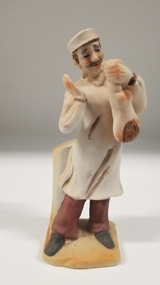
Sculpture - Porcelain figurine of a doctor holding a baby
... hair and a moustache. He is wearing a white surgical gown and cap, with brown trouser cuffs and black shoes visible below the gown. The doctor is holding a baby by its ankles in his left hand, and is holding his right hand with the palm facing towards the baby. The baby is facing the doctor, head pointing towards the ground. The figure is supported by a plinth behind the right leg, and is standing on a flat, sandy coloured base. Sculpture ...Porcelain bisque figurine of a doctor holding a baby. The doctor is male, with brown hair and a moustache. He is wearing a white surgical gown and cap, with brown trouser cuffs and black shoes visible below the gown. The doctor is holding a baby by its ankles in his left hand, and is holding his right hand with the palm facing towards the baby. The baby is facing the doctor, head pointing towards the ground. The figure is supported by a plinth behind the right leg, and is standing on a flat, sandy coloured base.obstetrics -
 Royal Australian and New Zealand College of Obstetricians & Gynaecologists (RANZCOG)
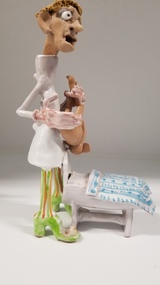
Sculpture - Porcelain figurine of a doctor holding a monkey
... hair and is wearing a white coat, with a white substance on their hands resembling gloves. They are wearing bright green and orange striped pants below the gown, and green high heeled shoes. The doctor is holding a monkey by its ankles in their left hand, and is holding the palm of his right hand on the monkey's bottom. The doctor is standing behind a small white crib, which is covered with a blue and white patterned blanket. The maker's name 'BESSI'(?) and the word 'ITALY' are hand painted on the underside of the crib. Sculpture ...The writing is unclear, but the name of the artist for this piece may be Bessi.Colourful porcelain figurine of a doctor holding a monkey. The doctorhas yellow hair and is wearing a white coat, with a white substance on their hands resembling gloves. They are wearing bright green and orange striped pants below the gown, and green high heeled shoes. The doctor is holding a monkey by its ankles in their left hand, and is holding the palm of his right hand on the monkey's bottom. The doctor is standing behind a small white crib, which is covered with a blue and white patterned blanket. The maker's name 'BESSI'(?) and the word 'ITALY' are hand painted on the underside of the crib.obstetrics -
 Royal Australian and New Zealand College of Obstetricians & Gynaecologists (RANZCOG)
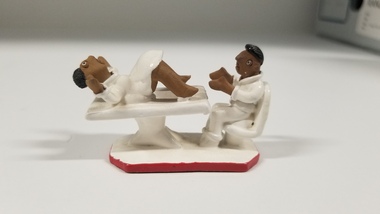
Sculpture - Ceramic vignette of a woman in childbirth
... hair. A word is engraved on the underside of the base of the figurine, which may be the name of the artist, but it is illegible. Sculpture ...This piece may originally have been Indian in origin. It was purchased by the donor at the Oxford Street Market in Paddington, Sydney.Small ceramic figurine of a woman giving birth, attended by a doctor. Scene depicts a woman in a white gown lying on her back an obstetric table, with her knees up and feet flat on the table. A doctor dressed in white is sitting on a chair at the end of the table, between the patients legs, with arms raised ready to receive a baby. Both figures in the scene have brown skin and black hair. A word is engraved on the underside of the base of the figurine, which may be the name of the artist, but it is illegible.obstetric delivery -
 Royal Australian and New Zealand College of Obstetricians & Gynaecologists (RANZCOG)
Sculpture - Staffordshire ceramic figurine of Queen Victoria, with baby, c. 1840
... hair visible beneath the bonnet, and rosy cheeks. She is seated on a stool and cushion, and is holding a baby on her knee. The baby is dressed in a long white gown, with a hood. Sticker beneath the base of the statue carries the handwritten number '44'. Sculpture ...This is believed to be a figurine of Queen Victoria. Staffordshire pottery began to be produced in the 1840s, at the beginning of the reign of Queen Victoria, and the Queen and her family were popular subjects for depiction in pottery.Painted ceramic figurine of a woman holding a baby. The woman is wearing a dark blue dress with gold lapels and a white frilled collar, and a decorative gold pattern at the hem. The woman is also wearing a white bonnet with gold bow at the top and a red flower at the front, white gloves, and yellow slippers. The woman has short, dark coloured hair visible beneath the bonnet, and rosy cheeks. She is seated on a stool and cushion, and is holding a baby on her knee. The baby is dressed in a long white gown, with a hood. Sticker beneath the base of the statue carries the handwritten number '44'. -
 Royal Australian and New Zealand College of Obstetricians & Gynaecologists (RANZCOG)
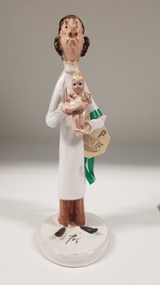
Sculpture - Porcelain figure of a doctor holding a baby
... hair, an exaggerated protruding nose, and has a serious expression, looking slightly upwards. The figure is holding a baby by the waist in his right hand, supporting the baby's feet with his left hand. A small Certificate of Origin is attached to the figure's left arm by a short length of green ribbon. The certificate is signed by the artist and indicates the piece was made in Italy. The base of the statue, between the figure's feet, is painted with the inscription 'PoG'. Underside of base is painted with the inscription '72/17'1/ITALY'. Sculpture ...Porcelain figurine of a doctor holding a baby. The figure is male in appearance, and is wearing a long white coat which is enclosed at the collar and extends below the knees. The figure is wearing brown trousers and black shoes, and is standing upright with legs together. The figure has black hair, an exaggerated protruding nose, and has a serious expression, looking slightly upwards. The figure is holding a baby by the waist in his right hand, supporting the baby's feet with his left hand. A small Certificate of Origin is attached to the figure's left arm by a short length of green ribbon. The certificate is signed by the artist and indicates the piece was made in Italy. The base of the statue, between the figure's feet, is painted with the inscription 'PoG'. Underside of base is painted with the inscription '72/17'1/ITALY'. -
 Royal Australian and New Zealand College of Obstetricians & Gynaecologists (RANZCOG)
Painting - Portrait of Professor L.W. Cox, Robert Hannaford, 1990
... sculptures. (Wikipedia) Oil on board painting. Colour portrait of a man seated in a chair. The subject is wearing a white shirt with a black suit and a blue tie which bears a yellow stripe and crest. The subject is wearing a dark blue robe with light blue front panels and yellow trim, with decorative buttons and embroidery visible at both cuffs. The subject has receding white hair ...Dr Lloyd Woodrow Cox (1919-2001) was the inaugural President of the Royal Australian College of Obstetrics and Gynaecology from 1978-1979. He had previously been President of the Australian Council, RCOG from 1975-1978. Robert Lyall "Alfie" Hannaford AM is an Australian realist artist notable for his drawings, paintings, portraits and sculptures. (Wikipedia) Oil on board painting. Colour portrait of a man seated in a chair. The subject is wearing a white shirt with a black suit and a blue tie which bears a yellow stripe and crest. The subject is wearing a dark blue robe with light blue front panels and yellow trim, with decorative buttons and embroidery visible at both cuffs. The subject has receding white hair and is facing the artist, with his body facing forward and his hands folded in his lap. The subject is pictured against a brown background, wtih shadowing at bottom right hand corner. Signature painted at bottom right corner of portrait reads 'HANNAFORD 88'. Brass plaque attached to back of board is engraved with the text 'PROFESSOR L.W. COX/PRESIDENT/SEPT 1978- AUG 1979'. -
 Royal Australian and New Zealand College of Obstetricians & Gynaecologists (RANZCOG)
Painting - Portrait of Dr J.A. O'Loughlin, Robert Hannaford, 1990
... sculptures. (Wikipedia) Oil on board painting. Colour head and shoulders portrait of a man sitting in a chair. The subject is wearing a white shirt with a grey suit and a blue tie printed with yellow stripes and the College crest. The subject is wearing a blue robe with yellow trim on front panels and at edges. The subject is wearing a medal in the shape of a nine-pointed star from a blue ribbon around his neck. The subject has receding grey hair ...Dr John Augustine O'Loughlin (1927-2014) was the President of the Royal Australian College of Obstetrics and Gynaecology from 1986-1989. Robert Lyall "Alfie" Hannaford AM is an Australian realist artist notable for his drawings, paintings, portraits and sculptures. (Wikipedia) Oil on board painting. Colour head and shoulders portrait of a man sitting in a chair. The subject is wearing a white shirt with a grey suit and a blue tie printed with yellow stripes and the College crest. The subject is wearing a blue robe with yellow trim on front panels and at edges. The subject is wearing a medal in the shape of a nine-pointed star from a blue ribbon around his neck. The subject has receding grey hair and is looking at the artist, with his body facing forward and his left leg crossed over his right. The subject has his hands folded in his lap. The arms of a chair are visible beneath both of his arms. The subject is depicted sitting in front of a yellow and black background. Signature painted at top right corner of portrait reads 'HANNAFORD/ 90'. Brass plaque attached to back of frame is engraved with the text 'DR. J. A. O'LOUGHLIN/PRESIDENT/Oct 1986 - Sept 1989''. -
 Bendigo Historical Society Inc.
Photograph - STATUE - FEMALE
... TOPIC Art sculpture Bartlett Bros, Bendigo black and white photo: statue female crouching nude with left arm resting on lefdt thigh. Right arm across chest, curled hair ...black and white photo: statue female crouching nude with left arm resting on lefdt thigh. Right arm across chest, curled hair in front of curtain with portion of picture frame, showing at bottom left glass container at front right.Bartlett Bros, Bendigotopic, art, sculpture -
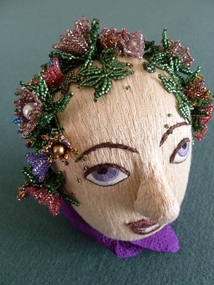 Embroiderers Guild, Victoria
Artwork, other - Sculptured Head Decorated with Beads, Yvonne Walton, "A Fertile Mind", 2010
... Small sculptured lady's head, embroidered all over and covered as hair with beaded flowers (50) and leaves in pink,mauve, blue and green. ...Bead work Embroidery Beading Soft sculpture Australia Small sculptured lady's head, embroidered all over and covered as hair with beaded flowers (50) and leaves in pink,mauve, blue and green. ...This piece was an entrant in the Challenge section of the "Jubilation" exhibition in 2010 to celebrate the 50th anniversary of the Guild and acquired by the Collection . Small sculptured lady's head, embroidered all over and covered as hair with beaded flowers (50) and leaves in pink,mauve, blue and green. Neck is wrapped with purple scarf. Soft Sculpture Head Bead Flowersbead work, embroidery, beading, soft sculpture, australia -
 Bayside Gallery - Bayside City Council Art & Heritage Collection
Sculpture, Ellen José, Boon wurrung Blossom, 2008
... Among the Banksia trees that provided shelter, grew indigenous plants and flowers through which the women made garlands to wear in their hair. boon wurrung blossom sculpture public art indigenous bayside indigenous coastal trail ellen josé ellen jose bluestone sandstone Boon wurrung Blossom Sculpture sculpture Ellen José ...The bluestone is laid on crushed yellow ochre sandstone, with the base encircled by indigenous flowering plants. Each rock represents one of the six clans that made up the Boon wurrung. For thousands of years, Boon wurrung women and children congregated in this area during special periods in spring and summer. The area was rich in seafood and had fresh water wells dotted around it. Among the Banksia trees that provided shelter, grew indigenous plants and flowers through which the women made garlands to wear in their hair.boon wurrung, blossom, sculpture, public art, indigenous, bayside indigenous coastal trail, ellen josé, ellen jose, bluestone, sandstone -
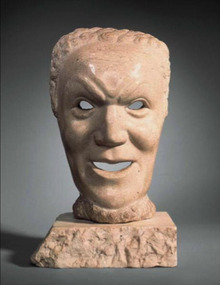 Duldig Studio museum + sculpture garden
Sculpture, Karl Duldig, Mask by Karl Duldig 1921, 1921
... hair. Marble base separate (75 x 275 x 198, wt 9000) and added later by artist. Mask by Karl Duldig 1921 Sculpture Karl Duldig ...Karl Duldig carved this marble sculpture of a mask in the Vienna Kunstgewerbeschule (School of Applied Arts) in 1921. His teacher, Anton Hanak, the Professor of Sculpture at the School, encouraged him to carve directly into the stone. It was an accomplished work for the 19 year-old student and was selected by Hanak to represent the students of the School at the Deutschen Gewerbeschau (German Applied Art exhibition) in Munich in 1922, an early accolade for the young artist. The sculpture and another Kneeling Nude were reproduced in the journal Deustche Kunst and Dekoration in 1923-24 in an article on the Hanak-Klasse. In 2011 Mask was exhibited in the National Gallery of Victoria exhibition Vienna: Art and Design. The sculpture is one of ten substantial sculptures in marble and stone, and a larger group terracotta sculptures and masks, portrait busts and small stone sculptures created by Karl Duldig in Vienna that are held in the Museum collection. These art works are complemented by an archive of contemporary documents including letters, photographs, documents and ephemera. In 1938 Duldig’s Viennese sculptures were sent to Paris in 1938 for a proposed exhibition, and were hidden in Paris by Slawa Duldig’s sister Rella, throughout the Second World War, and arrived in Australia post-war over 5 decades. Karl Duldig was a student of the Kunstgewerbeschule from 1921 until 1925, and then attended the Akademie Der Bildenden Künste (Academy of Fine Arts) from 1929 until 1933. He was accepted into the Professor Josef Mullner’s “Meisterschule” at the Academy of Fine Arts from 1929 until 1933. His teacher at the Kunstgwerebeschule was Austria’s foremost contemporary sculptor Anton Hanak, and he was a formative influence on Duldig’s work. Hanak had been a member of Viennese Secession, and worked with Josef Hoffman on architectural commissions prior to the First World War. Hanak shared both his love of the expressive quality of materials and a humanist vision with his students. Various writers have written about Duldig’s interest in masks. His interest may have been stimulated by his classical education, the Greek and Roman antiquities in the Kunsthistoriches Museum in Vienna, or the ethnological collections in Vienna’s Museum of Ethnology (now known as the Weltmuseum). The mask was a motif explored by expressionist and cubist artists whose work was exhibited at the Vienna Secession. Duldig would have been familiar with the psychological investigations of the neurologist and founder of psychoanalysis Sigmund Freud, who established his practice in Vienna. In the Duldig Studio library, Duldig’s keen interest in the arts of a myriad of visual cultures is apparent. Of particular note are two well-thumbed copies Rudolf Utzinger’s, Masken, published by Ernst Wasmuth in Berlin in 1923, depicting masks from around the world. It is likely that a multitude of influences were at play. Slawa Duldig also worked with this motif, and also carved a smaller mask in Salzburg marble as well as a remarkable mask in clay, and these are held in the collection. Ann Carew 2016The Mask has national and international aesthetic significance. It is one of the earliest works by Karl Duldig in the Studio collection, and is a subject that he would continue to explore throughout his working life. The sculpture demonstrates a high degree of technical skill and mastery at an early age. It is evidence of Duldig’s engagement with the art of his peers during this period – the mask is a motif that inspired contemporary expressionist and cubist artists. It also demonstrates his interests in portraiture, human psychology, and the creation of identity and transformation of personalities. The Mask also provides an important link to the studio practice in the Vienna Kunstgwerbeschule, the teaching of Anton Hanak, and the program of international art exhibitions in Europe during the period. It is also of historical significance: the story of its survival and eventual recovery provides a counterpoint to the story of the Nazis’ confiscation of art during the Second World War. Ann Carew 2016Carving in Salzburg Marble. Holes for eyes and mouth cut through the block. Highly polished finish at front contrasting with rough finish at back and stylised curled hair. Marble base separate (75 x 275 x 198, wt 9000) and added later by artist. Karl Duldig 1921 incised on back -
 Duldig Studio museum + sculpture garden
Sculpture, Slawa Horowitz-Duldig, Self-portrait by Slawa Horowitz-Duldig c. 1924, c.1924
... It takes inspiration from Egyptian sculptures and is strikingly similar to the cover image of Götter Ӓgyptens (Gods of Egypt) by Alexander Scharff (Library) although her short hair puts a stylish and very modern slant upon the image. ...The sculpture is hollow, with a large opening at the rear. Slawa on full face, eyes downcast, hair parted in the middle & pulled back in bun with large comb. ...It takes inspiration from Egyptian sculptures and is strikingly similar to the cover image of Götter Ӓgyptens (Gods of Egypt) by Alexander Scharff (Library) although her short hair puts a stylish and very modern slant upon the image. modernism The sculpture is hollow, with a large opening at the rear. ...This self-portrait exemplifies Karl and Slawa's shared interest in the art forms of other cultures - also seen in the significant number of Viennese art books on these topics in the Duldig Studio library. It takes inspiration from Egyptian sculptures and is strikingly similar to the cover image of Götter Ӓgyptens (Gods of Egypt) by Alexander Scharff (Library) although her short hair puts a stylish and very modern slant upon the image. The sculpture is hollow, with a large opening at the rear. Slawa on full face, eyes downcast, hair parted in the middle & pulled back in bun with large comb. Drapes across both shoulders. modernism -
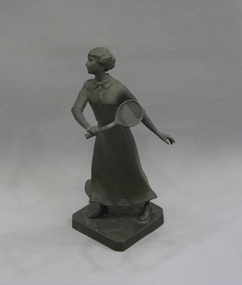 Tennis Australia
Sculpture, Circa 1915
... A pewter sculpture of female figure with tennis racquet mounted on a square base. Figure has long skirt and hair pulled up onto head, and is in action of backhand stroke. ...Tennis A pewter sculpture of female figure with tennis racquet mounted on a square base. Figure has long skirt and hair pulled up onto head, and is in action of backhand stroke. ...A pewter sculpture of female figure with tennis racquet mounted on a square base. Figure has long skirt and hair pulled up onto head, and is in action of backhand stroke. 'KAYSER' imprinted in base. Materials: Pewter/Metal compositetennis -
 Federation University Art Collection
Painting - Artwork - Drawing, Neville Bunning, [Young Girl] by Neville Bunning
... Sculpture and ceramics at the Ballarat Technical Art School, a division of the Ballarat School of mines, from 1945 until 1964. During that time he formed the Ballarat Artist's Society, a group that sponsored art and invited modernist artists to visit Ballarat to speak to students and the public. Bunning wrote a weekly column in 'The Courier', where his insightful comments made readers aware of significant trends in art. neville bunning art artists ballarat school of mines bunning available Signed lower left "Neville M. Bunning" Portrait of a girl with red ribbons in her hair ...Neville Bunning taught Sculpture and ceramics at the Ballarat Technical Art School, a division of the Ballarat School of mines, from 1945 until 1964. During that time he formed the Ballarat Artist's Society, a group that sponsored art and invited modernist artists to visit Ballarat to speak to students and the public. Bunning wrote a weekly column in 'The Courier', where his insightful comments made readers aware of significant trends in art.Portrait of a girl with red ribbons in her hair.Signed lower left "Neville M. Bunning"neville bunning, art, artists, ballarat school of mines, bunning, available
