
Showing 142 items matching " historical notes of bendigo"
-
 Bendigo Historical Society Inc.
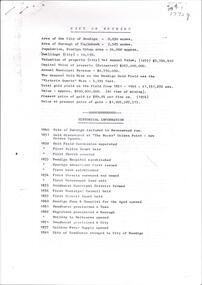
Document - BENDIGO HISTORICAL SOCIETY: HISTORICAL NOTES ON THE CITY OF BENDIGO, Unknown
... BENDIGO HISTORICAL SOCIETY: HISTORICAL NOTES ON THE CITY OF BENDIGO...BENDIGO HISTORICAL SOCIETY: Historical Notes on the City of Bendigo Included: 1871 Bendigo's Big Year from the Bendigo Advertiser July 1971 Information on mining in Bendigo Information on the Town Hall Information on the Mayoral Chain and Symbols/Coat of Arms...BENDIGO History BENDIGO HISTORICAL SOCIETY: Historical Notes on the City of Bendigo Included: 1871 Bendigo's Big Year from the Bendigo Advertiser July 1971 Information on mining in Bendigo Information on the Town Hall Information on the Mayoral Chain and Symbols/Coat of Arms Document BENDIGO HISTORICAL SOCIETY: HISTORICAL NOTES ON THE CITY OF BENDIGO ...BENDIGO HISTORICAL SOCIETY: Historical Notes on the City of Bendigo Included: 1871 Bendigo's Big Year from the Bendigo Advertiser July 1971 Information on mining in Bendigo Information on the Town Hall Information on the Mayoral Chain and Symbols/Coat of Armsbendigo, history -
 Bendigo Historical Society Inc.
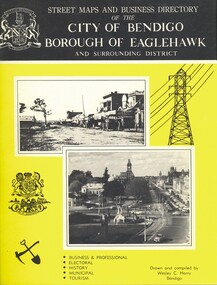
Book - STREET MAPS AND BUSINESS DIRECTORY OF THE CITY OF BENDIGO, c1972
... ... historical notes of Bendigo...History of the name of Bendigo. Historical pictures with notes. Advertisements for local businesses. ...BOOK Bendigo bendigo & district maps streets & localities Bendigo & District businesses historical notes of Bendigo Wesley C Harry Street Maps and Business Directory of the City of Bendigo Borough of Eaglehawk and Surrounding District : with Classified Business Directory (1973). ...Street Maps and Business Directory of the City of Bendigo Borough of Eaglehawk and Surrounding District : with Classified Business Directory (1973). Drawn and compiled by Wesley C Harry. Publisher: Cambridge Press, Bendigo. 88 pages. Includes b/w photographs, illustrations & maps. Information on the shires that make up Bendigo. History of the name of Bendigo. Historical pictures with notes. Advertisements for local businesses. Signed - Alec S Craig, mayor. Grace A. O. CraigWesley C Harrybook, bendigo, bendigo & district maps, streets & localities bendigo & district, businesses, historical notes of bendigo -
 Ballarat Tramway Museum
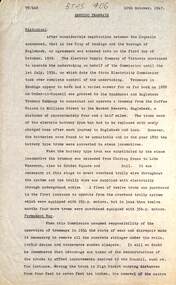
Document - Report, State Electricity Commission of Victoria (SECV), "Bendigo Tramways", 10/10/1947
... Gives historical notes about the Bendigo trams, battery trams, steam, and then electric trams. ...Gives historical notes about the Bendigo trams, battery trams, steam, and then electric trams. ...Gives historical notes about the Bendigo trams, battery trams, steam, and then electric trams. Has a note about the early tracks and upgrading by the SEC, track relocation, overhead rehabilitation and rolling stock. Gives notes about acquisition of the trams ex MMTB, the Birneys and max traction trams.Yields a information about the early history of the trams in Bendigo. Gives information about the track, overhead and tramcars - 1947.Two page, typed notes on foolscap paper, titled "Bendigo Tramways", dated 10-10-1947, with initials "TT/DAS" in the top left hand corner. In top right hand corner in black ink "BTPS 406"trams, tramways, bendigo, sec, mmtb, track, overhead, rolling stock -
 Bendigo Historical Society Inc.
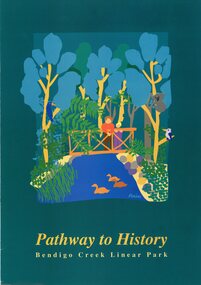
Pamphlet - MERLE HALL COLLECTION: ROSALIND PARK CREATIVE VILLAGE BENDIGO PROJECT PAMPHLET, 1993
... On outside pages, cover, historical notes on Bendigo and Notes on the Bendigo Creek Linear Park. ...On outside pages, cover, historical notes on Bendigo and Notes on the Bendigo Creek Linear Park. ...MERLE HALL COLLECTION: ROSALIND PARK CREATIVE VILLAGE BENDIGO PROJECT PAMPHLET Pathway to History Bendigo Creek Linear Park Inside pages - Graphic image of the Linear Park from Alexandra Fountain to the Botanical Gardens, includes Rosalind Park, Golden Dragon Museum, Shamrock Hotel, Bendigo Gas Works, Chinese Joss House, Chinese Tea House, Lake Weroona, Wetlands, White Hill Cemetery and mine sites. On outside pages, cover, historical notes on Bendigo and Notes on the Bendigo Creek Linear Park. Notes on the back cover: A joint project of the City of Greater Bendigo and the Department of planning and development. Production by the Publick Affairs Branch, Department of Planning and Development. Printed in Bendigo June 1993 4360/93.rosalind park, bendigo creative village -
 Bendigo Historical Society Inc.
Document - Rocky Vale Beebe House, 2010 to 2015
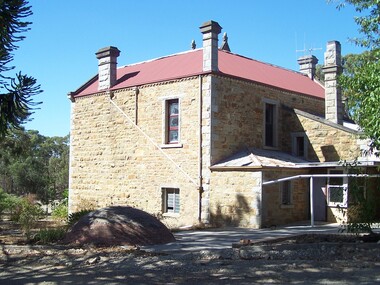
... The article is derived from a research project designed to establish a better understanding of the nature of professional architectural activity in the State of Victoria, Australia, in the second half of the 19th century. 8677v Official Rocky Vale Villa Significant Assessment by City of Greater Bendigo, Heritage Policy Citations Project Lovell Chen, 2010. 8677w Rocky Vale Villa Significance Assessment 8677x William Beebe Death Notice 8677y The Beebes of Bendigo Family History Notes (Contact the BHS for details) 8677z Newspaper Article Bendigo Advertiser 14 April 1900 - Bon Voyage to Mr Beebe 8677aa Death Notices 1891 of Mr W Beebe 8677bb Election Announcement The Argus 18 Mar 1913 8677cc Mr Beebe Newspaper mention of Influenza - The Bendigo Independant 18 Oct 1899 8677dd Historical Notes for Bendigo Advertiser on Bendigo by Carol Holdsworth (Contact the BHS for Details) 8677ee Mayoral Elections - The Bendigonian 2nd Sept 1915 8677ff The names of the Bendigo Cemetery 8677gg William Vahland and John Beebe 1904 Notes 8677hh City of Greater Bendigo, heritage Policy Citations Project Name Rocky Vale Villa Reference in 1998 study...The article is derived from a research project designed to establish a better understanding of the nature of professional architectural activity in the State of Victoria, Australia, in the second half of the 19th century. 8677v Official Rocky Vale Villa Significant Assessment by City of Greater Bendigo, Heritage Policy Citations Project Lovell Chen, 2010. 8677w Rocky Vale Villa Significance Assessment 8677x William Beebe Death Notice 8677y The Beebes of Bendigo Family History Notes (Contact the BHS for details) 8677z Newspaper Article Bendigo Advertiser 14 April 1900 - Bon Voyage to Mr Beebe 8677aa Death Notices 1891 of Mr W Beebe 8677bb Election Announcement The Argus 18 Mar 1913 8677cc Mr Beebe Newspaper mention of Influenza - The Bendigo Independant 18 Oct 1899 8677dd Historical Notes for Bendigo Advertiser on Bendigo by Carol Holdsworth (Contact the BHS for Details) 8677ee Mayoral Elections - The Bendigonian 2nd Sept 1915 8677ff The names of the Bendigo Cemetery 8677gg William Vahland and John Beebe 1904 Notes 8677hh City of Greater Bendigo, heritage Policy Citations Project Name Rocky Vale Villa Reference in 1998 study Document Rocky Vale Beebe House ...The Beebe name was well-known in Bendigo in the last quarter of the 19th and the early part of the 20th centuries. From 1875, William Beebe senior, monumental mason, occupied a site in the centre on the city, in Mitchell Street opposite King Street. Death was more part of life in those days, and the Beebes were there to provide the burial monuments. Later, he took his sons into the business, which grew as Beebe and Son. Many examples of their work can be found in the local cemeteries. William Beebe senior (1830-1891) was born in Rutland, the smallest English county in 1830, to stonemason Chamberlain Beebe and Susannah Clements. William emigrated to Victoria in 1854 and after engaging on unknown works in Port Fairy, Dunkeld, and Melbourne arrived in Bendigo. His obituary records that he commenced work here on the site of the Bank of Australasia (opposite the Shamrock Hotel), which would have been no later than 1856. He took up a 13 acre selection on the site of Rocky Vale Villa in 1864 and continued to select or purchase further parcels of adjoining land until he owned some 150 acres, much of it unfit for cultivation. He was a keen gardener and had a garden and orchard around the house. William took over 20 years to build the two-story sandstone and granite house "Rocky Vale Villa". The house was constructed from sandstone sourced "from an adjacent ridge of rocks" (Bendigo Advertiser 28/9/1891). Granite from Harcourt was used for lintels and quoins. Not long before he died, William was still adding to the house. In the Codicil to his will, he states that "I have just built and completed two additional rooms to my Dwelling house situe at Inglewood Road aforesaid" (dated 19/9/1891). William died one week later on the 26th September 1891.Photographs and Historical Documents relating to Rocky Vale Villa, 7 Wicks Road, Maiden Gully, Bendigo by the Bendigo Historical Society. This item contains the following 34 documents and photos: 8677a Colour Photo - Side and rear view of Rocky Vale 8677b Colour Photo - Side and rear view of Rocky Vale 8677c Colour Photo - Front view of Rocky Vale 8677d Colour Photo - Front view of Rocky Vale 8677e Colour Photo - Front view of Rocky Vale from a distance 8677f Colour photo of the doomed cover on the well 8677g Colour photo of shed and storage area 8677h Colour photo of shed and storage area 8677i Colour photo of a dam, a windmill, and possibly an old mining boiler 8677j Colour photo of and out-building (Shed, storage area) 8677k Colour photo of and out-building (Shed, storage area) 8677l Colour photo of and out-building (Shed, storage area) inside ceiling 8677m Black and white photo of the Villa and front garden - not long after building 8677n Black and white photo of a wedding group at the front of the house 8677o Black and white photo of the rear of the wedding photo showing names of people 8677p Colour photo of the inside showing damage around the top of a window and ceiling 8677q Colour photo of the inside showing damage around the ceiling plaster decoration 8677r Colour photo of the inside showing damage around the ceiling plaster decoration 8677s Colour photo of an outside window with a granite frame and the Stone walls 8677t Colour photo of an outside window with a granite frame and the Stone walls 8677u Architects Creating a Landscape by Ray Tonkin. The article is derived from a research project designed to establish a better understanding of the nature of professional architectural activity in the State of Victoria, Australia, in the second half of the 19th century. 8677v Official Rocky Vale Villa Significant Assessment by City of Greater Bendigo, Heritage Policy Citations Project Lovell Chen, 2010. 8677w Rocky Vale Villa Significance Assessment 8677x William Beebe Death Notice 8677y The Beebes of Bendigo Family History Notes (Contact the BHS for details) 8677z Newspaper Article Bendigo Advertiser 14 April 1900 - Bon Voyage to Mr Beebe 8677aa Death Notices 1891 of Mr W Beebe 8677bb Election Announcement The Argus 18 Mar 1913 8677cc Mr Beebe Newspaper mention of Influenza - The Bendigo Independant 18 Oct 1899 8677dd Historical Notes for Bendigo Advertiser on Bendigo by Carol Holdsworth (Contact the BHS for Details) 8677ee Mayoral Elections - The Bendigonian 2nd Sept 1915 8677ff The names of the Bendigo Cemetery 8677gg William Vahland and John Beebe 1904 Notes 8677hh City of Greater Bendigo, heritage Policy Citations Project Name Rocky Vale Villa Reference in 1998 studyhistory, bendigo, rocky vale villa maiden gully, william beebe stonemason bendigo -
 Federation University Historical Collection
Book - Ledger, Ballarat School of Mines Donation Book, 1878 - 1895, 1878-1895
... Bendigo School of Mines Science Society, June 20. 1881 by P.H. Macgillivray, MA, MRCS, FLS, President. (Note: This item is not in the present Federation University Historical Collection) (Note: This item is not in the present Federation University Historical Collection)
446. ...Bendigo School of Mines Science Society, June 20. 1881 by P.H. Macgillivray, MA, MRCS, FLS, President. (Note: This item is not in the present Federation University Historical Collection) (Note: This item is not in the present Federation University Historical Collection)
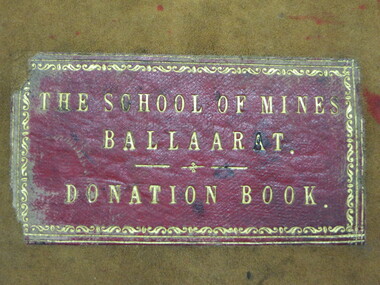
446. ...The Donation Book relates to the Ballarat School of Mines Museum which opened in 1872. Very few of these items are still held by Federation University. The Museum was emptied in the 1960s with items being distrubuted to the Ballarat Historical Society, returned to original lenders (ie Pern Collection), of disposed of. Donations to the Ballarat School of Mines include: 34. M. Hamburger, Ballarat - bunsen burner 41. W.H. Shaw, Phoenix Foundry - 81 nos of 'Engineer' 89. Juvenile Industrial Exhibition Association Committee per Joseph Flude - dies used for striking medals awarded to successful exhibits. 165. Ferdinand Von Mueller 172 Ferdinand Von Mueller o hortus siccus 6 197. James Stoddart 203. Edward Gazzard, North Creswick - Model of safety Cage invented and made by donor 218. E. Morey 222. Alfred Lestor 228. J.J. Sleep, Ballarat, patent Lever escarpment Clock (displayed in laboratories) 237. Bernard Smith (Warden) per favor of James M. Bickett - Bust of Mr John Lynch, Smythesdale. (Note: This item is not in the present Federation University Historical Collection) 241. James Oddie, J.P., Ballarat, Copy of 'the Chemist and Druggist' 267. John Lynch Junior, Smythesdale - Cast of "Golden Age" nugget, found at Browns by Co-operative party, 12 men. Weight 75 oz, 12 dwts, 12 grs.(Note: This item is not in the present Federation University Historical Collection) 270. Isaac Davis, Main Road, Ballarat 294. W. H. Shaw, Ballarat - 94 nos of 'The Engineer' 295. Rivett Henry Bland, Clunes - Specimen of water pipe from the Port Phillip Company's mine encrusted with carbonites of lime and magnesium (Note: This item is not in the present Federation University Historical Collection) 299. D.J. Williams, Queenscliff - 1 case shells from Fiji 305. C. Retallack, Ballarat 314. William Henry Shaw, Ballarat - glass case 323. W. Longley, Ballarat - Botanical Specimen (Note: This item is not in the present Federation University Historical Collection) 327. W. H. Angove, Perth 337. J. Cosmo Newbery, B Sc, Melbourne 343. James Hector, M.D., New Zealand 353. R.S. Mitchell, Ballarat - 8 specimens live plants (medicinal) (for the Ballarat School of Mines Garden) 355. W. Magee, Ballarat - Sugar cane plants and seeds (for the Ballarat School of Mines Garden) 363. James Hector, Wellington, new Zealand 371. William Wesley, 28 Essex St, Strand, London - Scientific book circular 380. Jacob Upfold (deceased) per favor of the trustees - bequest of steam engine indicator and belongings (boothe and case) 381. Joseph Mitchell, 22 Macarthur Street, Ballarat - sod of turf cut from Warboy's High Few, County Huntingdon, England, 1872. 394. W.H. Barnard 401. James Orr 418. F. Ratte, Sydney 440. Alfred Mica Smith, Sandhurst (Bendigo), Inaugural Address, delivered to the Bendigo School of Mines Science Society, June 20. 1881 by P.H. Macgillivray, MA, MRCS, FLS, President. (Note: This item is not in the present Federation University Historical Collection) (Note: This item is not in the present Federation University Historical Collection) 446. C. C. Shoppee, Ballarat 462. Dr Bunce, Ballarat 468. James Black, Mining Manager "Kerrit Bureet' 479. J.S. North, Mining Manager No. 2 Queen Co, Black Hill Ballarat. 505. Smith Tibbitts - A block of ancient leaves from the Nigtingbool Estate near Haddon on the Ballarat district from shaft 80 feet deep. (Note: This item is not in the present Federation University Historical Collection) 512. F.W. Niven, Ballarat - "A Handy Book to Tasmania" 522. James Hector, Wellington, New Zealand 549. C.E. Grainger, Manager Ballarat Woollen Mills - samples of dyed and raw wools 600. (4 July 1882) Henry Sutton, Ballarat - 13th annual report of the Aeronautical Society of Great Britain; 2 papers from the Proceedings of the Royal Society, nos 217 and 218- 1882, "One a new electrical storage battery by Henry Sutton, Ballarat, Victoria. 608. H. Glenny J.P., Ballarat - Specimen of Asbestos from Tasmania 610. M.H. Edelmann, Munich, Germany 674. W.H. Shaw, Phoenix Foundry - Steel boring 95 feet long taken from bed-plate of locomotive engine. 675 - H.R. Hancock J.P. pre favour Mr James Pryor, Moonta Mines 676. Baron Ferdinand Von Mueller KCMG, etc, Melbourne 678. E.F.A. Gaunt, Royal Navy, H.M.S. Nelson, per favour Lyde Gaunt - Specimen of manganese ore from the mines - Russell - New Zealand 728. Dr Pinnock, Ballarat 760. Simon Morrison, Ballarat 784. James Shugg, Hamilton - 1 case fossils from Muddy Creek, near Hamilton. (Note: This item is not in the present Federation University Historical Collection) 786. W. Bolam (inspector of Schools), Melbourne - 2 spears and 1 fishing prong Fijian 806. James Oddie, Ballarat 708. Henry G. Hanks, San Francisco 786. W. Bolam (Inspector of Government Schools Melbourne) - 2 spears and one fishing prong Fijian 824. Henrique Gorceixm Onro Preto, Brazil 840. W. Laplau, Ballarat - Gas furnace with a large assortment of fittings, also large gas holder and oil-heating apparatus 854. Robert Borch, Main Road, Ballarat - Improved safety chain (Note: This item is not in the present Federation University Historical Collection) 928. James Oddie 944. James P. Munroe, Registrar, Massachusetts 952. L.E. Cutter per favour of Mr F.J. Martell - Unexploded bomb shell from the Eureka Stockade 957. H. Glenny, Hobart 962. George Hart, Ballarat - eagle 976. Henry Sutton, Ballarat - 1 volume "Plattner on the Blowpipe" 978. J.W. Flatow, 45 Madeline Street, Carlton, Melbourne 984. Charles C Shoppee Ballarat - Copies of ancient coins 989-95 - Specimens from Moonta, South Australia 985. W.H. Wooster BOlwarra - books microscope related 1179. James Oddie - Live hedgehog 1181 C. Crisp, Bacchus Marsh, Portugal Copper Coin, 1785 1248 James Oddie, Solomon Islands - Bow and arrows & Spears 1285. C. Colyer, Smythesdale 1327. John L. McKenna, Smeaton - Fragment of Stone Axe. 1395. Mrs O. Skoglund, Nerrina 1428. Daniel Brophy, Ballarat - Collection of mineral specimen form Silverton (Collected by Mrs James Murray) 1442. Henry Sutton, Ballarat - Specimens of fossil fruits collected at Haddon by Charles Brown. 1444. Mining Department - Underground Mine Workings from Band of Hope and others. 1517. W.H. Wooster, Ballarat 1592. Bishop of Ballarat - Stone Axe and other native items 1669. H. McHaffier, Napoleons - 1 Spanish silver coin 1681. James Oddie, Dunedin 1688. W. Burbridge, Ballarat - Native Tomahawk from Metung 1708. A. Doepel, Ballarat 1712. Marty Guerin, Ballarat 1735. Bella Guerin. M.A., Ballarat - Copy Wide Awake Vol 1 No 7 May 28th 1887 and The Bulletin, March 19th 1887. 1747. Bella Geurin M.A., Ballarat - Copy Wide Awake Vol 1 No 8 June 4 1887 1751. Bella Geurin M.A., Ballarat - Copy Wide Awake Vol 1 No 9 June 11th 1887 1842. Linnean Society, London England - Charter, By Laws, Proceedings, Transactions, Journals 1853. W.J. Corbould, Silverton, NSW - chloride of silver from Pinnacles, Broken Hill, Silverton 1888. W. J. Corbould, Sample of metallic silver from Silverton, NSW 1928. E. Morey, Ballarat - Steam Engine 1937. Henry Sutton A.S.I.E., Ballarat - Plate Electric Machine, chimes and Sportman (number crossed out) 1951. Henry Sutton A.S.I.E., Ballarat - Plate Electric Machine, chimes and Sportman 1981. Harrie Wood (per W.H.B.[Barnard?), Ballarat 1996. W.H. Shaw, Phoenix Foundry - Papers "The Vict Engineer July 1887, May June July August 1888 and others 2014. Harrie Wood, Sydney - Report Department of Mines, 18872027. W.J. Bechervaise - Copy of Book by Baldwin Spencer 2034. A.G. Randall - Native Hatchet 2045. W.H. Corbould, Silverton, Collection of silver ores 2051. Fowler, Tarnagulla - Native Tomahawk 2123-2131. James Oddie, London 2163. Roff. F. Taplier, Sturt Street - Native Tomahawk 2178. Syd. Johnson, Meredith - Native Tomahawk, Greenstone 2184. Mr Tupp for Hall - Native Spear and Club 2292. Emmanuel Steinfeld, Melbourne 2313. A. Atwood, Rowlands Factory, Dana Street 2361. Dr Pinnock, Ballarat - Collection of Living Sponges 2363. P. Curnow, Ballarat - Piece of wood with stone naturally embedded 2364. R. Dowling, Waubra 2875. Mrs C, Flude, Ballarat - Collection of (5) mineral specimens 3460. Joseph Weir, Ballarat - Sample of rolled Annibar 3466. J. Hart, Ballarat - Native Shield - supposed to have been made by King Billy 4784. Mr. O. Woolnaugh, Pleasant Street - Four Native Tomahawks 6469. L. Balhausen, Ballarat 3472. John English, Smeaton - three samples of auriferous wash dirt 3607. Columbia College, New York - Handbook of Information of the Columbia College in the Ciry of New York 1892-3. 3672. L.A. Samuels, Bendigo 3724. P. Paperhagen 3736. The Late Rivett Henry Bland per John Noble Wilson - Collection of mineral specimens and fossils 3752. G.A. Denny, South Africa 3755. J. Carroll, Ballarat - Specimen of Native bread found in Ballarat East. 4765. J. Donnelly, Springs, Bungaree I. Fowler, Coolgardie, Specimen of Gold Bearing Quartz ballarat school of mines, doantions, museum, ballarat school of mines museum, safety cage, botanical garden, materia medica garden, library, bella guerin, james oddie, phoenix foundry, w.h. shaw, john lynch, henry sutton, aboriginal, stone axe, tomahawk, geological specimens, moonta, fedinand krause, oddie collection of minerals, thomas bath, spears, solomon islands, king billy, bows and arrows, ancient coins, birds eggs, snakes -
 Glen Eira Historical Society
Document - Balaclava Road, 91, Caulfield North, 'Miami'
... Typed notes on the history and past owners of the house 'Miami', Balaclava Road, 91, Caulfield North, by Hilary Bullock and Rosalind Landells of the Brighton Historical Society, dated 9/09/1988. The file also includes is an additional handwritten summary of the information. Miami Balaclava Road Otira Road Bendigo ...Typed notes on the history and past owners of the house 'Miami', Balaclava Road, 91, Caulfield North, by Hilary Bullock and Rosalind Landells of the Brighton Historical Society, dated 9/09/1988. The file also includes is an additional handwritten summary of the information.miami, balaclava road, otira road, bendigo road, caulfield north, dixson francis, mcharg gerald, dean c r, walker a g, bullock hilary, landells rosalind -
 Bendigo Military Museum
Photograph - PHOTOGRAPH AND LEGEND, Pre war - 1941-42
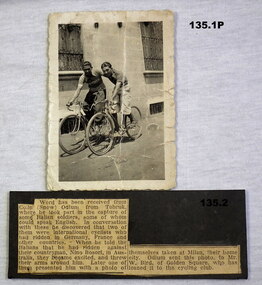
... Bendigo. Colin Odlum VX45898 2/23 Batt AIF. KIA 12.7.42. Refer 127.56, 128.2, 137.3P. Bettie Bird refer 136.2, Billy Bird 1601. documents historical notes photography photographs military history .1) On the rear faded writing re the two cyclists "POW's" .1) Photo, B & W of two Italian men on Racing Bikes with building in the background. .2) Original newspaper article re Italian POW's and Colin Odlum on a black background. ...The two cyclists were taken prisoner in North Africa. The prisoners gave the photo to Colin Odlum and the result was that the photo came back to Australia and given to William (Billy) Bird who loaned the photo to the Cycling Club in Bendigo. Colin Odlum VX45898 2/23 Batt AIF. KIA 12.7.42. Refer 127.56, 128.2, 137.3P. Bettie Bird refer 136.2, Billy Bird 1601. .1) Photo, B & W of two Italian men on Racing Bikes with building in the background. .2) Original newspaper article re Italian POW's and Colin Odlum on a black background. .1) On the rear faded writing re the two cyclists "POW's"documents, historical notes, photography, photographs, military history -
 Bendigo Military Museum
Photograph - Five Nation Mapping, Charting & Geodesy Conference - Army Survey Regiment, Fortuna, Bendigo, Five Nation Mapping, Charting & Geodesy Conference - Army Survey Regiment, Fortuna, Bendigo, c1990
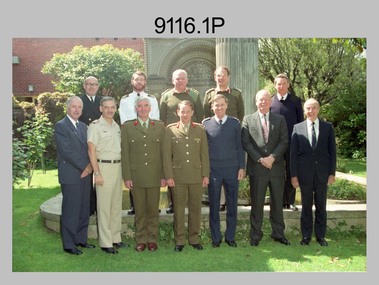
... Note – the 1991 date is most likely incorrect as there is conflicting dates. Refer to Historical information. This set of four photographs was taken during the Five Nation Mapping, Charting & Geodesy (MC&G) Conference, held at the Army Survey Regiment, Fortuna, Bendigo in October 1990. ...This collection of four photographs was taken at the Five Nation Mapping, Charting & Geodesy (MC&G) Conference, held at the Army Survey Regiment, Fortuna, Bendigo in 1991. Directors (or their representatives) from Australia, Canada, New Zealand, United Kingdom and the United States of America military mapping agencies attended Five Nations MC&G Conference. The Director of Australia’s Joint Intelligence Organisation - MAJ GEN John Baker AC DSM FTSE attended the conference. Photos .1P to .3P were taken in the front of Fortuna’s Pompeii Fountain and photo .4P was taken probably at the same time in Lithographic Squadron’s main print room. More information on this conference is provided in page 145 of Valerie Lovejoy’s book 'Mapmakers of Fortuna – A history of the Army Survey Regiment’ ISBN: 0-646-42120-4. Note – Photo .1P was also published on page 144 of the book. It was incorrectly dated 1988.This set of four photographs was taken during the Five Nation Mapping, Charting & Geodesy (MC&G) Conference, held at the Army Survey Regiment, Fortuna, Bendigo in October 1990. The photographs are on 35mm negative film and scanned at 1200 dpi. They are part of the Army Survey Regiment’s Collection. .1)- Photo, colour, 1991, back row L to R: unidentified (x2), D-SVY COL Don Swiney MBE, unidentified (x2), front row L to R: unidentified (x3), MAJ GEN John Baker AC DSM FTSE, unidentified (x3). .2) - Photo, colour, 1991, back row L to R: unidentified (x2), D-SVY COL Don Swiney MBE, unidentified (x2), front row L to R: all unidentified. .3} - Photo, colour, 1991, back row L to R: unidentified (x2), D-SVY COL Don Swiney MBE, unidentified (x3), front row L to R: all unidentified. .4} - Photo, colour, 1991, L to R: LTCOL Simon Lemon, CO LTCOL Rene van den Tol, MAJ GEN John Baker AC DSM FTSE, MAJ Bob Coote. No personnel or civilians are identified. ‘5 Nations Conference ‘91’ is annotated on plastic negative sleeve. Note – the 1991 date is most likely incorrect as there is conflicting dates. Refer to Historical information.royal australian survey corps, rasvy, army survey regiment, army svy regt, fortuna -
 Bendigo Historical Society Inc.
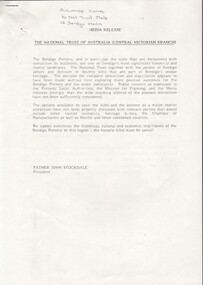
Document - National Trust Collection: Bendigo Pottery (Epsom) Pty Ltd - three-page correspondence regarding concern over the future of the Bendigo Pottery kilns, 07/1987
... National Trust - three-page correspondence 23 - 28 July 1977 regarding the future of the Bendigo Pottery 1 white A4 media release from the National Trust (Central Victorian Branch) from Father John Stockdale President "stressing the historical, cultural and economic importance of the Bendigo Pottery to this region". 2 stapled green A4 page a file note dated 28 July 1987. ...historic significant of Bendigo Pottery physical assets Bendigo Pottery Bottle Kilns regulations regarding demolition of buildings National Trust - three-page correspondence 23 - 28 July 1977 regarding the future of the Bendigo Pottery 1 white A4 media release from the National Trust (Central Victorian Branch) from Father John Stockdale President "stressing the historical, cultural and economic importance of the Bendigo Pottery to this region". 2 stapled green A4 page a file note dated 28 July 1987. ...historic significant of Bendigo Pottery physical assets National Trust - three-page correspondence 23 - 28 July 1977 regarding the future of the Bendigo Pottery 1 white A4 media release from the National Trust (Central Victorian Branch) from Father John Stockdale President "stressing the historical, cultural and economic importance of the Bendigo Pottery to this region". 2 stapled green A4 page a file note dated 28 July 1987. "after protracted but amiable discussions with the Bendigo Pottery management, it is evident that the Pottery has taken care to preserve the important kins and promote the historic nature of the Bendigo Pottery" 3 pink-page from Shire Engineer, Shire of Huntly to the Managing Director Bendigo Pottery stating, "that there has been unconfirmed reports of possible future demolition works at your premises", and "bringing to their notice requirements under the: * Victorian Building Regulations 1983, regarding demolition * Regulation No. 14 Rats and Mice Destruction Regulations 1973 buildings shall not be altered or demolished without a permit from Council * Historic Buildings Act 1981regulations regarding demolition of buildings bendigo pottery bottle kilns -
 Bendigo Historical Society Inc.
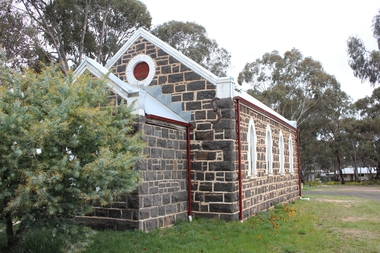
Document - Notes on St Andrews Church Axedale, 1st Sept 2024
... It lies between Heathcote and Bendigo. axedale st andrews church axedale Dr Nish Historical Notes on St Andrews Axedale 1868-1968 and the 150th Anniversary Church booklet March 2019. ...Although Presbyterians held religious services prior to 1854 it, was not till that year that Dr Nish arrived in Bendigo. It is known that Dr Nish preached to the shepherds in Axedale, long before the church was built, but where is not known. The foundation stone for the church was lain on September 30th, 1868. Axedale is a town in Victoria, Australia. It is located on the McIvor Highway, in the City of Greater Bendigo, east of Bendigo. It was surveyed and proclaimed in 1861. At the 2021 census, Axedale had a population of 984. The town is nestled alongside the Campaspe River which feeds out of Lake Eppalock. It has a golf course, tennis courts, a school, a pub and a convenience store/petrol station. It lies between Heathcote and Bendigo.Historical Notes on St Andrews Axedale 1868-1968 and the 150th Anniversary Church booklet March 2019.axedale, st andrews church axedale, dr nish -
 Bendigo Historical Society Inc.
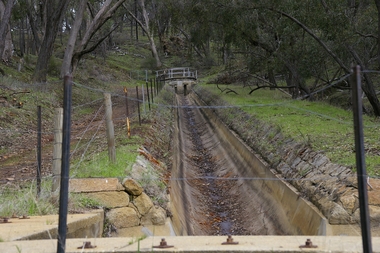
Photograph - Historical Society Field Trip to the Springs at Sedgwick, Abt 2009
... Bendigo Historical Society to "The Springs" on the main Coliban water channel from Malmsbury to the Sandhurst Reservoir in Bendigo. The water race descends through a concrete chute, and continues sharply around the contour of the hills. Once it descended into a syphon across the gully. The are 182 photos in this series and can be found at 8683.1 to 8683.11. The series also includes photos of the surrounding farming land and the remains of an old house. There are also some notes...Bendigo Historical Society to "The Springs" on the main Coliban water channel from Malmsbury to the Sandhurst Reservoir in Bendigo. The water race descends through a concrete chute, and continues sharply around the contour of the hills. Once it descended into a syphon across the gully. The are 182 photos in this series and can be found at 8683.1 to 8683.11. The series also includes photos of the surrounding farming land and the remains of an old house. There are also some notes ...The Phil Wilkin Collection contains a series of 11 Items. The related items can be found by clicking on the reference link below. The following history of the Young family and their descendants who lived at the Springs is provided by Phil Wilkin. His Great Grandparents were Frances Young and August Wirth. Phil has also provided notes on the Wilkin Family and some history of the gold mining in Sedgwick. Frances Young's parents Joseph and Margaret Young owned the property called "The Old Place, Preston Vale or Wellington Flat" at Sedgwick near the Springs. Joseph Young owned and Managed the Standard Brewery which was located at Campbells Creek during the late 1800’s early 1900’s. Joseph and Margaret are buried in the Harcourt cemetery. In 1880 August Wirth lived at Mosquito Creek (Lake Eppalock, Victoria) when he married Frances Young. In 1902 they moved to part of Joseph Young's property. They milked cows and sold cattle for a living. One of their children Charles Wirth (Phil Wilkin's Grandfather) bought the land in 1935 after his parents had died. Charles Wirth was a councillor and also was president of the Shire of Strathfieldsaye. The "Old Place" was part of the property owned by members of the family. The old house at the Springs was burnt out by bushfire in January 1944 and much of the stonework was later vandalized by campers. The original Coliban Water Works were designed in 1863 by the Irish engineer Joseph Brady. The system included 70 kilometres of open water channels, aqueducts, syphons and tunnels to carry water (by gravity) from the Coliban River at Malmsbury, north to Castlemaine and Bendigo. Sedgwick is a locality in Central Victoria, Australia. It is located in the City of Greater Bendigo. Facilities include a public hall that opened in 1958 and CFA Rural fire station. It was named Upper Emu Creek until 1901 when it was renamed as Sedgwick after British geologist Adam Sedgwick.Twenty nine photos taken on a field trip by the Bendigo Historical Society to "The Springs" on the main Coliban water channel from Malmsbury to the Sandhurst Reservoir in Bendigo. The water race descends through a concrete chute, and continues sharply around the contour of the hills. Once it descended into a syphon across the gully. The are 182 photos in this series and can be found at 8683.1 to 8683.11. The series also includes photos of the surrounding farming land and the remains of an old house. There are also some notes on the pioneers of the district.history, bendigo, coliban water, joseph brady, irrigation, the springs, sedgwick -
 Bendigo Historical Society Inc.
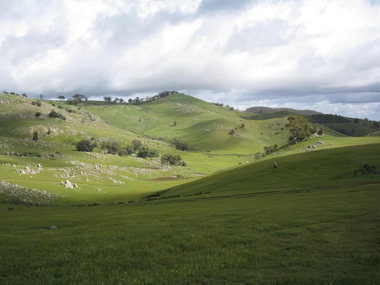
Photograph - Historical Society Field Trip to the Springs at Sedgwick, Abt 2009
... Bendigo Historical Society to "The Springs" on the main Coliban water channel from Malmsbury to the Sandhurst Reservoir in Bendigo. The water race descends through a concrete chute, and continues sharply around the contour of the hills. Once it descended into a syphon across the gully. The are 182 photos in this series and can be found at 8683.1 to 8683.11. The series also includes photos of the surrounding farming land and the remains of an old house. There are also some notes...Bendigo Historical Society to "The Springs" on the main Coliban water channel from Malmsbury to the Sandhurst Reservoir in Bendigo. The water race descends through a concrete chute, and continues sharply around the contour of the hills. Once it descended into a syphon across the gully. The are 182 photos in this series and can be found at 8683.1 to 8683.11. The series also includes photos of the surrounding farming land and the remains of an old house. There are also some notes ...The Phil Wilkin Collection contains a series of 11 Items. The related items can be found by clicking on the reference link below. The following history of the Young family and their descendants who lived at the Springs is provided by Phil Wilkin. His Great Grandparents were Frances Young and August Wirth. Phil has also provided notes on the Wilkin Family and some history of the gold mining in Sedgwick. Frances Young's parents Joseph and Margaret Young owned the property called "The Old Place, Preston Vale or Wellington Flat" at Sedgwick near the Springs. Joseph Young owned and Managed the Standard Brewery which was located at Campbells Creek during the late 1800’s early 1900’s. Joseph and Margaret are buried in the Harcourt cemetery. In 1880 August Wirth lived at Mosquito Creek (Lake Eppalock, Victoria) when he married Frances Young. In 1902 they moved to part of Joseph Young's property. They milked cows and sold cattle for a living. One of their children Charles Wirth (Phil Wilkin's Grandfather) bought the land in 1935 after his parents had died. Charles Wirth was a councillor and also was president of the Shire of Strathfieldsaye. The "Old Place" was part of the property owned by members of the family. The old house at the Springs was burnt out by bushfire in January 1944 and much of the stonework was later vandalized by campers. The original Coliban Water Works were designed in 1863 by the Irish engineer Joseph Brady. The system included 70 kilometres of open water channels, aqueducts, syphons and tunnels to carry water (by gravity) from the Coliban River at Malmsbury, north to Castlemaine and Bendigo. Sedgwick is a locality in Central Victoria, Australia. It is located in the City of Greater Bendigo. Facilities include a public hall that opened in 1958 and CFA Rural fire station. It was named Upper Emu Creek until 1901 when it was renamed as Sedgwick after British geologist Adam Sedgwick.Twenty five photos taken on a field trip by the Bendigo Historical Society to "The Springs" on the main Coliban water channel from Malmsbury to the Sandhurst Reservoir in Bendigo. The water race descends through a concrete chute, and continues sharply around the contour of the hills. Once it descended into a syphon across the gully. The are 182 photos in this series and can be found at 8683.1 to 8683.11. The series also includes photos of the surrounding farming land and the remains of an old house. There are also some notes on the pioneers of the district.history, bendigo, coliban water, joseph brady, irrigation, the springs, sedgwick -
 Bendigo Historical Society Inc.
Photograph - Historical Society Field Trip to the Springs at Sedgwick, Abt 2009
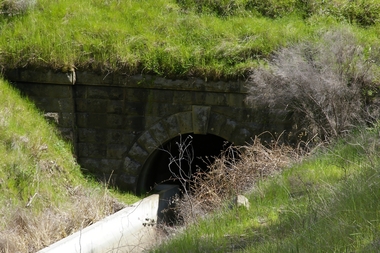
... Bendigo Historical Society to "The Springs" on the main Coliban water channel from Malmsbury to the Sandhurst Reservoir in Bendigo. The water race descends through a concrete chute, and continues sharply around the contour of the hills. Once it descended into a syphon across the gully. The are 182 photos in this series and can be found at 8683.1 to 8683.11. The series also includes photos of the surrounding farming land and the remains of an old house. There are also some notes...Bendigo Historical Society to "The Springs" on the main Coliban water channel from Malmsbury to the Sandhurst Reservoir in Bendigo. The water race descends through a concrete chute, and continues sharply around the contour of the hills. Once it descended into a syphon across the gully. The are 182 photos in this series and can be found at 8683.1 to 8683.11. The series also includes photos of the surrounding farming land and the remains of an old house. There are also some notes ...The Phil Wilkin Collection contains a series of 11 Items. The related items can be found by clicking on the reference link below. The following history of the Young family and their descendants who lived at the Springs is provided by Phil Wilkin. His Great Grandparents were Frances Young and August Wirth. Phil has also provided notes on the Wilkin Family and some history of the gold mining in Sedgwick. Frances Young's parents Joseph and Margaret Young owned the property called "The Old Place, Preston Vale or Wellington Flat" at Sedgwick near the Springs. Joseph Young owned and Managed the Standard Brewery which was located at Campbells Creek during the late 1800’s early 1900’s. Joseph and Margaret are buried in the Harcourt cemetery. In 1880 August Wirth lived at Mosquito Creek (Lake Eppalock, Victoria) when he married Frances Young. In 1902 they moved to part of Joseph Young's property. They milked cows and sold cattle for a living. One of their children Charles Wirth (Phil Wilkin's Grandfather) bought the land in 1935 after his parents had died. Charles Wirth was a councillor and also was president of the Shire of Strathfieldsaye. The "Old Place" was part of the property owned by members of the family. The old house at the Springs was burnt out by bushfire in January 1944 and much of the stonework was later vandalized by campers. The original Coliban Water Works were designed in 1863 by the Irish engineer Joseph Brady. The system included 70 kilometres of open water channels, aqueducts, syphons and tunnels to carry water (by gravity) from the Coliban River at Malmsbury, north to Castlemaine and Bendigo. Sedgwick is a locality in Central Victoria, Australia. It is located in the City of Greater Bendigo. Facilities include a public hall that opened in 1958 and CFA Rural fire station. It was named Upper Emu Creek until 1901 when it was renamed as Sedgwick after British geologist Adam Sedgwick.Twenty six photos taken on a field trip by the Bendigo Historical Society to "The Springs" on the main Coliban water channel from Malmsbury to the Sandhurst Reservoir in Bendigo. The water race descends through a concrete chute, and continues sharply around the contour of the hills. Once it descended into a syphon across the gully. The are 182 photos in this series and can be found at 8683.1 to 8683.11. The series also includes photos of the surrounding farming land and the remains of an old house. There are also some notes on the pioneers of the district.history, bendigo, coliban water, joseph brady, irrigation, the springs, sedgwick -
 Bendigo Historical Society Inc.
Photograph - Historical Society Field Trip to the Springs at Sedgwick, Abt 2009
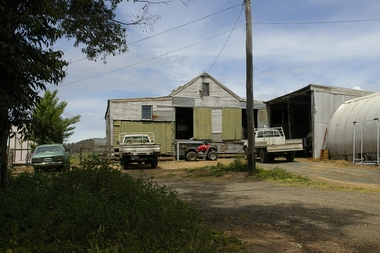
... Bendigo Historical Society to "The Springs" on the main Coliban water channel from Malmsbury to the Sandhurst Reservoir in Bendigo. The water race descends through a concrete chute, and continues sharply around the contour of the hills. Once it descended into a syphon across the gully. The are 182 photos in this series and can be found at 8683.1 to 8683.11. The series also includes photos of the surrounding farming land and the remains of an old house. There are also some notes...Bendigo Historical Society to "The Springs" on the main Coliban water channel from Malmsbury to the Sandhurst Reservoir in Bendigo. The water race descends through a concrete chute, and continues sharply around the contour of the hills. Once it descended into a syphon across the gully. The are 182 photos in this series and can be found at 8683.1 to 8683.11. The series also includes photos of the surrounding farming land and the remains of an old house. There are also some notes ...The Phil Wilkin Collection contains a series of 11 Items. The related items can be found by clicking on the reference link below. The following history of the Young family and their descendants who lived at the Springs is provided by Phil Wilkin. His Great Grandparents were Frances Young and August Wirth. Phil has also provided notes on the Wilkin Family and some history of the gold mining in Sedgwick. Frances Young's parents Joseph and Margaret Young owned the property called "The Old Place, Preston Vale or Wellington Flat" at Sedgwick near the Springs. Joseph Young owned and Managed the Standard Brewery which was located at Campbells Creek during the late 1800’s early 1900’s. Joseph and Margaret are buried in the Harcourt cemetery. In 1880 August Wirth lived at Mosquito Creek (Lake Eppalock, Victoria) when he married Frances Young. In 1902 they moved to part of Joseph Young's property. They milked cows and sold cattle for a living. One of their children Charles Wirth (Phil Wilkin's Grandfather) bought the land in 1935 after his parents had died. Charles Wirth was a councillor and also was president of the Shire of Strathfieldsaye. The "Old Place" was part of the property owned by members of the family. The old house at the Springs was burnt out by bushfire in January 1944 and much of the stonework was later vandalized by campers. The original Coliban Water Works were designed in 1863 by the Irish engineer Joseph Brady. The system included 70 kilometres of open water channels, aqueducts, syphons and tunnels to carry water (by gravity) from the Coliban River at Malmsbury, north to Castlemaine and Bendigo. Sedgwick is a locality in Central Victoria, Australia. It is located in the City of Greater Bendigo. Facilities include a public hall that opened in 1958 and CFA Rural fire station. It was named Upper Emu Creek until 1901 when it was renamed as Sedgwick after British geologist Adam Sedgwick.Twenty six photos taken on a field trip by the Bendigo Historical Society to "The Springs" on the main Coliban water channel from Malmsbury to the Sandhurst Reservoir in Bendigo. The water race descends through a concrete chute, and continues sharply around the contour of the hills. Once it descended into a syphon across the gully. The are 182 photos in this series and can be found at 8683.1 to 8683.11. The series also includes photos of the surrounding farming land and the remains of an old house. There are also some notes on the pioneers of the district.history, bendigo, coliban water, joseph brady, irrigation, the springs, sedgwick -
 Bendigo Historical Society Inc.
Book - SANDHURST COURT RECORDS LEDGER, 1857 - 1858
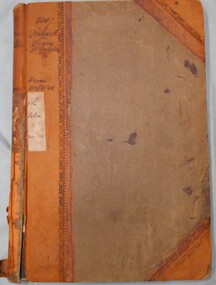
... Notes Philip Barton inherited the book from his father Russell Barton who died in 2002. Russell Barton was a barrister who practised on the Supreme Court Circuit in Bendigo from 1960 - 1975. He was interested in history and it is assumed that he was given the book by the Bendigo Court officials. Philip Barton gave the book to Dennis Johnason on the understanding that it be given to the Bendigo Historical...Notes Philip Barton inherited the book from his father Russell Barton who died in 2002. Russell Barton was a barrister who practised on the Supreme Court Circuit in Bendigo from 1960 - 1975. He was interested in history and it is assumed that he was given the book by the Bendigo Court officials. Philip Barton gave the book to Dennis Johnason on the understanding that it be given to the Bendigo Historical ...District Police Office Sandhurst Court records. October 1857 - October 1858. Brown ledger containing the records of the District Police Office Sandhurst. Cover has linen like covering with suede leather corners and spine. All have decorative scroll and pattern work. Dates written in ink on the spine. Remnants of an adhesive label on the spine. Inside covers lined with red, green and gold patterned paper. Entries include names of judges, solicitors, witnesses, accused and plaintiffs, Each record include descriptions of charges and the rulings. Most of the sittings were conducted by police magistrate Lachlan McLachlan. Notes Philip Barton inherited the book from his father Russell Barton who died in 2002. Russell Barton was a barrister who practised on the Supreme Court Circuit in Bendigo from 1960 - 1975. He was interested in history and it is assumed that he was given the book by the Bendigo Court officials. Philip Barton gave the book to Dennis Johnason on the understanding that it be given to the Bendigo Historical Society. See Donor.government, local, court records -
 Bendigo Historical Society Inc.
Document - The Reynolds Family Records Collection (Folder 1 of four folders), Abt 2005
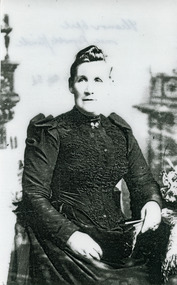
... (Contact the Bendigo Historical Society for Access) 10891.1i PDF File - Family History Report - Descendants of Archelaus Opie and Eleanor Hinde and their seven children. Their Child Louisa Rynolds who married Thomas Richard Preston in 1909 and had a daughter (Contact the Bendigo Historical Society for Access) 10891.1j PDF File - Hand Written Notes - two pages - Descendants of Archelaus Opie and Eleanor Hinde and her two husbands, Richard Reynolds and Archelaus Opie (Contact the Bendigo Historical Society for Access)...(Contact the Bendigo Historical Society for Access) 10891.1i PDF File - Family History Report - Descendants of Archelaus Opie and Eleanor Hinde and their seven children. Their Child Louisa Rynolds who married Thomas Richard Preston in 1909 and had a daughter (Contact the Bendigo Historical Society for Access) 10891.1j PDF File - Hand Written Notes - two pages - Descendants of Archelaus Opie and Eleanor Hinde and her two husbands, Richard Reynolds and Archelaus Opie (Contact the Bendigo Historical Society for Access) Document The Reynolds Family Records Collection (Folder 1 of four folders) ...Eleanor Hinde (1842-1902) was born in Lancashire England. In 1858, Eleanor married Richard Reynold in the Forest St. Wesleyn Methodist Church in Sandhurst. They both gave their address as Sailors Gully Goldfields. They had seven children together. Richard was a skilled tradesman. After he died in 1872 from lung disease, Eleanor married Arculus Opie. Eleanor owned a property on the corner of Gladstone and Stanley Streets which later became an electrical substation. She sold poultry and eggs and preserves. One of Eleanor's sons, William John, married Anna (Annie) Jorgensen, and one of her daughters. Amelia, married Anna's brother Thomas Joynes Jorgensen. The Jorgensens founded and managed Jorgensen and Sons foundry and engineering works. Peter Jorgensen (1849-1914), was a mining contractor, he lived at, "Bro," Russell street, Quarry Hill. His firm was Jorgensen and Sons, mining contractors. He was a native of the Island of Alsen, Denmark. He left Denmark in the year 1861, embarking at Hamburg in a small sailing Ship. The four folders contain family history documents and photos of the descendants of Eleanor Hinde. This item contains the following documents: 10891.1a There are two photos of Eleanor sitting on a chair with a fan in her hand. The smaller photo has inscribed on its back "Opie, nee Reynolds"; the larger photo has: "Eleanor Hinde Mrs Reynolds/Mrs Opie, Mother of seven Reynolds children, Mother of two Opie sons, All children lived long lives. 10891.1b Notes on Eleanor Hinde by her Great-granddaughter Ruth Pendavingh - Eltham Victoria March 2008 10891.1c Family card Sheet for Richard Croom Reynolds and Eleanor Hinde. There are handwritten notes on the sheet. 10891.1d Letter to Richard Reynolds in 1872 from his friend Thomas Hayward 10891.1e Family Tree of Eleanour and Richard from Ancestory.com public trees 10891.1f List of descendants of Richard Reynolds and Eleanor Hinde. It includes places lived. 10891.1g PDF File - Family History Report - Descendants of Richard Reynolds and Eleanor Hinde and their seven children (Contact the Bendigo Historical Society for Access) 10891.1h PDF File - Family History Report - Descendants of Archelaus Opie and Eleanor Hinde and their seven children. (Contact the Bendigo Historical Society for Access) 10891.1i PDF File - Family History Report - Descendants of Archelaus Opie and Eleanor Hinde and their seven children. Their Child Louisa Rynolds who married Thomas Richard Preston in 1909 and had a daughter (Contact the Bendigo Historical Society for Access) 10891.1j PDF File - Hand Written Notes - two pages - Descendants of Archelaus Opie and Eleanor Hinde and her two husbands, Richard Reynolds and Archelaus Opie (Contact the Bendigo Historical Society for Access)bendigo, sandhurst, peter jorgensen, eleanor hinde, eleanor reynolds, eleanor opie, reynolds collection -
 Bendigo Historical Society Inc.
Document - National Trust Collection: Churches of Bendigo and Inglewood, Nov 7th 1965
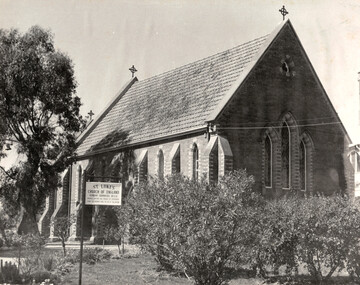
... Also included is some hand-written history notes of the church - See the notes in the Historical Section above. 3084.36c This document is a formal letter dated 9th November 1970 from the National Trust of Australia (Victoria) to Bishop Bernard Stewart. St. Augustine's Church in Bendigo...Also included is some hand-written history notes of the church - See the notes in the Historical Section above. 3084.36c This document is a formal letter dated 9th November 1970 from the National Trust of Australia (Victoria) to Bishop Bernard Stewart. St. Augustine's Church in Bendigo ...St LUKES ANGLICAN CHURCH BENDIGO In 1852, a party of Cornish miners, refusing to give up and having dug, by hand, down nearly 70 feet ‘got their reward. Suddenly, their picks sank into soft pipe-clay, white, satin-smooth and seemingly depthless. The men began tunnelling. Presently, the roof forming above them showered gold at their feet – the secret of Bendigo’s famous White Hills lay revealed.’ In the ‘wild rush’ that followed, when ‘the White Hills yielded enormously and some pretty piles were made’, a young Anglican priest, John Herbert Gregory, held the first Anglican church service at White Hills in 1853. The Hamlet of White Hills was surveyed and mapped in 1854 and, by 1863, St Luke’s Church in White Hills was opened on ‘an elevated site’ in a generously sized ‘church reserve’. St AUGUSTINE'S CHURCH MYERS FLAT Early diggers to this area were men named Myers and Nicholls, hence the name - Myers Flat and Myers Creek. 1857 saw the discovery of gold in the area and in less than one month 1000 ounces of gold per week resulted. The number of diggers in the Myers Creek or Burnt Gully totalled 4000 to 5000. Myers Creek consisted of several shops and buildings, two hotels, a race course and a lock-up built of logs. On November 6th, 1864, the opening of the new church of St Augustine' took place. The first mass was celebrated by the Reverand Dean Hayes, of St Killian's Sandhurst. The church of gothic design was built by a local contractor, and with bricks made from local clay. The church also has a fire place and is widely known as "The church with the Chimney. For many years it was also a Catholic school. St AUGUSTINE'S CHURCH INGLEWOOD The church features an Early English design from 1864 and Decorated Gothic extensions from 1884.Notable elements include the sanctuary with the Catto Memorial window and interior cusped arcading of the wainscot. Architectural attribution is given to Vahland and Getzschmann for one or both sections. St JOHNS CHURCH (PRESBYTERIAN) BENDIGO The church's architect was W C Vahland VIA, and the builder was N Langstaff. It was built in April 1890, and opened in Feb 1891. The tender price was 2,481 pounds. The church style was gothic, built by the Congregational Church to replace an earlier building built in 1858. St Johns bought the church in 1949 and made additions in 1951. THE SACRED HEART CATHEDRAL BENDIGO Originally designed in 1895 by Reed, Smart and Tappin of Melbourne, the first stage opened in September 1901; the second stage began in January 1954 and was expected to finish in late 1976. Skilled stonemasons were brought from overseas for the completion. The Exterior built from Geelong sandstone and Harcourt granite, matching the original materials for color consistency. The cathedral is designed in the early English Gothic style. It Features a tower and spire weighing several thousand tons, with the spire rising 282 ft. from the floor and topped by a 10 ft. cross.Interior. The original stained glass window, made in Birmingham, England, is above the main entrance on the west side. Marble for the floor was imported from Vincenzo and Via Reggio, Italy; Sicilian Pearl marble is used in the four chapels. Ceilings in the chapels feature Western red cedar and yellow pine timbers.The transept includes Australian blackwood paneling and 12 carved shields representing the apostles. The internal height from floor to ceiling is 80 ft.Artistic Elements. Two large tapestries, specially designed and crafted by Mrs. Carrington, hang in the sanctuary as a symbolic link to Bendigo. ST PAULS BENDIGO The nave was built in 1868 and the tower in 1873. The nave is notable for unusual ceiling with metal and timber overlay members. The tower notable for early brick and bold Gothic influenced design. The church was opened on 12th Nov 1868 and a new chancel sanctuary and Transepts were added on 22 Oct 1927. The architect was Robert A Love. CONGREGATIONAL CHURCHES IN BENDIGO Three main Congregational church buildings existed in Bendigo: at the corner of Forest and Mackenzie Streets (the original site), on Quarry Hill (corner of Russell and Gladstone Streets), and on Calvin Street (later the Lutheran Church). The Calvin Street church was named in honor of John Calvin, a notable figure who lived in the area. In June 1858, 1.5 acres of land were purchased at the Forest and Mackenzie Streets corner for £1200.The first church was built on this site in November 1858 and later enlarged in May 1867 to seat 500 people. A prefabricated parsonage stood nearby until about 1920, serving as a caretaker's cottage for several years. In 1890, foundation stones for a new church designed by W.C. Vahland were laid, featuring a tall tower and two gable crossings (reduced from three to save costs). The new church opened on February 26, 1890, costing £2483. The contractor was N. Longstaff. Some architectural elements, such as the chancel, were added later when St. John's Presbyterian took over the building. Congregational attendance declined, leading to the purchase and alteration of a brick school complex in Olinda Street to serve as their headquarters.The timber church on Russell Street and the Calvin Street property were sold.The valuable Forest Street property was eventually sold to a London sect and later became an investment for the Methodist Church.Historical information on seven denominational churches in Bendigo and Inglewood. This item contains the following items: 3084.36a Black and white photo of St Lukes Bendigo Church of England, Napier Street, White Hills. 3084.36b St Augustine's Church Myers Flat 100 years newsletter 1965. The newsletter's purpose is for a Commemorative afternoon mass in memory of the pioneers of Myers Flat and district.Celebration of the 101st anniversary of the first mass at St. Augustine's Church; on Sunday, November 7th, 1965, at 2:00 PM.Location: St. Augustine's Church, Myers Flat. The invitation is extended to the recipient and their friends. This invitation serves both as a memorial and a community gathering to honour local history. Also included is some hand-written history notes of the church - See the notes in the Historical Section above. 3084.36c This document is a formal letter dated 9th November 1970 from the National Trust of Australia (Victoria) to Bishop Bernard Stewart. St. Augustine's Church in Bendigo has been awarded a "D" classification by the National Trust's expert committee. The church is now officially "recorded" by the National Trust. The letter is addressed to Bishop Bernard Stewart, with copies sent to Father Louis McDonnell (Eaglehawk), A. J. Watts (Town Clerk, Bendigo), and Mrs. R. R. Adams (Secretary, Central Victorian Branch). 3084.36d This document is a formal letter from the National Trust of Australia (Victoria) to Miss L. Doble, Registrar of the Bendigo Church of England Diocese, dated March 20, 1973. St. Augustine's Church of England in Inglewood has been officially placed on the National Trust's Classified List. This classification recognizes the church as essential to Australia's heritage and emphasizes its preservation. The church features an Early English design from 1864 and Decorated Gothic extensions from 1884.Notable elements include the sanctuary with the Catto Memorial window and interior cusped arcading of the wainscot. Architectural attribution is given to Vahland and Getzschmann for one or both sections. The church is about to celebrate the centenary of its consecration on May 13, with the Archbishop expected to attend. 3084.36e This document is a survey form used by the National Trust of Australia (Victoria) to collect detailed information about St Augustine's Church at Myers Flat. It records the original purpose, present use, and current name of the building.Requires a precise address or location description for site visits.It captures special features or points of interest not visible in photographs. It documents the present owner and occupant, including their addresses, the date of initial construction and supporting evidence for that date. 3084.36f Handwritten letter re history of St Johns Presbyterian Church Bendigo, 13th October 1980 - author unknown 3084.36g Typed notes - "Interesting information on the Sacred Heart Cathedral Bendigo", and hand-written notes on St Pauls Cathedral. 3084.36h Two pages of typed notes. Three main Congregational church buildings existed in Bendigo: at the corner of Forest and Mackenzie Streets (the original site), on Quarry Hill (corner of Russell and Gladstone Streets), and on Calvin Street (later the Lutheran Church). 3084.36i Hand-written notes on St Pauls Cathedral.history, church, national trust bendigo collection, sacred heart cathedral bendigo, st augustine's church myers flat, st pauls church bendigo, st johns presbyterian church bendigo, congregational church bendigo -
 Bendigo Historical Society Inc.
Document - RED RIBBON COLLECTION: DOCUMENT THE BENDIGO PETITION AND THE RED RIBBON MOVEMENT 1853
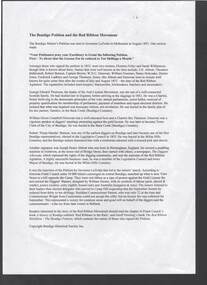
... notes on The Bendigo Petition and the Red Ribbon Movement. Amongst the petitioners were two women, Florence Foley and Sarah Williamson. Others include J H Abbott, Theodore Ballerstedt, Robert Benson, Captain Brown, W D C Denovan, William Froomes, Henry Holyoake, Doctor Jones, Frederick Ladbury and George Thomson. Also mentioned is how the petition was resolved. Further reading mentioned is: Frank Cusack's book 'A History of Bendigo entitled 'Red Ribbons in the Rain', and Geoff Hocking's book 'The Red Ribbon Rebellion - The Bendigo Petition, which contains names of those who signed the Petition. Written by the Bendigo Historical...EVENT The Bendigo Petition and the Red Ribbon Movement 1853 Governor La Trobe Florence Foley Sarah Williamson J H Abbott Theodore Ballerstedt Robert Benson Captain Brown W D C Denovan William Froomes Henry Holyoake Doctor Jones Frederick Ladbury George Thomson George Edward Thomson Anti-License Movement Sanders William Dixon Campbell Denovan City of Bendigo Back Creek (Bendigo) Cemetery White Hills Cemetery Joseph Henry Abbott The Diggers Advocate Frank Cusack Gold License fee Diggers' Banner William Dexter Commissioner Panton Commissioner Wright A History of Bendigo Frank Cusack Geoff Hocking The Red Ribbon Rebellion - The Bendigo Petition Bendigo Historical Society Inc Typed notes on The Bendigo Petition and the Red Ribbon Movement. ...In 1853, Bendigo Miners protested against the 30 shilling miners licence the had to pay the government. They wore red ribbons to show their protest and shopkeepers hung red ribbons outside their premises in support. Thousands of miners signed a petition to Governor LaTrobe to no avail. A protest gathering in Pall Mall marched to the Government camp on Camp Hill but this was a peaceful event again to no real avail.Typed notes on The Bendigo Petition and the Red Ribbon Movement. Amongst the petitioners were two women, Florence Foley and Sarah Williamson. Others include J H Abbott, Theodore Ballerstedt, Robert Benson, Captain Brown, W D C Denovan, William Froomes, Henry Holyoake, Doctor Jones, Frederick Ladbury and George Thomson. Also mentioned is how the petition was resolved. Further reading mentioned is: Frank Cusack's book 'A History of Bendigo entitled 'Red Ribbons in the Rain', and Geoff Hocking's book 'The Red Ribbon Rebellion - The Bendigo Petition, which contains names of those who signed the Petition. Written by the Bendigo Historical Society Inc.event, the bendigo petition and the red ribbon movement 1853, governor la trobe, florence foley, sarah williamson, j h abbott, theodore ballerstedt, robert benson, captain brown, w d c denovan, william froomes, henry holyoake, doctor jones, frederick ladbury, george thomson, george edward thomson, anti-license movement, sanders, william dixon campbell denovan, city of bendigo, back creek (bendigo) cemetery, white hills cemetery, joseph henry abbott, the diggers advocate, frank cusack, gold license fee, diggers' banner, william dexter, commissioner panton, commissioner wright, a history of bendigo, frank cusack, geoff hocking, the red ribbon rebellion - the bendigo petition, bendigo historical society inc -
Bendigo Historical Society Inc.
Document - Notes of public talk given to Bendigo Historical Society by Jenny Trewartha on 7th March, 2025 relating to NDSN, 7th March, 2025
... Document Notes of public talk given to Bendigo Historical Society by Jenny Trewartha on 7th March, 2025 relating to NDSN ...Speech given by Jenny Trewartha to the Bendigo Historical Society on 7th March, 2025 at the la Trobe Art Institute, View Street, Bendigo. Jenny was a graduate of the NDSN at the end of 1972. The Northern District School of Nursing opened at Bendigo in 1950 and was the only regional independent School of Nursing of its kind in the southern hemisphere. There was a huge need for trained nurses in hospitals across the region as the nursing numbers were dwindling. Post World War II was a critical period with soldiers returning with wounds and conditions not seen before and needing special treatment. Medicine and medical treatments were entering a new age, and this new age needed nurses with new skills. There was a need to improve the status and prospects for nurses. Improved working and living conditions were needed; adequate remuneration and a career path to attract a better class of trainees, and a uniform training by means of a circular or block system. This was the basis of the establishment of the Northern District School of Nursing which oversaw nurse training in hospitals across the northwest of Victoria, including Bendigo, Castlemaine, Kyneton, Maryborough, Mildura, Ouyen, St Arnaud, Swan Hill, Dunolly, Inglewood and Echuca. The Northern District School of Nursing opened in 1950 and closed its doors in 1989 having overseen the training of more than 3000 nurses who are now scattered across Australia and the world.Ten pages of typed notes pertaining to training as a nurse at the Northern District School of Nursing from 1950 to 1989, and the Northern District School of Nursing Graduates Association. Document discusses different aspects of life as a trainee nurse - including financial, social and where students came from.northern district school of nursing, nursing, student -
 Bendigo Historical Society Inc.
Administrative record - National Trust Collection: Bendigo Joss House Tram Stop, 1968
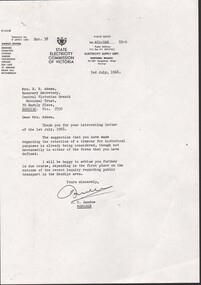
... National Trust Collection: Bendigo Joss House Tram Stop 3219 A -letter 3 Jul 1968 - between State Electricity Commission of Victoria and National Trust, Central Victorian Branch, noting the retention of the tramcar for historical purposes is under consideration 3219 B - 9 Feb 1971 - article from the Bendigo Advertiser, noting that the Bendigo City Council and the Eaglehawk Borough Counicl will request that one tram from Eaglehawk and one from each type for Bendigo be retained of the Bendigo Depot for five years following removal of the tram service 3219 CA - 23 March 1971 - between State Electricity Commission of Victoria and National Trust, Victorian Branch, concerns proposals for the preservation of a section of the electric tramway systems at both Ballarat and Bendigo 3219 CB - 9 Mar 1971 - letter from the National Trust, Central Victorian Branch, seeking advice and clarification on the extent to which the State Electricity Commission would be involved in the preservation of segments of the tramways system in Ballarat and Bendigo. 3219 D undated, foolscap typed sheet from The Tramway Museum of Victoria Ltd. entitled "You wish to help part of Victoria's Tramway History", covering Bendigo, Ballarat and Geelong tramways system 3219 E - 3 June 1971 - correspondence from NT Victoria and, referencing 23/03/1971 letter and Tramways flyer; noting a "forlorn hope" that retention of trams in Ballarat and Bendigo will not occur due to maintenance costs and operating costs being the "killers". 3219 F - 29 March 1971 - letter from the between State Electricity Commission of Victoria and National Trust, Central Victorian Branch, to SEC noting the retention of the historic trams in Bendigo and Ballarat will be taken up by the NT Branches in these areas. 3219 G - 30 Sept 1982 memorandum from National Trust, Central Victorian Branch, requesting to be notified of the Trust's Council on the decision regarding the tram stopover at the Bendigo Joss House 32198 H - 11 Oct 1982 - heritage Week 1983 / Joss House Trams, Bendigo 3219 I - 26 Oct 1982 - Note for file: The Central Victorian Branch seeks clarification in regard to the problem between the Bendigo Trust and the Bendigo Branch of the National Trust over the stopping of the "talking" tram at the Joss House 3219 J - 18 November 1982 - file note: discussions with Daryl McClure re trams. ...Chinese society on Bendigo Goldfields Bendigo Joss House Bendigo Joss House Chinese on the Bendigo Gold fields National Trust Collection: Bendigo Joss House Tram Stop 3219 A -letter 3 Jul 1968 - between State Electricity Commission of Victoria and National Trust, Central Victorian Branch, noting the retention of the tramcar for historical purposes is under consideration 3219 B - 9 Feb 1971 - article from the Bendigo Advertiser, noting that the Bendigo City Council and the Eaglehawk Borough Counicl will request that one tram from Eaglehawk and one from each type for Bendigo be retained of the Bendigo Depot for five years following removal of the tram service 3219 CA - 23 March 1971 - between State Electricity Commission of Victoria and National Trust, Victorian Branch, concerns proposals for the preservation of a section of the electric tramway systems at both Ballarat and Bendigo 3219 CB - 9 Mar 1971 - letter from the National Trust, Central Victorian Branch, seeking advice and clarification on the extent to which the State Electricity Commission would be involved in the preservation of segments of the tramways system in Ballarat and Bendigo. 3219 D undated, foolscap typed sheet from The Tramway Museum of Victoria Ltd. entitled "You wish to help part of Victoria's Tramway History", covering Bendigo, Ballarat and Geelong tramways system 3219 E - 3 June 1971 - correspondence from NT Victoria and, referencing 23/03/1971 letter and Tramways flyer; noting a "forlorn hope" that retention of trams in Ballarat and Bendigo will not occur due to maintenance costs and operating costs being the "killers". 3219 F - 29 March 1971 - letter from the between State Electricity Commission of Victoria and National Trust, Central Victorian Branch, to SEC noting the retention of the historic trams in Bendigo and Ballarat will be taken up by the NT Branches in these areas. 3219 G - 30 Sept 1982 memorandum from National Trust, Central Victorian Branch, requesting to be notified of the Trust's Council on the decision regarding the tram stopover at the Bendigo Joss House 32198 H - 11 Oct 1982 - heritage Week 1983 / Joss House Trams, Bendigo 3219 I - 26 Oct 1982 - Note for file: The Central Victorian Branch seeks clarification in regard to the problem between the Bendigo Trust and the Bendigo Branch of the National Trust over the stopping of the "talking" tram at the Joss House 3219 J - 18 November 1982 - file note: discussions with Daryl McClure re trams. ...Chinese society on Bendigo Goldfields Bendigo Joss HouseNational Trust Collection: Bendigo Joss House Tram Stop 3219 A -letter 3 Jul 1968 - between State Electricity Commission of Victoria and National Trust, Central Victorian Branch, noting the retention of the tramcar for historical purposes is under consideration 3219 B - 9 Feb 1971 - article from the Bendigo Advertiser, noting that the Bendigo City Council and the Eaglehawk Borough Counicl will request that one tram from Eaglehawk and one from each type for Bendigo be retained of the Bendigo Depot for five years following removal of the tram service 3219 CA - 23 March 1971 - between State Electricity Commission of Victoria and National Trust, Victorian Branch, concerns proposals for the preservation of a section of the electric tramway systems at both Ballarat and Bendigo 3219 CB - 9 Mar 1971 - letter from the National Trust, Central Victorian Branch, seeking advice and clarification on the extent to which the State Electricity Commission would be involved in the preservation of segments of the tramways system in Ballarat and Bendigo. 3219 D undated, foolscap typed sheet from The Tramway Museum of Victoria Ltd. entitled "You wish to help part of Victoria's Tramway History", covering Bendigo, Ballarat and Geelong tramways system 3219 E - 3 June 1971 - correspondence from NT Victoria and, referencing 23/03/1971 letter and Tramways flyer; noting a "forlorn hope" that retention of trams in Ballarat and Bendigo will not occur due to maintenance costs and operating costs being the "killers". 3219 F - 29 March 1971 - letter from the between State Electricity Commission of Victoria and National Trust, Central Victorian Branch, to SEC noting the retention of the historic trams in Bendigo and Ballarat will be taken up by the NT Branches in these areas. 3219 G - 30 Sept 1982 memorandum from National Trust, Central Victorian Branch, requesting to be notified of the Trust's Council on the decision regarding the tram stopover at the Bendigo Joss House 32198 H - 11 Oct 1982 - heritage Week 1983 / Joss House Trams, Bendigo 3219 I - 26 Oct 1982 - Note for file: The Central Victorian Branch seeks clarification in regard to the problem between the Bendigo Trust and the Bendigo Branch of the National Trust over the stopping of the "talking" tram at the Joss House 3219 J - 18 November 1982 - file note: discussions with Daryl McClure re trams. Discussions "were not very conclusive". 32198 K - Bendigo Advertiser 19 November 1983 - The Bendigo Trust to meet with the NT Central Victorian Branch to resolve issues preventing vintage tram stopover at the Chinese Joss House 3219 L - 4 Mat 1988 - The Bendigo Trust resolved to meet with three representatives of the NT Central Victoria Branch at the next meeting on 23 May 3219 M - undated pie charts of attendance statistics for the Chinese Joss House, Bendigobendigo joss house, chinese on the bendigo gold fields -
 Bendigo Historical Society Inc.
Newspaper - Fortuna Article - "Melody Maker", Jan 07 2008
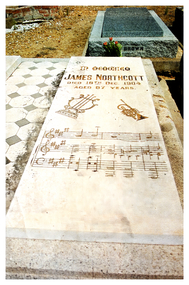
... notes. William Francis and Richard Francis were founders of the Beehive store during the gold rush era. Peter Hoey Finn arrived during the goldfields, owned a store that burned down, and later carved the granite bowl of the Alexandra Fountain as a mason. Elizabeth Watson was he only woman known to have died in a mining accident in Bendigo, tragically killed in 1863 due to her dress getting caught in mining machinery. The monumental section of Bendigo Cemetery has had about 60,000 interments since 1854, with some graves containing up to six people.The cemetery is denominational, with burial locations historically...notes. William Francis and Richard Francis were founders of the Beehive store during the gold rush era. Peter Hoey Finn arrived during the goldfields, owned a store that burned down, and later carved the granite bowl of the Alexandra Fountain as a mason. Elizabeth Watson was he only woman known to have died in a mining accident in Bendigo, tragically killed in 1863 due to her dress getting caught in mining machinery. The monumental section of Bendigo Cemetery has had about 60,000 interments since 1854, with some graves containing up to six people.The cemetery is denominational, with burial locations historically ...James Northcott In 1867 married Miss Lansell sister of George Lansell. A prominent bandsman in Bendigo, recognized for his musical contributions and honored with a silver cornet in 1871. His grave in the Bendigo Cemetery features musical notes. William Francis and Richard Francis were founders of the Beehive store during the gold rush era. Peter Hoey Finn arrived during the goldfields, owned a store that burned down, and later carved the granite bowl of the Alexandra Fountain as a mason. Elizabeth Watson was he only woman known to have died in a mining accident in Bendigo, tragically killed in 1863 due to her dress getting caught in mining machinery. The monumental section of Bendigo Cemetery has had about 60,000 interments since 1854, with some graves containing up to six people.The cemetery is denominational, with burial locations historically determined by religion.Community and Historical Significance:Cemetery tours are offered at Bendigo, White Hills, Eaglehawk, and Kangaroo Flat as part of the Summer in the Parks program. Many Australians have a family connection to Bendigo, with an estimated one in seven families linked to the area.Prominent Graves in the Bendigo Cemetery Article - "Melody Maker" - The Bendigo Miner Thursday Jan 07 2008 This item contains the following: 11217.11a Colour Photo of The Grave of Bandsman James Northcott 11217.11b Colour Photo of The Grave of Sir John Quick, the federal member for Bendigo 1901-1913, died 1932 11217.11c Colour Photo of The Grave of Anne Caudle in whose honour the Ann Caudle Centre is named, died in 1865 11217.11d Colour Photo of a Father and Mother - Some graves contain up to six people 11217.11e Part of page 5 - Melody Makernon-fictionbendigo, fortuna, george lansell, james northcott, anne caudle, john quick, northcott band -
Bendigo Historical Society Inc.
Document - Fortuna Article - Handout Notes for a Tour, 1990s
... These points highlight the architectural, artistic, and historical significance of Fortuna Villa and its associated features. bendigo fortuna george lansell george victor lansell Fortuna Article - Handout Notes for a Tour, by the Australian Government Department of defence support group This item contains the following document: 11217.61a A glossy coloured page A3 document of Fortuna lower floor and Ground Floor, which lists tha main points of the Villa and includes plans of the two floors. ...Here are the key points from the document on Fortuna Villa and its grounds: Music Room: Originally the main drawing room, featuring an ornate decorative ceiling and stained glass windows with musical inscriptions. The room was expanded in 1904, with earlier renovations enclosing an open colonnade in the 1890s. Conservatory: Built in 1876 after Lansell's European trip, showcasing high-quality etched glass and Italian design.Features rare glasswork, including Ruby Flashed Seedless French Antique glass and acid-etched panels with mining, Australian, and heraldic motifs. Reception Room: Served as the initial gathering space for guests, with a bay window added in 1875.Decorative elements like pressed metal ceilings, a cut glass skylight, and parquetry were likely added around 1895. Staircase: Made of cedar and blackwood, added in 1888 to access a new third floor, and remodeled in 1907. Features an upper balcony intersecting a large stained leadlight window. Bedrooms: Main bedrooms are located off a central passage, each with its own bathroom equipped with marble baths and cedar cabinetry.Pompeii Fountain: Constructed in 1879 as a scale replica of the Great Fountain in Pompeii, inspired by Lansell's travels.Includes statues, water features, and a Roman column with a statue, considered unique in Australia and possibly worldwide. Crushing Battery: A 30-head stamper battery built in 1874 for mining, attached to the villa's northern end.The chimney and machinery were removed in the 1940s, but the structure remains largely intact, now used as a printing press. These points highlight the architectural, artistic, and historical significance of Fortuna Villa and its associated features.Fortuna Article - Handout Notes for a Tour, by the Australian Government Department of defence support group This item contains the following document: 11217.61a A glossy coloured page A3 document of Fortuna lower floor and Ground Floor, which lists tha main points of the Villa and includes plans of the two floors.non-fictionbendigo, fortuna, george lansell, george victor lansell -
 Bendigo Historical Society Inc.
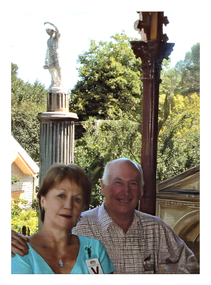
Document - Fortuna - History Note "The Great Fortuna Statue Massacre", Feb 2008
... Plastibond remains a commonly used material for such repairs. bendigo fortuna george lansell helen and john mcewen Fortuna - History Note "The Great Fortuna Statue Massacre" - Visit by John and Helen McEwen on Feb 25 2008 This item contains the following documents: 11217.78a Colour photo of Helen and John McEwen with the statue in the background 11217.78a Colour photo of the statue 11217.78a Two sided sheet labelled Fortuna Villa Historical Note 001 Fortuna "The Great Fortuna Statue Massacre" Document Fortuna - History Note "The Great Fortuna Statue Massacre" ...John McEwen repaired the Pompeii Fountain statue at Fortuna Villa in the early 1970s after it was damaged by gunfire in the 1960s. He was a ceramics teacher at Bendigo Institute of TAFE, later a farrier, and a volunteer teacher in outback NSW.In 2008, John and his wife Helen revisited Fortuna Villa to see his restoration work.The "Statue Massacre" IncidentShooting IncidentIn the early 1960s, a National Serviceman allegedly used a .303 rifle to shoot several statues at Fortuna Villa, possibly while intoxicated. There is some uncertainty about the exact timing and presence of National Servicemen on site, with conflicting accounts about when the incident could have occurred. Multiple statues were damaged or destroyed, but one original statue from the Lansell era survived. A notable surviving statue was of a boy carrying a basket, which sometimes caused confusion due to its lifelike appearance. John McEwen was contacted by two military men in the early 1970s to repair the damaged statue. The statue was made of compressed cement and was badly fragmented, with the front and left arm destroyed and the head separated but intact. John constructed a metal armature for the missing arm, used chicken wire for structure, and rebuilt the statue with cement mixed with Plastibond adhesive. Plastibond remains a commonly used material for such repairs.Fortuna - History Note "The Great Fortuna Statue Massacre" - Visit by John and Helen McEwen on Feb 25 2008 This item contains the following documents: 11217.78a Colour photo of Helen and John McEwen with the statue in the background 11217.78a Colour photo of the statue 11217.78a Two sided sheet labelled Fortuna Villa Historical Note 001 Fortuna "The Great Fortuna Statue Massacre"non-fictionbendigo, fortuna, george lansell, helen and john mcewen -
 Bendigo Historical Society Inc.
Document - PETER ELLIS COLLECTION: PETER ELLIS EULOGY
... note at top of first page reads: Eulogy published in Trad & Now Magazine. Vale Peter Ellis OAM. By John Williams. The folk community lost a giant on May 18th when Peter Ellis passed away after a short illness. Peter had been a collector, author and musician for nearly forty years and his work has been prodigious to say the least. Peter has the largest collection of dance related material in the National Library and had travelled Australia on his collection trips. He produced twenty CDs of dance music and historical music with his Bendigo...note at top of first page reads: Eulogy published in Trad & Now Magazine. Vale Peter Ellis OAM. By John Williams. The folk community lost a giant on May 18th when Peter Ellis passed away after a short illness. Peter had been a collector, author and musician for nearly forty years and his work has been prodigious to say the least. Peter has the largest collection of dance related material in the National Library and had travelled Australia on his collection trips. He produced twenty CDs of dance music and historical music with his Bendigo ...2 A4 sheets. Handwritten pencil note at top of first page reads: Eulogy published in Trad & Now Magazine. Vale Peter Ellis OAM. By John Williams. The folk community lost a giant on May 18th when Peter Ellis passed away after a short illness. Peter had been a collector, author and musician for nearly forty years and his work has been prodigious to say the least. Peter has the largest collection of dance related material in the National Library and had travelled Australia on his collection trips. He produced twenty CDs of dance music and historical music with his Bendigo based band the Celebrated Emu Creek Bush Band which he founded and led for thirty four years. His final project was the double CD 'Cooee, Songs of the ANZACS' which he organised in conjunction with the Bendigo Historical Society. It was launched on 24th April and was Peter's last performance. Peter has also been a member of the Wedderburn Old Timers for over thirty years and has assisted with many of their recordings including their latest Bush Concert CD which Peter Organised. Peter has contributed to many other CDs over the years and has been thanked on many a CD cover by many folk artists. Peter has also written several books, the three volume 'Collectors' Choice,' 'Two Hundred Dancing Years' co-written with Shirley Andrews OAM, and 'Music Makes Me Smile' the history of the Nariel Valley musicians co-written with Harry Gardner. Peter's recent major work The Merry Country Dance will become the bible for people wishing to learn about our bush music heritage with its matching six CD collection. Peter has also contributed to 'Verandah Music' edited by Rob Willis and Graham Seal and 'The Oxford Companion to Australian Folklore' edited by Graham Seal and is a regular contributor to Trad & Now. He completed his last Trad & Now article the week before he died. Peter was also a life member of the Field Naturalists and was extremely active in campaigns to preserve Lake Pedder, the Whipstick Forest and Kamarooka Forest (now part of Bendigo National Park and preserved forever) One Tree Hill, Jackass Flat Flora Reserve and Saloman's Gully bushlands. Peter has discovered and named plants in the whipstick and enjoyed propagating native plants. He loved his amazing bush block in suburban Bendigo. Peter was also a keen photographer and had photos published in the book 'Wildflowers of Bendigo'. Peter taught dancing and music classes with Continuing Education for many years and encouraged many young musicians over the years. Peter was an accomplished ballroom dancer and had achieved gold medal status in that field. He was one of Australia's finest exponents of the button accordion, concertina, harmonica and tin whistle. Peter also played piano, organ and ukulele as well as the Swanee whistle and bones. Peter was the founder of the Annual Dinki Di Ball held each September in Eaglehawk as a tribute to the old MC's. Peter was happy playing for fund-raisers for any organisation who asked and also enjoyed plying the big gigs such as for the opening of the Melbourne Museum or for State Parliament. He played in the National Folk Festivals in four states and was a regular at the National in Canberra where he gave regular classes, performed with his bands and was a stalwart of the Aussie section of the session bar. He performed at nearly every Maldon Folk Festival and was MC at Nariel Folk Festival dances for many years. Peter was very proud of his OAM and wore the little medal at all of his performances. That honour was rightly given to one who did so much to preserve Australia's dance history. Peter lived a full life and was a friend to hundreds of people. He was taken far too young and in typical fashion was planning new projects right till the end. His passing is a huge loss for us all but one thing is certain. He will never be forgotten.person, individual, peter ellis oam -
Bendigo Historical Society Inc.
Audio - The 1930s Depression Tapes - Frank Crawford, 2005
... Bendigo Town Hall. Two audio tapes with length of one hour and 45 minutes, with eleven pages of handwritten notes of the interview. Frank was born in 1915, his parents were a bricklayer and a dressmaker. He attended St Liborius Catholic Primary School in Eaglehawk from 1920 to 1928. The tape has been converted to a sound file. The 90 minute interview can be listened to; and the notes viewed at the Bendigo Historical...Bendigo Town Hall. Two audio tapes with length of one hour and 45 minutes, with eleven pages of handwritten notes of the interview. Frank was born in 1915, his parents were a bricklayer and a dressmaker. He attended St Liborius Catholic Primary School in Eaglehawk from 1920 to 1928. The tape has been converted to a sound file. The 90 minute interview can be listened to; and the notes viewed at the Bendigo Historical ...In 2005 Michele Matthews interviewed current and former residents of Bendigo for her thesis on the 1930s Depression as part of her PhD Research, with the University of Melbourne Faculty of Arts, History Department. Michele interviewed fifteen members of prominent Bendigonian families. The thesis was titled: "How Depressing?: The impact of the Great Depression on Bendigo and District 1925-1935". The Michele Matthews Collection contains fourteen audio cassette tape recordings and one written transcript. The tapes are each approximately one hour and 45 minutes duration. The questions presented to the interviewees explore everyday experiences they would have lived through at the time of the Depression. The questions covered sixteen relevant subjects: • Introduction and housing • Social activities, swimming, cinemas, school and games played with friends • Organizations such as the RSL, Relief Committees etc. and any effect they had on family life • The life of the single woman • Unemployment and Employment • Government Assistance • Charities Aid • Self-help • People Power, e.g. boycotts or protests • Politics • Trouble or crime • Family Health, Medical and Diet • Education • General memories of, and hardships encountered, during the DepressionAudio tape interview with Frank Crawford. Crawford's Shoe Shop business was on the corner of Bull and Hargreaves Streets, opposite the Bendigo Town Hall. Two audio tapes with length of one hour and 45 minutes, with eleven pages of handwritten notes of the interview. Frank was born in 1915, his parents were a bricklayer and a dressmaker. He attended St Liborius Catholic Primary School in Eaglehawk from 1920 to 1928. The tape has been converted to a sound file. The 90 minute interview can be listened to; and the notes viewed at the Bendigo Historical Society. By appointment only.history, bendigo, michele matthews collection, frank crawford bendigo, crawford's shoe shop bendigo, 1930s depression tapes -
 Bendigo Historical Society Inc.
Audio - The 1930s Depression Tapes - Amy Elizabeth Brown, 2005
... The 150 minute interview can be listened to, and the notes viewed, at the Bendigo Historical Society. By appointment only. ...Bendigo Michele Matthews Collection The 1930s Depression Tapes Amy Brown Audio tape interview with Amy Brown (Nee Osterfield). Amy was born in 1922. In 1942 she married Allan Stanley Brown. Her father, Charles Osterfield was a wood cutter before becoming unemployed. She never attended school. The tape has been converted to a sound file. The 150 minute interview can be listened to, and the notes viewed, at the Bendigo Historical ...In 2005 Michele Matthews interviewed current and former residents of Bendigo for her thesis on the 1930s Depression as part of her PhD Research, with the University of Melbourne Faculty of Arts, History Department. Michele interviewed fifteen members of prominent Bendigonian families. The thesis was titled: "How Depressing?: The impact of the Great Depression on Bendigo and District 1925-1935". The Michele Matthews Collection contains fourteen audio cassette tape recordings and one written transcript. The tapes are each approximately 1 hour and 45 minutes duration. The questions presented to the interviewees explore everyday experiences they would have lived through at the time of the Depression. The questions covered sixteen relevant subjects: • Introduction and housing • Social activities, swimming, cinemas, school and games played with friends • Organizations such as the RSL, Relief Committees etc. and any effect they had on family life • The life of the single woman • Unemployment and Employment • Government Assistance • Charities Aid • Self-help • People Power, e.g. boycotts or protests • Politics • Trouble or crime • Family Health, Medical and Diet • Education • General memories of, and hardships encountered, during the DepressionAudio tape interview with Amy Brown (Nee Osterfield). Amy was born in 1922. In 1942 she married Allan Stanley Brown. Her father, Charles Osterfield was a wood cutter before becoming unemployed. She never attended school. The tape has been converted to a sound file. The 150 minute interview can be listened to, and the notes viewed, at the Bendigo Historical Society. By appointment only. Also included is Amy's memories of her childhood - Amy's Story. This is a 26 page document available here to read.history, bendigo, michele matthews collection, the 1930s depression tapes, amy brown -
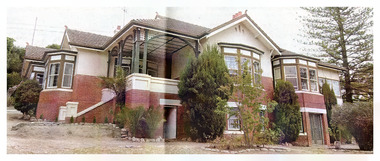 Bendigo Historical Society Inc.
Audio - The 1930s Depression Tapes - Doreen and Josephine Favaloro, 2005
... The 120 minute interview can be listened to, and the notes viewed, at the Bendigo Historical Society. By appointment only. ...Bendigo Michele Matthews Collection The 1930s Depression Tapes Doreen and Josephine Favaloro Audio tape interview with sisters Doreen Domenica Favalora, and Josephine Monica Faveloro; cake and food shop owners. Daughters of Salvatore and Gina Favaloro. Doreen was born in 1915, and Josephine in 1920. Both attended school at St Mary's College, Doreen, c1920-1933, and Josephine, 1925-1938. The tape has been converted to a sound file. The 120 minute interview can be listened to, and the notes viewed, at the Bendigo Historical ...In 2005 Michele Matthews interviewed current and former residents of Bendigo for her thesis on the 1930s Depression as part of her PhD Research, with the University of Melbourne Faculty of Arts, History Department. Michele interviewed fifteen members of prominent Bendigonian families. The thesis was titled: "How Depressing?: The impact of the Great Depression on Bendigo and District 1925-1935". The Michele Matthews Collection contains fourteen audio cassette tape recordings and one written transcript. The tapes are each approximately 1 hour and 45 minutes duration. The questions presented to the interviewees explore everyday experiences they would have lived through at the time of the Depression. The questions covered sixteen relevant subjects: • Introduction and housing • Social activities, swimming, cinemas, school and games played with friends • Organizations such as the RSL, Relief Committees etc. and any effect they had on family life • The life of the single woman • Unemployment and Employment • Government Assistance • Charities Aid • Self-help • People Power, e.g. boycotts or protests • Politics • Trouble or crime • Family Health, Medical and Diet • Education • General memories of, and hardships encountered, during the DepressionAudio tape interview with sisters Doreen Domenica Favalora, and Josephine Monica Faveloro; cake and food shop owners. Daughters of Salvatore and Gina Favaloro. Doreen was born in 1915, and Josephine in 1920. Both attended school at St Mary's College, Doreen, c1920-1933, and Josephine, 1925-1938. The tape has been converted to a sound file. The 120 minute interview can be listened to, and the notes viewed, at the Bendigo Historical Society. By appointment only. The sisters lived at 137 Forest Street (not the one in the photo) Generations of the Favaloro family have attended Catherine McAuley College and its predecessor colleges St Mary's and Marist Brothers'. A book has been released documenting the progressive family migration from Salina, Italy to Bendigo. The family went on to run many much-loved businesses in Bendigo including cafes, fruit shops, theatre kiosks and caterers. A book has been written called 'The Favaloro Family of Bendigo: The Early Year 1895-1942' by Robert McWilliam. The photo and article are from the Bendigo Weekly Newspaper Friday April 7th 2006history, bendigo, michele matthews collection, the 1930s depression tapes, doreen and josephine favaloro -
Bendigo Historical Society Inc.
Audio - The 1930s Depression Tapes - Gordon Glover, 2005
... Bendigo Business college in 1934. He married Jessie Glover in 1942. The tape has been converted to a sound file. The 90 minute interview can be listened to, and the notes viewed, at the Bendigo Historical Society. ...Bendigo Business college in 1934. He married Jessie Glover in 1942. The tape has been converted to a sound file. The 90 minute interview can be listened to, and the notes viewed, at the Bendigo Historical Society. ...In 2005 Michele Matthews interviewed current and former residents of Bendigo for her thesis on the 1930s Depression as part of her PhD Research, with the University of Melbourne Faculty of Arts, History Department. Michele interviewed fifteen members of prominent Bendigonian families. The thesis was titled: "How Depressing?: The impact of the Great Depression on Bendigo and District 1925-1935". The Michele Matthews Collection contains fourteen audio cassette tape recordings and one written transcript. The tapes are each approximately 1 hour and 45 minutes duration. The questions presented to the interviewees explore everyday experiences they would have lived through at the time of the Depression. The questions covered sixteen relevant subjects: • Introduction and housing • Social activities, swimming, cinemas, school and games played with friends • Organizations such as the RSL, Relief Committees etc. and any effect they had on family life • The life of the single woman • Unemployment and Employment • Government Assistance • Charities Aid • Self-help • People Power, e.g. boycotts or protests • Politics • Trouble or crime • Family Health, Medical and Diet • Education • General memories of, and hardships encountered, during the DepressionAudio tape interview with Gordon Glover. Son of Charles John Richard Glover and Clarice Ethel Glover who were Aerated Waters and canned tomato and sauce producers. Gordon was born in 1917. He attended school at Gravel Hill State School, 1922-1929, Bendigo High School, 1929-1932, and Bendigo Business college in 1934. He married Jessie Glover in 1942. The tape has been converted to a sound file. The 90 minute interview can be listened to, and the notes viewed, at the Bendigo Historical Society. By appointment only.history, bendigo, michele matthews collection, the 1930s depression tapes, gordon glover -
Bendigo Historical Society Inc.
Audio - The 1930s Depression Tapes - Jessie Glover, 2005
... Bendigo Domestic Arts School, 1930-1931. She married Gordon Glover in 1942. The tape has been converted to a sound file. The 90 minute interview can be listened to, and the notes viewed, at the Bendigo Historical Society. ...Bendigo Domestic Arts School, 1930-1931. She married Gordon Glover in 1942. The tape has been converted to a sound file. The 90 minute interview can be listened to, and the notes viewed, at the Bendigo Historical Society. ...In 2005 Michele Matthews interviewed current and former residents of Bendigo for her thesis on the 1930s Depression as part of her PhD Research, with the University of Melbourne Faculty of Arts, History Department. Michele interviewed fifteen members of prominent Bendigonian families. The thesis was titled: "How Depressing?: The impact of the Great Depression on Bendigo and District 1925-1935". The Michele Matthews Collection contains fourteen audio cassette tape recordings and one written transcript. The tapes are each approximately 1 hour and 45 minutes duration. The questions presented to the interviewees explore everyday experiences they would have lived through at the time of the Depression. The questions covered sixteen relevant subjects: • Introduction and housing • Social activities, swimming, cinemas, school and games played with friends • Organizations such as the RSL, Relief Committees etc. and any effect they had on family life • The life of the single woman • Unemployment and Employment • Government Assistance • Charities Aid • Self-help • People Power, e.g. boycotts or protests • Politics • Trouble or crime • Family Health, Medical and Diet • Education • General memories of, and hardships encountered, during the DepressionAudio tape interview with Jessie Glover. Daughter of business-man James Percy Craven and Jane Petts Craven. Jessie was born in 1916. She attended school at Huntly State School, 1922-1923, Gravel Hill State School, 1924-1929, Bendigo Domestic Arts School, 1930-1931. She married Gordon Glover in 1942. The tape has been converted to a sound file. The 90 minute interview can be listened to, and the notes viewed, at the Bendigo Historical Society. By appointment only.history, bendigo, michele matthews collection, the 1930s depression tapes, jessie glover
