
Showing 13 items matching " horse and cattle market"
-
 Bendigo Historical Society Inc.
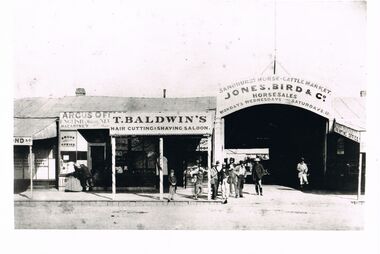
Photograph - WES HARRY COLLECTION: JONES, BIRD AND CO, T. BALDWIN'S, MARKET SQUARE, BENDIGO
... ... horse and cattle market...black and white image ( copy ) image shows Sandhurst horse and cattle market, (Jones, Bird & Co.,) T. ...PLACE Bendigo market square Bendigo gold mining horse and cattle market Jones Bird & Co. T. ...black and white image ( copy ) image shows Sandhurst horse and cattle market, (Jones, Bird & Co.,) T. Baldwin's hair cutting and shaving saloon, Argus office. Market Square, Bendigo. People outside on footpath, and standing in driveway of horse and cattle market.place, bendigo, market square, bendigo, gold mining, horse and cattle market, jones, bird & co., t. baldwins, argus -
 Bendigo Historical Society Inc.
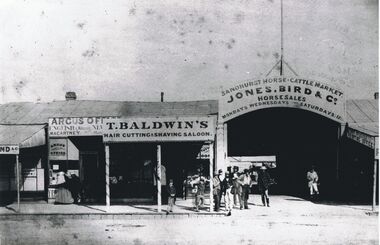
Photograph - PALL MALL 1861?, 1861 approx
... Baldwins's Haircutting & Shaving Saloon, Sandhurst Horse and Cattle Market, Jones Bird & Co., Printing Office...Baldwins's Haircutting & Shaving Saloon, Sandhurst Horse and Cattle Market, Jones Bird & Co., Printing Office. '8' in grey lead on obverse side of photograph Photograph PALL MALL 1861? ...Black and white photo : copy of Batchelder, 1861. Commercial premises Pall Mall. Left to right Argus Office, Macartney Watchmaker ? T. Baldwins's Haircutting & Shaving Saloon, Sandhurst Horse and Cattle Market, Jones Bird & Co., Printing Office. '8' in grey lead on obverse side of photographBatchelderplace, streetscape, pall mall -
 City of Moorabbin Historical Society (Operating the Box Cottage Museum)
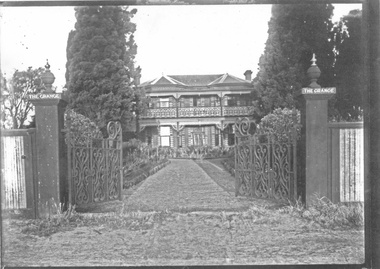
Photograph - 3 black & white Photographs, 'The Grange' ( 'Baydon Hill' ) Moorabbin, c 1920
... The Moorabbin Police Station is built on the site. tuck charles tuck jane veterinary surgeons livestock market gardeners early settlers dendy's special survey brighton moorabbin ballarat gold diggings horses chickens cattle bullocks flower shows fruit garden mulvaney s. t. healey haold james healey keith moorabbin city council chinese market gardeners plant nursery tuck leslie stephen jones elsa Written in pencil on back a) " This Photo donated by Mr Neil Follett - at the time it came into his possession he had a photography studio in Cheltenham. ...'The Grange ' was a 2 storey home built 1857 by Mr Charles Tuck, originally named 'Baydon Hill', at 1011 Nepean Highway, Moorabbin ( South Brighton). Mr Charles Tuck was Veterinary Surgeon from Baydon Hill, Wiltshire, England, who migrated to Australia c1850. He married his cousin Miss Jan Chaudler in Melbourne in1853. He was at the Ballarat gold-fields at the time of the riots and then they settled in South Brighton (later Moorabbin) and built a large Georgian styled home called 'Baydon Hill'. The Tucks had a large family - 9 children. Charles enjoyed a prosperous Veterinary Practice as his advice was needed for stock purchases by the farmers / settlers. Charles died in 1893 and Jane left the property c 1903 and died at Blackburn in 1928. The House had 5 owners, the last being the Healey family c1920 and at some stage the name was changed to 'The Grange' and the gates shown were installed. The Healey Family were also prosperous in developing vegetables and flower seeds and seedlings. 'The Grange' was sold to Moorabbin City Council 1972 and then used by the City of Moorabbin Historical Society for meetings and storage of historical material. It was demolished amidst considerable controversy 1983 and the Moorabbin Police Station was built on the site. ( S.T.Mulvany, Grand-daughter of Charles Tuck 26/7/1974)The Grange was a significant property 1853 -1983 in Moorabbin. It was built by Mr Charles Tuck 1857and in1900 extended from Point Nepean Road to South Road - 10acres. Mr Harold James Healey purchased the property in c1920 and leased a portion to a Chinese market gardener. Later with his sons he established a profitable Plant Nursery that they managed for 42years. Keith Healey, a son, remodelled the house extensively mid 20thC. The Moorabbin City Council purchased it in 1972 for $255,000 and it was demolished amid controversy 1983. The Moorabbin Police Station is built on the site.3x black and white photographs of the property at 1011 Nepean Highway Moorabbin built by Mr Charles Tuck c1853 known as 'The Grange'. Originally it was named 'Baydon Hill' because he migrated from Baydon Hill, Wiltshire, England c1850. PHOTOGRAPHS: c 1880, 1920 and 1950 showing the original and later additions made to the property by some of the 5 owners. PLAN: Proposed Alterations & Additions to 'The Grange" brick and stone residence for Mr K Healy Dack & Armstrong, Home & Industrial Designers 12 Station Street, Moorabbin. c1950sWritten in pencil on back a) " This Photo donated by Mr Neil Follett - at the time it came into his possession he had a photography studio in Cheltenham. Photographer unknown"; Folio 6 b) The Grange c 1950 Folio 6/10 c) 'Baydon Hill' ( alias "The Grange" ) / Donated by Mrs Elsa Jones, daughter of Leslie Stephen Tuck, youngest son of Charles Tuck Folio 6 /18tuck charles, tuck jane, veterinary surgeons, livestock, market gardeners, early settlers, dendy's special survey, brighton, moorabbin, ballarat, gold diggings, horses, chickens, cattle, bullocks, flower shows, fruit garden, mulvaney s. t., healey haold james, healey keith, moorabbin city council, chinese market gardeners, plant nursery, tuck leslie stephen, jones elsa -
 Orbost & District Historical Society
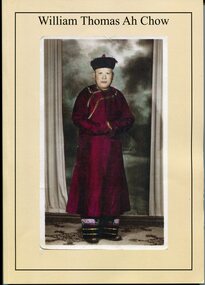
Booklet - Booklet, softcover, William Thomas Ah Chow, March 2019
... Whenever there was fire danger, he rode his horse up to the fire tower on Mt Nugong and acted as look-out. ...Whenever there was fire danger, he rode his horse up to the fire tower on Mt Nugong and acted as look-out. ...This family history book was published as a family record of the Ah Chow family. A limited number of copies were printed. Thomas William (Bill) Ah Chow was a Chinese-Australian soldier, farmer, fire lookout and legendary bushman of East Gippsland in Victoria. Many Chinese came to the Victorian gold rush in the 1850s to seek their fortune at the Omeo and Cassilis diggings. Many of the immigrants later settled and integrated into their local communities working as farm labourers, tending market gardens, making furniture, running grocery stores and cafes or practising Chinese medicine. Thomas William "Bill" Ah Chow of Bruthen, Victoria attempted to enlist early in the War but was rejected for being "not substantially of European origin". Undeterred, he reapplied and was accepted in June 1917. During his service with the 5th Battalion, he was wounded at least three times. After the War, Bill returned to Bruthen where he drove sheep, worked cattle and eventually assisted in the building of roads through the area. He became a Forestry Commission fire-spotter and built a hut called 'Moscow Villa' in 1942. He lived in the hut during the summer months and in winter, returned to his family in Ensay. Whenever there was fire danger, he rode his horse up to the fire tower on Mt Nugong and acted as look-out. Bill worked for the Forestry Commission for more than twenty years and came out of retirement to continue his duties when no suitable replacement could be found. Bill died in 1967 and is buried in Omeo. Moscow Villa still stands and is a popular camping site This is a useful reference item. As a family history it is detailed and contains useful copies of personal documents. Bill Ah Chow, along with the Ah Chow family were well known in Orbost and East Gippsland. This booklet is a testament to his life. A soft covered 97pp book with a cream cover. On the front is a coloured photograph of a Chinese man in traditional robe and hat. On the back cover is Moscow Villa. It contains information, copies of 1949 photographs, documents, hand -written letters and a will. There is an envelope attached to the inside cover containing a CD, photos and family tree.ah-chow-william-thomas family-history-ah-chow -
 Bendigo Historical Society Inc.
Book - BENDIGO SALEYARDS COLLECTION: RECORD OF TOKENS
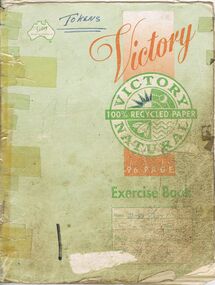
... BHS Collection BENDIGO Council cattle markets Bendigo Saleyards Collection - Record of Tokens Robt Blake Gib Davey M Tappe John Wilson Allan Somerville Peter Harris ? ...BHS CollectionPale green covered exercise book with Victory printed in orange at the top right. Below is a circle with Victory at the top and Natural below. Across the centre is 100% Recycled Paper. Below is 96 page printed in white on an orange background. Below that is Exercise Book printed in dark green, and below that is the name plate. On the name line is a date 31-10-91. Book was used as a record of who bought tokens for the truckwash and how much they paid. Later the money was paid to the Council. Names in the book included: Robt Blake, Gib Davey,M Tappe, John Wilson, Allan Somerville, Peter Harris, ? Hearn, Andrew Beer, Jack McKenna, Don White, J Govett, J Wignall, Matthews Transports, Pickthalls Transport, Carlisle Bros, Noel Hartland, Grogans Livestock, K Stratton, Rutlands Transports, J Truscott, Des Byrne, Commercial Pig Co, Rick Thompson, M Connally, K Otoole, B McLean, K Stevens, S Bennitt, Alan Pickdall, L Boyd, Mathews Transport, Mathews, Cowan Transport, H J Sooble, John Kerr, Stone, John Wilson, Brendan Morgan, Bruce Stewart. Jack Covett, Len Terry, Neil Adams, P Llewellyn, Peter Norris, Steve Nann, Glen Bish, R Frazer, Rutland, S Johnston, R Hearn, Ronald D Stone, Stephen Bennett, Nick Connally, Wayne Wignall, G Chapman, Noel Hartland, Stan Rutland, Mr Preston, K Barrow, John Wilson, Mr McGrath, W Lanz, John Truscott, Craigs, M Vick, Craig Hoy, Cliff Johnson, N Johnson, Sullivan, Colin Bloomfield, R Thompson, M Vick, Jan Wignall, Bicknalls, JJ Wilson, Des Byrne, Keith O'Toole, Llewellyns transports, Reg Hearn, Don White, J Boon, Mr Webb, W Fergson, Glen Bish, G Pollock, Penview Pastoral Co, G Pollock, Meehan, Woodstock Holdings, J W Pekthall & Sons, John Wilson, Kerrs Transports, K Stevens, John Kerr, Benview Elmore, Steve Mann, Mr Anfuso, K Wignall, D Fawcett, P Johnson, Llewingtons, R Hearn, Paynes Transports, G Watson, Ian Johnson, G G Muller & Son, Pichard O'Sullivan, Gib Davies, Adams Transport, Kevin Marlow, Lewington, Maurie Bick, Isaac, Des Byrne, Lewington, J Govett, N Hartland, S Bennett, J Govett, R Thompson, B Morgan, Colin Bloomfield, J Kerr, Mr Carver, Richards, K Isaac, Amfuso, Bob McLean, Mr Marke, Geodie, Ted Goddard, Kulpinski, Hollingworth, W Hodge, G F Farmer, R Hearn, Kevin Stevens, Don White, Morrie Vick, Mr Gallagher, R McKenzie, L Lanz, L Kirk, D Harrigan, RG & F Moon, E J Hooper, Des Byrne, G Medlyn, J Wilson, N Hartland, H Green, D Vick, G D Gamble, Con Mulvahill, Pietorala Transports, C Reece, Graham Miller, Rinaldi, Les Smith, Brendan Morgan, Pickhalls Transports, Mr Dawn, Steven Bennett, Steve Mann, Les Smith, H Green, Connallys, Lewington, I Gallagher, Ray Collins, Burrow, Hugh Green, C Congrim, D Byrne, Don White, grogan, Mr Selly, Adams Transports, Kevin Marlow, Roberts Transports, J W Pickhalls, Wick Lockington, G Bish, Don White, GG Muller & Son, McKenna's, T Smith G Watson, Blacky, B Lee, Don Wright, Hue Green, John Wilson, Carl Cooke, Mr Connally, N Northland, Jan Hollingsworth, Mr Preston, Mr Hooper, Mr Rose, D White, Ron Mellier, GD Gamble, K Richards, Bond Bros, J Govett, Victorian Producers, Gavin O'Sullivan, Neil Adams, Mr Dowell, I Gallagher, W Lanz, Mr Boyd, Peter Bish, J McKay, Farmer, Joe Blow, J Matthews, M Vick, N Adams, Colins Pastoral Co, Younghusband, K Barrow, K Richards, Steve Bennett, Les Smith, Ben Webb, John Wilson, Gavin O'Sullivan, Mr McCarthy, Col Warrack, Steve Ellis, Charlie Reece, Mr Vanderene, D Hannagan, P Morgan, Don White, Sommerville, McDonald, P Meighan, Don White, Les Smith, Carl Koch, Ron Stone, M Connally, J Gover, Mr Craig, M Vick, Eddy Smith, B Morgan, B Hickson, Len Reid, Mr Curt, Mr Grogan, Rob Blake, Mr Goulthorpe, Bob McLean, O'Sullivans, Ricky thompson, Johnson, Mr Coffey, J McKay, D White, Giles, Johnstone, Nicholls, Govett, White, Wilson, Don White, Geoff Gill, D Gorden, Ray Collins, Pellegrino, Cory Watson, W Ferguson, Pickthall, McDonald, Cook, S Mann, J Govett, Collins Pastral, Broad, Rick thompson, R Hearn, S Bennett, W Fitzpatrick, Noel Hartland, K Rotheran, David Beers, Congran, R Blake, R Weeks, Taylor, R Frazer, K Stratton, M Connally, N Adams, Don White, Milgate, Findlays, J Dury, McKibbins, Morgan, Roberts, R Stone, K Stevens, M Vick, C Reece, Steve Bennett, Ahern, S Boyd, Rick thompson,McClean, Hearn, Govett, Peter harris, Graham Medlyn, McAllister, Noel Hartland, Beer, RJ Grogan, Hindle, Bendigo Horse Transport, Jack McKenna, R Hearn, J McKay, T Rinaldi, Hayes, G Muller, J Govett, Ranoldi, D Ford, K O'Toole, J Talbot, McKibbons, Barr, S Bennett, P Johnston, J Hird, Paynes Transport, D White, P Harris, Maurie Vick, P Bish, Don Hollingsworth, C Gilmore, Jack Talbot, G Chapman, J Wilson, Kevin Stevens, Eddy Smith, C Bloomfield, R thompson, Davies, Truscott, D Byrne, Hayes Transport, Yanga Pty Ltd, M Connally, A Rothacker, Coad, D Byrne, R O'Sullivan, K Stevens, Cliffton, M Douglas, Trevor Mathews, Botly, Anufson, w Fitzpatrick, R Hearn, R Collins, Craig Dorman, Brian Bentley, M Johns, T Sully, W Fawcett, Bob McLean, D White, Hugh Green, B Harris, Rod thompson, P Meighan, Allan McAllister, Mark Barri, Don White, M Connelly, P Lewellyn, G Gill, G Rand, Hayes, S O'Sullivan, D White, Bob Blake, R Stone, B Liddle, Bentley Trans, J Govett, Stevens Transport, N Broad, Govett, G Young, M Footh, Geoff Gill, Gamble, D Holingworth, C Reece, S White, S Bennett, M Barri, John Wilson, D Byrne, P Morgan, R Stone, Bentley, Pollock, Des Byrne, Doug Rinaldi, J Govett, B Harris, R Brunt, Roberts, R Burt, Tang, Peter Morgan, M Oxley, G W Nunn, D Boyd, Findley, C Johns, W Craig, A Beer, A & M Rinaldi, D Illingworth, M Barri, G Rand, G & P Nunn, R Hearn, A Broad, C Bloomfield, K Marlow, P Trailer, J Govett, Talbot, J Beer, M Gray, J Kerr, R Stone, R Stewart, English Trans, Argyle Transport, Bentley's, B Stewart, G Davey, Leavinitons, Lewington's, Miller, G Muller, J Talbot, S Mann, McKibbins, Hanson, D Boon, R Burt, English, Oxley, N Collier, Broadacres, Murphy, M Oxley, G Thomas, Holly, Dalgety, Elders, McKean, Nevins, Nuttall, Rodwell, Vains, VPC, Allan MacAllister, Hyland, Gathercole, Gilbertson, Hardwick, Le frankie, Midfield, Osullivans Wignall, John Crimmins, D Lane and Jack Fisher.bendigo, council, cattle markets, bendigo saleyards collection - record of tokens, robt blake, gib davey, m tappe, john wilson, allan somerville, peter harris, ? hearn, andrew beer, jack mckenna, don white, j govett, j wignall, matthews transports, pickthalls transport, carlisle bros, noel hartland, grogans livestock, k stratton, rutlands transports, j truscott, des byrne, commercial pig co, rick thompson, m connally, k otoole, b mclean, k stevens, s bennitt, alan pickdall, l boyd, mathews transport, mathews, cowan transport, h j sooble, john kerr, stone, john wilson, brendan morgan, bruce stewart. jack covett, len terry, neil adams, p llewellyn, peter norris, steve nann, glen bish, r frazer, rutland, s johnston, r hearn, ronald d stone, stephen bennett, nick connally, wayne wignall, g chapman, noel hartland, stan rutland, mr preston, k barrow, john wilson, mr mcgrath, w lanz, john truscott, craigs, m vick, craig hoy, cliff johnson, n johnson, sullivan, colin bloomfield, r thompson, m vick, jan wignall, bicknalls, jj wilson, des byrne, keith o'toole, llewellyns transports, reg hearn, don white, j boon, mr webb, w fergson, glen bish, g pollock, penview pastoral co, g pollock, meehan, woodstock holdings, j w pekthall & sons, john wilson, kerrs transports, k stevens, john kerr, benview elmore, steve mann, mr anfuso, k wignall, d fawcett, p johnson, llewingtons, r hearn, paynes transports, g watson, ian johnson, g g muller & son, pichard o'sullivan, gib davies, adams transport, kevin marlow, lewington, maurie bick, isaac, des byrne, lewington, j govett, n hartland, s bennett, j govett, r thompson, b morgan, colin bloomfield, j kerr, mr carver, richards, k isaac, amfuso, bob mclean, mr marke, geodie, ted goddard, kulpinski, hollingworth, w hodge, g f farmer, r hearn, kevin stevens, don white, morrie vick, mr gallagher, r mckenzie, l lanz, l kirk, d harrigan, rg & f moon, e j hooper, des byrne, g medlyn, j wilson, n hartland, h green, d vick, g d gamble, con mulvahill, pietorala transports, c reece, graham miller, rinaldi, les smith, brendan morgan, pickhalls transports, mr dawn, steven bennett, steve mann, les smith, h green, connallys, lewington, i gallagher, ray collins, burrow, hugh green, c congrim, d byrne, don white, grogan, mr selly, adams transports, kevin marlow, roberts transports, j w pickhalls, wick lockington, g bish, don white, gg muller & son, mckenna's, t smith g watson, blacky, b lee, don wright, hue green, john wilson, carl cooke, mr connally, n northland, jan hollingsworth, mr preston, mr hooper, mr rose, d white, ron mellier, gd gamble, k richards, bond bros, j govett, victorian producers, gavin o'sullivan, neil adams, mr dowell, i gallagher, w lanz, mr boyd, peter bish, j mckay, farmer, joe blow, j matthews, m vick, n adams, colins pastoral co, younghusband, k barrow, k richards, steve bennett, les smith, ben webb, john wilson, gavin o'sullivan, mr mccarthy, col warrack, steve ellis, charlie reece, mr vanderene, d hannagan, p morgan, don white, sommerville, mcdonald, p meighan, don white, les smith, carl koch, ron stone, m connally, j gover, mr craig, m vick, eddy smith, b morgan, b hickson, len reid, mr curt, mr grogan, rob blake, mr goulthorpe, bob mclean, o'sullivans, ricky thompson, johnson, mr coffey, j mckay, d white, giles, johnstone, nicholls, govett, white, wilson, don white, geoff gill, d gorden, ray collins, pellegrino, cory watson, w ferguson, pickthall, mcdonald, cook, s mann, j govett, collins pastral, broad, rick thompson, r hearn, s bennett, w fitzpatrick, noel hartland, k rotheran, david beers, congran, r blake, r weeks, taylor, r frazer, k stratton, m connally, n adams, don white, milgate, findlays, j dury, mckibbins, morgan, roberts, r stone, k stevens, m vick, c reece, steve bennett, ahern, s boyd, rick thompson, mcclean, hearn, govett, peter harris, graham medlyn, mcallister, noel hartland, beer, rj grogan, hindle, bendigo horse transport, jack mckenna, r hearn, j mckay, t rinaldi, hayes, g muller, j govett, ranoldi, d ford, k o'toole, j talbot, mckibbons, barr, s bennett, p johnston, j hird, paynes transport, d white, p harris, maurie vick, p bish, don hollingsworth, c gilmore, jack talbot, g chapman, j wilson, kevin stevens, eddy smith, c bloomfield, r thompson, davies, truscott, d byrne, hayes transport, yanga pty ltd, m connally, a rothacker, coad, d byrne, r o'sullivan, k stevens, cliffton, m douglas, trevor mathews, botly, anufson, w fitzpatrick, r hearn, r collins, craig dorman, brian bentley, m johns, t sully, w fawcett, bob mclean, d white, hugh green, b harris, rod thompson, p meighan, allan mcallister, mark barri, don white, m connelly, p lewellyn, g gill, g rand, hayes, s o'sullivan, d white, bob blake, r stone, b liddle, bentley trans, j govett, stevens transport, n broad, govett, g young, m footh, geoff gill, gamble, d holingworth, c reece, s white, s bennett, m barri, john wilson, d byrne, p morgan, r stone, bentley, pollock, des byrne, doug rinaldi, j govett, b harris, r brunt, roberts, r burt, tang, peter morgan, m oxley, g w nunn, d boyd, findley, c johns, w craig, a beer, a & m rinaldi, d illingworth, m barri, g rand, g & p nunn, r hearn, a broad, c bloomfield, k marlow, p trailer, j govett, talbot, j beer, m gray, j kerr, r stone, r stewart, english trans, argyle transport, bentley's, b stewart, g davey, leavinitons, lewington's, miller, g muller, j talbot, s mann, mckibbins, hanson, d boon, r burt, english, oxley, n collier, broadacres, murphy, m oxley, g thomas, holly, dalgety, elders, mckean, nevins, nuttall, rodwell, vains, vpc, allan macallister, hyland, gathercole, gilbertson, hardwick, le frankie, midfield, osullivans wignall, john crimmins, d lane, jack fisher -
 Bendigo Historical Society Inc.
Document - BENDIGO SALEYARDS COLLECTION: LIVESTOCK TOTALS
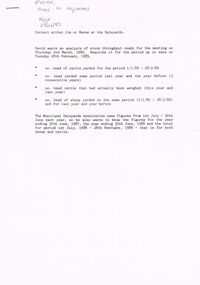
... BENDIGO Council cattle markets Bendigo Saleyards Collection - Livestock Totals The Municipal Saleyards Association Photocopy of six handwritten pages of totals of Cattle, Horse, B'by calves and pigs sold from July 87 to June 88. ...Photocopy of six handwritten pages of totals of Cattle, Horse, B'by calves and pigs sold from July 87 to June 88. The front page has instructions for a typed copy for the number of cattle yarded from 1/1/89 to 28/2/89 and for the same period last year and the year before. Also the number of cattle that had been weighed. Also the same for the sheep.bendigo, council, cattle markets, bendigo saleyards collection - livestock totals, the municipal saleyards association -
 Bendigo Historical Society Inc.
Document - BENDIGO SALEYARDS COLLECTION: GRAND TOTALS OF STOCK SOLD - JULY 87 TO SEPT 89
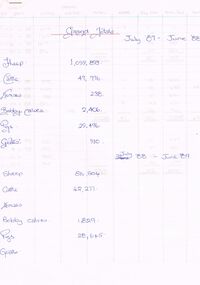
... BENDIGO Council cattle markets Bendigo Saleyards Collection - Grand Totals of Stock Sold - July 87 to Sept 89 9 Hand written pages mentioning the totals of Sheep, Cattle, Horses, Bobby Calves, Pigs and Goats sold at the saleyards from July 87 to Sept 89. ...9 Hand written pages mentioning the totals of Sheep, Cattle, Horses, Bobby Calves, Pigs and Goats sold at the saleyards from July 87 to Sept 89. May 88 was the last entry for horses. After this date a column for stores was inserted. Six hand written pages Oct 89 to Jun 91.Columns mention the totals of sheep, lambs, fat cattle, bulls, bobby calves and pigs with totals. Typed list of Bendigo Special Sheep Sale Dates 1991. Also listed are the advertising agents: Elders Pastoral, R H McGregor & Company, W McKean & Company, Miller Turner Livestock, F P Nevins & Company, Ellis Nuttall & Company, B Rodwell & Company, E M Vains & Company, Victorian Producers and Dalgety Farmers Limited. Written at the end is Charolaise 1st Wednesday March '92. All Agents.bendigo, council, cattle markets, bendigo saleyards collection - grand totals of stock sold - july 87 to sept 89 -
 Glen Eira Historical Society
Article - Bentleigh East Primary School
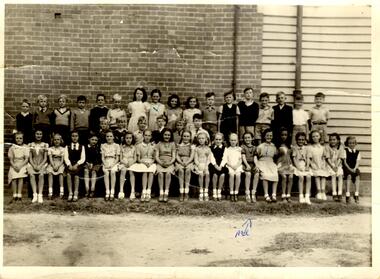
... ... Horse Racing...(Head teacher) War Savings Certificates Shelter pavilions Bristol units – classrooms Redmond MR (Head Teacher) School Pedestrian crossings Sound systems School canteen World War 1914 – 1918 Electricity Supply Salmagundi Tamrakis Socrates School libraries Railway Stations Education School Rolls Market Gardens Cattle – nuisance Bushrangers Toll gates Chinese School Chinese community School curriculum – historical Flora Aborigines Snakes Migrant Teachers Japanese Language Rats Caretaker’s Residences Fencing Cattle Horse Racing Caulfield Military Hospital Advertising Street lighting Anglican School St Stephens Chinese Christian Church Arthur’s Seat Road (now Nepean Hwy) St John’s Anglican Church Bentleigh Hit & Miss Hotel Live & Let Live Hotel Plough & Harrow Hotel Moorabbin District Roads Board Army huts Higgins Stan MR . ...This file contains 5 items. A limited edition of a book "A History of the Bentleigh East Primary School No. 2083 formerly Bentleigh formerly East Brighton 1878-1978" published to mark the centenary of the Bentleigh East Primary School celebrated from 1 – 5th August 1978. The book was compiled by the Principal Peter Morris and is a collection of incidents, reminiscences and anecdotes arranged in chronological order to capture the character of the differing periods through which the school passed. It provides an insight to the development of the area and of the school and includes a list of school principals from 1878 – 1978, an honor roll for WW1 students etc. Notes on the Camm family who donated the School Centenary Book A newspaper article on the centenary celebrations. The article is undated and the source is not known. It includes 2 photographs of the celebrations. A name badge for Duchie Laven issued for the centenary. The badge is on pink cardboard. A Black + White school photograph taken in 1948. Josephine and Wilma Newman are identified in the photograph.malane thomas market gardener, atkinson william – head teacher 1878 – 1883, initial school staff, jack margaret, stevens eliza (pupil teacher), water supply, mills henry (prominent head teacher), craig robert district inspector, centre road, primitive methodist church 22/07/1884, tram lines, taylor mr., head teacher list, shelter sheds., joyce colin dr., thiele mr. (head teacher), north road state school, ormond state school no 3074, east bentleigh state school, east brighton state school no. 2083, bentleigh state school no 2083, bentleigh east primary school no 2083, school 213 brighton east, bentleigh elementary school no 2083, bentleigh west state school no 4318, coatesville primary school, tucker road moorabbin primary school, bent thomas sir, honor lists, honour book, awards, snowball o.r. mla gilbert mr. head teacher, brighton gas lighting, sloyd classes, gilbert mr. (head teacher), cross bob (pupil), school strap, henderson w. (district inspector), school rooms, school work books, schools, school concerts, school committees, caretaker’s residence, fencing, higgins a., higgins stan, bentleigh public hall, marriott william (chairman school committee), bentleigh theatre, old scholars, trenches 1937 (slit), donald j.r. (head teacher), war savings certificates, shelter pavilions, bristol units – classrooms, redmond mr (head teacher), school pedestrian crossings, sound systems, school canteen, world war 1914 – 1918, electricity supply, salmagundi, tamrakis socrates, school libraries, railway stations, education, school rolls, market gardens, cattle – nuisance, bushrangers, toll gates, chinese school, chinese community, school curriculum – historical, flora, aborigines, snakes, migrant teachers, japanese language, rats, caretaker’s residences, fencing, cattle, horse racing, caulfield military hospital, advertising, street lighting, anglican school st stephens, chinese christian church arthur’s seat road (now nepean hwy), st john’s anglican church bentleigh, hit & miss hotel, live & let live hotel, plough & harrow hotel, moorabbin district roads board, army huts, higgins stan mr, . marriott william mr, cremean mr. mla, arnett kevin, vanderlaven vanderlaven adrian, vanderlaven josephine, laven fredericha willamena, laven adrian, laven duchie, newman wilma, newman josephine, camm josephine, marshall gladys, neville gladys, holis ivy, monroe victor, duckmanton keith, tram lines - mordialloc sandringham, school paper, public works dept., springthorpe j.w. dr., vosey joseph, camm terry, camm josie, barrenger elsie, bentleigh oval, race course east bentleigh 1899, keys's hotel, unveiling of honor book and cabinet 25/08/1922 -
 Warrnambool and District Historical Society Inc.
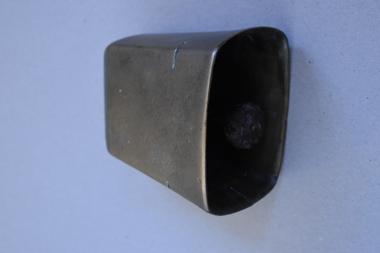
Bell, James Barwell, Animal, C 19th century
... Bells of this type were normally used to hang around the necks of cows, horses or bullocks to prevent them from being lost and were used from around the 1860's onwards. ...Bells of this type were normally used to hang around the necks of cows, horses or bullocks to prevent them from being lost and were used from around the 1860's onwards. The initial J B identify the bell as being made by James Barwell who made bells for the Australian market from around the 1860's. His bell and brass foundry manufactured all sorts of bells from school bells to full church peals as well as plumbing fittings. The four marks on the edge of the bell are typical of those used by drovers or owners to identify their animal. While this bell has no known local provenance, it is a link to the early cattle and agricultural life in Australia and most likely the Western District. Its significance lies in the fact that it is typical of bells used for a purpose at that time and as such can be used for discussion in a social and interpretive context.This is a brass bell of the type used to hang around the necks of animals such as cows, horses and bullocks. The mechanism for the attachment to a collar or harness has been sheared off and the clapper is detached from the inside hook. The bell has an inscription incised around the top and there are four small cuts or incisions made into the bell at the wider end. The bell is a little tarnished.‘Success to 4 in horse teams J.B.’history of warrnambool, animal husbandry, animal bell, james barwell bells -
 Ballarat Heritage Services
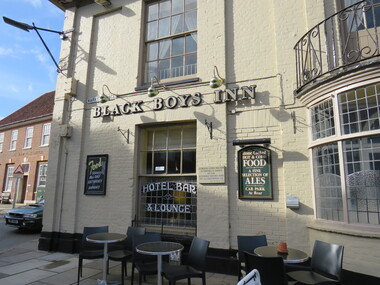
digital photographs, Inn, Aylesham, England, 2016
... Besides weekly markets there were cattle fairs twice a year and, in October, a hiring fair. ...Besides weekly markets there were cattle fairs twice a year and, in October, a hiring fair. ...Black Boys Inn is in the market square of Aylesham, England. "Archaeological evidence shows that the site of the town has been occupied since prehistoric times. Aylsham is just over two miles (3 km) from a substantial Roman settlement at Brampton, linked to Venta Icenorum at Caistor St Edmund, south of Norwich, by a Roman road which can still be traced in places - that site was a bustling industrial centre with maritime links to the rest of the empire. Excavations in the 1970s provided evidence of several kilns, showing that this was an industrial centre, pottery and metal items being the main items manufactured. Aylsham is thought to have been founded around 500 AD by an Anglo Saxon thegn called Aegel, Aegel's Ham, meaning "Aegel's settlement". The town is mentioned in the Domesday Book of 1086 as Elesham and Ailesham, with a population of about 1,000. Until the 15th century, the linen and worsted industry was important here, as well as in North Walsham and Worstead and Aylsham webb or 'cloth of Aylsham' was supplied to the royal palaces of Edward II and III. John of Gaunt was lord of the manor from 1372 and Aylsham became the principal town of the Duchy of Lancaster. Although John of Gaunt probably never came to Aylsham, the townspeople enjoyed many privileges, including exemption from jury service outside the manor and from payment of certain taxes. The village sign depicts John of Gaunt. In 1519 Henry VIII granted a market on Saturdays and an annual fair to be held on 12 March, which was the eve of the feast of St Gregory the pope. Aylsham markets have always been an important feature of the town, and businesses developed to meet the needs of the town and the farming lands around it. Besides weekly markets there were cattle fairs twice a year and, in October, a hiring fair. The historic Black Boys Inn in the Market Place is one of Aylsham's oldest surviving buildings, and has been on the site since the 1650s, although the present frontage dates to between 1710 and 1720. There is a frieze of small black boys on the cornice and a good staircase and assembly room. The Black Boys was a stop for the post coach from Norwich to Cromer, had stabling for 40 horses, and employed three ostlers and four postboys. A thatched waterpump was built in 1911 at Carr's Corner in memory of John Soame by his uncle, a wealthy financier. An artesian well 170 feet (52 m) deep, its canopy is thatched in Norfolk reed. As with many of the other market towns in the county, the weaving of local cloth brought prosperity to the town in medieval times. Until the 15th century it was the manufacture of linen which was the more important, and Aylsham linens and Aylsham canvases were nationally known. From the 16th century linen manufacture declined and wool became more important, a situation that continued until the coming of the Industrial Revolution. Thereafter the principal trade of the town for the 19th century was grain and timber, together with the range of trades to be found in a town which supported local agriculture. Records show that Aylsham had markets and fairs, certainly from the 13th century. Such weekly and annual events were important for the trade that they brought. Annual horse fairs would bring many other traders to the town, and the weekly market would be the occasion for more local trade. The rights of the stallholders in the market place today date back to the rights established in medieval times." See wikipediaDigital photograph colouredinn, aylsham, england, black boys inn, market square -
 Ballarat Heritage Services
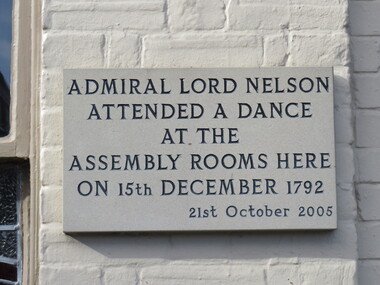
Photograph - Digital photograph, Lord Nelson Plaque, 2016
... Besides weekly markets there were cattle fairs twice a year and, in October, a hiring fair. ...Besides weekly markets there were cattle fairs twice a year and, in October, a hiring fair. ...Black Boys Inn is in the market square of Aylsham, England. "Archaeological evidence shows that the site of the town has been occupied since prehistoric times. Aylsham is just over two miles (3 km) from a substantial Roman settlement at Brampton, linked to Venta Icenorum at Caistor St Edmund, south of Norwich, by a Roman road which can still be traced in places - that site was a bustling industrial centre with maritime links to the rest of the empire. Excavations in the 1970s provided evidence of several kilns, showing that this was an industrial centre, pottery and metal items being the main items manufactured. Aylsham is thought to have been founded around 500 AD by an Anglo Saxon thegn called Aegel, Aegel's Ham, meaning "Aegel's settlement". The town is mentioned in the Domesday Book of 1086 as Elesham and Ailesham, with a population of about 1,000. Until the 15th century, the linen and worsted industry was important here, as well as in North Walsham and Worstead and Aylsham webb or 'cloth of Aylsham' was supplied to the royal palaces of Edward II and III. John of Gaunt was lord of the manor from 1372 and Aylsham became the principal town of the Duchy of Lancaster. Although John of Gaunt probably never came to Aylsham, the townspeople enjoyed many privileges, including exemption from jury service outside the manor and from payment of certain taxes. The village sign depicts John of Gaunt. In 1519 Henry VIII granted a market on Saturdays and an annual fair to be held on 12 March, which was the eve of the feast of St Gregory the pope. Aylsham markets have always been an important feature of the town, and businesses developed to meet the needs of the town and the farming lands around it. Besides weekly markets there were cattle fairs twice a year and, in October, a hiring fair. The historic Black Boys Inn in the Market Place is one of Aylsham's oldest surviving buildings, and has been on the site since the 1650s, although the present frontage dates to between 1710 and 1720. There is a frieze of small black boys on the cornice and a good staircase and assembly room. The Black Boys was a stop for the post coach from Norwich to Cromer, had stabling for 40 horses, and employed three ostlers and four postboys. A thatched waterpump was built in 1911 at Carr's Corner in memory of John Soame by his uncle, a wealthy financier. An artesian well 170 feet (52 m) deep, its canopy is thatched in Norfolk reed. As with many of the other market towns in the county, the weaving of local cloth brought prosperity to the town in medieval times. Until the 15th century it was the manufacture of linen which was the more important, and Aylsham linens and Aylsham canvases were nationally known. From the 16th century linen manufacture declined and wool became more important, a situation that continued until the coming of the Industrial Revolution. Thereafter the principal trade of the town for the 19th century was grain and timber, together with the range of trades to be found in a town which supported local agriculture. Records show that Aylsham had markets and fairs, certainly from the 13th century. Such weekly and annual events were important for the trade that they brought. Annual horse fairs would bring many other traders to the town, and the weekly market would be the occasion for more local trade. The rights of the stallholders in the market place today date back to the rights established in medieval times." See wikipediaDigital photograph"Admiral Lord Nelson attended a dance at the Assembly rooms here on 15th December 1792 - 21st October 2005"aylsham, lord nelson, 1792, plaque -
 Ballarat Heritage Services
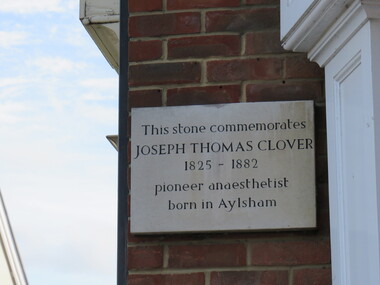
Photograph - Digital photograph, Dorothy Wickham, Plaque to Joseph Thomas Clover, ć2016
... Besides weekly markets there were cattle fairs twice a year and, in October, a hiring fair. ...Besides weekly markets there were cattle fairs twice a year and, in October, a hiring fair. ...Lord Nelson plaque is in the town of Aylsham. "Archaeological evidence shows that the site of the town has been occupied since prehistoric times. Aylsham is just over two miles (3 km) from a substantial Roman settlement at Brampton, linked to Venta Icenorum at Caistor St Edmund, south of Norwich, by a Roman road which can still be traced in places - that site was a bustling industrial centre with maritime links to the rest of the empire. Excavations in the 1970s provided evidence of several kilns, showing that this was an industrial centre, pottery and metal items being the main items manufactured. Aylsham is thought to have been founded around 500 AD by an Anglo Saxon thegn called Aegel, Aegel's Ham, meaning "Aegel's settlement". The town is mentioned in the Domesday Book of 1086 as Elesham and Ailesham, with a population of about 1,000. Until the 15th century, the linen and worsted industry was important here, as well as in North Walsham and Worstead and Aylsham webb or 'cloth of Aylsham' was supplied to the royal palaces of Edward II and III. John of Gaunt was lord of the manor from 1372 and Aylsham became the principal town of the Duchy of Lancaster. Although John of Gaunt probably never came to Aylsham, the townspeople enjoyed many privileges, including exemption from jury service outside the manor and from payment of certain taxes. The village sign depicts John of Gaunt. In 1519 Henry VIII granted a market on Saturdays and an annual fair to be held on 12 March, which was the eve of the feast of St Gregory the pope. Aylsham markets have always been an important feature of the town, and businesses developed to meet the needs of the town and the farming lands around it. Besides weekly markets there were cattle fairs twice a year and, in October, a hiring fair. The historic Black Boys Inn in the Market Place is one of Aylsham's oldest surviving buildings, and has been on the site since the 1650s, although the present frontage dates to between 1710 and 1720. There is a frieze of small black boys on the cornice and a good staircase and assembly room. The Black Boys was a stop for the post coach from Norwich to Cromer, had stabling for 40 horses, and employed three ostlers and four postboys. A thatched waterpump was built in 1911 at Carr's Corner in memory of John Soame by his uncle, a wealthy financier. An artesian well 170 feet (52 m) deep, its canopy is thatched in Norfolk reed. As with many of the other market towns in the county, the weaving of local cloth brought prosperity to the town in medieval times. Until the 15th century it was the manufacture of linen which was the more important, and Aylsham linens and Aylsham canvases were nationally known. From the 16th century linen manufacture declined and wool became more important, a situation that continued until the coming of the Industrial Revolution. Thereafter the principal trade of the town for the 19th century was grain and timber, together with the range of trades to be found in a town which supported local agriculture. Records show that Aylsham had markets and fairs, certainly from the 13th century. Such weekly and annual events were important for the trade that they brought. Annual horse fairs would bring many other traders to the town, and the weekly market would be the occasion for more local trade. The rights of the stallholders in the market place today date back to the rights established in medieval times." See wikipediaDigital photograph"This stone commemorates JOSEPH THOMAS CLOVER 1825-1882 pioneer anaesthetist born in Aylsham"aylsham, joseph thomas clover, anaesthetist -
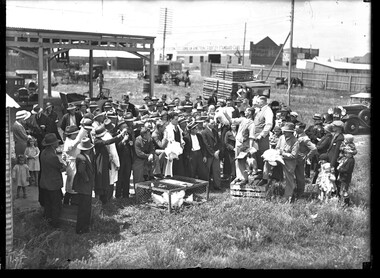 City of Melbourne Libraries
Photograph, Bull, Hugh Jones, 1897-1993, Poultry auction for Christmas dinners, Bentleigh Poultry Market
... The Boon wurrung reputedly called this district Mooroobin, a name that Richard and John King adapted to Moorabbin for the cattle run they established in the mid-1840s. The sandy soil of much of the district proved suitable for market gardening which flourished in Moorabbin from the 1850s. ...The Boon wurrung reputedly called this district Mooroobin, a name that Richard and John King adapted to Moorabbin for the cattle run they established in the mid-1840s. The sandy soil of much of the district proved suitable for market gardening which flourished in Moorabbin from the 1850s. ...Published: Age (Melbourne, Vic.: 1854- ), Thursday 21 December 1933, page 11 Published title: : POULTRY FOR CHRISTMAS DINNERS Published caption: With the approach of the Festive Season, the demand for poultry of all descriptions tends to harden and good clearances of many thousands of birds have been effected at recent auctions. The above picture was taken yesterday at the sale conducted by Messrs. Parnham and Carter of Bentleigh, whose auctions are the largest in Melbourne on the basis of individual sales. The auctioneer's assistant is holding up a prime goose for the appraisement of bidders preparing for Christmas fare. Trove article identifier: http://nla.gov.au/nla.news-article203351699 Research by project volunteer, Louise McKenzie: This photo is full of action! A poultry auction is in full flight. The serious-looking auctioneer and his assistant stand on a Parnham & Carter wooden box so that the auctioneer can make eye contact with the bidding crowd. The auctioneer is wearing a waistcoat and tie and has his pencil and paper ready to record the winning bids. The assistant in overalls is holding a live white duck in each hand. Two other assistants also hold live birds. A wire cage on the ground holds a few white chickens – presumably the next auction items. The majority of the substantial crowd is male, mostly wearing Fedora hats and jackets or suits and ties. Some women are present, wearing hats and coats, and at least seven children are visible, some dressed up, others dressed more casually. The auction is taking place in a rural setting, possibly on the site where the birds are farmed. It is an informal, rather rough, grassed area next to a large shed with a high verandah. Two horse drawn vehicles are visible in the background, as well as five motorised vehicles. There are stacks of wooden boxes or crates which look as if they transport birds, and two cows are grazing by the fence. There are two telegraph poles with many lines. In the adjacent block is a very large car business comprising two large brick warehouse style buildings, plus outbuildings. The signage on one brick warehouse mentions Standard Cars. Both a man and a woman have their arms raised to bid. It is an occasion – but a serious one. We cannot be sure if these birds are for breeding or the table, but buying poultry for the Christmas meal was a tradition in Melbourne with purchasers going either to the auctions, or perhaps the Queen Victoria Market. The Argus in its article “Christmas Dinner” on 6 December 1932 advised of increased demand for turkeys and chickens ahead of a possible Christmas shortage. Part of this shortage would be because of the outbreak of Newcastle disease which resulted in a quarantine around Melbourne within which all killing must be under supervision and bear the Government brand. They believed this would result in smaller producers not bothering to get such a permit as "for many of them the poultry cheque is only pin money for their wives.” Interestingly, an article in the Sun News Pictorial of 26 January 1934 reported a strong market, and “One auctioneer stated that buyers were taking up chickens freely now for the Centenary celebrations because they would probably never be as plentiful at the present levels of prices until next season.” That same article quoted officials of the Department of Agriculture stating that "…they had received a fair number of inquiries from farmers recently on the possibilities of table poultry breeding for local and export markets. The good prices being paid for poultry were attracting interest.” In fact, on 29 December 1933, the Sun News-Pictorial had reported that for the first time, the innovation of holding poultry sales in Melbourne between the Christmas and New Year holidays had been trialled the day before, and had proved successful. The Bentleigh area had a long history of poultry farming. The Seal of the Municipality of Moorabbin has a cockerel featured in the top right quadrant, and according to its local history website, “Writers in the local press gave advice on breeding, feeding, marketing and other matters of concern to anyone keeping fowls. In 1914 poultry farms were spread from Ormond, through Cheltenham and Mentone to Mordialloc.” The Encyclopedia of Melbourne online advises that the Shire of Moorabbin once covered an extensive area of the south-eastern suburbs, land where the Boon wurrung people had hunted, fished and collected water from the natural springs near Beaumaris and Cheltenham. The Boon wurrung reputedly called this district Mooroobin, a name that Richard and John King adapted to Moorabbin for the cattle run they established in the mid-1840s. The sandy soil of much of the district proved suitable for market gardening which flourished in Moorabbin from the 1850s. Some districts, such as Highett, remained largely devoted to cattle, while fishing was a major activity in the coastal villages. Moorabbin's population remained tiny throughout the 19th and much of the early 20th century with less than 1000 ratepayers in the shire. When the more popular coastal resort areas of the shire seceded after World War I, Moorabbin was left as an under-serviced, still largely rural area. It was not until the 1930s that the population rose above 20,000. By the late 1930s poultry farming had been added to market gardening as a local industry. But northern sections of the city, such as Bentleigh and McKinnon, were beginning to develop as residential areas. The local council took steps to attract industry and new residents to the city by erecting reputedly the largest neon sign in Melbourne at the time on the Point Nepean Road (later Nepean Highway), pointing out that plentiful residential and industrial land was available. The era of gardeners’ picnics, the formation of the Market Gardeners’ & Fruit Growers’ Association, and the Moorabbin Horticultural, Poultry & Dog Society Spring Shows was over. References: POULTRY SALES HELD (1933, December 29). The Sun News-Pictorial (Melbourne, Vic. : 1922 - 1954; 1956), p. 20. Retrieved July 30, 2024, from http://nla.gov.au/nla.news-article276124760 MUCH INTEREST IN POULTRY (1934, January 26). The Sun News-Pictorial (Melbourne, Vic. : 1922 - 1954; 1956), p. 30. Retrieved July 30, 2024, from http://nla.gov.au/nla.news-article277292695 Christmas Dinner. (1932, December 6). The Argus (Melbourne, Vic. : 1848 - 1957), p. 6. Retrieved July 30, 2024, from http://nla.gov.au/nla.news-article4512606 'Moorabin', eMelbourne, https://www.emelbourne.net.au/biogs/EM01004b.htm 'City of Glen Eira Thematic Environmental History [Refresh] 2020', prepared for The City of Glen Eira by Built Heritage P/L, https://www.gleneira.vic.gov.au/media/7583/glen-eira-c214glen-city-of-glen-eira-thematic-environmentla-history-refresh-2020.pdf Photographer notations on slide: "Poultry for Christmas Dinners Age 21-12-33 B9".christmas, poultry
