
Showing 38 items matching " indigenous knowledge"
-
 Victorian Aboriginal Corporation for Languages
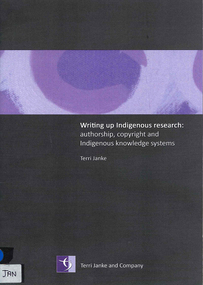
Book, Terri Janke, Writing up Indigenous research : authorship, copyright and Indigenous knowledge systems, 2009
... Writing up Indigenous research : authorship, copyright and Indigenous knowledge systems......Indigenous knowledge...copyright intellectual property Indigenous knowledge Writing up Indigenous research : authorship, copyright and Indigenous knowledge systems Book Terri Janke ...copyright, intellectual property, indigenous knowledge -
 Koorie Heritage Trust
Journal - Serials, Department of Pacific and Southeast Asian History, Australian National University, Aboriginal History - Volume 09. 1-2 1985, 1985
... . | Animals - Birds - Brolgas | Stories and motifs - Emu | Indigenous knowledge - Botany | Indigenous knowledge - Zoology | Language - Change | Language - Linguistics - Language classification | Language - Linguistics - Phonology and phonetics | Language - Semantics | Language - Texts and translations - Aboriginal to non-Aboriginal language | Crime - Bushrangers and outlaws | Law enforcement - Police - Native police | Law enforcement - Police trackers | Indigenous peoples - Pacific | Language - Kriol - Pidgins and creoles - Torres Strait Creole |.... | Animals - Birds - Brolgas | Stories and motifs - Emu | Indigenous knowledge - Botany | Indigenous knowledge - Zoology | Language - Change | Language - Linguistics - Language classification | Language - Linguistics - Phonology and phonetics | Language - Semantics | Language - Texts and translations - Aboriginal to non-Aboriginal language | Crime - Bushrangers and outlaws | Law enforcement - Police - Native police | Law enforcement - Police trackers | Indigenous peoples - Pacific | Language - Kriol - Pidgins and creoles - Torres Strait Creole | A series of articles by leading writers on Aboriginal History. 240 P.; footnotes; appendices; maps; ports.; bibs.; 24 cm. ...A series of articles by leading writers on Aboriginal History.240 P.; footnotes; appendices; maps; ports.; bibs.; 24 cm.A series of articles by leading writers on Aboriginal History.aboriginal australians -- periodicals. | ethnology -- australia -- periodicals. | animals - birds - brolgas | stories and motifs - emu | indigenous knowledge - botany | indigenous knowledge - zoology | language - change | language - linguistics - language classification | language - linguistics - phonology and phonetics | language - semantics | language - texts and translations - aboriginal to non-aboriginal language | crime - bushrangers and outlaws | law enforcement - police - native police | law enforcement - police trackers | indigenous peoples - pacific | language - kriol - pidgins and creoles - torres strait creole | -
 Robin Boyd Foundation
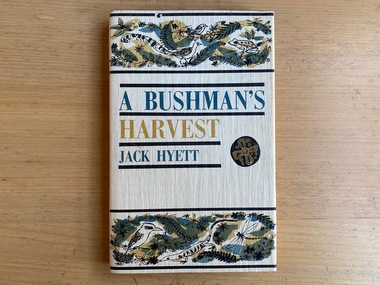
Book, Jack Hyett, A Bushman's Harvest, 1961
... ... Indigenous knowledge...Australian nature Natural history Australia Indigenous knowledge Environment Walsh St library Hardcover W/ Dust Jacket A Bushman's Harvest Book Jack Hyett F.W. ...Hardcover W/ Dust Jacketaustralian nature, natural history, australia, indigenous knowledge, environment, walsh st library -
Koorie Heritage Trust
Book, Department of Pacific and Southeast Asian History, Australian National University, Aboriginal History - Volume 08. 1-2 1984, 1984
... . - To 1900 | Sex relations | Indigenous knowledge - World view | Language - Personal names | Language - Semantics | Social identity | Language - Sociolinguistics | Government policy - State and territory - New South Wales | Socioeconomic conditions - Living conditions | Language - Linguistics - Language classification | Language - Vocabulary - Word lists | Language - Linguistics | Geography - Territories and boundaries | Art - Rock art - Painting | Art - Production - Materials / techniques | Art - Art motifs |.... - To 1900 | Sex relations | Indigenous knowledge - World view | Language - Personal names | Language - Semantics | Social identity | Language - Sociolinguistics | Government policy - State and territory - New South Wales | Socioeconomic conditions - Living conditions | Language - Linguistics - Language classification | Language - Vocabulary - Word lists | Language - Linguistics | Geography - Territories and boundaries | Art - Rock art - Painting | Art - Production - Materials / techniques | Art - Art motifs | This volume of 'Australian History' is devoted to studies of the south-eastern corner of the Australian continent. ...This volume of 'Australian History' is devoted to studies of the south-eastern corner of the Australian continent. The papers arose from a series of meetings convened with Professer R. W. Dixon in 1981. They involved scholars from the disciplines listed, all concerned with the south-east. A series of articles by leading writers on Aboriginal History.237 P.; ill,; figs.; tables; notes; reviews; 24 cm.This volume of 'Australian History' is devoted to studies of the south-eastern corner of the Australian continent. The papers arose from a series of meetings convened with Professer R. W. Dixon in 1981. They involved scholars from the disciplines listed, all concerned with the south-east. A series of articles by leading writers on Aboriginal History.aboriginal australians -- periodicals. | ethnology -- australia -- periodicals. | settlement and contacts - colonisation - 1788-1850 | race relations - violent - massacres, murders, poisonings etc. - to 1900 | sex relations | indigenous knowledge - world view | language - personal names | language - semantics | social identity | language - sociolinguistics | government policy - state and territory - new south wales | socioeconomic conditions - living conditions | language - linguistics - language classification | language - vocabulary - word lists | language - linguistics | geography - territories and boundaries | art - rock art - painting | art - production - materials / techniques | art - art motifs | -
 Wyndham Art Gallery (Wyndham City Council)
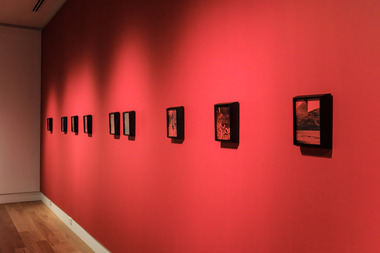
Photograph - She was like the lizard that fell into the water and became a crocodile, Hayley Millar Baker, 2025
... ...Indigenous knowledge systems...First Nations art Aboriginal Australian art Gunditjmara culture Djabwurrung culture Indigenous knowledge systems Indigenous sovereignty Cultural reclamation Cultural memory Storytelling Contemporary Indigenous identity Aboriginal women Womanhood Motherhood Indigenous feminism Spirituality First Nations Photography A series of ten photographic collages 2O.5 X 15CM EACH She was like the lizard that fell into the water and became a crocodile Photograph She was like the lizard that fell into the water and became a crocodile Hayley Millar Baker ...She was like the lizard that fell into the water and became a crocodile works with land through photographs that are cut, reassembled, and sutured into collaged forms. The seams have been left open; the ruptures are central to each work. Observing the sutured landscapes becomes a meditation on responsibility and on the uneasy coexistence of care, complicity, and inherited harm. The collages return the act of looking back onto the viewer, presenting their scars. To engage with them is to confront one’s position within ongoing colonial systems and to acknowledge the violences that remain embedded in the land and in the systems that have fractured its sovereignty. To look to the land is to feel the weight of what has been done to it and to those who belong to it, while recognising how it continues to nourish, restore, and strengthen. Looking demands attentiveness and accountability, insisting on the ethical and relational dimensions of vision itself. The images collaged throughout She was like the lizard that fell into the water and became a crocodile combine photographs taken by the artist on unceded Country in south-western Victoria over the past decade —across the lands of the Wauthaurong, Bunurong, Wadawurrung, and Gunditjmara —with archival material sourced from the State Library of Victoria of the same areas. The archival images, produced exclusively by white colonial settler photographers, documented and mapped the land, creating visual records that both precede and actively participate in the colonial inscription of place. By bringing these materials into dialogue, the work creates a confrontation between lived Indigenous presence and the extractive logic of the colonial archive.A series of ten photographic collages 2O.5 X 15CM EACHfirst nations art, aboriginal australian art, gunditjmara culture, djabwurrung culture, indigenous knowledge systems, indigenous sovereignty, cultural reclamation, cultural memory, storytelling, contemporary indigenous identity, aboriginal women, womanhood, motherhood, indigenous feminism, spirituality, first nations, photography -
 Victorian Aboriginal Corporation for Languages
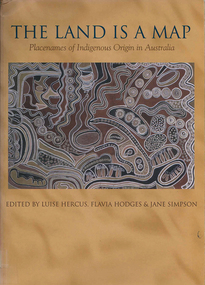
Book, Luise Hercus, The land is a map : placenames of Indigenous origin in Australia, 2002
... Place names often evoke important information about features of the environment and their place in Indigenous knowledge. On the other hand, place names given by European settlers are largely arbitrary....place names Wik Cape York Peninsula Ngalakgan Alawa Marra Yukgul Kaurna Yuwaalaraay Yuwaaliyaay Gamilaraay Ngiyampaa Maps, b&w photographs, b&w illustrations, word lists Place names often evoke important information about features of the environment and their place in Indigenous knowledge. On the other hand, place names given by European settlers are largely arbitrary. ...Place names often evoke important information about features of the environment and their place in Indigenous knowledge. On the other hand, place names given by European settlers are largely arbitrary.Maps, b&w photographs, b&w illustrations, word listsplace names, wik, cape york peninsula, ngalakgan, alawa, marra, yukgul, kaurna, yuwaalaraay, yuwaaliyaay, gamilaraay, ngiyampaa -
 Kiewa Valley Historical Society
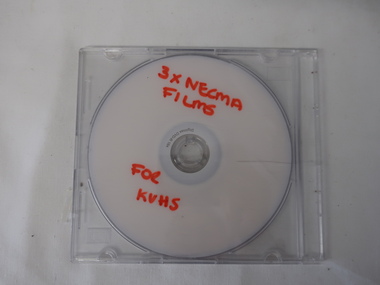
DVD - NECMA Films, Cultural Burning, Stone Implements, Weaving, Plants
... The North East Catchment Management Authority presents Indigenous knowledge and practices on film by way of a DVD allowing it to be played on a screen such as a computer or linked to a TV screen....The North East Catchment Management Authority presents Indigenous knowledge and practices on film by way of a DVD allowing it to be played on a screen such as a computer or linked to a TV screen. ...The North East Catchment Management Authority presents Indigenous knowledge and practices on film by way of a DVD allowing it to be played on a screen such as a computer or linked to a TV screen.Indigenous knowledge and practices presented by film on a DVDDVD with title in red texta on silver side of DVD. Stored in hard, clear plastic containerRed Texta printed -' 3 x NECMA / Films / for / KVHSindigenous australians, north east catchment management authority, dvd film -
 Victorian Aboriginal Corporation for Languages
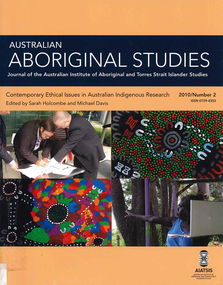
Periodical, Australian Institute of Aboriginal and Torres Strait Islander Studies, Australian Aboriginal studies : journal of the Australian Institute of Aboriginal and Torres Strait Islander Studies, 2010
... (i.e. protect and maintain) Indigenous knowledge by ensuring ethical engagement with the knowledge holders. ...(i.e. protect and maintain) Indigenous knowledge by ensuring ethical engagement with the knowledge holders. ...'Whose Ethics?':Codifying and enacting ethics in research settings Bringing ethics up to date? A review of the AIATSIS ethical guidelines Michael Davis (Independent Academic) A revision of the AIATSIS Guidelines for Ethical Research in Indigenous Studies was carried out during 2009-10. The purpose of the revision was to bring the Guidelines up to date in light of a range of critical developments that have occurred in Indigenous rights, research and knowledge management since the previous version of the Guidelines was released in 2000. In this paper I present an outline of these developments, and briefly discuss the review process. I argue that the review, and the developments that it responded to, have highlighted that ethical research needs to be thought about more as a type of behaviour and practice between engaged participants, and less as an institutionalised, document-focused and prescriptive approach. The arrogance of ethnography: Managing anthropological research knowledge Sarah Holcombe (ANU) The ethnographic method is a core feature of anthropological practice. This locally intensive research enables insight into local praxis and culturally relative practices that would otherwise not be possible. Indeed, empathetic engagement is only possible in this close and intimate encounter. However, this paper argues that this method can also provide the practitioner with a false sense of his or her own knowing and expertise and, indeed, with arrogance. And the boundaries between the anthropologist as knowledge sink - cultural translator and interpreter - and the knowledge of the local knowledge owners can become opaque. Globalisation and the knowledge ?commons?, exemplified by Google, also highlight the increasing complexities in this area of the governance and ownership of knowledge. Our stronghold of working in remote areas and/or with marginalised groups places us at the forefront of negotiating the multiple new technological knowledge spaces that are opening up in the form of Indigenous websites and knowledge centres in these areas. Anthropology is not immune from the increasing awareness of the limitations and risks of the intellectual property regime for protecting or managing Indigenous knowledge. The relevance of the Declaration on the Rights of Indigenous Peoples in opening up a ?rights-based? discourse, especially in the area of knowledge ownership, brings these issues to the fore. For anthropology to remain relevant, we have to engage locally with these global discourses. This paper begins to traverse some of this ground. Protocols: Devices for translating moralities, controlling knowledge and defining actors in Indigenous research, and critical ethical reflection Margaret Raven (Institute for Sustainability and Technology Policy (ISTP), Murdoch University) Protocols are devices that act to assist with ethical research behaviour in Indigenous research contexts. Protocols also attempt to play a mediating role in the power and control inherent in research. While the development of bureaucratically derived protocols is on the increase, critiques and review of protocols have been undertaken in an ad hoc manner and in the absence of an overarching ethical framework or standard. Additionally, actors implicated in research networks are seldom theorised. This paper sketches out a typology of research characters and the different moral positioning that each of them plays in the research game. It argues that by understanding the ways actors enact research protocols we are better able to understand what protocols are, and how they seek to build ethical research practices. Ethics and research: Dilemmas raised in managing research collections of Aboriginal and Torres Strait Islander materials Grace Koch (AIATSIS) This paper examines some of the ethical dilemmas for the proper management of research collections of Indigenous cultural materials, concentrating upon the use of such material for Native Title purposes. It refers directly to a number of points in the draft of the revised AIATSIS Guidelines for Ethical Research in Indigenous Studies and draws upon both actual and hypothetical examples of issues that may arise when requests are made for Indigenous material. Specific concerns about ethical practices in collecting data and the subsequent control of access to both the data itself and to published works based upon it are raised within the context of several types of collections, including those held by AIATSIS and by Native Title Representative Bodies. Ethics or social justice? Heritage and the politics of recognition Laurajane Smith (ANU) Nancy Fraser?s model of the politics of recognition is used to examine how ethical practices are interconnected with wider struggles for recognition and social justice. This paper focuses on the concept of 'heritage' and the way it is often uncritically linked to 'identity' to illustrate how expert knowledge can become implicated in struggles for recognition. The consequences of this for ethical practice and for rethinking the role of expertise, professional discourses and disciplinary identity are discussed. The ethics of teaching from country Michael Christie (CDU), with the assistance of Yi?iya Guyula, Kathy Gotha and Dh�?gal Gurruwiwi The 'Teaching from Country' program provided the opportunity and the funding for Yol?u (north-east Arnhem Land Aboriginal) knowledge authorities to participate actively in the academic teaching of their languages and cultures from their remote homeland centres using new digital technologies. As two knowledge systems and their practices came to work together, so too did two divergent epistemologies and metaphysics, and challenges to our understandings of our ethical behaviour. This paper uses an examination of the philosophical and pedagogical work of the Yol?u Elders and their students to reflect upon ethical teaching and research in postcolonial knowledge practices. Closing the gaps in and through Indigenous health research: Guidelines, processes and practices Pat Dudgeon (UWA), Kerrie Kelly (Australian Indigenous Psychologists Association) and Roz Walker (UWA) Research in Aboriginal contexts remains a vexed issue given the ongoing inequities and injustices in Indigenous health. It is widely accepted that good research providing a sound evidence base is critical to closing the gap in Aboriginal health and wellbeing outcomes. However, key contemporary research issues still remain regarding how that research is prioritised, carried out, disseminated and translated so that Aboriginal people are the main beneficiaries of the research in every sense. It is widely acknowledged that, historically, research on Indigenous groups by non-Indigenous researchers has benefited the careers and reputations of researchers, often with little benefit and considerably more harm for Indigenous peoples in Australia and internationally. This paper argues that genuine collaborative and equal partnerships in Indigenous health research are critical to enable Aboriginal and Torres Islander people to determine the solutions to close the gap on many contemporary health issues. It suggests that greater recognition of research methodologies, such as community participatory action research, is necessary to ensure that Aboriginal people have control of, or significant input into, determining the Indigenous health research agenda at all levels. This can occur at a national level, such as through the National Health and Medical Research Council (NHMRC) Road Map on Indigenous research priorities (RAWG 2002), and at a local level through the development of structural mechanisms and processes, including research ethics committees? research protocols to hold researchers accountable to the NHMRC ethical guidelines and values which recognise Indigenous culture in all aspects of research. Researching on Ngarrindjeri Ruwe/Ruwar: Methodologies for positive transformation Steve Hemming (Flinders University) , Daryle Rigney (Flinders University) and Shaun Berg (Berg Lawyers) Ngarrindjeri engagement with cultural and natural resource management over the past decade provides a useful case study for examining the relationship between research, colonialism and improved Indigenous wellbeing. The Ngarrindjeri nation is located in south-eastern Australia, a ?white? space framed by Aboriginalist myths of cultural extinction recycled through burgeoning heritage, Native Title, natural resource management ?industries?. Research is a central element of this network of intrusive interests and colonising practices. Government management regimes such as natural resource management draw upon the research and business sectors to form complex alliances to access funds to support their research, monitoring, policy development, management and on-ground works programs. We argue that understanding the political and ethical location of research in this contemporary management landscape is crucial to any assessment of the potential positive contribution of research to 'Bridging the Gap' or improving Indigenous wellbeing. Recognition that research conducted on Ngarrindjeri Ruwe/Ruwar (country/body/spirit) has impacts on Ngarrindjeri and that Ngarrindjeri have a right and responsibility to care for their lands and waters are important platforms for any just or ethical research. Ngarrindjeri have linked these rights and responsibilities to long-term community development focused on Ngarrindjeri capacity building and shifts in Ngarrindjeri power in programs designed to research and manage Ngarrindjeri Ruwe/Ruwar. Research agreements that protect Ngarrindjeri interests, including cultural knowledge and intellectual property, are crucial elements in these shifts in power. A preliminary review of ethics resources, with particular focus on those available online from Indigenous organisations in WA, NT and Qld Sarah Holcombe (ANU) and Natalia Gould (La Trobe University) In light of a growing interest in Indigenous knowledge, this preliminary review maps the forms and contents of some existing resources and processes currently available and under development in the Northern Territory, Queensland and Western Australia, along with those enacted through several cross-jurisdictional initiatives. A significant majority of ethics resources have been developed in response to a growing interest in the application of Indigenous knowledge in land and natural resource management. The aim of these resources is to ?manage? (i.e. protect and maintain) Indigenous knowledge by ensuring ethical engagement with the knowledge holders. Case studies are drawn on from each jurisdiction to illustrate both the diversity and commonality in the approach to managing this intercultural engagement. Such resources include protocols, guidelines, memorandums of understanding, research agreements and strategic plans. In conducting this review we encourage greater awareness of the range of approaches in practice and under development today, while emphasising that systematic, localised processes for establishing these mechanisms is of fundamental importance to ensuring equitable collaboration. Likewise, making available a range of ethics tools and resources also enables the sharing of the local and regional initiatives in this very dynamic area of Indigenous knowledge rights.b&w photographs, colour photographsngarrindjeri, ethics, ethnography, indigenous research, social justice, indigenous health -
 Eltham District Historical Society Inc
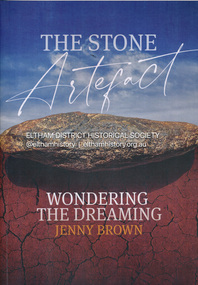
Book, Jenny Brown, The stone artefact : wondering the dreaming, 2022
... The discovery in a Melbourne park (opposite the Osborne Peninsula, North Warrandyte) of an enigmatic Aboriginal stone tool led writer Jenny Brown on a fascinating journey that connected her with expert anthropologists, archeologists, Indigenous elders and knowledge holders to discover what it was. ...The discovery in a Melbourne park (opposite the Osborne Peninsula, North Warrandyte) of an enigmatic Aboriginal stone tool led writer Jenny Brown on a fascinating journey that connected her with expert anthropologists, archeologists, Indigenous elders and knowledge holders to discover what it was. ...The discovery in a Melbourne park (opposite the Osborne Peninsula, North Warrandyte) of an enigmatic Aboriginal stone tool led writer Jenny Brown on a fascinating journey that connected her with expert anthropologists, archeologists, Indigenous elders and knowledge holders to discover what it was. The stone tool invited many interpretations and spun off just as many amazing stories and experiences. It also afforded Jenny the appropriate canvas to tell of her own time-warping encounters with the extraordinary "otherness" of Aboriginal Australia, and with an especially marvelous character, the late Elder of the Yuin Tribe of southern NSW, Guboo Ted Thomas.193 pages : illustrations (chiefly colour), maps, portraits ; 30 cmindigenous history, aboriginal artefacts, warrandyte, archaeology -
 Victorian Aboriginal Corporation for Languages
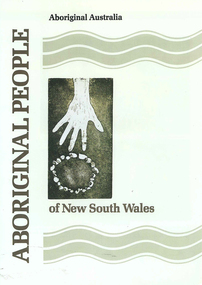
Book, Aboriginal Community Elders Service et al, Aboriginal elders' voices : stories of the "tide of history" : Victorian Indigenous elders' life stories &? oral histories, 2003
... Contents: The writing team Indigenous elders: keepers of knowledge; custodians of land and culture Aboriginal lands Missions and reserves Growing up running from the welfare /? ...Contents: The writing team Indigenous elders: keepers of knowledge; custodians of land and culture Aboriginal lands Missions and reserves Growing up running from the welfare /? ...This book is a collection of Victorian Indigenous Elders' life stories and oral histories. The Elders share their stories in an attempt to ensure that both sides of Australia's history are finally heard. These stories tell of cultural resistance on missions, of defying assimilation laws, of forever moving around to save children from the welfare. They document the development of both fringe and urban communities and work in the Aboriginal rights movement. They clarify the ways in which these experiences have affected the individual authors along with the indigenous population in general. Also included in the book is a brief history and analysis of the legislation, policies, attitudes and strategies that have affected the lives of the authors and their families since colonisation. This aspect provides an historical perspective, encouraging a deeper understanding of the Elders' stories. Reconciliation can only eventuate with an understanding gained from hearing and including the voices of Indigenous Australians. Contents: The writing team Indigenous elders: keepers of knowledge; custodians of land and culture Aboriginal lands Missions and reserves Growing up running from the welfare /? Aunty Olive Jackson Respecting our Elders /? Aunty Lola James If your mother didn't tell you, then your grandmother did! /? Uncles Les Stewart Don't dwell on trouble /? Aunty Audrey Critch There are my people /? Aunty Gwen Nelson We were all cousins, more or less /? Aunty Iris Lovett-Gardiner Aboriginality is about culture, not colour /? Aunty Dianne Phillips Take up the opportunities we struggled to make /? Aunty Frances Gallagher Home /? Aunty Eileen Alberts We were supposed to forget our Aboriginality /? Aunty Gwen Garoni Not enough heart to say sorry? /? Uncle Brian Kennewell-Taylor Learning from indigenous elders: Keeping the traditions, keeping the culture strong; Since time immemorial; Invasion: the tide ran red; The flood of legislation; Stolen children; Cultural resistance: holding on to children traditions and land; Organised resistance: a movement is born; The 1950s: community resistance to race laws; The price of assimilation; The Aboriginal rights movement; After the flood: self-determination; Turning the tide Bibliography Appendix. Cultural custodianship: developing an indigenous methodology.maps, colour illustrations, b&w photographswiradjuri, victorian indigenous elders, oral histories, yorta yorta, dja dja wurrung, language maps, victorian missions and reserves, lake condah, framlingham, coranderrk, ramahyuck, lake tyers, wahgunyah, cummeragunja, moonahcullah, balranald, ebenezer, maloga, acheron -
 Victorian Aboriginal Corporation for Languages
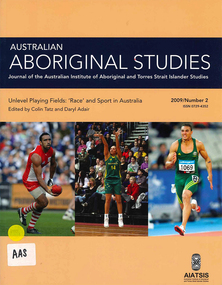
Periodical, Australian Institute of Aboriginal and Torres Strait Islander Studies, Australian Aboriginal studies : journal of the Australian Institute of Aboriginal and Torres Strait Islander Studies, 2009
... Sport, physical activity and urban Indigenous young people Alison Nelson (The University of Queensland) This paper challenges some of the commonly held assumptions and ?knowledges...Sport, physical activity and urban Indigenous young people Alison Nelson (The University of Queensland) This paper challenges some of the commonly held assumptions and ?knowledges ...Darkness and a little light: ?Race? and sport in Australia Colin Tatz (AIATSIS & Australian National University) and Daryl Adair (University of Technology Sydney) Despite ?the wonderful and chaotic universe of clashing colors, temperaments and emotions, of brave deeds against odds seemingly insuperable?, sport is mixed with ?mean and shameful acts of pure skullduggery?, villainy, cowardice, depravity, rapaciousness and malice. Thus wrote celebrated American novelist Paul Gallico on the eve of the Second World War (Gallico 1938 [1988]:9-10). An acute enough observation about society in general, his farewell to sports writing also captures the ?clashing colors? in Australian sport. In this ?land of the fair go?, we look at the malice of racism in the arenas where, as custom might have it, one would least want or expect to find it. The history of the connection between sport, race and society - the long past, the recent past and the social present - is commonly dark and ugly but some light and decency are just becoming visible. Coming to terms: ?Race?, ethnicity, identity and Aboriginality in sport Colin Tatz (AIATSIS & Australian National University) Notions of genetic superiority have led to some of the world?s greatest human calamities. Just as social scientists thought that racial anthropology and biology had ended with the cataclysm of the Second World War, so some influential researchers and sports commentators have rekindled the pre-war debate about the muscular merits of ?races? in a new discipline that Nyborg (1994) calls the ?science of physicology?. The more recent realm of racial ?athletic genes?, especially within socially constructed black athletic communities, may intend no malice but this search for the keys to their success may well revive the old, discredited discourses. This critical commentary shows what can happen when some population geneticists and sports writers ignore history and when medical, biological and sporting doctrines deriving from ?race? are dislocated from any historical, geographic, cultural and social contexts. Understanding discourses about race, racism, ethnicity, otherness, identity and Aboriginality are essential if sense, or nonsense, is to be made of genetic/racial ?explanations? of sporting excellence. Between the two major wars boxing was, disproportionately, a Jewish sport; Kenyans and Ethiopians now ?own? middle- and long-distance running and Jamaicans the shorter events; South Koreans dominate women?s professional golf. This essay explores the various explanations put forward for such ?statistical domination?: genes, biochemistry, biomechanics, history, culture, social dynamics, the search for identity, alienation, need, chance, circumstances, and personal bent or aptitude. Traditional games of a timeless land: Play cultures in Aboriginal and Torres Strait Islander communities Ken Edwards (University of Southern Queensland) Sports history in Australia has focused almost entirely on modern, Eurocentric sports and has therefore largely ignored the multitude of unique pre- European games that are, or once were, played. The area of traditional games, especially those of Aboriginal and Torres Strait Islander peoples, is an important aspect of the cultural, social and historical experiences of Indigenous communities. These activities include customs of play that are normally not associated with European notions of competitive sport. Overall, this paper surveys research undertaken into traditional games among Indigenous Australians, as well as proposals for much needed further study in this area. Culture, ?race? and discrimination in the 1868 Aboriginal cricket tour of England David Sampson As a consequence of John Mulvaney?s important historical research, the Aboriginal cricket and performance tour of Britain in 1868 has in recent decades become established as perhaps the most famous of all public events in contact history involving Aborigines, white settlers and the British metropolis. Although recognition of its importance is welcome and significant, public commemorations of the tour have enveloped the tour in mythologies of cricket and nation. Such mythologies have obscured fundamental aspects of the tour that were inescapable racial and colonial realities of the Victorian era. This reappraisal of the tour explores the centrality of racial ideology, racial science and racial power imbalances that enabled, created and shaped the tour. By exploring beyond cricketing mythology, it restores the central importance of the spectacular performances of Aboriginal skills without which the tour would have been impossible. Such a reappraisal seeks to fully recognise the often trivialised non-cricketing expertise of all of the Aboriginal performers in 1868 for their achievement of pioneering their unique culture, skills and technologies to a mass international audience. Football, ?race? and resistance: The Darwin Football League, 1926?29 Matthew Stephen (Northern Territory Archive Service) Darwin was a diverse but deeply divided society in the early twentieth century. The Commonwealth Government introduced the Aboriginals Ordinance 1911 in the Northern Territory, instituting state surveillance, control and a racially segregated hierarchy of whites foremost, then Asians, ?Coloureds? (Aborigines and others of mixed descent) and, lastly, the so-called ?full-blood? Aborigines. Sport was important in scaffolding this stratification. Whites believed that sport was their private domain and strictly controlled non-white participation. Australian Rules football, established in Darwin from 1916, was the first sport in which ?Coloured? sportsmen challenged this domination. Football became a battleground for recognition, rights and identity for all groups. The ?Coloured? community embraced its team, Vesteys, which dominated the Northern Territory Football League (NTFL) in the 1920s. In 1926, amidst growing racial tension, the white-administered NTFL changed its constitution to exclude non-white players. In reaction, ?Coloured? and Chinese footballers formed their own competition - the Darwin Football League (DFL). The saga of that colour bar is an important chapter in Australia?s football history, yet it has faded from Darwin?s social memory and is almost unknown among historians. That picture - Nicky Winmar and the history of an image Matthew Klugman (Victoria University) and Gary Osmond (The University of Queensland) In April 1993 Australian Rules footballer Nicky Winmar responded to on-field racist abuse by lifting his jersey and pointing to his chest. The photographic image of that event is now famous as a response to racial abuse and has come to be seen as starting a movement against racism in football. The racial connotations in the image might seem a foregone conclusion: the power, appeal and dominant meaning of the photograph might appear to be self-evident. But neither the fame of the image nor its racial connotation was automatic. Through interviews with the photographers and analysis of the use of the image in the media, we explore how that picture came to be of such symbolic importance, and how it has remained something to be re-shown and emulated. Rather than analyse the image as a photograph or work of art, we uncover some of its early history and explore the debates that continue to swirl around its purpose and meaning. We also draw attention to the way the careful study of photographs might enhance the study of sport, race and racism. ?She?s not one of us?: Cathy Freeman and the place of Aboriginal people in Australian national culture Toni Bruce (University of Waikato) and Emma Wensing (Independent scholar) The Sydney 2000 Olympic Games generated a national media celebration of Aboriginal 400 metre runner Cathy Freeman. The construction of Freeman as the symbol of national reconciliation was evident in print and on television, the Internet and radio. In contrast to this celebration of Freeman, the letters to the editor sections of 11 major newspapers became sites for competing claims over what constitutes Australian identity and the place of Aboriginal people in national culture. We analyse this under-explored medium of opinion and discuss how the deep feelings evident in these letters, and the often vitriolic responses to them, illustrate some of the enduring racial tensions in Australian society. Sport, physical activity and urban Indigenous young people Alison Nelson (The University of Queensland) This paper challenges some of the commonly held assumptions and ?knowledges? about Indigenous young people and their engagement in physical activity. These include their ?natural? ability, and the use of sport as a panacea for health, education and behavioural issues. Data is presented from qualitative research undertaken with a group of 14 urban Indigenous young people with a view to ?speaking back? to these commentaries. This research draws on Critical Race Theory in order to make visible the taken-for-granted assumptions about Indigenous Australians made by the dominant white, Western culture. Multiple, shifting and complex identities were expressed in the young people?s articulation of the place and meaning of sport and physical activity in their lives. They both engaged in, and resisted, dominant Western discourses regarding representations of Indigenous people in sport. The paper gives voice to these young people in an attempt to disrupt and subvert hegemonic discourses. An unwanted corroboree: The politics of the New South Wales Aboriginal Rugby League Knockout Heidi Norman (University of Technology Sydney) The annual New South Wales Aboriginal Rugby League Knockout is so much more than a sporting event. Involving a high level of organisation, it is both a social and cultural coming together of diverse communities for a social and cultural experience considered ?bigger than Christmas?. As if the planning and logistics were not difficult enough, the rotating-venue Knockout has been beset, especially since the late 1980s and 1990s, by layers of opposition and open hostility based on ?race?: from country town newspapers, local town and shire councils, local business houses and, inevitably, the local police. A few towns have welcomed the event, seeing economic advantage and community good will for all. Commonly, the Aboriginal ?influx? of visitors and players - people perceived as ?strangers?, ?outsiders?, ?non-taxpayers? - provoked public fear about crime waves, violence and physical safety, requiring heavy policing. Without exception, these racist expectations were shown to be totally unfounded. Research report: Recent advances in digital audio recorder technology provide considerable advantages in terms of cost and portability for language workers.b&w photographs, colour photographs, tablessport and race, racism, cathy freeman, nicky winmar, rugby league, afl, athletics, cricket, digital audio recorders -
 Marysville & District Historical Society
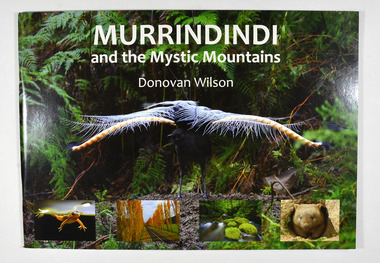
Book, Donovan Wilson, Murrindindi and the Mystic Mountains, Post 2009
... indigenous people translating as: Place of Mist and Mountains./ Many Taungurung People still live in their country and care for it. They are a valuable source of knowledge...indigenous people translating as: Place of Mist and Mountains./ Many Taungurung People still live in their country and care for it. They are a valuable source of knowledge ...A book of photographs of natural attractions, flora and fauna taken in and around the Murrindindi Shire.Paperback. Front cover has a large photograph of a lyrebird in full song. Along the lower edge of the front cover are four photographs; a Spotted March frog, the Gould Memorial Drive, a river and a wombat. Back cover has a photograph of the Cathedral Range at dawn.non-fictionA book of photographs of natural attractions, flora and fauna taken in and around the Murrindindi Shire.murrindindi, victoria, landmarks, flora, fauna, waterfalls, rivers, nature, natural attractions -
 Marysville & District Historical Society
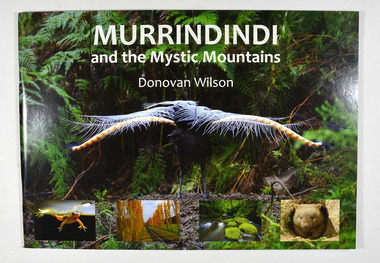
Book, Donovan Wilson, Murrindindi and the Mystic Mountains, Post 2009
... indigenous people translating as: Place of Mist and Mountains./ Many Taungurung People still live in their country and care for it. They are a valuable source of knowledge...indigenous people translating as: Place of Mist and Mountains./ Many Taungurung People still live in their country and care for it. They are a valuable source of knowledge ...A book of photographs of natural attractions, flora and fauna taken in and around the Murrindindi Shire.Paperback. Front cover has a large photograph of a lyrebird in full song. Along the lower edge of the front cover are four photographs; a Spotted March frog, the Gould Memorial Drive, a river and a wombat. Back cover has a photograph of the Cathedral Range at dawn.non-fictionA book of photographs of natural attractions, flora and fauna taken in and around the Murrindindi Shire.murrindindi, victoria, landmarks, flora, fauna, waterfalls, rivers, nature, natural attractions -
 Federation University Historical Collection
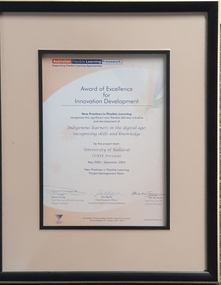
Certificate, Award for Innovation Development - Indigenous Learners in the Digital Age: Recognising Skills and Knowledge, 2004
... Award for Innovation Development - Indigenous Learners in the Digital Age: Recognising Skills and Knowledge...In 2004 the Australian Flexible Learning framework awarded University of Ballarat (TAFE Division) with an award of excellence for innovation development University of Ballarat TAFE Indigenous aboriginal Australian flexible learning framework Australian National Training Authority Stuart young Paul Byrne Phil de Garis Framed certificate in a light brown mount with black edge Award for Innovation Development - Indigenous Learners in the Digital Age: Recognising Skills and Knowledge Certificate ...In 2004 the Australian Flexible Learning framework awarded University of Ballarat (TAFE Division) with an award of excellence for innovation developmentFramed certificate in a light brown mount with black edgeuniversity of ballarat tafe, indigenous, aboriginal, australian flexible learning framework, australian national training authority, stuart young, paul byrne, phil de garis -
 Federation University Historical Collection
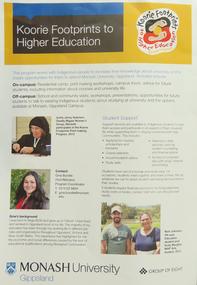
Pamphlet - Brochure, Koorie Footprints to Higher Education, Gippsland, 1913, 2012
... Double side A3 sheet outlining a program for indigenous people to increase their knowledge about the university and to create opportunities to attend Monash University Gippsland. ...On 01 January 2014 Monash University Gippsland became a campus of Federation University Australia. aunty jenny solomon gina bundle nick johnson vicky murgha pauline mackinnon bronwyn boyce courtney hales helen bartlett. monash university gippsland aborigines aboriginal education centre printmaking koorie footprints Gippsland Campus Collection Nicholas Johnson Double side A3 sheet outlining a program for indigenous people to increase their knowledge about the university and to create opportunities to attend Monash University Gippsland. ...On 01 January 2014 Monash University Gippsland became a campus of Federation University Australia.Double side A3 sheet outlining a program for indigenous people to increase their knowledge about the university and to create opportunities to attend Monash University Gippsland. Photographs include Aunty Jenny Solomon, Gina Bundle, Nick Johnson, Vicky Murgha, Pauline Mackinnon, Bronwyn Boyce. Courtney Hales, Pro Vice-Chancellor Helen Bartlett.aunty jenny solomon, gina bundle, nick johnson, vicky murgha, pauline mackinnon, bronwyn boyce, courtney hales, helen bartlett., monash university gippsland, aborigines, aboriginal education centre, printmaking, koorie footprints, gippsland campus collection, nicholas johnson -
 Flagstaff Hill Maritime Museum and Village
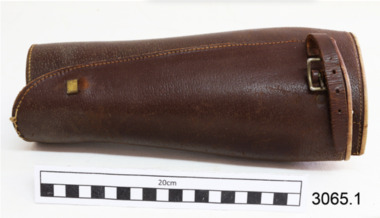
Clothing - Leather Leggings, 1899 to 1920
... Indigenous soldiers served as valuable members of the Light Horse and many possessed excellent horse handling skills and specialist tracking knowledge....Indigenous soldiers served as valuable members of the Light Horse and many possessed excellent horse handling skills and specialist tracking knowledge. ...The subject leather leggings are associated with mounted troops known as the Australian Light Horse that served in the South African War from 1899 to 1902. After the war, Britain wanted to use fewer mounted troops and restructured its force around a style of combat that needed more infantry. But the defence of Australia still relied upon mounted military units as these were more mobile than infantry and could travel faster over long distances. Light Horse brigades in the Australian Imperial Force (AIF) mostly contained recruits who served in the Light Horse regiments of the Citizen Forces. Many young men from rural areas of Australia volunteered for the Light Horse regiments. They had to pass a riding test to join, this test was easier for men from the bush because horses were still the main method of transport on farms and in country towns. The army did not officially accept First Australians into the AIF until May 1917 when enlistment standards were relaxed to include 'half-castes' with a parent of European origin. Indigenous soldiers served as valuable members of the Light Horse and many possessed excellent horse handling skills and specialist tracking knowledge.The subject items are part of the uniform for the Light Horse Units that served in the Australian army from 1899 until 1918. These leggings were worn by soldiers on horseback and are significant as they represent a noteworthy time in Australia's early military history. It was a time when many young men gave their lives during the South African and First World Wars in the defence of the then British Empire as part of the Imperial Forces that were gathered from many British-controlled Colonial countries.A pair of two Leather Leggings used by Mounted Australian soldiers during the first world war. The leggings are dark tan in colour with stitching to attach buckles and fastener straps. The strap buckles are made of brass and the leather legging straps are of same leather as leggings. Noneflagstaff hill, warrnambool, flagstaff hill maritime museum, shipwreck coast, flagstaff hill maritime village, great ocean road, leggings, leather leggings, protective leggings, protective clothing, australian mounted light horse units, military equipment -
 Flagstaff Hill Maritime Museum and Village
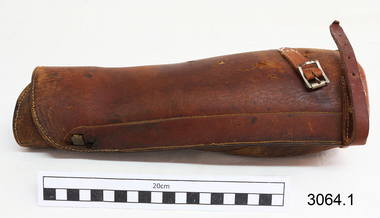
Clothing - Leather Leggings, 1899 to 1918
... Indigenous soldiers served as valuable members of the Light Horse and many possessed excellent horse handling skills and specialist tracking knowledge....Indigenous soldiers served as valuable members of the Light Horse and many possessed excellent horse handling skills and specialist tracking knowledge. ...The subject leather leggings are associated with mounted troops known as the Australian Light Horse that served in the South African War from 1899 to 1902. After the war, Britain wanted to use fewer mounted troops and restructured its force around a style of combat that needed more infantry. But the defence of Australia still relied upon mounted military units as these were more mobile than infantry and could travel faster over long distances. Light Horse brigades in the Australian Imperial Force (AIF) mostly contained recruits who served in the Light Horse regiments of the Citizen Forces. Many young men from rural areas of Australia volunteered for the Light Horse regiments. They had to pass a riding test to join, this test was easier for men from the bush because horses were still the main method of transport on farms and in country towns. The army did not officially accept First Australians into the AIF until May 1917 when enlistment standards were relaxed to include 'half-castes' with a parent of European origin. Indigenous soldiers served as valuable members of the Light Horse and many possessed excellent horse handling skills and specialist tracking knowledge.The subject items are part of the uniform for the Light Horse Units that served in the Australian army from 1899 until 1918. These leggings were worn by soldiers on horseback and are significant as they represent a noteworthy time in Australia's early military history. It was a time when many young men gave their lives during the South African and First World Wars in the defence of the then British Empire as part of the Imperial Forces that were gathered from many British-controlled Colonial countries.A pair of two Leather Leggings used by Mounted Australian soldiers during the first world war. The leggings are dark tan in colour with stitching to attach buckles and fastener straps. The strap buckles are made of brass and the leather legging straps are of same leather as leggings. Noneflagstaff hill, warrnambool, flagstaff hill maritime museum, shipwreck coast, flagstaff hill maritime village, great ocean road, leggings, leather leggings, protective leggings, protective clothing, australian mounted light horse units, military equipment -
 Flagstaff Hill Maritime Museum and Village
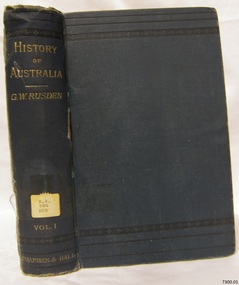
Book - Reference Book/History/Social History, George William Rusden, History of Australia Vol 1, 1883
... Its broad scope drew from his personal knowledge, and it notably emphasised pre European Aboriginal history and showed sympathy for Indigenous peoples, setting it apart from other works in its era. ...Volume 1 covers Australia's history from prehistoric times through early European exploration to the founding of New South Wales in 1788. It details early rumours of a great southern land. Also voyages by explorers like Dirk Hartog, Tasman, Dampier, and Cook, along with the establishment of the first colony under Governor Arthur Phillip, including challenges like famine and initial settlements.History of Australia Vol 1 Author: George William Rusden Publisher: Chapman & Hall Ltd Date: 1883non-fictionVolume 1 covers Australia's history from prehistoric times through early European exploration to the founding of New South Wales in 1788. It details early rumours of a great southern land. Also voyages by explorers like Dirk Hartog, Tasman, Dampier, and Cook, along with the establishment of the first colony under Governor Arthur Phillip, including challenges like famine and initial settlements. warrnambool, shipwrecked-coast, flagstaff-hill, flagstaff-hill-maritime-museum, maritime-museum, shipwreck-coast, flagstaff-hill-maritime-village, shipwrecked-artefact, great ocean road, book, warrnambool library, warrnambool mechanics’ institute, mechanics’ institute library, victorian library board, warrnambool books and records, warrnambool children’s library, warrnambool public library, history of australia vol 1, g w rusden -
 Flagstaff Hill Maritime Museum and Village
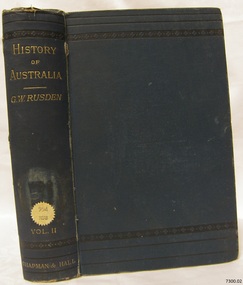
Book - Reference Book/History/Social History, George William Rusden, History of Australia Vol 2, 1883
... Its broad scope drew from his personal knowledge, and it notably emphasised pre European Aboriginal history and showed sympathy for Indigenous peoples, setting it apart from other works in its era. ...Volume 2 of G.W. Rusden's History of Australia continues the narrative from early colonial governance, examining governors after Arthur Phillip up through the mid 19th century. It covers expansions in New South Wales, the establishment of Van Diemen's Land (Tasmania), and Moreton Bay (Queensland), including key events like the Macarthur wool industry rise, convict management under governors like Lachlan Macquarie, and inter colonial tensions.Hard cover book History of Australia in three Volumes Author: George William Rusden Publisher: Chapman & Hall Ltd London, Melbourne and Sydney Date: 1883 Dark blue hardcover with a blue matching spine, the spine has a label with an inscription. (These volumes are first editions)non-fictionVolume 2 of G.W. Rusden's History of Australia continues the narrative from early colonial governance, examining governors after Arthur Phillip up through the mid 19th century. It covers expansions in New South Wales, the establishment of Van Diemen's Land (Tasmania), and Moreton Bay (Queensland), including key events like the Macarthur wool industry rise, convict management under governors like Lachlan Macquarie, and inter colonial tensions.warrnambool, shipwrecked-coast, flagstaff-hill, flagstaff-hill-maritime-museum, maritime-museum, shipwreck-coast, flagstaff-hill-maritime-village, shipwrecked-artefact, great ocean road, book, warrnambool library, warrnambool mechanics’ institute, mechanics’ institute library, victorian library board, warrnambool books and records, warrnambool children’s library, warrnambool public library, history of australia vol 2, g w rusden -
 Flagstaff Hill Maritime Museum and Village
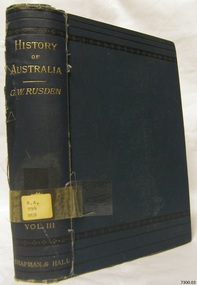
Book - Reference Book/History/Social History, George William Rusden, History of Australia Vol 3, 1883
... Its broad scope drew from his personal knowledge, and it notably emphasised pre European Aboriginal history and showed sympathy for Indigenous peoples, setting it apart from other works in its era. ...Volume 3 shifts to political developments, focusing on the 1856 Constitution Act and Victoria's road to self-government. It details federation debates, relationships with Britain, sketches later governors, and addresses gold rush impacts, land reforms, and emerging parliamentary systems across colonies. Together, the volumes form Rusden's comprehensive, if biased, chronicle to the 1850s.Hard cover book History of Australia in three Volumes Author: George William Rusden Publisher: Chapman & Hall Ltd London, Melbourne and Sydney Date: 1883 Dark blue hardcover with a blue matching spine, the spine has a label with an inscription. (These volumes are first editions)non-fictionVolume 3 shifts to political developments, focusing on the 1856 Constitution Act and Victoria's road to self-government. It details federation debates, relationships with Britain, sketches later governors, and addresses gold rush impacts, land reforms, and emerging parliamentary systems across colonies. Together, the volumes form Rusden's comprehensive, if biased, chronicle to the 1850s.warrnambool, shipwrecked-coast, flagstaff-hill, flagstaff-hill-maritime-museum, maritime-museum, shipwreck-coast, flagstaff-hill-maritime-village, book, warrnambool library, warrnambool mechanics’ institute, mechanics’ institute library, victorian library board, warrnambool books and records, warrnambool children’s library, warrnambool public library, history of australia vol 3, g w rusden -
 Ringwood and District Historical Society
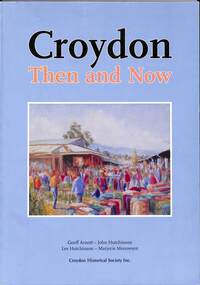
Book, Croydon Then and Now, 2012
... knowledge and expertise in specialised areas, which concludes with a quality production - a book that is attractive, informative and accurate. We believe this book fits the description handsomely, and should bring joy and pleasant memories to many former and current residents of Croydon. To people who don't know very much about Croydon, this book will most certainly enlighten them. This has been a team effort, with many people playing important roles. With all this in mind, we would like to thank the following: The Maroondah City Council The Australian National Library Department of Families, Housing, Community Services and Indigenous...knowledge and expertise in specialised areas, which concludes with a quality production - a book that is attractive, informative and accurate. We believe this book fits the description handsomely, and should bring joy and pleasant memories to many former and current residents of Croydon. To people who don't know very much about Croydon, this book will most certainly enlighten them. This has been a team effort, with many people playing important roles. With all this in mind, we would like to thank the following: The Maroondah City Council The Australian National Library Department of Families, Housing, Community Services and Indigenous ...Historic summary of Croydon comprised largely of early and contemporary photographs - Geoff Arnott, John Hutchinson, Les Hutchinson, Marjorie Meeuwsen, Croydon Historical Society Inc.Foreword by Cr. Les Willmott, J.P. - last mayor of the former City of Croydon. Acknowledgments: In the production of any book, many people play a part, be it financially or the giving of time with their knowledge and expertise in specialised areas, which concludes with a quality production - a book that is attractive, informative and accurate. We believe this book fits the description handsomely, and should bring joy and pleasant memories to many former and current residents of Croydon. To people who don't know very much about Croydon, this book will most certainly enlighten them. This has been a team effort, with many people playing important roles. With all this in mind, we would like to thank the following: The Maroondah City Council The Australian National Library Department of Families, Housing, Community Services and Indigenous Affairs Hutchinson Legal of Ringwood Sue Pitt, Alan Bennett and staff of the Croydon Library David and Ron Jewell Andrew Potts Adrian Arnott Elsie Bolwell Lyn Lynch Nick Anchen Cr Les Wilmott JP The Neville Family Bounty Print Dawn Gubb Photo courtesy of Leader Newspaper Press on pages 87, 90 and 113 -
 Eltham District Historical Society Inc
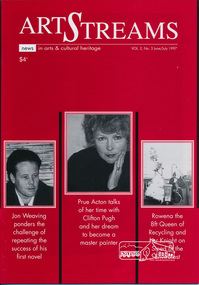
Journal, Peter Doughtery, ArtStreams: News in arts and cultural heritage; Vol. 2, No. 3, Jun-Jul 1997, 1997
... knowledge about present day and historical aspects of local art and artists." - Eltham District Historical Society Newsletter No. 161, March 2005 art streams food for all seasons prue acton jon weaving michelle lonsdale sandon mcleod patrickk mccauley malcolm riddle cultural tourism valley of the arts tourism association inc. robert peter smith danny chable farm gate spirit of eltham chris stonehouse eltham bookshop carolyn pickett anne delaney richard besley mike parr anita furey aboriginal art indigenous art julie le bon jackie stojanova ranee lee daniel chabble tony trembath john kauffman westerfolds park envirofest were street cafe helen o'grady children's drama academy nillumbik art collection Colour front and back cover with feature articles and literary pieces with photographs and advertisements printed in black and white. 36 pages, 30 cm. ...Vol. 2, No. 3, Jun-Jul 1997 CONTENTS WEAVING ON A ROLL Author Jon Weaving talks about the pitfalls of success 3 DON’T PASS THE GUINNESS Poet Patrick McCauley turns over a new leaf 6 AIMING FOR THE TOP Prue Acton chases a dream 9 CULTURAL TOURISM Selling a way of life 12 CONVERSATION WITH BOB SMITH An artist shares some thoughts on the why and how of painting 14 REPRIEVE FOR A GATE Some traditions refuse to die 16 STALKING THE STRANGER Short story by Chris Stonehouse 18 THEATRE IN AUTUMN Melbourne theatre is alive and well 21 TO A WOLF THE KILL Anne Delaney reviews Jon Weaving's first novel 23 EXHIBITION REVIEWS Richard Besley, Neophytes, The Eye of the Storm, Soft But True 24, 26, 27, & 30 CD REVIEWS 28 NEW SOURCE OF POWER Tony Trembath lights up a town hall 29 WHO’S DOING WHAT 32 "Peter Dougherty has been involved in the local art scene for many years. As publisher and editor of the arts magazine Artstreams, his comments on the various branches of the arts are widely respected. His "The Arts" column in the Diamond Valley Leader presents a brief summary for a much wider cross section of the local community. Peter also operates his own gallery and the Artstreams Cafe at the St Andrews market. Peter has a wealth of knowledge about present day and historical aspects of local art and artists." - Eltham District Historical Society Newsletter No. 161, March 2005Colour front and back cover with feature articles and literary pieces with photographs and advertisements printed in black and white. 36 pages, 30 cm. Vol. 1, no. 1 (Nov. 1996) - Vol. 10, no. 5 (summer ed. 2005/06) art streams, food for all seasons, prue acton, jon weaving, michelle lonsdale, sandon mcleod, patrickk mccauley, malcolm riddle, cultural tourism, valley of the arts tourism association inc., robert peter smith, danny chable, farm gate, spirit of eltham, chris stonehouse, eltham bookshop, carolyn pickett, anne delaney, richard besley, mike parr, anita furey, aboriginal art, indigenous art, julie le bon, jackie stojanova, ranee lee, daniel chabble, tony trembath, john kauffman, westerfolds park envirofest, were street cafe, helen o'grady children's drama academy, nillumbik art collection -
 Eltham District Historical Society Inc
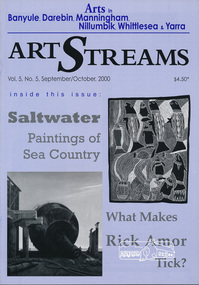
Journal, Peter Doughtery, ArtStreams: Arts in Banyule, Darebin, Manningham, Nillumbik, Whittlesea & Yarra; Vol. 5, No. 5 (sic - 4) Sep-Oct 2000, 2000
... knowledge about present day and historical aspects of local art and artists." - Eltham District Historical Society Newsletter No. 161, March 2005 art streams Rick Amor willy wonka's ice cream gourmet food bulleen art & garden centre sandy jeffs museum of modern art at heide sea country indigenous paintings roberta sykes Kinglake Gallery Sue Yardley Alan Marshall Short Story Award Plenty Ranges Arts & Convention Centre Eltham Little Theartre Warrandyte Theartre Company Eltham Wiregrass Gallery David Moore Montsalvat Art Now At Winter's End Festival Artstreams Publications amberley Anthology of Australian music on disc Plenty Views Golf Park Wayne Viney william Barak Short Story competition emily borg Rhiannon Foster Dynamic Vegies Maria Pellicano Steve Pellicano were street cafe Gemma Lynch-Memory Adriane Strampp Nina Christesen Stephanie Holt St andrews Market Thompsons Pharmacy Colour front and back cover with feature articles and literary pieces with photographs and advertisements printed in black and white. 36 pages, 30 cm. ...Vol. 5, No. 5 (4), Sep-Oct 2000 CONTENTS From Beach to Battleground 3 Talking art with Rick Amor The Poetry of Catharsis 7 New Work by Sandy Jeffs Saltwater 8 Paintings of Sea Country Snake Circle 10 Reviewed by Anna Barden Short Story 12 The Rainbow Shell Theatre Reviews 16 By Kathy Oliver Interview 18 David Moore and why he paints Art Now 21 City of Darebin Biennial Exhibition Australian Classical Music 22 Betty Scarlett William Barak Writing Competition 24 Stories by Emily Borg & Rhiannon Foster New Arts Contributors 26 Were Street Cafe & Studio19 Artin About 27 Wining & Dining 30 Poetry 32 By Shelton Lea Artist's Services 32 "Peter Dougherty has been involved in the local art scene for many years. As publisher and editor of the arts magazine Artstreams, his comments on the various branches of the arts are widely respected. His "The Arts" column in the Diamond Valley Leader presents a brief summary for a much wider cross section of the local community. Peter also operates his own gallery and the Artstreams Cafe at the St Andrews market. Peter has a wealth of knowledge about present day and historical aspects of local art and artists." - Eltham District Historical Society Newsletter No. 161, March 2005Colour front and back cover with feature articles and literary pieces with photographs and advertisements printed in black and white. 36 pages, 30 cm. Vol. 1, no. 1 (Nov. 1996) - Vol. 10, no. 5 (summer ed. 2005/06) art streams, rick amor, willy wonka's ice cream gourmet food, bulleen art & garden centre, sandy jeffs, museum of modern art at heide, sea country, indigenous paintings, roberta sykes, kinglake gallery, sue yardley, alan marshall short story award, plenty ranges arts & convention centre, eltham little theartre, warrandyte theartre company, eltham wiregrass gallery, david moore, montsalvat, art now, at winter's end festival, artstreams publications, amberley, anthology of australian music on disc, plenty views golf park, wayne viney, william barak short story competition, emily borg, rhiannon foster, dynamic vegies, maria pellicano, steve pellicano, were street cafe, gemma lynch-memory, adriane strampp, nina christesen, stephanie holt, st andrews market, thompsons pharmacy -
 Bendigo Military Museum
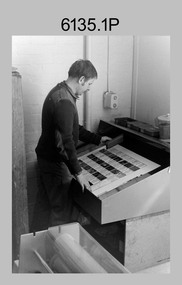
Photograph - Print Troop – Lithographic Squadron – Army Survey Regiment, Fortuna, Bendigo
... indigenous plants and descriptions endemic to that region printed on the reverse side to assist soldiers living off the land in survival situations. The authoritative information was provided by Major Leslie James (Les) Hiddins aka ‘the Bush Tucker Man’ He is a retired Australian Army soldier and war veteran, who is best known for his love and knowledge of the Australian bush. ...indigenous plants and descriptions endemic to that region printed on the reverse side to assist soldiers living off the land in survival situations. The authoritative information was provided by Major Leslie James (Les) Hiddins aka ‘the Bush Tucker Man’ He is a retired Australian Army soldier and war veteran, who is best known for his love and knowledge of the Australian bush. ...This collection of 23 photos was most likely taken in Lithographic Squadron, Army Survey Regiment, Fortuna, Bendigo, in 1988. In photos .1P and .2P the technician is preparing a Chromalin map proof for supporting information that would be printed on the reverse side of a topographic map. This map was commonly referred to as a ‘snack’ map, with photos of edible indigenous plants and descriptions endemic to that region printed on the reverse side to assist soldiers living off the land in survival situations. The authoritative information was provided by Major Leslie James (Les) Hiddins aka ‘the Bush Tucker Man’ He is a retired Australian Army soldier and war veteran, who is best known for his love and knowledge of the Australian bush. See item 6190.6P for more information on the Chomalin proof production process. In the remaining photos, Print Troop’s technicians were most likely operating the Komoni, Planeta or Ultra-MAN-III offset printing presses, as well as working in the map despatch dock. Although these photos are not annotated most personnel are positively identified. This is a set of 23 photographs of Print Troop personnel and equipment from Lithographic Squadron at the Army Survey Regiment, Fortuna, Bendigo, 1988. The photographs were on 35mm negative film and were scanned at 96 dpi. They are part of the Army Survey Regiment’s Collection. .1) - Photo, black & white, 1988, Chromalin Proof laminating, Terry King. .2) - Photo, black & white, 1988, Chromalin Proof laminating, Terry King. .3) to .6) - Photo, black & white, 1988, Ultra-MAN-III Printing Press, Colin Yeats. .7) - Photo, black & white, 1988, Ultra-MAN-III Printing Press, L to R: Greg Rowe, SPR Mark ‘Dogs’ Doherty. .8) - Photo, black & white, 1988, Ultra-MAN-III Printing Press, SPR Mark ‘Dogs’ Doherty. .9) to .10) - Photo, black & white, 1988, Ultra-MAN-III Printing Press, John Bateman. .11) - Photo, black & white, 1988, Ultra-MAN-III Printing Press. .12) - Photo, black & white, 1988, Map laminator? L to R: SGT Dale Hudson, SGT Gary Kerr. .13) - Photo, black & white, 1988, Newkoni Komori Printing Press, Peter Hamilton. .14) to .17) - Photo, black & white, 1988, Original Heidelberg Printing Press, Peter Hamilton. .18) to .19) - Photo, black & white, 1988, Map Despatch area, SPR Steve Wright. .20) - Photo, black & white, 1988, Map Despatch area, L to R: unidentified, SGT Gary Kerr. .21) - Photo, black & white, 1988, Printing Presses - foreground: Ultra-MAN-III (x2), centre: Newkoni Komori and background: Planeta Polygraph. .22) - Photo, black & white, 1988, Ultra-MAN-III Printing Presses (x2). .23) - Photo, black & white, 1988, L to R: Daryl South, Mark McCulloch.No personnel are identifiedroyal australian survey corps, rasvy, army survey regiment, army svy regt, fortuna, asr, litho, printing -
 Kiewa Valley Historical Society
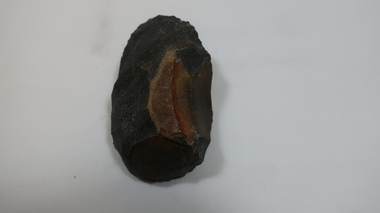
Rocks - Aboriginal x 3
... These three rocks were given to KVHS on the understanding that they were Indigenous rocks used as tools.No knowledge of their origins....These three rocks were given to KVHS on the understanding that they were Indigenous rocks used as tools.No knowledge of their origins. ...These three rocks were given to KVHS on the understanding that they were Indigenous rocks used as tools.No knowledge of their origins.These rocks have been stored in the Kiewa Valley on the understanding that they are Indigenous tools. It is not known where they came from.1. Dark grey rock with smooth surfaces and ridges with one flat side. Size of an adult's hand 2. Grey rock with smooth surfaces and ridges with one flat side. Smaller than no. 1 3.Narrow dark grey rock with beige section on rounded side. One flat side and a sharp pointed end.rocks, aboriginal tools, kiewa valley -
 Victorian Aboriginal Corporation for Languages
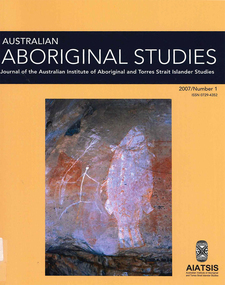
Periodical, Australian Institute of Aboriginal and Torres Strait Islander Studies, Australian Aboriginal studies : journal of the Australian Institute of Aboriginal and Torres Strait Islander Studies, 2007
... knowledge, nurturance, care, cash and commodities. Mobbing and bossing are best understood as structures in Giddens? sense of sets of rules and resources involved in the production of social systems, in this case social alliances. Mobbing and bossing imply a concept of a person as a being in a relationship. Attention needs to be given to the way these structures interact with institutions in the wider Australian society. 3. Recognising victims without blaming them: A moral contest? About Peter Sutton?s ?The Politics of Suffering: Indigenous...knowledge, nurturance, care, cash and commodities. Mobbing and bossing are best understood as structures in Giddens? sense of sets of rules and resources involved in the production of social systems, in this case social alliances. Mobbing and bossing imply a concept of a person as a being in a relationship. Attention needs to be given to the way these structures interact with institutions in the wider Australian society. 3. Recognising victims without blaming them: A moral contest? About Peter Sutton?s ?The Politics of Suffering: Indigenous ...1. The moral lexicon of the Warlpiri people of central Australia LR Hiatt This paper discusses words that match ?Good? and ?Bad?; examples of ?Good? and ?Bad? behaviour; morality and law; and egalitarianism and dominance. It also presents a comparison with Gidjingarli (Burarra). 2. Mobs and bosses: Structures of Aboriginal sociality Patrick Mullins (Mount Druitt, NSW) A commonality of Aboriginal social organisation exists across the continent in communities as different as those from the Western Desert across to Cape York, from the towns of New South Wales and Western Australia to cities like Adelaide. This is found in the colloquial expressions ?mob? and ?boss?, which are used in widely differing contexts. Mobbing is the activity where relatedness, in the sense of social alliances, is established and affirmed by virtue of a common affiliation with place, common experience and common descent, as well as by the exchange of cash and commodities. Bossing is the activity of commanding respect by virtue of one?s capacity to bestow items of value such as ritual knowledge, nurturance, care, cash and commodities. Mobbing and bossing are best understood as structures in Giddens? sense of sets of rules and resources involved in the production of social systems, in this case social alliances. Mobbing and bossing imply a concept of a person as a being in a relationship. Attention needs to be given to the way these structures interact with institutions in the wider Australian society. 3. Recognising victims without blaming them: A moral contest? About Peter Sutton?s ?The Politics of Suffering: Indigenous Policy in Australia since the 1970s? and Gillian Cowlishaw?s replies Ma�a Ponsonnet (Universit� Paris- 8-Saint-Denis) Peter Sutton?s texts on Aboriginal violence, health and their politicisation are replied to using his methodology, and acknowledging his convincing points. Sutton rightly denounces a lack of lucidity and scientific objectivity in anthropological debates. These inadequacies impede identification of what Aboriginal groups can do to improve their situations for fear that this identification would lead to blame the victims. At the other end of the ethical spectrum, those who advocate a broader use of what I will call a ?resistance interpretation? of violence fail to recognise victims as such, on the implicit grounds that seeing victims as victims would deprive them of any agency, on the one hand, and entail blame, on the other hand. I aim to define a middle road between those views: the idea that victims should be acknowledged as such without being denied their agency and without being blamed for their own condition. This middle road allows identification of the colonisers? responsibilities in the contemporary situation of Indigenous communities in Australia, and to determine who can do what. Secondly, I show that Sutton?s texts convey, through subtle but recurrent remarks, an ideology of blame rather than a mere will to identify practical solutions. As a consequence, some of his proposals do not stand on a solid and objective causal analysis. 4. 'You would have loved her for her lore?: The letters of Daisy Bates Bob Reece (Murdoch University) Daisy Bates was once an iconic figure in Australia but her popular and academic reputation became tarnished by her retrograde views. Her credibility was also put in doubt through the exposure of her fictionalised Irish background. In more recent times, however, her ethnographic data on the Aborigines of Western Australia has been an invaluable source for Native Title claims, while her views on Aboriginal extinction, cannibalism and ?castes? are being seen as typical of her time. This article briefly reviews what has been the orthodox academic opinion of her scientific achievement before summarising what is reliably known of her early history and indicating what kind of person is revealed in the 3000 or more letters that she left behind. 5. What potential might Narrative Therapy have to assist Indigenous Australians reduce substance misuse? Violet Bacon (Curtin University of Technology) Substance misuse is associated with adverse consequences for many Australians including Aboriginal and Torres Strait Islander peoples. Extensive research has been conducted into various intervention, treatment and prevention programs to ascertain their potential in reducing substance misuse within Aboriginal and non-Aboriginal communities. I explore the potential of Narrative Therapy as a counselling intervention for assisting Indigenous Australians reduce the harm associated with substance misuse. 6. Bone points from the Adelaide River, Northern Territory Sally Brockwell (University of Canberra) and Kim Akerman (Moonah) Large earth mounds located next to the vast floodplains of the lower Adelaide River, one of the major tropical rivers draining the flat coastal plains of northern Australia, contain cultural material, including bone points. The floodplains of the north underwent dynamic environmental change from extensive mangrove swamps in the mid-Holocene, through a transition phase of variable estuarine and freshwater mosaic environments, to the freshwater environment that exists today. This geomorphological framework provides a background for the interpretation of the archaeology, which spans some 4000 years. 7. A different look: Comparative rock-art recording from the Torres Strait using computer enhancement techniques Liam M Brady (Monash University) In 1888 and 1898, Cambridge University?s Alfred C Haddon made the first recording of rock-art from the Torres Strait islands using photography and sketches. Systematic recording of these same paintings and sites was carried out from 2000 to 2004 by archaeologists and Indigenous Torres Strait Islander and Aboriginal communities as part of community-based rock-art recording projects. Computer enhancement techniques were used to identify differences between both sets of recordings, to reveal design elements that Haddon missed in his recordings, and to recover images recorded by Haddon that are today no longer visible to the naked eye. Using this data, preliminary observations into the antiquity of Torres Strait rock-art are noted along with recommendations for future Torres Strait region rock-art research and baseline monitoring projects. 8. Sources of bias in the Murray Black Collection: Implications for palaeopathological analysis Sarah Robertson (National Museum of Australia) The Murray Black collection of Aboriginal skeletal remains has been a mainstay of bio-anthropological research in Australia, but relatively little thought has been given to how and why this collection may differ from archaeologically obtained collections. The context in which remains were located and recovered has created bias within the sample, which was further skewed within the component of the collection sent to the Australian Institute of Anatomy, resulting in limitations for the research potential of the collection. This does not render all research on the collection unviable, but it demonstrates the importance of understanding the context of a skeletal collection when assessing its suitability for addressing specific research questions.maps, b&w photographs, colour photographs, illustrations, graphs, chartswarlpiri, sociology, daisy bates, substance abuse, narrative therapy, rock art, technology and art, murray black collection, pleistocene sites, watarrka plateau -
 Victorian Aboriginal Corporation for Languages
Book, Linda Tuhiwai Smith, Decolonizing methodologies : research and Indigenous peoples, 1999
... indigenous researcher issues a clarion call for the decolonisation of research methods. In the first part of the book, the author critically examines the historical and philosophical base of Western research. Extending the work of Foucault, she explores the intersections of imperialism, knowledge...indigenous researcher issues a clarion call for the decolonisation of research methods. In the first part of the book, the author critically examines the historical and philosophical base of Western research. Extending the work of Foucault, she explores the intersections of imperialism, knowledge ...From the vantage point of the colonised, the term 'research' is inextricably linked with European colonialism; the way in which scientific research has been implicated in the worst excesses of imperialism remains a powerful remembered history for many of the world's colonised peoples. Here, an indigenous researcher issues a clarion call for the decolonisation of research methods. In the first part of the book, the author critically examines the historical and philosophical base of Western research. Extending the work of Foucault, she explores the intersections of imperialism, knowledge and research; en route she provides a history of knowledge from the Enlightenment to postcoloniality. The second part of the book meets an urgent demand: people who are carrying out their own research projects need literature which validates their frustrations in dealing with various Western paradigms. In setting an agenda for planning and implementing indigenous research, the author shows how such programmes are part of the wider project of reclaiming control over indigenous ways of knowing and being.tables, diagramscolonisation, research, imperialsim -
 Victorian Aboriginal Corporation for Languages
Book, Brett Baker, Indigenous language and social identity : papers in honour of Michael Walsh, 2010
... For almost 40 years, Michael Walsh has been working alongside Indigenous people: documenting language, music and other traditional knowledge, acting on behalf of claimants to land in the Northern Territory, and making crucial contributions to the revitalisation of Aboriginal languages in NSW. ...language and identity language maintenance language and culture language and country Maps, b&w photographs, charts, word lists For almost 40 years, Michael Walsh has been working alongside Indigenous people: documenting language, music and other traditional knowledge, acting on behalf of claimants to land in the Northern Territory, and making crucial contributions to the revitalisation of Aboriginal languages in NSW. ...For almost 40 years, Michael Walsh has been working alongside Indigenous people: documenting language, music and other traditional knowledge, acting on behalf of claimants to land in the Northern Territory, and making crucial contributions to the revitalisation of Aboriginal languages in NSW. This volume, with contributions from his colleagues and students, celebrates his abiding interest in and commitment to Indigenous society with papers in two broad themes. ?Language, identity and country? addresses the often complex relations between Aboriginal social groups and countries, and linguistic identity. In ?Language, identity and social action? authors discuss the role that language plays in maintaining social identities in the realms of conversation, story-telling, music, language games, and in education. ?Language and Social Identity in Australian Indigenous Communities? will be of interest to students of linguistics, Indigenous studies, anthropology, and sociology. Contents: 1. Introduction /? Rod Gardner ... [et al.] 2. Michael Walsh : a personal reflection /? Ros Fraser 3. Place and property at Yintjingga/?Port Stewart under Aboriginal Law and Queensland Law /? Bruce Rigsby and Diane Hafner 4. Linguistic identities in the eastern Western Desert : the Tindale evidence /? Peter Sutton Juwaliny : dialectal variation and ethnolinguistic identity in the Great Sandy Desert /? Sally Dixon 6. Who were the 'Yukul'? and who are they now? /? Brett Baker 7. Colonisation and Aboriginal concepts of land tenure in the Darwin region /? Mark Harvey 8. Aboriginal languages and social groups in the Canberra region : interpreting the historical documentation /? Harold Koch 9. The Kuringgai puzzle : languages and dialects on the NSW Mid Coast /? Jim Wafer and Amanda Lissarrague 10. Dawes' Law generalised : cluster simplification in the coastal dialect of the Sydney language /? David Nash 11. Space, time and environment in Kala Lagaw Ya /? Lesley Stirling 12. Turn management in Garrwa mixed-language conversations /? Ilana Mushin and Rod Gardner 13. Laughter is the best medicine : roles for prosody in a Murriny Patha conversational narrative /? Joe Blythe 14. Collaborative narration and cross-speaker repetition in Umpila and Kuuku Ya'u /? Clair Hill 15. Co-narration of a Koko-Bera story : giants in Cape York Peninsula /? Paul BlackMaps, b&w photographs, charts, word listslanguage and identity, language maintenance, language and culture, language and country -
 Victorian Aboriginal Corporation for Languages
Book, Julie Reid, Wergaia community grammar and dictionary, 2007
... knowledge about the structure of Australian languages. Rather, it is intended for use as an adjunct to a course in Wergaia, such as the VCE Study Design Indigenous Languages of Victoria: Revival and Reclamation - Wergaia....knowledge about the structure of Australian languages. Rather, it is intended for use as an adjunct to a course in Wergaia, such as the VCE Study Design Indigenous Languages of Victoria: Revival and Reclamation - Wergaia. ...This consultation draft is a sketch grammar of Wergaia, incorporating a revised Wergaia Wordlist (version 1), now renamed Wergaia dictionary, which was developed from recent and historical sources, and funded by the Victorian Aboriginal Corporation for Languages. It is not intended for use as a language course. To fully understand its contents, the reader will need a high level of knowledge about the structure of Australian languages. Rather, it is intended for use as an adjunct to a course in Wergaia, such as the VCE Study Design Indigenous Languages of Victoria: Revival and Reclamation - Wergaia.colour photographs, b&w photographs, word listswergaia, wotjobaluk, barengi gadyin land council inc, grammar, language learning -
 Victorian Aboriginal Corporation for Languages
Book, Michael J Christie, Aboriginal perspectives on experience and learning : the role of language in Aboriginal education, 1995
... education linguistics curriculum development Aboriginal stories Indigenous education The content moves from the history of Aboriginal people to knowledge and learning skills to arranging a classroom program. ...The content moves from the history of Aboriginal people to knowledge and learning skills to arranging a classroom program.education, linguistics, curriculum development, aboriginal stories, indigenous education
