
Showing 6 items matching " international (chile)"
-
 Women's Art Register
Archive (Collection) - Christina Cordero Artist Archive
... ... International (Chile)...Narrative Memory Symolism Dreams Romanticism International (Chile) Australian Galleries Printmaking Aquatint Etching Screenprinting Intaglio Archive Christina Cordero Artist Archive ...narrative, memory, symolism, dreams, romanticism, international (chile), australian galleries, printmaking, aquatint, etching, screenprinting, intaglionarrative, memory, symolism, dreams, romanticism, international (chile), australian galleries, printmaking, aquatint, etching, screenprinting, intaglio -
Women's Art Register
Archive (Series) - Cordero, Christina. Artist File 1
... ... International (Chile)...Narrative Memory Symolism Dreams Romanticism International (Chile) Australian Galleries Printmaking Aquatint Etching Screenprinting Intaglio Foolscap white archival 4 flap folder or document wallet Archive Cordero, Christina. ...CV, Biography, Invitations, Promotional Material, Artwork Imagesnarrative, memory, symolism, dreams, romanticism, international (chile), australian galleries, printmaking, aquatint, etching, screenprinting, intaglionarrative, memory, symolism, dreams, romanticism, international (chile), australian galleries, printmaking, aquatint, etching, screenprinting, intaglio -
Women's Art Register
Archive (Series) - Christina Cordero. Duplicate File 1
... ... International (Chile)...Printmaking Aquatint Etching Screenprinting Intaglio Narrative Memory Symolism Dreams Romanticism International (Chile) Australian Galleries Foolscap manilla file Archive Christina Cordero. ...CV, Biography, Invitations, Promotional Material, Artwork Imagesprintmaking, aquatint, etching, screenprinting, intaglio, narrative, memory, symolism, dreams, romanticism, international (chile), australian galleriesprintmaking, aquatint, etching, screenprinting, intaglio, narrative, memory, symolism, dreams, romanticism, international (chile), australian galleries -
 The Beechworth Burke Museum
Geological specimen - Native (metallic) copper, Unknown
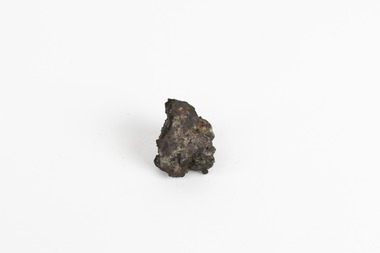
... As of 2016, Australia was the second largest producer of Copper internationally, following behind Chile in first place. ...As of 2016, Australia was the second largest producer of Copper internationally, following behind Chile in first place. This copper specimen is significant historically and scientifically as it is such an important metal commonly used throughout the world in various ways. ...This specimen is a native copper specimen that is metallic. Copper is typically found in the earth's crust and is often found alongside other metals such as gold, zinc, lead and silver which all belong to the same group which is the Copper/Gold group. Copper is most commonly formed from large masses of molten lava rock which has solidified in the earth's crust and over time though different sizes and speeds of crystal growth has turned into large amounts of copper, stored in porphyry copper deposits. Copper has a distinctive colour, yet can sometime appear blue and greenish which is often caused by oxidisation or a mixture of copper and other metals. This specific specimen was recovered from Moonta, South Australia. The Moonta Mining Company was established in 1861, after a Shepard in the area noticed traces of copper. This lead to a rush in the copper mining industry which was relatively young in Australia at the time, making Moonta Mining Company one of the richest in Australia. By the 1860's, South Australia had been nicknamed the "Copper Kingdom" due to its vast amount of Large copper mines and resources. As of 2016, Australia was the second largest producer of Copper internationally, following behind Chile in first place. This copper specimen is significant historically and scientifically as it is such an important metal commonly used throughout the world in various ways. Copper is an invaluable recourse used in daily life, used in most electrical appliances as it is a great conductor of heat and electricity, as well as being soft and malleable, making it easy to bend and mould into delicate sheets and wires. Copper does not corrode and is therefore used in the production of water pipes among countless other significant necessities that are often overlooked in our society. Historically, Copper holds great significance as it was the first metal used by humans. It was discovered roughly 9000 years ago and was utilised by the Neolithic Man who learnt that heating the metal made it more malleable, thus tools and utensils were made which were far superior to the previous stone tools used by humans. This history and its connection to the current and ongoing relationship between humans and copper must be preserved and highlighted as it is integral to the history of all humankind. A small, palm-sized solid native copper mineral specimen with shades of browns, black and rustic tones throughout the specimen.NATIVE (metalic) COPPER / Locality: Moonta, South Australiabeechworth, burke museum, geological specimen, native specimen, geological, mineral, mineralogy, indigo shire, beechworth museum, copper, copper ore -
 Embroiderers Guild, Victoria
Textile - Chilean Arpillera Appliqué Scene, 1980
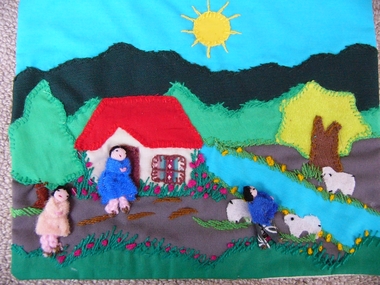
... Pinochet Regime (1973–1990): They gained international fame in Chile during General Augusto Pinochet's military dictatorship. ...Pinochet Regime (1973–1990): They gained international fame in Chile during General Augusto Pinochet's military dictatorship. ...Arpillera are brightly colored, three-dimensional patchwork tapestries and textile pictures created predominantly by working-class women (arpilleristas). The word comes from the Spanish term for the rough burlap or hessian sacking (often made from flour, potato, or sugar sacks) used as a backing material. They feature fabric scraps, embroidery, wool, and small 3D figures like dolls. Pinochet Regime (1973–1990): They gained international fame in Chile during General Augusto Pinochet's military dictatorship. The Catholic Church Role: Organized under the protection of the Vicariate of Solidarity (Vicaría de la Solidaridad) and the Catholic Church, these workshops offered a safe space for women to process grief, share stories, and earn a vital source of income after their husbands, sons, or fathers were forcibly disappeared (los desaparecidos). A "Fabric Newspaper": Because public gatherings were banned and traditional media was heavily censored, women used these textiles to document state atrocities, poverty, soup kitchens, forced disappearances, and human rights abuses. International Smuggling: Finished pieces were secretly rolled up and smuggled out of Chile in diplomatic or traveler luggage to be sold abroad, raising global awareness and funding for the resistance movement.They tell of the maker's lives and the traumatic events experienced by these mothers, wives and sisters of the victims.This piece depicts a brightly coloured scene with a house, people and sheep in appliqué and embroidery.appliqué, creative embroidery -
 Mission to Seafarers Victoria
Photograph - Photograph, Black and white, Freda Kathleen Oxley (1882-1969), Chilean Sailmaker on the Skaregrøm, 1925-1926
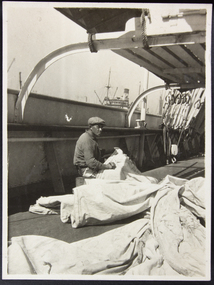
... Chile John" or "Chileno/Chilano John". He also mentions his real name John Oyarzo, probably Juan Oyarzo (see Sea History Magazine). His name, although misspelled, is written in the Freda Oxley album. The picture shows one of the work on board a sailing ship. It also demonstrates how international ...The Skaregrøm was a swedish windjammer. On his log during his time on the Skaregrøm Captain Archie Horka often mentions "Chile John" or "Chileno/Chilano John". He also mentions his real name John Oyarzo, probably Juan Oyarzo (see Sea History Magazine). His name, although misspelled, is written in the Freda Oxley album.The picture shows one of the work on board a sailing ship. It also demonstrates how international ship crew were at the time. The photograph was published in the annual report for 1926.Sailor with grey shirt and cap sitting on the deck of the ship, repairing sails. Around his right hand is one of the sailmaker tool: the sailmaker sewing palm is a leather strap with metal piece on the palm called the eye. This piece has indentations to accept the head of the needle as you push it through the cloth. The number 14 at the back indicates the photograph was previously on one of the grey album pages with the legend: "Chilean sailmaker on the Skaregrom".in pencil: "cut off"is written twice on the top and bottom of the photograph. Number 14 was added later in black inkskaregrom, sailing ship, sailmaker, skaregrøm, chilean, sailor, reverend john reginald weller (1880-1969), weller album, windjammer, freda kathleen oxley 1882-1969, juan oyarzo, john oyarzo
