
Showing 48 items matching " international (italy)"
-
 Women's Art Register
Archive (Series) - Fontana, Lavinia. Artist File 1
... International (Italy)...International (Italy) Felton Bequest Baroque Figurative Portraiture Foolscap white archival 4 flap folder or document wallet Archive Fontana, Lavinia. ...Articleinternational (italy), felton bequest, baroque, figurative, portraitureinternational (italy), felton bequest, baroque, figurative, portraiture -
Women's Art Register
Archive (Collection) - Angela Cavalieri Artist Archive
... ... International (Italy)...Religion Migration Text Narrative International (Italy) Printmaking Linocut Archive Angela Cavalieri Artist Archive ...religion, migration, text, narrative, international (italy), printmaking, linocutreligion, migration, text, narrative, international (italy), printmaking, linocut -
Women's Art Register
Archive (Collection) - Lavinia Fontana Artist Archive
... International (Italy)...1552 - 1614 International (Italy) Felton Bequest Baroque Figurative Portraiture Archive Lavinia Fontana Artist Archive ...international (italy), felton bequest, baroque, figurative, portraitureinternational (italy), felton bequest, baroque, figurative, portraiture -
Women's Art Register
Archive (Series) - Cavalieri, Angela. Artist File 1
... ... International (Italy)...Religion Migration Text Narrative International (Italy) Printmaking Linocut Foolscap white archival 4 flap folder or document wallet Archive Cavalieri, Angela. ...List of Images, CV, Biography, Newspaper Clippings, Invitations, Artwork Images, Articlesreligion, migration, text, narrative, international (italy), printmaking, linocutreligion, migration, text, narrative, international (italy), printmaking, linocut -
Women's Art Register
Archive (Series) - Angela Cavalieri. Duplicate File 1
... ... International (Italy)...Printmaking Linocut Religion Migration Text Narrative International (Italy) Foolscap manilla file Archive Angela Cavalieri. ...List of Images, CV, Biography, Newspaper Clippings, Invitations, Artwork Images, Articlesprintmaking, linocut, religion, migration, text, narrative, international (italy)printmaking, linocut, religion, migration, text, narrative, international (italy) -
 City of Ballarat
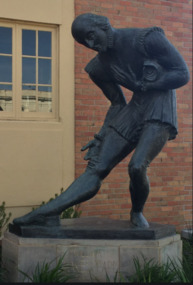
Artwork, other - Public Artwork, Andor Mészáros, Shakespeare by Andor Mészáros, 1960
... In 1951 he received 'the highest award' at the International Medallion Exhibition, Madrid and in 1964 he won the 'purchase prize' at the International Medallion Competition, Arezzo, Italy. From 1970 Mészáros worked with his younger son Michael, also a sculptor. ...In 1951 he received 'the highest award' at the International Medallion Exhibition, Madrid and in 1964 he won the 'purchase prize' at the International Medallion Competition, Arezzo, Italy. From 1970 Mészáros worked with his younger son Michael, also a sculptor. ...The well known sculpture of English playwright William Shakespeare takes an elaborate bow before the Civic Hall, a performance and community center for Ballarat. The unique abstract and elongated mannerist style used in this cast bronze sculpture hints at the art deco style of the Hall behind. The sculptor, Andor Mészáros, was from Budapest but created much of his work in Melbourne. He also created works for Canterbury Cathedral in the UK and several carved stone sculptures for Sydney Hospital. The artwork was commissioned in 1959 through a widely publicised competition and installed in 1960. In addition to making sculptures, Mészáros was also renown as a creator of medallions. In 1951 he received 'the highest award' at the International Medallion Exhibition, Madrid and in 1964 he won the 'purchase prize' at the International Medallion Competition, Arezzo, Italy. From 1970 Mészáros worked with his younger son Michael, also a sculptor. In 2002, the City of Ballarat granted permission for Michael Mészáros to make a cast of the Ballarat Shakespeare artwork to create replica installed in Budapest. The Budapest installation commemorates Shakespeare's connection to the City and the achievements of Andor Mészáros. The artwork was unveiled by Mayor Arthur W. Nicholson. The statue was presented by L.F. North, general Manager of the Fidelity Trustee Company Limited, representing the late H.P. Stevens as one of the benefactors whose generosity enabled the Statue to be erected.The artwork is of aesthetic significance to the people of BallaratLarge bronze statue of William Shakespeare mounted on a stone plinthWilliam Shakespeare 1564-1616. Erected by benefactions from Harry Pearson Stevens who settled here 1855 and other Citizens unveiled by Arthur W. Nicholson J.P. Mayor.17.11.1960shakespeare, andor mészáros, civic hall, ballarat -
 Flagstaff Hill Maritime Museum and Village
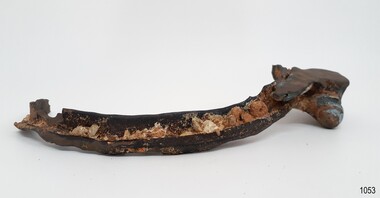
Functional object - Porthole Frame, Russell & Co, 1888
... Italian barque, clipper, Antares was sometime later reported as overdue. The wreck of the ship was later found at the base of a cliff at the Bay of Islands near Warrnambool in November 1914; there were no survivors. The Antares is significant as it was a sail trader carrying international ...This portion of the porthole frame was part of the fittings of the Antares. The Italian barque “Antares” was an iron three-masted sailing ship built in 1888 by Russell & Co of Port Glasgow. The ship was originally named the “Sutlej” but was renamed the “Antares” in 1907 when sold to the Semider Bros of Genoa, Italy, where it was registered. The vessel left Marseilles on the 18th of December 1913 with its master Captain Gazedo destined for Mullaly & Byrne of Melbourne with a cargo of roofing tiles but failed to arrive. The wreckage was found near the Bay of Islands, twenty-two miles east of Warrnambool, after a body had washed ashore. Some of the timbers washed up were charred by fire, and a small boat's stern board with the name "Sutlej" led to the identification of the wreck as Antares, which had been reported missing. According to later reports, the Antares wrecking was overshadowed by war news at the time. A young local boy had remarked that the Germans had arrived off the coast as he had seen them firing off shells and rockets, but his story was passed off as a joke. These rockets were most likely the distress signals from the stricken ship. The Italian barque, clipper, Antares was sometime later reported as overdue. The wreck of the ship was later found at the base of a cliff at the Bay of Islands near Warrnambool in November 1914; there were no survivors.The Antares is significant as it was a sail trader carrying international inbound cargo during the early part of the 20th century. It is part of the Great Ocean Road Historic Shipwreck Trail and as such is registered as a protected wreck in the Victorian Heritage Database VHS S34 .Porthole frame section, brass, large part corroded away. Hing is still visible on the end. The underside is shaped to allow the fitting of the glass. Recovered from the wreck of the Antares. Noneflagstaff hill, warrnambool, shipwrecked-coast, flagstaff-hill, flagstaff-hill-maritime-museum, maritime-museum, shipwreck-coast, flagstaff-hill-maritime-village, antares, tall ship, sailing ship, peterborough, phillip le couteur, peter mathieson, constable stainsbury, sutlej, antares rock., bay of islands, porthole, ship fitting, 1914 shipwreck, porthole frame -
 Flagstaff Hill Maritime Museum and Village
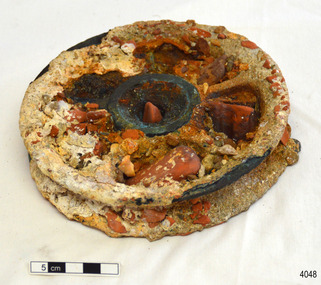
Functional object - Pulley Sheave, Russell & Co, 1888
... Italian barque/clipper Antares was sometime later reported as overdue. The wreck of the ship was later found at the base of a cliff at the Bay of Islands near Warrnambool in November 1914, there were no survivors. The Antares is significant as it was a sail trader carrying an international ...This ship's pully sheave was part of the Antares rigging. A pulley sheave is a circle on a shaft that is manufactured to hold up movement and change of way of a cable or/and rope, or transfer of power between the shaft and cable or/and rope. A pulley is a unique mechanism that is used to leverage the lifting of heavy loads to required heights. The Italian barque Antares was an iron three-masted sailing clipper built in 1888 by Russell & Co of Port Glasgow originally named the “Sutlej” and renamed in 1907 the “Antares” when sold to the Semider Bros of Genoa Italy. The vessel left Marseilles on the 18th of December 1913 with its master captain Gazedo destined for Mullaly & Byrne of Melbourne with a cargo of roofing tiles but failed to arrive. The wreckage was found near the Bay of Islands twenty-two miles east of Warrnambool after a body had washed ashore. Some of the timbers washed up were charred by fire, and a small boat's stern board with the name "Sutlej" led to the identification of the wreck as Antares which had been reported missing. According to later reports, the Antares wrecking was overshadowed by war news at the time. A young local boy had remarked that the Germans had arrived off the coast as he had seen them firing off shells and rockets, but his story was passed off as a joke. These rockets were most likely the distress signals from the stricken ship. The Italian barque/clipper Antares was sometime later reported as overdue. The wreck of the ship was later found at the base of a cliff at the Bay of Islands near Warrnambool in November 1914, there were no survivors.The Antares is significant as it was a sail trader carrying an international inbound cargo during the early part of the 20th century. It is part of the Great Ocean Road Historic Shipwreck Trail and as such is registered as a protected wreck in the Victorian Heritage Database VHS S34.Pulley sheave; brass, with recesses full of concretion. The metal has some blue-green colouration due to exposure to sea water. Recovered from the wreak of the Antares. Noneflagstaff hill, warrnambool, flagstaff-hill-maritime-museum, shipwreck-coast, flagstaff-hill-maritime-village, pulley sheave, antares, tall ship, peterborough, 1914 shipwreck, phillip le couteur, peter mathieson, constable stainsbury, sutlej, bay of islands, pully sheave, pulley, lifting equipment -
 Federation University Historical Collection
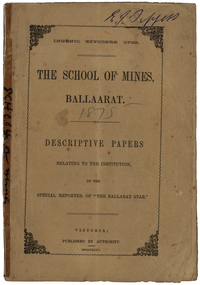
Booklet, The School of Mines Ballaarat: Descriptive papers relating to the institution by the special reporter of "The Ballarat Star", 1875 (exact)
... Italy; Julius Von Haast, Ph. D.F.R.S., Government Geologist of Canterbury; James Hector, M.D., F.R.S., Government Geologist of Wellington, New Zealand, W.F. Hopkins (Grant); Charles A. La Trobe, C.E. (Engineer-in-Chief International...Italy; Julius Von Haast, Ph. D.F.R.S., Government Geologist of Canterbury; James Hector, M.D., F.R.S., Government Geologist of Wellington, New Zealand, W.F. Hopkins (Grant); Charles A. La Trobe, C.E. (Engineer-in-Chief International ...The booklet comprises of a series of papers published in the Ballarat Star, with some revisions. The Administrative Council hoped the publication would increase interest in Technical Education, especially the Art of Mining. He would also hope the public would recognise the Ballarat School of Mines as an institution adapted to supply technical education. The Ballarat School of Mines Council listed at the front of the book includes: Redmond Barry (President and Trustee), Judge Rogers (Vice-President), Somerville Livingstone Learmonth (Trustee), Rivett Henry Bland (Trustee), Charles Gavan Duffy, John A. MacPherson (MLA), William McLellan (MLA), Duncan Gillies (MLA), F. McCoy (University of Melbourne), John I. Bleasdale, W.H. Barnard, James M. Bickett, Henry Richards Caselli, P. Chauncy, J.M. Davey, Joseph Flude, R.F. Hudson, Robert Lewis, James Oddie, Robert M. Serjeant, J. F. Usher, John Walker, J. Williamson, Mayor of the City of Ballaarat, chairman (for the time being) of each of the seven Mining Boards of Victoria. The President of Examiners was Judge Rogers, and the Honorary Auditor was Richard Ford.Stapled, brown soft covered booklet of 48 pages. Section I outlines the establishment of the Ballarat School of Mines, the buildings and land used by the school, describes in detail the former Ballarat Circuit Court and describes the lecture rooms. Section II describes the Ballarat School of Mines Museum, including a description of exhibits. Section III describes the lecture hall, and the apartments on either side of the hall, including the office of the registrar W.H. Barnard, mathematical classroom, chemical laboratory, and metallurgical laboratory. Section IV outlines the subjects offered by the Ballarat School of Mines, including Mathematics taught by John Victor of Grenville College, who had been educated at Trinity College Dublin. Mining and Land Surveying was taught by C.W. Thomas. Mr Croll taught mechanical drawing, followed by Jonathan Robinson of the Union Foundry, and finally S. Keast. It then lists some text books used in the school. Section V mentions the School Council, lack of funds, future directions, mining laboratory. Vi- Describes the land and out buildings, and the proposed building for metal and wood turning, brass foundry, blacksmith, working engine, etc. This section describes some large donations to the school - 50 pounds from the Misses Meglin of Melbourne, 10 pounds 10 shillings to the 'Pyrites fund' by the Walhalla and Long Tunnel Companies in Gippsland. Section VII covers the teaching of chemistry by Joseph Flude. Section VIII outlines the metallurgy classes and the process of assaying. Section IX covers telegraphy taught by Mr Bechervaise Section X describes the examination process at the Ballarat School of Mines. Examiners in mathematics were G.J. Russell (Buninyong) and John Lynch (Smythesdale), mining and land surveying John Lynch and P.C. Fitzpatrick (Ballarat), Principles and Practice of Mining R.M. Serjeant (Band and Albion Consols), Mechanical Engineering John Lewis (New North Company Clunes, Mineralogy and Geology G.H. F. Ulrich, Assayign and Chemistry J. Cosmo Newberry, and Telegraphy R.L.J. Ellery (government astronomer) and Sam W. Macgowan. Underground managers and captains in quart mining was examined by Henry Rosales (Walhalla Company), and alluvial mines by Messrs Bockett, Kent, Martin and Mitchell. Engineers and Engine driving was examined by W.H. Keast,Peter Matthews, Jonathan Robinson and J.M. Troup. Section XI - Covers Annual reports of the school, and honorary correspondents of the school including: John Day (Geelong); R. Evan Day (London); W.W. Evans, M.J.C.E. of New York; J.Y. Fishburne, M.B. of Ararat; Felice Giordano, Inspector of Mines, Italy; Julius Von Haast, Ph. D.F.R.S., Government Geologist of Canterbury; James Hector, M.D., F.R.S., Government Geologist of Wellington, New Zealand, W.F. Hopkins (Grant); Charles A. La Trobe, C.E. (Engineer-in-Chief International Railway Plant, London); Archibald Liversidge, F.G.S. (Professor of Mineralogy and Reader in geology at Sydney University; J.J. Macgregor, M.D. (Creswick); J.T. McKenna (1st class of SMB underground management - Northern Territory); Henry Rosales, M.E. and M. (Walhalla); Harrie Wood (SMB founder and Under-secretary for Mines, Sydney); John Walthew (Stockport, England) .2) Signed 'E.J. Tippett', former President of the Ballarat School of Mines Council melbourne, mla, ballarat school of mines, redmond barry, j f usher, james bickett, w f hopkins, rivett henry bland, s m b, judge rogers, somerville learmonth, charles gavan duffy, gavan duffy, john macpherson, william mclellan, duncan gillies, f mccoy, university, john bleasdale, henry richards caselli, henry caselli, p chauncy, j m davey, joseph flude, r f hudson, robert lewis, james oddie, robert m serjeant, john walker, j williamson, richard ford, ballarat court house, assay, john victor, grenville college, trinity college dublin, c w thomas, jonathan robinson, union foundry, s keast, blessdale, john day, r evan day, w w evans, j y fishburne, felice giordano, julius von haast, james hector, charles a la, trobe, archibald liversidge, j j macgregor, j t mckenna, henry rosales, harrie wood, john walthew, fees, frederick mccoy, w.h. barnard -
 Ringwood and District Historical Society
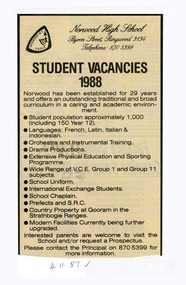
Newspaper - Clipping, Norwood High School, Ringwood, Victoria
... Italian & Indonesian. • Orchestra and Instrumental Training. • Drama Productions. • Extensive Physical Education and Sporting Programme. • Wide Range of V.C.E. Group 1 and Group 11 subjects. • School Uniform. • International...Italian & Indonesian. • Orchestra and Instrumental Training. • Drama Productions. • Extensive Physical Education and Sporting Programme. • Wide Range of V.C.E. Group 1 and Group 11 subjects. • School Uniform. • International ...November 1987 advertisement inviting enrolment enquiries for the following year.Norwood has been established for 29 years and offers an outstanding traditional and broad curriculum in a caring and academic environment. • Student population approximately 1,000 (including 150 Year 12). • Languages: French, Latin, Italian & Indonesian. • Orchestra and Instrumental Training. • Drama Productions. • Extensive Physical Education and Sporting Programme. • Wide Range of V.C.E. Group 1 and Group 11 subjects. • School Uniform. • International Exchange Students. • School Chaplain. • Prefects and S.R.C. • Country Property at Gooram in the Strathbogie Ranges. • Modern Facilities Currently being further upgraded. Advertisement invites Interested parents to visit the School and/or request a Prospectus, and includes contact details for the Principal on 870 5399 for more information. -
 Flagstaff Hill Maritime Museum and Village
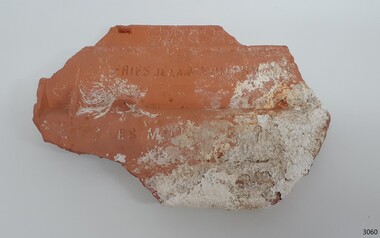
Ceramic - Roof Tile, Circa 1914
... Italian barque/clipper Antares was sometime later reported as overdue. The wreck of the ship was later found at the base of a cliff at the Bay of Islands near Warrnambool in November 1914, there were no survivors. The Antares is significant as it was a sail trader carrying an international ...The Italian barque Antares was an iron three-masted sailing clipper built in 1888 by Russell & Co of Port Glasgow originally named the “Sutlej” and renamed in 1907 the “Antares” when sold to the Semider Bros of Genoa Italy. The vessel left Marseilles on the 18th of December 1913 with its master captain Gazedo destined for Mullaly & Byrne of Melbourne with a cargo of roof tiles but failed to arrive. The wreckage was found near the Bay of Islands twenty-two miles east of Warrnambool after a body had washed ashore. Some of the timbers washed up were charred by fire, and a small boat's stern board with the name "Sutlej" led to the identification of the wreck as Antares which had been reported missing. According to later reports, the Antares wrecking was overshadowed by war news at the time. A young local boy had remarked that the Germans had arrived off the coast as he had seen them firing off shells and rockets, but his story was passed off as a joke. These rockets were most likely the distress signals from the stricken ship. The Italian barque/clipper Antares was sometime later reported as overdue. The wreck of the ship was later found at the base of a cliff at the Bay of Islands near Warrnambool in November 1914, there were no survivors.The Antares is significant as it was a sail trader carrying an international inbound cargo during the early part of the 20th century. It is part of the Great Ocean Road Historic Shipwreck Trail and as such is registered as a protected wreck in the Victorian Heritage Database VHS S34 .Roof tile; clay terracotta roof tile. Inscriptions are impressed into the clay. It was recovered from the wreck of the Antares. ”- E R I E S DE LA MEDITERRANEE” “ … T S – MI-LES BOU- R …..” SYMBOL [Sideways crown or tree (could be TULLERIES DE LA MEDITERRANEE)]flagstaff hill, warrnambool, flagstaff hill maritime museum, maritime museum, shipwreck coast, flagstaff hill maritime village, great ocean road, roofing tile, building materials, antares, peterborough, 1914 shipwreck, sutlej, antares rock., bay of islands, terracotta tile, clipper -
Moorabbin Air Museum
document (item) - Roland Jahne Collection - See Description for details
... BOX 1-2 X622 November 18, 2022 Manilla folder Oct-72 NA50 P64 Manilla folder Various NA P51 UP TO "D" Manilla folder No date Martin B57 Manilla folder Various Martin 202 Manilla folder Various Martin B26 Model 179 Marauder Manilla folder Various McDD F4 Phantom Manilla folder Various McD F101 Voodoo Manilla folder Various McDD KC10 Tanker Manilla folder Feb-82 McDD AV-8B Air International Manilla folder Various McDonnell F3H Demon Manilla folder Various McDD YC15 C17 Manilla folder Various McDonald Douglas AH64 Apache Manilla folder Various McD FA18 Manilla folder Various Napier Manilla folder No date NH Industries. (Eurocopter France & Germany & Augusta Italy...BOX 1-2 X622 November 18, 2022 Manilla folder Oct-72 NA50 P64 Manilla folder Various NA P51 UP TO "D" Manilla folder No date Martin B57 Manilla folder Various Martin 202 Manilla folder Various Martin B26 Model 179 Marauder Manilla folder Various McDD F4 Phantom Manilla folder Various McD F101 Voodoo Manilla folder Various McDD KC10 Tanker Manilla folder Feb-82 McDD AV-8B Air International Manilla folder Various McDonnell F3H Demon Manilla folder Various McDD YC15 C17 Manilla folder Various McDonald Douglas AH64 Apache Manilla folder Various McD FA18 Manilla folder Various Napier Manilla folder No date NH Industries. (Eurocopter France & Germany & Augusta Italy ... -
Moorabbin Air Museum
Document (item) - Bill Prowse Collection WP14 See details in Description, Bill Prowse Collection WP14
... Jet Instrument Flying Trainer Type AT50 Maintenance Handbook Australia Flies First Local Hornet - extract from Flight International Magazine 16/3/85 Techniques of Oblique Aerial Photography of agricultural Field trials CSIRO Alata Magazine - Italy Jindivik Target Program for US Army McGregor Range Dowty Hydraulic System and Undercarriages fitted to Armstrong Whitworth Argosy - Course notes Summary of Evaluation of Tactical Transport Aircraft for RAAF - technical report TTA 13/77 Pilot's Notes General RAF Govt of India Press 1943 AP 2095 (RAF) Air BP Journal Number 28 Jindivik Details Sketch Nomad 22B Promotional Catalogue GAF Mirage Metallurgy Technical Memo No 322 Canberra Metallurgy Tech Memo 319 Fatigue racking in mail landing wheels Handbook of wireless Telegraphy Vol 1 1938 Jindivik target Program US Army Aircraft Flight Test recording and Analysis System AFTRAS Tech notes Mission Avionics for Medium Range Maritime Reconnaissance Patrol Aircraft - proposal by Litton Systems for GAF 1993 Assessment of Installation of Edward Davis Jet Engine in Jindivik Initial Study to redesign Jindivik Wing Nomad 22 Fenwick Aviation - French 1972 Jindivik Publication B4A-PO3 Equipment bench test Specs Mirage Metallurgy Memo 302 - disc brakes Mirage Metallurgy Tech memo 326 Corrosion of main landing wheels Adour Mk 871.F405 Rolls RoyceLeading the Trainer Market Adour/F405 Turbo Fan Jet Engine Promotional Jindivik Promotional Catalogue weapons test facilityJindivik Promotional Catalogue weapons test facility Canberra Production line magazine leaflet Mirage IIIO and IIID handwritten report ATAR 8 and 9 Snecma Engine Promotional engine Malkara Guided Weapon promotional leaflet CAC Promotional leaflet brief history 1939 to 1966 Fighters for today and tomorrow McDonnell Douglas McDonnell Douglas Hornet Production details Australian Industry Participation Program Northrop Turana Australia's Target reprint of article from Aircraft Magazine Ikara Anti Submarine guided weapon system - single page promotional Nomad de-icing team UK 1979 Jindivik weapons target facility The Hunted One promotional catalogue Jindivik tow system - line drawings Mirage III Bulletins Meteor Target a/c accident A77-802 Investigation result 1969 GAF Brochure and products 1969 Defence Science and Technology Organisation Brochures for Aeronautical and Maritime Research Lab Jindivik Mk4 Report GAF Jindivick brief history Design proposal for Searchlight on N22 Nomad The Link Trainer - article Thrust Alignment for launch/firing at Woomera Ikara - photos Turana - naval target 1970 article Ceres Agricultural CAC proposal Magazine Missile and Razzi 1962 RFDS 50th anniversary publication magazine Potential new workload estimates for GAF 1983 Parachute Assembly deceleration Type 936-71 ...Jet Instrument Flying Trainer Type AT50 Maintenance Handbook Australia Flies First Local Hornet - extract from Flight International Magazine 16/3/85 Techniques of Oblique Aerial Photography of agricultural Field trials CSIRO Alata Magazine - Italy Jindivik Target Program for US Army McGregor Range Dowty Hydraulic System and Undercarriages fitted to Armstrong Whitworth Argosy - Course notes Summary of Evaluation of Tactical Transport Aircraft for RAAF - technical report TTA 13/77 Pilot's Notes General RAF Govt of India Press 1943 AP 2095 (RAF) Air BP Journal Number 28 Jindivik Details Sketch Nomad 22B Promotional Catalogue GAF Mirage Metallurgy Technical Memo No 322 Canberra Metallurgy Tech Memo 319 Fatigue racking in mail landing wheels Handbook of wireless Telegraphy Vol 1 1938 Jindivik target Program US Army Aircraft Flight Test recording and Analysis System AFTRAS Tech notes Mission Avionics for Medium Range Maritime Reconnaissance Patrol Aircraft - proposal by Litton Systems for GAF 1993 Assessment of Installation of Edward Davis Jet Engine in Jindivik Initial Study to redesign Jindivik Wing Nomad 22 Fenwick Aviation - French 1972 Jindivik Publication B4A-PO3 Equipment bench test Specs Mirage Metallurgy Memo 302 - disc brakes Mirage Metallurgy Tech memo 326 Corrosion of main landing wheels Adour Mk 871.F405 Rolls RoyceLeading the Trainer Market Adour/F405 Turbo Fan Jet Engine Promotional Jindivik Promotional Catalogue weapons test facilityJindivik Promotional Catalogue weapons test facility Canberra Production line magazine leaflet Mirage IIIO and IIID handwritten report ATAR 8 and 9 Snecma Engine Promotional engine Malkara Guided Weapon promotional leaflet CAC Promotional leaflet brief history 1939 to 1966 Fighters for today and tomorrow McDonnell Douglas McDonnell Douglas Hornet Production details Australian Industry Participation Program Northrop Turana Australia's Target reprint of article from Aircraft Magazine Ikara Anti Submarine guided weapon system - single page promotional Nomad de-icing team UK 1979 Jindivik weapons target facility The Hunted One promotional catalogue Jindivik tow system - line drawings Mirage III Bulletins Meteor Target a/c accident A77-802 Investigation result 1969 GAF Brochure and products 1969 Defence Science and Technology Organisation Brochures for Aeronautical and Maritime Research Lab Jindivik Mk4 Report GAF Jindivick brief history Design proposal for Searchlight on N22 Nomad The Link Trainer - article Thrust Alignment for launch/firing at Woomera Ikara - photos Turana - naval target 1970 article Ceres Agricultural CAC proposal Magazine Missile and Razzi 1962 RFDS 50th anniversary publication magazine Potential new workload estimates for GAF 1983 Parachute Assembly deceleration Type 936-71 Bill Prowse Collection WP14 Document Bill Prowse Collection WP14 See details in Description ... -
 Australian Gliding Museum
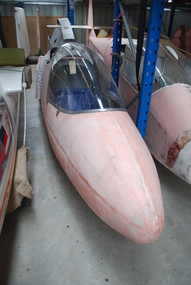
Machine - Glider – Sailplane, 1960s
... Italy and France. The design was a development of the M100 incorporating changes to fit the international rules for “Standard” class competition gliders: thus the designation “S”. ...Italy and France. The design was a development of the M100 incorporating changes to fit the international rules for “Standard” class competition gliders: thus the designation “S”. ...The Morelli M-100S 15 metre Italian sailplane first flew in 1960 and over 220 were built in Italy and France. The design was a development of the M100 incorporating changes to fit the international rules for “Standard” class competition gliders: thus the designation “S”. The name applied to the M-100 gliders built in France was “Mesange” This example has undergone major restoration to display condition by Museum volunteers. In the main the airframe is made up of the glider serial number 69 formerly registered in Australia as VH-GUD. The restoration incorporated parts of another wrecked M100 (serial number 71). VH-GUD was previously owned by Darling Downs Soaring Club (from 28 October 1967) and Beaudesert Gliding Club (from 30 October 1971). It was test flown in Australia on 28 October 1967 and logged 1533 hours 41 minutes from 2731 launches until it crashed and was wrecked on 11 February 1978. When completely restored to display standard this exhibit will be a representative example of the Morelli M100 sailplane type Single seat sailplane of wooden construction with plywood and aircraft fabric covering.Serial Number 69australian gliding, glider, sailplane, morelli, m-100s, mesange, aeromere and avionautica rio, darling downs soaring club, beaudesert gliding club -
 National Wool Museum
Poster, Costumes of Europe in Wool- Italy
... "Costumes of Europe in Wool- Italy" - Dept of Education, International Wool Secretariat, part of the "Costumes of Europe in Wool" Series...."Costumes of Europe in Wool- Italy" - Dept of Education, International Wool Secretariat, part of the "Costumes of Europe in Wool" Series....Wool Marketing International Wool Secretariat Dept of Education Prepared by the Department of Education, International Wool Secretariat, Dorland House, 18-20 Regent St London "Costumes of Europe in Wool- Italy" - Dept of Education, International Wool Secretariat, part of the "Costumes of Europe in Wool" Series. ..."Costumes of Europe in Wool- Italy" - Dept of Education, International Wool Secretariat, part of the "Costumes of Europe in Wool" Series."Costumes of Europe in Wool- Italy" - Dept of Education, International Wool Secretariat, part of the "Costumes of Europe in Wool" Series.Prepared by the Department of Education, International Wool Secretariat, Dorland House, 18-20 Regent St Londonwool marketing, international wool secretariat, dept of education -
 Robin Boyd Foundation
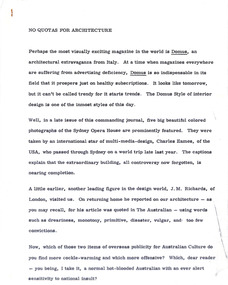
Document - Manuscript, Robin Boyd, No Quotas for Architecture, c1969
... Discusses 'Domus' (an Italian architecture and design magazine) as visually exciting and trend starter; compares recent international opinions on Australian architecture and culture (Charles Eames on Sydney Opera House, J. ...Discusses 'Domus' (an Italian architecture and design magazine) as visually exciting and trend starter; compares recent international opinions on Australian architecture and culture (Charles Eames on Sydney Opera House, J. ...Discusses 'Domus' (an Italian architecture and design magazine) as visually exciting and trend starter; compares recent international opinions on Australian architecture and culture (Charles Eames on Sydney Opera House, J. M. Richards on Australian architecture as primitive and vulgar). Boyd indicates international opinions of Australian architecture as important because many Australian buildings are being designed by overseas architects; argues for greater promotion of Australian architecture and architects.Typewritten (c copy), quarto, 5 pagesLast page: no image attached but this inscription "caption to illustration"; appears that Boyd wanted image of St James Building, AMP Tower and Shell House by Skidmore, Owings & Merrill attached.domus, sydney opera house, charles eames, jm richards, australian culture, globalisation, robin boyd, manuscript -
 Bayside Gallery - Bayside City Council Art & Heritage Collection
Painting - oil on linen, Stieg Persson, Duck and quail eggs, Italian herbs, 2015
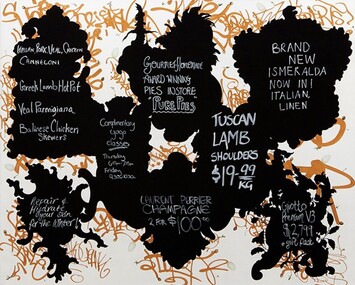
... international art world. Persson’s work is celebrated for his distinct (yet eclectic) style, which consists of elements associated with abstraction, figuration and decorative art, as well as the artist’s deeply intellectual interrogation of Australian culture and society. In this work titled, Duck and quail eggs, Italian...international art world. Persson’s work is celebrated for his distinct (yet eclectic) style, which consists of elements associated with abstraction, figuration and decorative art, as well as the artist’s deeply intellectual interrogation of Australian culture and society. In this work titled, Duck and quail eggs, Italian ...With a career spanning over 30 years as a painter, Stieg Persson is a well known figure within the Australian and international art world. Persson’s work is celebrated for his distinct (yet eclectic) style, which consists of elements associated with abstraction, figuration and decorative art, as well as the artist’s deeply intellectual interrogation of Australian culture and society. In this work titled, Duck and quail eggs, Italian herbs, Persson reflects on contemporary parallels in changes of taste and the desire for decadence as a political and social drive. Inspired by Brighton’s iconic Church and Bay Streets, the artist addresses the social currency of luxury and high-end cuisine by depicting rococo style blackboards which offer the latest in fine dining, alcohol, exercise classes, skin treatments and lavish linens. Persson is presenting a subtle critique of the contemporary obsession with food; as contemporary society places greater significance on the connoisseurship of eating, it does so in lieu of engagement with culture as it is traditionally conceived (music, theatre, literature and art).oil on linenstieg persson, brighton, signage, graffiti, food, chalkboard, bayside, painting -
 National Wool Museum
Functional object - Auctioneer's Gavel, c. 1950s
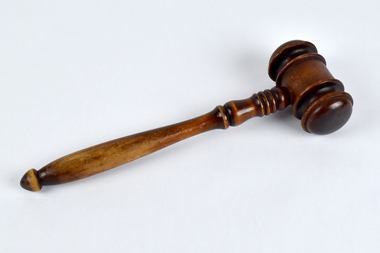
... The bidders represented the Japanese firm Aoki International and Loro Piana of Italy. The hammer fell at 1,030,000 cents per kilogram, with Aoki International paying $1,194,800 for the 116kg bale. ...The bidders represented the Japanese firm Aoki International and Loro Piana of Italy. The hammer fell at 1,030,000 cents per kilogram, with Aoki International paying $1,194,800 for the 116kg bale. ...Michael Crooks was the auctioneer responsible for selling Australia's million dollar wool bale on the 11th January, 1995 in Geelong, using this gavel. The wool was shorn from sheep of the Wyndarra and Rockbank bloodlines. A flock of 290 sheep were kept undercover at Kadinia, the property of the Appledore family from Brim in the Wimmera district of Victoria. Their record-breaking wool was produced by giving the sheep a special diet and providing each one with a UV-protective coat. Around 180 fleeces were selected for the million dollar bale. The sale of the first bale of wool measuring below 14 microns was held in the Auction Room here at the National Wool Museum. Bidding began at 40,000 (cents a kilogram) and steadily increased until there were only two bidders left. The bidders represented the Japanese firm Aoki International and Loro Piana of Italy. The hammer fell at 1,030,000 cents per kilogram, with Aoki International paying $1,194,800 for the 116kg bale. The fleece was scoured (cleaned) at the Goulburn Wool Scour, New South Wales. The degree of preparation and care taken with the task was extreme. The Scour closed production three days before and was extensively cleaned. On the day of scouring 12 tonnes of 17 micron wool was washed to condition the water, then nine bales of extra super fine wool, worth over $300,000 was washed as a trial run. Toabo Agaki Japan was employed to process the scoured wool into suit cloth. Taobo required the scoured wool to contain 0.5% residual grease, 12% moisture and a yield of 83kg. These requirements were met. The entire staff of the Scour wanted to be part of washing the best wool in the world. Without asking for payment both the night shift and afternoon shift crews assisted the day shift in the task. The bale was fed into the scour in seven minutes and fitted into three bowls, half the scour. It completely disappeared into the dryer and the last wool was fed before the first wool was out. The clean wool was hand-packed into cardboard cartons and freighted to Japan. Aoki International, based in Yokohama Japan, cut three suit lengths from the cloth, then blended the remaining wool into an exclusive line of commercially-available suits. These suits are labelled Kadinia.Small wooden hammer, with handle and double sided face.gavel, michael crooks, auctioneer, wool industry, million dollar bale, geelong, auction, kadinia, appledore -
 National Wool Museum
Photograph - Armed Guards with Million Dollar Bale, 11 January 1995
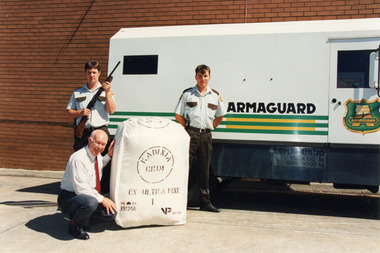
... The bidders represented the Japanese firm Aoki International and Loro Piana of Italy. The hammer fell at 1,030,000 cents per kilogram, with Aoki International paying $1,194,800 for the 116kg bale. ...The bidders represented the Japanese firm Aoki International and Loro Piana of Italy. The hammer fell at 1,030,000 cents per kilogram, with Aoki International paying $1,194,800 for the 116kg bale. ...This photograph shows armed guards and Wool Manager Keith Jackson posing with the million dollar wool bale after it was sold by auctioneer Michael Crooks on the 11th January, 1995 in Geelong. The wool was shorn from sheep of the Wyndarra and Rockbank bloodlines. A flock of 290 sheep were kept undercover at Kadinia, the property of the Appledore family from Brim in the Wimmera district of Victoria. Their record-breaking wool was produced by giving the sheep a special diet and providing each one with a UV-protective coat. Around 180 fleeces were selected for the million dollar bale. The sale of the first bale of wool measuring below 14 microns was held in the Auction Room here at the National Wool Museum. Bidding began at 40,000 (cents a kilogram) and steadily increased until there were only two bidders left. The bidders represented the Japanese firm Aoki International and Loro Piana of Italy. The hammer fell at 1,030,000 cents per kilogram, with Aoki International paying $1,194,800 for the 116kg bale. The fleece was scoured (cleaned) at the Goulburn Wool Scour, New South Wales. The degree of preparation and care taken with the task was extreme. The Scour closed production three days before and was extensively cleaned. On the day of scouring 12 tonnes of 17 micron wool was washed to condition the water, then nine bales of extra super fine wool, worth over $300,000 was washed as a trial run. Toabo Agaki Japan was employed to process the scoured wool into suit cloth. Taobo required the scoured wool to contain 0.5% residual grease, 12% moisture and a yield of 83kg. These requirements were met. The entire staff of the Scour wanted to be part of washing the best wool in the world. Without asking for payment both the night shift and afternoon shift crews assisted the day shift in the task. The bale was fed into the scour in seven minutes and fitted into three bowls, half the scour. It completely disappeared into the dryer and the last wool was fed before the first wool was out. The clean wool was hand-packed into cardboard cartons and freighted to Japan. Aoki International, based in Yokohama Japan, cut three suit lengths from the cloth, then blended the remaining wool into an exclusive line of commercially-available suits. These suits are labelled Kadinia.Colour photograph showing three men with a bale of wool in front of an armaguard truck. Two of the men are armed guards standing either side of the wool bale, one is holding a shotgun. Another man in a suit and tie is crouching near the bale.gavel, michael crooks, auctioneer, wool industry, million dollar bale, geelong, auction, kadinia, appledore, keith jackson, armed guards, armaguard -
 National Wool Museum
Photograph - Sale Room, National Wool Centre, Geelong, 11 January 1995
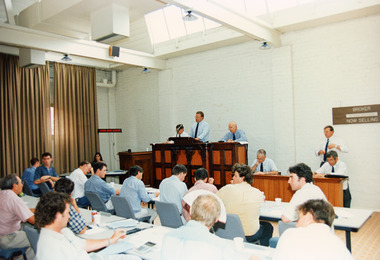
... The bidders represented the Japanese firm Aoki International and Loro Piana of Italy. The hammer fell at 1,030,000 cents per kilogram, with Aoki International paying $1,194,800 for the 116kg bale. ...The bidders represented the Japanese firm Aoki International and Loro Piana of Italy. The hammer fell at 1,030,000 cents per kilogram, with Aoki International paying $1,194,800 for the 116kg bale. ...This photograph shows bidding underway for the million dollar bale in the Sale Room on the 11th January, 1995 at the National Wool Centre, Geelong. People depicted include Sale Team Baxter Murray, Auctioneer Michael Crooks and Wool Manager Keith Jackson. The wool was shorn from sheep of the Wyndarra and Rockbank bloodlines. A flock of 290 sheep were kept undercover at Kadinia, the property of the Appledore family from Brim in the Wimmera district of Victoria. Their record-breaking wool was produced by giving the sheep a special diet and providing each one with a UV-protective coat. Around 180 fleeces were selected for the million dollar bale. The sale of the first bale of wool measuring below 14 microns was held in the Auction Room here at the National Wool Museum. Bidding began at 40,000 (cents a kilogram) and steadily increased until there were only two bidders left. The bidders represented the Japanese firm Aoki International and Loro Piana of Italy. The hammer fell at 1,030,000 cents per kilogram, with Aoki International paying $1,194,800 for the 116kg bale. The fleece was scoured (cleaned) at the Goulburn Wool Scour, New South Wales. The degree of preparation and care taken with the task was extreme. The Scour closed production three days before and was extensively cleaned. On the day of scouring 12 tonnes of 17 micron wool was washed to condition the water, then nine bales of extra super fine wool, worth over $300,000 was washed as a trial run. Toabo Agaki Japan was employed to process the scoured wool into suit cloth. Taobo required the scoured wool to contain 0.5% residual grease, 12% moisture and a yield of 83kg. These requirements were met. The entire staff of the Scour wanted to be part of washing the best wool in the world. Without asking for payment both the night shift and afternoon shift crews assisted the day shift in the task. The bale was fed into the scour in seven minutes and fitted into three bowls, half the scour. It completely disappeared into the dryer and the last wool was fed before the first wool was out. The clean wool was hand-packed into cardboard cartons and freighted to Japan. Aoki International, based in Yokohama Japan, cut three suit lengths from the cloth, then blended the remaining wool into an exclusive line of commercially-available suits. These suits are labelled Kadinia.Colour photograph showing an interior view of people seated at rows of tables with an auctioneers stand at front of the room.michael crooks, auctioneer, wool industry, million dollar bale, geelong, auction, kadinia, appledore, keith jackson, sale room -
 National Wool Museum
Photograph - Appledore Family, Growers Gallery, National Wool Centre, Geelong, 11 January 1995
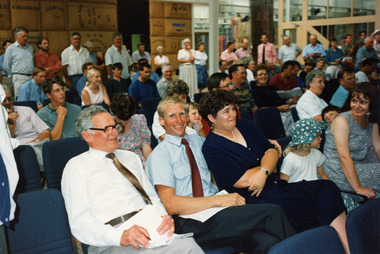
... The bidders represented the Japanese firm Aoki International and Loro Piana of Italy. The hammer fell at 1,030,000 cents per kilogram, with Aoki International paying $1,194,800 for the 116kg bale. ...The bidders represented the Japanese firm Aoki International and Loro Piana of Italy. The hammer fell at 1,030,000 cents per kilogram, with Aoki International paying $1,194,800 for the 116kg bale. ...This photograph depicts people gathered in the Growers Gallery on the 11th January, 1995 at the National Wool Centre, Geelong. It shows the emotions of Murray, Ian and Kaye Appledore while bidding took place for the million dollar bale. The wool was shorn from sheep of the Wyndarra and Rockbank bloodlines. A flock of 290 sheep were kept undercover at Kadinia, the property of the Appledore family from Brim in the Wimmera district of Victoria. Their record-breaking wool was produced by giving the sheep a special diet and providing each one with a UV-protective coat. Around 180 fleeces were selected for the million dollar bale. The sale of the first bale of wool measuring below 14 microns was held in the Auction Room here at the National Wool Museum. Bidding began at 40,000 (cents a kilogram) and steadily increased until there were only two bidders left. The bidders represented the Japanese firm Aoki International and Loro Piana of Italy. The hammer fell at 1,030,000 cents per kilogram, with Aoki International paying $1,194,800 for the 116kg bale. The fleece was scoured (cleaned) at the Goulburn Wool Scour, New South Wales. The degree of preparation and care taken with the task was extreme. The Scour closed production three days before and was extensively cleaned. On the day of scouring 12 tonnes of 17 micron wool was washed to condition the water, then nine bales of extra super fine wool, worth over $300,000 was washed as a trial run. Toabo Agaki Japan was employed to process the scoured wool into suit cloth. Taobo required the scoured wool to contain 0.5% residual grease, 12% moisture and a yield of 83kg. These requirements were met. The entire staff of the Scour wanted to be part of washing the best wool in the world. Without asking for payment both the night shift and afternoon shift crews assisted the day shift in the task. The bale was fed into the scour in seven minutes and fitted into three bowls, half the scour. It completely disappeared into the dryer and the last wool was fed before the first wool was out. The clean wool was hand-packed into cardboard cartons and freighted to Japan. Aoki International, based in Yokohama Japan, cut three suit lengths from the cloth, then blended the remaining wool into an exclusive line of commercially-available suits. These suits are labelled Kadinia.Colour photograph showing an interior view of rows of people seated and standing in room.michael crooks, auctioneer, wool industry, million dollar bale, geelong, auction, kadinia, appledore, keith jackson, sale room -
 National Wool Museum
Photograph - Million Dollar Bale, National Wool Centre, Geelong, 11 January 1995
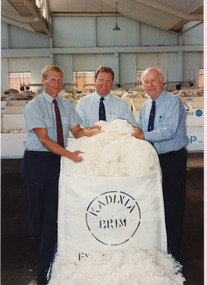
... The bidders represented the Japanese firm Aoki International and Loro Piana of Italy. The hammer fell at 1,030,000 cents per kilogram, with Aoki International paying $1,194,800 for the 116kg bale. ...The bidders represented the Japanese firm Aoki International and Loro Piana of Italy. The hammer fell at 1,030,000 cents per kilogram, with Aoki International paying $1,194,800 for the 116kg bale. ...This photograph shows Grower Ian Appledore, Auctioneer Michael Crooks and Wool Manager Keith Jackson posing with the million dollar bale after it was sold on 11th January 1995 in Geelong. The wool was shorn from sheep of the Wyndarra and Rockbank bloodlines. A flock of 290 sheep were kept undercover at Kadinia, the property of the Appledore family from Brim in the Wimmera district of Victoria. Their record-breaking wool was produced by giving the sheep a special diet and providing each one with a UV-protective coat. Around 180 fleeces were selected for the million dollar bale. The sale of the first bale of wool measuring below 14 microns was held in the Auction Room here at the National Wool Museum. Bidding began at 40,000 (cents a kilogram) and steadily increased until there were only two bidders left. The bidders represented the Japanese firm Aoki International and Loro Piana of Italy. The hammer fell at 1,030,000 cents per kilogram, with Aoki International paying $1,194,800 for the 116kg bale. The fleece was scoured (cleaned) at the Goulburn Wool Scour, New South Wales. The degree of preparation and care taken with the task was extreme. The Scour closed production three days before and was extensively cleaned. On the day of scouring 12 tonnes of 17 micron wool was washed to condition the water, then nine bales of extra super fine wool, worth over $300,000 was washed as a trial run. Toabo Agaki Japan was employed to process the scoured wool into suit cloth. Taobo required the scoured wool to contain 0.5% residual grease, 12% moisture and a yield of 83kg. These requirements were met. The entire staff of the Scour wanted to be part of washing the best wool in the world. Without asking for payment both the night shift and afternoon shift crews assisted the day shift in the task. The bale was fed into the scour in seven minutes and fitted into three bowls, half the scour. It completely disappeared into the dryer and the last wool was fed before the first wool was out. The clean wool was hand-packed into cardboard cartons and freighted to Japan. Aoki International, based in Yokohama Japan, cut three suit lengths from the cloth, then blended the remaining wool into an exclusive line of commercially-available suits. These suits are labelled Kadinia.Colour photograph showing three men standing around a bale of wool.michael crooks, auctioneer, wool industry, million dollar bale, geelong, auction, kadinia, appledore, keith jackson, sale room, geelong wool centre -
 National Wool Museum
Photograph - Million Dollar Bale, National Wool Centre, Geelong, Gordon Robertson, 11 January 1995
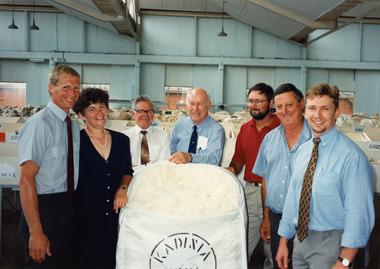
... The bidders represented the Japanese firm Aoki International and Loro Piana of Italy. The hammer fell at 1,030,000 cents per kilogram, with Aoki International paying $1,194,800 for the 116kg bale. ...The bidders represented the Japanese firm Aoki International and Loro Piana of Italy. The hammer fell at 1,030,000 cents per kilogram, with Aoki International paying $1,194,800 for the 116kg bale. ...This photograph shows Growers Ian Appledore, Kaye Appledore and Murray Appledore, Wool Manager Keith Jackson, Wool Classer Phillip Gibson, Geoff Allibon and Brendan Dart posing with the million dollar bale after it was sold on 11th January 1995 in Geelong. The wool was shorn from sheep of the Wyndarra and Rockbank bloodlines. A flock of 290 sheep were kept undercover at Kadinia, the property of the Appledore family from Brim in the Wimmera district of Victoria. Their record-breaking wool was produced by giving the sheep a special diet and providing each one with a UV-protective coat. Around 180 fleeces were selected for the million dollar bale. The sale of the first bale of wool measuring below 14 microns was held in the Auction Room here at the National Wool Museum. Bidding began at 40,000 (cents a kilogram) and steadily increased until there were only two bidders left. The bidders represented the Japanese firm Aoki International and Loro Piana of Italy. The hammer fell at 1,030,000 cents per kilogram, with Aoki International paying $1,194,800 for the 116kg bale. The fleece was scoured (cleaned) at the Goulburn Wool Scour, New South Wales. The degree of preparation and care taken with the task was extreme. The Scour closed production three days before and was extensively cleaned. On the day of scouring 12 tonnes of 17 micron wool was washed to condition the water, then nine bales of extra super fine wool, worth over $300,000 was washed as a trial run. Toabo Agaki Japan was employed to process the scoured wool into suit cloth. Taobo required the scoured wool to contain 0.5% residual grease, 12% moisture and a yield of 83kg. These requirements were met. The entire staff of the Scour wanted to be part of washing the best wool in the world. Without asking for payment both the night shift and afternoon shift crews assisted the day shift in the task. The bale was fed into the scour in seven minutes and fitted into three bowls, half the scour. It completely disappeared into the dryer and the last wool was fed before the first wool was out. The clean wool was hand-packed into cardboard cartons and freighted to Japan. Aoki International, based in Yokohama Japan, cut three suit lengths from the cloth, then blended the remaining wool into an exclusive line of commercially-available suits. These suits are labelled Kadinia.Colour photograph showing three six men and one woman standing around a bale of wool.michael crooks, auctioneer, wool industry, million dollar bale, geelong, auction, kadinia, appledore, keith jackson, sale room, geelong wool centre -
 National Wool Museum
Document - Victorian Producers' Sale Catalogue, National Wool Centre, Geelong, Victorian Producers' Co-operative Limited, 11 January 1995
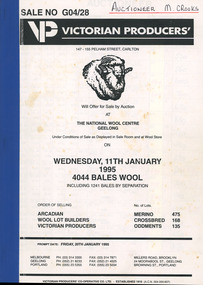
... The bidders represented the Japanese firm Aoki International and Loro Piana of Italy. The hammer fell at 1,030,000 cents per kilogram, with Aoki International paying $1,194,800 for the 116kg bale. ...The bidders represented the Japanese firm Aoki International and Loro Piana of Italy. The hammer fell at 1,030,000 cents per kilogram, with Aoki International paying $1,194,800 for the 116kg bale. ...This sales catalogue was the one used by Auctioneer Michael Crooks on 11th January 1995 when the million dollar bale was sold at the National Wool Centre, Geelong. The wool was shorn from sheep of the Wyndarra and Rockbank bloodlines. A flock of 290 sheep were kept undercover at Kadinia, the property of the Appledore family from Brim in the Wimmera district of Victoria. Their record-breaking wool was produced by giving the sheep a special diet and providing each one with a UV-protective coat. Around 180 fleeces were selected for the million dollar bale. The sale of the first bale of wool measuring below 14 microns was held in the Auction Room here at the National Wool Museum. Bidding began at 40,000 (cents a kilogram) and steadily increased until there were only two bidders left. The bidders represented the Japanese firm Aoki International and Loro Piana of Italy. The hammer fell at 1,030,000 cents per kilogram, with Aoki International paying $1,194,800 for the 116kg bale. The fleece was scoured (cleaned) at the Goulburn Wool Scour, New South Wales. The degree of preparation and care taken with the task was extreme. The Scour closed production three days before and was extensively cleaned. On the day of scouring 12 tonnes of 17 micron wool was washed to condition the water, then nine bales of extra super fine wool, worth over $300,000 was washed as a trial run. Toabo Agaki Japan was employed to process the scoured wool into suit cloth. Taobo required the scoured wool to contain 0.5% residual grease, 12% moisture and a yield of 83kg. These requirements were met. The entire staff of the Scour wanted to be part of washing the best wool in the world. Without asking for payment both the night shift and afternoon shift crews assisted the day shift in the task. The bale was fed into the scour in seven minutes and fitted into three bowls, half the scour. It completely disappeared into the dryer and the last wool was fed before the first wool was out. The clean wool was hand-packed into cardboard cartons and freighted to Japan. Aoki International, based in Yokohama Japan, cut three suit lengths from the cloth, then blended the remaining wool into an exclusive line of commercially-available suits. These suits are labelled Kadinia.Bound paper booklet, approximately 35 pages, with printed and handwritten text.Front: [handwritten] AUCTIONEER M. CROOKS Front: [printed] SALE NO G04/28 / VICTORIAN PRODUCERS' / 147-155 PELHAM STREET, CARLTON / Will Offer for Sale by Auction / AT / THE NATIONAL WOOL CENTRE / GEELONG / Under Conditions of Sale as Displayed in Sale Room and at Wool Store / ON / WEDNESDAY, 11TH JANUARY / 1995 / 4044 BALES WOOL / INCLUDING 1241 BALES BY SEPARATIONmichael crooks, auctioneer, wool industry, million dollar bale, geelong, auction, kadinia, appledore, keith jackson, sale room, geelong wool centre -
 National Wool Museum
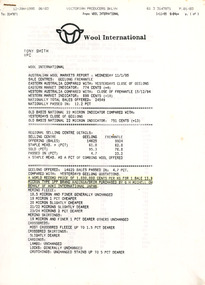
Document - Australian Wool Markets Report, Wool International, 11 January 1995
... The bidders represented the Japanese firm Aoki International and Loro Piana of Italy. The hammer fell at 1,030,000 cents per kilogram, with Aoki International paying $1,194,800 for the 116kg bale. ...The bidders represented the Japanese firm Aoki International and Loro Piana of Italy. The hammer fell at 1,030,000 cents per kilogram, with Aoki International paying $1,194,800 for the 116kg bale. ...Australian Wool Markets Report, featuring details of the sale of the million dollar bale on Wednesday 11th January, 1995 in Geelong. The wool was shorn from sheep of the Wyndarra and Rockbank bloodlines. A flock of 290 sheep were kept undercover at Kadinia, the property of the Appledore family from Brim in the Wimmera district of Victoria. Their record-breaking wool was produced by giving the sheep a special diet and providing each one with a UV-protective coat. Around 180 fleeces were selected for the million dollar bale. The sale of the first bale of wool measuring below 14 microns was held in the Auction Room here at the National Wool Museum. Bidding began at 40,000 (cents a kilogram) and steadily increased until there were only two bidders left. The bidders represented the Japanese firm Aoki International and Loro Piana of Italy. The hammer fell at 1,030,000 cents per kilogram, with Aoki International paying $1,194,800 for the 116kg bale. The fleece was scoured (cleaned) at the Goulburn Wool Scour, New South Wales. The degree of preparation and care taken with the task was extreme. The Scour closed production three days before and was extensively cleaned. On the day of scouring 12 tonnes of 17 micron wool was washed to condition the water, then nine bales of extra super fine wool, worth over $300,000 was washed as a trial run. Toabo Agaki Japan was employed to process the scoured wool into suit cloth. Taobo required the scoured wool to contain 0.5% residual grease, 12% moisture and a yield of 83kg. These requirements were met. The entire staff of the Scour wanted to be part of washing the best wool in the world. Without asking for payment both the night shift and afternoon shift crews assisted the day shift in the task. The bale was fed into the scour in seven minutes and fitted into three bowls, half the scour. It completely disappeared into the dryer and the last wool was fed before the first wool was out. The clean wool was hand-packed into cardboard cartons and freighted to Japan. Aoki International, based in Yokohama Japan, cut three suit lengths from the cloth, then blended the remaining wool into an exclusive line of commercially-available suits. These suits are labelled Kadinia.Three pages held with staple in top left corner with printed black text.Front: [printed] Wool International / TONY SMITH / VPC / WOOL INTERNATIONAL / AUSTRALIAN WOOL MARKETS REPORT: WEDNESDAY 11/1/95michael crooks, auctioneer, wool industry, million dollar bale, geelong, auction, kadinia, appledore, keith jackson, sale room, geelong wool centre -
 National Wool Museum
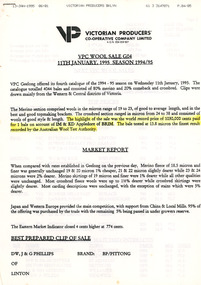
Document - Victorian Producers' Market Report, Victorian Producers' Co-operative Limited, 11 January 1995
... The bidders represented the Japanese firm Aoki International and Loro Piana of Italy. The hammer fell at 1,030,000 cents per kilogram, with Aoki International paying $1,194,800 for the 116kg bale. ...The bidders represented the Japanese firm Aoki International and Loro Piana of Italy. The hammer fell at 1,030,000 cents per kilogram, with Aoki International paying $1,194,800 for the 116kg bale. ...Victorian Producers Market Report, featuring details of the sale of the million dollar bale on Wednesday 11th January, 1995 in Geelong. The wool was shorn from sheep of the Wyndarra and Rockbank bloodlines. A flock of 290 sheep were kept undercover at Kadinia, the property of the Appledore family from Brim in the Wimmera district of Victoria. Their record-breaking wool was produced by giving the sheep a special diet and providing each one with a UV-protective coat. Around 180 fleeces were selected for the million dollar bale. The sale of the first bale of wool measuring below 14 microns was held in the Auction Room here at the National Wool Museum. Bidding began at 40,000 (cents a kilogram) and steadily increased until there were only two bidders left. The bidders represented the Japanese firm Aoki International and Loro Piana of Italy. The hammer fell at 1,030,000 cents per kilogram, with Aoki International paying $1,194,800 for the 116kg bale. The fleece was scoured (cleaned) at the Goulburn Wool Scour, New South Wales. The degree of preparation and care taken with the task was extreme. The Scour closed production three days before and was extensively cleaned. On the day of scouring 12 tonnes of 17 micron wool was washed to condition the water, then nine bales of extra super fine wool, worth over $300,000 was washed as a trial run. Toabo Agaki Japan was employed to process the scoured wool into suit cloth. Taobo required the scoured wool to contain 0.5% residual grease, 12% moisture and a yield of 83kg. These requirements were met. The entire staff of the Scour wanted to be part of washing the best wool in the world. Without asking for payment both the night shift and afternoon shift crews assisted the day shift in the task. The bale was fed into the scour in seven minutes and fitted into three bowls, half the scour. It completely disappeared into the dryer and the last wool was fed before the first wool was out. The clean wool was hand-packed into cardboard cartons and freighted to Japan. Aoki International, based in Yokohama Japan, cut three suit lengths from the cloth, then blended the remaining wool into an exclusive line of commercially-available suits. These suits are labelled Kadinia.Two pages held with staple in top left corner with printed black text.Front: [printed] VP / VICTORIAN PRODUCERS' / CO-OPERATIVE COMPANY LIMITED / A. C. N. 004 059 607 / VPC WOOL SALE G04 / 11TH JANUARY, 1995 SEASON 1994/95michael crooks, auctioneer, wool industry, million dollar bale, geelong, auction, kadinia, appledore, keith jackson, sale room, geelong wool centre -
 National Wool Museum
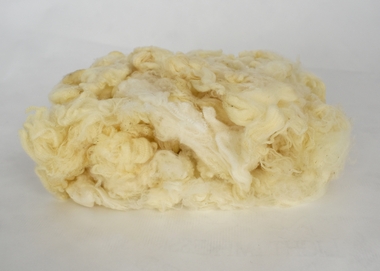
Million Dollar Bale Wool Sample, 1995
... The bidders represented the Japanese firm Aoki International and Loro Piana of Italy. The hammer fell at $10,300/kg, with Aoki International paying $1,194,800 for the 116kg bale. ...The bidders represented the Japanese firm Aoki International and Loro Piana of Italy. The hammer fell at $10,300/kg, with Aoki International paying $1,194,800 for the 116kg bale. ...The wool was shorn from sheep of the Wyndarra and Rockbank bloodlines. A flock of 290 sheep were kept undercover at Kadinia, the property of the Appledore family from Brim in the Wimmera district of Victoria. Their record-breaking wool was produced by giving the sheep a special diet and providing each one with a UV-protective coat. Around 180 fleeces were selected for the million dollar bale. The sale of the first bale of wool measuring below 14 microns was held in the Auction Room here at the National Wool Museum. Bidding began at $600/kg and steadily increased until there were only two bidders left. The bidders represented the Japanese firm Aoki International and Loro Piana of Italy. The hammer fell at $10,300/kg, with Aoki International paying $1,194,800 for the 116kg bale. The fleece was scoured (cleaned) at the Goulburn Wool Scour, New South Wales. The degree of preparation and care taken with the task was extreme. The Scour closed production three days before and was extensively cleaned. On the day of scouring 12 tonnes of 17 micron wool was washed to condition the water, then nine bales of extra super fine wool, worth over $300,000 was washed as a trial run. Toabo Agaki Japan was employed to process the scoured wool into suit cloth. Taobo required the scoured wool to contain 0.5% residual grease, 12% moisture and a yield of 83kg. These requirements were met. The entire staff of the Scour wanted to be part of washing the best wool in the world. Without asking for payment both the night shift and afternoon shift crews assisted the day shift in the task. The bale was fed into the scour in seven minutes and fitted into three bowls, half the scour. It completely disappeared into the dryer and the last wool was fed before the first wool was out. The clean wool was hand-packed into cardboard cartons and freighted to Japan. Aoki International, based in Yokohama Japan, cut three suit lengths from the cloth, then blended the remaining wool into an exclusive line of commercially-available suits. These suits are labeled Kadinia.Wool sample from the Million Dollar Balewool sales, million dollar bale -
 Sunshine and District Historical Society Incorporated
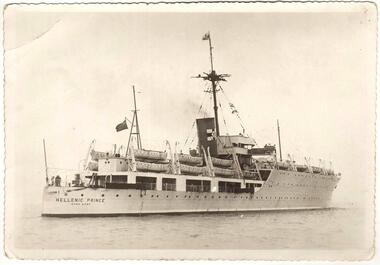
Photograph - Hellenic Prince Ship, Copy 27/01/2014 - (Original Post Card circa 1950)
... International Refugee Organisation to transport displaced persons from Europe to Australia. Its first trip was to Sydney where it arrived with 1000 passengers on 5 December 1949. On the third trip it left Naples on 23 March 1950, and arrived in Fremantle on 20 April 1950, and in Melbourne on 25 April 1950. The men and women were separated for the voyage with my father sleeping on a hammock in a large room with other men, while my mother, my brother, and I had bunks in a shared cabin. On board were displaced persons ex Bagnoli Camp Italy...International Refugee Organisation to transport displaced persons from Europe to Australia. Its first trip was to Sydney where it arrived with 1000 passengers on 5 December 1949. On the third trip it left Naples on 23 March 1950, and arrived in Fremantle on 20 April 1950, and in Melbourne on 25 April 1950. The men and women were separated for the voyage with my father sleeping on a hammock in a large room with other men, while my mother, my brother, and I had bunks in a shared cabin. On board were displaced persons ex Bagnoli Camp Italy ...In 1949 the HELLENIC PRINCE with its 3 hospitals, 2 cinemas, and air conditioned accommodation was chartered by the International Refugee Organisation to transport displaced persons from Europe to Australia. Its first trip was to Sydney where it arrived with 1000 passengers on 5 December 1949. On the third trip it left Naples on 23 March 1950, and arrived in Fremantle on 20 April 1950, and in Melbourne on 25 April 1950. The men and women were separated for the voyage with my father sleeping on a hammock in a large room with other men, while my mother, my brother, and I had bunks in a shared cabin. On board were displaced persons ex Bagnoli Camp Italy, some of whom later built their bungalows on the grassy and rocky paddocks near Sunshine Victoria, and began to establish a new life in a new country. A few of the families that arrived on the third trip and purchased land in the Dunkeld Ave - Sandford Ave area of North Sunshine (Birmingham Estate) were Janczak, Kolanowicz, Mroz, Pawlak, Rasztabiga, Skrobalak, Szydlowski, Witkowski, and Zielinski. Some friends settled elsewhere in Sunshine. The family Tabaka went to West Sunshine just over the Derby Rd Bridge, while the family Wojcik went to Ardeer. The ship first started service in 1929 for the Royal Australian Navy as the HMAS ALBATROSS. It had a standard displacement of 4,800 tons and was 443 feet 7 inches (135.2 metres) long, and its top speed during trials reached 22 knots (41 km/hr). It was built at Cockatoo Island Dockyard as Australia's first Aircraft Carrier (seaplanes), but the aircraft that it was designed for were retired just before the ship went into service. A new plane specifically designed to work with the Albatross began operations after the ship was decommissioned in 1933, and placed into reserve in Sydney Harbour. Seaplanes continued to operate from the anchored ship. (Click on the Link 'HMAS Albatross (1)' situated above the Object Registration number to view pictures of the HMAS Albatross on the Navy web site). In 1938 the ship was recommissioned and transferred to the Royal Navy as part payment for the light cruiser Hobart. The ship then did military service for the Royal Navy during World War 2. It did patrol and escort duties in the southern Atlantic, and from mid 1942 in the Indian Ocean. By early 1944 the ship was converted so that it could repair landing craft and other support vessels off Sword and Juno beaches. The ship managed to return 132 craft into service and to save 79 others from total loss. On 11 August 1944 Albatross was torpedoed with the loss of either 50 or 66 personnel, but was able to be towed back to Portsmouth. After repairs she did a short service as a minesweeper depot ship, and following that was placed into reserve on 3 August 1945. In August 1946 the ship was sold for commercial use but the plans to convert it into a luxury liner or a floating cabaret fell through. The ship was again sold on 14 November 1948 to the British-Greek Yannoulatos Group, who renamed it HELLENIC PRINCE in recognition of the birth of Prince Charles and his Greek heritage. After conversion into a passenger ship the Hellenic Prince made several trips to Australia transporting displaced persons, however apparently not all trips were pleasant for the passengers. In the on board newsletter 'Kangaroo' dated 5 January 1951, the ship's master P. C. King expressed his indignation about the behaviour of passengers and made accusations of mutiny. According to some immigrants the conditions were appalling and overcrowded with 1200 passengers. Passengers were supposedly required to work and were paid with Woodbine cigarettes. The drinking water ran out, the freezer broke down, and fresh food that was brought on board went to the crew. Sea sickness was rife because the ship was rarely level due to malfunctioning pumps. (The newsletter 'Kangaroo' can be viewed at the Museum Victoria web site by clicking the Link 'Newsletter - Kangaroo'). In 1953 during the Mau Mau uprising the Hellenic Prince was used to transport troops to Kenya, and in 1954 the ship came to an end in a scrap yard at Hong Kong. THE ABOVE INFORMATION WAS COMPILED FROM; (1) http://en.wikipedia.org/wiki/HMAS_Albatross_(1928) (accessed 11/2/2013), (2) An article by Graeme Andrews found at http://www.afloat.com.au/afloat-magazine/2011/july-2011/The_boat_people_of_the _forties_and_fifties#.UuYY6ou4apo (accessed 27/1/14), (3) http://museumvictoria.com.au/collections/items/273166/newsletter-kangaroo-hellenic-prince-5-jan-1951 (accessed 27/1/14), (4) National Archive search starting at; www.naa.gov.au/collection/search/index.aspx (accessed 27/1/14), (5) http://www.flickr.com/photos/41311545@N05/3864781978 (accessed 29/1/14). Hellenic Prince has a significance to Sunshine Victoria because some of the displaced people from Europe, who arrived in Melbourne on Anzac Day 1950, were among the first people to settle in the grassy and rocky paddock areas of North Sunshine. These settlers established a residential suburban area out of the paddocks. In those early days there were no services and the planned roads were basically just drawings on a map. The ship is also significant because it was named in recognition of the birth of Prince Charles. In the ship's former life as the HMAS Albatross the significance is that it was built in Australia as our country's first Aircraft Carrier (seaplanes).New photograph made from a scanned copy of a circa 1950 Post Card featuring the ship on calm water.Hellenic Prince / Hong Konghellenic prince, migrant ship, displaced persons, refugees, international refugee organisation, bagnoli camp, hmas albatross, yannoulatos group -
 Sunshine and District Historical Society Incorporated
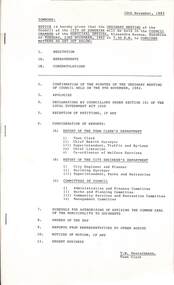
Administrative record - City of Sunshine - Commissioner Mr Alexander Alex George Gillon Collection 1976 - 1982 - Notice of Ordinary Meeting 16th November 1982, City of Sunshine, 16th November 1982
... Ordinary meeting notice including reports from Council's officers Report of the Town Clerk's Department Report of the Town Clerk Accounts for Payment as at 25th October 1982 Statistical Report for Year October 1981 to September 1992 Proposed Discontinuance of Right of Way Beside 36 Clyde Street Maidstone Telephone Number Metropolitan Fire Brigade Acquisition Chaplin Reserve Community Facility Sunshine West United Nations Association of Australia Possible Membership Salvation Army Western Region Advisory Committee Council Representation Open Space Area Maribyrnong Valley Meeting Dates 1993 Proposal to Close Part of Service Street Sealing of General Rate Year Ending 30th September 1983 Use of Council Facilities Saturday 4th December 1982 Sunshine International Women's Year Action Group Discontinuance of Right of Way Between Lewin Street and Robinsons Road South Side of Ballarat Road Deer Park Discontinuance of Right of Way Between Hamilton Street, Burnside Street, Christie Street and Tulloch Street Deer Park Report of Chief Health Surveyor Registration of Premises Health Act Transfer of Premises Health Act Prosecution Proceedings Sunshine Magistrate Court Delivery of Advertising Material / Junk mail Health Act Registration Fees Report of the Medical Officer of Health Report of the Superintendent Traffic and By-Laws Dog Act Traffic and Parking Infringements Court Proceedings Proposed Procession Italian Festival Deer Park Parking Infringements Increase In Penalties Report of the Chief Librarian Children's Pre-Christmas workshops Report of the Co-Ordinator of Welfare Services Multi-Cultural Senior Citizens' Club of West Sunshine Registration and Maintenance Subsidy Showers Street Housing Commission Estate Furnishings Community Room Showers Street Housing Commission Estate Twin Tub Washing Machines Special Bus Emergency Foster Care Report of the City Engineer / Planner Western Suburbs Study Department of Planning Planning Permit Application Advertising Sign 35 Wright Street Planning Permit Application Extensions to Existing Abattoir Kalingra Road (Armbrook Siding) Brooklyn Melbourne Metropolitan Planning Scheme Amendment No 190 On Exhibition Planning Permit Application Extensions to Existing Premises Corner Hampstead Road and Mitchell Street Maidstone Plan of Proposed Strata Subdivision 35 Washington Street St. ...Albans Hampton Avenue Reid Street Albion Boral Resources Previously Albion Reid Glendenning Street Princes Highway Little Boundary Road Sommerville Road Sunshine Centre Plaza Shopping Centre Hampshire Road Ravenna Street Thompson Hall Krambrook Street Summers Street The Mews Ardeer Merrivale Avenue Tamar Drive Salvia Street Yallourn Street Forrest Street Ordinary meeting notice including reports from Council's officers Report of the Town Clerk's Department Report of the Town Clerk Accounts for Payment as at 25th October 1982 Statistical Report for Year October 1981 to September 1992 Proposed Discontinuance of Right of Way Beside 36 Clyde Street Maidstone Telephone Number Metropolitan Fire Brigade Acquisition Chaplin Reserve Community Facility Sunshine West United Nations Association of Australia Possible Membership Salvation Army Western Region Advisory Committee Council Representation Open Space Area Maribyrnong Valley Meeting Dates 1993 Proposal to Close Part of Service Street Sealing of General Rate Year Ending 30th September 1983 Use of Council Facilities Saturday 4th December 1982 Sunshine International Women's Year Action Group Discontinuance of Right of Way Between Lewin Street and Robinsons Road South Side of Ballarat Road Deer Park Discontinuance of Right of Way Between Hamilton Street, Burnside Street, Christie Street and Tulloch Street Deer Park Report of Chief Health Surveyor Registration of Premises Health Act Transfer of Premises Health Act Prosecution Proceedings Sunshine Magistrate Court Delivery of Advertising Material / Junk mail Health Act Registration Fees Report of the Medical Officer of Health Report of the Superintendent Traffic and By-Laws Dog Act Traffic and Parking Infringements Court Proceedings Proposed Procession Italian Festival Deer Park Parking Infringements Increase In Penalties Report of the Chief Librarian Children's Pre-Christmas workshops Report of the Co-Ordinator of Welfare Services Multi-Cultural Senior Citizens' Club of West Sunshine Registration and Maintenance Subsidy Showers Street Housing Commission Estate Furnishings Community Room Showers Street Housing Commission Estate Twin Tub Washing Machines Special Bus Emergency Foster Care Report of the City Engineer / Planner Western Suburbs Study Department of Planning Planning Permit Application Advertising Sign 35 Wright Street Planning Permit Application Extensions to Existing Abattoir Kalingra Road (Armbrook Siding) Brooklyn Melbourne Metropolitan Planning Scheme Amendment No 190 On Exhibition Planning Permit Application Extensions to Existing Premises Corner Hampstead Road and Mitchell Street Maidstone Plan of Proposed Strata Subdivision 35 Washington Street St. ...Ordinary meeting notice including reports from Council's officers Report of the Town Clerk's Department Report of the Town Clerk Accounts for Payment as at 25th October 1982 Statistical Report for Year October 1981 to September 1992 Proposed Discontinuance of Right of Way Beside 36 Clyde Street Maidstone Telephone Number Metropolitan Fire Brigade Acquisition Chaplin Reserve Community Facility Sunshine West United Nations Association of Australia Possible Membership Salvation Army Western Region Advisory Committee Council Representation Open Space Area Maribyrnong Valley Meeting Dates 1993 Proposal to Close Part of Service Street Sealing of General Rate Year Ending 30th September 1983 Use of Council Facilities Saturday 4th December 1982 Sunshine International Women's Year Action Group Discontinuance of Right of Way Between Lewin Street and Robinsons Road South Side of Ballarat Road Deer Park Discontinuance of Right of Way Between Hamilton Street, Burnside Street, Christie Street and Tulloch Street Deer Park Report of Chief Health Surveyor Registration of Premises Health Act Transfer of Premises Health Act Prosecution Proceedings Sunshine Magistrate Court Delivery of Advertising Material / Junk mail Health Act Registration Fees Report of the Medical Officer of Health Report of the Superintendent Traffic and By-Laws Dog Act Traffic and Parking Infringements Court Proceedings Proposed Procession Italian Festival Deer Park Parking Infringements Increase In Penalties Report of the Chief Librarian Children's Pre-Christmas workshops Report of the Co-Ordinator of Welfare Services Multi-Cultural Senior Citizens' Club of West Sunshine Registration and Maintenance Subsidy Showers Street Housing Commission Estate Furnishings Community Room Showers Street Housing Commission Estate Twin Tub Washing Machines Special Bus Emergency Foster Care Report of the City Engineer / Planner Western Suburbs Study Department of Planning Planning Permit Application Advertising Sign 35 Wright Street Planning Permit Application Extensions to Existing Abattoir Kalingra Road (Armbrook Siding) Brooklyn Melbourne Metropolitan Planning Scheme Amendment No 190 On Exhibition Planning Permit Application Extensions to Existing Premises Corner Hampstead Road and Mitchell Street Maidstone Plan of Proposed Strata Subdivision 35 Washington Street St. Albans Plan of Proposed Transfer Hampton Avenue Plan of Subdivision Reid Street Sunshine Boral Resources (Previously Albion Reid Pty Ltd) Glendenning Street Traffic Problems Half Cost Footpath and Kerb And Channel Various Locations Traffic Signals Linking On Princes Highway West From Little Boundary Road to Sommerville Road Parking Restrictions At Municipal Offices Grade Separated Pedestrian Crossings Sunshine Centre Plaza Shopping Centre Traffic Control Items Bus Shelter At Stop 45 Ashley Street Maidstone Melbourne And Metropolitan Tramway Board Neale Road / Station Road Proposes Traffic Signals No Standing Prohibition Load Limits Various Roads Half Cost Fencing 11 Ravenna Street St. Albans Thompson Hall Maidstone West Gate Bridge Charges City of Williamstown Report of the Building Surveyor Building Over Easement 26 Krambrook Street Sunshine West Building Over Easement 36 Summers Street Deer Park Building Over Easement 2 The Mews Ardeer Building Over Easement 18 Merrivale Avenue Sunshine West Building Over Easement 34 Summers Street Deer Park Building Over Easement 83 Tamar Drive St. Albans Building Over Easement 7 Salvia Street St. Albans Building Over Easement 28 Yallourn Street Ardeer Substandard Allotment Lot 62 Tulloch Street Deer Park Height of Fence 100 Ballarat Road Extension of Building Time 52B Forrest Street Sunshine Orders of the Day Planning Permit Application Restaurant and Take Away Food Ballarat Road Sunshine Planning Permit Application Consulting Rooms Main Road West St. Albans city of sunshine, alexander "alex" george gillon, clyde street, maidstone, chaplin reserve, anderson road, sunshine, maribyrnong valley, service street, ballarat road, deer park, lewin street, robinsons road, hamilton street, burnside street, christie street, tulloch street, multi-cultural senior citizens' club of west sunshine, showers street, braybrook, wright street, kalingra road, armbrook siding, tottenham, hampstead road, mitchell street, washington street, st. albans, hampton avenue, reid street, albion, boral resources, previously albion reid, glendenning street, princes highway, little boundary road, sommerville road, sunshine centre plaza shopping centre, hampshire road, ravenna street, thompson hall, krambrook street, summers street, the mews, ardeer, merrivale avenue, tamar drive, salvia street, yallourn street, forrest street -
 Kew Historical Society Inc
Footwear - Pair of Leather Court Shoes with Polka Dot Bows, Mario Valentino, 1970s–1980s
... Mario Valentino was founded in Naples in 1952. international fashion women's shoes court shoes mario valentino Label: "MARIO VALENTINO / MADE IN ITALY" Pair of leather women’s court shoes, manufactured by Mario Valentino of Italy. ...The extensive fashion and design collection of the Kew Historical Society has been assembled over a number of decades. One subsection of this collection is shoes, designed and manufactured for Australian women by Australian and European designers. Many of the shoes, while often mass-produced, were generally constructed by skilled artisans using traditional shoe-making techniques. Mario Valentino was founded in Naples in 1952.Pair of leather women’s court shoes, manufactured by Mario Valentino of Italy. The yellow leather shoes have a cream leather insole and decorative white leather bows with black polka dots. This pair of shoes reflects the playfully structural styles of the late 1970s and 1980s. Label: "MARIO VALENTINO / MADE IN ITALY"international fashion, women's shoes, court shoes, mario valentino
