
Showing 22 items matching " international (south africa)"
-
 Women's Art Register
Archive (Collection) - Florence Fuller Artist Archive
... ... International (South Africa...1867-1946 Portraiture International (South Africa UK) Royal Academy Royal Institute of Oil Painters Painting Watercolour Archive Florence Fuller Artist Archive ...portraiture, international (south africa, uk), royal academy, royal institute of oil painters, painting, watercolourportraiture, international (south africa, uk), royal academy, royal institute of oil painters, painting, watercolour -
Women's Art Register
Archive (Collection) - Zanele Muholi Artist Archive
... ... International (South Africa)...Gender Queer Body International (South Africa) Photography Archive Zanele Muholi Artist Archive ...gender, queer, body, international (south africa), photographygender, queer, body, international (south africa), photography -
Women's Art Register
Archive (Series) - Fuller, Florence. Artist File 1
... ... International (South Africa...Portraiture International (South Africa UK) Royal Academy Royal Institute of Oil Painters Painting Watercolour Foolscap white archival 4 flap folder or document wallet Archive Fuller, Florence. ...List of Images, Biographyportraiture, international (south africa, uk), royal academy, royal institute of oil painters, painting, watercolourportraiture, international (south africa, uk), royal academy, royal institute of oil painters, painting, watercolour -
Women's Art Register
Archive (Series) - Muholi, Zanele. Artist File 1
... ... International (South Africa)...Gender Queer Body International (South Africa) Photography Foolscap white archival 4 flap folder or document wallet Archive Muholi, Zanele. ...Promotional Materialgender, queer, body, international (south africa), photographygender, queer, body, international (south africa), photography -
Women's Art Register
Archive (Series) - Zanele Muholi. Duplicate File 1
... ... International (South Africa)...Photography Gender Queer Body International (South Africa) Foolscap manilla file Archive Zanele Muholi. ...Promotional Materialphotography, gender, queer, body, international (south africa)photography, gender, queer, body, international (south africa) -
Women's Art Register
Archive (Series) - Florence Fuller. Duplicate File 1
... ... International (South Africa...Painting Watercolour Portraiture International (South Africa UK) Royal Academy Royal Institute of Oil Painters Foolscap manilla file Archive Florence Fuller. ...List of Images, Biographypainting, watercolour, portraiture, international (south africa, uk), royal academy, royal institute of oil painterspainting, watercolour, portraiture, international (south africa, uk), royal academy, royal institute of oil painters -
 Ringwood and District Historical Society
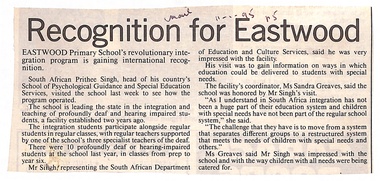
Newspaper, Eastwood Primary School, East Ringwood - Newspaper Clipping - 11-?-1995 - "Recognition for Eastwood"
... Summary: Eastwood Primary School’s integration program for profoundly deaf and hearing‑impaired students has attracted international attention. South African educator Prithee Singh, head of the School of Psychological Guidance and Special Education Services, visited to observe how the school includes integration students in regular classes with support from specialist teachers. ...Summary: Eastwood Primary School’s integration program for profoundly deaf and hearing‑impaired students has attracted international attention. South African educator Prithee Singh, head of the School of Psychological Guidance and Special Education Services, visited to observe how the school includes integration students in regular classes with support from specialist teachers. ...Summary: Eastwood Primary School’s integration program for profoundly deaf and hearing‑impaired students has attracted international attention. South African educator Prithee Singh, head of the School of Psychological Guidance and Special Education Services, visited to observe how the school includes integration students in regular classes with support from specialist teachers. The program, coordinated by Sandra Greaves, has become a state leader in inclusive education. Singh praised the facility and sought insight into transitioning from segregated schooling to a system that meets the needs of all children, leaving impressed by Eastwood’s approach.. (Co-Pilot Summary 4/7/2026). -
 The Beechworth Burke Museum
Geological specimen - Olivine with Chromian diopside (dark green), Unknown
... South America, and across Australia, Africa, Europe and Asia. Chromium-bearing Diopside is mined in Siberia, Russia and is sold as a commercial substitute for emeralds. The stone is often turned into jewellery. This item is one of many geological and mineral specimens that constitute a broader collection obtained from various regions across Australia (as well as some international locales) and generously contributed to the Burke Museum between 1868 and 1880. ...This specimen was donated in 1868 by Alfred Selwyn. Olivine is typically found in basic and ultra-basic igneous rocks around the world, in a variety of colours including yellowish green, olive green, greenish black and reddish brown with a transparent to translucent diaphaneity. The luster of the specimen is vitreous, the luminescence non-fluorescent and when fractured the mineral is very brittle producing small, conchoidal fragments. Chromian diopside is normally found in small sizes as the larger the size of the mineral the darker the colour is, almost black rather than green. Chromium is the element that gives chromian diopside and emeralds their rich green colour. Diopside is found across the world in multiple colours however gem-quality chromian diopside is mined in Siberia, Russia and prominent within the jewellery industry as a more affordable substitute to emeralds. Chromium-bearing diopside has been located across Australia. Chromium-bearing Diopside is located across the world found in North America, parts of South America, and across Australia, Africa, Europe and Asia. Chromium-bearing Diopside is mined in Siberia, Russia and is sold as a commercial substitute for emeralds. The stone is often turned into jewellery. This item is one of many geological and mineral specimens that constitute a broader collection obtained from various regions across Australia (as well as some international locales) and generously contributed to the Burke Museum between 1868 and 1880. A significant portion of these specimens originated from Victoria and were acquired as a result of the Geological Survey of Victoria, initiated in 1852 during the Gold Rush era. The primary objective of this survey was to investigate and chart the geological characteristics of Victoria. The procurement of geological specimens played a vital role in advancing our comprehension of the Earth's scientific composition and was instrumental in supporting research and educational institutions throughout Australia, including the Burke Museum, in their efforts to foster further exploration and study. A solid mineral specimen in shades of green, grey and brownburke museum, beechworth, geological, geological specimen -
 Lara RSL Sub Branch
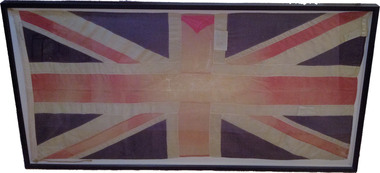
Flag, Australian Flag (Union Jack) 1900
... South Africa by 1229 Trooper Fredrick James Smith. Between 1899 and 1902, around 16,500 Australians served in South Africa during the Boer War. This was the largest international...South Africa by 1229 Trooper Fredrick James Smith. Between 1899 and 1902, around 16,500 Australians served in South Africa during the Boer War. This was the largest international ...There is a Union Jack brought back from South Africa by 1229 Trooper Fredrick James Smith. Between 1899 and 1902, around 16,500 Australians served in South Africa during the Boer War. This was the largest international deployment of troops from the Australian Colonies before Australian Federation. Of the 16,500 men who served in South Africa, 606 were killed in action or died of diseases. The Australian War Memorial records that the fighting conditions in South Africa extremely hard on men and horses. Australians fighting in South Africa were doing so as part of Colony based Regiments such as the Victorian Mounted Rifles, New South Wales Lancers, Queensland Mounted Infantry as well as units from the other states. Australians were awarded six Victoria Crosses during the campaign along with many other decorations. In May of 1902 the treaty of Vereeniging was signed officially ending the Boer War. The Boer War is commemorated in many Towns and Cities around Australia. The Lara RSL Sub Branch holds some memorabilia from the Boer War. There is a Union Jack brought back from South Africa by 1229 Trooper Fredrick James Smith. He was a resident of Lara and was a member of the 5th Victorian Mounted Rifles. It was reported that he carried this flag into battle. The Lara RSL also holds the flag staff of the China, South African and Old Veterans Association. Both these items are of national significance. Both the flag and flag staff were used in marches in Geelong each year until 1916 when Anzac Day commenced. The flag and flag staff were donated to the Lara RSL sub Branch when he joined in 1928. Fredrick James Smith was born at Lara in 1879, the son of Mr/Mrs Smith from Lara. He was a farm hand from Horton Vale, Anakie when he joined F Company of the 5th Victorian Mounted Rifles at the beginning of February 1901. Two weeks later, he left for South Africa on the 15th February. Before leaving, he purchased the flag from W. Libby & Son Geelong. Frederick Left for South Africa on the 15 February 1901 on the Orient. He saw service between March 1901 - March 1902 in east Transvaal and Natal frontier under the British Major General S. Beatson then Pulteney, including the defeat at Wilmansrust where 18 soldiers were killed and 42 wounded (12th June 1901 - heaviest casualties of any Australian contingent,); and the successful intervention at Onverwacht on the 4th January 1902. The 5th Victorian Mounted Rifles suffered: 36 killed or died of wounds, 13 died of disease of a contingent of 46 Officers, 971 Other Ranks and 1099 horses. They returned to Australia on the 26th April 1902 on the Custodian after sailing from Point Natal in South Africa on the 5th April. On his return, Tropper Smith (Saddler Private) joined the South African Soldiers Association of Victoria – Geelong Branch, and after 1928, he joined the Lara RSL. He was buried in Western Cemetery on the 19th June 1968 at the age of 89. Enrolled February 1901 Departed for South Africa on 15 February 1901 Establishment: 46 Officers, 971 Other Ranks with 1099 horses Mobilised at Pretoria: 24 March -- 4 April 1901 Typical company: 1 Captain, 4 Lieutenants, 1 company sergeant-major, 1 company quartermaster-sergeant, 1 sergeant-farrier, 1 sergeant-saddler, 5 sergeants, 6 corporals, 3 shoeing-smiths, 3 saddlers, 1 bugler, 99 privates. Total in company: 126 with 131 horses. Engagements: Rhenoster Kop, Klippan, Kornfontein, Drivelfontein, Wilmansrust, Kambuladraai, H'Lobane, Luchiel's Nek, Loch's Kraal, Vryheid, Onverwacht, Johnston Hoek Killed in action (or died): six Officers, 48 Other Ranks VC Winner: Lieut. L. C. Maygar News article Leader (Melbourne) Saturday 31st May 1902, page 42 - Dear Cinderella. — This is the second time I have written to you. I was very sorry at not seeing my first letter in "The Leader". But I hope to say, that this one will be in. The last time I wrote to you I told you that my brother (Fredrick Smith) went to the Boer War in South Africa, and that he was supposed to be killed in the Wilmansrust disaster. But this time I am going to tell you about his return, and the grand welcome he got from the residents of Lara. Mother, Father, and my Brother, went down to Melbourne, to meet the boat. You can just imagine how rejoiced we all were to see him back again. The railway station was decorated some thing beautiful with flags of all description all the colours you could think of. He has bought a lot of Boer curios home and some Kaffir bracelets. They are such funny looking things. The residents of Lara, also gave my brother a grand social and ball there were over four hundred people present, They presented him with a hand some gold chain, and locket suitably inscribed, and a pair of gold sleeve links, they were magnificent. The ball was very nice. . I had a few dances. I enjoyed myself grand. I think this is all I can tell you this time. I must conclude with love. I remain yours sincerely - BESSIE SMITH. Age 14-years. This flag is of national significance as it was used in the Boer War by Private Fredrick James Smith (SN:1229) of the 5th Victorian Mounted Rifles, F Company in their deployment to South Africa between 1901 and 1902. The flag was taken into the Wilmansrust engagement in which 19 soldiers died and 41 were wounded. On return to Australia, the flag was used in marches by the South Africa, China Old Veterans Association - Geelong. This flag represents a unique part of Australian history from which the movie, Breaker Morant was taken. It is of spiritual significance as the Boer War was where the first Australian received the Imperial Victoria Cross, and the spirit of Anzac was conceived, giving birth in World War 1. The Flag represents the spirit of Australians who fought and died in South Africa.Cotton Union Jack flag approx 221cm wide by 109cm tall with small repair patches and center section cotton deteriorated.Has the word "Lara" inscribed in black on bottom part of the flag heading. Has the flag makers name "W.Libby & Son" on the top part of the flag heading.boer war, union jack flag, south africa, wilmansrust, 5th victorian mounted rifles, f coy, private fredrick james smith, service number 1229, february 1901, april 1902, south africa china old veterans association -
 Flagstaff Hill Maritime Museum and Village
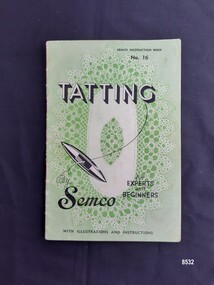
Book - Craft book, Norma Benporath, Tatting, circa 1940's
... South Africa as well as the U.K. and U.S.A. When Semco, a thread manufacturer, noticed a rise in the sale of fine crochet threads, they realized they had an untapped market to explore. Norma designed a collection of tatting patterns for Semco that were used to help promote their threads. Norma also worked with Semco to produce a line of threads and shuttles specifically suited to tatting. In 1997, Norma was inducted into the "Order of Australia" for "Service to the craft of tatting as a designer and through the international...South Africa as well as the U.K. and U.S.A. When Semco, a thread manufacturer, noticed a rise in the sale of fine crochet threads, they realized they had an untapped market to explore. Norma designed a collection of tatting patterns for Semco that were used to help promote their threads. Norma also worked with Semco to produce a line of threads and shuttles specifically suited to tatting. In 1997, Norma was inducted into the "Order of Australia" for "Service to the craft of tatting as a designer and through the international ...Tatting is a form of knotted lace making using thread and a small shuttle. Twisted threads are tied around or through small, pointed shuttles that can be made of bone, mother of pearl, tortoise shell, steel or plastic. This produces a stable, strong lace using simple knots of two half hitches to make rings and chains embellished with picots. The origins of tatting are not clear but early versions of decorative knotting were used by the Egyptians on their ceremonial dress. Tatting also has elements of fishermen's net making techniques and the decorative knotting that was practiced by aristocratic women from the 15th century. Tatting, as we know it today, emerged in the first half of the 19th century. The new availability of mercerised thread from 1835 encouraged a burgeoning of lace crafts of all sorts. It was known in Italy as "occhi" and in France as "la frivolite". Tatting looks fragile but is both strong and durable. An article in a column named "Wives and Daughters" published in the Star newspaper in May 1910 describes the durability of tatting lace - "there is edging and insertion still in existence that have outworn two sets of pillow slips." In the 19th century and well into the 20th century, tatting was used like crochet and knitted lace for decorative edgings, collars, doilies, tray cloths etc. At first, different tatting patterns were passed along by word of mouth from person to person, however in time, patterns regularly appeared in newspapers and magazines well into the 1950's. This book has photographs and detailed instructions for a wide range of tatted edgings and insertions suitable for household linens such as towels, doilies and tablecloths as well as patterns for whole mats. Stanley E. Mullen (a businessman) developed Semco Pty Ltd which began as a Melbourne based importation company in 1907. The first three letters of Semco's name were his initials. In 1915 it began manufacturing women's apparel, whitework and transfer patterns. In 1924 the company moved to Black Rock, Victoria and continued to produce an extensive range of needlework patterns and handcraft instruction booklets, threads etc. up until the late 1970's. Semco had a staff that included many young women. It was noted by E.J. Trait (editor of the local newspaper "Standard News") that the firm provided them with good working conditions and the correct rate of pay for women in a time of war - the starting rate for 15 year olds, mainly girls at Semco was 25 shillings per week. During World War 2, Manpower Regulations could be used to coerce workers to move into jobs that supported the war effort, but Trait argued that being employed at Semco could make this unlikely as the firm made some goods essential for the war effort. He even suggested that women be encouraged to produce needlework items (and play a part in the war effort) by sending them as presents, to the troops up north. He also heaped praise on the Semco workplace - noting that no Saturday work was the norm, allowing employees to shop and have "hair-do's" before enjoying a relaxing weekend! Semco also had a female cricket side in the women's Saturday association. After the war the firm stayed in production until the early 1990's when it was taken over by Coates-Paton Pty Ltd. Norma Benporath (1900 - 1998) was an expert in tatting techniques and taught and published extensively on the subject. She was born in New Zealand with impaired sight but cataract surgery restored 50% vision to one eye. She was inspired to learn tatting whilst watching her aunt tat and being told that tatting did not require as much sharp vision as embroidery. She quickly learnt to design her own patterns and published over 1000 tatted lace patterns between 1929 and 1952. She became a regular contributor to magazines (such as Home Beautiful) and newspapers across Australia. Her designs were also published in New Zealand, South Africa as well as the U.K. and U.S.A. When Semco, a thread manufacturer, noticed a rise in the sale of fine crochet threads, they realized they had an untapped market to explore. Norma designed a collection of tatting patterns for Semco that were used to help promote their threads. Norma also worked with Semco to produce a line of threads and shuttles specifically suited to tatting. In 1997, Norma was inducted into the "Order of Australia" for "Service to the craft of tatting as a designer and through the international publication of her patterns".This item is an excellent example of the needle work being enjoyed by women in the 1940's in Australia and the skills of the Australian designer, Norma Benporath. It is also an example of the trend that emerged for craft companies such as Semco to publish pattern books in order to advertise their own materials.A 32 page soft cover instruction book with green front and back covers showing two tatted doily designs. The book includes black and white photographs and written patterns by Norma Benporath.Front cover - "TATTING" "For / EXPERTS/ and / BEGINNERS" "By/Semco" "SEMCO INSTRUCTION BOOK" "No. 16" "WITH ILLUSTRATIONS AND INSTRUCTIONS" "9" Back cover - "FOR INSTRUCTIONS FOR WORKING SEE PAGE 22" "Published by Semco Pty. Ltd." "BLACK ROCK, 29, VIC"flagstaff hill maritime museum and village, warrnambool, great ocean road, tatting, tatting instruction book, tatting patterns, tatting shuttle, semco, semco pty ltd, norma benporath, needlework, handcrafts, household linen, craftwork -
 Orbost & District Historical Society
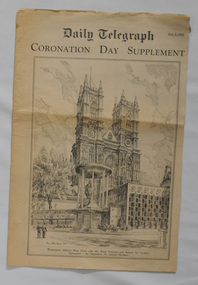
newspaper supplement, Coronation Day Supplement, June 2 1953
... internationally. It was founded by Arthur B. Sleigh in 1855 as The Daily Telegraph and Courier. The coronation of Queen Elizabeth II as monarch of the United Kingdom, Canada, Australia, New Zealand, the Union of South Africa, Pakistan, and Ceylon took place on 2 June 1953. ...internationally. It was founded by Arthur B. Sleigh in 1855 as The Daily Telegraph and Courier. The coronation of Queen Elizabeth II as monarch of the United Kingdom, Canada, Australia, New Zealand, the Union of South Africa, Pakistan, and Ceylon took place on 2 June 1953. ...The Daily Telegraph is a broadsheet newspaper published in London by Telegraph Media Group and distributed across the United Kingdom and internationally. It was founded by Arthur B. Sleigh in 1855 as The Daily Telegraph and Courier. The coronation of Queen Elizabeth II as monarch of the United Kingdom, Canada, Australia, New Zealand, the Union of South Africa, Pakistan, and Ceylon took place on 2 June 1953. Elizabeth ascended the throne at the age of 25, upon the death of her father, King George VI, on 6 February 1952, and was proclaimed queen by her various privy and executive councils shortly afterwards. The ceremony took place at Westminster Abbey. Celebrations took place and a commemorative medal was issued throughout the Commonwealth. Saving an item dedicated to the royal family is typical of the general feeling of respect and admiration felt by the rural communities towards the British Royal Family, especially towards Queen Elizabeth II.A supplement from the Daily Telegraph, June 2 1953, titled Coronation Day Supplement. On the front cover is a b/w picture of Westminster Abbey.newspaper-supplement-daily-telegraph coronation royal-family elizabeth-11 -
 Orbost & District Historical Society
newspaper supplement, Coronation Picture Supplement, June 3 1953
... internationally. It was founded by Arthur B. Sleigh in 1855 as The Daily Telegraph and Courier. This is the third supplement to the Daily Telegraph containing photographs and articles on the coronation of Queen Elizabeth 11. The coronation of Queen Elizabeth II as monarch of the United Kingdom, Canada, Australia, New Zealand, the Union of South Africa...internationally. It was founded by Arthur B. Sleigh in 1855 as The Daily Telegraph and Courier. This is the third supplement to the Daily Telegraph containing photographs and articles on the coronation of Queen Elizabeth 11. The coronation of Queen Elizabeth II as monarch of the United Kingdom, Canada, Australia, New Zealand, the Union of South Africa ...The Daily Telegraph is a broadsheet newspaper published in London by Telegraph Media Group and distributed across the United Kingdom and internationally. It was founded by Arthur B. Sleigh in 1855 as The Daily Telegraph and Courier. This is the third supplement to the Daily Telegraph containing photographs and articles on the coronation of Queen Elizabeth 11. The coronation of Queen Elizabeth II as monarch of the United Kingdom, Canada, Australia, New Zealand, the Union of South Africa, Pakistan, and Ceylon took place on 2 June 1953. On the 2nd June 1953, the coronation of Queen Elizabeth II took place and the commonwealth countries, including Australia joined in the celebration. Saving an item dedicated to the royal family is typical of the general feeling of respect and admiration felt by the rural communities towards the British Royal Family, especially towards Queen Elizabeth II.A 23 pp newspaper supplement from the Daily Telegraphdated June 3rd 1953. It is titled "Coronation Picture Supplement". On the front is a photo captioned The Duke Pays Homage.newspaper-supplement-daily-telegraph media-print royal-family coronation -
 Bendigo Historical Society Inc.
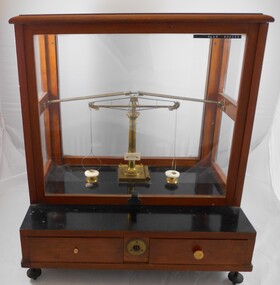
Tool - OERTLING SCALES IN GLASS CASE, 1898
... By 1851, the year of the Great International Exhibition of the Works of All Nations, Oertling had established his own instrument-making business, employed five instrument-makers and by 1861, ten staff were engaged in designing and making instruments, principally analytical balances. Oertling's first twin-column beam balance was the prototype for all Oertling assay balances that were produced during the next century and exported to the British colonies: Australia, New Zealand, Canada, South Africa and India, to Europe and America." ...By 1851, the year of the Great International Exhibition of the Works of All Nations, Oertling had established his own instrument-making business, employed five instrument-makers and by 1861, ten staff were engaged in designing and making instruments, principally analytical balances. Oertling's first twin-column beam balance was the prototype for all Oertling assay balances that were produced during the next century and exported to the British colonies: Australia, New Zealand, Canada, South Africa and India, to Europe and America." ...The Oertling beam balance scale was used in the Bendigo School of Mines assay laboratory. The manufacturer, Ludwig Oertling (1818-1893), was born near Hamburg and gained his apprenticeship in instrument-making with his brother Johann. He immigrated to London in 1840, where he joined instrument-maker and assayer George Makins (1815-1893). Oertling collaborated with Makins and built his first balance, which was "a twin-column assay type with a light lattice beam". By 1851, the year of the Great International Exhibition of the Works of All Nations, Oertling had established his own instrument-making business, employed five instrument-makers and by 1861, ten staff were engaged in designing and making instruments, principally analytical balances. Oertling's first twin-column beam balance was the prototype for all Oertling assay balances that were produced during the next century and exported to the British colonies: Australia, New Zealand, Canada, South Africa and India, to Europe and America." Reference: Powerhouse Collection - https://collection.powerhouse.com.au/object/550913 Brass beam balance made by Oertling, London in 1898. The scale is mounted on a wooden base board with a mahogany case, glass on four sides with two drawers underneath. On bottom of the left hand drawer, written in pencil, is the works number '21736'. A cursive 'L' on the same drawer bottom indicates 'left'. Also on bottom corner 'J.W. 28.2.98'. 'J.W' was John Wright, foreman and cabinet maker. He was Oertling’s longest working cabinet maker from1886-1928. In pencil underneath the right corner of the left drawer is '3/98'. Written in pencil inside the drawer cavity is 'E.C' in fancy script. This refers to 'Charlie Craig, employed as an instrument maker by the Oertling Company. The maker's name, "Oertling' is embossed on the base of the scale. There is a brass knob that fits in the front to make adjustments to the scales and also on either side of the exterior case to set the top of the scales. 21736, J.W. 28.2.98, E.C., 3/98mining, equipment, scales, ludwig oertling, beam balance, assay, bendigo school of mines and industry -
 Narre Warren and District Family History Group
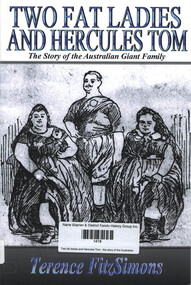
Book, Terence FitzSimons, Two fat ladies and Hercules Tom : the story of the Australian giant family, 2015
... internationally famous as "The Australian Giant Family" in the late 1800s. Discovered by Max Kreitmayer, the proprietor of Melbourne Waxworks, they toured the world, performing in America, Great Britain, South Africa, and beyond. ...Two Fat Ladies and Hercules Tom: The Story of the Australian Giant Family by Terence FitzSimons tells the fascinating tale of Clara, Anna, and Tom Snell, siblings from Gippsland, Australia, who became internationally famous as "The Australian Giant Family" in the late 1800s. Discovered by Max Kreitmayer, the proprietor of Melbourne Waxworks, they toured the world, performing in America, Great Britain, South Africa, and beyond. Their combined weight as adults exceeded half a ton, making them a spectacle of their time. The book also delves into their encounters with other famous performers, such as Jo-Jo the Dog-Faced Boy and Buffalo Bill, as well as the challenges they faced, including tensions with their father, William Snell, who managed their early careers. (AI generated)202 p.; 23 cmnon-fictionTwo Fat Ladies and Hercules Tom: The Story of the Australian Giant Family by Terence FitzSimons tells the fascinating tale of Clara, Anna, and Tom Snell, siblings from Gippsland, Australia, who became internationally famous as "The Australian Giant Family" in the late 1800s. Discovered by Max Kreitmayer, the proprietor of Melbourne Waxworks, they toured the world, performing in America, Great Britain, South Africa, and beyond. Their combined weight as adults exceeded half a ton, making them a spectacle of their time. The book also delves into their encounters with other famous performers, such as Jo-Jo the Dog-Faced Boy and Buffalo Bill, as well as the challenges they faced, including tensions with their father, William Snell, who managed their early careers. (AI generated)hercules tom, snell siblings, clara snell, anna snell, tom snell, australian giant family, max kreitmayer, melbourne waxworks -
 Warrnambool and District Historical Society Inc.
Medals, Baden Powell, Early 1900s
... South Africa during the Boer War for 217 days. Robert Baden Powell (1857-1941) was a British Army officer who served in India and Africa from 1876 to 1910. In 1907 he founded the Boy Scout movement, now an international...South Africa during the Boer War for 217 days. Robert Baden Powell (1857-1941) was a British Army officer who served in India and Africa from 1876 to 1910. In 1907 he founded the Boy Scout movement, now an international ...These medals were struck to commemorate the feat of Colonel Baden Powell who, with his troops, defended the town of Mafeking in South Africa during the Boer War for 217 days. Robert Baden Powell (1857-1941) was a British Army officer who served in India and Africa from 1876 to 1910. In 1907 he founded the Boy Scout movement, now an international organization for boys and with his sister Agnes, founded the Girl Guide movement, also now internationally established.These medals are of local interest as they commemorate Colonel Baden Powell’s heroics in defending in 1899-1900 the town of Mafeking in South Africa during the Boer War. The Relief of Mafeking was celebrated in Warrnambool in May 1900. .1 A bronze-coloured medal with an image of Colonel Baden Powell on one side and some descriptive text on the other. The medal has a metal ring at the top to attach the medal to a cord. .2 as .1 above except that the top metal ring is missing .1 Colonel Baden Powell Defender of Mafeking Relief of Mafeking May 1900 and Baden Powell The Hero Who Kept the Flag Flying For Over 215 Days .2 as .1 above colonel robert baden powell, boer war, relief of mafeking, history of warrnambool -
 Mont De Lancey
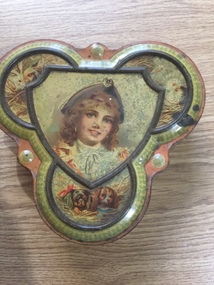
Tin, Swallow & Ariell, Ltd
... At the height of the South African war it employed 1900 workers but even in 1991 it employed 450 people. biscuit tins tins Inside the lid: "Swallow & Ariell, Ltd. Biscuit Manufacturers, Port Melbourne. Prizes received at all international ...Biscuit tin: late 19th century Swallow & Ariell operated continuously in Port Melbourne from 1858 to 1991. The former Swallow & Ariell’s factory buildings, now The Anchorage, continue to add interest and pleasure along Stokes, Rouse and Princes Streets. Thomas Swallow, born in Reading, travelled to California and Ballarat before setting up a business making ships biscuits in Port Melbourne. His business partner Ariell died in 1877. He then went into partnership with Frederick Derham, his son in law. Company farms around Shepparton provided much of its wheat, and after 1889 most was ground into flour on the Port Melbourne premises. For the year ending 1 May 1920, the factory used 51 tons of butter, 2,740 eggs and produced more than 66 lines of biscuits. They also made puddings, elaborate cakes and ice cream. S & A was a significant employer – locally referred to as S & A College. At the height of the South African war it employed 1900 workers but even in 1991 it employed 450 people.Pink and brown clover-shaped ornamental biscuit tin decorated with pictures of a girl (central panel), 2 dogs (lower section), 2 rabbits (upper left-side panel) and 2 birds (upper right-hand panel. It has floral designs around the outer edges of both the tin and the lid which is hinged at the top of the tin.Inside the lid: "Swallow & Ariell, Ltd. Biscuit Manufacturers, Port Melbourne. Prizes received at all international & inter-colonial exhibitions"biscuit tins, tins -
Disability Sport & Recreation Victoria
Newsletter, Paravics Newsletter Vol. 1 No. 12, May 1972 - Paraplegic and Quadriplegic Association of Victoria, May 1971
... international sporting competitions. Apart from its goal for advocating for greater sporting and recreation opportunities for disabled athletes, Paravics / Paraplegic and Quadriplegic Association of Victoria also sought to bring awareness and advocacy to the general needs of wheelchair bound persons. The newsletter, the first for 1972, includes numerous news items, including: - Notes from Dr Burke of the Austin Hospital's Spinal Unit, on a year-long of tour of overseas spinal centres, principally in South Africa...international sporting competitions. Apart from its goal for advocating for greater sporting and recreation opportunities for disabled athletes, Paravics / Paraplegic and Quadriplegic Association of Victoria also sought to bring awareness and advocacy to the general needs of wheelchair bound persons. The newsletter, the first for 1972, includes numerous news items, including: - Notes from Dr Burke of the Austin Hospital's Spinal Unit, on a year-long of tour of overseas spinal centres, principally in South Africa ...The Paravics Sports Club, now known as Disability Sport and Recreation Victoria, was formed in 1962 to help a group of eight athletes with disability compete in national and international sporting competitions. Apart from its goal for advocating for greater sporting and recreation opportunities for disabled athletes, Paravics / Paraplegic and Quadriplegic Association of Victoria also sought to bring awareness and advocacy to the general needs of wheelchair bound persons. The newsletter, the first for 1972, includes numerous news items, including: - Notes from Dr Burke of the Austin Hospital's Spinal Unit, on a year-long of tour of overseas spinal centres, principally in South Africa, France, United Kingdom, and the United States. Burke notes that based on his observations during tour, the standard and quality of treatment at the Austin for spinal injuries is "As good as anywhere in the world and in some respects the best, particularly that of early treatment after injury". Burke also notes the difference in attitudes between different countries in terms of research focus, equipment and technology, the use of sport as a rehabilitation tool for people with permanent spinal injuries, and staffing levels and education. - Job vacancies - News from the Quadriplegic Activities Group. - Information about various auxiliary groups and fundraising efforts. - News about members of the organisation. - A letter from Mrs D. Kendall about her efforts to improve the situation for disabled car drivers with regards to parking, and for providing wheelchairs to various venues for the purposes of providing access to such places as the Myer Music Bowl, parks, gardens, etc With the introduction of the metric system in Australia, Paravics attempted to use the adoption of the metric system for a fundraising campaign called "mark a metre", which included a poster attached to the newsletter.Three photocopied sheets (6 pages, double-sided), full-text.This newsletter contains six pages of news items.paravics sports club, disabled sports, wheelchair sport, mike jarrett, paraplegic and quadriplegic association of victoria -
 Wodonga & District Historical Society Inc
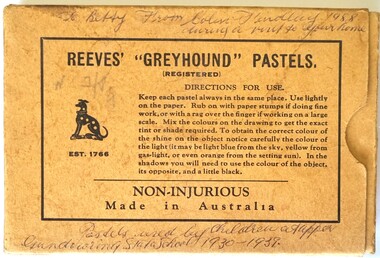
Functional object - Reeves' "Greyhound" Pastels
... Reeves continues to be a huge brand both in the United Kingdom and internationally, placed in over 70 countries worldwide including America, France, Germany, Italy, Japan, South Africa and Australia....Reeves continues to be a huge brand both in the United Kingdom and internationally, placed in over 70 countries worldwide including America, France, Germany, Italy, Japan, South Africa and Australia. ...This box of pastels was donated to the Wodonga & District Historical Society by Betty L. Barberis (nee Barton), a prominent artist. They were given to her by Mr Colin Findlay, the teacher at Upper Gundowring Primary School from 1930 to 1939. His students at that school and many others used these pastels each day. Reeves’ “Greyhound” business was originally established by William Reeves who opened his first shop near St Paul’s Cathedral in London, England in 1766. The greyhound crest was later adopted as their emblem, taken from the coat-of-arms of the extinct Ryves family of Dorset. It consisted of a black-seated greyhound spotted with gold. After William’s death, the business was carried out by his brother, in partnership with various businessmen. They sold a wide range of art supplies in England and their trade extended to supplying drawing instruments and stationery products to the East India Company in the early 1800s. In the 1920s the Greyhound Colour Works at Enfield became known especially for its famous Greyhound pastels. Reeves Greyhound products were also being made in Melbourne, Australia. They were marketed widely through schools in all States from the 1920s onwards. Reeves continues to be a huge brand both in the United Kingdom and internationally, placed in over 70 countries worldwide including America, France, Germany, Italy, Japan, South Africa and Australia.These pastels are significant because they were widely used in Victorian Schools and were donated to our Collection by a prominent local artist.A cardboard box with a corrugated cardboard to store 12 pastels. The pastels are held in a cardboard tray insert.REEVES' 'GREYHOUND" PASTELS (REGISTERED) Directions for use Non-INJURIOUS Made in Australia On each pastel: REEVES GREYHOUND reeves greyhound pastels, primary school art supplies, education 1930s, upper gundowring primary school, betty l. barberis -
 Falls Creek Historical Society
Poster - Kangaroo Hoppet 2021
... international audience. In 2021 plans were in place for the 30th anniversary of the Hoppet when it was again stopped due to COVID-19. A virtual Hoppet was put in place. It ran between 1st and 29th August 2021 and was again successful, with almost 1200 entrants. 31 countries and all Australian states and mainland territories were represented. Participants came from Argentina, Austria, Canada, Czechia, Dubai, Estonia, Finland, France, Germany, Iceland, India, Ireland, Israel, Italy, Japan, Malaysia, Netherlands, New Zealand, Norway, Russia, Slovakia, Slovenia, South Africa...international audience. In 2021 plans were in place for the 30th anniversary of the Hoppet when it was again stopped due to COVID-19. A virtual Hoppet was put in place. It ran between 1st and 29th August 2021 and was again successful, with almost 1200 entrants. 31 countries and all Australian states and mainland territories were represented. Participants came from Argentina, Austria, Canada, Czechia, Dubai, Estonia, Finland, France, Germany, Iceland, India, Ireland, Israel, Italy, Japan, Malaysia, Netherlands, New Zealand, Norway, Russia, Slovakia, Slovenia, South Africa ...The Kangaroo Hoppet is Australia’s premier long distance cross country ski race, and a member of the Worldloppet series of international cross country ski events. The first race at Falls Creek was held in 1979 under the name of “Australian Birkebeiner”. It was a 21km race with about 80 participants organised by the Birkebeiner Nordic Ski Club of Mount Beauty. The course started and finished at Falls Creek Alpine Resort and took participants out into the Bogong High Plains. After running the event for 10 years, it was decided they should become part of the Worldloppet series of marathon ski races. Representatives from the Birkebeiner Nordic Ski Club and the Australian Ski Federation attended the Worldloppet Annual Meeting in Finland in June 1990 to put the case for the acceptance of an Australian event into the Worldloppet series. Before being admitted, they had to demonstrate that the Birkebeiner Club could run a world class event, so three months later in August 1990 a 42km event named the Australian International Ski Marathon was held at Falls Creek together with a 21km Birkebeiner race and a 7km event called the Birkebeiner Lite. The event was approved by delegates from USA, Norway and Austria, in 1991 Australia became the 12th member of Worldloppet, with the condition that there had to be a name change. After some late night discussion allegedly involving red wine from North East Victoria the main event became the 42km Kangaroo Hoppet, with the minor events being the 21km Australian Birkebeiner, and 7km Joey Hoppet. In the winter of 1991, the first Kangaroo Hoppet was held. It was a great success and has been a regular fixture on the international ski calendar ever since. It features the main 42km event as well as a 21km event and a 7km event. The Hoppet brings the Australian snowfields to an international audience. In 2021 plans were in place for the 30th anniversary of the Hoppet when it was again stopped due to COVID-19. A virtual Hoppet was put in place. It ran between 1st and 29th August 2021 and was again successful, with almost 1200 entrants. 31 countries and all Australian states and mainland territories were represented. Participants came from Argentina, Austria, Canada, Czechia, Dubai, Estonia, Finland, France, Germany, Iceland, India, Ireland, Israel, Italy, Japan, Malaysia, Netherlands, New Zealand, Norway, Russia, Slovakia, Slovenia, South Africa, Spain, Sweden, Switzerland, UK and the USA.This poster is significant because it documents an event which brings international attention to Falls Creek and the surrounding region.A poster featuring two skiers heading into the distance. One skier has a race bib with 30 1991 - 2021 visible on his back. At the top is a circular emblem featuring a kangaroo looking through the middle of the number 30. It is surrounded by the words "KANGAROO HOPPET ANNIVERSARY 1991 - 2021". Logos of Worldloppet, AGL, Falls Creek, Alpine Shire Council, Victorian State Government, the Birkebeiner Nordic Ski Club, FIS, Community Bank Mount Beauty & District and KANGAROO HOPPET are across the bottom of the poster. In middle of image: AUSTRALIA'S PREMIER X-COUNTRY SKI RACE Between image and logos: 18 AUGUST 2021 FALLS CREEK AUSTRALIA 7 KM 21 KM 42 KM HOPPET.COM.AUkangaroo hoppet, worldloppet events, falls creek, mt. beauty -
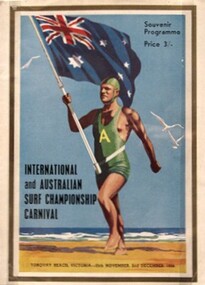 Torquay and District Historical Society
Programme - Souvenir Programme, International and Australian surf championship carnival, Torquay Beach, Victoria 25th November, 2nd December 1956, 1956
... In 1956 an international surfing competition was staged on Torquay Beach in conjunction with the Melbourne Olympics. A number of countries were invited including the USA and its Territory of Hawaii, New Zealand, South Africa, Ceylon, Great Britain. ...In 1956 an international surfing competition was staged on Torquay Beach in conjunction with the Melbourne Olympics. A number of countries were invited including the USA and its Territory of Hawaii, New Zealand, South Africa, Ceylon, Great Britain. ...In 1956 an international surfing competition was staged on Torquay Beach in conjunction with the Melbourne Olympics. A number of countries were invited including the USA and its Territory of Hawaii, New Zealand, South Africa, Ceylon, Great Britain. An international surf carnival was held on 25th November and Australian championships were held on 2nd December. Australia was represented by each state with the majority of teams coming from NSW (64), then Queensland (18), Victoria (12), South Australia (7), Western Australia (7) and Tasmania (3). The Victorian teams were Anglesea, Apollo Bay, Lorne, Ocean Grove, Point Leo, Point Lonsdale, Port Fairy, Portland, RAAF College, Sorrento/Portsea, Torquay and Warrnambool. Preparation for the carnivals was immense. The mouth of Spring Creek was diverted closer to the bluff to allow more sand area for the competitors. Forestry Commission tractors were brought to do the task and they also smoothed other sections of the beach and covered rocky areas. Wire fences were erected to enclose the spectators' area. VIPs who accepted to attend were Prime Minister R G Menzies, State Premier H E Bolte, High Commissioners of South Africa, Ceylon and New Zealand and the Ambassador of USA. International visitors included Rusty Millar USA Chief Lifeguard and Duke Kahanamoku. Australian VIPs included Andrew "Boy" Charlton who set five world swimming records and won three silver and one bronze Olympic medal. Special trains ran from Flinders St Station from 8.45am connecting with buses to Torquay. Torquay locals were called upon to volunteer as ushers, gatekeepers and for other event duties. Torquay SLSC entered 52 competitors across all events both junior and senior. 70,000 people attended the International Carnival. The Americans came with narrow fibre-glass surfboards which were much faster than the Australian boards. The reel and line method of rescue was a new concept to the Americans who wore a belt and carried a reel of line into the water and let it out as they swam to the patient. New Zealand won the march past and Hawaii won the beach relay and the board race. In the Australian Championships NSW won the rescue and resuscitation event and a Victorian (J Fountain, Lorne) won the belt race.108 page souvenir programme, colour cover. Colour, and black and white pages inside. surfing, surf life saving association of australia, torquay -
 Merri-bek City Council
Photograph - Ilford smooth pearl print, Atong Atem, Nyanluak, 2022
... South Sudanese diaspora in Australia – it is therefore important that members of this diaspora can see themselves represented in local public art collections, such as the Merri-bek Art Collection. Atem’s career is also experiencing rapid growth. Atem is currently included in Melbourne Now at the National Gallery of Victoria, a biennial exhibition that celebrates local and ambitious contemporary artists. She is also included in the Tate’s exhibition A World in Common: Contemporary African Photography (London), which demonstrates her growing international ... -
 Embroiderers Guild, Victoria
Artwork, other - South African Kaross Picture, Mavis Kaross, 20th C late
... South Africa/Mozambique and presented to Pam Breukhoven in friendship. Embroidery is a traditional skill for most Vatsonga and Northern Sotho people. Kaross revived this skill by making it commercially viable and has grown into a South African success story that now employs around 1300 embroiderers in the Letsitele/Giyani area. It produces a comprehensive range of premium quality products from placemats to cushion covers, handbags and wall hangings. These individual hand-crafted works of art retail through outlets in major tourist hubs such as our international...South Africa/Mozambique and presented to Pam Breukhoven in friendship. Embroidery is a traditional skill for most Vatsonga and Northern Sotho people. Kaross revived this skill by making it commercially viable and has grown into a South African success story that now employs around 1300 embroiderers in the Letsitele/Giyani area. It produces a comprehensive range of premium quality products from placemats to cushion covers, handbags and wall hangings. These individual hand-crafted works of art retail through outlets in major tourist hubs such as our international ...Made by Mavis Kaross people in South Africa/Mozambique and presented to Pam Breukhoven in friendship. Embroidery is a traditional skill for most Vatsonga and Northern Sotho people. Kaross revived this skill by making it commercially viable and has grown into a South African success story that now employs around 1300 embroiderers in the Letsitele/Giyani area. It produces a comprehensive range of premium quality products from placemats to cushion covers, handbags and wall hangings. These individual hand-crafted works of art retail through outlets in major tourist hubs such as our international airports, or direct to the public through the newly launched Kaross online shop.Irma van Rooyen, Founder of Kaross, says - the Tsonga people told me their stories and I became inspired. By their humanity, their space, their life - so utterly proud. By their eagerness to be involved and to be part of the project. These talented women and men, together, raised up the Kaross project from its beginning. And now, the drive to never give up, to keep on exploring and developing and growing. And learning to be stronger together. To you, whose path I am privileged to share, I owe my inspiration. The Tsonga people (Vatsonga) are a diverse Bantu ethnic group primarily inhabiting southern Mozambique, South Africa (Limpopo/Mpumalanga), and parts of Zimbabwe and Eswatini.Picture of a rhinoceros and a tree, stitched in perle threads, navy, rust, cream, blue, aqua, purple, green. Mounted in a frame (dark brown timber) and steel mount.MAVIS KAROSSembroidery
