

Historical information
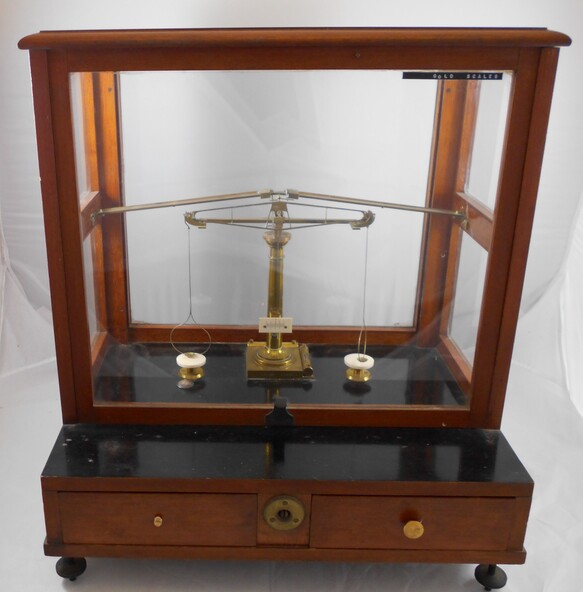
The Oertling beam balance scale was used in the Bendigo School of Mines assay laboratory. The manufacturer, Ludwig Oertling (1818-1893), was born near Hamburg and gained his apprenticeship in instrument-making with his brother Johann. He immigrated to London in 1840, where he joined instrument-maker and assayer George Makins (1815-1893). Oertling collaborated with Makins and built his first balance, which was "a twin-column assay type with a light lattice beam".
By 1851, the year of the Great International Exhibition of the Works of All Nations, Oertling had established his own instrument-making business, employed five instrument-makers and by 1861, ten staff were engaged in designing and making instruments, principally analytical balances.
Oertling's first twin-column beam balance was the prototype for all Oertling assay balances that were produced during the next century and exported to the British colonies: Australia, New Zealand, Canada, South Africa and India, to Europe and America."
Reference: Powerhouse Collection - https://collection.powerhouse.com.au/object/550913
Physical description
Brass beam balance made by Oertling, London in 1898. The scale is mounted on a wooden base board with a mahogany case, glass on four sides with two drawers underneath. On bottom of the left hand drawer, written in pencil, is the works number '21736'. A cursive 'L' on the same drawer bottom indicates 'left'. Also on bottom corner 'J.W. 28.2.98'. 'J.W' was John Wright, foreman and cabinet maker. He was Oertling’s longest working cabinet maker from1886-1928. In pencil underneath the right corner of the left drawer is '3/98'. Written in pencil inside the drawer cavity is 'E.C' in fancy script. This refers to 'Charlie Craig, employed as an instrument maker by the Oertling Company. The maker's name, "Oertling' is embossed on the base of the scale. There is a brass knob that fits in the front to make adjustments to the scales and also on either side of the exterior case to set the top of the scales.
Inscriptions & markings
21736, J.W. 28.2.98, E.C., 3/98
