
Showing 229 items matching " j. case"
-
 Port Melbourne Historical & Preservation Society
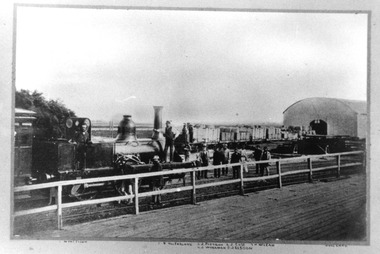
Photograph, Sandridge train, Jan 1862
... ...J CASE...W.Pattison, D MacFarlane, J Pattison, J Workman, J Case, J Elsdon, W McLean, Woolshed....W.Pattison, D MacFarlane, J Pattison, J Workman, J Case, J Elsdon, W McLean, Woolshed. Train at Sandridge January 1862, engine is "Kew". ...William PATTISON (1823-1895) was great grandfather of donor and driver of the first train at Sandridge, 1854. Digital image scanned from copy photograph & donated to the society by Keith PATTISON, great grandson of first Sandridge train driver then reclaimed for reproduction.Train at Sandridge January 1862, engine is "Kew". (No crack through this one).Details on back of copied photos. W.Pattison, D MacFarlane, J Pattison, J Workman, J Case, J Elsdon, W McLean, Woolshed.transport - railways, william pattison, j pattison, d macfarlane, j workman, j case, w mclean, james elsdon -
 Merbein District Historical Society
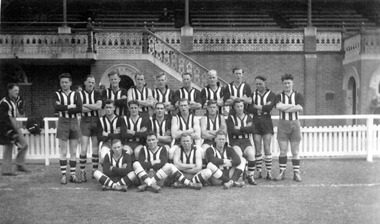
Photograph, Merbein Football Club Team, c.1949
... ... J. Case...Connelly B. McKay J. Case F. Millhouse D. Congress ? Blair N. ...a. connelly, b. mckay, j. case, f. millhouse, d. congress, ? blair, n. jamieson, ? blair, k. congress, l. herath, a. sylvia, c. chamberlain, g. masterson, f. lang, j. doherty, b. sylvia, a. krake, p. hudson, j. lang, bill o'donnell, gordon matheson, sport -
 Merbein District Historical Society
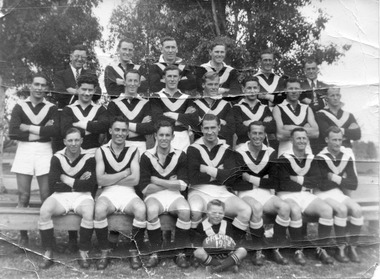
Photograph, Merbein Football Team (Premiers 1948), 1948
... ... J. Case...Masterson B. Hogan J. Case C. Hudson J. Lang R. Faulkhead J. Doherty R. ...o. gow, d. matheson, g. maynard, s. bennett, c. game, m. fletcher, f. lang, a. sylvia, n. jamieson, k. congress, m. blair, g. masterson, b. hogan, j. case, c. hudson, j. lang, r. faulkhead, j. doherty, r. ziersch, r. pike, j. mcphee -
 Merbein District Historical Society
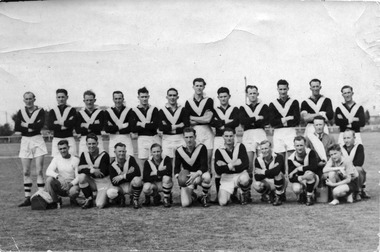
Photograph, Merbein Football Team at Nhill, 1947
... ... J. Case...Congress A. Sylvia J. Case R. McRae N. Jamieson R. Halls M. Fletcher L. ...m. ziersch, g. masterson, d. matheson, r. ziersch, c. chamberlain, f. lang, k. congress, a. sylvia, j. case, r. mcrae, n. jamieson, r. halls, m. fletcher, l. herath, r. pike, c. hudson, j. doherty, s. hemming, a. fletcher, j. mcphee, g. sylvia, a. driscoll -
 Merbein District Historical Society
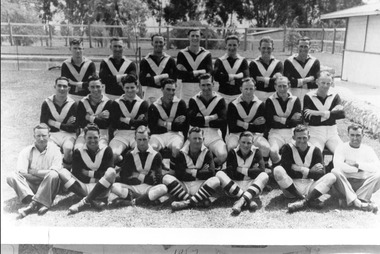
Photograph, Merbein Football Team, 1947
... ... J. Case...Hemming J. Doherty J. Case M. Ziersch J. Howie G. Sylvia L. Herath J. ...c. chamberlain, g. maynard, n. jamieson, k. congress, g. masterson, d. matheson, r. ziersch, f. lang, j. lang, a. sylvia, s. hemming, j. doherty, j. case, m. ziersch, j. howie, g. sylvia, l. herath, j. mcphee, r. pike, c. hudson, c. game, m. fletcher -
 Port Melbourne Historical & Preservation Society
Furniture - Display case from J Kitchen & Sons musuem, 1980s
... Display case from J Kitchen & Sons musuem...From the Kitchen's museum Furniture Display case from J Kitchen & Sons musuem ...Large glass and metal display case with front sliding glass doors, lockable. From the Kitchen's museumindustry - manufacturing, celebrations fetes and exhibitions, business and traders - soaps/candles, j kitchen & sons pty ltd -
 Merbein District Historical Society
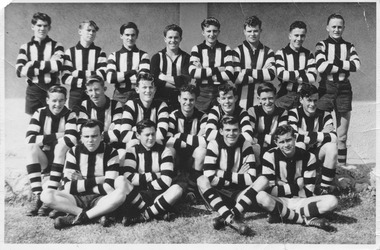
Photograph, Merbein Football Team, unknown
... ... W. J. (Bill) Case...Ian Griffiths Bernie McKay Merv Farnsworth Jim McSwain Ken Lindsay Les Thompson W. J. (Bill) Case Bill Fisher John Dorman Merbein Football Team Photograph ...ian griffiths, bernie mckay, merv farnsworth, jim mcswain, ken lindsay, les thompson, w. j. (bill) case, bill fisher, john dorman -
 Queenscliffe Maritime Museum
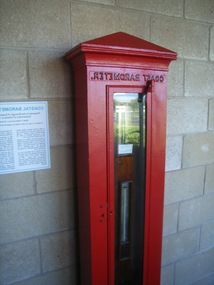
Instrument - Coastal Barometer, 1866
... Instrument: J Grimaldi, Case: Langlands Bros...J. Grimaldi - Instrument maker Langlands brothers Melbourne made the Cast Iron Case...case. Only one left in existance Coastal Barometer Queenscliffe Fishing Industry Instrument: J Grimaldi, Case: Langlands Bros Coastal Barometer No. 5 was installed on the Queenscliff pier in 1866. ...Coastal Barometer No. 5 was installed on the Queenscliff pier in 1866. The purpose was to provide weather data to the Professional Fisherman. It was later installed in the slipway winch shed. Instrument is housed in a cast iron case.Only one left in existanceCoastal Barometer No. 5 was installed on the Queenscliff pier in 1866. The purpose was to provide weather data to the Professional Fisherman. It was later installed in the slipway winch shed. Instrument is housed in a cast iron case.Instrument: J Grimaldi, Case: Langlands Broscoastal barometer, queenscliffe, fishing industry -
 Bendigo Historical Society Inc.
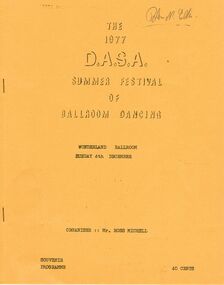
Document - PETER ELLIS COLLECTION: SUMMER FESTIVAL OF BALLROOM DANCING, 4th December, 1977
... ... J Bulger... G Case...Summer Festival of Ballroom Dancing Programme Ross Michell George Wanstall Doreen Holmes Norman Gonsal Graham Pike R Martin C Dove L Wanstall M Zoanetti R Bampton D Swift P Swift J Bulger G Case G Francis P Dorstyn R Turner G Alexander R Michell Cyril Short Stuart Bowshall D Bailey N McCormack A Laland L Turner D Gonsal J Stevens J English The 1977 D.A.S.A. ...The 1977 D.A.S.A. Summer Festival of Ballroom Dancing Programme. Held on the 4th December 1977. Program has typed pages and a yellow cover. Contained inside are the names of office bearers, a Christmas message, notices, rules, and the dance program. Peter Ellis written on the front cover.entertainment, dance, ballroom dancing, peter ellis collection, peter ellis, the 1977 d.a.s.a. summer festival of ballroom dancing programme, ross michell, george wanstall, doreen holmes, norman gonsal, graham pike, r martin, c dove, l wanstall, m zoanetti, r bampton, d swift, p swift, j bulger, g case, g francis, p dorstyn, r turner, g alexander, r michell, cyril short, stuart bowshall, d bailey, n mccormack, a laland, l turner, d gonsal, j stevens, j english -
Clunes Museum
accessory - SPECTACLES AND CASE, J. GILLMAN
... ON CASE - J. GILLMAN OPTICIAN CLUNES...local history personal effects seeing aids ON CASE - J. GILLMAN OPTICIAN CLUNES .1 SPECTACLES WITH SMALL OVAL LENSES AND FINE METAL FRAMES. .2 CASE -CARDBOARD WITH MAROON LEATHERETTE COVERING. accessory SPECTACLES AND CASE J. ....1 SPECTACLES WITH SMALL OVAL LENSES AND FINE METAL FRAMES. .2 CASE -CARDBOARD WITH MAROON LEATHERETTE COVERING.ON CASE - J. GILLMAN OPTICIAN CLUNESlocal history, personal effects, seeing aids -
 Dandenong/Cranbourne RSL Sub Branch
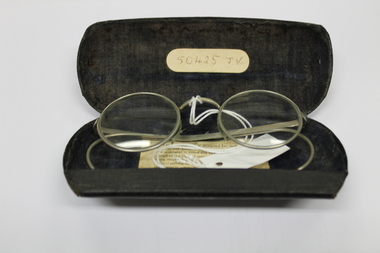
Memorabilia - Spectacles in black case. Medal Africa Star, Unknown. Possibly Circa WW1
... case. How to wear under respirator. Alpha B (inscribed on frame.) 50425 J V inside case....case. How to wear under respirator. Alpha B (inscribed on frame.) 50425 J V inside case. ...The spectacles and medal were owned by Joseph Vella. #50425 Born 8th May 1918. Enlisted with Territorial Army and served with the Kings Own Regiment in Africa and as a gunner in Malta.Stainless steel silver frame round glass spectacles. Black covered steel case. Africa Star Medal with ribbon.Instructions inside case. How to wear under respirator. Alpha B (inscribed on frame.) 50425 J V inside case. -
 Orbost & District Historical Society
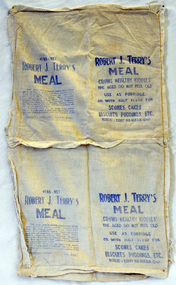
pillow case, c. 1930 - 1950
... The name of the porridge manufacturer is evident on the pillow case, Robert J Terry....The name of the porridge manufacturer is evident on the pillow case, Robert J Terry. pillow case ...Presumed to have been made by the family of Mrs. Jean Snow who donated this item. This is a classic example of the tradition of "making do" , of creating new uses for older items or bits of scrap. A pillow case made from four porridge bags which have been opened out and stitched together. The name of the porridge manufacturer is evident on the pillow case, Robert J Terry.Robert J Terry N D M B A N (Eng)pillow- case making-do depression-creativity -
 Bendigo Historical Society Inc.
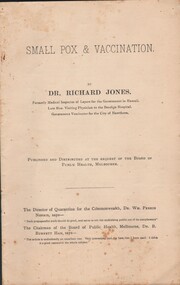
Book - HARRY BIGGS COLLECTION: SMALL POX AND VACCINATION, 25/03/1898 (letter)
... A photocopy of a letter relating to a list of Typhoid cases , from J. Colville Esq., Secretary to the Board of Health...J. Colville Board of Health Two small booklets entitled 'Small Pox and Vaccination' by Dr. Richard Jones. (undated). 2. A photocopy of a letter relating to a list of Typhoid cases , from J. ...Two small booklets entitled 'Small Pox and Vaccination' by Dr. Richard Jones. (undated). 2. A photocopy of a letter relating to a list of Typhoid cases , from J. Colville Esq., Secretary to the Board of Healthorganization, government, health, small pox, typhoid, richard jones, j. colville, board of health -
 Bendigo Military Museum
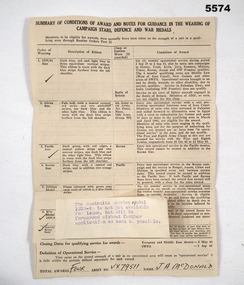
document - MEDAL ENTITLEMENT SUMMARY, Aust Government, 1939-1948
... It describes conditions of Award and some clasps if entitled. In this case CFN J. A. McDonald was entitled to 1939/45 Star, Pacific Star, War Medal 1939/45. ...It describes conditions of Award and some clasps if entitled. In this case CFN J. A. McDonald was entitled to 1939/45 Star, Pacific Star, War Medal 1939/45. ...See Cats 2481 & 5556.2.Single sheet of paper. printing is in black ink. It has a list of 7 campaign medals. It describes conditions of Award and some clasps if entitled. In this case CFN J. A. McDonald was entitled to 1939/45 Star, Pacific Star, War Medal 1939/45. Aust Service Medal.At bottom of sheet, handwritten are words, Four, VX7954, J.A. McDonald.ww2, medals -
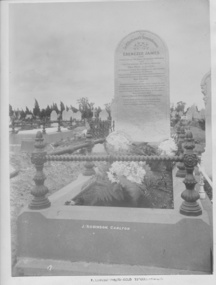 Mission to Seafarers Victoria
Photograph - Photograph, Black and white, early 20th Century
... There are flowers and ferns on the grave.Across edge of grave in White upper case: J ROBINSON CARLTON appears to be over printed, the Sepia image may be a copy of an original photograph. ...There are flowers and ferns on the grave.Across edge of grave in White upper case: J ROBINSON CARLTON appears to be over printed, the Sepia image may be a copy of an original photograph. ...Headstone inscription: "In Affectionate Remembrance / EBENEZER JAMES / late Chaplain to the Naval Forces of Victoria / and / The Victorian Seamen's Mission/ This stone is erected / by Friends of all nationalities and creeds as a mark of esteem for his unselfish and consistent Christian efforts for the social and moral advancement of our sailors/ and / in recognition of.... his indefatigable and praiseworthy exertions the stamping out in Victoria of the cruel degrading maritime curse of crimping was mainly due. / Born 11th of March 1841 Died 14th of July 1901/ "A good deed is never lost. He who sows / courtesy reaps friendship and he who plants kindness gathers love." Basil. The Headstone was found at the Melbourne Cemetery, Carlton in 2016. Rev James worked at Port Melbourne and Williamstown Missions but was also a regular visit to Geelong and other coastal ports and beside encouraging fortnightly entertainments and Chapel services, actively shipvisiting to meet with Seamen.This image documents in full the inscription on this commissioned marble headstone marking the grave of a significant figure, the second Chaplain at Port Melbourne, and an important figure in the development and story of not only the Mission to Seafarers in Victoria but also in the life of the Naval Force of Victoria prior to Federation. Rev James was not only an influential figure in the stamping out of crimping, the exploitation of seamen, but also actively worked with government and community to improve the quality of life by active lobbying for the controlled licensing of hotels and liquor sources to limit the incidence of drunkeness rife in the Ports and Wharves of Victoria in the late 19th Century. See also MTSV 0030Large Sepia photograph on paper mount features an Inscribed marble Headstone and grave with a stone facing and surround supporting low decorative cast iron railing. There are flowers and ferns on the grave.Across edge of grave in White upper case: J ROBINSON CARLTON appears to be over printed, the Sepia image may be a copy of an original photograph. Inscription on the headstone can be read, see full wording below in History field. on the paper mount below lwr edge of Photograph: "T. TENNENT 'PHOTO-GOLD TS' COLLINGWOOD"ebenezer james, chaplains, seamen exploitation of, naval force, victoria, melbourne cemetery, carlton, maritime crimping, ebenezer james (1841 - 1901), carlton, mission to seamen, seamen's mission, mission to seafarers -
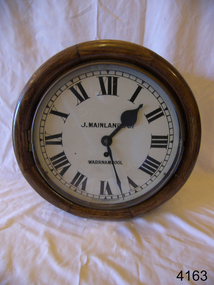 Flagstaff Hill Maritime Museum and Village
Clock, 1890s
... Having an item that was made by John Mainland during the early development of Warrnambool and in such good condition is in itself significant, it's provenance is well established and it is another piece of local history that further tells a story of Warrnambool's cultural life and early development in the 1890s. flagstaff hill warrnambool shipwrecked-coast flagstaff-hill flagstaff-hill-maritime-museum maritime-museum shipwreck-coast flagstaff-hill-maritime-village Warrnambool Clock maker John Mainland John Gall Mainland Mary Gall clock maker optician jeweller Name of maker to dial face "J Mainland & Co Warrnambool" Wall Clock, circular in a wooden case Roman numerals on a twelve hour dial Clock John Gall Mainland ...John Gall Mainlands father John Mainland Snr. was born in 1835 in the town of Lerwick in the Shetland Isles off the coast of Scotland. At the age of fifteen, he migrated to the South Island of New Zealand where he trained as a carpenter/builder after settling in Oamaru where he soon became a prominent citizen. He was for many years the Chairman of the Hospital Board and Captain of the fire brigade (which he founded). Mary Gall, Johns wife had also migrated with her family from Glasgow Scotland in 1837 at the age of thirteen to New Zealand where she had met and married John Mainland and in 1866 John Gall Mainland the second eldest of their six children was born. After John Gall Mainland Jnr. had trained as a jeweller and watchmaker he also developed itchy feet and left New Zealand for Australia in the late 1880s eventually settling in Walhalla Victoria where he became chief of the fire brigade for ten years before moving to Warrnambool. Gertrude Emily born 1872 met and married John G Mainland after he had increased his skills to become an optician. In Jan 1892 opened a business in Liebig St Warrnambool the sign outside his premises read, (J Mainland Watchmaker Jeweler and Optician). While he was establishing his business and profession John had set about contributing to the cultural and business life of the Warrnambool community. One of his many community commitments was with the scouting movement where he became a King Scout and an original charter member of the Warrnambool Rotary Club.The clock was made by an early Warrnambool business identity who had also made an important contribution to the local community over the years through his involvement with Rotary as a founding member the fire brigade. Having an item that was made by John Mainland during the early development of Warrnambool and in such good condition is in itself significant, it's provenance is well established and it is another piece of local history that further tells a story of Warrnambool's cultural life and early development in the 1890s. Wall Clock, circular in a wooden case Roman numerals on a twelve hour dialName of maker to dial face "J Mainland & Co Warrnambool"flagstaff hill, warrnambool, shipwrecked-coast, flagstaff-hill, flagstaff-hill-maritime-museum, maritime-museum, shipwreck-coast, flagstaff-hill-maritime-village, warrnambool clock maker, john mainland, john gall mainland, mary gall, clock maker, optician, jeweller -
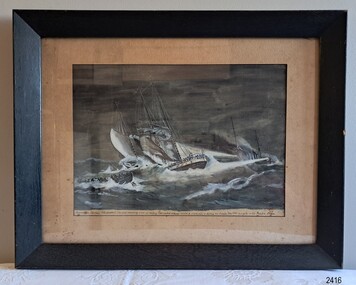 Flagstaff Hill Maritime Museum and Village
Print - Lithograph, sea rescue, R.N. Duffield, Australian cruiser “MELBOURNE” (Tons 5600) rescuing crew of sinking four-masted schooner “HELEN B. STERLING” of Halifax NS Canada, Tons 1343 in a gale in the Pacific Ocean, 19-11-1924
... J Feakes...Commander Wilfred Ward Hunt...sinking ship...shipwreck...sea rescue...gale...cyclone...1922 rescue...shipwreck rescue...breeches buoy...line rescue...rescue line...lifesaving...cutter...cutter Melbourne...sea boat...lifesaving crew...12-oar cutter...shipwreck victim...R.N. Duffield...marine artist...Nov. 19. 1924...20th century artist...A Frith...Footscray picture framer...Shiplovers’ Society of Victoria...Shiplovers’ Society Library...watercolour...A V Gregory...Arthur Victor Gregory...Melbourne artist...Newcastle coal...Newcastle NSW...Society Islands...San Fracisco...Aukland New Zealand...school composition...ship’s cat...SOS signal...Lord Mayor Cr. Swanston...heroes...cigarette case...J Feakes Commander Wilfred Ward Hunt sinking ship shipwreck sea rescue gale cyclone 1922 rescue shipwreck rescue breeches buoy line rescue rescue line lifesaving cutter cutter Melbourne sea boat lifesaving crew 12-oar cutter shipwreck victim R.N. Duffield marine artist Nov. 19. 1924 20th century artist A Frith Footscray picture framer Shiplovers’ Society of Victoria Shiplovers’ Society Library watercolour A V Gregory Arthur Victor Gregory Melbourne artist Newcastle coal Newcastle NSW Society Islands San Fracisco Aukland New Zealand school composition ship’s cat SOS signal Lord Mayor Cr. Swanston heroes cigarette case ...This framed lithograph print in watercolour and gouache was produced on November 19th, 1924, by 20th-century marine artist, Mr R.N. Duffield. It depicts the event of a sea rescue that took place two years earlier. The framer was A.L. Frith of Footscray, Melbourne, who actively advertised from 1933 to 1935. The now disbanded Shiplovers' Society of Victoria (1930-2018) donated the print, and it seems likely that this print was framed for that organisation. This graphic image shows the conditions in which the rescue from the wrecked Helen B. Sterling happened. Captain George Harris was master of the American-owned, four-masted windjammer. His wife Edith and their ten-year-old son Leslie were on board, along with a crew of fifteen seamen. The ship set off from Newcastle, NSW, on January 5th, 1922, loaded with a cargo of coal to deliver to the Society Islands and on to San Francisco. Young Leslie later wrote a lively school composition for his teacher about his experiences on board the Helen B Sterling. He tells of a fire that broke out the day after they departed and burned a hole in a beam. Then another troublesome time on the 9th, when a strong gale blew a sail off the ship. Finally, he tells of the highlight of his voyage when, on the 18th January, the ship was right in the path of a strong cyclone, which broke the mainmast. Huge waves crashed over both sides of the deck, meeting in the middle, and the ship began to sink. The rescue from the wreck was an exciting time for the young boy, and even more so when one of his cats survived after being carefully wrapped in a pillowcase and thrown down from the ship for the boy. Reporters later wrote about Leslie’s comments, “... what had grieved him most was the thought that he might never see his two little sisters again”. Captain Harris said in a published statement, “… the gale was the worst he had met in his 12 years’ experience at sea. All went well for the first week. We then encountered a strong blow from the south-east. We tried the gasoline pump, but the engine broke down, and we had to do the pumping by hand. We at once shortened sail, but the sea increased in fury to such an extent that men were washed from the pumps. I was below at 5:30 on Sunday morning [January 22nd, 1922] when the main mast went over the side, … I at once sent out SOS signals, and got word that HMAS Melbourne was coming to our assistance. I had made a mistake with regard to our position, but did not know it until 11:30 o’clock, when I sent out the correct location. This was picked up by the Melbourne and I received the following reply: “We will reach you about 2 am. Keep a good heart. The Melbourne will do all she can.” Our ship was practically awash when we were taken off.” (Ref: the ‘Helen B. Sterling Disaster’, Maitland Weekly Mercury, NSW, 4-2-1922.) Officers from the Royal Australian Navy, Captain Henry J Feakes (later Rear-Admiral) and Commander Wilfrid Ward Hunt, were on board the light cruiser, HMAS Melbourne (1913-1928), when it left Sydney for New Zealand. After the SOS was received, the ship sped at full steam towards the sinking Helen B. Sterling. They found the vessel at about midnight and shone bright search lights on the distressed ship to illuminate the desperate scene. The Melbourne was unable to move close to the schooner, so sixteen seamen, including Commander Hunt, volunteered to man the Melbourne’s lifesaving 12-oared cutter. They rowed the sea boat with great urgency towards the victims of the sinking ship, keen to save lives no matter what the conditions. When the cutter was close to the Sterling, a line was secured between the Sterling and the cutter. The weary, waterlogged and anxious men on board could be rescued, one at a time, in the breeches buoy equipment, which looked like canvas shorts with a lifesaving ring in the waistband. The victims were hauled along the line and pulled aboard by many willing hands. All eighteen crew and passengers were saved, including Captain Harris and his family. The seamen of the Melbourne received a heroes’ welcome when they arrived in New Zealand. The grateful survivors were taken to Auckland, where they received the care and comfort they needed. Melbourne’s Lord Mayor, Cr. Swanston, on behalf of the citizens of Melbourne, formally recognised the heroic rescue efforts of the seamen of the HMAS Melbourne on March 2nd, 1922, at a special presentation. Two large flags, a White Ensign and an Australian “Jack" Flag, were presented to the Captain of HMAS Melbourne, and souvenirs were awarded to the sea boat’s crew and its Commander, Wilfred Ward Hunt. Commander Hunt was also presented with an original watercolour depicting the heroic rescue from the wreck of the Helen B. Sterling, painted just after the event by renowned marine artist Arthur V Gregory (1867-1957), and he received a silver cigarette case bearing the City’s coat of arms and the inscription, "To Commander Ward Hunt from the Citizens of Melbourne as a memento of the rescue of the crew of Helen B. Stirling by H.M.A.S. Melbourne, on 23.1.22". Both the painting and the cigarette case are now treasured items inherited by his grandson; a reminder of “… a very fine naval gentleman who believed in leading by example." R.N. DUFFIELD: - The Lithograph print in our collection by 20th-century English artist R.N. Duffield is dated Nov. 19, 1924. It is very similar to, and possibly created from, the original A V Gregory watercolour presented to Commander Hunt and dated 1922. Mr R.N. Duffield has art works in the Yarmouth Museums, Norfolk Museums Collection; “Orient Liner Otranto …,” and "Convoy of six ships at sea", both painted in watercolour and gouache during the 1940s. Some of his other works, also painted in watercolour and gouache, have been advertised for sale on Internet sites. Some details differ between the original A.V. Gregory and this Lithograph Print: - -the words on the bow on the original watercolour are “Helen B. Sterling, Blain”, which is in Washington, USA, where the Sterling Shipping Company was registered from around 1919; the words on the print are “Helen B. Sterling, Halifax, N S”, for Nova Scotia, Canada, which is the hometown of Sterling Shipping Company founder’s wife, Helen B Sterling. -The watercolour is coloured and has fine details; the print is monochrome - The A V Gregory signed the watercolour in 1922, on the lower left; the print is signed with the Lithographer’s name on the lower right; “R N Duffield, Nov. 19. 1924” ARTHUR VICTOR GREGORY (1867-1957): - A.V. Gregory is a renowned marine artist who worked in watercolour and gouache. He painted actively between 1899 and 1932, creating over 3o0 works. South Melbourne, Victoria, was where he lived and worked. This Lithograph print is significant in that it depicts the rescuing of the passengers and crew of the schooner “Helen B Stirling”. At the time this was a significant event that made most Australian and New Zealand papers because of the involvement of the Australian cruiser “Melbourne”. The image demonstrates the perilous conditions experienced by seafarers. It includes an example of the line and breeches buoy method used to save lives at sea from the 1860s and into the 20th century. It reflects a time in our history when sail and steam ships cruised the world’s seas together, the former trading with a cargo of coal from Newcastle, the latter defending our country in World War I. The print is part of Flagstaff Hill Maritime Museum’s Collection of maritime artworks that depict famous events, vessels and locations, showing the evolution of sea craft, and aiding the interpretation of our maritime history. The Lithograph print is behind glass in a black painted timber frame and mounted under a cream matte. The vivid image depicts a sea rescue in progress. The night scene is illuminated by a light beaming from a steamship, the Cruiser HMAS Melbourne. It reveals figures on the deck of a sinking sailing ship, the schooner Helen B. Sterling, as foaming waves roll across it. The stricken ship has a broken main mast, and a sail has been detached. A small figure is floating in the choppy sea, secured in a breeches buoy that is attached to a rescue line between a lifesaving cutter and the sailing ship. The crewmen in the cutter are ready to haul the shipwrecked victim aboard, while the figures on the foundering ‘Sterling’ watch them. The print’s paper-covered wooden backboard is attached to the frame with small tacks. A metal hanging wire is secured to two dissimilar eyelet screws. Inscriptions include text on the bow of the sinking vessel, a handwritten title below the picture, and a handwritten name in the print’s lower right corner. On the reverse are two oval, black ink stamps and a round cream label with printed text. The hand-painted print was reproduced from a lithograph, signed in the lower right, by R.N. Duffield of England, on November 19th, 1924. A Frith of Footscray, Melbourne framed it. Painted on the ship’s bow: “HELEN B. STERLING / HALIFAX N S” [Nova Scotia, Canada] Handwritten below the print: “AUSTRALIAN CRUISER “MEMBOURNE” (Tons 5600) rescuing crew of sinking four-masted schooner “HELEN B. STERLING” of Halifax NS Canada, Tons 1343 in a gale in the Pacific Ocean.” Handwritten on lower right: “R.N. DUFFIELD / Nov. 19. 1924” (underlined) On paper label: “Phone: / Footscray 398 [some of the text has torn off] / “A. FRITH / PICTURE FRAMER / Manufacturer / 17 Paisley Street / Footscray.“ On both oval stamps: “SHIPLOVERS SOCIETY OF VICTORIA / LIBRARY” flagstaff hill, flagstaff hill maritime museum and village, warrnambool, maritime museum, maritime village, great ocean road, shipwreck coast, lithograph, lithograph print, reproduction print, helen b. sterling, the sterling, american owned schooner, halifax, halifax n s, halifax nova scotia, nova scotia, halifax n s canada, schooner, windjammer, sailing ship, four-masted ship, captain george harris, george harris, edith harris, leslie harris, sterling shipping line, hmas melbourne, hmas melbourne (1), cruiser hmas melbourne, the melbourne, australian cruiser, captain henry j feakes, commander wilfred ward hunt, sinking ship, shipwreck, sea rescue, gale, cyclone, 1922 rescue, shipwreck rescue, breeches buoy, line rescue, rescue line, lifesaving, cutter, cutter melbourne, sea boat, lifesaving crew, 12-oar cutter, shipwreck victim, r.n. duffield, marine artist, nov. 19. 1924, 20th century artist, a frith, footscray picture framer, shiplovers’ society of victoria, shiplovers’ society library, watercolour, a v gregory, arthur victor gregory, melbourne artist, newcastle coal, newcastle nsw, society islands, san fracisco, aukland new zealand, school composition, ship’s cat, sos signal, lord mayor cr. swanston, heroes, cigarette case -
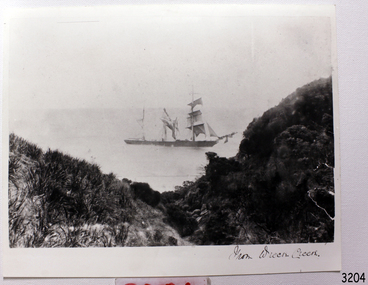 Flagstaff Hill Maritime Museum and Village
Photograph, C. 1891
... cased pocket watch, the only possession that he still had, as a token for having saved his life and the lives of some of the crew. (The pocket watch came with 2 winding keys, one to wind it and one to change the hands.) Years later Bill passed the watch to his brother-in-law Gib (Gilbert) Hulands as payment of a debt and it has been passed down the family to Gilbert Hulands’ grandson, John Hulands. Seaman Julius Gebauhr later gave his knife, in its hand crafted leather sheath, to F. J...cased pocket watch, the only possession that he still had, as a token for having saved his life and the lives of some of the crew. (The pocket watch came with 2 winding keys, one to wind it and one to change the hands.) Years later Bill passed the watch to his brother-in-law Gib (Gilbert) Hulands as payment of a debt and it has been passed down the family to Gilbert Hulands’ grandson, John Hulands. Seaman Julius Gebauhr later gave his knife, in its hand crafted leather sheath, to F. J ...Photograph shows the ship FIJI where she met her demise, in Wreck Bay, on the shipwreck coast of South West Victoria. The three-masted iron barque Fiji had been built in Belfast, Ireland, in 1875 by Harland and Wolfe for a Liverpool based shipping company. The ship departed Hamburg on 22nd May 1891 bound for Melbourne, under the command of Captain William Vickers with a crew of 25. The ship’s manifest shows that she was loaded with a cargo of 260 cases of dynamite, pig iron, steel goods, spirits (whisky, schnapps, gin, brandy), sailcloth, tobacco, coiled fencing wire, concrete, 400 German pianos (Sweet Hapsburg), concertinas and other musical instruments, artists supplies including brushes, porcelain, furniture, china, and general cargo including candles. There were also toys in anticipation for Christmas, including wooden rocking horses, miniature ships, dolls with china limbs and rubber balls. On September 5th, one hundred days out from Hamburg in squally and boisterous south west winds the Cape Otway light was sighted on a bearing differing from Captain Vickers’ calculation of his position. At about 2:30am, Sunday 6th September 1891 land was reported 4-5 miles off the port bow. The captain tried to put the ship on the other tack, but she would not respond. He then tried to turn her the other way but just as the manoeuvre was being completed the Fiji struck rock only 300 yards (274 metres) from shore. The place is known as Wreck Bay, Moonlight Head. Blue lights were burned and rockets fired whilst an effort was made to lower boats but all capsized or swamped and smashed to pieces. Two of the younger crewmen volunteered to swim for the shore, taking a line. One, a Russian named Daniel Carkland, drowned after he was swept away when the line broke. The other, 17 year old able seaman Julius Gebauhr, a German, reached shore safely on his second attempt but without the line, which he had cut lose with his sheath-knife when it become tangled in kelp. He rested on the beach a while then climbed the steep cliffs in search of help. At about 10am on the Sunday morning a party of land selectors - including F. J. Stansmore, Leslie Dickson (or Dixon) and Mott - found Gebauhr. They were near Ryans Den, on their travels on horseback from Princetown towards Moonlight Head, and about 5km from the wreck. Gebauhr was lying in the scrub in a poor state, bleeding and dressed only in singlet, socks and a belt with his sheath-knife, ready for all emergencies. At first they were concerned about his wild and shaggy looking state and what seemed to be gibberish speech, taking him to be an escaped lunatic. They were reassured after he threw his knife away and realised that he was speaking half-English, half-German. They gave him food and brandy and some clothing and were then able to gain information about the wreck. Some of the men took him to Rivernook, a nearby guest house owned by John Evans, where he was cared for. Stansmore and Dickson rode off to try and summon help. Others went down to the site of the wreck. Messages for rescuing the rest of the crew were sent both to Port Campbell for the rocket rescue crew and to Warrnambool for the lifeboat. The S.S. Casino sailed from Portland towards the scene. After travelling the 25 miles to the scene, half of the Port Campbell rocket crew and equipment arrived and set up the rocket tripod on the beach below the cliffs. By this time the crew of the Fiji had been clinging to the jib-boom for almost 15 hours, calling frantically for help. Mr Tregear from the Rocket Crew fired the line. The light line broke and the rocket was carried away. A second line was successfully fired across the ship and made fast. The anxious sailors then attempted to come ashore along the line but, with as many as five at a time, the line sagged considerably and some were washed off. Others, nearly exhausted, had to then make their way through masses of seaweed and were often smothered by waves. Only 14 of the 24 who had remained on the ship made it to shore. Many onlookers on the beach took it in turns to go into the surf and drag half-drowned seamen to safety. These rescuers included Bill (William James) Robe, Edwin Vinge, Hugh Cameron, Fenelon Mott, Arthur Wilkinson and Peter Carmody. (Peter Carmody was also involved in the rescue of men from the Newfield.) Arthur Wilkinson, a 29 year old land selector, swam out to the aid of one of the ship’s crewmen, a carpenter named John Plunken. Plunken was attempting to swim from the Fiji to the shore. Two or three times both men almost reached the shore but were washed back to the wreck. A line was thrown to them and they were both hauled aboard. It was thought that Wilkinson struck his head on the anchor before s they were brought up. He remained unconscious. The carpenter survived this ordeal but Wilkinson later died and his body was washed up the next day. It was 26 year old Bill Robe who hauled out the last man, the captain, who had become tangled in the kelp. The wreck of the Fiji was smashed apart within 20 minutes of the captain being brought ashore, and it settled in about 6m of water. Of the 26 men on the Fiji, 11 in total lost their lives. The remains of 7 bodies were washed onto the beach and their coffins were made from timbers from the wrecked Fiji. They were buried on the cliff top above the wreck. The survivors were warmed by fires on the beach then taken to Rivernook and cared for over the next few days. Funds were raised by local communities soon after the wreck in aid of the sufferers of the Fiji disaster. Captain Vickers was severely reprimanded for his mishandling of the ship. His Masters Certificate was suspended for 12 months. At the time there was also a great deal of public criticism at the slow and disorganised rescue attempt to save those on board. The important canvas ‘breech buoy’ or ‘bucket chair’ and the heavy line from the Rocket Rescue was in the half of the rocket outfit that didn’t make it in time for the rescue: they had been delayed at the Gellibrand River ferry. Communications to Warrnambool were down so the call for help didn’t get through on time and the two or three boats that had been notified of the wreck failed to reach it in time. Much looting occurred of the cargo that washed up on the shore, with nearly every visitor leaving the beach with bulky pockets. One looter was caught with a small load of red and white rubber balls, which were duly confiscated and he was ‘detained’ for 14 days. Essence of peppermint mysteriously turned up in many settlers homes. Sailcloth was salvaged and used for horse rugs and tent flies. Soon after the wreck “Fiji tobacco” was being advertised around Victoria. A Customs officer, trying to prevent some of the looting, was assaulted by looters and thrown over a steep cliff. He managed to cling to a bush lower down until rescued. In 1894 some coiled fencing wire was salvaged from the wreck. Hundreds of coils are still strewn over the site of the wreck, encrusted and solidified. The hull is broken but the vessel’s iron ribs can be seen along with some of the cargo of concrete and pig iron. Captain Vickers presented Bill Robe with his silver-cased pocket watch, the only possession that he still had, as a token for having saved his life and the lives of some of the crew. (The pocket watch came with 2 winding keys, one to wind it and one to change the hands.) Years later Bill passed the watch to his brother-in-law Gib (Gilbert) Hulands as payment of a debt and it has been passed down the family to Gilbert Hulands’ grandson, John Hulands. Seaman Julius Gebauhr later gave his knife, in its hand crafted leather sheath, to F. J. Stansmore for caring for him when he came ashore. The knife handle had a personal inscription on it. A marble headstone on the 200m high cliffs overlooking Wreck Beach, west of Moonlight Head, paying tribute to the men who lost their lives when Fiji ran aground. The scene of the wreck is marked by the anchor from the Fiji, erected by Warrnambool skin divers in 1967. Amongst the artefacts salvaged from the Fiji are china miniature animals, limbs from small china dolls, rubber balls, a slate pencil, a glass bottle, sample of rope from the distress rocket and a candlestick holder. These items are now part of the Fiji collection at Flagstaff Hill Maritime Museum, along with Captain Vickers’ pocket watch and Julius Gebauhr’s sheath knife. Flagstaff Hill’s Fiji collection is of historical significance at a State level because of its association with the wreck Fiji, which is on the Victorian Heritage Register VHR S259. The Fiji is archaeologically significant as the wreck of a typical 19th century international sailing ship with cargo. It is educationally and recreationally significant as one of Victoria's most spectacular historic shipwreck dive sites with structural features and remains of the cargo evident. It also represents aspects of Victoria’s shipping history and its potential to interpret sub-theme 1.5 of Victoria’s Framework of Historical Themes (living with natural processes). The Fiji collection meets the following criteria for assessment: Criterion A: Importance to the course, or pattern, of Victoria’s cultural history. Criterion B: Possession of uncommon, rare or endangered aspects of Victoria’s cultural history Criterion C: Potential to yield information that will contribute to an understanding of Victoria’s cultural history. Black and White Photograph of the ship "Fiji" taken from Wreck Creek. warrnambool, shipwrecked coast, flagstaff hill, flagstaff hill maritime museum, maritime museum, shipwreck coast, flagstaff hill maritime village, shipwrecked artefact, pocket watch, fob watch fiji, william vickers, william robe, bill robe, gebauhr, stansmore, carmody, wreck bay, moonlight head, fiji shipwreck 1891, port campbell rocket crew, wreck bay victoria -
 Federation University Historical Collection
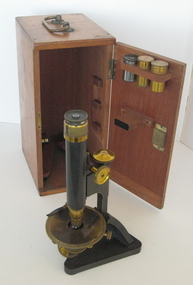
Scientific Instrument, Petrographic Microscope
... J. BECK Ltd LONDON 26791" Black-finished brass microscope and brass stage. Includes adjustment knobs, lens mounts,three objective lenses and two eyepiece lenses of same rating. The microscope is boxed in a timber storage case ...This microscope is thought to be one of the earliest 'mineral microscopes' obtained by the Ballarat School of Mines. See reference in SMB Calendar 1896, p47, also Ballarat SChool of Mines Calendar 1908-9, p35 - "petrological microscope".Black-finished brass microscope and brass stage. Includes adjustment knobs, lens mounts,three objective lenses and two eyepiece lenses of same rating. The microscope is boxed in a timber storage case, hinged at the front with a brass handle on top. Model: London, Ser.no. 26791Engraved on rear of base frame "R. & J. BECK Ltd LONDON 26791"petrographic microscope, microscope, petrology, ballarat school of mines, school of mines ballarat, mineral microscope, laboratory, r. & j. beck ltd -
 Federation University Historical Collection
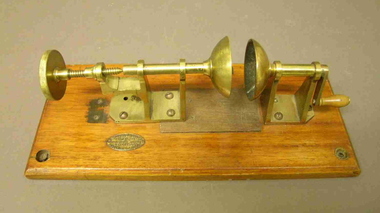
Object, Mystery Item
... case. A photograph of this item has the catalogue number 01002. ballarat school of mines scientific equipment scientific objects j. sturrock Brass plate on second handtimber base board "J. ...It is thought that this item may have been made for use at the Ballarat School of Mines. The use is unknown. At one time it was thought to have something to do with lens-making, but this is no longer thought to be the case. A photograph of this item has the catalogue number 01002.A mechanism made of cast brass mounted onto a second hand timber base board. Two horizontal coaxial shafts, each ending with a hemispherical cup, facing each other. The right hand shaft is fitted with a crank handle. The diameter of the two brass domes is 6 cm. The space between the two brass domes from spindle to spindle is 7 cm. Only one dome turns, the one attached to the handle. Brass plate on second handtimber base board "J. Sturrock, Dundee. Patentee. Wholesale Agents Jeffries & Co. Woolwich and London." ballarat school of mines, scientific equipment, scientific objects, j. sturrock -
 Federation University Historical Collection
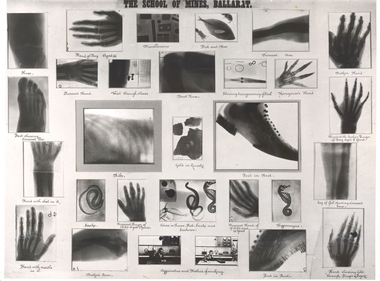
Photograph - Original x-rays, X-rays from pioneering Ballarat Demonstrations, 1896, 1896
... J. Martell. (http://guerin.ballarat.edu.au/aasp/is/library/collections/art_history/honour-roll/honourroll_X-Ray_pioneers.shtml) "Seven patients of the doctors who were present were treated. In each case...J. Martell. (http://guerin.ballarat.edu.au/aasp/is/library/collections/art_history/honour-roll/honourroll_X-Ray_pioneers.shtml) "Seven patients of the doctors who were present were treated. In each case ...X-Rays were first discovered on 08 November 1895. By 18 July 1896 staff members of the Ballarat School of Mines (SMB), were experimenting with the exciting new discovery. The history of x-rays began on 08 November 1895 at the University of Wurzburg in Bavaria. The discovery was officially announced on 25 December 1895. The first radiographs in Ballarat were taken at the School of Mines in July 1896 according to the Ballarat School of Mines (SMB) Annual Report. Frederick J. Martell, the Registrar of SMB arranged for the importation of tubes, while John M. Sutherland, an electrician, conducted most of the experiments giving 6 inch, 12 inch and 16 inch sparks respectively. In a short time brilliantly successful results were obtained, with some SMB Roentgen negatives taken at this time still in existence today. Samuel Ernest Figgis, H. R. W. Murphy, D. McDougall, and Frederick J. Martell carried out experiments at the SMB on Saturday evening 18 July 1896, producing 'perfect' negatives of a hand and wrist. A Roentgen Tube and an induction coil giving a two inch spark, the coil being sparked by the SMB's dynamo, were used to obtain these results. The Courier reported that 'the exposure of five minutes was ample' but concluded that 'the length of the exposure will be shortened as experiments proceed.' The Ballarat Courier reported on 20 July 1896 that: "Thanks to the energy of the staff of The School of Mines, Ballarat, and particularly to Messers F.J. Martell and D. McDougall, the assistance of Rontgen X-rays will soon be available, for the relief of suffering humanity, at this institution." Martell was an ardent amateur photographer, and Duncan McDougall's experience as an electrician has enabled the two gentlemen to carry their experiments on to a perfectly successful issue. At first these gentlemen, together with Professor Purdie and Mr W. Huey Steele, conducted a series of experiments by the aid of a Bonetti glass-plate induction machine which had been constructed by Mr McDougall. The results were very good, the various bones of the hand being distinctly visible. The following people were among those who witnessed the first X-ray experiments to be carried out in Ballarat. Andrew Anderson, President of the School of Mines, a large number of ladies and gentlemen, the medical profession Dr Edward Champion (1867-1929) Dr Gerald Eugene Cussen (1888-1943) Dr William Edward Davies (1868-1928) Dr Charles William Henry hardy (1861-1941) Dr Edward Kenneth Herring(1864-1922) Dr Joseph Lalor (1859-1907) Dr James Thomas Mitchell (1856-1945) Dr Edward Graham Ochiltree (1857-1896) Dr Robert Denham Pinnock (1849-1902) Dr Joseph Francis Usher (c1832-1909) Dr Grace Vale (nk-1933). The staff of SMB Professor Alfred Mica Smith Professor D. J. Dawbarn Mr. F. J. Martell. (http://guerin.ballarat.edu.au/aasp/is/library/collections/art_history/honour-roll/honourroll_X-Ray_pioneers.shtml) "Seven patients of the doctors who were present were treated. In each case the patient was suffering from the effects of an old wound or some other injury to other a hand or foot. One patient, a boy had a finger broken some years earlier and when xray plate of the injury was developed it indicated plainly the fracture on one of the joints of the third finger. In another case a woman had a foot had a foot X-rayed and the photograph revealed the seat of an earlier imjury to it. Likewise an injury to the bones of a hand of an elderly man was revealed by an x-ray photograph. Every X-ray photograph that evening showed the importance of this new development in electrical science and the doctors present agreed the "the results of the experiments on their patients, by showing the exact seat of the injury and its present condittion, would materially assist them iin supporting cures." (Warren Perry, The Ballarat School of Mines and Industries Ballarat, p 146.)A number of photographic xrays as taken by the Ballarat School of Mines in 1896. The xrays include bones, hands, feet, shoes and more. ballarat school of mines, scientific equipment, x-ray, xray, photography, foto, roentgen tube -
 Federation University Historical Collection
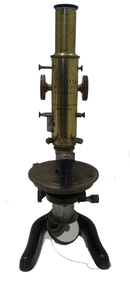
Instrument - Scientific Instrument, Boxed Petrographic Microscope, c1912
... J BECK. LTD, Objective H. Crouch. London Boxed optical microscope - Petrographic type. It has a rigid (upright) frame and twin objective lens turret and a black enameled frame with brass-finish components. Stored in blonde finished wooden box. Manufacturers certificate inside box door dated "1. ii. 1912" Three other objectives in metal cases ...Used by Ballarat School of Mines Geology Department. Probably a second generation purchase by SMB Geology department. Earlier references to "Petrological microscope", SMB Calendar for 1908-9, p 35Boxed optical microscope - Petrographic type. It has a rigid (upright) frame and twin objective lens turret and a black enameled frame with brass-finish components. Stored in blonde finished wooden box. Manufacturers certificate inside box door dated "1. ii. 1912" Three other objectives in metal casesEye piece - "Reichert Wien" Microscope - E.Leitz Wetzlar No140283 Made for Kilpatrick & Co Melbourne Objective x 2 R & J BECK. LTD, Objective H. Crouch. London ballarat school of mines, geology, petrography, microscope, leitz, scientific instruments, brass, lens, r & j beck, reichert -
 Federation University Historical Collection
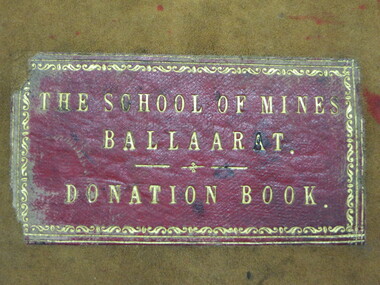
Book - Ledger, Ballarat School of Mines Donation Book, 1878 - 1895, 1878-1895
... case
323. W. Longley, Ballarat - Botanical Specimen (Note: This item is not in the present Federation University Historical Collection)
327. W. H. Angove, Perth
337. J...case
323. W. Longley, Ballarat - Botanical Specimen (Note: This item is not in the present Federation University Historical Collection)
327. W. H. Angove, Perth
337. J ...The Donation Book relates to the Ballarat School of Mines Museum which opened in 1872. Very few of these items are still held by Federation University. The Museum was emptied in the 1960s with items being distrubuted to the Ballarat Historical Society, returned to original lenders (ie Pern Collection), of disposed of. Donations to the Ballarat School of Mines include: 34. M. Hamburger, Ballarat - bunsen burner 41. W.H. Shaw, Phoenix Foundry - 81 nos of 'Engineer' 89. Juvenile Industrial Exhibition Association Committee per Joseph Flude - dies used for striking medals awarded to successful exhibits. 165. Ferdinand Von Mueller 172 Ferdinand Von Mueller o hortus siccus 6 197. James Stoddart 203. Edward Gazzard, North Creswick - Model of safety Cage invented and made by donor 218. E. Morey 222. Alfred Lestor 228. J.J. Sleep, Ballarat, patent Lever escarpment Clock (displayed in laboratories) 237. Bernard Smith (Warden) per favor of James M. Bickett - Bust of Mr John Lynch, Smythesdale. (Note: This item is not in the present Federation University Historical Collection) 241. James Oddie, J.P., Ballarat, Copy of 'the Chemist and Druggist' 267. John Lynch Junior, Smythesdale - Cast of "Golden Age" nugget, found at Browns by Co-operative party, 12 men. Weight 75 oz, 12 dwts, 12 grs.(Note: This item is not in the present Federation University Historical Collection) 270. Isaac Davis, Main Road, Ballarat 294. W. H. Shaw, Ballarat - 94 nos of 'The Engineer' 295. Rivett Henry Bland, Clunes - Specimen of water pipe from the Port Phillip Company's mine encrusted with carbonites of lime and magnesium (Note: This item is not in the present Federation University Historical Collection) 299. D.J. Williams, Queenscliff - 1 case shells from Fiji 305. C. Retallack, Ballarat 314. William Henry Shaw, Ballarat - glass case 323. W. Longley, Ballarat - Botanical Specimen (Note: This item is not in the present Federation University Historical Collection) 327. W. H. Angove, Perth 337. J. Cosmo Newbery, B Sc, Melbourne 343. James Hector, M.D., New Zealand 353. R.S. Mitchell, Ballarat - 8 specimens live plants (medicinal) (for the Ballarat School of Mines Garden) 355. W. Magee, Ballarat - Sugar cane plants and seeds (for the Ballarat School of Mines Garden) 363. James Hector, Wellington, new Zealand 371. William Wesley, 28 Essex St, Strand, London - Scientific book circular 380. Jacob Upfold (deceased) per favor of the trustees - bequest of steam engine indicator and belongings (boothe and case) 381. Joseph Mitchell, 22 Macarthur Street, Ballarat - sod of turf cut from Warboy's High Few, County Huntingdon, England, 1872. 394. W.H. Barnard 401. James Orr 418. F. Ratte, Sydney 440. Alfred Mica Smith, Sandhurst (Bendigo), Inaugural Address, delivered to the Bendigo School of Mines Science Society, June 20. 1881 by P.H. Macgillivray, MA, MRCS, FLS, President. (Note: This item is not in the present Federation University Historical Collection) (Note: This item is not in the present Federation University Historical Collection) 446. C. C. Shoppee, Ballarat 462. Dr Bunce, Ballarat 468. James Black, Mining Manager "Kerrit Bureet' 479. J.S. North, Mining Manager No. 2 Queen Co, Black Hill Ballarat. 505. Smith Tibbitts - A block of ancient leaves from the Nigtingbool Estate near Haddon on the Ballarat district from shaft 80 feet deep. (Note: This item is not in the present Federation University Historical Collection) 512. F.W. Niven, Ballarat - "A Handy Book to Tasmania" 522. James Hector, Wellington, New Zealand 549. C.E. Grainger, Manager Ballarat Woollen Mills - samples of dyed and raw wools 600. (4 July 1882) Henry Sutton, Ballarat - 13th annual report of the Aeronautical Society of Great Britain; 2 papers from the Proceedings of the Royal Society, nos 217 and 218- 1882, "One a new electrical storage battery by Henry Sutton, Ballarat, Victoria. 608. H. Glenny J.P., Ballarat - Specimen of Asbestos from Tasmania 610. M.H. Edelmann, Munich, Germany 674. W.H. Shaw, Phoenix Foundry - Steel boring 95 feet long taken from bed-plate of locomotive engine. 675 - H.R. Hancock J.P. pre favour Mr James Pryor, Moonta Mines 676. Baron Ferdinand Von Mueller KCMG, etc, Melbourne 678. E.F.A. Gaunt, Royal Navy, H.M.S. Nelson, per favour Lyde Gaunt - Specimen of manganese ore from the mines - Russell - New Zealand 728. Dr Pinnock, Ballarat 760. Simon Morrison, Ballarat 784. James Shugg, Hamilton - 1 case fossils from Muddy Creek, near Hamilton. (Note: This item is not in the present Federation University Historical Collection) 786. W. Bolam (inspector of Schools), Melbourne - 2 spears and 1 fishing prong Fijian 806. James Oddie, Ballarat 708. Henry G. Hanks, San Francisco 786. W. Bolam (Inspector of Government Schools Melbourne) - 2 spears and one fishing prong Fijian 824. Henrique Gorceixm Onro Preto, Brazil 840. W. Laplau, Ballarat - Gas furnace with a large assortment of fittings, also large gas holder and oil-heating apparatus 854. Robert Borch, Main Road, Ballarat - Improved safety chain (Note: This item is not in the present Federation University Historical Collection) 928. James Oddie 944. James P. Munroe, Registrar, Massachusetts 952. L.E. Cutter per favour of Mr F.J. Martell - Unexploded bomb shell from the Eureka Stockade 957. H. Glenny, Hobart 962. George Hart, Ballarat - eagle 976. Henry Sutton, Ballarat - 1 volume "Plattner on the Blowpipe" 978. J.W. Flatow, 45 Madeline Street, Carlton, Melbourne 984. Charles C Shoppee Ballarat - Copies of ancient coins 989-95 - Specimens from Moonta, South Australia 985. W.H. Wooster BOlwarra - books microscope related 1179. James Oddie - Live hedgehog 1181 C. Crisp, Bacchus Marsh, Portugal Copper Coin, 1785 1248 James Oddie, Solomon Islands - Bow and arrows & Spears 1285. C. Colyer, Smythesdale 1327. John L. McKenna, Smeaton - Fragment of Stone Axe. 1395. Mrs O. Skoglund, Nerrina 1428. Daniel Brophy, Ballarat - Collection of mineral specimen form Silverton (Collected by Mrs James Murray) 1442. Henry Sutton, Ballarat - Specimens of fossil fruits collected at Haddon by Charles Brown. 1444. Mining Department - Underground Mine Workings from Band of Hope and others. 1517. W.H. Wooster, Ballarat 1592. Bishop of Ballarat - Stone Axe and other native items 1669. H. McHaffier, Napoleons - 1 Spanish silver coin 1681. James Oddie, Dunedin 1688. W. Burbridge, Ballarat - Native Tomahawk from Metung 1708. A. Doepel, Ballarat 1712. Marty Guerin, Ballarat 1735. Bella Guerin. M.A., Ballarat - Copy Wide Awake Vol 1 No 7 May 28th 1887 and The Bulletin, March 19th 1887. 1747. Bella Geurin M.A., Ballarat - Copy Wide Awake Vol 1 No 8 June 4 1887 1751. Bella Geurin M.A., Ballarat - Copy Wide Awake Vol 1 No 9 June 11th 1887 1842. Linnean Society, London England - Charter, By Laws, Proceedings, Transactions, Journals 1853. W.J. Corbould, Silverton, NSW - chloride of silver from Pinnacles, Broken Hill, Silverton 1888. W. J. Corbould, Sample of metallic silver from Silverton, NSW 1928. E. Morey, Ballarat - Steam Engine 1937. Henry Sutton A.S.I.E., Ballarat - Plate Electric Machine, chimes and Sportman (number crossed out) 1951. Henry Sutton A.S.I.E., Ballarat - Plate Electric Machine, chimes and Sportman 1981. Harrie Wood (per W.H.B.[Barnard?), Ballarat 1996. W.H. Shaw, Phoenix Foundry - Papers "The Vict Engineer July 1887, May June July August 1888 and others 2014. Harrie Wood, Sydney - Report Department of Mines, 18872027. W.J. Bechervaise - Copy of Book by Baldwin Spencer 2034. A.G. Randall - Native Hatchet 2045. W.H. Corbould, Silverton, Collection of silver ores 2051. Fowler, Tarnagulla - Native Tomahawk 2123-2131. James Oddie, London 2163. Roff. F. Taplier, Sturt Street - Native Tomahawk 2178. Syd. Johnson, Meredith - Native Tomahawk, Greenstone 2184. Mr Tupp for Hall - Native Spear and Club 2292. Emmanuel Steinfeld, Melbourne 2313. A. Atwood, Rowlands Factory, Dana Street 2361. Dr Pinnock, Ballarat - Collection of Living Sponges 2363. P. Curnow, Ballarat - Piece of wood with stone naturally embedded 2364. R. Dowling, Waubra 2875. Mrs C, Flude, Ballarat - Collection of (5) mineral specimens 3460. Joseph Weir, Ballarat - Sample of rolled Annibar 3466. J. Hart, Ballarat - Native Shield - supposed to have been made by King Billy 4784. Mr. O. Woolnaugh, Pleasant Street - Four Native Tomahawks 6469. L. Balhausen, Ballarat 3472. John English, Smeaton - three samples of auriferous wash dirt 3607. Columbia College, New York - Handbook of Information of the Columbia College in the Ciry of New York 1892-3. 3672. L.A. Samuels, Bendigo 3724. P. Paperhagen 3736. The Late Rivett Henry Bland per John Noble Wilson - Collection of mineral specimens and fossils 3752. G.A. Denny, South Africa 3755. J. Carroll, Ballarat - Specimen of Native bread found in Ballarat East. 4765. J. Donnelly, Springs, Bungaree I. Fowler, Coolgardie, Specimen of Gold Bearing Quartz ballarat school of mines, doantions, museum, ballarat school of mines museum, safety cage, botanical garden, materia medica garden, library, bella guerin, james oddie, phoenix foundry, w.h. shaw, john lynch, henry sutton, aboriginal, stone axe, tomahawk, geological specimens, moonta, fedinand krause, oddie collection of minerals, thomas bath, spears, solomon islands, king billy, bows and arrows, ancient coins, birds eggs, snakes -
 Flagstaff Hill Maritime Museum and Village
Container - Chart Case, ca 19th century
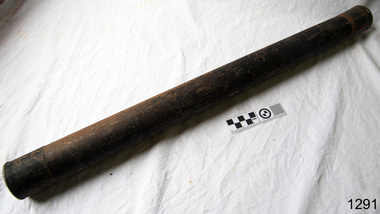
... "Flagstaff Hill c/ J Lindsay" This chart case is an example of maritime chart storage used in colonial times to protect charts and maps from the weather and to store them is an easily accessible was. flagstaff hill warrnambool shipwrecked-coast flagstaff-hill flagstaff-hill-maritime-museum maritime-museum shipwreck-coast flagstaff-hill-maritime-village chart case navigation chart storage Chart case, black painted metal cylindrical container with caps on both ends. ...Black painted metal cylindrical container. Label attached at one end with inscription. "Flagstaff Hill c/ J Lindsay"This chart case is an example of maritime chart storage used in colonial times to protect charts and maps from the weather and to store them is an easily accessible was. Chart case, black painted metal cylindrical container with caps on both ends.flagstaff hill, warrnambool, shipwrecked-coast, flagstaff-hill, flagstaff-hill-maritime-museum, maritime-museum, shipwreck-coast, flagstaff-hill-maritime-village, chart case, navigation, chart storage -
 Flagstaff Hill Maritime Museum and Village
Weapon - Shell Case, Australian Army, 1940 -1941
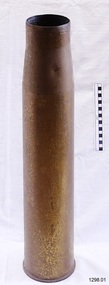
... Around firing pin “MF I 422” “ME” “II” “4 I N” “5-“ ”MF [within rectangle]” “f” “B – [within circle]”, Shell Case 1298.02 - headstamp “N 1941 MF / F symbol [square box] LOT 679”, [in oval] 101 / 4 / S /U2) M GUNS 7 “, symbol [Australian Government Arrow], Stencil [in red circle] “B J”, symbol [Diamond with line top to bottom] Stamped in red ink “R5G 11 1 2B7”...Around firing pin “MF I 422” “ME” “II” “4 I N” “5-“ ”MF [within rectangle]” “f” “B – [within circle]”, Shell Case 1298.02 - headstamp “N 1941 MF / F symbol [square box] LOT 679”, [in oval] 101 / 4 / S /U2) M GUNS 7 “, symbol [Australian Government Arrow], Stencil [in red circle] “B J”, symbol [Diamond with line top to bottom] Stamped in red ink “R5G 11 1 2B7” Shell case: two brass 4" rimmed shell cases with headstamps (inscriptions) on the base plate around the firing pin three holes evenly spaced around the centre of the base. ...These shell cases were donated along with other items from the St Nicholas' Mission to Seamen's Church at 139 Nelson Place, Williamstown, Victoria. The Church was operated by the Mission to Seamen organisation. The symbol of the broad arrow on the base of the shell case signifies that it was owned by the Australian Army. The dates of the shell cases - 1940 and 1941 - link the shell cases with World War II. Both cases' headstamps have "N", which could indicate that they were made for use by the Navy. Shell Case 1298.01: The headstamp code on the label "MEC" means that it was made by the Explosives Factory Maribyrnong - Cordite Annexe, Maribyrnong, Melbourne, which made cordite propellant for cartridges and shells. Shell Case 1298.02: The headstamp "MF" indicates it was made by the Small Arms Manufacturing Factory in Footscray, Melbourne, and the stamped year was 1941. THE MISSIONS TO SEAMEN (Brief History): - The Missions to Seamen was an Anglican charity that has served seafarers of the world since 1856 in Great Britain. Its symbol is a Flying Angel, inspired by a Bible verse. Today, there are centres in over 200 ports worldwide where seamen of all backgrounds are offered a warm welcome and provided with a wide range of facilities. In Victoria, the organisation began in Williamstown in 1857 as a Sailors’ Church, also known as ‘Bethel’ or the ‘Floating Church’ in an old hulk floating in Hobson’s Bay, Port of Melbourne. It soon became part of the Missions to Seamen, Victoria. In the year 2000, the organisation, now named Mission to Seafarers, still operated locally in Melbourne, Portland, Geelong and Hastings. The Ladies’ Harbour Lights Guild was formed in 1906 to support the Missions to Seamen in Melbourne and other centres, such as Williamstown. Two of the most significant ladies of the Guild were founder Ethel Augusta Godfrey and foundation member Alice Sibthorpe Tracy (who established a branch of the Guild in Warrnambool in 1920). The Guild continued its work until the 1960s. In 1943, a former Williamstown bank was purchased for the Missions to Seaman Club. The chapel was named St Nicholas’ Seamen’s Church and was supported by the Ladies’ Harbour Lights Guild, the Williamstown Lightkeepers’ Auxiliary and the League of Soldiers’ and Sailors’ Friends. It ceased operation in 1966. A Missions to Seamen Chapel and Recreation Room was a significant feature of ports during the late 1800s and into the 1900s. It seemed appropriate for Flagstaff Hill to include such a representation within the new Maritime Village, so the Melbourne Board of Management of Missions to Seamen Victoria gave its permission on 21st May 1979 for the entire furnishings of the Williamstown chapel to be transferred to Flagstaff Hill. The St Nicholas Seamen’s Church was officially opened on October 11, 1981, and closely resembles the Williamstown chapel. These shell cases are significant for their relationship with the Australian Army in general and in particular with the defence of Australia during World War II. The may have also been made for the Navy. Their significance is increased by their association with the Williamstown Missions To Seamen, which donated them to Flagstaff Hill in 1979, an organisation that has supported seafarers for many years.Shell case: two brass 4" rimmed shell cases with headstamps (inscriptions) on the base plate around the firing pin three holes evenly spaced around the centre of the base. A label is attached to one shell. The shell cases are part of the St. Nicholas Seamen's Church Collection. Shell Case 1298.01 - Printed stamp “P.2BT” “M.E.C.111” “I.E. 10/43”. Stamped into base “N”, “1940” “W [within lozenge]”, “S” symbol [Australian Government Arrow] “360“ . Around firing pin “MF I 422” “ME” “II” “4 I N” “5-“ ”MF [within rectangle]” “f” “B – [within circle]”, Shell Case 1298.02 - headstamp “N 1941 MF / F symbol [square box] LOT 679”, [in oval] 101 / 4 / S /U2) M GUNS 7 “, symbol [Australian Government Arrow], Stencil [in red circle] “B J”, symbol [Diamond with line top to bottom] Stamped in red ink “R5G 11 1 2B7”flagstaff hill, warrnambool, shipwrecked-coast, flagstaff-hill, flagstaff-hill-maritime-museum, maritime-museum, shipwreck-coast, flagstaff-hill-maritime-village, munitions, shell case, ammunition 1940, ammunition 1941, firearms, cannon, australian government, borad arrow, australian army, wwii, world war 2, australian defence, australian ordinance, small arms manufacturing factory, explosives factory maribyrnong, cordite, world war ii, ww2, 1940, 1941, defence, n headstamp, footscray -
 Flagstaff Hill Maritime Museum and Village
Instrument - Hydrometer, J Long (Joseph Long), late 19th - early 20th century
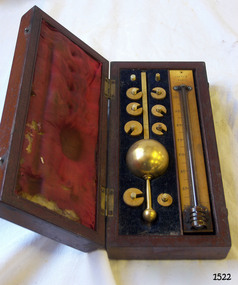
... Flagstaff Hill Warrnambool Shipwrecked coast Flagstaff Hill Maritime Museum Maritime Museum Shipwreck coast Flagstaff Hill Maritime Village Great Ocean Road Measuring instruments Customs tax weighing instrument Sike’s Hydrometer Calibrator Long of London Loftus of London instrument maker Loftus J Long Sikes Hydrometer Scientific Instrument pressure measurement measuring instrument ullage tool Customs Excise Duty Tax alcohol content proof calibrate Standard Weights and Measures tariff Scientific Instrument Makers specific gravity liquid density alcohol testing technology alcohol measurement proof spirit wine and spirits merchants local business brass measuring instrument Port Fairy Customs Office Port Fairy Customs Joseph Long instrument maker All parts of the float and eight weights are inscribed with Serial Number “14674” The float stem is stamped "SIKE'S IID 51o” Calibrator, "LONG LITTLE TOWER ST LONDON" The weights are numbered individually ”20”, “30”, “40”, “50”, “60”, “70”, “80” or “90” Each weight in inscribed; symbol “(J L) [inside an ova, with textured background]” The thermometer inscribed: “LOFTUS OF LONDON” Sikes Hydrometer and thermometer in a fitted wooden case with crimson lining inside the lid and dark lining in the base. ...This Sike’s Hydrometer was donated by the Port Fairy Customs Office as it was no longer required by them due to a change in the law. The hydrometer was part of a system for Ullaging or calculating the amount of liquid remaining in a container of liquor such as a barrel, and the amount of alcoholic content in the contents. It can also measure the free space or head space remaining. Hydrometers were used to measure the density, or relative density, of liquids from the late 1600s. In 1816 Bartholomew Sikes won the competition for the most useful accurate hydrometer. Hydrometers were commonly used by distillers, vintners, and brewers to establish accurate measures of alcohol concentration in their beverages. Following this manufacturing process, government inspectors and excise officers used them to check that the labelled indications of alcohol-proof were correct and that the right amounts of duty were being paid.The Sikes hydrometer is of local significance because of its association with the Government's Customs Office in Port Fairy, in the southwest region of Victoria. It is also associated with Bartholomew Sikes, whose design of a hydrometer was chosen in 1816 as being the most useful and accurate hydrometer. The hydrometer has evolved into the digital version available today to measure density of liquids.Sikes Hydrometer and thermometer in a fitted wooden case with crimson lining inside the lid and dark lining in the base. The case has ten vertical pegs to secure the weights. The brass hydrometer has a spherical float and eight thick brass horseshoe-shaped weights. The serial number is on each section of the float and all weights. Both sides of the float’s upper flat stem have a scale from 0-10, with five divisions between each number. The eight weights are numbered from 20 – 90 in increments of 10. The set includes a mercury thermometer mounted on an ivory back plate labelled with Fahrenheit and Centigrade Scales. The Sikes hydrometer set was made by Loftus of London. The hydrometer model is IID 510, Serial Number is 14674, calibrated by Longs, London. All parts of the float and eight weights are inscribed with Serial Number “14674” The float stem is stamped "SIKE'S IID 51o” Calibrator, "LONG LITTLE TOWER ST LONDON" The weights are numbered individually ”20”, “30”, “40”, “50”, “60”, “70”, “80” or “90” Each weight in inscribed; symbol “(J L) [inside an ova, with textured background]” The thermometer inscribed: “LOFTUS OF LONDON”flagstaff hill, warrnambool, shipwrecked coast, flagstaff hill maritime museum, maritime museum, shipwreck coast, flagstaff hill maritime village, great ocean road, measuring instruments, customs tax, weighing instrument, sike’s hydrometer, calibrator long of london, loftus of london instrument maker, loftus, j long, sikes hydrometer, scientific instrument, pressure measurement, measuring instrument, ullage tool, customs, excise duty, tax, alcohol content, proof, calibrate, standard weights and measures, tariff, scientific instrument makers, specific gravity, liquid density, alcohol testing, technology, alcohol measurement, proof spirit, wine and spirits merchants, local business, brass measuring instrument, port fairy, customs office, port fairy customs, joseph long, instrument maker -
 Flagstaff Hill Maritime Museum and Village
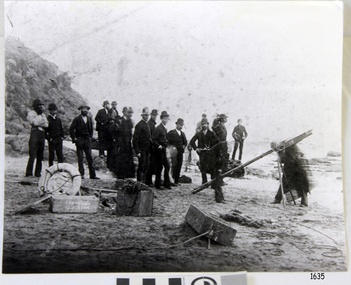
Photograph - Shipwreck rescue, c. 1890's
... cased pocket watch, the only possession that he still had, as a token for having saved his life and the lives of some of the crew. Years later, Bill used the pocket watch to pay a debt, and it was handed down through that family. Seaman Julius Gebauhr later gave his knife, in its handcrafted leather sheath, to F. J...cased pocket watch, the only possession that he still had, as a token for having saved his life and the lives of some of the crew. Years later, Bill used the pocket watch to pay a debt, and it was handed down through that family. Seaman Julius Gebauhr later gave his knife, in its handcrafted leather sheath, to F. J ...CONTEXT – UPDATED The photograph taken on Sunday, September 6, 1891, shows the Port Campbell Rocket Rescue Crew and Equipment at Wreck Beach, Moonlight Head, preparing to save the stranded men on the wreck of the barque Fiji. The man standing in the middle, front of the photograph, facing the ocean, is Herbert Maxwell Morris, a farmer at Barruppa near Princetown, who is also a member of the Rocket Rescue Crew. The Rocket Rescue lifesaving method used an explosive rocket to shoot a light line from the shore across to the distressed vessel. The line was then secured to the ship’s mast, and a heavy, continuous line was sent out with a ‘breaches buoy’ attached (a buoy similar to the seat of a pair of trousers). The stranded seafarers would sit in the seats and be pulled along the line to safety. A lot of skill was needed to set up the line to reach its target, and the crew trained regularly to keep up their skills. The FIJI and the RESCUE: - The three-masted iron barque Fiji was built at Belfast, Ireland, in 1875 by Harland and Wolfe for a Liverpool-based shipping company. The ship departed Hamburg on May 22, 1891, bound for Melbourne under the command of Captain William Vickers with a crew of 25. The Cape Otway light was sighted on September 5, 1891. However, the bearing was different from Captain Vickers’ calculations. At about 2:30 am the next morning, the land was reported only 4-5 miles away. The captain tried to redirect the ship in the rough weather without success, and the Fiji struck rock only 300 yards (274 metres) from shore. The crew burned blue lights and fired rockets to signal distress. The lifeboats either capsized or were swamped and smashed to pieces. Two younger crewmen volunteered to swim to the shore with a line. One, a Russian named Daniel Carkland, drowned after he was swept away when the line broke. The other, Julius Gebauhr, a 17-year-old German able seaman, reached shore safely on his second attempt but had cut the line loose with his sheath-knife when it tangled in kelp. He climbed the cliffs in search of help. Later that morning, a young man named William (Willie) Ward reported that he saw the wreck of the ship close to shore near Moonlight Head from the cliffs, and the alarm for help was sent to Princetown, six miles away. At around the same time, a Mott’s party of land selectors, including F. J. Stansmore and Leslie Dickson, was travelling on horseback from Princetown towards Moonlight Head. They were near Ryans Den when they found Gebauhr in the scrub, bleeding and dressed only in a singlet, socks and a belt with his sheath-knife. They thought the man might be an escaped lunatic, due to his wild and shaggy-looking state and what seemed to be gibberish speech. After Gebauhr threw his knife away, they realised that he was speaking half-English, half-German as he talked about the wreck. They gave him food, brandy and clothing, and he was taken to a nearby guest house, Rivernook, owned by John Evans, where he was cared for. Most of the party went off to the wreck site. Stanmore and Dickson rode for help from both Port Campbell, for the two Rocket Rescue Crew buggies, and from Warrnambool, for the lifeboat. The vessel S.S. Casino sailed from Portland towards the scene. Half of the Port Campbell Rocket Crew and equipment arrived after a 25-mile journey and set up the rocket tripod on the beach below the cliffs. By this time, the weary crew of the Fiji had been clinging to the jib-boom for almost 15 hours, calling frantically for help. The Office in Charge of the Rocket Crew, W. Tregear, ordered the rocket to be fired, but the light line broke and the rocket was carried away. A second line was successfully set up by Herbert Morris. It crossed the ship and was secured. The anxious sailors tried to come ashore along the line, but some were washed off as the line sagged with too many on it at one time. Other nearly exhausted crewmen made their way through masses of seaweed and were often smothered by waves. Only 14 of the 24 who had remained on the ship made it to shore. Rocket Crew members and onlookers on the beach took turns to go into the surf and drag the half-drowned seamen to safety. These rescuers included Bill (William James) Robe, Herbert Maxwell Morris, Edwin Vinge, Hugh Cameron, Fenelon Mott, Arthur Wilkinson and Peter Carmody, who was also involved in the rescue of men from the Newfield. Arthur Wilkinson, a 29-year-old land selector from Geelong, swam out to help one of the ship’s crewmen, a carpenter named John Plunken, who was trying to swim from the ship to the shore. Two or three times, both men almost reached the shore but were washed back to the wreck, where they were both hauled back on board. Wilkinson was unconscious, possibly from hitting his head on the anchor before they were brought up. Plunken survived, but Wilkinson later died, and his body washed up the next day. The 26-year-old Bill Robe hauled out the last man; it was the captain, and he’d been tangled in the kelp. Only 20 minutes later, the wreck of the Fiji was smashed apart, and it settled in about 6 metres of water. Of the 26 men on the Fiji, 11 in total lost their lives. The remains of 7 bodies were washed onto the beach. Their coffins were made from timbers from the wrecked Fiji, and they were buried on the cliff top above the wreck. The survivors were taken to Rivernook and cared for over the next few days. Funds were raised by locals soon after the wreck in aid of the sufferers of the Fiji disaster. Captain Vickers was severely reprimanded for his mishandling of the ship. His Master's Certificate was suspended for 12 months. There was public criticism of the rescue. The important canvas ‘breeches buoy’ and heavy line for the Rocket Rescue were in the half of the rocket outfit that didn’t make it in time for the rescue, as they had been delayed at the Gellibrand River ferry. The communications to Warrnambool were down, so the call for help didn’t get through on time. The boat that was notified of the wreck failed to reach it in time. Much cargo looting occurred. One looter was caught with a small load of red and white rubber balls. Essence of peppermint mysteriously turned up in many settlers' homes. Sailcloth was salvaged and used for horse rugs and tent flies. Soon after the wreck, “Fiji tobacco” was advertised around Victoria. A Customs officer, trying to prevent some of the looting, was assaulted by looters and thrown over a cliff. He managed to cling to a bush lower down until rescued. In 1894, some coiled fencing wire was salvaged from the wreck. Hundreds of coils are still strewn over the site of the wreck, encrusted and solidified. The hull is broken, but the vessel’s iron ribs can be seen along with some of the cargo of concrete and pig iron. Captain Vickers presented Bill Robe with his silver-cased pocket watch, the only possession that he still had, as a token for having saved his life and the lives of some of the crew. Years later, Bill used the pocket watch to pay a debt, and it was handed down through that family. Seaman Julius Gebauhr later gave his knife, in its handcrafted leather sheath, to F. J. Stansmore for caring for him when he came ashore. The knife handle had a personal inscription on it. A marble headstone on the cliffs overlooking Wreck Beach pays tribute to the men who lost their lives when Fiji ran aground. The scene of the wreck is marked by the anchor from the Fiji, erected by Warrnambool skin divers in 1967. Captain Vickers’ pocket watch and Julius Gebauhr’s sheath knife are among the artefacts salvaged from the Fiji that are now part of the Fiji collection at Flagstaff Hill Maritime Village. The man identified in the photograph, Herbert Maxwell Morris, was the nephew of the Victorian era artist, William Morris. Herbert had sailed from England to Australia; he was about 25 years old when he joined the Rocket Rescue Crew at Port Campbell, where he lived. His successful rocket line firing at the Fiji wreck site was noted by author Jack Loney in one of his historic shipwreck books. Later, Morris moved from his property at Baruppa to Laver’s Hill to run a more profitable enterprise. This photograph is significant as an image of a historical event, being the willingness of local volunteers to aid in the saving of lives of stranded seafarers. It gives a clear picture of the use of Rocket Rescue Equipment in shore-to-ship rescues. Flagstaff Hill’s Fiji collection is of historical significance at a State level because of its association with the wreck Fiji, which is on the Victorian Heritage Register VHR S259. The Fiji is archaeologically significant as the wreck of a typical 19th century international sailing ship with cargo. It is educationally and recreationally significant as one of Victoria's most spectacular historic shipwreck dive sites with structural features and remains of the cargo evident. It also represents aspects of Victoria’s shipping history and its potential to interpret sub-theme 1.5 of Victoria’s Framework of Historical Themes. The Fiji collection meets the following criteria for assessment; Importance to the course, or pattern, of Victoria’s cultural history, possession of uncommon, rare or endangered aspects of Victoria’s cultural history, and potential to yield information that will contribute to an understanding of Victoria’s cultural history. Black and white photograph of the Rocket Rescue Crew from Pt Campbell on Wreck Beach, Moonlight Head, at the barque 'Fiji' wreck site. September 6, 1891.warrnambool, shipwrecked coast, flagstaff hill, flagstaff hill maritime museum, maritime museum, shipwreck coast, flagstaff hill maritime village, shipwrecked artefact, pocket watch, fob watch fiji, william vickers, william robe, bill robe, gebauhr, stansmore, carmody, wreck bay, moonlight head, fiji shipwreck 1891, rocket crew, port campbell rocket crew, lifesaving crew, photograph of rocket crew, herbert morris, warrnambool, shipwreck artefact, mott, william ward, rocket rescue, breeches buoy, rivernook guest house -
 Flagstaff Hill Maritime Museum and Village
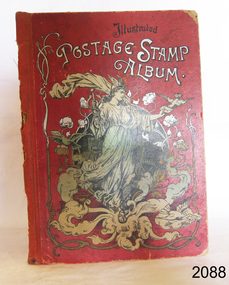
Book - Stamp Album, CF Lucke, publisher, Illustrated Postage Stamp Album, ca 1900
... Inscription: Edwin J Dale, May 13th 1901" Cover: "Illustrated POSTAGE STAMP ALBUM" Inage on cover: "within a floral border, a robed figure wearing a winged helmet, holding a staff with two snakes in one hand, and a sealed letter in the other." Fly: "Registered" "Schaubeks Postage Stamp Album" "Victoria" "Briefmarken"[German - stamps] "Pour Timbres-poste" [French - for postage Stamps] "Para Selloyde Correo" [Spanish - for postage stamps] "With 1070 reduced illustrations, 2200 blank cases for stamps" (also in German, French and Spanish) "Made in Germany"...It represents the hobbies and past times of the people of that era. flagstaff hill warrnambool shipwrecked-coast flagstaff-hill flagstaff-hill-maritime-museum maritime-museum shipwreck-coast flagstaff-hill-maritime-village illustrated postage stamp album postage stamp album stamp album book postage stamp stamp Edwin J Dale May 13th 1901 stamp collecting German stamp album Spottiswoode & Co Ltd Germany CF Lucke Leipzig CF Lucke Leipzig Inscription: Edwin J Dale, May 13th 1901" Cover: "Illustrated POSTAGE STAMP ALBUM" Inage on cover: "within a floral border, a robed figure wearing a winged helmet, holding a staff with two snakes in one hand, and a sealed letter in the other." Fly: "Registered" "Schaubeks Postage Stamp Album" "Victoria" "Briefmarken"[German - stamps] "Pour Timbres-poste" [French - for postage Stamps] "Para Selloyde Correo" [Spanish - for postage stamps] "With 1070 reduced illustrations, 2200 blank cases for stamps" (also in German, French and Spanish) "Made in Germany" Illustrated Postage Stamp Album. ...The inscription in the book indicates that it once belonged to Edwin J Dale, who may have received it May 13th 1901, the date on the inscription. The album was made in Germany and has English, German, French and Spanish language on the fly page. It has 2000 pockets for holding stamps and is illustrated. The printer, Spottiswoode and Co., was established in 1738 by William Strahan, with premises in New Street Square, London. The growing firm advertised as Printers, Lithographers, Stationers, Electrotypers, Publishers, and Booksellers and by 1914 there were 1,000 employees.The stamp album is of Victorian vintage and shows that at the end of the 19th century people collected stamps. It represents the hobbies and past times of the people of that era.Illustrated Postage Stamp Album. Publisher: Lalso by CF Lucke, Leipzig, Germany Printer: Spottiswoode & Co Ltd, London Date: 1908 Red hardcover, illustrated with a robed figure image and text in English, German, French and Spanish. Book has information, advertising and pages divided into blank squares for attaching stamps. Some pages have cutouts where squares would have been, perhaps holding stamps. An inscription with the name Edwin J Dale, 13 May 1901 is on the first turned page..Inscription: Edwin J Dale, May 13th 1901" Cover: "Illustrated POSTAGE STAMP ALBUM" Inage on cover: "within a floral border, a robed figure wearing a winged helmet, holding a staff with two snakes in one hand, and a sealed letter in the other." Fly: "Registered" "Schaubeks Postage Stamp Album" "Victoria" "Briefmarken"[German - stamps] "Pour Timbres-poste" [French - for postage Stamps] "Para Selloyde Correo" [Spanish - for postage stamps] "With 1070 reduced illustrations, 2200 blank cases for stamps" (also in German, French and Spanish) "Made in Germany"flagstaff hill, warrnambool, shipwrecked-coast, flagstaff-hill, flagstaff-hill-maritime-museum, maritime-museum, shipwreck-coast, flagstaff-hill-maritime-village, illustrated postage stamp album, postage stamp album, stamp album, book, postage stamp, stamp, edwin j dale, may 13th 1901, stamp collecting, german stamp album, spottiswoode & co ltd, germany, cf lucke leipzig, cf lucke, leipzig -
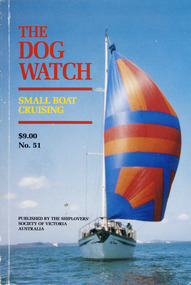 Mission to Seafarers Victoria
Journal (item) - Periodicals-Annual, Shiplovers' Society of Victoria, The Annual Dog Watch
... J. Ferrell Colton Fire At Sea - Capt. Ron Hart Case of the Missing Sandal - W. ...J. Ferrell Colton Fire At Sea - Capt. Ron Hart Case of the Missing Sandal - W. ...This journal provides the reader with glimpses of the adventures and hardships of a seaman's life. Many of the stories are of sailing ships.Contributes to our knowledge of the importance of shipping and places on record those stories of the sea which would otherwise be lost.Contents Indonesian Sailing Harbour - Michael Treacy Errata Dog Watch 50 - Cerberus Crumbles - - The Carola Story - R. N. Thiele Left Behind - W.S. McUtchen Circumnavigation of Tasmania - Alex Algie HMS/HMAS Kanimbla — An Afterthought. Farewell Captain George Molyneux - Keith Nichols Eight Bells - Capt.G. S. Dooley Blue Water Sailing - Valerie Watts Little Man, Big Ship - Capt. J. Ferrell Colton Fire At Sea - Capt. Ron Hart Case of the Missing Sandal - W. P. Shemmeld Frankston-On-Sea- G. M. Naug Voyage - A. Roland Jones Registration, Surveys and Tonnage of Ships 1786-1992 - J. Mills and K. Shewan Cruising Western Port - Harrow Morgan Letters From a Deck Hand on S.S. Thistleford - F. A. Bishop A Sheer Fanatic - Capt. Eric I. Messer The Final Voyage of R.R.S. John Briscoe - T. J. Boult Of Luggers, Pearls and Men - Lawrence Whyte A Sailor’s Life - G. A. Alcock Book Reviews - sailing ships, steamships, shipping, seafaring life, shiplovers' society of victoria, dog watch -
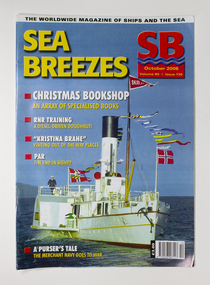 Mission to Seafarers Victoria
Magazine, Sea Breezes Publications Ltd, Sea Breezes, 2006
... This was the case until the late 1930s, when, to further reflect this change in focus, and the awareness that shipping was of considerable interest – not only to seafarers – but many people from all walks of life, the title was changed to Sea Breezes – The Ship Lovers’ Magazine. During that time, it was published by Charles Birchall and Sons, 17 James Street, Liverpool. The normal production of the magazine ceased in October 1939 for the duration of World War Two. Paper had become difficult to source and the editor at that time – Lieutenant- Commander J ...Colour magazinenon-fictionmaritime journals, maritime magazines, ships
