
Showing 13 items matching " japanese screen"
-
 Embroiderers Guild, Victoria
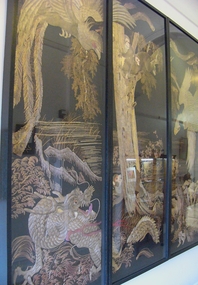
Textile - Japanese Triptych Screen, Late 18th- Early 19th C Edo Period
... Japanese Triptych Screen...... Japanese screen...Large Japanese metal thread screen depicting dragons, ho-o birds and monkeys....Textile Japanese Triptych Screen ...The ho-o bird (hōō or 鳳凰) is a legendary, phoenix-like creature from East Asian mythology, originating from the Chinese fenghuang. The name comes from Japanese, where hō represents the male bird and ō represents the female bird, symbolizing yin and yang harmony. Symbolism: Unlike the Western phoenix, the ho-o does not burn up and rise from ashes. It is a peaceful, divine spirit that appears only to mark times of peace, virtue, or the birth of a just ruler. Appearance: Traditional descriptions combine parts of many animals, featuring the beak of a rooster, head of a pheasant, neck of a snake, and tail of a peacock. Its feathers display five sacred colors (red, yellow, blue, white, and black). Eventually the two creatures merged into one and their combined name was used. The combined creature is still considered to be female, and is often partnered with the tatsu, which is considered to be male. The hōō is one of the most revered and holiest animals in Japan. Second only to the kirin in terms of power, it is the most sacred bird in the Japanese pantheon. Japanese dragon, known as ryū or tatsu (龍 or 竜), is a legendary, serpentine water deity in Japanese mythology and folklore. Physical Appearance: Body: Long, scaly, and snake-like without wings. Claws: Typically depicted with three toes on each foot (distinguishing them from Chinese five-clawed and Korean four-clawed variants). Features: Horns, long whiskers or a beard, and a fierce expression. Movement: Associated with water, oceans, rain, and clouds rather than fire-breathing. Meaning and Symbolism: Water and Weather: Viewed as benevolent water gods controlling rainfall, rivers, and tides. Wisdom and Power: Symbolize strength, protection, and good fortune. Imperial Lineage: Ancient legends state that Japan's imperial family descends from sea deities and dragon royalty like Ryūjin . A Japanese monkey (saru, 猿) in traditional or decorative embroidery symbolizes protection, good luck, cleverness, and the removal of evil. Core Meanings of the Monkey : Warding off evil: Historically, the monkey was viewed as a protector against demons and bad luck. Japanese macaques act as divine messengers in certain Shinto shrines (like the Hie Shrine). Fertility and safe birth: Ancient Japanese clay monkey amulets were used to pray for healthy children and easy childbirth, a meaning that carried into traditional folk textiles and garments. Mischief and playfulness: On a lighter note, single playful monkeys represent cleverness, agility, and lighthearted joy.Large Japanese metal thread screen depicting dragons, ho-o birds and monkeys.embroidery, japanese screen, metal work, surface stitchery -
 Embroiderers Guild, Victoria
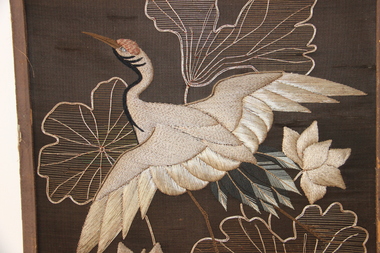
Textile - Japanese Screen with Cranes, c 1900
... Japanese Screen with Cranes...19th century Japanese screen (partial) embroidered in silver metal threads on brown silk in a wooden frame...In original wooden frame. Textile Japanese Screen with Cranes ...19th century Japanese screen (partial) embroidered in silver metal threads on brown silk in a wooden frameEmbroidered screen depicting two cranes and one small bird amongst lily pads and flowers. Worked in silver metal thread couched with coloured silks. In original wooden frame.birds, flowers, crane, tsuru, lily pads -
 Flagstaff Hill Maritime Museum and Village
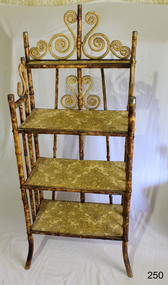
Furniture - Shelves, A. Englander & Searle, Late 19th Century (1898)
... While most produced standard tables, stands and fire-screens, the more adventurous offered for sale items such as Corner shelve units, charcoal barbecue grills and musical tea tables. Shelves were often covered with embossed leather paper designs, at first imported from Japan and then later produced in England. ...While most produced standard tables, stands and fire-screens, the more adventurous offered for sale items such as Corner shelve units, charcoal barbecue grills and musical tea tables. Shelves were often covered with embossed leather paper designs, at first imported from Japan and then later produced in England. ...This music stand set of shelves is one of many 19th century items of furniture, linen and crockery donated to Flagstaff Hill Maritime Village by, Vera and Aurelin Giles. The items are associated with the Giles Family and are known as the “Giles Collection”. Many of the items of furniture, linen and crockery in the Lighthouse Keeper’s Cottage were donated by Vera and Aurelin Giles and mostly came from the simple home of Vera’s parents-in-law, Henry Giles and his wife Mary Jane (nee Freckleton) whose photos are in the parlour. They married in 1880. Henry, born at Tower Hill in 1858, was a labourer on the construction of the Breakwater before leaving in 1895 to build bridges in N.S.W. for about seven years. Mary Jane was born in 1860 at Cooramook. She attended Mailor’s Flat State School where she was also a student teacher before, as family legend has it, she became a governess at “Injemiara” where her grandfather, Francis Freckleton, once owned land. Henry and Mary’s family of six, some of whom were born at Mailor’s Flat and later children at Wangoom, lived with their parents at Wangoom and Purnim west, where Henry died in 1933 and Mary Jane in 1940. THE SHELVES During the years 1869-1935 there were well over 250 registered bamboo furniture producers in Britain. The earliest recorded firm was Hubert Bill of 14 Little Camden St, London N.W., who claimed to have been established in (1869 the first bamboo furniture maker), while Daniel Jacobs & Sons of Hackney Road, London, were still in business in 1915, after 45 years of production. Design, quality, price and methods of construction were fairly consistent throughout the whole period, but it was the imaginative and often eccentric choice of subject matter that marked the differentiation between the various firms. While most produced standard tables, stands and fire-screens, the more adventurous offered for sale items such as Corner shelve units, charcoal barbecue grills and musical tea tables. Shelves were often covered with embossed leather paper designs, at first imported from Japan and then later produced in England. Some firms incorporated the knobbly roots of the bamboo stems into their designs, generally to form feet. Occasionally handles to drawers and cupboards were made with these roots although they were more commonly carved as imitations. Handles were mostly of cheap metal or brass. The ends of the bamboo canes were capped with stamped metal or turned bone, ivory or wooden discs. Methods of construction fell into three categories. First and most common is that of pegging. Bamboo stems being hollow, thick dowels can easily be glued into the joints. Some firms farmed out this work of `plugging' the ends of the canes to part-time workers at home. The second method, that of pinning, was far less satisfactory as bamboo tends to split lengthwise and therefore the jointed pieces eventually disintegrated. The most efficient method was that patented in 1888 (patent No 2383) by the firm of W. F. Needham in Birmingham. It consisted of metal shoes and covers for all joints which were made by wrapping a metal strip around the stems and soldering the overlapping ends. Some joints were further strengthened by a small pin or screw. Needham was by far the largest and most successful manufacturer and their individual and superior method of construction undoubtedly gained them their reputation. A. Englander & Searle of 34 Gt Eastern St and 31 Mare St, Hackney, London, were a firm particularly concerned with methods of construction. Although they seem to have entered the bamboo furniture market at a comparatively late date, about 1898, they produced inexpensive bamboo, aimed particularly at the export trade. The company stated in their catalogue that bamboo furniture “can be exported in one piece or it can be exported in pieces and put together again. The fixing up is much facilitated by a system of marking and numbering. Further, no glue is required for putting together as the screw system only is applied”. This method of construction best fits the Etagere in the Flagstaff collection and it is believed to have been made by A Englander & Searle, exported in a knock down form to Australia, purchased in kit form from a dealer hear and put together by the owner. The Etagere is a significant item as it highlight furniture fashion of the late Victorian era. This item was highly sort after in its time and although mass produced, not many examples remain, so this example is a valuable addition to the Flagstaff collection. It is believed that the construction method used is by a notable and respected maker of bamboo furniture and that its production was aimed at the export market and probably came to Australia in kit form.Bamboo shelves: decorative free standing Etagere comprising three large shelves and one small shelf. Shelves are made of wood used to store either orange or bacon boxes (as there are no knots in the wood, imported from South America and cheap to recycle). Shelves are covered with embossed leather paper. Frame is made from tortoise shell bamboo (brown lacquer applied to simulate tortoise shell appearance). Ends of bamboo canes are covered with metal shoes and fixed with a pin. Other bamboo joints are fixed with round head steel screws. This item is part of the Giles Collection.Noneflagstaff hill, warrnambool, shipwrecked-coast, flagstaff-hill, flagstaff-hill-maritime-museum, maritime-museum, shipwreck-coast, flagstaff-hill-maritime-village, bamboo shelves, bamboo etagere, victorian furniture, furniture, bamboo furniture, embossed leather paper, simulated bamboo, tortise shell, a englander & searle, giles collection, henry giles, tower hill, cooramook, warrnambool breakwater, mailor’s flat, wangoom, 19th century furniture -
 Flagstaff Hill Maritime Museum and Village
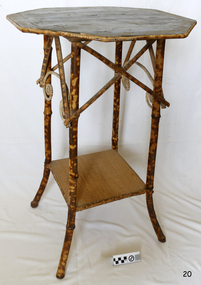
Furniture - Plant Stand, 1880
... While most produced standard tables, stands and fire-screens, the more adventurous offered for sale items such as corner shelve units, charcoal barbecue grills and musical tea tables. Shelves were often covered with embossed leather paper designs, at first imported from Japan and then later produced in England. ...While most produced standard tables, stands and fire-screens, the more adventurous offered for sale items such as corner shelve units, charcoal barbecue grills and musical tea tables. Shelves were often covered with embossed leather paper designs, at first imported from Japan and then later produced in England. ...During the years 1869-1935, there were well over 250 registered bamboo furniture producers in Britain. The earliest recorded firm was Hubert Bill of 14 Little Camden St, London N.W., who claimed to have been established in 1869, while Daniel Jacobs & Sons of Hackney Road, London, were still in business in 1915, after 45 years of production. Design, quality, price and methods of construction were fairly consistent throughout the whole period, but it was the imaginative and often eccentric choice of subject matter that marked differentiation between the various firms. While most produced standard tables, stands and fire-screens, the more adventurous offered for sale items such as corner shelve units, charcoal barbecue grills and musical tea tables. Shelves were often covered with embossed leather paper designs, at first imported from Japan and then later produced in England. Some firms incorporated the knobbly roots of the bamboo stems into their designs, generally to form feet. Occasionally, handles to drawers and cupboards were made with these roots, although they were more commonly carved as imitations. Handles were mostly of cheap metal or brass. The ends of the bamboo canes were capped with stamped metal or turned bone, ivory or wooden discs. Methods of construction fell into three categories. First and most common is that of pegging. Bamboo stems being hollow, thick dowels can easily be glued into the joints. Some firms farmed out this work of `plugging' the ends of the canes to part-time workers at home. The second method, that of pinning, was far less satisfactory as bamboo tends to split lengthwise and therefore the jointed pieces eventually disintegrated. The most efficient method was that patented in 1888 (patent No. 2383) by the firm of W. F. Needham in Birmingham. It consisted of metal shoes and covers for all joints, which were made by wrapping a metal strip around the stems and soldering the overlapping ends. Some joints were further strengthened by a small pin or screw. Needham was by far the largest and most successful manufacturer, and their individual and superior method of construction undoubtedly gained them their reputation. A. Englander & Searle of 34 Gt Eastern St and 31 Mare St, Hackney, London, were a firm particularly concerned with methods of construction. Although they seem to have entered the bamboo furniture market at a comparatively late date, about 1898, they produced inexpensive' bamboo, aimed particularly at the export trade. Stating in their catalogue that bamboo furniture “can be exported in one piece or it can be exported in pieces and put together again. The fixing up is much facilitated by a system of marking and numbering. Further, no glue is required for putting together as the screw system is applied”. This method of construction best fits the Etagere and this item in the Flagstaff collection, and it is believed to have been made by A Englander & Searle, exported in a knock-down form to Australia, purchased in kit form from a dealer here and put together by the purchaser. The bamboo plant stand is a significant item as it highlight furniture fashion of the late Victorian era. This item was highly sort after in its time and although mass produced, not many examples remain because the item is so fragile so this example is a valuable addition to the Flagstaff collection. It is believed,the construction method used is by a notable and respected maker in England of bamboo furniture that was aimed specifically at the export market and probably came to Australia in kit form to be assembled by the purchaser.Plant stand: a bamboo plant stand with a hexagonal pine timber top edged with tortoise shell bamboo. The top is supported on four tortoise shell bamboo legs joined at the base by a square cane-covered shelf. The tortoise shell appearance is brown lacquer. This stand is part of the Giles Collection. flagstaff hill, warrnambool, shipwrecked coast, flagstaff hill maritime museum, shipwreck coast, furniture, plant stand, bamboo furniture, etagere, victorian furniture, simulated bamboo, tortise shell, a englander & searle, domestic furniture, giles collection, henry giles, cooramook, mailor’s flat, wangoom, 19th century household goods -
 Bendigo Military Museum
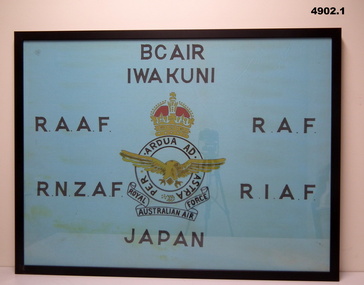
Banner - BCOF BANNERS, FRAMED, c1946 - Frame 2022
... Screen printing - black ink. 1. "BCAIR/IWA KUNI/ R.A.A.F./R.A.F./ R.N.2.A.F./R.I.A.F./JAPAN " Unit insignia 'ROYAL AUSTRALIAN AIR FORCE' 2. " R.A.N....Military WW2 Japan Banners Screen printing - black ink. 1. "BCAIR/IWA KUNI/ R.A.A.F. ...1. "I.W.A. KUNI" - City in Japan. 2. " B.C.O.F." - Japan 1946-48. British Commonwealth Occupation Forces (Japan).1. Banner - framed cotton fabric, light blue background with screen printing in black colour letters and centre unit insignia black, yellow and red colours. 2. Banner - framed cotton fabric, white background with screen printing in black colour letters and centre unit insignia red, yellow and blue colours. 1. & 2. Frames - timber, black colour paint, glass front, timber housing.Screen printing - black ink. 1. "BCAIR/IWA KUNI/ R.A.A.F./R.A.F./ R.N.2.A.F./R.I.A.F./JAPAN " Unit insignia 'ROYAL AUSTRALIAN AIR FORCE' 2. " R.A.N./H.M.A. SHIPS/ B.C.O.F./ AUSTRALIA - JAPAN/1946-1948"military, ww2, japan, banners -
 Kiewa Valley Historical Society
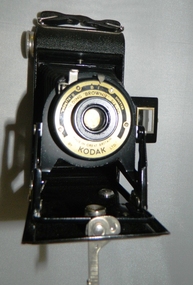
Camera Box Brownie Folding, Six 20 Folding Brownie KodetteII, Circa 1948 to late 1970s
... Japan finally nailed the coffin lid on the Kodak Company. Ironically, one of Kodak's engineers called Steve Sasson, devised a camera that could save images using electronic circuits. The images were transferred onto a tape cassette and were viewable by attaching the camera to a TV screen, however Kodak tried to maintain its photographic film products beyond its "use by date". ...Japan finally nailed the coffin lid on the Kodak Company. Ironically, one of Kodak's engineers called Steve Sasson, devised a camera that could save images using electronic circuits. The images were transferred onto a tape cassette and were viewable by attaching the camera to a TV screen, however Kodak tried to maintain its photographic film products beyond its "use by date". ...This camera was made for the mobile photographer and the camera manufacturer Kodak was at the peak of production. Mr. George Eastman, the company's founder, who invented roll film, which could withstand the outdoor activities and therefor replaced photographic plates. In 1900, the Box Brownie camera was first released Kodak's motto was' "You push the button, we do the rest," The film used in this camera was Kodak Verichrome 620 introduced in 1936 and only went out of production 2009. This camera was a vintage 1970s one. Between 1963 and 1970 the company sold 50 million of this type of camera. The production of smaller and more user friendly digital cameras, mainly from Japan finally nailed the coffin lid on the Kodak Company. Ironically, one of Kodak's engineers called Steve Sasson, devised a camera that could save images using electronic circuits. The images were transferred onto a tape cassette and were viewable by attaching the camera to a TV screen, however Kodak tried to maintain its photographic film products beyond its "use by date". In1975 Kodak becomes the first company to make a digital camera, however the Japanese manufacturers could make smaller and more compact cameras ending Kodak's monopoly and eventual demise.This particular "box brownie" was used by Margaret Shefford, nee Turner, who with her husband retired, in the 1980s, to Mount Beauty. The camera was purchased in the 197's and used on their cruise to England. The significance of this item is that at the time of its introduction to Mount Beauty the camera was a "state of the art", for general public, camera introduced by an ever increasing influx of retirees. This identifies the Kiewa Valley not only as an attraction for sightseers and overseas tourists but also retirees. The social implications of this trend will continue to provide a broader requirement for medical and other facilities geared up to the requirements of an aging population. As a lot of cities in Australia have increasing levels of violence (mainly drug related) rural "retreats" are becoming more sought after by sections of "the gentle populous"This is a black metal rectangular camera, rounded on the ends and has silver colored fittings(stainless steel) and a small leather handle on hinges the left side (facing the lens). The folding lens and shutter component fold out from the main compartment. Two metal arms swing out and hold the lens and collapsible lens body to the required length. When not in use this collapsible (folding) lens extension is fastened to the main body structure providing security and preventing damage to the folding material. The camera has a collapsible eye piece or view finder at the top end. The right hand bottom end has a cylindrical film wider (polished steel). Inside there are two cylindrical cavities, one holding the roll of unexposed film and the other (winder) end a cylinder onto which the unexposed film is wound through for each picture frame. There is a locking mechanism to hold the folding lens structure to the main box structure. See KVHS 0419B for its carrying caseNo external makings but when the lens is folded out it exposes manufacturing information on metal base around the lens " Kodette II B I shutter"(B= Bulb and I= Instant), underneath this, in larger print, is "'FOLDING 'BROWNIE' SIX - 20" below the lens and in smaller print, "made in Great Britain" and underneath this "by KODAK ltd"kodak kodette ii, folding brownie camera, photography, hobby personal item, tourist gadgets. -
 Deaf Children Australia
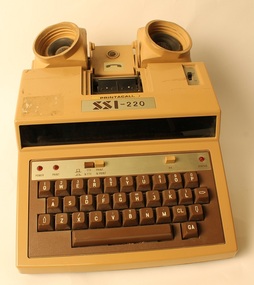
Printacall TTY Printer, Specialized Systems, Inc, 1970's
... JAPAN / SERIAL NO. 02478" On sticker on back: "MODEL. SSI-220 / SERIAL NO. 84840001 / Printacall Pty. Ltd. (02) 2648104 / P.O BOX A623 Sydney South 2000 N.S.W. Australia." Inscribed on R side: "HEIDELBERG HIGH SCHOOL / HEARING IMPAIRED UNIT NO 3" Label on L side: "TELECOM AUSTRALIA / Permit No 08216 103/2" Light brown top with dark brown base telephone keyboard. Made of plastic with sockets for the handpiece of a phone, a QWERTY keyboard and small (5cmW) printer, possibly with a screen ...Light brown top with dark brown base telephone keyboard. Made of plastic with sockets for the handpiece of a phone, a QWERTY keyboard and small (5cmW) printer, possibly with a screen. Used to take and send telphone calls. Uses batteries and has a handle for carrying. On top: "PRINTACALL/SSI-220" On back: "SSI / INNOVATIONS IN COMMUNICATIONS" On bottom: in middle of metal plaque "SSI-220 / Power: DC 6V/ Type "C" x 4 / (RECHARGEABLE BATTERY) / SPECIALIZED SYSTEMS, INC. / SAN DIEGO, CALIFORNIA / MADE IN JAPAN / SERIAL NO. 02478" On sticker on back: "MODEL. SSI-220 / SERIAL NO. 84840001 / Printacall Pty. Ltd. (02) 2648104 / P.O BOX A623 Sydney South 2000 N.S.W. Australia." Inscribed on R side: "HEIDELBERG HIGH SCHOOL / HEARING IMPAIRED UNIT NO 3" Label on L side: "TELECOM AUSTRALIA / Permit No 08216 103/2" -
 Whitehorse Historical Society Inc.
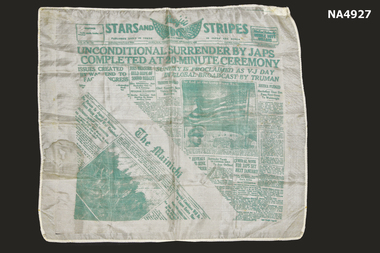
Textile - Handkerchief, 1945 approx
... White silk handkerchief with screen prints in green of newspaper articles of surrender by Japanese 2 September 1945....Japan on 2 September 1945. World War 2 military history army costume accessories male as above White silk handkerchief with screen prints in green of newspaper articles of surrender by Japanese 2 September 1945. ...White silk handkerchief with newspaper headlines and stories related to the surrender of Japan on 2 September 1945.World War 2White silk handkerchief with screen prints in green of newspaper articles of surrender by Japanese 2 September 1945.as abovemilitary history, army, costume accessories, male -
 Whitehorse Historical Society Inc.
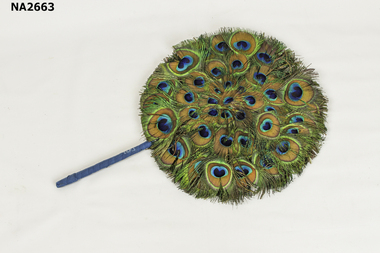
Accessory - Fan, Hand Screen, 1880 - 1930
... Japanese Fans.` costume accessories female Women's fan. Blue and green peacock feathers in circle. Handle wrapped in blue ribbon. Used indoors beside the fire to protect a ladies complexions against the heat. Accessory Fan, Hand Screen ...Queen Alexandra and Queen Mary were photographed holding these fans.|In 'Feather Fans - Collectors Guide to Fans' by Susan Nayer - 'In1880 feather fans returned to fashion -- remained in use until 1930s at court presentations. Also known as Japanese Fans.`Women's fan. Blue and green peacock feathers in circle. Handle wrapped in blue ribbon. Used indoors beside the fire to protect a ladies complexions against the heat.costume accessories, female -
 Whitehorse Historical Society Inc.
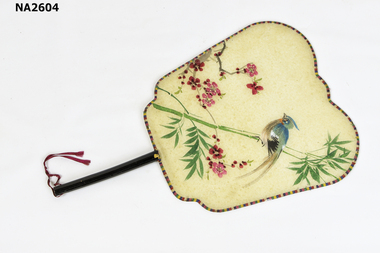
Accessory - Fan
... Japan. costume accessories female Silk fan with wooden handle, A straight fan rather than folded. Cream background with bird of paradise on green bamboo with pink cherry blossom. Thin multi coloured border. Modern Chinese Fan Known as a rigid or screen ...Possibly a version of 'The Comfyhold Fan' - trade mark US patent.|Also it is possibly made in Japan.Silk fan with wooden handle, A straight fan rather than folded. Cream background with bird of paradise on green bamboo with pink cherry blossom. Thin multi coloured border. Modern Chinese Fan Known as a rigid or screen fan. Stretched over a circumferential frame of very thin wood which was usually braced by a handle that continued across its diameter behind the silk. A cooling device of the Chinese.costume accessories, female -
 Wodonga & District Historical Society Inc
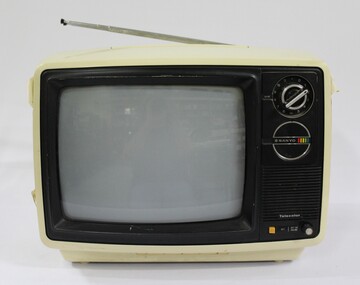
Functional object - Sanyo VHF Colour Television 1980
... Japanese parts." printed on a paper label attached to the upper back part of the television. Cream and black plastic Sanyo VHF colour televison, with the Sanyo logo and one large circular VHF control knob for the different channels on the proper left black plastic panel, and one small off-on volume knob at the bottom of the black plastic panel. The diagonal screen ...The Sanyo VHF colour television is thought to have been assembled in Wodonga, as Sanyo was one of the international companies that set up business in Wodonga in the 1970s as part of the de-centralisation of industry and continued operation into the 1980s. The Sanyo Australia Pty. Ltd. factory in Wodonga opened in 1974 with 35 staff and production peaked in 1976-1977 when it employed 360 people. In the first ten years 350,000 televisions were assembled from Japanese parts, however by 1984 the number of staff had reduced to 112 and the factory closed in 1987. All Sanyo televisions were then imported from Japan. The Sanyo VHF colour television has local, state and national significance as it is thought to have been assembled in Sanyo Australia's factory in Wodonga. Sanyo was one of the international companies that set up business in Wodonga as part of the decentralisation of industry in Australia in the 1970s-1980s.Cream and black plastic Sanyo VHF colour televison, with the Sanyo logo and one large circular VHF control knob for the different channels on the proper left black plastic panel, and one small off-on volume knob at the bottom of the black plastic panel. The diagonal screen measurement is 30 cm or 11 inches."VHF" / SANYO / Telecolor / AFT / OFF-ON/ VOLUME" on the proper left black plastic panel on the front of the television. "75Ω- 300Ω" on the black part of the cable attached to the two antennas. "FOR YOUR SAFETY / Install any external / aerial to AS1417.1" on the back of the television. "SERIAL NO / 30207332" on the back of the television. "SANYO / MODEL CTP 2600 / CHASSIS NO. 79P-B5ZH 01 / AC 240V~, 50Hz, 85 WATTS / SANYO ELECTRIC CO., LTD. MADE IN JAPAN / WARNING / DANGEROUS VOLTAGE INSIDE / CHASSIS LIVE / CONTACT IS DANGEROUS / 3401901 B5ZH-B" on the back of the television. "SBS TELEVISION" stickers on both sides of the television. "WODONGA ASSEMBLED TELEVISION. (underlined) / This SANYO VHF COLOUR TELEVISION / Serial number AS1417.A (AS = Australia) / Model CTP 2600 was assembled / at the Sanyo Drive, Wodonga, factory Circa 1980, from Japanese parts." printed on a paper label attached to the upper back part of the television. sanyo, sanyo colour televisions, sanyo t.v.s, vhf t.v.s, sbs, wodonga, sanyo australia pty. ltd. -
 Returned Nurses RSL Sub-branch
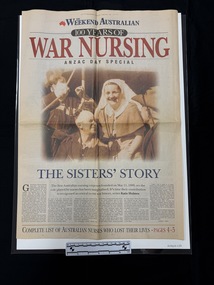
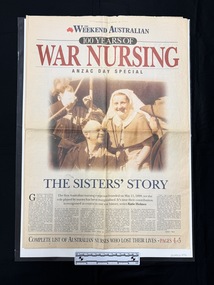
Newspaper - Newspaper lift out, The Weekend Australian et al, 100 years of War Nursing : ANZAC Day Special, 19990424
... 'A will to remember' by Catherine Kenny - p6 - Article providing overview of stories shared by surviving Japanese POW nurses including Betty Jeffrey, Wilma Young (neé Oram), Jessie Hookway (neé Simons), Pat Darling (neé Gunther), Vivian Bullwinkel, Lorna Johnson (neé Whyte), and Mavis Cation (neé Cullen). Article also discussed artistic representations of the stories on stage and screen...'A will to remember' by Catherine Kenny - p6 - Article providing overview of stories shared by surviving Japanese POW nurses including Betty Jeffrey, Wilma Young (neé Oram), Jessie Hookway (neé Simons), Pat Darling (neé Gunther), Vivian Bullwinkel, Lorna Johnson (neé Whyte), and Mavis Cation (neé Cullen). Article also discussed artistic representations of the stories on stage and screen ...The Weekend Australian lift out from ANZAC Day 1999. Contains article titles as follows: 'The Sisters' story' by Katie Holmes - p1 - Beginning of an article talking about the circumstances of nurses in warfare, duties, conditions, etc. Continued on p8 'Private battles' by Jan Bassett - p2 - Article gives a brief overview of how armed forces nursing services were formed, why and how they developed, including major players such as Nellie Gould and Grace Wilson. '100 years of service, dedication' - p2 - Timeline of armed forces nursing services. 'Wild dogs and 13 patients' by Jan Bassett - p2 - Edited extract from recollections of Julia Anderson who served as a nurse in the Boer War. 'A pioneer called Nellie' by Jan Bassett - p2 - Brief biographical article on Nellie Gould. 'Into the mess' by Jan Bassett - p3 - Article on the conditions faced by WWI nurses serving overseas including memories of various nurses. 'Tragedy made more personal' by Jan Bassett - p3 - Brief biographical article on Grace Wilson. 'The old ship is heaven after the peninsula' - p3 - Edited excerpt from WWI diary of Ella Jane Tucker. 'In Memoriam' - p4-5 - Names of nurses who have died as a result of war service from Boer war to Vietnam war. 'Hell of Banka' by Catherine Kenny - p6 - Article providing basic details on the sinking of the Vyner Brooke, massacre on Banka Island, survival of Vivian Bullwinkel and later surrender to Japanese. 'A will to remember' by Catherine Kenny - p6 - Article providing overview of stories shared by surviving Japanese POW nurses including Betty Jeffrey, Wilma Young (neé Oram), Jessie Hookway (neé Simons), Pat Darling (neé Gunther), Vivian Bullwinkel, Lorna Johnson (neé Whyte), and Mavis Cation (neé Cullen). Article also discussed artistic representations of the stories on stage and screen. 'Making do to survive' by Jessie Simons - p6 - Reprinted excerpt from book by same author 'Japanese Hands Australian Nurses as POWs'. 'Grim miracles' by Siobhan McHugh - p7 - Article on experiences of nurses in the Vietnam war including Colleen Mealy, Anne Hall, Trish Ferguson, Jan McCarthy, Del Waterman, Terrie Roach and Anne Healy. 'Anyone's blood was welcome' by Siobhan McHugh - p7 - Brief article of the working conditions of civilian nurses in Vietnam during the war, including recollections of Jenny James, Fran Sardelich and Kay Collett (radiographer not nurse). 'A long day's journey' - p7 - Brief interview article with Del Waterman an RAAF Nurse who served in Malaysia during the Vietnam war. 'Attitudes changes in the face of suffering' by Siobhan McHugh - p7 - Brief interview article with Anne Hall on her time as an army nurse during the Vietnam war. 'Neglected heroes' by Ken Inglis - p8 - An article on war memorial recognition or lack of for nurses throughout history of memorials in Australia, how some were recognised and others not and how attitudes have changed over time. '100 years of service, skill and sacrifice' by Katie Holmes - p8 - Continuation of article on p1. 'Sisters in arms' - p8 - Box insert of numbers of military nurses who served in major conflicts from Boer - Gulf wars.A large newspaper lift out with text in red, blue and black. Front cover has large headings and a large sepia toned photo featuring a woman in nurses uniform with men in dressing gowns around her. The lift out is made up of two pieces of paper folded to make 8 pages of articles.nursing in warfare, anzac day, memorial -
 Returned Nurses RSL Sub-branch
Newspaper - Newspaper lift out, The Weekend Australian et al, 100 years of War Nursing : ANZAC Day Special, 19990424
... 'A will to remember' by Catherine Kenny - p6 - Article providing overview of stories shared by surviving Japanese POW nurses including Betty Jeffrey, Wilma Young (neé Oram), Jessie Hookway (neé Simons), Pat Darling (neé Gunther), Vivian Bullwinkel, Lorna Johnson (neé Whyte), and Mavis Cation (neé Cullen). Article also discussed artistic representations of the stories on stage and screen...'A will to remember' by Catherine Kenny - p6 - Article providing overview of stories shared by surviving Japanese POW nurses including Betty Jeffrey, Wilma Young (neé Oram), Jessie Hookway (neé Simons), Pat Darling (neé Gunther), Vivian Bullwinkel, Lorna Johnson (neé Whyte), and Mavis Cation (neé Cullen). Article also discussed artistic representations of the stories on stage and screen ...The Weekend Australian lift out from ANZAC Day 1999. Contains article titles as follows: 'The Sisters' story' by Katie Holmes - p1 - Beginning of an article talking about the circumstances of nurses in warfare, duties, conditions, etc. Continued on p8 'Private battles' by Jan Bassett - p2 - Article gives a brief overview of how armed forces nursing services were formed, why and how they developed, including major players such as Nellie Gould and Grace Wilson. '100 years of service, dedication' - p2 - Timeline of armed forces nursing services. 'Wild dogs and 13 patients' by Jan Bassett - p2 - Edited extract from recollections of Julia Anderson who served as a nurse in the Boer War. 'A pioneer called Nellie' by Jan Bassett - p2 - Brief biographical article on Nellie Gould. 'Into the mess' by Jan Bassett - p3 - Article on the conditions faced by WWI nurses serving overseas including memories of various nurses. 'Tragedy made more personal' by Jan Bassett - p3 - Brief biographical article on Grace Wilson. 'The old ship is heaven after the peninsula' - p3 - Edited excerpt from WWI diary of Ella Jane Tucker. 'In Memoriam' - p4-5 - Names of nurses who have died as a result of war service from Boer war to Vietnam war. 'Hell of Banka' by Catherine Kenny - p6 - Article providing basic details on the sinking of the Vyner Brooke, massacre on Banka Island, survival of Vivian Bullwinkel and later surrender to Japanese. 'A will to remember' by Catherine Kenny - p6 - Article providing overview of stories shared by surviving Japanese POW nurses including Betty Jeffrey, Wilma Young (neé Oram), Jessie Hookway (neé Simons), Pat Darling (neé Gunther), Vivian Bullwinkel, Lorna Johnson (neé Whyte), and Mavis Cation (neé Cullen). Article also discussed artistic representations of the stories on stage and screen. 'Making do to survive' by Jessie Simons - p6 - Reprinted excerpt from book by same author 'Japanese Hands Australian Nurses as POWs'. 'Grim miracles' by Siobhan McHugh - p7 - Article on experiences of nurses in the Vietnam war including Colleen Mealy, Anne Hall, Trish Ferguson, Jan McCarthy, Del Waterman, Terrie Roach and Anne Healy. 'Anyone's blood was welcome' by Siobhan McHugh - p7 - Brief article of the working conditions of civilian nurses in Vietnam during the war, including recollections of Jenny James, Fran Sardelich and Kay Collett (radiographer not nurse). 'A long day's journey' - p7 - Brief interview article with Del Waterman an RAAF Nurse who served in Malaysia during the Vietnam war. 'Attitudes changes in the face of suffering' by Siobhan McHugh - p7 - Brief interview article with Anne Hall on her time as an army nurse during the Vietnam war. 'Neglected heroes' by Ken Inglis - p8 - An article on war memorial recognition or lack of for nurses throughout history of memorials in Australia, how some were recognised and others not and how attitudes have changed over time. '100 years of service, skill and sacrifice' by Katie Holmes - p8 - Continuation of article on p1. 'Sisters in arms' - p8 - Box insert of numbers of military nurses who served in major conflicts from Boer - Gulf wars.A large newspaper lift out with text in red, blue and black. Front cover has large headings and a large sepia toned photo featuring a woman in nurses uniform with men in dressing gowns around her. The lift out is made up of two pieces of paper folded to make 8 pages of articles.nursing in warfare, anzac day, memorial
