
Showing 81 items matching " knight family"
-
 Bendigo Historical Society Inc.
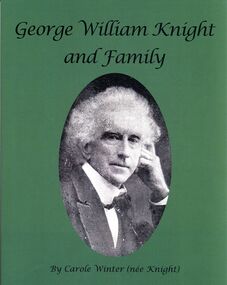
Book - GEORGE WILLIAM KNIGHT AND FAMILY
... GEORGE WILLIAM KNIGHT AND FAMILY......Family...Knight...George William Knight and Family by (Carole Winter 9 nee Knight), green soft cover contains 108 pages of information on the Knight family history with black and white & some coloured photographs....GENEALOGY Family Knight Carole Winter George William Knight and Family by (Carole Winter 9 nee Knight), green soft cover contains 108 pages of information on the Knight family history with black and white & some coloured photographs. ...George William Knight and Family by (Carole Winter 9 nee Knight), green soft cover contains 108 pages of information on the Knight family history with black and white & some coloured photographs.Carole Wintergenealogy, family, knight -
 Bendigo Historical Society Inc.
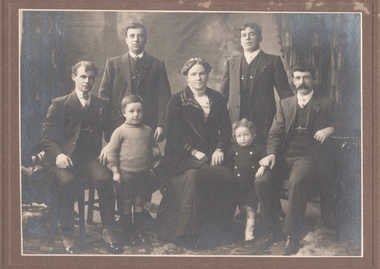
Photograph - Knight Family, McKenzie Family Collection
... Knight Family ...Knight Family posed studio B&W photograph with brown cardboard mount. ...McKenzie Family Collection Photograph Knight Family ...BHS CollectionKnight Family posed studio B&W photograph with brown cardboard mount. Matriarch with four adult sone and two young children. Notated as Ollie Swales step family. Photographer's stamp Jenkinson Broken Hill.history, eaglehawk -
 Halls Gap & Grampians Historical Society
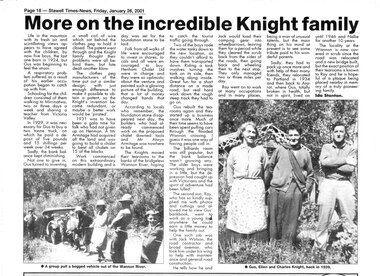
Newspaper - B/W, 26/01/2001
... It refers to Gus Knight and his family when they lived at Henham and on the Wannon River. ...A newspaper article headed "More on the incredible Knight Family", containing two photos....It refers to Gus Knight and his family when they lived at Henham and on the Wannon River. ...This is a newspaper article written by Ida Stanton for the Stawell Times-News "Halls Gap Extra" and published on Friday, 26 January 2001, p.18. It refers to Gus Knight and his family when they lived at Henham and on the Wannon River. The photos included in the article show: 1) a bogged vehicle being pulled out of the Wannon River by a large group of people; and 2) Gus, Ellen and Charles Knight in 1939.A newspaper article headed "More on the incredible Knight Family", containing two photos.people, knight -
 Halls Gap & Grampians Historical Society
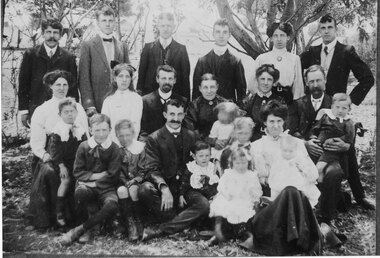
Photograph - B/W, C 1910
... Photo shows extended Knight family - Parents - Gus and Ellen Knight 6 boys 1 girl...Ray Doig, Agnes (nee Mason) Knight, Celma (Knight) Doig, Jim Doig Front Row Agnes Knight's grandchildren, Len Knight and his wife PEOPLE Knight Photo shows extended Knight family - Parents - Gus and Ellen Knight 6 boys 1 girl Photograph B/W ...Back Row - Frank Emmett, Jim Knight, Les Knight, Arthur Knight, Ellen (nee Boyd) and Gus Knight Middle Row - Lil Emmet (Knight)? Ray Doig, Agnes (nee Mason) Knight, Celma (Knight) Doig, Jim Doig Front Row Agnes Knight's grandchildren, Len Knight and his wifePhoto shows extended Knight family - Parents - Gus and Ellen Knight 6 boys 1 girlpeople, knight -
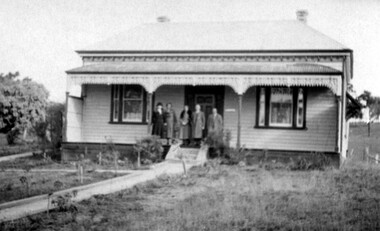 Linton and District Historical Society Inc
Photograph, Mrs. Norris' House, Linton, 1937
... ... Knight family...Houses Mrs Norris Knight family "Mrs Norriss's house Skipton road Linton 1937 later Knights home". ...This house was sold by the Knights approx 1970, and moved to the Linton-Piggoreet Road.Black and white original photograph of five people standing on the verandah of a late Victorian house."Mrs Norriss's house Skipton road Linton 1937 later Knights home".houses, mrs norris, knight family -
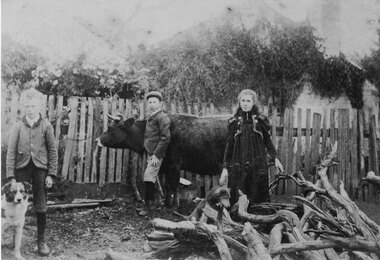 Halls Gap & Grampians Historical Society
Photograph - Sepia, C 1891
... Photo shows 3 members of the knight family standing in front of wood heap There are two dogs and a cow From left to right - Leslie (Les), Augustus knight, Lil Knight...PEOPLE Knight Photo shows 3 members of the knight family standing in front of wood heap There are two dogs and a cow From left to right - Leslie (Les), Augustus knight, Lil Knight Photograph Sepia ...Photo shows 3 members of the knight family standing in front of wood heap There are two dogs and a cow From left to right - Leslie (Les), Augustus knight, Lil Knightpeople, knight -
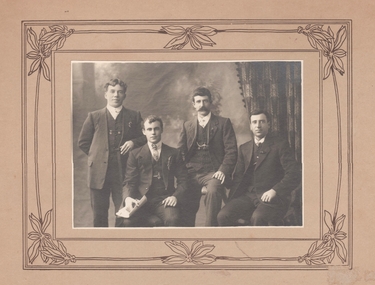 Bendigo Historical Society Inc.
Photograph - Posed studio B&W photograph of four Knight brothers, McKenzie Family Collection, August 2024
... Knight Family posed studio B&W photograph with brown cardboard mount. ...No information on other men available. history Eaglehawk Photographers stamp Jenkinson Broken Hill. Knight Family posed studio B&W photograph with brown cardboard mount. ...Valentine Claude (Claude) Knight (1871-1974) was the son of Caroline Knight who later married Henry Joh Batten in 1876. Claude married Catherine Martha Roberts in 1914. No information on other men available.Knight Family posed studio B&W photograph with brown cardboard mount. Four adult males detailed as Claude Knight (front LHS) with Carrie Brays (son), Ollie Swales (stepbrother) and unnamed male. Photographers stamp Jenkinson Broken Hill.history, eaglehawk -
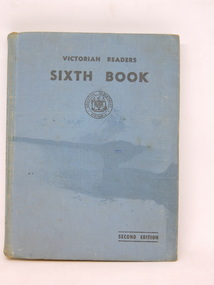 Kilmore Historical Society
Book, VICTORIAN READERS SIXTH BOOK
... Used by the Knight family....Used by the Knight family. Used by the Knight family. Reading children textbook knight Sixth of a series of eight readers produced 1927-30 for school children in Victoria and used (with revisions & content changes) until the 1950's Front end paper "1/3", "WK" [crossed out] , "Glenn Knight"/design within a circled done in red biro. ...Sixth of a series of eight readers produced 1927-30 for school children in Victoria and used (with revisions & content changes) until the 1950'sBlue cloth-bound cover stained & faded. Minor wear to extremities. Pages yellowed.244pp. Good condition.fictionSixth of a series of eight readers produced 1927-30 for school children in Victoria and used (with revisions & content changes) until the 1950'sreading, children, textbook, knight -
 Kilmore Historical Society
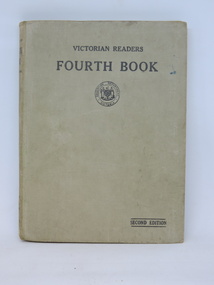
Book, Education Department, Victorian Readers Fourth Book, 1940
... Used by the Knight family of Kilmore...Used by the Knight family of Kilmore reading spelling children knight textbook School Reader, short stories & poetry. ...School Reader, short stories & poetry. One of a series of eight readers produced 1927-30 for school children in Victoria. Used (with revisions and contents changes) until the 1950's.Clothbound, beige cover, stained. 179 pp. Fair condition.fictionSchool Reader, short stories & poetry. One of a series of eight readers produced 1927-30 for school children in Victoria. Used (with revisions and contents changes) until the 1950's.reading, spelling, children, knight, textbook -
 Halls Gap & Grampians Historical Society
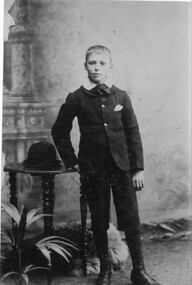
Photograph - Sepia, C 1890
... The Knight family ran a teashop at Henham and then on the Wannon river...The Knight family ran a teashop at Henham and then on the Wannon river PEOPLE Knight Photo shows Augustus (Gus) Knight C 1890 probalby in a professional photographer's studio Gus is standign with his hand resting on a table Photograph Sepia ...The Knight family ran a teashop at Henham and then on the Wannon riverPhoto shows Augustus (Gus) Knight C 1890 probalby in a professional photographer's studio Gus is standign with his hand resting on a table people, knight -
 Halls Gap & Grampians Historical Society
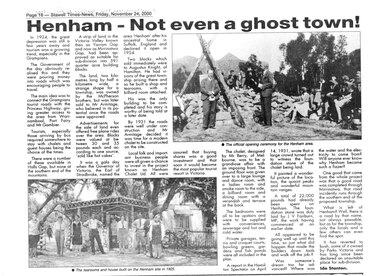
Newspaper - B/W, C 24/11/2000
... An article describing the Henham Township project as well as the Knight Family Tearooms built on the Henham site in 1925. ...An article describing the Henham Township project as well as the Knight Family Tearooms built on the Henham site in 1925. ...An article describing the Henham Township project as well as the Knight Family Tearooms built on the Henham site in 1925. For further info see "Victoria's Wonderland" pp 93-95, 103.A newpaper article from "The Stawell Times" , "Halls Gap Extra" Supplement of 24 November 2000, page 16, entitled Henham v- Not even a ghost town!townships, henham -
 Halls Gap & Grampians Historical Society
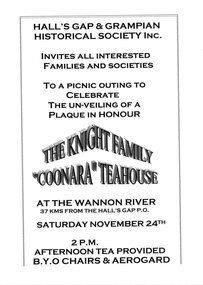
Flyer - B/W, C November 2001
... Halls Gap & Grampians Historical Society flyer for picnic outing to celebrate the unveiling of a commemorative plaque in honour of the Knight Family Coonara Teahouse. The unveiling was to take place on 24 November 2001....Halls Gap & Grampians Historical Society flyer for picnic outing to celebrate the unveiling of a commemorative plaque in honour of the Knight Family Coonara Teahouse. The unveiling was to take place on 24 November 2001. ...Halls Gap & Grampians Historical Society flyer for picnic outing to celebrate the unveiling of a commemorative plaque in honour of the Knight Family Coonara Teahouse. The unveiling was to take place on 24 November 2001.A copy of a flyer advertising the unveiling of a plaque at the site of the "Coonara" tea-rooms on the Wannon River.media, flyers -
 Kilmore Historical Society
Ensemble, c1970
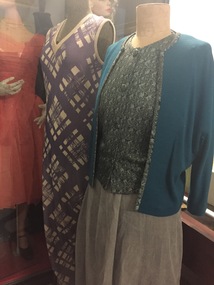
... Clothing belonging to Joyce Knight, Kilmore family....Clothing belonging to Joyce Knight, Kilmore family. knight "Styled & made by Young Fashions" "Melbourne" "Double knit jersey/100% acron/ The new fashion synthetic" 20th C. ladies ensemble. ...Clothing belonging to Joyce Knight, Kilmore family.20th C. ladies ensemble. Rear buttoned blouse and turquoise jacket with blouse fabric trim."Styled & made by Young Fashions" "Melbourne" "Double knit jersey/100% acron/ The new fashion synthetic"knight -
 Halls Gap & Grampians Historical Society
Newspaper - B/W, 09/03/1934
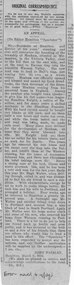
... It appeals for donations to assist the Knight family, Gus in particular. The dontaions were to be used to move the family to Portland, due to the effects of the depression on their income and to Gus' continued ill-health....It appeals for donations to assist the Knight family, Gus in particular. The dontaions were to be used to move the family to Portland, due to the effects of the depression on their income and to Gus' continued ill-health. ...This is a letter which was published in the Hamilton Spectator on 9 March 1934. It appeals for donations to assist the Knight family, Gus in particular. The dontaions were to be used to move the family to Portland, due to the effects of the depression on their income and to Gus' continued ill-health.Newspaper clipping from the "Hamilton Spectator". The copy is two photos, which combined are an enlargement of the original article (see additional image).people, knight -
 Halls Gap & Grampians Historical Society
Newspaper - B/W, 29/12/2000
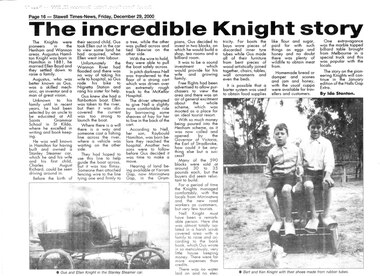
... This is a newspaper article about the Knight family. It was written by Ida Stanton for the Stawell Times-News "Halls Gap Extra" and was published on Friday, 29 December 2000, p.16. ...This is a newspaper article about the Knight family. It was written by Ida Stanton for the Stawell Times-News "Halls Gap Extra" and was published on Friday, 29 December 2000, p.16. ...This is a newspaper article about the Knight family. It was written by Ida Stanton for the Stawell Times-News "Halls Gap Extra" and was published on Friday, 29 December 2000, p.16. The photos included in the article are C 1881. For more information see "Victoria's Wonderland", "Water between the hills".A newspaper article headed "The Incredible Knight story", containing two photos. The photos are of a couple (Gus and Ellen Knight) in a Stanley Steamer car; and two boys (Bert and Ken Knight) sitting on a pile of boxes with a small dog in the foreground. They are wearing shoes made from rubber tubes.people, knight -
 Halls Gap & Grampians Historical Society
Newspaper - Photocopy, 28/12/2001
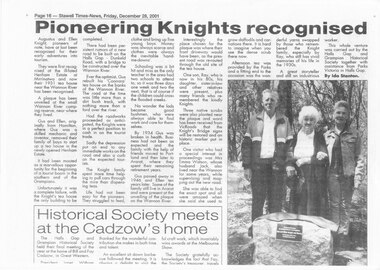
... This is an article about unveiling of a plaque at the Wannon River campsite, to commemorate the Knight family and their 'Coonara" tea-rooms which opertated on that site in 1931. ...This is an article about unveiling of a plaque at the Wannon River campsite, to commemorate the Knight family and their 'Coonara" tea-rooms which opertated on that site in 1931. ...This is an article about unveiling of a plaque at the Wannon River campsite, to commemorate the Knight family and their 'Coonara" tea-rooms which opertated on that site in 1931. The photo in the article shows Ray Knight, Emma Watson and Emma's daughter standing behind the plaque. The article was written by Ida Stanton for the Stawell Times-News, 'Halls Gap Extra" and published on Friday, 28 December 2001, p.16.A photocopy of a newspaper article titled "Pioneering Knights recognised".people, knight -
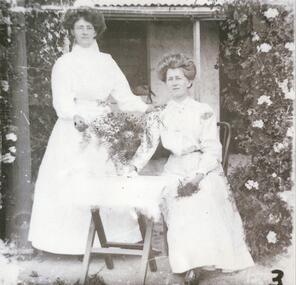 Lake Bolac & District Historical Society
Black and white photograph, Sisters at "St Mary's", Lake Bolac
... Una and Eva Knight at their family home, "St Mary's", on the east bank of Lake Bolac....Una and Eva Knight at their family home, "St Mary's", on the east bank of Lake Bolac. ...Una and Eva Knight at their family home, "St Mary's", on the east bank of Lake Bolac. -
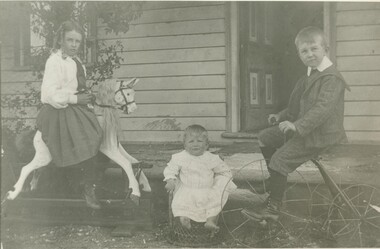 Lake Bolac & District Historical Society
Black and white photograph, Knight children of Lake Bolac
... Lake Bolac family, the Knight children: Gladys, George and Arthur 'Jim"....Lake Bolac family, the Knight children: Gladys, George and Arthur 'Jim". ...Lake Bolac family, the Knight children: Gladys, George and Arthur 'Jim".lake bolac, knight -
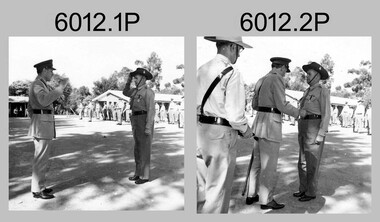 Bendigo Military Museum
Photograph - Army Survey Regiment GOC Parade Medal Presentations, 1969
... MAJ GEN Robert William Knights CB, CBE and family. .21) - Photo, black & white, 1969. ...MAJ GEN Robert William Knights CB, CBE and family. .21) - Photo, black & white, 1969. ...These photographs were taken at a GOC Parade at the Army Headquarters (AHQ) Survey Regiment in 1969. GOC Southern Command MAJ GEN Robert William Knights CB, CBE formally presented the Defence Force Service Medal to personnel in recognition of 15 years of efficient remunerated service, or the Clasp for each further 5 year period of service. These 25 black and white photographs were taken at a GOC Parade Medal Presentation in 1969 at the Army Headquarters (AHQ) Survey Regiment, Bendigo. 25 photographs are on negative film. 13 of photographs are printed on photographic paper. and scanned at 600 dpi. are part of the Army Survey Regiment’s Collection. .1) - Photo, black & white, 1969. L to R: MAJ GEN Robert William Knights CB, CBE, unidentified. .2) & .3)- Photo, black & white, 1969. L to R: MAJ GEN Robert William Knights CB, CBE, SGT Keith Harris. .4) to .6) - Photo, black & white, 1969. MAJ GEN Robert William Knights CB, CBE, unidentified. .7) - Photo, black & white, 1969. L to R: unidentified, MAJ GEN Robert William Knights CB, CBE. .8) - Photo, black & white, 1969. L to R: MAJ GEN Robert William Knights CB, CBE, SGT Ben Williams. .9) - Photo, black & white, 1969. L to R: ex SGT Alan Pollard, MAJ GEN Robert William Knights CB, CBE. .10) - Photo, black & white, 1969. L to R: WO1 Bill Miller, MAJ GEN Robert William Knights CB, CBE. .11) & .12) - Photo, black & white, 1969. WO1 Steve McConnachie, MAJ GEN Robert William Knights CB, CBE, unidentified. .13) - Photo, black & white, 1969. L to R: unidentified, MAJ GEN Robert William Knights CB, CBE. .14) to .15) - Photo, black & white, 1969. L to R:MAJ GEN Robert William Knights CB, CBE, unidentified. .16) - Photo, black & white, 1969. L to R: unidentified, MAJ GEN Robert William Knights CB, CBE, unidentified. .17) - Photo, black & white, 1969. AHQ Survey Regiment standing at ease on the parade ground. .18) - Photo, black & white, 1969. L to R: unidentified, MAJ GEN Robert William Knights CB, CBE, CO LTCOL Lionel Sprenger MBE, MID. .19) & .20) - Photo, black & white, 1969. MAJ GEN Robert William Knights CB, CBE and family. .21) - Photo, black & white, 1969. L to R: Alan Pollard, MAJ GEN Robert William Knights CB, CBE, Bet and Ben Williams. .22) - Photo, black & white, 1969. Ex SGT Alan Pollard and Mrs Pollard. .23) - Photo, black & white, 1969. WO2 Steve MeConnachie and Family. .24) - Photo, black & white, 1969. Unidentified recipient and Family. .25) - Photo, black & white, 1969. WO2 Jack Williams and Family..9) Photo - SGT Alan Pollard identified on back .10) Photo - WO1 Bill Miller identified on back .11) Photo - WO1 Steve McConnachie identified on back royal australian survey corps, rasvy, fortuna, army survey regiment, army svy regt, asr -
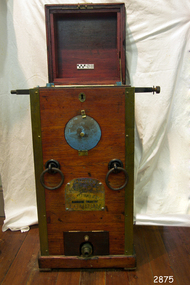 Flagstaff Hill Maritime Museum and Village
Machine - Diving Compressor, Siebe Gorman & Co. Ltd, 1880-1890
... In 1932, Robert Davis was knighted by King George V, principally for his invention of the ‘Davis Submerged Escape Apparatus’ (D.S.E.A.). Siebe Gorman essentially remained a family firm from the beginning (under A Siebe) until it became a public company for the first time in 1952. ...In 1932, Robert Davis was knighted by King George V, principally for his invention of the ‘Davis Submerged Escape Apparatus’ (D.S.E.A.). Siebe Gorman essentially remained a family firm from the beginning (under A Siebe) until it became a public company for the first time in 1952. ...This compressor was part of the E.G. Ward Collection. It is connected to the diving suit and boots, also in our collection. Siebe Gorman & Company Ltd was a British company that developed diving equipment and breathing equipment and worked on commercial diving and marine salvage projects. The company advertised itself as 'Submarine Engineers'. It was founded by Augustus Siebe, a German-born British engineer chiefly known for his contributions to diving equipment. Siebe Gorman traded as an engineering firm for over 180 years, from 1819 to 1999. The early success of the business was due to its founder, the Prussian immigrant Christian 'Augustus' Siebe (1788-1872). For business reasons, he applied for and was granted British citizenship in 1856. He was a gifted engineer who was able to translate theoretical problems into practical, working products. During the industrial Victorian period, the business traded as 'A. Siebe's at 145 High Street, Holborn, London, but in 1828, new premises were acquired at 5 Denmark Street, Soho. The family firm produced a wide range of manufactured goods, including paper-making machinery, measuring machinery, water-pumps, refrigeration equipment and diving apparatus. Augustus Siebe specialised in submarine engineering early on, and the company gained a reputation for the manufacture of safe, reliable diving apparatus. Augustus Siebe is best remembered for the development and manufacture of the ‘closed’ Diving Dress based on the ideas of Charles and John Deane, George Edwards and Charles Pasley. Apart from some small modifications to valves and diver communications, the basic 12 bolt ‘closed’ diving dress remained relatively unchanged after the 1870s. Later company successes were also based on innovation, with new products that could be successfully developed and manufactured to high standards. This was largely attributed to the inventive nature, foresight, engineering and entrepreneurial skills of Robert Henry Davis (1870-1965). In 1882, RH Davis joined the company of 'Siebe & Gorman' as a young 11-year-old office boy, and he was to remain with the company until he died in 1965. Augustus Siebe retired in 1869 and handed over the company to a new partnership of Henry H. Siebe (1830-1885) and William A. O'Gorman (1834-1904). The new firm traded as 'Siebe & Gorman' (1870-1879) from premises in and around Mason Street, Westminster Bridge Road, Lambeth, London. The two partners soon recognised the potential of R.H. Davis, and in 1894, aged 24, he became General Manager of Siebe & Gorman. Davis increasingly ran the company until the surviving partner (W.A. Gorman) died in 1904. The firm was disposed of to the Vickers (armaments) family, and a new company, Siebe Gorman & Co. Ltd. (1905-1998) was formed. Under the chairmanship of Albert Vickers, R.H. Davis was kept on as Managing Director, and the company forged ahead. However, after WW1, the Great Depression caused manufacturing output and share prices to slump. In 1924, Robert Davis made a deal with the Vickers Board and acquired control of the company through majority shares. Under his leadership, the Siebe Gorman Company flourished, and in time, four of his sons also joined the firm. The company gained a worldwide reputation for the manufacture of diving apparatus, decompression and observation chambers, and safety breathing apparatus of all types for use on the land, in the air and under the sea (including mine rescue, tunnelling, aircraft, diving, submarine escape and in other hazardous environments). Close research and development links with the MOD (especially the Admiralty), also provided a lucrative outlet for the company's products. In 1932, Robert Davis was knighted by King George V, principally for his invention of the ‘Davis Submerged Escape Apparatus’ (D.S.E.A.). Siebe Gorman essentially remained a family firm from the beginning (under A Siebe) until it became a public company for the first time in 1952. However, following WW2, British manufacturing stagnated through stifled investment and post-war austerity, and there was little innovation. Siebe Gorman's fortunes began to decline as an ageing Sir Robert Davis failed to invest or change the company's business and management practices. In 1959, Siebe Gorman was acquired by the “Fairy Group” and the ailing Sir Robert was made Life President. Consequently, nothing changed, and the slow decline continued until Sir Robert's death in March 1965. Around 1960, Siebe Gorman acquired the diving apparatus manufacturer C E Heinke, and for a brief period, it manufactured some diving equipment under the combined name of Siebe Heinke. Around 1964, Mr E. 'Barry' Stephens was appointed as the new Managing Director to modernise Siebe Gorman. Changes were made, including a move to a new factory in Wales in 1975. The new company concentrated on firefighting breathing apparatus and escape equipment, and the move coincided with the loss of many of the older, traditional craft skills. Between 1985 and 1998, Siebe expanded through acquisitions, and several other companies were acquired. The Siebe Gorman (diving apparatus) company has therefore traded as A. Siebe (1819-1870); Siebe & Gorman (1870-1879); Siebe Gorman & Co (1880-1904); Siebe Gorman & Co. Ltd (1905-1998).The diving compressor, along with associated equipment in the Flagstaff Hill collection, represents a highly significant snapshot of marine history. These items are particularly important in understanding the evolution of diving equipment, with a special focus on their use in salvage operations before and throughout the Second World War. Manufactured by a company renowned for its inventions, development, and innovation in marine engineering, the equipment demonstrates the progression of technology in deep-sea diving. Early helmets and related items produced by this company remain highly sought after by collectors worldwide, highlighting their historical and technological value. The presence of these items within the Flagstaff Hill Maritime Museum allows for a unique insight into the working conditions and methods employed by divers. It also illustrates the considerable dangers they faced while performing such essential and hazardous work, underscoring the critical role played by these professionals in maritime history.A single cylinder divers' pump by Siebe Gorman & Co Ltd, London, eccentric hand cranked in brass, brass-mounted mahogany case with instructions to the underside of the lid, brass-covered pressure gauge and air outlet, brass maker's plaque to the front, water inlet and outlet to the rear, green-painted lifting rings. Machinery has some blue-painted areas on the metal. This compressor is part of the E.G. Ward Collection.Plate on the back 'WATER SUPPLY" "WATER OVERFLOW" "WATER DRAIN-IN" Pressure gauge dial "BOURDON'S PRESSURE GAUGE" STEBE GORMAN & CO. LONDON", "LBS PRESSURE" "FEET OF SALT WATER" Plate on the front " PATENT, Siebe Gorman & Co Ltd Submarine Engineers" below emblem (Lion, Crown, Horse)flagstaff hill, warrnambool, flagstaff-hill, maritime-museum, diving compressor, london, siebe gorman & co ltd, marine technology, life saving, deep sea diving, maritime museum, maritime village, manine history, maritime history, marine engineers, marine diving, deep-sea diving, e g ward, vintage diving compressor, e. g. ward, e.g. ward, edward ward, ted ward -
 Flagstaff Hill Maritime Museum and Village
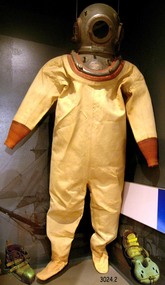
Functional object - Diving Suit, boots and weight, Early-to-mid 20th century
... In 1932, Robert Davis was knighted by King George V, principally for his invention of the ‘Davis Submerged Escape Apparatus’ (D.S.E.A.). Siebe Gorman essentially remained a family firm from the beginning (under A.Siebe) until it became a public company for the first time in 1952. ...In 1932, Robert Davis was knighted by King George V, principally for his invention of the ‘Davis Submerged Escape Apparatus’ (D.S.E.A.). Siebe Gorman essentially remained a family firm from the beginning (under A.Siebe) until it became a public company for the first time in 1952. ...This diving suit with helmet, boots and weight is part of the E. G.Ward collection, along with the diving compressor and a photograph of a diver in this equipment. Siebe Gorman & Company Ltd was a British company that developed diving equipment and breathing equipment and worked on commercial diving and marine salvage projects. The company advertised itself as 'Submarine Engineers'. It was founded by Augustus Siebe, a German-born British engineer chiefly known for his contributions to diving equipment. Siebe Gorman traded as an engineering firm for over 180 years from 1819 to 1999. The early success of the business was due to its founder, the Prussian immigrant Christian 'Augustus' Siebe (1788-1872). For business reasons, he applied for and was granted British citizenship in 1856. He was a gifted engineer who was able to translate theoretical problems into practical, working products. During the industrial Victorian period, the business traded as 'A. Siebe' at 145 High Street Holborn London, but in 1828 new premises were acquired at 5 Denmark Street, Soho. The family firm produced a wide range of manufactured goods including paper-making machinery, measuring machinery, water pumps, refrigeration equipment and diving apparatus. Augustus Siebe specialised in submarine engineering early on and the company gained a reputation for the manufacture of safe, reliable diving apparatus. Augustus Siebe is best remembered for the development and manufacture of the ‘closed’ Diving Dress based on the ideas of Charles and John Deane, George Edwards and Charles Pasley. Apart from some small modifications to valves and diver communications, the basic 12-bolt ‘closed’ diving dress remained relatively unchanged after the 1870s. Later company successes were also based on innovation, with new products that could be successfully developed and manufactured to high standards. This was largely attributed to the inventive nature, foresight, engineering and entrepreneurial skills of Robert Henry Davis (1870-1965). In 1882, RH Davis joined the company of 'Siebe & Gorman' as a young 11-year-old office boy and he was to remain with the company until he died in 1965. Augustus Siebe retired in 1869 and handed over the company to a new partnership of Henry H. Siebe (1830-1885) and William A. O'Gorman (1834-1904). The new firm traded as 'Siebe & Gorman' (1870-1879) from premises in and around Mason Street, Westminster Bridge Road, Lambeth, London. The two partners soon recognised the potential of R.H. Davis and in 1894, aged 24, he became General Manager of Siebe & Gorman. Davis increasingly ran the company until the surviving partner (W.A. Gorman) died in 1904. The firm was disposed of to the Vickers (armaments) family and a new company 'Siebe Gorman & Co. Ltd.' (1905-1998) was formed. Under the chairmanship of Albert Vickers, R.H. Davis was kept on as Managing Director, and the company forged ahead. However, after WW1, the Great Depression caused manufacturing output and share prices to slump. In 1924 Robert Davis made a deal with the Vickers Board and acquired control of the company through majority shares. Under his leadership, the Siebe Gorman Company flourished and within time, four of his sons also joined the firm. The company gained a worldwide reputation for the manufacture of diving apparatus, decompression and observation chambers, and safety breathing apparatus of all types for use on the land, in the air and under the sea (including mine rescue, tunnelling, aircraft, diving, submarine escape and in other hazardous environments). Close research and development links with the MOD (especially the Admiralty), also provided a lucrative outlet for the company products. In 1932, Robert Davis was knighted by King George V, principally for his invention of the ‘Davis Submerged Escape Apparatus’ (D.S.E.A.). Siebe Gorman essentially remained a family firm from the beginning (under A.Siebe) until it became a public company for the first time in 1952. However, following WW2, British manufacturing stagnated through stifled investment and post-war austerity, and there was little innovation. Siebe Gorman fortunes began to decline as an ageing Sir Robert Davis failed to invest, or change the company business and management practices. In 1959, Siebe Gorman was acquired by the “Fairy Group” and the ailing Sir Robert was made Life President. Consequently, nothing changed and the slow decline continued until Sir Robert's death in March 1965. Around 1960, Siebe Gorman acquired the diving apparatus manufacturer C E Heinke, and for a brief period, it manufactured some diving equipment under the combined name of Siebe Heinke. Around 1964, Mr E. 'Barry' Stephens was appointed as the new Managing Director to modernise Siebe Gorman. Changes were made, including a move to a new factory in Wales in 1975. The new company concentrated on fire-fighting breathing apparatus and escape equipment, and the move coincided with the loss of many of the older, traditional craft skills. Between 1985 and 1998, Siebe expanded through acquisitions, and several other companies were acquired. The Siebe Gorman (diving apparatus) company has therefore traded as A. Siebe (1819-1870); Siebe & Gorman (1870-1879); Siebe Gorman & Co (1880-1904); Siebe Gorman & Co. Ltd (1905-1998).The diving suit, helmet, boots, and weights, along with associated equipment in the Flagstaff Hill collection, represent a highly significant snapshot of marine history. These items are particularly important in understanding the evolution of diving equipment, with a special focus on their use in salvage operations before and throughout the Second World War. Manufactured by a company renowned for its inventions, development, and innovation in marine engineering, the equipment demonstrates the progression of technology in deep-sea diving. Early helmets and related items produced by this company remain highly sought after by collectors worldwide, highlighting their historical and technological value. The presence of these items within the Flagstaff Hill Maritime Museum allows for a unique insight into the working conditions and methods employed by divers. It also illustrates the considerable dangers they faced while performing such essential and hazardous work, underscoring the critical role played by these professionals in maritime history.Diving suit including helmet, boots and a weight. Diving suit is made of canvas with knitted cuffs. The helmet is metal. The boots have a thick sole and thick leather upper that is held on with leather straps and buckles. The toe of the boot is heavy metal. The weight is worn next to the trunk of the diver and it has an inscription to mark the front. It is worn with straps and buckles holding it in place. Royal Navy Admiralty Pattern 6 bolt No 3 light Siebe Gorman light diving helmet circa 1960, used by the Royal Navy before and after World War 2. This equipment is part of the E. G. Ward Collection."Siebe Gorman & Co Ltd Marine Engineers London. Patent" with "E G Ward" on front and back plate. On weight "FRONT"flagstaff hill, warrnambool, diving suit, siebe gorman and co ltd., siebe gorman and co ltd marine engineers london, marine engineers, diving helmet, diving boots, diving weight, marine diving, maritimemuseum, maritime village, maritime history, marine technology, life saving, deep sea diving, maritime museum, siebe gorman and co ltd., siebe gorman and co ltd, london, deep-sea diving, e. g. ward, e g ward, e.g. ward, edward ward, ted ward -
 Flagstaff Hill Maritime Museum and Village
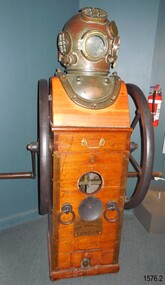
Equipment - Diving compressor and helmet, 1944
... In 1932, Robert Davis was knighted by King George V, principally for his invention of the ‘Davis Submerged Escape Apparatus’ (D.S.E.A.). Siebe Gorman essentially remained a family firm from the beginning (under A.Siebe) until it became a public company for the first time in 1952. ...In 1932, Robert Davis was knighted by King George V, principally for his invention of the ‘Davis Submerged Escape Apparatus’ (D.S.E.A.). Siebe Gorman essentially remained a family firm from the beginning (under A.Siebe) until it became a public company for the first time in 1952. ...Siebe Gorman & Company Ltd was a British company that developed diving equipment and breathing equipment and worked on commercial diving and marine salvage projects. The company advertised itself as 'Submarine Engineers'. It was founded by Augustus Siebe, a German-born British engineer chiefly known for his contributions to diving equipment. Siebe Gorman traded as an engineering firm for over 180 years from 1819 to 1999. The early success of the business was due to its founder, the Prussian immigrant Christian 'Augustus' Siebe (1788-1872). For business reasons, he applied for and was granted British citizenship in 1856. He was a gifted engineer who was able to translate theoretical problems into practical, working products. During the industrial Victorian period, the business traded as 'A. Siebe' at 145 High Street Holborn London, but in 1828 new premises were acquired at 5 Denmark Street, Soho. The family firm produced a wide range of manufactured goods including paper-making machinery, measuring machinery, water pumps, refrigeration equipment, and diving apparatus. Augustus Siebe specialised in submarine engineering early on and the company gained a reputation for the manufacture of safe, reliable diving apparatus. Augustus Siebe is best remembered for the development and manufacture of the ‘closed’ Diving Dress based on the ideas of Charles and John Deane, George Edwards, and Charles Pasley. Apart from some small modifications to valves and diver communications, the basic 12 bolt ‘closed’ diving dress remained relatively unchanged after the 1870s. Later company successes were also based on innovation, with new products that could be successfully developed and manufactured to high standards. This was largely attributed to the inventive nature, foresight, engineering, and entrepreneurial skills of Robert Henry Davis (1870-1965). In 1882, RH Davis joined the company of 'Siebe & Gorman' as a young 11-year-old office boy and he was to remain with the company until he died in 1965. Augustus Siebe retired in 1869 and handed over the company to a new partnership of Henry H. Siebe (1830-1885) and William A. O'Gorman (1834-1904). The new firm traded as 'Siebe & Gorman' (1870-1879) from premises in and around Mason Street, Westminster Bridge Road, Lambeth, London. The two partners soon recognised the potential of R.H. Davis and in 1894, aged 24, he became General Manager of Siebe & Gorman. Davis increasingly ran the company until the surviving partner (W.A. Gorman) died in 1904. The firm was disposed of to the Vickers (armaments) family and a new company 'Siebe Gorman & Co. Ltd.' (1905-1998) was formed. Under the chairmanship of Albert Vickers, R.H. Davis was kept on as Managing Director, and the company forged ahead. However, after WW1, the Great Depression caused manufacturing output and share prices to slump. In 1924 Robert Davis made a deal with the Vickers Board and acquired control of the company through majority shares. Under his leadership, the Siebe Gorman Company flourished and within time, four of his sons also joined the firm. The company gained a worldwide reputation for the manufacture of diving apparatus, decompression and observation chambers, and safety breathing apparatus of all types for use on the land, in the air, and under the sea (including mine rescue, tunneling, aircraft, diving, submarine escape and in other hazardous environments). Close research and development links with the MOD (especially the Admiralty), also provided a lucrative outlet for the company products. In 1932, Robert Davis was knighted by King George V, principally for his invention of the ‘Davis Submerged Escape Apparatus’ (D.S.E.A.). Siebe Gorman essentially remained a family firm from the beginning (under A.Siebe) until it became a public company for the first time in 1952. However, following WW2, British manufacturing stagnated through stifled investment and post-war austerity, and there was little innovation. Siebe Gorman's fortunes began to decline as an aging Sir Robert Davis failed to invest, or change the company's business and management practices. In 1959, Siebe Gorman was acquired by the “Fairy Group” and the ailing Sir Robert was made Life President. Consequently, nothing changed and the slow decline continued until Sir Robert's death in March 1965. Around 1960, Siebe Gorman acquired the diving apparatus manufacturer C E Heinke, and for a brief period, it manufactured some diving equipment under the combined name of Siebe Heinke. Around 1964, Mr E. 'Barry' Stephens was appointed as the new Managing Director to modernise Siebe Gorman. Changes were made, including a move to a new factory in Wales in 1975. The new company concentrated on fire-fighting breathing apparatus and escape equipment, and the move coincided with the loss of many of the older, traditional craft skills. Between 1985 and 1998, Siebe expanded through acquisitions, and several other companies were acquired. The Siebe Gorman (diving apparatus) company has therefore traded as A. Siebe (1819-1870); Siebe & Gorman (1870-1879); Siebe Gorman & Co (1880-1904); Siebe Gorman & Co. Ltd (1905-1998). (For information regards the diving helmet & Frank King see Notes Section at the end of this document)The items are very significant as a snapshot into marine history and the development of diving equipment generally especially that used for salvage operations before and during WW2. The company that made the equipment was a leading inventor,developer and innovator of marine equipment with its early helmets and other items eagerly sought after today for collections around the world. The items in the Flagstaff Hill collection give us an insight as to how divers operated and the dangers they faced doing a very necessary and dangerous job. Frank Kings' diving helmet and compressor (communication pipe stored separately). Compressor is hand cranked. US Navy diving helmet, Mark V. Two maker's plates attached. Made in 1944.On rear "WATER SUPPLY" On front 'PATENT" " Logo: Images (Lion, Crown, Horse, Shield within an oval) "SIEBE, GORMAN & Co. Ltd. SUBMARINE ENGINEERS, LONDON.flagstaff hill, warrnambool, maritime museum, great ocean road, us navy diving helmet, commonwealth government salvage, diving helmet, marine salvage, frank king, diver, siebe. gorman & co ltd, submarine equipment, diving equipment, communication under water, hand cranked, diving compressor -
 The Beechworth Burke Museum
Audio - Oral History, Jennifer Williams, Mavis Jensen, 11 May 2000
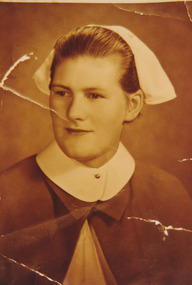
... Mavis Jensen (nee Knight) was born in Broadford in 1920 and came to Beechworth with her family a year later, so her father could assist his father at Knight's Blacksmith at 1A Camp Street, where the Hotel Nicholas is now located. ...Mavis Jensen (nee Knight) was born in Broadford in 1920 and came to Beechworth with her family a year later, so her father could assist his father at Knight's Blacksmith at 1A Camp Street, where the Hotel Nicholas is now located. ...Mavis Jensen (nee Knight) was born in Broadford in 1920 and came to Beechworth with her family a year later, so her father could assist his father at Knight's Blacksmith at 1A Camp Street, where the Hotel Nicholas is now located. Mavis Jensen left school at the age of 13 and worked as a kitchen maid at Ovens Benevolent Asylum. She was employed as a ward assistant at Mayday Hills Hospital from 1939 to 1980, except for 1958-59 when she gave birth to her son, Noel. This oral history recording was part of a project conducted by Jennifer Williams in the year 2000 to capture the everyday life and struggles in Beechworth during the twentieth century. This project involved recording seventy oral histories on cassette tapes of local Beechworth residents which were then published in a book titled: Listen to what they say: voices of twentieth century Beechworth. These cassette tapes were digitised in July 2021 with funds made available by the Friends of the Burke.Mavis Jensen's account of her life in Beechworth and the local area during the 20th century is historically and socially significant to the cultural heritage of the region. She details important historical events and hardships in the region's history that had a lasting local, regional and national impact, including Australia during war time, economic struggles, and women's societal roles in a rural area. Her oral history is particularly significant for its insights into developments in psychiatric patient treatment and care in regional Victoria, as well as women's work conditions in the mid-twentieth century. This oral history account is socially and historically significant as it is a part of a broader collection of interviews conducted by Jennifer Williams which were published in the book 'Listen to what they say: voices of twentieth-century Beechworth.' While the township of Beechworth is known for its history as a gold rush town, these accounts provide a unique insight into the day-to-day life of the town's residents during the 20th century, many of which will have now been lost if they had not been preserved.This is a digital copy of a recording that was originally captured on a cassette tape. The cassette tape is black with a horizontal white strip and is currently stored in a clear flat plastic rectangular container. It holds up 40 minutes of recordings on each side.Mavis Jensen /listen to what they say, beechworth, oral history, burke museum, jensen, mavis jensen, psychiatric hospitals, mid-twentieth century psychiatry, regional hospitals, regional mental health care, mid-twentieth century women's working conditions, mayday hills hospital., ovens benevolent asylum, beechworth hospital history -
 Greensborough Historical Society
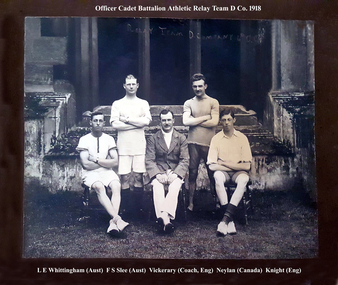
Photograph - Photograph - Digital Image, Officer Cadet Battalion Athletics relay team, D Company 1918, 1918
... Knight (Eng). 6 Officer Cadet Battalion Athletic Team, relay team D company. From our research the Whittingham is Leslie Ernest. Slee is actually my father, his name is Frederick Samuel, also a lieutenant. The photo was taken in Oxford 1918, we believe around June or July. leslie ernest whittingham world war World War I whittingham family Digital team photograph, black and white. ...Information as supplied by donor: Names written on original photo: Left to right: Whittingham (Aust), Slee (Aust), Vickerary (Eng) coach, Neylan (Canada), Knight (Eng). 6 Officer Cadet Battalion Athletic Team, relay team D company. From our research the Whittingham is Leslie Ernest. Slee is actually my father, his name is Frederick Samuel, also a lieutenant. The photo was taken in Oxford 1918, we believe around June or July. Digital team photograph, black and white.leslie ernest whittingham, world war, world war i, whittingham family -
 Marysville & District Historical Society
THE TRIANGLE NEWS-VOL 36 NO 35-SEPTEMBER 18 2009
... yvonne knight benefactor to the marysville & district historical society...the white family...fragas cafe the village walk moss snow and mountain ash advertisements marysville & district historical society 40th anniversary andrew mackenzie crossways inn yvonne knight benefactor to the marysville & district historical society the white family joe white gallipoli park mary kenealy marysville big screen school holidays play animation family night screening THE TRIANGLE NEWS-VOL 36 NO 35-SEPTEMBER 18 2009 ...marysville, victoria, australia, the village walk(s) again!, fragas cafe, the village walk, moss snow and mountain ash, advertisements, marysville & district historical society, 40th anniversary, andrew mackenzie, crossways inn, yvonne knight benefactor to the marysville & district historical society, the white family, joe white, gallipoli park, mary kenealy, marysville big screen school holidays, play animation, family night screening -
 Flagstaff Hill Maritime Museum and Village
Book - Fictional Novel, Sir Thomas Malory, Morte Darthur, 1868
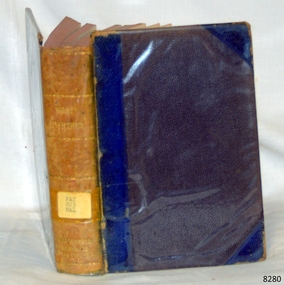
... knight, landowner, and member of parliament who lived during the turbulent Wars of the Roses. Historically, Malory is famously believed to have compiled and written the Morte Darthur while imprisoned for a series of political and criminal offences. His work stands as one of the absolute pillars of medieval English literature. The editor, Sir Edward Strachey, 3rd Baronet (1812–1901), was an English man of letters, essayist, and dedicated religious and philosophical writer based at his family...knight, landowner, and member of parliament who lived during the turbulent Wars of the Roses. Historically, Malory is famously believed to have compiled and written the Morte Darthur while imprisoned for a series of political and criminal offences. His work stands as one of the absolute pillars of medieval English literature. The editor, Sir Edward Strachey, 3rd Baronet (1812–1901), was an English man of letters, essayist, and dedicated religious and philosophical writer based at his family ...This work, Le Morte d'Arthur, was originally finished around 1469–1470 and is the definitive English compilation of the legends of King Arthur. Written in Middle English prose, it weaves together diverse French and British source materials into a single cohesive epic. It follows Arthur from his miraculous birth and pulling the sword from the stone, through the golden age of the Round Table and the Quest for the Holy Grail, to the tragic collapse of the kingdom fueled by the love affair between Sir Lancelot and Queen Guinevere.Morte Darthur Author: Thomas Malory Publisher: Macmillan & Co Date: 1868 Further Information: Blue front cover and brown spine with gilt lettering, reinforced corners to hard cover in dark blue, library label to spine. Introduction By Sir Edward Strachey BartfictionThis work, Le Morte d'Arthur, was originally finished around 1469–1470 and is the definitive English compilation of the legends of King Arthur. Written in Middle English prose, it weaves together diverse French and British source materials into a single cohesive epic. It follows Arthur from his miraculous birth and pulling the sword from the stone, through the golden age of the Round Table and the Quest for the Holy Grail, to the tragic collapse of the kingdom fueled by the love affair between Sir Lancelot and Queen Guinevere.flagstaff hill, warrnambool, shipwrecked coast, flagstaff hill maritime museum, maritime museum, shipwreck coast, flagstaff hill maritime village, great ocean road, book, pattison collection, warrnambool library, warrnambool mechanics’ institute, ralph eric pattison, corangamite regional library service, warrnambool city librarian, mechanics’ institute library, victorian library board, warrnambool books and records, warrnambool children’s library, thomas malory, morte darthur -
 Orbost & District Historical Society
framed photo, APFA- Davisigns (PG & ME Davis)
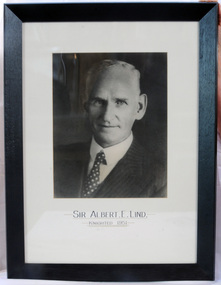
... family to move to East Gippsland where Lind was educated at Lucknow, and then to Bairnsdale in 1884 where he attended Bairnsdale state school. In October 1920, he was elected to the Victorian Legislative Assembly for the seat of Gippsland East for the Victorian Farmers' Union. Lind was made Minister of Forests, President of the Board of Land and Works and Commissioner of Crown Lands and Survey in Albert Dunstan's cabinet. He was knighted...family to move to East Gippsland where Lind was educated at Lucknow, and then to Bairnsdale in 1884 where he attended Bairnsdale state school. In October 1920, he was elected to the Victorian Legislative Assembly for the seat of Gippsland East for the Victorian Farmers' Union. Lind was made Minister of Forests, President of the Board of Land and Works and Commissioner of Crown Lands and Survey in Albert Dunstan's cabinet. He was knighted ...This photo was inherited with the building when the museum was established. Lind was born in 1878 in East Charlton, Victoria, the son of Oliver Nicholas Lind, a farmer from Denmark, and his Welsh wife Mary Ann Clay. In 1882, drought forced the family to move to East Gippsland where Lind was educated at Lucknow, and then to Bairnsdale in 1884 where he attended Bairnsdale state school. In October 1920, he was elected to the Victorian Legislative Assembly for the seat of Gippsland East for the Victorian Farmers' Union. Lind was made Minister of Forests, President of the Board of Land and Works and Commissioner of Crown Lands and Survey in Albert Dunstan's cabinet. He was knighted in 1951. In 1926 two national parks east of Orbost were named the Albert and the Lind national parks after him.A framed photo of Sir Albert Eli Lind. It is a black and white head and shoulders photo in a black wooden frame.Sir Albert E. Lind Knighted !951photograph politician lind-albert government -
 Ringwood and District Historical Society
Certificate, United Religious and Military Orders of the Temple and Hospital Membership - Collection of Masonic Degrees and Correspondence maintained by Aird family of Ringwood, Victoria
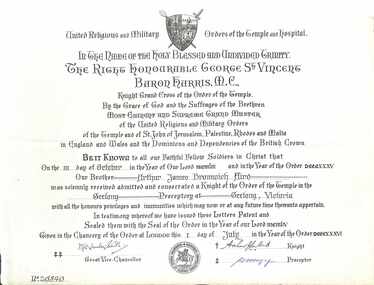
... Two certificates - Arthur James Bromwich Aird (1) solemly received admitted and consecrated as a Knight of the Order of the Temple in Geelong Preceptory at Geelong, Victoria, on 1st July, 1936, and (2) solemly admitted as a Knight of St.John of Jerusalem, Palestine, Rhodes and Malta in the Geelong Priory, Geelong, Victoria, on 18th April, 1938. United Religious and Military Orders of the Temple and Hospital Membership - Collection of Masonic Degrees and Correspondence maintained by Aird family of Ringwood, Victoria Certificate ...Two certificates - Arthur James Bromwich Aird (1) solemly received admitted and consecrated as a Knight of the Order of the Temple in Geelong Preceptory at Geelong, Victoria, on 1st July, 1936, and (2) solemly admitted as a Knight of St.John of Jerusalem, Palestine, Rhodes and Malta in the Geelong Priory, Geelong, Victoria, on 18th April, 1938. -
 Ringwood and District Historical Society
Certificate, Supreme Council of the 33rd Degree (1962) - Collection of Masonic Degrees and Correspondence maintained by Aird family of Ringwood, Victoria
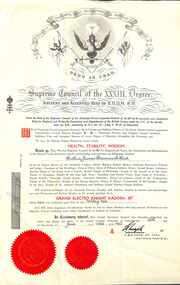
... Knight Kadosh, 30 Degrees, conferred on 1st May, 1962. Signed by the Grand Secretary General and Seals affixed in the Grand Council Chamber at London on 20th June A.L. 5962, A.D. 1962. Supreme Council of the 33rd Degree (1962) - Collection of Masonic Degrees and Correspondence maintained by Aird family of Ringwood, Victoria Certificate ...Buff coloured certificate with red Lodge seals. Certification that Arthur James Bromwich Aird was received and acknowledged as a Grand Elected Knight Kadosh, 30 Degrees, conferred on 1st May, 1962. Signed by the Grand Secretary General and Seals affixed in the Grand Council Chamber at London on 20th June A.L. 5962, A.D. 1962. -
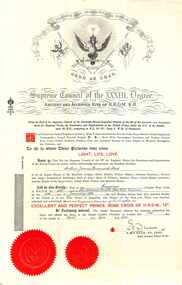 Ringwood and District Historical Society
Certificate, Supreme Council of the 33rd Degree (1952) - Collection of Masonic Degrees and Correspondence maintained by Aird family of Ringwood, Victoria
... Knight of the East and West. and was received, admitted and constitued as an Original Member of the Chapter, an Excellent and Perfect Prince Rose Croix of H.R.D.M., 18 Degree, on 17th January, 1952. Signed by the Grand Secretary General and Seals affixed in the Grand Council Chamber at London on 18th April A.L.5952, A.D. 1952. Supreme Council of the 33rd Degree (1952) - Collection of Masonic Degrees and Correspondence maintained by Aird family ...Buff coloured certificate with red Lodge seals. Certification that Arthur James Bromwich Aird was duly installed Knight of the Sword or of the East, Prince of Jerusalem, and Knight of the East and West. and was received, admitted and constitued as an Original Member of the Chapter, an Excellent and Perfect Prince Rose Croix of H.R.D.M., 18 Degree, on 17th January, 1952. Signed by the Grand Secretary General and Seals affixed in the Grand Council Chamber at London on 18th April A.L.5952, A.D. 1952.
