
Showing 15 items matching " mcclelland family"
-
 Whitehorse Historical Society Inc.
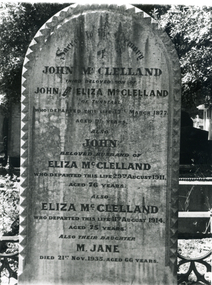
Photograph, McClelland Family Headstone
... McClelland Family Headstone...Black and white photo of McClelland Family Headstone....McClelland John McClelland Eliza McClelland Jane Black and white photo of McClelland Family Headstone. McClelland Family Headstone Photograph Photograph ...Black and white photo of McClelland Family Headstone.mcclelland, john, mcclelland, eliza, mcclelland, jane -
 Whitehorse Historical Society Inc.
Article, McClelland Family, 1911 - 1988
... McClelland Family...Documents on members of the McClelland family including letter from Helen McClelland to Dr Diane Sydenham, 8 Mar 1988 and eulogy given by Murray Anderson for John Robert McClelland, Jun 1987....McClelland Family Article Article ...Documents on members of the McClelland family.Documents on members of the McClelland family including letter from Helen McClelland to Dr Diane Sydenham, 8 Mar 1988 and eulogy given by Murray Anderson for John Robert McClelland, Jun 1987.Documents on members of the McClelland family. mcclelland, john, mcclelland, thomas robert, mcclelland, john robert -
 Whitehorse Historical Society Inc.
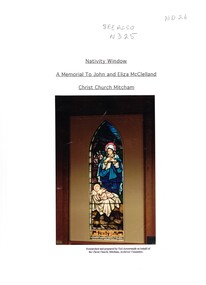
Document - Report, Nativity Window, a memorial to John & Eliza McClelland, Christ Church, Mitcham, 1995
... ...mcclelland family...Includes history of the window and of the McClelland family and a letter from Bronwyn Hughes of Monash University regarding its manufacture. ...christ church anglican church mitcham; stained glass windows mcclelland family mcclelland john Researched and prepared by Ted Arrowsmith on behalf of the Christ church, Mitcham Archives Committee. ...History prepared for the Christ Church Archives Committee. Includes history of the window and of the McClelland family and a letter from Bronwyn Hughes of Monash University regarding its manufacture. There is also a page from a Brooks Robinson Pty. Ltd. catalogue. Includes a colour photograph. 7 pages.christ church anglican church, mitcham;, stained glass windows, mcclelland family, mcclelland, john -
 Bendigo Historical Society Inc.
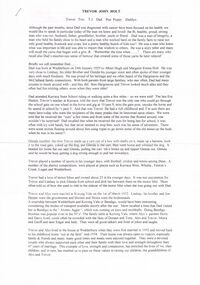
Document - PETER ELLIS COLLECTION: TREVOR JOHN HOLT
... ... McClelland Family...PERSON Individual trevor john holt Peter Ellis Collection Trevor John Holt Albert Hugh Holt Margaret Emma Holt Lindsay Holt Glenda Holt Hargreaves Family McClelland Family Ken Hargreaves Kurraca State School Ern Harkin Alys Holt Joe Harper Margaret Holt Lynette Holt Kevin Holt Kerry Holt Alan Holt CFA Wedderburn Brass Band Wedderburn Historical Society Wedderburn Football Club Masonic Lodge Victorian Farmers Federation Engine Club Wedderburn Old Timers Concord Tours Three page story of the life of Trevor John Holt, a member of the Wedderburn Old Timers. ...Three page story of the life of Trevor John Holt, a member of the Wedderburn Old Timers.person, individual, trevor john holt, peter ellis collection, trevor john holt, albert hugh holt, margaret emma holt, lindsay holt, glenda holt, hargreaves family, mcclelland family, ken hargreaves, kurraca state school, ern harkin, alys holt, joe harper, margaret holt, lynette holt, kevin holt, kerry holt, alan holt, cfa, wedderburn brass band, wedderburn historical society, wedderburn football club, masonic lodge, victorian farmers federation, engine club, wedderburn old timers, concord tours -
Whitehorse Historical Society Inc.
Letter - Correspondence, John McClelland, 1905
... ...McClelland family...Letter to John McClelland from solicitors in 1905 regarding the transfer of land to members of his family. ...McClelland John McClelland family Tunstall Letter to John McClelland from solicitors in 1905 regarding the transfer of land to members of his family. ...Letter to John McClelland from solicitors in 1905 regarding the transfer of land to members of his family.Letter to John McClelland from solicitors in 1905 regarding the transfer of land to members of his family. Land was north and south of the railway in Tunstall (sketch).Letter to John McClelland from solicitors in 1905 regarding the transfer of land to members of his family. mcclelland, john, mcclelland family, tunstall -
 Whitehorse Historical Society Inc.
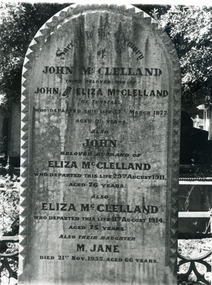
Photograph, Headstone
... mcclelland family headstone...mcclelland family headstone See NP952 Headstone Photograph Photograph ...See NP952mcclelland family headstone -
 Whitehorse Historical Society Inc.
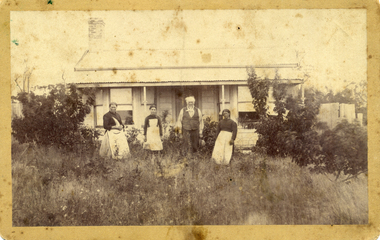
Photograph, Scott Family
... family...mcclelland...Sepia photo of Scott Family with Mrs. McClelland...scott family mcclelland mrs. Sepia photo of Scott Family with Mrs. ...Sepia photo of Scott Family with Mrs. McClellandscott family, mcclelland, mrs. -
 Lara RSL Sub Branch
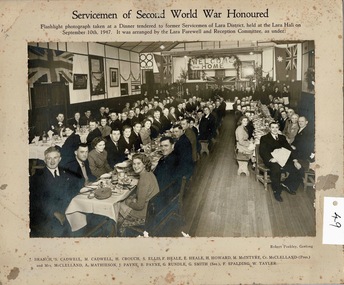
Photograph, Dinner for 2nd World War veterans - Lara District - September 10th 1947, SEPTEMBER 1947
... Also second photo 49.2 under glass second world war servicemen lara mcintyre 1947 rsl j branch mcclelland Flashlight photograph September 10 1947. 49.1 Oblong/Landscape....Black&White photograph on aged white cardboard....WELCOME HOME banner....Australian & British Flags prominent. 49.2 Photo mounted behind glass presented to the McIntyre Family Dinner for 2nd World War veterans - Lara District - September 10th 1947 Photograph. ...49.1 Names & images of 18 Returned Servicemen from W W 2. of the Lara District 49.2 Names & images of 18 Returned Servicemen from W W 2. of the Lara District presented to J & J McIntyre and Miss F McIntyre with compliments of the Lara Reception CommitteeLocal to Lara district , a visual record of persons in their home environment again . Also second photo 49.2 under glass 49.1 Oblong/Landscape....Black&White photograph on aged white cardboard....WELCOME HOME banner....Australian & British Flags prominent. 49.2 Photo mounted behind glass presented to the McIntyre FamilyFlashlight photograph September 10 1947. second world war servicemen lara mcintyre 1947 rsl j branch mcclelland -
 Flagstaff Hill Maritime Museum and Village
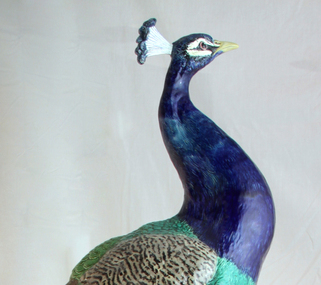
Decorative object - Peacock, Minton Majolica life-size model, Paul Comolera, artist, Designed: c. 1873; Made: c. 1875
... family possession. As such, this 'Loch Ard peacock' was almost forgotten and mistaken with other Minton peacocks around the world. Miss Florence Miller tried to sell the peacock due to financial difficulties in the 1930s but was unsuccessful. While attempting to sell her Loch Ard relic, it was displayed in the window of the old Argus newspaper office, which was at 76 Collins Street, Melbourne; the Argus had relocated to the corner of Elizabeth and La Trobe Streets in 1926. Between 1935 and 1939, the old Argus building was occupied by the Joshua N. McClelland...family possession. As such, this 'Loch Ard peacock' was almost forgotten and mistaken with other Minton peacocks around the world. Miss Florence Miller tried to sell the peacock due to financial difficulties in the 1930s but was unsuccessful. While attempting to sell her Loch Ard relic, it was displayed in the window of the old Argus newspaper office, which was at 76 Collins Street, Melbourne; the Argus had relocated to the corner of Elizabeth and La Trobe Streets in 1926. Between 1935 and 1939, the old Argus building was occupied by the Joshua N. McClelland ...This majestic peacock embodies the technical achievement, skill and ingenuity of artisans during the 19th century. It is now known as the 'Loch Ard Peacock' and was designed and modelled in 1873 by Paul Comolera (1818-1897) and fired in one piece at the Minton factory at Stoke-on-Trent in the United Kingdom in 1875. The peacock has been portrayed in symbolic motifs and has figured heavily in folktales and fables since antiquity, and many cultures around the world see it as a symbol of beauty, rebirth and power. Wealthy Victorians loved majolica, and the large peacock would have been the ultimate home accessory as a conservatory ornament – combining their desire for nature, the exotic and vibrant colours. The peacock model was listed in catalogues by Minton & Co. for a retail price of 35 guineas or sold as a pair for 90 guineas. Minton & Co. was founded in 1793 by Thomas Minton (1765–1836) and became a famous pottery and porcelain manufacturer. Comolera was a French artist and sculptor, renowned for dramatic naturalistic forms and life-size renditions of birds and animals that won him admiration in public and artistic circles. He was employed by Minton & Co. from 1873 to 1880, and the life-sized peacock became his best-known work. Comolera kept a live peacock loaned from the nearby Duke of Sutherland's Trentham Hall Estate in his studio to create a life-size model of fine buff earthenware model, which was then hand painted in brilliantly coloured green and blue glazes to mimic the peafowl’s dazzling plumage. There are no surviving production records, but according to documents in the Minton Archive, nine peacocks were made by Comolera. However, today, some historians now believe that twelve were fired at the Minton factory; research is ongoing. These peacocks were so admired that Minton & Co. used them as exhibition showpieces at International Exhibitions in London, Paris, and the United States of America, ensuring the company had a worldwide reputation. So, when Melbourne hosted an International Exposition in 1880, Minton & Co. sent out ceramics and tiles, and in particular, this peacock was intended to be part of their exhibit in the British Court in the Exhibition Building, built in the Carlton Gardens. The early dispatch date (1878) indicates that the company may have intended to exhibit their wares, including the peacock, at the 1879 Sydney International Exhibition, but the company did not take up this option. The ship that Minton & Co. used to bring the peacock and their other wares to the Australian colonies was the ill-fated Loch Ard, which sunk after striking Mutton Bird Island near Port Campbell, Victoria, in calm foggy weather in June 1878 on the final leg of the ship's journey to Melbourne. The loss of 52 lives made it one of Victoria’s worst shipwrecks. Therefore, this peacock never made it to the grand exposition in Melbourne, as Minton & Co. had planned. Charles McGillivray dragged this peacock, still in its original packing case, onto the beach in the gorge just two days after the Loch Ard went down. The peacock was rescued unscathed apart from a chip on its beak (only repaired in 1988). After a disagreement with a Melbourne Customs Officer, Joseph Daish, McGillivray stopped his salvage operations, leaving the peacock on the beach. The second salvagers were James Miller and Thomas Keys. Miller was a member of the firm Howarth, Miller and Matthews, Geelong, who had brought the salvage rights to the Loch Ard wreck on 10 June. When Miller and Keys arrived at the wreck site, a storm had washed many of the salvaged goods, including this peacoc,k back into the sea. The two men found the peacock in its case ‘bobbing along in the water’ and pulled it back to the beach. To ensure the peacock wasn't washed out to sea again, Miller and Keys hauled the packing case containing the peacock up the gorge's cliff face to the top, ready to be transported. In an interview in 1928, Keys claimed that at the time of the rescue, the head had broken from the body. This account was proven to be true in 1988, following the birds' display in Brisbane. This peacock began its life in Australia, not in the grandeur of an International Exhibition as intended, but in the hallway of a simple domestic house in Geelong. It appears Minton & Co. did not attempt to buy this peacock back. Florence Miller, daughter of James Miller (Loch Ard salvage rights holder), later remarked that the only item of real value rescued from the wreck had been the peacock and that this had been kept by her father in the family home at Malvern for many years and became a treasured family possession. As such, this 'Loch Ard peacock' was almost forgotten and mistaken with other Minton peacocks around the world. Miss Florence Miller tried to sell the peacock due to financial difficulties in the 1930s but was unsuccessful. While attempting to sell her Loch Ard relic, it was displayed in the window of the old Argus newspaper office, which was at 76 Collins Street, Melbourne; the Argus had relocated to the corner of Elizabeth and La Trobe Streets in 1926. Between 1935 and 1939, the old Argus building was occupied by the Joshua N. McClelland Print Room, which sold not only paintings and prints but also antiques and authentic replicas, as well as hosting exhibitions. Miss Florence Miller loaned her peacock for display at the Victorian Historical Exhibition held in the National Gallery on 1st June 1935, the 57th anniversary of the Loch Ard wreck. As a result, the peacock attracted public attention in books, newspapers and magazine articles that told the story of its survival from a shipwreck. Miss Florence Miller was keen to sell the peacock, even writing overseas to Captain Blain on November 30th, 1938, about the possibility of a sale, but this became no longer possible due to the outbreak of war. Recent information points to the Loch Ard peacock being owned by John S R Heath before its sale to Frank Ridley-Lee in May 1941. Research is ongoing, but it seems likely that John Samuel Robert Heath, a leading Melbourne dentist with a practice in Collins Street, and his wife, a dental mechanic, had purchased Miss Miller’s Loch Ard peacock before its sale in 1941. They were lovers of fine arts, music, wine and food. The peacock in the window of the old Argus building could have attracted their attention as they had already purchased the old stone Presbyterian Church on Warrigal Road, Oakleigh, in 1933 and had converted its interior. The home, renamed The Studio, even included Melbourne’s first all-electric kitchen. The peacock was perfect for display in the Studio’s entrance. A magazine article published after the conversion was completed included photographs of the interior. The picture of the ‘portico’ had a caption below that stated, “Some of her [Mrs Heath’s] finest pottery was salvaged from the Loch Ard Wreck”. In 2025, Heath’s two remaining sons remember running around in the entrance with the peacock standing there, oblivious to its value. Heath was an accomplished artist, studying under Max Meldrum. He painted and exhibited his works at The Studio and in a public exhibition, and he was a finalist eight times in the coveted Archibald Prize portrait competition, including the submission of his self-portrait that is now part of his grandson’s collection. The next owner of the Loch Ard Peacock was Frank Ridley-Lee. He displayed it at his home in Ivanhoe after buying it at an auction in May 1941. The peacock remained in the hands of the Ridley-Lee family until it was offered for sale by auction in 1975 as part of an art collection belonging to Mrs Ridley-Lee's estate. The peacock was not sold at this time, as the reserve price of $4500 was not met. This news was passed on to the board of the newly created Flagstaff Hill Maritime Village. Urgent efforts were made to collect the necessary money through fundraising by the Warrnambool City Council and public donations. The Fletcher Jones Company and the Victorian Government contributed half the cost. On 9 September 1975, the Loch Ard peacock was purchased by Flagstaff Hill Maritime Village, and it found a new home at the maritime museum. Since then, it has only left Warrnambool twice. Firstly, in 1980, at the centenary celebrations of the Royal Exhibition Building in Melbourne, and secondly, in 1988, the peacock was given pride of place at the entrance to the Victorian Pavilion at the Brisbane World Expo, acknowledging that this Minton Majolica peacock is the most significant shipwreck object in Australia. The Minton majolica peacock is considered of historical social and aesthetic significance to Victoria and is one of only a few 'objects' registered on the Victorian Heritage Register (H 2132), as it is a most notable and rare object associated with the Minton factory of the 1870s and works by the celebrated sculptor Paul Comolera along with the wreck of the Loch Ard on the Victorian coastline. This Minton peacock is historically significant for its rarity; it was one of only 9-12 known to exist. The shipwreck of the Loch Ard is also of significance for Victoria and is registered on the Victorian Heritage Register Ref (S 417). Flagstaff Hill has a varied collection of artefacts from Loch Ard and its collection is significant for being one of the largest accumulation of artefacts from this notable Victorian shipwreck. The collections object is to also give us a snapshot into history so we can interpret the story of this tragic event. The collection is also archaeologically significant as it represents aspects of Victoria's shipping history that allows us to interpret Victoria's early social and historical themes. The collection is historically significant is that it is associated, unfortunately with the worst and best-known shipwreck in Victoria's history. The peacock, resplendent in polychrome glaze, stands perched on a rocky plinth decorated with vines, leaves, flowers, blackberries and wild mushrooms. The peacock’s breast is cobalt blue; the wings and legs are in naturalistic colours. The tail is a mass of feathers coloured in green, ochre blue and brown — a fantastic display of artistry and Minton expertise. Inscribed at the base :P Comolera, and a Minton & Co. design number: 2045.flagstaff hill, warrnambool, maritime museum, shipwreck coast, loch ard, loch ard gorge, peacock, paul comolera, victorian heritage register, minton peacock, minton & co., stoke upon trent, bird figures, mintons, ceramics, international expositions, majolica, naturalistic, staffordshire, john samuel robert heath, peacock statue, loch ard peacock, majorca peacock -
 Bendigo Military Museum
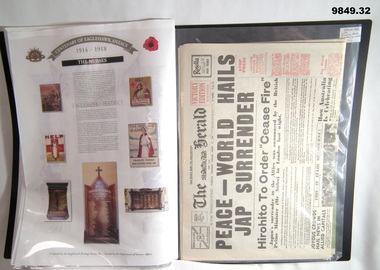
Memorabilia - POSTERS, NEWSPAPER ARTICLES, WW1, Eaglehawk Heritage Society, 1.-30. 2014, - 31. - 32. 1995
... Family. 11. Harry Fletcher. 12. Flett Brothers. 13. Gee Brothers. 14. Howe Brothers. 15. David J.V. Jamieson. 16. Norman V. Long. 17. William J. May. 18. McClelland...Family. 11. Harry Fletcher. 12. Flett Brothers. 13. Gee Brothers. 14. Howe Brothers. 15. David J.V. Jamieson. 16. Norman V. Long. 17. William J. May. 18. McClelland ...Posters are copies of a framed collection from the Eaglehawk Heritage Society Inc. Refer Cat No. 5155 for first item in that collection.1. to 30 Posters. 31. & 32. Newspapers. 1. to 30. Posters - white colour paper. Printed in colour using memorabilia of WW1 soldiers and their lives. 1. Bellesini Brothers. 2. Bice Brothers. 3. John James Bray. 4. Cairns Brothers. 5. Roy E.G. Calvery. 6. David M. Davies. 7. Arthur E. Dower. 8. George Eddy. 9. Elliott Brothers. 10. Fletcher Family. 11. Harry Fletcher. 12. Flett Brothers. 13. Gee Brothers. 14. Howe Brothers. 15. David J.V. Jamieson. 16. Norman V. Long. 17. William J. May. 18. McClelland Brothers. 19. Robert R. Metcalf. 20. Moyle Family. 21. Francis N. Moyle. 22. Frederick Sheldon. 23. George T. Speedy, Charles E. Speedy. 24. William J. Symons V.C. 25. John E. Wood. 26. Leslie W. Miller. 27. William N. Ruddick, Frederick W.L. Knuckey. 28. John T. Taylor, Alfred A. Priest. 29. Frederick D. Trewarne, Edward J. Siler, 30. The Nurses. 31. & 32. Newspapers - off white paper. Black and colour print. 31. The Herald Victory Edition Souvenir, 50 Years of Freedom 1995. 32. Victory. A Bendigo Advertiser Special Supplement, Tuesday, August 15, 1995. Items stored in "20 pocket A.3 Clear Display Book". Black colour folder cover with clear plastic pockets.memorabilia, posters, newspapers, anzacs -
 Eltham District Historical Society Inc
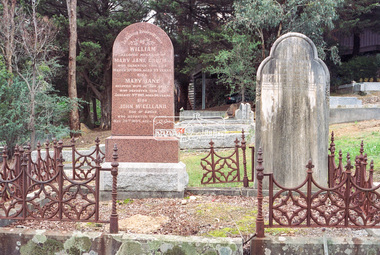
Negative - Photograph, Harry Gilham, Graves of William J and Mary Jane (nee Vance) Crozier and their sons Thomas Vance and John McClelland Crozier, Eltham Cemetery, Victoria, 1 Aug 2007
... McClelland (1851 Eltham), Eliza (1855 Eltham), William (1857 Eltham), Jane(1859 Yarraville), Charlotte Amelia (1861 Yarraville), and Thomas Vance (1864 Eltham). The Crozier farm prospered and in 1870, William applied for, and was granted a leasehold on an additional sixty-three-acre selection, half-a-mile east of his twenty-four-acre Mt Pleasant Road property. Upon this property he built a two-roomed dwelling of slats and bark and a storeroom of log and bark, ten feet square. In 1880 he applied for a Crown grant of the property. Tragedy struck the family...McClelland (1851 Eltham), Eliza (1855 Eltham), William (1857 Eltham), Jane(1859 Yarraville), Charlotte Amelia (1861 Yarraville), and Thomas Vance (1864 Eltham). The Crozier farm prospered and in 1870, William applied for, and was granted a leasehold on an additional sixty-three-acre selection, half-a-mile east of his twenty-four-acre Mt Pleasant Road property. Upon this property he built a two-roomed dwelling of slats and bark and a storeroom of log and bark, ten feet square. In 1880 he applied for a Crown grant of the property. Tragedy struck the family ...William Crozier was born 1823 in County Armagh, Ireland. Mary Jane Vance was born 1829 in Desecrete, County Tyrone, Ireland. They were married in 1848. On New Year's Eve, 1849, together with their baby daughter Sarah, William and Mary embarked from Plymouth aboard the Eliza Caroline, as assisted immigrants, for Port Phillip, arriving 31 March 1850 from where they journeyed out to Eltham on a bullock wagon. The Croziers were Episcopalians and soon after arriving in Eltham the Wesleyans of Little Eltham were holding services in the Crozier's home, among other locations. It was not until January 1856 that the Wesleyan church first acquired land in Henry Street for a chapel, which later became the home of the Eltham Hall. The Crozier home, known as ‘Belmont’ was weatherboard with a rammed earth floor. It was situated on twenty-four acres along the track at its rise, about half-a-mile east of Maria Street (Main Road) bounded by Mt Pleasant Road on the south and Pitt Street northwards. William Crozier used the land for cultivation and grazing. The track the Eltham Wesleyans took, by foot or horse, was along the Mt Pleasant Road, and like most roads of the time, a dusty trail in summer and a hoof and cart rutted quagmire in winter. William and Mary Crozier had seven children: Sarah, (1848 Ireland), John McClelland (1851 Eltham), Eliza (1855 Eltham), William (1857 Eltham), Jane(1859 Yarraville), Charlotte Amelia (1861 Yarraville), and Thomas Vance (1864 Eltham). The Crozier farm prospered and in 1870, William applied for, and was granted a leasehold on an additional sixty-three-acre selection, half-a-mile east of his twenty-four-acre Mt Pleasant Road property. Upon this property he built a two-roomed dwelling of slats and bark and a storeroom of log and bark, ten feet square. In 1880 he applied for a Crown grant of the property. Tragedy struck the family in 1882 when the youngest, Thomas Vance at age 17 accompanied by John Anderson, went into "Hall's Dam" to bathe, neither of them being able to swim. On wading out together, Crozier suddenly slipped into a part about 10ft. deep, and sank, after rising only once. Anderson pluckily tried to save him, nearly losing his own life in the attempt, saving himself when sinking for the last time by seizing hold of a projecting root. The body was not recovered until two hours after, when Mr. Thomas Bell, a farmer in the locality, who was attracted to the spot, on hearing of the occurrence, although unable to swim, plunged in with a rope around his waist, and succeeded with some difficulty in bringing it to the surface. Their eldest son, John also died prematurely at age 42 when he was killed by a falling tree branch whilst engaged in ring-barking trees at Eltham. A still cold wind was blowing and John, and others who were working with him, sheltered themselves at lunch time by sitting on the side of a large tree. When thus seated, the wind detached a limb of the tree which sheltered them, and though they heard the cracking, they had not time to get clear before the limb fell. It struck John on the head, and felled him to the ground, He appeared to be suffering severe pain, and two of his companions conveyed him to the Melbourne Hospital, where during the night he was operated upon for a fracture of the skull. Despite the operation being successful, John ultimately succumbed to his injuries the following afternoon. In good times William was known for his wealth of reminiscences of the early days of the district however his health failed him for several years until his death in March 1909. He was a man of very industrious habits, of a retiring disposition and much esteemed by those who knew him best. Mary died in January 1915 after a long illness. They are buried together along with their sons John and Thomas in the Eltham Cemetery. In Loving Remembrance William Beloved husband of Mary Jane Crozier Who departed this life March 31st 1909, aged 85 years Also Mary Jane Beloved wife of the above Who departed this life January 3rd 1915, aged 86 years Also John McCelland Son of the above Who departed this life May 20th 1894, aged 42 years also Sacred Memory of Thomas Vance Dearly beloved son of William J. Crozier Who departed this life at Eltham, February 3rd 1882 Aged 17 yearseltham cemetery, gravestones, memorials, film - kodak gold gc 400-9, john mccelland crozier, mary jane crozier (nee vance), scan - 35mm negative, thomas vance crozier, william crozier, william j crozier -
 Eltham District Historical Society Inc
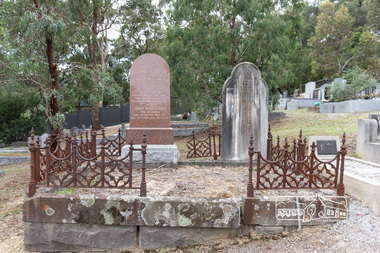
Photograph, Peter Pidgeon, Graves of William J and Mary Jane (nee Vance) Crozier and their sons Thomas Vance and John McClelland Crozier, Eltham Cemetery, Victoria, 5 April 2021
... McClelland (1851 Eltham), Eliza (1855 Eltham), William (1857 Eltham), Jane(1859 Yarraville), Charlotte Amelia (1861 Yarraville), and Thomas Vance (1864 Eltham). The Crozier farm prospered and in 1870, William applied for, and was granted a leasehold on an additional sixty-three-acre selection, half-a-mile east of his twenty-four-acre Mt Pleasant Road property. Upon this property he built a two-roomed dwelling of slats and bark and a storeroom of log and bark, ten feet square. In 1880 he applied for a Crown grant of the property. Tragedy struck the family...McClelland (1851 Eltham), Eliza (1855 Eltham), William (1857 Eltham), Jane(1859 Yarraville), Charlotte Amelia (1861 Yarraville), and Thomas Vance (1864 Eltham). The Crozier farm prospered and in 1870, William applied for, and was granted a leasehold on an additional sixty-three-acre selection, half-a-mile east of his twenty-four-acre Mt Pleasant Road property. Upon this property he built a two-roomed dwelling of slats and bark and a storeroom of log and bark, ten feet square. In 1880 he applied for a Crown grant of the property. Tragedy struck the family ...William Crozier was born 1823 in County Armagh, Ireland. Mary Jane Vance was born 1829 in Desecrete, County Tyrone, Ireland. They were married in 1848. On New Year's Eve, 1849, together with their baby daughter Sarah, William and Mary embarked from Plymouth aboard the Eliza Caroline, as assisted immigrants, for Port Phillip, arriving 31 March 1850 from where they journeyed out to Eltham on a bullock wagon. The Croziers were Episcopalians and soon after arriving in Eltham the Wesleyans of Little Eltham were holding services in the Crozier's home, among other locations. It was not until January 1856 that the Wesleyan church first acquired land in Henry Street for a chapel, which later became the home of the Eltham Hall. The Crozier home, known as ‘Belmont’ was weatherboard with a rammed earth floor. It was situated on twenty-four acres along the track at its rise, about half-a-mile east of Maria Street (Main Road) bounded by Mt Pleasant Road on the south and Pitt Street northwards. William Crozier used the land for cultivation and grazing. The track the Eltham Wesleyans took, by foot or horse, was along the Mt Pleasant Road, and like most roads of the time, a dusty trail in summer and a hoof and cart rutted quagmire in winter. William and Mary Crozier had seven children: Sarah, (1848 Ireland), John McClelland (1851 Eltham), Eliza (1855 Eltham), William (1857 Eltham), Jane(1859 Yarraville), Charlotte Amelia (1861 Yarraville), and Thomas Vance (1864 Eltham). The Crozier farm prospered and in 1870, William applied for, and was granted a leasehold on an additional sixty-three-acre selection, half-a-mile east of his twenty-four-acre Mt Pleasant Road property. Upon this property he built a two-roomed dwelling of slats and bark and a storeroom of log and bark, ten feet square. In 1880 he applied for a Crown grant of the property. Tragedy struck the family in 1882 when the youngest, Thomas Vance at age 17 accompanied by John Anderson, went into "Hall's Dam" to bathe, neither of them being able to swim. On wading out together, Crozier suddenly slipped into a part about 10ft. deep, and sank, after rising only once. Anderson pluckily tried to save him, nearly losing his own life in the attempt, saving himself when sinking for the last time by seizing hold of a projecting root. The body was not recovered until two hours after, when Mr. Thomas Bell, a farmer in the locality, who was attracted to the spot, on hearing of the occurrence, although unable to swim, plunged in with a rope around his waist, and succeeded with some difficulty in bringing it to the surface. Their eldest son, John also died prematurely at age 42 when he was killed by a falling tree branch whilst engaged in ring-barking trees at Eltham. A still cold wind was blowing and John, and others who were working with him, sheltered themselves at lunch time by sitting on the side of a large tree. When thus seated, the wind detached a limb of the tree which sheltered them, and though they heard the cracking, they had not time to get clear before the limb fell. It struck John on the head, and felled him to the ground, He appeared to be suffering severe pain, and two of his companions conveyed him to the Melbourne Hospital, where during the night he was operated upon for a fracture of the skull. Despite the operation being successful, John ultimately succumbed to his injuries the following afternoon. In good times William was known for his wealth of reminiscences of the early days of the district however his health failed him for several years until his death in March 1909. He was a man of very industrious habits, of a retiring disposition and much esteemed by those who knew him best. Mary died in January 1915 after a long illness. They are buried together along with their sons John and Thomas in the Eltham Cemetery. In Loving Remembrance William Beloved husband of Mary Jane Crozier Who departed this life March 31st 1909, aged 85 years Also Mary Jane Beloved wife of the above Who departed this life January 3rd 1915, aged 86 years Also John McCelland Son of the above Who departed this life May 20th 1894, aged 42 years also Sacred Memory of Thomas Vance Dearly beloved son of William J. Crozier Who departed this life at Eltham, February 3rd 1882 Aged 17 yearsBorn Digitaleltham cemetery, gravestones, john mccelland crozier, mary jane crozier (nee vance), thomas vance crozier, william j crozier -
Glen Eira Historical Society
Document - Lees Family
... Family... Pioneers... Market Gardens... McKinnon... Bentleigh... Lees Jack Allan... Briggs Vera Victoria... Lees James Henry... Tobin Linda Doris... McClelland...Lees Family Pioneers Market Gardens McKinnon Bentleigh Lees Jack Allan Briggs Vera Victoria Lees James Henry Tobin Linda Doris McClelland Vera Auraria Lees Leonard William Rigby Jan Lees James Lees William Bentleigh Jasper Road Centre Road Harwood J. ...A seven page reprinted article by Jan Rigby, on the Lees Family, who were early pioneers, and pioneer market gardeners in McKinnon and Bentleigh 1850-2003. Includes footnotes and references author Jan Rigby used for her research.lees family, pioneers, market gardens, mckinnon, bentleigh, lees jack allan, briggs vera victoria, lees james henry, tobin linda doris, mcclelland vera auraria, lees leonard william, rigby jan, lees james, lees william, bentleigh, jasper road, centre road, harwood j., branbury thomas, mckinnon road, wheatley road, mckinnon railway, east bentleigh, convicts, crop production, farmers, vineyards, viticulture, bent james, mckinnon road, elster creek, hellins edward, inns, gardeners arms, brighton cemetery, cemeteries, guerin mary, quirk michael, quirk patrick, quirk catherine, quirk daniel, quirk edward, quirk daniel snr., lees mary, slab huts, lees joseph, lees joe, east bentleigh school, primary schools, ring catherine, ring kate, stables, lees bill, lees tom, lees james henry, lees jim, ormond state school, wagons, cruickshanks nursery, nurseries, church of christ, ormond, carlton street, lees street, ring charles, rout charlotte, horse racing, lees george, lees stan, crop production, nicholson street, lees street, cowie william, lees leonard william, lees len, lees vera, lees linda doris, lees jack allen, lees vera victoria, mckinnon cricket club, sporting clubs, bentleigh club, masonic lodge, thomas street, edwards george, nurserymen, chinese community, market gardeners, j.h. lee and sons, lee floss, lees iris, centre road, bent thomas -
 Kiewa Valley Historical Society
Photographs – Old Tawonga District General Hospital Mt Beauty. Set of 19 colour photographs
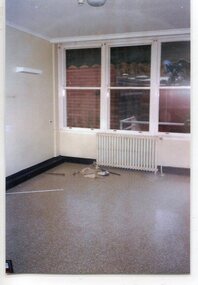
... family 1. No markings 2. G Ryder at front entrance 3. Sister G Ryder in the Resuscitation Room 4. Nurse D Hateley in the Kitchen 5. Nurse D Hateley in the Casualty Room 6. Sister W McClelland ...In the early stages of the Kiewa Hydro-Electric Scheme the State Electricity Commission took over the financial and construction responsibility of the Tawonga District General Hospital building at a cost of 27,000 pounds. This included the removal and re-erection of the ex-military Bonegilla ward from Wodonga while in addition they carried out all the necessary building works that allowed the hospital to operate as a functional unit. The work was completed and handed over to the Hospital Committee of Management on September 1, 1949. Local residents raised 3,400 pounds through fund raising. The balance was met by the SEC and the Hospital and Charities Commission. The initial project was to provide for a basic temporary hospital which was later to include an Operating Theatre, Offices, Store, Mortuary and a Nurse’s Home, until the establishment of a permanent medical premises. Following the opening, 455 patients were admitted to the Tawonga District General Hospital and 254 operations were performed in the first year. The hospital relocated to Mount Beauty in the former SEC administration offices located in the town centre. Official opening of the 18 bed Tawonga District General Hospital was on April 29 in 1961. The old weatherboard building was demolished around the late 1900’s to early 2000’s and replaced with a new modern brick building. Alpine Health CEO Mr Lyndon Seys oversaw the opening of the new Mount Beauty Hospital in November 2001 alongside Board of Management President Mr Andrew Randell, other board members and politicians. The Kiewa Hydro-Electric Scheme the State Electricity Commission played a pivotal part in the planning and initial funding of the Tawonga District General Hospital, with a view to providing medical support for its many workers on the Hydro scheme. Later, spouse and family members of workers were also able to access medical assistance The hospital was originally located in Tawonga away from the majority of the patients as the Hospital and Charities. Many SEC workers and their families have received medical care at Tawonga District General Hospital and Alpine Health over the years. A number of family members of SECV workers as well as other dedicated staff have provided high quality medical attention and support in all the facilities as nursing staff, support staff and volunteers. Many past staff members and their families still remain living in the Kiewa Valley area 19 Colour photographs of the Tawonga and District Hospital situated in Mt Beauty circa 2000. Including photographs of interior and of some staff members1. No markings 2. G Ryder at front entrance 3. Sister G Ryder in the Resuscitation Room 4. Nurse D Hateley in the Kitchen 5. Nurse D Hateley in the Casualty Room 6. Sister W McClelland in new nurse’s station 7. R Forrest, G Ryder, ?, M Ranton 8. Nurse D Hateley in the Pan Room 9. Tawonga District General Hospital: Resuscitation Room 10. Hospital Hallway 11. Empty Nurses Station 12. Tawonga District General Hospital: Nursery 13. Patient Tea Room 14, 15, 16, 17, & 18. No marking mt beauty district hospital, tawonga district hospital, bonegilla ward, ryder family -
 Vision Australia
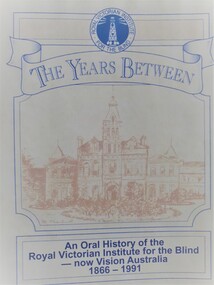
Audio - Sound recording, The Years Between: an oral history of the Royal Victorian Institute for the Blind 1866-1991, c2006
... McClelland John Murphy Harry Worland Dorothy Hamilton Hugh Jeffrey Violet Arnett Ian Cooper Harry Finlayson Elaine Leahy Joan Neich Reuban Ryan Neville Kerr E.E. (Ted) Petersen Neil Westh Norman Rees Charlie Bradley Ethel Sutcliffe Esme Dunnell Margaret Fialides Carol Baxter Ben Quin Graeme McGowan Margaret Bull Jim Smith Dick Sutcliffe Ray Smart George Findlay Edward (Ted) Hanlon David Blyth Martin Stewart Len Stevens Oral history Many thanks to Alan Nuske, Betty Vinters, Jon Lock, Ross Johnstone, Simon von Saldern, Leo Hartman, Elaine Leahy, Mary Adams, Ben Quin, Kasia Graphics, Art Attack, June Treadwell, Jamie Kelly, Neville Kerr, Dorothy Hamilton, family and friends of Alan Nuske, Pam McAleese and Julie Brain. 153 MP3 audio recordings comprising a file for each section of the book The Years Between: an oral history of the Royal Victorian Institute for the Blind 1866-1991 Audio Sound recording ...'The Years Between' is an oral history of RVIB 1866 - 1991. It was put together by Allan Nuske and Jamie Kelly and consists of narration and excerpts of oral histories from past staff/students. Through historical data and personal recollections, former students tell the story of how the institution developed under the changing approaches of teachers and other staff, the need to keep fundraising, being shipped to Olinda during the war, 153 MP3 audio recordings comprising a file for each section of the bookMany thanks to Alan Nuske, Betty Vinters, Jon Lock, Ross Johnstone, Simon von Saldern, Leo Hartman, Elaine Leahy, Mary Adams, Ben Quin, Kasia Graphics, Art Attack, June Treadwell, Jamie Kelly, Neville Kerr, Dorothy Hamilton, family and friends of Alan Nuske, Pam McAleese and Julie Brain.royal victorian institute for the blind, allan nuske, jamie kelly, alice mcclelland, john murphy, harry worland, dorothy hamilton, hugh jeffrey, violet arnett, ian cooper, harry finlayson, elaine leahy, joan neich, reuban ryan, neville kerr, e.e. (ted) petersen, neil westh, norman rees, charlie bradley, ethel sutcliffe, esme dunnell, margaret fialides, carol baxter, ben quin, graeme mcgowan, margaret bull, jim smith, dick sutcliffe, ray smart, george findlay, edward (ted) hanlon, david blyth, martin stewart, len stevens, oral history
